Native Fashion on the PEM Runway


When Karen Kramer, Peabody Essex Museum’s Curator of Native American and Oceanic Art and Culture, went to Santa Fe’s annual Indian Market, a traditional Native American juried show, she sensed there was a new, exciting movement afoot. It was edgier, unexpected and non-ceremonial.


Instead of the usual fare of beadwork, basketry and textiles, she noticed a new trend in contemporary Native American art, especially around fashion. “What I was seeing was fresh, relevant and a little bit sexy,” she said. “Native American designers were updating traditional ideas and making them their own.”


She wanted to curate an exhibit to showcase these innovative, pioneering Native fashion designers whose high-energy works break traditional boundaries with materials and invention that go far beyond the stereotypic buckskin, feathers, beads and fringe. “Contemporary Native fashion designers are dismantling and upending familiar motifs, adopting new forms of expression and materials, and sharing their vision of Native culture and design with a global audience,” Kramer said.


Kramer’s dream is now a reality with her curated show, “Native Fashion Now”, at PEM through March 6. Over two years in the planning, it is the first full-scale exhibit to chronicle the contemporary Native American fashion movement over the past 60 years. The show features over 70 artists and after debuting at PEM, will travel for two years to Oregon, Oklahoma and the Smithsonian’s National Museum of the American Indian in New York City.


One of the most unusual aspects of “Native Fashion Now” is the fact that of the 74 artists exhibited, 71, or 95 percent, are living.


PEM1

Orlando Dugi (Dine Navajo). Photo by Shelley A. Sackett


With over 100 garments, shoes, pocketbooks, jewelry, scarves and accessories displayed on 40 mannequins, the exhibit feels like a Native American “Project Runway”- which, in a way, it is. Fans of the television show may recognize the white leather sheath dress that greets visitors on their arrival inside the exhibit. It is the one designed by Patricia Michaels, the Taos Pueblo artist who was the first Native American contestant on the reality TV hit show in 2013. The judges loved the dress, which Michaels hand painted with an abstract New York skyline.


Michaels is delighted that mainstream fashion lovers are embracing Native American design. “We don’t have to be stuck in this gunny sack look anymore,” she said with a smile. Kramer said that the groundbreaking Michaels’ work was the most fitting way to kick off the exhibition, and commissioned her to design the cascading parasols that lead up to the show’s entrance.


The exhibition’s four galleries — Pathbreakers, Revisitors, Activators and Provocateurs — reflect how designers respond to ideas and trends in the world of Native fashion. All take us to similar places, far away from buckskin and fringe, especially Provacateurs, whose departure from convention makes works that are experimental and one-of-a-kind.


Lloyd “Kiva” New, the Cherokee designer and first true “Pathbreaker”, blazed a trail with his delicate shirtwaist dresses. Their display pays homage to the designer’s 1950s creation of his high-fashion brand, the first Native American to do so. Their timeless style is just as fresh today.


Activators, who embrace an everyday, personal style that engages with today’s trends and politics, are represented in the third gallery by street wear, skates and a pop culture liveliness. Navajo Jared Yazzie’s bold T-shirt with “Native Americans Discovered Columbus” emblazoned on its front turns the familiar saying on its head by encouraging people to think about the truths of history.


NFN-012 (1)

Pat Pruitt (Laguna Pueblo) and Chris Pruitt (Laguna Pueblo/Chiricahua Apache). Belt buckle, 2012. Stainless steel, silver,Teflon, turquoise, and coral. © 2015 Peabody Essex Museum. Photography by Walter Silver.


Jeweler and metal smith Pat Pruitt, a member of the Laguna Pueblo, was trained as a mechanical engineer and worked in the body piercing industry before starting to make jewelry in the 1990s. His use of non-precious metals, like titanium, zirconium and stainless steel, creates pieces that are radically different from the traditional Native turquoise and silver jewelry.

IMG_4082

Jewelers Kristen Dorsey (Chicksaw) and Pat Pruitt (Pueblo) at the PEM “Native Fashion Now” opening.


Pruitt told the story (repeated by most of the artists who were present at the show’s press opening) about how his creations were not allowed into Native American art shows because they were “not Native enough.” He praised Kramer’s vision in creating the opportunity to showcase the individuality of the Native designer in the context of their tribal identity. “The Native art world wants me to fit in with their stereotype,” he said, pausing. “But individuality and self expression is part of our tradition.


NFN-018 (1)
Jamie Okuma (Luiseño/Shoshone-Bannock). Boots, 2013–14. Glass beads on boots designed by Christian Louboutin. Museum commission with support from Katrina Carye, John Curuby, Dan Elias and Karen Keane, Cynthia Gardner, Merry Glosband, and Steve and Ellen Hoffman, 2014.44.1AB. © 2015 Peabody Essex Museum. Photography by Walter Silver.


Although Shoshone-Bannock Jamie Okuma’s beaded boots, commissioned for the exhibition, are riveting in their intricacy and beauty, they are not focus of the “Revisitors” gallery, named for the artists’ fresh, new and expanded take on tradition. Rather, it is the two pieces by non-Native designers — Ralph Lauren and Isaac Mizrahi — Kramer included in order to spark conversation about cultural appropriation and borrowing that draw the audience’s attention.


“It’s a complex topic,” Kramer said, noting that some mainstreamers feel that certain Native American cultural icons should be off limits to non-Native designers. For example, Mizrahi’s flannel gown, embroidered as the totem pole that honors North West Native families, could be viewed as offensive by traditionalists. On the other hand, his use of a sacred Native icon could be viewed as mainstream fashion’s acceptance of Native American design, using new materials to update a traditional idea and create something entirely new. “It’s meant to open a dialogue,” Kramer explained, clearly delighted that her inclusion of the piece in the exhibit had already done just that.


While the dynamic and lively exhibit shines a light on what Kramer has called a “Native American fashion renaissance”, the real spotlight is on the individuality of these contemporary designers’ inspirations as they reference their tradition while transcending culture and stereotyping. “We can choose whether we present our culture in our art and what that art means to us,” said Pruitt. “PEM is a museum that recognizes individuality. They get it,” added Michaels.


Pictured at top:

Orlando Dugi (Diné [Navajo]). Cape, dress, and headdress from “Desert Heat” Collection, 2012. Paint, silk, organza, feathers,beads, and 24k gold; feathers; porcupine quills and feathers. Courtesy of the designer, Sante Fe. Hair and makeup: DinaDeVore. Model: Julia Foster. Photography by Unék Francis.

Native Fashion Now runs through March 6 at the Peabody Essex Museum, 161 Essex St., Salem. For more information, visit pem.org.


“Strandbeests” on the Loose at PEM’s Groundbreaking New Exhibit

By Shelley A. Sackett / salem@wickedlocal.com

Americus Umericus, Scheveningen beach, Netherlands (2009). Courtesy of Theo Jansen. Photo by Loek van der Klis.

SALEM

When the Peabody Essex Museum’s Trevor Smith encountered Dutch artist Theo Jansen’s jaw-dropping Strandbeests (“beach animals”), he knew he had to bring them to PEM. Like most people, Smith first saw them on the Internet, “walking” sideways on Scheveningen Beach in The Hague. He was hooked on the spot.

“I wanted to show what makes perpetual motion possible and that there is great inspiration in the world,” Smith said. “We all have ideas; we all have creativity. Theo is the poster child for Present Tense Initiative. He is the personification of the blending of the arts.”

The PEM’s Present Tense Initiative, curated by Smith, celebrates the central role that creative expression plays in shaping the world today, and pushes the boundaries of what a museum experience can be.

Four years in the making, “Strandbeest: The Dream Machines of Theo Jansen” opens on Saturday, Sept. 19 and is the first large-scale presentation of Jansen’s Strandbeests in the U.S. With its multi-sensory approach that invites touching and playing, it is a must-see exhibit for all ages.

“I wanted an exhibit that would be hands on and contemplative with zones of the intellectual and experiential, which I hope will translate to our audience,” said Smith. With multi-media displays, large-scale kinetic sculptures, artist sketches, immersive video and photography by Lena Herzog, the Russian photographer who spent more than seven years documenting the Strandbeests’ evolution, Smith’s goal is exceeded.

Trevor Smith (left), PEM Curator of the Present Tense, and Theo Jansen, creator of Strandbeests. (Shelley A. Sackett)

Trevor Smith (left), PEM Curator of the Present Tense, and Theo Jansen, creator of Strandbeests. (Shelley A. Sackett)

Jansen defies pigeonholing. He is a magician, a physicist, an artist, an engineer, a philosopher, a theologian, and a choreographer, and he calls on all these personae to create his kinetic universe where pistons, crankshafts and complex leg systems transform inert plastic tubing into living beings that dance at the ocean’s edge.

Using lightweight PVC, which is common in Dutch households, and zip ties, Jansen has invented a new species that he describes as “migration animals that have a lot of patience.” Visitors marvel and empathize with these fragile, skeletal creatures that capture imaginations and pull at heartstrings.

Twenty-five years ago, Jansen, wearing his physicist’s hat, set out to design a machine that could pile sand onto the Dutch eroding coastline. The utilitarian project was meant to take one year. Instead, his Strandbeests hit a very deep chord in Jansen’s psyche, reminding him of the origins of life and inspiring him to create an entire new species, complete with life cycles, evolutionary adaptations, fossil records and, despite their Star Wars appearance, deep roots in reality.

The author with one of the many hands-on exhibits (John Andrews/Social Palates (socialpalatesphotography.com)

The author with one of the many hands-on exhibits (John Andrews/Social Palates (socialpalatesphotography.com)

“I dreamed that I would give a new specimen to the world,” Jansen told members of the press at a preview of his exhibit. Normally, evolution takes millions of years to occur, but Jansen recently decided to share the genetic algorithm (the Strandbeest’s DNA, which he refers to as his “holy numbers”) that he created on his Atari computer in order to speed up and enrich the process.

“Thousands of students have been making Strandbeests since I published the DNA on the website. That’s how Strandbeests reproduce and survive the wind; they are sitting on students’ shelves,” Jansen said with the seriousness of a biology professor. “These mutants that are created by students might reproduce faster than mine, discovering a solution to survival on the beach.” He estimates that over the next 20 years, the animals will evolve to a point where they can exist on their own.

When Jansen talks about his creatures, the line blurs between fantasy and reality, invention and nature. His Strandbeests are “like my children. You create them, you nurture them, and then you kick them out of the house to live their own lives,” he said with a hint of a smile. He has created a phylogenetic family tree and evolutionary periods with names like the Strap Period, the Hot Period and the Less Hot Period. If Theodor Seuss Geisel had been an engineer, he might have been team-teaching with Jansen.

At the end of the presentation, Jansen stood in front of one of his Strandbeests and in what was the evening’s greatest understatement said, “You can see that I’ve been working hard the last few years.”

Strandbeest: The Dream Machines of Theo Jansen opens Sept. 19 at the Peabody Essex Museum, 161 Essex St., Salem. The exhibit will run through Jan. 3, after which it will travel to the Chicago Cultural Center and San Francisco’s Exploratorium. For more information, visit pem.org/strandbeest.

PEM Thomas Hart Benton Exhibit a Dramatic Slice of Americana

“Hollywood” — The 1937-38 Life magazine commission is the centerpiece of the Peabody Essex Museum’s exciting new exhibit.

For Thomas Hart Benton, history was not a scholarly study, but a drama. The bold and ambitious artist was, at heart, a terrific storyteller who could connect his audience to characters. His medium was painting and his subject matter was anything identified with American culture, from Native Americans and the Wild West to the Jim Crow South to Hollywood and its glamorous movie industry. The not-to-be-missed new show at the Peabody Essex Museum in Salem takes a multi-media approach to a most remarkable artist’s work and life.

Benton (1889-1975) was born in Missouri where he served as a congressman before leaving to attend the Art Institute in Chicago, later moving to Paris to continue his studies. His first major mural series, “American Historical Epic,” retold America’s history through his uniquely satirical, provocative and serious eye. Although it was a commercial failure (he had painted it on spec), it established him as an artist capable of producing large public works.

Benton and Rita

“Self Portrait with Rita” — The self-portrait of Benton and his wife that made the coveted cover of Time magazine in 1934.

His self-portrait with his wife, Rita, landed Benton on the cover of Time magazine in 1934 and skyrocketed his career. The painting, which greets the visitor at the exhibit’s entrance, is quintessential Benton. The modeled figures pay homage to the Italian Renaissance masters, whose methods Benton adopted by making clay models and painting from them in his studio. The couple expresses the ultimate modern American identity: modern, outdoorsy, and dazzlingly stylish. Yet there is something aloof in their gazes and Benton’s faceless watch leaves the viewer wondering what might be amiss.

His provocative and gifted paintings (and the fact that he had adorned its rival’s cover) caught the eye of Life magazine editors, who commissioned him in 1937 to spend a month in Hollywood preparing for a “movie mural” which would be the centerfold of its issue about the glitzy new industry. The painting is the centerpiece of the PEM exhibit’s most entertaining section devoted to all things cinematic, including clips of movies (“Last of the Mohicans”, “America”, “Uncle Tom’s Cabin” and “The Big Trail”, and especially, “Grapes of Wrath”) for which Benton painted the official publicity poster.

His tongue-in-cheek approach to the industry and his amazing power of observation are a delight to behold. His attention to wacky details and ability to generate emotion while telling an engaging story create compelling images that border on caricature, much as the movies of that era did. Nonetheless, upon closer inspection of the captivating painting, it becomes clear that Benton was more interested in telling the stories of the ordinary people behind the scenes rather than those of the screen stars.

Within a single career, Benton embraced many styles and immersed himself in many genres, all on display in the informative and expertly staged exhibition. The modern mythmaker explored the macho, grotesque violence of World War II with a style akin to Marvel Comic superheroes and super villains. He also portrayed the innocence and optimism of the young American boys shipped overseas to confront those demons. His renditions of the plight and contributions of the “modern Negro” tell tales of slavery, romance and jazz.

Between 1946 and 1975 Benton completed nine more murals. He was in the midst of finishing his last commission for the Country Music Hall of Fame in Nashville when he died at age 85.

“American Epics: Thomas Hart Benton and Hollywood” runs through September 7.

Finding Hope Against Hope

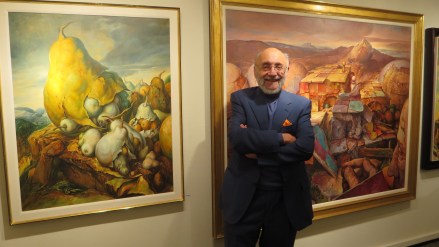
Samuel Bak’s new exhibit is a stunning collection of oil paintings in which the letters “H.O.P.E.” appear in various states of prominence and entirety, sometimes hidden amid bits and pieces of broken bottles and pottery, sometimes clearly visible. Bak’s complex, vibrant paintings address, in his words, “the problem we all share in searching for Hope when it is so difficult to find.” 

“Hope — how did I get there?” the child prodigy and Holocaust survivor rhetorically asked in his preface to the show’s catalog. If there are pictures worth a thousand words, he reasoned, “aren’t there words worth thousands of pictures?”

The show at the Pucker Gallery on Boston’s Newbury Street is as rich in allegory and metaphor as it is in color and texture. Huge fruit, mostly pears, appear in bewildering forms and situations. They are made of metal, stone and wood. They are blue, orange and red. They borrow their identity from cups and vases, shifting from the familiar to the unfamiliar. And yet, each remains unmistakably identifiable.

Bak first painted pears when he was preparing for a big show in Paris during the 1960’s. “I suddenly realized that the pear can be used for all kinds of things that bring different thoughts with them,” he said. For example, the pear brings to mind the female form. It also, according to Bak, can symbolize the limitation of human knowledge. “No one really knows what was the fruit of knowledge,” chuckled Bak, who admitted that, as a child, he disliked apples and that the pear was his favorite fruit.

IMG_3154

“I try to extract whatever I can from a single object,” he said, revealing that returning again and again to the same subject allows him to go deeper into a theme, like a composer whose improvisations create new works based on a single musical theme, such as Bach’s “30 Goldberg Variations.” “My imagination is not surreal; it is grounded in reality,” he added. 


An only child, Bak was born in 1933 to an educated, cultured middle-class family in Vilna. By age three, he was a recognized child prodigy painter. “At that age, I wanted to be a fireman or to sell candy, but little by little I got used to it,” he noted, adding he remembers loving painting and making his parents proud.


At seven years old, on the day after his first day of school, Bak and his family were deported to the Vilna Ghetto. At the age of nine, he had his first exhibition, inside the ghetto. When the Russians liberated Vilna, he and his mother were among its two hundred survivors from a pre-war community of between 70 and 80 thousand. They spent from 1945 until 1948 in German displaced person camps, immigrating to Israel in 1948. His second day of school was in Israel, at age 15. “That’s how it was. My times were not normal when I was young,” Bak said, shrugging.

He lived and worked in Tel Aviv, Paris, Rome and Lausanne, before settling in Weston in 1993. The Pucker Gallery had represented him since 1967, when an Israeli art dealer showed Bernie Pucker some of Bak’s work. “It is a kind of marriage,” Bak said, pointing out that such long relationships between artist and gallery are extremely rare.

Bak1

Under the Arches

Bak is keenly aware of the role the Holocaust has played in his choices of subjects and themes. His imagery reveals survival and suffering, reconstruction and destruction, hope and despair. His paintings are full of bits and pieces of broken objects that have been put back together in sometimes disturbing fashion. His choice of the theme “bits and pieces” is deliberate.

“After the Holocaust, despite the fact that each one of them was haunted by ghosts, the survivors put up an appearance of a certain normalcy, of something that was almost reconstructed but that was intrinsically broken inside,” Bak began.

He continued, “This became the very big subject of my paintings. It means to describe the reality of bringing up an old memory of something that cannot be completely repaired. My paintings are made out of bits and pieces, like the lives of these people.”


Although Bak has been compared to Elie Wiesel, the Holocaust survivor and Nobel Prize-winning author, he identifies more with writers like Primo Levi, the Italian survivor who wrote, “If This Is A Man” and “If Not Now, When”?

“For me, the Holocaust was more of a universal kind of experience. It was a laboratory of human behaviors that showed the extremes of the destructive powers of humans harming each other…For Elie, it is a more Jewish specific drama,” Bak explained, adding, “We speak of the human condition in very different terms. I speak of the terrible with a greater degree of irony and humor. He goes at it more directly.”

Besides, noted Bak, he speaks in images and Wiesel speaks in words. “I was told, ‘You are the Elie Wiesel of painting,’ but there is no such thing.”

PEM’s Calder Exhibit a Dance in Slow Motion

Peabody Essex Museum’s exclusive East Coast presentation of “Calder and Abstraction: From Avant-Garde to Iconic” is everything an art exhibit should be. It is welldesigned, sensually pleasing and intellectually stimulating. The 40 pieces by one of the most influential and innovative artists of the 20th century reinforce PEM’s commitment to American art and celebrate Alexander Calder’s contribution of single-handedly transforming what would be thereafter thought of as “sculpture.”

Visiting the show is like entering an elegant abstract landscape, one where shadows have mass and gravity is irrelevant. The theatrical, dancing mobiles, which Calder invented, and stabiles (grounded pieces that still move) activate time and space in a way that creates an atmosphere of performance. Background avantgarde music by such composers as John Cage adds to the multi­sensory experience.

Calder was raised in Pennsylvania and his family included accomplished sculptors. He travelled to Paris frequently during the 1920’s and 30’s, befriending such surrealist and abstract artists as Joan Miro, Jean Arp and Marcel Duchamp. When he saw Piet Mondrian’s paintings, which only used primary colors, Calder exclaimed, “I would like to do that, but I would like it to move.”

Trained as an engineer, Calder became fascinated by the challenge of liberating sculpture from its historical limitations. His goal was to take the static, hollow, pedestalled medium and reinvent it. “Just as one can compose colors or forms,” Calder said, “so one can compose motion.”

Calder started working with wire in 1930, and the gallery’s first pieces explore his development of mobiles, ethereal works that create lines in space and, thanks to the superb lighting design, moving shadows. Many of the works, such as a trilogy of mobiles mounted in front of colored panels, are owned by the Calder Foundation N.Y. and are rarely exhibited.

“Little Face” is a choreographer’s delight, untethered parts creating a cohesive whole. Calder’s engineering genius is evident in his knowledge of the precise weight and density of each black piece that would counter the elements above and below.

From the magical, slow wake of the mobiles, one next explores his stabiles. Moving more slowly, subtly and quietly than the mobiles, their effect is one of benevolent creatures that happily invite the viewer to connect emotionally.

The exciting “Un effet du japonais” is like an anthropomorphic animal dance, its three legs stationary, its two arms poised, ready for the frenzy a puff of air would create. “Southern Cross,” displayed nearby, is a blend of mass and weightlessness, of movement and stillness. The effect is spell-binding, and prompted Albert Einstein to remark, “I wish I’d thought of that.”

Before his death, Calder also revolutionized monumental sculpture constructed for large outdoor spaces. La Grande Vitesse, a landmark in Grand Rapids, Michigan, marked the first time the public embraced abstract sculpture.

Pictured at top: 2014 Calder Foundation, New York/Art Resource Un effet du japonais (1941)

Honky Tonk on Parade

There should be a jukebox tucked in the corner of Endicott College’s Manninen Center for the Arts Heftler Visiting Artist Gallery, one loaded with songs by the country music favorites whose portraits adorn the compact gallery’s walls. Dolly Parton, Bill Monroe, Loretta Lynn, Waylon Jennings and Doc Watson are all there, looking young and fresh and ready to break into toothy, foottapping song. “Honky Tonk: Portraits of Country Music” is a collection of 27 black and white photographs taken between 1968 and 2010 by Henry Hornstein, a 67-yearold New Bedford native who teaches photography and illustration at Rhode Island School of Design. His photos document the changing world of country music and its fans, and reflect his deep love for the music, its performers and its unique venues.

Horenstein describes how a Jewish kid growing up in New Bedford developed an interest in country music in the exhibition notes. He started hanging out in the “kid friendly” Melody Shop, New Bedford’s only music store, at age eight. He met folk singer Paul Clayton there, who recommended he buy “Johnny Cash Sings Hank Williams.” It was Horenstein’s first LP and he still plays that record.

When his parents moved to Boston during his high school years, he essentially took up residence at Cambridge’s legendary Club 47, hearing many different performers playing many different genres. His interest in photography blossomed as a junior history major at University of Chicago. Heeding the advice of his teacher, Harry Callahan, to “photograph people and places to which I was naturally drawn,” he took pictures in Nashville and Texas, in smoke-filled bars and hillbilly ranches during the 1970’s.

All along, he knew he wanted to preserve on film what he saw as a disappearing world of lesser honky tonks and country music parks. In 2012, he published “Honky Tonk: Portraits of Country Music,” a sumptuous collection of 120 black and white photographs he shot from 1972 through 2011, many of which are part of the Manninen exhibit.

HonkyTonk2
Waylon Jennings, Performance Center, Cambridge, 1976


What is most surprising is how well represented New England, and especially Massachusetts, is. There is Don Stover, a banjo picker from West Virginia, who came to Boston in 1952 and settled in Billerica. A 26-year-old Dolly Parton, looking like the poster child for the song, “Honky Tonk Angel,” posed in front of Symphony Hall before her debut concert there in 1972. Doc Watson, the North Carolina blind guitarist and singer who performed until his death at 89 in 2012, was memorialized at Cambridge’s Performance Center in 1974, as was the hard-living Waylon Jennings in 1976.

The Hillbilly Ranch in Boston was a favorite of Horenstein’s, and he photographed Tex Ritter there, as well as the regular patrons. Jerry Lee Lewis, at an old Baldwin piano, nonchalantly lights up a cigar at Boston’s Ramada Inn in 1976.

“A lot of people assume that country music is a Southern thing,” Horenstein wrote. “It isn’t. It’s everywhere.”

Honky Tonk” will be at Endicott College Manninen Center for the Arts through October 17. For directions and hours, go to endicott.edu/centerforthearts.

Pictured at top: Jerry Lee Lewis, Ramada Inn, Boston, 1976


52nd Street and All That Jazz

Billie Holiday’s unmistakably seductive voice singing “Fine and Mellow” lures the listener into Bowdoin College of Art’s second floor Shaw Ruddock Gallery. Stepping into the installation “On 52nd Street: The Jazz Photography of William P. Gottlieb” is like entering a time capsule into the 1940’s, when 52nd Street’s “Swing Alley” in New York City was the epicenter of jazz, and William P. Gottlieb (1917-2006) was its passionate chronicler.

The exhibit is a compact, deeply satisfying gem. The 40 vintage gelatin silver prints of jazz musicians in performance are accompanied by a continuous loop of nine classic songs from such masters as Louis Armstrong, Ella Fitzgerald, Coleman Hawkins and Lionel Hampton. Gottlieb’s photographs capture the artists’ personalities with all the intimacy that close-up pictures provide. The narratives beside each photograph include Gottlieb’s descriptions of what he felt, shooting in the dark, densely packed confines of those smoky, heady jazz clubs. They also describe some of the innovative techniques he had to invent so he could shoot without a flash. His ability to remain unobtrusive is evident in the unguarded portraits he produced.

Known as “Mr. Jazz,” Gottlieb was born in Brooklyn and began writing a jazz column for The Washington Post during his senior year at Lehigh University. When the Post decided it could not afford to pay a photographer to shoot photos for his column, Gottlieb bought his own press camera and began taking his own photographs. Over the course of his career, he took hundreds of pictures of jazz musicians, four of which were the basis for U.S. postage stamps and 250 of which found their way onto record album covers.

A skilled craftsman, Gottlieb’s photos embody a natural empathy for and attraction to his subjects. He captures the personalities of the jazz musicians in a subtle, anecdotal way. “In my photographs, I try to say something visually that augments the written review,” Gottlieb said. In his iconic 1947 photograph of Billie Holiday, he wanted to capture “the beauty of her face and the pain in her voice.” It remained one of his favorite pictures.

“The Street,” according to Gottlieb, “was heaven on earth for jazz fans and musicians.” Bowdoin College Museum of Art’s exhibit is a little piece of that heaven on earth, at least until September 14, 2014.


Pictured at top: Billie Holiday, 1946 Photos by William P. Gottlieb and courtesy of the Bowdoin College Museum of Art

Unjust Rule of Law: Jewish Lawyers Under the Reich

Throughout their long diaspora, Jews have flourished when treated fairly and allowed to compete. Such was the case in Germany with the creation of the German Empire in 1871. Suddenly, Jews enjoyed full citizenship rights. At the same time, they gained access to a previously unavailable livelihood when the practice of law was delinked from the civil service. A private, independent legal profession swiftly emerged, and with their tradition of Talmudic discussions and analysis, Jews quickly found a new niche.

Up until the 1920s, the number of Jewish lawyers increased continuously and included women in their ranks. Subsequent generations took over the private practices of their fathers or started their own. In the big cities, the share of Jewish lawyers was higher than in smaller towns with a court. In Berlin, for example, on January 1, 1933 more than half of the 3,400 lawyers were of Jewish origin.

However, they did not identify as Jewish lawyers: they were German, lawyers and Jews, in that order. Many of them had been soldiers during the First World War; others had renounced their Jewish faith and some had even been baptized. In the area of jurisprudence, they contributed to the development of renowned legal journals and to the establishment of professional organizations.

All that came to an abrupt halt with the rise of Hitler and the dissolution of the democratic state. Overnight, Jews were excluded from all areas of social life. In March 1933, a decree was issued which refused all Jewish judges, public prosecutors and lawyers entry to the courts starting the very next day.

Reich2
The public is advised “Don’t go to Jewish lawyers” in 1933 Munich.

From 1933 until 1938, the National Socialists chipped away at Jewish access to the law. Finally, in 1938 all except a very few were banned altogether from practicing their profession. Those few could only act as “legal consultants” for Jewish clients. Essentially, there were no more Jewish lawyers in Germany. The Nazis had achieved their goal of making the legal profession “entjudet” (free of Jews).

“Lawyers Without Rights: Jewish Lawyers in Germany Under the Third Reich” is a sparse, densely informative exhibit jointly sponsored by the German Federal Bar and the American Bar Association. Since the fall of 2012, it has toured all over the world. With the support of the Vilna Shul, it is on display in the John Joseph Moakley Courthouse lobby through September 30.

Most of the show’s panels are devoted to the stories of individuals who lost their livelihoods, and in many cases their lives, during those darkest of times. These intimate portraits, and the fragile accompanying photographs and documents, are the heart and soul of the exhibit.

Margarete Berent’s story is one of perseverence. The 1914 dissertation on family law that she wrote to complete her law studies actually served as the 1958 model for the legal reform of inheritance and property laws in the Federal Republic of Germany. Berent was unable to practice law until 1919, when women were first allowed to take the bar exam. By 1925, as the first Prussian female lawyer, she had a thriving practice in Berlin. By 1939, she had fled to Chile, and by 1940 she was living in New York as a housemaid and postal worker. Undaunted, she went to New York University Law School at night and began working as a lawyer again in 1950, at age 63.

If the exhibit sounds dry and factual, that’s because it is. There is little excitement generated by posters on easels and trifold office wall mounts. Excitement, however, is not the point; contemplation and solemnity are. We mourn anew the senseless loss of our fellow Jews and reflect about a time when a nation completely abandoned individual rights and the rule of law. To do so in the lobby of a United States courthouse is all the more moving.

It may be a coincidence that Berent’s easel stands beside an inlaid panel of Daniel Webster’s famous quote, “Justice is the great interest of man on Earth. It is the ligament which holds civilized nations together.” Then again, it may not.

Go to lawyerswithoutrights.com for more information.

Pictured at top: Jewish lawyer Dr. Michael Siegel was forced to march through Munich barefoot after complaining to the police. 

Unknown Jewish Artist’s Work Celebrated in Endicott Retrospective

If City University of New York art history professor Gail Levin had not stumbled upon the then unknown artist Theresa Bernstein in the course of her research on Edward Hopper in the 1980’s, she might be unknown still. Instead, Levin positioned her front and center in the noteworthy retrospective, “Theresa Bernstein: A Century in Art,” which opened last December in New York City. Luckily, one of the show’s four traveling stops is at Endicott College’s Walter Manninen Center for the Arts, where it will remain until July 11.

Self-Portrait

“Self Portrait” (1931)

Notwithstanding Levin’s curated exhibit and in-depth catalogue, Bernstein remains unknown, despite the fact that she exhibited in every decade of the twentieth century. Born in Cracow in 1890, she was raised in Philadelphia by educated and cultured Jewish immigrant parents. Her travels to Europe in 1905 and 1911 awakened a passion for modern art, and her paintings reflect her admiration of Manet, Matisse, Picasso and Cezanne. When her family relocated to New York City in 1912, she established a studio near Bryant Park and began painting in earnest, exhibiting alongside Edward Hopper in 1919.                   

The-Immigrants

“The Immigrants” (1923)

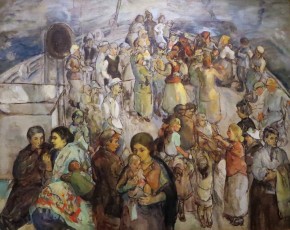
Although Bernstein pretended she was American-born, many of her paintings reflect her compassion for the trials her fellow immigrants faced. In “The Immigrants” (1923), for example, Bernstein emphasizes maternal tenderness in the foreground of the large oil painting. Set in the 1920’s, the immigrants she portrays are arriving in New York City aboard the Cunard R.M.S. “Aquitania.” At a time when the U.S. government was passing laws restricting immigration, Bernstein was concerned for the future of her fellow Jews who had been escaping Russian Empire persecution in large numbers since the 1890’s.

The-Milliners

“The Milliners” (1919)

Many of her paintings reflect Jewish subjects. “The Milliners” (1919) incorporates portraits of Bernstein’s mother, mother in- law, sisters-in-law and her housekeeper. With the exception of the housekeeper, all were Jewish immigrants, many of whom worked as hat makers in New York’s garment trades. “The Menorah” (1948) celebrates Israel’s birth in 1948 with its symbol of statehood. “The Cone Sisters” (1930) is an intimate portrait of Etta and Claribel Cone, daughters of German-Jewish immigrants. The wealthy Baltimore sisters, trailblazing patrons of modern artists, supported Picasso and Matisse.

“The Cone Sisters” (1930)

Cone-SIstersBernstein married fellow painter William Meyerowitz, sharing 63 years of marriage and an Upper West Side studio. She outlived him by 23 years, dying just shy of her 112th birthday in 2002. Starting in 1916, the couple summered in Gloucester every year, members of a well-known colony of artists. Bernstein painted beach and other local scenes, and William often played chess with their neighbors. “The Country Fair” (1917) is a loving, intimate snapshot of Bernstein’s connections to the seaport town that offered her a “cradle-like serenity” and the inspiration of authentic American crowds.

Bernstein’s most exciting paintings, however, are post-1929, the year she discovered jazz. Her style is freer, less chained to conventions of color, brush stroke and composition. The three paintings “Charlie Parker” (1953), “Cab Calloway-Minnie the Moocher” (1935)  (below left) and “Lil Hardin & Louis Armstrong” (1927)  (below right) are an almost surrealist triptych so full of life that that if you close your eyes, you can hear the music that inspired them.

Cab-CallowayLouis-Armstrong

In her “Credo,” Theresa Bernstein stated, “I believe that my work will be more appreciated and understood as it is more seen and studied, just as sound or a language becomes more coherent.” Her appearance at Endicott College in Beverly couldn’t be more fitting. The park-like setting of the Manninen Center for the Arts makes for a perfect summer outing, and the discovery of a new artist’s work is like a breath of sunny air. How often, after all, do we have the opportunity to view an artist and her work with truly fresh eyes, unclouded by preconceptions and judgments? Be sure to take this opportunity to do just that.

Pictured at top: “The Menorah” (1948)

endicott building

The park-like setting of Endicott College’s Walter J. Manninen Center for the Arts

All photos by Shelley A. Sackett

The exhibit is showing in the Manninen Center for the Arts at Endicott College, Beverly. Through July 11. For directions and hours, visit endicott.edu/Center-For-The-Arts.

For an in-depth interview with curator Gail Levin, read Regina Weinreich’s article at forward.com.

Read more: http://blogs.boston.forward.com/insights/184368/unknown-no-more-theresa-bernstein-retrospective-a/?#ixzz3ddXru9da

California Dreamin’ at Peabody Essex Museum

If ever there were a day to be California Dreamin’, it was a recent day when the sky was gray, the leaves were brown, and there was no doubt that it was warmer in L.A. Luckily, there was shelter from the gloom at the Peabody Essex Museum’s sleek and sunny new exhibit, “California Design 1930-1965: Living In A Modern Way.” 


Five years in the making, the exhibit asks the question, “What is the California way of life?” It answers it with 250 mid-century design objects broken into four themes: shaping, making, living and selling. These objects cover a lot of territory and commemorate the innovation, experimentation and freedom that characterized the golden era of the Golden State. The galleries are chockfull of items, from furnishings and architectural renderings of homes, to jewelry and toys. There is a shiny aluminum 1930’s Air Stream Clipper, and Esther Williams’s glittering gold lame swimsuit.

PEM-suit

Woman’s bathing suit, late 1950s. Gift of Esther Ginsberg and Linda Davis in honor of Jennifer Blake. Margit Fellegi Estate; Reproduced with permission of The Warnaco Group Inc. For Authentic Fitness Corp., Cole of California. MuseumAssociates/LACMA

Wandering the fashion and home decor sections, one feels like an intruder on the “Mad Men” set. In somewhat academic fashion, the exhibit explores the various historical influences that shaped and marketed the distinctive “California aesthetic.” Unprecedented population and economic explosions during the 1920’s and 1930’s insulated California from the suffering much of the rest of the country experienced after the Great Depression. Oil, agriculture and movie industries took seed and thrived. The vintage aerial views contrasting the 1922 and 1930 intersections of Wilshire and Fairfax Boulevards are visual proof.

After World War II, 850,000 GIs received California subsidized housing, looking for an indoor/outdoor lifestyle of warmth, surf and fun. Designers, including many avant-garde European immigrants who had fled Nazi persecution, heard of California’s reputation for encouraging professional originality and daring, and flocked there.

PEM-desk

Dan Johnson and Hayden Hall, Desk, 1947. LACMA, purchased with funds provided by The Buddy Taub Foundation, Dennis A. Roach and Jill Roach, Directors. 2011 Museum Associates/LACMA

Developments of new materials during the war (such as molded plywood, fiberglass and steel) and new commercial technologies after the war together created, for the first time, the ability to mass-produce goods. Moreover, the confluence of three conditions generated the perfect consumerist storm: enormous population growth, economic boom and postwar optimism. Add permanently sunny skies and spontaneous cultural combustion seemed inevitable.

The show’s open floor plan mirrors the California architects’ concepts of collapsed boundaries between rooms and fluidity of space. Strolling the show is like a scavenger hunt down memory lane. Charles and Ray Eames’ famous “Eames chair,” Barbie and Ken dolls, and the Polaroid Swinger camera are near a kidney-shaped pool and icons of the glamour of Hollywood (including Cedric Gibbons’ 1927 Oscar statue). Floor lamps with attitude, flatware with personality, and fashion with flair round out the offerings.

The overriding theme of the exhibit, however, is that the “California Dream” was meant to fulfill everyman’s dream of the modern, middle-class utopia.

“The goal was to provide well-designed, accessible and affordable modern homes and furnishings to millions of Californians, and those around the country who craved them,” said Austen Barron Bailly, PEM’s American Art curator. “The designers wanted to make everyday life comfortable and beautiful. Their motto was, ‘The best for the most for the least,’” she added.

The show’s 1930-1965 time bracket is deliberate. It starts at modern California’s birth, amidst 1930’s economic and cultural optimism, and winds down with 1965’s dawn of the counter-culture, political protest and individualism. In between, however, is a magical wonderland of color, charm and joie de vivre. Revel in its sheer joy and envy its giddy innocence of what the future holds.

Pictured at top: Raymond Loewy, Studebaker Avanti, 1964. Private Collection of Richard Vaux. Walter Silver/PEM