Pleasure and Pain: Not All Shoes Are Meant for Walking


If, as Mark Twain said, “Clothes makes the man”, then the Peabody Essex Museum’s newest exhibit is full throttle support for a complementary adage: “Shoes make the woman”.

“Shoes: Pleasure and Pain” showcases 300 pairs of shoes by more than 130 designers and artists that range from the sublime to the ridiculous, from the comfortable to the downright punishing. Although men’s shoes are represented with bling and panache, over 70% of the exhibit is devoted to women’s shoes.

With its recent acquisition of 20th– and 21st-century fashion, PEM has the largest shoe collection in the country. Over 100 are included in the exhibit, many of which have never been displayed before.

“We are in the process of building a fashion presence at PEM,” said Lynda Roscoe Hartigan, PEM’s James B. and Mary Lou Hawkes Deputy Director and coordinating curator for the exhibition. “There is a growing appetite for compelling exhibitions about fashion.”

Organized by the Victoria and Albert Museum, London, the PEM show marks its U.S. debut and will run through March 12, 2017.

Curated by themes, the five-section show (Transformation, Status, Seduction, Creation and Obsession) features shoes worn by high profile celebrities such as David Beckham, Elton John, Queen Elizabeth and Princess Diana. Among the artists and designers represented are Manolo Blahnik (of “Sex and the City” notoriety), Christian Louboutin (with his signature red soles), Christian Dior, Jimmy Choo and Prada. Combat boots and sneakers share center stage with stilettos and seductive boudoir mules.


11rogervivierchristiandior

Beaded evening shoes by Roger Vivier for Christian Dior, 1958-1960.


It is the pairing of designer and consumer that is at the heart of the exhibit. “Shoes are about the personal creativity of the designer and the person who wears that shoe. It’s a partnership between two people who likely never meet. Creation is about communication,” Hartigan said.

The shoes on display aren’t just meant to protect feet and promote locomotion. They are also projections of the mood, identity and status of the wearer. “Shoes are extensions of ourselves,” she added.

Blahnik’s Mondrian-inspired red and yellow “Tendona” shoes would be conversation-stoppers at any gathering as would Louboutin’s impossibly high-heeled “Anemone” design, with its red satin bursts and feathers. The shoes seem molded to fit a Barbie doll’s nonhuman foot, and in fact, Barbie does have her very own accessory line of three Louboutin designs.


Manolo Blahnik , 'Tendona' shoe, 2015. Leather. Courtesy of Manolo Blahnik

“Tedona” by Manolo Blahnik, 2015, made of leather and on loan from the designer..


These shoes aren’t meant for the average consumer (even Barbie’s version retails for $35). With starting prices of $700, they are associated with more than female sexuality and power. “High heels have always been worn by rich people of high society,” said Hartigan, noting that the Egyptians first developed platform shoes in 3500 B.C. so the wealthy could be seen as walking high off the ground.

Historians looking for more than the dazzle of sequins and crystals (yes, there is even a Swarovski Cinderella glass slipper) can linger among the lotus shoes made for bound feet, 16th century chopines and men’s shoes with noisy slap-soles that were worn in Europe in the 17th century.


chopines

Chopines by an artist in Venice, Italy, about 1600 made of punched leather and pine.


Fashionistas will delight in the chance to see Vivienne Westwood’s dramatically exaggerated lace-up blue platform heels that famously caused model Naomi Campbell to stumble on a Paris runway in 1993. A picture of Campbell good-naturedly laughing after her very public tumble is part of the display.


campbell

The Vivienne Westwood blue, platform-heeled “Super Elevated Gillie” shoes that caused Naomi Campbell’s infamous 1993 Paris catwalk show tumble.


The exhibit also has a distinctive local flavor, acknowledging New England’s importance as a shoe manufacturing center and featuring selections from the late Boston style maven Marilyn Riseman and noted North Shore collectors Jimmy Raye and Lillian Montalto Bohlen.

Turning momentarily serious, the section “Seduction” shines a spotlight on the often-blurred lines between objectification and celebration of women’s sexuality. Inspired by bondage and 18th century prostitution, mules and high heels have always represented both passion and exploitation.

Perhaps the most extreme example of this is “Fetish”, an unwearable pair of stilettos created by Louboutin in collaboration with film director David Lynch, whose signature style (“Blue Velvet”, “Twin Peaks”) is darkly twisted sensuality. The only way one can wear these shoes is by crawling. A picture of a woman doing just that is part of the exhibit.


fetish

“Fetish” by Louboutin in collaboration with David Lynch.


Walking through the galleries, it’s evident that while the lion’s share of shoes is designed for women, the designers are predominantly men. Although high heels may empower and literally elevate women, they can do so at a cost of permanent back and foot problems.

Asked whether he has sympathy for women who wear his designer high heels, Louboutin was unambiguous in a 2012 interview with “Grazia” magazine. “High heels are pleasure with pain. If you can’t walk in them, don’t wear them,” he scoffed.

Or, as a shoe designer in ancient Roman times (when high heels were popular with both men and women) might have put it, “caveat emptor”.

Shoes: Pleasure and Pain runs through March 12, 2017 at the Peabody Essex Museum, 161 Essex St., Salem. For more information, visit pem.org.

Christine Barr Sullivan Remembered


When she passed away suddenly on October 25 at age 72, Christine Barr Sullivan left a large footprint and even larger shoes to fill.


“She was always on the move. If she hadn’t just started something new, she was thinking about what to do next,” said John Neely, her husband of many decades.


Her commitment to public service and her love affair with Salem are common threads in a multifaceted career. She started in Washington, D.C. as North Shore Congressman Michael Harrington’s Chief of Staff and then moved on to state government as Secretary of Consumer Affairs under Governor Michael Dukakis after earning a graduate degree from Harvard University’s Kennedy School of Government.


Although familiar with Salem from her work with then Councilman Harrington, Sullivan had never lived there. After graduate school, she bought a house there, quickly becoming part of the fabric of the city, commuting to Boston for her job in state government.


Her first meeting with Neely was when he was working in the MA State Energy Office and she was asked to find someone to speak to a group of business people at a breakfast Councilman Harrington was hosting. “Christine introduced herself and said those fabulous words, ‘The Danish is over there,’” Neely said, adding with a chuckle that for some reason, nothing clicked between them with that first meeting.


The second time, however, Sullivan was in her state government position and needed help getting a new energy-related agency off the ground. She called Neely, who was then living in Colorado, did a phone interview and hired him. This time, a romance developed and the two married and Neely moved to Salem.


As their family grew, Sullivan’s focus shifted to a path that afforded her more flexibility and the ability to be a working mother. After starting Best of Salem magazine and launching a successful marketing and public relations firm, she found her niche with the Enterprise Center, the Salem State University (SSU) business incubator. (@EnterpriseCtr and facebook.com/EnterpriseCtr).


In 2002, soon after becoming CEO of the Enterprise Center, Sullivan invited Patricia Zaido, who had recently lost her husband, to lunch. Zaido had also just retired from the SSU faculty after a 37-year career where she served as Chair of the Theater Department and as the founding Executive Director of the Center for Creative and Performing Arts.


“She was telling me all the things she was doing with the Enterprise Center and I was enthused about it, ” Zaido recalled. “I was trying to decide what to do with the rest of my life.” Zaido became executive director of the Salem Partnership a short time after that lunch with Sullivan.


The Salem Partnership is a non-profit whose goal is to revitalize economic development in Salem with a close focus on the downtown district.


The two became fast friends and colleagues, working closely on many joint projects. “We went to five or six meetings a month together,” Zaido said. “We really got to know each other well.”


Eventually, they both became interested in Creative Economy, a new concept that recognizes the contribution people in the creative domain make to the economic development of a region. Both women got the reluctant agreement of their respective boards to explore the concept for Salem and the North Shore.


“I guess we were both doing a good enough job that they were willing to go along with us if we wanted to do this,” Zaido said with a laugh.


The two women brought their idea to the North Shore, co-founding the Creative Economy Association of the North Shore. (@ceanstweet and facebook.com/creative.economy) Not satisfied with just the North Shore, they decided to expand their reach and to have Salem host the first statewide Creative Economy conference.


Out of that conference, they eventually succeeded in getting legislation passed to create the Creative Economy Council. Although it was an uphill battle, the two were tenacious and persistent. “Christine would not take no for an answer,” Zaido said.


Sullivan served on many local boards, including the Salem YMCA, Northeast Arc, the Bentley Academy Charter School and the North Shore and Salem Chambers of Commerce.


“Christine was smart, funny and always motivated. She showed me the way in Salem and the North Shore, providing thought-provoking insights,” said Rinus Oosthoek, Executive Director of the Salem Chamber of Commerce. “She would never settle for the ordinary.”


When Sullivan retired in 2014, SSU and the Salem Chamber of Commerce established the Sullivan Education Fund to “continue and grow the extensive educational programs at the Enterprise Center, and to help entrepreneurs learn the skills to start and grow their businesses.”


“Christine was a unique and remarkable woman,” said Salem Mayor Kim Driscoll. “It is truly difficult to imagine Salem without her positive, enthusiastic presence. Her commitment to this community and to our Commonwealth was deep and powerful, and her work changed so many lives for the better.”


Never ones to rest on their laurels, Sullivan and Zaido were in the midst of launching their latest project based on the concept of an “Age Friendly City” that was developed by the World Health Organization in 2010. They applied to the WHO network and Salem was accepted, the first city on the North Shore and only the third in MA to achieve that status.


After “a lot of hard work”, they developed a 72-page strategic plan that is scheduled to go to the WHO for certification next week. The plan identifies areas where Salem is strong now and areas where it needs improvement.


“We now have to implement it,” Zaido said and paused before adding, “But we have to do it without Christine.”

For Salem Haunted Happenings, the carnival returns to Derby Street

By Shelley A. Sackett, correspondent

Haunted Happenings, the annual month-long festival that crowns Salem the world capital of all things Halloween, will kick off its third weekend with the beloved Fiesta Shows Carnival on Derby Street. Famed for having the most thrilling Midway, Fiesta Shows owns and operates over 100 amusement rides ranging in excitement from the most popular Kiddie rides to the ultimate thrill seekers.

The Carnival runs from 1:00 p.m. (12 noon on Sunday) until 10:00 p.m. on weekends and from 3:00 p.m. until 9:30 p.m. on weekdays from Friday, October 14 through Monday, October 31.

“There is something special happening every weekend,” said Kate Fox, Executive Director of Destination Salem, the city’s Office of Tourism & Cultural Affairs. Salem Haunted Happenings typically draws over 250,000 visitors to Salem during October.

In addition to the outdoor fun and frolic of the Carnival, there are plenty of opportunities for lovers of theater, film, séances, tours and much more.

CinemaSalem at Museum Place Mall screens the terrific “The History of Halloween”, a short film shot in 3D that will entertain any age, and “The True 1692”, a 3D film that tells the story of the Salem witchcraft hysteria of 1692. (Visit CinemaSalem.com for the full schedule).

For a more up close and personal 1692 experience, History Alive, Inc. presents the 25th season of “Cry Innocent: The People vs. Bridget Bishop” at Old Town Hall at 32 Derby Square. The live, interactive event allows participants to play the part of the Puritan jury, hearing testimony, cross examining witnesses and deciding the outcome of the famous witchcraft trial. (Visit CryInnocentSalem.com for more information).

If dinner and theater is your treat of choice, then head to the Hawthorne Hotel on Friday, October 14 or Finz on Saturday, October 15 at 7:00 p.m. for “Ghostbusted!”, the family friendly whodunit where the actors perform tableside and diners help solve the mystery while enjoying a buffet dinner. (For more information and to make reservations, go to HauntedDinnerTheater.com ).

If magic is more your cup of tea, then head to St. Peter’s Church at 24 St. Peter Street for the Salem Haunted Magic Show, a live 75-minute show filled with a unique blend of inconceivable stunts, bizarre demonstrations, dark comedy and — of course — audience participation. (Visit TheSalemMagicShow.com for more information).

If your Halloween experience isn’t complete without a séance (or two), then Festival of the Dead’s authentic nightly séances at The Omen at 184 Essex Street should fit the bill. For a complete listing of all events, including the Official Witches’ Ball and the Annual Psychic Fair and Witches’ Expo, visit festivalofthedead.com.

New to Haunted Happenings this year, The Salem Waterfront Hotel at 225 Derby Street will host Chowderfest, a Breast Cancer Benefit, on Saturday, October 15 from 11:30 a.m. until 2:30 p.m. For a $10 “spoon fee”, visitors can sample chowder from restaurants in the North Shore and vote for the Best Chowder. All proceeds will be donated to NSMC/MassGeneral/NS Cancer Services.

Trolley tours and harbor boat cruises let revelers enjoy more of Salem by land and by sea. For landlubbers, Salem Trolley offers two options: a one-hour narrated historical tours, and “Tales & Tombstones” a special evening tour that visits scenes of Salem’s haunted past and forgotten secrets. (For reservations, visit SalemTrolley.com ). Gallows Hill’s “Ghosts & Legends Trolley” is a sinister and comical guided look at Salem’s history. (For more information, visit GallowsHillSalem.com )

Mahi Mahi Cruises has three tours to choose from: a “Haunted Happenings” tour, complete with face painting and Tarot card readings; a 90-minute lighthouse and foliage cruise; and a 21+ “Halloween Boo!s Cruise” with DJ, costumes, prizes and — of course — booze. For more details, visit MahiCruises.com.

If it seems like an impossible task to keep all the schedules and events straight, you’re in luck. Destination Salem has published “The Guide to Salem Haunted Happenings”, the zombie-themed essential handbook for getting the most out of Haunted Happenings. It includes calendars, articles, Haunted Happenings “Dos and Don’ts” and information about Salem’s tours, attractions, entertainment, parking and transportation. The guide is available at the National Park Service Salem Visitors Center at 2 New Liberty St. or at hauntedhappenings.org/.

Justice Is Not Denied in “Denial”


By Shelley A. Sackett


When historian Deborah E. Lipstadt walked onto the stage on September 22 for a Q&A after a preview of the film “Denial”, she was asked what it felt like to be portrayed by the Academy Award-winning actress Rachel Weisz. “It was surreal,” she said with a laugh, noting that the most remarkable part was hearing her own Queens accent perfectly mimed by the English film and theater star.


But with that, any light-heartedness faded as discussion turned to her real life role as defendant in a British lawsuit brought by Hitler admirer and “historian” David Irving. After Lipstadt labeled him a Holocaust denier in her 1993 book, “Denying the Holocaust: The Growing Assault on Truth and Memory”, Irving sued her and her publisher, Penguin books, for libel, claiming her false statements had harmed his reputation.


Her subsequent ten-week legal battle in 2000 to defend herself and establish the “historical truth” that the Holocaust did indeed occur formed the basis of her “History on Trial: My Day in Court with a Holocaust Denier” (2005), the book on which playwright David Hare’s script for “Denial” is based.


denial2

Rachel Weisz as Deborah Lipstadt in the true story, “Denial”.


As Irving knew, in Britain libel laws favor the plaintiff. The defendant must prove that statements the plaintiff considered libelous, or false, are indeed true. In this case, Lipstadt had to prove that the Holocaust really happened, and that, therefore, Irving intentionally lied when he insisted there were never any gas chambers at Auschwitz and that the Nazis had never murdered any Jews.


As if this isn’t complicated (and heart wrenching) enough, Lipstadt and her team had two additional stumbling blocks. The first was a lack of physical evidence. The team had to amass their case despite the facts that the Nazis never allowed photographs of prisoners being gassed in Auschwitz and further covered their tracks by destroying the gas chambers.


The second was defense counsel’s decision not to allow Lipstadt or any Holocaust survivors to testify for fear that Irving, who was acting as his own attorney, would humiliate and exploit them. For Lipstadt, this was worse.


“A trial is not therapy,” Lipstadt’s British solicitor, Anthony Julius (Andrew Scott, known to TV’s “Sherlock” fans as Moriarty), tells her. Furious, she tries to make him understand that it is not their own catharsis the survivors seek. “You think they want to testify for themselves? It’s not for themselves. They want to give voice to the ones who didn’t make it.” Unmoved, Julius replies, “It’s the price you pay for winning.”


The bulk of the film centers on the trial and all the testimony comes directly from the actual trial transcripts. “This was a film about truth and it had to be truthful,” Lipstadt said during the Q&A. Although some of the film’s detailed court procedures may be confusing (and boring to a non-attorney), the exchanges between Irving (Timothy Spall) and the defense’s Scottish barrister Richard Rampton (Tom Wilkinson) crackle, due in large part to the stellar acting of both.


Spall, who recently starred in “Mr. Turner”, has a rubber face perfectly suited to playing the duplicitous and self-impressed Irving. One minute, he is all smarmy self-justification, buttering up the judge and showboating for the spectators. The next, he is at his most infuriating, spewing diabolical anti-Semitic racist invectives and then playing the victim, accusing Lipstadt of tarnishing his reputation with a “verbal yellow star”.


The always-terrific Wilkinson brings weight and nuance to a cool-headed performance that hints at the roiling emotion lurking just below the surface. The film’s most satisfying moments are when his Rampton slyly lures Irving in during cross examination, then ferociously pounces, drawing and quartering his squirming prey.


Its most moving scene is during the legal team’s visit to Auschwitz. When Rampton steps on a barbed wire shard on his way to the gas chamber entrance, he suddenly understands the enormity of the atrocity perpetrated by the Nazis. To imagine a barefooted Jew stepping on a piece of barbed wire on his way to his imminent murder is unspeakably unjust — and real.


Given the extraordinary pre-release press “Denial” has engendered, it can hardly be a spoiler to reveal that Lipstadt won her case. The Holocaust scholar, however, hopes the biggest takeaway of the film is not her victory, but a recognition that not all opinions merit defending.


“There are not two sides to every story. The Holocaust happened. Slavery happened. There are some things you cannot debate,” she said. “I will debate you on the facts. I will not debate liars.”


Noting that earlier in the day, the New York Time used “lie” to describe some of the things Donald Trump has said, Lipstadt is worried about what lies ahead. “We are living in a time when lying has become mainstream. The needle has moved so far,” she said. “There is an anti-intellectual, anti-factual attitude which is frightening.”


She paused for a moment and then directed the Q&A session towards the audience. “Where does that put us? As academics and people interested in social justice, what do we do?” she asked.


“It’s All in the Timing”: The Evolution of the Sackett Family’s Business

By Shelley A. Sackett

Note: This article originally appeared in the Rhode Island Jewish Historical Association’s publication “Notes”, Vol. 17, Number 1, November 2015


Israel Sakofsky

Ettie and James Sackett (born Israel Sacofsky) and their nine surviving children, ca. 1905.


In April 1882, a month after a revolutionary assassin had killed Czar Alexander II in St. Petersburg, a wave of pogroms spread throughout the Russian empire’s southwestern region. Hundreds of Jewish communities were attacked, including some in the Rechitsa district of southeastern Belarus, where some of my ancestors lived. Like most of the approximately 2.3 million Jews who left Russia between 1881 and 1930, they never saw their native land again.

What’s in a Name?

When my paternal great-grandfather, Israel Sacofsky, and his wife, Ettie, landed in Boston on July 15, 1882, they were literally in the same boat as many Jewish passengers who had also fled Czarist Russia. He was 23 and she was 24, and they sought the promise of new lives in America.

When Israel applied for United States citizenship on December 29, 1885, he renounced allegiance to “every foreign Prince, Potentate, State and Sovereignty whatever,” but particularly to Czar Alexander III. On October 31, 1891, he became a naturalized citizen in Providence’s district court.

The young couple made Providence their new hometown. Over the course of 17 years, they had eleven children, nine of whom survived. Only my grandfather, Morris, the fifth surviving child, was not born in Providence. Instead, he was born on August 9, 1889 at 176 Clinton Street in New York City.

Having returned to Providence in 1890, the city directory shows that Israel worked as a tailor and lived at 201 North Main Street. This was in the lower reaches of the Jewish neighborhood known as the “North End.” The following year he moved his business to 305 North Main. In 1892 his new home was located at 52 Charles Street.

By 1895, however, Israel was back in New York for a visit. As reported in the November 9 issue of The New York Times, he told Officer John Croughan that a stranger had tried to steal his watch near Delancey and Eldridge Streets. The suspect, arrested hours later, turned out to be Raymond Elroy of Boston, the leader of a masked band of thieves who had shot and killed a man during a holdup at a nearby bar a few nights earlier. Elroy had a gun in his pocket when he tried to rob Israel.

It may have been a coincidence, but thereafter the Sacofskys never resided anywhere but Providence. Israel worked as a tailor or sold tailor’s trimmings.

Uncle Meyer and Uncle Nathan’s Influence

Of all the Sacofsky children, Meyer and Nathan, the first and second born, had the most lasting impact upon their family. This assessment was made by my father, Herbert Sackett (born in 1928), who, as the son of Morris, was their nephew.

There is a family story that in the fall of 1899, when Meyer and Nathan were seniors at English High School and applied for admission to Brown, they used their given name, Sacofsky. They were refused admission. Although Jews had always been welcome under the university’s colonial charter, the first identifiable Jew, Israel Strauss, had not graduated until 1894. So, in order to improve their chances for admission, Meyer and Nathan decided to change their surname to Sackett and their father’s first name to James. A few Sacketts lived in Providence. Frederic was Rhode Island’s adjutant general. There was also a Sackett Street (between Elmwood and Broad) in South Providence. The family submitted a change-of-name application to the State Legislature in January 1900, and Meyer and Nathan reapplied to Brown in the fall.

Again, according to our family’s story, this time both boys were accepted, and they commuted from their family’s home at 22 Wheaton Street. Meyer and Nathan were born more than 18 months apart. Meyer was originally a member of the Class of 1905, but both young men, known as Sackett, earned bachelor of philosophy degrees with the Class of 1906. The “Sackett” seed of the family tree was sown, and next came the family business.

It Was in the Cards

Scan 4

Sackett’s, 203 Union Street in Providence, Rhode Island, ca. 1930.


Prior to attending Brown or even while they were students, Nathan and Meyer opened a small store or newsstand at 449 Westminster Street, on the fringe of downtown Providence. They may have also sold postcards, a word that had not come into existence until 1870. Because they could not devote full time to the store, they persuaded their younger brother, Morris, to tend to the business. Herbert explained, “Apparently my father took a liking to it and, upon their graduation, he somehow ended up becoming the proprietor and operated the store at that location until 1910.” Providence directories suggest, however, that at least one of Morris’s siblings, Lillian, continued selling postcards in the Union Street store through 1915.

By this time, according to the Providence directory, Meyer had moved to Detroit. In fact, he relocated to Cambridge and then Somerville, Massachusetts, where he became a wholesaler of cotton goods. By the 1940s, he and his wife, Minnie, lived in Winthrop, where he died in 1949.

According to Providence directories, Nathan sold postcards at 449 Westminster Street. In 1918, he moved to New York City and became a publisher of postcards. Herbert remembers that he ran a company on Long Island that manufactured high-quality, engraved cards. Nathan, who married Helen, died in New York in 1967.

Morris opened the small store at 203 Union Street in the center of downtown in 1910. “This became one of the first stores selling only postcards and greeting cards in the Northeast,” Herbert explained. He elaborated, “My father maintained the Union Street store for the balance of his career, and it was there I was raised into the retail business.”

Coincidentally, 1910 was the same year that another business pioneer, 18-year-old Joyce Clyde (J.C.) Hall, traveled from his home in Nebraska to Kansas City, Missouri. He brought two shoeboxes of picture postcards (the only form of greeting card at that time) and an entrepreneurial fire in his belly. Hall set up a wholesale distribution center at the Kansas City YMCA where he was lodging. The postcards were a huge success and soon his brother, Rollie, joined him in the business that became Hall Brothers. It was later known as Hallmark Cards.

J.C. Hall’s Midwest success and pioneering spirit brought him and his shoebox full of cards to the East in search of greater distribution. One of his first stops was 203 Union Street. Morris Sackett liked Hall’s product and decided to retail it. Little could either man suspect that that transaction was the start of a 75-year business relationship.   It would culminate in 1985, when J.C.’s son, Don, invited Morris’s son, Herbert, to a lavish weekend celebration at Hallmark’s Kansas City headquarters to celebrate another milestone of their business relationship. In 1910 neither J. C. Hall nor Morris Sackett could have imagined that the 203 Union Street store would someday become the oldest Hallmark account in its original location.

It is of course ironic that Rhode Island became home to another of America’s manufacturers of greeting cards. Founded in 1906 by Samuel and Charles Markoff, also Jewish entrepreneurs, Paramount was headquartered in Pawtucket after a start in Providence. It remained a highly successful family business until its sale to new owners in 1983. After relocating to Canada, the company folded in 2006.

Morris Sackett, like J.C. Hall, was an innovator. He developed solid oak, continuous-run greeting card racks so customers could see cards full-face. His store, among the first to use fluorescent lighting and air conditioning, set industry standards. Max Abrams and Son, Cabinetmakers, in Providence, was the contractor who built these fixtures. Morris wanted to create a pleasant, comfortable place where customers would linger as they selected cards. When postcard sales declined and the Hall brothers recognized the public’s desire for more private communication, Morris carried their new greeting cards, which were sold with envelopes.

By 1930, Morris was living at 23 Methyl Street with his Providence-born wife, Evelyn (Sergy) Sackett, and their three children, Shirley (then ten), Edna (then six) and Herbert (then two). Morris and his wife, Evelyn, were charter members of Temple Emanu-El.
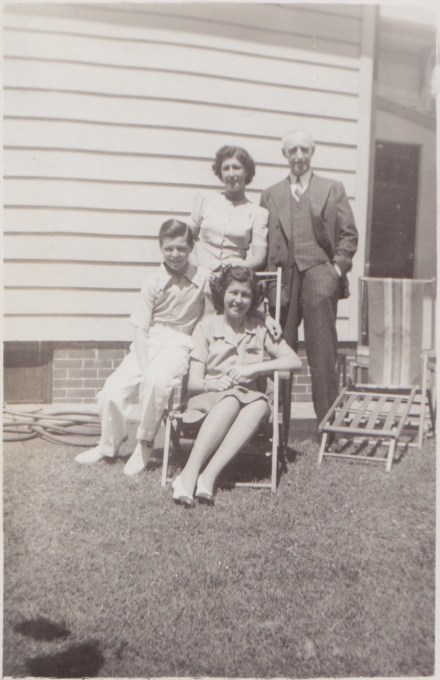
1939 Sackett family

The Sackett family at 23 Methyl Street in Providence: Herbert, Edna (seated), Evelyn and Morris, ca. 1940.


In 1934, James died in a tragic accident. When returning home from synagogue during a snowfall, he did not realize that he was walking along snow-covered trolley tracks on North Main Street. He also did not hear a silent electric trolley coming from behind. In the snowfall, its conductor did not see him either, and James was killed. Herbert recalled that his grandfather was 74 years old and in very good health. Herbert added, “I was only six, but I remember it clearly.”

The War Years

During World War II, manufacturers of all kinds faced strict quotas. The same was of course true for paper. Greeting cards became a popular way to communicate with troops stationed all over the world. Because mail took weeks or even months to reach its destination, customers had to send cards very early to arrive on time. Christmas cards were sold out weeks before the holiday, and Valentine’s Day cards were on sale before Christmas. “It was probably a never-to-be-repeated situation in the industry,” he reflected.

During this era, Evelyn Sackett was actively involved in U.S.O. Herbert, who was a young teen at Nathan Bishop Junior High and already working after school hours at the family store, liked visiting the headquarters of card factories with his father, Morris. For example, they traveled to Rust Craft’s in Boston and Norcross’s in New York City. Morris was treated “kind of special” by vendors who recognized him as the retailing pioneer he was. “I used to tag along and got to meet the heads of the companies and many of the executives,” Herbert said, noting that companies in those early years presented their card lines through samples that buyers would choose from, one card at a time. “I gained knowledge of the products and learned to identify those which contained quality and salability,” he observed. Herbert also learned many intangibles from his father. “The major things he taught me were the importance of accurate record-keeping and financial discipline,” he added. Such lessons would stick with Herbert throughout his 41-year career.

The Suburbs and Beyond
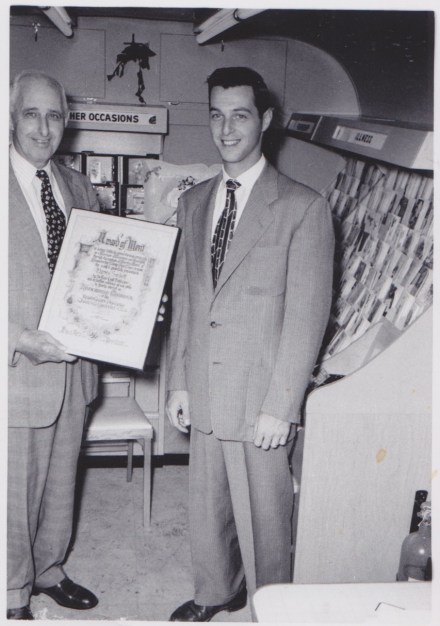
1953 Morris and Herbert

Morris and Herbert Sackett, 1953.


In July 1950, having graduated from the University of Rhode Island with a degree in business administration, Herbert went to work full-time for Sackett’s Greeting Cards. Given his full-time job and his engagement to Jane Lee Cohen, he also gave up his ROTC membership. I was born in 1952 and my brother Richard in 1955. Our family lived in a two-family house at 98 Dexterdale Road in Providence before moving to 287 Rochambeau Avenue in 1958.

From the Providence store, he saw firsthand what was happening to downtowns throughout New England during the 1950s. “Downtowns were no longer the retail vehicle,” he said, referring to the development of suburbs and those residents’ desire to shop closer to their homes. He knew intuitively that this was where the retailing action of the future would be. Shopping centers were also the perfect vehicle for an ambitious young entrepreneur who already knew he wanted to be “an operator of stores, not a store operator.” But the suburbs were not the kind of place where a store that sold only greeting cards could thrive. He needed a plan.

Over the next four years, Herbert researched product mixes and store formats that could be duplicated as a multi-store operation. By 1960, he was ready to open a 1,400 square foot store at 742 Hope Street, around the corner from his Rochambeau Avenue residence.

This “Sackett’s” carried party goods, candles, and stationery items in addition to greeting cards, a “social expression” resource that would become the prototype for future development. Because no single company carried all of these products, he had to put together his own mix of vendors, including greeting card vendors.

In 1962, Herbert brought this new diversified product approach to the store he opened on Westminster Mall, around the corner from the flagship Union Street location. He named it “Richley’s” after my brother and me- “Rich”-ard and Shel- “ley”- to avoid competition with the Union Street store. Although greeting cards were still the dominant product, Richley’s also had a paperback book department, an entire area devoted to party goods, and a candy department. Evidently, Herbert still believed that downtowns had a future.

Over the next few years, he paid careful attention to which products worked and which didn’t. Candy and paperback books were in the latter category.

Herbert opened his first two stores outside Rhode Island in 1967 in downtown New Bedford and downtown Taunton, Massachusetts. They were also the first step toward affiliation with an all-Hallmark product presentation. He then sold the Hope Street “laboratory” location.

Toward the end of the 1960s, when new highways connected suburban shoppers to destination retail areas, there was also an explosive growth of shopping centers. For Herbert, this was a perfect retail storm. “The major positive thing that happened to me in my career was timing,” he said. “Being able to be involved just about the time the suburbs, shopping centers, and malls caught on provided the biggest momentum for my career. I saw this as the wave of the future. It was obvious to me that Main Street, U.S.A. was not going to be the retailing future.”

In 1968, Morris, who had retired in 1963, died at age 79, leaving his son to continue his legacy. While Herbert did just that, he was poised on a very different trajectory. “For my father’s time and personality,” he explained, “functioning basically as a single-store owner was the right thing for him to do. I was much more oriented toward the idea that you take your knowledge and package it.” Unfortunately, Morris did not live long enough to witness a Sackett’s store in a mall location.

Further Expansion

By 1970, Hallmark was retooling in a similar way, diversifying its product line from just greeting cards and gift wrap to include other products like party goods, photo albums, candles, and some gift items. This shift made Hallmark a more attractive vehicle through which Herbert could accomplish his goal of expansion. So Sackett’s became an official Hallmark retail outlet and changed its name to “Sackett’s Hallmark.”

The relationship between the companies remained that of independent manufacturer and retailer (as opposed to franchisor and franchisee). This proved to be a winning combination.

In 1971, the first Sackett’s Hallmark store within an enclosed mall opened in Wampanoag Mall in East Providence. At 2,500 square feet, it included a book department, an expanded gift department, and a cutting-edge, brightly colored saw-toothed ceiling decorated with reproductions of silk-screened poster banners.

Over the next 20 years, Sackett’s Hallmark, driven by a philosophy of “controlled growth,” expanded to locations in Rhode Island, Massachusetts, Connecticut, New Hampshire, Maine, and upstate New York. In 1978, to accommodate the management infrastructure needed to support the rapid growth, Sackett’s moved its headquarters from an upstairs balcony alcove in its downtown, Union Street location to a 13,000-square-foot building in East Providence that housed both corporate offices and a warehouse. Herbert also concentrated on fine-tuning his mix of “allied” (or non-Hallmark) products to achieve an identity that would distinguish Sackett’s Hallmark stores from other Hallmark retailers.

He explained, “Our growth was a conservative one, which gave me a certain amount of comfort, but once you’re committed to that kind of expansion and growth, you’re in all the way. In order to attract and keep the right personnel to make it grow, you need to provide career opportunities for them. We were successful in attracting and keeping our key managerial and supervisory staff because they always knew there was the possibility for future promotion. That was always a challenge and responsibility for me.”

In 1980, I joined Sackett’s as area retail coordinator. Thus, I became the third generation Sackett to be part of the business. My duties included merchandising, writing a company newsletter, and learning the art of gift buying from my father. Only his sharp eye for spotting the next hot seller eclipsed his love for its hunt. In the fiercely competitive gift industry, his merchandising prowess was renowned among vendors and fellow retailers alike.

When I started accompanying him to gift shows in New York and Los Angeles, I was amused and amazed by the effect his lingering in a vendor’s booth could create. I could not have asked for a better mentor.

I remained with the company until 1989 when I relocated to Cheyenne, Wyoming. My brother, Richard, had and still maintains a psychotherapy practice in Manhattan.

By 1985, Herbert was again noticing a new trend in retailing, the “trendy, young-at-heart-oriented” shop. He wanted to take that concept, remove the off-color humor some companies emphasized, and package it in a 1,200-square-foot store that could go into the same malls as Sackett’s Hallmark stores. These new stores, which would carry no Hallmark products, would have a mix of 70 percent gifts and 30 percent cards and were named “Be Dazzled!”. This would be the reverse of the Sackett’s chain merchandising formula.

This was also at the height of mall expansions, when developers were seeking to maximize their attraction by offering the most interesting mix of stores to their customers. The two-store Sackett’s approach had two goals: to differentiate Sackett’s Hallmark from other Hallmark retailers who were competing for the same locations, and to appeal to mall developers who were interested in an additional concept to add to their store mix. Such a move would also maximize Sackett’s management and administrative efficiencies.

Be Dazzled! was birthed on Thayer Street that year, and I was its project director. Over the next few years, it grew to its own chain of seven stores with additional locations in Dedham, Hadley, and Swansea, Massachusetts, as well as in upstate New York.

By the time the 1990s arrived, there were 60 stores under the Sackett’s, Inc. umbrella in six states with over 1,000 employees. Retail competition had become more intense and demanding than ever and Herbert, now in his sixties (who had been receiving a number of overtures from would-be buyers), decided it was time for a change of lifestyle. An opportunity soon arose. In September of 1991, and after so many decades in the industry, he elected to say “yes” to an offer, agreeing to sell the retail division to a longtime acquaintance who was in the same industry but whose locations were primarily in the Middle Atlantic states.

“Needless to say it was a difficult and traumatic decision and was not made quickly or lightly,” Herbert said. “After all those years together, my organization was like family to me. Many of them had been with me from the beginning and it was important to me that I was leaving them in good hands.

“One of my most fulfilling satisfactions came from the fact that, throughout the entire building process, we were able to remain an “independent” company and succeed based on our own high standards, of which we were very proud. On a strictly personal level, it made me even more aware and grateful for the opportunities made possible for me and my family only through the courage and bravery of my grandfather Israel and grandmother Ettie and their migration to this great country,” he said pausing. “This is a message of gratitude I’ve tried to pass down to my own children and grandchildren.”
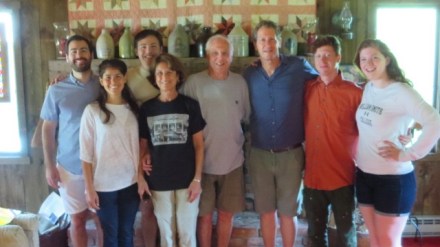
 

IMG_3681

The Sackett clan today: Shelley and her children Julia, Alex and James; Herbert (center); Richard and his children Taylor and Mimi.


Retirement Reflections

Herbert reflected on his retirement. “With such a dramatic change of lifestyle and pace, it amazed me how seamless the transition became,” he said. “The fact that I remained active was, for me, the key – and it still is.”

Sackett’s, Inc. (the corporate structure that was not part of the transaction) became an investment vehicle and still allows Herbert to keep a finger in the business world, “but only to whatever degree I choose.” He noted that suddenly, there was more time to be involved with his grandkids, volunteer work, travel, hobbies, reading for leisure and for one of his then favorite activities, skiing (which he was now able to enjoy mid-week when the slopes were less crowded). “All in all, it became a satisfying combination,” he said.


United Brothers Synagogue

Congregation-and-guests

United Brothers Synagogue in Bristol, Rhode Island.

Since 1987, Herbert has lived in Bristol. A couple of years before he sold the business, he ran into Jack Temkin, a fellow Temple Emanu-El member also active in the wider Jewish community. When Herbert remarked about planning to see him over the high holidays, Jack asked why he didn’t attend the synagogue in Bristol. That was the first time Herbert heard there was such a synagogue.

Having learned that United Brothers Synagogue has been located at 205 High Street since 1916, Herbert decided to attend services one Shabbat. “I was overwhelmed by the building and very impressed by the cantor, who had a beautiful voice,” he remarked. “My nickname for him was ‘the Robert Goulet of the cantorial world.’ A lot of people felt that way.”

Although to this day he remains a member of Temple Emanu-El, Herbert was so taken by United Brothers that he decided to become a member. After officially retiring from business in 1991, he decided to become further involved. In 2006, after serving many years on its board, he became treasurer. Quickly realizing that the synagogue was underfinanced and in need of many costly repairs, Herbert decided that his personal goal would be to strengthen United Brothers’ financial health. This led to a building fund campaign that paid for a restoration in 2008. After the completion of a recent 2015 capital campaign, there is now an operating surplus.

Business Advice

When asked if he misses being in business, Herbert quickly replied, “I don’t miss being in business at all. If I miss anything, it’s the camaraderie that I developed, the personal relationships.” At gift shows there were social engagements almost every evening. “I always looked forward to them,” he said. He served on the boards of the New York and California Gift Shows and remained an advisor to the board of the California Gift Show for a few years after his retirement. He still sees some old business friends a few times each year.

Asked what advice he would give a young person just starting out in business, he answered without hesitation. “The most important thing, no matter what kind of business- whether it’s bricks and mortar or Internet or whatever- is to have a sound business plan. A well-thought-out business plan becomes a vehicle for producing the degree of profit. Those rules never change.”

“What does change,” Herbert cautions, “are business cycles that represent shifts in consumer demands. The successful entrepreneur must respond to these, which may occur in five-year cycles.” “The Internet,” he warns, “has completely overhauled the retail arena.”

As for additional lessons learned from his family’s business launched about 110 years ago, Herbert offered this: “Don’t expect to be 100 percent right when making decisions; that’s aiming too high. Always think about the ‘what ifs.’”
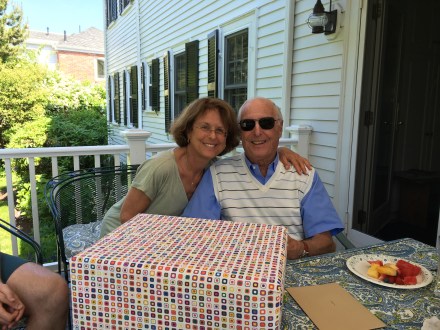
IMG_2305

Shelley and Herbert, Father’s Day 2016. The envelope on the table holds, of course, a Hallmark card.


Despite the phenomenal growth of the Internet with its dozens of virtual e-cards, Herbert still believes that there can be no substitute for old-fashioned, paper cards. “The concepts of art and sentiment, in the ‘touchy-feely’ greeting card, will always have its place,” he proclaims. In fact, both my dad and I are drawn to Hallmark cards and still send them to each other on every card-giving occasion. I can’t speak for him, but the ones he has sent me over the years are in a special shoebox that I look forward to adding to for many years to come.


Salem Farmers Market returns to Old Town Hall every Thursday, 3-7 p.m.

Salem Farmer’s Market keeps a tradition alive and well

Shelley A. Sackett, correspondent


Although the 2016 Salem Farmers’ Market may bear little resemblance to its 1634 originator, the Commonwealth’s earliest settlers would feel right at home in downtown Derby Square in front of Old Town Hall — the oldest surviving municipal building in Salem.


Today, as then, the market offers much more than local fresh produce and other dry and baked goods. It also offers a place where people can gather and feel a real sense of local community.


Hundreds of smiling people of all ages did just that last Thursday, braving the wind gusts and threatening skies, to be part of the festivities marking the Salem Farmers’ Market’s eighth opening day. Many lounged on Town Hall steps, munching and talking. Others gladly sampled the vendors’ wares.


SAlemMkt1

Amy Glidden looks at one of the plants for sale at the Gibney Gardens booth during the Salem Farmers Market at Derby Square, Thursday, June 9, 2016. Wicked Local Staff Photo / David Sokol


“The Salem Farmer’s Market creates a community center where residents can catch up with other,” said Kylie Sullivan, executive director of Salem Main Streets.


In fact, according to Kylie, whose downtown Salem revitalization organization runs the market, the city’s deed actually requires the use of Derby Square as a market. “The Salem Farmer’s Market physically transforms the feel of downtown for a little while in a way that’s very relevant to its history,” she added.


The volunteer-run market will be held at the square on Front Street in downtown Salem every Thursday from 3 p.m. to 7 p.m. through October 13. Each week features live music and other entertainment.


Among the 30 vendors lined up for 2016 is “Balloon Man” Lawrence Levesque, who lives in Peabody and is also a magician. He met some people who were “in balloons” eight years ago, and he’s been twisting balloons into fanciful shapes to the delight of youngsters of all ages ever since. “I love it. I wouldn’t do anything else. It’s the best career choice I ever made,” he said as he handed a preschooler a perfect latex dachshund.


IMG_2293

Lawrence Levesque, who is also a magician, delights Salem Farmers Market shoppers of all ages with his balloon creations. Photo by Shelley A. Sackett


Mandy Williamson of Marblehead’s “Fishwives Specialty Foods” started her business on a friend’s dare after she lost her job as regional director of biotech in a wastewater management company. She makes all natural, gluten-free chowders and bisques and “on-the-go” gazpacho that comes in a 16-ounce bottle ready to crack open and drink “much as they do in Spain.”


Because the chowders are gluten free, Williamson can cut back on cream and butter without cutting back on taste resulting in an “absolutely decadent” taste with only 200 calories per 10-ounce cup.


Holly and Andy Varela started Maitland Mountain Farms, one of the seven major farms that anchor the market, after Holly’s 2009 visit to the Salem Farmer’s Market inspired them to ask her father about growing vegetables on his 2.5 acre Salem property.


He agreed, and the two revived the land, cultivating it and installing greenhouses. “Six years later, we’re actually an agricultural production,” Andy said proudly of Salem’s only urban farm.


These days, the bulk of their business is pickles, which they sell all over the Northeast through a food service. They still stay close to their homegrown roots, however, by doing local farmers markets and servicing farm stands and small “boutique-y shops.”


Among the market’s biggest fans is Mayor Kim Driscoll, who was excited when its June 9 opening day rolled around. “The market is such a vibrant and fun weekly downtown event,” she said, offering thanks to Salem Main Streets, the volunteers, City employees and all the vendors “who put in the hard work to make the market possible.”


Tucked in a corner in the shadow of Town Hall is Ann Counihan’s “All Fruit Inc.”, an all natural dried fruit and nut mix that comes in eleven varieties. The healthy snacks-in-a bag are attractively packaged for travelling and are meant to be eaten anywhere.


A large board labeled “Samples” generously offered smaller versions of each of the 11 varieties, each packaged with the same attention to style and detail. Not only were they the classiest samples at the market, Counihan’s encouragement to try as many as you wanted made doing so guilt-free.


Sullivan thinks these direct connections between business owners and customers are a key benefit of the Salem Farmer’s Market. “It becomes a pipeline for emerging businesses to grow their product and their reach,” she said.


For the latest updates about the Salem Farmer’s Market, visit salemfarmersmarket.org, “like” them on Facebook at facebook.com/SalemMAFarmersMarket or follow them on Twitter at @salemfarmmarket.


Redemption Fish Closes the Loop


Local startup farm grows fish in a sustainable way

By Shelley A. Sackett, Correspondent


Colin Davis, co-founder of Salem’s Redemption Fish Company, has a history of merging his entrepreneurial spirit and interest in “sustainability” (the intersection of ecology, economics, politics and culture). The 30-year-old Trinity College graduate had already launched two start-ups when he and his roommate (and fellow Redemption Fish co-founder), Andy Davenport, decided it would be fun to raise fish in a sustainable way in the basement of their Cambridge apartment.


Davenport, 27, who met Davis through Craig’s List when seeking a roommate, has a background in biology and chemistry and worked at Biogen. By the time the eviction letter came from their landlord, their “hydrofarm” had over 10,000 trout. “I talked Andy out of his job and into starting a fish farm with me. Basically, this was a hobby that got horribly out of control,” Colin said with a chuckle as he pointed with pride to the 10,000 square feet of space that Redemption Fish Co. now occupies in Shetland Park in the space that housed another seafood farming enterprise in the 1970s.


Andy1

Owner Andy Davenport goes fishing for some rainbow trout in one of the holding tanks at Redemption Fish Co. at Shetland Park in Salem. Wicked Local Staff Photo / Kirk R. Williamson


Davis and Davenport’s goal is to run their plant like an ecosystem, using the least number of inputs for the maximal output. There is no compost waste. There is little fish waste, and there is little water waste. “We try to close the loop on everything we do,” Davis said.


The basic principle behind what they’re doing is called “aquaponics”, the marriage of aquaculture (growing fish) and hydroponics (growing plants in water). Davis’ enthusiasm is palpable as he explains the process in a nutshell:


First, they feed the fish. The fish fertilize the water. That fertilized water gets pumped up to a grow bed of clay balls that biologically filtrate the wastewater through a nitrification process. Then, they grow plants in the grow bed.


Andy2

Redemption Fish Co. owner Andy Davenport looks over a verbina plant and an orange tree that are being grown hydroponically. Wicked Local Staff Photo / Kirk R. Williamson


Aquaculture currently occupies the majority of floor space. Although there are huge vats growing tilapia, bass, brown trout and experimenting with Atlantic salmon, rainbow trout are the only fish they are currently commercially producing. In the wild, it takes 18 months to two years for a rainbow trout egg to reach “market weight” of one pound. Davis grows them in about 12 months.


A couple of months ago, Redemption Fish Co. started harvesting a few hundred of its first trout eggs and selling them to a handful of restaurants and through Farmers Markets.

The goal is to be producing 1,000 pounds of rainbow trout per week by the end of the summer and to distribute them locally.


“Not shipping them across the country is the way this is better than mass produced trout from one of the three mega farms in this country. We leave a smaller [carbon] footprint,” Davis said.


Andy3

Owner Andy Davenport holds up a tilapia at Redemption Fish Co. in Salem. Wicked Local Staff Photo / Kirk R. Williamson

Hydroponics, the other part of the aquaponics equation, uses 5% of the amount of water growing plants in soil would, and the plants grow faster. “Growing plants this way actually saves waste water we’d otherwise have to dispose of,” Davis pointed out.


On the day of this visit, one grow bed had a three foot orange tree, tomatoes, lemon verbena and ghost peppers. They just harvested 20 pounds of basil, which Jean Louis Faber, owner of the Jean Louis Pasta Shop on Derby Street, took and turned into pesto. He also bought some of Fish Co.’s rainbow trout to use in his smoked trout ravioli.


“That’s the fun part about local small business. I can just wander in places and say, ‘I think what you’re doing is cool. Can we work together?’” said Davis. “There’s something really neat about being able to grow basil two blocks from where it’s turned into pesto, and the consumer can walk to the store. That doesn’t exist in urban areas in the United States anymore.”


Within five years, Davis estimates Redemption Fish Co. will produce 250,000 pounds of fish and the better part of one million pounds of produce yearly. Future expansion plans include large-scale hydroponic production; he also wants the company to help others start small hydroponic gardens for their own consumption.


Davis points out that it takes three gallons of water to produce one pound of trout and five pounds of vegetables. In dirt, one pound of broccoli alone uses 75 gallons of water, according to Davis. “Nature doesn’t have a concept of waste. We invented waste. Up until man, there was no such thing,” Davis said. “Resources in, resources out, this [aquaponics] is probably the single most efficient way you can possibly grow food for human consumption.”


Davis and Davenport closed their own loop on making their dream a reality through a fluke. Davis’ mother was telling her optometrist about her son’s interest in starting a fish farm. As luck would have it, her optometrist knew Peter Lappin (whose family owns Shetland Park), who had started Sea Plantations in the 1970s to raise fish and seafood for research and commercial consumption. The space was empty and still housed Sea Plantations’ equipment.


Davis got on the phone and called Lappin, who “forced me to read his book (‘Live Holding Systems’)” which chronicles Sea Plantations. Ultimately, Davis and Davenport were able to lease part of the 50,000 former Sea Plantations space from Bruce Poole, one of Lappin’s original partners who runs his environmental services firm in space adjacent to Redemption Fish Co.


“There are not a lot of people trying to start urban fish farms, and not a lot of other convenient things this space could be used for, so we were pretty lucky to run into this,” Davis said.


When Mayor Kim Driscoll (whose favorite fish dish is grilled salmon) recently welcomed Redemption Fish Co. to the Salem business community at a ribbon-cutting ceremony, she emphasized how excited she was that the company uses innovative and sustainable technologies to grow food. “This company’s products will offer a healthy and local option to Salem and the region’s restaurants and food suppliers, providing one more terrific ‘farm to table’ opportunity for customers and diners,” she told the Salem Gazette.


Although finding funding for a sustainable urban farm in a finite space remains Davis’ biggest challenge, he is as optimistic about the company’s future as Mayor Driscoll. “If we worked with every restaurant in Salem, we could feed thousands of people out of a tiny basement a quarter of a mile away,” he mused.


For more information, visit Redemption Fish Company’s facebook site or redemptionfish.com or email info@redemptionfish.com.


Northeast Animal Shelter rescues out-of-state cats and dogs


By Shelley A. Sackett


Last week, Old Fella Animal Rescue in Burke County, Georgia sent 39 dogs and eight cats to the Northeastern Animal Shelter on Highland Avenue in Salem. It was their fifth transfer in 2016.


“Georgia has a high kill rate in their shelters. They don’t quite get the spay and neutering part of owning a dog,” said Jane Taubenec, whose job as canine coordinator includes deciding which out of state animals are eligible for transfer to the Salem shelter.


Georgia has no leash or spay-and-neuter laws (except for stray or unwanted animals adopted from a shelter). It is the Northeast Animal Shelter’s biggest source of animals.


The three different Georgia shelters and rescue services Taubenec takes dogs from send her pictures and a short description of prospective adoptees. She then sends them the list of medical and behavioral protocols the animals must meet to be eligible. A lot of them can’t meet those requirements.


Tink

Tink, a 1-year-old cat from Georgia, is up for adoption. Wicked Local Staff Photo / Kirk R. Williamson


“We always want healthy, adoptable dogs. Being the size that we are and the number of animals we can handle, we have to be strict about what’s done prior to them coming,” she said. Under the current arrangement, Georgia performs the initial medical work and the Northeast Animal Shelter reimburses them for a portion of it.


“These private rescue groups are like us. For most of them, it’s their own money or their friends pay for it,” said Laurie McCannon, who has worked at the Salem shelter for 25 years and is now its Executive Director.


Laurie


The Salem shelter placed 4,606 dogs and cats out its current space in 2015. With no local, state or federal funding, the shelter depends on private donors who are “looking to save pets.” McCannon estimates it costs between $150 and $200 per pet to pay for a portion of Georgia’s medical expense, transportation, and then follow up medical care in Salem.


Some of the pets arrive healthy and ready to be adopted. Others end up costing the Salem shelter a lot more money. “We don’t want to send people home with problems,” McCannon stressed.


One of the biggest issues is socialization. “Pets being in a shelter — it’s tough on them. Most of them are used to having a family, somebody who’s stable in their lives. They’re natural pack animals. When they don’t have their pack, you can understand why their behavior is tough,” she added.


For example, two dogs from the recent Georgia group will require extensive training before they’re ready for adoption. “They always lived in a group of nine or ten dogs, and now they’ve been taken away from their pack. They’re scared,” she said.


McCannon’s face reflects pride and compassion as she describes the shelter’s programs for animals that need behavior modification training before they are adoptable. “That’s a pretty regular subject around here. ‘What can we do for them?’ They’re here. Let’s help them,” she said.


The Salem shelter works with Loyal Canines of Beverly, a local trainer who takes the pets for a couple of weeks to try to work on specific behaviors. “We’re constantly putting in various programs,” McCannon said. There are volunteers who work with the more difficult pets. There is even a treadmill to help the animals “work off a little steam.”

And there is a doggie bed in each office so staff can either bring their own pet to work or have a shelter pet for company. “We try to keep them social and from getting frustrated and lonely,” she added.


Despite the training and the willingness of adopting pet owners, the match is not always made in heaven and sometimes the adoption just doesn’t work out for a variety of reasons. While there is no guarantee, there are situations where the Northeast Animal Shelter will take the pets back. “Sometimes we don’t have a big history, so we don’t know every situation that an adopter is going to run into,” McCannon said.


At some point, however, McCannon has to draw a line. “When you adopt a pet, it’s your pet. That’s just kind of a reality. You have to commit to them and try to work through things,” she said, emphasizing that that was her personal opinion and not official policy.


After New England’s big push for “spay-neuter” laws in the early 1990s, the Northeast Animal Shelter experienced a diminished list of pets awaiting placement. “It’s not fool proof yet, but we started to see the effects. There are still plenty of issues here, but it isn’t what it once was,” McCannon said.


The shelter took its first out of state group of pets from Nebraska in 1994. In 1995, the first group came from Puerto Rico, “basically street dogs that were rescued by private people.” The program has gone on from there, and expects to place even more pets in 2016 than it did in 2015.


For both Taubenec and McCannon, their greatest satisfaction comes after watching a particularly difficult pet that they have worked with go home with an adoptive owner. “When they finally get adopted, everybody is crying because they’re leaving, but they’re also crying because they’re so happy,” McCannon said.


But the biggest reward? “When the adopters get back in touch with us and tell us how great they’re doing,” she said with a huge smile.

275 Years of the Black Picnic

Salem United will focus on voter registration at July 16 event

By Shelley A. Sackett, correspondent


Over a century before the Civil War, Salem was among a handful of Massachusetts towns that allowed enslaved and freed blacks to gather once a year and elect their own Black Governor, who spoke on behalf of all blacks and served as a judge, mediator and liaison.


That day, called “Negro Election Day” in 1741, was the first occurrence of voting rights for blacks in the United States. Now known as the Salem Willows Black Picnic, it will celebrate its 275th anniversary on Saturday, July 16, and Doreen Wade couldn’t be prouder.


Salem United

Left to right: Su Almeida, Salem United Treasurer, Doreen Wade, Salem United Founder and President, Mayor Kim Driscoll, Ann Carlson, Salem United Historian


“During this crazy election year, it is especially important to let people know the role Salem played in the black vote and to show everyone the importance of voting,” said the founder of the Salem United Organization, which hosts the event. “Our goal is to bring the day back to its origin and maintain its mission to voter registration and family unity.”


To that end, the event collaborates with the Young Urban League of Eastern Massachusetts for a get out and vote campaign statewide and a day of voter registration. The group will host a voter registration table at the event. Wade said that anyone with a driver’s license or birth certificate would be able to register on the spot at the Salem Willows Black Picnic.


Wade stresses that the day is geared to the entire community, not just its black members. “We want everyone out there to understand the importance of the vote,” she said.


photo (4)

2015 Salem Black Picnic-kers


“With the republicans and Democrats in such disarray, we need to have all voters registered and educated to who they are voting for and what they are voting for,” she added. Salem United will be hosting family oriented vendors, including educational and health groups, as well as speakers to highlight the historical significance of the day.


The Picnic is also a day for family-oriented fun. Since 1885, Salem Willows Park has been the Picnic’s annual location and has always included barbecues, volleyball games, dances and more. This year, the musical entertainment on the Main Stage will feature the Dave Macklin Band, Purpose Music Group, and various other performers. Children ages 5 to 14 can enjoy free face painting, arts and crafts and other hands-on activities.


And, of course, there will be food. “The day is also a day everyone came together and cooked out. There are grills galore and all you smell is barbecue,” Wade said, reminding people that is it fine for them to bring their own grills.


Wade, who is Publisher and CEO of New England Informer dba N.E. Informer Newsmagazine, founded Salem United in 2015 to preserve and restore the Salem Willows Black Picnic. “As we celebrate its history and its 275th year anniversary, we felt it would be easier if we were a formal organization,” she said.


Organizing the 2016 event, she was impressed with the support from the City of Salem, from Mayor Kim Driscoll’s office to the City officials (many of whom are marching in the parade) and licensing departments. She is disappointed that Massachusetts didn’t embrace and support the July 16 event, but hopes the 2017 Black Picnic may receive more state recognition.


Nonetheless, Wade is upbeat and enthusiastic and steadfast in her commitment to the Black Picnic’s mission. “I hope people take away from this event that their voices are important. A day of unity is healthy and necessary. We can come together as a community,” she said.

CAPTION FOR PHOTO AT TOP: The Black Picnic, which started as “Negro Election Day” in 1741, at its first celebration at Salem Willows in 1885.

For more information, visit http://www.neinformer.net/BlackPicnic.html.


Let the Gaming Begin!

Bit Bar Salem: where two bits still buys what it did in 1980

By Shelley A. Sackett, correspondent


You don’t have to have a Ph.D. in economics to realize that 25 cents doesn’t buy what it used to. Armed with a single quarter, you would have to time travel to 1945 to use it to buy a pound of hamburger; to 1960 to buy a gallon of gas; and to 1970 to buy a loaf of bread.


Or, you could just walk into the new Bit Bar Salem arcade-restaurant-bar hybrid at the intersection of St. Peter Street and Bridge Street, plunk your quarter into a vintage Ms. PacMan or Donkey Kong arcade machine, and pretend it was still 1980.


“Yes, it really is a quarter for a game. We say inflation be damned!” Rob Hall, one of the five co-owners said with a chuckle.

BitBar1

Bit Bar co-owner Rob Hall plays his favorite video game, Mortal Kombat. Wicked Local Staff Photo / Kirk R. Williamson


The genesis of Bit Bar was Hall’s interest in classic arcade games (Teenage Mutant Ninja Turtles, Donkey Kong, Pac-Man, etc.) The North Shore native, who graduated from Rochester Institute of Technology with a concentration in programming and media, set up a Facebook page for people who lived in the Boston area and enjoyed talking about these classic games. He met Joshua Allen, a technician by trade whose hobby is collecting and restoring arcade games, through his page. Andrew Wylie, a vintage shop owner who is plugged into the creative and music community in Greater Boston, joined the group. So did Max Clark, the restaurant manager at Trident Booksellers in Boston. Last, Allen brought in a friend of his, Gideon Coltof, who had just earned an M.B.A. at Babson College and was looking for an interesting project.


The group tossed around the idea of doing “Bit Fests”, pop up arcade events that would take place mostly at breweries. The idea was successful in other areas, but untested locally. “We were always interested in having a permanent location, but even before that, we were thinking it would be fun to do a classic themes festival,” said Hall, who admitted that the idea of moving these 300-lb. machines to temporary locations for a day or two was “a totally crazy idea. Totally insane.”


Coltof thought it was a textbook way to get a feel for the market before taking the brick-and-mortar plunge. “It’s not often you come upon a completely unguarded market like this. There was nothing in the Boston area,” he said, referring to the Bit Fests as “three tons of fun”.


In December 2014, the group did its first pop up event. Over the course of a year, Boston Bit Fest had ten events, but as early as last summer, they started looking to make the brick and mortar a reality. Originally they looked in Cambridge, Somerville, Malden and Boston, but it was hard to find interesting, good space.

One day, Coltof saw a listing for the old Salem jail space that had been home to The Great Escape and most recently, A&B Burgers. Hall had been mentioning Salem as a possible location, but this was the first time a potential listing had caught his eye. “Gideon thought it was funny, like ‘Ha, ha, ha. Look at this, an old jail!’, but I live on the North Shore and had eaten here when it was A&B. I told him it was a great space,” said Hall.


Coltof came to Salem and was blown away. “I tried to get a sense of what Salem was like and I thought, ‘This is really cool. We can really make this work.” They signed the lease and began working on Bit Bar Salem in January.


The 3,000 square foot space features two rooms of classic arcade and pinball machines with total capacity of 106, including seating for 70. The outdoor patio accommodates an additional 60 people. There are 30 machines in the bar area and another 30 in a warehouse in Everett, which they rotate for variety. These are the original games, painstakingly restored, refurbished and spit shined to their original glory. Some of the most popular games are Teenage Mutant Ninja Turtles, and pinball machines Cue Ball Wizard, Hook and Cyclone.


Under Executive Chef Eric Hammer, formerly of Tavern in the Square, the attention-grabbing menu features Walking Tacos (“a tasty, traveling taco minus the mess”), snacks, sandwiches, entrees and sweets. Specialty cocktails are whimsically named “Pooka”, “Dankey Kang” and ”Pinky & Clyde”, among others. Local breweries are featured and Maine Root supplies Fair Trade Certified organically sweetened sodas


Most important to Hall and Coltof is that Bit Bar Salem be as green as possible, leaving the smallest carbon footprint and supporting the local community. “We pay living wages. We recycle our cooking oil into biodiesel fuel. Our meat is from Walden Meats (‘happy cows and chickens’). I want to be sure we are building something we can be proud of,” Coltof said.


Mayor Kim Driscoll is excited to welcome Bit Bar to Salem and to stake her personal arcade turf. “This creative business will add to our downtown’s growing reputation as a hip, vibrant and diverse dining destination. Beyond just the new jobs and economic activity this restaurant will bring, its innovative theme will make a real unique experience, not simply in Salem but for the whole greater Boston area,” she said, adding,” I look forward to setting their high score in Galaga.”


After a “soft opening” in June, the group is looking to tweak a few things before hosting its grand opening. Their biggest issue is managing all three things that Bit Bar Salem is: a classic arcade, a bar and a restaurant. During the day, it is more like a restaurant; at night, it feels like a busy bar. And then there are the 30 arcade games. “Our biggest challenge is how much floor space to devote to tables and how much to games. We are loath to give up a single game in our floor-plan, but if a bussing station has to go somewhere, or a server station is needed to make the flow of the place work ten times better, then we have to do it,” Hall said.


Like Mayor Driscoll, Coltof and Hall each have favorite games. For Coltof, it’s Rolling Thunder, Teenage Mutant Ninja Turtles and the pinball game Cyclone. For Hall, it’s more personal.


“Altered Beast”, a fun classic Sega game, is not necessarily the best game ever made, according to Hall. But for him, it is especially fun to play because it is one he helped fix and restore. “Just seeing that come back to life after you think it’s dead and gone is something,” he said.