Bearing witness: 85-year-old Holocaust survivor relives her childhood in the docudrama, ‘Hidden: The Kati Preston Story’

By Shelley A. Sackett

Kati Preston being interviewed for the film. | KELLY FAN

On Sept. 20, the 41st Boston Film Festival will host the world premiere of “Hidden: The Kati Preston Story.” The 75-minute film is a powerful docudrama that follows the extraordinary journey of 85-year-old Holocaust survivor Kati Preston. Exceptionally well-edited, directed and produced, it retells the story of one person’s resilience and survival in the face of a society descending into antisemitism, authoritarianism, dictatorship and tyranny.

The film opens on a bucolic country scene with a horse peacefully grazing near a white clapboard house. Smoke spirals invitingly from its chimney. Inside, a woman sits at her desk, turning the pages of a scrapbook of sepia-toned family photos. “Everybody here is dead. I’m the only one left,” says Kati Preston. “It feels so strange because I feel like I’m in exile. The world I come from is gone. When I die, nobody will remember these people because I’m the last person who bears witness.”

Seamlessly, the screen melts into 43 seconds of black-and-white archival footage that shows Jews living openly Jewish lives followed quickly by scenes of them being rounded up, transported, beaten and murdered. The last shot is of crematoria ovens, doors wide open, displaying their interiors of ashen, bony remains. Mercifully short, these devastating images are a reminder of the lightning speed and crusading evil that are the backdrops to Kati’s story.

Based on Kati’s award-winning graphic novel, “HIDDEN: The True Story of the Holocaust,” the film is narrated by Kati and features reenactments of her story. In 1943, her hometown of Nagyárad, Hungary (now Oradea, Romania) boasted a thriving Jewish community with synagogues, a Jewish hospital, Jewish schools and Jewish coffee houses. Despite a diverse society that welcomed religious Jews, Roma and Muslims, Jews remained insulated, not wanting to assimilate.

Kati’s childhood was one of luxury. Her mother ran a dressmaking business with 40 employees and her father was a carp wholesaler. At 5 years old, she was beautifully dressed, wore curlers to bed every night and enjoyed the comforts of maid and governess. Her father was Jewish, her mother a Catholic who converted. Although they were secular Jews, Kati remembers her mother lighting Shabbat candles every Friday night.

She also remembers going to the opera on Sundays with her Catholic grandmother. Those outings routinely ended with the two of them sitting at a bar and her grandmother slugging down shot after shot until she was drunk.

Kati’s father was playful and happy-go-lucky. Her mother, whom Kati feared and loved but “did not like,” was more in control and controlling. To make sure Kati was trained to be a proper young lady, she hired Fraulein, who “terrified children into behaving instead of educating them.” One tool in Fraulein’s toolbox was her book of Grimm’s Fairy Tales, which was used to teach German children the dangers of misbehavior through traumatic stories. These included a child having his thumbs cut off for thumb-sucking and a girl who burns to death for playing with matches.

Interspersed among the narrative reenactments are interviews with Tom White (Holocaust and genocide educator), Dr. Martin Rumscheidt (Christian minister, educator, author and theologian), Annette Tilleman Lantos (Holocaust survivor from Budapest), Rabbi Oberlander Baruch (Chief of the Budapest Orthodox Rabbinate) and Kati’s son Daniel Mator, who directed “Hidden.” His six-year collaboration with filmmaker Jody Glover and determination to trace his family roots are responsible for Kati’s story being brought to life.

Inserting talking heads into a docudrama can be risky. If clumsily done, these can interrupt rather than augment, breaking the mood and boring the audience. Director Mator and his team avoid this common pitfall, masterfully using these commentators to supplement the interviews with eye witness accounts and historical context. In particular, Mator’s on-the-ground guided narration of life and lives in the Jewish ghetto in the 1940s feels more like an immersion experience than a lecture, thanks to his use of animated maps and archives.

Things go from bad to worse for Kati and her mother after Hitler invades Hungary. Her mother sews the mandatory yellow star onto Kati’s coat, which she proudly wears until a man sees it and spits on her. “I couldn’t understand why I had to wear a star that would make someone spit on me,” Kati says of her first encounter with antisemitism.

A Hungarian farmer woman who feels beholden to Kati’s mother agrees to hide Kati in her barn. Miraculously, she avoids detection until she can be reunited with her mother. The defeat of the Nazis brings Russian occupation and a different set of perils, as those soldiers rape, pillage and murder with impunity. Again, Kati’s mother displays fearless ingenuity and chutzpah when she curries favor by offering to make a dress for one of the female Russians. Soon, she is outfitting the entire women’s corps. In exchange, mother and daughter are protected and amply fed.
Their lives under Stalin’s communist regime take an even darker turn, as Kati, “brainwashed,” actually reports her own mother to the police. Mator eventually brings us into the 21st century, focusing on generational trauma and the troubling narrative of Hungary’s revisionist history.

Kati is one of the two (out of 52) kindergarteners in her class who survived the Holocaust. She lost all 28 members of her extended family to Nazi genocide. Believing that her survival has given her “the energy to make my life count,” she pursued careers in journalism, fashion, theater and education before dedicating her life to sharing her story. She speaks in schools, libraries and public institutions, emphasizing survival over victimhood and the urgency of combatting prejudice.

Along with former New Hampshire Gov. Chris Sununu, she succeeded in getting Bill HB115 passed to make Holocaust education compulsory in New Hampshire schools. Her remarkable connection with youth has inspired her graphic novel, and now this film. These are being combined with classroom lesson plans for a worldwide distribution to schools as an initiative towards Holocaust education.

“I loved my childhood,” Kati reminds her audience. “Then things shifted. These things can happen here.”

Marblehead’s Edna and Don Kaplan volunteer in Israel to provide “hands on” help

Edna Kaplan in the Israeli army uniform she “proudly wore.”

BY SHELLEY A. SACKETT

MARBLEHEAD — After Oct. 7, 2023, Edna and Dr. Don Kaplan wanted to do something hands-on to help Israel. Edna, who was born in Israel and lived there until her family relocated to New York City when she was eight years old, had dreamed of returning to her native land to do her army service for over 30 years, but had no idea how. After the Hamas attack, she was motivated to make that dream come true and started researching in earnest.

She discovered Sar-El, a non-political volunteer organization founded in 1983 and dedicated to supporting Israel by assisting the Israel Defense Forces and learned that volunteers had been manning bases in Israel for decades.

For two weeks in May, she and Don volunteered (Don lovingly says that Edna volunteered; he was conscripted) at Tel Hashomer, where a major IDF base and the Sheba Medical Center are located. A mission-critical logistics base, Tel Hashomer prepares medical kits of all types requested by military bases.

On Sundays, the Kaplans’ team was met at the Tel Aviv airport for transport to the Dori base near Ramat Gan. They returned to Tel Aviv on Thursday mid-afternoon for Shabbat.

During the first week, their team opened up kits that had been returned by army bases and sorted them for repackaging. Another team checked for expired dates.

The second week they packed several different medical kits requested by various IDF bases. Don, a retired critical care and pulmonary specialist, was tapped to pack operating room kits.

The volunteers were paired with a roommate to share air-conditioned barracks. Every evening the organization arranged programs in the activity center for after-dinner gatherings.

“I still communicate with my roommate, Hadar, at least weekly,” Edna said. She and Don look forward to seeing other Sar-El friends when they travel to Australia this fall.

Dr. Don Kaplan (right) stands with Amnon, manager of the surgical kits warehouse.

Edna’s Israeli roots extend deeper than her birth certificate. In 1947, her Polish parents set out for Israel on the Exodus, a ship carrying Jewish refugees – primarily Holocaust survivors – from Europe to Palestine during the British Mandate era. Refused entry in Palestine, they were returned to Germany. They found another ship in 1948. “When my father got off the boat in Israel, he immediately enlisted. He fought in the 1948 and 1956 wars,” she said.

The family moved to New York City in 1956. Each parent had one sister there, the only remains of very large families. Her father was one of nine children, her mother one of seven.

When she was a 21-year-old doctoral candidate at Ohio State University, Edna decided to take a quarter off and go to Israel. She and her cousin volunteered at Kibbutz Degania Bet as cooks, preparing meals for 600 people. “The day we were supposed to fly home, we looked at each other, shrugged and went back to work. I gave up a fully paid Ph.D. program, and never regretted staying in Israel. I only left because I was about to be drafted. That, I do regret.

“I have wanted to do my army service a couple of weeks at a time until I put in my full two years,” Edna said. “Well, two weeks down, 102 weeks to go! If I had only known about Sar-El earlier, I would have started a lot sooner.”

Newton native Don attended Hebrew school and had his bar mitzvah at Temple Emeth in South Brookline, where his father served on the board and his mother was an active member of Hadassah. He and Edna started dating when he moved to New York City for his internship and residency in internal medicine. The two married in 1976 and eventually settled in Marblehead, joining Temple Israel and raising two sons, both Y2I alumni.

Don worked as medical director of the Whidden Memorial Hospital and was instrumental in its merger with Cambridge Health Alliance. An avid sailor since childhood, he was president of Community Boating on the Charles River and trustee of Boston’s Museum of Science.

Edna, “mostly retired” from KOGS Communication, the PR agency she founded in 1990, was a JCCNS board member for 23 years, serving on and chairing numerous committees. She was also a longtime National Tay-Sachs and Allied Diseases (NTSAD) board member.

Other than one local friend who was born in Israel and Edna’s Israeli family, the Kaplans haven’t found a specifically Israel-focused community like what they experienced through Sar-El.

“There’s good reason Sar-El volunteers from all over the world return year after year, some multiple times in a single year. It’s a soul-satisfying experience like no other. You are with a group of like-minded, pro-Israel volunteers, Jews and non-Jews, secular and religious, doing productive, meaningful work together,” Edna said.

She and Don stay in touch with the people they’ve met from all over the world through WhatsApp. “I think I’ll find my pro-Israel family through Sar-El,” Edna said. Θ

Judaism Shares the Spotlight in PEM’s Stunning “Ethiopia at the Crossroads” Exhibit

Artist in Addis Ababa, Ethiopia, Queen of Sheba and King Solomon conceiving King Mǝnǝlik I, 20th century. Tempera paint on cotton canvas. Gift of Charles R. and Elizabeth C. Langmuir, after 1973. Peabody Essex Museum./KATHY TARANTOLA/PEM

By Shelley A. Sackett

SALEM – “Ethiopia at the Crossroads,” the impressive new exhibit at the Peabody Essex Museum through July 7, celebrates the extraordinary artistic traditions of Ethiopia from their origins to the present day.

Co-organized by the Walters Art Museum and the Toledo Museum of Art, the sensory-rich show presents a collection of over 200 objects, ranging from antique painted religious icons, illuminated manuscripts, gospel books, coins, metalwork, and carvings to modern photographic, textile, and multimedia works by contemporary artists.

As the first major touring exhibition to examine Ethiopian art in a global context, its curators wisely added many roadmaps that describe and illuminate this often-overlooked African nation’s contribution to the world.

Artist in the Beta Israel community, Ethiopia Necklace, 20th century. Silver, metal, and string. Minneapolis Institute of Art, The Ethel Morrison Van Derlip Fund./SHELLEY A. SACKETT

Seated in the Horn of Africa between Europe and the Middle East, Ethiopia has played a profound foundational role in the evolution of the region’s history, creativity, and cross-cultural exchanges over two millennia. It has the distinction – despite upheavals – of maintaining its independence as one of the only African nations to resist colonization. Religious art, in particular, emphasizes the outsized role Ethiopia played in the establishment and evolution of the three major Abrahamic religions: Judaism, Christianity, and Islam.

Most striking is the place Judaism played in this mix.

Prior to the arrival of Christianity, many people in Ethiopia practiced Judaism, perhaps linking back to the meeting of the Ethiopian Queen of Sheba and King Solomon of Israel in the 10th century B.C.E. Known as Beta Israel, the Jewish community in Ethiopia has persisted for over 2,000 years.

Most of the Beta Israel community immigrated to Israel in the 1980s and into the 1900s when political destabilization, famine, and religious persecution threatened the country. Operations Moses (1984), Sheba (1985), and Solomon (1991) airlifted over 80,000 Ethiopian Jews to Israel. Nonetheless, the union between Sheba and Solomon yielded a line of Ethiopian kings that lasted until its last emperor, Haile Selassie, was overthrown by a coup d’état in 1974.

In the 20th century, Jewish community members produced objects in diverse media that alluded to Ethiopia’s Jewish origins. Two large panels depict a graphic novel-type chronicle of the Queen of Sheba (known as the Ethopian Queen Makǝdda) and King Solomon conceiving King Mǝnilǝk I, the first ruler in a Solomonic line of Ethiopian kings.

These epic works (vibrant tempera paint on cotton canvas mounted on board) detail Mǝnilǝk’s journey as an adult to Israel in order to meet his father, King Solomon. His envoy returned to Israel two years later, with the Ark of Covenant, a sacred relic containing two stone tablets inscribed with the Ten Commandments. That ark is said to be located in Ethiopia today, at a church in Aksum. Nearby is a silver necklace crafted by a Beta Israel artist.

Aïda Muluneh, “Addis Neger,” from the Mirror of the Soul series, 2019. Inkjet print. Museum purchase by exchange. Peabody Essex Museum. Courtesy of the artist. ©AïdaMuluneh.

A stunning pillow sham, created by Yederesal Abuhay, depicts two rabbis and their students in front of a synagogue. In the 1990s through the 2010s, the North American Conference on Ethiopian Jewry created a work program for Ethiopian Jews living in Addis Ababa. With the support of this program, Jewish Ethiopian artists created basketry and textile objects, like this pillow sham that also can double as a Shabbat challah cover.

PEM is known for its groundbreaking approach to exhibits, and “Ethiopia at the Crossroads” is no exception. An introductory video provides a panorama of the country’s majestic geography and local inhabitants, including a Jewish man wearing tefillinkippah, and praying outdoors. A trio of scratch-and-sniff cards invites the visitor to inhale the scents of berbere, frankincense, and Ge’ez manuscripts representing the history and literature of the Ethiopian Orthodox Church. Audio-visual displays highlight Ethiopia’s unique sights and sounds and showcase members of the local Ethiopian diaspora community, which includes an estimated 12,000 people in the Greater Boston area alone.

Most striking are the contemporary artworks. Multidisciplinary mixed media collages by Helina Metaferia feature women adorned in elaborate headdresses with messages of resistance and change. Six exciting photographs by Aïda Muluneh combine thought-provoking observations on multigenerational traditions and transitions among Ethopia’s women with a keen sense of design, color, and technical acumen. The first African woman to serve as a commissioned artist for the Nobel Peace Prize, Muluneh’s work questions assumptions about spirituality, mortality, divisions, and community. She draws inspiration from folklore, religious icons, and memories of her grandmother.

“These photographs express what it is to be an African woman by encapsulating gender and identity as a celebration of contemporary self-expression. As the first contemporary Ethiopian artist to have her work acquired for PEM’s collection, Muluneh raises awareness of the impact of photography in shaping cultural perceptions,” said Karen Kramer, PEM’s Stuart and Elizabeth F. Pratt curator of Native American and oceanic art and culture. Θ

For more information and tickets, visit pem.org.

‘The Dybbuk’ showcases how throughout history, Jews have lived ‘Between Two Worlds’


By Shelley A. Sackett

‘The Dybbuk’ has been adapted from a 1914 play by Igor Golyak, founder and artistic director of Arlekin Players Theatre.

Igor Golyak, founder and artistic director of Arlekin Players Theatre, was an 8-year-old growing up in Kyiv – then part of the Soviet Union – when his family gave him news that would change the trajectory of his life.

They told him that he was Jewish.

Because the practice of Judaism was suppressed by the state, Golyak had never even heard of Jews. His family moved to Boston in 1990 when he was 11 and – other than returning to Moscow to study theater after graduating from high school – he has called the area home since.

In 2009, he founded Arlekin Players, a Needham-based company of mostly Jewish immigrants from the former USSR. It has risen to national and international acclaim, especially since the pandemic and the launch of its ground-breaking Virtual Theater Lab in 2020. The New York Times recently cited Golyak as “among the most inventive directors working in the United States.”

Although Golyak has said he never thought he would be a “Jewish theater director,” the company has increasingly presented works that underscore themes of immigration, antisemitism, displacement, and Jewish cultural and religious identity.

“It’s what’s happening in our world and in my community. I’m Jewish. These are things that I’m trying to understand. These ideas and questions have captured my attention, my imagination and, at least right now, is what’s compelling to me,” he told the Journal by email.

Right after the Oct. 7 Hamas attack, Arlekin Players launched its Jewish Plays Initiative with the goal of shedding light on voices and stories that aren’t being heard; on pain points that are misunderstood; on ideas that are silenced; and on the “beautiful culture of a people that needs to be shared and celebrated.”

“The Dybbuk,” its latest project, was adapted by Golyak and Rachel Merrill Moss and will celebrate its U.S. premiere in partnership with the Vilna Shul, Boston’s Center for Jewish Culture, from May 30 through June 23.

Steeped in Jewish tradition, folklore, and mysticism, “The Dybbuk” – also known as “Between Two Worlds” – is one of the most widely produced plays in the history of Jewish theater. It was written in 1914 by the Russian S. Ansky and is based on the mystical concept from Hassidic Jewish folklore of the dybbuk, a disembodied human spirit that wanders restlessly until it finds a haven in the body of a living person.

In Ansky’s work, a young girl’s father refuses to let her marry her lover, betrothing her to another more worthy suitor. The rejected suitor dies of heartbreak, and his spirit enters the body of his beloved. The two eventually reunite supernaturally.

It is the account of two suspended souls trapped between two worlds, tethered to each other yet also displaced. To Golyak, the tale of these disoriented young people is particularly pertinent.

“Isn’t this where we live? As Jews, as immigrants? It’s where we so often have lived as Jewish people for centuries: between worlds. It’s our story – ancient and mystical, the story of our ancestors, but also our story of living in America today,” he said.

While researching “The Dybbuk,” Golyak learned that its original production in Poland was performed by the Vilna Troupe. When he visited the Vilna Shul in Boston for the first time last fall, he was struck by its history, architectural details, and layers of paint, murals, and Judaica. He could feel the company of several generations, from those Eastern European immigrants who built the shul at the turn of the last century to those who use the space today.

As the only surviving landmark of Boston’s immigrant Jewish past, he knew it would be the perfect space to share “The Dybbuk.”

Elyse Winick, director of arts and culture at the Vilna, hopes the audience will gain a deeper sense of the 1919 shul that is both a performance venue and a living museum. “This is a rare opportunity to synthesize those two aspects of our identity, deepening both the power of seeing the play and the significance of this extraordinary piece of Boston’s Jewish history,” she said by email.

“For us, it is as if the souls of the Polish Vilna Troupe have taken refuge in the Vilna Shul and then come forward to share this tale,” Golyak added.

Golyak’s professional and personal lives overlap, his Jewish identity informing both. In an October 2023 article for WBUR, he wrote in support of Israel and expressed shock at the silence from others in the theater world. “I don’t know if I am an American, or a Ukrainian, or if I am somehow an Israeli, but I know that I am a Jew,” he wrote. “The more we are hated, the more I feel I am a Jew.”

He believes the theater is important as a place where people can experience others’ truths and wrestle with that exposure. “With war, brokenness, displacement, and a rise in antisemitism happening around us, I want to do plays that help us see each other and untangle how we do what we do as human beings,” he said.

In a world where unexplainable hatred exists, he is concerned about his children and the future they may face. “They should be proud of their identity. They are part of a people who feel deeply, think wisely, laugh abundantly, innovate and invent, and will always gather and share food, music and stories,” he said. “They belong wherever they are. And no matter what, they can survive and thrive.” Θ

For more information and to purchase tickets, visit arlekinplayers.com.

Local Co-editors Trumpet Global Diversity with Stories of 100 Jewish Brides From 83 Countries

At their wedding, David Winer breaks the glass as Adena and her mother look on./INDIANA UNIVERSITY PRESS

By SHELLEY A. SACKETT

In Costa Rica, where it is customary to hand-deliver wedding invitations, most of San Jose’s Jewish community was invited to Karen and Michael Bourne’s 2003 wedding. Over 350 attended.

In Nicaragua, Veronica and Kurt Preiss married three times: first, in a civil ceremony, second in a Jewish ceremony not recognized by religious law, and third in conjunction with a conversion organized by Kulanu (“all of us” in Hebrew), an organization that supports isolated, returning and emerging Jewish communities all over the world.

Diana and Lev Pershtein-Lapkis were married by a reform rabbi in Latvia because traditional Orthodox and Conservative branches of Judaism don’t consider her to be Jewish. Hédi and Michael Fried survived Auschwitz and, despite all odds and an 18-year age difference, married in 1947 in Sweden.

And in Egypt, Esther and Léon Abécassis, the Chief Rabbi of Alexandria and their witnesses had to sign a “single status affidavit” (proof of celibacy) before their wedding at the Great Synagogue of Alexandria in 1934.

These are but five of the 100 stories in local co-editors Barbara Vinick’s and Shulamit Reinharz’s “100 Jewish Brides: Stories from Around the World.” Released on Feb. 6, the book features the first-hand stories of Jewish weddings from six continents that span almost a century.

Written by brides, their relatives, clergy and friends, this collection of personal stories from around the world offers readers a peek through the keyhole at the surprising variety of ways in which the Jewish wedding process can unfold, from the first meeting to the wedding ceremony and beyond.

“100 Brides” is the third cultural project celebrating Jewish womanhood that Vinick and Reinharz have co-edited. “Esther’s Legacy: Celebrating Purim around the World” (2002) examined how Queen Esther’s courage in saving the Jews is observed in different communities. “I Am a Woman: Stories of Bat Mitzvah around the World” (2012) looked at the wide range of ways in which a Jewish girl’s coming of age is marked.

With “100 Brides,” the co-editors turned their attention to Jewish weddings from the bride’s point of view in an effort to learn about how Jewish life was and is actually lived throughout the world. What they discovered was that although Jewish weddings may differ in detail depending on the era and international community, they share many commonalities too.

They found that some features of Jewish weddings – the ketubah (Jewish marriage contract), chuppah (wedding canopy), wine, rings and breaking of the glass – are almost universal. Others, such as a henna ceremony where groups of women apply temporary tattoos on the bride, are unique to Mizrahi (Sephardic Jews from the Middle East and North Africa), Indian and Pakistani weddings.

“Every religious community develops a culture over time,” Reinharz told the Journal. Even though Judaism has central texts which define “this is the way we do things,” everything has changed in the modern era where individualism prevails and the bride and her partner can decide how they want to structure their ceremony.

As a longtime board member and the current secretary of Kulanu, Vinick has had access to and knowledge about many far-flung and little known communities. She was part of the Kulanu group that traveled to Madagascar with a bet din (rabbinic court of three rabbis) to convert more than 100 people to Judaism. There, she attended the post-conversion remarriages of 12 couples, including Ahava, one of the brides whose story is in the book.

As engaging as these short narratives from different countries are, the last chapters give the book more heft, delving into the meatier, more macro- issues of arranged and forced marriages, intermarriage and interethnic Jewish marriage, and contemporary marriage issues in Israel. “One of my passions in life is using a sociological framework to understand things better,” Reinharz explained. “The Israel stories in particular are very important.”

She hopes readers will realize that there are alternatives to what they assume a Jewish wedding should look like. In America, for example, a particular emphasis has evolved to give the bride as much of a voice as the groom. “If I had had this book when I got married in 1967, I would have added all sorts of things that were not available at the time,” she said.

Reinharz and Vinick, who both have doctorates in sociology, have been friends for decades. In 1997, Reinharz founded the Hadassah-Brandeis Institute (HBI), a research center whose purpose is to develop new ideas about Jews and gender worldwide. Her HBI and Vinick’s Kulanu connections created a large network of Jewish scholars, rabbis and activists from across the globe for the co-editors to plumb.

Both acknowledge that their biggest challenge was not accumulating stories, but rather figuring out how to organize them into a coherent narrative. They toyed with the ideas of time-period or geography, but ultimately settled on the stages of marriages.

Vinick hopes the book might inspire readers to write the story of their own wedding. “These are really mini autobiographies and biographies,” she said. “A marriage is a good place to start.” Θ

Reinharz and Vinick will speak about “100 Jewish Brides: Stories from Around the World” at Congregation Shirat Hayam on Saturday, March 2 at 10 a.m.

“Prayer for the French Republic” Tackles Existential Issues with Humor, Grit and Gravitas

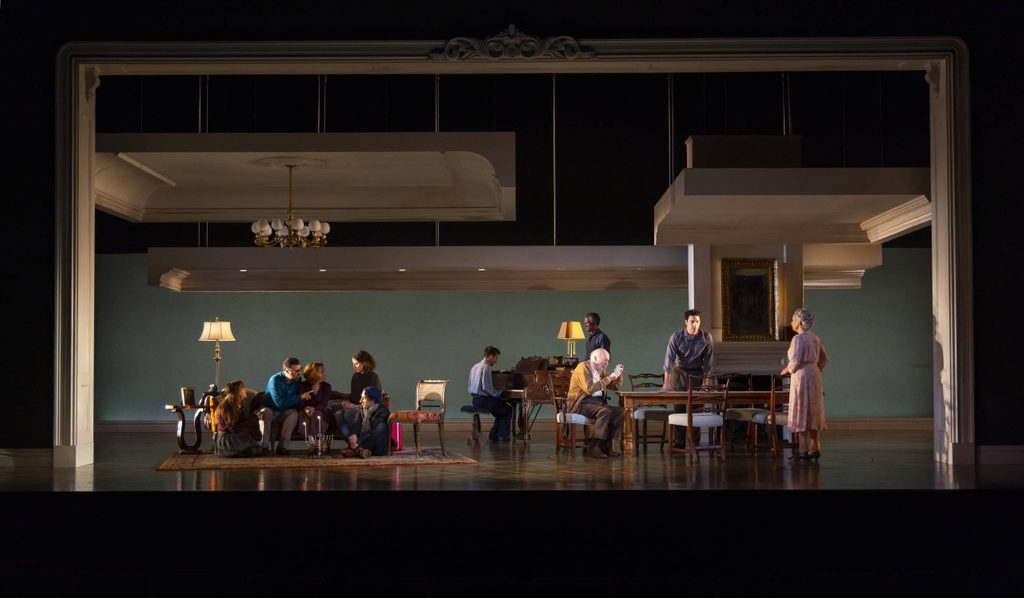
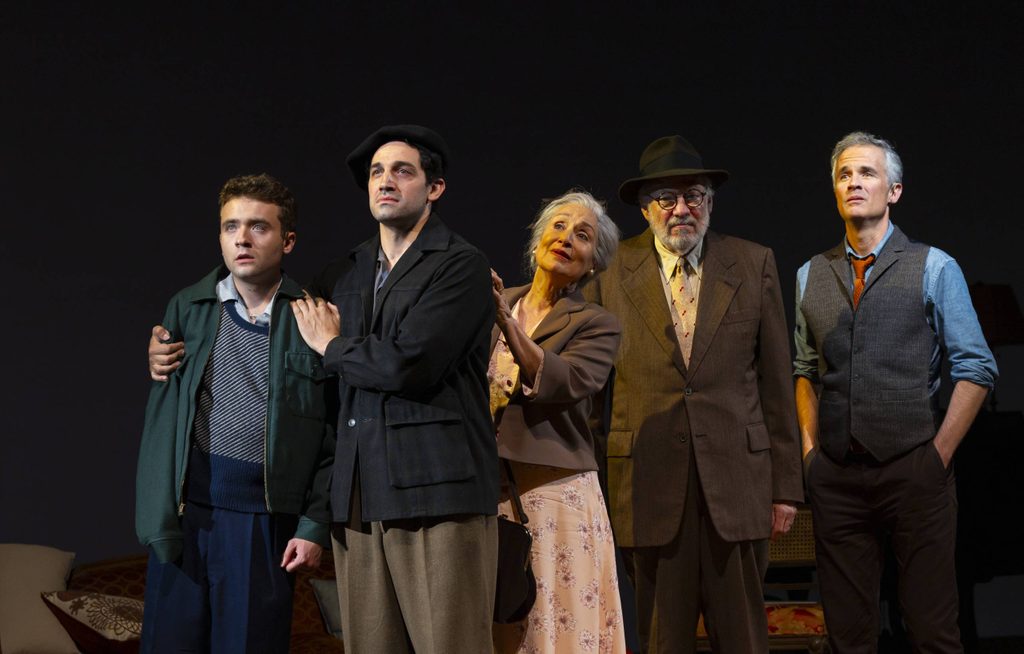
Cast of The Huntington’s ‘Prayer for the French Republic’.  Photo by Nile Hawver.

‘Prayer for the French Republic’ – Written by Joshua Harmon. Directed by Loretta Greco. Scenic Design by Andrew Boyce. Costume Design by Alex Jaeger. Lighting Design by Christopher Akerlind. Sound Design and Composition by Fan Zhang. Presented by Huntington Theatre, 264 Huntington Ave., through October 8.

By Shelley A. Sackett

Playwright Joshua Harmon has a gift for tackling important, profoundly challenging and topical subjects and, through sheer brilliance of characters and dialogue, creating intimate and accessible theater that both rivets his audience and leaves them in a standing ovation of thunderous applause.

He did it with “Bad Jews,” “Admissions,” and “Significant Other,” which Boston theatergoers had the good fortune to see at SpeakEasy Stage Company. Thanks to the Huntington Theatre’s season opener, the 2022 Drama Desk Outstanding Play Award-winning “A Prayer for the French Republic,” they have the opportunity to experience this supremely talented writer’s latest and most ambitious project.

And experience it they should.

Under Loretta Greco’s razor-sharp direction, the 11-member cast masterfully brings Harmon’s themes of antisemitism, assimilation, family, freedom, identity and fear — to name a few — to life. Despite its three-hour running time (one intermission), the fast-paced and sharp-witted dialogue makes the time fly by.

Set in Paris in 2016 and 1945, the play follows five generations of Jewish piano sellers. Marcelle Salomon Benhamou, the current matriarch, her husband Charles and their children, Daniel (26) and Elodie (28), are the contemporary members of the original Salomon family. Hers is a complicated and intricate family tree, full of twists and turns and bent and broken branches.

Jesse Kodama, Jared Troilo, Phyllis Kay, Peter Van Wagner, Tony Estrella

The play opens with house lights up as Patrick (Tony Estrella), the play’s narrator and Marcelle’s brother, addresses the audience. His eye contact and hands-in-trousers-pockets ease establish rapport and immediacy. “What is the beginning of a family?” he asks as he strolls across a set that will represent both 1945 and 2016. “And what,” he doesn’t ask but seems about to, “is its end?”

The calm is broken by a thrust into the Benhamou apartment, where Marcelle (the sublimely talented Amy Resnick) continues Patrick’s train of thought by explaining the family genealogy to a dumbfounded guest, Molly (Talia Sulla), a naïve and distant sort of cousin from America who is spending her junior year abroad in Paris. Molly (like the audience) tries to absorb the details but is thankful when Marcelle repeats the accounting.

Jumping to the present, Marcelle explains that Daniel is their religiously observant son. Daughter Elodie has been struggling with mental health issues and is, well, Elodie. Molly nods in mute agreement.

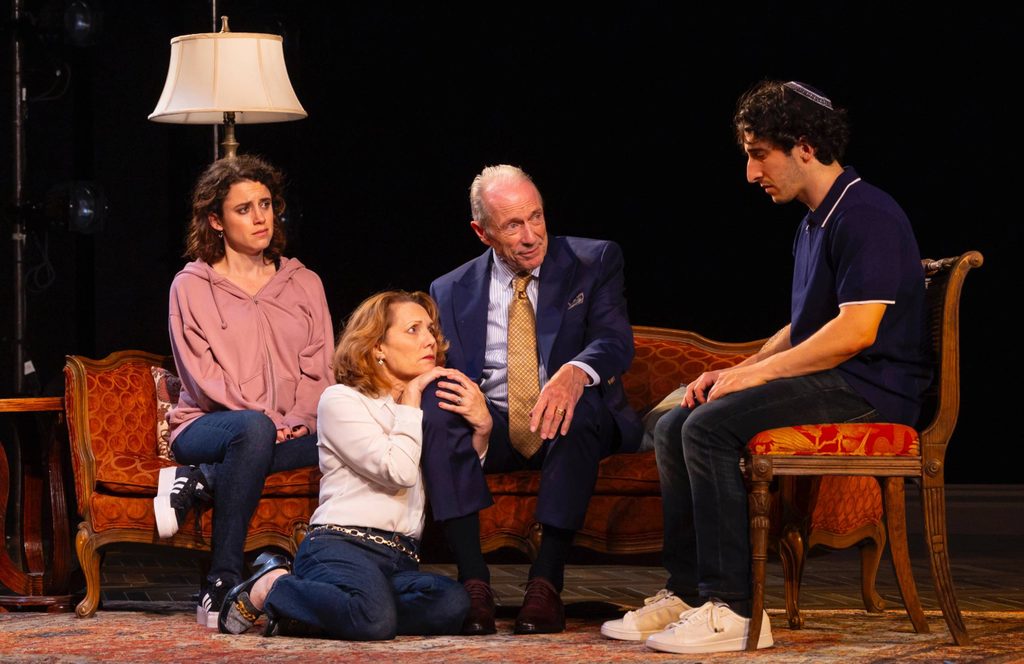
Just as Molly (and we) sort of get it, Charles (the always amazing Nael Nacer) and Daniel (Joshua Chessin-Yudin) burst through the door. Daniel, who teaches at a Jewish school and wears a kippah (Jewish head covering), has been attacked by a gang of antisemitic thugs. His face is bloody, but he is nonplussed. His parents are apoplectic.

“How many times have I begged you to wear a baseball cap?” Marcelle pleads, comparing his refusal to hide the kippah to painting a target on his back that screams, “Here I Am.” She urges her son to wake up to the danger he invites by advertising his religion in what is France’s current climate, where Holocaust deniers and Nazi sympathizers hold more sway. What she doesn’t do is entertain any thought of fleeing the country where her family of Ashkenazi ancestors has lived for centuries.

Carly Zien, Amy Resnick, Will Lyman, Joshua Chessin-Yudin

Charles’ reaction is different. He has seen this before and knows where it can lead. His North African Sephardic Jewish ancestors have been living in diaspora since they were forced to flee their home in Algeria in the 1960s. 

“It’s the suitcase or the coffin,” he says. He has reached his limit. He wants to go “home.” He wants to move to Israel. It may be unsafe there, too, but at least everyone is unsafe, not just Jews.

The family’s real firebrand and deliverer of Harmon’s celebrated monologues and dialectic analyses is Elodie (an electrifying Carly Zien, who steals every scene she’s in). While she may present as disheveled, her lines of logic and fact-based arguments are sources of encyclopedic knowledge and awe. She is not mentally ill so much as she is reacting in an unhinged way to a world that has come unhinged. (Her interaction with Molly at a bar is worth the price of admission and deserving of a standing ovation).

Harmon then quietly relocates us to 1944 (Andrew Boyce’s set accomplishes this seamlessly and with elegant artistry), where we meet Marcelle and Patrick’s great-grandparents, Irma and Adolphe Salomon (Peter Van Wagner and Phyllis Kay, both charming). They sit in their apartment towards the end of World War II, wondering what has happened to the rest of their family. Miraculously, they were able to remain in Paris during the war after the Nazis sent to deport them took pity on their age and left them alone. They have even managed to hold onto their piano store.

“What do people remember when you’re gone?” narrator Patrick asks the audience, pointing to his forebears. He then tells the story (Estrella really shines here) of how Irma would butter Adolphe’s toast first, and then use what was left to butter her own, in order to make it last longer and hide their dire circumstances from Adolphe. Those tiny, very human details are only one example of Harmon’s many playwriting virtuosities.

Writing cutting, funny, fast-paced and well-researched dialogue is another. The words fly at whiplash speed when the action shifts from 1944 back to 2016, where we pick up where we left off. Daniel and Molly are getting to know each other. (“How did you become religious?” she asks. “I prayed and I liked it, so I kept going,” he replies.)

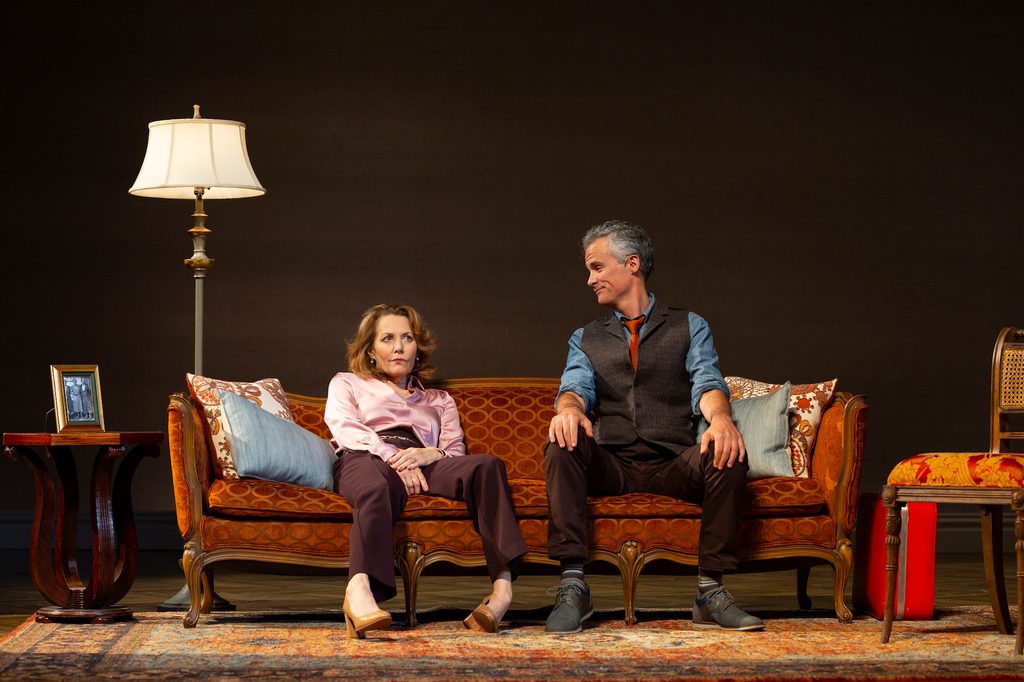
Amy Resnick, Tony Estrella; photo by T Charles Erickson

Charles makes his case for leaving France before it’s too late (“I’m scared. Something is happening,” he confesses). Marcelle, quintessentially French and clinging to control, argues that Jews are never safe. Anywhere. At any time. Jew hatred, which in 2016, with the 2015 Charlie Hebdo and kosher deli shootings in Paris, the rise of the ultra-right in Europe and the election of Trump in America, has been regaining a foothold globally, is just the way it is.

“What is history but a bunch of stuff other people tell you to get over,” Patrick asks when later, with calm, cynicism and a touch of sadness, he gives a matter-of-fact account of the centuries of persecution suffered by Jews at the hands of the French, starting in 1096 with the Crusades.

And yet, France was the first country in Europe to offer Jews the full rights of citizenship in the hope that they would stop acting like a separate nation and assimilate, identifying more as French than as Jews. Making the case for staying put, he alludes to the fact that even the Holocaust couldn’t uproot the Salomon French family tree. Nor did it force them to convert (although he chose to marry a Catholic). They can withstand this comparative blip.

“Prayer for the French Republic” addresses many deeply troubling topics. Why are people obsessed with Israel? Is it appropriate for Jews to be scared? Is it irresponsible not to be? Now that Israel’s internal politics have so radically shifted, is even Israel still safe? Is it really “home?” Are we at the same tipping point where we were right before the Holocaust? At what point do we acknowledge that our world has hit an iceberg and, like it or not, our choices are to jump overboard or go down with the mother ship?

For this reviewer, the most telling moment was the play’s end. Would Harmon come down on the side of staying put in France or moving to Israel? As the cast belted out the French national anthem, “La Marseillaise” instead of Israel’s “Hatikva,” we had our answer.

For more information and to buy tickets, visit https://www.huntingtontheatre.org/

Deb Schutzman to become executive director at Swampscott’s Congregation Shirat Hayam

Deb Schutzman / STEVEN A. ROSENBERG/JOURNAL STAFF

By Shelley A. Sackett

SWAMPSCOTT — About a year ago, Congregation Shirat Hayam President Ruth Estrich knew the synagogue would be hiring an executive director. The board of directors had included the salary in their budget and generated the revenue to fund it.

The Swampscott synagogue didn’t have to travel far to find the perfect fit: Deb Schutzman has worked at Temple B’nai Abraham in Beverly for 18 years, the last 15 as its executive and education directors. B’nai Abraham is just over 7 miles from Shirat Hayam.

It has been a while since Shirat Hayam had an executive director, and Estrich, a retired corporate executive, knew what the synagogue needed.

“We were looking for a seasoned professional, someone who would be capable of leading our employees, working collaboratively with our clergy, being the face of our congregation with our congregants, and supporting our board and our volunteers,” Estrich said.

In addition, the synagogue wanted someone who would honor Shirat Hayam’s history; create unprecedented growth for the future and attract new members; increase revenue; and provide all segments of the community with a place to call home.

“A piece of cake!” Estrich said with a laugh.

The next step was to craft a contemporary and comprehensive job description. The Shirat Hayam human resource committee – after gathering information from congregational stakeholders – created a draft. They vetted it with two national organizations: the United Synagogue of Conservative Judaism – the major congregational organization of Conservative Judaism in North America – and the North American Association of Synagogue Executives.

Estrich heard about Schutzman through “good old-fashioned networking.” They connected online and set up an in-person meeting.

“I knew immediately and absolutely our search was over. It felt bashert [Yiddish for “meant to be”], like the missing piece of our puzzle was in place,” she said.
Schutzman, who was born in Lowell and lives in Gloucester, brings expertise in community building, facility management, and strategic planning. She also has a deep love for the Jewish community of the North Shore. During her years as executive director at B’nai Abraham, she participated in hiring a new rabbi, a successful merger, increasing adult education programming, adding music to services, and launching a capital campaign.

While Schutzman loved her tenure at B’nai Abraham, she was ready for a change. “Shirat Hayam faces the same challenges as other synagogues. We all need to get people back into the building,” she said.

Although she acknowledged that the pandemic made attending services virtually both easier and more acceptable, “Nothing compares to being physically together. Shabbat is just not an ordinary experience at Shirat Hayam. There is an energy when we are physically together that makes it very special.”

One of her greatest joys at B’nai Abraham was her involvement with the religious school, and she especially loves watching kids come into the sanctuary at the end of Shabbat services and high-five Rabbi Michael Ragozin before chanting the blessings over wine and challah.

“Children are our greatest gifts. While teaching them, we are reminded about what is truly important and meaningful in life. The value of that teaching experience for me was priceless,” she said.

As executive director, Schutzman’s first focus at Shirat Hayam will be assessing its staffing needs. “Shirat Hayam has an incredible staff who have worked tirelessly over the past few years to hold things together during very unusual circumstances,” she said. As the congregation turns the corner on the pandemic and its ramifications, the needs of the community require reevaluation.

“Synagogue life has changed. How we communicate and interact is different now, and we need to ensure that we have the people in place with the skills to meet those needs,” she said.

Schutzman’s longer-range goals are to stabilize the operations side of the synagogue; improve communication; training and support for staff; address deferred facility maintenance; and plan for the future.

“I want to help fill the building not just for services, but for educational and social programming, life cycle events, and celebrations,” she said.

Schutzman attended Hebrew day schools from kindergarten through ninth grade. She lived in Israel for two years during high school and graduated from the New England Academy of Torah in Providence. She studied business administration at Stern College of Yeshiva University in Manhattan and UMass Lowell, after which she spent 12 years in retail store management for Macy’s and Filene’s Basement before joining B’nai Abraham.

She is the proud mother of Benjamin and Andrew and loves kayaking on the Annisquam River from May though November, “especially at sunset.”

With her term as president nearing its end, Estrich will be leaving on a personal high note with Schutzman at the organizational helm. “I’d say that with Rabbi Michael, Cantor Sarah and Deb, we’ve got the dream team and the sky’s the limit. I can’t wait to see where they take us,” she said.

Author to tell Golda Meir’s story through a feminist lens at JCCNS

Pnina Lahav, author of “The Only Woman in the Room”

By Shelley A. Sackett

MARBLEHEAD — There is no dearth of books about and by Golda Meir, the Israeli politician, teacher, and kibbutznik who served as the fourth prime minister from 1969 to 1974. Yet, as far as Pnina Lahav was concerned, Meir’s real story was still untold.

The former law professor and member of the Elie Wiesel Center for Judaic Studies at Boston University last September published, “The Only Woman in the Room: Golda Meir and Her Path to Power,” which looks at Meir through a feminist lens, focusing on her recurring role as a woman standing alone among men. The meticulously researched book is chockful of anecdotes that flesh out Meir’s full identity as a woman, Jew, wife, mother, and Zionist leader who was one of the founders of Israel.

On Tuesday, March 21 at 7 p.m., the Jewish Community Center of the North Shore in Marblehead will sponsor “An Evening with Pnina Lahav,” where the Israel-born scholar will talk about her new book with this Journal correspondent and answer questions from the audience. The event is part of the Israel at 75 series and will be followed by a dessert reception.

The idea for the book emerged as Lahav approached retirement and found herself reflecting on her career and what had most resonated with her over the decades. In 1998, she wrote her first biography, an award-winning book about Shimon Agranat, the third president of the Supreme Court of Israel. She had enjoyed both the process and the positive reviews and prizes it earned.

While searching for a special retirement gift to herself, she came up with the perfect idea: She would write another biography and return to the topic that had held her interest for half a century, since she published her first article in 1974 titled, “The Status of Women In Israel: Myth and Reality.”

“I decided to explore how Golda, the most successful Israeli politician of the 20th century and the fourth and only woman prime minister, functioned between the myth of equality and the reality of misogyny,” Lahav told the Journal. The title is both a play on the famous statement, attributed to David BenGurion, that Golda was ‘the only man in the room,’ and a tip of the hat to the fact that Golda surrounded herself with men. She made sure she was indeed the only woman in her political room.

Lahav’s biggest challenge was covering the entire history of Israel through a gender-oriented lens, from the Second Aliyah (1904-1914) to the Yom Kippur War (1973). She hopes today’s Jewish woman learns a lesson of perseverance from reading about Golda’s life story.

“If you want something with all your heart, try to get it, try to do it all, and do not fear criticism. At the end, you will be a happier person.” Lahav said. Θ

The event is free to JCCNS members, $10 for the community. To register, visit jccns.org.

Jewish Americana band Nefesh Mountain will light up the Shalin Liu stage for Hanukkah

Doni Zasloff and Eric Lindberg (with mandolin) and their band, Nefesh Mountain. NEFESHMOUNTAIN.COM

By Shelley A. Sackett

Doni Zasloff has always felt like a “spiritual cowgirl.”

The songs she and her husband, Eric Lindberg, write and sing for Nefesh Mountain – the band they co-founded – draw from Jewish history, tradition, and religion, but they work in a musical idiom that wouldn’t seem at all Jewish – bluegrass.

It all started in 2010, when Zasloff met guitarist and banjo player Lindberg. Raised in Brooklyn, he attended Hebrew school and synagogue. He also spent summers with his father’s relatives in North Georgia, playing music with his uncles and learning their southern traditional styles, like Appalachian, bluegrass, and blues.

Jewish music was a big part of Zasloff’s traditional Jewish childhood in Philadelphia, where she attended synagogue, Jewish schools and camps. She joined all the theater productions from her Jewish youth groups and learned to chant from the Torah and lead services at a very young age.

In 2010, the two started playing music together and Lindberg opened Zasloff’s eyes and ears to the beauty and depth of old time Americana music. They see their music as the perfect expression of their love and identity as American Jews.

“For us, these are all fragments of who we are as Jewish Americans,” Zasloff said by phone from her Montclair, N.J., home during a break from the band’s busy tour schedule. “It’s our story of wanting to be authentic and honest while putting love out into the world.”

Since 2016, Nefesh Mountain has released four albums: “Nefesh Mountain” (2016); “Beneath The Open Sky” (2018); “Songs for the Sparrows” (2021), and “Live From Levon Helm Studios: A Hanukkah Holiday Concert” (2021).

On Nov. 29, they will illuminate the Shalin Liu Performance Center stage in Gloucester with the kickoff concert for their 2022 Hanukkah Tour.

The tour grew out of the couple’s desire to stay on top of their careers as musicians during the pandemic lockdown of late 2020. They wanted to live-stream an event into people’s homes, and Hanukkah seemed like a good time to do it.

“Hanukkah is a celebration, and we wanted to bring some light into a very dark year and dark time for everybody,” Lindberg explained by phone.

The band got together at the Levon Helm Studio in Woodstock, N.Y. After their live presentation, they had all the audio recordings. “We thought, ‘Let’s just get it out there,’ ” Lindberg said, and they imprinted a CD and started streaming it on Spotify and other social and music media. In 2021, they took the album on the road with their first Hanukkah Holiday Concert Tour, which also opened at the Rockport venue.

“Touring is harder now than even before the pandemic, but it’s the only way to make a sound living as a musician,” Lindberg said, referring to the financial impact of streaming on artists. The model, he says, hasn’t changed in 100 years. “You come up with an album, go out on the road and meet people, and it becomes part of your career.”

Their repertoire (and the album) includes “Donna, Donna” and several by American folk singer-songwriter Woody Guthrie – who penned the music to a “baker’s dozen” of Hanukkah songs. “We’re kind of an Americana folk band, and it’s fun to bring this music to life within the context of what we do,” Lindberg said.

Lindberg specifically recalls recalled one Hanukkah from his youth when his parents played Harry Belafonte’s 1959 Caribbean version of “Henei Ma Tov” right after they lit the Hanukkah candles. He remembers listening to this song, watching the candles and feeling “this otherworldly thing. Wherever music transports us to is a place I feel lucky to go,” he said. “Donna, Donna,” based on an Eastern European Yiddish folk tale, has that same spirit that, to Lindberg, “fits the vibe of Hanukkah.”

Their 2012 album, “Songs for the Sparrow,” also evolved out of the couple’s shared experiences and Jewish heritage. American Songwriter described it as “arguably some of the best bluegrass ever made.”
In 2018, Zasloff and Lindberg took a trip to Poland and Ukraine, visiting many of the cities and towns where their ancestors had lived and met violent deaths during the Holocaust.

At the cemetery where Lindberg’s great-grandfather was buried, a huge swarm of sparrows suddenly flew overhead. “There was something in that moment that we thought about until we got home. The song, ‘A Sparrow’s Song’ is for them – the lives that were lost, the voices silenced,” Zasloff said.

A few months after their they returned home, a gunman walked into the Tree of Life synagogue in Pittsburgh and murdered 11 people. The next morning, Lindberg, still shaken, woke early and started working on a melody. Zasloff joined him, and “Tree of Life,” a somber banjo song that ends with the words, “Oh sweet spirit hear my prayers/help these words heal someone out there,” poured out of them. The song also appears on the album.

“We’re not politicians. As musicians, this is what we do,” Zasloff said.

The Nefesh Mountain website, nefeshmountain.com, calls their music “the place where American bluegrass and old-time music meet with Jewish heritage and tradition.” Zasloff chafes at attempts by others to label their music as Jewish Bluegrass, “Jewgrass” or other mash-ups.

“There’s no kitsch in our music,” she said. “It’s our truth.” Θ

Visit rockportmusic.org/nefesh-mountain.

Book your ticket to hear eight top authors at the Marblehead JCC’s speaker series

The 28th Annual Jewish Book Month Speaker Series will be held at the Jewish Community Center of the North Shore.

by Shelley A. Sackett

MARBLEHEAD – Once again, culture vultures on the North Shore are in luck. From Oct. 12 until Nov. 29, the 28th Annual Jewish Community Center of the North Shore Jewish Book Month Speaker Series in Marblehead will treat locals to in-person conversations with seven authors and a virtual interview with another, and a catered lunch in memory of Susan Steigman, a former JCCNS staff member, longtime JBM committee member, and dedicated JCCNS volunteer.

JBM cochairs Sylvia Belkin and Patti McWeeney and their committee have selected a bang-up roster of eight non-fiction, mystery, memoir, historical fiction, and cookbook authors. Sharon and Howard Rich continue as longstanding cultural benefactors. Discounted ticket packages to all events are available at $165 for members and $180 for non-members.

Opening night features two-time Peabody Award-winning writer and CBS News “60 Minutes” producer Ira Rosen, who will talk about his revealing tell-tale memoir, “Ticking Clock: Behind the Scenes at 60 Minutes.” The book – dubbed “a 60 Minutes story on 60 Minutes itself” – details the intimate and untold stories of Rosen’s decades at America’s most iconic news show, including war room scenes of clashing producers, anchors, and correspondents like the legendary Mike Wallace. The Oct. 12 event at 7 p.m. at the JCCNS is $30 and includes a reception.

Letty Cottin Pogrebin, journalist, lecturer, social activist, a founding editor of Ms. magazine, and the author of 12 books, will speak about her latest, “Shanda: A Memoir of Shame and Secrecy.” Fears of shanda (shame or disgrace in Yiddish) and public humiliation and an overarching desire to fit in drove three generations of her immigrant family to lie and cover up long suppressed secrets. Pogrebin unmasks their hidden lives – including her own long suppressed secret – and showcases her family’s talent for reinvention in an engrossing and illuminating narrative. This writer will interview her on Zoom on Oct. 19, which can be seen by a live audience and also at home – both for $20.

Marblehead resident and best-selling author Eric Jay Dolin will speak about his latest book, “Rebels at Sea: Privateering in the American Revolution” on Oct. 27 at 7 p.m. at the JCCNS ($20 includes a reception). Dolin contends that privateers (aka pirates), thousands of whom tormented British ships, were critical to the war’s outcome. Abounding with tales of daring maneuvers and deadly encounters, Dolin’s book reveals the history of this critical period in the nation’s founding in a way rarely documented.

Two historical novels, set against the backdrop of World War II, bring life and romance to very different stories. Based on the true account of Coco Chanel’s war-time romance with a German spy and how that affair led to her arrest for treason following the liberation of Paris, author Gioia Diliberto, who will be interviewed by JCCNS past president Izzi Abrams, takes a closer look at Chanel, her powerful personality, and her activities during the occupation of France in “Coco at the Ritz.” (Nov. 2 at 7 p.m. at the Boston Yacht Club for $30.

Weina Randel’s “The Last Rose of Shanghai,” set in 1940 when the city was occupied by Japan, brings to life Shanghai’s history as a haven for Jewish refugees as well as its dynamic jazz scene, all through a heart-rending and timeless love story. (Nov. 10 at 7 p.m. at the JCCNS. $20 includes reception)

In partnership with the Consulate General of Israel to New England, chef and restaurateur Avi Shemtov will talk about “The Simcha Cookbook,” which celebrates the traditions of Shemtov’s Turkish-Israeli heritage and recreates the delectable dishes those familiar with his Sharon restaurant have come to cherish. The event, in memory of Susan Steigman, is on Nov. 13 at 11 a.m. at the JCCNS. $30 includes lunch.

Beloved bestselling writer B.A. Shapiro will speak about her masterful novel of psychological suspense, “Metropolis,” on Nov. 16 at 7 p.m. at the JCCNS ($20 includes a reception). In her latest, Shapiro follows a cast of six intriguing characters with no obvious ties to each other except they all store goods at the same warehouse in Cambridge. After a fatal accident, their precariously balanced lives are torn apart in this page-turning mystery.

Closing the series is “The Imposter’s War,” a riveting narrative about intrigue and espionage by Mark Arsenault. Arsenault has covered national politics, gambling, and worked on Spotlight Team investigations as a staff reporter for the Boston Globe, which won a Pulitzer Prize for its coverage of the Boston Marathon bombing. In his first nonfiction book, he tells the stranger-than-fiction story of the efforts of John Rathom, the Australian-born editor of the scrappy Providence Journal, to shift American attitudes toward involvement in World War I after Germany spent the modern equivalent of $1 billion to infiltrate American media, industry, and government in the hopes of undermining the supply chain of Allied forces. Without the ceaseless activity of this editor, America may have remained committed to its position of neutrality. Yet, Rathom was not even his real name! Arsenault asks and answers the question: who was this great, beloved, and ultimately tragic imposter? (Nov. 29 at 7 p.m. at the JCCNS. $20 includes a reception.)

The Jewish Community Center of the North Shore is located at 4 Community Road, Marblehead. For more information and to buy tickets, go to
jccns.org/jewish-book-month

All books can be purchased through Copperdog Books in Beverly at copperdogbooks.com/jewish-book-month