The Huntington’s Superb Musical ‘Fun Home’ Plumbs Memories and Memoirs

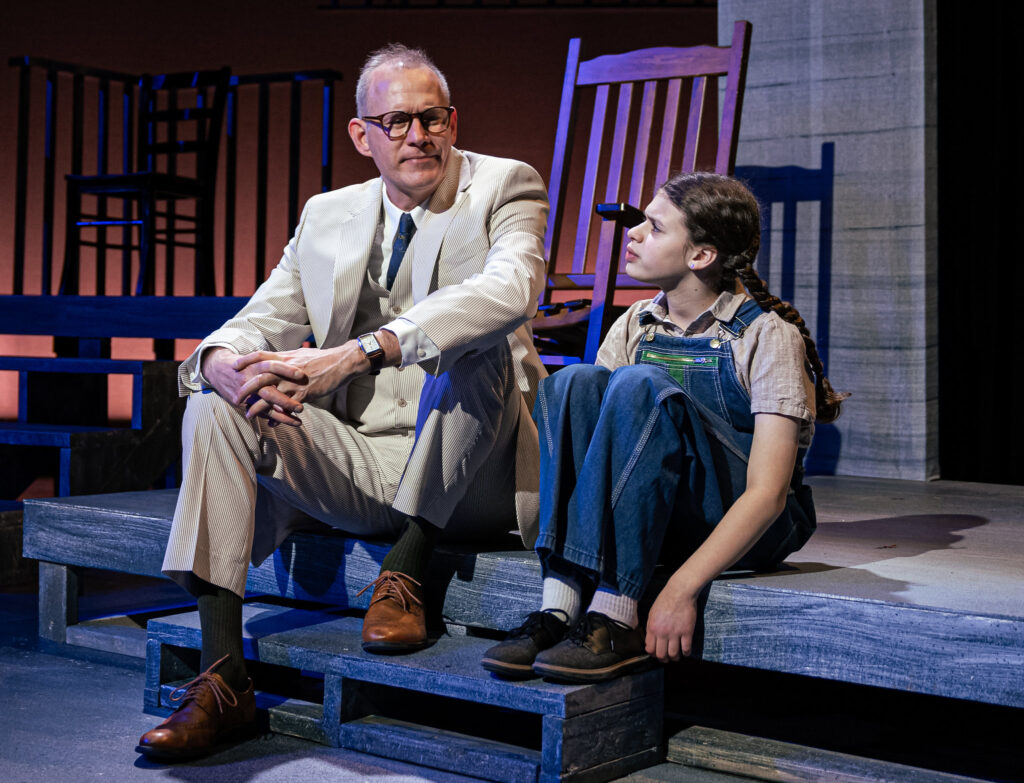
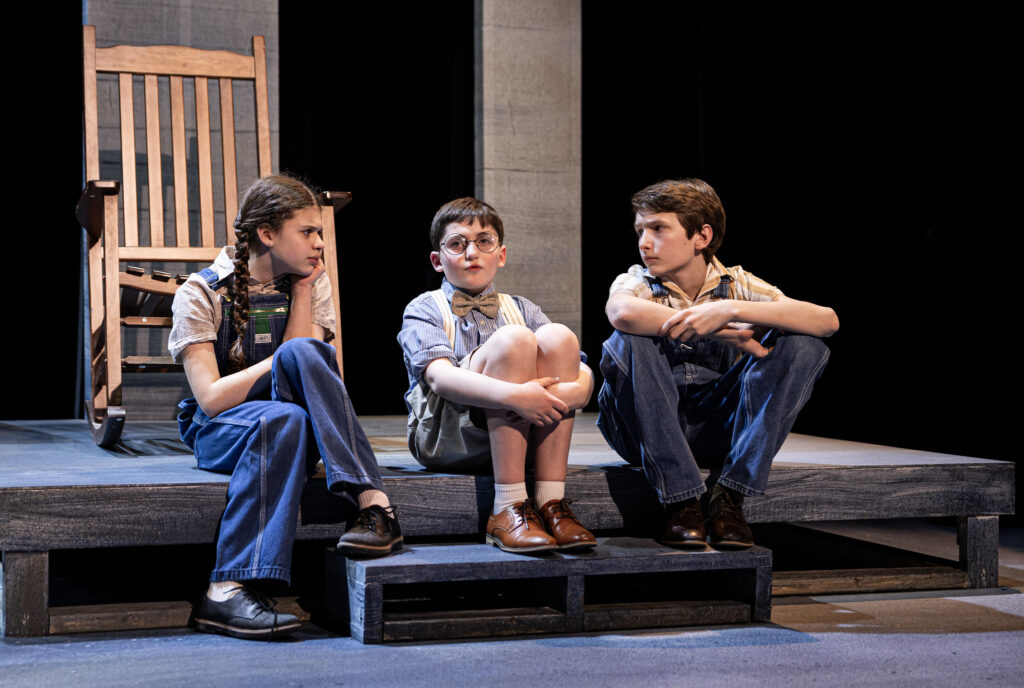
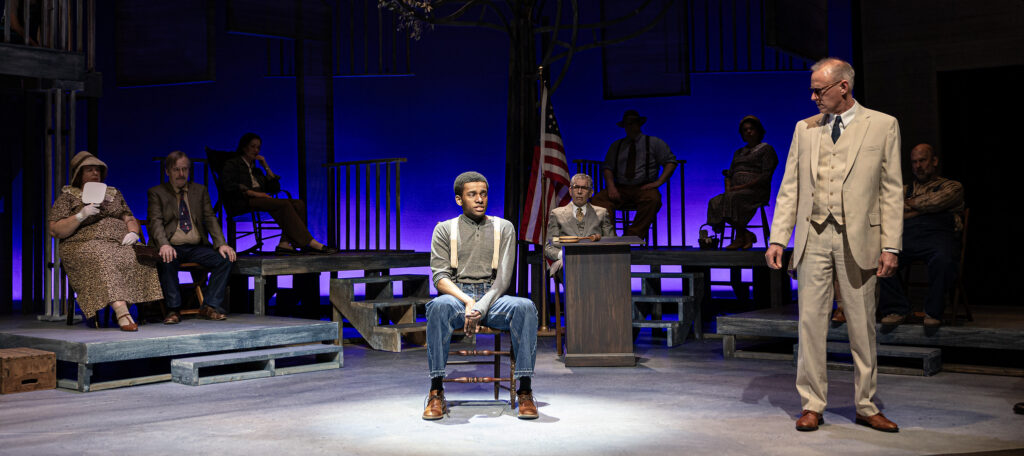
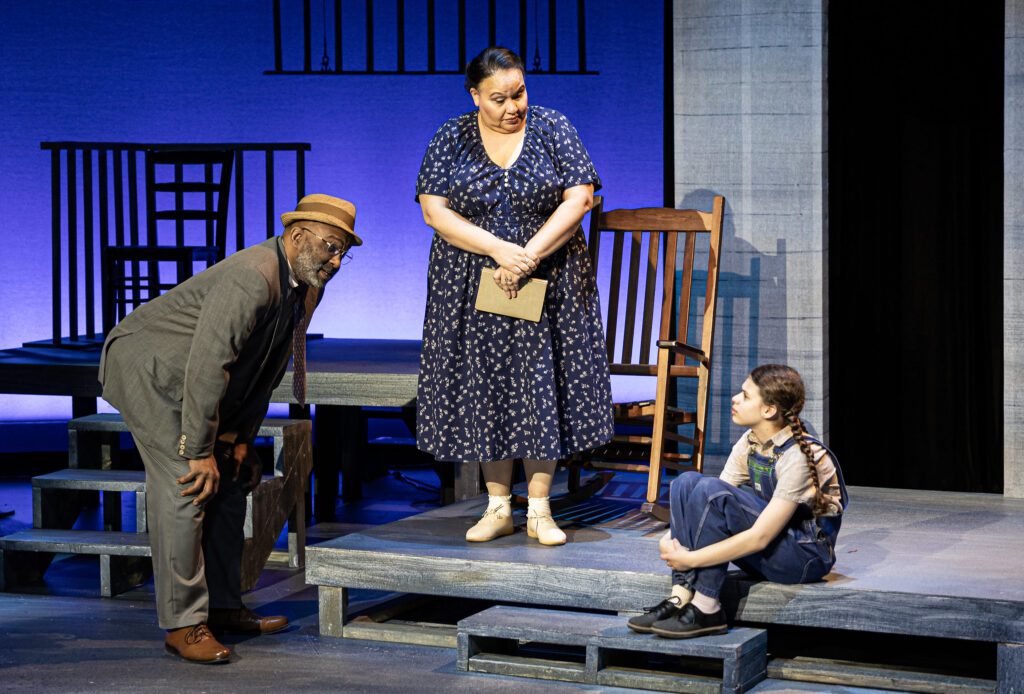
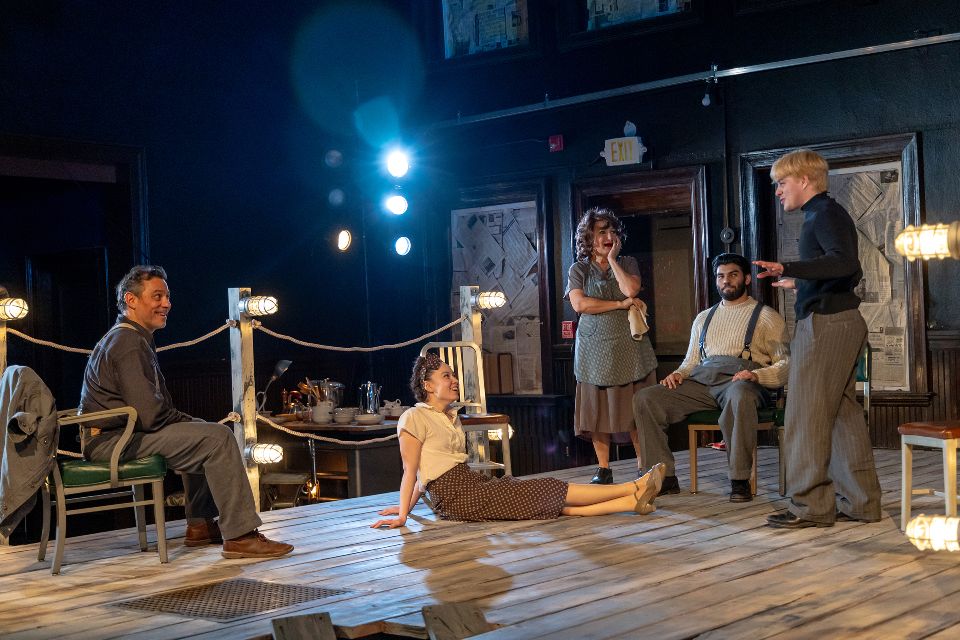
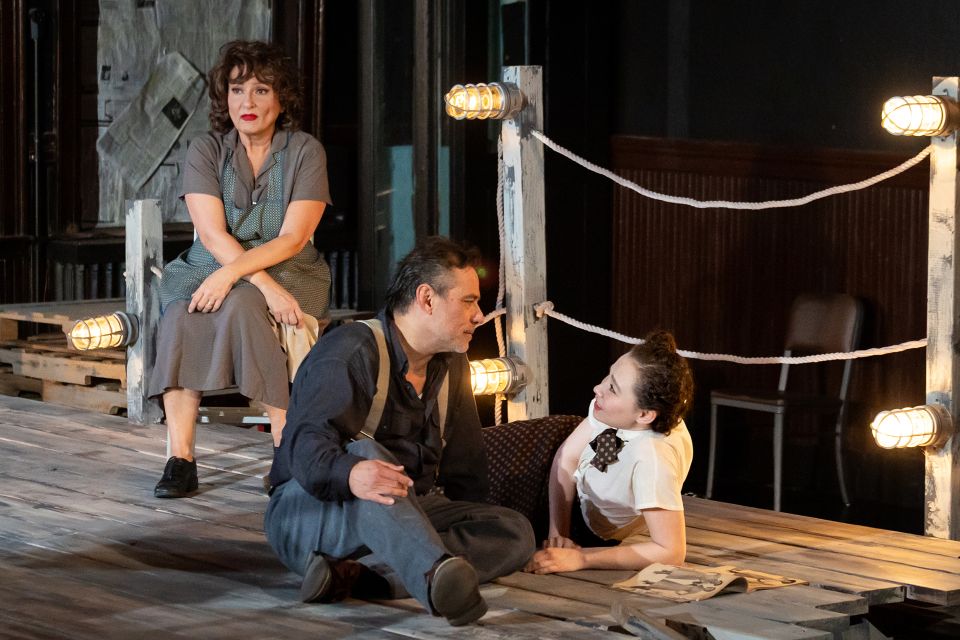
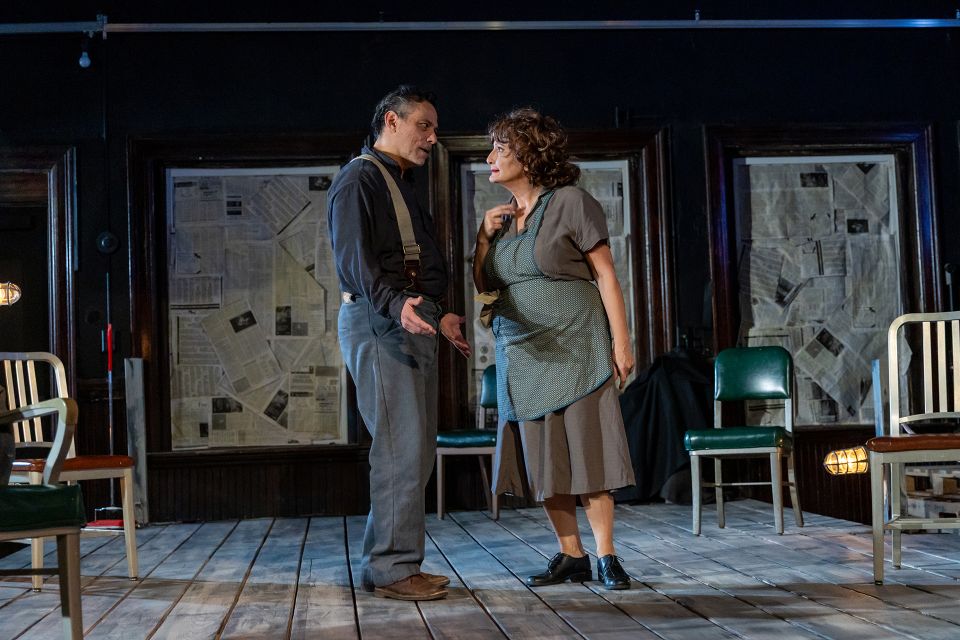
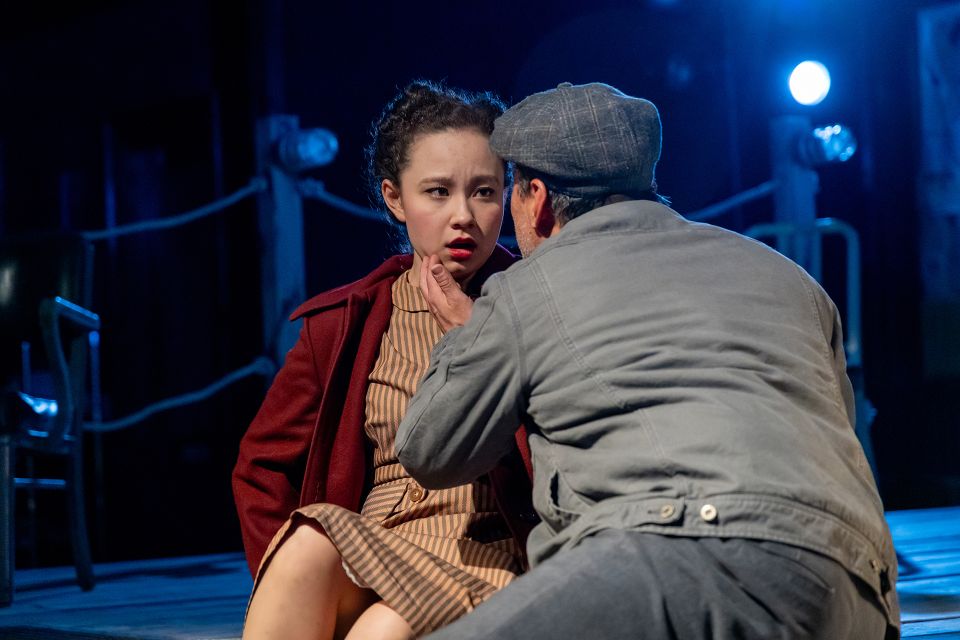
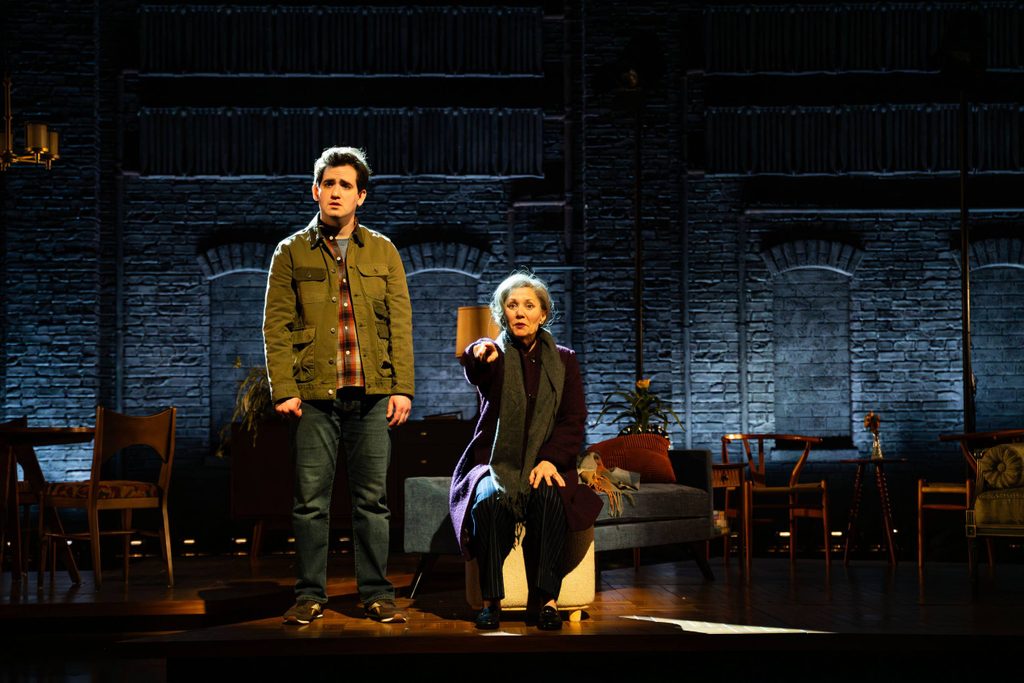
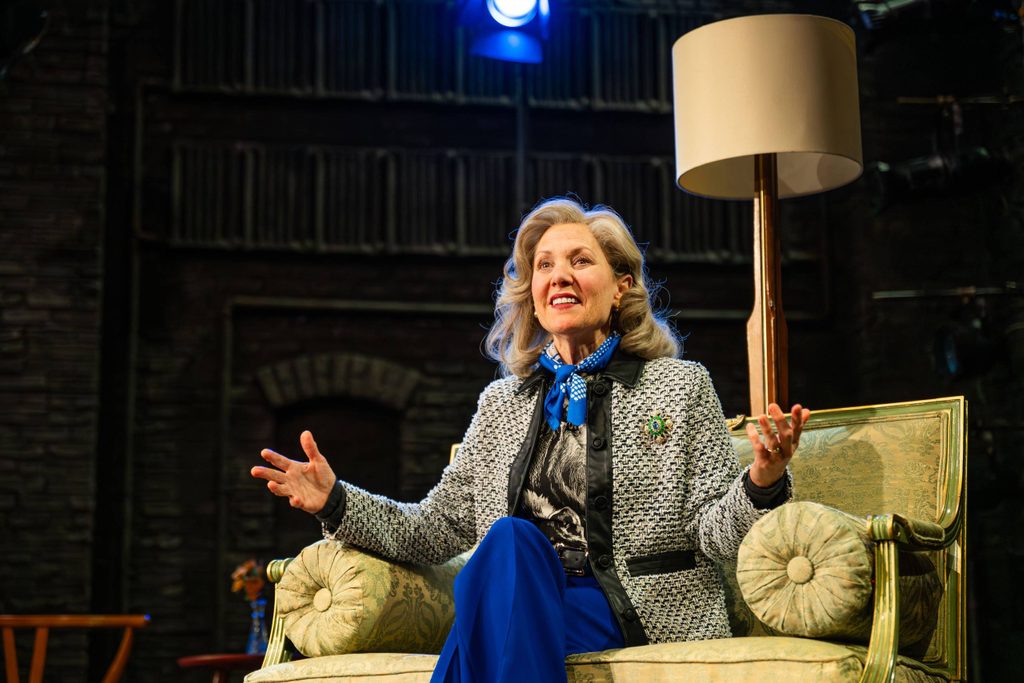
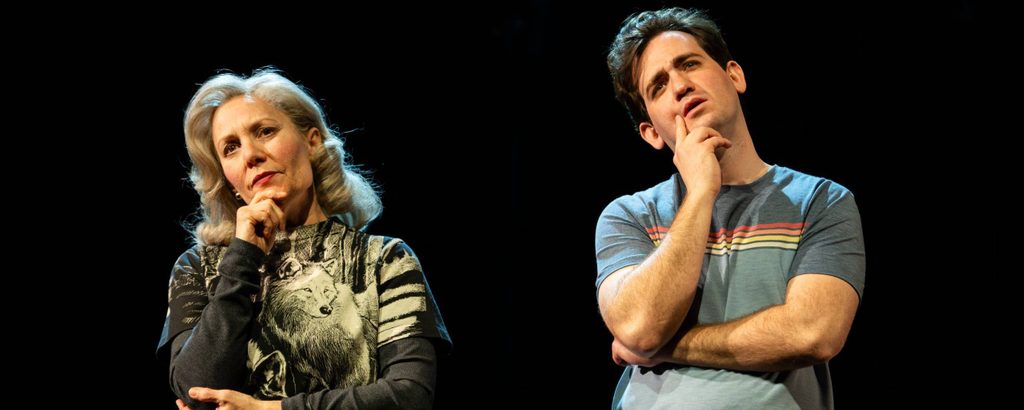
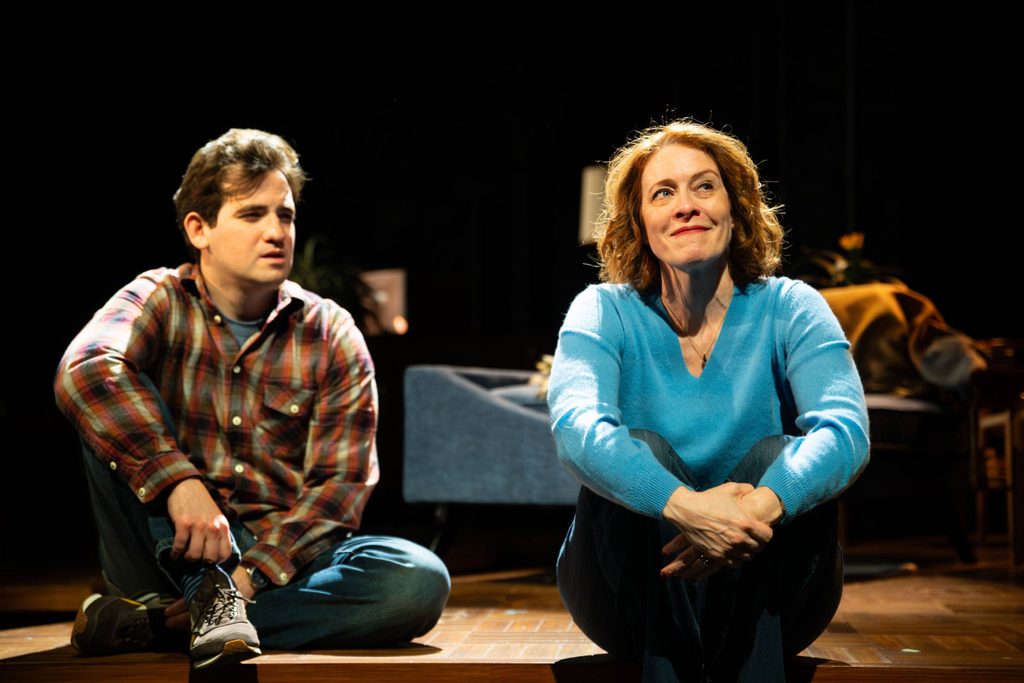
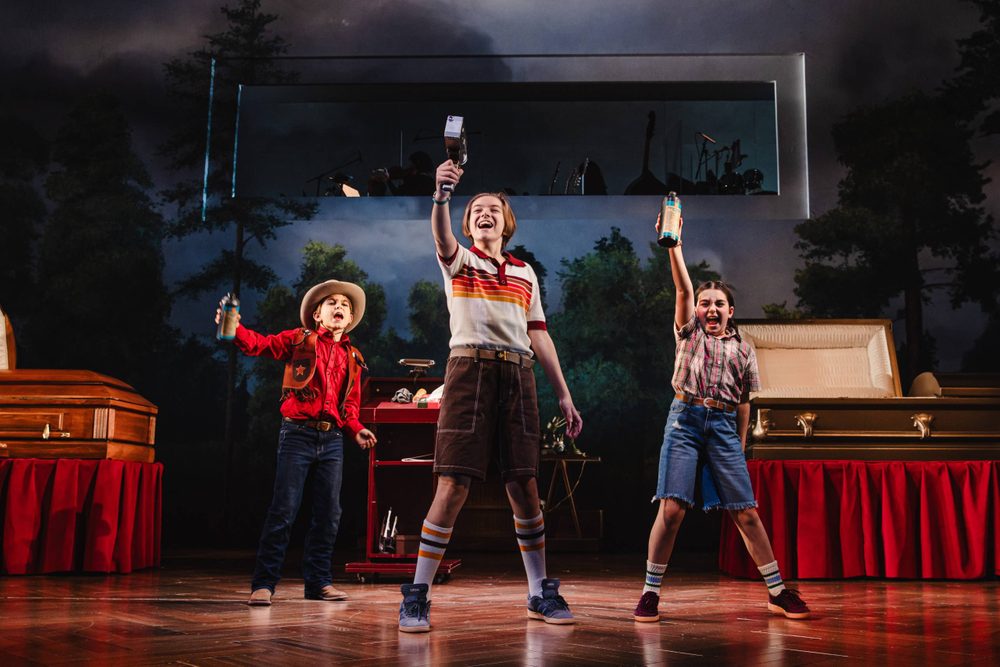
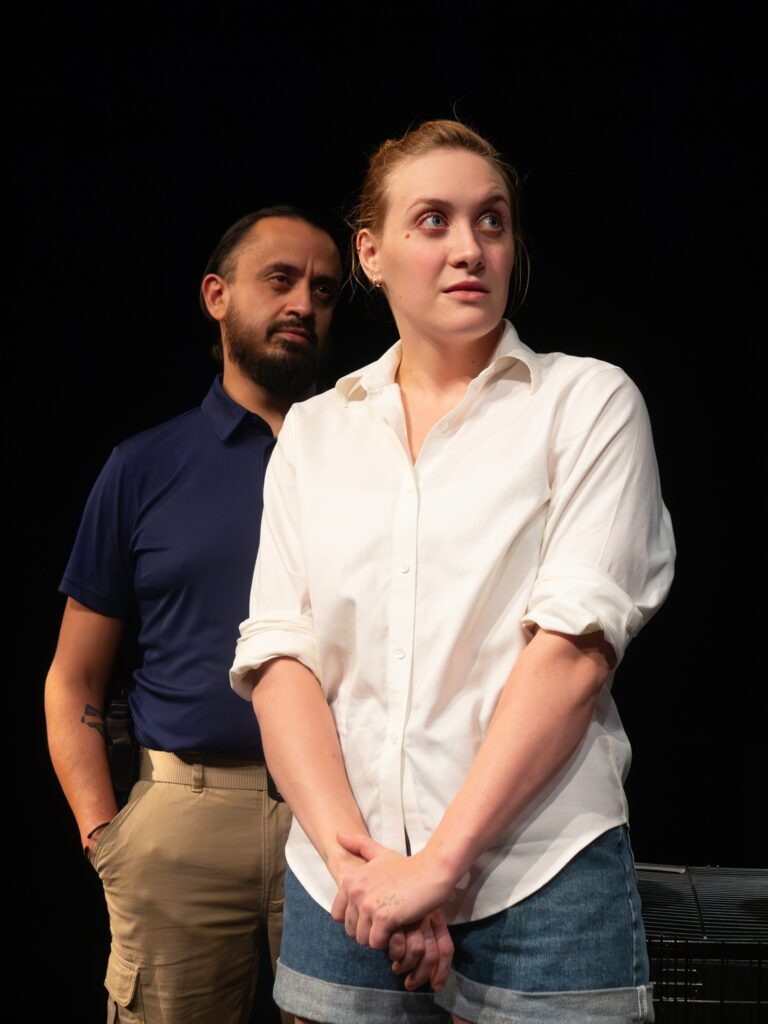
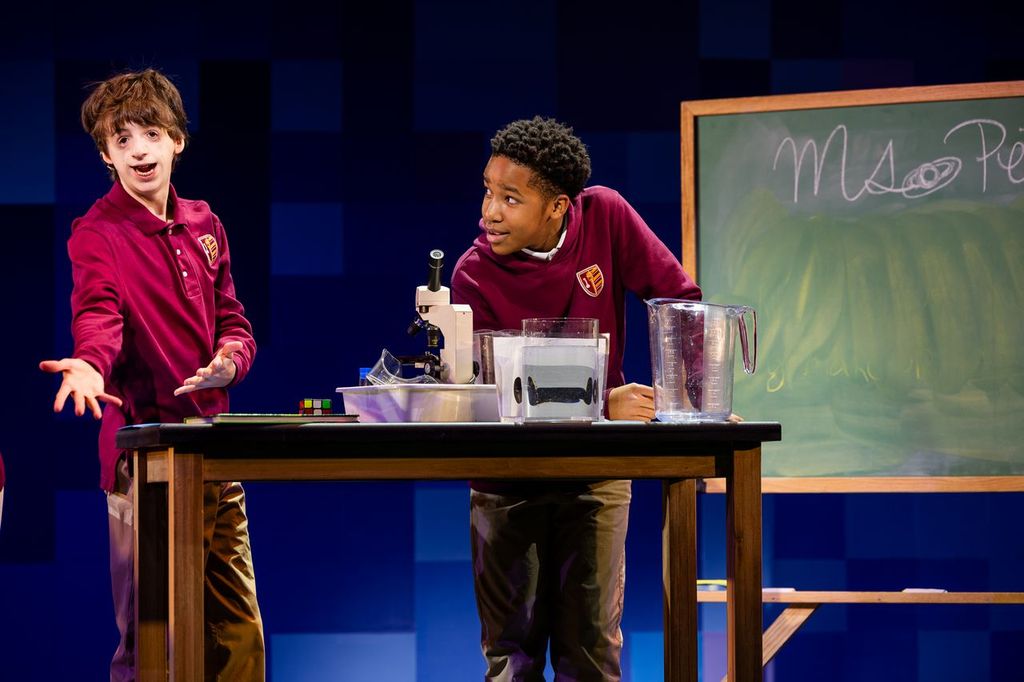
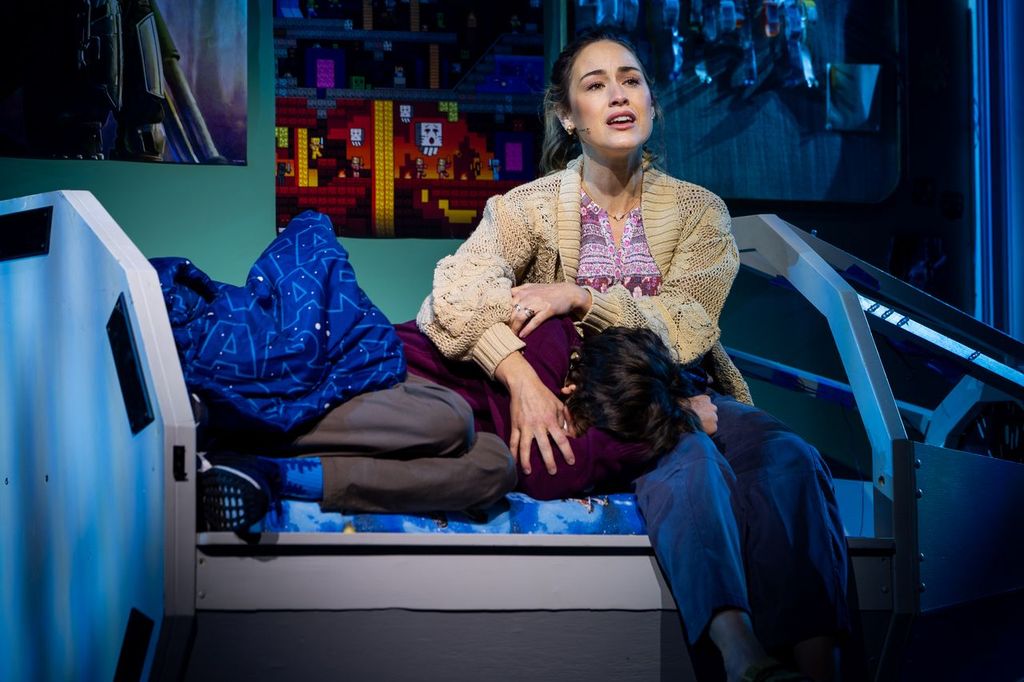
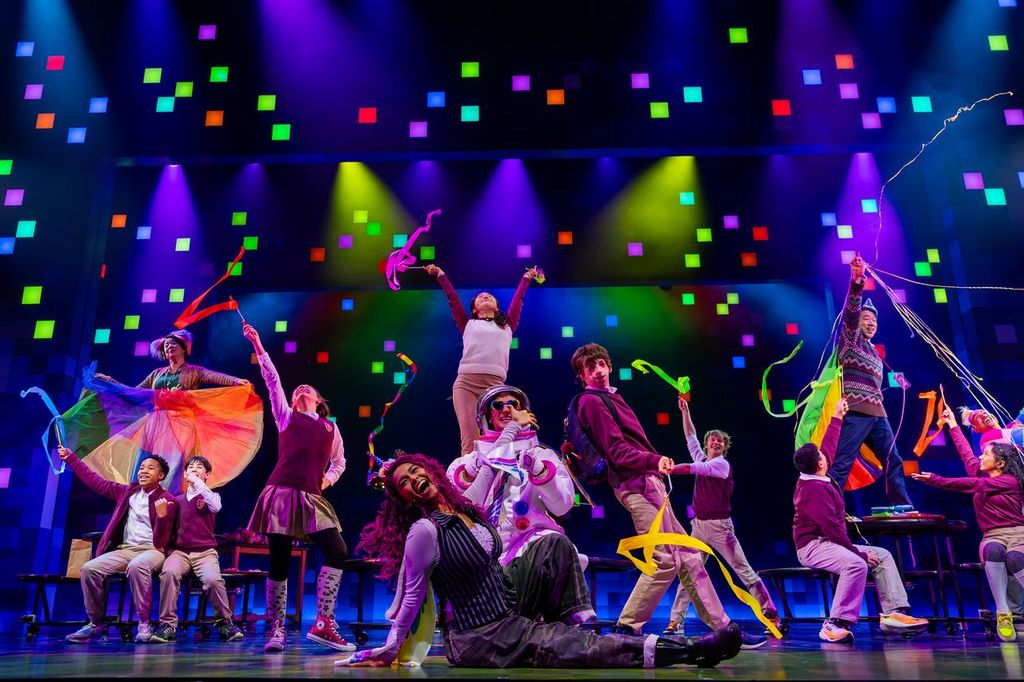
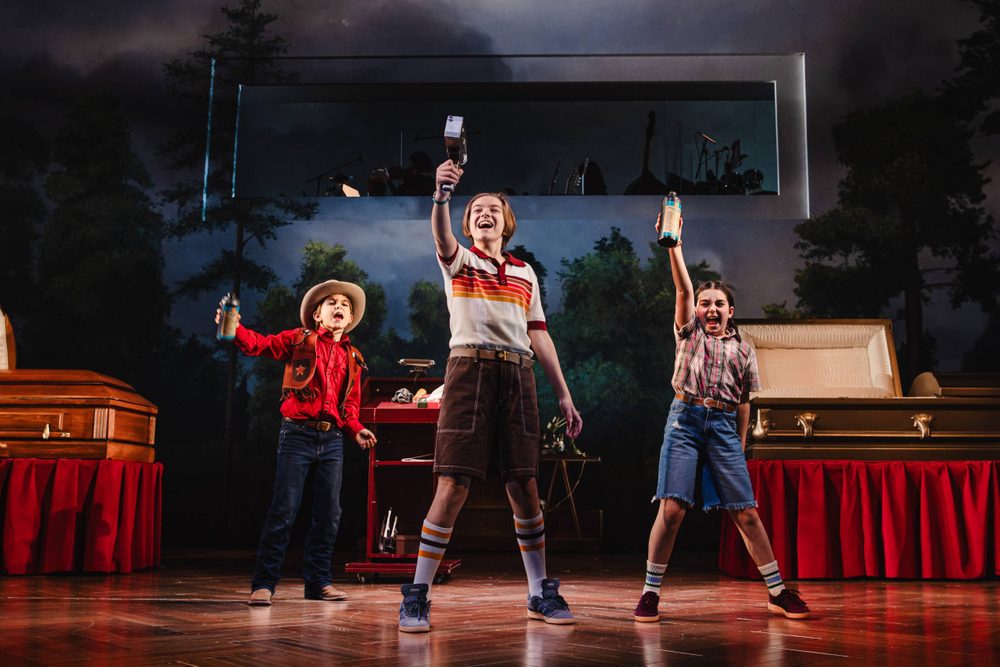
Caleb Levin, Odin Vega, Lyla Randall in ‘Fun Home’ at the Huntington. Photos by Marc J Franklin

‘Fun Home’ — Music by Jeanine Tesori. Book and Lyrics by Lisa Kron. Based on the graphic novel by Alison Bechdel. Directed by Logan Ellis. At the Huntington Theatre, Huntington Ave., Boston through Dec. 14.

By Shelley A. Sackett

In less capable hands, the multiple Tony Award-winning Fun Home, at the Huntington through Dec. 14, could have been a disaster. Adapted from Alison Bechdel’s graphic novel memoir, the storyline follows a family’s journey through sexual orientation, gender roles, suicide, emotional abuse, grief, loss, and lesbian Bechdel’s complicated relationship with her tightly closeted father. To boot, the title refers to the family funeral parlor, where her father worked and she and her siblings played.

Doesn’t sound like the raw material for one of the year’s outstanding Boston area productions? Think again.

Jeanine Tesori, a two-time Tony Award recipient and two-time Pulitzer Prize finalist for drama, has created gorgeous, melodic music for Fun Home. Award-winning playwright and lyricist Lisa Kron hits all the right tones with a masterpiece of storytelling musical numbers overlayed with a balanced, nuanced script that manages to be funny, poignant, clever, wise, and heartbreaking. These two talented women breathe life into Bechdel’s memories, turning what might have been maudlin into a dense and complex story of one family’s journey as narrated by one of its travelers.

Add to the mix a stellar cast, meticulous direction (Logan Ellis), a sumptuous set (Tanya Orellana), effective lighting (Philip Rosenberg), and a superb orchestra (music direction by Jessie Rosso), and you have all the ingredients for one very special evening of theater.

Bockel, Nick Duckart

The play opens with Alison (Sarah Bockel), a 42-year-old successful cartoonist, center stage, huddled over her drafting table. She crumples one sheet of paper after another, throwing them onto the floor. She recalls two other periods in her life: one when she was 10 (Small Alison, played by the showstopping Lyla Randall) and another when she was a freshman at Oberlin College (Medium Alison, played by Maya Jacobson).

Suddenly, Small Alison’s head pops up out of the drafting table. Kron’s narrative lyrics both highlight Bockel and clue us in about her character. Alison is trying to make sense of her childhood and the larger-than-life role her father, Bruce (a knockout Nick Duckart), played in it. At the center is Alison’s joy at discovering she is a lesbian, her first year in college, and Bruce’s tortured and shamed existence as a closeted gay man living as an outwardly “normal,” heterosexual, family man. His suicide (he stepped in front of a truck) only elevated his importance in Alison’s pursuit of answers to the question, “What happened to us?” If she could only unlock the mysteries surrounding his life, perhaps she could understand those surrounding her own.

The problem is, she doesn’t trust her memory. She needs “real things,” both to draw and to rely on. She needs eyewitnesses. She needs Small and Medium Alisons. Told in a series of nonlinear vignettes connected by narration from the adult Alison character, the Bechdel family saga unfolds.

Her childhood in rural Pennsylvania was anchored by the ornate Victorian house her father obsessively and compulsively restores (two traits he also brings to his homosexuality and cruising). She and her siblings played games, including performing an imaginary advertisement for the family funeral home (Randall, as Small Alison, brings down the house in the hysterical and arresting Jackson Five-style “Come to the Fun Home”). Juxtaposed with Partridge Family scenes are their opposites. Bruce, for example, invites Roy, a young man whom he has hired to do yard work, into the house and begins to seduce him in the library while his wife, Helen (the gifted Jennifer Ellis), plays the piano upstairs, trying her best to ignore it (“Helen’s Etude”).

Sushma Saha, Maya Jacobson

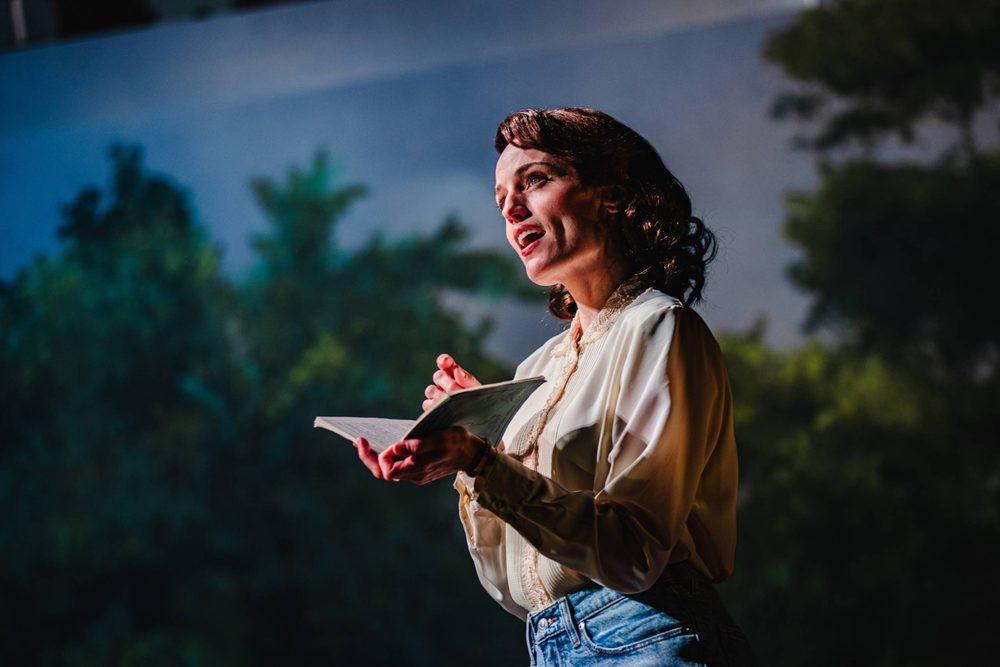
Medium Alison (Jacobson is terrific) enacts Alison’s memories of her first lesbian affair with Joan (Sushma Saha) and gushes with delirious post-sexual froth that she is “changing my major to Joan.” She shares that news with her parents and is forever haunted by suspicions that her coming out led to her father’s death. “I leapt out of the closet — and four months later my father killed himself by stepping in front of a truck,” the overhead caption reads.

Many of the musical numbers are more than plot devices; they are emotional powder kegs and stand-alone gems. “Telephone Wire” documents the moment where Alison and her dad try to get into a gay bar but end up defeated, even when she is carded. The tragedy of the missed opportunity for connection, and of the unspoken yearning and loss both feel but can’t acknowledge, is heartbreaking. In “Ring of Keys,” Small Alison (Randall) again brings down the house as a tiny girl transfixed by a butch delivery woman whose uniform and ring of keys open up doors she didn’t even know were locked.

“Days and Days,” Helen’s cri de Coeur, stands out as a vehicle for Ellis’ prodigious vocal power and a showcase for Kron’s Tony-nominated lyrics. As Bruce’s long-suffering wife, humiliated and abused by the homosexual husband she just as fiercely protects and stands by, Helen admits to Alison that she has sacrificed her life to keep the family together. She wants better for her daughter and warns her not to follow in her mother’s footsteps. “I didn’t raise you to give away your days like me,” she says introspectively.

Jennifer Ellis

Fun Home is as complicated as it is simple. It is about a family, its underlying anguish, and the balance between fitting in and being true to oneself. Honest, moving and hilarious, the play never becomes mawkish or angry (though it has every reason to). Each character stands upright, for better and worse, owning their authentic selves.

In the finale, Alison finally realizes the moment when she felt a perfect balance in her life: when her 10-year-old self and her father played “Airplane.” In “Flying Away,” Small Alison duets with her two older selves, a melding at last of past and present that paves a clearer way to the future. The caption above them reads, “Every so often, there was a rare moment of perfect balance when I soared above him.” There wasn’t a dry eye in the house.

Highly recommended.

For more information, visit https://www.huntingtontheatre.org.


Saul Rubinek recasts Shakespeare in the provocative ‘Playing Shylock’

Saul Rubinek in “Playing Shylock.” | DAHLIA KATZ

By Shelley A. Sackett

Ask a Jewish audience what their first reaction is when they think about Shakespeare’s “The Merchant of Venice,” and chances are they will mention the negative portrayal of Jews by the Venetian moneylender and play’s principal villain, Shylock. Long considered a slur against Jews, the very term was condemned by the Anti-Defamation League as antisemitic as recently as last July, when Trump described bankers as “shylocks and bad people” during a rally in Iowa.

Saul Rubinek flips that ingrained stereotype on its head in “Playing Shylock,” the provocative and powerful solo play he stars in and helped develop with playwright Mark Leiren-Young and director Martin Kinch. The play premieres in New York at Polonsky Shakespeare Center and runs through Dec. 7.

Rubinek plays a fictionalized version of himself. The actor is forced to stop “The Merchant of Venice” because his portrayal of Shylock – as Rubinek, a Jewish man – has angered members of the Jewish community, who have successfully petitioned for the production to be shuttered because it “endangers the well-being of some in our community.”

During the play, Rubinek uses the show’s cancellation as a launching pad from which to engage the audience on thorny issues like antisemitism, institutional self-censorship and cultural appropriation, and stereotyping. He challenges the audience to wrestle with whether the theater might be right to consider the current climate of antisemitism or whether it’s more dangerous to censor a play than to stage it.

“Isn’t Shylock part of the history of antisemitism? The most famous Jewish character in theater? And isn’t it important to own it, talk about it and show it?” Rubinek rhetorically asked the Journal over Zoom from his California home. Contrary to popular perception, he posits that “Shylock is not a caricature. He is the first three-dimensional Jew in the history of English literature.”

He details how in 1595, when Shakespeare’s play was first produced, there had been no Jews in England in the 300 years since King Edward I issued the Edict of Expulsion in 1290 (ironically on Tisha B’Av). Jews were portrayed as clowns, puppets with horns, or a devil in religious pageants. Audiences threw figs and oyster shells at them. “They were used to thinking of Jews as not being people because they had never actually met one,” Rubinek said.

Christopher Marlowe’s “The Jew of Malta,” first produced in 1592 (three years before Shakespeare), “sold tickets like Taylor Swift” and was the first antisemitic play where a Jew was played by a living actor. Its Jewish character was a one-dimensional Machiavellian villain. Shakespeare, on the other hand, was the first playwright to humanize his Jewish character.

Although Shylock only appears in five scenes, the character and his lines are synonymous with the play, even though he is not the star (the Italian Antonio is the eponymous merchant) and is deemed vile for demanding the pound of flesh he is owed on a defaulted loan.

Rubinek points to Shylock’s most famous speech: “Hath not a Jew eyes? Hath not a Jew hands, organs, dimensions, senses, affections, passions? Fed with the same food, hurt with the same weapons, subject to the same diseases, healed by the same means, warmed and cooled by the same winter and summer, as a Christian is? … And if you wrong us, shall we not revenge? If we are like you in the rest, we will resemble you in that … The villainy you teach me, I will execute, … but I will better the instruction.”

“The point of that speech,” he said, “is not a plea for humanity;” rather, it is a declaration of a right. “We are human, just like a Christian. And if we are like you in other ways, are we not like you in villainy? Whatever you do to me, I will do back to you tenfold. That is what the character is about. That is what the speech is about. And that is why it’s ageless and relevant.”

In other words, according to Rubinek, Shylock is telling his Christian audience, “If you don’t like what you see in me, look in the mirror to see where it comes from.”

The 77-year old actor, best known for television (“Frasier,” “Billions,” “Mrs. Maisel,” “Schitt’s Creek,” “Hunters”) and films (“Unforgiven,” “True Romance,” “The Battle of Buster Scruggs” and over 60 other features), co-founded and was actor/writer/director at the Toronto Free Theatre (now Canadian Stage). He has continued his work in theater in Canada, the U.S. and Europe.

Rubinek’s love for the theater and storytelling is deeply rooted in his heritage. His parents survived the Holocaust by hiding in a Polish farmhouse for 2 1/2 years. (In 1986, he took his parents back to Poland for a reunion with these farmers and created a book, play and documentary film about the experience). He was born in a refugee camp in Germany after World War II. His father, who was a Yiddish theater actor before the war in Lodz, ran a Yiddish repertory company in Germany before the family immigrated to Canada when Rubinek was 9 months old. He spoke Yiddish and French before learning English, and at age 8 started acting in English on the stage.

Though he attended Talmud Torah and Jewish summer camp and grew up in a world of Talmudic discussion, his Jewish upbringing was secular. “I have never been fond of any organized religion, but I love the Jewish traditions. They matter to me on a deep level even though I don’t go to synagogue,” he shared. He, his wife and his children, who are half Scottish/English, celebrate the Jewish holidays and participate in, for example, tashlich. “I grew up without any grandparents, but with these rituals. They are very meaningful to me,” he added.

Rubinek recalled that his father always wanted to portray Shylock on the stage, but “Hitler stopped him. I always wanted to play my father playing Shylock in his heavy Jewish accent,” he said. One of the play’s most moving scenes is when the Rubinek character, clad in traditional Hassidic garb and channeling his father, recites Shylock’s famous “Does a Jew not bleed?” speech in Yiddish.

In the play (and during this interview), Rubinek tells the story of his 16-year-old father confronted by his father (Rubinek’s Zayde) after he had cut off his payos (sidelocks) so he could continue in the Lodz Yiddish theater he so loved. “My Zayde asked, ‘How could you go so far away from God? How can you betray your family, your people, like this?”’ Rubinek said.

His father explained that he was doing a Yiddish play by a great writer about a Jewish family and their hopes for their children. Rubinek continued, “My father said to his father, ‘Theater – if it’s good – the audience sees themselves on the stage. They laugh. They cry. And for a few minutes each night, they don’t feel so alone.’ And my Zayde said, ‘Maybe it’s not so far from God after all.’

“That’s why I wrote the play,” Rubinek said, with an emotional catch in his voice and the glimmer of a tear in his eye.

For more information, visit https://tfana.org/about/polonsky-shakespeare-center

Muggles Marvel At Magic Tricks in Emerson Colonial’s ‘Harry Potter and the Cursed Child’

Cast of ‘Harry Potter and the Cursed Child’ at Emerson Colonial Theatre
Photo Credit: Matthew Murphy

By Shelley A. Sackett

Harry Potter and the Cursed Child is handicapped before the curtain even rises. It is based on the Harry Potter series, a seven-book global phenomenon created by J.K. Rowling. The novels chronicle the lives of a young wizard, Harry Potter, and his friends, Ron Weasley and Hermione Granger, all of whom are students at Hogwarts School of Witchcraft and Wizardry. The main story arc concerns Harry’s conflict with a dark wizard (Lord Voldemort) who intends to become immortal, overthrow the wizard governing body, and subjugate all wizards and Muggles (non-magical people).

The books were responsible for getting millions of children to start reading chapter books and were engaging and cheeky enough to lure their parents to join them. The eight movies the books spawned were even more popular and brought the world of Harry Potter to life on the big screen.

Alas, those same characters appear in Harry Potter and the Cursed Child, but they have not aged well in the 19 years since the last Harry Potter book. Neither has the plot, which, aside from one major twist, is muddled and tedious. At three hours, this ship might have sunk in harbor were it not for one gigantic rabbit it (thankfully) pulls out of its oversized sorting hat — STAGECRAFT MAGIC!!!!

With a stunning set by Christine Jones, illusions and magic by Jamie Harrison, and movement direction by Steven Hoggert, it was easier to ignore the baffling script, uneven accents and uneven miking. Lighting (Neil Austin), sound (Gareth Fry) and costume (Katrina Lindsay) designs enhanced the special effects. This was one production where a seat with good sight lines mattered.

Julia Nightingale, Aidan Close and Emmet Smith 

Right out of the gate, the showmanship elicited oohs and ahhs of wonder and amazement, as characters change costumes mid-sentence, chairs fly, capes whirl and suitcases have minds of their own. Characters slump in their oversize capes and within seconds transform into each other as if by, well, magic.

Later, when the evil dementors descend from the sky, with their unraveling mummy-like bandages and menacing flailing, it is a moment of staging perfection, a trifecta of spot-on music, lights, and sound effects.

It’s all jolly good fun and a lot of visual stimulation. Not since a recent Cirque-de-Soleil have I heard an audience murmur in unison, “How did they do that?”

Which brings us to the story line.

Harry Potter (Nick Dillenburg), the headstrong, brave Boy Who Lived, is now a middle-aged administrator in the Ministry of Magic, a job that bores and depresses him. He married Ginny Weasley (Erica Sweany) and they have two boys, James and Albus Severus (Adam Grant Morrison), and a daughter, Lily.

Following in Harry’s footsteps, Albus is off to Hogwarts, where Harry is mythic. Albus is also an unruly and insubordinate teenager who, like Harry, struggles with the burden of his father’s legacy. “I didn’t ask to be his son,” he retorts when people marvel that Harry Potter’s son is in their midst.

He befriends Scorpius Malfoy (a fine David Fine), son of his father’s nemesis, Draco Malfoy (Ryan Hallahan). The two team up to prove they are more than their fathers’ sons by saving the life of a Hogwarts student who died 20 years ago. There are colorful characters they meet along the way (Mackenzie Lesser-Roy is a scene stealer as quirky, spirited Moaning Myrtle), including their fathers’ teachers (Katherine Leask is a delight, channeling the Maggie Smith and Imelda Staunton characters, Professors McGonagall and Umbridge, and Larry Yando is equally splendid as Albus Dumbledore, Severus Snape and Amos Diggory). There is even a “Time Turner” machine. There is not, however, a life line to save the audience from drowning in a sea of untethered and disconnected actions that make little sense.

While the staging gimmickry, swirling capes, strobes and undulating time travel effects are cool the first, second and maybe even third times, by the umpteenth time (and as the clock marches towards the end of the third hour), they are as tired as some of the audience.

Nonetheless, judging by the raucous standing ovation of the majority of theatergoers, the yawners in the crowd were clearly in the minority.

‘Harry Potter and the Cursed Child.’ Based on an original new story by J.K. Rowling, Jack Thorne, and John Tiffany. A new play by Jack Thorne. Directed by John Tiffany. Presented by Emerson Colonial Theatre at 106 Boylston St., Boston through Dec. 20.

For more information, visit: https://www.emersoncolonialtheatre.com/

‘Murder for Two’ Is A Goofy, Musical Valentine to Classic Whodunits.

Will McGarrahan and Jared Troilo in “Murder for Two” at Greater Boston Stage
Photos: Niles Scott Studios

‘Murder for Two’ — Book and Music by Joe Kinosian. Book and Lyrics by Kellen Blair. Directed by Tyler Rosati. Music Direction by Bethany Aiken; Scenic Design by Katy Monthei; Lighting Design by Matt Cost; Sound Design by Adam Smith. Presented by Greater Boston Stage Company, 395 Main St., Stoneham, MA through Nov. 9.

By Shelley A. Sackett

Murder for Two is a loving parody of classic murder mysteries. A two-person musical, the 100-minute (no intermission) production is more vaudevillian revue than its genre’s prototypes, relying on gimmicks, songs, and quick changes to tell a familiar story in a new way.

The plot is fairly straightforward and as formulaic as it gets.

In the opening moments, Arthur Whitney, a famous author, is murdered in his mansion on the eve of his own surprise party. It is, of course, a stormy and dark night and the suspects are many — 13, in fact. From the widow, to the niece, psychiatrist, ballerina, town doctor, neighbors and local fireman, each is quirky and none lacks motive.

The only thing that keeps Murder for Two from being a total cliché is that all 13 suspects are played by Will McGarrahan, a virtuoso with a supple face and talent for impersonation. A simple hand gesture, distinctive gait, snooty scowl, tutu or pair of cat’s eyeglasses, and he becomes a different character, capturing their essence in the blink of an eye.

Jared Troilo is the small-town cop named Marcus Moscowicz who jumps at the chance to solve the case (and advance his stagnant career) when the real detective can’t be located. A by-the-books kind of guy, he has his work cut out for him dealing with this motley crew.

Troilo

The focal point of the small but expertly designed and lighted set is an upright piano, where the two actors show off their piano playing and vocal chops. Their musical rapport and interaction is delightful. They finish each other’s phrases, take turns singing and accompanying, and shine during four-handed duets. Unfortunately, the songs lack lyrics of substance and tunes with catchy melodies, but the actors’ comfort, confidence, and camaraderie (almost) make up for it.

The play also relies heavily on shtick and, like all shtick, some is laugh-out-loud funny, and some is corny and cutesy, landing with a thud.

At the Saturday evening performance on opening weekend, McGarrahan’s microphone malfunctioned and, despite an unscheduled intermission (which provided fertile fodder and opportunity for the actors to break the fourth wall and ad lib to the audience’s delight), still didn’t work properly. Given the show’s fast pace and McGarrahan’s pivotal role, it made the first half of the show even harder to follow.

McGarrahan 

Following the plot and figuring out who done it, however, is not the point of attending this production. The real reason is the physical comedy and musical showmanship of two actors who are so comfortable with each other and their performances that, at one point, McGarrahan goes off script and shakes a tambourine in Troilo’s face until he cracks up. After an hour of scripted unevenness, the audience applauded in appreciation and relief.

Despite working with such unexceptional material, McGarrahan and Troilo seem to be having the time of their lives on stage. Would that the audience could have shared in some of that.

For more information, visit https://www.greaterbostonstage.org/

ASP’s ‘Macbeth’ Is a Muddled Mashup of Time, Place and Tone

Omar Robinson, Brooke Hardman in Actors’ Shakespeare Project’s ‘Macbeth’
Photos by Benjamin Rose Photography.

‘Macbeth’ — Written by William Shakespeare. Directed by Christopher V. Edwards. Presented by Actors’ Shakespeare Project at Mosesian Center for the Arts, Watertown through October 26.

By Shelley A. Sackett

Ten minutes into ASP’s production of Macbeth, my friend leaned over and whispered, “I thought we were seeing Macbeth.”

He wasn’t being a smart aleck; he was astutely stating the obvious. While it seems au courant (at least in Boston) to catapult timeless Shakespeare into other eras with disco, hip hop, and gratuitous references to current headlines, Actors Shakespeare Project, under the direction of Christopher V. Edwards, proves definitively that it is possible to overreach and completely miss your mark.

One of the Bard’s most quoted and beloved plays (“Fair is foul, and foul is fair,” “Is this a dagger which I see before me?” and “Double, double toil and trouble,” for example), it speaks for itself, elegantly and eloquently. Yet, for some baffling reason, Edwards thinks that contemporary audiences are unable to fully “get” the timelessness of the Elizabethan masterpiece without referencing the Epstein files, ICE, MAGA, the war in Gaza, and AI. Couple that misstep with creative but distracting staging, and you get the fuller picture.

Claire Mitchell, Amanda Esmie Reynolds, and Jade Guerra

To his credit, Edwards doesn’t hide the ball about his intent, which he spells out in the program’s Director’s Notes.

His version of Macbeth (which he nicknamed MK-Beth) reimagines the three witches as architects of state-sponsored psychological manipulation. He sets his version in the thick of a covert 1960s Cold War where Lady Macbeth and her husband are as much test subjects for mind control as they are murderous, power-obsessed co-conspirators.

The central issue, Edwards feels, is “reconsidering ambition, conspiracy and complicity in an era where truth itself could be weaponized.” I don’t know about other audience members, but I was looking forward to a version that was a little more faithful to the original rather than a spin on the contemporary front page political headlines, which take all my psychic energy to avoid.

On its own, Macbeth really does address the issue that Edwards wishes to magnify (the dangers of a budding dictator’s unquenchable thirst for power). Would that he had trusted the audience to “get” that on their own.

Disagreement with his spin aside, its execution has way more misses than hits. On the positive side, imagining Lady Macbeth as a grieving mother who undergoes electro-convulsive therapy at the hands of the three doctors/witches to cure her depression is an interesting conceit, although a baffling way to open the action. We are supposed to have picked up how devoted (and normal) the Macbeths were from family home videos that include the deceased child projected on stage before the play, but that point is a little too subtle to grasp without context.

Danielle Ibrahim’s set, however, is marvelous, a gossamer set of white curtains that encircle the stage area and work well with the varying ambiance of the play.

While some of the lesser characters seem to be reciting their lines in a classroom more than delivering them before an audience, there are some noteworthy performances, particularly by Brooke Harman as Lady Macbeth, Dennis Trainor, Jr. as Duncan/Porter, and Chingwe Padraig Sullivan as Malcom.

Jesse Hinson, Omar Robinson, and Dennis Trainor Jr.

Omar Robinson (who collected the 2025 Norton award for outstanding lead performance in The Piano Lesson) breaks out of his singularly militant monomaniacal version of Macbeth to court nuance and pathos, particularly in the famous “Out, out, brief candle! Life’s but a walking shadow, a poor player that struts and frets his hour upon the stage and then is heard no more” speech upon learning of Lady Macbeth’s death.

Perhaps ASP’s parting gift to its audience is a back-handed reminder that Shakespeare can bridge eras, standing on its original two feet. I, for one, took that as an invitation to revisit the Bard’s version and went home, dusted off my college Pelican Text, and had a jolly good read.

For more information, visit https://www.actorsshakespeareproject.org/

Don’t Throw Away Your Shot to See Broadway in Boston’s Spectacular ‘Hamilton’

Cast of Broadway in Boston’s ‘Hamilton’. Photos: Joan Marcus
 

By Shelley A. Sackett

How lucky are we that Lin-Manuel Miranda decided to pack Ron Chernow’s biography, “Alexander Hamilton,” when preparing his bag to take on his first vacation in seven years after the Broadway run of his smash hit, In the Heights. He plowed through the 800+ page book and was mesmerized by Hamilton, particularly his story as a poor immigrant rising to power.

“The moment my brain got a moment’s rest, Hamilton walked into it,” he told Ariana Huffington in an interview.

Had he grabbed any of a number of other bestselling books instead, the world would have been deprived of what remains, after ten years, a singular and thrilling theatrical experience. Broadway in Boston’s production now at Citizens Opera House is as good as it gets, even withstanding a distractingly deficient performance by Hamilton standby, Michael Natt, on the evening I saw it.

The set, by David Korins, is magnificent. Huge, with a drawbridge, walkways, and two stories, it accommodates the large cast and encourages easy transformation from scene to scene. A circular rotating insert is put to good use, and Paul Tazewell’s costumes both complement and add spice. The orchestra (Emmanuel Schvartzman, conductor) is stupendous and Andy Blankenbuehler’s choreography is cheeky, contemporary and delightfully slick. Last, but hardly least, Howell Binkley’s lighting is literally spot-on and hosannas to Nevin Steinberg and his sound design (and the cast’s flawless articulation) that ensure the audience hears every syllable (hardly a given on Boston stages).

Nathan Haydel, Tyler Fauntleroy, Jared Howelton, Elvie Ellis

The opening number, “Alexander Hamilton,” firmly establishes that the rest of the talented touring cast is not just up to the challenge but will surpass even the highest expectations of excellence. (Ensemble member Miriam Ali is a standout, and not because of her height.)

The storyline is fairly straightforward. It details the life of American Founding Father Alexander Hamilton, from his humble beginnings as a Caribbean orphan to his crucial role in the American Revolution and the formation of the new nation, culminating in his death in a duel with Aaron Burr. Aaron Burr (an outstanding Deon’te Goodman) opens with the line, “How does a bastard, orphan, son of a whore and a Scotsman, dropped in the middle of a forgotten Spot in the Caribbean by Providence, impoverished in squalor Grow up to be a hero and a scholar?” introducing Hamilton as the remarkable immigrant who, through grit, ambition, intelligence and sheer will, rose to positions of power and influence to have an undeniable and lasting effect on this nation’s history.

A.D. Weaver

While the actors may be center stage, it’s Miranda’s breathtaking score that is the true star. Over 30 songs tell the story through hip-hop, jazz, R&B, pop, and good old-fashioned ballads. Their narrative quality and melodic power are timeless, awesome in the truest sense of that now hollowed out and trite adjective.

The show features a diverse cast (Miranda broke new ground in many ways, including casting actors of color to play the roles of the Founding Fathers) and highlights Hamilton’s relationships with figures like the Schuyler sisters (despite being a standby, Amanda Simone Lee was splendid as Angelica and Lauren Mariasoosay shone as Eliza), the Marquis de Lafayette and Thomas Jefferson (both played by an excellent Christian Magby), and, of course, George Washington (a powerful A.D. Weaver).

The crowd favorite, however, is always King George III, whose role may be limited but whose songs are among the best in the show. Matt Bittner doesn’t disappoint, chewing up the role and delighting the audience with each brief appearance.

Lauren-Mariasoosay, Marja Harmon, Lily-Soto

Even if you’ve seen “Hamilton” before (and especially if you saw it when it played in Boston on its last disappointing tour), do not hesitate to high-tail it to the Citizens Opera House to see this particular version. I daresay, it is as close as we in Boston can get to the New York experience.

Most highly recommended.

‘Hamilton’ — Book, music and lyrics by Lin-Manuel Miranda. Inspired by Ron Chernow’s “Alexander Hamilton.” Directed by Thomas Kail. Choreography by Andy Blankenbuehler; Music Supervision and Orchestrations by Alex Lacamoire. Presented by Broadway in Boston at Citizens Opera House, Boston through Nov. 2.
For more information, visit bton.broadway.com/shows/hamilton/

‘The Mountaintop’ Is A Gripping Rendering of MLK’s Last Night

Dominic Carter as MLK in Front Porch Arts Collective‘s ‘The Mountaintop’

By Shelley A. Sackett

Playwright Katori Hall couldn’t have asked for a better production of his Olivier Award-winning play, The Mountaintop, than the one it is receiving at the Modern Theater at Suffolk University. Under Maurice Emmanuel Parent’s pitch-perfect direction, its two stars, Dominic Carter and Kiera Prusmack, deliver impeccable performances as civil rights and social justice leader, Rev. Martin Luther King, Jr. and Camae, a motel employee. Ben Lieberson’s set is straightforward and literal, a classic 1960s era, no frills, wood-paneled motel room.

The time and place are uncomplicated. It is April 3, 1968, and a storm rages outside room 306 of the Lorraine Motel in Memphis. As King, Carter is a commanding presence from the moment he enters the room. He has just delivered his famous “I Have Been to the Mountaintop” speech, in which eerily he proclaims, “I’ve been to the mountaintop… And I’ve seen the promised land. I may not get there with you.”

He was assassinated the next day.

King is exhausted yet wired, spooked by every crack of lightning and suspicious that his room is bugged and his phone tapped (hardly unwarranted since J. Edgar Hoover, FBI director, was known to have targeted King with both).

He is in Memphis to support striking sanitation workers whose nonviolent protests had ended disastrously in rioting and ransacking. All he wants is a cigarette and a cup of coffee. His traveling companion, fellow civil rights activist and Baptist minister, Rev. Ralph Abernathy, has gone to buy the cigarettes. He calls for room service for the coffee.

After some interludes meant to show King’s less saintly and more human side (including smelly feet, petty vanity and annoyance at overhearing a toilet flush in the room next door), he finally settles down to start writing his next speech/sermon. He wants to get more incendiary and provocative, and toys with opening with the line, “Why America Is Going to Hell.”

“They’re really gonna burn me on a cross for this one,” he snickers.

The entire focus and tone of the play shifts with the arrival of a sexy, self-confident young maid named Camae, who delivers more than a pot of coffee. Under the Parent’s kid-glove direction and terrific acting by Carter, the swing from King’s turbulent internal intensity to his slick, external charismatic charm happens with the silent ease of a perfect downshift.

She calls him “Preacher King.” He flirts with her shamelessly, flaunting his male bravado, trying to hide his fear and suspicion. He asks her opinion whether he should shave his moustache. She tells him, “If I was a man, I’d be staring at me, too,” as she runs her hands over her breasts and hips.

Camae just happens to have his favorite cigarettes, Pall Malls, in her apron pocket. She also has a flask, which she offers King before swigging from it directly.

All is light banter (they even have a pillow fight) until the talk turns to the state of race relations in America and what she thinks King should be doing about it. She is his equal, smart, passionate and articulate. “You need something else,” she counsels. “Something other than marching.” He thinks “a new day is coming” and says he will continue preaching “until the day I die.” Her suggestion? “Fuck the white man.”

The tension escalates until the great reveal, which thankfully happens early enough that there is plenty of time left for Pulitzer Prize-winning playwright Hall to spin his magic, culminating in a monologue set against a rapid montage of people, movements and events from 1968 to 2024 (projection design by Pamela Hersch). The effect is as spellbinding as the magical 90 minutes we have just spent in the presence of greatness, from the acting, writing, and direction to witnessing the final hours in the life of a man whose legacy is deservedly legendary. Dr. King, the promised land has never seemed so far away. We sure could use your voice today.

Highly recommended.

The Mountaintop – Written by Katori Hall. Directed by Maurice Emmanuel Parent. Presented by The Front Porch Arts Collective in collaboration with Suffolk University at Modern Theatre, 525 Washington St., Boston, through October 12.

For more information, visit https://www.frontporcharts.org/

The Ceremony’ Revisits and Rewrites the Ufot Legacy

Lumanti Shrestha, Khadaj Bennett in CHUANG Stage’s The Ceremony’
Photos by Ken Yotsukura

By Shelley A. Sackett

Playwright Mfoniso Udofia’s nine-play Ufot Family Cycle follows the various members of the Nigerian Ufot family across three generations, starting with the brutal Nigerian Civil War (also known as the Biafran War) of 1967-1970. With the world premiere of  The Ceremony, the sixth in the series, Udofia brings the family firmly into the present (2023) with all its contemporary social mores and cultural pressures.

The Ufot Family Cycle is an unprecedented two-year city-wide festival where theaters and arts organizations around Greater Boston join to produce the nine plays in partnership with universities, social organizations, non-profits, and a host of community activation partners. The Ceremony is produced by the pay-as-you-are CHUANG Stage. At two plus hours (one intermission), the play focuses on the marriage between 31-year-old Nigerian-American Ekong Ufot (a fine Kadahj Bennett) and 32-year-old Lumanti Shrestha (equally fine Mahima Saigal), a Nepalese-American. Both are first-generation Americans, born in one country and raised by parents anchored in another

Whether the two can intertwine their Nigerian and Nepali heritages, with their different cultural traditions— and, more importantly, whether their families will let them — is the challenge they face as they try to plan a wedding that offends none and pleases most.

Compromise is the goal, but first the affianced couple must circumvent complex family issues, including their equally estranged fathers: Disciple (a powerful and complex Adrian Roberts), Ekong’s father; and Lumanti’s never seen but equally resistant father. How well they circumvent these stealth emotional and psychological IEDs will determine if Ekong and Lumanti make it to the wedding finish line.

Udofia leaves us guessing whether the couple can pull it off until the end, one reason the lengthy play doesn’t feel quite as long as it is.

[Although the nine plays are touted as being discrete stories linked together through lineage and characters, those unfamiliar with the Ufot family history may want to prepare by investing the time to listen to the excellent podcast, runboyrun. (It’s worth it for context). The third play in The Ufot Family Cycle, it focuses on Disciple as a boy in war-torn Nigeria and helps understand his tormented character, his relationship with his ex-wife and Ekong’s mother, Abasiama (the always welcome Cheryl D. Singleton), and the significance of such seemingly innocent props as a clock and a stick in The Ceremony.]

The play opens in Worcester in media res, with Lumanti center stage and the Nigerian women (Ekong’s mother, Abasiama, and sisters, Adiana (Regine Vital) and Toyoima (Natalie Jacobs)) above, on a lightly propped catwalk. Large staircases bookend the stage and are used with a practiced light touch under the spot on direction by Kevin R. Free. Cristina Todesco’s efficient and creative set and Andrea Sala’s restrained but effective lighting create a trifecta of simultaneous activity.

All the women are talking at once. Lumanti speaks into her cell phone in Nepali. Unlike some of Udofia’s previous plays (especially The Grove), the use of long passages of unsubtitled, non-English language is not off-putting. Here, the actors and Udofia offer enough clues so that the audience, instead of being shut out, is treated like special guests, invited for a behind-the-scenes peek at what life is like for this young, second-generation couple.

Lumanti is talking to her father, and we get the gist that she is getting an earful. Upstairs, the Nigerian women, with Abasiama lapsing into her native Ibibio, seem to be okay with the wedding, although the sisters are a little less enthusiastic than their mother.

It seems that white, in Nepalese culture, represents death, yet Lumanti has agreed to wear white for the wedding. “We wanted a western wedding,” she unconvincingly says.

The action swings back to the lower stage, where a table and couch shift the scene to Ekong and Lumanti’s apartment. Ekong is in the midst of a disciplined workout. His eyes are glued to one of three overhead projections showing the same episode of “The Fresh Prince of Bel-Air,” the 1992 iconic Black American television show starring Will Smith (projection and digital content design by Michi Zaya).

Ekong doesn’t just enjoy the show, however. He needs it, and his eyes bulge with the panic of an addict who needs his fix until the set flips on. Only then can he truly relax. His mouth goes lax and he zones out from his outside world to the interior existence he channels, where he can step into a world of what his life could have been like if he had had different parents.

He sets a romantic table, complete with flowers and wine. When Lumanti enters the apartment, he is blindsided when she tells him her father, who had adamantly opposed and boycotted their wedding, has changed his mind. He will make the trip from Kathmandu after all. She is overjoyed.

“And you believe him?” Ekong asks. Ekong had assumed that, because Lumanti’s father was a no-show, his own father’s (Disciple) absence wouldn’t be questioned. Suddenly, Lumanti believes both their fathers are capable of change and she wants him to reach out again to his father with the news that hers will be in attendance.

It turns out Ekong never even spoke to his father. Lumanti, changed by the fact that her father will bear witness to the ceremony, has other news — she wants their wedding to be more traditional and include rituals from their two cultures.

“Why?” Ekong asks. “I’m Nepalese,” she replies. “Since when?” he demands. “Since dad said he’s coming,” she responds in all honesty.

And so the scene is set that will drive the rest of this thought-provoking, entertaining, and well-produced drama.

Udofia weaves together several subplots that show, rather than tell, the backstory of Ekong and his father’s 20-year estrangement. The owner of a successful physical therapy practice, Ekong bonds with Philip (the excellent Roberts), a client whom he equates with the idealized Black father figure in the TV show. He even tries to enlist him as a surrogate father, but Philip wisely declines.

Meanwhile, Lumanti navigates her own journey with her mother, Laxima ‘Amma’ Shrestha (Salma Qamain), and Auntie (Natalya Rathnam, funny and wise), and their reactions to the news that her father will attend. The older matriarchs share relationship and marriage advice and the three dig into the work of turning the secular wedding into more of a cultural celebration.

Act II brings out the dramatic strengths of the action and script, especially the scenes between Disciple, Abasiama and Ekong, and, of course, the wedding ceremony itself. Director Free makes free use of the full stage with multiple, simultaneous locations and conversations that keep up the pace and audience’s interest.

Eventually (no spoiler here-), the wedding takes place and the audience is both invited and delighted by the multi-traditional festivity. Something new and unique to Lumanti and Ekong (and their families) has been born from the blending of two families intent on preserving their heritage while acknowledging contemporary realities. Two parts really can make a new whole, but for the audience, the destination was never the brass ring. The journey, with all its potential derailings lying in wait and complicated intra-familial, was always what it was about.

Director Free brings out the best in his cast (with special shout-outs to Bennett (Ekong), Saigal (Lumanti), and Roberts (Disciple)), and Udofia’s script is crisp and unpreachy with just the right amount of humor and pathos. As an added bonus (like we needed one), we get to ride shotgun as both Ibibio and Nepali wedding traditions are unveiled before our eyes, a lovely touch.

There is a reason the show sold out almost immediately, although last-minute seats may be available. Do yourself a favor and try to be one of the lucky ones who scores one.

The Ceremony’ — Written by Mfoniso Udofia. Directed by Kevin R. Free. Presented by CHUANG Stage at Boston University’s Joan & Edgar Booth Theatre, 820 Commonwealth Ave., Boston through October 5.

For more information, visit https://www.chuangstage.org/the-ceremony

Lyric Stage’s ‘Our Town’ Is A Classy Production of A Timeless Classic

Will McGarrahan as the Stage Manager in Lyric Stages’ “Our Town”
Photos by Nile Hawver

By Shelley A. Sackett

Our Town, Thornton Wilder’s 1938 Pulitzer Prize-winning play, is set in the fictional New Hampshire town of Grover’s Corners. Narrated by a Stage Manager (Will McGarrahan, excellent in the sober yet not dispassionate part), this classic uses a minimal set to explore universal themes of life, love, and death. Described by Edward Albee as “the greatest American play ever written,” it presents the fictional American town of Grover’s Corners, New Hampshire, between 1901 and 1913. Through its citizens, and especially the Webb and Gibbs families, Wilder celebrates our shared humanity and the importance of appreciating the present moment, especially the glimmers of community and connection that keep us grounded and give our lives meaning.

And who couldn’t use a glimmer of light during dark times, whether it’s 1938 or 87 years later?

Act I (“Daily Life”) of the two-hour (one intermission) production opens on a set (Shelley Barish) of movable curved benches, Jenga-like in their flexibility and simplicity. They start as an arc and turn into whatever a scene calls for. Courtney O’Connor directs with a steady hand (especially the pantomiming in the prop-less production). Lighting and costumes subtly supplement.

The Stage Manager then presents each character, each building, and each historical fact, context meant to orient and bond the audience with time, place, and, most importantly, people.

“The play is Our Town. In our town, we like to know the facts about everyone,” he states matter-of-factly.

It is dawn on May 7, 1901. The Stage Manager guides us on a tour of the town, with its six churches, town hall/post office/jail, grocery store, drug store, and the homes of the Gibbs and Webb families. We are introduced to Joe Crowell (Jacob Thomas Less) as he delivers the morning paper, “The Grovers Corner Sentinel,” to Doc Gibbs (Robert Najarian). As Howie Newsome (Jesse Garlick) delivers their milk, we meet the rest of the townspeople, including Editor Webb (the always welcome De’Lon Grant) and the rest of the Webb and Gibbs families.

Mrs. Webb (Amanda Collins) and Mrs. Gibbs (a refreshingly nuanced Thomika Marie Bridwell) ready their children and husbands for their days. Emily and Wally Webb (Josephine Moshiri Elwood, Darren Paul) and George and Rebecca Gibbs (Dan Garcia and the irresistibly magnetic Kathy St. George) attend school together. The romance between Emily and George will become the lens through which the town’s story unfolds.

Professor Willard (John Kuntz, notable as always) and Editor Webb fill in some of the gaps, giving us the skinny on the history of the town and its socioeconomic status and political and religious demographics.

The Stage Manager then gets into the weeds about each character’s relationships and challenges, along the way presenting the town’s more colorful and minor characters. Simon Stimson (Kunz), the church organist and choir director, is also the town drunk. Doc Gibbs chews his son out for not helping his mother with her chores, and George and Rebecca’s eventual romance begins to bud under a full moon.

The Stage Manager dismisses us with a no-nonsense, “That’s the end of Act I, folks. You can go and smoke, now. Those that smoke.”

Act II (“Love and Marriage”) opens three years later. The Stage Manager summarizes the themes of Acts I and II — daily life, love and marriage — adding, “There’s another act coming after this. I reckon you can guess what that’s about.”

Emily and George’s courtship takes center stage, and the delightful ice cream parlor scene in Act II is one of the play’s best.

As Emily and George prepare to marry, the interactions with their families are warm, intimate and funny. Bride and groom are terrified, caught between wanting to remain kids and needing to follow the rules of the natural order of things, at least as they are in Grover’s Corners.

Doubling as wedding officiant, the Stage Manager says plainly, “People were made to live two by two… I’ve married over two hundred couples in my day. Do I believe in it? I don’t know.” The important thing, reminds Mrs. Soames (St. George), is to be happy. “I’m sure they’ll be happy. I always say, ‘Happiness, that’s the great thing!’”

Act III (“Death and Eternity”) takes place nine years later. The Stage Manager paints broad brushstrokes of changes — even the farmers drive cars, people now lock their doors — but quickly circles back to the play’s main themes of the unavoidable passage of time, the importance of paying attention to life’s little moments, and the miracles that are the substance of everyday life and the fabric of eternity.

Focused on those who have passed away in the last nine years, the act takes place in the town cemetery. The Stage Manager describes how each person died before letting us know whose funeral is about to take place. The most thought-provoking of the three acts, playwright Wilder urges that we seize each day and celebrate the “magnificence and magnitude of life.” Asked if anyone truly understands the value of life while they live it, the Stage Manager responds, “No. The saints and poets, maybe —they do some.”

The rest of us? Not so much.

Some might complain that Our Town is dated and question why Lyric Stage has chosen to open its 2025/2026 season with this oft-produced classic. I say kudos to Producing Artistic Director Courtney O’Connor for recognizing an existential need in the current external turmoil to remind us that even in these dark times — especially in these dark times — we must not forget to slow down, breathe deeply and acknowledge that life is — no matter what — the most precious gift we are given.

Recommended.

‘Our Town’ – Written by Thornton Wilder. Directed by Courtney O’Connor; Scenic Design by Shelley Barish; Costume Design by Rachel Padula-Shufelt; Lighting Design by Deb Sullivan; Sound Design by Andrew Duncan Will. Presented by The Lyric Stage Company of Boston, 140 Clarendon Street, Boston, through October 19.

For more information, visit: https://lyricstage.com/

CST’s ‘Silent Sky’ Aims for The Stars But Falls Short

Lee Mikeska Gardner, Jenny S. Lee, Erica Cruz Hernández in Central Square’s ‘Silent Sky’
Photos by Nile Scott Studios

By Shelley A. Sackett

Lauren Gunderson’s career as a playwright (she is also a screenwriter and short story author) has largely focused on stories about iconoclastic women in history, science and literature. She is one of the top 20 most produced playwrights in the country, with over twenty plays produced. (Lyric Stage Boston’s 2022 production of her The Book of Will was a knockout).

With Silent Sky, a Catalyst Collaborative@MIT Production presented by Central Square Theater through October 5, she turns her attention to the story of Henrietta Swan Leavitt, a young astronomer whose scientific brilliance and curiosity led to her discovery of the relationship between luminosity and the period of Cepheid variables (a star that pulsates).

If that sounds wonky and more opaque than incandescent, it is. Yet, thanks to Gunderson’s witty, tightly crafted script and several outstanding performances, the almost two hours almost fly by.

The play starts in 1902 with Henrietta (Jenny S. Lee), the daughter of a rural preacher in Lancaster, Mass., speaking to her sister, Margaret Leavitt (Kandyce Whittingham). Henrietta, a recent Radcliffe College graduate, studied the classics with strong interests in math and astronomy. She considers herself, above all else, to be a scientist.

Margaret, on the other hand, considers herself (and Henrietta) to be unmarried, marriage-aged women whose lives will be unfulfilled until their status changes.

Kandyce Whittingham

Henrietta has just received an invitation to join the Harvard College Observatory. She assumes that she will be working with the college’s “Great Refractor” telescope directly under its greatest faculty member, Dr. Pickering. She is determined to accept their offer, despite Margaret’s trying her best to get her to understand that she will die an old maid if she does.

Ironically, her words fall on deaf ears (Henrietta contracted a disease that led to deafness). “I need to start my life,” Henrietta pleads. “With daddy’s money.”

Dowry in hand, she burns any hope of marrying and heads to Harvard.

There, she is met by Peter Shaw (an excellent Max Jackson). It is Shaw’s unfortunate duty to inform Henrietta that she has been hired to join The Harvard Computers, a sisterhood of scientists who analyze plates that contain images from the telescope they are not allowed to touch. These women do the necessary mathematical equations for the observatory’s male-only research team, who absorb (code for steal) the women’s work and pass it off as their own.

Lee, Max Jackson

Shaw’s second unfortunate duty is to inform Henrietta that he is her boss and mediator to Dr. Pickering, whom she will also never see. Needless to say, Henrietta goes ballistic in the first of many scenes that are so well written but flatly executed.

As Shaw, the inferior physicist whose father’s connections landed him his job, Jackson turns in a solid performance. He is clearly out of his league professionally and his will, credentials and verbal swordsmanship are no match for Henrietta’s. The two circle the desk as Henrietta puts on her best pit bull persona, furious and determined.

Gunderson’s script is crisp, funny and fast-paced, a gift to both actors and audience. The problem is that Lee doesn’t quite have the tone and touch that the part of Henrietta requires. Strident and droning, she struggles to flesh out Henrietta with the nuance and rhythm she needs.

Her co-workers, thankfully, are another story. As Williamina Fleming, the Scottish housekeeper turned “computer,” Lee Mikeska Gardner is the runaway showstopper. Pitch perfect in every way, she milks her character’s dry sense of humor with straight-faced deliveries in an impeccable (and easily comprehensible!) brogue. She has some of the show’s best lines and delivers them like the consummate (and much regaled) actress she is.

Annie Cannon (Erica Cruz Hernández, also very good) is the no-nonsense, brilliant scientist and head of the computing team. A diva relegated to backup singer, she is at peace with her lot. “I don’t need a title,” she declares. “My life is my work.”

The two convince Henrietta to stay. At least she has access to the world she longs to live in and, with Cannon and Fleming as her colleagues, its best minds.

The play unwinds fairly chronologically with relationships, historical events and family crises moving the story along. Eventually, her discovery allowed astronomers to estimate greater distances up to ten million light-years away, much greater than one hundred light-years. Hubble used the law to estimate the distance of the Andromeda galaxy in light-years. She was nominated for the Nobel Prize in physics, but she had already passed away 4 years earlier.

Gunderson tackles more than just Henrietta’s contribution to science, however, with big-ticket issues and questions. Societal restrictions on women permeated every aspect of her life. It was expected she would be a homemaker and supporter rather than a contributing participant. Her legacy was to be her children, a life well lived, measured in her husband’s accomplishments.

Lee

Henrietta, on the other hand, dared to challenge long-held norms and trumpet the call for women’s independence, unfettered scientific research, and academic gender bias blindness. Thank you, Central Square Theater, for spotlighting this little-explored crusader. Sadly, over a century later, her concerns couldn’t be more relevant.

‘Silent Sky.’ Written by Lauren Gunderson. Directed by Sarah Shin. Scenic Design by Qingan Zhang; Costume Design by Leslie Held; Lighting Design by Eduardo M. Ramirez; Sound Design and Composition by Kai Bohlman. A Catalyst Collaborative@MIT Production. Presented by Central Square Theater, 450 Massachusetts Ave., Cambridge through October 5.

For more information, visit https://www.centralsquaretheater.org/