Scottsboro: Where Boys Will Be Good Ole Boys

“Scottsboro Boys” at the SpeakEasy Theatre: a Review

By Shelley A. Sackett


There is a tipping point moment about an hour into the SpeakEasy Stage Company’s sparkling and disturbing vaudeville-style musical, “The Scottsboro Boys”.


Wade Wright, attorney for the Prosecution, gives his summation at the second trial of the Scottsboro Nine, as the nine African-American boys and men falsely accused of raping two white women on an Alabama train in 1931 became known. Their accuser has just recanted her entire testimony in open court. Samuel Leibowitz, a white Jewish New York criminal lawyer, is their defense attorney.


Wright decides to tap into another form of bigotry to win his now baseless case. “Is justice in this case going to be bought and sold in Alabama with Jew money from New York?” he sings to the all white jury in a song based on actual court transcripts.


The white jurors find the nine guilty and it takes two decades of re-trials and appeals (including two to the U.S. Supreme Court which resulted in landmark civil rights rulings) to reverse that injustice. Those cases exposed the dark underbelly of this nation’s racism and the continuing challenge of reeling in the deep South and its ingrained ways, even half a century after the end of the Civil War.


Most songwriters wouldn’t look to Jim Crow-era Alabama and this shocking incident for the subject matter of a musical. But John Kander and the late Fred Ebb, whose resume includes the prickly blockbusters “Cabaret”, “Kiss of the Spiderwoman” and “Chicago”, have never looked to the usual suspects for inspiration. They have relished the edgy and subversive, and the opportunity to expose one of American history’s most shameful episodes of racial injustice was just their cup of tea.


Creating an entertaining show from such weighty raw material was a challenge. In an unconventional and daring move, they decided to tell the story of the Scottsboro Boys as a play within a play. The audience is to pretend they are attending an old-time minstrel show. The subject of that show is the Scottsboro nine.


The conceit miraculously works. The play’s characters appear as Stepin Fetchit archetypes, cartoonish characters that are arm’s length enough to give the audience moral breathing room to laugh at the blustering sheriffs, duplicitous damsels and singing and dancing inmates. Simultaneously, discomfort hits, and the same audience cringes at the racist caricatures and demeaning blackface meant to debase blacks and sentimentalize slavery. It takes a little while, but eventually the message sinks in: the same people who made black anguish and white injustice the heart and soul of America’s most popular form of entertainment also created a world with the kind of unwritten law that the Scottsboro jury upheld.


shout

Members of “The Scottsboro Boys” cast in “Shout”.


At slightly under two intermission-less hours, the production showcases a zesty score of dark, barbed lyrics and ragtime-infused music. The opening number, “Hey, Hey, Hey”, introduces us to the characters and acts as a primer about how minstrel shows work (which is a good thing, since most 21st century theatergoers are unfamiliar with the 150-year-old format). The audience is told to expect song, dance and comic sketches, and that’s exactly what they get, complete with tambourines and white-gloved open palmed hand flapping. The musical numbers pay homage to Dixie Depression-era style with a perfect blend of reeds, trombone, guitar and drums. Somewhere, Al Jolson’s spirit is smiling.


Director Paul Daigneault and choreographer Ilyse Robbins make the most of the compact stage, using the aisles and minimal set to creative advantage. Several numbers (especially “Electric Chair” and “Make Friends with the Truth”) are real showstoppers and Isaiah Reynolds is nothing short of flawless as Ruby Bates in “Never Too Late”.


tambo-bones

Brandon G. Green (left) and Maurice Emmanuel Parent as Tambo and Bones.


While mostly faithful to the minstrel form, “The Scottsboro Boys” departs from it in ways significant to the storytelling. The recognizable stock minstrel characters of Mr. Bones and Mr. Tambo (usually white men in black face playing black stereotypes) are black men playing cartoonish racist white law enforcement officers and lawyers. Most importantly, the Scottsboro nine are never reduced to shtick or buffoonery. Their story is serious and their words are honest, raising the specter of lynching, fear and despair.


While each of the Scottsboro boys has his story and chance to shine, it is Haywood Patterson (played with grace and authority by De’lon Grant) who is the moral center of the show. He refuses to tell a lie, even when his false admission to a crime could mean his freedom. His part (and Grant’s delivery) is the show’s most lifelike, his dilemma the most universal. “Everyone believes me when I’m telling a lie, but nobody believes me when I’m telling the truth,” he laments.

shadow-play

De’Lon Grant in “Shadow Play”.


Despite a catchy score that combines jazz, gospel and vaudeville and entertaining musical numbers that mix the comic and the monstrous, the show manages to make its critical and timely point. “You’re guilty because of the way you look,” a character is told, and the murmur in the audience brought to mind contemporary refrains of “Build A Wall!” “Black Lives Matter” and “Bad Hombre”. Perhaps things haven’t changed as much since the 1930’s as we would like to think they have.


The Scottsboro Boys is presented by SpeakEasy Stage Company through November 26 at the Roberts Studio Theatre, Calderwood Pavillion, Boston Center for the Arts at 527 Tremont Street. For more information, call 617-933-8600 or visit SpeakEasyStage.com.

For Salem Haunted Happenings, the carnival returns to Derby Street

By Shelley A. Sackett, correspondent

Haunted Happenings, the annual month-long festival that crowns Salem the world capital of all things Halloween, will kick off its third weekend with the beloved Fiesta Shows Carnival on Derby Street. Famed for having the most thrilling Midway, Fiesta Shows owns and operates over 100 amusement rides ranging in excitement from the most popular Kiddie rides to the ultimate thrill seekers.

The Carnival runs from 1:00 p.m. (12 noon on Sunday) until 10:00 p.m. on weekends and from 3:00 p.m. until 9:30 p.m. on weekdays from Friday, October 14 through Monday, October 31.

“There is something special happening every weekend,” said Kate Fox, Executive Director of Destination Salem, the city’s Office of Tourism & Cultural Affairs. Salem Haunted Happenings typically draws over 250,000 visitors to Salem during October.

In addition to the outdoor fun and frolic of the Carnival, there are plenty of opportunities for lovers of theater, film, séances, tours and much more.

CinemaSalem at Museum Place Mall screens the terrific “The History of Halloween”, a short film shot in 3D that will entertain any age, and “The True 1692”, a 3D film that tells the story of the Salem witchcraft hysteria of 1692. (Visit CinemaSalem.com for the full schedule).

For a more up close and personal 1692 experience, History Alive, Inc. presents the 25th season of “Cry Innocent: The People vs. Bridget Bishop” at Old Town Hall at 32 Derby Square. The live, interactive event allows participants to play the part of the Puritan jury, hearing testimony, cross examining witnesses and deciding the outcome of the famous witchcraft trial. (Visit CryInnocentSalem.com for more information).

If dinner and theater is your treat of choice, then head to the Hawthorne Hotel on Friday, October 14 or Finz on Saturday, October 15 at 7:00 p.m. for “Ghostbusted!”, the family friendly whodunit where the actors perform tableside and diners help solve the mystery while enjoying a buffet dinner. (For more information and to make reservations, go to HauntedDinnerTheater.com ).

If magic is more your cup of tea, then head to St. Peter’s Church at 24 St. Peter Street for the Salem Haunted Magic Show, a live 75-minute show filled with a unique blend of inconceivable stunts, bizarre demonstrations, dark comedy and — of course — audience participation. (Visit TheSalemMagicShow.com for more information).

If your Halloween experience isn’t complete without a séance (or two), then Festival of the Dead’s authentic nightly séances at The Omen at 184 Essex Street should fit the bill. For a complete listing of all events, including the Official Witches’ Ball and the Annual Psychic Fair and Witches’ Expo, visit festivalofthedead.com.

New to Haunted Happenings this year, The Salem Waterfront Hotel at 225 Derby Street will host Chowderfest, a Breast Cancer Benefit, on Saturday, October 15 from 11:30 a.m. until 2:30 p.m. For a $10 “spoon fee”, visitors can sample chowder from restaurants in the North Shore and vote for the Best Chowder. All proceeds will be donated to NSMC/MassGeneral/NS Cancer Services.

Trolley tours and harbor boat cruises let revelers enjoy more of Salem by land and by sea. For landlubbers, Salem Trolley offers two options: a one-hour narrated historical tours, and “Tales & Tombstones” a special evening tour that visits scenes of Salem’s haunted past and forgotten secrets. (For reservations, visit SalemTrolley.com ). Gallows Hill’s “Ghosts & Legends Trolley” is a sinister and comical guided look at Salem’s history. (For more information, visit GallowsHillSalem.com )

Mahi Mahi Cruises has three tours to choose from: a “Haunted Happenings” tour, complete with face painting and Tarot card readings; a 90-minute lighthouse and foliage cruise; and a 21+ “Halloween Boo!s Cruise” with DJ, costumes, prizes and — of course — booze. For more details, visit MahiCruises.com.

If it seems like an impossible task to keep all the schedules and events straight, you’re in luck. Destination Salem has published “The Guide to Salem Haunted Happenings”, the zombie-themed essential handbook for getting the most out of Haunted Happenings. It includes calendars, articles, Haunted Happenings “Dos and Don’ts” and information about Salem’s tours, attractions, entertainment, parking and transportation. The guide is available at the National Park Service Salem Visitors Center at 2 New Liberty St. or at hauntedhappenings.org/.

Justice Is Not Denied in “Denial”


By Shelley A. Sackett


When historian Deborah E. Lipstadt walked onto the stage on September 22 for a Q&A after a preview of the film “Denial”, she was asked what it felt like to be portrayed by the Academy Award-winning actress Rachel Weisz. “It was surreal,” she said with a laugh, noting that the most remarkable part was hearing her own Queens accent perfectly mimed by the English film and theater star.


But with that, any light-heartedness faded as discussion turned to her real life role as defendant in a British lawsuit brought by Hitler admirer and “historian” David Irving. After Lipstadt labeled him a Holocaust denier in her 1993 book, “Denying the Holocaust: The Growing Assault on Truth and Memory”, Irving sued her and her publisher, Penguin books, for libel, claiming her false statements had harmed his reputation.


Her subsequent ten-week legal battle in 2000 to defend herself and establish the “historical truth” that the Holocaust did indeed occur formed the basis of her “History on Trial: My Day in Court with a Holocaust Denier” (2005), the book on which playwright David Hare’s script for “Denial” is based.


denial2

Rachel Weisz as Deborah Lipstadt in the true story, “Denial”.


As Irving knew, in Britain libel laws favor the plaintiff. The defendant must prove that statements the plaintiff considered libelous, or false, are indeed true. In this case, Lipstadt had to prove that the Holocaust really happened, and that, therefore, Irving intentionally lied when he insisted there were never any gas chambers at Auschwitz and that the Nazis had never murdered any Jews.


As if this isn’t complicated (and heart wrenching) enough, Lipstadt and her team had two additional stumbling blocks. The first was a lack of physical evidence. The team had to amass their case despite the facts that the Nazis never allowed photographs of prisoners being gassed in Auschwitz and further covered their tracks by destroying the gas chambers.


The second was defense counsel’s decision not to allow Lipstadt or any Holocaust survivors to testify for fear that Irving, who was acting as his own attorney, would humiliate and exploit them. For Lipstadt, this was worse.


“A trial is not therapy,” Lipstadt’s British solicitor, Anthony Julius (Andrew Scott, known to TV’s “Sherlock” fans as Moriarty), tells her. Furious, she tries to make him understand that it is not their own catharsis the survivors seek. “You think they want to testify for themselves? It’s not for themselves. They want to give voice to the ones who didn’t make it.” Unmoved, Julius replies, “It’s the price you pay for winning.”


The bulk of the film centers on the trial and all the testimony comes directly from the actual trial transcripts. “This was a film about truth and it had to be truthful,” Lipstadt said during the Q&A. Although some of the film’s detailed court procedures may be confusing (and boring to a non-attorney), the exchanges between Irving (Timothy Spall) and the defense’s Scottish barrister Richard Rampton (Tom Wilkinson) crackle, due in large part to the stellar acting of both.


Spall, who recently starred in “Mr. Turner”, has a rubber face perfectly suited to playing the duplicitous and self-impressed Irving. One minute, he is all smarmy self-justification, buttering up the judge and showboating for the spectators. The next, he is at his most infuriating, spewing diabolical anti-Semitic racist invectives and then playing the victim, accusing Lipstadt of tarnishing his reputation with a “verbal yellow star”.


The always-terrific Wilkinson brings weight and nuance to a cool-headed performance that hints at the roiling emotion lurking just below the surface. The film’s most satisfying moments are when his Rampton slyly lures Irving in during cross examination, then ferociously pounces, drawing and quartering his squirming prey.


Its most moving scene is during the legal team’s visit to Auschwitz. When Rampton steps on a barbed wire shard on his way to the gas chamber entrance, he suddenly understands the enormity of the atrocity perpetrated by the Nazis. To imagine a barefooted Jew stepping on a piece of barbed wire on his way to his imminent murder is unspeakably unjust — and real.


Given the extraordinary pre-release press “Denial” has engendered, it can hardly be a spoiler to reveal that Lipstadt won her case. The Holocaust scholar, however, hopes the biggest takeaway of the film is not her victory, but a recognition that not all opinions merit defending.


“There are not two sides to every story. The Holocaust happened. Slavery happened. There are some things you cannot debate,” she said. “I will debate you on the facts. I will not debate liars.”


Noting that earlier in the day, the New York Time used “lie” to describe some of the things Donald Trump has said, Lipstadt is worried about what lies ahead. “We are living in a time when lying has become mainstream. The needle has moved so far,” she said. “There is an anti-intellectual, anti-factual attitude which is frightening.”


She paused for a moment and then directed the Q&A session towards the audience. “Where does that put us? As academics and people interested in social justice, what do we do?” she asked.


Here come Haunted Happenings


Salem Haunted Happenings, the annual month-long festival of all things Halloween, typically draws over 250,000 visitors to Salem during October. The 2016 schedule has something for everyone, from artsy street fairs to an a cappella competition to free family Saturday night films.


Reignited partnership between SSU and Salem public schools a win-win for both


In 1854, when Salem Normal School welcomed its first class of women who wanted to prepare for a teaching career, the city of Salem embraced the new school, endowing its One Broad Street location. Over the decades, the city and school developed a relationship that was mutually beneficial, but that waxed and waned.


That close historical partnership is entering a new phase with the recent signing of a memorandum of agreement between Salem State University (Salem Normal School’s heir) and Salem Public Schools (SPS).


Mayor Kim Driscoll is pleased that SSU will expand their connection with SPS through their Graduate School of Education and their commitment to the Horace Mann Laboratory School especially. “There is no more important mission for our city than ensuring that all our children receive a first class education that provides them with an opportunity to succeed,” she said.


One of the major sources of excitement for both SPS Superintendent Margarita Ruiz and SSU Dean of the School of Education, Dr. Joseph Cambone, is the return of the Horace Mann Laboratory School to its original purpose as a true “training school” for SSU students. “Some of our faculty longed to get back to collaborating with Salem Public Schools,” Dr. Cambone said during a phone interview.

Horace Mann Laboratory School was founded in 1896 and is now located at 33 Loring Avenue. Its 265 K-5 students and 26 teachers have traditionally drawn on the comprehensive resources of Salem State University.


When Superintendent Ruiz stepped in as superintendent in 2015, however, that liaison with the SSU School of Education was at an all time low. After the Horace Mann principal resigned soon after Superintendent Ruiz’s arrival, Dr. Cambone had a proposal for her and School Committee Chair, Mayor Kim Driscoll: What if a “very qualified” SSU faculty member served as interim principal for a year so Dr. Ruiz could have the time to think through where she wanted to go next with Horace Mann?


Superintendent Ruiz and Mayor Driscoll agreed, and SSU faculty member Chad Leith, EdD, was appointed interim principal for 2015-2016. “That was the genesis of our reigniting what has been in the past a close relationship but that had, over the years, become less strong,” Dr. Cambone said.


Dr. Cambone and Superintendent Ruiz wanted to use this turning point as an opportunity to explore the mutually beneficial ways SPS and the SSU School of Education could strengthen their ties and craft a formal agreement to memorialize that bond. To that end, they asked Leith to help convene a “blueprint committee” to rethink the SSU/SPS relationship and to consider ways in which the historic partnership between the two institutions could be better leveraged to enhance the learning experiences of Horace Mann students and aspiring teachers from SSU.


The blueprint committee included SSU faculty, an undergraduate education student, Horace Mann faculty, and a Horace Mann parent, and came up with five categories of activities to address.


Among those activities is collaboration between SSU and Horace Mann faculty around “curriculum enhancement”, meaning how teachers actually teach their subject matter. “Each year, whatever the core focus of Horace Mann is for their professional development and curriculum, we’ll work on our (SSU) side with some of our experts to assist,” Dr. Cambone said. This year, the core focus at Horace Mann is science.


Thanks to a 3-year grant, the SSU School of Education faculty and students and the Horace Mann community are also collaborating on “youth development”, including vacation, after school and summer programming. Winter and spring break “vacation academies” are under discussion.

As part of their curriculum, SSU students observe and student teach in classrooms while they do coursework to become early child educators. Returning Horace Mann to true “laboratory” status boosts the opportunities for students with interests in English language learners and kids with special needs to gain that targeted experience.


“Central to everything is our educator development,” Dr. Cambone said, adding that SSU students may go to Horace Mann to student teach and then return to their SSU classroom for faculty critique. “There is a back and forth between SSU and Horace Mann.”


Following his 2015-2016 year as interim principal, Leith was selected as principal of Horace Mann after submitting to a process that involved input from Superintendent Ruiz and the community. Once selected, that SSU faculty member steps off the faculty and into the role of principal for just under a three-year term, renewable one time. Leith is still an SSU employee, but reports first to Superintendent Ruiz and then to Dr. Cambone.


Leith’s expertise in English language learners (ELL) and inclusion classrooms, and his experience as a bilingual educator dovetail well with the needs of Horace Mann’s diverse student body, many of whom are newcomers who speak little or no English.


“Our students and families represent the full spectrum of the larger Salem community. We want to be sure we are continually looking for new ways of supporting and challenging our learners academically so that all students are moving forward, regardless of their particular needs,” he said.


The “blueprint committee” also suggested that Horace Mann support community outreach. To that end, a bilingual human resource specialist was hired to spearhead more Horace Mann community school efforts and to work on banding together with parents, the after school programs, service programs and other resources within the city.


“Another goal for the current year is to strengthen our approach to family and community engagement. I’m proud to say that we have a lot of happy children and families, but I know we can do better,” Leith said.


Both Dr. Cambone and Superintendent Ruiz point to the broader implications for the entire district of the revitalized Horace Mann/Salem Public Schools connection. “As students do their practicums at Horace Mann, they’ll get excited and think about working for us here at Salem. That’s what we want to be able to do,” Superintendent said.


“We are really strengthening the pipeline for our graduates training in Salem and then coming back to Salem to work. This is one of the benefits for the larger district,” Dr. Cambone said. “With Mayor Driscoll’s, SSU President Meservey’s and Superintendent Ruiz’s help, the stars are aligned for us to say, ‘Hey. This is a great way for us to get back to what we believe in.”

“Ben-Hur” Remake Should Have Been Called “Ben-Huh?”


By Shelley A. Sackett


During this summer of bloated spectacles, from the latest Jason Bourne franchise’s car chases to Marvel superheroes pitted against each other instead of a common enemy to the blood lust pageantry of the Republican National convention, the remake of “Ben Hur” fits right in. The CGI-burdened film is a superficial paean to excess, short attention spans, and sound bite pablum.


That said, it does have a spectacular and thunderous ten-minute chariot race made festive by 3-D glasses- enhanced special effects. You almost feel like a character inside a video game.


The plot, in a nutshell, centers on the rivalrous relationship between the Jewish prince, Judah Ben-Hur (Jack Huston), and his best pal and Roman adopted brother, Messala (Toby Kebbell). The two share an idyllic boyhood in a Jerusalem under benign Roman rule, riding horses and ignoring the civil unrest that will eventually pit brother against brother.


Messala loves Judah’s sister, but knows he is unworthy in station and finance. He does what any red-blooded man in his position and in quest of fame, fortune and globetrotting would do — he enlists in the Roman army.


Turns out Messala has quite a talent for battle and pillage, and when he returns to Jerusalem five years later, it is as a wealthy and powerful commander in a red cape and copper breastplate.


By then, Jerusalem and its Jews are clearly under Roman military control. Jewish zealots are waging a dangerous resistance, and a Jewish carpenter named Jesus (Rodrigo Santoro) proffers a world where one loves one’s enemies. Messala has returned not out of sentimental homesickness, but as a Roman officer charged with snuffing out this unrest.


Judah lives in a naïve rich boy’s bubble. This causes his undoing when a zealot he harbors (for humanitarian, not political or religious reasons) shoots an arrow at a Roman procession from the Hur roof. It misses Pontius Pilate, but the Roman reaction is swift and merciless. Inexplicably, Judah takes the blame and is sentenced to a slave’s slow death rowing in the belly of a Roman war ship.


The scenes shot during the ocean battles are the film’s most riveting. As man-powered ships ram each other to the steady beat of a war drum, we see only what the slaves can see through the small portholes in the ship’s side. From above deck, we are thrust into the turmoil of a losing naval battle. In this era of arm’s length drone warfare, it is a grim reminder of just what hell war is.

messala

Messala (Toby Kebbell) trying to keep the upper hand at the races.

Judah eventually escapes and washes up on a desert presided over by Ilderim (Morgan Freeman), a wheeler-dealer who raises and races horses. After witnessing Judah’s equestrian gifts, Ilderim convinces Judah to return to Jerusalem and race his horses in the Circus chariot race against Messala. Of course, Judah’s horses are white and Messala’s are black. Of course, Judah wins.


It’s hard to know where to stop complaining about the cast, script and directing. Huston brings a doe-eyed, easy-going melancholy to a role that demands grit and primal presence. When he cuts his Jesus-like hair and shaves for the race, he looks more like the cover of GQ magazine than a fight-to-the-death warrior.


Kebbell is no more convincing as the malicious Messala. His un-nuanced, soft performance brings to mind Eliott Gould more than Russell Crowe or Mel Gibson. Santoro’s Jesus, by contrast, is the most three-dimensional and captivating of the three. Perhaps the casting should have been rearranged; perhaps it wouldn’t have made a difference absent a complete script overhaul.

Morgan

Morgan Freeman as Ilderim.

The only breath of professionalism is the always magnificent Morgan Freeman, whose voice has that certain remarkable quality that inspired his casting as the voice of God (twice) and the narrator of countless films. Even wearing a grey dreadlocks wig that makes him look like the love child of the Lion King and Whoopie Goldberg, he injects his scenes with a grounded artistic integrity the rest of the film lacks. His cheeky delivery and rascally expressions is an oasis in a creative desert.


The remake of Ben-Hur is most interesting in its treatment of Jesus’ crucifixion, the blame for which is placed squarely on the shoulders of the Romans. It’s a shame that the whole episode is treated like a cinematic afterthought.


Perhaps the silver lining to this gratuitous remake is that it may send the Generation CGI-ers scurrying to their computers to stream the 1959 masterpiece that won eleven Oscars and catapulted Charlton Heston to godlike status. Who knows — it might even turn into a teachable moment that sometimes it really is best to leave well enough alone.

“Café Society” Could Be Better, Could Be Worse

Shelley A. Sackett


Like the West Bank settlements, 2016 presidential politics or the temperature of the main sanctuary during High Holiday services, Woody Allen is a lightning rod topic guaranteed to incite impassioned debate.

His 47th film, “Café Society”, was released less than a month ago and has been called everything from “a lavish diagram working hard to come off as a real movie” to “the most beguiling in his ongoing late work.” It’s not his best, but he’s certainly made worse.

WoodyAllen

Woody Allen directing Jesse Eisenberg and Kristin Stewart.

The film opens with a breathtaking shot of a romanticized version of 1930’s Hollywood, surprising coming from Allen, known more for his antipathy than amity towards Los Angeles. Sophisticated guests in formal evening wear mill about an impossibly blue pool where their host, the mega-agent Phil Stern (Steve Carell) holds court. He is expecting a call from Ginger Rogers, he announces loudly. Instead, he gets the family matriarch in the Bronx. His older sister Rose (Jeannie Berlin) announces the imminent arrival of her youngest son Bobby (Jesse Eisenberg), who is heading West to seek his fame and fortune. Phil should “set him up”.

Phil manages to avoid his nephew for three weeks, and then gives him “some cockamamie title” and a glorified errand-boy job. He also gives him his secretary, the Nebraska transplant Vonnie (Kristen Stewart, whose luminous performance lends the film its only breath of fresh air), to show Bobby around his new hood. With her midriff-baring ensembles, ankle socks and little girl headbands, she is the quintessential Allen “it” girl/woman (think Diane Keaton, Mariel Hemingway, Mia Farrow and Scarlet Johansson).

Predictably, Bobby falls hard for her as they bond over Malibu beaches, grand old movie palaces and cheap, authentic Mexican food. Suddenly Bobby isn’t so homesick.

But just when he thinks he’s hit it big, it turns out he’s mined fool’s gold. (WARNING: Spoiler alert!) Vonnie has a much older, very married boyfriend who, in a plot twist all the more creepy in the context of Allen’s real life marriage to his quasi-adopted stepdaughter, is none other than Bobby’s Uncle Phil. Phil ups the ante and finally leaves his wife, asking Vonnie to marry him after Bobby confides he has just proposed to her. Vonnie chooses the Hollywood wife life, and Bobby heads back to New York broken-hearted.

images

Parker Posey, Paul Schneider, Blake Lively and Jesse Eisenberg live it up in New York high style.

Bobby’s gangster brother Ben (a credible Corey Stoll) sets him up with a nightclub, and before long Bobby and his “Café Society” are thriving. His sophisticated clientele are the same swanky swells we met in the opening scene — they’ve just swapped their California sunglasses for sequins. It turns out Bobby was in his element in Hollywood after all; he was simply displaced on the wrong coast.

While Bobby and Vonnie get on with their lives (he marries another Veronica, Blake Lively, in an under-scripted part), they never get over each other, and their unrequited love is the theme of the last third of the movie. This would make for a gloomy half-hour were it not for some terrific one-liners and stand-out, effortless supporting performances, especially by Jeannie Berlin and Ken Stott, as Bobby’s squabbling parents Rose and Marty, and Sari Lennick, as his older sister Evelyn.

Unfortunately, Jesse Eisenberg is miscast as the Allen archetype of neurotic, articulate, self-absorbed and self-identifying New York Jew. There is a disconnect between the message and the messenger as Eisenberg giggles, hiccups and lurches his way through the film, his flat affect and bland hunch-shouldered physicality becoming distracting annoyances by the film’s end.

There are the usual cringe lines (Bobby’s response, “It’s part of our charm” to an unambiguous, “It’s true what they say. You people are pushy.”) and scenes (notably the gratuitous and unfunny prostitute encounter) we are braced to expect. But Vittorio Storaro’s stunning cinematography is bewitching. He brings a pallet of sepias, golds and organic shadows to his first collaboration with Allen. His artistry and Stewart’s portrayal of Vonnie are reasons enough to see the film.

It’s hard to believe that Woody Allen is an 80-year-old man, but believe it we must as we listen to his brittle, fragile voiceover narration. Love him, hate him, tolerate him, whatever. There’s no denying the guy’s a cinematic wunderkind and our very own boychik to boot.

“It’s All in the Timing”: The Evolution of the Sackett Family’s Business

By Shelley A. Sackett

Note: This article originally appeared in the Rhode Island Jewish Historical Association’s publication “Notes”, Vol. 17, Number 1, November 2015


Israel Sakofsky

Ettie and James Sackett (born Israel Sacofsky) and their nine surviving children, ca. 1905.


In April 1882, a month after a revolutionary assassin had killed Czar Alexander II in St. Petersburg, a wave of pogroms spread throughout the Russian empire’s southwestern region. Hundreds of Jewish communities were attacked, including some in the Rechitsa district of southeastern Belarus, where some of my ancestors lived. Like most of the approximately 2.3 million Jews who left Russia between 1881 and 1930, they never saw their native land again.

What’s in a Name?

When my paternal great-grandfather, Israel Sacofsky, and his wife, Ettie, landed in Boston on July 15, 1882, they were literally in the same boat as many Jewish passengers who had also fled Czarist Russia. He was 23 and she was 24, and they sought the promise of new lives in America.

When Israel applied for United States citizenship on December 29, 1885, he renounced allegiance to “every foreign Prince, Potentate, State and Sovereignty whatever,” but particularly to Czar Alexander III. On October 31, 1891, he became a naturalized citizen in Providence’s district court.

The young couple made Providence their new hometown. Over the course of 17 years, they had eleven children, nine of whom survived. Only my grandfather, Morris, the fifth surviving child, was not born in Providence. Instead, he was born on August 9, 1889 at 176 Clinton Street in New York City.

Having returned to Providence in 1890, the city directory shows that Israel worked as a tailor and lived at 201 North Main Street. This was in the lower reaches of the Jewish neighborhood known as the “North End.” The following year he moved his business to 305 North Main. In 1892 his new home was located at 52 Charles Street.

By 1895, however, Israel was back in New York for a visit. As reported in the November 9 issue of The New York Times, he told Officer John Croughan that a stranger had tried to steal his watch near Delancey and Eldridge Streets. The suspect, arrested hours later, turned out to be Raymond Elroy of Boston, the leader of a masked band of thieves who had shot and killed a man during a holdup at a nearby bar a few nights earlier. Elroy had a gun in his pocket when he tried to rob Israel.

It may have been a coincidence, but thereafter the Sacofskys never resided anywhere but Providence. Israel worked as a tailor or sold tailor’s trimmings.

Uncle Meyer and Uncle Nathan’s Influence

Of all the Sacofsky children, Meyer and Nathan, the first and second born, had the most lasting impact upon their family. This assessment was made by my father, Herbert Sackett (born in 1928), who, as the son of Morris, was their nephew.

There is a family story that in the fall of 1899, when Meyer and Nathan were seniors at English High School and applied for admission to Brown, they used their given name, Sacofsky. They were refused admission. Although Jews had always been welcome under the university’s colonial charter, the first identifiable Jew, Israel Strauss, had not graduated until 1894. So, in order to improve their chances for admission, Meyer and Nathan decided to change their surname to Sackett and their father’s first name to James. A few Sacketts lived in Providence. Frederic was Rhode Island’s adjutant general. There was also a Sackett Street (between Elmwood and Broad) in South Providence. The family submitted a change-of-name application to the State Legislature in January 1900, and Meyer and Nathan reapplied to Brown in the fall.

Again, according to our family’s story, this time both boys were accepted, and they commuted from their family’s home at 22 Wheaton Street. Meyer and Nathan were born more than 18 months apart. Meyer was originally a member of the Class of 1905, but both young men, known as Sackett, earned bachelor of philosophy degrees with the Class of 1906. The “Sackett” seed of the family tree was sown, and next came the family business.

It Was in the Cards

Scan 4

Sackett’s, 203 Union Street in Providence, Rhode Island, ca. 1930.


Prior to attending Brown or even while they were students, Nathan and Meyer opened a small store or newsstand at 449 Westminster Street, on the fringe of downtown Providence. They may have also sold postcards, a word that had not come into existence until 1870. Because they could not devote full time to the store, they persuaded their younger brother, Morris, to tend to the business. Herbert explained, “Apparently my father took a liking to it and, upon their graduation, he somehow ended up becoming the proprietor and operated the store at that location until 1910.” Providence directories suggest, however, that at least one of Morris’s siblings, Lillian, continued selling postcards in the Union Street store through 1915.

By this time, according to the Providence directory, Meyer had moved to Detroit. In fact, he relocated to Cambridge and then Somerville, Massachusetts, where he became a wholesaler of cotton goods. By the 1940s, he and his wife, Minnie, lived in Winthrop, where he died in 1949.

According to Providence directories, Nathan sold postcards at 449 Westminster Street. In 1918, he moved to New York City and became a publisher of postcards. Herbert remembers that he ran a company on Long Island that manufactured high-quality, engraved cards. Nathan, who married Helen, died in New York in 1967.

Morris opened the small store at 203 Union Street in the center of downtown in 1910. “This became one of the first stores selling only postcards and greeting cards in the Northeast,” Herbert explained. He elaborated, “My father maintained the Union Street store for the balance of his career, and it was there I was raised into the retail business.”

Coincidentally, 1910 was the same year that another business pioneer, 18-year-old Joyce Clyde (J.C.) Hall, traveled from his home in Nebraska to Kansas City, Missouri. He brought two shoeboxes of picture postcards (the only form of greeting card at that time) and an entrepreneurial fire in his belly. Hall set up a wholesale distribution center at the Kansas City YMCA where he was lodging. The postcards were a huge success and soon his brother, Rollie, joined him in the business that became Hall Brothers. It was later known as Hallmark Cards.

J.C. Hall’s Midwest success and pioneering spirit brought him and his shoebox full of cards to the East in search of greater distribution. One of his first stops was 203 Union Street. Morris Sackett liked Hall’s product and decided to retail it. Little could either man suspect that that transaction was the start of a 75-year business relationship.   It would culminate in 1985, when J.C.’s son, Don, invited Morris’s son, Herbert, to a lavish weekend celebration at Hallmark’s Kansas City headquarters to celebrate another milestone of their business relationship. In 1910 neither J. C. Hall nor Morris Sackett could have imagined that the 203 Union Street store would someday become the oldest Hallmark account in its original location.

It is of course ironic that Rhode Island became home to another of America’s manufacturers of greeting cards. Founded in 1906 by Samuel and Charles Markoff, also Jewish entrepreneurs, Paramount was headquartered in Pawtucket after a start in Providence. It remained a highly successful family business until its sale to new owners in 1983. After relocating to Canada, the company folded in 2006.

Morris Sackett, like J.C. Hall, was an innovator. He developed solid oak, continuous-run greeting card racks so customers could see cards full-face. His store, among the first to use fluorescent lighting and air conditioning, set industry standards. Max Abrams and Son, Cabinetmakers, in Providence, was the contractor who built these fixtures. Morris wanted to create a pleasant, comfortable place where customers would linger as they selected cards. When postcard sales declined and the Hall brothers recognized the public’s desire for more private communication, Morris carried their new greeting cards, which were sold with envelopes.

By 1930, Morris was living at 23 Methyl Street with his Providence-born wife, Evelyn (Sergy) Sackett, and their three children, Shirley (then ten), Edna (then six) and Herbert (then two). Morris and his wife, Evelyn, were charter members of Temple Emanu-El.
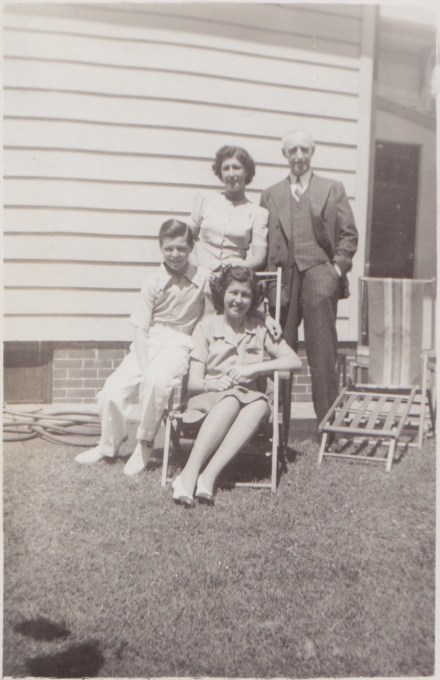
1939 Sackett family

The Sackett family at 23 Methyl Street in Providence: Herbert, Edna (seated), Evelyn and Morris, ca. 1940.


In 1934, James died in a tragic accident. When returning home from synagogue during a snowfall, he did not realize that he was walking along snow-covered trolley tracks on North Main Street. He also did not hear a silent electric trolley coming from behind. In the snowfall, its conductor did not see him either, and James was killed. Herbert recalled that his grandfather was 74 years old and in very good health. Herbert added, “I was only six, but I remember it clearly.”

The War Years

During World War II, manufacturers of all kinds faced strict quotas. The same was of course true for paper. Greeting cards became a popular way to communicate with troops stationed all over the world. Because mail took weeks or even months to reach its destination, customers had to send cards very early to arrive on time. Christmas cards were sold out weeks before the holiday, and Valentine’s Day cards were on sale before Christmas. “It was probably a never-to-be-repeated situation in the industry,” he reflected.

During this era, Evelyn Sackett was actively involved in U.S.O. Herbert, who was a young teen at Nathan Bishop Junior High and already working after school hours at the family store, liked visiting the headquarters of card factories with his father, Morris. For example, they traveled to Rust Craft’s in Boston and Norcross’s in New York City. Morris was treated “kind of special” by vendors who recognized him as the retailing pioneer he was. “I used to tag along and got to meet the heads of the companies and many of the executives,” Herbert said, noting that companies in those early years presented their card lines through samples that buyers would choose from, one card at a time. “I gained knowledge of the products and learned to identify those which contained quality and salability,” he observed. Herbert also learned many intangibles from his father. “The major things he taught me were the importance of accurate record-keeping and financial discipline,” he added. Such lessons would stick with Herbert throughout his 41-year career.

The Suburbs and Beyond
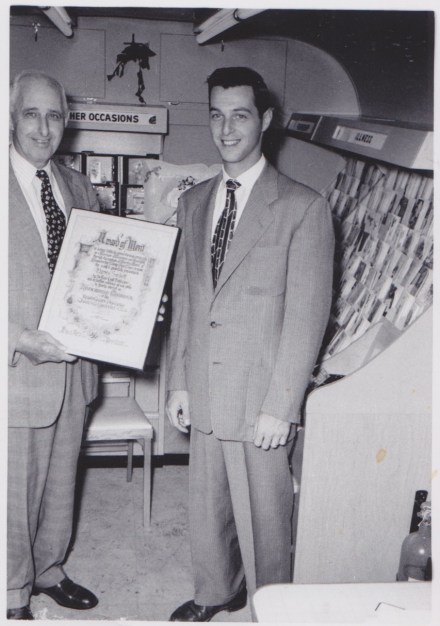
1953 Morris and Herbert

Morris and Herbert Sackett, 1953.


In July 1950, having graduated from the University of Rhode Island with a degree in business administration, Herbert went to work full-time for Sackett’s Greeting Cards. Given his full-time job and his engagement to Jane Lee Cohen, he also gave up his ROTC membership. I was born in 1952 and my brother Richard in 1955. Our family lived in a two-family house at 98 Dexterdale Road in Providence before moving to 287 Rochambeau Avenue in 1958.

From the Providence store, he saw firsthand what was happening to downtowns throughout New England during the 1950s. “Downtowns were no longer the retail vehicle,” he said, referring to the development of suburbs and those residents’ desire to shop closer to their homes. He knew intuitively that this was where the retailing action of the future would be. Shopping centers were also the perfect vehicle for an ambitious young entrepreneur who already knew he wanted to be “an operator of stores, not a store operator.” But the suburbs were not the kind of place where a store that sold only greeting cards could thrive. He needed a plan.

Over the next four years, Herbert researched product mixes and store formats that could be duplicated as a multi-store operation. By 1960, he was ready to open a 1,400 square foot store at 742 Hope Street, around the corner from his Rochambeau Avenue residence.

This “Sackett’s” carried party goods, candles, and stationery items in addition to greeting cards, a “social expression” resource that would become the prototype for future development. Because no single company carried all of these products, he had to put together his own mix of vendors, including greeting card vendors.

In 1962, Herbert brought this new diversified product approach to the store he opened on Westminster Mall, around the corner from the flagship Union Street location. He named it “Richley’s” after my brother and me- “Rich”-ard and Shel- “ley”- to avoid competition with the Union Street store. Although greeting cards were still the dominant product, Richley’s also had a paperback book department, an entire area devoted to party goods, and a candy department. Evidently, Herbert still believed that downtowns had a future.

Over the next few years, he paid careful attention to which products worked and which didn’t. Candy and paperback books were in the latter category.

Herbert opened his first two stores outside Rhode Island in 1967 in downtown New Bedford and downtown Taunton, Massachusetts. They were also the first step toward affiliation with an all-Hallmark product presentation. He then sold the Hope Street “laboratory” location.

Toward the end of the 1960s, when new highways connected suburban shoppers to destination retail areas, there was also an explosive growth of shopping centers. For Herbert, this was a perfect retail storm. “The major positive thing that happened to me in my career was timing,” he said. “Being able to be involved just about the time the suburbs, shopping centers, and malls caught on provided the biggest momentum for my career. I saw this as the wave of the future. It was obvious to me that Main Street, U.S.A. was not going to be the retailing future.”

In 1968, Morris, who had retired in 1963, died at age 79, leaving his son to continue his legacy. While Herbert did just that, he was poised on a very different trajectory. “For my father’s time and personality,” he explained, “functioning basically as a single-store owner was the right thing for him to do. I was much more oriented toward the idea that you take your knowledge and package it.” Unfortunately, Morris did not live long enough to witness a Sackett’s store in a mall location.

Further Expansion

By 1970, Hallmark was retooling in a similar way, diversifying its product line from just greeting cards and gift wrap to include other products like party goods, photo albums, candles, and some gift items. This shift made Hallmark a more attractive vehicle through which Herbert could accomplish his goal of expansion. So Sackett’s became an official Hallmark retail outlet and changed its name to “Sackett’s Hallmark.”

The relationship between the companies remained that of independent manufacturer and retailer (as opposed to franchisor and franchisee). This proved to be a winning combination.

In 1971, the first Sackett’s Hallmark store within an enclosed mall opened in Wampanoag Mall in East Providence. At 2,500 square feet, it included a book department, an expanded gift department, and a cutting-edge, brightly colored saw-toothed ceiling decorated with reproductions of silk-screened poster banners.

Over the next 20 years, Sackett’s Hallmark, driven by a philosophy of “controlled growth,” expanded to locations in Rhode Island, Massachusetts, Connecticut, New Hampshire, Maine, and upstate New York. In 1978, to accommodate the management infrastructure needed to support the rapid growth, Sackett’s moved its headquarters from an upstairs balcony alcove in its downtown, Union Street location to a 13,000-square-foot building in East Providence that housed both corporate offices and a warehouse. Herbert also concentrated on fine-tuning his mix of “allied” (or non-Hallmark) products to achieve an identity that would distinguish Sackett’s Hallmark stores from other Hallmark retailers.

He explained, “Our growth was a conservative one, which gave me a certain amount of comfort, but once you’re committed to that kind of expansion and growth, you’re in all the way. In order to attract and keep the right personnel to make it grow, you need to provide career opportunities for them. We were successful in attracting and keeping our key managerial and supervisory staff because they always knew there was the possibility for future promotion. That was always a challenge and responsibility for me.”

In 1980, I joined Sackett’s as area retail coordinator. Thus, I became the third generation Sackett to be part of the business. My duties included merchandising, writing a company newsletter, and learning the art of gift buying from my father. Only his sharp eye for spotting the next hot seller eclipsed his love for its hunt. In the fiercely competitive gift industry, his merchandising prowess was renowned among vendors and fellow retailers alike.

When I started accompanying him to gift shows in New York and Los Angeles, I was amused and amazed by the effect his lingering in a vendor’s booth could create. I could not have asked for a better mentor.

I remained with the company until 1989 when I relocated to Cheyenne, Wyoming. My brother, Richard, had and still maintains a psychotherapy practice in Manhattan.

By 1985, Herbert was again noticing a new trend in retailing, the “trendy, young-at-heart-oriented” shop. He wanted to take that concept, remove the off-color humor some companies emphasized, and package it in a 1,200-square-foot store that could go into the same malls as Sackett’s Hallmark stores. These new stores, which would carry no Hallmark products, would have a mix of 70 percent gifts and 30 percent cards and were named “Be Dazzled!”. This would be the reverse of the Sackett’s chain merchandising formula.

This was also at the height of mall expansions, when developers were seeking to maximize their attraction by offering the most interesting mix of stores to their customers. The two-store Sackett’s approach had two goals: to differentiate Sackett’s Hallmark from other Hallmark retailers who were competing for the same locations, and to appeal to mall developers who were interested in an additional concept to add to their store mix. Such a move would also maximize Sackett’s management and administrative efficiencies.

Be Dazzled! was birthed on Thayer Street that year, and I was its project director. Over the next few years, it grew to its own chain of seven stores with additional locations in Dedham, Hadley, and Swansea, Massachusetts, as well as in upstate New York.

By the time the 1990s arrived, there were 60 stores under the Sackett’s, Inc. umbrella in six states with over 1,000 employees. Retail competition had become more intense and demanding than ever and Herbert, now in his sixties (who had been receiving a number of overtures from would-be buyers), decided it was time for a change of lifestyle. An opportunity soon arose. In September of 1991, and after so many decades in the industry, he elected to say “yes” to an offer, agreeing to sell the retail division to a longtime acquaintance who was in the same industry but whose locations were primarily in the Middle Atlantic states.

“Needless to say it was a difficult and traumatic decision and was not made quickly or lightly,” Herbert said. “After all those years together, my organization was like family to me. Many of them had been with me from the beginning and it was important to me that I was leaving them in good hands.

“One of my most fulfilling satisfactions came from the fact that, throughout the entire building process, we were able to remain an “independent” company and succeed based on our own high standards, of which we were very proud. On a strictly personal level, it made me even more aware and grateful for the opportunities made possible for me and my family only through the courage and bravery of my grandfather Israel and grandmother Ettie and their migration to this great country,” he said pausing. “This is a message of gratitude I’ve tried to pass down to my own children and grandchildren.”

 

IMG_3681

The Sackett clan today: Shelley and her children Julia, Alex and James; Herbert (center); Richard and his children Taylor and Mimi.


Retirement Reflections

Herbert reflected on his retirement. “With such a dramatic change of lifestyle and pace, it amazed me how seamless the transition became,” he said. “The fact that I remained active was, for me, the key – and it still is.”

Sackett’s, Inc. (the corporate structure that was not part of the transaction) became an investment vehicle and still allows Herbert to keep a finger in the business world, “but only to whatever degree I choose.” He noted that suddenly, there was more time to be involved with his grandkids, volunteer work, travel, hobbies, reading for leisure and for one of his then favorite activities, skiing (which he was now able to enjoy mid-week when the slopes were less crowded). “All in all, it became a satisfying combination,” he said.


United Brothers Synagogue

Congregation-and-guests

United Brothers Synagogue in Bristol, Rhode Island.

Since 1987, Herbert has lived in Bristol. A couple of years before he sold the business, he ran into Jack Temkin, a fellow Temple Emanu-El member also active in the wider Jewish community. When Herbert remarked about planning to see him over the high holidays, Jack asked why he didn’t attend the synagogue in Bristol. That was the first time Herbert heard there was such a synagogue.

Having learned that United Brothers Synagogue has been located at 205 High Street since 1916, Herbert decided to attend services one Shabbat. “I was overwhelmed by the building and very impressed by the cantor, who had a beautiful voice,” he remarked. “My nickname for him was ‘the Robert Goulet of the cantorial world.’ A lot of people felt that way.”

Although to this day he remains a member of Temple Emanu-El, Herbert was so taken by United Brothers that he decided to become a member. After officially retiring from business in 1991, he decided to become further involved. In 2006, after serving many years on its board, he became treasurer. Quickly realizing that the synagogue was underfinanced and in need of many costly repairs, Herbert decided that his personal goal would be to strengthen United Brothers’ financial health. This led to a building fund campaign that paid for a restoration in 2008. After the completion of a recent 2015 capital campaign, there is now an operating surplus.

Business Advice

When asked if he misses being in business, Herbert quickly replied, “I don’t miss being in business at all. If I miss anything, it’s the camaraderie that I developed, the personal relationships.” At gift shows there were social engagements almost every evening. “I always looked forward to them,” he said. He served on the boards of the New York and California Gift Shows and remained an advisor to the board of the California Gift Show for a few years after his retirement. He still sees some old business friends a few times each year.

Asked what advice he would give a young person just starting out in business, he answered without hesitation. “The most important thing, no matter what kind of business- whether it’s bricks and mortar or Internet or whatever- is to have a sound business plan. A well-thought-out business plan becomes a vehicle for producing the degree of profit. Those rules never change.”

“What does change,” Herbert cautions, “are business cycles that represent shifts in consumer demands. The successful entrepreneur must respond to these, which may occur in five-year cycles.” “The Internet,” he warns, “has completely overhauled the retail arena.”

As for additional lessons learned from his family’s business launched about 110 years ago, Herbert offered this: “Don’t expect to be 100 percent right when making decisions; that’s aiming too high. Always think about the ‘what ifs.’”
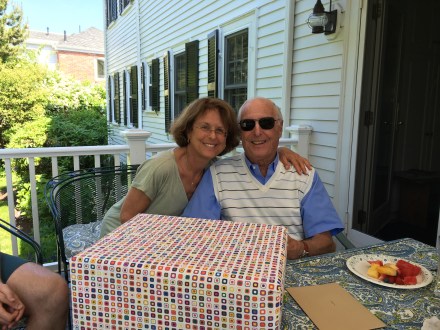
IMG_2305

Shelley and Herbert, Father’s Day 2016. The envelope on the table holds, of course, a Hallmark card.


Despite the phenomenal growth of the Internet with its dozens of virtual e-cards, Herbert still believes that there can be no substitute for old-fashioned, paper cards. “The concepts of art and sentiment, in the ‘touchy-feely’ greeting card, will always have its place,” he proclaims. In fact, both my dad and I are drawn to Hallmark cards and still send them to each other on every card-giving occasion. I can’t speak for him, but the ones he has sent me over the years are in a special shoebox that I look forward to adding to for many years to come.


All’s Unfair in Love and War in “Indignation”


By Shelley A. Sackett

Boston Jewish Film Festival did a real mitzvah on Sunday, July 17 when it treated local film lovers to a free sneak preview of Indignation, the film based on the 2008 Philip Roth novel that opens at the West Newton Cinema and local theaters on July 29. Even better, BJFF further indulged the sold out audience by bringing director and screenwriter James Schamus, (co-founder and former CEO of Focus Features) and his lead actor, Logan Lerman (Fury, Percy Jackson, The Perks of Being a Wallflower), to the stage for a post-screening Q&A.


Semi-autobiographical, Roth’s dark story fictionalizes his own early-1950’s college experience at Bucknell University in rural Pennsylvania. Schamus picked up the slim novel in an airport and fell in love with the book. “It is contemporary but shocking,” the producer and frequent Ang Lee collaborator said.


Set in 1951 against the backdrop of the Korean War, Indignation introduces us to Marcus Messner (played by 24-year-old Logan Lerman). He is the straight-A, straight-laced only son of Max, an overbearing Newark kosher butcher, and Esther, his practical, well-meaning wife (played by theatre veterans Danny Burstein and Linda Emond). Marcus is also the film’s narrator, and his voiceover story has a single simple message: the choices we make determine our fate.


When Marcus’ buddies start coming home from Korea in body bags, Max’s spiraling anxieties fuel his transition from paternal protector to paranoid oppressor. “The tiniest mistakes can have consequences,” he relentlessly warns his son, worried he will squander his future in a pool hall or behind the wrong closed door.


As much to escape his suffocating parents as to avoid the draft, Marcus accepts a scholarship (awarded by his synagogue) to the fictional, elite and very WASP-y Winesburg College in bucolic Ohio. Instantly, the cinematographer Christopher Blauvett’s pallet changes from the overcast skies and gloomy browns and greys of working-class Newark to the sunshine and lush lawns of the collegiate mid-West.


Marcus’ emotional pallet, however, retains its muddy hues. A defiant loner by choice, he avoids getting too close to his two roommates and chafes at any action he interprets as controlling. He resents mandatory chapel attendance not because he is Jewish, but because he is an atheist. He is an equal opportunity religious objector, a rebel for whom the whole world is his cause.


He joylessly slogs through his days, excelling at his studies and working in the library. Then one day, the dreamy creamy Olivia (Sarah Gadon) awakens his slumbering id. Simultaneously calculated and insouciant, she casts her line in Marcus’ sight line and reels him in with the lure of her twitching foot. Schamus’ light directorial touch subtly alerts us to impending danger and ultimate doom. She is Eve, and Marcus is ravenous for whatever she is serving up.

indignation-02

Olivia (Sarah Gadon) and her alluring twitching foot.


During their first date at the only French restaurant in town, the two seem an easy intellectual match, but there’s an unsettling emotional power imbalance at play. He’s as naïve and unscathed as she is cynical and damaged. Even later, during and after the unsolicited sexual favor she performs on him in the front seat of his roommate’s borrowed car, there’s a steely premeditation to Olivia that puts Marcus (and the audience) on edge. This is the least intimate intimate act imaginable, and that disconnect bodes ill for our protagonist.

Indignation

Marcus (Logan Lerman) and Olivia (Sarah Gadon) on their first date.

Marcus may be sitting in the driver’s seat, but Olivia’s clearly behind the wheel. With that single shocking act, she has changed his life forever, and she knows it.

Their initial infatuation becomes hopelessly complicated, careening from snub to obsession to mutual self destruction. This unravels the stoic Marcus to the point where he draws the attention of Dean Hawes Caudwell (played by the terrific Tracy Letts, lately of “Homeland” fame), who summons him to his office for a little chat. In an 18-minute scene that is the unequivocal showpiece of the film, Marcus sheds his melancholic reserve and demonstrates his High School debate captain chops as he rips into the Dean’s defense of all things Winesburg, including mandatory chapel.


Admiring the precocious Marcus’ considerable oratory skills while clearly loathing his message, the Dean treats him as an intellectual equal, and the two go at it tooth and nail. There is no deference to status or age; this is intellectual trench warfare, and each is prepared to fall on the blade of his razor sharp wit.


“I knew the film would live or die on that scene,” Schamus said during the Q&A, and he’s right. It’s the most riveting and emotional scene of the entire movie. It’s a shame Marcus doesn’t show half the passion and urgency with Olivia that he does while lacerating the Dean. The two lovers just don’t share the same on-screen chemistry.


shamus

Director and screenwriter James Schamus

Eventually things go from not great to worse, and Esther shows up at Winesburg when Marcus lands in the hospital after an emergency appendectomy. She meets Olivia, immediately spots the suicide scars on her wrist, and quickly evaluates the danger her son is in. The scene where she exacts Marcus’s promise never to see Olivia again in exchange for her remaining married to his increasingly abusive father is both devastating and tender.


In his directorial debut, Schamus has made a classy, painterly film. As Marcus, Lerman gives a focused performance of subtlety and depth. Although Marcus is clearly Jewish, he is more engaging and accessible than the neurotic clichéd stereotypes popularized by Jesse Eisenberg and Woody Allen. Each time he bristles at some real or imagined oppressive authority figure, his indignation brings home the film’s point.


Gadon’s Olivia is impossible to look away from. She is as complicated as she is stunning, equal parts Lauren Bacall, Grace Kelley and Rebecca Pigeon. Letts, however, is nothing short of brilliant as Dean Caudwell, the roguish academic autocrat whose concern for Marcus is both intrusive and sincere.


Schamus has made a good, entertaining movie, especially considering it is the industry’s “Summer Season”. But for Jay Wadley’s trite and overbearing score, and the fact that we really don’t care enough about Olivia and Marcus because they don’t seem to care enough about each other, it could have been a very good one indeed.


Salem Farmers Market returns to Old Town Hall every Thursday, 3-7 p.m.

Salem Farmer’s Market keeps a tradition alive and well

Shelley A. Sackett, correspondent


Although the 2016 Salem Farmers’ Market may bear little resemblance to its 1634 originator, the Commonwealth’s earliest settlers would feel right at home in downtown Derby Square in front of Old Town Hall — the oldest surviving municipal building in Salem.


Today, as then, the market offers much more than local fresh produce and other dry and baked goods. It also offers a place where people can gather and feel a real sense of local community.


Hundreds of smiling people of all ages did just that last Thursday, braving the wind gusts and threatening skies, to be part of the festivities marking the Salem Farmers’ Market’s eighth opening day. Many lounged on Town Hall steps, munching and talking. Others gladly sampled the vendors’ wares.


SAlemMkt1

Amy Glidden looks at one of the plants for sale at the Gibney Gardens booth during the Salem Farmers Market at Derby Square, Thursday, June 9, 2016. Wicked Local Staff Photo / David Sokol


“The Salem Farmer’s Market creates a community center where residents can catch up with other,” said Kylie Sullivan, executive director of Salem Main Streets.


In fact, according to Kylie, whose downtown Salem revitalization organization runs the market, the city’s deed actually requires the use of Derby Square as a market. “The Salem Farmer’s Market physically transforms the feel of downtown for a little while in a way that’s very relevant to its history,” she added.


The volunteer-run market will be held at the square on Front Street in downtown Salem every Thursday from 3 p.m. to 7 p.m. through October 13. Each week features live music and other entertainment.


Among the 30 vendors lined up for 2016 is “Balloon Man” Lawrence Levesque, who lives in Peabody and is also a magician. He met some people who were “in balloons” eight years ago, and he’s been twisting balloons into fanciful shapes to the delight of youngsters of all ages ever since. “I love it. I wouldn’t do anything else. It’s the best career choice I ever made,” he said as he handed a preschooler a perfect latex dachshund.


IMG_2293

Lawrence Levesque, who is also a magician, delights Salem Farmers Market shoppers of all ages with his balloon creations. Photo by Shelley A. Sackett


Mandy Williamson of Marblehead’s “Fishwives Specialty Foods” started her business on a friend’s dare after she lost her job as regional director of biotech in a wastewater management company. She makes all natural, gluten-free chowders and bisques and “on-the-go” gazpacho that comes in a 16-ounce bottle ready to crack open and drink “much as they do in Spain.”


Because the chowders are gluten free, Williamson can cut back on cream and butter without cutting back on taste resulting in an “absolutely decadent” taste with only 200 calories per 10-ounce cup.


Holly and Andy Varela started Maitland Mountain Farms, one of the seven major farms that anchor the market, after Holly’s 2009 visit to the Salem Farmer’s Market inspired them to ask her father about growing vegetables on his 2.5 acre Salem property.


He agreed, and the two revived the land, cultivating it and installing greenhouses. “Six years later, we’re actually an agricultural production,” Andy said proudly of Salem’s only urban farm.


These days, the bulk of their business is pickles, which they sell all over the Northeast through a food service. They still stay close to their homegrown roots, however, by doing local farmers markets and servicing farm stands and small “boutique-y shops.”


Among the market’s biggest fans is Mayor Kim Driscoll, who was excited when its June 9 opening day rolled around. “The market is such a vibrant and fun weekly downtown event,” she said, offering thanks to Salem Main Streets, the volunteers, City employees and all the vendors “who put in the hard work to make the market possible.”


Tucked in a corner in the shadow of Town Hall is Ann Counihan’s “All Fruit Inc.”, an all natural dried fruit and nut mix that comes in eleven varieties. The healthy snacks-in-a bag are attractively packaged for travelling and are meant to be eaten anywhere.


A large board labeled “Samples” generously offered smaller versions of each of the 11 varieties, each packaged with the same attention to style and detail. Not only were they the classiest samples at the market, Counihan’s encouragement to try as many as you wanted made doing so guilt-free.


Sullivan thinks these direct connections between business owners and customers are a key benefit of the Salem Farmer’s Market. “It becomes a pipeline for emerging businesses to grow their product and their reach,” she said.


For the latest updates about the Salem Farmer’s Market, visit salemfarmersmarket.org, “like” them on Facebook at facebook.com/SalemMAFarmersMarket or follow them on Twitter at @salemfarmmarket.