Pro-Israel Campus Groups Need To Become A Real Movement

Once again, articles about anti-Israel groups on U.S. campuses peppered the Jewish and secular press this week, leaving the impression that Jewish and pro-Israel students are being harassed, intimidated and compromised.


The ADL, in a November 20 blog titled, “Anti-Israel Activity Prevalent on Massachusetts Campuses This Year,” listed nine events that have occurred since September, including a “Festival of Resistance” at Smith College that culminated in an anti-Israel rally outside Northampton City Hall.

Haaretz reported that Wellesley College’s Hillel director and Jewish chaplain were fired after they asked for a meeting with Wellesley’s Students for Justice in Palestine leaders. The Times of Israel reported about SJP’s planned illegal activities against Jewish students and Israel.

Divestment organizers at UCLA, representing a wide coalition of students from all backgrounds and sectors of campus, celebrated a milestone victory for social justice with the passage of “A Resolution to Divest from Companies Engaged in Violence against Palestinians” that singled out Israel.

Once again, pro-Israel groups reacted independently and inconsistently. Some worried that generating outside attention might inflame the situation, making campuses even more vulnerable. Some planned Israel advocacy trainings and sponsored thoughtful opportunities for dialogue. Others rose in defiance, loudly defending Israel against unfair resolutions.

One challenge they all faced was how to address these injustices without legitimizing them. David Suissa, in his opinion piece on the facing page, proposes a solution that is both proactive and constructive.

He suggests that all pro-Israel groups unite behind a single slogan so potent that it will reframe the debate over Palestine in a way that can empower all students, Jewish and non-Jewish, to support Israel.

His idea? “Israel can save the Middle East.”

Think about what might happen if the various pro-Israel groups banded together as a true movement that spoke with one voice and one goal: to draw attention away from Israel’s flaws and towards Israel’s position as the only positive and democratic influence in the Middle East and the only hope for transforming the chaotic region.

Who knows what could happen? Maybe someday the articles about pro-Israel activity on U.S. campuses might just outnumber their counterpart’s.

This originally appeared in the Jewish Journal on December 4, 2014.

Finding Hope Against Hope

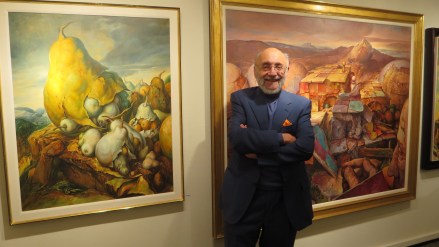
Samuel Bak’s new exhibit is a stunning collection of oil paintings in which the letters “H.O.P.E.” appear in various states of prominence and entirety, sometimes hidden amid bits and pieces of broken bottles and pottery, sometimes clearly visible. Bak’s complex, vibrant paintings address, in his words, “the problem we all share in searching for Hope when it is so difficult to find.” 

“Hope — how did I get there?” the child prodigy and Holocaust survivor rhetorically asked in his preface to the show’s catalog. If there are pictures worth a thousand words, he reasoned, “aren’t there words worth thousands of pictures?”

The show at the Pucker Gallery on Boston’s Newbury Street is as rich in allegory and metaphor as it is in color and texture. Huge fruit, mostly pears, appear in bewildering forms and situations. They are made of metal, stone and wood. They are blue, orange and red. They borrow their identity from cups and vases, shifting from the familiar to the unfamiliar. And yet, each remains unmistakably identifiable.

Bak first painted pears when he was preparing for a big show in Paris during the 1960’s. “I suddenly realized that the pear can be used for all kinds of things that bring different thoughts with them,” he said. For example, the pear brings to mind the female form. It also, according to Bak, can symbolize the limitation of human knowledge. “No one really knows what was the fruit of knowledge,” chuckled Bak, who admitted that, as a child, he disliked apples and that the pear was his favorite fruit.

IMG_3154

“I try to extract whatever I can from a single object,” he said, revealing that returning again and again to the same subject allows him to go deeper into a theme, like a composer whose improvisations create new works based on a single musical theme, such as Bach’s “30 Goldberg Variations.” “My imagination is not surreal; it is grounded in reality,” he added. 


An only child, Bak was born in 1933 to an educated, cultured middle-class family in Vilna. By age three, he was a recognized child prodigy painter. “At that age, I wanted to be a fireman or to sell candy, but little by little I got used to it,” he noted, adding he remembers loving painting and making his parents proud.


At seven years old, on the day after his first day of school, Bak and his family were deported to the Vilna Ghetto. At the age of nine, he had his first exhibition, inside the ghetto. When the Russians liberated Vilna, he and his mother were among its two hundred survivors from a pre-war community of between 70 and 80 thousand. They spent from 1945 until 1948 in German displaced person camps, immigrating to Israel in 1948. His second day of school was in Israel, at age 15. “That’s how it was. My times were not normal when I was young,” Bak said, shrugging.

He lived and worked in Tel Aviv, Paris, Rome and Lausanne, before settling in Weston in 1993. The Pucker Gallery had represented him since 1967, when an Israeli art dealer showed Bernie Pucker some of Bak’s work. “It is a kind of marriage,” Bak said, pointing out that such long relationships between artist and gallery are extremely rare.

Bak1

Under the Arches

Bak is keenly aware of the role the Holocaust has played in his choices of subjects and themes. His imagery reveals survival and suffering, reconstruction and destruction, hope and despair. His paintings are full of bits and pieces of broken objects that have been put back together in sometimes disturbing fashion. His choice of the theme “bits and pieces” is deliberate.

“After the Holocaust, despite the fact that each one of them was haunted by ghosts, the survivors put up an appearance of a certain normalcy, of something that was almost reconstructed but that was intrinsically broken inside,” Bak began.

He continued, “This became the very big subject of my paintings. It means to describe the reality of bringing up an old memory of something that cannot be completely repaired. My paintings are made out of bits and pieces, like the lives of these people.”


Although Bak has been compared to Elie Wiesel, the Holocaust survivor and Nobel Prize-winning author, he identifies more with writers like Primo Levi, the Italian survivor who wrote, “If This Is A Man” and “If Not Now, When”?

“For me, the Holocaust was more of a universal kind of experience. It was a laboratory of human behaviors that showed the extremes of the destructive powers of humans harming each other…For Elie, it is a more Jewish specific drama,” Bak explained, adding, “We speak of the human condition in very different terms. I speak of the terrible with a greater degree of irony and humor. He goes at it more directly.”

Besides, noted Bak, he speaks in images and Wiesel speaks in words. “I was told, ‘You are the Elie Wiesel of painting,’ but there is no such thing.”

Giving Thanks for Shmita

As we gather around our Thanksgiving tables with loved ones and favorite dishes, our thoughts turn to many things for which we are grateful. Despite recent outbursts of anti-Israel and anti-Semitic sentiments, we are thankful that America remains a safe haven for Jews. Despite an unsteady economy and a widening of the gap between the haves and have-nots, we acknowledge that we have a roof over our heads and enough to eat. Although friends and family may be scattered all over the globe, we appreciate that we have the means and desire to come together as a community.


Thanksgiving 5775 is a “Shmita” year, the sabbatical year of a seven-year cycle mandated by the Torah, and we should also take a moment to be thankful for it.

Shmita (literally “release”) is the mitzvah that commands us to let the land rest and to forgive all debts to fellow Jews every seven years. Any fruit which grows of its own accord is deemed ownerless and may be picked by anyone. After six years of farming, our ancestors were called upon to release control over all they owned and owed.

In essence, Shmita teaches us about social justice and sustainability, about how we can help maintain economic, environmental and social balance in the world. It is a commandment of action and commitment. Our gratitude to God expresses itself in deeds. We feed others, whether they are family members or strangers. We revere the land, granting it a year of rest and replenishment. We acknowledge that God sustains living creatures with lovingkindness by extending the same to the earth that sustains us.

Shmita is also a commandment that we slow down, that we stop and rest and examine our own behaviors and beliefs to see what we want to change. Shmita implies that our thankfulness to God should not remain in the realm of emotions, thoughts or even speech, but should also move us to action. It reminds us of our connectedness to God, to each other and to the land.

And so, this year when we say our brachot giving thanks to God before enjoying our holiday meal, let us recognize that Thanksgiving 5775 is special by including an additional prayer for the gift of Shmita.

This originally appeared in the Jewish Journal on November 20, 2014.

Lest We Forget: Remembering Kristallnacht

November 9, 1938, started as just another day for Jews in Germany, Austria and the Sudetenland. After breakfast, fathers went to work, children went to school and mothers kissed their loved ones goodbye. They returned home for a family dinner, went to bed and expected the next day to be identical.


That night, Nazi storm troopers, aided by citizen rioters, burned 267 synagogues, vandalized 7,500 Jewish businesses, murdered 91 Jews and incarcerated 30,000 Jewish men, transferring them to newly built concentrations camps. Overnight, the Holocaust had officially begun.

Kristallnacht — the night of broken glass — marked an important turning point in Hitler’s anti-Semitic policy. Historians uniformly point out that the passivity with which German citizens accepted this violence signaled to the Nazi regime that the public was prepared for their more radical measures aimed at removing Jews entirely from German economic and social life. The Nazis were organized, they were well funded and they were united behind a single mission.

After this summer’s Operation Protective Edge, the trend of declining global anti-Semitism sharply reversed. Daily reports of vandalism, violence and intimidation of Jews all over the world has become the new normal. Classicanti-Jewish tropes have resurfaced, masquerading as critiques of Israel’s political policies and support for Palestinian human rights.

Closer to home, Students for Justice in Palestine, a well-organized group that advocates aggressive and intimidating anti-Israel tactics, is spreading its presence on college campuses throughout the U.S. at an alarming rate. Since June 2014, SJP has formed 28 new chapters, according to the Israel on Campus Coalition (ICC), bringing the nationwide total to 157.

SJP is sponsored by American Muslims for Palestine, a group that promotes and defends posting mock eviction notices on Jewish students’ dorm rooms as “constitutionally guaranteed political speech.”

Kristallnacht was a unique and extreme event that caught its victims completely off guard. Despite mounting evidence, we must remain calm and optimistic, but we must also be alert and vigilant. We must challenge those who claim their blatantly anti-Semitic rhetoric and actions are simply robust exchanges of ideas. Most importantly, we must not be afraid to act. For, in the words of Ayaan Hirsi Ali, “tolerance of intolerance is cowardice.” It is also dangerous.

This originally appeared in the Jewish Journal on November 6, 2014.

Between Avraham and Ibrahim: Interview with “In Between” author Ibrahim Miari

Ibrahim Miari

Ibrahim Miari’s one-man show, “In Between” is a 5-course dramatic feast. It starts with the hypnotic pageantry of Miari’s Sufi dervish dancing and ends with his intercultural marriage to Sarah Goldberg, a Jewish Buddhist. In between, there is a larger-than-life puppet, hypnotic dumbek drumming, and lightening speed changes of character, place, time and emotion.

The play is also a petri dish for every conceivable political, religious and intercultural discussion on the subject of Israel and the Middle East. Miari grew up in Acco, Israel, the son of an Israeli Jewish mother and Palestinian Muslim father. His spellbinding autobiographical story, told with piercing insight and candor, repeatedly raises our awareness by putting us in the unfamiliar shoes of an Israeli who carries a passport stamped “Arab.”

As an Arab Israeli, Miari explains to his audience, he’s not Israeli enough because he’s a Muslim through his father (Islam is patrilineal); he’s not Arab enough because he’s a Jew through his mother; and he’s not Palestinian enough because he doesn’t live on the West Bank.

“I am a 1948 Arab,” his character declares, referring to Arabs who settled in Israel after the War of Independence. “I’m a demographic problem. I’m an inside Arab- an Israeli citizen. I am a ticking bomb-the ultimate security risk.”

Miari is also Ishmael grafted onto Isaac. Born Avraham, at 7 he attended a Jewish school and won the costume contest for Purim, his (and his mother’s) favorite Jewish holiday. By age 8, he was Ibrahim, enrolled at an Arabic school where Israeli Independence Day was celebrated as Nakba Day, the “Day of the Catastrophe”. He identified with everyone and with no one; he was a community of one.

Before moving to the United States in 2005, Miari was a member of the Acco Theatre Center Ensemble for nearly 12 years, acting and dancing in ensemble based projects for both young and adult audiences throughout Israel, Europe and the United States. He also performed solo shows in Hebrew, Arabic and English. An accomplished Sufi dancer and sacred dances instructor, he has directed the drama program at several peace camps in Canada and US with high school age Israeli and Palestinian youth.

In fact, it was while running such a program at a Canadian peace camp for young Israelis and Palestinians that he met his wife Sarah. Their subsequent search for a clergy to marry them gave Miari terrific material. He mesmerizes the audience with skill and satire as his Bread-and-Puppet sized silk cloud of a puppet transforms from imam to rabbi to Buddhist priest, each declining the young couple’s request to officiate their ceremony for ironically similar reasons.

Shelley A. Sackett with Ibrahim Miari at Arsenal Center for the Art’s NewRep Black Box Theater.

Reached at home by phone, Miari articulated why he has not published his play. “It is still a work in progress,” he said of the work that began as his MFA thesis project while attending Boston University’s Theater Education program. “(Not publishing) it allows me to change it as I grow as an artist and a performer. I improvise as I see fit in the moment, according to the energy in the room and current events.” By example, he recalled performing at MIT shortly after the Boston Marathon bombing last year. When his character likened being an “inside Arab” in today’s world to a “ticking bomb”, Miari sensed how the weight and immediacy of that line moved the audience. He paused along with them, incorporating that instant into that performance.

“All of a sudden, I took them to my story and I brought them back to reality. I am in the show and I am in the moment. This play is so personal to me and to my experience that no one else but me could perform it.”

Although his play is autobiographical, he had to invent the way his parents met because his mother wouldn’t tell him the true story. “After watching the DVD (“In Between” has yet to be staged in Israel), my mother said ‘You see? That’s why I didn’t tell you!’” Miari laughed. She remains silent on the subject to this day, although she is as supportive and understanding of her son in real life as she is portrayed in the play.

Miari prefers not to talk about politics (“My opinion about what is happening in Palestine is expressed in my work”), but he offers that the road to a peaceful resolution in Israel is as complicated as it is simple. “It is simple because people need to acknowledge that the violence, occupation and suffering needs to stop, and then they need to have the intention to go towards a solution. It is complicated because most people are unwilling to talk and because there is a lot of ignorance on both sides.”

On a happier note, he pondered what his daughter might take away from “In Between.” “I hope she would see that we’re all one, that this world is so much more than religion and politics. That you should live your life the way it suits you and not try to accommodate anyone.”

While Ibrahim Miari’s story and background may be unique, he echoes what every parent of every nationality and every religion says about every one of his children. “I just want her to be happy.”

Read more: http://blogs.boston.forward.com/insights/183518/between-avraham-and-ibrahim-interview-with-in-be/?#ixzz3dT0uEz5w

Tufts Alums Riled Over National SJP Conference

MEDFORD — When Nanette Fridman of Newton received an email from Tufts University Hillel in early October, she was alarmed by the news it contained. Her alma mater would host the fourth annual National Students for Justice in Palestine (SJP) conference October 24-26.


The group is known for its anti-Zionist, pro-Palestinian college student activism.

Since June 2014, SJP has formed 28 new chapters, according to Israel on Campus Coalition (ICC), bringing the nationwide total to 157. The 2014 three-day conference at Tufts drew over 500 participants, including 50 from the Tufts community.

Fridman’s first reaction was concern for Tufts students. “I had read and heard about stories of harassment, intimidation and physical violence on other campuses. Northeastern even suspended SJP because its members regularly and persistently engaged in anti-Semitic harassment of their fellow students.”

Her second reaction turned to action. Fridman, founder of Fridman Strategies, a firm specializing in strategic planning for nonprofits, emailed a few friends, including Baer, to share her concern and together they drafted a letter to Tufts President Anthony Monaco. “The goal was never stopping the conference or preventing anyone from speaking,” Fridman said.

“We believe in free speech. The best thing is for the SJP/ BDS movement folks to say the things they believe publicly so people can hear for themselves the philosophy of hate and irrationality underlying it.”

On its website tuftssjp.com, the Tufts SJP chapter identifies itself with three slogans: “Peace through justice. Equality through resistance. Humanity through boycott, divestment and sanctions (BDS).” As a group recognized by the Tufts student government, SJP was eligible to apply to the student-run senate for permission to host the national conference and for funds to do it. They received both.

Fellow alumna Simi Kaplin Baer, a real estate lawyer from Philadelphia, said she was “worried that there would be a formal call for divestment by the University,” referring to the SJP’s support of the movement.

Their letter asked Monaco to issue a formal statement that Tufts does not support divestment from Israel, nor sanctions or boycotts against Israel. It was sent on October 16 with 143 alumni signatures.

Monaco’s October 21 response fell short of the group’s goal. He replied that while he hoped the student groups at Tufts that hold differing ideas about the Middle East would have a constructive dialogue, it was important for him as President to refrain from taking sides in this debate.

Michael J. Granoff, Tufts ’91, lives in Ra’anana, Israel, where he manages investments in alternative energy. He was disappointed by Monaco’s reply. “The right, moral thing to do would have been to state unequivocally that SJP espouses values contrary to those on which Tufts is based,” he said, explaining, “Hamas’s charter calls clearly for the destruction of Israel and genocide of Jews. SJP supports Hamas. SJP does not condemn violence. SJP does not support two states for two peoples; they support the eradication of the Jewish state.”

Fridman, too, said that the letter was not what she had hoped for. “A stronger response would have been to issue a public release making clear Tufts’s rejection of BDS and that hate speech is not welcome on the Tufts campus in any circumstance.”

Titled “Beyond Solidarity: Resisting Racism and Colonialism from the U.S. to Palestine,” the weekend featured many workshops promoting “direct action,” defined by one workshop as “a last resort tactic that maximizes student pressure and demands attention from all stakeholders.”

Other workshops were “Israeli Apartheid: Reality on the Ground After the Protective Edge Massacre and Ending Genocide in Gaza” and “Bursting the Campus Bubble: Learning from Campaigns Beyond Campus Divestment Resolutions,” where students were taught to expand SJP’s anti-Israel strategy to offcampus activities. “False Claims of Anti-Semitism: How to Effectively Respond,” addressed whether it is okay to distribute flyers to a dorm room in a mock eviction action and how free speech rights apply to campus activism and civil disobedience.

All workshops were closed to non-registered attendees. Only SJP students, alumni and students from selected allied groups could register. At least one Jewish journalist, Daniel Mael, a senior at Brandeis who has written about the SJP for thetower. org (“On Many Campuses, Hate Is Spelled SJP”), was denied press credentials.

“NSJP does not care about human rights or the future of the Jewish people and does not tolerate dissenting opinions. Therefore, they found my presence unfit for their conference,” Mael said.

According to the ADL’s website, American Muslims for Palestine (AMP), a leading organization providing anti-Zionist training and education to students and Muslim community organizations, has placed heavy emphasis on supporting and helping coordinate the activity of SJP.

One Tufts SJP member, senior Hani Azzam, wrote on the news website, Mondoweiss.net that hosting the national SJP conference was a dream come true. “When I was a freshman, we dreamed of holding an Israeli Apartheid Week… Although our ultimate dream of a liberated Palestine remains on the horizon, our accomplishments these past four years… fuel the resilience and progression of our entire movement.”

Another attendee, Ofek Ravid, a U.S. citizen from Israel, described his experience in less glowing terms in the tuftsdaily. com. After making a point during a workshop Q&A that the BDS movement may be harming rather than helping Palestinians, he was booed and hissed at and asked to leave the building by an SJP representative. “I came to the conference with an open mind in an attempt to learn about the Palestinian struggle from activists… This movement restricts freedom of speech and undermines the Palestinian cause instead of supporting it,” he wrote.

In his letter to the alumni, Monaco made clear that Tufts is committed to providing a “range of thoughtful opportunities for our students to gain an understanding of challenging issues and develop the listening skills essential for resolving conflict.” He did not address divestment.

Two such opportunities this fall are an eight-week series of discussions sponsored by the University Chaplaincy called, “Restoring Dignity in the Israel-Palestine Conversation” and a range of Israel programming and initiatives sponsored by Tufts Hillel, including “Advocacy Training” and “Fostering Civil Campus Dialogue,” spearheaded by Rabbi Jeffrey Summit.
Power

“Power in People” from Students for Justice in Palestine’s facebook page

No time was lost putting some of the “direct action” tactics taught at the October 24-26 conference into practice. On October 30, ICC reported that Ohio State University was the first school of the 2014 academic year where mock eviction notices were sent to Jewish students. Megan Marzec, of Ohio State University, was one of the SJP workshop presenters on October 26. Last year, 14 schools, including Rutgers and Northeastern, were targeted.

Baer is worried about the future. “I am concerned that anti-Semitic and hateful rhetoric against Israel and Jews that would not be considered ‘free speech’ were it directed at any other group is tolerated at Tufts,” she said.

Fridman is already thinking about the future with her and many of the signatories’ spring 2015 Tufts University reunion on the horizon. “We got 143 signatories over a few days just by emailing our letter to friends whose addresses we had. I know if we used a petition website or social media, we could get thousands and thousands of alumni who feel similar to us.” She received many more emails from concerned alumni since their letter was submitted.

She paused and added, “We are closely watching events on campus, and we are monitoring the Administration’s response.”
Supporting Our Children

Our college students are under pressures most of us did not encounter when we were their age. In addition to the expected stresses of academic and social adjustments, they are part of a generation that must struggle with financial anxieties over how they will bear their share of the exorbitant cost of their education and whether they will find a job in this very competitive market when they graduate. This fall, they must also contend with the burden of what it means to be a Jewish student on an American campus. The summer’s war in Gaza has led to an increase in global anti-Semitism, including pro-Palestinian protests and activism on campuses throughout the country. Some of the rallies, meetings and letter-writing campaigns have been organized by groups expressing reasoned criticism of Israel in respectful ways. Some of the anti-Israel and anti-Zionist demonstrations, however, are hateful attacks against Jews and the Jewish State that embrace Nazi imagery and anti-Semitic slogans. Most of our children have never encountered such openly hostile and aggressive targeting during their lives.


Many campus Hillel organizations have recognized the problem and are offering additional support and resources. For example, at Tufts University, where the Tufts chapter of Students for Justice in Palestine (SJP) will hold its national conference October 24-26, Israel educational programming and advocacy training are available for all interested students. Nonetheless, the presence of so many students, academics and activists who sponsor “Israel Apartheid Week” and promote the movement that advocates boycott, divestment and sanctions against Israel will be unnerving.

And what about our students who do support a two state peaceful and just resolution to the Israel-Palestine conflict? Where can they find a safe place for thoughtful, nuanced civil dialogue in the current polarized environment where even some of their parents have drawn bright lines between what it means to be pro-Israel and what it means to be anti-Israel?

We need to make the time to talk to our young adult children and support them as thinkers in their own right.

This originally appeared in the Jewish Journal on October 23, 2014.

Dual Paths for Dual Hands

As the daughter of Holocaust survivors, Monique Illona was shaped by her parents’ pain and anguish. “My parents were traumatized and their experiences traumatized me and my siblings,” Illona said. “They didn’t have the opportunity or resources to learn how to deal with their problems.”

She, however, did. Her recently published book, “A Dual Path: Sacred Practices and Bodywork,” describes her path from pain, bitterness and anger, “the energetic matrix I inherited from my parents,” to an awakened life of transformation and sacredness.

She also offers a blueprint for how the integration of bodywork (massage) and spiritual practices can help one achieve a life that cultivates inner stability, connection and strength.

Illona
Monique Illona


Illona’s parents met in Paris after World War II. Her French mother had survived the war by hiding in Paris and her Czechoslavakian father had survived Auschwitz. They first lived in Paris, but her father could not get a work permit. They applied for visas in three countries, America, Australia and England. The visa to Australia came through first. Her two brothers were born there, but the family eventually settled in England where Illona was born in 1960.

Judaism was a foundation for her growing up. She and her brothers attended weekly Hebrew school, but her parents were conflicted about how to integrate Judaism with raising a family. “My father came out of the Holocaust believing there wasn’t really a God,” she said. One of her brothers wanted to have a traditional Jewish family life, which caused huge arguments at home. “My brother kind of won and we did do Passover and Shabbat and always went to synagogue for the High Holidays,” she said. Her brothers still lead actively Jewish lives.

When Illona was 12, her father discovered that his sister had survived the war and lived in Israel. She accompanied her parents on their first trip there and fell in love with the country. She went back every year from the age of 13 during summer vacations to volunteer at various kibbutzim or to do work study programs.

“A Dual Path” enables others to shorten their own paths from a painful to a more vibrant and meaningful existence.

Once she finished school, she joined an ulpan on a kibbutz to learn the language. She ended up staying, joining the Israeli Defense Forces and becoming a member of a kibbutz in the Golan Heights. “My connection to Israel became stronger than my connection to Judasim,” she said.

She married in Israel and she and her American husband lived in a kibbutz made up of three or four “garinim” (groups of people who serve in the army together and then go to the same community to help build and establish it). Her husband fought in the 1982 Lebanon War in Beirut; many of their fellow kibbutz members died in that war. She and her husband, who are now divorced, decided to leave Israel and give it a go in the U.S.

She completed a B.F.A. at the School of Visual Arts in New York and earned a Masters degree at Lesley University in Expressive Therapies. It was during this program that she began to examine herself and to understand the connection between the legacy she had inherited and the life she had been leading.

She started learning things her parents never had the chance to. “There was something in me that was strong, clear and focused. I realized I could go forward in a whole different direction,” she said, adding, “It was like giving up caffeine. I rejected who I had been until that time.”

Illona was also a self-defense instructor and an inductee into the World Martial Arts Hall of Fame. She met her soulmate and professional partner Blane Allen in 1990 when his martial arts school moved into the building where she lived and worked as a sculptor. They have offered professional massage bodywork since 1991, and created “Hand in Hand Massage” in Marblehead.

At their teaching facility, The Dual Path Institute™, located next door to Hand in Hand, they offer events, programs and workshops for massage professionals and the general public for personal transformation and professional growth. They also travel the country and the globe with their trainings and public speaking.

Illona wanted to write “A Dual Path” to enable others to shorten their own paths from a painful to a more vibrant and meaningful existence. “Once you have enough strength, it’s so much easier. I really feel we have that choice every day in every moment.”

Visit handinhandmassage. com and adualpathpath.com or call 781-639-4380.

The Sacredness of Sukkot

After the ten-day period of Rosh Hashanah and Yom Kippur, Sukkot is a literal breath of fresh air. Our focus turns from the internal world of selfassessment, forgiveness and atonement to the external gift of the earth in its autumnal glory.


Sukkot’s historical significance commemorates the forty-year period when the children of Israel wandered in the desert, living in fragile, temporary huts. Its agricultural significance celebrates the fall harvest, honoring the relationship between human and earth. We are commanded to build a small, simple shelter (sukkah) with a roof of vegetation through which we can see the stars, and to live in it for seven days. It is an opportunity to leave our partisan, self-centered, materialistic lives and reconnect with the sacredness of family and land.

Although Sukkot is a festive and joyous holiday, it imparts many serious lessons. Unlike the High Holidays, the bulk of its rituals and celebrations occur in the home. This time we spend in a basic, small space with family and friends reminds us how important and valuable communication, community and sharing are. The temporary nature of the sukkah reminds us that, outside Israel, we remain wanderers and that our existence on earth is transitory. The fragility of the structure reminds us that we are fortunate to have a roof over our heads and food on our tables when so many have neither. We learn to appreciate more and take less for granted.

Most critically, however, Sukkot reminds us that our Torah commands us to recognize the holiness of the earth and the role we must play to nurture and protect it. All the holiday’s rituals reinforce our slowing down, simplifying and returning to the basics.

During the High Holidays, we are mindful of perfecting ourselves so we can repair and perfect the world through compassion, justice and peace. During Sukkot, we remember we must appreciate that world for what it is: God’s gift to us. It is our responsibility and within our ability to remain worthy of that trust.

This originally appeared in the Jewish Journal on October 9, 2014.

New CD Commemorates Kristallnacht and Reimagines Hebrew Melodies

When composer Eugene Marlow had the inspired idea to include a track on his upcoming CD, “Mosaica,” to commemorate Kristallnacht’s 76th anniversary, the first person he thought of was his Aunt Ruth Rack in Australia.

Now in her mid-80’s, she was a 9-year-old in Leipzig, Germany when she witnessed the 1938 event, also known as “The Night of Broken Glass.” “I decided I had to have her narrate this,” said Marlow. The result is “Zikkaron (Remembrance)/ Kristallnacht,” an original composition that opens with the sound of Goebbels’ harsh voice and then fades to Ruth’s memories of that awful night.

The quasi-classical/Hebraic melody, according to the CD liner notes, represents Ruth’s mother’s resolute calm against the surreal, destructive aggression by the Nazis. Repetitive, single piano notes bring to mind the shattering of glass. The marching rhythm of the brass and percussion evokes a dark terror and brutality.

Marlow sent Ruth a rough mix of the track. “She liked it very much,” he said, adding that he also included an instrumental- only version on the ninetrack CD.

Pianist Marlow founded “The Heritage Ensemble,” a quintet dedicated to performing and recording his original compositions and arrangements of Hebraic melodies in various jazz, Afro-Cuban, Brazilian and classical styles. Other members are of Puerto Rican, Lebanese and Eastern European descent. Marlow’s family background is Russian, Polish, German and British.

“I am a third or fourth generation musician/composer,” Marlow said. “This is my passion,” he added, jokingly, “If you open up one of my veins, little quarter notes will jump out.”

“Mosaica” is the ensemble’s fourth album and the first to include a vocalist, Cantor Shira Lissek. “I heard her sing and loved her voice. She and I chose specific melodies,” Marlow said, adding that Lissek was concerned that as a classically trained cantor, she lacked a strong background in jazz. ”I told her, ‘You sing it straight. We’ll do the jazz around you.’” The result is a stunning collection of songs that simultaneously feel familiar and brand new. “Eliyahu Hanavi (Elijah the Prophet)” is an exciting combination of moving vocals and silky jazz accompaniment, while “Mah Nishtanah Halaylah Haze (Passover’s Four Questions)” is a bright, lively rendition of the traditional Passover melody.

Marlow, who holds a Ph.D. in Media Studies, an MBA, an M.S. and B.S. in music composition and a B.A. in English, is a professor at New York City’s Baruch College in the department of journalism and writing. He didn’t get serious about music until he was in his 20’s and didn’t start studying composing formally until he was in his 50’s.

He plans a spring 2015 release of a DVD visualizing the “Kristallnacht” track with vintage photographs from Austria and Germany to coincide with Holocaust Remembrance Day, and a fall 2015 release of original Brazilian-inspired compositions.

“I have accelerated my music output in the last five years,” Marlow said. “With ‘Mosaica,’ in particular, I made it a mission to do something different than our previous albums.”

To purchase the CD, go to cdbaby.com/cd/eugenemarlow6.