Unjust Rule of Law: Jewish Lawyers Under the Reich

Throughout their long diaspora, Jews have flourished when treated fairly and allowed to compete. Such was the case in Germany with the creation of the German Empire in 1871. Suddenly, Jews enjoyed full citizenship rights. At the same time, they gained access to a previously unavailable livelihood when the practice of law was delinked from the civil service. A private, independent legal profession swiftly emerged, and with their tradition of Talmudic discussions and analysis, Jews quickly found a new niche.

Up until the 1920s, the number of Jewish lawyers increased continuously and included women in their ranks. Subsequent generations took over the private practices of their fathers or started their own. In the big cities, the share of Jewish lawyers was higher than in smaller towns with a court. In Berlin, for example, on January 1, 1933 more than half of the 3,400 lawyers were of Jewish origin.

However, they did not identify as Jewish lawyers: they were German, lawyers and Jews, in that order. Many of them had been soldiers during the First World War; others had renounced their Jewish faith and some had even been baptized. In the area of jurisprudence, they contributed to the development of renowned legal journals and to the establishment of professional organizations.

All that came to an abrupt halt with the rise of Hitler and the dissolution of the democratic state. Overnight, Jews were excluded from all areas of social life. In March 1933, a decree was issued which refused all Jewish judges, public prosecutors and lawyers entry to the courts starting the very next day.

Reich2
The public is advised “Don’t go to Jewish lawyers” in 1933 Munich.

From 1933 until 1938, the National Socialists chipped away at Jewish access to the law. Finally, in 1938 all except a very few were banned altogether from practicing their profession. Those few could only act as “legal consultants” for Jewish clients. Essentially, there were no more Jewish lawyers in Germany. The Nazis had achieved their goal of making the legal profession “entjudet” (free of Jews).

“Lawyers Without Rights: Jewish Lawyers in Germany Under the Third Reich” is a sparse, densely informative exhibit jointly sponsored by the German Federal Bar and the American Bar Association. Since the fall of 2012, it has toured all over the world. With the support of the Vilna Shul, it is on display in the John Joseph Moakley Courthouse lobby through September 30.

Most of the show’s panels are devoted to the stories of individuals who lost their livelihoods, and in many cases their lives, during those darkest of times. These intimate portraits, and the fragile accompanying photographs and documents, are the heart and soul of the exhibit.

Margarete Berent’s story is one of perseverence. The 1914 dissertation on family law that she wrote to complete her law studies actually served as the 1958 model for the legal reform of inheritance and property laws in the Federal Republic of Germany. Berent was unable to practice law until 1919, when women were first allowed to take the bar exam. By 1925, as the first Prussian female lawyer, she had a thriving practice in Berlin. By 1939, she had fled to Chile, and by 1940 she was living in New York as a housemaid and postal worker. Undaunted, she went to New York University Law School at night and began working as a lawyer again in 1950, at age 63.

If the exhibit sounds dry and factual, that’s because it is. There is little excitement generated by posters on easels and trifold office wall mounts. Excitement, however, is not the point; contemplation and solemnity are. We mourn anew the senseless loss of our fellow Jews and reflect about a time when a nation completely abandoned individual rights and the rule of law. To do so in the lobby of a United States courthouse is all the more moving.

It may be a coincidence that Berent’s easel stands beside an inlaid panel of Daniel Webster’s famous quote, “Justice is the great interest of man on Earth. It is the ligament which holds civilized nations together.” Then again, it may not.

Go to lawyerswithoutrights.com for more information.

Pictured at top: Jewish lawyer Dr. Michael Siegel was forced to march through Munich barefoot after complaining to the police. 

In Their Own Words

Every summer, hundreds of American teenagers travel to Israel under the auspices of programs such as the Lappin Foundation’s Youth to Israel. Y2I, a “rite de passage” for many North Shore Jewish teens, is intended as a life-changing Israel experience. 2014’s trip was uniquely so.

As their plane landed at Ben Gurion Airport, news broke that the fate of three kidnapped boys was clear: their murdered bodies had been found. Within days, Hamas rockets sequestered the Y2I group in northern Israel, precluding visits to Tel Aviv, Jerusalem, the Dead Sea and Masada. It was simply unsafe to proceed with the trip “as usual.”

The teens wrote post-trip essays about their experience and, with the permission of the Lappin Foundation, we share passages from many of them, joined together into a single voice.

“This trip taught me the true definition of being Jewish. It was not until I was actually in Israel, with the rockets and fighting, that I understood how strong we are. Israel is an amazing and resilient country and we were lucky enough to witness it firsthand.

The Israeli kids told me how important it was to just go through your day with a smile, and make the best of a dim situation. I will take that piece of advice with me and use it for the rest of my life. I never thought one trip could teach me such a big lesson.

What I admire most about Israel is her strength and heart. Israel and the Jewish people have always faced adversity. But even when times get tough, even when other people and other countries knock us down and try to belittle us or hurt us or say we are not good enough, we always get up.

I feel it is part of my responsibility to let people know about the real struggles in Israel, not the fake rumors. This is extremely important to me, and Y21 gave me the ability to understand it better.”

During this wrenching time for Israel and Jews everywhere, it is easy to get caught in the web of relentless media coverage, political polemics and sharp-tongued rhetoric. How fortunate we are that we can also tune into the voices of those with the most at stake: our children, who will live in a future we will not see.

This originally appeared in the Jewish Journal on July 31, 2014.

Wish I Weren’t There

Almost exactly 10 years ago, Zach Braff debuted his wildly acclaimed “Garden State” at the prestigious Sundance Film Festival. Braff played Andrew, a depressed, heavily medicated twenty-something year old aspiring actor who returned from Los Angeles to his native Newark for his mother’s funeral.

“Wish I Was Here,” to be released in Boston July 25, (again) stars Braff, this time as Aidan, a struggling thirty-something actor who (still) lives in Los Angeles in states of perpetual malaise and financial distress. If viewed as the same character, Aidan/Andrew’s only observable accomplishment over the last 10 years was his acquisition of a wife and two children. Otherwise, his last decade has been spent on a treadmill.

Unfortunately, almost two hours into the movie, the audience can relate to Aidan’s melancholy after what feels like a decade spent artistically running in place.

To be fair, the story had potential and the star-studded cast had the chops.

Aidan Bloom calls himself an actor, but had only one “starring” role many years ago as the “before” guy in a dandruff commercial. He spends a good deal of his time daydreaming that he is a spaceman and cursing in front of the kids. His wife Sarah (Kate Hudson) supports the family, trudging off to her data-cruncher job at the water department, where she contends with the spiritual wasteland of her cubicle and the infuriating sexual harassment by her cellmate. Their two kids, pre-teen Grace and younger brother Tucker, attend a pricey yeshiva school, paid for by Aidan’s father, (Mandy Patinkin). Aidan exists in a bubble of self-indulgent fantasy until Gabe develops cancer that requires expensive out-of-pocket treatments and, faced with limited financial resources, decides to pull the plug on the kids’ tuition rather than on himself.

Josh Gad in his favorite spaceman costume.

Josh Gad in his favorite spaceman costume.

As if the cosmos itself had snapped its fingers, Aidan awakens from his trance. Suddenly, he has to contend with the realities of a dying parent, an impatient wife, and kids who need schooling. As Gabe must confront death, his son must confront adulthood and its attending responsibilities.

Rather than subject his kids to the taunting and thumping of his still painful public school years, Aidan homeschools them, with predictably mixed results. The world is his blackboard, and he starts in his own backyard. (“Nice little slice of Mumbai you have here,” Gabe quipped). The lessons alternate between the practical (resurrecting a neglected pool) and the universal (appreciating the magic of desert camping), with a bit of street-smart manipulation thrown in (scamming an Aston Martin test drive).

Their value, however, is not pedagogic (as California Standard Tests would no doubt eventually reveal). These are lessons for the teacher, not his students. Slowly (as in excruciatingly slowly), Aidan awakens to his ability to discipline and be disciplined, to be open to family intimacy, and to appreciate parenthood.

In short, Aidan starts to grow up, and in the process transitions from perpetual child to budding head of his own nuclear family.

The best part of the film, especially for those of us suffering from “Homeland” withdrawal, is Patinkin as Gabe Bloom (a dead ringer for his Saul Berenson). The patriarch Bloom is the film’s only nuanced character, a man whose religion is both sword and shield. His biggest disappointment is his relationship with his sons, but rather than admit it, he hides behind caustic barbs and Talmudic aphorisms. He is not Aidan’s ideal role model.

Josh Gad, as Aidan’s reclusive and grizzly brother Noah, does his best with a bizarre role and Hudson is light and gracious as Aidan’s inexplicably supportive wife.

The movie’s insurmountable problem is that it seems stuck in the glib mediocrity of television sitcoms. The gags and artsy California montages feel tired and trite. The countless vanity close ups of Braff go from embarrassing to annoying. When Hassids show up on Segways, all that is missing is a canned laughter track.

“Wish I Was Here” has some solid soulful messages about family, Judaism and life’s challenges in the modern age of insta-everything, but they are buried beneath layers of extraneous and superficial footage. As the late great Roger Ebert succinctly stated, “No good movie is too long and no bad movie is short enough.” ‘Nuff said.
Pictured at top: Zach Braff and Kate Hudson are co-parents to Pierce Gagnon (left) and Joey King (right).

On Film, Faith and Family

Zach Braff should be as exhausted as he looks. On his day off from his eightshow- a-week lead role in “Bullets Over Broadway,” Woody Allen’s musical comedy that opened in April, he is not relaxing and renewing. Instead, he was in Boston on a publicity blitz of interviews and appearances in support of his favorite thing in life: his filmmaking.

“Wish I Was Here,” which opens in Boston on July 18, is his second time both behind and in front of the camera. It has been 10 years since his indie film, “Garden State,” which he also directed, wrote and starred in, blazed its way from the Sundance Film Festival to cult favorite, picking up a Grammy for best soundtrack along the way. Braff is passionate about this project, his newest film, which he funded through a Kickstarter campaign. He deflected the criticism he attracted from those who felt that celebrities should bankroll their own projects. “You can’t make a movie these days about Jews,” he stated. “We’re 2% of the population and shrinking, and none of the studios want to make a movie for or about us. Part of the crowd-funding was to be able to tell an honest story about a Jewish family.”

In this new film, which he co-wrote with his older brother Adam, Braff stars as Aidan Bloom, a 30-something secular Jew whose kids attend Yeshiva (paid for by their observant

grandfather, Gabe (played by the always captivating Mandy Patinkin), and whose wife works a job she hates to support his “career” of auditioning for acting jobs he never gets. When Gabe is diagnosed with terminal cancer, Adam is forced to transition from child to parent, from cared for to caregiver. Along the way, he taps into his own spirituality and reconciles with his father and his faith.

The plot, however, is secondary to Braff’s real purpose in making the film.

“This film is about people who are searching for their spirituality and haven’t found it yet,” Braff stated. “I identify with the cultural aspects of Judaism. I grew up with stories of the Holocaust. I relate to the stories of Jews being persecuted and forever being killed and chased from wherever they lived. You can’t help thinking, ‘Wow, I am descended from these people that nobody wanted to be on this earth.’ I want to protect that.”

The three Braff brothers (older brother Joshua is also a writer) were raised in New Jersey in a strictly Orthodox home. Although Zach and Adam scripted the film, Joshua collaborated on developing Aidan’s character.

“My brother and I wanted to write about our faith and we wanted to write about growing up Jewish. Because we’re 10 years apart, our father raised us differently. Adam went to an Orthodox, very strict yeshiva and it pushed him away from Judaism. It had the opposite effect my father had hoped for,” Braff explained.

“By the time I was going to school, we were conservative and kosher, but I was going to secular school and Hebrew school three times a week instead of yeshiva,” he continued. “We knew we could approach the subject of a secular man’s search for spirituality because we were raised from two different stances.”

“We were a great yin and yang for each other,” he shared.

Braff’s father, who welcomes Shabbat every Friday with prayers and dinner, was concerned that his sons might be taking digs at organized religion in general, and Judaism in particular. “I made it clear to him that this movie isn’t about condemning Orthodoxy at all,” Braff said.

Rather, it is about the yearnings of a young man to tap into something which he knows is there but which he has yet to experience.

Two characters in the film, an old man and a young rabbi, illustrate Braff’s point. “The old rabbi isn’t surviving well in a modern world, let alone trying to enroll a secular man in faith. Then there is the opposite with the young rabbi, who goes out of his way to tap into the spirituality that Aidan has. He untangles him from needing the exact right words of Judaism and instead focuses in on exactly where he is.”

He smiles broadly. “This was the dream rabbi my brother and I always hoped for, but never met, and so we created him. My father cries his eyes out every time he sees it.”

For his soundtrack, Braff again enlisted bands he loved to create original content for the film (“Garden State” launched The Shins from the indie to mainstream realms). The playlist includes songs by Bon Iver, Cat Power, Coldplay and The Shins.

A Trivial Pursuit tidbit about Braff is that he is related to Mitt Romney, whom he met when flying to Utah last fall. When asked if his mother is really Romney’s ninth cousin, he laughed. “It’s a very bizarre fact, but it’s true. The research was done by a genealogist who clearly has too much time on his hands.”

He paused and then leaned forward, blue eyes thoughtful and somber. “I fought hard to keep this a Jewish movie with a Jewish star and I hope the Jews of Boston and Massachusetts will go see it. I’d like to make more films about my Jewish experience.”

Time to Restore Peace and Security

Israel has reluctantly launched a military offensive against Hamas in response to repeated attacks against its citizenry. Fortunately most of the world agrees that Israel has an unconditional right to protect its people; some believe it should have happened sooner, while others fear that this operation could turn into a broader and more extensive war.


The fact is that war has broken out in Israel once again, and we in the diaspora must stand as one in support of Israel’s efforts to eliminate the danger terrorists pose. What options are there when people want to kill you simply because you exist, not because of anything you do or don’t do? How do you make peace with people whose mandate is your destruction?

As CJP President Barry Shrage said at a recent memorial for the three slain Israeli teens, “We don’t believe that tragedy is inevitable, we don’t believe that we’re trapped in endless cycles of violence. We just can’t afford to mourn any longer. Now is the time for action.”

We must look at the reality of what is on the ground today — not what could have been, not what should have been, but what is. As we go to press, Israel has expressed willingness to consider cease-fire terms proposed by the Egyptians. Hamas has refused. One million Israelis have spent time in a bomb shelter this past week. No country in the world would or should tolerate terror attacks on their civilian population.

We support and echo the statement of Combined Jewish Philanthropies/ Jewish Community Relations Council by urging decent people everywhere to be especially firm, vocal and unequivocal in expressing not only their support for Israel, but also an absolute intolerance for Hamas’s assaults.

On this we must stand united.

This originally appeared in the Jewish Journal on July 17, 2014.

Unknown Jewish Artist’s Work Celebrated in Endicott Retrospective

If City University of New York art history professor Gail Levin had not stumbled upon the then unknown artist Theresa Bernstein in the course of her research on Edward Hopper in the 1980’s, she might be unknown still. Instead, Levin positioned her front and center in the noteworthy retrospective, “Theresa Bernstein: A Century in Art,” which opened last December in New York City. Luckily, one of the show’s four traveling stops is at Endicott College’s Walter Manninen Center for the Arts, where it will remain until July 11.

Self-Portrait

“Self Portrait” (1931)

Notwithstanding Levin’s curated exhibit and in-depth catalogue, Bernstein remains unknown, despite the fact that she exhibited in every decade of the twentieth century. Born in Cracow in 1890, she was raised in Philadelphia by educated and cultured Jewish immigrant parents. Her travels to Europe in 1905 and 1911 awakened a passion for modern art, and her paintings reflect her admiration of Manet, Matisse, Picasso and Cezanne. When her family relocated to New York City in 1912, she established a studio near Bryant Park and began painting in earnest, exhibiting alongside Edward Hopper in 1919.                   

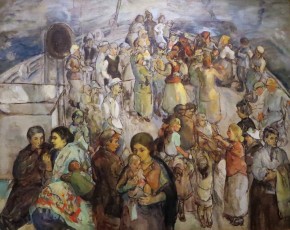
The-Immigrants

“The Immigrants” (1923)

Although Bernstein pretended she was American-born, many of her paintings reflect her compassion for the trials her fellow immigrants faced. In “The Immigrants” (1923), for example, Bernstein emphasizes maternal tenderness in the foreground of the large oil painting. Set in the 1920’s, the immigrants she portrays are arriving in New York City aboard the Cunard R.M.S. “Aquitania.” At a time when the U.S. government was passing laws restricting immigration, Bernstein was concerned for the future of her fellow Jews who had been escaping Russian Empire persecution in large numbers since the 1890’s.

The-Milliners

“The Milliners” (1919)

Many of her paintings reflect Jewish subjects. “The Milliners” (1919) incorporates portraits of Bernstein’s mother, mother in- law, sisters-in-law and her housekeeper. With the exception of the housekeeper, all were Jewish immigrants, many of whom worked as hat makers in New York’s garment trades. “The Menorah” (1948) celebrates Israel’s birth in 1948 with its symbol of statehood. “The Cone Sisters” (1930) is an intimate portrait of Etta and Claribel Cone, daughters of German-Jewish immigrants. The wealthy Baltimore sisters, trailblazing patrons of modern artists, supported Picasso and Matisse.

“The Cone Sisters” (1930)

Cone-SIstersBernstein married fellow painter William Meyerowitz, sharing 63 years of marriage and an Upper West Side studio. She outlived him by 23 years, dying just shy of her 112th birthday in 2002. Starting in 1916, the couple summered in Gloucester every year, members of a well-known colony of artists. Bernstein painted beach and other local scenes, and William often played chess with their neighbors. “The Country Fair” (1917) is a loving, intimate snapshot of Bernstein’s connections to the seaport town that offered her a “cradle-like serenity” and the inspiration of authentic American crowds.

Bernstein’s most exciting paintings, however, are post-1929, the year she discovered jazz. Her style is freer, less chained to conventions of color, brush stroke and composition. The three paintings “Charlie Parker” (1953), “Cab Calloway-Minnie the Moocher” (1935)  (below left) and “Lil Hardin & Louis Armstrong” (1927)  (below right) are an almost surrealist triptych so full of life that that if you close your eyes, you can hear the music that inspired them.

Cab-CallowayLouis-Armstrong

In her “Credo,” Theresa Bernstein stated, “I believe that my work will be more appreciated and understood as it is more seen and studied, just as sound or a language becomes more coherent.” Her appearance at Endicott College in Beverly couldn’t be more fitting. The park-like setting of the Manninen Center for the Arts makes for a perfect summer outing, and the discovery of a new artist’s work is like a breath of sunny air. How often, after all, do we have the opportunity to view an artist and her work with truly fresh eyes, unclouded by preconceptions and judgments? Be sure to take this opportunity to do just that.

Pictured at top: “The Menorah” (1948)

endicott building

The park-like setting of Endicott College’s Walter J. Manninen Center for the Arts

All photos by Shelley A. Sackett

The exhibit is showing in the Manninen Center for the Arts at Endicott College, Beverly. Through July 11. For directions and hours, visit endicott.edu/Center-For-The-Arts.

For an in-depth interview with curator Gail Levin, read Regina Weinreich’s article at forward.com.

Read more: http://blogs.boston.forward.com/insights/184368/unknown-no-more-theresa-bernstein-retrospective-a/?#ixzz3ddXru9da

Pikuach Nefesh — Saving a Life

Pikuach Nefesh, the obligation to save a life in jeopardy, is as old as the Torah from which it comes. Valuing human life over all else is a basic tenet of Judaism. Its purpose, according to Maimonides, is to encourage compassion, loving-kindness and peace in the world.


Israel showed the world that this moral obligation is constant, as applicable in times of war as in times of peace, when it traded POW Gilad Shalit for 1,027 imprisoned terrorists in 2011. Israelis supported their government’s action by a 6 to 1 margin, according to a Jerusalem Post poll published the next day.

Contrast that to recent events at home. When the Taliban exchanged U.S. Army Sergeant Bowe Bergdahl for five prisoners held in the U.S. Guantanamo prison, a Pew Research Center and USA Today poll indicated that only 34% of those questioned thought it was the right thing to do. The cover of Time magazine ran a picture of Bergdahl with the oversized caption, “Was He Worth It?”

Israel and the United States both have their share of political infighting and finger pointing. Polarization of right and left, ultra-this and ultra-that, are equally prevalent. Yet the way each country responded to its government’s deal to bring home its citizen prisoners of war couldn’t be more different. Or more revealing.

Both soldiers faced criticism of their conduct after they were freed. Both governments came under fire for negotiating with terrorists. In the U.S., the conversation about whether the swap was “worth it” focuses on public examination and criticism of Bergdahl’s character. Allegations and political jockeying have been swift, eclipsing all else.

In Israel, although there was an undercurrent questioning whether Shalit could have avoided captivity, his homecoming was celebrated. Despite the lopsided nature of the exchange, the public did not attack Shalit or his family personally. In Israel, a Jewish life is unconditionally sacred. Gilad Shalit needed to be brought home. Period.

Politics aside, the plurality of U.S. citizens could learn a valuable lesson from Israel and reconsider their reaction to Bowe Bergdahl’s release. Jews everywhere should look in our collective Jewish mirror, remember that which binds us as a unique people, and celebrate what we see.

This editorial originally appeared in the Jewish Journal on June 19, 2014.

Pope Francis Visits Israel With a Message for All

Pope Francis Visits Israel With a Message for All


A
lthough Pope Francis came to the Middle East as an emissary of the Vatican and representative of the world’s Catholics, his message stressing inclusion and cooperation was more global than partisan. By the end of his three-day tour, he left an impression of himself as a world leader of humanity because he acted like one.

Pope Francis’ point was that only through interfaith respect, dialogue and friendship can we hope to build a better world, and that each individual can make a difference. His message was clear, consistent and powerful, and he reinforced it repeatedly in word and deed. Rather than just making heartfelt but abstract speeches, he went one step further. He invited Rabbi Abraham Skorka and Sheik Omar Abboud, two friends with whom he regularly collaborated when he was archbishop of Buenos Aires, to join his papal delegation. These three friends showed the world what it could look like when Muslim, Jew and Christian lead by example.

He met with Christian, Jewish and Muslim leaders. With all three, he stressed common ground and shared monotheistic theological heritage. He spoke of the significance of Christianity’s Jewish roots and the role of Abraham in Christianity and Islam. He spoke of the importance of free access to Jerusalem’s holy sites and condemned religious intolerance, persecution and violence. To an audience that included the grand mufti of Jerusalem, he declared, “May no one abuse the name of God through violence!” Again and again, he stressed universal themes common to all.

We are not so nave to think a papal visit would make everyone in Israel happy, nor could it replace top-down policy negotiations. Nonetheless, a bottom-up approach that emphasizes redefining personal relations on the basis of empathy and communication may just have a better chance at creating the basic infrastructure for a culture of peace. As John F. Kennedy said, “Let us not rest all our hopes on parchment and on paper, let us strive to build peace, a willingness to work for peace in the hearts and minds of all of our people.”

Pope Francis’ words and actions were a step in this constructive direction.

This editorial was originally published in the Jewish Journal on June 5, 2014.

Polish Film Explores an ‘Ida’ State of Mind

If Edward Steichen or Ansel Adams made a movie, it might look like Pawel Pawlikowski’s small gem “Ida,” shot in luminous monochrome as a string of stark meditative stills. Although set in the early 1960’s in the desolate, austere Polish countryside, we could be anywhere, anytime, because the state where “Ida” takes place is actually a state of mind.

When we first meet Anna, she is a novice in the rural convent where she has lived since unknown persons left her on its doorstep as an infant in 1945. She is about to make the irrevocable decision to take her final vows. But before she can take that step, she is ordered to make contact with a surviving relative who has recently surfaced: her aunt, Wanda Gruz, a vodka-slugging, Communist zealot who has been demoted from state prosecutor to petty magistrate. Anna and Wanda are as black and white as is the cinematography.

Anna travels to Gdansk to meet this aunt, who answers the door bleary-eyed, cigarette dangling between lipstick-smeared lips, as a one-night stand hastily dresses just within Anna’s field of vision. Wanda, who earned the nickname “Red Wanda” for the many people she convicted during the Communist purges, gruffly informs Anna that she is Jewish, that her real name is Ida, and that the two of them must set out to discover what happened to Anna/Ida’s parents during the war. For Wanda, the decision to make this trip will be as life altering as Anna’s to take her final vows, the consequences as irrevocable and stark.

Thus begins a road-trip with the unlikeliest of traveling companions. “I’m the slut and you’re the little saint,” Wanda proclaims. Thelma and Louise this ain’t.

As the two travel to Anna/ Ida’s birthplace, we see the bleak lunar state that is postwar, post-Communist Poland, a country painfully suspended in time, overwhelmed by the weight of such cruel and tyrannical personal and political histories. Here and there are glimpses of mirth (usually activated by large quantities of vodka) and regeneration (accompanied by the relief of a John Coltrane soundtrack), but those who lived through the horrors of war still outnumber the luckier new generation coming of age in a time of peace.

With her gritty prosecutor’s relentless tenacity, Wanda gets to the bottom of what happened to Anna/Ida’s parents. Along the way, we encounter the countless contradictions that existed in Poland during the war and that live on through its survivors. Catholics either turned on or saved their Jewish neighbors (or, in some cases, both). Then came the Stalinist purges, again pitting Pole against Pole. While “Ida” is at its heart a film about Anna/Ida and Wanda’s relationship, Pawlikowski candidly addresses the issues that colored his country’s history, and affect it still.

Ida director


Director Pawel Pawlikowski

At 80 minutes, “Ida” is as complete and satisfying a film as a cinemaphile could wish for. Agata Kulesza is riveting as Wanda, and Agata Trzebuchowska radiates a luminescent innocence as Anna/ Ida. A soundtrack dominated by the mellifluous Coltrane, and a cinematographer who successfully exploits the richness of a gray palette, are icing on the cake.

Ultimately, “Ida” is an examination of the powers of memory, ignorance and free will. For Wanda and Anna/Ida, the choices and contexts are different, but the stakes are the same. Was Anna/Ida victim or blessed as Anna, a girl as ignorant of Ida as she was of the existence of free will? Who will she choose to be, now that she knows what she would be giving up? And how can Wanda integrate the answers she receives to the painful questions that have tortured her for so long? Who is she now that she can no longer fend off her memories?

“Ida” is one of those rare, not-to-be-missed, movies. Especially during this season of mind-numbing, revenue-driven summer blockbusters, it is a reminder that film is at its core a medium of art.

Pictured above: Anna/Ida (Agata Trzebuchowska) and Wanda (Agata Kulesza) star in “Ida.” Courtesy of Music Box Films


California Dreamin’ at Peabody Essex Museum

If ever there were a day to be California Dreamin’, it was a recent day when the sky was gray, the leaves were brown, and there was no doubt that it was warmer in L.A. Luckily, there was shelter from the gloom at the Peabody Essex Museum’s sleek and sunny new exhibit, “California Design 1930-1965: Living In A Modern Way.” 


Five years in the making, the exhibit asks the question, “What is the California way of life?” It answers it with 250 mid-century design objects broken into four themes: shaping, making, living and selling. These objects cover a lot of territory and commemorate the innovation, experimentation and freedom that characterized the golden era of the Golden State. The galleries are chockfull of items, from furnishings and architectural renderings of homes, to jewelry and toys. There is a shiny aluminum 1930’s Air Stream Clipper, and Esther Williams’s glittering gold lame swimsuit.

PEM-suit

Woman’s bathing suit, late 1950s. Gift of Esther Ginsberg and Linda Davis in honor of Jennifer Blake. Margit Fellegi Estate; Reproduced with permission of The Warnaco Group Inc. For Authentic Fitness Corp., Cole of California. MuseumAssociates/LACMA

Wandering the fashion and home decor sections, one feels like an intruder on the “Mad Men” set. In somewhat academic fashion, the exhibit explores the various historical influences that shaped and marketed the distinctive “California aesthetic.” Unprecedented population and economic explosions during the 1920’s and 1930’s insulated California from the suffering much of the rest of the country experienced after the Great Depression. Oil, agriculture and movie industries took seed and thrived. The vintage aerial views contrasting the 1922 and 1930 intersections of Wilshire and Fairfax Boulevards are visual proof.

After World War II, 850,000 GIs received California subsidized housing, looking for an indoor/outdoor lifestyle of warmth, surf and fun. Designers, including many avant-garde European immigrants who had fled Nazi persecution, heard of California’s reputation for encouraging professional originality and daring, and flocked there.

PEM-desk

Dan Johnson and Hayden Hall, Desk, 1947. LACMA, purchased with funds provided by The Buddy Taub Foundation, Dennis A. Roach and Jill Roach, Directors. 2011 Museum Associates/LACMA

Developments of new materials during the war (such as molded plywood, fiberglass and steel) and new commercial technologies after the war together created, for the first time, the ability to mass-produce goods. Moreover, the confluence of three conditions generated the perfect consumerist storm: enormous population growth, economic boom and postwar optimism. Add permanently sunny skies and spontaneous cultural combustion seemed inevitable.

The show’s open floor plan mirrors the California architects’ concepts of collapsed boundaries between rooms and fluidity of space. Strolling the show is like a scavenger hunt down memory lane. Charles and Ray Eames’ famous “Eames chair,” Barbie and Ken dolls, and the Polaroid Swinger camera are near a kidney-shaped pool and icons of the glamour of Hollywood (including Cedric Gibbons’ 1927 Oscar statue). Floor lamps with attitude, flatware with personality, and fashion with flair round out the offerings.

The overriding theme of the exhibit, however, is that the “California Dream” was meant to fulfill everyman’s dream of the modern, middle-class utopia.

“The goal was to provide well-designed, accessible and affordable modern homes and furnishings to millions of Californians, and those around the country who craved them,” said Austen Barron Bailly, PEM’s American Art curator. “The designers wanted to make everyday life comfortable and beautiful. Their motto was, ‘The best for the most for the least,’” she added.

The show’s 1930-1965 time bracket is deliberate. It starts at modern California’s birth, amidst 1930’s economic and cultural optimism, and winds down with 1965’s dawn of the counter-culture, political protest and individualism. In between, however, is a magical wonderland of color, charm and joie de vivre. Revel in its sheer joy and envy its giddy innocence of what the future holds.

Pictured at top: Raymond Loewy, Studebaker Avanti, 1964. Private Collection of Richard Vaux. Walter Silver/PEM