Evocative Post-Impressionist Exhibit Enthralls

Salem Cove, 1916


M
aurice Prendergast (1858-1924) and his jubilant style seduced me at the Barnes Museum in 1999. A snobby Francophile, I was ill-prepared to lose my heart to an American Post-Impressionist artist in that quirky bastion of French Impressionist masters. But lose it I did. For the last 14 years, I have wondered why Prendergast was not more widely exhibited. Bowdoin College Museum of Art’s stunning “Maurice Prendergast: By the Sea,” on exhibit until October 13, 2013, makes up for lost time.

Prendergast was born in St. John’s, Newfoundland, to a shopkeeper who moved the family to Boston in 1868. He studied painting in Paris and spent summers in France honing his skills and establishing his lifelong artistic niche of representing seascapes and the crowds that flocked to them.

He returned to Boston in 1894 where he worked as a commercial artist. He spent many hours at Boston’s piers, chronicling the men, women and children who idled by the water.

By 1900 he had his first solo show in New York. He was continuously lauded and exhibited until his death in 1924. A lifelong bachelor, his frail health left him deaf at an early age. His brother Charles, a gifted craftsman whose frames house many of the works on display, was his constant companion and supporter.

The enchanting show (and its equally wonderful catalog) gathers, for the first time, a retrospective of Prendergast’s seaside imageries of New England, Italy and France. The 88 oils, watercolors, pastels, sketches and monotypes celebrate the artist’s decades-long love affair with all things “seaside.” These are not just pictures of pretty scenery. Each is alive with crowds of happy people enjoying the sea. The thickly applied vibrant color of his oils, and masterful fluid transparencies of his watercolors, establish Prendergast as an imaginative authority of his craft.
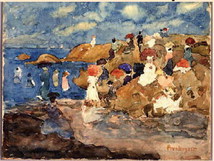
salemcoveRevere Beach 1896.


Strolling from room to room, one is aware of the influences of Sargent, Cezanne, Renoir and Bonnard. And yet, with that awareness comes an appreciation for this artist’s unique and innovative contribution to the evolution of the genre. His oil paintings vibrate with sumptuous color. His playful watercolors emit a peacefulness and deep admiration for both landscape and those enjoying it. The obvious joy his animated well-dressed subjects take in their surroundings is contagious. Adding to this exhilarating mix is the unexpected surprise of recognizing our own backyard in many of the paintings’ titles (Marblehead, Nahant, Revere Beach, Salem). The oil, “Marblehead Harbor,” on loan from the Barnes Foundation, is a particular thrill.

I dare you to go to this delightful show and not fall in love. In fact, I double dare you.

My Virgin Visit to Nordstom’s Makeup Department

I have been to Las Vegas, Reno and Aruba, and left without putting a single quarter into a slot. I have all the television stations and have never seen a single episode of “American Idol,” “Dancing With the Stars” or “Survivor.” Nordstrom opened in Peabody on April 17, 2009, and I had never stepped foot inside its doors. As a 60-something Jewish female, it was time.

I wanted to sport visible proof of my deflowering. What better way than letting the beautician Chanelle use my face as a canvas for her palette of expensive face paint?

In truth, I had a headshot photo shoot scheduled the next day, and oral surgery the previous week had left me looking, well, my age.

Chanelle was gentle with me, cooing encouragement as she removed my glasses and examined every pore with evaluative eyes. She described the procedures I would be undergoing, defining why each product was necessary to achieving her goal. The list was long.

Feeling like an obedient preschooler, I submitted to her authority. My makeup regime is limited to concealer, blush, mascara and lipstick, and then only when attending a gala wedding at the Four Seasons. I had no idea what the four beigecolored pots de maquillage were. Chanelle’s explanation left me feeling I had been living on borrowed time, and that each product would be critical to my survival going forward.

Even in my naked myopia, I could sense the array of clinical instruments to my left, laid out neatly by shape and function. There was no turning back.

Coat after coat was applied, brushed, reapplied and rebrushed. I counted six different brushes, more than the Impressionists ever used to create masterpieces. The makeup had names like primer, foundation, concealer, highlighter and bronzer. I felt like the outside of my house. The functions sounded inherently contradictory: an illuminating concealer, a lightweight foundation and one that lifted as it covered. Even my eyelids needed camouflaging. When I looked atmyself in the mirror, I saw a Prendergast oil painting rather than the captured glow of pubescent skin. I burst out laughing.

Chanelle, bless her heart, soldiered on. Next came the eyes. I was immediately reminded why contact lenses and I had never gotten along. The approaching mascara wand in my peripheral vision elicited a textbook Pavlovian response of watering and blinking. Before the eyeliner had been imbedded between each lash (“Never draw a line across your lids!”), I was fantasizing about makeup removers and a long shower.

The one that really got me, however, was the creation of eyebrows. I truthfully had never felt disadvantaged by my lightly endowed eyebrows. In fact, my girlfriends who are slaves to plucking and waxing are green with envy. I thought they were a lifestyle asset. Not so, apparently. My face would look much more youthful with the framing eyebrows would provide. When I looked in the mirror, I saw a cross between my grandmother and Martin Scorsese.

By contrast, the blush was fun. Unsurprisingly, the one named Orgasm is their top seller. Luckily, it did not match my skin tone, as it was predictably out of stock. My lined dry lips required a $30 remedy. The case, at least, was exquisite, worthy of Faberge. I did not escape purchase-free, but I only added one item to my shopping list of blush, lipstick and gargantuan quantities of concealer (which I would apply with a paint roller, if such a product existed). That add-on purchase? A case full of autumn eye shadows. The included free eyeliner had clinched the deal.

I tried my best to gush and cluck as I gave myself a parting glance in the blindingly lit mirror, but I’m sure I fooled no one. Especially not Chanelle. In the privacy and muted, conventional lighting of my kitchen, however, I did ooh and aah, and yes, admire. Those eyebrows did lift my face, and I’ll be darned if my skin didn’t look 25 years younger. (Okay, maybe closer to 10.) I wondered if the store’s bright lights are deliberately of torture quality to terrify and encourage equity loan-caliber purchases. Ponce de Leon’s ghost holds court in Nordstrom’s makeup department, where he is healthy, wealthy and wrinkle-free.

I am a 60-something Jewish female who has never had Botox or any of its iterations. Don’t count on an article chronicling a change in that status any time soon.


Pictured above: The author, after Chanelle did her magic.

“The Prime Ministers”: A Peek Into Israel’s Inner Sanctum of Power, Privilege and Privacy


A
mbassador Yehuda Avner, author of the 2010 best-seller, “The Prime Ministers” and subject of Richard Trank’s new documentary, “The Prime Ministers: The Pioneers,” has a twinkle in his eye, a magnetic, on-camera presence, and a melodious voice.

Trank’s directorial instinct to focus his lens on Avner as a “talking head” is spot on: he devours center stage as if it were the role he had been waiting in the wings to play.

“From the moment I met the Ambassador, I knew this approach would work because he is such an intimate, lively storyteller,” Trank explained via email.

During his five decades as personal aide and speechwriter to Israeli leaders (including five prime ministers), Avner bore witness to some of the most candid and private moments during some of the most critical events in Israel’s history. “I used to be the note taker,” Avner said in a phone interview. “I prepared executive summaries for the prime ministers, but I never threw away those original notes. This is the core of the book and the movie.”

Director Trank has divided Avner’s enormous memoir into two films. “The Pioneers” opens with Avner’s teenage involvement in Zionist youth activities in his native Manchester, England in the 1940’s, and ends with Golda Meir’s resignation following the 1973 Yom Kippur war.

(“Soldiers and Peacemakers,” which picks up the story in 1974, will open in Spring 2014.) Avner narrates as Israel’s cinematic chronology unfolds. The footage includes historical newsreels and videotapes of high-level whispered asides and passed notes. The effect is of crouching by a closed door and peeking through a keyhole to an inner sanctum of power, privilege and privacy. The film’s most memorable scenes are Avner’s eyewitness recollections. We hear how violinist Leopold Mahler, Gustav Mahler’s nephew and a member of Avner’s army unit, grabbed his instrument and passionately played “Hava Nagilah” to dancing crowds on Israel Independence Day. We eavesdrop on Prime Minister Eshkol and President Lyndon Johnson as the kibbutznik and the rancher bond over the birthing of a calf at LBJ’s Texas ranch. We see Golda Meir and Henry Kissinger in 1973 huddled in conversation over Israel’s request for American aid, connecting as “fellow Jews.“ This is not the stuff of history books. Yet according to Avner, his book has been adopted as part of the curriculum of many Jewish high schools.

“Most people below a certain age know nothing about Israel’s history. I wanted to bring back to life the personalities of the prime ministers,” Avner said. He is pleased that the release of the film has led more people to read the book.

Don’t miss this important and entertaining film. And then think about reading the book.

Pictured above: Israeli Prime Minister Golda Meir and Defense Minister Moshe Dayan met their troops October 21, 1973 in the Golan Heights, during the Yom Kippur War.

Billy Crystal’s Birthday Memoir

Billy Crystal’s mother advised him, “Do something special on your birthday.

Celebrate the fact that you’re here, that people love you, and you love them.” For his 50th, Crystal booked the ballroom at the Four Seasons and entertained over 250 guests. For his 60th, he wore the uniform of his beloved Yankees as leadoff man during spring training. Luckily for us, we don’t need a personal invitation to attend his 65th. His memoir, “Still Foolin’ ’Em: Where I’ve Been, Where I’m Going, and Where the Hell Are My Keys?,” is his birthday tribute to this milestone event, and we’re all invited to the party.

And what a commemoration it is! This is one terrific book, written by one terrific guy. (Be forewarned: Expect lots of swear words and anatomical humor.) It is poignant, personal and uproariously funny. A fellow baby boomer, Crystal hits many nails squarely on the head. Chapter Four, “Growing Up Crystal,” chronicles his youth in Long Beach, Long Island. With the exception of his father’s untimely death when he was 15, his childhood was cheerful, loving and culturally rich. He played ball with the neighborhood kids until it got dark. His home was filled with laughter, encouragement, jazz and Judaism. He was raised to be the mensch he is today, full of reverence, loyalty, generosity and humble gratitude.

The remaining chapters, with such titles as “Take Care of Your Teeth,” “Buying The Plot,” and “Grandpa,” recount his life, decade by decade, from his twenties to the present. Some read like stand up shtick; some are more serious and factual.

The best parts are the anecdotes Crystal shares from his star-studded career and the dozens of decades-long relationships he formed, nurtured and maintained along the way. These are real gems. We are treated to up close and personal pearls about Mickey Mantle, Muhammad Ali, Howard Cosell, Lew Alcindor, the Saturday Night Live cast and the makings of “When Harry Met Sally,” “City Slickers” and “Analyze This.” Crystal takes us behind the scenes at the Oscars, a show he hosted nine times and hoped to restore to the dignity and class he remembered it having in his youth. We are with him in 1977 when he played Jodie Dallas on “Soap,” one of television’s first unambiguously homosexual characters, and in 2005 as he scripts and performs his oneman Broadway homage to his father, “700 Sundays.” We cheer his well-deserved Emmys, Tony, and Golden Globe and Oscar nominations. The more Crystal reveals his thoughts, his feelings and his character, the more deeply we admire, respect and appreciate him.

These anecdotes are entertaining and voyeuristically satisfying, and Crystal is a gifted comedian and storyteller. But he has a deeper and wiser purpose in sharing his life with us. While he knows he has been blessed with talent, success and opportunity, his message is that family and faith string these pearls together and give them form and substance. He takes parenthood, and now grandparenthood, seriously. He respects his elders and treasures their memories. He is reminded of the legacy they left him, and is mindful of creating an equally meaningful one for his family.

Crystal continuously asks whether anything we do really matters. On the last page, contemplating the simultaneous birth of his fourth grandchild and his 65th birthday, he answers.

“It is a great life with plenty more to go. Time to see how my little ones fare in the world we turn over to them. That is our task after all. Teach them all we know and help them try to be better than us.”

Amen, Billy. Happy birthday, and many more.

“Still Foolin’ ’Em: Where I’ve Been, Where I’m Going, and Where the Hell Are My Keys?” Billy Crystal Holt, Henry & Company, Inc., 2013

From Victim to Expert, Jessica Stern Shares Her Story

Jessica Stern attributes her professional fascination with violent perpetrators and her ability to remain calm in dangerous situations to the traumatic experience of being raped at age 15 at her Concord, Mass. home. These qualities are the silver lining borne of a horrendous attack, and they have served her well as a former member of President Clinton’s National Security Council, an expert on terrorists and terrorism, and an author.


Stern’s most recent work — “Denial: A Memoir of Terror” — is an autobiographical account of her 1973 rape at gunpoint by a serial rapist who was never
caught. She is also the author of “Terror in the Name of God: Why Religious Militants Kill,” which features interviews with Christian, Muslim, Jewish and American fringe group extremists. Stein traveled to Pakistan alone, engaging aspiring mujahedin in dialogue in remote madrassas; she interviewed Jewish radicals in West Bank settlements; and she even included conversations with Texan antiabortion militants and followers of Timothy McVeigh.

Stern, now 55 and living in Cambridge, will be a panelist at Boston Bookfest alongside Valerie Plame Wilson, Wes Craven and Mary Louise Kelly. Their topic is “Writing Terror: An Exploration of Fear.”

“I am fascinated by the secret motivations of violent men, and I’m good at ferreting them out,” she wrote in “Denial.” The 2010 work also describes her close relationship with her father and her identity struggles in the wake of trauma that caused undiagnosed and unacknowledged post-traumatic stress disorder (PTSD). Being the child of a refugee and Holocaust survivor, she believes, exacerbated her painful path to self-identity.

Stern responded to questions by phone:

SS: What was your goal in telling your story?

JS: I had no clue that I had PTSD. I thought it was something soldiers got. I had no idea that the symptoms I had of hyper- and hypo-vigilance were symptoms, and not just who I was. When I mentioned this to my father and sister, both said, “Oh, we have that, too.” It allowed them to talk about this and that has helped all three of us and made us closer. My sister had a harder time with my writing this book (she was also raped during the same incident) but it brought us closer in a more authentic way. My father and I had never spoken about the rape or about why he hadn’t cut short his trip to Europe and come home when it happened. Writing the book allowed us to have those conversations. There is less distance between us.

I have received letters from women who were raped by the same guy I was. Some have written, “You saved my life.” (The paperback edition has a section in the back with reprinted letters from readers).

SS: What does your faith mean to you?

JS: I feel completely Jewish, but I wasn’t really raised Jewish. We didn’t celebrate any of the holidays, not even Passover.

I think being the child of a refugee completely determined my choice of career. It feels to me like a very Jewish choice to study violence. I am finally meeting children of refugees, and I feel like I have a lot in common with them. There is a kind of determination, which I associate with Judaism, but it may be the result of being raised by a Holocaust survivor. There is an emphasis on education and on philanthropy. I hope that, in a way, I am giving back and helping others by writing this book.

SS: Did you ever have second thoughts about writing “Denial”?

JS: Not once I committed to it, but it took a long time to get to that stage. My editor is the one who told me, “You should be writing about your rape.” I resisted at first, but I couldn’t resist doing the investigation with the police. I was afraid that my colleagues wouldn’t take me seriously if I wrote this book.

SS: What are you working on now?

JS: I am working on two books; one about other victims of the same rapist, and one about the war criminals from the Yugoslav tribunal. I’m also developing a concept I call “post-traumatic growth.”

‘The Soul Doctor’ is In

“Soul Doctor” is a Broadway musical based on the life of Rabbi Shlomo Carlebach. The Rebbe, who died in 1994, was known as the “rock-star rabbi.” A colorful character, Carlebach transformed liturgical music during the 1960’s, recording over 25 albums and performing with such luminaries as Bob Dylan, Joni Mitchell and the Grateful Dead.


A brilliant Torah scholar, his progressive and unique views on everything from prayer to women inspired a generation to seek connection to God and to each other through his songs.

The play starts with a flash-forward to its last scene: a 1972 concert in Vienna, at the height of Reb Shlomo’s Haight-Ashbury “House of Love and Prayer” commune phase. The actors enter from four aisles, singing and dancing, sporting vibrant hippie-era clothing and hairdos. I felt like I was seeing “Hair” again. The Jewish version.

This playfulness is unfortunately short-lived, as we begin our plodding, chronological journey through the life of Shlomo, played with subtlety, warmth and charm by the stellar Eric Anderson.

We start in 1938 Vienna, where we meet 13-year-old Shlomo and his middle class family. The heir to a dynasty of Orthodox rabbis, young Shlomo exhibits his rebellious, passionate and determined nature. His Rebbe father moves the family to Brooklyn, one step ahead of the Nazis. He starts a strictly Orthodox yeshiva in his strictly Orthodox shul. Both, Shlomo tells his father, “are bankrupt. The bank accounts are fine, but the seats are empty.”

Shlomo sets off to find a different way to rekindle their passion of head and heart. He doesn’t have to go far. The Chabad-Lubavitch movement has set up shop nearby, and Shlomo, as his father fears he will, “goes to the Hassidim as a tourist, and comes back as a tour guide.”

Carlebach

The late Rabbi Shlomo Carlebach

Wandering New York’s streets late one night in 1963, Shlomo drifts into a lounge where the classically-trained Nina Simone is singing sultry, smoky blues and jazz. With Nina’s appearance (played by the polished and riveting Amber Iman, in her Broadway debut), the show wakes up and turns an important corner. She’s not exaggerating when she sings, “I Put a Spell On You.”

Meeting Nina is the watershed event of Shlomo’s life. They are kindred souls, both unconventional children of clergy (a Baptist minister in Nina’s case). She plugs him in to his inner neshama (soul/spirit), giving him the tools to express his heart through his music. She is his muse; he is her cheerleader. Their 25-year friendship is a celebration of the secular and the sacred, of mutual respect and support, and of the limitless possibilities available to those of open hearts and minds. Their parallel rises to fame and popularity are as spiritual and uplifting as the songs each sings.

Yet not all the songs are hits. Of the 35 musical numbers in the show, those saddled with new English lyrics feel long and monotonous. The jazz, gospel and Hebrew songs (especially “Ki Va Moed” and “Sim Shalom”) are infectious and stirring.

“Soul Doctor” is not just a valentine to Shlomo Carlebad (although it is definitely that). It raises important questions such as: What are the roles of tradition and revision in modern American Judaism? How do we connect with one another and with God? When have we strayed too far from our roots, for the sake of filling the empty shul?

The play doesn’t offer any easy answers. But it does, per Jewish custom, offer a question. As Shlomo said to his father, “You brought us to America. What did you expect?”

No Repentance in Woody Allen’s ‘Blue Jasmine’

From the beginning of Elul until Rosh Hashanah, the resonant blast of the shofar awakens us from our daily complacency, and reminds us that the time for repentance (teshuva), forgiveness (selicha) and prayer (tefillah) is nigh. The liturgy repeats the same message: God is sovereign; God prefers us to pray as a community rather than as individuals; and we have freedom of choice to recognize, regret and acknowledge.


Jasmine, who is alcoholic and psychotic in addition to being blue, would find no solace in shul this year. She has not appeased the injured parties; she does not strive to do good; she lacks understanding about the consequences of her actions and cares for no one and nothing that extends beyond her polished and toned epidermis. She is all veneer, from her shellacked nails to her counterfeit name. Free will for her is the ability to maintain a minimum level of Stoli in her blood.

The plot of Woody Allen’s latest film, “Blue Jasmine,” is straightforward. Hal (Alec Baldwin) is a fraudulent financier in Bernie Madoff clothing. He builds a house of cards that allows him to pamper his wife Jasmine (a luminescent and spellbinding Cate Blanchett) and countless mistresses. They hang with their own in the Hamptons and Park Avenue. Alas, it all comes tumbling down (I will not spoil the one and only surprise of the predictable script by revealing how). Hal is arrested, and Jasmine is evicted and stripped of all but her pearls, her Chanel purse and her delusions of grandeur.

BlueJAsmine


Cate Blanchett (left), Woody Allen and Alec Baldwin on the set of “Blue Jasmine.”

The opening scene introduces us to her en route to San Francisco. Seated in first class, glass tumbler in hand, she maniacally monologues to her exhausted and overly polite seatmate.

Exiled from New York, she heads for the only refuge available, her sister Ginger’s (the happy-go-lucky Sally Hawkins) working-class apartment. The contrast between the two sisters borders on caricature. Ginger is a divorced, single mom who cheerfully bags groceries to make ends meet and maintains a relationship with her ex (Andrew Dice Clay, as the decent, down-to-earth Augie) for the sake of her two young boys.

Scads of reviews have illumined that “Blue Jasmine” is Allen’s homage to Tennessee Williams’ “A Streetcar Named Desire.” Indeed, Ginger plays the concerned, compassionate Stella to Jasmine’s demanding and arrogant Blanche DuBois (a role Blanchett recently devoured on Broadway). As with Blanche, Jasmine’s tenuous grip on reality slips away before our eyes.

Ginger is the anti-Jasmine; she accepts, pardons and moves on. Job-like, she even excuses Jasmine her complicity in instigating Ginger’s financial downfall and her family’s ensuing suffering and destruction. Hawkins’ relentless, upbeat sunniness in the face of these offenses would be maddeningly cloying were it not for the lines Allen provides her that help us to understand that although Ginger has forgiven, she has not forgotten. Ginger would not only be welcome at shul, she would have her own pew. Up front, in the expensive seats.

Cinematically, “Blue Jasmine” is lovely, especially the flashback scenes. Of the cast, Michael Stuhlbarg (of the Coen brothers’ “A Singular Man”) is at once creepy, pathetic and nasty. He manages to wrest his scenes from the overpowering Blanchett, a formidable feat. As Chili, Ginger’s mechanic boyfriend, Bobby Cannavale is obviously trying to clone Brando’s Stanley Kowalski. He is better when he doesn’t try so hard, which is not often.

Interwoven with the “Streetcar” warp is the weft of the Madoff tragedy. Although the “Blue Jasmine” characters are unambiguously blue-blooded, Allen draws a straight line between the film and the actual events. “Tails of Manhattan” is an allegory he published in the March 30, 2009 issue of The New Yorker. In a nutshell (and I encourage you to Google the short piece), Moscowitz and Silverman are two Madoff victims who committed suicide and are reincarnated as two-lb. lobsters. They bump into each other in a restaurant fish tank, where they recognize Madoff as he peers into their tank and chooses yet again to devour them. Incensed, they leap out of their tank and attack the con artist, sending him screaming into the street where the two persuade him to plead guilty and apologize to his victims.

Alas, “Blue Jasmine” lacks such a satisfying denouement. There are neither mea culpas uttered nor retribution exacted. Hal goes to his grave, eyes and teeth intact. Jasmine fades from view as she spins her cocoon of dementia and denial. Their suffering, however, is not the point. Teshuva, selicha and tefillah is.

Strout’s Sequel Falls Flat

Sequels are risky business. Will that second kiss, second season of an addictive series or second visit to Paris make us swoon like the first, or leave us wishing we’d left well enough alone?

Alas, less is often more. Think Barbara Kingsolver’s “Flight Behavior” (versus “The Lacuna”), or Sarah Gruen’s“Ape House” (versus “Water For Elephants.”) Add Elizabeth Strout’s “The Burgess Boys” (versus her 2009 Pulitzer Prize-winning “Olive Kittreridge”) to the list.

The Burgess siblings, boy wonder Jimmy and the loser younger twins Susie and Bobby, grew up in Shirley Falls, Maine. Flash forward 30 years to the same town, a site frozen in time with one exception — the recent near doubling of its population by the arrival of refugee Somalis whose presence puts it on the map as the second largest community of Somalis in America. It also puts the town on edge. This is rural, white, overweight and impoverished Maine. The lithe ebony-skinned Somalis with their brilliant silk head coverings, unisex caftans and foreign language, customs and mosque, do not exactly blend in.

Predictably (and somewhat stereotypically), there is an incident that may or may not be a serious hate crime. Susie still lives in Shirley Falls in the family home, and her troubled, sad sack son is the perpetrator. The Burgess boys are both Manhattan lawyers living in Brooklyn. Jimmy has a corner office, a six-figure salary and a six-figure patrician wife, and Bobby still wears worn baggy cords to his job as legal aid counsel. Susie summons them to Shirley Falls for emotional and professional support. Instead, the reunion compels the middle-aged siblings to confront their demoralizing childhood and the trauma that changed each of their lives. None is up to the task. They claw open barely scabbed-over wounds and then retreat to lick their fresh gashes.

The “Olive Kitteridge” Strout, who trusted her reader’s ability to read between the lines, is sorely missed here. Instead we get the disengaged Strout and her clumsy, uninspired, aloof dialogues. I wanted to feel compassion and empathy for these lost souls, but Strout wouldn’t let me in. These individuals have no depth, no exposed inner world to tap into.

Strout’s prose sparks briefly when she turns her pen to the Somali community. Here, her Pulitzer Prize-caliber craftsmanship rematerializes with sentences that enchant and inspire.

By the end of “Olive Kitteridge,” I cared deeply for my complicated friend Olive and wasn’t yet ready to part company. I longed for the last sentence of “The Burgess Boys,” and if any of the lot of them had trespassed for even one more syllable, I would have called the cops.

I have experienced the magic and intimacy KingsoIver, Gruen and Shreve can create when writing at their best. I still eagerly await their newest publications, and I will do the same for the next Strout. But it will only be because I have not given up hope that when I open the first page, it will be Olive who greets me. If it’s the Burgess clan instead, I’m outta here.

The Burgess Boys 

Elizabeth Strout

Random House Publishing Group, 2013

A Lesson From St. Louis

On June 17, Metropolitan Opera’s General Manager Peter Gelb announced that it would not be simulcasting John Adams’s “The Death of Klinghoffer” to cinemas around the world this fall. ADL National Director Abraham H. Foxman praised the decision, expressing fear of how the opera might be received in a time of rising anti-Semitism abroad. Adams and others condemned the cancellation, maintaining that it promoted the same kind of intolerance the opera’s detractors claimed to be preventing.


The disagreement over the simulcast was settled after familiar players took familiar entrenched positions. A better approach might have been to recognize the conflict as a chance to promote dialogue and education. We wish someone had thought to adopt the Opera Theatre of St. Louis’s approach.

When Opera Theatre announced its intention to perform the piece in 2011, the city embraced the work’s controversial history as an opportunity to generate conversation on interfaith subjects, and the relevance and role of art in the world. Christian, Jewish and Muslim leaders in the community formed a steering committee and created a guide to help study groups begin structured and constructive discussions of the themes raised in the provocative work. The packet included background materials, libretto excerpts and a chronology of events; the Opera Theatre’s website promoted it.

By contrast, the reactions in New York have been polarized and polarizing. The opera has been condemned as a rationalization of terrorism and false moral equivalencies between Palestinian and Jewish suffering. The Met’s action has been condemned as shocking, shortsighted and indefensible, a concession to certain donors and a violation of artistic free expression.

It takes vision, commitment and courage to welcome new ways of approaching the same disagreements. We could all learn a lesson from St. Louis. Maybe the next time such an opportunity arises, we’ll recognize its potential.

This originally appeared in the Jewish Journal on July 3, 2014