ASP’s Not-to-Be-Missed “How I Learned to Drive” Explores Abuse and Memory in a Tour de Force Production

Dennis Trainor, Jr. and Jennifer Rohn in Actors’ Shakespeare Project’s ‘How I Learned to Drive’
(Photo Credit: Nile Scott Studios)

By Shelley A. Sackett

“You and Driver Education — Safety First,”  a voice announces as the lights dim. A middle-aged woman steps onto a bare set, composing herself. She turns to face the audience, addressing them as though mid-conversation.

“Sometimes, to tell a secret, you first have to teach a lesson,” she says. “We’re going to start our lesson tonight on an early, warm summer evening.”

So begins Paula Vogel’s brilliant Pulitzer Prize Award-winning play, “How I Learned to Drive,” in which she examines the complicated ways in which we process the trauma, shame, and blame associated with pedophilia and family complicity. If the topic sounds heart-wrenching and heavy, that’s because it is.

Yet, thanks to superb acting, Elaine Vaan Hogue’s sensitive direction, and Vogel’s candid and non-judgmental script, we grow to care about the characters — all of them, including the predator, Uncle Peck. Although a testament to Vogel’s ability to create a defective character whose humanness prevents us from dismissing him as pure evil, that is perhaps the most disturbing part of the play.

Set in Maryland in the 1960s and ‘70s, the non-chronological scenes are narrated by Li’l Bit (the spectacular Jennifer Rohn), a woman now in her mid-30s who plumbs her memories of the sexual assault she endured beginning at age 11 and continuing until her 18th birthday. The abuse began as a driving lesson, and Vogel uses titles from a guide to a driving handbook as a device to link the nonlinear episodes.
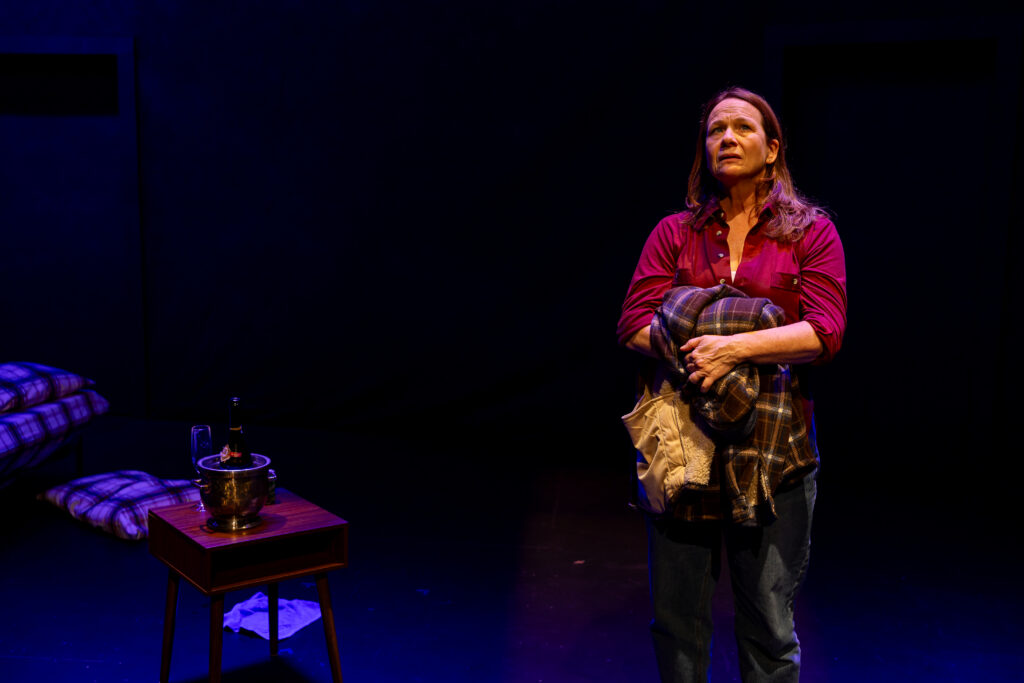
Rohn

As “Drive” moves back in time, from when Li’l Bit was 17 to 15 to 13 and, finally, 11,  the horror and helplessness of the situation hangs heavy. Endowed from a young age with very large breasts, Li’l Bit is ridiculed and bullied at school and at home. Only Uncle Peck (an equally amazing Dennis Trainor, Jr.), whose playful, empathetic, and supportive relationship is a welcome refuge for the isolated and lonely child/woman, seems to understand and care about her. Their relationship forms the backbone of the play.

We watch as Uncle Peck systematically grooms and desensitizes Li’l Bit, nefariously making her his accomplice instead of his victim. “Have I forced you to do anything?” he asks repeatedly as he unlatches her bra with one hand, joking about how boys her own age probably fumble and need her assistance to accomplish the same feat. “Nothing is going to happen between us until you want it to,” he croons. “You just can’t tell anyone.”

Interspersed between the edgy scenes of seduction are narration and a Greek chorus of three (Amy Griffin, Sarah Newhouse, and Tommy Vines, all superb) who deliver monologues and play many roles in family scenes, driving lessons, restaurants, and the schoolyard. In one scene, our hearts ache for 11-year-old Li’l Bit as her family (mother, aunt Mary, Uncle Peck, cousin BB, Grandma and Grandpa) shrieks derisively as they joke about her breasts. No wonder she takes refuge in the kitchen with Uncle Peck as he washes the dishes and converses with her as if she were his peer.

Their weekly driving lessons start shortly after.

As Li’l Bit plumbs her memory, revealing and reliving episodes of these driving lessons and submission to the accompanying sexual abuse, she also reveals how the years of trauma finally caught up with her, leading to her drinking to excess and getting expelled from college. She relives other memories, too, some so painful she can’t deal with them and, continuing the driving metaphor, changes them “like changing stations on the radio.”

Vogel expertly uses humor and slapstick to lighten the emotional load of the unrelenting manipulation and abuse. “A Mother’s Guide to Social Drinking” and “On Men, Sex and Woman” feature bravura performances by Newhouse as Li’l Bit’s mother and make their points while making the audience laugh.

Vogel turns to a monologue by Aunt Mary (also Newhouse) to answer the question of whether Li’l Bit’s family knew what was going on.
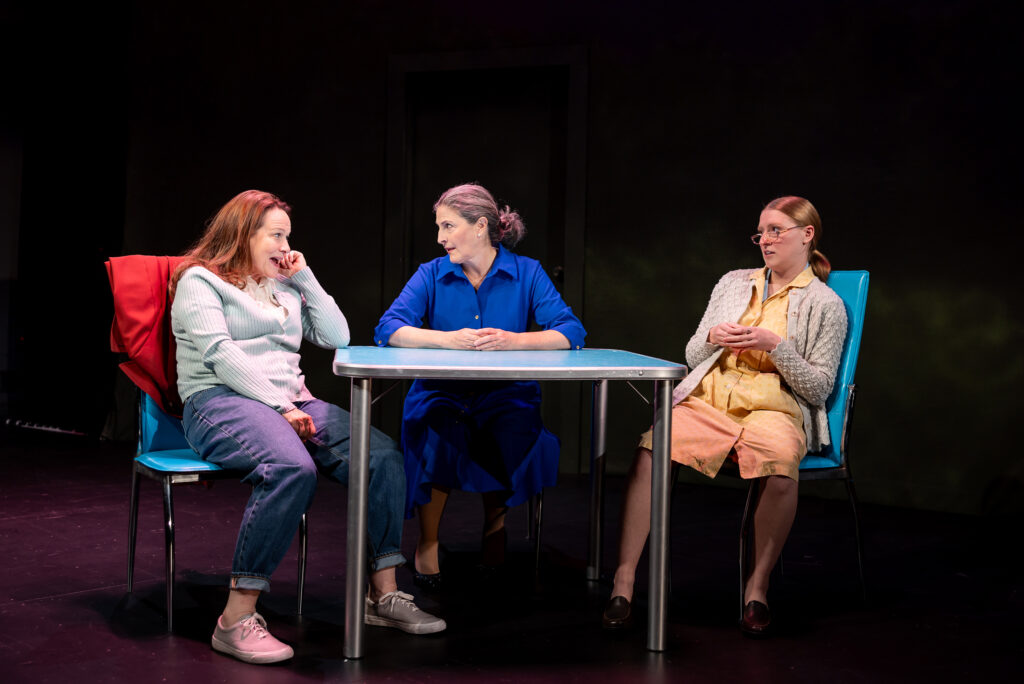
Rohn, Sarah Newhouse, Amy Griffin

Turns out, they did.

Alone on stage, Aunt Mary defends her husband, claiming he is the victim of Li’l Bit’s manipulation. She can’t wait for Li’l Bit to go off to college, so things can go back to normal. “I’m a very patient woman,” she states with more than a whiff of menace. ”But I’d like my husband back.”

Even more chilling, if that is possible, is the scene titled, “Uncle Peck Teaches Cousin Bobby How to Fish,” during which it becomes clear that Uncle Peck also assaulted his young nephew BB after baiting and trapping him with the same kindness, gifts and you-can-trust-me-banter he used on his niece. The ruthless and deliberate nature of the premeditated attack, stripped naked of the frisky banter of his encounters with Li’l Bit, unmasks Uncle Peck for the cold-blooded pedophile he is.

Eventually, Li’l Bit breaks free of Uncle Peck on her 18th birthday in a pivotal scene where Uncle Peck exposes how unhinged he has become, and Li’l Bit finally leaves him and their situation for good. The trouble is, the years of trauma have etched an indelible toll on her, one that leaves her reflecting on why Uncle Peck molested her and what responsibility she bears. She ruefully wonders whether she will ever be able to forgive Uncle Peck and, by extension, herself.

As Li’l Bit and Uncle Peck, Rohn and Trainor are spot-on perfection. Trainor captures Uncle Peck’s crushed spirit and underlying aw-shucks grace, his tortured yet thoughtful self. Rohn brings an incandescence to the complex Li’l Bit and the chasms separating her bone-weary adult sadness and giddy little girl appreciation for adult attention and admiration. It is a fine line, and Rohn navigates it effortlessly. A set bare of all but a few chairs, tables, and a bed places the focus squarely where it should be: on the characters.

At the end of the play, Vogel’s script returns to the present. Li’l Bit thinks about her next steps now that she is 35. “That’s getting up there for a woman. I find myself believing in things that a younger self vowed never to believe in. Things like family and forgiveness,” she says.
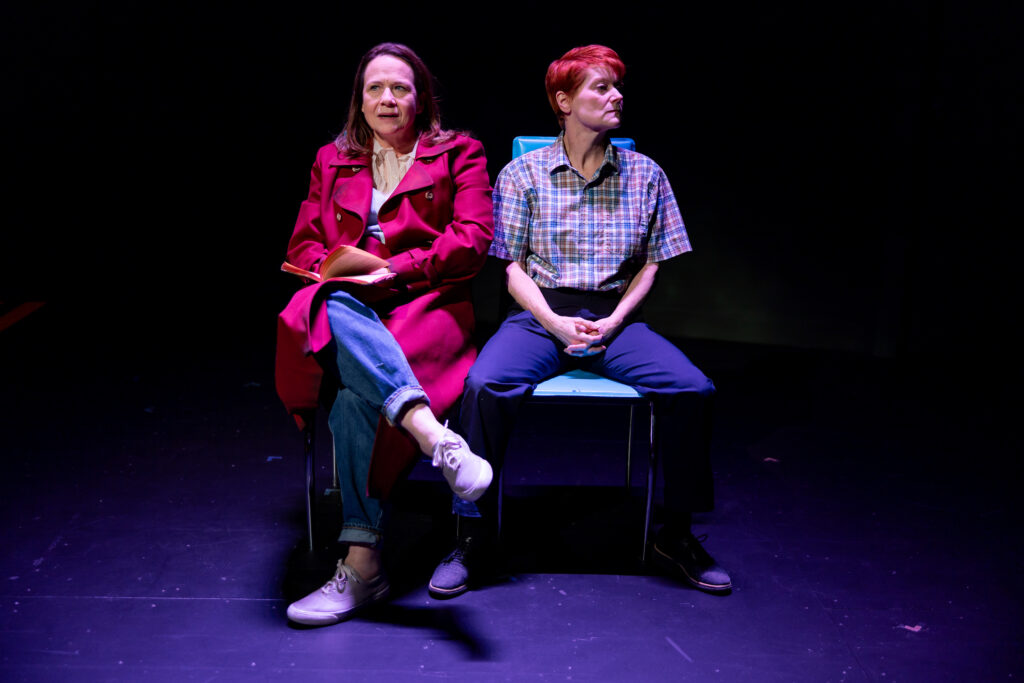
Rohn, Tommy Vines

Despite everything she has been through and the fact that it all began with her sitting in the driver’s seat, she is grateful for the freedom she feels when she drives, the nearest sensation she can muster of “flight in the body.”

As she sits alone in her car, adjusting her rear view mirror, she notices Uncle Peck sitting in the back. After smiling at him, she steps on the gas pedal and drives away.

Although first produced in 1997, it wasn’t until 2020 that Vogel first spoke about the play as autobiographical. “I didn’t go into this concerned with the forgiveness of that person [Peck is based on]. I went into this concerned with the forgiveness of myself. Because the truth is the children always feel culpable. And the structure of this is me getting to a point where I’m like, ‘You know what? You were a kid. That’s all I wanted, to get there and feel that. And to have it be such a basic truth that my childhood self would accept it,” Vogel said in an earlier interview.

‘How I Learned to Drive’ — Written by Paula Vogel. Directed by Elaine Vaan Hogue. Scenic Design by Baron E. Pugh; Lighting Design by Marcella Barbeau; Costume Design by Marissa Wolf; Sound Design by Mackenzie Adamick. Presented by Actors’ Shakespeare Project at the Roberts Studio Theatre, Calderwood Pavilion, 527 Tremont St., Boston through November 25.

For information and tickets, go to https://www.actorsshakespeareproject.org/how-i-learned/
‘Seven Guitars’ Is August Wilson – And Boston Theater – at Its Finest

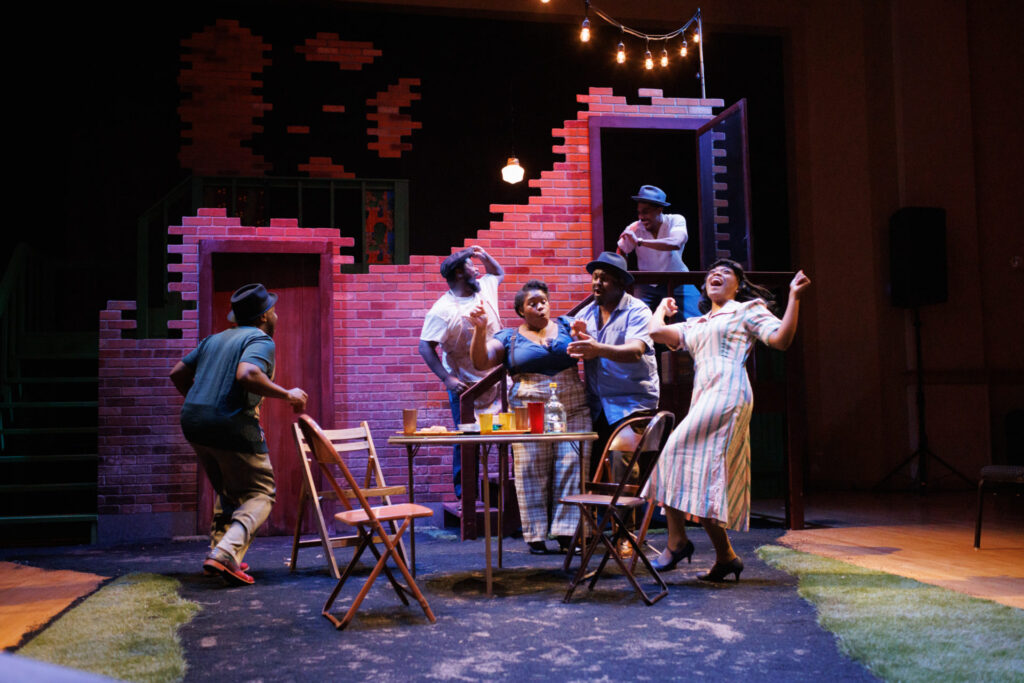
Cast of Actors’ Shakespeare Project’s ‘Seven Guitars’. Photo by Ken Yotsukura Photography. 

by Shelley A. Sackett

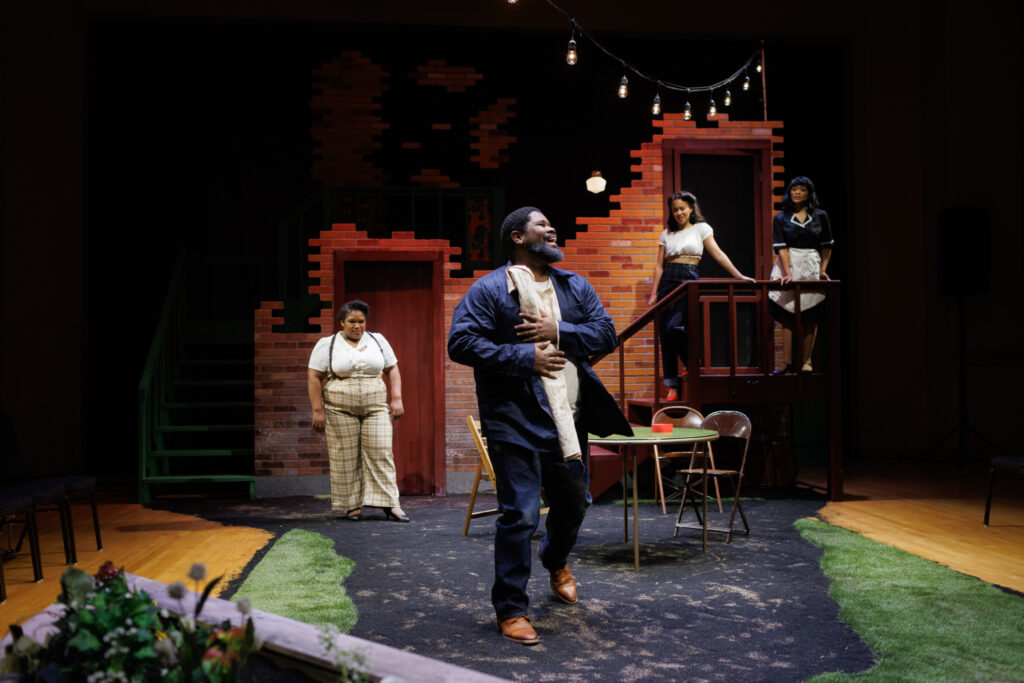
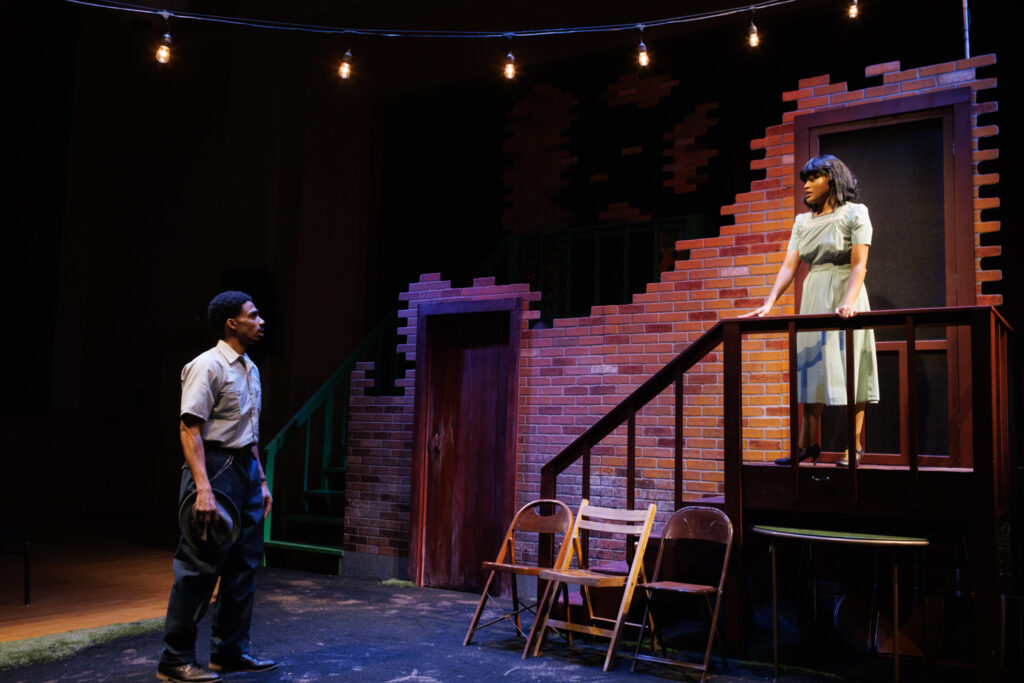
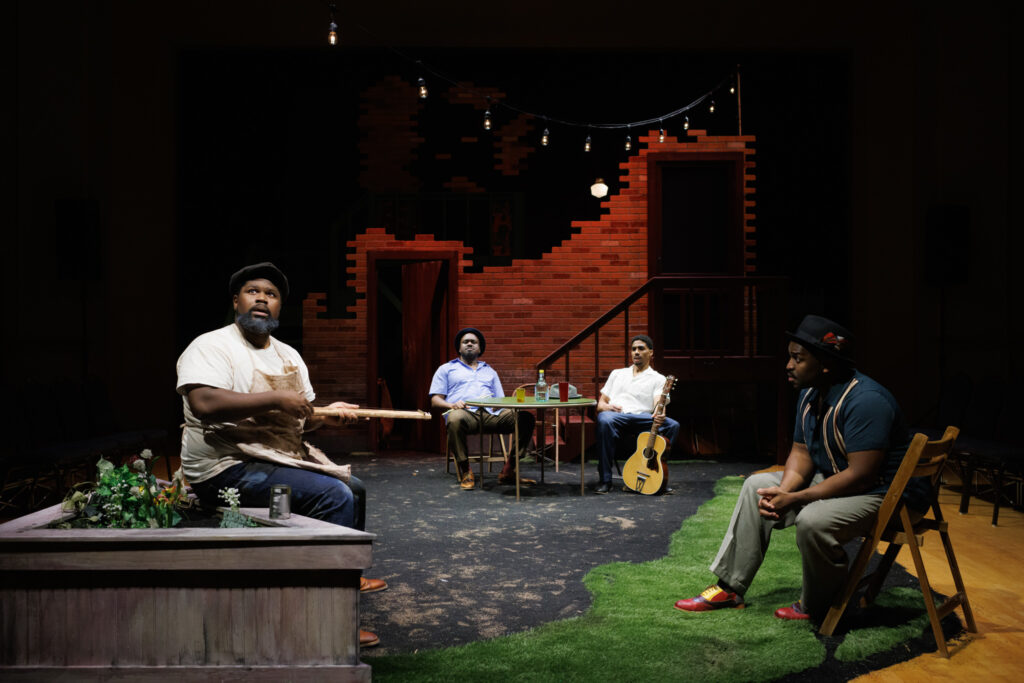
It’s hard to know where to begin praising Actors’ Shakespeare Project’s production of August Wilson’s ‘Seven Guitars.’ Jon Savage’s urban backyard set, with its backlit city side panels, gardens, make-do furniture, and hints of multiple interior spaces, combines simplicity with depth. Amanda E. Fallon’s lighting, Dewey Dellay’s pitch-perfect musical compositions, and Abe Joyner-Meyer’s toe-tapping sound design complete the immersive capsule. We are indeed time travelers to a 1948 rooming house in Pittsburgh’s Hill District.

Maurice Emmanuel Parent’s intimate and sensitive direction elicits a natural rhythm from the cast of seven first-rate actors who miraculously coalesce as an ensemble without diminishing their unique bright lights. And then, of course, there is Wilson’s multi-layered, music-infused drama, with dialogue the actors imbue with lyricism and individuality.

Regina Vital, Johnnie Mack, Valyn Lyric Turner, Maya Carter

The play opens in the rooming house backyard right after the funeral of its main character, Floyd “Schoolboy” Barton, a young blues guitarist (played by the exceptional Anthony T. Goss) who was killed just as his dream of stardom was about to come true. His murder remains unsolved.

Wilson has a knack for gathering strangers, putting them under the same roof, and creating a convivial family unit through which a complete social picture materializes. Small talk is never small from this playwright. There is a living power that pulses with every word.

The solemn scene of mourning quickly turns playful, as we meet the residents and witness the warmth and ease with which they address each other. “He almost make it where you want to die just to have somebody talk over you like that,” says Canewell (Omar Robinson), one of Floyd’s musician friends and band sidemen, about the Reverend’s eulogy.

Anthony T. Goss, Carter

Vera (Maya Carter), Floyd’s girlfriend, observes she saw six angels dressed in black carrying Floyd away into the sky. Louise (a spirited Regine Vital), the lively boardinghouse owner, her tenant, Hedley (Johnnie Mack), a Bible-thumping elder, and Red Carter (Dereks Thomas), another of Floyd’s musician sidemen, round out the group. (Ruby (Valyn Lyric Turner), Louise’s pregnant niece will arrive late in Act I. All but Louise also saw the angels whisk Floyd away.

From the get-go, the characters’ quirks and reflections on life, loss, and the history and burden of being Black in white America pepper their conversations, bonding these folks in a natural and kindhearted way. Family, in all of Wilson’s plays, is not defined by biology; it is defined by fate and choice.

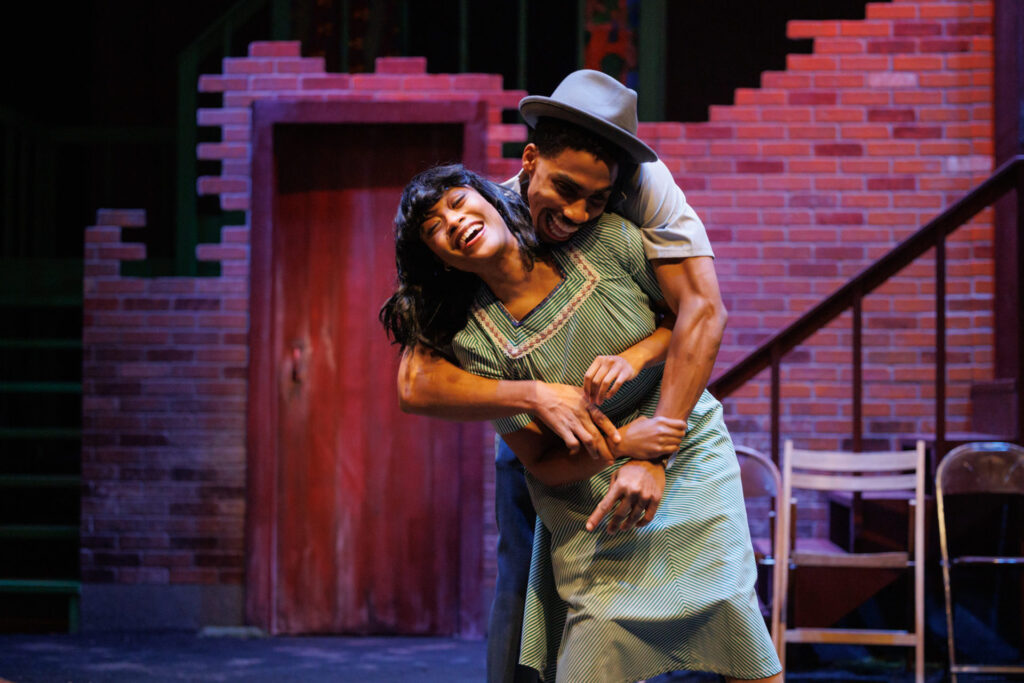
The rest of the play is through flashbacks that retell the story leading up to and including, the murder. Floyd explodes onto the stage, freshly released from a 90-day stint in a workhouse detention and ready to kickstart his paused career and love affair with Vera. His plans to return to Chicago and pursue celebrity hinge on convincing Vera and sidemen Red and Canewell to return with him.

Johnnie Macks, Dereks Thomas, Goss, Omar Robinson

Floyd has an uphill battle on his hands. He left Vera for another woman when he went to Chicago the first time, and convincing her that he’s on the up and up will take all the swagger and charm he can muster. Likewise his bandmates, who were burned by their first experiences in the Windy City and the wily ways of the white record industry.

While “Seven Guitars” satisfies its audience with a plot-driven narrative, it is through its seven characters and their conversations that Wilson’s underlying messages surface. These seven are a microcosm of the ways in which racism and its oppressive economic and legal system have stacked the deck against the Black man. Yet, despite these shackles, there emerge layers of folklore, superstitions, family traditions, and shifting dreams that paint a broader, deeper social picture.

Wilson interweaves big ticket topics — male/female relationships, police brutality, the danger of being black in a white land — organically through his characters’ conversations and monologues, giving each their moment in the spotlight. Even the occasional existential soapbox riff – thanks to Wilson’s light and shrewd pen –  blends naturally with banter about recipes and family histories.

Carter, Goss

Each character has their moment, and the actors glow without showboating. All sinew and kinetic energy, Goss brings a riveting physicality to the charismatic, angry Floyd. In his hands, even a hat becomes punctuation. Carter embodies Vera, centering the play’s melancholy and grace with her calm and passion. Vital is wonderfully entertaining as the chatty Louise, whose gossip takes on the gravitas of living history. As Hedley, Wilson’s resident seer, Mack underplays the character, lending a gentle touch that tempers his apocalyptic rants. Robinson (Canewell) and Thomas (Red) round out and individualize the band members, while Turner brings nuance to the mantrap Ruby.

Though “Seven Guitars” clocks in at 2 hours 45 minutes (with one intermission), the pace and quality of the play and its staging never lag. Nominated for a Pulitzer Prize and winner of the New York Drama Critics Award for Best Play, it is fifth in Wilson’s theatrical saga of “The Pittsburgh Cycle,” ten plays set in a different decade of the 20th century. Wilson remains one of the most important voices in modern American theater, his life-size dramas drawing audiences wherever they play.

Don’t miss the chance to see Actors’ Shakespeare’s Project flawless production of this infrequently staged play. It is a must-see bases-loaded home run! For tickets and information, go to: https://www.actorsshakespeareproject.org/

‘Seven Guitars’ by August Wilson. Directed by Maurice Emmanuel Parent. Scenic Design by Jon Savage; Sound Design by Abe Joyner-Meyers; Original Music Composition by Dewey Dellay; Lighting Design by Amanda E. Fallon Presented by Actors’ Shakespeare Project, Hiberian Hall,182 Dudley St., Roxbury through March 5. Photo by Ken Yotsukura Photography. 

Actors’ Shakespeare Project’s ‘The Bomb-itty of Errors’ Brings out The Bomb in The Bard

Cast of Actors’ Shakespeare Project’s ‘The Bomb-itty of Errors’

by Shelley A. Sackett

Actors’ Shakespeare Project’s “The Bomb-itty of Errors” is perfect pre-summer fare. Hip-hop and rap, a live DJ, a brilliantly exhaustive (and sometimes exhausting) script, some sublime acting and — as if that’s not enough — the Bard himself, camouflaged but hardly hidden. All wrapped neatly in a 90-minute intermission-less package that is as invigorating as it is boisterous.

The brainchild of four final-year students at New York’s Tisch School of the Arts, “Bomb-itty” started as a university project in 1998. It was so popular that it received enough support to return to New York the following year for a seven-month run, which in turn led to a lengthy Chicago run.

“Bomb-itty” is true to Shakespeare’s style of rhyming couplets, (sometimes bawdy) humor and historical references. The language often mirrors Shakespeare’s with references to other works sprinkled here and there to stroke the egos of those who recognize them. But the real star of the show is the vibrant, beatbox soundbox and the actors who manage to memorize a super-sized number of lines, which they deliver at break-neck speed.

The result is a theater experience unlike any I’ve experienced. (No, “Bomb-itty” is not a “Hamilton” clone. It’s way more fun.)

Based more than loosely on Shakespeare’s “The Comedy of Errors,” the plot involves two sets of identical twins with identical names, mistaken identities, misfortunes galore and a slew of stereotypes (some more offensive than funny). To get the most out of the rapid fire lines and delivery, either arrive early enough to read the playbill’s summary (twice, at least), or spend some time digesting the on-line Cliff Notes version of the original. Trust me, it is time well spent.

Despite first appearances (the prologue is a gem), “Bomb-itty” adheres closely to Shakespeare’s play.

In the original, a merchant of Syracuse, Egeon, suffered a shipwreck some years ago in which he was separated from his wife, Emilia, from one of his twin sons, later Antipholus of Ephesus, and the son’s slave, Dromio of Ephesus. The other slave’s twin, Dromio of Syracuse and Egeon’s remaining son, Antipholus of Syracuse, remained with Egeon.

When he came of age, Egeon allowed Antipholus of Syracuse and his slave Dromio of Syracuse to go in search of his lost brother. When they didn’t return, Egeon set out after his remaining son, and the play begins as we learn of Egeon’s capture and his condemnation to death by Duke Solinus in the hostile city of Ephesus. The details of Egeon’s story move Solinus to pity, and he grants a reprieve until nightfall, by which time a ransom of a thousand marks must be raised.

Unbeknown to all, the missing Antipholus and Dromio landed in Ephesus after the shipwreck and have thrived there. Antipholus of Ephesus and his servant Dromio are thrown into confusion when, unknown to each other, their twin brothers of the same names arrive in town from Syracuse.

In “Bomb-itty,” the Antipholus and Dromio twins are now quadruplets, put up for adoption after their father, a famous rap MC (Master of Ceremonies), committed suicide. The time is today and Ephesus and Syracuse have been replaced by the US East and West coasts.

Antipholus and Dromio of Ephesus visit Syracuse, New York, to take part in an MC competition. In the ensuing mayhem, one Antipholus is called home to a wife he never married, only to fall in love with her sister, Luciana. Meanwhile, the other Antipholus runs afoul of a policeman who enjoys a questionable relationship with his horse.

Four actors play most of the roles. Henry Morehouse as Dromio of Ephesus and Luciana chews up the stage. He has a natural physicality and stellar delivery and is comfortable and confident. He hands-down steals every scene in which he plays Luciana. A recent graduate of Boston University with a BFA in acting, Morehouse is a talent to be watched. His stage presence is spot-on and magnetic.

Likewise, the veteran actor Malik Mitchell brings the same charisma and acting chops to this production that those of us lucky enough to see him in SpeakEasy Stage Company’s “Once on this Island” have already experienced. His Dr. Pinch, the Rastafarian herbal “doctor,” is a show-stopper.

Anderson Stinson, III is all sinew and smiles in his many roles, shining as Antipholus of Syracuse. DJ Whysham strikes all the right beats and Victoria Omoregie rises to the challenge of her many character and costume changes.

Notwithstanding its gratuitous sexism, misogyny and anti-LGBTQ+ rhetoric (and a truly baffling and unforgivable antisemitic portrayal of a Jewish jeweler), the play is worth seeing for its high-energy, rowdy fun and for showing us what hip-hop and rap in the right hands can produce: a unique and exciting contemporary art form. If you listen carefully, you can feel the Bard’s ghostly presence, his sandaled toes tapping out the beats. For tickets and more information, go to: https://www.actorsshakespeareproject.org/

x

MICHAELHOBAN

Cast of Actors’ Shakespeare Project’s ‘The Bomb-itty of Errors’

‘The Bomb-itty of Errors’ — Written by Jordan Allen-Dutton, Jason Catalano, Gregory J. Qaiyum, Jeffrey Qaiyum and Erik Weiner. Based on ‘The Comedy of Errors’ by William Shakespeare. Directed by Christopher V. Edwards. Scenic Design by Baron E. Pugh; Costume Design by Zoe Sundra; Lighting Design by Max Wallace; Props Design by Steve Viera, Sound Design by Abraham Joyner-Meyers. Presented by the Actors’ Shakespeare Projectat the Charlestown working Theater, 442 Bunker Hill St., Chares through June 26.

by Shelley A. Sackett

Actors’ Shakespeare Project’s “The Bomb-itty of Errors” is perfect pre-summer fare. Hip-hop and rap, a live DJ, a brilliantly exhaustive (and sometimes exhausting) script, some sublime acting and — as if that’s not enough — the Bard himself, camouflaged but hardly hidden. All wrapped neatly in a 90-minute intermission-less package that is as invigorating as it is boisterous.

The brainchild of four final-year students at New York’s Tisch School of the Arts, “Bomb-itty” started as a university project in 1998. It was so popular that it received enough support to return to New York the following year for a seven-month run, which in turn led to a lengthy Chicago run.

“Bomb-itty” is true to Shakespeare’s style of rhyming couplets, (sometimes bawdy) humor and historical references. The language often mirrors Shakespeare’s with references to other works sprinkled here and there to stroke the egos of those who recognize them. But the real star of the show is the vibrant, beatbox soundbox and the actors who manage to memorize a super-sized number of lines, which they deliver at break-neck speed.

The result is a theater experience unlike any I’ve experienced. (No, “Bomb-itty” is not a “Hamilton” clone. It’s way more fun.)

Based more than loosely on Shakespeare’s “The Comedy of Errors,” the plot involves two sets of identical twins with identical names, mistaken identities, misfortunes galore and a slew of stereotypes (some more offensive than funny). To get the most out of the rapid fire lines and delivery, either arrive early enough to read the playbill’s summary (twice, at least), or spend some time digesting the on-line Cliff Notes version of the original. Trust me, it is time well spent.

Despite first appearances (the prologue is a gem), “Bomb-itty” adheres closely to Shakespeare’s play.

In the original, a merchant of Syracuse, Egeon, suffered a shipwreck some years ago in which he was separated from his wife, Emilia, from one of his twin sons, later Antipholus of Ephesus, and the son’s slave, Dromio of Ephesus. The other slave’s twin, Dromio of Syracuse and Egeon’s remaining son, Antipholus of Syracuse, remained with Egeon.

When he came of age, Egeon allowed Antipholus of Syracuse and his slave Dromio of Syracuse to go in search of his lost brother. When they didn’t return, Egeon set out after his remaining son, and the play begins as we learn of Egeon’s capture and his condemnation to death by Duke Solinus in the hostile city of Ephesus. The details of Egeon’s story move Solinus to pity, and he grants a reprieve until nightfall, by which time a ransom of a thousand marks must be raised.

Unbeknown to all, the missing Antipholus and Dromio landed in Ephesus after the shipwreck and have thrived there. Antipholus of Ephesus and his servant Dromio are thrown into confusion when, unknown to each other, their twin brothers of the same names arrive in town from Syracuse.

In “Bomb-itty,” the Antipholus and Dromio twins are now quadruplets, put up for adoption after their father, a famous rap MC (Master of Ceremonies), committed suicide. The time is today and Ephesus and Syracuse have been replaced by the US East and West coasts.

Antipholus and Dromio of Ephesus visit Syracuse, New York, to take part in an MC competition. In the ensuing mayhem, one Antipholus is called home to a wife he never married, only to fall in love with her sister, Luciana. Meanwhile, the other Antipholus runs afoul of a policeman who enjoys a questionable relationship with his horse.

Four actors play most of the roles. Henry Morehouse as Dromio of Ephesus and Luciana chews up the stage. He has a natural physicality and stellar delivery and is comfortable and confident. He hands-down steals every scene in which he plays Luciana. A recent graduate of Boston University with a BFA in acting, Morehouse is a talent to be watched. His stage presence is spot-on and magnetic.

Likewise, the veteran actor Malik Mitchell brings the same charisma and acting chops to this production that those of us lucky enough to see him in SpeakEasy Stage Company’s “Once on this Island” have already experienced. His Dr. Pinch, the Rastafarian herbal “doctor,” is a show-stopper.

Anderson Stinson, III is all sinew and smiles in his many roles, shining as Antipholus of Syracuse. DJ Whysham strikes all the right beats and Victoria Omoregie rises to the challenge of her many character and costume changes.

Notwithstanding its gratuitous sexism, misogyny and anti-LGBTQ+ rhetoric (and a truly baffling and unforgivable antisemitic portrayal of a Jewish jeweler), the play is worth seeing for its high-energy, rowdy fun and for showing us what hip-hop and rap in the right hands can produce: a unique and exciting contemporary art form. If you listen carefully, you can feel the Bard’s ghostly presence, his sandaled toes tapping out the beats. For tickets and more information, go to: https://www.actorsshakespeareproject.org/

‘The Bomb-itty of Errors’ — Written by Jordan Allen-Dutton, Jason Catalano, Gregory J. Qaiyum, Jeffrey Qaiyum and Erik Weiner. Based on ‘The Comedy of Errors’ by William Shakespeare. Directed by Christopher V. Edwards. Scenic Design by Baron E. Pugh; Costume Design by Zoe Sundra; Lighting Design by Max Wallace; Props Design by Steve Viera, Sound Design by Abraham Joyner-Meyers. Presented by the Actors’ Shakespeare Project at the Charlestown working Theater, 442 Bunker Hill St., Charles through June 26.