A.R.T.’s Ephemeral ‘Passengers’ Awes with Acrobatics, Music and Dance

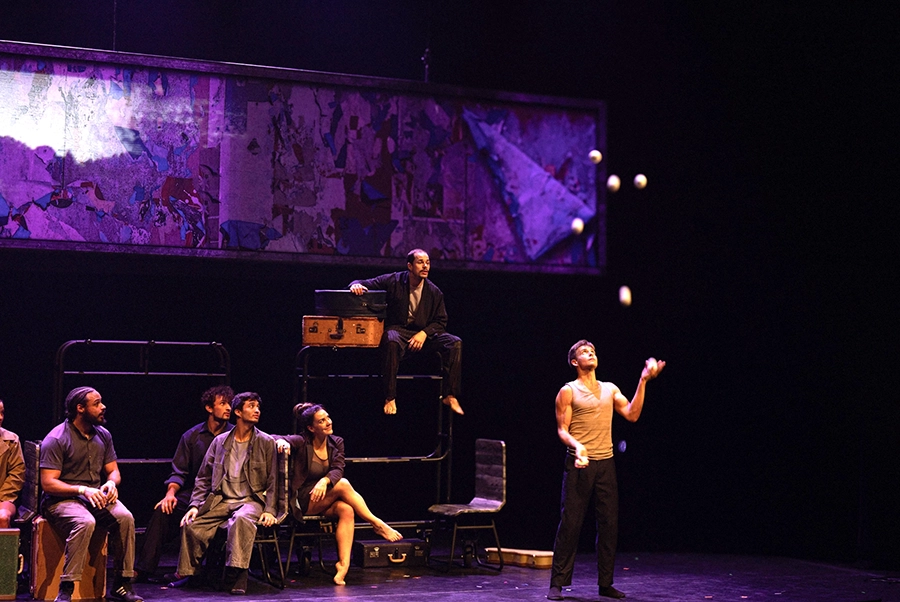
Cast of ‘Passengers’ by The 7 Fingers (Les 7 Doigts) at A.R.T.

By Shelley A. Sackett

Train travel has always evoked a magical aura of nostalgia and romanticism, an opportunity to slow down, observe and contemplate while suspended between past and future, between here and there. American Repertory Theater’s production of Passengers, a contemporary circus performance that combines acrobatics, dance, music and a gossamer thread of dramatic narrative, makes a case that train travel (as a metaphor for life) is all about the journey, not the destination.

For 90 intermission-less minutes, 10 extraordinarily talented acrobats and circus performers (the cast of Montreal-based circus company, The 7 Fingers) use aerial straps, juggling, contortion, hand-to-hand balancing, hoops, pole climbing and aerial silk hammocks to elicit “oohs,” “aahs” and applause from an audience spellbound by the troupe’s physical strength and artistry. Equally dazzling is the show’s crystal clear sound system and arresting 16-song soundtrack of folk, jazz, Latin hip-hop, electronic trance and soulful chamber music. A simple but elegant set uses luggage racks and molded chairs as both acrobatic props and scene creators. Stunning lighting and effective, pleasing projections are icing on the cake.

As Artistic Director Diane Paulus explains in her program notes, the A.R.T. Engagement team develops the Essential Question to catalyze conversation. For Passengers, those questions are: In what ways does life happen while in transit? Is the journey truly more important than the destination?

Passengers’ strength lies in its ability to conjure feeling rather than thought. It is long on the sensual — from visual to auditory to emotional — but short on narrative and nuance.

The show begins with the performers arranging the chairs into train seats. They breathe in waves, creating the illusion of a train’s wheels as a cello and piano reach a velvety crescendo (“Prologue”). Like a mash-up of Pilobolus and a three-ring circus, the performers break off into couples and triads. The effect is spellbinding and its episodic pace and focus set the tone for the rest of the evening.
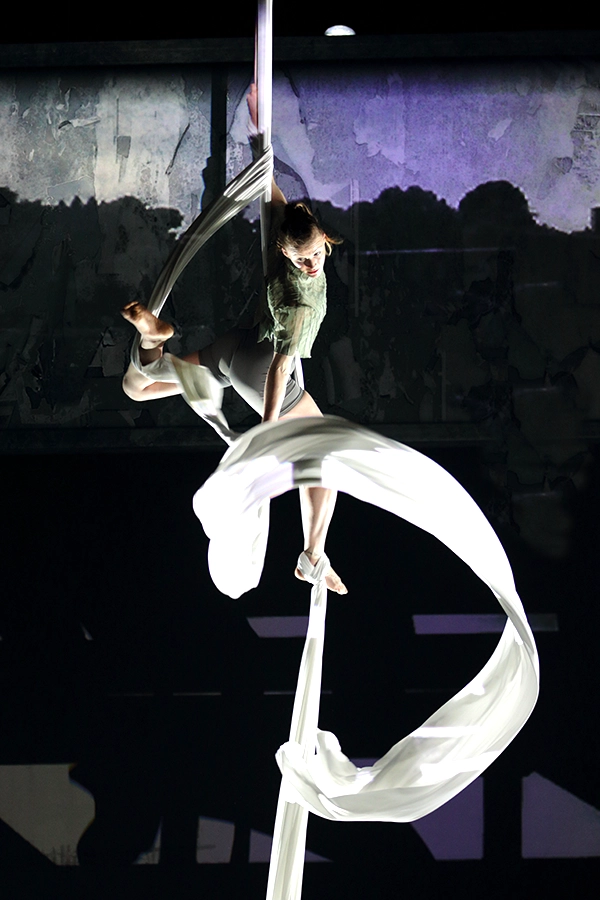
Amanda Orozco. Photo by Sébastien Lozé

Next is the upbeat, swinging “Train Is Coming,” featuring Méliejade Tremblay-Bouchard and her amazing hula hoops. “Sabine’s Departure” features a gorgeous cello and the extraordinary Amanda Orozco, who dazzles and mesmerizes with her white silk parachute aerial skills. There is playful, captivating egg juggling (Santiago Rivera Laugerud), fearless high-flying leaping (Marie-Christine Fournier) and a stunning number that ends with a couple entwined on the floor.

The most whimsical story-lined number has a passenger (Isabella Diaz) somberly waiting for and boarding the train, nervous about the future, sad to leave the past, or a little of both. Once aboard, she unleashes her power to freeze frame time and the other passengers with it. She plays with them lightheartedly, repositioning them and gesturing with expressive, elegant hands, before unfreezing them. Her movements are a delight, as balletic as they are spunky and charming.

Most amazing of all is the fact that these performers work without nets, their safety dependent on teamwork and trust. In addition to inviting us to ponder the passage of time, Passengers also forces us to look our own (and the performers’) mortality squarely in the eye.

The show finishes as it began, with the performers seated in a semi-circle. There is no definitive arrival or resolution, but somehow these passengers seem more connected, more intimate. They (and we) have shared something, even if that something lacks narrative cohesion or clarity.

At the end of the day, Passengers is a valentine to physical strength, flexibility and the extraordinary grace inherent in the human body. If you are in the mood to be entertained by a smaller, gentler, more abstract but no less breathtaking Cirque de Soleil, then Passengers may be right up your alley. If, however, you prefer your live theatrical entertainment to have more plot and clearly definable characters than physical stunts and “acts,” then Passengers may not fit your bill.
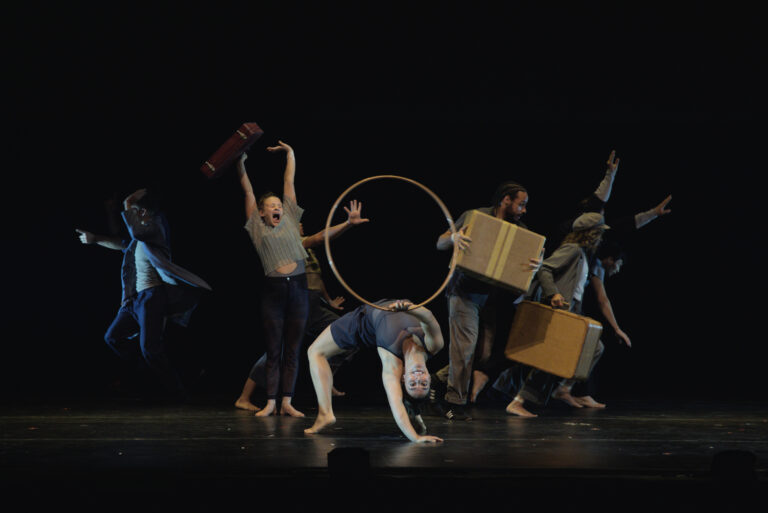
Photo by Grace Gershenfeld

Whether Passengers is theater or contemporary circus (and whether that matters) is an important conversation for another time. Clearly, A.R.T., by opening its 2025/2026 season with the show, believes it belongs on its revered stage.

Colin Gagné; Lyrics by Colin Gagné and Shana Carrol; Scenic Design by Ana Cappelluto; Costume Design by Camille Thibault-Bédard; Lighting Design by Éric Champoux; Projection Design by Johnny Ranger; Sound Design by Colin Gagné and Jérôme Guilleaume. Presented by American Repertory Theater at Loeb Drama Center, 64 Brattle St., Cambridge, through Sept. 26.

For more information, visit americanrepertorytheater.org/

Charming, Engaging, and Clever — A.R.T.’s Musical ‘Two Strangers’ Has It All!

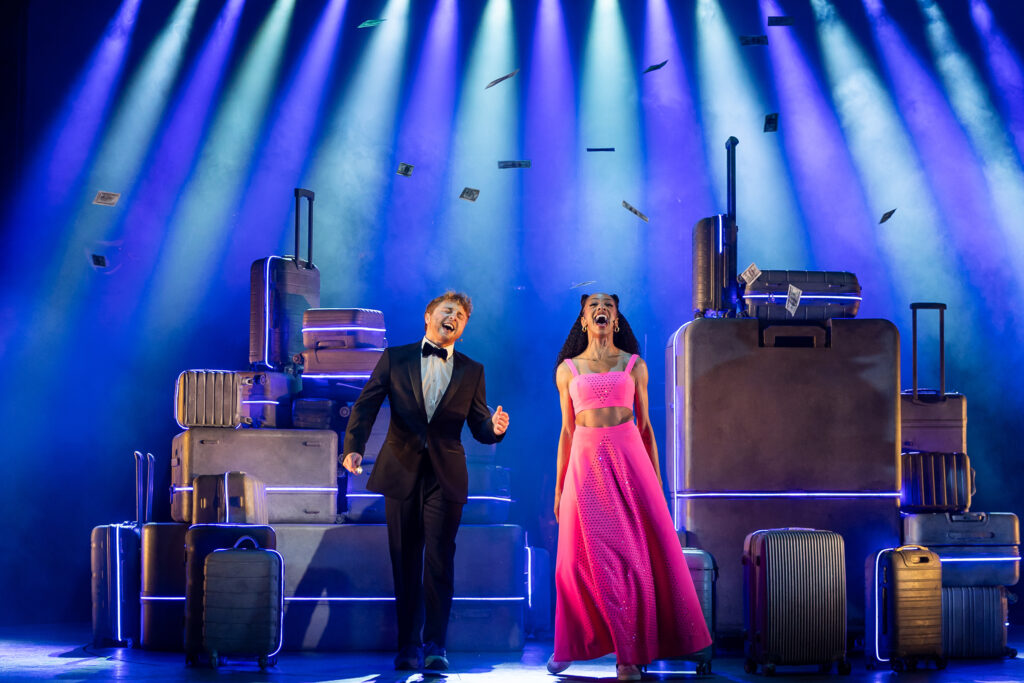
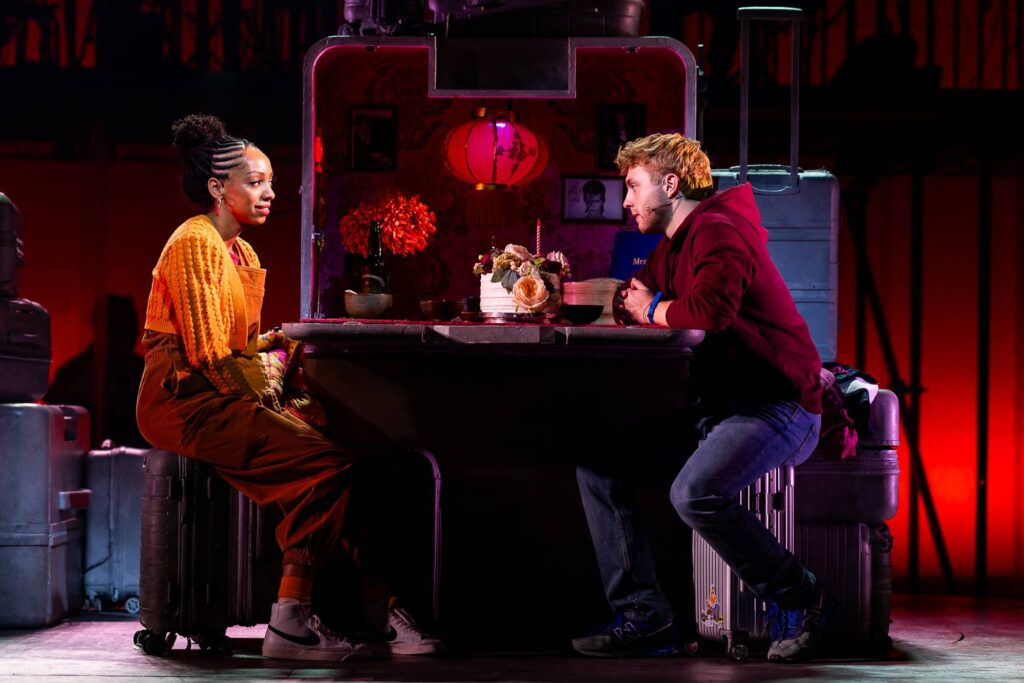
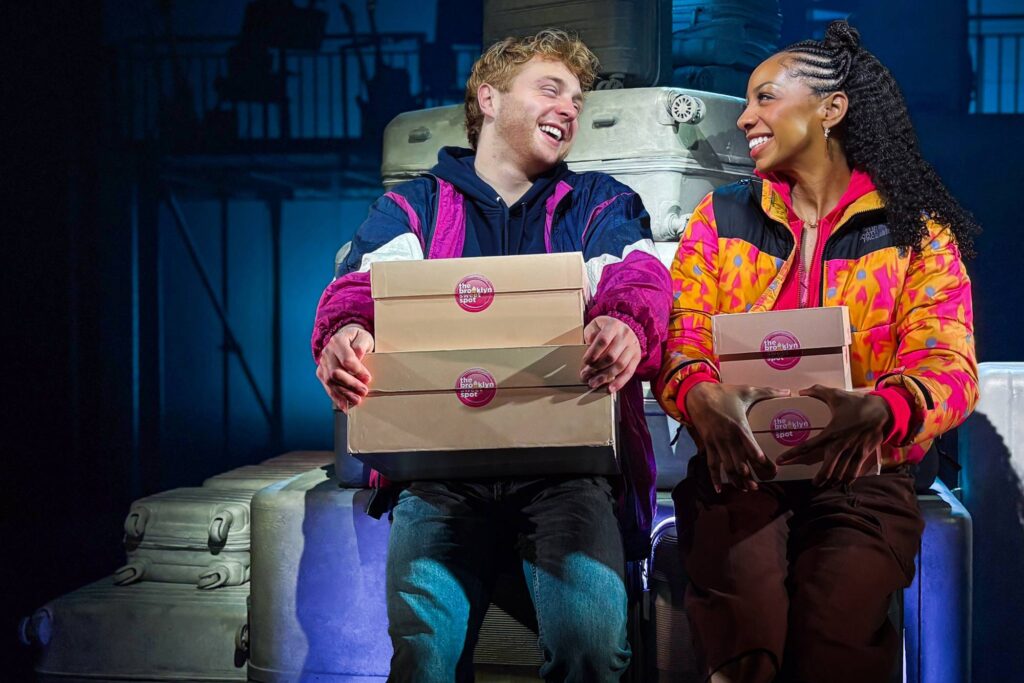
Sam Tutty and Christiani Pitts in A.R.T.’s ‘Two Strangers (Carry a Cake Across New York)’.
Photos: Joel Zayac

Two Strangers (Carry a Cake Across New York).’ Written by Jim Barne and Kit Buchan. Directed and Choreographed by Tim Jackson. Scenic and Costume Design by Soutra Gilmour; Lighting Design by Jack Knowles; Sound Design by Tony Gayle and Cody Spencer; Orchestrations by Lux Pyramid; Music Direction by Jeffrey Campos. Presented by A.R.T.’s Loeb Drama Center, 64 Brattle St., Cambridge through June 29.

By Shelley A. Sackett

Two Strangers (Carry a Cake Across New York), in its American debut at the American Repertory Theatre,is the perfect antidote to our bleak, cold spring. This sunny, upbeat two-hander musical romantic comedy is as beguiling as it is impeccably acted, directed and produced. In short, it is a full-blown fabulous evening of musical theater at its finest.

Unlike too many musicals these days, Two Strangers has a complicated plot and fetching music with lyrics that are Sondheim-esque in their conversational fluency and relevance. Add to that a smart, slick set (Soutra Gilmour), superb band (Music Direction by Jeffrey Campos), impeccable direction (Tim Jackson) and perfectly matched and equally talented leads (Christiani Pitts and Sam Tutty), and…well…you get the picture.

The premise is worthy of a Meg Ryan-Billy Crystal/Meg Ryan-Tom Hanks blockbuster “meet cute” film. Dougal, an excited and excitable 30-something-year-old Brit, has arrived in New York to attend the Christmastime wedding of the father he has never met. Robin, the 30-something-year-old older sister of the bride, is charged with picking him up at the airport. The two couldn’t possibly be more different.

Dougal (a bouncy, adorable and charismatic Tutty) is a bundle of enthusiastic energy. He’s pumped up to be in New York for the first time (“Are They Ready for Me in New York?” he sings in the opening number, “New York”) and marvels, wide-eyed and bushy tailed, at his first subway ride.

Robin is the jaded and pessimistic foil to Dougal’s blind optimism. A disillusioned New Yorker, working as a barista in a coffee shop and barely making ends meet, she is waiting for something to jump-start her “real” life. Her opening number, “What’ll It Be?” (“Is there something ’round the corner in the distancе? If you’re changing, what’ll it be that makes thе difference? Will you notice, will you feel it? What’ll it be?”) is a lamentation to dreams deferred. 

Dougal is in the same boat over the pond (he lives in his mother’s basement and works as an usher at a cinema), but he has the confidence and faith that fate and time are on his side. Robin’s glass is more than half empty; Dougal toasts hers with one that’s more than half full.

Jim Barne and Kit Buchan have crafted lyrics and music that are varied and reflective of both the two characters and the various situations they encounter. Tutty and Pitts have sparkling chemistry, and they are both engagingly agile actors with spot-on timing, inflection, physicality, and dancing and singing gifts. In the magical first act closing number, “American Express,” with its tip of the hat to Ginger Rogers and Fred Astaire, the two actors really get to strut their stuff. (Kudos to Pitts and Tutty for sharp enunciation and to Tony Gayle and Cody Spencer’s crystal clear sound.)

Gilmour’s set design of stacks of suitcases etched with neon is simple and elegant. It spins throughout the show, underscoring how Robin and Dougal seem to be walking in place while circling each other. Magically, the wardrobes and large suitcases open to a coffee shop, a fleabag hotel, a Chinese restaurant and more. Jack Knowles’ dreamy lighting creates starry skies, dance floors and even a Plaza Hotel suite out of thin air.

The second act is more serious and meatier, as Dougal and Robin begin to open up to each other and provide compassionate reality checks. Robin gets Dougal to acknowledge his daddy fantasies and Dougal eventually succeeds in gaining Robin’s trust. And yes, the two do actually carry a wedding cake across New York.

By the play’s end, it is clear they have had a profound and indelible effect on each other, and that their connection has morphed into more than friendship. To their credit, Barne and Buchan resist the temptation to wrap it all up in a neat, happy rom-com bow, leaving the audience heartful, hopeful and thoroughly charmed.

Highly recommended.

For more information, visit americanrepertorytheater.org

A.R.T.’s ‘Night Side Songs’ Is Magical, Boundary-Breaking Theater

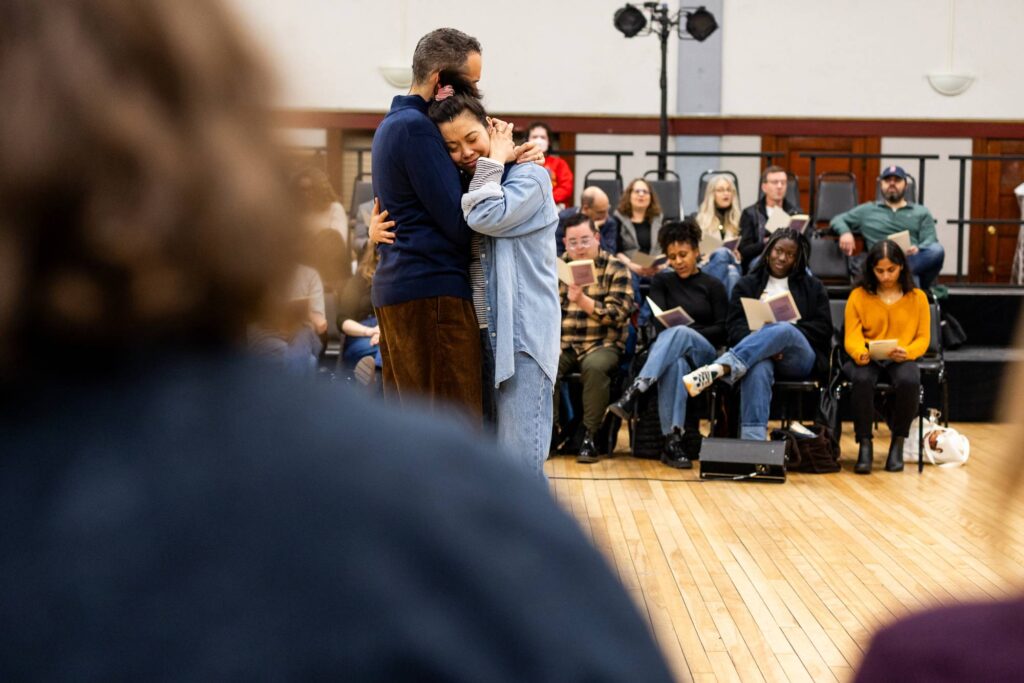
Jonathan Raviv and Brooke Ishibashi in A.R.T.’s ‘Night Side Songs’. Photo: Nile Scott Studios

By Shelley A. Sackett

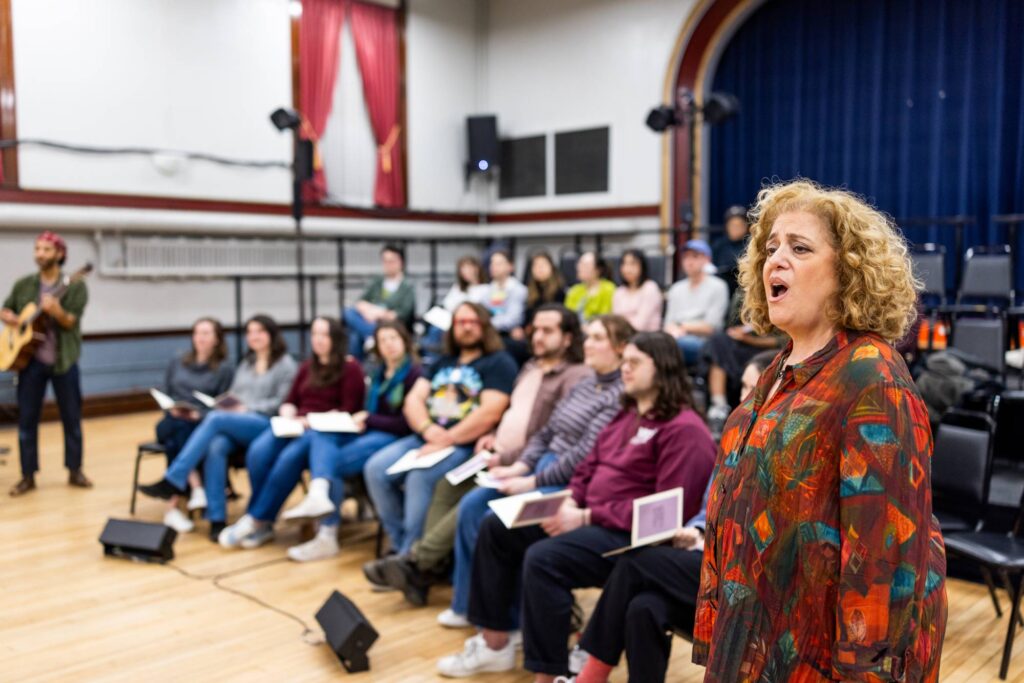
Night Side Songs, the remarkable production by A.R.T. now at Hibernian Hall, bills itself as “communal music-theater experience performed for—and with—an intimate audience that gives voice to doctors, patients, researchers, and caregivers to celebrate the resilience of the human spirit.” This description barely scratches the surface of the uncharted grounds this play explores, and the transfixing heights it reaches.

A musical that explores the intimacy of illness and death through the universal power of song sounds neither uplifting nor entertaining, yet owing to the Lazours’ insightful script and the ensemble of five outstanding talents, that is exactly what Night Side Songs’ 100 minutes is. Knitting a cozy throw from the experiences and voices of doctors, patients and caregivers, the Lazours have somehow managed to address the awfulness of cancer through the kaleidoscope of a dramatic immersion.

Jordan Dobson

The show opens with the charismatic and talented Mary Testa quoting Susan Sontag, who died of complications of acute myelogenous leukemia at 71. “Illness is the night side of life, a more onerous citizenship. Everyone who is born holds dual citizenship, in the kingdom of the well and in the kingdom of the sick. Although we all prefer to use the good passport, sooner or later each of us is obliged, at least for a spell, to identify ourselves as citizens of that other place.”

She and the rest of the ensemble proceed to escort us on several such journeys by means of 21 songs and the 11-part story of Yasmine’s (a sensitive yet sturdy Brooke Ishibashi) confrontation with breast cancer. With unflinching clarity, the Lazours spare no detail as Yasmine finds a lump, receives her diagnosis, goes through treatment, remission, relapse, and chemotherapy with lethal side effects while dealing with bills and her high-maintenance mother, Desiree (Testa). We are strapped in beside her on the roller coaster ride of good and bad days and share in her joy at reconnecting with, and marrying, Frank (Jonathan Raviv) and the eight years of remission they enjoy before the other shoe drops.

If this sounds heavy, that’s because it is. If it sounds depressing, it is not because the Lazour brothers have spun a story of compassion, caring and intimacy out of shards of misery, pain and grief. Their insightful lyrics, the first-rate cast and the warmth of Hibernian Hall’s small performance space create a powerful sense of community and healing.

The audience is invited to sing along at designated spots (lyrics provided), and the repeated lines are particularly poignant and resonant. “Sometimes you don’t know; sometimes you just know. Either way, you gotta keep it together,” Yasmine sings after discovering a lump but before receiving a diagnosis from her doctor (a superb Robi Hager), with whom she coincidentally shared an 8th-grade clandestine kiss.

Mary Testa

Despite her illness, Yasmine soldiers on through the dysfunctional relationship between Frank and her mother and her mother’s quick, surprising death. By the time her end is inevitable, we too are ready to let go. This transition, while sad, is a loving and very natural segue, the beginning of an uncharted crossing away from dark and into light. While the play has focused on the journey, it is the destination that now commands center stage.

Along the way, the Lazours tackle other meaty issues that accompany illness, caregiving and the often callous state of healthcare in the US. In a segment that takes place in a medieval pub, its feisty owner (Testa) deals with a tumor that is treated with leeches, excision and derision. She searches for an underlying cause and remedy, alternately looking for a miracle from God and a reason that justifies her illness. In her search, she encounters guilt-tripping clergy and a vacuum where compassion and pity should dwell. She also discovers the power of song, showcased in “The Reason,” an upbeat, funny number with fabulous harmonies and a show-stealing vamping by Hager.

Ishibashi

The brothers also shine a light on the caregiver and their pain and need for treatment, albeit of a nonmedical nature. When the side effects from Yasmine’s chemo treatment reverse her remission, catapulting her into a terminal relapse, Frank travels almost daily from Maine to Mass General to be by her side. “I won’t know what to say, but I will check in on you every day,” he sings to her. Yasmine, too, needs reassurance that Frank can handle the relief she comes to crave. ”Will you let me know I can let you go? Can you softly say you will be ok?” she asks.

The cast, rounded out by Jordan Dobson and his calm presence and musical chops, is uniformly terrific. If you get a chance to catch the last performances of this transfixing show, take it!

‘Night Side Songs.’ Words and Music by the Daniel and Patrick Lazour. Directed by Taibi Magar. Scenic Design by Matt Saunders; Costume Design by Jason A. Goodwin; Lighting Design by Amith Chandrashaker; Sound Design by Justin Stasiw. Music Direction and Piano Arrangements by Alex Bechtel. Presented by American Repertory Theater in association with Philadelphia Theatre Company at Hibernian Hall, 184 Dudley St., Boston through April 20.
For more information, visit https://americanrepertorytheater.org/shows-events/

A.R.T.’s ‘The Odyssey’ Catapults Homer’s Ancient Epic Poem into the 21st Century

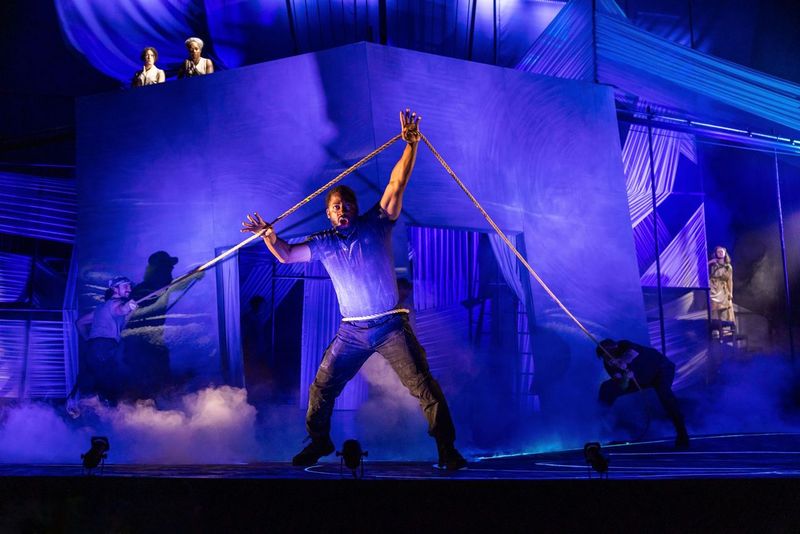
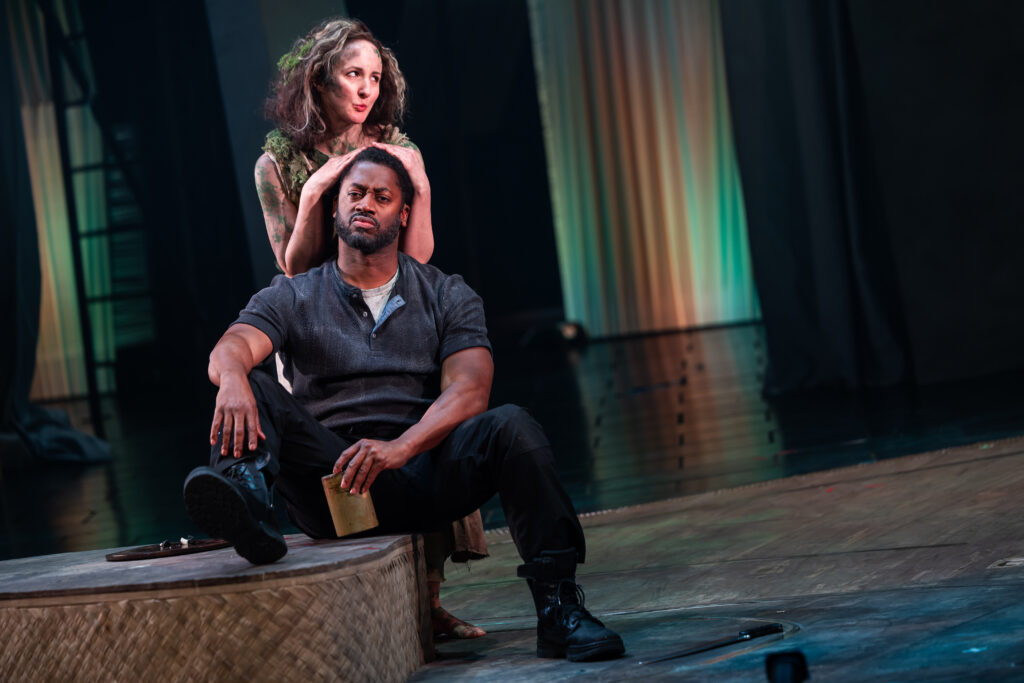
Members of the cast in A.R.T.’s world-premiere production of The Odyssey.
Photo Credits: Nile Scott Studios and Maggie Hall.

By Shelley A. Sackett

“If you’ve gone through something traumatic, can you ever go back to who you were? Can you ever go back home?” is the essential question American Repertory Theater’s Terrie and Bradley Bloom Artistic Director Diane Paulus asks audience members to consider as they experience the world premiere of Kate Hamill’s A.R.T.-commissioned newest work, ‘The Odyssey.’ This spectacularly produced reimagination of Homer’s 8th/7th century B.C. epic poem is the latest retelling of a classic tale by Hamill, who, once again, displays her special talent for penning plays that magically remain true to the original while interweaving parallel contemporary issues, culture and language.

Hamill’s version of The Odyssey evokes both memories of ninth-grade English class and the latest headlines. She is a true master storyteller and alchemist. For three hours (two welcomed intermissions), the audience rides shotgun as she personalizes and contextualizes the Greek epic that follows the hero and king of Ithaca, Odysseus, and his homecoming journey after the ten-year-long Trojan War. During the decades-long trip from Troy to Ithaca, he encounters many perils, and all of his crewmates are killed. During Odysseus’ inexplicably long absence (the distance from Troy to Ithaca is only 565 nautical miles), he is presumed dead, leaving his wife Penelope and son Telemachus to contend with a group of unruly suitors competing for Penelope’s hand in marriage.

Alejandra Escalante, Kate Hamill, NikeImoru and Carr

Homer’s original tale stresses ethical ambiguity and codes of heroic values and displacement. Hamill breathes contemporary life into these themes, adding her own twists that highlight the trauma of war on both those who fight and those they leave at home. Her trademark feminist lens focuses tightly on the play’s many female characters, especially Penelope and her struggles during Odysseus’ 20-year absence.

Sibyl Wickersheimer’s set is magnificent in elegance, simplicity and flexibility. Hundreds of yards of fabric shroud the stage as tasseled drapes hanging from the ceiling, geometric sculptural patterns along the back wall, and flowing, free panels. Shifting lighting and projections (Jeanette Oi-Suk Yew) change their color, mood and function. Cut-out boards and shapes shift function from ship to palace to island. The effect is dreamlike and captivating.

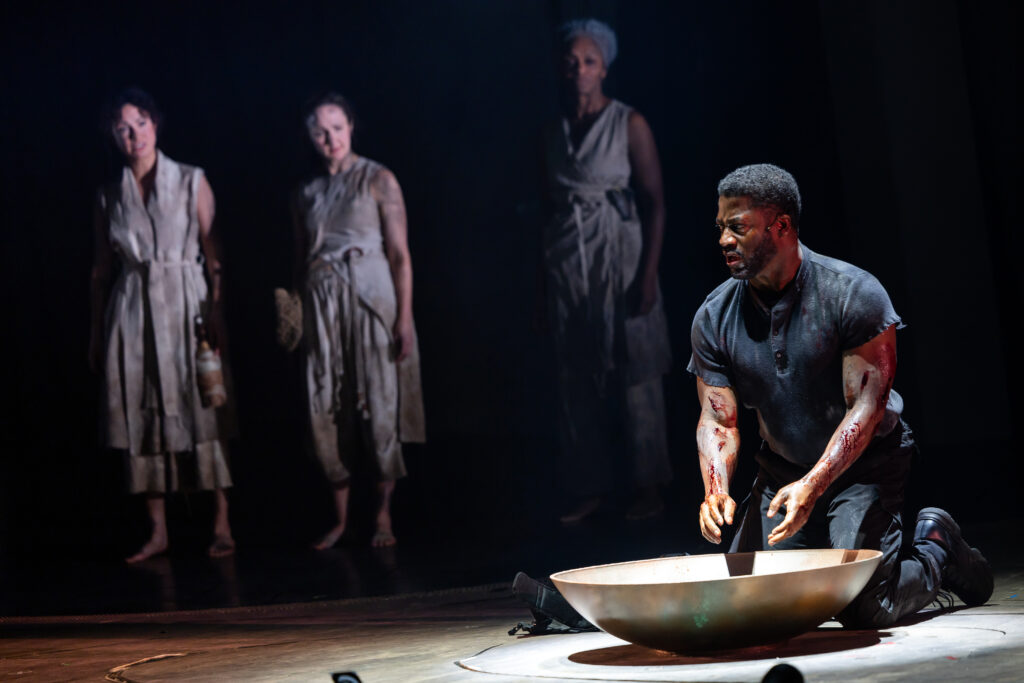
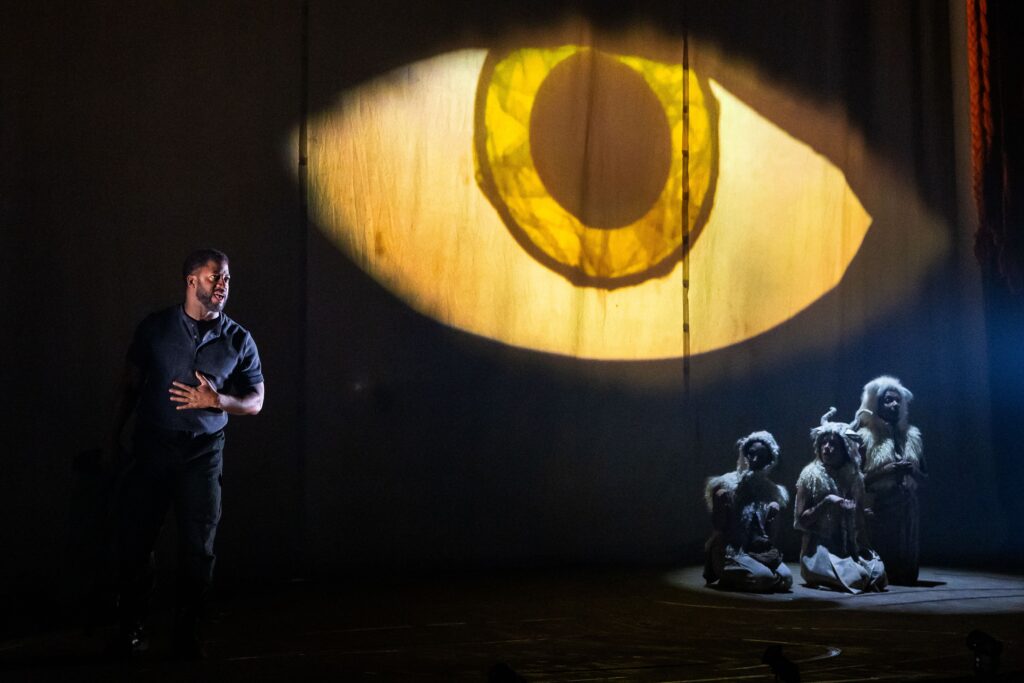
Act I opens on a beach with a chorus of three masked women who approach Odysseus (a credible Wayne T. Carr), as he scrubs his hands in a bowl of water. They act as narrators, dramatically bringing the audience up to speed on Odysseus’ life as king, husband, father and, above all, soldier. They are his guides and will accompany him throughout his travels.

Andrus Nichols and Carr

We learn that Odysseus is the only man who has not yet returned to Ithaca from the war in Troy. Shadow puppets (which appear throughout the play in various forms) illustrate his tale. The effect is Shakespearean, the triad reminiscent of the three witches, and Odysseus’ frantic hand-scrubbing is a hat tip to Lady Macbeth’s obsessive hand-washing in her effort to rid herself of feelings of shame and guilt.

“Your hands are clean,” the women croon, but Odysseus only revs up the pace in response.

In a flash, the language shifts from classical to contemporary vernacular and the beached ship morphs into a disco-like scene, complete with music, sexual innuendos and lots of swearing. We are in Ithaca, where Queen Penelope’s home has been besieged by rough-neck “suitors” intent on becoming the next king.

Flash again, and we are back with Odysseus, docked on an island inhabited by Titans. He and his men encounter the Cyclops, Polyphemus, when they search for food in a cave. Clever staging simultaneously evokes the giant and the cave through projections, puppetry and shadows. The three women (who also play different supporting characters in each scene) are charming as the mouth-watering lambs the men follow into the cave.

Act II is devoted to the cunning sea-witch goddess, Circe (played with impeccable timing, intonation and physicality by a scene-stealing Kate Hamill), and her island Aeaea, where Odysseus and his men almost meet their match. Circe agrees to let the men live if Odysseus stays with her. Finally, he snaps out of his drugged state of no man’s land when one of his men reminds him that, painful as it might be, he needs to confront himself, deal with his sins and pain, and return to his family.

“You can’t forget everything, or you forget what’s worth living for. Don’t you want to go home?” he is asked.

Hamill and Carr

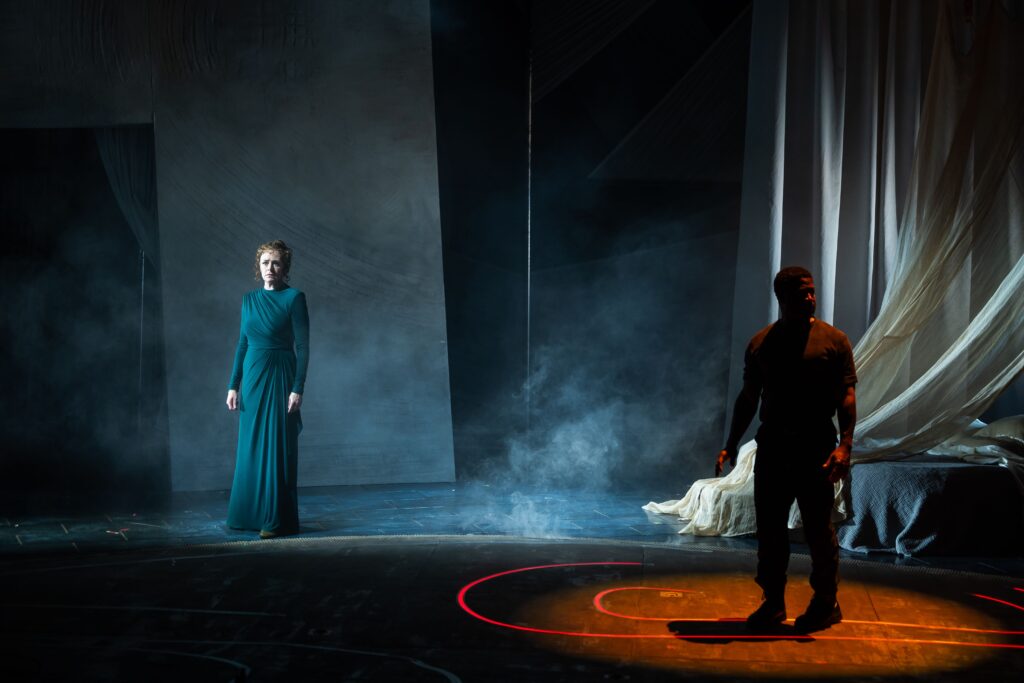
Meanwhile, back in Ithaca, Penelope’s (lithe and elegant Andrus Nichols) outer resolve begins to falter as Amphinomus (Keshav Moodliar) begins to chip away at it with seductive, honey-tongued persistence. The deliciously hung fabric is an exquisite setting in pastel hues of mauve and pink. Penelope admits she is tired of being afraid and alone. “I am worn out by memories,” she says. “I’m not free to choose, but I can touch.”

Act III is the longest and most lively, as Odysseus makes his way home (after a couple more stops) and eventually wins back his throne and family. There are bloody battles, disco galore and plenty of irreverent language. The play may be long, but the pace and production values keep it rolling and engaging.

Carr, Hamill, Escalante, Imoru

Director Shana Cooper has an excellent ensemble assembled, and her pacing, transitions and seamless blocking are all spot-on. Hamill’s script, as always, is a mashup of the classic and contemporary, fiercely loyal to the underlying ancient tale, yet spinning an exciting, smart and thought-provoking contemporary cocoon around it. The result is an adaptation that is accessible to all and explores big-ticket concepts.

What are the relationships between trauma, memory and violence, for example? Who are our heroes and what are their values? In this era of migration and displacement physically, emotionally and politically, what does “home” mean and how secure is it?

Hamill’s works are always something to look forward to. The curtain call at ‘The Odyssey’ left me eager to see what she will tackle next.

The Odyssey’ – Written by Kate Hamill. Based on the epic poem by Homer. Scenic Design by Sibyl Wickersheimer; Costume Design by An-Lin Dauber; Lighting Design and Projection Design by Jeanette Oi-Suk Yew; Sound Design and Music Composition by Paul James Prendergast. Presented by American Repertory Theater at Loeb Drama Center, 64 Brattle St., Cambridge, MA, through March 16.

The Odyssey’ – Written by Kate Hamill. Based on the epic poem by Homer. Scenic Design by Sibyl Wickersheimer; Costume Design by An-Lin Dauber; Lighting Design and Projection Design by Jeanette Oi-Suk Yew; Sound Design and Music Composition by Paul James Prendergast. Presented by American Repertory Theater at Loeb Drama Center, 64 Brattle St., Cambridge, MA, through March 16.

A.R.T.’s Innovative “Romeo and Juliet” Elevates and Grounds Shakespeare’s Masterpiece

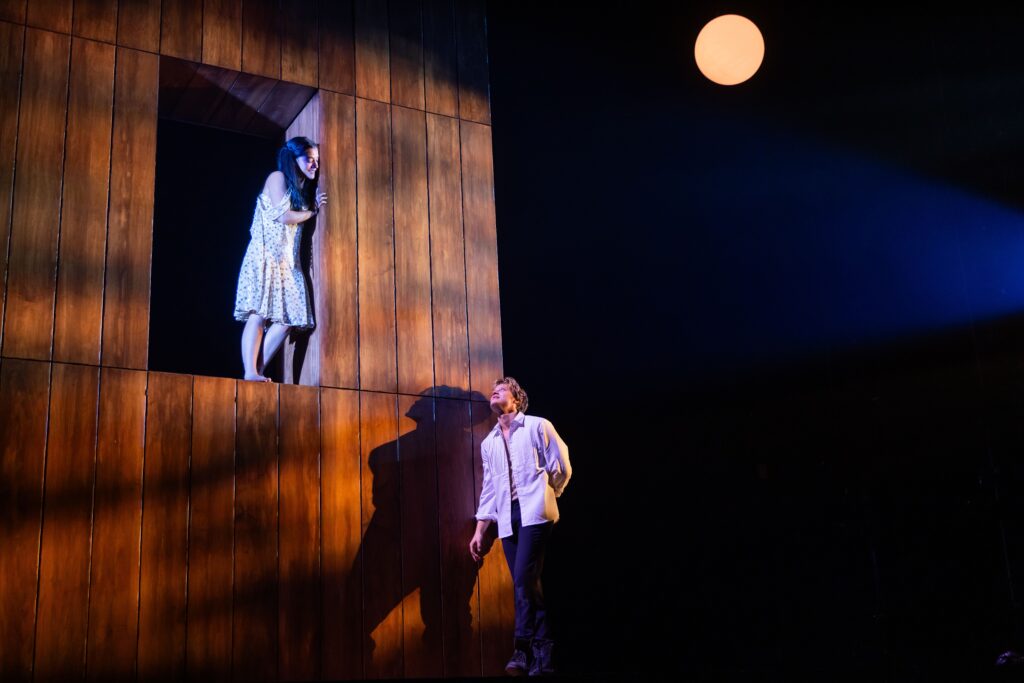
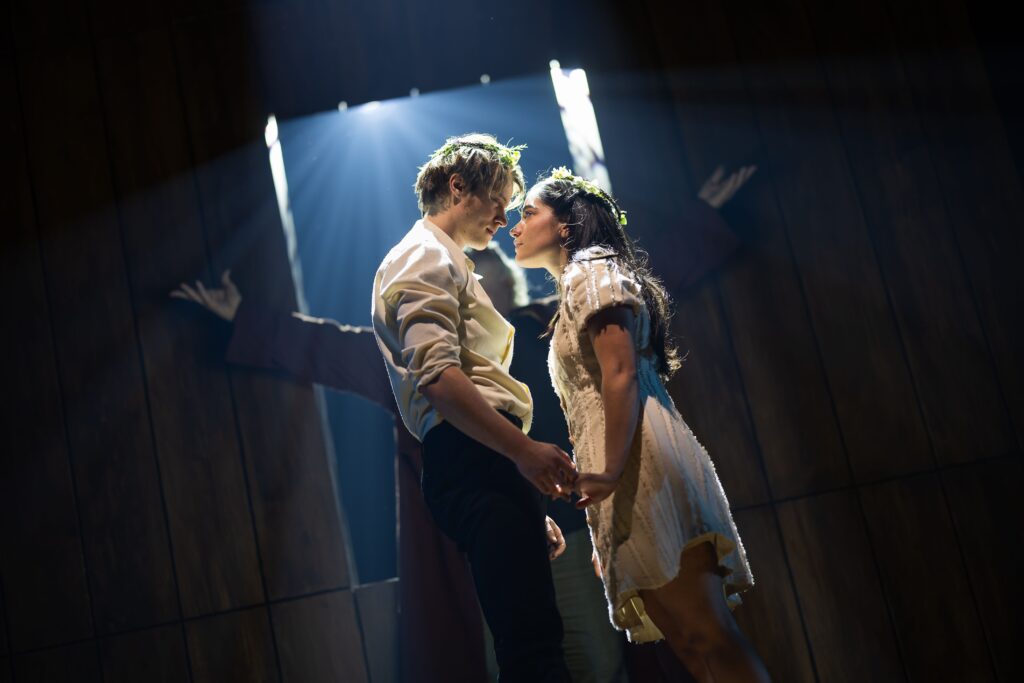
Emilia Suárez (Juliet) and Rudy Pankow (Romeo) in A.R.T.’s  Romeo and Juliet.
Photo Credits: Nile Scott Studios and Maggie Hall

By Shelley A. Sackett

Diane Paulus, Artistic Director at American Repertory Theater, has raised the bar on production values so often, we’ve come to expect the unexpected from her. From 1776 to Pippin to Gershwin’s Porgy and Bess, Gloria: A Life, Jagged Little Pill, Waitress, SIX, and moretheatergoers in Boston have benefitted from her inspiring collaborations and razor-sharp skills to enjoy Broadway-bound productions right in their own backyard.

Romeo and Juliet is no exception.

Working with a creative team of stellar talent, Paulus has breathed contemporary life into Shakespeare’s 16th-century well-known and oft-quoted masterpiece.

The tragic story is a familiar tale of star-crossed lovers caught in the crosshairs of a family feud so old that its origins have faded from memory. Paulus said she wanted to focus on the couple’s feelings for each other and highlight their love instead of their families’ hate. By using movement, evocative music, lighting, and a spectacularly efficient set, she creates the perfect stage upon which such a transformation can — and does — happen.

As with all Shakespeare (and especially in productions where there are no projected captions to serve as guides), a plot primer can be helpful.

Juliet Capulet (Emilia Suárez of Hulu’s Up Here fame) and Romeo Montague (Rudy Pankow of Netflix’s Outer Banks) meet and fall instantly in love at a masked ball hosted by Juliet’s parents. They profess their devotion when Romeo, unwilling to leave, climbs the wall into the orchard garden of her family’s house and finds her alone at her window. Because their well-to-do families are enemies, the two are married secretly by Friar Lawrence (the fabulous Tony Award winner and multiple nominee, Terrence Mann).

When Tybalt (Alex Ross), a Capulet, seeks out Romeo in revenge for the insult of Romeo’s having dared to shower his attentions on Juliet, an ensuing scuffle ends in the death of Romeo’s dearest friend, Mercutio (Clay Singer). Impelled by a code of honor among men, Romeo kills Tybalt and is banished to Mantua by the Prince of Verona (Jason Bowen), who has been insistent that the family feuding cease.

Sharon Catherine Brown and Suárez

Juliet’s father (Terence Archie), unaware that Juliet is already secretly married, arranges a marriage with the eminently eligible Count Paris (Adi Dixit). The young bride seeks out Friar Laurence for assistance in her desperate situation. He gives her a potion that will make her appear to be dead and assures her that if she takes it, he will arrange for Romeo to rescue her. She complies.

Romeo, uninformed of the friar’s scheme because a letter of explanation has failed to reach him, returns to Verona on hearing of Juliet’s apparent death. He encounters a grieving Paris at Juliet’s tomb, and reluctantly kills him when Paris attempts to prevent him from entering. There, he finds Juliet in the burial vault. Unaware that she is only sleeping, he gives her a last kiss and kills himself with poison. Juliet awakens, sees the dead Romeo, and kills herself. The families learn what has happened and end their feud.

At Wednesday’s preview performance, magic and pathos were on stage from the opening scene that revealed Amy Rubin’s simple, thick butcher block set bathed in spot-on, evocative lighting (Jen Schriever). Actors push the heavy door open, symbolically revealing the opportunity for closed doors to open. Later, the flexible set will metamorphosize into Juliet’s balcony, a tomb and a party. All of that possibility is communicated in the first few moments.

Background rumbling and emergent music (created by sound designer Daniel Lundberg and the composer of the play’s original music, Alexandre Dai Castaingset the tone for the opening fight scene, a West Side Story-esque stand-off between two teenage gangs. These are the Capulet and Montague clans, and the fury that boils in their blood is masterfully choreographed by fight consultant Thomas Schall and director/choreographer Sidi Larbi Cherkaoui. When the scene freezes into a bellicose tableau, the depth underlying this hostility is fixed on each light-bathed face. (Note: West Side Story is a modern adaptation of Romeo and Juliet that shares many themes and tells a similar story but is set in the 1950s in New York City’s Upper West Side).

Pankow, Terrance Mann

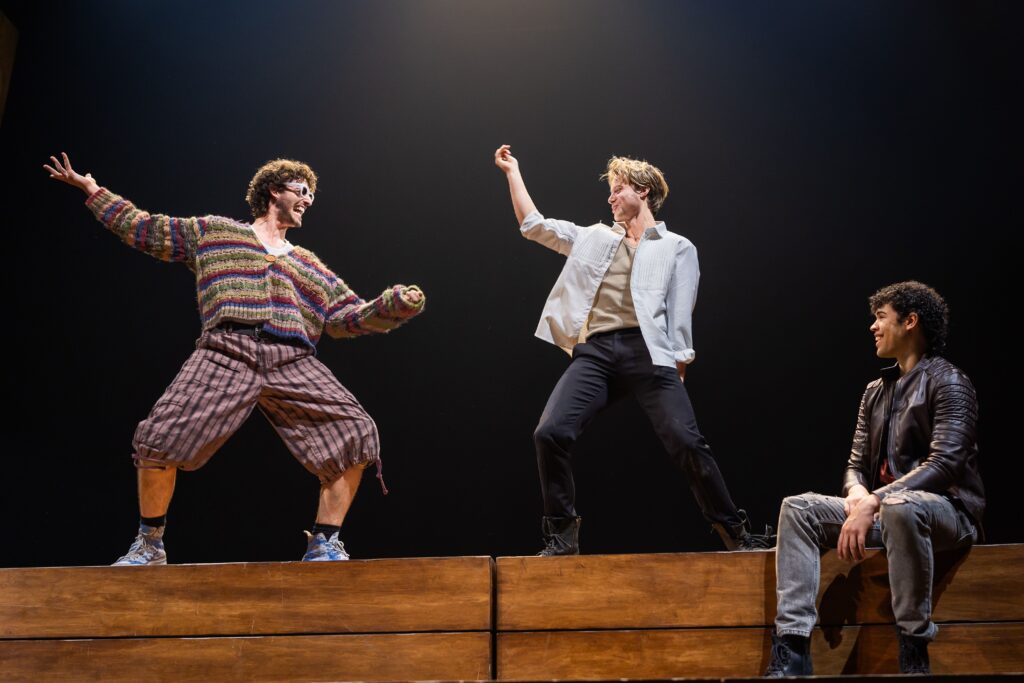
The impacts of visual imagery, light and sound throughout the two and one half hour (one intermission) production never wane. Rubin’s set frequently pivots to frame two or three scenes, providing simultaneous glimpses of different versions of the same event. Early on, as Romeo and Juliet prepare for the party her parents are throwing, Romeo and his buddies cavort stage left while Juliet preens stage right. The effect is as charming as it is enthralling.

Other special production moments are the use of globe lights (brilliant!), a warpath drumbeat soundtrack (by Dai Castaing), and the opening scene after intermission, when Juliet, wrapped in a white sheet, is lit like a fairy and the soft plunk of a harp highlight her delicate dancer’s gestures.

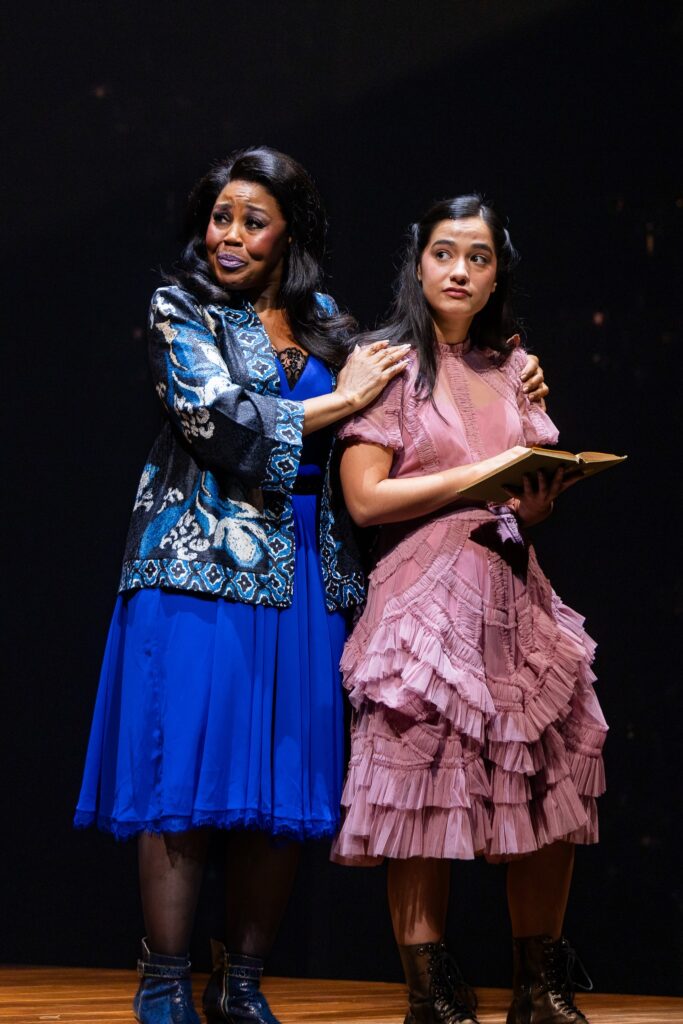
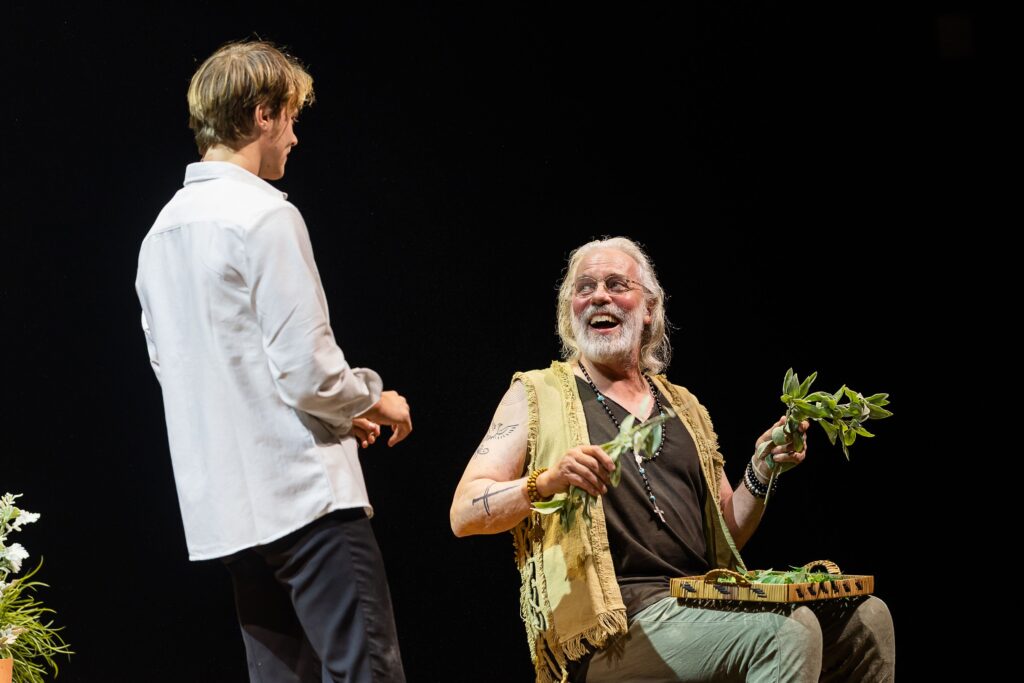
While enough can’t be written in praise of its production value, the real stars of Romeo and Juliet are the actors and the Bard’s sumptuous language. Cast standouts include Suárez as a stunningly lithesome Juliet, Nicole Villamil as Lady Capulet, Juliet’s mother, and the truly awesome Mann as Friar Laurence.

These three (and several other) actors seem to savor the play’s rich lines, lingering over some and articulating with a deliberateness that allows the audience to savor along with them. Unfortunately, some (most notably Singer as Mercutio) race through their lines, swallowing some of the glorious puns and humor that balance the play’s tragic overtones. A suggestion to A.R.T. is to consider following Shakespeare on the Common’s lead and provide projected captions. Absent that, audiences might want to read the play (it’s a short-ish one!) before or shortly after seeing this production. The added appreciation value is well worth the time spent.

Pankow, Suárez

Paulus ends the play on a note of hope despite the carnage that the Verona families’ feud has wrought. As Romeo, Juliet, Thibault, and Mercutio are eulogized and buried, the full cast is on stage. Bright white light bathes the scene as the entire community comes together to bury their dead and plant a garden. Despite the gloomy peace that reigns, the Prince of Verona reminds its citizens, “All are punished. For never was a story of more woe than this of Juliet and Romeo.”

As Capulets and Montagues sow flowers and trees, we imagine Adam and Eve in the Garden of Eden and the innocence and hope of starting fresh and turning the page. In the current climate of political and environmental angst, who can’t benefit from a message that hints at the possibility of restoration, revitalization, and rebirth?

Romeo and Juliet’ – By William Shakespeare. Directed by Diane Paulus. Movement and Choreography by Sidi Larbi Cherkaoui; Original Music Composed by Alexandre Dai Castaing; Scenic Design by Amy Rubin; Costume Design by Emilio Sosa; Lighting Design by Jen Schriever; Sound Design by Daniel Lundberg. Presented by American Repertory Theater at the Loeb Drama Center, 64 Brattle St., Cambridge through October 6.

For more information and to buy tickets, go to https://americanrepertorytheater.org/