A.R.T.’s ’Rhinoceros’ is A Must-See Knockout

By Shelley A. Sackett

Eugène Ionesco (né Ionescu) was born in Romania in 1909. He spent most of his childhood in France, returning to Romania with his father in 1925. As a young man in Bucharest, he witnessed the rise of the Iron Guard, a violent and prominent fascist movement, and watched in horror and despair as many of his friends, mentors, and intellectuals embraced its Nazi ideology. When his father, a magistrate, opportunistically shifted toward antisemitism and totalitarian politics in 1936, Ionesco broke off relations with him. The two never reconciled.

Years later, while living in France, he remained deeply scarred by World War II and the way ordinary people had accepted the extraordinary. In 1959, he wrote Rhinoceros, his “Absurdist” play that illustrates how society and herd mentality normalizes extremism. Now in production at American Repertory Theater’s Loeb Drama Center through September 27, this 2-ish hour (one intermission) is a response to and condemnation of the seduction of the surging rise of Fascism and Nazism during the years preceding World War II.
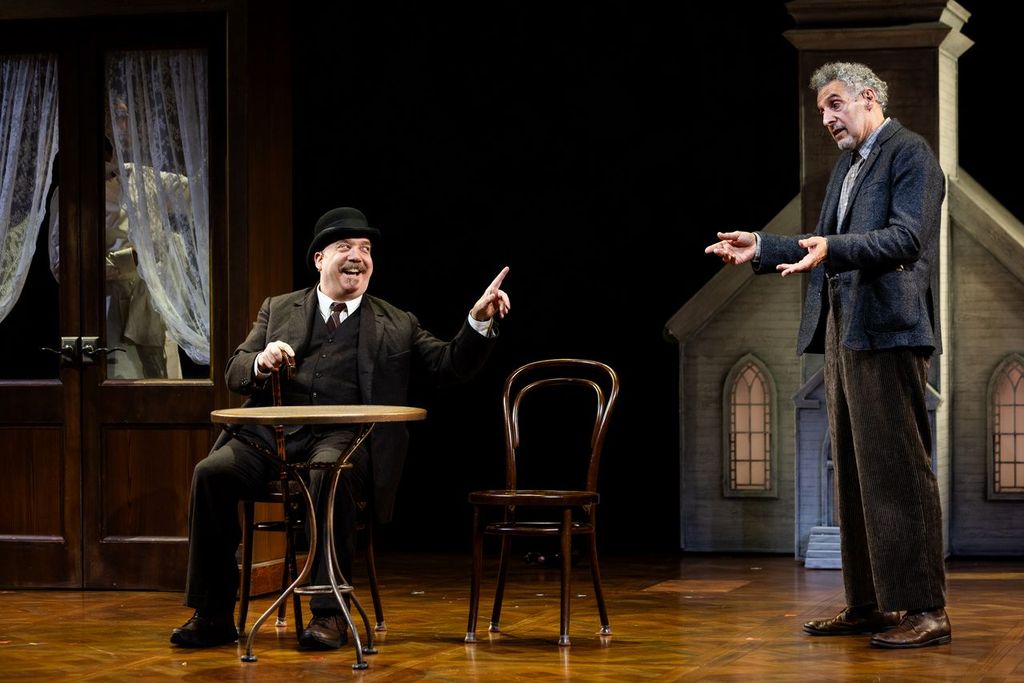
Paul Giamatti and John Turturro in A.R.T.’s ‘Rhinoceros’ Photos by Hawver and Hall

Rhinoceros starts out as an alarming, grotesque anomaly. Quickly, that anomaly is rationalized, debated into legitimacy, and eventually adopted by civic institutions as the new norm, leaving dissenters feeling like they are the ones losing their minds.

If this sounds like 2026 as much as 1936, well it should. The play’s themes of mob mentality, philosophy and (im)morality couldn’t be more timely.

If it sounds dark and depressing, it is that too, but rest assured that Tony Award-winning director Diane Paulus and her star-studded cast (led by John Turturro, Paul Giamatti and Tatiana Maslany) and creative team will mesmerize you with the most energetic, innovative, talented and — yes — hilarious evening of theater this side of Broadway. (Who would have guessed Ionesco could be quite THAT funny about a topic that painful?)

The play opens on a small, provincial French town square. The tidy, attractive café, church and grocery store (set by Riccardo Hernández) are the centers of activity. Bérenger (Turturro) is a low-level clerk who is too apathetic even to hate his job. He nurses a hangover and thirsts for his first drink of the day while awaiting his best friend, Jean, a man as buttoned-up and practical as Bérenger is disheveled and detached. Jean is a man of purpose with nary a moment to waste, except when it comes to criticizing his friend.
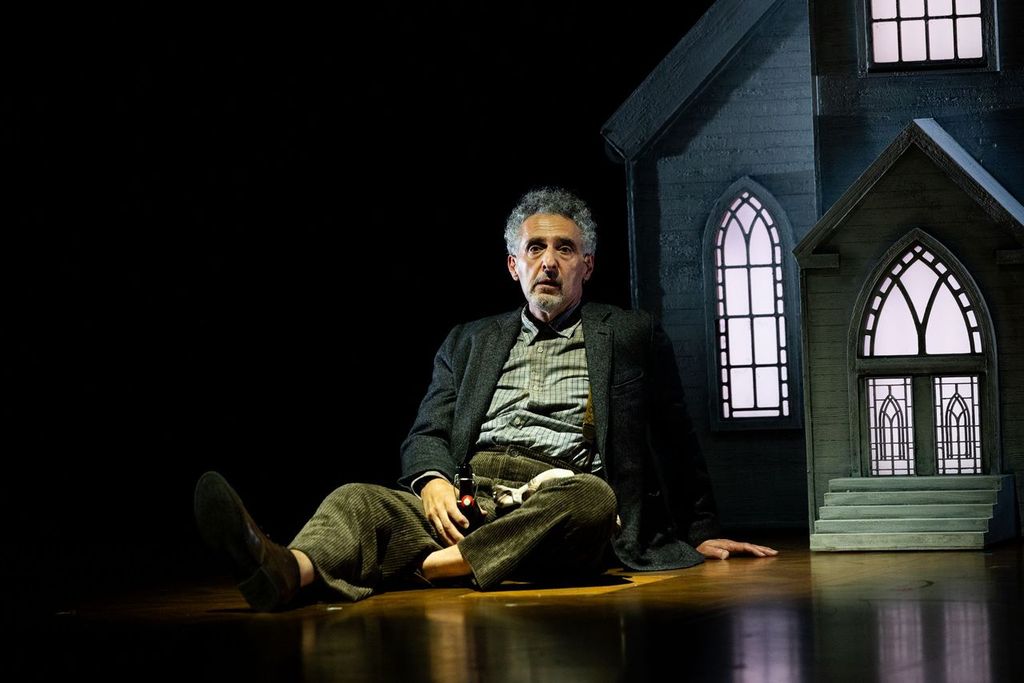
Turturro

Ionesco pens his most clever lines for these two, and Obie and Emmy Award-winning Turturro and three-time Golden Globe awardee Giamatti couldn’t be better matched, each electrifying in his own way. Part Vladimir and Estragon, part Laurel and Hardy, they are a winsome duo.

Turturro brings humor and heartache to Bérenger, withstanding Jean’s barbs one minute, regretting his life the next. (“I’ve always tried to live, but I’ve passed life by,” he laments.) His cadence is impeccable, his flourishing gestures and facial expressions works of art.

It is Giamatti, however, who will steal the first two acts (he doesn’t appear in Act III) with his staccato sarcasm and self-serving puffery. He uses his whole body to summon comedic punctuation, shape-shifting (literally) before our eyes.

All is not well in our bucolic town, however. A rhinoceros has been spotted, raging through the streets. Suddenly, one stampedes through town. A second tramples a cat.

The sound (Fitz Patton), special effects (Markus Maurette) and lighting (Jen Schriever) are dark and menacing. We feel the presence of these enormous animals as they blast past. Kudos to these three, who bring the stampede to life without overplaying their hand and turning the sublime into the mundane.

Jean is beside himself, asking everyone what they thought of what happened. “I can’t get over that!” he exclaims over and over. “It shouldn’t be allowed.” Nonplussed, Bérenger tries to rationalize the rhinoceroses’ appearance. Perhaps they escaped from a zoo, he suggests. In any case, it doesn’t matter, because it’s over.

Except it isn’t over and it does matter. Some don’t believe the news reports. (“I never believe journalists. I don’t need them to tell me what to think,” one of Bérenger’s co-workers says). Some think they should be left alone (“Are they harming you?”) Some question the morality of deciding whether to become a rhinoceros or not; others reframe good and evil, wondering whether they are merely “personal preferences.”

Suddenly, townspeople are changing into rhinoceroses. At first, it seems to be against their will. It just happens. There are debates about whether the metamorphosis is caused by a disease, why it is happening, whether it isn’t a good thing after all, and, finally, whether there is any reason NOT to join the crusade.

Even Jean embraces becoming one of the herd. Giacometti’s transformation is such a tour de force of frenzied snorting, frothing and rutting we almost expect him to return for the curtain as a fully shapeshifted rhinoceros.

Act III continues the downward spiral, but without the warmth and humor. A placid co-worker sheds his white button-down oxford for a horn and thick skin. One by one, the entire town “gets used to it.” Bérenger and his girlfriend, Daisy (Tatiana Maslany, the Emmy winner of TV’s “Orphan Black”), are the last holdouts until she too falls under the spell of mass conformity.
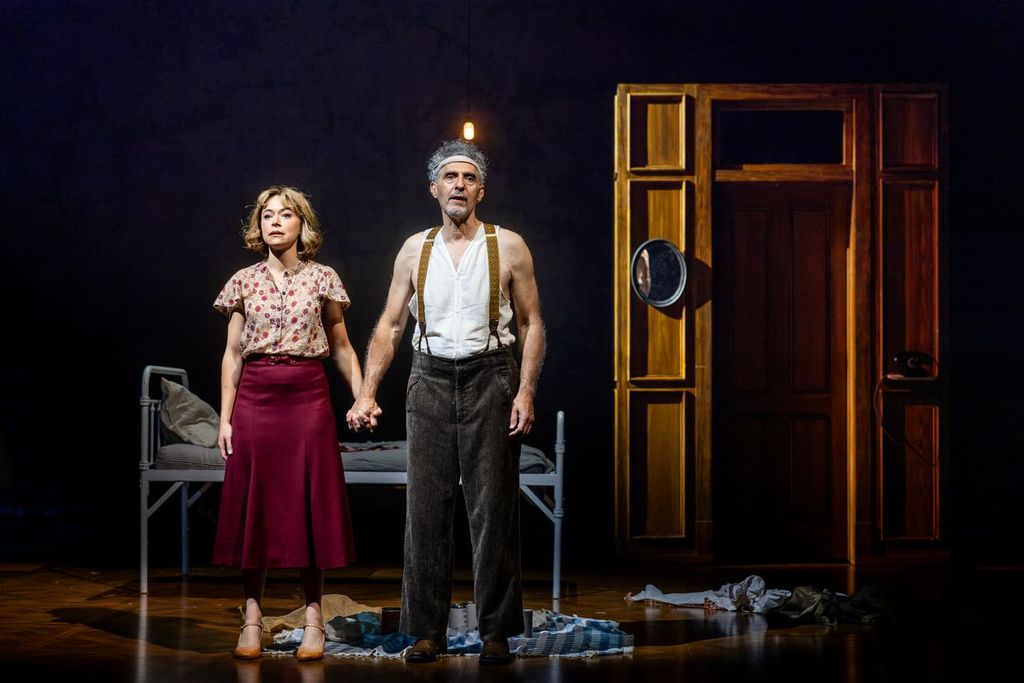
Tatiana Maslany and John Turturro

Alone, the last human left standing, Bérenger wonders if he’s made the right choice, then turns on himself. He is ugly. They are beautiful. He is miserable. They are happy. He will come to a bad end. They will triumph.

But be that as it may, he’s not giving up. He may be the last man standing, but he’s not capitulating. Long live Bérenger; long live Ionesco; and long live Diane Paulus and her reign at A.R.T.!

Highly recommended!

Rhinoceros‘ by Eugène Ionesco, translated by Derek Prouse, adapted by American Repertory Theater. Directed by Diane Paulus. Scenic Design by Riccardo Hernández; Costume Design by Anita Yavich; Lighting Design by Jen Schriever; Sound Design by Fitz Patton; Special Effects Design by Markus Maurette; Fight Direction by Thomas Schall; Movement Advisor Jill Johnson; Dramaturgy by Ryan McKittrick; Production Stage Manager Ryan Gohsman. Produced by American Repertory Theater in Cambridge, MA through September 27, 2026.

For more information, visit https://americanrepertorytheater.org/shows-events/rhinoceros/
A.R.T.’s Innovative “Romeo and Juliet” Elevates and Grounds Shakespeare’s Masterpiece

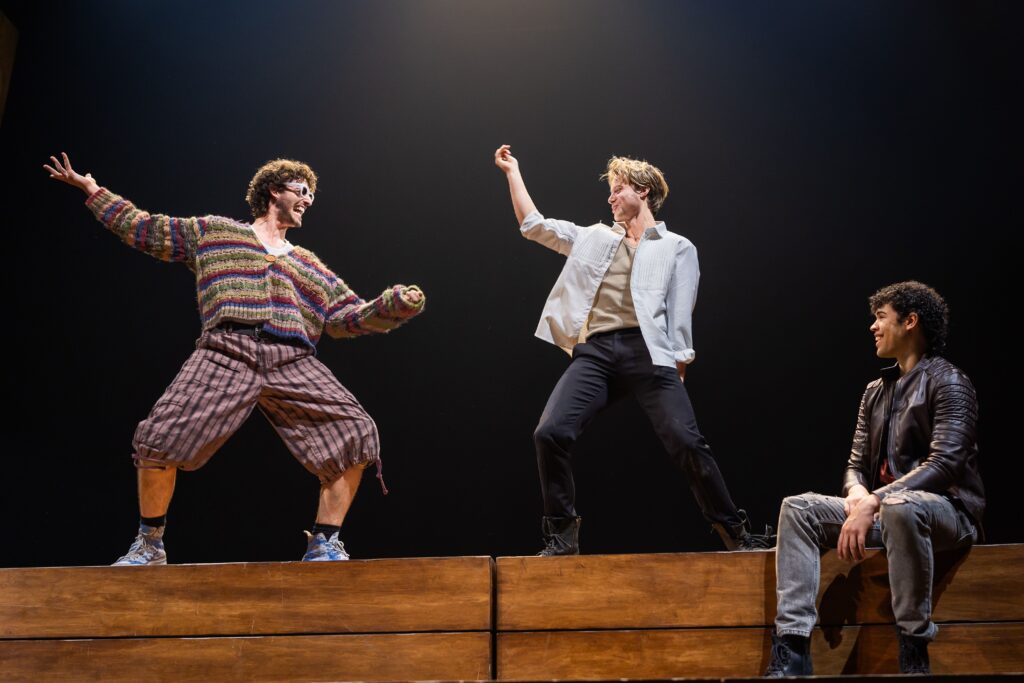
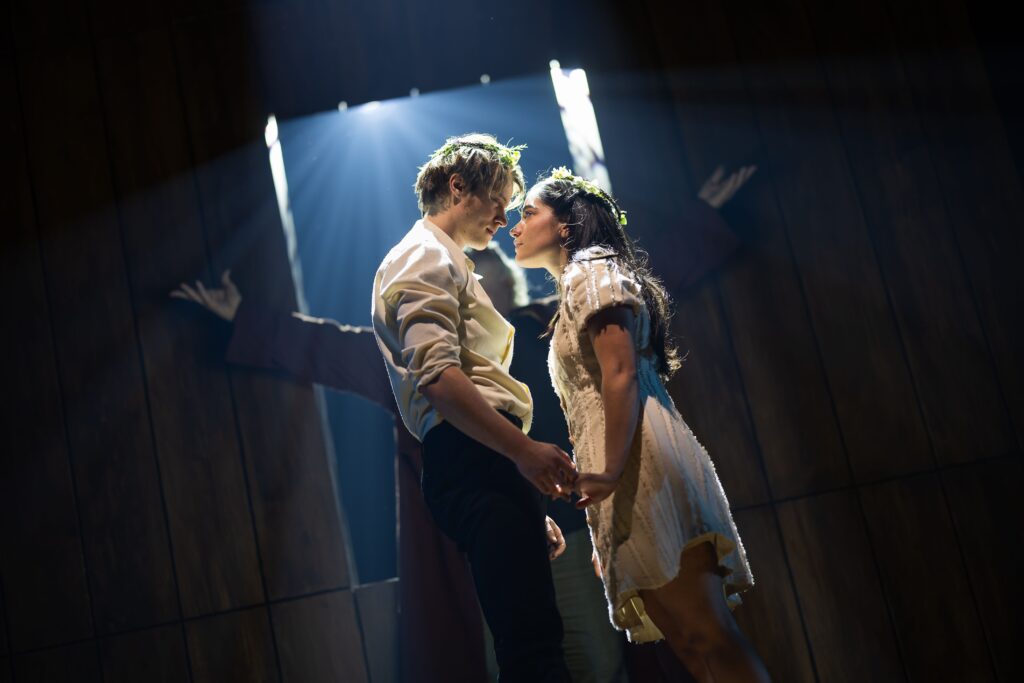
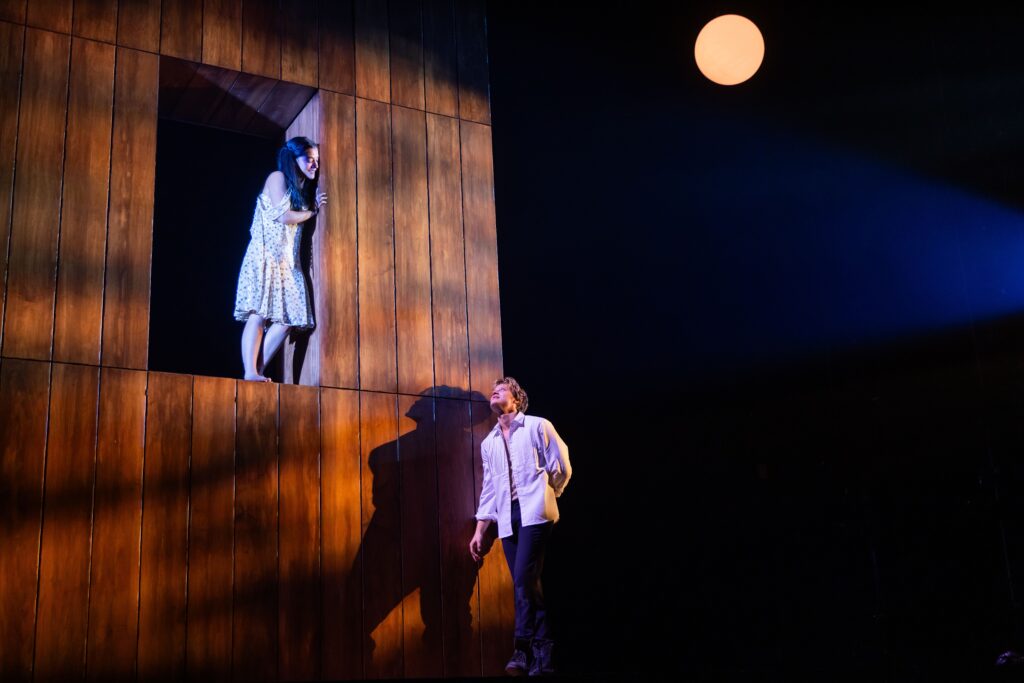
Emilia Suárez (Juliet) and Rudy Pankow (Romeo) in A.R.T.’s  Romeo and Juliet.
Photo Credits: Nile Scott Studios and Maggie Hall

By Shelley A. Sackett

Diane Paulus, Artistic Director at American Repertory Theater, has raised the bar on production values so often, we’ve come to expect the unexpected from her. From 1776 to Pippin to Gershwin’s Porgy and Bess, Gloria: A Life, Jagged Little Pill, Waitress, SIX, and moretheatergoers in Boston have benefitted from her inspiring collaborations and razor-sharp skills to enjoy Broadway-bound productions right in their own backyard.

Romeo and Juliet is no exception.

Working with a creative team of stellar talent, Paulus has breathed contemporary life into Shakespeare’s 16th-century well-known and oft-quoted masterpiece.

The tragic story is a familiar tale of star-crossed lovers caught in the crosshairs of a family feud so old that its origins have faded from memory. Paulus said she wanted to focus on the couple’s feelings for each other and highlight their love instead of their families’ hate. By using movement, evocative music, lighting, and a spectacularly efficient set, she creates the perfect stage upon which such a transformation can — and does — happen.

As with all Shakespeare (and especially in productions where there are no projected captions to serve as guides), a plot primer can be helpful.

Juliet Capulet (Emilia Suárez of Hulu’s Up Here fame) and Romeo Montague (Rudy Pankow of Netflix’s Outer Banks) meet and fall instantly in love at a masked ball hosted by Juliet’s parents. They profess their devotion when Romeo, unwilling to leave, climbs the wall into the orchard garden of her family’s house and finds her alone at her window. Because their well-to-do families are enemies, the two are married secretly by Friar Lawrence (the fabulous Tony Award winner and multiple nominee, Terrence Mann).

When Tybalt (Alex Ross), a Capulet, seeks out Romeo in revenge for the insult of Romeo’s having dared to shower his attentions on Juliet, an ensuing scuffle ends in the death of Romeo’s dearest friend, Mercutio (Clay Singer). Impelled by a code of honor among men, Romeo kills Tybalt and is banished to Mantua by the Prince of Verona (Jason Bowen), who has been insistent that the family feuding cease.

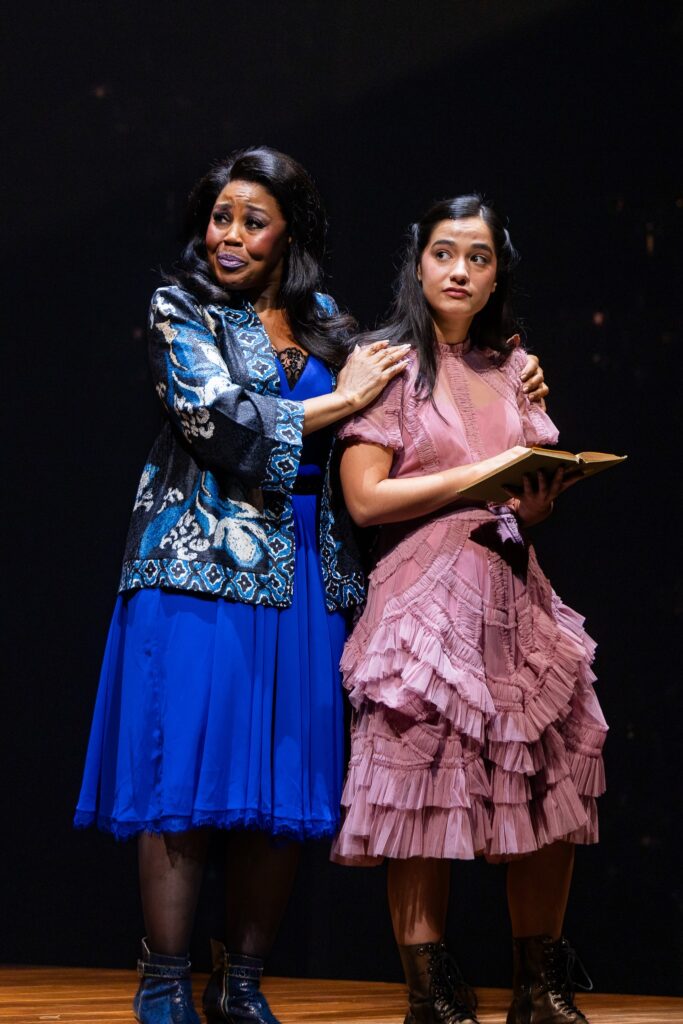
Sharon Catherine Brown and Suárez

Juliet’s father (Terence Archie), unaware that Juliet is already secretly married, arranges a marriage with the eminently eligible Count Paris (Adi Dixit). The young bride seeks out Friar Laurence for assistance in her desperate situation. He gives her a potion that will make her appear to be dead and assures her that if she takes it, he will arrange for Romeo to rescue her. She complies.

Romeo, uninformed of the friar’s scheme because a letter of explanation has failed to reach him, returns to Verona on hearing of Juliet’s apparent death. He encounters a grieving Paris at Juliet’s tomb, and reluctantly kills him when Paris attempts to prevent him from entering. There, he finds Juliet in the burial vault. Unaware that she is only sleeping, he gives her a last kiss and kills himself with poison. Juliet awakens, sees the dead Romeo, and kills herself. The families learn what has happened and end their feud.

At Wednesday’s preview performance, magic and pathos were on stage from the opening scene that revealed Amy Rubin’s simple, thick butcher block set bathed in spot-on, evocative lighting (Jen Schriever). Actors push the heavy door open, symbolically revealing the opportunity for closed doors to open. Later, the flexible set will metamorphosize into Juliet’s balcony, a tomb and a party. All of that possibility is communicated in the first few moments.

Background rumbling and emergent music (created by sound designer Daniel Lundberg and the composer of the play’s original music, Alexandre Dai Castaingset the tone for the opening fight scene, a West Side Story-esque stand-off between two teenage gangs. These are the Capulet and Montague clans, and the fury that boils in their blood is masterfully choreographed by fight consultant Thomas Schall and director/choreographer Sidi Larbi Cherkaoui. When the scene freezes into a bellicose tableau, the depth underlying this hostility is fixed on each light-bathed face. (Note: West Side Story is a modern adaptation of Romeo and Juliet that shares many themes and tells a similar story but is set in the 1950s in New York City’s Upper West Side).

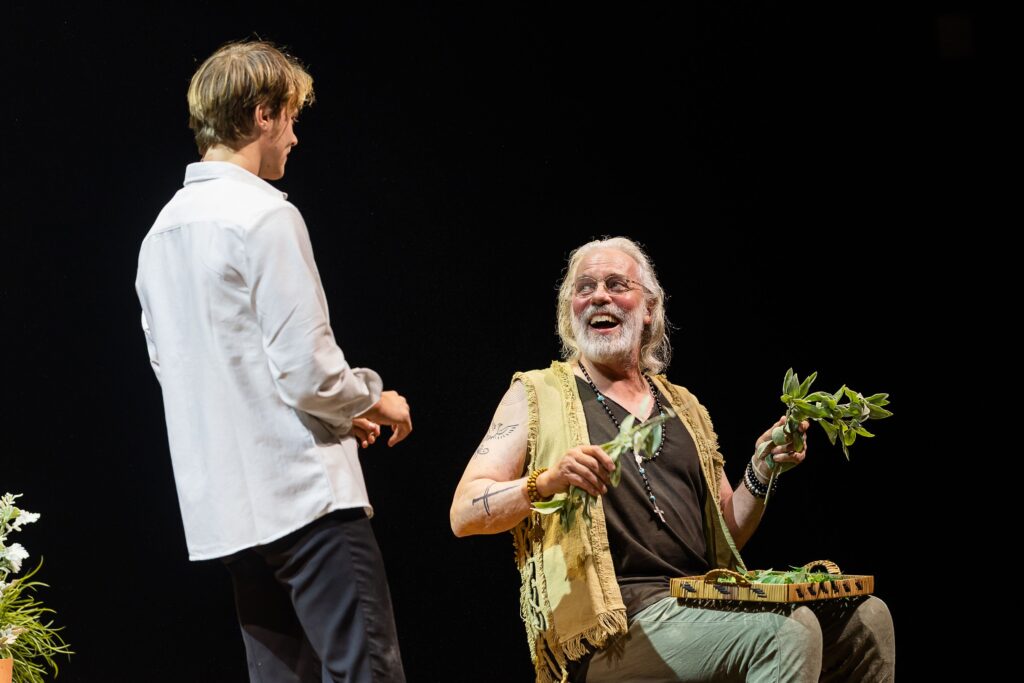
Pankow, Terrance Mann

The impacts of visual imagery, light and sound throughout the two and one half hour (one intermission) production never wane. Rubin’s set frequently pivots to frame two or three scenes, providing simultaneous glimpses of different versions of the same event. Early on, as Romeo and Juliet prepare for the party her parents are throwing, Romeo and his buddies cavort stage left while Juliet preens stage right. The effect is as charming as it is enthralling.

Other special production moments are the use of globe lights (brilliant!), a warpath drumbeat soundtrack (by Dai Castaing), and the opening scene after intermission, when Juliet, wrapped in a white sheet, is lit like a fairy and the soft plunk of a harp highlight her delicate dancer’s gestures.

While enough can’t be written in praise of its production value, the real stars of Romeo and Juliet are the actors and the Bard’s sumptuous language. Cast standouts include Suárez as a stunningly lithesome Juliet, Nicole Villamil as Lady Capulet, Juliet’s mother, and the truly awesome Mann as Friar Laurence.

These three (and several other) actors seem to savor the play’s rich lines, lingering over some and articulating with a deliberateness that allows the audience to savor along with them. Unfortunately, some (most notably Singer as Mercutio) race through their lines, swallowing some of the glorious puns and humor that balance the play’s tragic overtones. A suggestion to A.R.T. is to consider following Shakespeare on the Common’s lead and provide projected captions. Absent that, audiences might want to read the play (it’s a short-ish one!) before or shortly after seeing this production. The added appreciation value is well worth the time spent.

Pankow, Suárez

Paulus ends the play on a note of hope despite the carnage that the Verona families’ feud has wrought. As Romeo, Juliet, Thibault, and Mercutio are eulogized and buried, the full cast is on stage. Bright white light bathes the scene as the entire community comes together to bury their dead and plant a garden. Despite the gloomy peace that reigns, the Prince of Verona reminds its citizens, “All are punished. For never was a story of more woe than this of Juliet and Romeo.”

As Capulets and Montagues sow flowers and trees, we imagine Adam and Eve in the Garden of Eden and the innocence and hope of starting fresh and turning the page. In the current climate of political and environmental angst, who can’t benefit from a message that hints at the possibility of restoration, revitalization, and rebirth?

Romeo and Juliet’ – By William Shakespeare. Directed by Diane Paulus. Movement and Choreography by Sidi Larbi Cherkaoui; Original Music Composed by Alexandre Dai Castaing; Scenic Design by Amy Rubin; Costume Design by Emilio Sosa; Lighting Design by Jen Schriever; Sound Design by Daniel Lundberg. Presented by American Repertory Theater at the Loeb Drama Center, 64 Brattle St., Cambridge through October 6.

For more information and to buy tickets, go to https://americanrepertorytheater.org/