A Theatrical Alchemy, A.R.T.’s ‘Diary of a Tap Dancer’ Is More Than the Sum of Its Parts

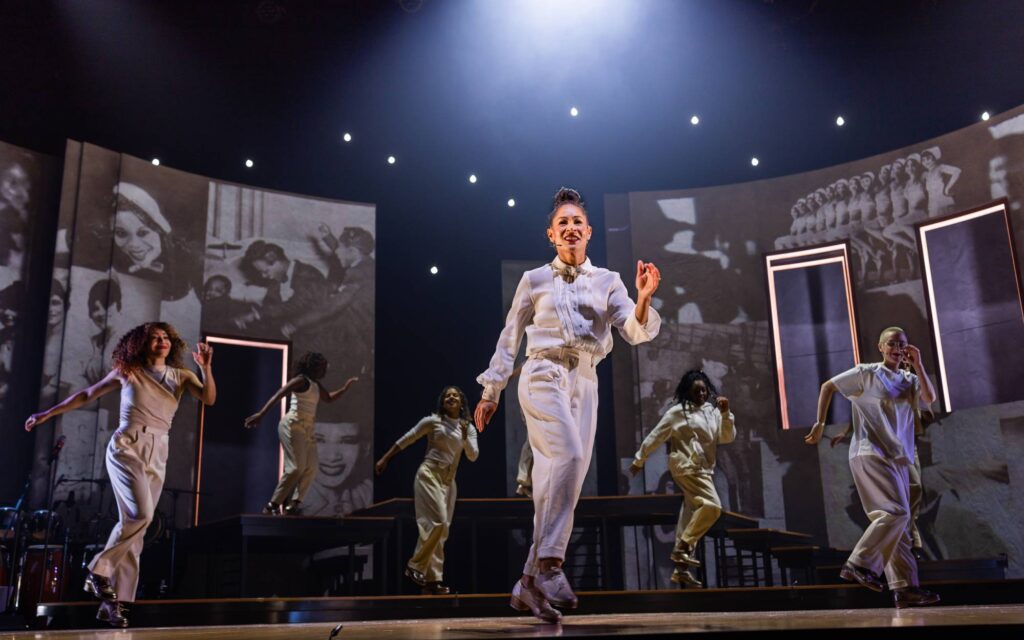
Ayodele Casel (center) and the cast of A.R.T.s ‘Diary of a Tap Dancer.’
Photos: Nile Scott Studios and Maggie Hall
 

By Shelley A. Sackett

Ayodele Casel’s ‘Diary of a Tap Dancer’ defies pigeonholing. First, it is a crackerjack tap dance concert, choreographed and performed by a jubilant devotée of the genre whose sensitivity to its rhythmic musicality keeps the action moving and the audience’s toes tapping along.

Second, it is a narrative documentary that “shines a light on women hoofers,” especially the unknown and forgotten black tap dancers of the 1920s through the ‘50s who blazed a trail for others, like Casel, to follow. Projection Designer Katherine Freer has curated a six-screen still and moving visual accompaniment that introduces us to all the dancers who might have been written out of history — women like Juanita Pitts, Jeni Le Gon, Cora LaRedd, Louise Madison and Marion Coles —  but for her efforts to draw attention to them.

“I have an intense need, desire and responsibility to speak their names,” Casel, the self-proclaimed sepia Cinderella of tap, shares. “They were entrepreneurs, choreographers and dancers. Our time on earth matters. Don’t wait for an invitation to tell your story.”

Additionally, Casel’s ‘Diary of a Tap Dancer’ is just that- an oral diary that tells, in upbeat, humorous and, at times, painfully repetitive detail, the story of her life.

Born in the Bronx to a Puerto Rican mother and African American father (whom she didn’t meet until she was 17 years old), she was sent as a child to live with her Puerto Rican grandparents, where she honed her scrappy spirit by getting into fist fights with boys. When she returned to the Bronx, she and her mother watched old movies and read movie magazines, falling for the glamor and magic of Ginger Rogers and Fred Astaire. She discovered the world of tap during a high school class in movie history. Later, as an NYU theater major, she took her first tap class, showing up with shoes from “Payless” that were as close to Rogers’ as she could find.

“Tap is magic,” Casel says. “It changed my life.”

Her single-minded persistence landed her a spot as the first woman in Savion Glover’s (of mid-90s off-Broadway hit, “Bring in ‘da Noise, Bring in ‘da Funk,” fame) dance company, a real turning point in her career. Tap legend Gregory Hines has referred to her as “one of the top young tap dancers in the world.”

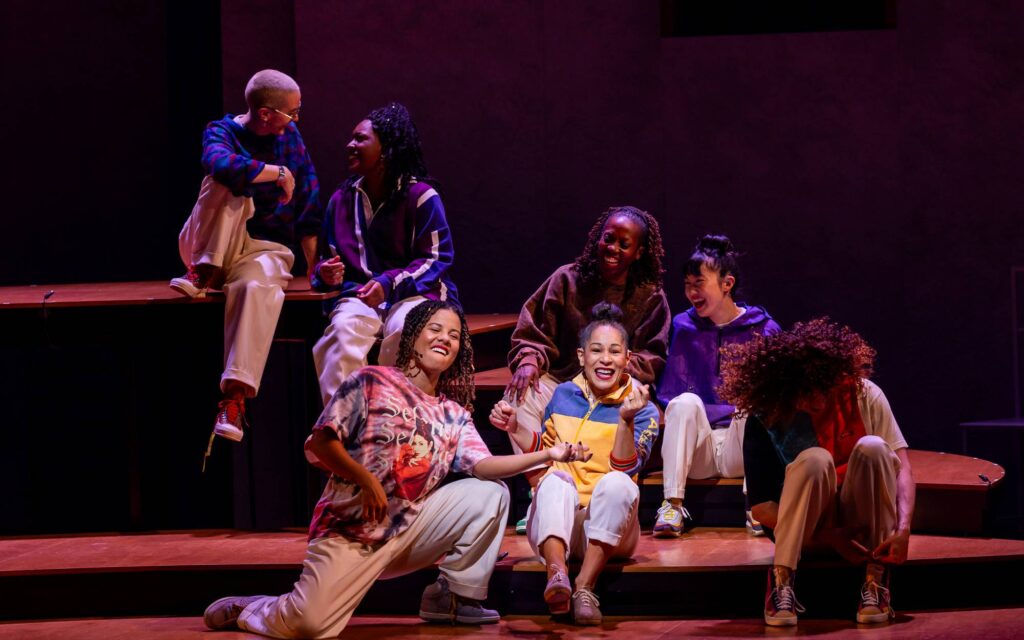
When it comes to paving the way for other marginalized dancers, Casel doesn’t just talk the talk; she also walks the walk (taps the tap?) by sharing the stage and spotlight with seven female and nonbinary young dancers who both complement each other as an ensemble and shine as soloists. But the spritely, charismatic, and extraordinarily talented Casel can’t help but steal every scene with the simplest flap-ball-change. Who knew tap could be so orchestral and communicative?

Under Torya Beard’s (Casel’s longtime collaborator and wife) direction, the atmosphere is set even before the show starts with an almost holy ambient organ major harmonic dyad punctuated by muted city traffic, sirens, and birds. A simple blue set sports what looks like graffiti but is actually a photograph of 18th-century legislation forbidding slaves from owning drums.

A slow spotlight reveals white-clad dancers using every inch of Tatiana Kahvegian’s sparse but effective stage. Dancers are scattered in little solo spaces reminiscent of the staging of “The Lion King.” When the soundtrack kicks in and they all start tapping, it’s like a magical sound bath of rhythm and movement.

Backed by a terrific trio of on-stage musicians (Carlos Cippelletti on piano, Raul Reyes Bueno on bass and Keisel Jiménez Leyva on drums), the musical dance numbers are a pure delight. Casel tells her intimate and powerful story through straight narration, rap, beat and counter-beat. Her acting chops show in the comfort with which she addresses the audience. It’s no surprise to learn that “Ayodele” is Yoruban for “joy.” Casel is not just a top-notch dancer and choreographer; she is genuinely warm, funny, smart, guileless, and humble. She is also an articulate, eloquent, and bold guide who unlocks the enchantment and triumph of the human spirit that is the essence of tap.
The problem (at least at last Sunday’s world premiere production, which ran 30 minutes beyond the show’s already overly generous 2 hours with one intermission) is that Casel has a lot to say about a lot of topics about which she is understandably passionate. “This show is narrative justice,” she explains.

But by trying to tackle such big-ticket items as racism, sexism, African American history, misogyny, and historical exclusion, instead of leaving her audience feeling enlightened and informed, she leaves them wishing for more dance and less talk. A LOT less talk.

While Casel is an excellent and engaging narrator, it is the magic language of her syncopated footwork and vocal scat work that offer a more compelling and emotionally accessible (and less preachy) tribute to the art form of tap and the black foremothers she seeks to honor. A little editing could go a long way.

‘Diary of a Tap Dancer’ – Written and Choreographed by Ayodele Casel. Directed by Torya Beard. Musical Direction by Nick Wilders; Scenic Design by Tatiana Kahvegian; Costume Design by Camilla Dely; Lighting Design by Brandon Stirling Baker; Sound Design by Sharath Patel; Projection Design by Katherine Freer; Compositions, Orchestrations, and Arrangements by Carlos Cippelletti, Ethan D. Packchar. Presented by American Repertory Theater at the Loeb Drama Center, 64 Brattle St., Cambridge, through January 4, 2025.

For tickets and information, go to: https://americanrepertorytheater.org/shows-events/diary-of-a-tap-dancer/
A.R.T.’s “Gatsby” Is This Summer’s Blockbuster

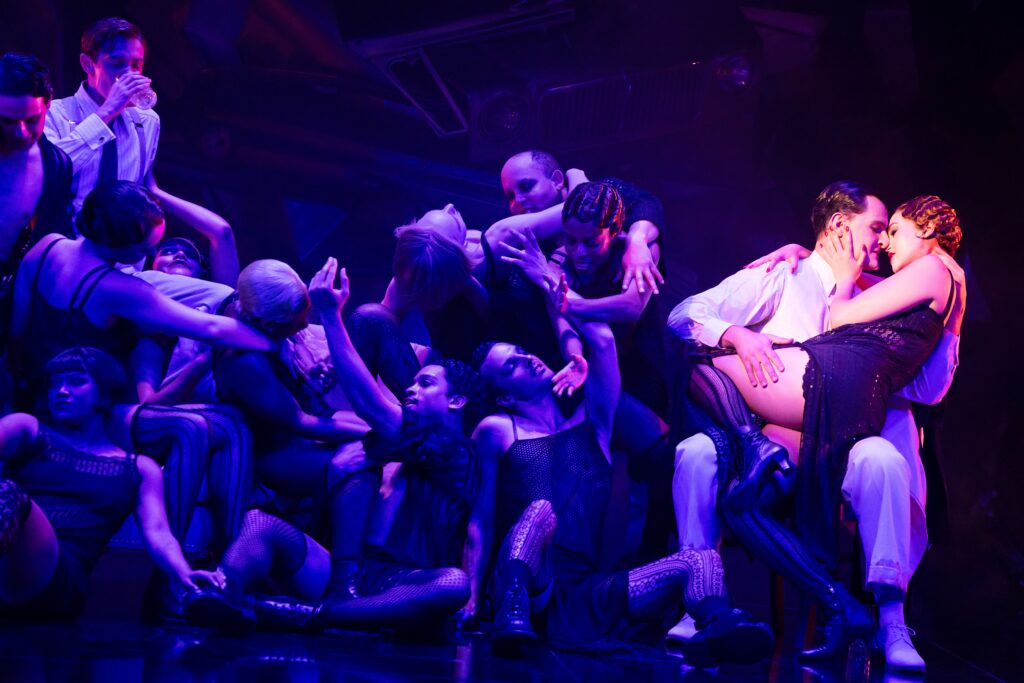
Cory Jeacoma, Solea Pfeiffer, and the cast of A.R.T.’s ‘Gatsby.’
Photo Credits: Julieta Cervantes

“Gatsby.” Book by Martyna Majok based on the novel, “The Great Gatsby” by F. Scott Fitzgerald. Directed by Rachel Chavkin. Music by Florence Welch and Thomas Bartlett. Lyrics by Florence Welch. Choreography by Sonya Tayeh. Orchestration and Arrangements by Thomas Barlett. Scenic Design by Mimi Lien. Lighting Design by Alan C. Edwards. Presented by American Repertory Theater at the Loeb Drama Center, 64 Brattle St., Cambridge, through August 3.

By Shelley A. Sackett

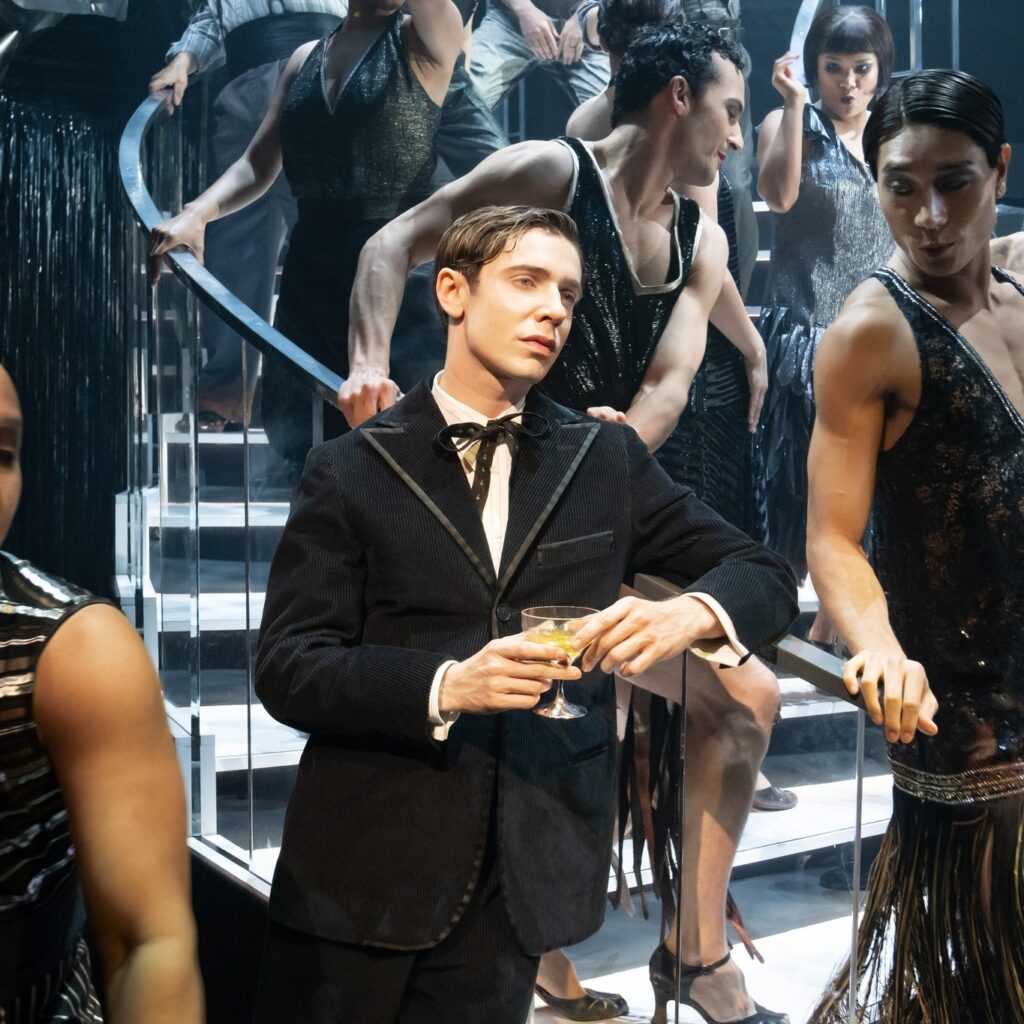
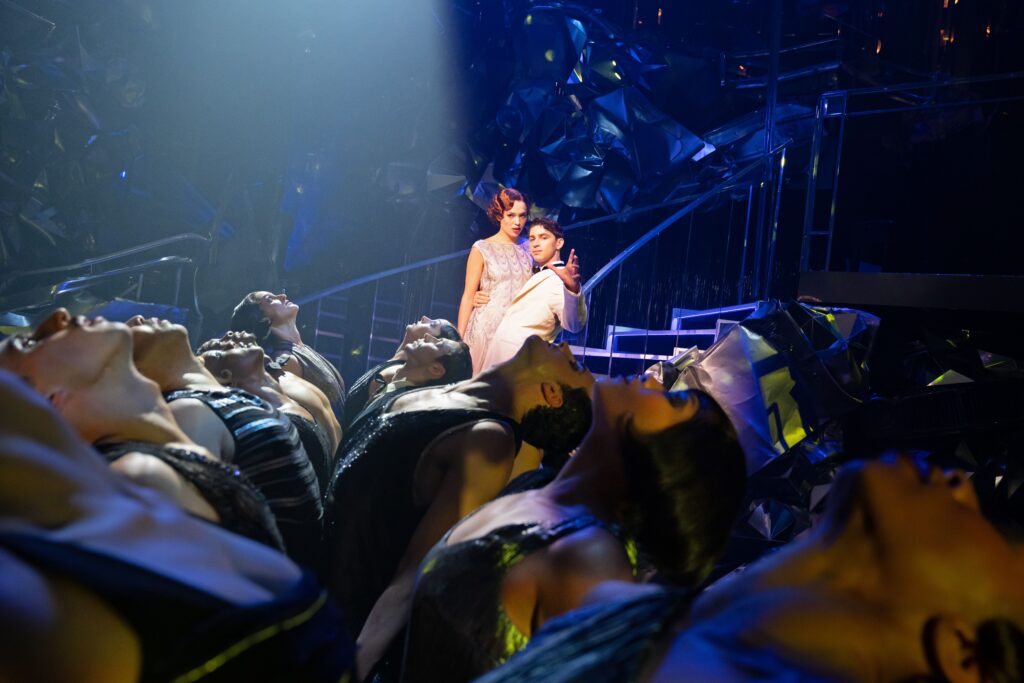
“Gatsby” is a tour-de-force chockful of bells and whistles. A.R.T. spares nothing for its world premiere of the musical adaptation of Fitzgerald’s Jazz Age chronicle. Two colossal heaps of metallic sculpture reminiscent of the infernal “Hadestown” underworld are a Jenga/“Where’s Waldo” of identifiable automobile parts and crumpled rubble (set by Mimi Lien). Draped in gleaming tinsel and expertly lighted by Alan C. Edwards, these gloomy twin towers are a continual reminder of the dangers of decadence and the debris it leaves in its wake.

Like “Moby Dick” and other inventive re-tellings of familiar tales, it’s clear from the get-go that A.R.T. will once again raise the bar on production values.

In preparation for seeing “Gatsby,” I reread the novel both to refresh my 9th-grade memory and to better understand where (and guess why) Martyna Majok had chosen to be faithful to and stray from the original in her adaptation. While hardly necessary – the storyline is short on subtlety – it was fun when I recognized a line that had struck us both as particularly poignant.

At its heart, however, this “Gatsby” is a musical, and the tale is told through its 25 musical numbers. (Unfortunately, the 13-piece orchestra often drowns out those lyrics, leaving the frustrated audience to fill in the blanks). In the exciting first number, “Welcome to the New World,” we meet our narrator, Nick Carraway (Ben Levi Ross), who fills us in on time, place, and tenor. It’s 1922, and the influenza plague and World War I, although in the rearview mirror, left emotional, physical, and financial wreckage in its wake. As if awakening from a nightmare, Jazz Age America has emerged, revving its engine and ready to roar.

Ben Levi Ross

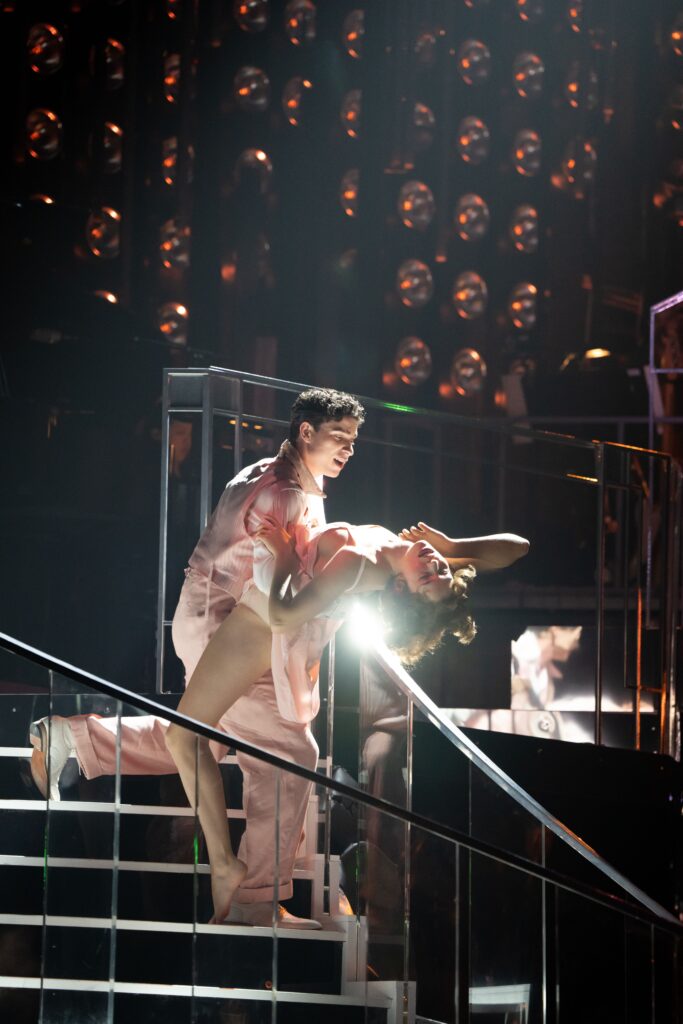
Underscoring the headiness of the era, the 15-member ensemble bursts on the stage clad in flapper period and contemporary non-cis costumes. Costume designer Sandy Powell cleverly introduces us to the main characters by dressing them symbolically. George and Myrtle, the have-not couple, are dressed in hellish red. Daisy, Tom and their friend Jordan, the silver-spoon gentry, wear heavenly white. And Jay Gatsby, our eponymous protagonist, appropriately wears an in-between pink.

As the plot unfolds, so do these characters’ backstories. Each harbors longings, secrets and disappointments that propel them towards disaster while attracting and repulsing them to and from each other. Majok exercises editorial discretion (and keen perception) in adding a richly nuanced focus on these relationships that are lacking in Fitzgerald’s novel.

Nick is just back from the war. While he presents as the affable, “aw shucks” mid-Westerner, his baggage includes heavy loads of PTSD and grief. He has sought the diversion of Long Island high society and the company of his cousin Daisy to reset the trajectory of his life. He rents a cottage for the summer and is immediately invited to join the Fellini-esque world of ultra-rich navel-gazers.

Daisy (Charlotte MacInnes), a former Louisville belle, is married to scion Tom Buchanan (Cory Jeacoma) and lives in a fairytale mansion with her loutish, philandering husband. She and Gatsby had met and fallen in love years ago, right before he was shipped off to war. Her childhood friend and famous golf pro, Jordan Baker (Eleri Ward), provides the stability and affection so sorely lacking in her marriage. She is also the play’s flapper Pied Piper, flamboyantly hedonistic and desperate for everyone to follow her reckless lead.

Isaac Powell, Charlotte MacInnes

Tom is as spoiled and obnoxious as they come. He wears his entitlement as a badge of honor, helping himself to whatever suits his fleeting fancy, including Myrtle Wilson (Solea Pfeiffer), the blue-collar wife of a gas station owner who yearns for the sparkling trinkets Tom dangles before her. Her voracious appetite for excess and risk are sated in the short run, but the long-term damage is one of the play’s underlying themes.

George Wilson (Matthew Amira), Myrtle’s husband, is outnumbered and outmaneuvered. Honest, hard-working, decent, and loyal, he doesn’t stand a chance.

This brings us to Jay Gatsby (Isaac Powell), the mysterious epicenter of the action who throws parties reminiscent of the Rocky Horror Picture Show. Personifying a corrupted version of the “American Dream” where wealth is the sole solution to all of life’s challenges, his obsession with Daisy and maniacally detailed plan to win her back are the ill-fated coattails onto which every other character’s fate hangs.

To her great credit, playwright Majok has managed to both plumb the intricacies of these individuals and their various romantic liaisons and dalliances and create a rip-roaringly entertaining almost-three-hour evening of outstanding song and dance.

Under Rachel Chavkin’s talented direction, the cast hits that sweet spot between virtuoso solo and ensemble performances. There are ample opportunities for each to shine in words, song, and dance. MacInnis brings a needed self-awareness to Daisy, who could easily become a cardboard character. She is as disconsolate a victim in “I’ve Changed My Mind” as she is scheming perpetrator in the duet with Tom in “The Damage That You Do.” Both feature her amazing voice.

As Jordan, Ward adds a sophisticated cynicism and “been there, done that” breeziness to the unbridled frenzy that surrounds the other characters. Willowy and lithe, she is a pleasure to watch as she glides around the cabaret party settings.

Jeacoma (Tom), Powell (Gatsby), and Amira (Wilson) stay in character in less shaded roles. Ross brings a slightly tinted palette to Nick, making him more mysterious and less pathetic than he at times seemed in the novel.

It is Pfeiffer as Myrtle and Adam Grupper as Meyer Wolfsheim, Gatsby’s mentor and syndicate boss, who really stand out. In addition to her outstanding voice, Pfeiffer easily transitions between the grief, rage, and despair she feels in her trapped marriage to a gas jockey and the giddiness of being wildly out of control in the sybaritic world to which Tom gives her the key. I only wish the orchestra didn’t drown out half of her songs.

MacInnes, Powell

Grupper, a Sydney Greenstreet of a presence, could not be drowned out by a 20-piece brass band (thank goodness). “Feels Like Hell,” his solo, brings down the house.

Lien’s flexible set is a presence of its own. Spanning the entire proscenium, the wide staircase, balcony, and stage allow three small scenes to play simultaneously, adding interest and challenge. And last but hardly least, Welch’s music and lyrics turn Fitzgerald’s 200-page novel into an operatic dramatic feast. While there are no tunes that stick in your head after the curtain falls, the actors’ universally extraordinary voices and Welch’s spot-on lyrics (when we can hear them) are the backbone of this summer extravaganza.

For more information and to buy tickets, visit: https://americanrepertorytheater.org/

A.R.T’s ‘Wife of Willesden’ is a Pleasure with a Capital P

Clare Perkins in ‘The Wife of Willesden’ at the A.R.T. Photo Credits: Marc Brenner

by Shelley A. Sackett

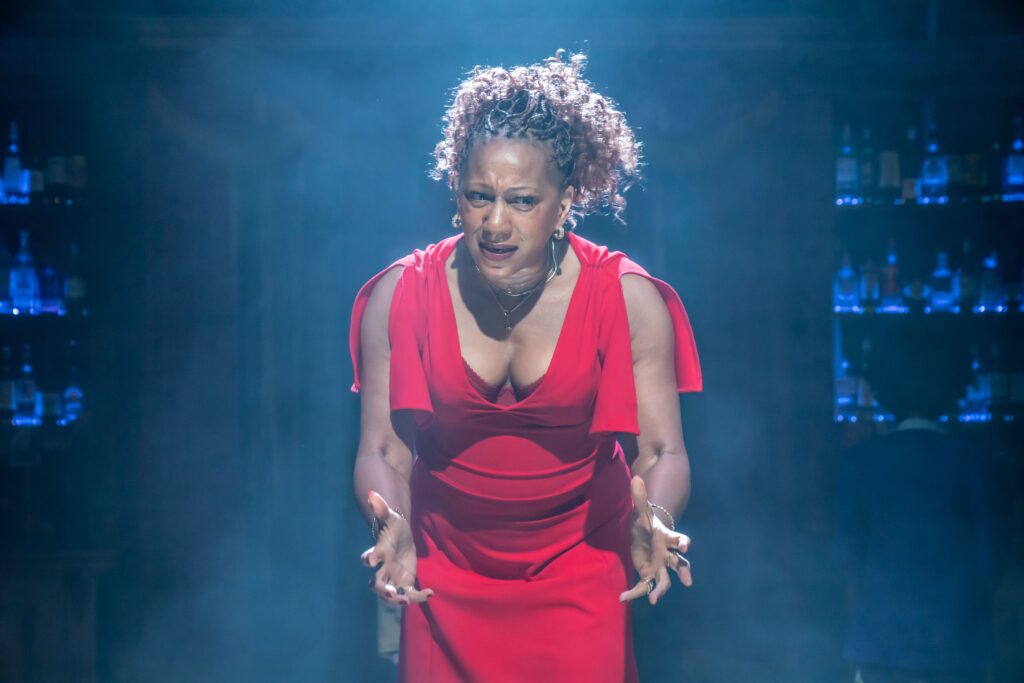
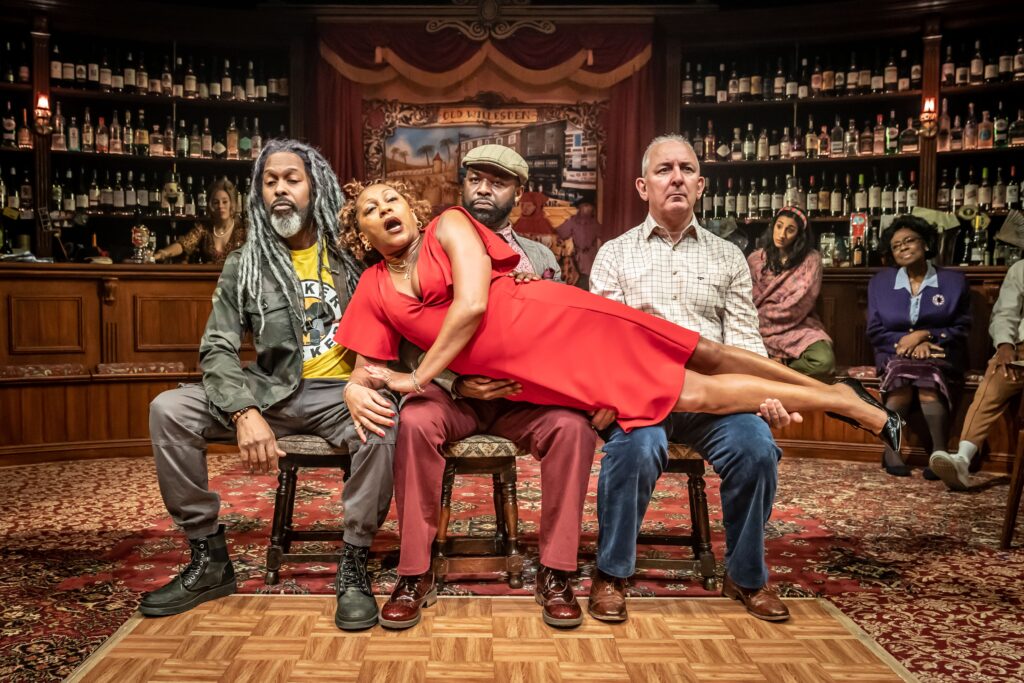
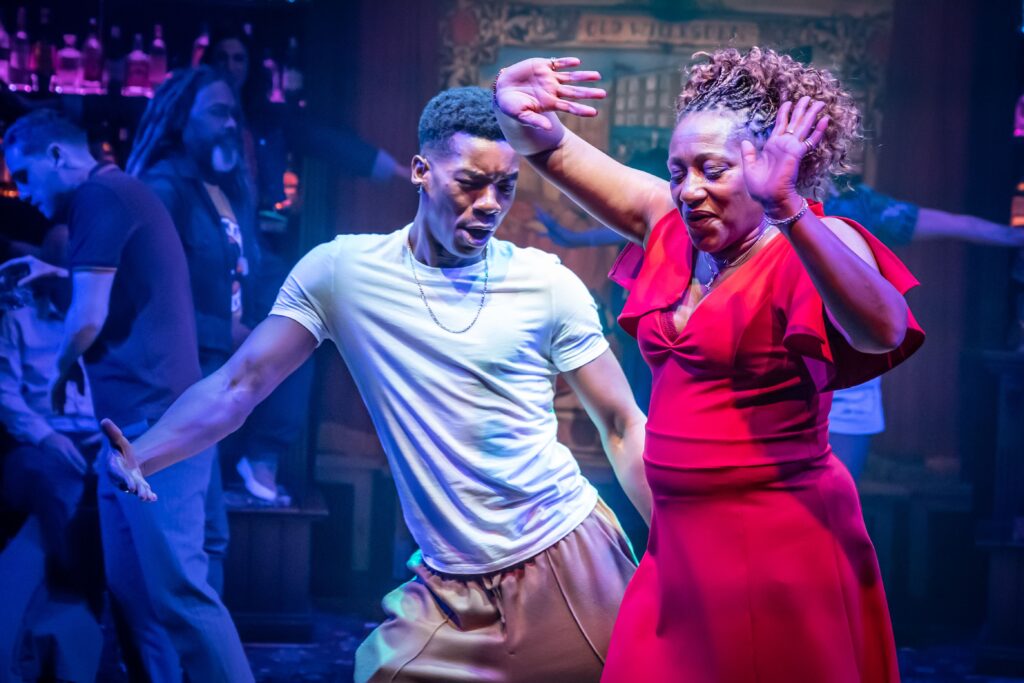
Whether by design or chance, the slightly tardy start to “The Wife of Willesden” gifted the audience with a few bonus minutes to soak in the vibe of Robert Jones’s magnificent set while seat dancing to disco party tunes. The stage, meant to represent a pub in Willesden (a multi-racial part of North London’s Brent) feels more like a holy shrine to drink and camaraderie. Six triple-case bays are filled floor to ceiling with glimmering bottles. A disco ball sparkles from above. A barmaid cuts fruit while local revelers mill about. Members of the audience sit at small tables on the stage, further breaking down the fourth wall. The effect is, well, intoxicating.

And then boom! The play starts.

Enter Author (Jessica Murrain), an undisguised stand-in for playwright Zadie Smith, who profusely apologizes for the play we are about to see and introduces us to the pub’s lively, diverse clientele. “If there is a person in Brent who doesn’t think their life should be turned into a 400-page story, I’d like to meet them,” she declares.

Based on Chaucer’s 1392 “The Canterbury Tales,” Smith’s raucous modernized reworking has the pub’s motley group of locals gathered for a story-telling competition with the prize of a full English breakfast to the winner. The first few stories are told by pompous men, who drone on about themselves with misplaced over-confidence. Lurking in the background is Alvita, the Wife of Willesden. Finally, fed up with the men’s yawning yarns and itching for center stage, she grabs the imaginary mic and never puts it down.

Marcus Adolphy, Perkins, George Eggay, and Andrew Frame

As Alvita, Clare Perkins is a category 6 hurricane. Poured into a scarlet body-hugging dress and shod in weapon-grade stilettos heels, she bursts into the spotlight and commands it for the rest of the evening. Brash and boozy, fierce and wise, Alvita has a story to tell, a folktale about an 18th-century Jamaican soldier and a life-changing lesson he learned. But first, she needs to introduce herself and provide a little context. By way of prologue to her actual tale, she recounts her romantic history of five marriages with full Monty unapologetic focus on sex, pleasure, and her rapacious libido.

“The shock never ends when women say things usually said by men whether today or 600 years ago,” she says with a wink. Alvita is a consummate narrator. She imitates, animates, and intimidates, bringing her history to life with the help of her husbands, who happen to be at the pub. They are her willing props as she details their virtues and vices, defending her right to marry as many times as she pleases. She is utterly devoid of regrets and chafes at anyone who dares to judge her. Her philosophy of life defies conventions and rules, be they religious, political, or matrimonial. “What you call laws, I call advice,” she tells her strict, churchgoing aunt. “I think God likes variety.”

Most of all, Alvita is an unashamed pleasure seeker. She wears her libido on her sleeve like a badge of honor. “I demand pleasure,” she half growls, half purrs. “I’m all about what feels good.” Eventually, (and just in the nick of time, as the prologue begins to feel more like a reprise), Alvita launches into the meat of her story — the Jamaican folktale. A young 18th-century soldier is sentenced to die for raping a woman. In the spirit of restorative justice, the benevolent Queen Nanny agrees to spare his life under one condition. He has a year and a day to comb the earth and discover the answer to the same question Alvita poses rhetorically throughout the play: What do women want?

The folktale’s answer echoes Alvita’s feminist refrain— women want to be free of fear, to be happy, to follow their own path of their own making, and, most importantly, to be deliciously, eternally, and completely satisfied sexually. She looks at the men around her and the power they claim as rightfully theirs and basically says, “I’ll have what they’re having.”

Perkins’s performance cannot be overpraised. She doesn’t steal the show; she IS the show. Her charismatic Alvita may present as part stand-up comic, part Tina Turner, but beneath that flashy exterior beats a tender heart with a sage message. Perkins effortlessly melds Alvita’s contradictory traits into a single nuanced and likable character.

Kiln Theatre Artistic Director Indhu Rubasingham brings a playfulness to the 95-minute (no intermission) production, changing mood, time, and place with, for example, a simple gold tray behind the head to represent an apostle or bar rags to represent togas. The superb ensemble cast doesn’t seem to be acting when frolicking on stage; they are thoroughly enjoying themselves.

Claudia Grant, Ellen Thomas, Scott Miller, and Frame

Finally, there is Smith’s ambitious and smart play. Although the cast’s uneven Jamaican, Nigerian, and North London accents and rapid-fire delivery made some of the lines impossible to decipher, Smith’s rhyming couplets in today’s vernacular evoked Chaucer’s Middle English in rhythm and meaning. That is no small feat. I wouldn’t be surprised if there is an uptick in interest in the original as a result. Or in Smith’s award-winning novels.

Though not without flaws, “The Wife of Willesden” is clever, fast-paced, and beautifully produced with a timely message and, above all else, the magnificent Clare Perkins in a role she was born to play. Although studying Chaucer is hardly a prerequisite, a cursory google search would enhance appreciation for Smith’s remarkable talent while scattering a few breadcrumbs to make following its path easier. For tickets and information, go to: https://americanrepertorytheater.org/

The Wife of Willesden’ – Adapted by Zadie Smith from Chaucer’s ‘The Wife of Bath’ from The Canterbury Tales; Directed by Kiln Theatre Artistic Director Indhu Rubasingham; Design by Robert Jones, Lighting Design by Guy Hoare; Composition and Sound Design by Drama Desk Ben and Max Ringham. The Wife of Willesden is a Kiln Theatre Production and is presented in association with BAM (Brooklyn Academy of Music) at the Loeb Drama Center, 64 Brattle St., Cambridge, MA through March 17