‘Art’ Becomes More Than What Meets The Eye in Lyric Stage’s Splendid Production

Theater Mirror

John Kuntz and Michael Kaye in Lyric Stage’s ‘Art’. Photo Credit: Mark S. Howard

By Shelley A. Sackett

The French playwright, actress, novelist, and screenwriter Yasmina Reza has a special talent for creating dialogue and characters that simultaneously focus inward on the complexities of interpersonal relationships and outward on the demands and mores of contemporary middle-class society. ‘Art,’ now enjoying a magnificent run at Lyric Stage Company, premiered in Paris in 1994 and took both London’s West End and New York’s Broadway by storm. It won Olivier, Tony, Molière, and every other major theatre award and has been packing in audiences worldwide in 30 languages ever since.

The plot is deceptively simple. Serge (Michael Kaye), Marc (John Kuntz) and Yvan (Remo Airaldi) have been friends for 15 years. Serge is a successful dermatologist. Marc is an aeronautical engineer and Yvan has spent his life “in textiles.” Unlike his friends, his professional life has been a failure and he has a new job as a sales agent for a wholesale stationery business. He’s engaged to marry his boss’s daughter in a couple of weeks.
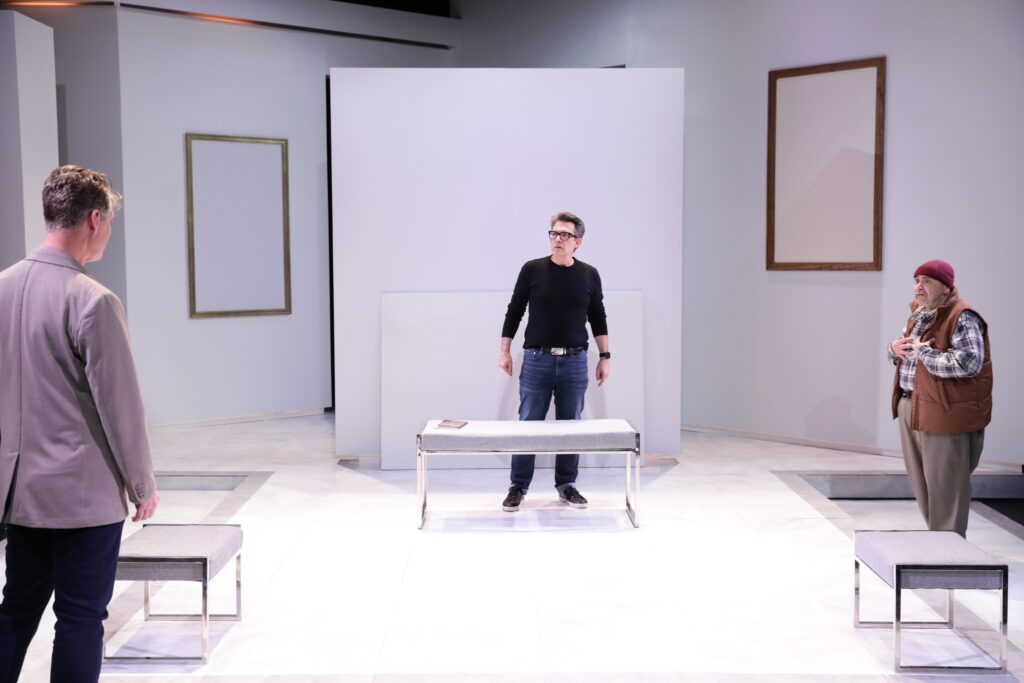
Kaye, Kuntz and Airaldi

When Serge spends an extortionate amount of money on a modernist painting by Atrios that is all white with three white stripes, his close friends are not just baffled but deeply rattled. Like an earthquake, Serge’s purchase shakes the bedrock of their friendship and sends aftershocks and tsunamis in its wake.

Marc is appalled to hear that Serge had paid two hundred thousand francs for “a piece of white shit.” Serge argues that the painting, created by a reputable artist (“he has three paintings in the Pompidou”) is worth its hefty price, but Marc remains unconvinced. The two draw verbal swords, and the temperature in the room rapidly rises as the thrusts and parries turn nasty and personal.

Both break the fourth wall, addressing the audience with what they really think. Serge mocks Marc, one of the “new style of intellectuals” who are enemies of modernism yet know nothing about it. Marc is upset on a deeper, more individual level. His friend has done something he cannot understand or relate to. He is hurt and untethered. “It’s a complete mystery to me, Serge buying this painting. It’s unsettled me, it’s filled me with some indefinable unease,” he admits. Worst of all, Serge seems to have lost his sense of humor. Marc can’t bear the thought of not sharing a laugh with Serge, even though it is over an act Serge himself committed.

Overwhelmed by the perceived seriousness of the situation, both Serge and Marc confide in Yvan about their disagreement. Yvan, who is dealing with his own conflict over his forthcoming wedding, tries to remain a neutral peacemaker, giving each just enough of what they want to hear while avoiding firmly taking sides. To Serge, Yvan is noncommittal, only admitting that he does not grasp the essence of the painting. To Marc, Yvan laughs off the price tag, but suggests that the work is not quite meaningless “if it makes Serge happy.”
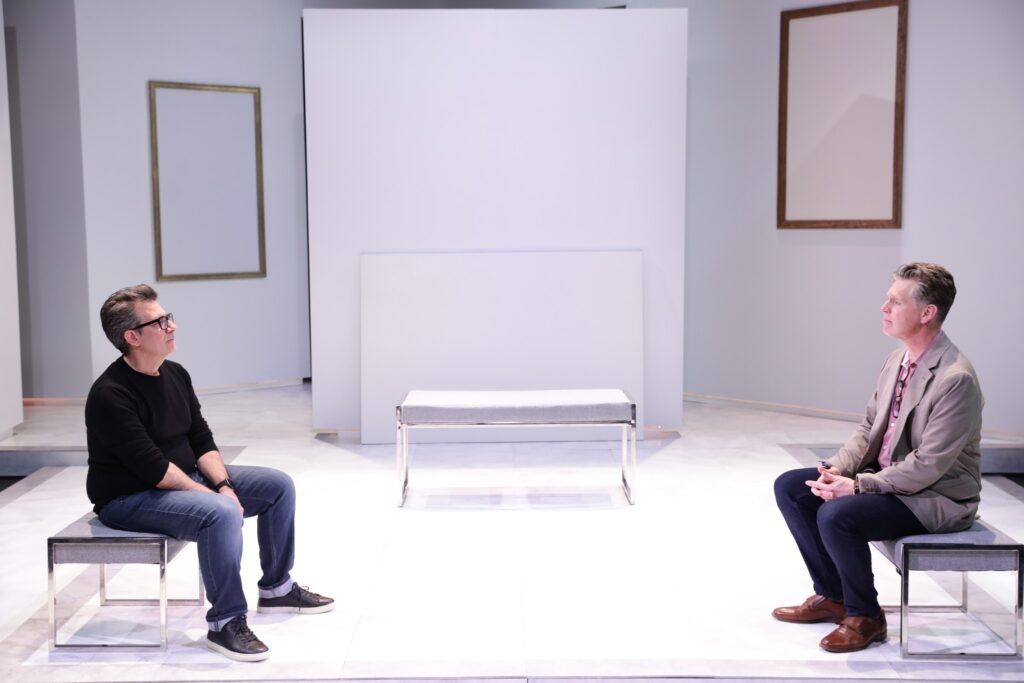
Kuntz and Kaye

Serge’s shuttle diplomacy is a failure. Instead, each digs in his heels deeper, and the clash escalates to all-out war. Objective art appreciation shifts to subjective, petty, tactless attacks. At the heart of the matter is the fact that these two really care about each other and this schism wounds them both. “What I blame him for is his tone of voice, his complacency, his tactlessness. I blame him for his insensitivity. I don’t blame him for not being interested in modern art, I couldn’t give a toss about that…,” Serge says. In an aside to the audience, Marc admits that, bottom line, his feelings are hurt. “What kind of friend are you if you don’t think your friends are special?” he laments.

Yvan’s vacillations are gas on the flames of his friends’ conflict. When neither Serge nor Marc succeeds in their goal of manipulating Yvan to their side, they turn on Yvan after he is late for dinner. Not even a Moth StorySLAM-worthy monologue of an excuse (Airaldi deserved a standing ovation) can dissuade Serge and Marc from attacking Yvan for being, well, Yvan.

That a male friendship could become unglued over a provocative painting rather than a love or property rivalry underscores the way Reza deftly peels this delicate onion to reveal the kind of profoundly felt emotions more usually explored among female relationships. These three ask deep and heady questions, revealing their innermost private selves in their answers. They are brutally honest, especially when they know the truth will sting. Yet, when all has been said and done, the underlying bond they share withstands even this most violent rupture.

Kaye and Remo Airaldi

Airaldi imbues Yvan with the kind of heart, humor and self-acceptance reminiscent of Jonathan Winters at his best. Kaye’s Serge is nuanced; he’s snooty and disdainful one minute yet insecure and lonely the next. As Marc, Kuntz has the difficult job of hiding his fears and vulnerabilities beneath a frosty veneer of supercilious superiority and furious frankness. All three actors give flawless performances, the kind that make 90 intermission-less minutes fly by.

Shelley Barish’s sleek, contemporary set mirrors the painting’s self-conscious minimalism. Chrome and steel benches adorn a simple platform of white tiles bordered in pale gray. The tone is both monastically sterile and peacefully Zen.

Kudos to Courtney O’Connor for her pitch-perfect direction. Recommended.

‘Art’ by Yasmina Reza. Translated by Christopher Hampton. Directed by Courtney O’Connor. Scenic Design by Shelley Barish. Costume Design by Chelsea Kerl, Lighting Design by Elmer Martinez. Sound Design by Adam Howarth. Presented by The Lyric Stage Company of Boston, 140 Clarendon Street, Boston, through March 16.

For more information or to buy tickets, visit https://www.lyricstage.com/
A Theatrical Alchemy, A.R.T.’s ‘Diary of a Tap Dancer’ Is More Than the Sum of Its Parts

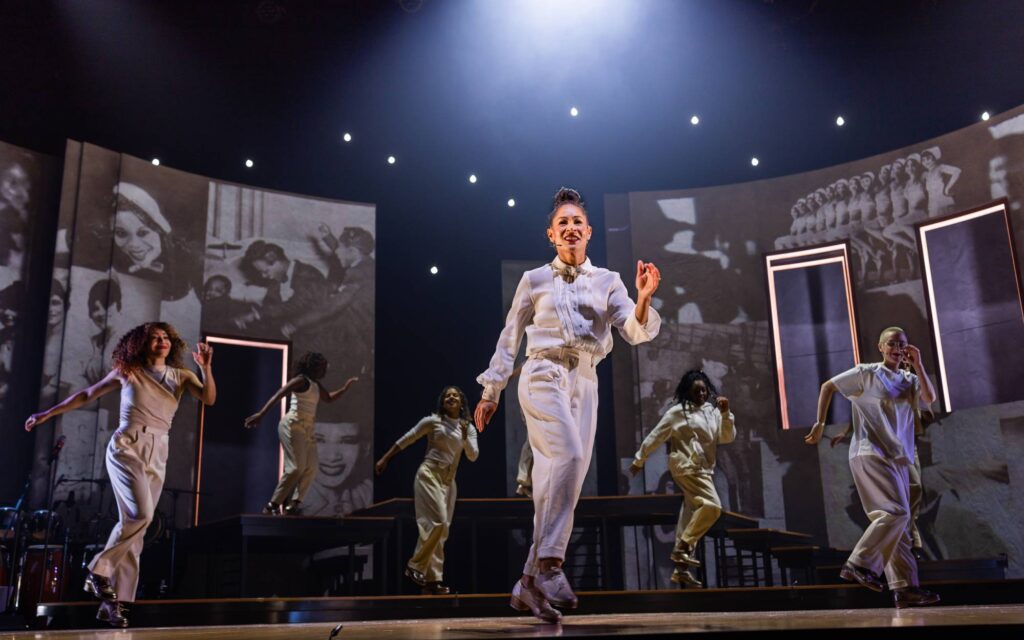
Ayodele Casel (center) and the cast of A.R.T.s ‘Diary of a Tap Dancer.’
Photos: Nile Scott Studios and Maggie Hall
 

By Shelley A. Sackett

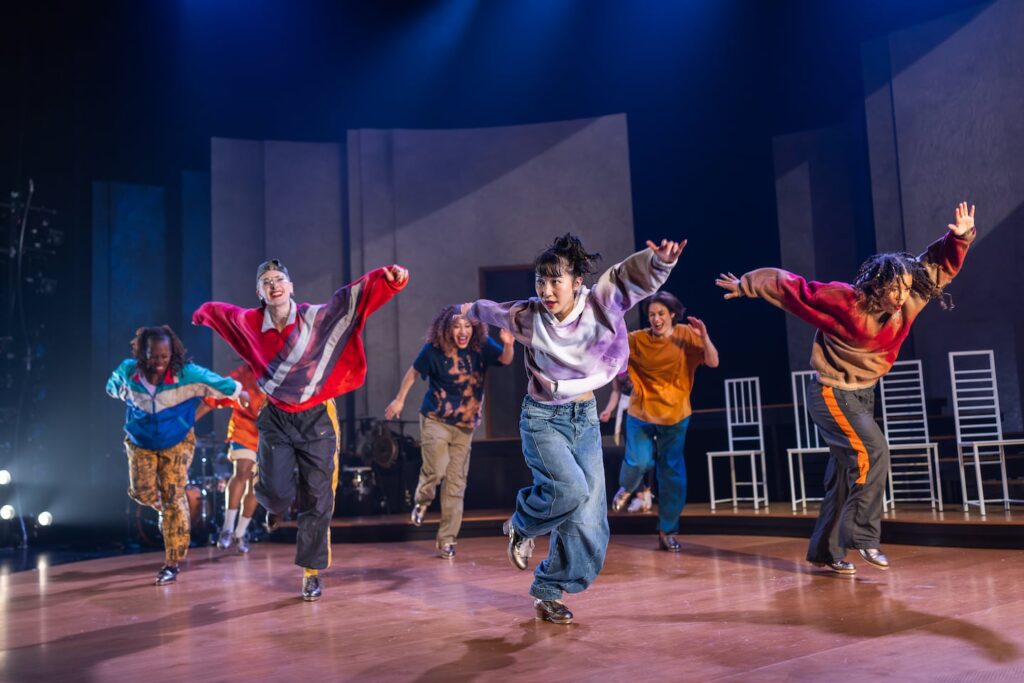
Ayodele Casel’s ‘Diary of a Tap Dancer’ defies pigeonholing. First, it is a crackerjack tap dance concert, choreographed and performed by a jubilant devotée of the genre whose sensitivity to its rhythmic musicality keeps the action moving and the audience’s toes tapping along.

Second, it is a narrative documentary that “shines a light on women hoofers,” especially the unknown and forgotten black tap dancers of the 1920s through the ‘50s who blazed a trail for others, like Casel, to follow. Projection Designer Katherine Freer has curated a six-screen still and moving visual accompaniment that introduces us to all the dancers who might have been written out of history — women like Juanita Pitts, Jeni Le Gon, Cora LaRedd, Louise Madison and Marion Coles —  but for her efforts to draw attention to them.

“I have an intense need, desire and responsibility to speak their names,” Casel, the self-proclaimed sepia Cinderella of tap, shares. “They were entrepreneurs, choreographers and dancers. Our time on earth matters. Don’t wait for an invitation to tell your story.”

Additionally, Casel’s ‘Diary of a Tap Dancer’ is just that- an oral diary that tells, in upbeat, humorous and, at times, painfully repetitive detail, the story of her life.

Born in the Bronx to a Puerto Rican mother and African American father (whom she didn’t meet until she was 17 years old), she was sent as a child to live with her Puerto Rican grandparents, where she honed her scrappy spirit by getting into fist fights with boys. When she returned to the Bronx, she and her mother watched old movies and read movie magazines, falling for the glamor and magic of Ginger Rogers and Fred Astaire. She discovered the world of tap during a high school class in movie history. Later, as an NYU theater major, she took her first tap class, showing up with shoes from “Payless” that were as close to Rogers’ as she could find.

“Tap is magic,” Casel says. “It changed my life.”

Her single-minded persistence landed her a spot as the first woman in Savion Glover’s (of mid-90s off-Broadway hit, “Bring in ‘da Noise, Bring in ‘da Funk,” fame) dance company, a real turning point in her career. Tap legend Gregory Hines has referred to her as “one of the top young tap dancers in the world.”

When it comes to paving the way for other marginalized dancers, Casel doesn’t just talk the talk; she also walks the walk (taps the tap?) by sharing the stage and spotlight with seven female and nonbinary young dancers who both complement each other as an ensemble and shine as soloists. But the spritely, charismatic, and extraordinarily talented Casel can’t help but steal every scene with the simplest flap-ball-change. Who knew tap could be so orchestral and communicative?

Under Torya Beard’s (Casel’s longtime collaborator and wife) direction, the atmosphere is set even before the show starts with an almost holy ambient organ major harmonic dyad punctuated by muted city traffic, sirens, and birds. A simple blue set sports what looks like graffiti but is actually a photograph of 18th-century legislation forbidding slaves from owning drums.

A slow spotlight reveals white-clad dancers using every inch of Tatiana Kahvegian’s sparse but effective stage. Dancers are scattered in little solo spaces reminiscent of the staging of “The Lion King.” When the soundtrack kicks in and they all start tapping, it’s like a magical sound bath of rhythm and movement.

Backed by a terrific trio of on-stage musicians (Carlos Cippelletti on piano, Raul Reyes Bueno on bass and Keisel Jiménez Leyva on drums), the musical dance numbers are a pure delight. Casel tells her intimate and powerful story through straight narration, rap, beat and counter-beat. Her acting chops show in the comfort with which she addresses the audience. It’s no surprise to learn that “Ayodele” is Yoruban for “joy.” Casel is not just a top-notch dancer and choreographer; she is genuinely warm, funny, smart, guileless, and humble. She is also an articulate, eloquent, and bold guide who unlocks the enchantment and triumph of the human spirit that is the essence of tap.

The problem (at least at last Sunday’s world premiere production, which ran 30 minutes beyond the show’s already overly generous 2 hours with one intermission) is that Casel has a lot to say about a lot of topics about which she is understandably passionate. “This show is narrative justice,” she explains.

But by trying to tackle such big-ticket items as racism, sexism, African American history, misogyny, and historical exclusion, instead of leaving her audience feeling enlightened and informed, she leaves them wishing for more dance and less talk. A LOT less talk.

While Casel is an excellent and engaging narrator, it is the magic language of her syncopated footwork and vocal scat work that offer a more compelling and emotionally accessible (and less preachy) tribute to the art form of tap and the black foremothers she seeks to honor. A little editing could go a long way.

‘Diary of a Tap Dancer’ – Written and Choreographed by Ayodele Casel. Directed by Torya Beard. Musical Direction by Nick Wilders; Scenic Design by Tatiana Kahvegian; Costume Design by Camilla Dely; Lighting Design by Brandon Stirling Baker; Sound Design by Sharath Patel; Projection Design by Katherine Freer; Compositions, Orchestrations, and Arrangements by Carlos Cippelletti, Ethan D. Packchar. Presented by American Repertory Theater at the Loeb Drama Center, 64 Brattle St., Cambridge, through January 4, 2025.

For tickets and information, go to: https://americanrepertorytheater.org/shows-events/diary-of-a-tap-dancer/

Arlekin Players Theater’s ‘State vs. Natasha Banina’ Turns Virtual Theatre on Its Head in a Groundbreaking Production


nd-29-1024x576

Darya Denisova as Natasha in ‘State vs. Natasha Banina.’


By Shelley A. Sackett


If there are silver linings to the COVID-19 pandemic (and I firmly believe there are many), the robust and varied ways in which live theatre has adapted itself to the digital Zoom era ranks at the top of the list. Some have opted to create a virtual replica of the silent, passive invisible spectator model, maintaining a masked cyber wall between actor and audience, with mixed and inconsistent success.


Not so Arlekin Players Theater’s production of ‘State vs. Natasha Banina.’ Under Igor Golyak’s ground-breaking direction, his “live theater and experiment” audience is far from detached and anonymous. Digging deep into his interactive theatrical bag of tricks, Golyak uses graphics, animation and live viewer participation to erase the glass barrier between observed and observer and create a unique film/theater hybrid. The result is one thrilling corona coaster ride.


The 55-minute live production centers on the fate of Natasha Banina (brilliantly played by the 2020 Elliot Norton Award-winner for Outstanding Actress, Darya Denisova), a Russian 16-year-old incarcerated as she awaits trial for manslaughter in a crime of passion. During pre-show remarks, a masked Golyak addresses the spectators with the words, “Welcome to our virtual courtroom.”


The audience/participants (which last Sunday numbered close to 100) are members of the Zoom jury, Golyak says. We are encouraged to introduce ourselves in a pre-show chat room and take an interactive on-line poll to determine our eligibility to serve. The camera remains 2-way throughout the performance, with Natasha periodically addressing the “jurors” by name. The effect is electrifying.


We then enter Natasha’s cell, where we remain with her for the rest of the piece as she takes the virtual stand and testifies on her own behalf. She slowly unfolds her story, peeling back the layers of an onion that brings predictable tears to the eye. Raised in a small-town orphanage by abusive and hard-hearted “caregivers”, she describes a childhood laced with pain, populated by girls who bully each other and a mother who refers to her as “my abortion.” Unflappable, Natasha nonetheless remains optimistic. She has hope for a different future. She has faith in an imaginary pipedream. “Natasha, what is your dream?” she repeatedly asks herself, with increasing desperation and animalistic passion.


Her life went bad, she confides, when a journalist came to the orphanage and, in the course of his research, took a personal interest in her inhumane conditions. He asked her a question no one had ever asked: “What’s your dream, Natasha?”


nd-24-1-1024x576


Natasha misinterprets this single moment of kindness (“It is the first time someone has been horrified for my life,” she says with puppy dog exuberance). She overreacts, and in her delusional and desperate infatuation, imagines him as her knight in shining armor who will marry her and lead her into a fairytale land of forever after. (Under animator Anton Iakhontov’s inspired genius, the knight is replaced by an astronaut who literally leads Natasha to another world amid cartoon hearts and clouds).


As the lines between inside and outside the stark white cell become blurred for the audience, so does Natasha’s grip on reality as she tells us what came next. She paces around the confined space, grinning all the time with a Cheshire cat grin that alternates among bestial, alluring, menacing and achingly vulnerable. Running black eye makeup and a half- blackened tooth amplify the effect.


Trapped by her fantasies, Natasha continues her self-defense. When she spies her imaginary lover with another woman, she becomes unhinged, encouraging her posse to savagely beat her as revenge. The woman remains hospitalized in a coma and for that act, Natasha faces trial.


And we, the Zoom jury, are to decide her fate.


Natasha takes it to an even more personal level as she addresses audience members by name and pleads with them to see her side of the story. “It’s just a dream I had,” she confesses. And with that, an interactive poll appears on the screen and we are asked to vote: guilty or not guilty?


Within seconds, the verdict appears. Last Sunday, Natasha was found guilty. Other nights, she has had more luck.


Denisova’s performance cannot be praised enough. Although she is alone throughout the entire performance, the audience is left wanting more, no small or standard feat. Her physicality is riveting: she prowls, growls, purrs and eventually claws her way into our hearts. Her jagged smile and trapped, beseeching eyes make us want to hug her and tame her, not necessarily in that order.


As engaging as the play was, the almost as long Emerson-facilitated talk-back was equally absorbing, as Golyak and Denisova fielded questions and took us on a tour of the apartment where the performance was filmed. The audience/jury participation in the live chat was rich with insight and nuance as the discussion veered to questions of morality, insanity defense, human pain and suffering, and judgment.


“The virtual medium is just another space where theater takes place and where audiences can share experiences,” Golyak explained. “Theater is one of those art forms that can be represented in many different environments.”


‘State vs Natasha’ has just started its global virtual tour. For more information, go to www.arlekinplayers.com.

‘State vs. Natasha Banina’ Directed by Igor Golyak, based on Yaroslava Pulinovich’s ‘Natasha’s Dream;’ Performed by Darya Denisova; Translated by John Freedman; Animation by Anton Iakhontov; Video by Igor Golyak; Music composed by Vadim Khrapatchev. Produced by Arlekin Players Theater in partnership with ArtsEmerson and the Cherry Orchard Festival. For upcoming performances, visit arlekinplayers.com/state-vs-natasha-banina-online-interactive-live-performance-2/


Georgia O’Keeffe as artist, model, and designer at Peabody Essex Museum

Shelley A. Sackett

DECEMBER 28, 2017 – SALEM – Few people outside academia realize that Georgia O’Keeffe (1887-1986), the iconic artist famous for paintings of enlarged flowers and New Mexico landscapes, was an accomplished seamstress who lavished as much creative juice on her self-presentation as on her work. With the opening of its multi-disciplinary exhibition, “Georgia O’Keeffe: Art, Image, Style,” the Peabody Essex Museum in Salem opens the door to her closet.

O’Keeffe’s paintings are presented alongside her never before exhibited handmade garments and dozens of images of the artist taken by photographers, including her Jewish husband, Alfred Stieglitz. The show, first curated at the Brooklyn Museum by art historian Wanda M. Corn, is the first to explore how the renowned artist deliberately and adeptly shaped her public image and myth, creating her own celebrity fame.

The 125 works expand our understanding of O’Keeffe while underscoring her fierce determination to be in charge of how the world understood her identity and artistic values. The powerful public persona she created through her clothes and the way she posed for the camera unequivocally proclaimed her independence and modern, progressive lifestyle.

“O’Keeffe drew no line between the art she made and the life she lived,” Corn said. “She strove to make her life a complete work of art, each piece contributing to an aesthetic whole.”

Corn discovered O’Keeffe’s cache during a 1980 cross-country stopover in New Mexico on her way to Stanford University, where she taught art history. She visited O’Keeffe’s homes in the Southwest state at Ghost Ranch and Abiquiú, finding closets full of the artist’s clothing preserved in beautiful condition. Because most were without labels, she had to guess which ones the artist created and which she bought. Corn said if she could sit down with O’Keeffe, “My first question would be, ‘Was I right in my attributions?’”

Most of the clothes and desert artifacts now belong to the Georgia O’Keeffe Museum in Santa Fe, founded the year of her death in 1986.

The provocative photographs by Stieglitz (1864-1946) dominate the exhibition’s walls at the Peabody Essex. It’s hard to imagine the different path O’Keeffe’s life might have taken had she not caught his eye in 1916, when he was 52, married, and a world-famous photographer based in New York and she was 28 and still unknown.

Instantly infatuated with O’Keeffe and her art, the son of German-Jewish immigrants wooed and won her. She moved to New York and soon, he began taking nude photographs of her, one of which hangs beside an O’Keeffe painting at the Peabody Essex exhibit. The two married in 1924. For years, Stieglitz photographed O’Keeffe obsessively, teaching her how to pose and helping make her the most photographed artist of the 20th century.

In 1927, O’Keeffe visited New Mexico and fell in love with the desert landscape. Her art and clothing would change in response to it. She lived there part of the year from 1929 on, moving there permanently after Stieglitz’s death in 1946. The younger generation of photographers who visited her in New Mexico cemented her status as a pioneer of modernism and a contemporary style icon.

Sprinkled throughout the rooms of paintings, paired clothing, and photographs at the Peabody Essex exhibit are small screen films, including fascinating home movies of O’Keeffe and Stieglitz in New York and a one-minute 1977 video portrait, the only such interview the artist granted.

One standout in the exhibition’s predominantly black and ivory palette is an orange Andy Warhol diamond-dusted print that introduces the idea of “Saint Georgia,” showing a meditative, mystical, Mother Theresa-like O’Keeffe. Another is a video of the House of Dior’s 2018 O’Keeffe-inspired cruise collection that features her signature gaucho hat.

“O’Keeffe’s aesthetic legacy of organic silhouettes, minimal ornamentation, and restrained color palettes continues to capture the popular imagination and inspire leading designers and tastemakers of today,” said Austen Barron Bailly, organizing PEM curator.

“Georgia O’Keeffe: Art, Image, Style” runs through April 1 at the Peabody Essex Museum, East India Square, 161 Essex St., Salem. For more information, call 978-745-9500 visit pem.org.

Salem Artist Tapped as New ArcWorks Director


AW10 (1)


Lifelong artist Susan Dodge loves her new position as Director of ArcWorks Community Center in Peabody. “The job I am doing now is just such a reward. I smile everyday. I’m happy to go to work. And I get to do so many things I really love, like curating shows, working with artists and envisioning what the next project will be,” the Salem resident said during an interview at The Bridge at 211 in Salem, where she currently has a piece on exhibit.


The Northeast Arc (NeArc) is a not-for-profit organization that helps children and adults with disabilities become full participants in the community. ArcWorks is its inclusive art center, which serves artists and viewers of all talents, skills, interests and backgrounds and provides artistic opportunity for people with and without disabilities.


In her role as its director, Dodge is responsible for scheduling gallery shows at both the art center and Breaking Grounds, the coffee shop in Peabody that NeArc runs. She also creates curriculum and teaches various art classes during the day to NeArc clients and in the evening to community members.


“I am happily tired at the end of the day,” Dodge said with a smile.


Tim Brown, Dodge’s supervisor and NeArc’s Director of Innovation and Strategy, couldn’t be more pleased to have Dodge on board.


“I have been a personal fan of Susan’s art for many years,” he said. “What I did not know was how each step in her personal journey fit so nicely into the model we wanted to develop.”


Dodge’s impressive resumé includes teaching art; a commission for 48 paintings at the famed Palm Beach, Florida property, The Breakers; a seven-year stint as Project Manager at a web design firm; a business career in sales and marketing at The Hawthorne Hotel; curating many art shows, and owning her own pottery studio, The Artful Dodger, through which she sold murals, tiles and signature pottery throughout the U.S. and the Virgin Islands.


She earned a B.F.A from Massachusetts College of Art and returned to school at age 48 for a certificate in digital graphic design.


According to Brown, the diversity of Dodge’s experience was exactly what NeArc hoped a new director bring to the position — the abilities both to develop an engaging class structure using a variety of mediums, and to manage the Gallery Shows and Shop within the ArcWorks program.


“Within her first four months at NeArc, she has curated five different gallery shows. Each show brought new artists and viewers, expanding our reach and recognition within the art community,” he said.

Prior to her current position, Dodge has always taught private art classes to children. This is her first time working with students with disabilities, but she sees more similarities than differences.


“I look at people with disabilities as just people. Creating art in so many ways is about honing a technique and seeing things. Everyone has their own vision of how they see things. Basically, making art is just translating that vision into an object or putting it on a canvas or a paper,” she said.


AW8 (1)

Susan Dodge is working with Polyvios Christoforos on a painting that was ultimately featured in a collection of greeting cards handed out at the Ne-Arc “An Evening of Changing Lives Dinner and Fashion Show” on April 29


She works with 25-year-old Polyvios Christoforos twice a week. “He is a prolific painter. We work together really well,” she said. Christoforos’ work was featured in a collection of greeting cards handed out at NeArc’s “An Evening of Changing Lives Dinner and Fashion Show” on April 29.


“When you teach people with disabilities, you have to be really present, and compassionate and listen really well,” Dodge said, noting that many of her clients have speech-related issues. “I have developed different ways I work with people” depending on their needs.


Over the years and from her teaching experiences in the U.S. and abroad, Dodge has noticed a consistent and common thread among all her students: they share an eagerness to create something they can be proud of.


“In my core, I believe that everyone is an artist. It’s just a matter of letting yourself do it without judging what you’re doing,” she said.


For more information, visit ne-arc.org.


Shedding a Special Light on Hanukkah at the MFA


It was beginning to feel a lot like Hanukkah at the Museum of Fine Arts last Wednesday when the Shapiro Family Courtyard was transformed into a large-scale celebration for the senses. The oversized interactive menorah cast its magic light over the crowd as some swayed to Ezekiel’s Wheels Klezmer Band, some created their own menorahs at the nearby crafts table, and some checked their official program guide, trying to fit as many of the evening’s overlapping art, music and storytelling offerings into their time schedule as possible.

menorah-making

Young and old gather in the Shapiro Family Courtyard to create one-of-a-kind menorahs.


Harriet and Jeff Brand of Marblehead were among the more than 1,000 attendees. At the third annual event “It’s just so festive and wonderful to see all the families here,” said Harriet, as a group of toddlers scrambled past. “It’s exciting the MFA is recognizing the joy of Hanukkah,” added Jeff.


“Hanukkah, the Festival of Lights” was presented by the MFA in partnership with the Combined Jewish Philanthropies of Greater Boston (CJP) and the newly formed Jewish Arts Collaborative (JArts), with support from the Consulate General of Israel to New England.

menorah2

The large-scale, interactive menorah changes whose flames change color as visitors approach.


This year’s celebration featured “Inworlds”, a cutting-edge mixed reality short performance created by Secret Portal in association with Dudley Square Studios that was as experiential as experimental. A live actor and a volunteer who wore a virtual reality headset interacted on a stage bathed in projected visuals that mirrored what the volunteer was seeing. The first-of-its-kind exploration told a story of loss, miracles, friendships and discovery, meant to reflect the miracle of Hanukkah itself.


For Laura Mandel, JArts Executive Director, this was the highlight of the 2016 event, and not just because her husband is part of the creative team behind it. “I have loved watching the evolution of our virtual reality endeavor. The end result is a beautiful look into the most current technology out there,” she said. “It excites me that we can inspire artists to push these boundaries in innovative ways, all tying us back to the miracle and illumination of Hanukkah.”


JArts was launched last December when the Boston Jewish Music Festival and New Center for Arts & Culture joined forces to create a bold new initiative to share the history, artistry and universality of Jewish Culture. Joey Baron, who co-created the Boston Jewish Music Festival with Jim Ball, is JArts Creative Director.


Baron’s selection of the evening’s musical events included a Hanukkah sing-a-long with cantor and klezmer clarinetist Becky Khitrik, the klezmer band Ezekial’s Wheels, a group Boston Jewish Music Festival helped introduce to Boston audiences, and the award-winning Nigun Chamber Ensemble.

nigun

The award-winning Nigun Chamber Ensemble perform Jewish songs from pre-war Eastern Europe.


Baron was most enthusiastic about Wendy Jehlen’s performance. Jehlen is founder and artistic director of Anikaya Dance, which weaves together music, dance and storytelling from disparate traditions and different ways of understanding.


“I’m not all that much of a dance fan, but there’s nothing like experiencing a dancer performing to live music in such an inspiring setting as a museum gallery setting. I think it could be magical,” he said.


Throughout the evening, “Spotlight Talks: Judaica” explored works of Judaica in four galleries with 15-minute talks that featured exploration of one or two specific pieces. A panel of curators, artists, Rabbis and educators discussed Judaica and Judaism at the MFA, in Bosoton and beyond.


No Hanukkah festivity would be complete without gifts, and the MFA celebration was no exception. The crowd eagerly awaited the unveiling of the just released 2016 Hanukkah stamp, its official party favor of the evening. The United States Postal Service’s official representative did the honors with great flourish to the sounds of snapping cameras and cell phones and robust claps and cheers.


usps

A United State Postal Service representative officially unveils the 2016 Hanukkah stamp.

But it was the installation of the giant menorah that really stole the show. The unique art menorah installation, “Step To Hanukkah Lights”, uses advanced technology to enable visitors to “light” a menorah by stepping on a platform with nine, free standing 8-foot candles. When they approach each candle, their proximity changes the menorah’s colors. The number of people close to the menorah and to each other alters the intensity and the color of the “flames.” It is quite something to behold and even more amazing to experience.


The menorah will remain on display at the MFA for two weeks and was created by a team of three local artists: Saul Baizman, Fish McGill and Andrew Ringler.


Neil Wallack, chair of CJP Board of Directors, was one of eight who offered remarks prior to the candle lighting. He referred to the evening as illustrative of “our combined efforts to repair the world. The light in our community gets brighter when we are together.”


After the menorah was lit, everyone joined in singing the Hanukkah prayers. “I get goose bumps every time I see 1,000-plus people singing Hanukkah blessings in the courtyard. That moment is the definition of community to me,” said Mandel, holding her squirming 18-month old.

Pleasure and Pain: Not All Shoes Are Meant for Walking


If, as Mark Twain said, “Clothes makes the man”, then the Peabody Essex Museum’s newest exhibit is full throttle support for a complementary adage: “Shoes make the woman”.

“Shoes: Pleasure and Pain” showcases 300 pairs of shoes by more than 130 designers and artists that range from the sublime to the ridiculous, from the comfortable to the downright punishing. Although men’s shoes are represented with bling and panache, over 70% of the exhibit is devoted to women’s shoes.

With its recent acquisition of 20th– and 21st-century fashion, PEM has the largest shoe collection in the country. Over 100 are included in the exhibit, many of which have never been displayed before.

“We are in the process of building a fashion presence at PEM,” said Lynda Roscoe Hartigan, PEM’s James B. and Mary Lou Hawkes Deputy Director and coordinating curator for the exhibition. “There is a growing appetite for compelling exhibitions about fashion.”

Organized by the Victoria and Albert Museum, London, the PEM show marks its U.S. debut and will run through March 12, 2017.

Curated by themes, the five-section show (Transformation, Status, Seduction, Creation and Obsession) features shoes worn by high profile celebrities such as David Beckham, Elton John, Queen Elizabeth and Princess Diana. Among the artists and designers represented are Manolo Blahnik (of “Sex and the City” notoriety), Christian Louboutin (with his signature red soles), Christian Dior, Jimmy Choo and Prada. Combat boots and sneakers share center stage with stilettos and seductive boudoir mules.


11rogervivierchristiandior

Beaded evening shoes by Roger Vivier for Christian Dior, 1958-1960.


It is the pairing of designer and consumer that is at the heart of the exhibit. “Shoes are about the personal creativity of the designer and the person who wears that shoe. It’s a partnership between two people who likely never meet. Creation is about communication,” Hartigan said.

The shoes on display aren’t just meant to protect feet and promote locomotion. They are also projections of the mood, identity and status of the wearer. “Shoes are extensions of ourselves,” she added.

Blahnik’s Mondrian-inspired red and yellow “Tendona” shoes would be conversation-stoppers at any gathering as would Louboutin’s impossibly high-heeled “Anemone” design, with its red satin bursts and feathers. The shoes seem molded to fit a Barbie doll’s nonhuman foot, and in fact, Barbie does have her very own accessory line of three Louboutin designs.


Manolo Blahnik , 'Tendona' shoe, 2015. Leather. Courtesy of Manolo Blahnik

“Tedona” by Manolo Blahnik, 2015, made of leather and on loan from the designer..


These shoes aren’t meant for the average consumer (even Barbie’s version retails for $35). With starting prices of $700, they are associated with more than female sexuality and power. “High heels have always been worn by rich people of high society,” said Hartigan, noting that the Egyptians first developed platform shoes in 3500 B.C. so the wealthy could be seen as walking high off the ground.

Historians looking for more than the dazzle of sequins and crystals (yes, there is even a Swarovski Cinderella glass slipper) can linger among the lotus shoes made for bound feet, 16th century chopines and men’s shoes with noisy slap-soles that were worn in Europe in the 17th century.


chopines

Chopines by an artist in Venice, Italy, about 1600 made of punched leather and pine.


Fashionistas will delight in the chance to see Vivienne Westwood’s dramatically exaggerated lace-up blue platform heels that famously caused model Naomi Campbell to stumble on a Paris runway in 1993. A picture of Campbell good-naturedly laughing after her very public tumble is part of the display.


campbell

The Vivienne Westwood blue, platform-heeled “Super Elevated Gillie” shoes that caused Naomi Campbell’s infamous 1993 Paris catwalk show tumble.


The exhibit also has a distinctive local flavor, acknowledging New England’s importance as a shoe manufacturing center and featuring selections from the late Boston style maven Marilyn Riseman and noted North Shore collectors Jimmy Raye and Lillian Montalto Bohlen.

Turning momentarily serious, the section “Seduction” shines a spotlight on the often-blurred lines between objectification and celebration of women’s sexuality. Inspired by bondage and 18th century prostitution, mules and high heels have always represented both passion and exploitation.

Perhaps the most extreme example of this is “Fetish”, an unwearable pair of stilettos created by Louboutin in collaboration with film director David Lynch, whose signature style (“Blue Velvet”, “Twin Peaks”) is darkly twisted sensuality. The only way one can wear these shoes is by crawling. A picture of a woman doing just that is part of the exhibit.


fetish

“Fetish” by Louboutin in collaboration with David Lynch.


Walking through the galleries, it’s evident that while the lion’s share of shoes is designed for women, the designers are predominantly men. Although high heels may empower and literally elevate women, they can do so at a cost of permanent back and foot problems.

Asked whether he has sympathy for women who wear his designer high heels, Louboutin was unambiguous in a 2012 interview with “Grazia” magazine. “High heels are pleasure with pain. If you can’t walk in them, don’t wear them,” he scoffed.

Or, as a shoe designer in ancient Roman times (when high heels were popular with both men and women) might have put it, “caveat emptor”.

Shoes: Pleasure and Pain runs through March 12, 2017 at the Peabody Essex Museum, 161 Essex St., Salem. For more information, visit pem.org.

Mass Poetry Festival Celebrates Spring

By Shelley A. Sackett


Spring has always been an inspiration for renewal and gaiety, especially among poets. From William Blake to Robert Louis Stevenson to New England’s own Robert Frost, scores have praised the magic and charm of the season over the centuries.


And since 2008, the Massachusetts Poetry Festival has offered the rare opportunity to hear the nation’s best poets read and discuss their work in intimate and engaging forums. From Friday, April 29 through Sunday, May 1, historic downtown Salem will become the epicenter of contemporary American poetry for the 8th annual festival, and Executive Director January O’Neil couldn’t be more excited.


“With so many events, everything is new each year. I’m thrilled that the Boston Typewriter Orchestra is joining us on Sunday,” O’Neil, who is an assistant professor of English at Salem State University, said. “There’s a lot of good energy here.”


Student Day of Poetry, which happens Friday morning before the general festival events begin, will host 250 students from across the Commonwealth for a morning of workshops and spoken word. “Money and time are always our biggest challenges. If we had more of each, how many more students could we invite?” O’Neil said.

untitled-646


Nearly 100 poetry readings and workshops take place at five venues in downtown Salem (Peabody Essex Museum, Old Town Hall, Museum Place Mall, First Universalist Church, Howling Wolf and Salem Five Community Room). The festival also features a small press and literary fair, panels, poetry slams, visual arts and open-air performances.


The full schedule is available at masspoetry.org.17186839679_254a2018f2_b


O’Neil first became involved in 2008 and 2009, when Lowell hosted the festival. She participated both years as a reader with a group, but decided to volunteer and handle marketing when Salem became the venue in 2011. Since 2012, she has been executive director.


“It’s been amazing to watch this three-day weekend event evolve into a national poetry event. But it still feels very grassroots. We try to be as inclusive as possible, recognizing as many different poets, literary groups, and arts organizations as possible,” she said.


Panel topics range broadly, from the state of poetry, poetry and gender, book publishing and modernism in contemporary art, to the Common Threads Reading, where contemporary poets with Massachusetts ties discuss their literary connections. More than 150 local and nationally known poets engage with thousands of New Englanders each year.


Many presentations have an international and political focus. “The Bravest Women in the World: Afghan Women Speak out through Poetry” has both. Through the Afghan Women’s Writing Project, founded by American journalist Masha Hamilton, Afghan women who live under the oppressive Taliban rule are mentored and encouraged to tell their stories using online workshops. Following readings by two Afghan writers at the Friday afternoon event, the panel will discuss the role of poetry as a “human right.”


In addition to eight headline events, the eclectic schedule includes something for everyone. There are workshops on teaching, writing, editing, and publishing poetry. Some look at poetry as humor; others as mystery, song or science fiction.


“You don’t have to be a poet to have a good time. The Peabody Essex Museum has family-friendly, drop-in activities. From music and readings, to slam and visual arts, there’s lots of wicked good poetry happening in Salem this weekend!” O’Neil said.

“Strandbeests” on the Loose at PEM’s Groundbreaking New Exhibit

By Shelley A. Sackett / salem@wickedlocal.com

Americus Umericus, Scheveningen beach, Netherlands (2009). Courtesy of Theo Jansen. Photo by Loek van der Klis.

SALEM

When the Peabody Essex Museum’s Trevor Smith encountered Dutch artist Theo Jansen’s jaw-dropping Strandbeests (“beach animals”), he knew he had to bring them to PEM. Like most people, Smith first saw them on the Internet, “walking” sideways on Scheveningen Beach in The Hague. He was hooked on the spot.

“I wanted to show what makes perpetual motion possible and that there is great inspiration in the world,” Smith said. “We all have ideas; we all have creativity. Theo is the poster child for Present Tense Initiative. He is the personification of the blending of the arts.”

The PEM’s Present Tense Initiative, curated by Smith, celebrates the central role that creative expression plays in shaping the world today, and pushes the boundaries of what a museum experience can be.

Four years in the making, “Strandbeest: The Dream Machines of Theo Jansen” opens on Saturday, Sept. 19 and is the first large-scale presentation of Jansen’s Strandbeests in the U.S. With its multi-sensory approach that invites touching and playing, it is a must-see exhibit for all ages.

“I wanted an exhibit that would be hands on and contemplative with zones of the intellectual and experiential, which I hope will translate to our audience,” said Smith. With multi-media displays, large-scale kinetic sculptures, artist sketches, immersive video and photography by Lena Herzog, the Russian photographer who spent more than seven years documenting the Strandbeests’ evolution, Smith’s goal is exceeded.

Trevor Smith (left), PEM Curator of the Present Tense, and Theo Jansen, creator of Strandbeests. (Shelley A. Sackett)

Trevor Smith (left), PEM Curator of the Present Tense, and Theo Jansen, creator of Strandbeests. (Shelley A. Sackett)

Jansen defies pigeonholing. He is a magician, a physicist, an artist, an engineer, a philosopher, a theologian, and a choreographer, and he calls on all these personae to create his kinetic universe where pistons, crankshafts and complex leg systems transform inert plastic tubing into living beings that dance at the ocean’s edge.

Using lightweight PVC, which is common in Dutch households, and zip ties, Jansen has invented a new species that he describes as “migration animals that have a lot of patience.” Visitors marvel and empathize with these fragile, skeletal creatures that capture imaginations and pull at heartstrings.

Twenty-five years ago, Jansen, wearing his physicist’s hat, set out to design a machine that could pile sand onto the Dutch eroding coastline. The utilitarian project was meant to take one year. Instead, his Strandbeests hit a very deep chord in Jansen’s psyche, reminding him of the origins of life and inspiring him to create an entire new species, complete with life cycles, evolutionary adaptations, fossil records and, despite their Star Wars appearance, deep roots in reality.

The author with one of the many hands-on exhibits (John Andrews/Social Palates (socialpalatesphotography.com)

The author with one of the many hands-on exhibits (John Andrews/Social Palates (socialpalatesphotography.com)

“I dreamed that I would give a new specimen to the world,” Jansen told members of the press at a preview of his exhibit. Normally, evolution takes millions of years to occur, but Jansen recently decided to share the genetic algorithm (the Strandbeest’s DNA, which he refers to as his “holy numbers”) that he created on his Atari computer in order to speed up and enrich the process.

“Thousands of students have been making Strandbeests since I published the DNA on the website. That’s how Strandbeests reproduce and survive the wind; they are sitting on students’ shelves,” Jansen said with the seriousness of a biology professor. “These mutants that are created by students might reproduce faster than mine, discovering a solution to survival on the beach.” He estimates that over the next 20 years, the animals will evolve to a point where they can exist on their own.

When Jansen talks about his creatures, the line blurs between fantasy and reality, invention and nature. His Strandbeests are “like my children. You create them, you nurture them, and then you kick them out of the house to live their own lives,” he said with a hint of a smile. He has created a phylogenetic family tree and evolutionary periods with names like the Strap Period, the Hot Period and the Less Hot Period. If Theodor Seuss Geisel had been an engineer, he might have been team-teaching with Jansen.

At the end of the presentation, Jansen stood in front of one of his Strandbeests and in what was the evening’s greatest understatement said, “You can see that I’ve been working hard the last few years.”

Strandbeest: The Dream Machines of Theo Jansen opens Sept. 19 at the Peabody Essex Museum, 161 Essex St., Salem. The exhibit will run through Jan. 3, after which it will travel to the Chicago Cultural Center and San Francisco’s Exploratorium. For more information, visit pem.org/strandbeest.

PEM Hires National Gallery of Art Curator

By Shelley A. Sackett / salem@wickedlocal.com

Peabody Essex Museum has appointed Sarah Kennel, Ph.D., as its new curator of photography. Kennel joins the PEM this month after a nine-year curatorial tenure at the National Gallery of Art in Washington, D.C., where she helped oversee the National Gallery’s permanent collection and managed an active exhibition program.

“Sarah’s comprehensive knowledge of the artistic and technological history of the medium, combined with her appetite for the interdisciplinary and photography’s dialogue with multiple art forms, will advance PEM’s reputation as a top-flight cultural destination that provides fascinating, provocative experiences with photography,” said Lynda Roscoe Hartigan, PEM’s James B. and Mary Lou Hawkes Chief Curator, in a press release.

Kennel, who holds a Ph.D. in art history from the University of California in Berkley and an undergraduate degree from Princeton University, is excited by PEM’s vast 800,000-piece photography collection.

“The sheer number of photographs in the collection is both exhilarating and daunting,” Kennel said by e-mail. “I am also intrigued by such a rich and unusual collection that has been formed so early, relative to other photography collections, and yet remains to be fully explored.”

She is particularly interested in the significant collections of 19th-century photographs made in Asia. Although the traditional history of photography centers on France, Britain and, to a lesser extent, America, it was, she pointed out, a global medium that traveled across the world and was adapted in many different ways for different purposes.

“I think the PEM’s collection can illuminate this complex story and also help us understand the widespread appeal and importance of photography from its origins to today — it was, from 1839 on, the most social of media,” she said.

Kennel is known for curating interdisciplinary exhibitions that pair photography with, for example, dance, costumes, textiles, film and music. While her primary focus will be on the photography collection and organizing exciting photography exhibitions, she looks forward to bringing this penchant for interdisciplinary displays to the PEM.

“After all,” she said, “the museum has been a leader in unconventional, exciting, mixed media installations. I think the first order of business will be to collaborate with my colleagues across the museum to integrate photography into mixed-media displays in the galleries, a goal that is already in place, but I am always thinking about how photography interacts and resonates with different forms of visual culture. I am especially interested in the rich relationship between photography, the birth of early film and the historical avant-garde — we’ll see where it goes.”

When Kennel was 4 years old, her father, a physicist, accepted a one-year sabbatical appointment in Paris. She recalled being dazzled by the cultural riches of Paris and its surroundings and is eager to collaborate with colleagues to come up with exhibitions that appeal to a wide range of audiences and offer different points of entry.

“Exhibitions that introduce us to different worlds — that help us enter an imaginative space, a different time, a different mindset — can be very powerful for everyone, but especially young minds as they seek to understand and interpret the world. And integrating a hands-on component somewhere is important — what better way than to learn than by doing? That being said, I didn’t need bells and whistles to fall in love with art when I was 4. I only needed the opportunity and access — so that’s the crucial first step. Every child should have the opportunity to explore and discover great works of art,” she said.

Kennel is excited to join the PEM team at a time when the museum is poised for a major expansion. “I love that the PEM is such a central part of the cultural life of the region, and I can’t wait to be a part of it. As a Los Angeles native, I also welcome tips on surviving the Massachusetts winters,” she said.