‘Life & Times of Michael K’ is ArtsEmerson’s Latest Must-See Marvel

‘Life & Times of Michael K’ at ArtsEmerson. Photos by Fiona McPherson

By Shelley A. Sackett

In substance, Life and Times of Michael K tells the extraordinary story of an ordinary man. Adapted from the 1983 Booker Prize winner, written by South African novelist J. M. Coetzee, it details the life of the eponymous Michael K and his ailing mother during a fictional civil war in South Africa.

As adapted and directed by Lara Foot in collaboration with the Tony award-winning Handspring Puppet Company, this simple tale becomes the captivating and transportive production presented by ArtsEmerson through February 9. “Must see” hardly does it justice; this is a groundbreaking pilgrimage into the multisensorial world of out-of-the-box theater.

Michael K was born with a severe cleft palate in besieged Cape Town, South Africa. Shunned his entire life, he is nonetheless resilient and good-natured. Devoted to his mother, Anna, he embarks on a journey to take her away from the destructive conflict and back to rural Prince Albert, her birthplace.
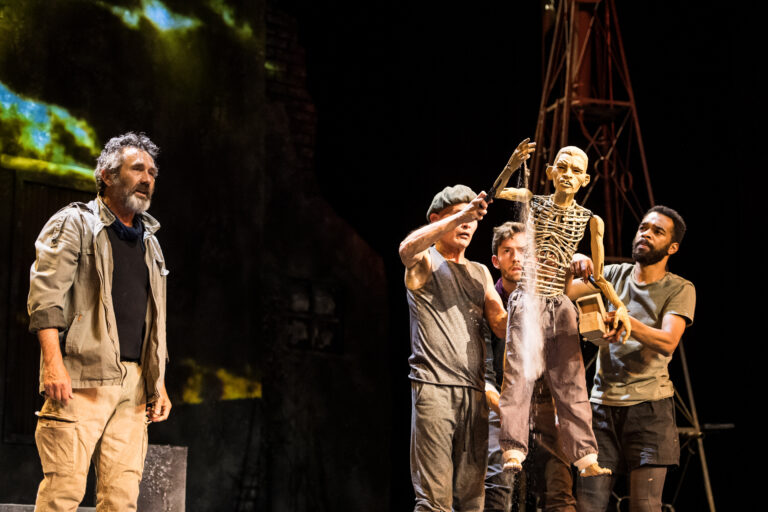
In this uninterrupted two-hour piece, Michael K. also happens to be a three-foot-tall puppet made of wood, cane, and carbon. Yet, miraculously, he is also the embodiment of grace, emotion and human interiority. He is maneuvered by three puppeteers (Craig Leo, Carlo Daniels, and Markus Schabbing) whose precision and synchronicity are impeccable and whose presence is both noticeable and integral to the play.

Life and Times of Michael K doesn’t play smoke and mirror games, camouflaging the puppeteers in black and trying to create the illusion that the puppets somehow function independently. Rather, it spotlights and celebrates the collaboration between human and puppet. Even when there are six people manipulating two puppets, the puppets are the undisputed focus and the magic spell is unbroken.

It’s hard to describe the enchantment of such artistry and skill.

The play opens with soft piano music as a performer carries an orange-shrouded Michael K. onto the stage. The shroud is lifted and a real, yet nonhuman, face is bared. With the slightest turn of the neck or tilt of the chin, that face expresses calm, pain and tears. One side emphasizes his cleft palate; the other his otherwise handsome features.

Yoav Dagan and Kirsti Cumming’s projection designs magnify Michael K.’s face, allowing the audience easier avenues of interior access and empathy. Green screen projections, a closed caption LED board and the use of rotating narrators add a multi-media excitement and emotional accessibility to the production. These elements don’t compete for our attention; rather, they complement and complete the action, conjuring something intoxicating and original.

Although there are nine people on stage — including the three puppeteers who manipulate Michael K — they are neither intrusive nor distracting. Michael K and the other five puppets (his mother, Anna, a feisty goat, and three curious children) seamlessly interact and interplay with the human beside them. They are different, but they are equals. At one point, Michael even addresses his handlers, offering them each a bite of his chicken pie even though he’s nearly dead from starvation.

The storyline is straightforward and told in linear chronology. We witness Michael’s birth (puppet Anna and her three puppeteers are amazing), his mother Anna’s rejection, and his childhood spent in institutions, where he learns gardening. When his mother falls ill and needs his help, she has him released and returned to her care. He now works as a gardener in Cape Town and tends Anna, a domestic servant to a wealthy family. The country descends into civil war and martial law is imposed. When Michael’s mother becomes very sick, he decides to quit his job and escape the city to return his mother to her birthplace, Prince Albert.

First, he jerry-rigs a wheelbarrow cart to transport his mother and their belongings. The two set off on a near-impossible trek that their banter and affection transforms into an adventure. Prone to philosophical questions and self-reflection, Michael K. frequently wonders why he had been brought into this world. His answer: to look after his mother. He never gives a second thought to the fact that his mother never looked after him.

That reason changes when his mother dies in a heartbreaking scene sensitively lit (Joshua Cutts) and soundtracked (Simon Kohler). His life takes a series of twists and turns when he encounters friends, enemies, detours, dangers, passions, hope — and one very spirited goat.

Yet, his innate ability to transcend and find the miracle in everyday life saves him from gloom and despair. He is relentlessly forgiving and accepting, unearthing solace in his life as a cultivator and eventual return to the farm where his mother was born. At last, he can let her ashes go. She is home and, he realizes, so is he.
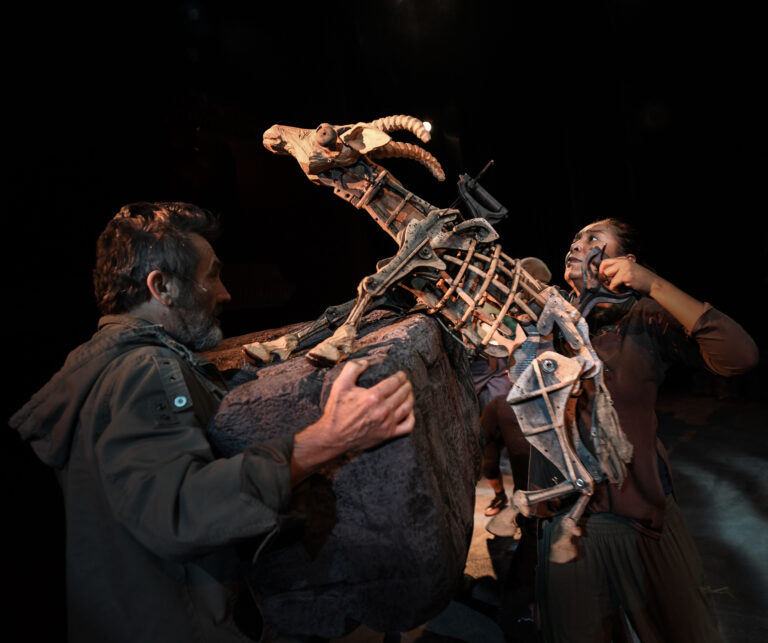
Enhancing the script and dazzling puppetry are Patrick Curtis’ set design and Dagan and Cummings’ projection design. Curtis uses minimum props and a smoky palette to maximum effect, creating a set versatile enough to serve as delivery room, bus, school, waves, farm and work camp. Backdrop projections ensure the audience is in lockstep with Michael K and his journey with inspired and enhancing visuals.

While Life and Times of Michael K is adapted from a work of fiction written over 40 years ago, its themes of displacement, poverty, discrimination and civil unrest are still relevant and perhaps even more urgently felt today. Yet Michael K’s journey focuses more on the internal than external as he uncovers his personal philosophy of life. “A man must live so that he leaves no trace of his living,” he says, vowing to only eat food he has grown himself. “There is no shame in being simple. One spoonful of water is enough to live,” he adds.

Michael K may be a puppet, but he has more heart and soul than many people.

‘Life & Times of Michael K’ — Adapted and Directed by Lara Foot in collaboration with Handspring Puppet Company. Based on the book written by J.M Coetzee. Adaptors and Puppetry Direction by Basil J.R. Jones and Adrian P. Kohler. Puppetry Design by Adrian P. Kohler. A Baxter Theatre Centre and Düsseldorf Schauspielhaus Production. Presented by ArtsEmerson at the Emerson Paramount Center, Robert J. Orchard Stage, 559 Washington St., through February 9.For more information and to buy tickets, visit www.artemerson.org

Bill Irwin Is Brilliant in ArtsEmerson’s Not-to-Be-Missed “On Beckett.”

Bill Irwin in “On Beckett” at ArtsEmerson

‘On Beckett’ — Conceived and Performed by Bill Irwin. Produced by Octopus Theatricals; Scenic Design by Charles Corcoran; Costume Consultation by Martha Hally; Lighting Design by Michael Gottlieb; Sound Design by M. Florian Staab. Presented by Arts Emerson at the Emerson Paramount Center, 559 Washington St., Boston, MA through October 30.

by Shelley A. Sackett

Bill Irwin is a legendary actor, writer, director and clown artist. The Tony award-winner is as known for serious theatrical roles on Broadway as he is for his beloved Mr. Noodle on television’s “Elmo’s World.”

With “On Beckett,” his solo exploration of his decades long relationship with the Irish playwright, Samuel Beckett, Irwin takes on yet another role — that of compassionate guide through the sticky wickets of Beckett’s intimidating and often baffling prose and plays.“Here is what I am proposing to you this evening,” he tells the audience with an intimacy and earnestness that has them in the palm of his hand from the get-go. “I’m not a scholar or a biographer,” he says almost apologetically, implying that those who expect a pedantic lecture from the head will be disappointed. “I am an actor and a clown and what I have is an actor’s knowledge” of Beckett, he says. And what a trove of treasures that is.

What Irwin brings to the table and generously shares is of far greater value and infinitely more enjoyable than a straight out lecture. He discloses what it has been like for him to experience Beckett’s language from the inside out, as one who has been entrusted with the sacred task of memorizing the writer’s words, processing them through his Bill Irwin persona, and then speaking them to a contemporary audience as he imagines Beckett himself intended.

For an absorbing, enlightening and entertaining 90 minutes, Irwin shines his inner light on four works by Beckett: Texts for Nothing, Watt, The Unnamable and Waiting for Godot. He peppers his readings/performances with anecdotes and observations, revealing what it feels like as an actor and as a human being to mouth the words of the great existentialist and arguably the greatest playwright who ever penned a line of dialogue.

His approach blends the physical (often hilarious) and emotional as he digs deep into Beckett’s “character energy,” managing to keep the evening challenging enough for aficionados of the work and light enough for novices. “These are like people I’ve known. Like my own mind — me, myself and I in conversation,” he says, bringing Beckett’s often lofty language down to earth.

Which is not to say he doesn’t pose heady questions meant to expand our thinking about Beckett, ourselves and the world we live in. “Was Beckett a writer of the body or mind?” he asks. Midway through the enjoyable and impactful evening, Irwin addresses the elephant in the room. “Is this a portrait of existence?” he asks of a passage in The Unnameable. “What is it?”

eckett

He then gives an easy-to-digest short treatise on existentialism, pithy and humorous, yet also the product of a deep thinker who has spent years pondering these questions both on and off stage. It is no surprise to learn he has won Fulbright, Guggenheim, National Endowment for the Arts and MacArthur Fellowships. His explanations and analyses are brilliant. “These are the precise but undefinable questions that keep us awake,” he says before adding,” and put us to sleep.”

As expected of a lauded actor and director, his timing and punctuation is perfect. But Irwin is also a clown, and when he grabs his bowler and baggy pants, the evening shifts gears. Although Beckett’s words carry no less weight and Irwin’s performance embodies that gravitas, it is now clothed in the shimmering gossamer of physical comedy, taking the sting out of some of the words by allowing us to laugh at them and, by extension, at ourselves. Sure, existence is tough and death is even tougher, but let’s not forget that we were also created to laugh, Irwin reminds us.

Irwin appeared with Steve Martin and Robin Williams in the Lincoln Center Off-Broadway production of Waiting for Godot in 1988, in the role of Lucky. Lucky’s only lines consist of a famous 500-word-long monologue, an ironic element for Irwin, since much of his clown-based stage work was silent.

He treats us to a remarkable rendition and, at the end of the show, frankly admits that even after all these years, some of Beckett’s language remains beyond his grasp. “I keep discovering new things in the words,” he says. “I don’t know why. I don’t know how an airplane stays up in the air either, but I still want to climb onboard.”

Act NOW and you might just be lucky enough to catch one of the last Boston performances. Whether you’re encountering the Nobel Prize winner’s writing for the first time, or building on a body of Beckett knowledge, this dynamic showcase is not to be missed.

ArtsEmerson’s One-of-A-Kind ‘An Iliad’ Is Not to Be Missed

Denis O’Hare in ArtsEmerson’s ‘An Iliad’ – Photo by Joan Marcus

By Shelley A. Sackett

“An Iliad,” the brilliant play by Lisa Peterson and Denis O’Hare in a lamentably short run at Emerson Paramount Center, is one phenomenal piece of theater. In a mere 100 minutes, on a simple stage with no props or costume changes, the virtuoso Denis O’Hare (with the help of bassist Eleonore Oppenheim) magically creates the story behind Homer’s epic poem about the tragic Trojan War. This is no ordinary dramatic experience. It is a magic carpet ride into the deepest power and charm that theater can offer. No wonder the painted muses above the magnificently renovated stage are all smiles. They know this audience is in for a one-of-a kind experience that will resonate long after their thunderous standing ovation finally fades.

As the house lights slowly dim, a near-deafening clang arises from a stage stacked with chairs. One beacon illuminates the narrator, clad in a Sam Spade-like trench coat and hat and carrying a suitcase. It’s as if he emerges from the belly of some post-apocalyptic landscape. He approaches the audience and with an intimacy and rapport that marks the entire production, he speaks directly to them. With a sorrowful weariness he says, “Every time I sing this song, I hope it’s the last time.” He has been singing this same story for millennia: in Mycenae, in Babylon, in Gaul and now, in 21st century Boston. “It’s a good story,” he admits. That is the only understatement of the entire script. Peterson and O’Hare have written a firecracker version (hence, “An Iliad”) of Homer’s “Iliad” based on Robert Fagles’ renowned translation about the bloody story of the war between the Confederation of Greeks and Troy (located in Asia Minor or current Turkey).

In a nutshell, it all started when the Trojans stole Helen and ends with the Greeks getting her back (with a little help from that famed Trojan Horse). Along the way, we witness swords clattering, gods and goddesses interfering for malice and amusement, and several battles to the death. We also learn a lot of history and mythology (and, for the trained ear, a bit of classical Greek poetry). We meet Agamemnon, the Greek commander-in-chief, who has abducted Chryseis, the daughter of one of Apollo’s Trojan priests, and refuses to give her back. Achilles, the greatest Greek warrior, tries to no avail to persuade Agamemnon of his folly. Not until Apollo punishes the Greek armies with plagues does he finally relent and give her up. But no sooner is Apollo’s curse lifted than Agamemnon decides he deserves to be compensated for his sacrifice. That compensation is in the form of stealing Achilles’ concubine, a captured princess Achilles considers to be his bride.

Understandably, Achilles responds with epic rage and refuses to fight for Agamemnon and the Greek confederation. Without him, Agamemnon’s army is no match for the Trojans and their Achilles analog, Hector. After nine years of fruitless fighting, the Greeks are depressed and exhausted. “They’ve forgotten why they’re fighting. They just want to go home,” our narrator says. He pauses and solemnly faces the audience. “How do you know when it’s over?” he asks in a whisper.

The artistic depth and muscle of “An Iliad” lies in the way it connects ancient past to the political and linguistic vernacular of today. In a chatty, informal, almost stand-up-comic tone, the narrator compares the inability of the Greeks to give up and seek a truce to the exasperation and irrational stubbornness of someone who has waited for over 20 minutes in a supermarket line. “Do you switch lines now? No, goddam it, I’ve been here for 20 minutes, I’m gonna wait in this line. I’m not leaving ‘cause otherwise I’ve wasted my time,” the narrator says in a delivery reminiscent of the great Robin Williams, and suddenly the ancient Greek’s emotional dilemma is crystal clear.

Oppenheim’s music (how does she get all those sounds from a stand-up bass?) and Zeilinski’s dazzling lighting add enormous complexity and texture to the production as O’Hare stalks the bare stage, narrating the story, embodying his characters and time-traveling to the present to address his contemporary peers directly. He physically communicates the violence of war and the destruction it wreaks on the human body and psyche, embodying both Hector and Achilles in the play’s most wrenching scenes. With a bend of his nimble legs or a tilt of his head into a lone spotlight, he is magically transformed from Hector into his wife, Androcmache, in a tender scene where he credibly personifies and simultaneously embodies both.

The night belongs to this remarkably gifted and nimble actor, and those who miss it in Boston must make a New Year’s resolution to jump on a plane and catch its traveling production somewhere. It really is that good. For tickets and information, go to: https://artsemerson.org

‘An Iliad’ – Written by Lisa Peterson and Denis O’Hare; Directed by Lisa Peterson; Scenic Design by Rachel Hauck; Costume Design by Marina Draghici; Lighting Design by Scott Zeilinski; Composer/Sound Design by Mark Bennett; Produced by Arts Emerson and Homer’s Coat in association with Octopus Theatricals at Emerson Paramount Center through November 24.