Second Stage’s ‘The Receptionist’ Shines A Light on the Underbelly of the Underworld

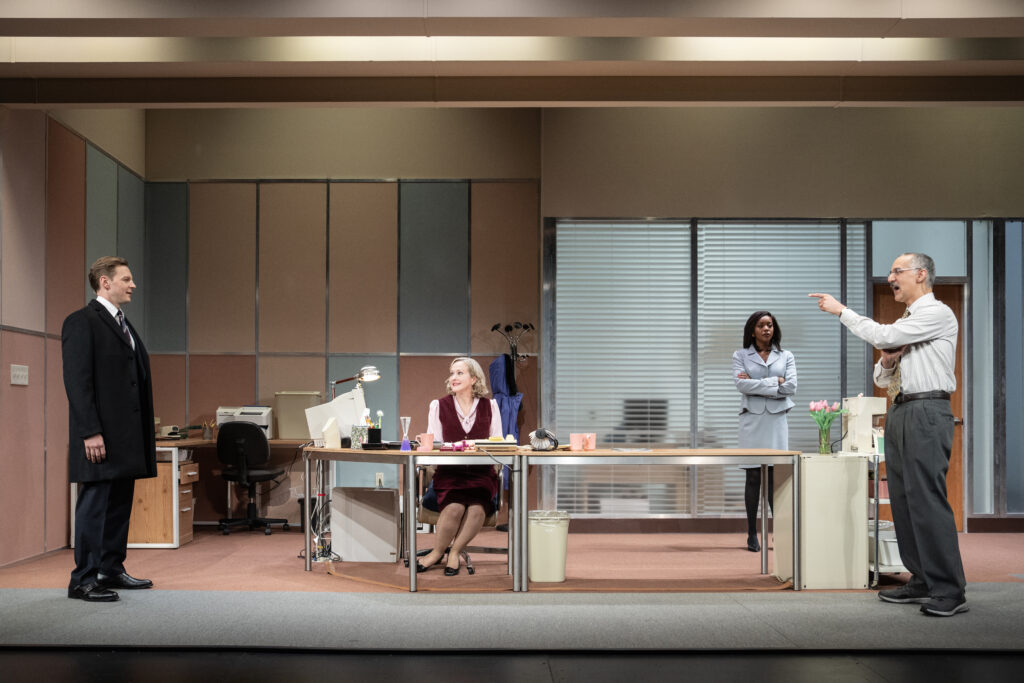
Will Pullen, Katie Finneran, Mallori Johnson, and Nael Nacer in Second Stage’s ‘The Receptionist’
Photos by Joan Marcus

“The Receptionist” – Written by Adam Bock; Directed by Sarah Benson; Scenic Design by dots; Costume Design by Enver Chakartash; Co-Lighting Design by Stacey Derosier and Bailey Costa; Sound Design by Bray Poor. Presented by Second Stage at the Pershing Square Signature Center, 480 W. 42nd St., New York, through May 24.

By Shelley A. Sackett

A frumpy, somewhat dazed man stands in a cardboard booth lined with some sort of metallic padding. It looks like a cross between a confessional, a detention unit, and a fourth grader’s science fair version of a spaceship.

The man’s name is Mr. Raymond (Nael Nacer, sadly underused). He is fidgety and nervous as he addresses the audience.

“I like fly fishing. There’s nothing like it. I love everything about it. I love catching fish. I love letting them go, too. I have a philosophy when it comes to a caught fish. If you catch a fish and it’s ok, you let it go. But if it’s snagged or it’s got a hook in its gills, you can’t put it back in the stream because it’ll die. So if that happens, I think you should prepare the fish to be killed,” he says matter-of-factly.

Johnson and Nacer

As if momentarily distracted by an almost PTSD type of unwanted, interfering thought, he pauses and then describes his wife’s reactions to pictures of people “over there” and what “we” are doing to them. He can’t finish his sentences.

“When things are hard,” he continues, after regaining his composure, “I think about fly fishing.”

Nacer brings a nuance to Mr. Raymond that is heartbreaking and intriguing. Unlike his colleagues, he lives in the gray – half in the dark and half in the light.

He is also a mystery. Why is he agitated, losing his train of thought mid-sentence? Why does he conclude with an explanation about how he kills the fish “humanely” and then eats it? “And that’s okay,” he explains. “Because everything out there is eating something.”

His monologue, part confession, part plea for help, ends, and Mr. Raymond ambles off stage, leaving us to wonder how and when his message will make sense (and bringing to mind Mark Rylance in the existentialist “Nice Fish”).

The scene abruptly shifts gears to the mundane here and now — the reception area of a shabby, mind-numbingly drab office reception area (with an elevator door that actually works, the only visual excitement on the set). Beverly Wilkins (Kate Finneran in a role she was born to play), the titular receptionist, handles her desk as if captain of a fleet. Brisk, efficient and in command of her domain, she interrupts her gossipy calls to friends and family only when forced to.

“Northeast Office, please hold,” she repeats – and repeats – as she rolls her eyes in irritation and puts callers through to the voice mail of her two higher-ups, head honcho Mr. Raymond and second-in-command, Lorraine Taylor, both missing in action.

She’s used to Lorraine being late; Mr. Raymond’s absence alarms her. A client contact apparently did not go well for him. Something is amiss. Something enigmatic, significant and menacing.

She distracts herself by playing “Dear Abby” to friends and family, making coffee, straightening the blinds and shredding some documents. She even orders a birthday cake. She is a whirling dervish of meaningless activity and bossy, judgmental, boundary-less encounters.

Owing to Finneran’s physical comedic flair and timing and director Sarah Benson’s crisp pacing, Beverly is engaging, endearing and more multi-layered than she at first presents.

She is also a riot. Playwright Adam Bock has given her most of the funniest lines, and she knows just how to milk their delivery for all they’re worth.

By the time Lorraine (Mallori Johnson) shows up, however, even Finneran can’t keep Bock’s stand-up comic/sitcom patois from becoming monotonous, and we crave anything and anyone more than just Beverly.  

Lorraine and Beverly engage in small talk about personal crises. Although Lorraine is clearly Beverly’s superior professionally, she seeks Beverly’s stern counsel on everything from romance to attire. (Beverly looks like she shops in the Target clearance department; Lorraine is sleek, chic, and skin-tight.)
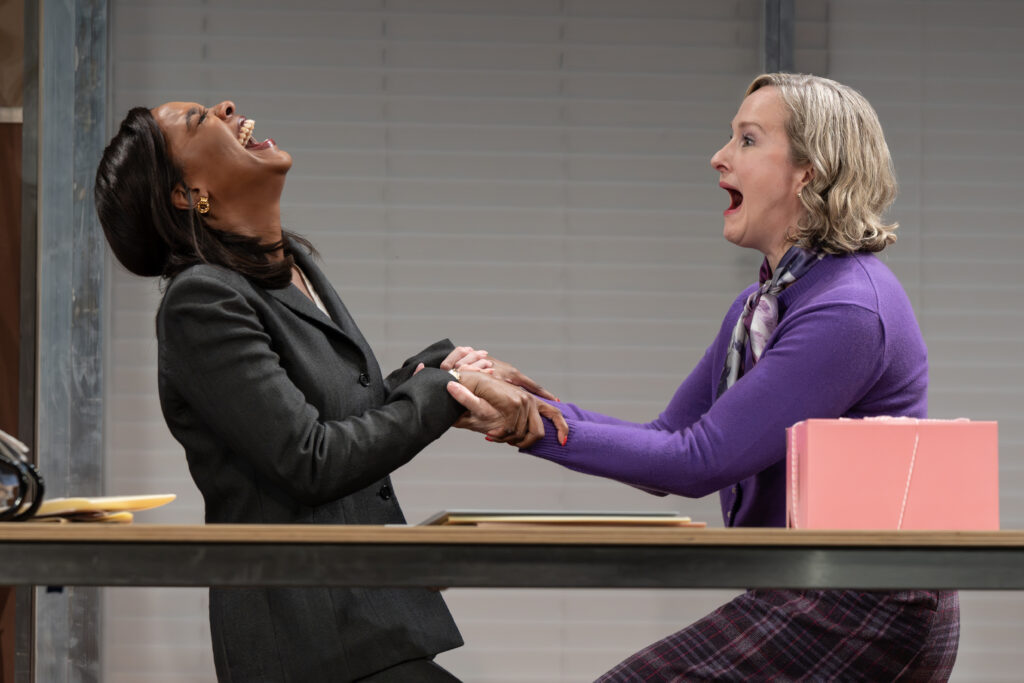
Johnson and Finneran

Just when it seems Bock will never get to the point of all this banter (the play, after all, is only 75 minutes and we’re almost at the half-hour point), Beverly lets slip that Mr. Raymond was summoned to the Central Office yesterday and never returned to the office.

Almost on cue, Martin Dart (Will Pullen) arrives, without an appointment, from that same Central Office.

He is looking for Mr. Raymond and will wait until he returns. He is married with a four-year-old who eats paste. He jokes with Beverly and flirts in a creepy, cringe-worthy way with the willing and desperate Lorraine. He even wears blood red socks.

He steps out to pick up pastries and a paper and so is gone when Mr. Raymond finally arrives and exposes what really goes on at this seemingly unremarkable office. His great reveal and his tenuous circumstance change everything.

Again, Nacer brings a sensitivity to a character who is blessed with three, rather than two, dimensions. Mr. Raymond is the meatiest (and smallest) role, and one can’t help wishing Bock had pared the other three and padded this one.

With Mr. Raymond’s acknowledgment of events, all that was light and comfortable suddenly is not. Loyalties, responsibilities and the banality of evil take center stage. Mr. Dart shape shifts into a Stasi-like commandant, official, brutal and terrifying. Everyone is ambiguous. No one can be trusted. Everyone is a potential liar. No one is above suspicion. No one is safe.

Like zombies in a “Twilight Zone” episode, our office mates wander in a world that not only no longer welcomes them, but actually may persecute and prosecute them.
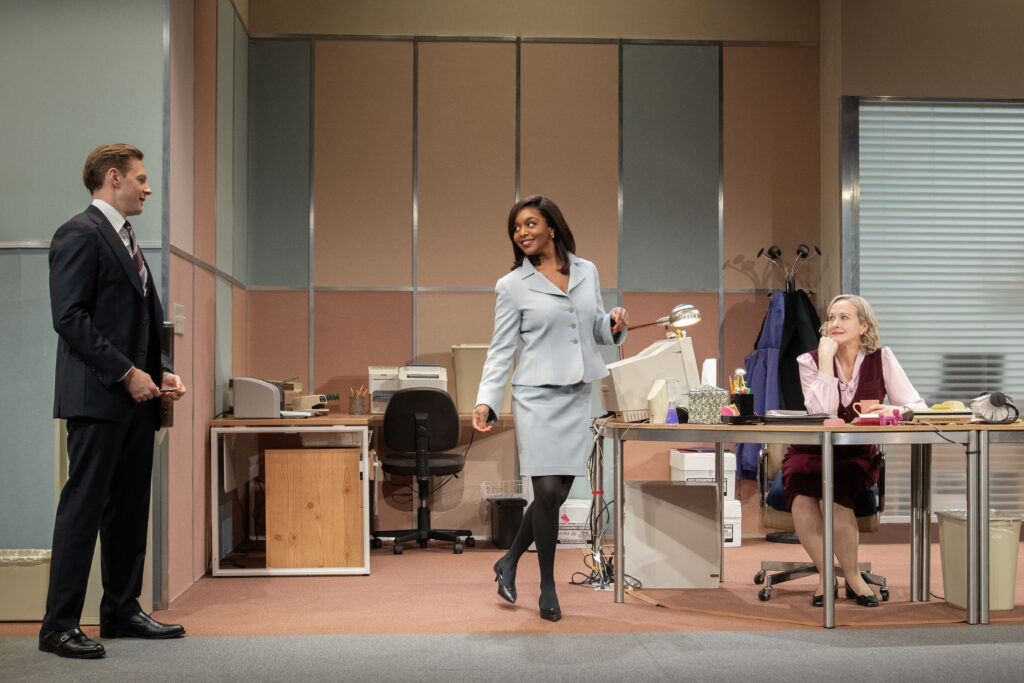
Pullen, Johnson and Finneran

It is impossible to detail any more of the plot without becoming a spoiler, but Bock’s outrage over issues he found compelling and relevant in 2004 (he started writing in response to the Iraq war “Torture Memos”) now leaves us nostalgic for those “good old days” when complicity, compliance and corruption were still alarming and shocking.

But for the outstanding cast (especially Finneran and Nacer) and elevated production, The Receptionist would leave us feeling like its revival was merely an opportunity to rub salt into an open, unhealed wound, still festering after more than two decades.

And if we want that feeling, all we have to do is read the front page of the newspaper.

For more information, go to https://2st.com/shows/the-receptionist
SpeakEasy’s Stirring “Swept Away” Will Carry You Away

Swept Away -Book by John Logan; Music and Lyrics by The Avett Brothers; Directed by Jeremy Johnson; Music Direction by Paul S. Katz; Choreography by Ilyse Robbins; Presented by SpeakEasy Stage Company, 527 Calderwood Pavilion for the Arts, Tremont St., through May 23.

By Shelley A. Sackett

By rights, SpeakEasy’s Swept Away should not be the crowd-pleaser that it is. The story is based on a true event that happened in 1884, when the British yacht Mignonette sank on its way to Australia, and only three of the four crew members were rescued (the event inspired the Avett Brothers’ 2004 album, “Mignonette,” which inspired the musical).

Swept Away, which substitutes the 1888 wreckage of a New Bedford whaling ship and the ensuing survival of its captain, two crewmen, and a cabin boy, is hardly an uplifting (or novel) tale. Add in being lost at sea on a lifeboat for three weeks before hitting land and facing starvation, dehydration, and the temptation of cannibalism, and front-page news starts to feel less wretched. Yet, this is no ordinary fish story gone awry.

This New England premiere feels anything but tragic, owing to the spell spun by music (lyrics/music by the talented folk/rock Avett brothers), choreography (the unfailingly inspired Ilyse Robbins), stirring set and staging (Janie E. Howland), and powerful performances by a terrific cast (led by Peter DiMaggio, Christopher Chew, Max Connor and Bishop Levesque). Add crisp, confident direction (Jeremy Johnson), pitch-perfect musical direction (Paul S. Katz), a script focused on its characters’ interiors (book by John Logan), haunting lighting (Karen Perlow), a melded ensemble, and even the entertaining distraction of an aerialist (Ezra Quinn), and rays of sun break through the play’s dark, heartbreaking tale.

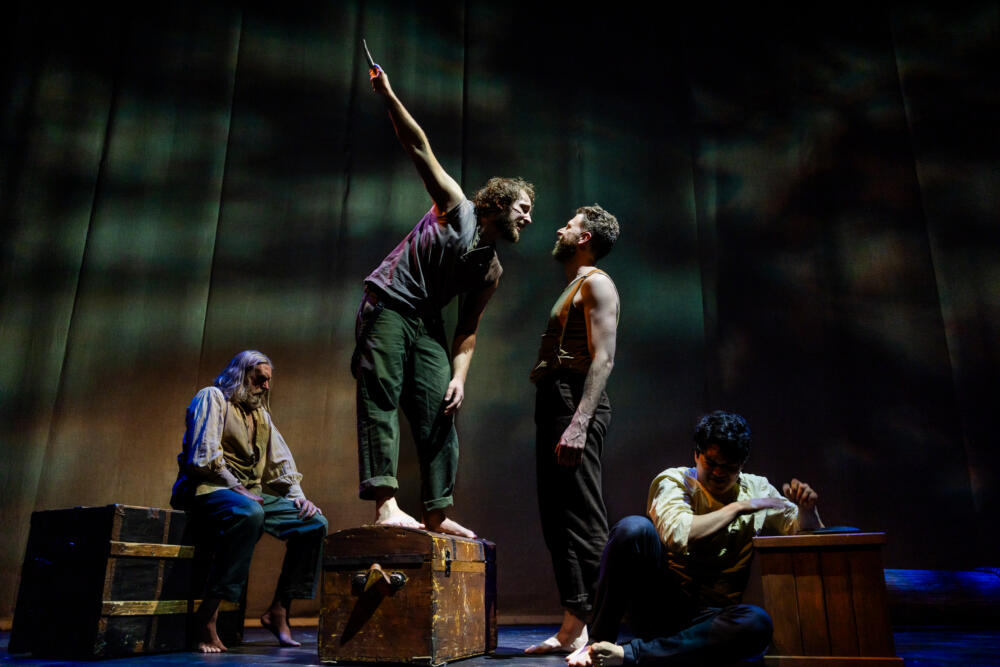
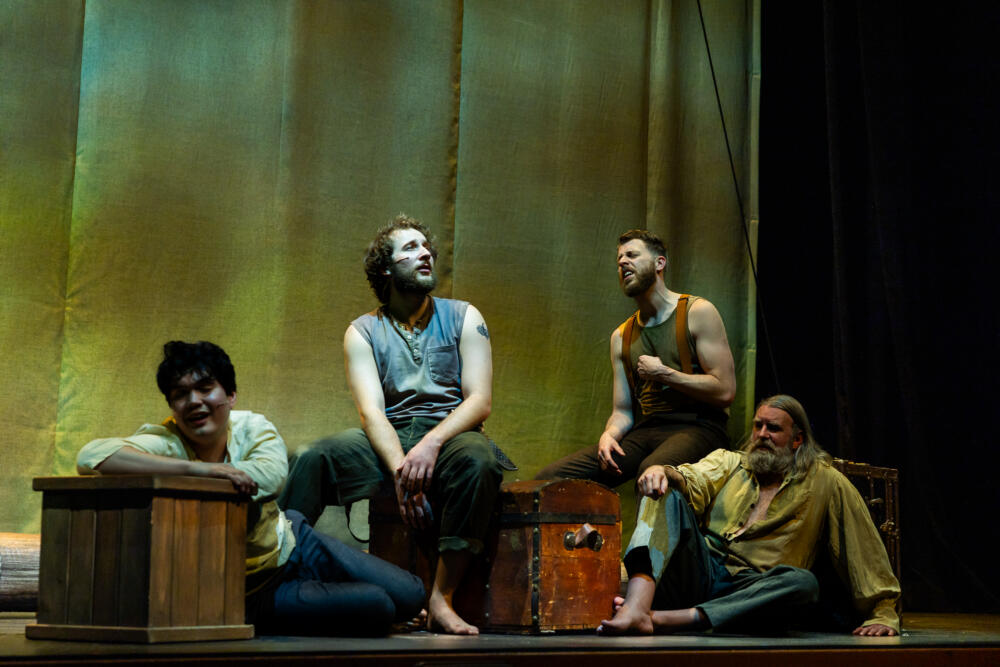
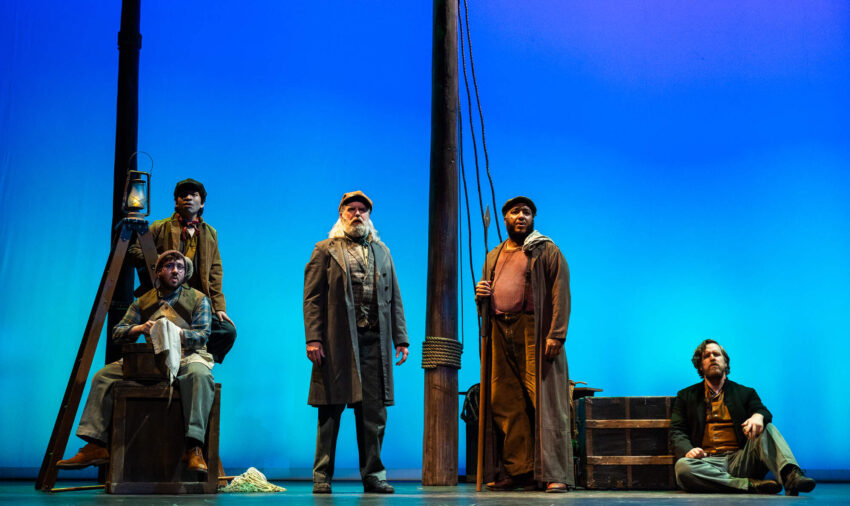
Christopher Chew, Peter DiMaggio, Bishop Levesque and Max Connor

The curtain rises in 1908 with the spectacular “Prelude,” which pulls out all the production stops. Transparent screens, an acrobat hanging from a sheet on the mast, moody lighting, strong harmonies and a tempered orchestra whose volume doesn’t compete with our ability to hear the lyrics literally set the stage for the next 90 minutes (no intermission). Robbins’ choreography has its own syncopation with hand-slapping and stomping, and acrobatic rolling and falling capture the energy of the tale about to unfold. So does the refrain, “Tell the Truth. Fess up. Now or never. Tell the Truth.” The rest of the plot happens in flashback to the 1888 last voyage of the doomed ship and its aftermath. It took these three survivors 20 years to garner the wherewithal to reveal what happened.

The Captain (Chew’s baritone is addictive) fills the role of narrator as he introduces the main characters and explains how “progress” (the use of kerosene and paraffin instead of blubber and whale oil) has made whaling obsolete. New Bedford’s residents are split between these coarse, seafaring footloose adventurers and the religious, earth-bound farmers. “Find the life that suits you,” Captain advises.

Connor, DiMaggio, Levesque and Chew

Mate (an absolutely pitch-perfect, multi-dimensional DiMaggio) and Captain have served together many times. Captain is at retirement age and, while lamenting the end of a lustrous career, has built a life on land with family who await him. Mate is scrappy, scruffy and itching for the thrills and lack of commitment that only a life at sea can scratch. Little Brother (Connor) knows nothing about seafaring except that it offers an escape from the shackles of his dull, religious family and their farming life. His Houdini attempt is partially obstructed by Big Brother (a steadfast evangelical yet compassionate and accessible Levesque), who stows away on the ship. He would rather leave the life he loves behind than abandon his little brother to the wily seduction of the likes of Mate.

Although the script lags in places (the plot is thin on action overall), there are dazzling moments, such as the stormy scene that sends our four survivors onto a lifeboat for six days. Lost at sea with no provisions or refuge from the scorching sun, their songs focus on hunger, hopelessness and horrible sins they would consider committing if it guaranteed they would stay alive. “Mama’s cooking something up, serving to us all; Satan’s ringing in now and I gotta take the call,” they sing in the catchy, “Satan Pulls the Strings.”

By the time of the show’s “great reveal,” we feel like we have really gotten to know and care for these four. We have been allowed entrance into what makes them tick and witnessed how they have (and not) changed as a result of their shared trauma and moral disgrace. Yet, the questions they ask and lessons they’ve learned leave us on a surprisingly even keel. When they sing, “If you live the life you’re given, you won’t be scared to die,” we believe them.

For more information, visit https://speakeasystage.com/

Gloucester Stage Company Serves Up Full-Bodied Blues in ‘Paradise Blue’

by Shelley A. Sackett

There’s a raw poetic cadence to the dazzling dialogue of playwright Dominique Morisseau’s final play in her trilogy set in different decades in Detroit. It’s 1949, and the downtown Blackbottom entertainment district is home to many black-owned jazz clubs, including the Paradise Club. Director Jackie Davis sets the tone immediately. Against an opening montage of black and white period photos and a pained, bone-melting trumpet solo,  we hear a single gunshot. This film noir trope is a perfect entrance into ‘Paradise Blue’ and an introduction to the complicated passions that drive its five characters.

Although a structurally imperfect play, Morisseau has served up a piece of theatrical pie rich in language, character development and emotional impact. Despite the virtual production (done zoom-like with seated actors who address the camera full on), the superb cast delivers the caliber of performances that suck the audience right in, dissolving the cyber barrier.  Davis uses a stage direction reader (Aimee Hamrick) to keep the production moving. Hamrick’s “just the facts-ma’am” efficient and unobtrusive narration adds another layer of Sam Spade noir. Once again, Gloucester Stage Company has gifted its theater-hunger fans with a satisfying and innovative armchair experience.

All the action takes place in the Paradise Club, a jazz and drinks joint that both exalts and entombs Blue (Ricardo Engermann), its owner, bandleader and tortured trumpeter. Although lean and small boned, Blue casts a long shadow and his moodiness hangs like an ominous dark cloud over his head. His club is staffed by his affable and hardworking girlfriend-cook-housekeeper Pumpkin (played with confidence and self-effacement by Meagan Dilworth) and his bandmates, piano man Cornelius (Cliff Odle) and drummer P-Sam (Omar Robinson). The topic at hand is how to keep the music going in the absence of the group’s bassist, whom Blue fired after getting into a row with him.

To make ends meet, Blue decides to advertise a room for rent. When the sultry, sexy Silver (Ramona-Lisa Alexander) shows up to answer the ad wearing a red hat and carrying a wad of cash, a loaded pistol and a steamy look that could liquefy lacquer, the play’s pulse quickens. Although Alexander is seated throughout the reading, her voice and gestures spellbind the audience with their overwhelming sensuality and physicality. She is unmistakably a woman used to using her charisma and beauty to charm men into doing what she wants them to do. In Alexander’s exceptional hands, she is indeed a black widow, drawing us into her web every time she looks our way.

Although the 2hour24 minute production gets off to a slow and stilted start, once Silver shows up, there’s an uptick that is sustained until the end. This play is not plot driven; rather it is a snapshot glimpse through the keyhole of five multi-dimensional lives in Black Detroit in 1949. Morisseau’s gifted dialogue lets her characters’ layered stories slowly unfold through their rich and intimate conversations and confrontations with each other. It’s a treat to be a fly on these walls.

Pumpkin, the literal heart of the play and its moral compass, is sensitive and caring. She even carries a book of poetry which she is intent on memorizing just because of its beauty. Despite Blue’s depression and habit of manhandling her, Pumpkin only sees the goodness in him. “A woman’s job is to ease a man’s troubles. This man has a gift. Makes me feel like somebody just to be close to it,” she tells Silver.

Silver couldn’t be a starker contrast. She is aggressive, suspicious and competitive. She is also heartbreakingly sensitive, seeing demons everywhere, from the white world in which a Black man struggles to exist to her own barren womb. “I’m cursed. What’s a woman if she ain’t bearing fruit?” she confides to the sympathetic, compassionate Cornelius (whom she takes as her lover).

Although the three males are less clearly delineated, their portrayers do a splendid job of bringing them to life. Engermann plays Blue with a Denzel Washington fluid and easy delivery, his voice like caramel with a dusting of sandpaper. His and Alexander’s (Silver) phrasings, cadences and pauses are breathtakingly spot on. Odle as Corn is accessible and gentle, a wise and wizened elder statesman. Robinson does the best he can with the thinly drawn P-Sam.

While Morisseau excels at teasing out the nuances of personal relationships, her structural shortcomings in three important areas diminish her audience’s ability to appreciate her artistic intent: (1) Detroit Mayor Albert Cobo’s platform promoting urban gentrification and the buying of black businesses to cure “urban/black blight” is essential background information only obliquely referenced; (2) as the play’s principal character, Blue is underdeveloped; we need more of his backstory told by- not about- him, and (3) the ending feels out of step, strained and jarring.

Notwithstanding, ‘Paradise Blue’ is well worth the stamina required to watch and highly recommended for its superb acting, fabulous soundtrack and inspired production. Once again, Kudos to Gloucester Stage Company for raising the virtual bar yet again.

‘Paradise Blue’ — Written by Dominique Morisseau; Directed by Jackie Davis; Produced by Gloucester Stage Company at Oneline/Virtual Space, as part of its 2020 Never Dark Series. Streaming online October 1-4 at https://gloucesterstage.com/battle-not-begun/

ArtsEmerson’s One-of-A-Kind ‘An Iliad’ Is Not to Be Missed

Denis O’Hare in ArtsEmerson’s ‘An Iliad’ – Photo by Joan Marcus

By Shelley A. Sackett

“An Iliad,” the brilliant play by Lisa Peterson and Denis O’Hare in a lamentably short run at Emerson Paramount Center, is one phenomenal piece of theater. In a mere 100 minutes, on a simple stage with no props or costume changes, the virtuoso Denis O’Hare (with the help of bassist Eleonore Oppenheim) magically creates the story behind Homer’s epic poem about the tragic Trojan War. This is no ordinary dramatic experience. It is a magic carpet ride into the deepest power and charm that theater can offer. No wonder the painted muses above the magnificently renovated stage are all smiles. They know this audience is in for a one-of-a kind experience that will resonate long after their thunderous standing ovation finally fades.

As the house lights slowly dim, a near-deafening clang arises from a stage stacked with chairs. One beacon illuminates the narrator, clad in a Sam Spade-like trench coat and hat and carrying a suitcase. It’s as if he emerges from the belly of some post-apocalyptic landscape. He approaches the audience and with an intimacy and rapport that marks the entire production, he speaks directly to them. With a sorrowful weariness he says, “Every time I sing this song, I hope it’s the last time.” He has been singing this same story for millennia: in Mycenae, in Babylon, in Gaul and now, in 21st century Boston. “It’s a good story,” he admits. That is the only understatement of the entire script. Peterson and O’Hare have written a firecracker version (hence, “An Iliad”) of Homer’s “Iliad” based on Robert Fagles’ renowned translation about the bloody story of the war between the Confederation of Greeks and Troy (located in Asia Minor or current Turkey).

In a nutshell, it all started when the Trojans stole Helen and ends with the Greeks getting her back (with a little help from that famed Trojan Horse). Along the way, we witness swords clattering, gods and goddesses interfering for malice and amusement, and several battles to the death. We also learn a lot of history and mythology (and, for the trained ear, a bit of classical Greek poetry). We meet Agamemnon, the Greek commander-in-chief, who has abducted Chryseis, the daughter of one of Apollo’s Trojan priests, and refuses to give her back. Achilles, the greatest Greek warrior, tries to no avail to persuade Agamemnon of his folly. Not until Apollo punishes the Greek armies with plagues does he finally relent and give her up. But no sooner is Apollo’s curse lifted than Agamemnon decides he deserves to be compensated for his sacrifice. That compensation is in the form of stealing Achilles’ concubine, a captured princess Achilles considers to be his bride.

Understandably, Achilles responds with epic rage and refuses to fight for Agamemnon and the Greek confederation. Without him, Agamemnon’s army is no match for the Trojans and their Achilles analog, Hector. After nine years of fruitless fighting, the Greeks are depressed and exhausted. “They’ve forgotten why they’re fighting. They just want to go home,” our narrator says. He pauses and solemnly faces the audience. “How do you know when it’s over?” he asks in a whisper.

The artistic depth and muscle of “An Iliad” lies in the way it connects ancient past to the political and linguistic vernacular of today. In a chatty, informal, almost stand-up-comic tone, the narrator compares the inability of the Greeks to give up and seek a truce to the exasperation and irrational stubbornness of someone who has waited for over 20 minutes in a supermarket line. “Do you switch lines now? No, goddam it, I’ve been here for 20 minutes, I’m gonna wait in this line. I’m not leaving ‘cause otherwise I’ve wasted my time,” the narrator says in a delivery reminiscent of the great Robin Williams, and suddenly the ancient Greek’s emotional dilemma is crystal clear.

Oppenheim’s music (how does she get all those sounds from a stand-up bass?) and Zeilinski’s dazzling lighting add enormous complexity and texture to the production as O’Hare stalks the bare stage, narrating the story, embodying his characters and time-traveling to the present to address his contemporary peers directly. He physically communicates the violence of war and the destruction it wreaks on the human body and psyche, embodying both Hector and Achilles in the play’s most wrenching scenes. With a bend of his nimble legs or a tilt of his head into a lone spotlight, he is magically transformed from Hector into his wife, Androcmache, in a tender scene where he credibly personifies and simultaneously embodies both.

The night belongs to this remarkably gifted and nimble actor, and those who miss it in Boston must make a New Year’s resolution to jump on a plane and catch its traveling production somewhere. It really is that good. For tickets and information, go to: https://artsemerson.org

‘An Iliad’ – Written by Lisa Peterson and Denis O’Hare; Directed by Lisa Peterson; Scenic Design by Rachel Hauck; Costume Design by Marina Draghici; Lighting Design by Scott Zeilinski; Composer/Sound Design by Mark Bennett; Produced by Arts Emerson and Homer’s Coat in association with Octopus Theatricals at Emerson Paramount Center through November 24.