ASP’s Impressive ‘King Hedley II’ Is a Requiem to a Dream

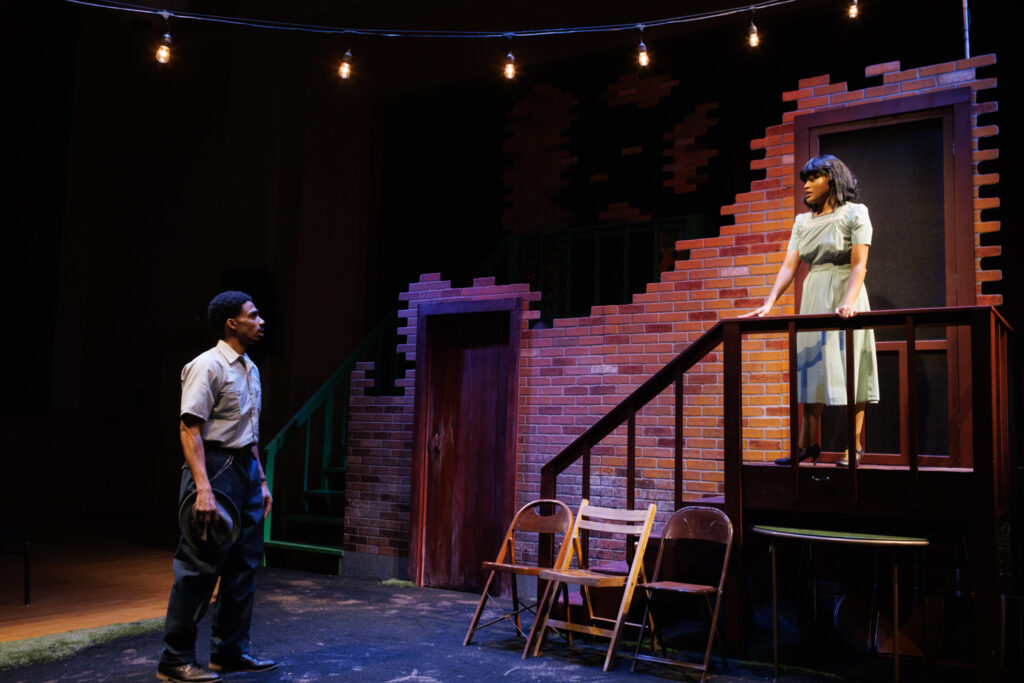
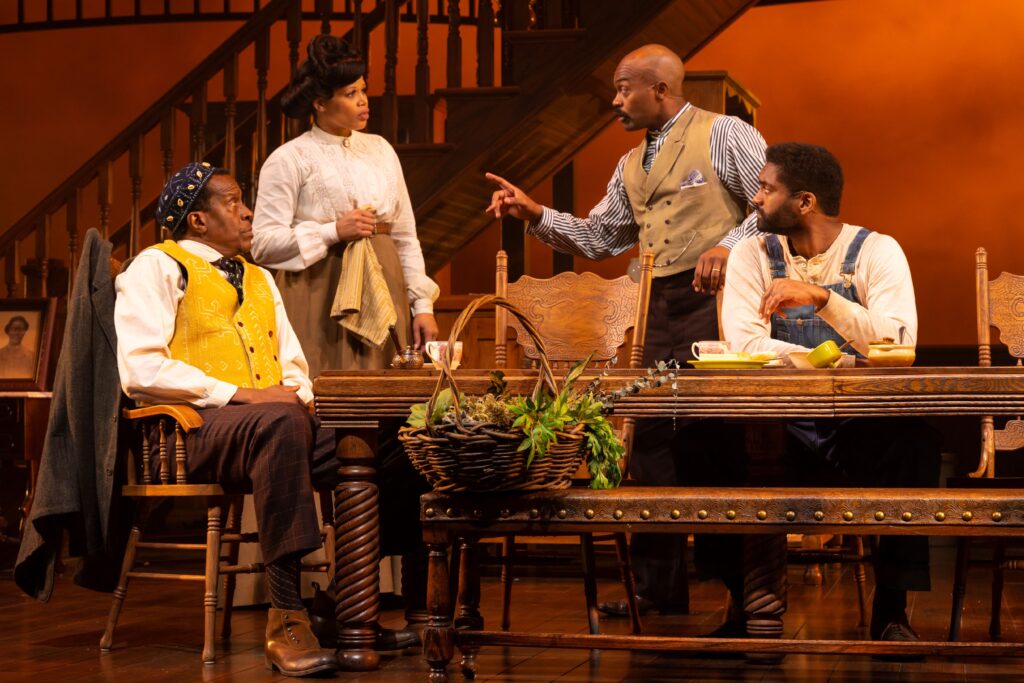
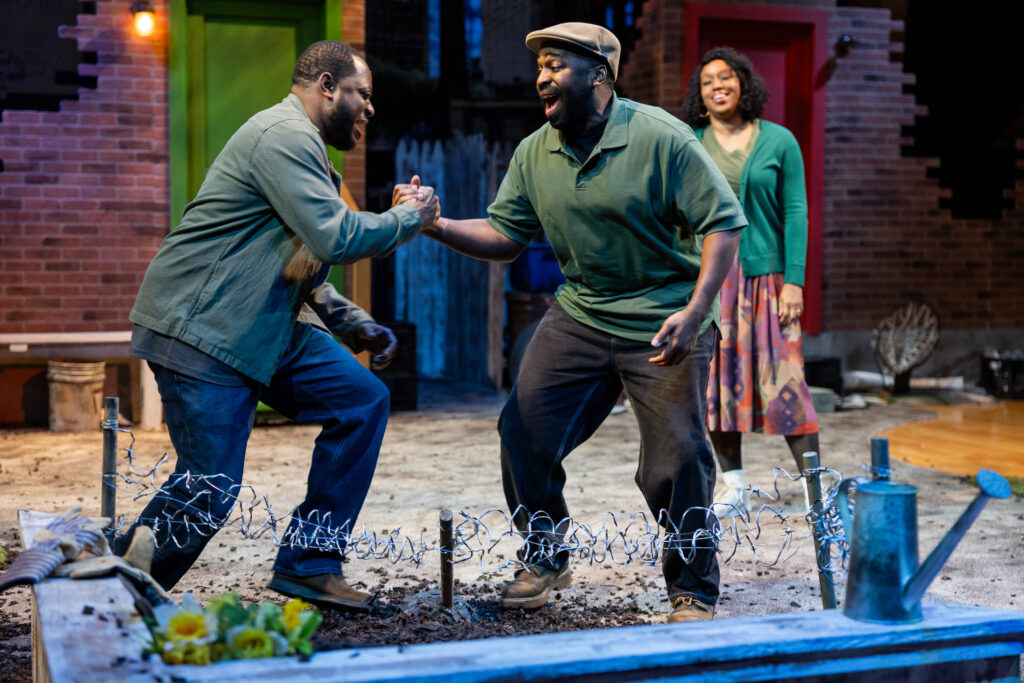
James Ricardo Milord and Omar Robinson in Actors’ Shakespeare Project’s production of August Wilson’s King Hedley II. Photo by Maggie Hall Photography.

By Shelley A. Sackett

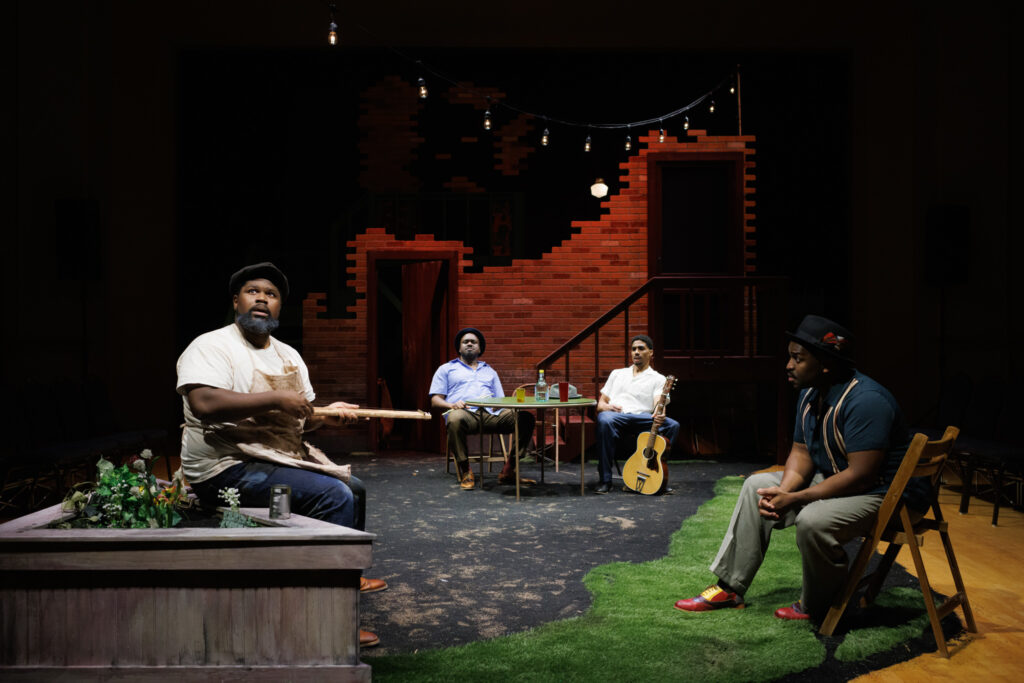
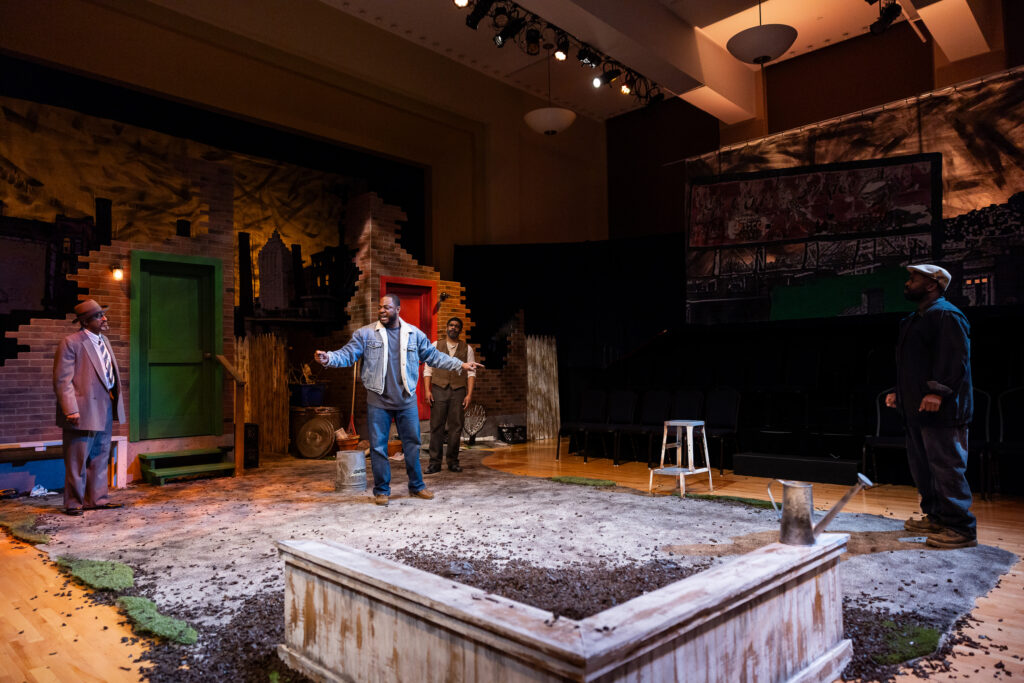
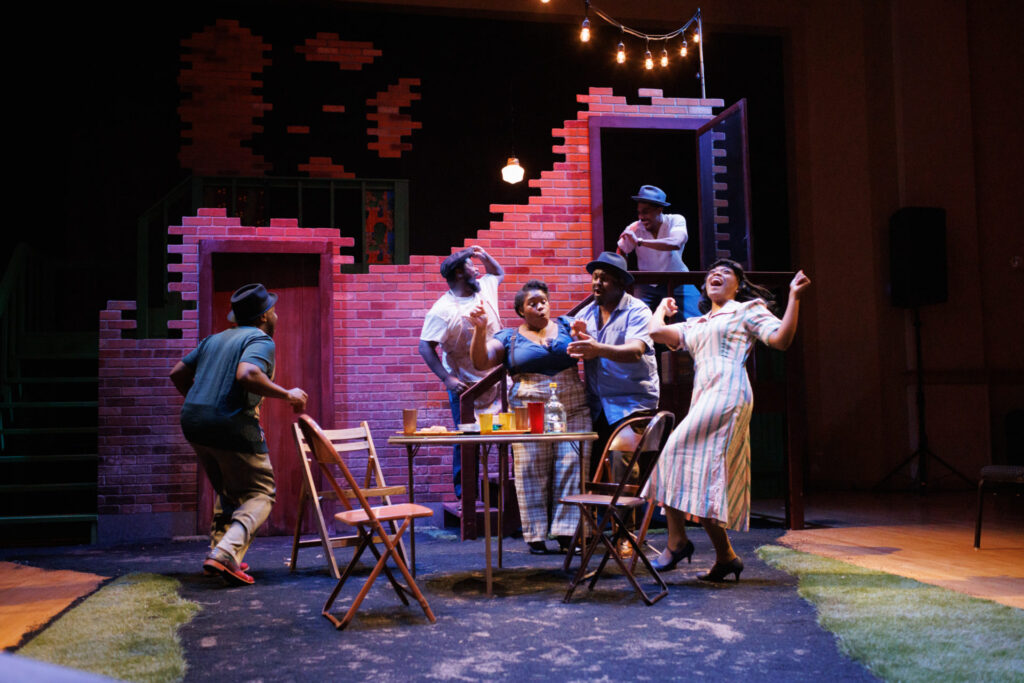
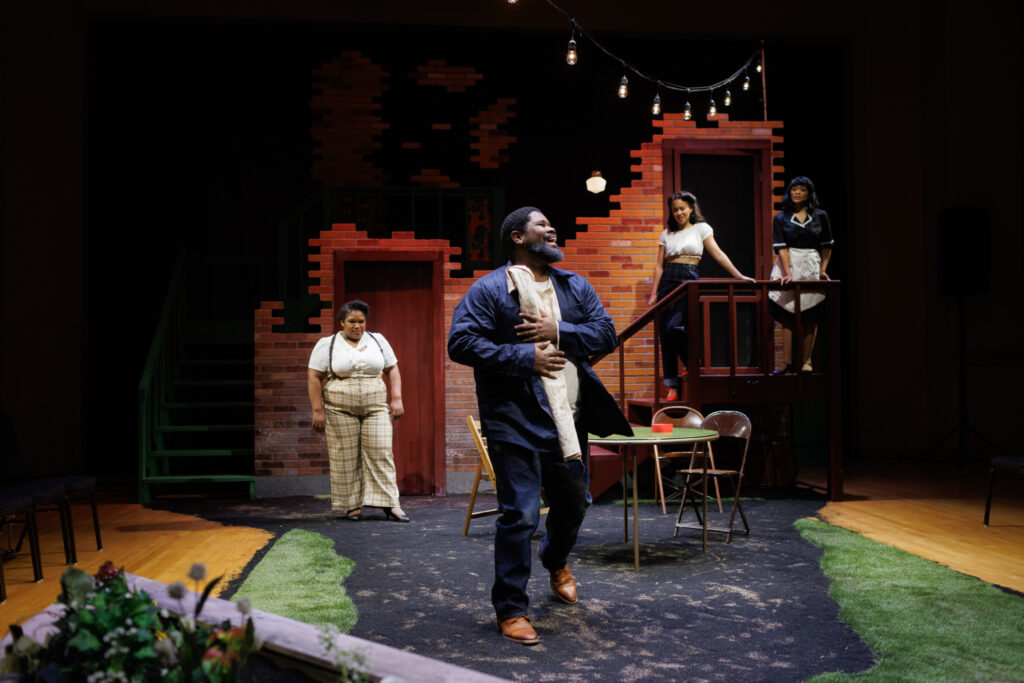
August Wilson’s King Hedley II, the Pulitzer Prize nominated play, is set in 1985 in the same Pittsburgh Hill District backyard where Wilson set his previous work, Seven Guitars (which received a knock out production in 2023 by Actor’s Shakespeare Project). Jon Savage’s same terrific set (and Anshuman Bhatia’s spot-on lighting) adds continuity and interest.

It’s now 40 years and several generations later, and the upbeat, soulful guitar blues arias soundtrack of Seven Guitars has been replaced by a thrumming funeral march set in a minor key.

Hill District is a poster child for its era: the promised trickle-down effect of Reaganomics has instead trickled up, and Black communities, always hampered, are now in a keyless lockbox.

Murder and crime are bit players in this tragedy of dreams confused and deferred, lurking behind every door and hiding under every unturned stone. Yet, as always, Wilson manages, through sheer artistic genius, to find a glimmer of light in this dark place. As with all ten of his Century Cycle plays (also called The Pittsburgh Cycle, a collection of ten plays that span across decades to document African American experiences in the 20th century), it is family and community that are Wilson’s main focus.
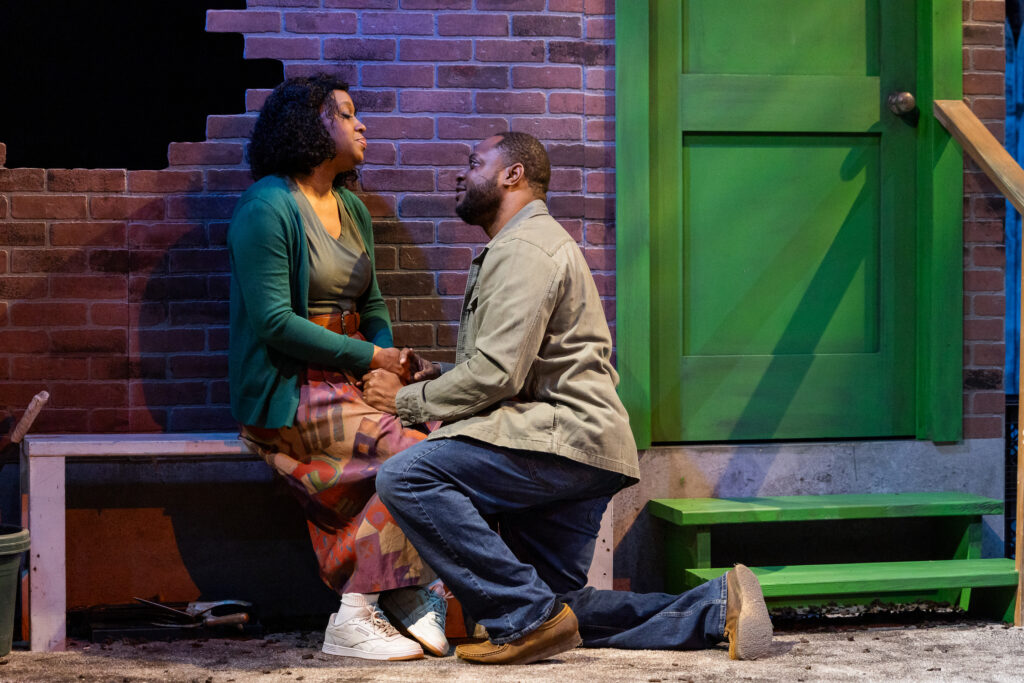
Milord, Karimah Williams

And it is through their words — brilliantly crafted dialogues, monologues and epistles — that he brings his characters to life and prevents the play from spiraling into a bottomless abyss of sorrow and gloom.

Which is a good thing, because King Hedley II’s backstory has already taken place when it begins. Much of its 90-minute first act is characters talking about what has already happened or what is happening offstage. Telling rather than showing rarely makes for thrilling theater.

Luckily, Wilson can create whole worlds through his dialogue.

King Hedley II fast forwards from where Seven Guitars ended. King (an outstanding James Ricardo Milord), last “seen” in utero, is now in his late thirties. He has just returned from a seven-year stint in prison and has a huge scar on the left side of his face, a reminder that he killed a man and a source of his unease and insecurity.

“Anyone who killed someone has no right to God. Living without God is the ultimate punishment,” a character says.
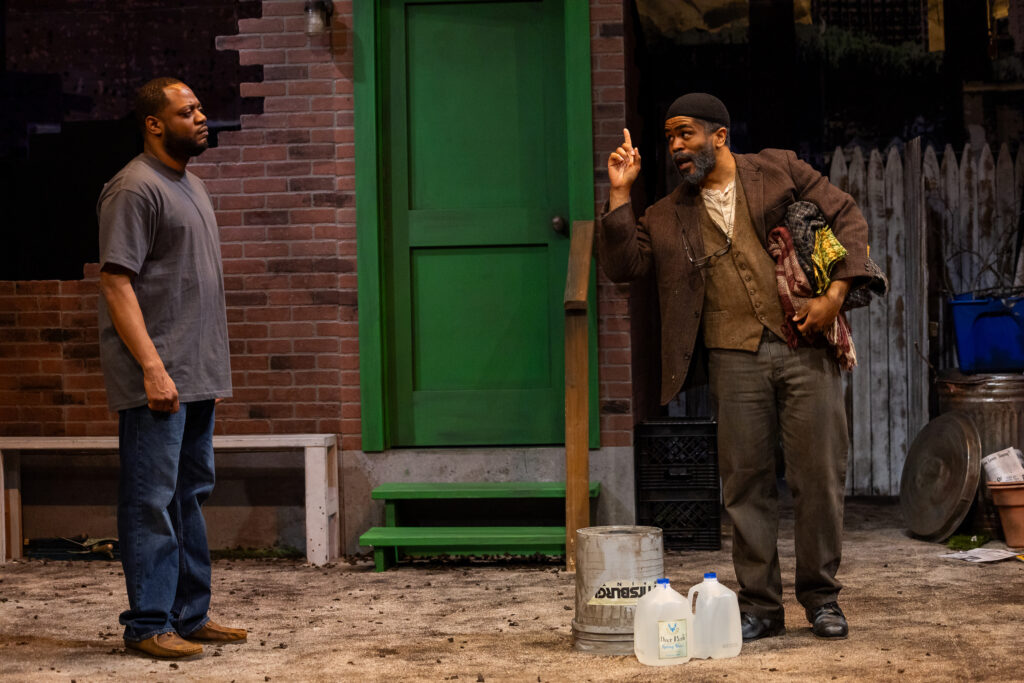
Milord and Brandon G. Green

He is desperate to restart his life. His to do list includes resuming his relationship with his second wife Tonya (Karimah Williams) and getting $10,000 so he and boyhood best friend Mister (an effectively under-stated Omar Robinson) can open a video store.

King and Mister have amassed a pool of cash by selling refrigerators with suspicious chains of ownership to their Black neighbors and supplementing that with recreational crimes like a midday jewelry heist. Despite pressing immediate needs for the money — Mister’s wife left him and took all the furniture; King wants to move from the Hill District to give him, Tonya and their expected baby a fresh start — they tamp down these immediate gratification urges in favor of the patience needed to achieve their American dream.

Ruby, (Patrice Jean-Baptiste, in a role and under direction that, after the disappointing  Trouble in Mind, thankfully allows her to strut her acting chops) a sixty-something former blues singer who recently moved back to Pittsburgh, is King’s biological mother. When we last saw her, she was a 20-something spitfire visiting her Aunt Louise. Pregnant by one of her two lovers (Leroy Slater or Elmore), she ended up leaving King with Louise and her boyfriend, King Hedley, who assumed the role of the boy’s father. The two raised King, although Hedley I died when he was three.
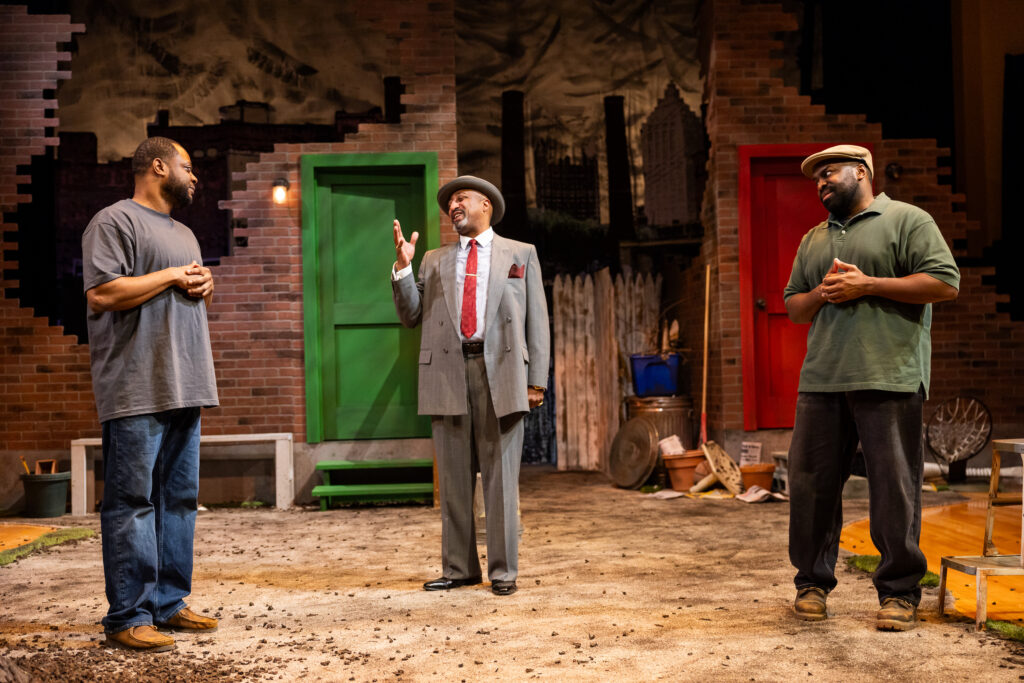
Milord, Naheem Garcia, and Robinson

Aunt Louise recently died and Ruby is back to claim her rightful property inheritance. She also wants to take a stab at establishing a mother-son relationship with King. Still hot on her trail is Elmore (a best-in-show Naheem Garcia), the unapologetic, charismatic snake-oil salesman who blows with the wind as long as that wind involves a con and carries Ruby’s scent. The two are moths drawn to each other’s flames, and it’s with a comparatively light heart that the audience watches their pas de deux, wondering how close they can dance before singeing their wings and retreating.

Stool Pigeon (Brandon G. Green) rounds out the cast, and as Greek chorus and narrator, his role is crucial. Through him, Wilson permeates his script with Black folklore, scripture, societal observation and bigger picture commentary. He picks up where King’s titular father, Hedley I, left off.

In Seven Guitars, Hedley I is an old man, not altogether right in the head, who has turned his back on the white world he loathes. He’s a Caribbean islander, a believer in saints, spirits, prophets and the ghost of Charles (Buddy) Bolden, the legendary New Orleans trumpeter who died in an insane asylum. More than anything else, Hedley would like to sire a messiah. (Throughout King Hedley II, King asks, “Is there a halo around my head?”)

Stool Pigeon’s opening prologue (the first time Wilson used this device in a Cycle play) gives context and content while firmly establishing his position as Hill elder spokesman, conduit to the outside world, and spiritual and practical truthsayer.

As the play opens, he has just learned Aunt Ester, who lived nearby, has died at age 366. (Interesting sidenote: that would mean she was born in 1619, the first year a documented African arrived in the continental US and a year before the Puritans landed. Throughout the Cycle plays, she has been the embodiment of African wisdom and tradition.)
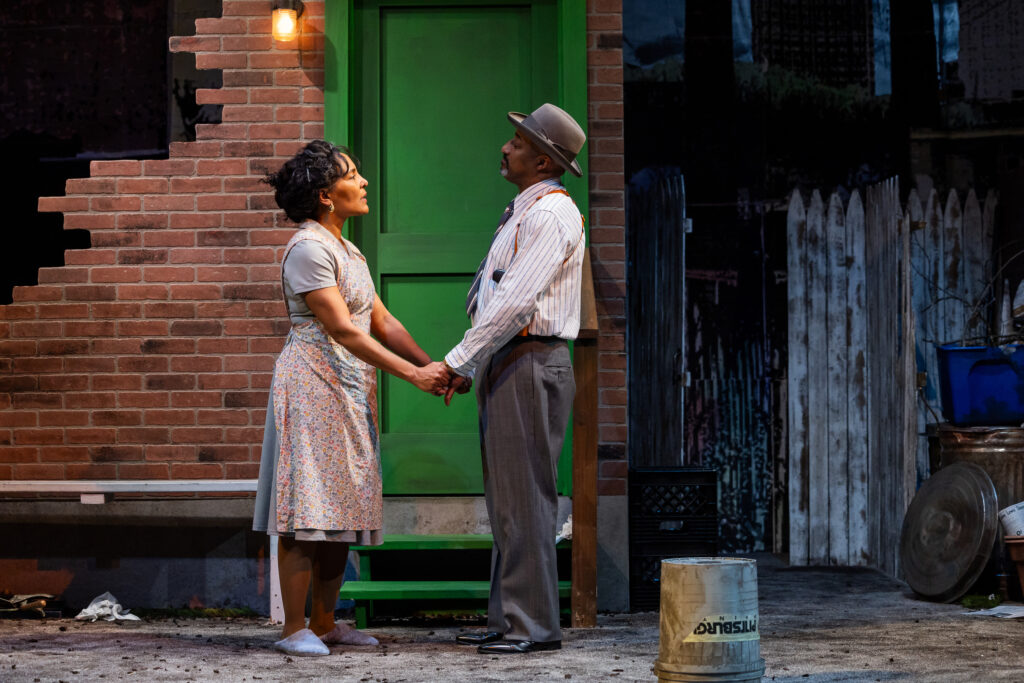
Patrice Jean-Baptiste, Garcia

Her death devastates the Hill District community. Stool Pigeon warns, “Lock your doors! Close your windows! Turn your lamp down! We in trouble now.”

He worries that without Aunt Esther to guide them, they will be lost and future generations of the Black community are at risk of never knowing where they came from.

“The people need to know the story. See what part they play,” he says. “God has already written the script, and man’s role is to play his part as written. Period.”

Their fates may be in God’s hands, but as for the ability to understand the meaning of it all and make the lack of free will bearable, well that’s another story altogether. “(God) said, ‘Let he who has wisdom understand.’ Aunt Esther got the wisdom. All that’s left now is the playing out,” Stool Pigeon says.

And for over three hours (plus one 20-minute intermission), the outstanding cast of King Hedley II does just that. Under Summer L. Williams’s crisp-paced and compassionate direction, the ensemble plays it out as both a single collective and a collection of individuals.

Notwithstanding their flaws, violent streaks and knuckleheaded moves, the men are at heart decent, caring and wanting to do the right thing. They can be whimsical and curious, undaunted by repeated set-backs. “Life is funny,” one says. “I keep trying to figure it out.”

Tonya and Ruby are voices of logic and healing, reality checks in a world where murder is a male rite of passage and a single slight can rip a dream to shreds.

King Hedley II tackles some meaty issues, both concrete and existential. Guns are everywhere, as are the consequences of their use and misuse. Poverty and conflict go hand in hand, as do death and deceit. Life is a gritty game where the white man makes the rules and those rules are in constant flux.
Yet the overarching question — how can a Black person survive, let alone thrive, in racist country? — is treated with thoughtfulness and introspection. King embodies and epitomizes the agony of trying to raise a family when all the odds are stacked against his success. “How do you build a better future when everything around you is going to shit?” he asks.

Nonetheless, his destiny is to try. When Tonya advocates for abortion over bringing a child into a world where motherhood is reduced to trying to keep that child alive, King chides her for having the baby buried before he’s born. He needs this baby both as a legacy (he already refers to him as King Hedley III) to redeem himself and as a way to prove that he has the ability to do something right.

This blind optimism is epitomized by King’s determination to force seeds to grow in a dried up patch of ground in the backyard in the middle of a slum. The image of him on his knees, tenderly tilling the dirt and rejoicing at the first signs of life, are heartbreaking and exhilarating. While the play ends on a disturbing note, this is the image remains: the extraordinariness that this ordinary man can do an ordinary thing on an ordinary day.

‘King Hedley II’ – Written by August Wilson; Directed by Summer L. Williams; Scenic Designer: Jon SavageCostume Designer: Becca JewettLighting Designer: Anshuman BhatiaSound Designer: Caroline Eng. Presented by Actors’ Shakespeare Project at Hibernian Hall, 184 Dudley St, Roxbury, through April 7, 2024

For tickets and information, go to: https://www.actorsshakespeareproject.org/
‘Seven Guitars’ Is August Wilson – And Boston Theater – at Its Finest

Cast of Actors’ Shakespeare Project’s ‘Seven Guitars’. Photo by Ken Yotsukura Photography. 

by Shelley A. Sackett

It’s hard to know where to begin praising Actors’ Shakespeare Project’s production of August Wilson’s ‘Seven Guitars.’ Jon Savage’s urban backyard set, with its backlit city side panels, gardens, make-do furniture, and hints of multiple interior spaces, combines simplicity with depth. Amanda E. Fallon’s lighting, Dewey Dellay’s pitch-perfect musical compositions, and Abe Joyner-Meyer’s toe-tapping sound design complete the immersive capsule. We are indeed time travelers to a 1948 rooming house in Pittsburgh’s Hill District.

Maurice Emmanuel Parent’s intimate and sensitive direction elicits a natural rhythm from the cast of seven first-rate actors who miraculously coalesce as an ensemble without diminishing their unique bright lights. And then, of course, there is Wilson’s multi-layered, music-infused drama, with dialogue the actors imbue with lyricism and individuality.

Regina Vital, Johnnie Mack, Valyn Lyric Turner, Maya Carter

The play opens in the rooming house backyard right after the funeral of its main character, Floyd “Schoolboy” Barton, a young blues guitarist (played by the exceptional Anthony T. Goss) who was killed just as his dream of stardom was about to come true. His murder remains unsolved.

Wilson has a knack for gathering strangers, putting them under the same roof, and creating a convivial family unit through which a complete social picture materializes. Small talk is never small from this playwright. There is a living power that pulses with every word.

The solemn scene of mourning quickly turns playful, as we meet the residents and witness the warmth and ease with which they address each other. “He almost make it where you want to die just to have somebody talk over you like that,” says Canewell (Omar Robinson), one of Floyd’s musician friends and band sidemen, about the Reverend’s eulogy.

Anthony T. Goss, Carter

Vera (Maya Carter), Floyd’s girlfriend, observes she saw six angels dressed in black carrying Floyd away into the sky. Louise (a spirited Regine Vital), the lively boardinghouse owner, her tenant, Hedley (Johnnie Mack), a Bible-thumping elder, and Red Carter (Dereks Thomas), another of Floyd’s musician sidemen, round out the group. (Ruby (Valyn Lyric Turner), Louise’s pregnant niece will arrive late in Act I. All but Louise also saw the angels whisk Floyd away.

From the get-go, the characters’ quirks and reflections on life, loss, and the history and burden of being Black in white America pepper their conversations, bonding these folks in a natural and kindhearted way. Family, in all of Wilson’s plays, is not defined by biology; it is defined by fate and choice.

The rest of the play is through flashbacks that retell the story leading up to and including, the murder. Floyd explodes onto the stage, freshly released from a 90-day stint in a workhouse detention and ready to kickstart his paused career and love affair with Vera. His plans to return to Chicago and pursue celebrity hinge on convincing Vera and sidemen Red and Canewell to return with him.

Johnnie Macks, Dereks Thomas, Goss, Omar Robinson

Floyd has an uphill battle on his hands. He left Vera for another woman when he went to Chicago the first time, and convincing her that he’s on the up and up will take all the swagger and charm he can muster. Likewise his bandmates, who were burned by their first experiences in the Windy City and the wily ways of the white record industry.

While “Seven Guitars” satisfies its audience with a plot-driven narrative, it is through its seven characters and their conversations that Wilson’s underlying messages surface. These seven are a microcosm of the ways in which racism and its oppressive economic and legal system have stacked the deck against the Black man. Yet, despite these shackles, there emerge layers of folklore, superstitions, family traditions, and shifting dreams that paint a broader, deeper social picture.

Wilson interweaves big ticket topics — male/female relationships, police brutality, the danger of being black in a white land — organically through his characters’ conversations and monologues, giving each their moment in the spotlight. Even the occasional existential soapbox riff – thanks to Wilson’s light and shrewd pen –  blends naturally with banter about recipes and family histories.

Carter, Goss

Each character has their moment, and the actors glow without showboating. All sinew and kinetic energy, Goss brings a riveting physicality to the charismatic, angry Floyd. In his hands, even a hat becomes punctuation. Carter embodies Vera, centering the play’s melancholy and grace with her calm and passion. Vital is wonderfully entertaining as the chatty Louise, whose gossip takes on the gravitas of living history. As Hedley, Wilson’s resident seer, Mack underplays the character, lending a gentle touch that tempers his apocalyptic rants. Robinson (Canewell) and Thomas (Red) round out and individualize the band members, while Turner brings nuance to the mantrap Ruby.

Though “Seven Guitars” clocks in at 2 hours 45 minutes (with one intermission), the pace and quality of the play and its staging never lag. Nominated for a Pulitzer Prize and winner of the New York Drama Critics Award for Best Play, it is fifth in Wilson’s theatrical saga of “The Pittsburgh Cycle,” ten plays set in a different decade of the 20th century. Wilson remains one of the most important voices in modern American theater, his life-size dramas drawing audiences wherever they play.

Don’t miss the chance to see Actors’ Shakespeare’s Project flawless production of this infrequently staged play. It is a must-see bases-loaded home run! For tickets and information, go to: https://www.actorsshakespeareproject.org/
‘Seven Guitars’ by August Wilson. Directed by Maurice Emmanuel Parent. Scenic Design by Jon Savage; Sound Design by Abe Joyner-Meyers; Original Music Composition by Dewey Dellay; Lighting Design by Amanda E. Fallon Presented by Actors’ Shakespeare Project, Hiberian Hall,182 Dudley St., Roxbury through March 5. Photo by Ken Yotsukura Photography. 

A Magnificent ‘Joe Turner’s Come and Gone’ Heralds the Huntington’s Jubilant Homecoming 

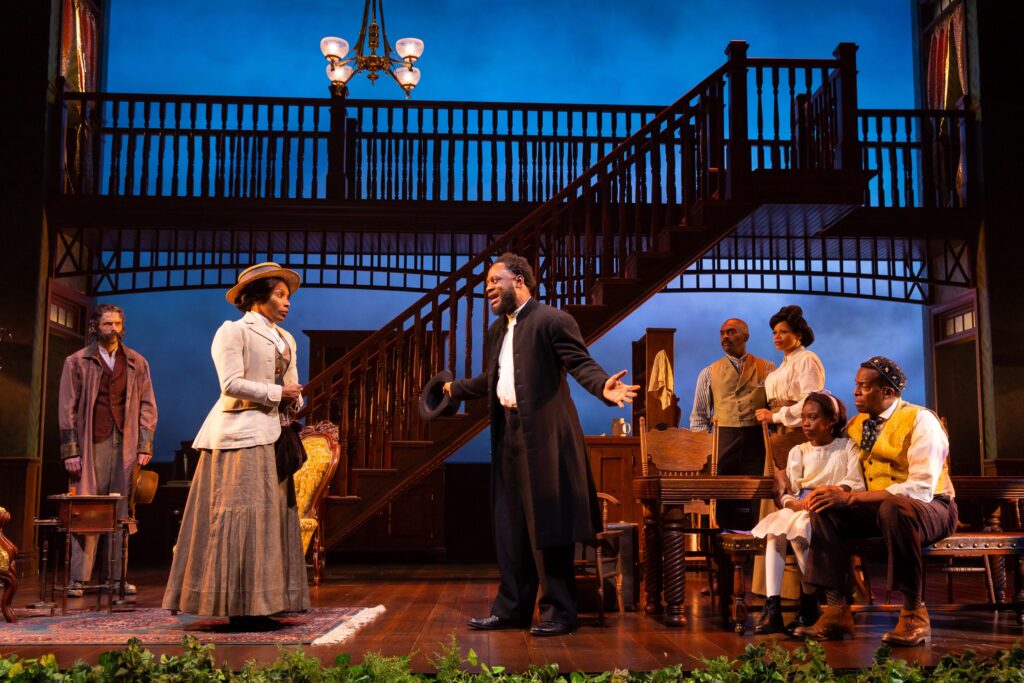
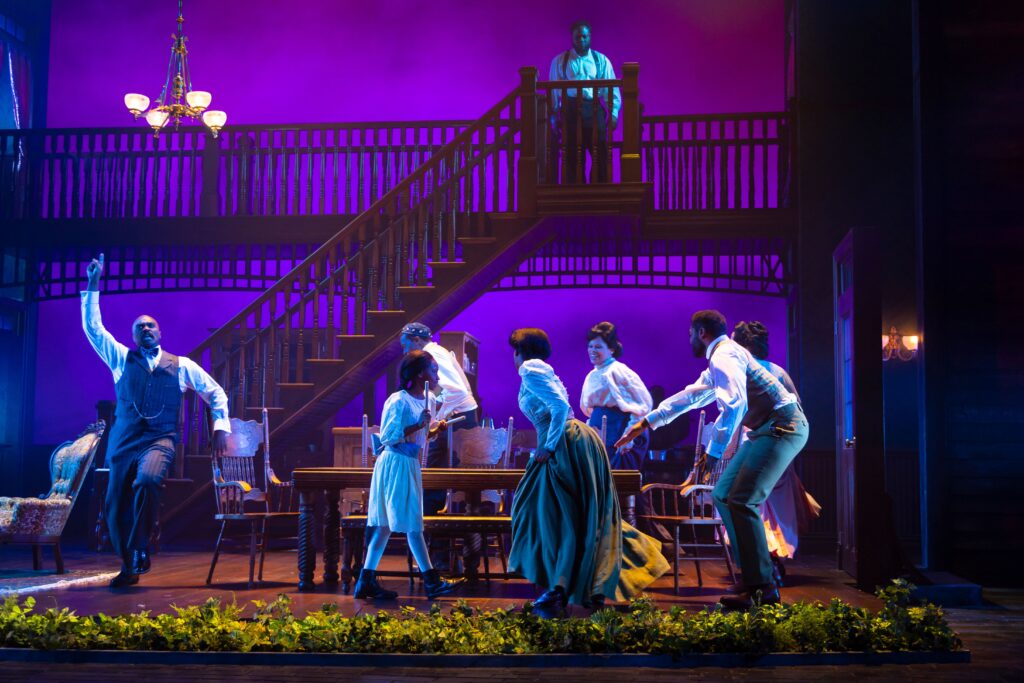
Patrese D. McClain and James Ricardo Milord (foreground) and cast in ‘Joe Turner’s Come and Gone’ at The Huntington.

‘August Wilson’s Joe Turner’s Come and Gone’ by August Wilson. Directed by Lili-Anne Brown; Arnel Sancianco, Scenic Design; Samantha C. Jones, Costume Design; Jason Lynch, Lighting Design; Aubrey Dube, Sound Design. Presented by The Huntington Theatre through November 13.

by Shelley A. Sackett

What a pleasure it is to have the Huntington Theatre Company back. With its sleek Narragansett Green walls, gold domed ceiling and cherry red extra legroom seats, an always pleasurable theatrical experience is now also one full of creature comforts. Even more stunning, however, is the magnificent production of August Wilson’s Joe Turner’s Come and Gone, with which the Huntington christened its reopening. If Joe Turner’s footprints lingered long after he had gone, it’s because Wilson’s unforgettable presence (and titular title as the Huntington’s creative patron saint) enveloped the stage.

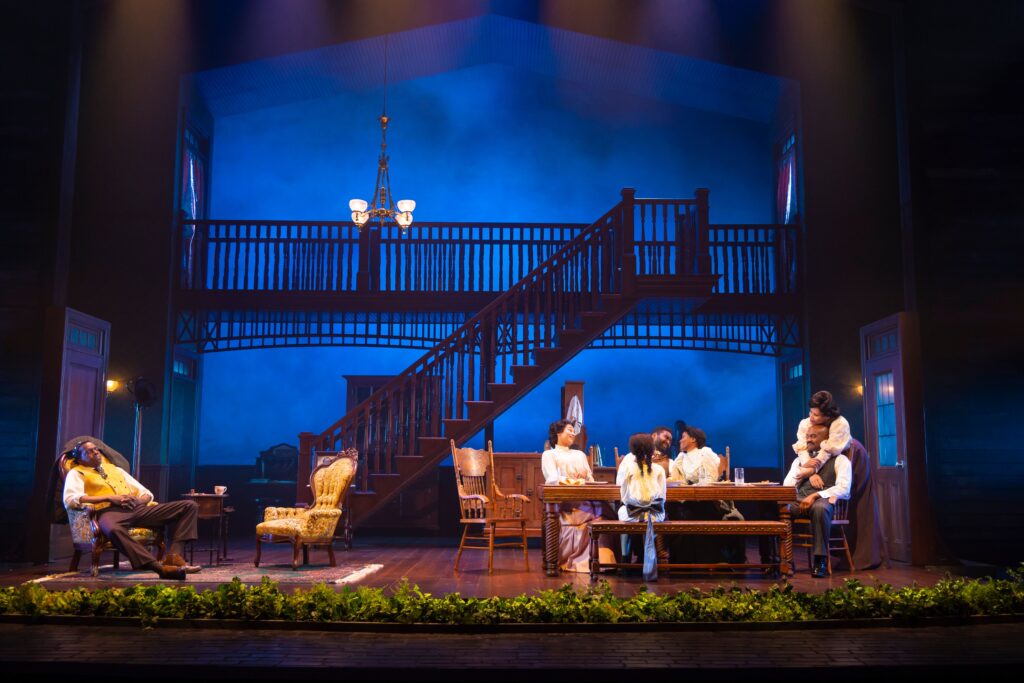
Other than sporadic trouble understanding and hearing some of the actors, the production is flawless. Arnel Sancianco’s set captures the pressed oak Victorian glory of an architectural era resplendent in its attention to eye candy detail, including a grand staircase and welcoming dining room table. A crystal clear sound system does justice to Aubrey Dube’s acoustic period selections (always a pleasure to hear Mississippi John Hurt sounding authentic but not like he’s singing underwater). And Samantha C. Jones’s costumes (especially the women’s hats) and Jason Lynch’s lighting (which manages to track the sun’s movement) are icing on the cake.

And that’s before we get to the cast’s universally brilliant acting and Lili-Anne Brown’s spot-on, outstanding direction.

First, though, a little historical background is in order. The title, Joe Turner’s Come and Gone, refers to Joe Turney, the brother of former Tennessee Governor Peter Turney. In the late 19th Century, Joe Turney was responsible for transporting black prisoners from Memphis to the Tennessee State Penitentiary, located in Nashville. Instead, Turney abused his role by running a network of “convict leasing.” He was also known for swooping down on innocent freed blacks and illegally enslaving them for seven years, often to work on his own farm. When men turned up missing in black communities, word quickly spread that “Joe Turner’s come and gone.”

Against this harsh backdrop of the Jim Crow lawless post-Civil War America, Wilson introduces us to his cast of vivid characters.

It’s 1911 and Seth and Bertha Holly run a “respectable” boardinghouse in Pittsburgh. Seth (played with pitch perfect comedic timing by Maurice Emmanuel Parent), its owner, inherited the property and business from his parents. He was born to free African-American parents in the North and is a real killjoy. Set in his ways, he is happy to assimilate to the degree he is allowed, and is economically shrewd and heartlessly capitalistic.

Bertha (the sublime Shannon Lamb), his wife of 25 years, is a loving mother to her boardinghouse family. Although she knows her place, she manages to manipulate Seth’s decision-making in subtle yet effective ways. Love and laughter get her by. She embraces Northern ways (including Christianity), but her heart and spirit remain tied to her African ancestors.

Bynum Walker, a 60ish “conjuror” who practices healing arts with herbs, incense and song, is Seth’s foil. As portrayed by Robert Cornelius, Bynum is both as large as a giant and as gentle as a lamb. He is as grounded in his roots and heritage as Seth is in his denial of them. In touch with his inner soul and identity, he offers to help those lost to themselves and others with his powers to “bind.” Bynum is part shaman, philosopher and therapist — and all compassion. He has lived at the Holly’s for a while and moves about as comfortably as if he were a blood relation.  

Jeremy Furlow (an exuberant Stewart Evan Smith), 25, is trying to find his identity as a member of the younger generation of newly liberated slaves. He is footloose and itching to travel the nation with his guitar and fancy green suit. In the meantime, he works anywhere that will hire him building whatever needs building. He naively chafes at the racial injustice he encounters and will accept the company of any woman who accepts his as he tries to find his perfect mate.

Robert Cornelius, Shannon Lamb, Maurice Emmanuel Parent and Stewart Evan Smith

The only white character in the play, Rutherford Selig (a suitably sycophantic and tone deaf Lewis D. Wheeler) is a peddler known as the “people finder.” He was also a fugitive slave finder, like his father (his grandfather ran the first ships, we’re told, that captured Africans and brought them to America to become slaves). He acts as middleman for Seth’s hand-crafted dustpans and keeps a tight record of everyone he meets on his travels.

Mattie Campbell (an earnest Al-nisa Petty), a young woman who finds Seth’s when she seeks Bynum’s help in binding her to her missing boyfriend, is disappointed in the life that has left her a bereaved mother of two dead babies and a jilted girlfriend. By contrast, the last thing Molly Cunningham (the slinky Dela Meskienyar), another tenant in her mid-20s, wants is to be bound to anyone or anything — except maybe her mama. She is independent, spoiled and totally aware of the power her striking looks and wardrobe afford her.

Into this ersatz family wanders Herald Loomis (brilliantly embodied by James Milford), a former deacon and odd man who dons an overcoat in August, and his skinny 11-year-old daughter Zonia (Gray Flaherty at last Sunday’s matinée). He has the skittish mannerisms of one suffering from post-traumatic stress disorder. He has been travelling from town to town, looking for his wife, Martha Loomis. The last time he saw her was 11 years ago, right before Joe Turner captured and enslaved him for seven years. By the time he was freed, Martha had fled. He’s been on the road looking for her for four years, Zonia in tow.

Wilson is a maestro at creating masterpieces that illustrate the Black human condition in America. Armed with this rich palette of characters and his magic wand of a brush, he paints a picture rich in both human emotion and historical context. He doesn’t polemicize, castigate or lecture, yet he makes his points about racial injustice, Black diaspora, migration and the irredeemable evil and gall of kidnapping and slavery. His wholly fleshed out characters let us through the keyholes of their lives and by the end of the play, we have connected the dots.

The specific plot twists and turns are too numerous (and contain too many spoilers) to detail here, and Wilson is more about the journey than the destination anyhow. By the end of the almost three hour (with intermission) play, the audience has experienced the pain and promise of the post-slavery years and the power of community to heal and revive a broken and lost soul.

Everyone at the boardinghouse is searching for their missing piece. Unspeakable horrors and disruptions untethered men like Herald Loomis, who has lost his sense of who he is because he cannot remember who he was before he was enslaved. For men like Seth, who has only known life in the North, slavery and its consequences are more hearsay than heartache. He’s more concerned with keeping what’s his in the face of the increased competition post-emancipation northern migration has wrought. He knows the system is, and always will be, rigged against him. His mission is to squeeze through the loopholes unnoticed and differentiate himself from these newly arrived migrants.

Seth is also a pragmatic man who doesn’t feel the need to seek meaning or purpose by way of spirituality or a return to his African roots. Christianity and churchgoing is as much about fitting in as it is about religion.  Of Bynum’s shaman-like behavior, he says, “All that old mumbo jumbo nonsense. I don’t know why I put up with it.”

Bynum, on the other hand, is at peace with himself and the world as he finds it. He believes himself to be part of a “grand design,” a belief that ultimately allows him to “swallow any adversity.” For Bynum, his spirituality and helping others re-find themselves become a way of making sense and finding his own purpose in an unpredictable world.

Straddling the two is Bertha, who is as down to earth and practical as Seth but takes comfort in Bynum’s old forms of African healing and mystical practices. One of the highlights of the play is the joyful “Juba” dance around the kitchen table where all but Herald participate and lose themselves in a moment of communal ecstasy. (The Juba dance was originally brought by Kongo slaves to Charleston, S.C.).

By the play’s end, Loomis (and several others) have found their inner song and are on the path to exploring their identity, and the audience standing has found itself in thunderous applause. Wilson’s words and spirit spin a magic that will resonate long after the last cheer has faded. Highly recommended.

For tickets and information, go to: https://www.huntingtontheatre.org/