52nd Street and All That Jazz

Billie Holiday’s unmistakably seductive voice singing “Fine and Mellow” lures the listener into Bowdoin College of Art’s second floor Shaw Ruddock Gallery. Stepping into the installation “On 52nd Street: The Jazz Photography of William P. Gottlieb” is like entering a time capsule into the 1940’s, when 52nd Street’s “Swing Alley” in New York City was the epicenter of jazz, and William P. Gottlieb (1917-2006) was its passionate chronicler.

The exhibit is a compact, deeply satisfying gem. The 40 vintage gelatin silver prints of jazz musicians in performance are accompanied by a continuous loop of nine classic songs from such masters as Louis Armstrong, Ella Fitzgerald, Coleman Hawkins and Lionel Hampton. Gottlieb’s photographs capture the artists’ personalities with all the intimacy that close-up pictures provide. The narratives beside each photograph include Gottlieb’s descriptions of what he felt, shooting in the dark, densely packed confines of those smoky, heady jazz clubs. They also describe some of the innovative techniques he had to invent so he could shoot without a flash. His ability to remain unobtrusive is evident in the unguarded portraits he produced.

Known as “Mr. Jazz,” Gottlieb was born in Brooklyn and began writing a jazz column for The Washington Post during his senior year at Lehigh University. When the Post decided it could not afford to pay a photographer to shoot photos for his column, Gottlieb bought his own press camera and began taking his own photographs. Over the course of his career, he took hundreds of pictures of jazz musicians, four of which were the basis for U.S. postage stamps and 250 of which found their way onto record album covers.

A skilled craftsman, Gottlieb’s photos embody a natural empathy for and attraction to his subjects. He captures the personalities of the jazz musicians in a subtle, anecdotal way. “In my photographs, I try to say something visually that augments the written review,” Gottlieb said. In his iconic 1947 photograph of Billie Holiday, he wanted to capture “the beauty of her face and the pain in her voice.” It remained one of his favorite pictures.

“The Street,” according to Gottlieb, “was heaven on earth for jazz fans and musicians.” Bowdoin College Museum of Art’s exhibit is a little piece of that heaven on earth, at least until September 14, 2014.


Pictured at top: Billie Holiday, 1946 Photos by William P. Gottlieb and courtesy of the Bowdoin College Museum of Art

Evocative Post-Impressionist Exhibit Enthralls

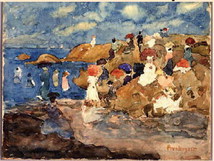
Salem Cove, 1916


M
aurice Prendergast (1858-1924) and his jubilant style seduced me at the Barnes Museum in 1999. A snobby Francophile, I was ill-prepared to lose my heart to an American Post-Impressionist artist in that quirky bastion of French Impressionist masters. But lose it I did. For the last 14 years, I have wondered why Prendergast was not more widely exhibited. Bowdoin College Museum of Art’s stunning “Maurice Prendergast: By the Sea,” on exhibit until October 13, 2013, makes up for lost time.

Prendergast was born in St. John’s, Newfoundland, to a shopkeeper who moved the family to Boston in 1868. He studied painting in Paris and spent summers in France honing his skills and establishing his lifelong artistic niche of representing seascapes and the crowds that flocked to them.

He returned to Boston in 1894 where he worked as a commercial artist. He spent many hours at Boston’s piers, chronicling the men, women and children who idled by the water.

By 1900 he had his first solo show in New York. He was continuously lauded and exhibited until his death in 1924. A lifelong bachelor, his frail health left him deaf at an early age. His brother Charles, a gifted craftsman whose frames house many of the works on display, was his constant companion and supporter.

The enchanting show (and its equally wonderful catalog) gathers, for the first time, a retrospective of Prendergast’s seaside imageries of New England, Italy and France. The 88 oils, watercolors, pastels, sketches and monotypes celebrate the artist’s decades-long love affair with all things “seaside.” These are not just pictures of pretty scenery. Each is alive with crowds of happy people enjoying the sea. The thickly applied vibrant color of his oils, and masterful fluid transparencies of his watercolors, establish Prendergast as an imaginative authority of his craft.

salemcoveRevere Beach 1896.


Strolling from room to room, one is aware of the influences of Sargent, Cezanne, Renoir and Bonnard. And yet, with that awareness comes an appreciation for this artist’s unique and innovative contribution to the evolution of the genre. His oil paintings vibrate with sumptuous color. His playful watercolors emit a peacefulness and deep admiration for both landscape and those enjoying it. The obvious joy his animated well-dressed subjects take in their surroundings is contagious. Adding to this exhilarating mix is the unexpected surprise of recognizing our own backyard in many of the paintings’ titles (Marblehead, Nahant, Revere Beach, Salem). The oil, “Marblehead Harbor,” on loan from the Barnes Foundation, is a particular thrill.

I dare you to go to this delightful show and not fall in love. In fact, I double dare you.