Flight 1619 Finally Lifts Off in SpeakEasy/Front Porch’s Ambitious ‘Ain’t No Mo’

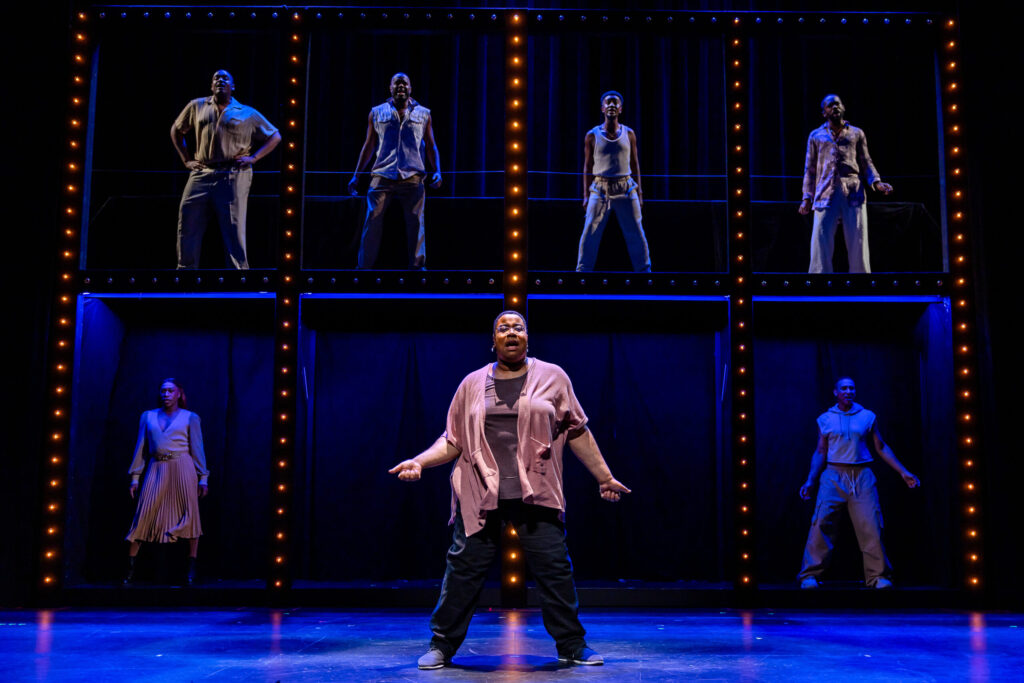
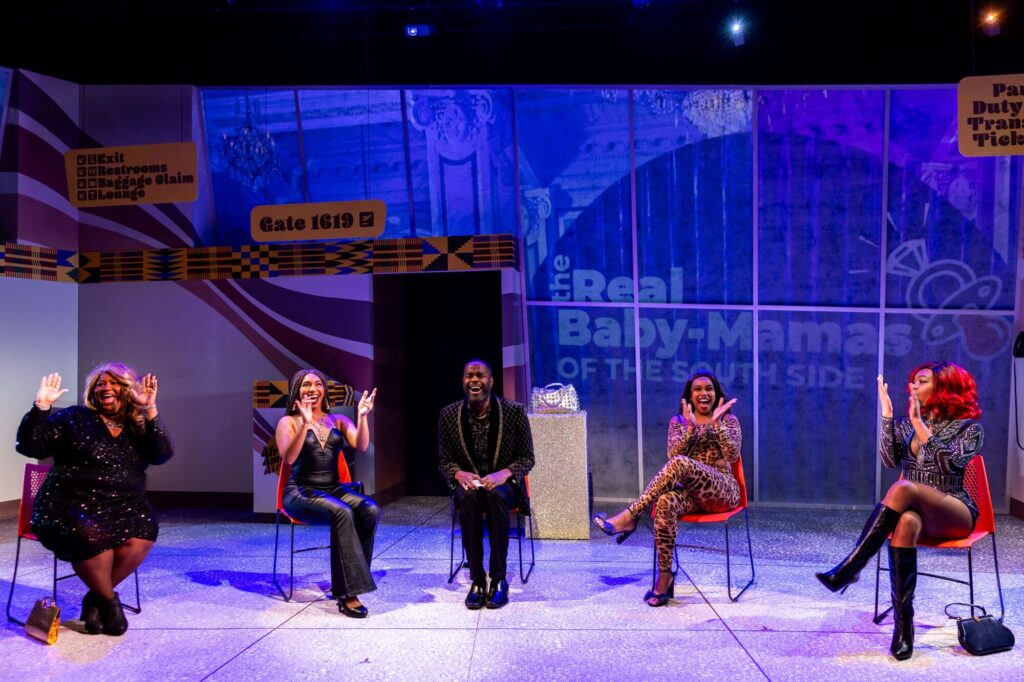
Cast of SpeakEasy/Front Porch’s ‘Ain’t No Mo’ Photos: Nile Scott Studios
MaConnia Chesser, Kiera Prusmack, De’Lon Grant, Schanaya Barrows, and Dru Sky Berrian.

By Shelley A. Sackett

Jordan E. Cooper’s Ain’t No Mo is a complicated, uneven, scathing, audacious, and hilarious rollercoaster ride of a play. It covers a lot of ground, and Cooper dips his pen into the inkwell of every genre known to playwrights: from satire, allegory, fiction, and parody to tragedy and Shakespeare-worthy soliloquy.

Performed as a series of loosely connected vignettes that sometimes change at whiplash speed during 100 intermission-less minutes, this SpeakEasy Stage Company/Front Porch Arts Collective production is guaranteed to spark lively post-theater discussion.

Here’s the premise.

In 2016, with the election of Donald Trump and the end of Barack Obama’s presidency and its promise of Hope and Equality, African Americans descended from slaves are offered a one-way ticket “home” to Dakar, Senegal. A “dedicated observer of equal oppression,” African American Airlines’ Flight 1619 is in the house, or the White House to be more precise. Whether to stay and live life as it is in this country or leave on the “Reparations Flight” and start anew is each individual’s choice.

The government expects this will solve the problem of racism in America once and for all. Almost all eligible Blacks (millions) register to take advantage of the free flight.

What Cooper does with this simple premise, however, is staggering in terms of its brazenness and sheer creative genius. Director Dawn M. Simmons executes with full-throated flamboyance and exaggeration.

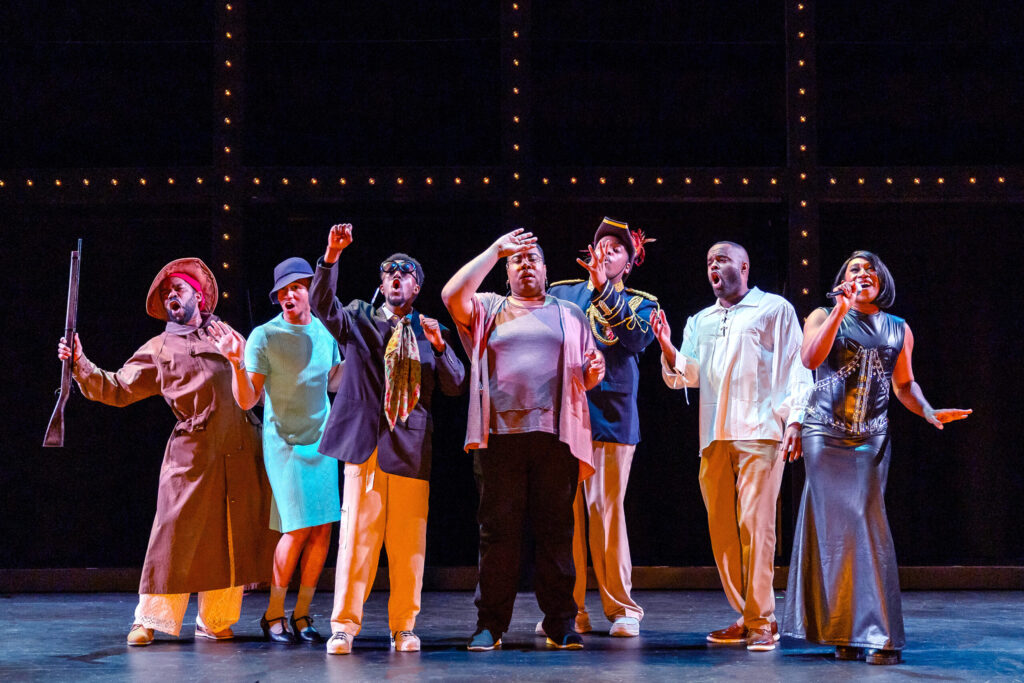
The six-actor ensemble switches into many roles easily, aided by Rachel Padula-Shufelt’s fabulous costume design and wig choices. Mac Young’s set design is both flexible and exacting, flowing smoothly between very different settings. Aja M. Jackson’s lighting design and Aubrey Dube’s sound design help create a unifying aesthetic for the show’s differing segments.

Cooper’s no-holds-barred approach is evidenced full blast even before the house lights are fully dimmed. The mild-mannered recording that announces where exits are and what to do in case of an emergency is suddenly interrupted by Peaches, the Flight 1619 airport gate attendant.
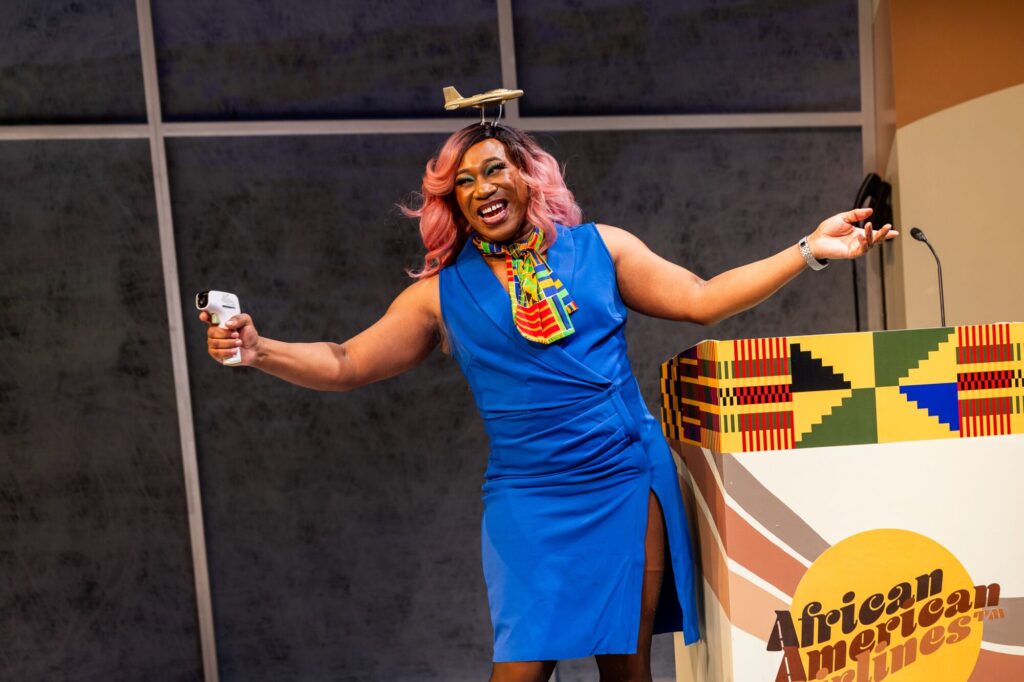
Grant Evan

“Ladies, gentleman, and those who don’t give a damn. Welcome yo ass to The Roberts Theater. Yessss, we in Boston, bitch! It’s ‘bout time to get this thing started, so I hope you had enough sense and shat before you sat,” she shouts into the sound system.

The rest of the play, which starts with the election of President Obama and ends with Flight 1619 taking off, traces the Black American experience with scenes Cooper chooses to exemplify that jumbled, complicated, painful journey. Like a book of loosely connected short stories, each scene functions independently, yet, taken together, they weave a single cloth.

What unites them is their characters’ reactions to news of the subsidized flight to Africa. Will they stay or leave? And, more importantly, why?

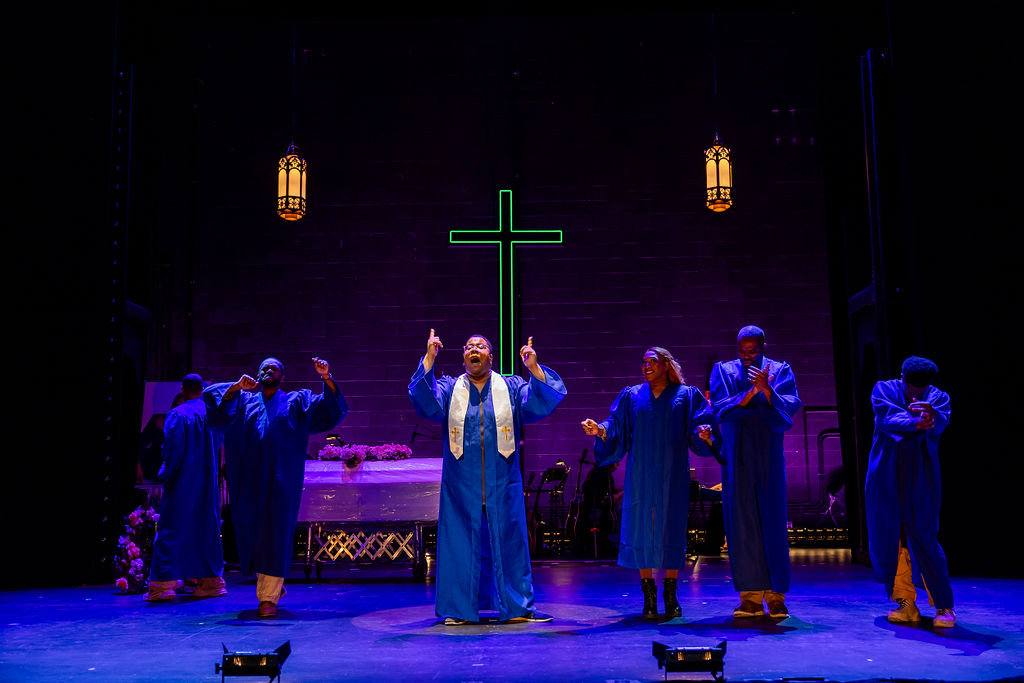
The action opens with “Book of Revelation,” a bang-up of a funeral led by Pastor Freeman (played with over-the-top verve by a terrific De’Lon Grant). It is November 4, 2008, and the Black community has gathered to celebrate Obama’s election and lay Brother Righttocomplain, the embodiment of protest and injustice, to rest.

“Ain’t no mo’ shot down dreams with its blood soaking the concrete,” Freeman bellows. “Ain’t no mo’ riots.”

Now that a Black president has been elected, the unrealistic assumption is that centuries of racism and discrimination will suddenly be reversed and a new era of promise will be escorted in.

The joy and celebration is short-lived. After this gospel-infused scene, the mood and time shifts to 2016 and the election of Trump. White backlash against black Americans and ginned-up fear and resentment will set the next agenda.

Between each plotted scene, we witness morsels of what Peaches (a scene-stealing non-binary Grant Evan) is dealing with as the sole check-in agent for Flight 1619. A larger-than-life drag queen who wears a hot pink wig, Kente scarf, and model airplane-adorned tiara; her role is the play’s only constant through a series of sketches and settings.

She checks in various passengers and offers counsel to those who are hesitant. She also prepares Miss Bag, a suitcase she claims holds “our entire story as a people in this country,” and encourages passengers to drop their stories in the bag so they may bring it to Africa. She warns those who stay behind will be subjected to “extreme racial transmogrification” by “The Powers That Be”: they will be turned into white people.

The audience comes to trust her voice and feel her frustration and angst as she single-handedly supervises boarding millions. She is the reliable narrator, part mother hen and part Greek chorus.
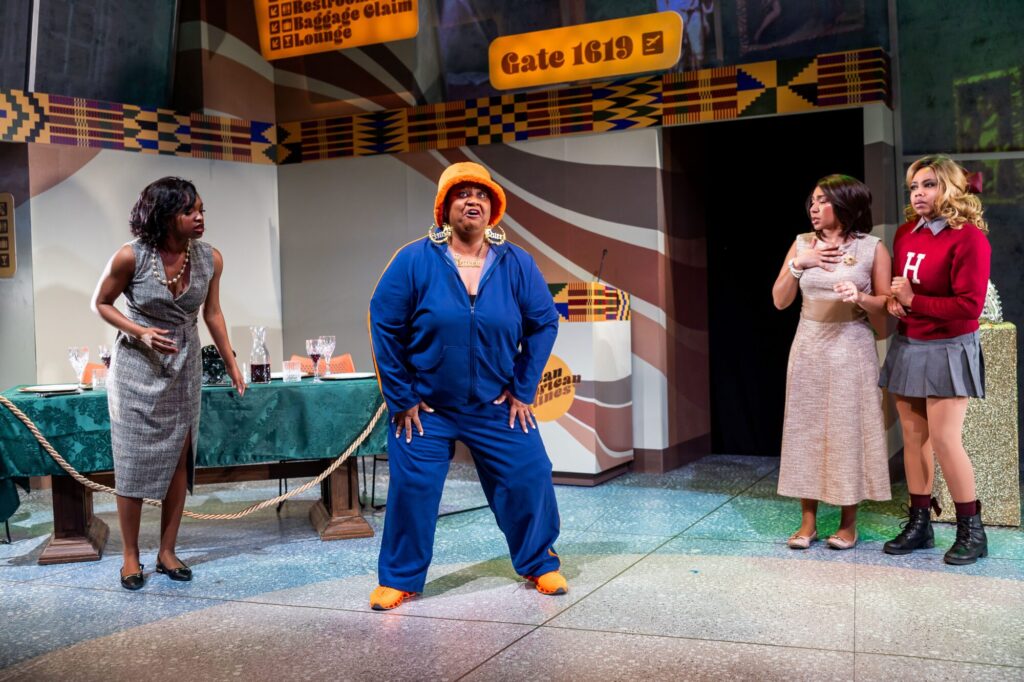
Dru Sky Berrian, MaConnia Chesser, Kiera Prusmack, and Schanaya Barrows

With “Circle of Life,” Cooper tackles the heartbreak of young lives ended by violence and police brutality and the unwillingness of Trisha (Dru Sky Berrian), pregnant by Damien (Grant), to bring a future victim into the world. “A better time is coming. We just have to wait for it,” Damien assures her. Despite his pleas, she is adamant. So are the million other women in line at the Sister Girl We Slay All Day Cause Beyonce Say Community Center, a clinic oasis in a country where abortions are no longer available. Trisha is Number 73,545.

“Real Baby Mamas of the South Side” is a parody of the Real Housewives franchise. This one focused on four black women pretending to have multiple baby daddies and an obsequious host who keeps the provocation flowing. One panelist isn’t even black but is “transracial,’ white Rachel dressed as black Rachonda, “choosing to be herself” and “living her truth” as a black woman.

Tracy, another panelist, breaks character and confronts her. “Race is not a choice. It’s a fact,” she states. Unlike the Rachondas of the world, her skin and the experiences that come with it are NOT optional.

Here, and at many other times, Cooper squanders an opportunity to dig deep into some meaty issues like exploitation, appropriation, stereotyping, ownership, protection of black culture and the tipping point between the humorous and the hateful. Instead, he takes the easy way out, letting the scene devolve into a catfight, leaving the audience unsatisfied and his craftsmanship in question.

In “Green” and “Untitled Prison Play,” Cooper makes his point with more clarity and self-discipline. Each scene features Maconnia Chesser, who anchors and elevates them. In “Green,” Cooper lampoons rich black families who – in this case literally — buried their blackness and partook in the material rewards of assimilation. They have no intention of going anywhere, certainly not to Africa. They have bought into the American Dream, despite its hefty price tag. This is now their America, too.

Chesser plays Black, the human personification of their family’s “blackness,” locked away in the basement by the family’s deceased patriarch for forty years while he became rich. Suddenly, she is set free. She has a lot to say. And she is pissed off.

“Now is the chance to learn who you really are,” she tells them. “I am your family’s black. Come on, we have a plane to catch.” Instead, they plead, threaten and eventually try to shove her back into the basement. No way is this Pandora going back into her box.

Again, the scene devolves into chaos and violence, and again, we are left unsure what point Cooper was trying to make and why.

In “Untitled Prison Play,” the play’s most moving scene, Chesser plays an inmate who can’t leave prison without signing for her possessions and who won’t sign until everything she had when first incarcerated is accounted for and returned. What she’s missing are her joy and a little piece of chaotic peace. Her name. Her place on earth. And, most of all, her smile. Her real smile.

But her choice is stark. Refuse to sign and return to her cell or leave and find herself some new stuff. Like Freedom.

Flight 1619 does finally takes off, but not before Peaches brings down the house with a lightning bolt monologue. There are even last-minute spoilers and pyrotechnics.

When Cooper started Ain’t No Mo, he was just a high school student. Its genesis was in reaction to an incident of police intimidation that rocked and changed him. Its Off-Broadway premiere happened when he was just 24 years old and three years later, Cooper became the youngest Black American to make his Broadway playwriting debut and the youngest Black American playwright ever nominated for a Tony Award. Ain’t No Mo garnered six nominations, including Best Drama, despite its closing after a mere three-week run.

To be sure, Cooper’s play is hardly flawless. It is dated and full of platitudes, pacing issues, and tiresome, gratuitous expletives. It is also in dire need of judicious breadth and length editing.

But Cooper’s pen is a magic wand as well, spinning a smart, confident and grand play out of an undisciplined galaxy of issues and ideas. And when the smoke clears and the stage finally quiets, we’re surprised by the number of important questions left rolling around in our minds, like party favors.
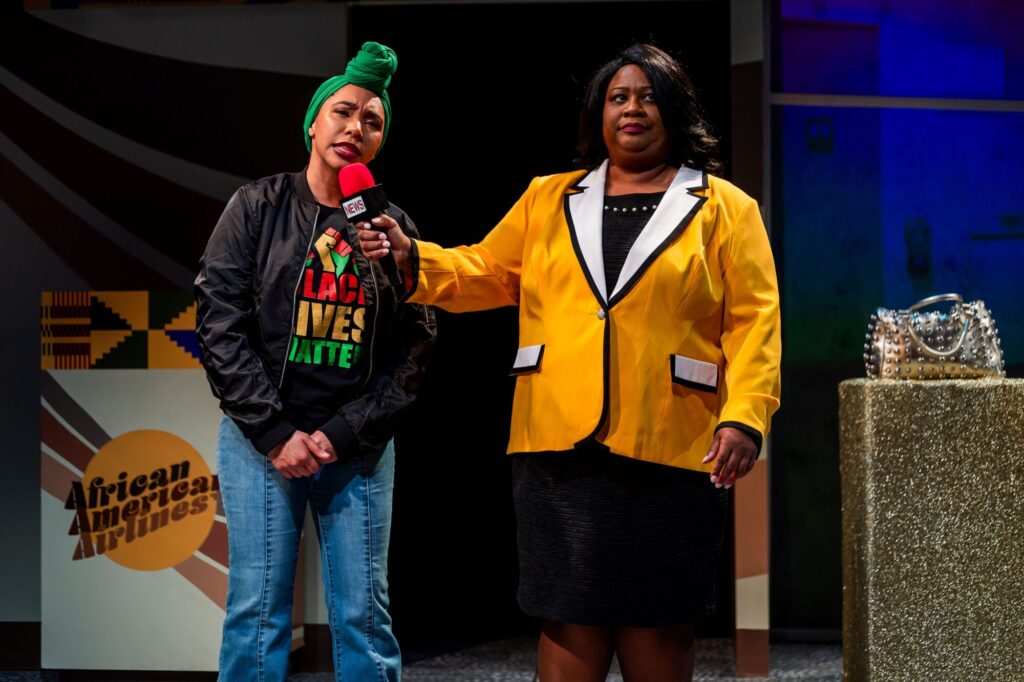
Kiera Prusmack and MaConnia Chesser

If Miss Bag is the “carrier of our entire story as a people in this country” — the music, art, culture, political ideas, and everything else Blacks have contributed to the American landscape — should it travel to a new destination? Will it reassimilate or hold its owners back, married to an old reality while trying to forge a new one?

When émigrés board a plane, for example, perhaps with just one bag, what do they leave behind? What does the country they leave lose? And after they leave, whose story is theirs to tell? What do we do when the story is over? Perhaps, most importantly, where does freedom fit in if its price is a future without a past?

And these questions are just for starters.

‘Ain’t No Mo’.’ Written by Jordan E. Cooper. Directed by Dawn M. Simmons. Co-produced by SpeakEasy Stage and Front Porch Arts Collective at the Calderwood Pavilion, 527 Tremont Street, through February 8.

For more information and to buy tickets, visit https://speakeasystage.com/shows/2025/01/aint-no-mo/
The Wheels Go ‘Round and ‘Round and ‘Round in SpeakEasy Stage/Front Porch’s ‘A Strange Loop.’


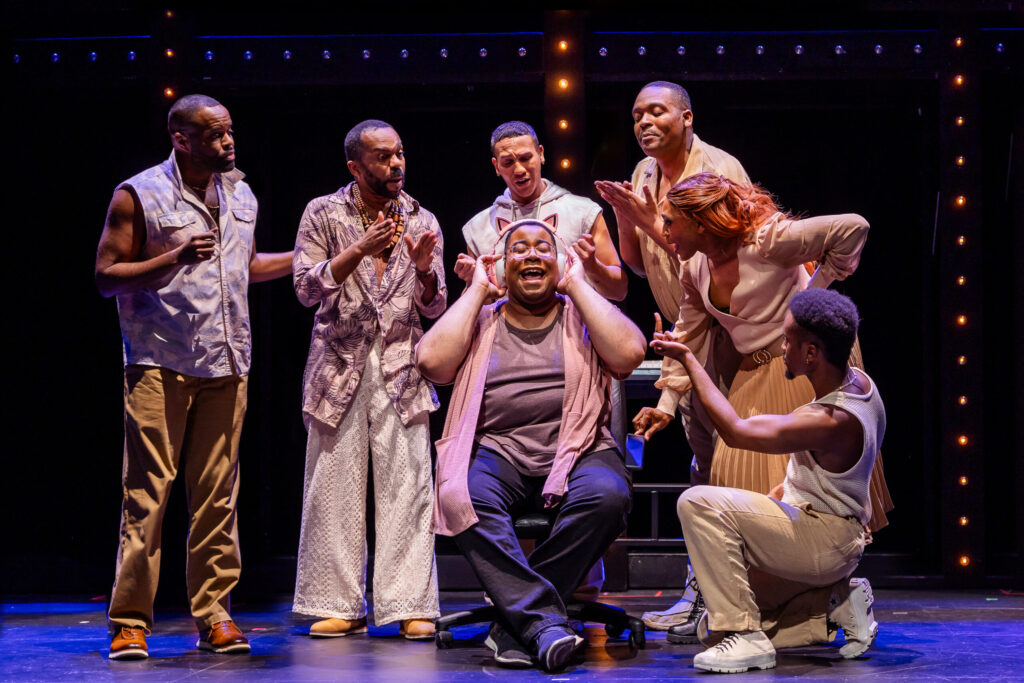
Kai Clifton (center) and the company of A STRANGE LOOP at Speakeasy Stage. From left: De’Lon Grant, Davron S. Monroe, Jonathan Melo, Aaron Michael Ray (background), Grant Evan, and Zion Middleton (kneeling). photos by Maggie Hall Photography.

By Shelley A. Sackett

Playwright Michael R. Jackson, a heavy-set Black queer man, has brought the concept of sharing to a new level in his Pulitzer Prize and Tony Award-winning musical, “A Strange Loop.” The compulsively introspective show, which runs at 100 intermission-less minutes, spelunks into the deepest crevices of the anguished mind of its hero, Usher, a fat, Black, queer man writing a musical called “A Strange Loop” about a fat, Black queer man who’s writing a musical about a fat Black queer man.

It’s a crawl through a wormhole rigged with armed psychological and emotional IEDs, self-loathing, and regrets. It’s also a raucous and playful musical, full of humor, harmony, colorful characters, and even more colorful (potty) language.

The play opens on Jon Savage’s effective, slick set of eight cubes lit in Broadway blue neon. (The only guidance Jackson’s script offers is to describe the setting as “A loop within a loop within a loop inside a perception of one man’s reality.”) Characters meant to represent Usher’s thoughts stand inside each cube. They dance. They sing. The effect is a cross between “Shindig” and “Hollywood Squares.”

We meet Usher (Kai Clifton) as the Thoughts dress him in his professional usher’s uniform. Usher works to make money in a theater where “The Lion King” reigns while he tries to write his play, a “big, Black, queer-ass, American Broadway show.” As he externally prepares to deal with the patrons who will soon flood the theater’s aisles, his mind is busy writing his play. He eagerly shares this work-in-progress with the audience.

““A Strange Loop” will have black shit! All thoughts. And white shit! It’ll give you uptown and downtown! With truth-telling and butt-fucking! There will be butt-fucking!” he belts out with gleeful forewarning.

It’s as if Jackson and Usher want to tip off their audience, “This ain’t no Disney musical, and make no mistake, we aim to deliver,” which they do, especially on the last item.

Usher leads a complicated inner life. His mind is a six-lane highway where Thoughts criticize, intimidate, denigrate, and insult his every move. Every time he resolves to dig himself out of his miserable routine, his thoughts disrupt and derail his plans.

The supporting cast of Thoughts #1-6, donning eye-catching costumes (Becca Jewett), are a vicious gang representing Usher’s agent (Fairweather), his inner cynic (Your Daily Self Loathing) and a host of other unhelpful characters, most notably Mom and Dad.

Through these inner/outer conversations between Usher and himself, Usher reveals his quest to peel back the layers of labels (Black, queer, etc.) and discover who he really is. We learn about all the issues he struggles with, including family pressures to ditch his sexual and professional preferences and embrace the Lord and style of Tyler Perry’s gospel melodramas; trying to figure out what it means to be a Black playwright writing a Black play; and struggling with what today’s world requires if one is to be “Black enough” and “gay enough.”

He also is coping with the bull’s eye homophobia, fatphobia, racism, and a white theater industry painted on his back.

All this should (and does) sound heartbreaking and overbearing. Yet, Jackson manages to pull off a musical that infuses humor and sincerity into a story replete with sadness, desolation, and rejection.

Through seventeen songs, Jackson’s lyrics tell a multilayered story of Usher’s angst-ridden life.

He longs for the unhampered freedom white girls have, yet also feels obligated to fulfill Black boy stereotypes (“Inner White Girl”). His doctor tells him he’s not gay enough because he’s only having sex once a year, but when Usher starts using dating apps, the result is predictably humiliating. He meets an engaging, flirtatious stranger only to discover he is a figment of his imagination.

The list of disappointments and rejections grows longer. His mother calls him on his birthday to remind him homosexuality is a sin, and his father asks if he’s contracted AIDS yet.

The best scenes, dramatically and musically, are those that have anything to do with Gospel music. When Usher’s agent tells him Tyler Perry is looking for a ghostwriter for his next gospel play, Usher turns up his nose in disgust. His Thoughts accuse him of being a “race traitor,” and in a hilarious scene, historical Black figures persuade him to take the job (“Tyler Perry Writes Real Life”). The full replication of a Tyler Perry set and lyrics that skewer Usher’s parents and parody Tyler (“Precious Little Dream/AIDS Is God’s Punishment”) are a welcome break. The actors’ voices (especially Clifton’s) awaken and strut their range and vibrancy. The lyrics are edgy and funny, the tune snappy and toe-tapping.

With the exception of distracting and annoying technical problems with the sound mixing (the actors’ voices were frequently not mic’d) and muffled lyrics, the production is effective, from Maurice Emmanuel Parent’s thoughtful direction to David Freeman Coleman’s music direction and conducting. The six Thoughts shine individually and blend seamlessly as an ensemble.

But it is Clifton as Usher who literally carries the weight of the show, and he is more than up to the task. Despite the temptation to wash our hands in frustration with this character who can’t seem to get out of his own way, his unfortunate circumstances notwithstanding), Clifton brings an underlying earnestness and likeability that make it impossible to abandon him. Plus, Clifton lets loose a powerful set of pipes during certain numbers (notably the gospel songs).

It’s hard to understand Jackson’s real purpose in writing “A Strange Loop.” It takes its title from a Liz Pfair song and from Douglas Hofstadter’s scientific concept that when a person only moves up or down, they’ll end up where they started. In other words, no matter how far or fast they think they’re going, they are essentially marching in place.

Jackson, now 43, said that although his play is not formally autobiographical, he began writing it as a monologue in his early 20s when he was experiencing himself as “nothing more than a mass of undesirable fat, Black gay molecules floating in space without purpose.”

He wrote Usher as a 26-year-old under unimaginable pressure. He is full of self-doubt and self-loathing, yet compulsively writes about himself in the belief it will magically change him. The more he plumbs his inner self, the more guilt and shame he dredges up. If writing “A Strange Loop” was meant to be Usher’s psychological catharsis, it misses its mark.

After all, Usher’s closing words are:

“Someone whose self-perception is based upon a lie,

Someone whose only problem is with the pronoun “I.”

Maybe I don’t need changing

Maybe I should regroup

’Cause change is just an illusion.

If thoughts are just an illusion, then what a strange, strange loop.”

And maybe that is Jackson’s point, after all. Inside his endless, strange loop of destructive thoughts and desperate hope that he can change who he is, Usher is his own worst enemy. Not only does he see himself as a failure, he assumes that everyone sees him as he sees himself.

His illusions are negative delusions.

It takes someone outside the loop—an impartial audience, for example—to appreciate that underneath this angsty, meek gay Black man beats the heart of a brave, creative person full of caustic wit and laser-sharp insight. We can only hope that Usher and all those suffering as he does can jump off the treadmill of self-doubt and fear, take a deep cleansing breath, and learn to love and accept themselves.

‘A Strange Loop’ — Book, Music and Lyrics by Michael R. Jackson. Directed by Maurice Emmanuel Parent. Music Direction by David Freeman Coleman. Choreographed by Taavon Gamble. Co-produced by SpeakEasy Stage and Front Porch Arts Collective at the Calderwood Pavilion, 527 Tremont Street, through May 25.

For more information and tickets, visit https://speakeasystage.com/

High Spirited ‘Chicken & Biscuits’ Marks Front Porch’s First Solo Production

Cast of ‘Chicken & Biscuits’ by The Front Porch Arts Collective at Suffolk University Modern Theatre

By Shelley A. Sackett

The architectural bones of Suffolk University’s Modern Theater are a set made to order for ‘Chicken & Biscuits,’ the first solo production by The Front Porch Arts Collective, a Black theater company whose previous presentations have been in collaboration with other larger companies.

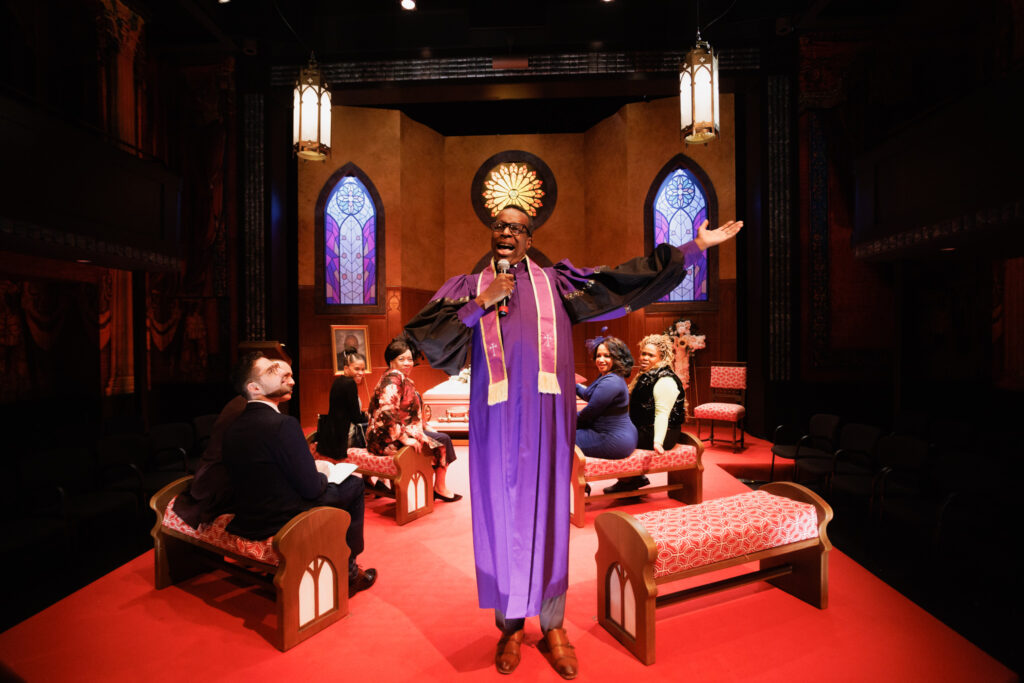
With its dark wood pews and balconies and Cluny-esque murals, we feel like part of a congregation even before the setting shifts from Reverend Reginald and Baneatta Mabry’s New Haven home to the sunlit church where Reginald will preside over the funeral of revered Pastor Bernard (“B”) Jenkins, his former father-in-law.

The play opens in the Mabry home, with Baneatta and Reginald preparing to attend Bernard’s funeral. Baneatta sits alone, having a private tête-a-tête with God, with Whom she is on intimate and joking terms. Within easy eavesdropping distance, the audience gets the lay of the land. All is not peace and love between Baneatta and her younger sister, Beverly, who buttoned-up Baneatta describes as a wild woman. The two have not seen each other in a while and, based on that most recent encounter, Baneatta anticipates the worst.

Reginald comes downstairs, interrupting Baneatta’s conversation. With B’s passing, Reginald inherited his pulpit. Bernard’s funeral is his first lead sermon in this new role, and he’s as nervous as his wife, but for different reasons. B was the glue that held both family and church together, leaving Reginald with pretty big shoes to fill. That his opening act will be B’s eulogy is daunting enough without the threat that the two rivalrous sisters will be at each other’s throats.

“Today should be a day of memory and healing for the family, not chaos,” he reminds Baneatta, offering her the chance to talk.

“I already talked about it with Jesus,” she replies, to her husband’s visible relief.

The scene shifts to Beverly and her 15-year-old daughter La’Trice as they get ready for the funeral, and we immediately understand the Mabry’s trepidation. Beverly is smoking a cigarette in her nonsmoking hotel room, defiantly blowing the smoke out an opened window. She is as brazen, brassy and flamboyant as Baneatta is proper, reserved and patrician. She is a spitfire to be reckoned with and she is also VERY loud.

For her father’s funeral, she has chosen a sausage-casing tight and revealing blue lounge singer dress and rhinestone studded belt and stilettos (Costume design by Zoe Sundra) . Even her aspiring rapper daughter, dressed in raggedy chic hip hop, asks if she maybe should tone it down a bit. Beverly will hear none of it. This funeral is a celebration, she says; and besides, there may be some good husband hunting to be had.

Rounding out the family are Kenny, Reginald and Baneatta’s gay son, and his sister Simone.  Kenny has brought his white, Jewish partner Logan to the funeral, hoping that his mother and sister will finally accept him for who he is, as his grandfather did. Simone, unlucky in love and as serious and perfection-obsessed as her mother, is nursing a recently trampled heart, searching for her lost self-esteem.

There is also a shadow lurking in the wings, a mysterious series of phone calls from someone Baneatta does not want to hear from, especially not on the day of her daddy’s funeral. (No spoilers here!)

As the family gathers, each member’s backstory is exposed, along with their strengths and Achilles’ heels. The conversations leading up and after the funeral service are meaty and thought-provoking. La’Trice confides in Simone that she wonders if she would have turned out a different person if she had known her father, whom she has never met. Simone confesses to Kenny that after her Black boyfriend dumped her for a white girl, she stopped eating for three months. “I can’t understand why God would want me to hurt this way,” she tells him.

For his part, Kenny wants to be open and accepted, something his mother and sister have refused to do. “A life style is something you choose. My sexuality is who I am,” he explains to Simone. “How do you find yourself while you’re trying to hide yourself?”

While the family may present as dysfunctional and unhealable, Reginald’s brilliant eulogy and each member’s parting words show how much their father and grandfather touched each of their lives. “You weren’t perfect, but you loved us perfectly,” Baneatta shares.

The play, however, and especially this production, is a lot more than somber reflections on family dynamics. God, shame, love, loyalty, joy, secrets and empathy are all given their moment in the sun.

It is also a hilarious dramedy with a script full of belly laughs. When the mysterious caller shows up at the funeral, a slow-motion meltdown of destruction set to a Rap song ensues. Thanks to Lyndsay Allyn Cox’s direction and her talented cast, there are also engaging performances all around. Robert Cornelius brings his honeyed baritone and charismatic presence to the role of Reverend Reginald Mabry. Jacqui Parker plays Baneatta with grace, gravitas and soul. She is the cornerstone of ‘Chicken & Biscuits,’ and Parker commands the stage, grounding and centering the play from start to finish.

Thomika Bridwell gives it her all — and then some — when playing the irrepressible side of Beverly, but truly shines when modulating and portraying her quieter, more contemplative counterpart.

Lorraine Kanyike brings a freshness to La’Trice, and Adrian Peguero and Sabrina Lynne Sawyer stand out as siblings no longer rivalrous. But it is Mishka Yarovoy who chews up the scenery as Logan, Kenny’s neurotic Woody Allenesque partner whose spot on physical comedy is matched by his impeccable timing.

Erik D. Diaz’s economical and effective set magically transforms the Mabry home into a church by removing of a few panels to replace windows overlooking a tree-lined street with stained glass panes. M. Berry’s lighting design and Anna Drummond’s sound design complete the effect.

By the end of the one hour and 45 minute (no intermission) performance, the audience has bonded with this family and is ready to join them in their cathartic denouement of digging into chicken, biscuits and all the fixings, Bernard’s favorite dinner. After all, we’ve been riding shotgun on the messy journey that pulled them apart. It’s only fair that we share the glory too.

Chicken & Biscuits’ — Written by Douglas Lyons. Directed by Lyndsay Allyn Cox; Scenic Design by Erik D. Diaz; Costume Design by Zoe Sundra; Lighting Design by M. Berry; Sound Design by Anna Drummond. Presented by The Front Porch Arts Collective at Suffolk University Modern Theatre, 525 Washington St., Run has ended.