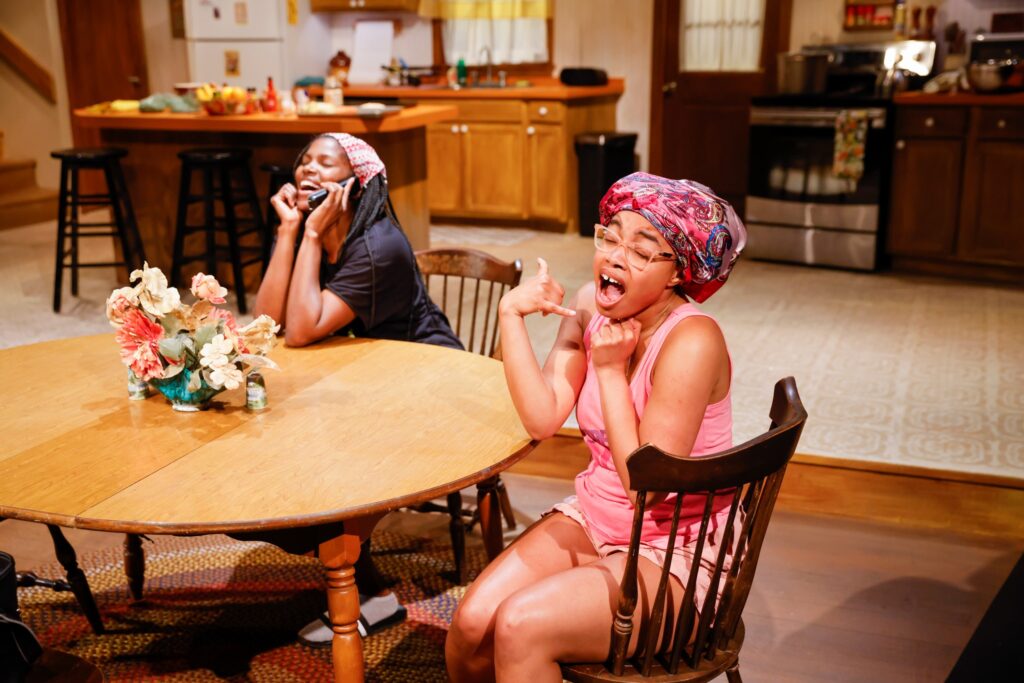
Gloucester Stage Breathes Fresh Life into A Beloved Classic, ‘The Glass Menagerie’

Liza Giangrande, Patrick O’Konis in Gloucester Stage company’s The Glass Menagerie’
Photos by: Shawn Henry

‘The Glass Menagerie.’ Written by Tennessee Williams. Directed by Doug Lockwood. Scenic Design by Jenna McFarland Lord; Costume Design by Nia Safarr Banks; Lighting Design by Amanda Fallon; Sound Design by Aubrey Dube. Presented by Gloucester Stage at 267 East Main Street, Gloucester, through June 28.

By Shelley A. Sackett

Tennessee Williams’ classic autobiographical story of a struggling family, The Glass Menagerie, is no stranger to Broadway and community theater stages. It premiered in Chicago in 1944, where it was championed by several Midwest critics, and moved to Broadway in 1945. Subsequent Broadway productions were mounted in 1965, 1975, 1983, 1994, and 2005, with the likes of Jessica Tandy, Julie Harris, and Jessica Lange playing matriarch Amanda Wingfield. The 2013 revival transferred to Broadway from the American Repertory Theatre in Cambridge, MA. Known as a staple in college and community theaters’ repertoire since its 1944 début, the play and its straightforward staging is a reliable crowd pleaser and audience draw.

It’s hard to imagine any theater company could add anything new. Yet, Gloucester Stage (2025 Elliot Norton Award Winner for Outstanding Play, Midsize for its production of Hombres) has effectively (and thankfully) taken the road less traveled in its presentation of the 80-year-old classic with an interesting and thought-provoking production that allows the audience to experience Williams’ script anew through an exciting, hyper-focused and refractive lens.

Williams advises in his preface, Author’s Production Notes, “Expressionism and all other unconventional techniques in drama have only one valid aim, and that is a closer approach to truth. When a play employs unconventional techniques, it is not, or certainly shouldn’t be, trying to escape its responsibility of dealing with reality, or interpreting experience, but is actually or should be attempting to find a closer approach, a more penetrating and vivid expression of things as they are.”

Kudos to Director Doug Lockwood and Scenic Designer Jenna McFarland Lord for taking those words to heart.
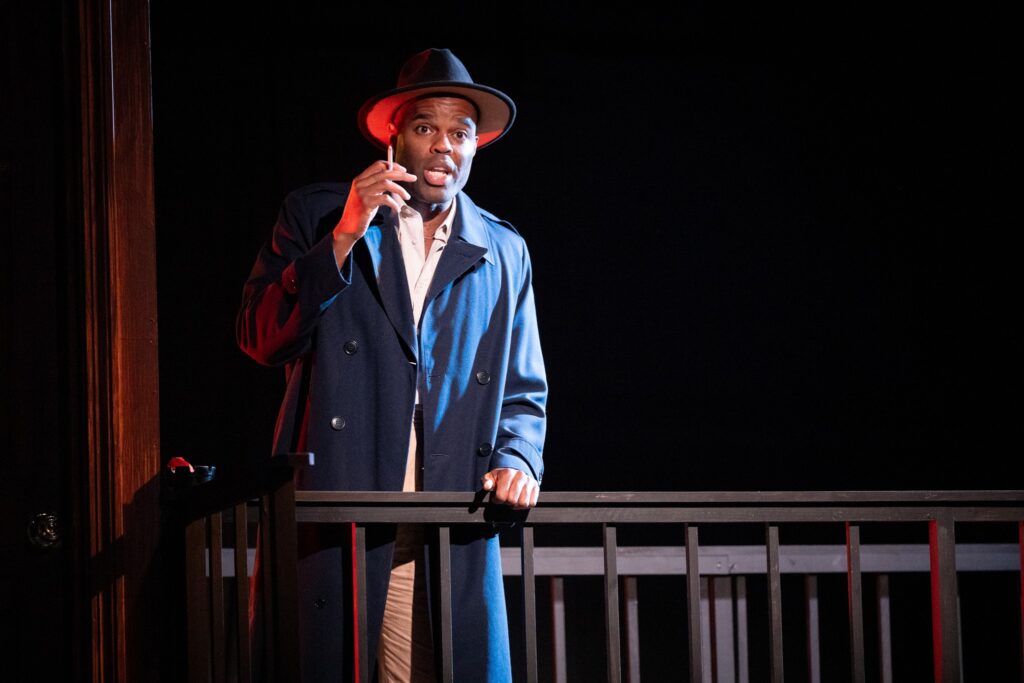
De’Lon Grant

The Glass Menagerie is a seven-scene memory play with a storyline that follows Tom Wingfield (De’Lon Grant) as he looks back on his family life in St. Louis during the 1930s. In the opening scene, Tom appears slightly offstage to deliver his soliloquy. “The play is memory. Being a memory play, it is dimly lighted, it is sentimental, it is not realistic,” he says, warning that what he is about to share may not be THE truth, but it is certainly what he remembers (or thinks he does). “Yes, I have tricks in my pocket, I have things up my sleeve. But I am the opposite of a stage magician. He gives you an illusion that has the appearance of truth. I give you truth in the pleasant disguise of illusion.”

He describes exactly who we will see — his mother, Amanda, his sister, Laura, himself, a mystery man — and who we will NOT see: his father, who was a telephone man who “fell in love with long distances.”

The set reflects the otherworldly dreaminess Tom describes. Gauzy, torn gold floor-length drapes enclose the stage like curtains around a freestanding shower/tub. As Amanda’s voice becomes audible, Tom pulls back the curtains and enters the Wingfield residence.

On stage are Amanda (Adrianne Krstansky), Laura (Liza Giangrande) and four chairs. Amanda and Laura sit at an imaginary table, pantomiming eating. Their gestures are in perfect spatial sync, creating the impression that they (and, therefore, we) are suspended in this dreamlike world of memory and mirage, where props are invisible and reality is a hermetically sealed snow globe. Even the only wall art, a baroque gold frame that is supposed to hold a portrait of Tom’s father, is empty.
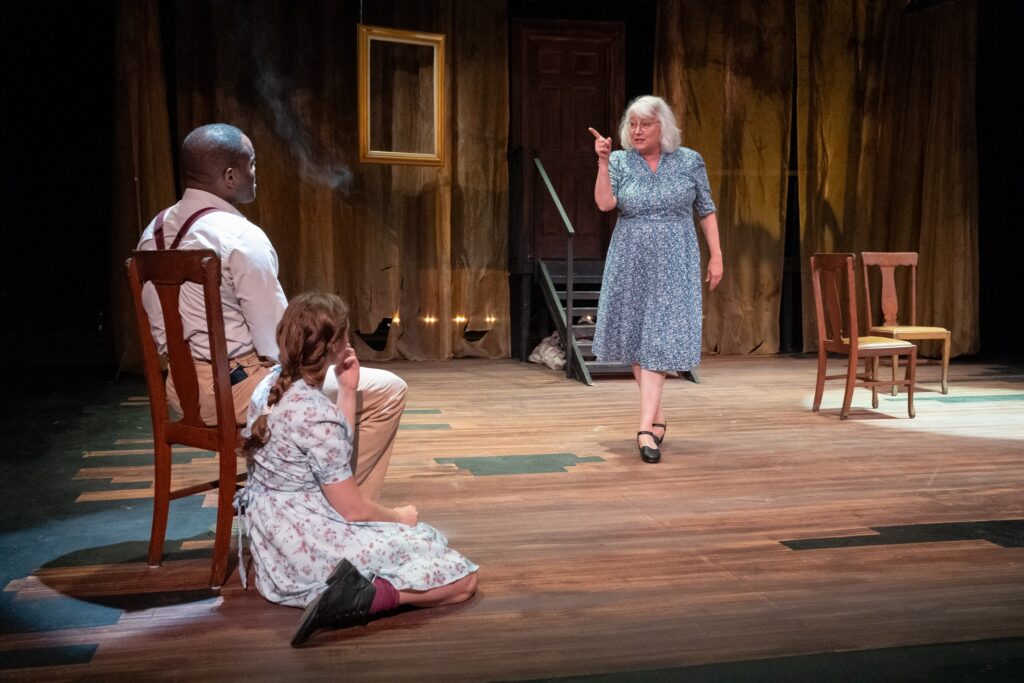
Grant, Giangrande, and Adrianne Krstansky

This minimalistic approach allows the audience to focus on Williams’ words and the true genius of the script. Without the distraction of glimmering glass animals and ornate period furniture, we too become submerged in Tom’s recollections, a key element of The Glass Menagerie’s success as a “memory play.”

A faded Southern belle of middle age, Amanda deals with her present by hanging onto her past. Abandoned by her husband, she lives with her children. Laura, in her 20s and afflicted with a limp, perhaps caused by polio, is debilitatingly shy. Tom, her younger brother, secretly writes poetry and supports the family by working a warehouse job that he hates. A fêted debutante in her Southern youth, Amanda longs for the creature comforts and male attention she enjoyed and spends most of her time reliving and recounting those happier times.

Amanda is also obsessed with finding a “gentleman caller” for Laura, whose crippling anxiety and introversion have sabotaged her every move, with the result of dropping out of high school and a secretarial course. Laura spends her days in her own homespun world, playing records on the Victrola and polishing and communing with her “glass menagerie,” a collection of tiny animals she engages with as a toddler would in fantasy play. Like Amanda, she treads the path of escapism.

The first five scenes of the play (“Preparation for a Gentleman Caller”) draw to an end as Amanda bribes Tom to bring home some nice young man from the warehouse by promising that, once Laura is married off, Tom is free to follow in his father’s footsteps. He tells her that Jim, a work acquaintance, will join them for dinner the next night. Amanda sets to work, reimagining the apartment, Laura, and the future.

After intermission, when the curtains are again drawn aside, the set revealed is firmly grounded in the “real” world of tangible accoutrements. After all, the very first outsider ever to enter the Wingfield inner sanctum might be scared away by anything short of at least the pretense of “normalcy.” Even Tom’s father is restored to his throne, majestically peering down at the chaos his legacy has sown.
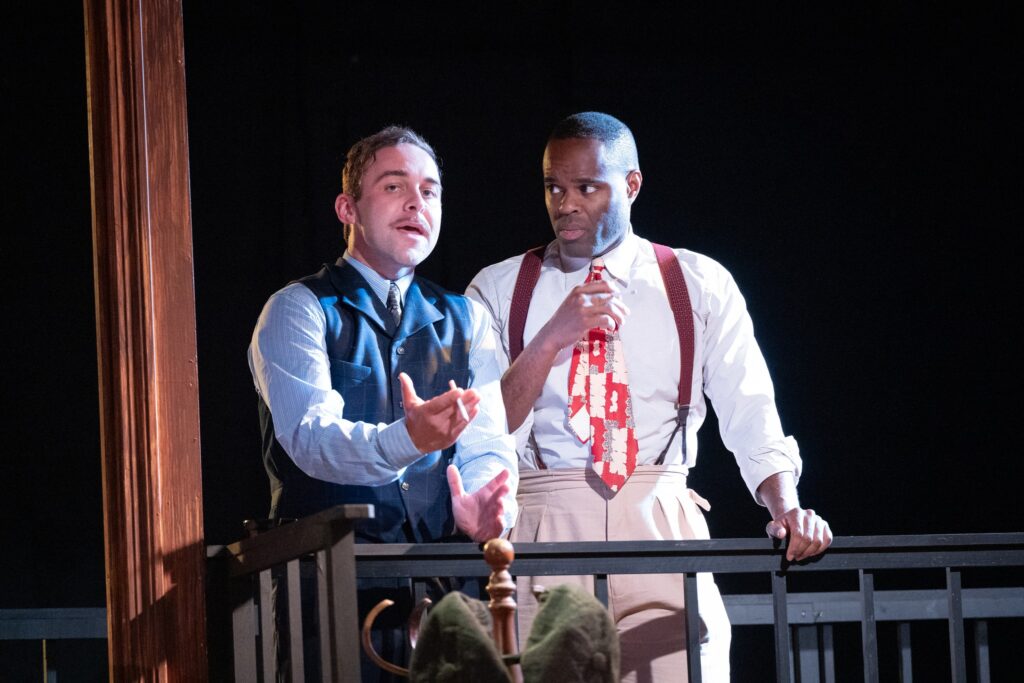
O’Konis and Grant

Subtitled “The Gentleman Calls,” these last two scenes are Williams at his heartbreaking best. Jim O’Connor (Patrick O’Konis, 2025 Elliot Norton Award Winner for Outstanding Lead Performance in a Play, Small), the man Tom has brought home, turns out to have gone to high school with the Wingfield siblings. Tom was “the” big man on campus, starring in the school play and excelling at any sport thrown his way. Like Tom, he is disappointed at his current lot in life and his hope to shine again is conveyed by his study of public speaking, radio engineering, and ideas of self-improvement.

The ending is predictably dark (this is Williams, after all), although there are bursts of cheer and light as Jim and Laura reminisce over their very different high school experiences. The real tragedy is that these two do connect in an authentic way, only possible in the living room of a home where its residents live in a dream world.

The acting in this four-hander is uniformly stellar, the direction more than spot on, and the script a critic’s delight. Even if you think you’ve seen The Glass Menagerie enough times for one lifetime, be sure to catch this version at Gloucester Stage through June 28. You’ll be sorry if you don’t.For more information, visit: https://gloucesterstage.com/glassmenagerie/
Gloucester Stage Serves Up More Than Good Food in ‘Stew’

By Shelley A. Sackett 

Stew is any dish that is prepared by “stewing” — that is, submerging the ingredients with just enough liquid to cook them through on a low flame in a covered pot for a longtime. It is also a synonym for brooding. One who is in an extreme state of worry and agitation is said to be “stewing.” 

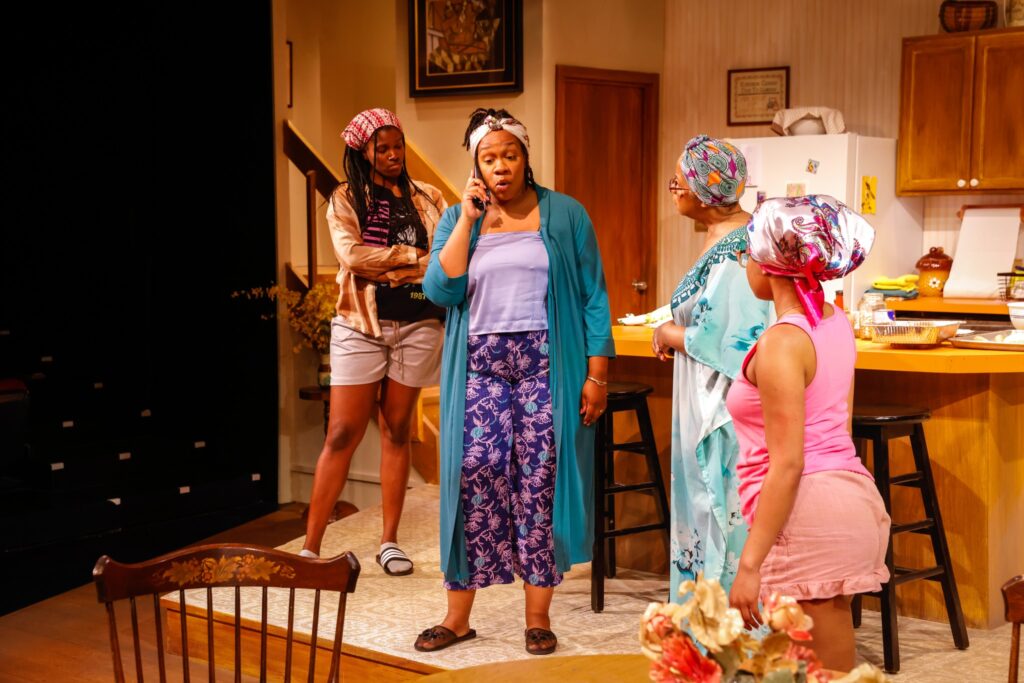
Playwright Zora Howard has captured the richness of the dish and the simmering state of its emotional namesake in her 90-minute intermission-less play, “Stew,” now in production at Gloucester Stage. A 2021 Pulitzer Prize in Drama finalist, it is the story of three generations of Black women who gather at the family home in Mount Vernon, N.Y. 

The show opens in the Turner’s comfortable kitchen with Mama (the magnificent Cheryl D. Singleton in a role that fits her like a glove) alone in her slippers and robe, singing, dancing, and grooving to the gospel song,”“Rejoice.” She sashays over to the pot bubbling on the stove, stirring it with the finesse and timing of a backup singer. This is a woman in her element. Unobserved, undisturbed, she is in her happy place. 

That spell is quickly shattered by a dog barking and the boisterous arrival of the rest of theclan. Mama’s two daughters, Lillian (Breezy Leigh) and Nelly (Janelle Grace), burst into the room, and the atmosphere shifts from private sanctuary to multi-generational chaos. Lillian, in her 30s, is visiting with her 12-year-old daughter, Lil Mama (Sadiyah Dyce Janai Stephens), and younger son Junior, who is already up and outside playing. Lillian’s sister, 17-year-old high schooler Nelly, lives with Mama, although not for long if she has her way and her temporary boyfriend turns out to be her forever man. 

The titular plot revolves around Mama cooking for 50 for an event after church. The stew that has been brewing on the stove has burned, and Mama dumps it into the trash. Similarly, the relationships among these four Turner women get an overhaul during the course of the day as their banter and bickering reveal their secrets, fears, resentments, and hopes, the ingredients they bring to the familial stew that has been quietly simmering on the Turner family back burner for many years. 

Mama has just been to the doctor, and although she won’t admit it, is starting to slow down. “Are you dyin’?” Lillian asks with both accusation and terror in her voice. “It’s certainly the direction I’m heading,” Mama quips. For her part, Lillian has returned home to do more than just check in on Mama’s well-being. Her marriage is stuck in an awkward gear, and, although it will take her another hour to voice it, she is home because she needs her mother’s support and advice. 

Nelly has her first real boyfriend and confides to Lil Mama that she’s sure she has found the real thing. She can’t wait to get on with her life with him. Lil Mama is a free-spirited pre-teen, equal parts silly and earnest, anxious to be taken seriously but still needing to be coddled. She is preparing to audition for the role of Queen Elizabeth in Shakespeare’s Richard III.  

Just as Mama takes charge of her brood in directing them to create her stew, so she commands the troops in helping Lil Mama practice her lines. Mama was, after all, the founder and director emeritus of the Mt. Vernon High Dramatic League as well as the first soloist at the Greater Centennial A.M.E. Zion Church, a fact her children know so well they lip sync the oft-repeated line. 

Howard has a keen ear for writing compelling and laugh-out-loud dialogue that blends the authentic, intimate, and emotional. She manages to keep the rapid-fire pace of the women’s feisty verbal thrusts and parries while subtly defining each character’s individual traits and issues. More than once, she injects thought-provoking subtext into a moment that was teetering dangerously close to TV sit-com banality. 

In her Director’s Notes, Rosalind Bevan hits the nail on the head in describing “Stew’s” message. “All families are woven from a multi-generational fabric spun with joy, pain, celebration, misunderstanding, regrets, and triumphs. If we’re lucky, we can feel and see that the thread holding all of these things together is love. If we’re honest with ourselves, in those moments when that love is less felt or harder to see, we know it’s still there.” 

Bevan’s direction shines a spotlight on the splendid set (Jenna McFarland Lord) while allowing her ensemble cast enough breathing room to create strong individual presences. Leigh’s Lillian is believable and complicated, her pain and uncertainty barely perceptible beneath her bubbly veneer. As the teenage rebel looking for a cause, Grace manages to bring a childish innocence to Nelly’s most churlish tantrum. And who could resist Stephens’s gap-toothed Lil Mama, even when she is screeching at the top of her lungs? 

But it is Singleton as Mama who grounds the show and the family, seasoning her loved ones with the same care and compassion she brings to her cooking. “You’ve got to season your food, talk to your food. Keep it going. You gotta laugh and eat together. It’s the nourishment of life,” she tells her daughters and granddaughter.  

Although uneven and sporting a questionable ending, “Stew” paints a timeless and universal picture of family life, with all its messiness and serendipity. Like the flavors of the secret ingredients in Mama’s special stew, Howard has written a play that will continue to roll around in your thoughts long after the curtain has fallen.

‘STEW’ – Written by Zora Howard. Directed by Rosalind Bevan. Scenic Design by JennaMcFarland Lord. Costume Design by KJ Gilmer. Lighting Design by Kat C. Zhou. SoundDesign by Aubrey Dube. Presented by Gloucester Stage, 267 E Main St, Gloucester, MAthrough July 23. 

For tickets and information, go to: https://gloucesterstage.com/

Gloucester Stage’s ‘Ben Butler’ Is Much More Than A Historical Comedy

Photo_1_GSC-BENBUTLER-0004

L to R: Lieutenant Kelly: Doug Bowen-Flynn; Shepard Mallory: Shane Taylor; Major General Benjamin Butler: Ames Adamson. All Photos by Jason Grow.

By Shelley A. Sackett

On May 23, 1861, smack in the middle of the Civil War, the citizens of Virginia voted overwhelmingly to secede from the United States. The next day, General Benjamin Butler, commander of Union-held Fort Monroe, VA, finds himself in an unusual moral and legal pickle. Three escaped slaves have showed up at the fort’s doorstep seeking sanctuary. Under the Fugitive Slave Act, settled federal law since its 1850 enactment, General Butler is required to return them to their owner.

Yet Butler wears more than just his military hat. A silver-tongued lawyer with a reputation as a champion of labor, abolition and naturalized citizens, he is reticent to follow the letter of the law and send the slaves back to the Confederacy. Are they not, after all, people seeking asylum from an oppressive regime? For Butler, this goes way beyond issues of legal or military might; it is a matter that goes straight to the core of who he is (or, is not) as a moral human being. At the same time, he is understandably reticent to rock the boat and sink his own career. Even scarier yet is the idea of leaving his fingerprints all over an incident that could affect the outcome of the war.


Photo_13-GSC-BENBUTLER-4140

L to R: Lieutenant Kelly: Doug Bowen-Flynn; Major General Benjamin Butler: Ames Adamson


The complicated matter becomes even more so when Butler actually meets Shepard Mallory, the slave who has demanded an audience to plead his case in person. Despite the stark black and white differences in their skin, station and status, the two soon realize they have more in common than not.

Both are expert verbal sparrers, and recognize in the other a familiar spunk and intellect. Both are, at their core, compassionate and humanistic. And bought are caught in the razor-sharp teeth of the cog that fuels the madness that has torn the United States in two.

If this sounds like the stuff of a heart-wrenching, angst-laden script, think again, for playwright Richard Strand has turned the tragic on its head. His lively comedy drives home all the important messages – that slavery is evil, that all humans are created as equals, and that war is bad, for starters – but clothes them in clever repartees and endless rounds of (mostly) delightful verbal gymnastics.

For it turns out that Shepard Mallory is no ordinary man. The runaway slave is literate, literary and able to run legal circles around General Butler who, in truth, is much more of a lawyer than military man. As they joust and brawl, they are shocked and then delighted to discover that they have each finally met their match.


Photo_24-GSC-BENBUTLER-4562

L to R: Major General Benjamin Butler: Ames Adamson; Shepard Mallory: Shane Taylor


And this is where Strand’s script – flawed and bloated though it is – is both brilliant and brave. As Butler and Mallory get to know each other, the world’s artifice that separates them melts away. They become kindred spirits, united in their revulsion at the perversity that is at the rotten core of slavery. Strand shows the audience what “all men are created equal” really looks like. This is infinitely more effective and more powerful than a chest-beating diatribe against racism could ever be.

A fast-paced comedy about slavery is dependent on the caliber of its actors, and the Gloucester Stage production rises to the occasion. As Butler, Ames Adamson (who originated the role at the New Jersey Repertory Company and again Off-Broadway at 59E59TH Theatre) is clearly having the time of his life, practically chewing the scenery. He is the eye of the storm and both the audience and his cast mates know it. Shane Taylor holds his own as Mallory, delicately walking a fine line between enlightened erudition and bondage. And Doug Bowen-Flynn, as the by-the-book West Point graduate Lieutenant Kelly, is a perfect foil for Butler’s more nuanced version of life. His transformation from knee-jerk bigot to color blind humanist is masterfully graceful and poignant.


Photo_17-GSC-BENBUTLER-4369

L to R: Lieutenant Kelly: Doug Bowen-Flynn; Shepard Mallory: Shane Taylor; Major General Benjamin Butler: Ames Adamson


Some might chafe at the idea of a subject as serious as slavery being handled with a light comedic touch, and in another playwright’s hands, they might be right. In the case of ‘Ben Butler,’ however, Richard Strand has brought home the very serious point that racism is evil and immoral, and let us have a jolly good time nonetheless.

‘Ben Butler’ –Written by Richard Strand; Directed by Joseph Discher; Scenic Design by Greg Trochlil; Lighting Design by Russ Swift; Costume Design by Chelsea Kerl; Props Design by Lauren Corcuera; Sound Design by Joseph Discher. Presented by Gloucester Stage Company, 267 E Main St., Gloucester, through August 25. For more information or to buy tickets, visit https://gloucesterstage.com/