GSC’s Timely ‘No Child…’ Lauds Teachers And Showcases An A+ Solo Performance

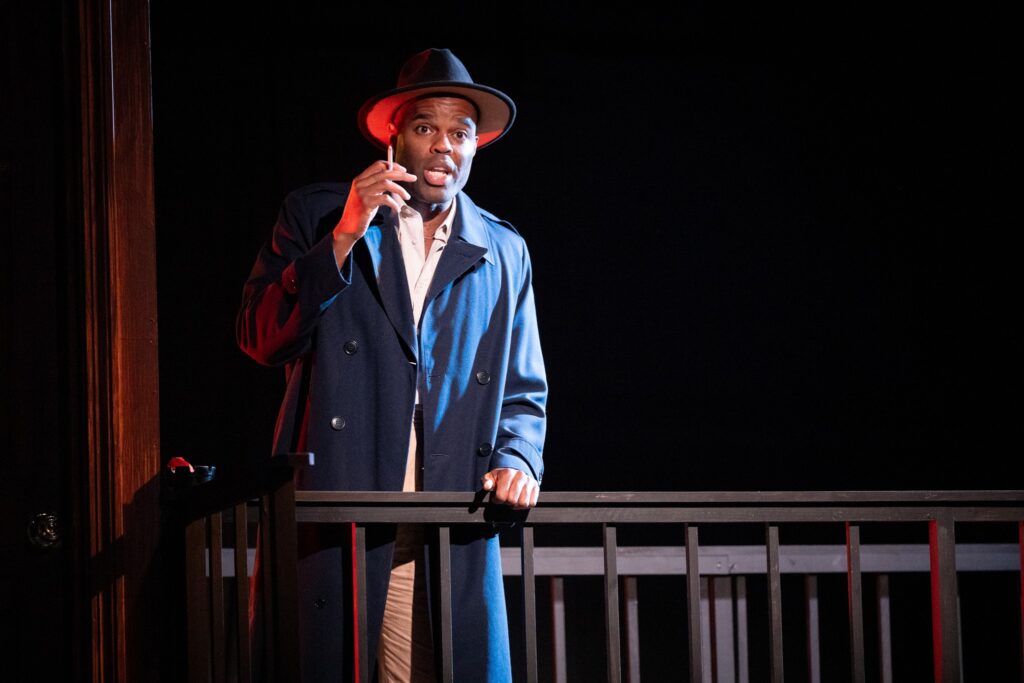
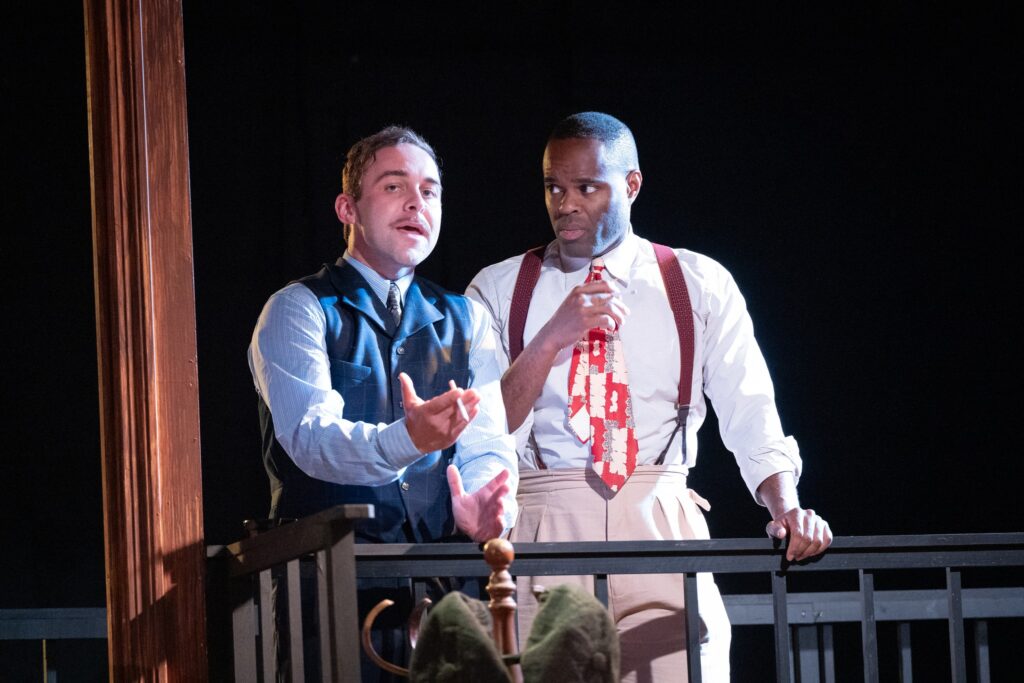
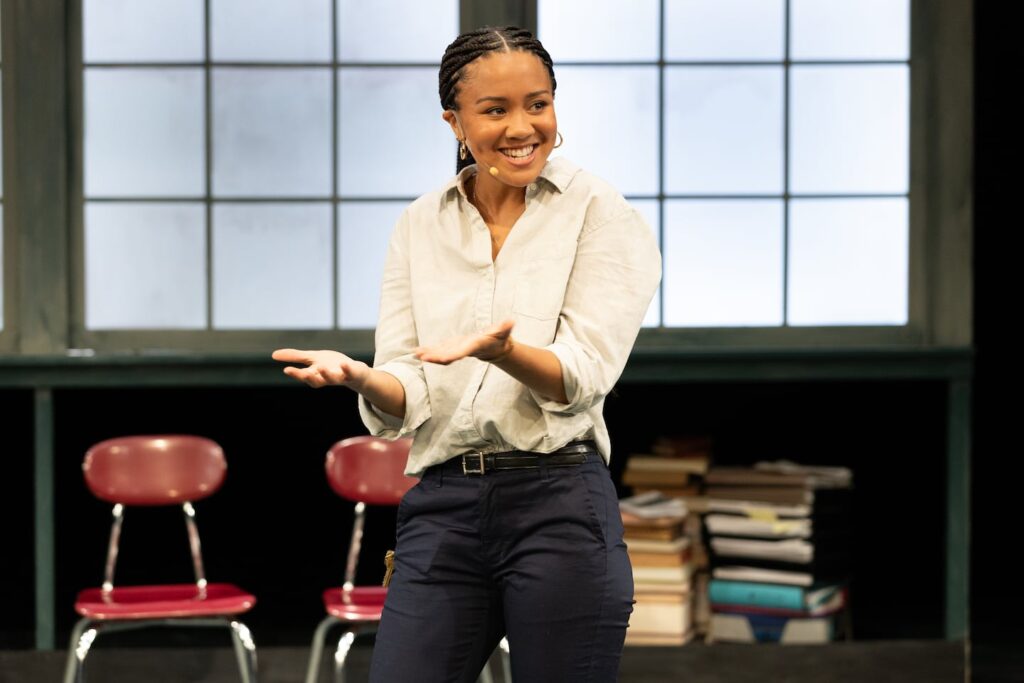
Valyn Lyric Turner in “No Child …” at Gloucester Stage Company. Photos by Jason Grow Photography

By Shelley A. Sackett

Playwright Nilaja Sun’s conventional tribute to the trials and tribulations of our unsung heroes who day after day teach the toughest kids at their toughest ages (high school) in the toughest neighborhoods is must-see theater for one reason— the luminous performance by its solo star, Valyn Lyric Turner.

Playing no fewer than a dozen roles, Turner is a whirling dervish of talent, her physicality and vitality hoisting the play from a ho-hum trope to a true tour de force.

The lights go up on Cristina Todesco’s deceptively simple set as a traditional version of “The Sun’s Gonna Shine in My Back Door Someday” sets the mood. Written as a song of hope during times of fear in 1901 by African-American Methodist minister Charles Albert Tindley, himself the son of slaves and a janitor, preacher and pastor, it serves as the show’s anthem and bookends the opening and closing scenes.

Jackson Baron Copeford, a janitor at Malcolm X High School, introduces himself as the story’s narrator. Setting the scene for the arrival of Ms. Sun, the protagonist, Baron mentions the school is situated in the poorest congressional district in the U.S., in the Bronx, where metal detectors and academically challenged youth share the space equally.

Before class, Ms. Sun, a struggling actor, has a conversation with her landlord about her late rent. She is about to teach a six-week workshop on Our Country’s Good, a play-within-a-play about convicts putting on the play The Recruiting Officer. Ms. Tam, a newly appointed and ineffectual teacher, introduces Ms. Sun to her English class of foul-mouthed, rowdy Grade 10 students.
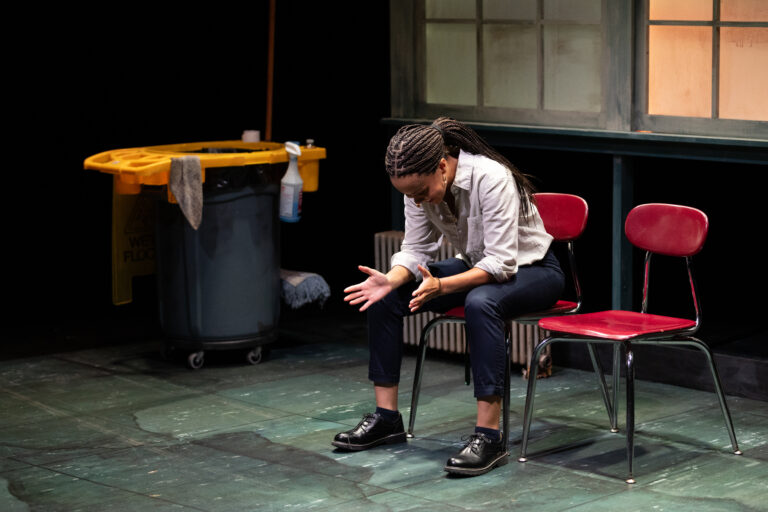
The lessons begin. Ms. Sun earnestly sets out to teach her students to use theatrical techniques, like Method acting and vocal projection, to bring out the play’s themes. She is committed to getting these kids to relate to the script and open up about their lives. As she looks at the bars on the windows and reflects on her choice of a play, however, she wonders if maybe she didn’t choose something a little too close to home for comfort.

Janitor Baron, who functions as a Greek chorus of one, reflects on being the first black janitor at the school, and the long history he and it have shared through the political turmoil of the U.S., from the pristine institution that it once was to the neglected structure it has become.

Ms. Sun’s class is full of stereotypes, each of which Turner, under Pascale Florestal’s pitch-perfect, razor-sharp direction, embodies and delineates with the subtlest, most effective nuance. Giving each different vocal intonations and just a single physical trait (hair twirling, crotch-hugging slouch, scowl, dimpled solicitous smile), she makes us see clearly every colorful character: the leader Jerome, the flamboyant Shondrika, the nervous Chris, the doomed José.

For 75 intermission-less minutes, we ride shotgun as Ms. Sun perseveres against all odds to stage a successful production that transforms her and her students’ lives. Along the way, the audience is hit with vital, repetitive messages. Teaching is the world’s hardest and most important profession. Students will rise and fall based on the predetermined assessment and expectation of their instructors. The educational system is stacked against the have-nots that society has deemed throwaway and incapable of ever rising above their predestined station.

Yet, notwithstanding its polemical transparency, Sun’s sentimental and humorous dialogue and Turner’s performance (under Florestal’s direction) transform the one-woman show into an emotionally satisfying theatrical event. Turner is simply transfixing as she seamlessly melts from one character to the next, sometimes seemingly mid-sentence. A stand-out on every Boston stage she has graced, this is a showcase role she was born to play.
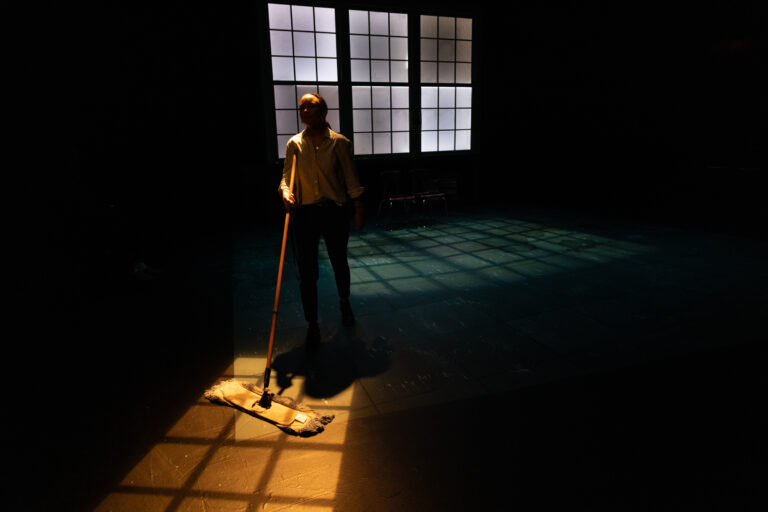
The show ends on an upbeat note and a glimmer of hope. Committed, skilled teachers who, despite the cards stacked against them and their students, care enough to sacrifice and invest actually can influence another’s life. Hard work pays off and the self-esteem it engenders is a true game changer. A little financial boost and a lot of faith and compassion can go a long way to opening the door of limitless options and mutual satisfaction.

In an epilogue that details the mostly rosy futures ahead of this class of 10th graders and their teachers, Janitor Baron leaves us with the mantra, “The times they are a-changin’.” In these days of defunded public education and callous, cruel policymakers intent on widening the gulf between the haves and have-nots, it’s hard to hang onto the belief that those changes are for the better and not the worse.

Highly recommended for Turner’s not-to-be-missed performance.

‘No Child…’ — Written by Nilaja Sun. Directed by Pascale Florestal. Scenic Design by Cristina Todesco; Costume Design by Chelsea Kerl; Lighting Design by Amanda Fallon; Sound Design by Jacques Matellus. Presented by Gloucester Stage Company, 267 East Main St., Gloucester through August 23.

For more information, visit gloucesterstage.com/

Two Unlikely Buddies Talk Trash in Gloucester Stage’s Clever Comedy, ‘The Garbologists’

Paul Melendy and Thomika Marie Bridwell in Gloucester Stage Company’s “The Garbologists.”
Photos by Shawn G. Henry

By Shelley A. Sackett

Rebecca Bradshaw, Producing Artistic Director of Gloucester Stage Company and director of its first-rate The Garbologists, couldn’t have timed it better. With Republic Services sanitation workers in the second week of their strike, garbage is on everyone’s mind as bags pile up on the North Shore and throughout Greater Boston.

Playwright Lindsay Joelle’s tight, bright comedy brings its audience behind the windshield of a New York City Sanitation Department truck and into the lives of two people thrown together by circumstance: Danny (an exceptionally talented and engaging Paul Melendy) and Marlowe (Thomika Marie Bridwell). The two-hander (80 minutes with no intermission) is one of the most endearing odd couple buddy comedies since, well, Jack Klugman and Jack Lemmon in the 1970s television series, “The Odd Couple.”

Danny, a 41-year-old white blue-collar regular guy, is bigger than life. A seasoned worker with nine years’ experience, he is a nonstop talker, full of advice and corny jokes. He also has a wealth of institutional knowledge and an intuitive sixth sense about the street as a source of understanding the meaning of life. “There’s a lot you can tell about someone by what they throw away,” he counsels his rookie partner. “Read the bags.”

Gloucester Stage Company’s production of The Garbologists by playwright Lindsay Joelle, in Gloucester, MA. The production is directed by Rebecca Bradshaw and stars Tomika Marie Bridwell as Marlowe and Paul Melendy as Danny. © 2025 Shawn G. Henry • 978-590-4869 GSC-250702-Garbologists_017

Marlowe, a mid-30s Black Ivy League-educated (two degrees, no less) woman, is as buttoned up as Danny is unzipped. For the first many minutes, she watches and listens in disinterested silence as Danny continues his comedic monologue. In her pressed and pristine uniform, she looks more ready to walk across a graduation podium than toss overstuffed black bags into the bowels of their truck.

Like an awkward blind date, they eye each other suspiciously, each seeming to wonder what they did to deserve such a match.

But these two have more in common than it first appears, and thanks to a combination of a mostly sharply honed script and spot-on, crisp direction, the layers of what separates them melt away. By the play’s life-affirming end, the two have found more than just friendship; they have found a piece of themselves through each other.

Set in the streets of New York (effective lighting by Anshuman Bhatia, sound by Julian Crocamo and a terrific set by Kristin Loeffler that includes traffic lights, road signs and a functioning trash truck that swivels and rotates), the show slowly builds hope, trust and friendship between these two seemingly mismatched characters as they go about the business of their day. Danny pours on the charm, trying to get Marlowe to loosen up and laugh. Melendy’s performance is worth the price of admission. He is a one-man showstopper, and he is on stage the entire time. As he swerves from serious mentorship to revealing details of his personal life (he is divorced, has a seven-year-old son and is currently under a temporary restraining order), he is a whirling dervish of physicality and nuanced delivery. He is also caring, philosophical and self-aware. “I’m an acquired taste,” he admits. “Like blue cheese.”

Gloucester Stage Company’s production of The Garbologists by playwright Lindsay Joelle, in Gloucester, MA. The production is directed by Rebecca Bradshaw and stars Tomika Marie Bridwell as Marlowe and Paul Melendy as Danny. © 2025 Shawn G. Henry • 978-590-4869 GSC-250702-Garbologists_053

For her part, Marlowe at first is having none of it. Bridwell alternates between high-decibel anger and sullen silence, limiting the audience’s ability to get to know and relate to her character. Although by the end we understand the trauma that led her to take this job, it is an uphill climb.

Joelle gives these two plenty of meaty dialogue, full of astute observations about the meaning behind what people throw away. The street is a resource as well as a wastebasket; one person’s waste is another’s life source.

There are some belly laugh lines and hysterical scenes, especially one with a box full of dildos that Danny uses for an improvisational monologue that finally gets Marlowe to laugh. Triumphant, Danny basks in his accomplishment. “You look radiant,” he practically gushes.

With the exception of a distractingly contrived and awkward twist at the play’s end, Joelle keeps both storyline and character development moving in dynamic and engaging ways.

When Danny gets a call to pick up his sick son at school, Marlowe helps him navigate the awkwardness of figuring out how to contact his ex-wife without violating the terms of his TRO. When Marlowe rescues a teddy bear and places it reverently on a pole, Danny observes but gives her space and time to disclose her reasons. And when Marlowe endangers herself by cavalierly tossing potentially hazardous substances into the compactor, Danny reacts both as boss and concerned friend.

Gloucester Stage Company’s production of The Garbologists by playwright Lindsay Joelle, in Gloucester, MA. The production is directed by Rebecca Bradshaw and stars Tomika Marie Bridwell as Marlowe and Paul Melendy as Danny. © 2025 Shawn G. Henry • 978-590-4869 GSC-250702-Garbologists_274

By the play’s end, we really feel for these two and the cycles of grief, joy, insecurity, loss and random bad luck each has experienced. We also think about garbage (and garbage collectors) in new and shaded ways. Is there a moral obligation, for example, to return something of value that its owner ignorantly tossed, or does the “Finders Keepers” rule apply? When we discard something, do we also discard the right to privacy and anonymity about having owned it?

Most of all, Joelle shines a timely light on our detached perception of those who haul away our debris as faceless and anonymous. These two are full-throated, wonderfully fleshed out, complex and likeable characters, loyal to their families and supportive in their friendships. “Just because we pick up trash doesn’t make us garbage,” Danny says. Amen to that.

Recommended.

‘The Garbologists’ — Written by Lindsay Joelle. Directed by Rebecca Bradshaw. Presented by Gloucester Stage Company at 267 East Main St., Gloucester, through July 26.

For more information, visit: https://gloucesterstage.com/garbologists/

Gloucester Stage Breathes Fresh Life into A Beloved Classic, ‘The Glass Menagerie’

Liza Giangrande, Patrick O’Konis in Gloucester Stage company’s The Glass Menagerie’
Photos by: Shawn Henry

‘The Glass Menagerie.’ Written by Tennessee Williams. Directed by Doug Lockwood. Scenic Design by Jenna McFarland Lord; Costume Design by Nia Safarr Banks; Lighting Design by Amanda Fallon; Sound Design by Aubrey Dube. Presented by Gloucester Stage at 267 East Main Street, Gloucester, through June 28.

By Shelley A. Sackett

Tennessee Williams’ classic autobiographical story of a struggling family, The Glass Menagerie, is no stranger to Broadway and community theater stages. It premiered in Chicago in 1944, where it was championed by several Midwest critics, and moved to Broadway in 1945. Subsequent Broadway productions were mounted in 1965, 1975, 1983, 1994, and 2005, with the likes of Jessica Tandy, Julie Harris, and Jessica Lange playing matriarch Amanda Wingfield. The 2013 revival transferred to Broadway from the American Repertory Theatre in Cambridge, MA. Known as a staple in college and community theaters’ repertoire since its 1944 début, the play and its straightforward staging is a reliable crowd pleaser and audience draw.

It’s hard to imagine any theater company could add anything new. Yet, Gloucester Stage (2025 Elliot Norton Award Winner for Outstanding Play, Midsize for its production of Hombres) has effectively (and thankfully) taken the road less traveled in its presentation of the 80-year-old classic with an interesting and thought-provoking production that allows the audience to experience Williams’ script anew through an exciting, hyper-focused and refractive lens.

Williams advises in his preface, Author’s Production Notes, “Expressionism and all other unconventional techniques in drama have only one valid aim, and that is a closer approach to truth. When a play employs unconventional techniques, it is not, or certainly shouldn’t be, trying to escape its responsibility of dealing with reality, or interpreting experience, but is actually or should be attempting to find a closer approach, a more penetrating and vivid expression of things as they are.”

Kudos to Director Doug Lockwood and Scenic Designer Jenna McFarland Lord for taking those words to heart.

De’Lon Grant

The Glass Menagerie is a seven-scene memory play with a storyline that follows Tom Wingfield (De’Lon Grant) as he looks back on his family life in St. Louis during the 1930s. In the opening scene, Tom appears slightly offstage to deliver his soliloquy. “The play is memory. Being a memory play, it is dimly lighted, it is sentimental, it is not realistic,” he says, warning that what he is about to share may not be THE truth, but it is certainly what he remembers (or thinks he does). “Yes, I have tricks in my pocket, I have things up my sleeve. But I am the opposite of a stage magician. He gives you an illusion that has the appearance of truth. I give you truth in the pleasant disguise of illusion.”

He describes exactly who we will see — his mother, Amanda, his sister, Laura, himself, a mystery man — and who we will NOT see: his father, who was a telephone man who “fell in love with long distances.”

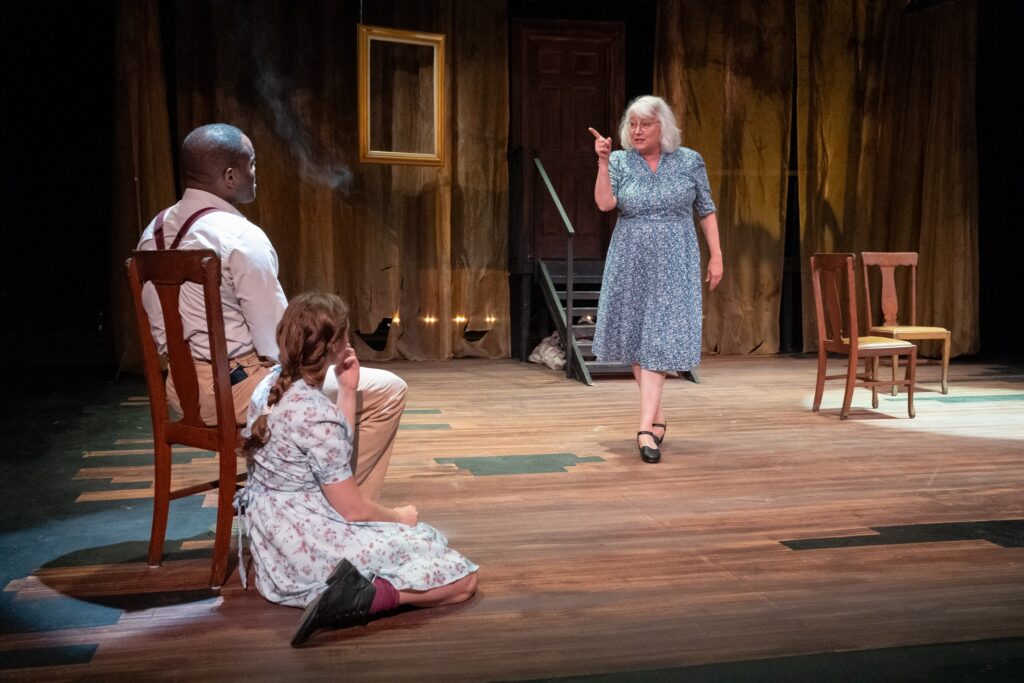
The set reflects the otherworldly dreaminess Tom describes. Gauzy, torn gold floor-length drapes enclose the stage like curtains around a freestanding shower/tub. As Amanda’s voice becomes audible, Tom pulls back the curtains and enters the Wingfield residence.

On stage are Amanda (Adrianne Krstansky), Laura (Liza Giangrande) and four chairs. Amanda and Laura sit at an imaginary table, pantomiming eating. Their gestures are in perfect spatial sync, creating the impression that they (and, therefore, we) are suspended in this dreamlike world of memory and mirage, where props are invisible and reality is a hermetically sealed snow globe. Even the only wall art, a baroque gold frame that is supposed to hold a portrait of Tom’s father, is empty.

Grant, Giangrande, and Adrianne Krstansky

This minimalistic approach allows the audience to focus on Williams’ words and the true genius of the script. Without the distraction of glimmering glass animals and ornate period furniture, we too become submerged in Tom’s recollections, a key element of The Glass Menagerie’s success as a “memory play.”

A faded Southern belle of middle age, Amanda deals with her present by hanging onto her past. Abandoned by her husband, she lives with her children. Laura, in her 20s and afflicted with a limp, perhaps caused by polio, is debilitatingly shy. Tom, her younger brother, secretly writes poetry and supports the family by working a warehouse job that he hates. A fêted debutante in her Southern youth, Amanda longs for the creature comforts and male attention she enjoyed and spends most of her time reliving and recounting those happier times.

Amanda is also obsessed with finding a “gentleman caller” for Laura, whose crippling anxiety and introversion have sabotaged her every move, with the result of dropping out of high school and a secretarial course. Laura spends her days in her own homespun world, playing records on the Victrola and polishing and communing with her “glass menagerie,” a collection of tiny animals she engages with as a toddler would in fantasy play. Like Amanda, she treads the path of escapism.

The first five scenes of the play (“Preparation for a Gentleman Caller”) draw to an end as Amanda bribes Tom to bring home some nice young man from the warehouse by promising that, once Laura is married off, Tom is free to follow in his father’s footsteps. He tells her that Jim, a work acquaintance, will join them for dinner the next night. Amanda sets to work, reimagining the apartment, Laura, and the future.

After intermission, when the curtains are again drawn aside, the set revealed is firmly grounded in the “real” world of tangible accoutrements. After all, the very first outsider ever to enter the Wingfield inner sanctum might be scared away by anything short of at least the pretense of “normalcy.” Even Tom’s father is restored to his throne, majestically peering down at the chaos his legacy has sown.

O’Konis and Grant

Subtitled “The Gentleman Calls,” these last two scenes are Williams at his heartbreaking best. Jim O’Connor (Patrick O’Konis, 2025 Elliot Norton Award Winner for Outstanding Lead Performance in a Play, Small), the man Tom has brought home, turns out to have gone to high school with the Wingfield siblings. Tom was “the” big man on campus, starring in the school play and excelling at any sport thrown his way. Like Tom, he is disappointed at his current lot in life and his hope to shine again is conveyed by his study of public speaking, radio engineering, and ideas of self-improvement.

The ending is predictably dark (this is Williams, after all), although there are bursts of cheer and light as Jim and Laura reminisce over their very different high school experiences. The real tragedy is that these two do connect in an authentic way, only possible in the living room of a home where its residents live in a dream world.

The acting in this four-hander is uniformly stellar, the direction more than spot on, and the script a critic’s delight. Even if you think you’ve seen The Glass Menagerie enough times for one lifetime, be sure to catch this version at Gloucester Stage through June 28. You’ll be sorry if you don’t.For more information, visit: https://gloucesterstage.com/glassmenagerie/

Iranian Girls Just Wanna Have Fun in Gloucester Stage’s Thought-Provoking “Wish You Were Here”

‘Wish You Were Here’ — Written by Sanaz Toossi. Directed by Melory Mirashafi. Scenic Design by Lindsay G. Fuori; Costume Design by KJ Gilmer; Lighting Design by Amanda Fallon; Composer and Sound Design by Bahar Royaee. At Gloucester Stage in Gloucester through August 25.

By Shelley A. Sackett

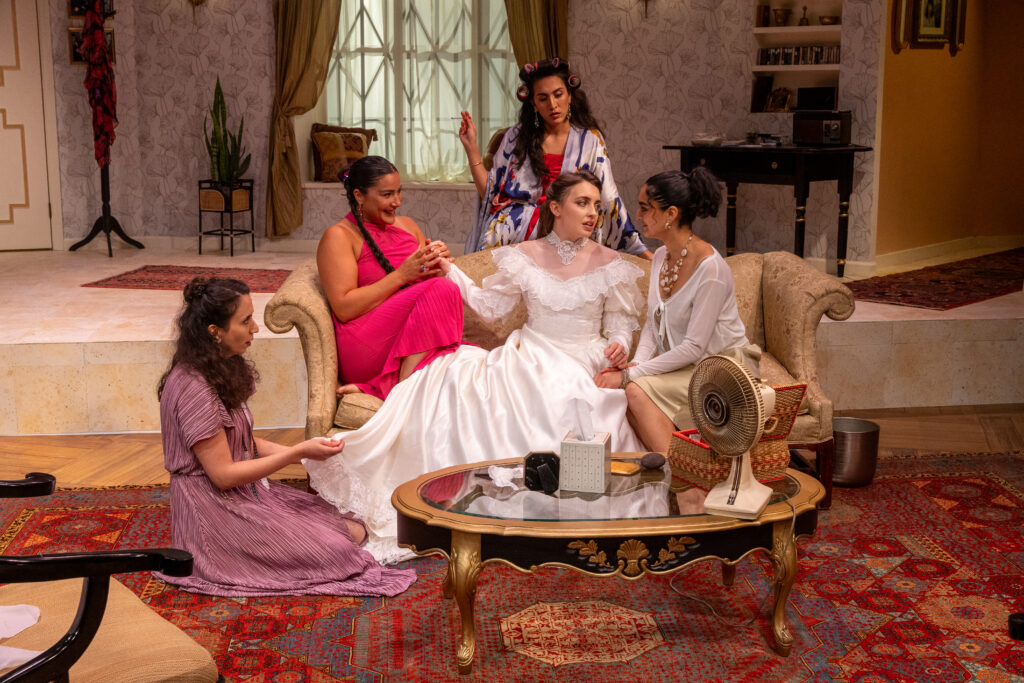
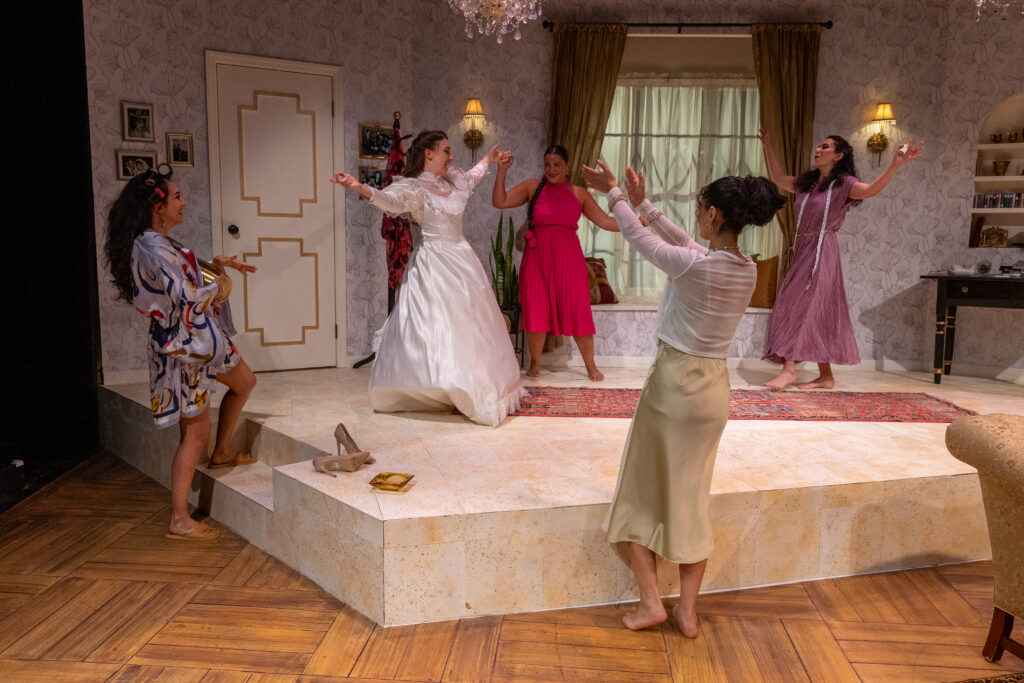
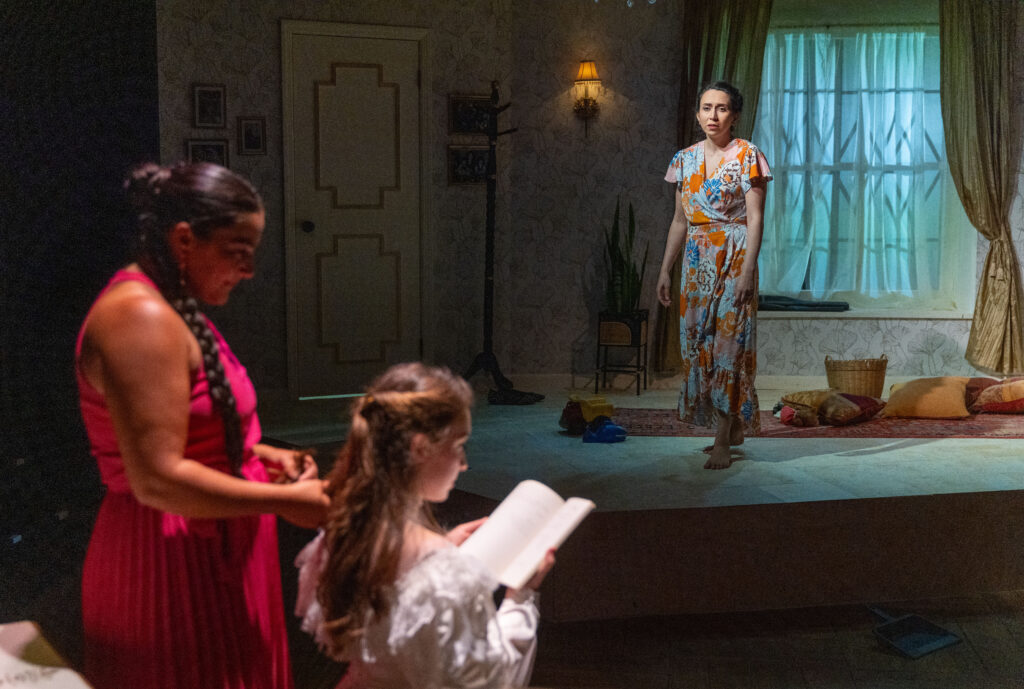
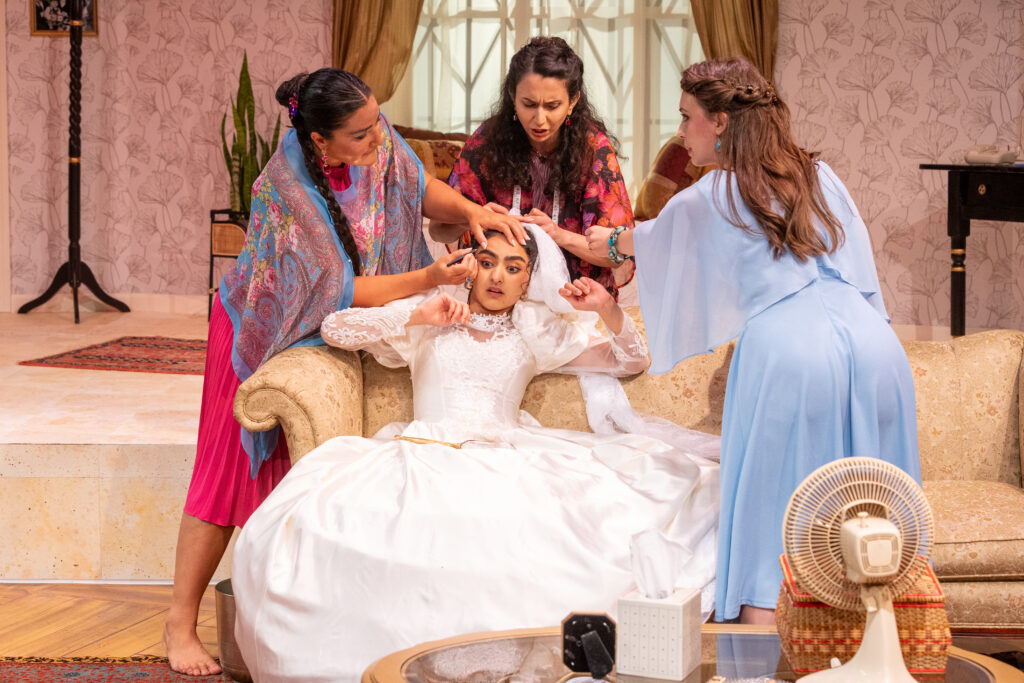
“Wish You Were Here,” in its regional premiere at Gloucester Stage, opens on three frozen tableaux set in a lavish apartment with Persian-inspired décor. At an ornate make-up table, two women hover over a third clad in a billowing wedding dress. Another, wearing a red silk short kimono and huge pink curlers, is draped over a couch, a cigarette dangling provocatively from her languid hand. A fifth slouches against the wall. All appear to be in their late teens/early 20s.

Suddenly, the three scenes simultaneously spring to life, all five women speaking to and over each other.

The friends have gathered to prepare for the wedding of Salme (Josephine Moshiri Elwood), the first among them to get married. She is the straightest, most religious and purest of the five. She prays faithfully and frequently on behalf of her friends, hoping their lives will be set on the path she deems is in their best interest.

The girls are chatty, animated, without a care in the world other than outwitting the wittiest and shocking the most prudish among them.

Shideh (Cerra Cardwell) neurotically frets over whether she will get into medical school. Nazarin (Deniz Khateri), a sullen eye roller, plans to become an engineer. She and best friend Rana (Aryana Asefirad), the kimono girl, vow never to marry and have children. Zari (Isan Salem), the youngest of the group, longs for sex. Vagina and large penis jokes are their favorites.

Although the setting is 1978 in Karaj, Iran, a city about 26 miles from Tehran, these five rambunctious friends could be straight out of the pajama party scene in “Grease.” They are silly, lewd and disarmingly intimate. They bicker and clown. They mock and soothe. They constantly touch each other and tease about sex and their bodies.

They paint each other’s nails, remove each other’s unwanted hair and perform the pre-wedding night olfactory “pussy audit.” Their favorite game is the telepathic “What am I thinking?” Through the boisterous banter and loving friction, their deep commitment to this quintet is unmistakable.

The atmosphere inside this posh apartment crackles with pop culture and the promise of youthful dreams of adventure, travel and sex. Although “there’s static in the air,” the girls are unconcerned about anything outside their snow globe existence. They hear the protests outside and are aware that the Shah has left, but blithely ignore the shape-shifting world around them.

Over the next 100 minutes, we will drop in on this living room and this group another 10 times, following them from 1978 until 1991. Mirroring the upheaval experienced by their country (from the Shah’s exile to the Islamic crackdown and revolution led by Khomeini to the American hostage crisis to the Iran-Iraq War), these five will face marriage, loss, the impact of misogynist religious zealotry and the torment of dreams snuffed out.

The first intrusion of the outside world into their cocoon comes the next year.

Before the Shah’s exile, Jews lived safely beside their Muslim fellow Iranians, flourishing and blending in. Muslims and Jews lived side by side, and religious freedom was a nonissue. Affluence and status mattered much more. With the Islamic Revolution, all that changed.

When we encounter the group for the next wedding (1979), there is turmoil in the streets. The Shah is out, and Khomeini is in. This turbulence directly affects our friends when Rana, the “cool Jewish girl and Nazanin’s best friend,” and her entire family go missing. Dishes were left in the sink, and there was no sign of a struggle. No one has seen or heard from them since.

Each girl deals with this loss in telling and different ways.

Cerra Cardwell, Elwood, Khateri

“She’s fine,” Nazanin says, although, as another points out, “A whole family of Jews missing is usually not a good sign.” Only Salme tries to find her through prayer and the internet. Later, in Act II, one wonders, “Where do we all go when there is no one trying to locate us?” a recurrent rhetorical and thematic thread.

By the third wedding, there may be Bee Gees disco in the background, but the internal atmosphere of the apartment has been infiltrated. The radio crackles with static, but when it is clear, Nazanin is nearby, hoping to hear a word about what is going on outside their doors.

As religious piety and intolerance increasingly rule the land, the group dwindles further. Salme embraces religion and prayer but meets an untimely death when she drowns while swimming in her burka. Shideh takes the opposite path, fleeing to the United States to study medicine. Nazarin and Zari, who never really cared for each other, are the sole sorority sisters.

“Do you love me because I’m the only one left?” Zari asks when they rekindle their friendship. They bond out of desperation and loneliness, vowing to remain in Iran and feed the flames of their newfound friendship. Yet Zari applies for a green card “just to be safe” and Nazarin is caught up in the torment of disappointment and confusion.

She disdains prayer, but believes in its power. She wonders every day how her life might have turned out had she been able to become an engineer had the winds of politics been blowing in her favor. She desperately misses Rana, yet never tried to find her. She swore she would settle for no less than true love, yet admits on her wedding day that she doesn’t love the man she is about to marry.

Iran, her homeland, is a dead end for everything that matters to her, yet she steadfastly refuses Zari’s offer to get her a green card. “Why,” she wonders aloud, “don’t I want to leave?”

When Rana finally gets in touch, 10 years after leaving, Nazanin and she pick up exactly where they left off. “Are you still a Muslim?” Rana asks. “Are you still a Jew?” Nazanin fires back, not missing a beat.

After five years in Israel, Rana now lives in California and works in a Pizza Hut. Suburban America may be spiritually lifeless, but she will never return to Iran. Instead of turmoil, revolution, persecution and flight, her children will know only one home, one that can’t inflict the kind of heartbreak and devastation she suffered.

Toossi revisits many of the same themes of emigration, national identity, home and displacement she so brilliantly tackled in her Pulitzer Prize winner, “English.” “Who do you think of when you think of where you’re from?” she asks through her characters. Who defines you? Where do you find your home? Is it a place? The people? Shared experiences? Where you grew up or where you live now?

Unfortunately, “Wish You Were Here” misses the high mark set by “English.” Toossi doesn’t flesh out these girls’ backgrounds and individualities; they lack nuance and depth. They live in an impenetrable bubble, teetering on a tipping point, and we have a hard time caring.

Director Mirashrafi does the best she can with a script that compresses 13 years into 100 minutes and 10 scenes that are confusing because they give too little context about the raging Iranian politics. There is a Dramaturgy & Timeline in the Playbill (which is most helpful if read BEFORE the play starts), but that doesn’t take the place of timeline references within the script, especially where the play is meant to cover so much ground in such a short time.

Sometimes it was impossible to tell that a new scene in a new year had started until it was almost over. It was also often impossible to tell who was who, especially at the very beginning when each girl seemed to be shouting, the pace was a little too quick and the girls’ names were indecipherable.

Nonetheless, it’s always a pleasure to attend a performance that may take several days of percolating before its impact bubbles up. In addition to the timely issues she raises, American-Iranian Toossi provides a compassionate multi-layered glimpse of Iranian society. Several scenes, although they also present speed bumps in the drama’s flow, are poignant reminders of the beauty and mystery at the heart of Islam.

There are joyful elements of traditional music, dress, and custom. The full silence during Salme’s long prayer scene lets the audience (and the less observant and devoted girls) through the keyhole of the sweet, nourishing elements of a religion that has been hijacked and weaponized by militant male power grabbers determined to dominate women and infidels.

It’s too bad Toossi didn’t spend more time exploring this element, as well as giving her characters a third dimension. Who knows? That might have elevated this play to the level we know she has the chops to write. For more information, go to https://gloucesterstage.com/

Gloucester Stage’s ‘Wish You Were Here’ gives glimpse of life for women of Iran

The cast of Gloucester Stage Company’s production of “Wish You Were Here.” / JASON GROW PHOTOGRAPHY

By Shelley A. Sackett

Jewish Journal

Iranian-American playwright Sanaz Toossi covers a lot of ground in “Wish You Were Here,” at Gloucester Stage Company through Aug. 25. She follows the evolution of a group of friends from 1978 to 1991 in Karaj, Iran, an industrial city 26 miles from Tehran. The revolutionary political and societal upheavals experienced during these years are the backdrop for Toossi’s bigger focus: The everchanging tides of female friendship.

The play opens in a lavish apartment with Persian-inspired décor. Two women hover over a third swathed in a billowing wedding dress. Another, wearing a short kimono and huge pink curlers, drapes over a couch, a cigarette dangling from her hand. A fifth slouches against the wall. All appear to be in their late teens/early 20s.

Suddenly, the set springs to life, all five women speaking to and over each other.

The friends have gathered to prepare Salme, the first to get married and the most religious of the five. Shideh neurotically frets over whether she will get into medical school. Nazarin, a sullen eye–roller, plans to become an engineer. She and best friend Rana, the kimono girl, vow never to marry and have children. Zari, the youngest of the group, longs for sex.

Although set in 1978 Karaj, these five could be straight out of the pajama party scene in “Grease.” The atmosphere crackles with pop culture and the promise of youthful dreams of adventure, travel, and intimacy. The girls can hear political protests outside the window, but unconcerned, they ignore the shape-shifting world around them.

Over the next 100 minutes, we will drop in on this living room and this group another 10 times, following them from 1978 until 1991. Mirroring the upheaval experienced by their country (from the shah’s exile to the Islamic crackdown and revolution led by Ayatollah Khomeini to the American hostage crisis to the Iran-Iraq War), these five will face marriage, loss, the impact of misogynist religious zealotry, and the torment of dreams snuffed out.

Its first intrusion comes when they gather the next year for Zari’s wedding.

There is turmoil in the streets. The shah is out and Khomeini is in. Rana, the “cool Jewish girl” and Nazanin’s best friend and her entire family, is missing. They departed suddenly, leaving dishes in the sink and no clues. No one has seen or heard from them.

Before the shah’s exile, Jews lived safely beside their Muslim fellow Iranians, flourishing and blending. Jews began settling in Iran around 2,700 years ago, and their years under the shah during his reform plan of 1964-1979 are considered a golden age. In 1978, the Iranian Jewish population numbered 80,000 and the vast majority was middle or upper-class. There were 30 synagogues in Tehran alone.

With the Islamic Revolution in 1978, all that changed overnight. Jews became enemies of the Islamic Republic – Zionists in league with Israel. Over two-thirds emigrated rather than face certain confiscation of their property and even execution.

Each girl deals with the loss of Rana in different ways. “She’s fine,” Nazanin says, although, as another points out, “A whole family of Jews missing is usually not a good sign.” Only Salme tries to find her through prayer and the internet.

As religious piety and intolerance increasingly rule the land, the group dwindles further. Salme embraces religion and prayer, but meets an untimely death when she drowns while swimming in her burka. Shideh takes the opposite path, fleeing to the United States to study medicine. Nazarin and Zari, never close, now seek solace in each other.

“Do you love me because I’m the only one left?” Zari asks when they rekindle their friendship out of desperation and loneliness. Zari applies for a green card “just to be safe” and Nazarin is caught up in the anguish of disappointment and confusion.

Nazanin disdains prayer, but believes in its power. She wonders every day how her life might have turned out had she been able to become an engineer, but she refuses Zari’s offer to get her a green card. “Why,” she asks aloud, “Don’t I want to leave?”

Toossi revisits the same meaty and timely themes of emigration, national identity, home, and displacement she so brilliantly tackled in her Pulitzer Prize-winning play, “English.” “Who do you think of when you think of where you’re from?” she asks through her characters. “What defines you? Is it a place? The people? Shared experiences? Where you grew up? Where you live now?”

Unfortunately, “Wish You Were Here” misses the high mark set by “English.” Toossi doesn’t flesh out these girls’ backgrounds and individualities; they lack nuance and depth. They live in an impenetrable bubble, teetering on a cataclysmic tipping point, yet we have a hard time even caring.

We also have a hard time following the play’s storyline because Toossi provides few contextual clues. There is a timeline in the playbill (which is most helpful if read BEFORE the play starts), but that doesn’t take the place of scripted points of reference.

Nonetheless, Toossi proffers gifts, most notably compassionate, multilayered glimpses of Iranian society. Several scenes, although also speed bumps in the drama’s flow, are poignant reminders of the beauty and mystery at the heart of Islam.

There are joyful elements of the traditional music, dress, and custom. The full silence during Salme’s long prayer scene lets the audience (and the less observant and devoted girls) through the keyhole of the sweet, nourishing elements of a religion that has been hijacked and weaponized by militant male power-grabbers determined to dominate women and eradicate infidels.

It’s too bad Toossi didn’t explore this element more. Who knows? That might have been the magic ingredient that could add a sorely lacking third dimension to her characters and elevate this play to the level we know she has the chops to write.

For more information, go to gloucesterstage.com.

Gloucester Stage ‘s Thought-Provoking ‘The Ding Dongs’ is a Theatrical Tour-de-Force

Erica Steinhagen, Karl Gregory, and Nael Nacer in Gloucester Stage Company’s ‘The Ding Dongs’

By Shelley A. Sackett

We’ve all been there. That split second when we realize that all may not be as it seems, that we have misread a vital clue and that all is about to go south. The Ding Dongs, in production at Gloucester Stage through August 27, takes that moment and straps it to a steroid drip.

Don’t be put off by the title, as I almost was. (Is it a tribute to Hostess? To a bebop group? To the comedic wrestling duo?) The Ding Dongs will keep you on the edge of your seat for its entire 75 minutes from lights up to fade out and leave you dying to talk about it to anyone within earshot.

When is the last time theater had that kind of visceral effect?

The action starts with — what else — a couple ringing the doorbell of a suburban single-family home. Inside, the owner Redelmo (the always magnetic Neal Nacer), pauses and runs his hand over his shaved head as if some sixth sense warns him against answering the door.

From the get-go, there is something awry with Natalie (the mesmerizing Erica Steinhagen) and Joe (the superbly flexible Karl Gregory). Natalie is dressed like soccer mom Barbie and her husband Joe looks at home in his orange hooded windbreaker and fitted mod shirt. They present as any ordinary, if unfashionable, couple might, a little ditzy perhaps (another meaning of “ding-dong” is dingbat), but otherwise innocuous.

Natalie is the more forceful, immediately establishing that Joe grew up in Redelmo’s house and that they would love to come inside and take a peek at the old homestead. Joe is the more affable, taking his cues from Natalie and speaking only when she opens that door and invites him into the conversation.

Uncomfortable and increasingly suspicious, Redelmo tries to field their barrage of questions and reveal as little about himself as possible. Yet his politeness and graciousness are no defense to the couple’s verbal bombardment, and they steamroll right over the doomed deed holder’s threshold.

Once inside, all semblance of ordinariness vanishes. The couple launches their assault in earnest, cajoling, beseeching and threatening Redelmo. Natalie is equal parts pit bull prosecutor, evil enchantress and comical talk show host. Joe plays her foil, good cop to her sinister, slightly unhinged one.

The exchanges can be funny, but the overlay of menace and chaos erases any possibility of the audience feeling comic relief. These two are world-class black widow creeps, and Redelmo, with his social graces and timidity, is no match for them.

Soon, their unsettling stories turn more sinister, violent and threatening. Their past is revealed, including a dark chapter involving home invasions, violence, disruption and dislocation. The two are verbal quick-change artists, feigning innocence one minute, wielding machetes the next.

In this boxing match of words and wit, Redelmo is outperformed and outnumbered and no amount of fancy footwork is going to save him from the blows that will eventually corner and pummel him into submission.

Unexpectedly, the doorbell rings again and large boxes addressed to the couple begin arriving. At this point (and not until), Redelmo wakes up to the fact that these two are not visitors who can be reasoned with and will eventually get the message that he wants them to leave. These are ruthless, deranged home invaders who play by alien rules and carry baggage far more unsettling than whatever might be in the avalanche of boxes squatting in his living room.

Abruptly, his house has gone from a calm, suburban home to a cross between Pee Wee’s Playhouse and Regan’s bedroom in “The Exorcist,” and Redelmo reels at the heightened stakes.

Natalie continues, now claiming that the house really belongs to Joe because, after all, he has priority in the chain of deeds, having lived there well before Redelmo “owned” it. In fact, they argue, to an outside observer, it is Redelmo who would be considered the squatter, not them.

“The simplest explanation is always the best, even if it isn’t the truth,” she says. Like wolves closing in on common prey, Natalie and Joe encircle Redelmo, smelling his fear and tightening their grip.

And then, things get even twistier and more disorienting until by the play’s sudden end, neither the actors nor the audience is really sure who’s who and what’s what. Like a huge pot put on a flaming stove, this play simmers for a long time until you wonder if it will ever reach boiling point. When it finally does start to roil, however, there is no lid heavy or strong enough to keep it from boiling over, like poor Mickey’s cauldron in “Fantasia’s” famous “The Sorcerer’s Apprentice.”

Playwright Brenda Withers has written a riveting, thought-provoking, timely play that receives a must-see, first-rate production under Rebecca Bradshaw’s crisp direction. Sound designer Julian Crocamo masterfully reflects the jerkiness of mood by subtly swinging from the sweetness of harmony to the menace of dissonance.

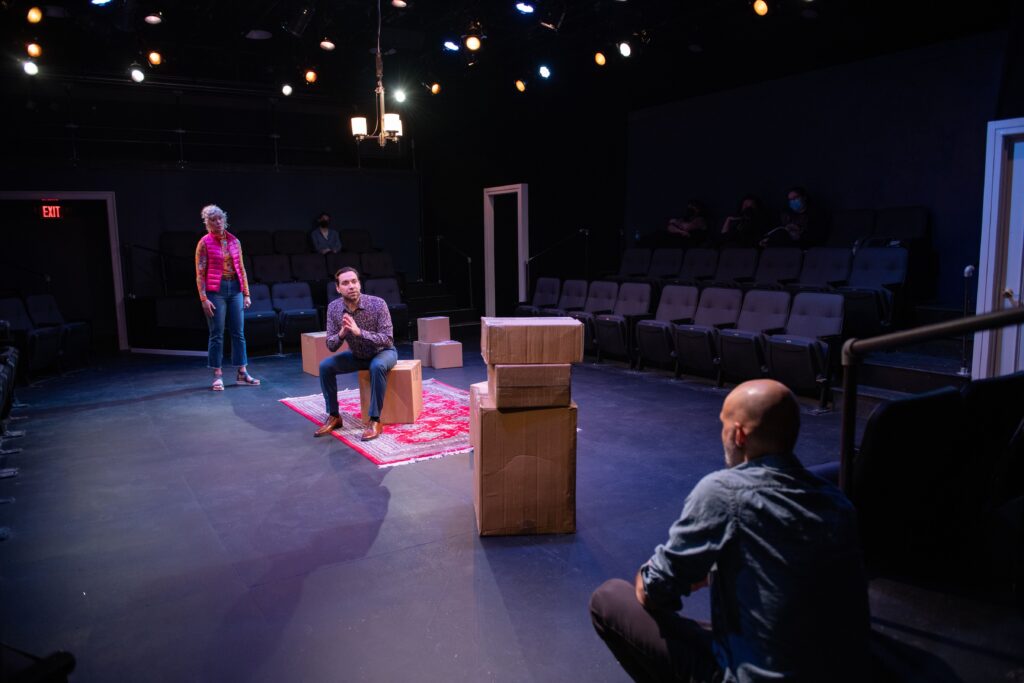
Setting the stage as a theater-in-the-square with four bays of seats gives the illusion of a boxing arena. It also allows Bradshaw and lighting designer M. Berry to take full advantage of a set that affords the audience a different perspective by slight shifts in position and luminosity. A few steps to the left or right and the focus can swing from an actor’s action to their reaction, giving the audience an entirely different perspective on the same situation.

With “The Ding Dongs,” Withers has created a sophisticated, multi-layered, complicated microcosm whose effects linger long after the play’s dramatic end. She subtitled her play, “What Is the Penalty in Portugal? a meditation on homeland security,” and she gives a clue as to her intention in writing it in a recent interview.

She had started thinking about land and property after reading an article about a skirmish in the Middle East. She thought about gentrification, the displacement of humans around the globe, and what makes a home a home.

She also thought about civility and how far we’ll let people get in order to maintain good manners. “What happens when you finally push back on someone and say, ‘These are actually my boundaries’ or ‘This is what’s making me uncomfortable.”’

This is not a “feel good” kind of play. Its laughs are funny but not funny. The manipulation, aggression and sense of helplessness are palpable and contagious. Those of us who think we may be inured and resigned to the realities of living in a macroworld where rules and truth are arbitrary will be further disheartened by this up close and personal micro-encounter with its nefarious day-to-day consequences.

It is, however, an important play with a timely and important message that should be seen and discussed. That Gloucester Stage’s production is an artistic bases loaded home run is icing on the cake.

‘The Ding Dongs’ — Written by Brenda Withers. Directed by Rebecca Bradshaw. Costume Design by Camilla Dely; Lighting Design by M. Berry; Sound Design by Julian Crocamo. Presented by Gloucester Stage, 267 East Main St., Gloucester, through August 27.

For tickets and information, go to: https://gloucesterstage.com/
Gloucester Stage’s ‘Grand Horizons’ Asks, “After 50 Years of Marriage, What’s Love Got to Do with It?

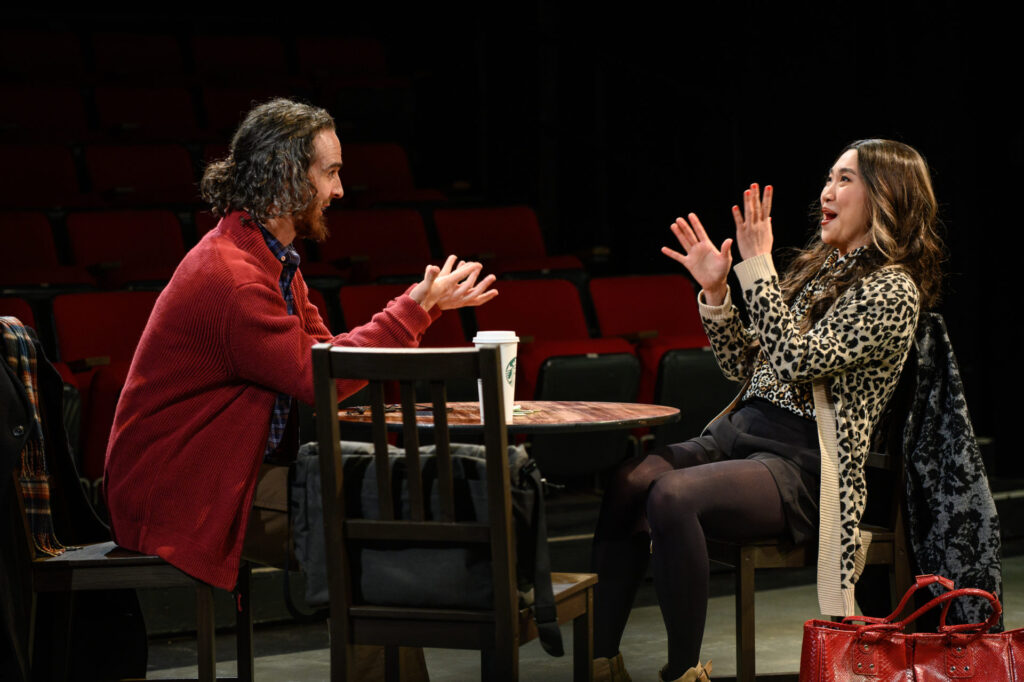
Cast of Gloucester Stage’s ‘Grand Horizons’

by Shelley A. Sackett

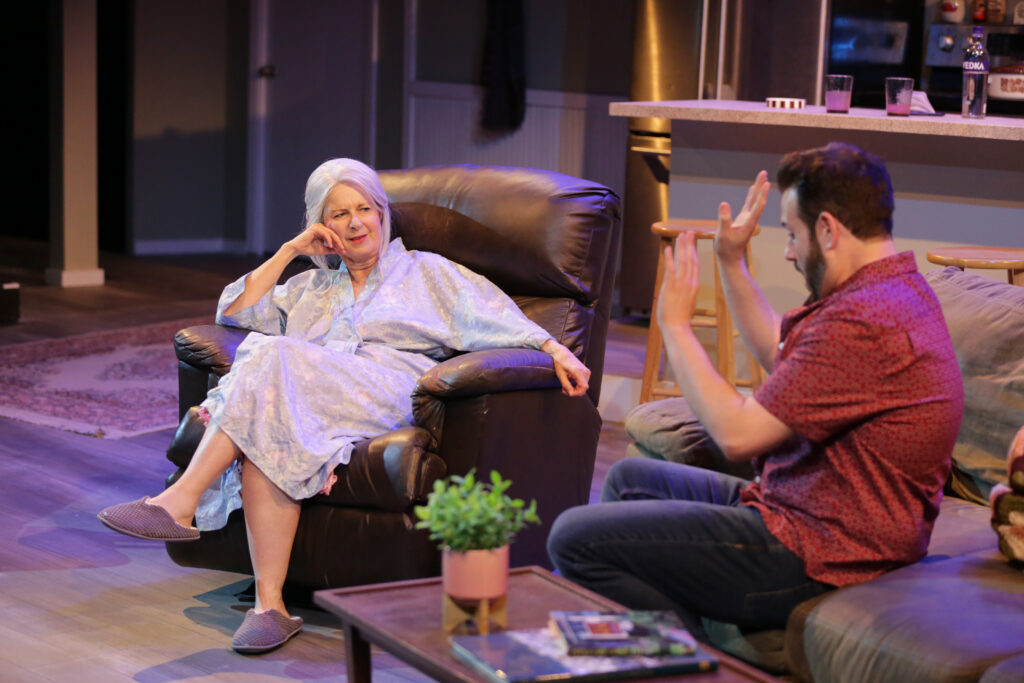
Nancy and Bill (played by real life spouses and stellar actors Paula Plum and Richard Snee) are introduced in their cookie cutter split level house as they go about their chores preparing for dinner. Silently and robotically, they perform their choreographed rituals. Bill sets the table; Nancy dishes out the food. Is this a couple so in sync after so many years that they don’t need to talk or is each seething with rancor just below their calm demeanor?

Finally, Nancy speaks. “I think I would like a divorce,” she says matter-of-factly. “All right,” Bill responds.

With all the subtlety of a network TV sitcom, their thirty-something sons, Ben (Jeremy Belize) and Brian (Greg Maraio) burst through the front door of their Grand Horizons independent-living home, outraged and sputtering about their parents’ obligation to stay together for the sake of the kids, especially since they’re almost dead anyway. “You’re almost 80. How much else even is there?” asks the stereotypical and bossy first-born Ben. Brian, the self-absorbed, whiny, indulged “baby,” just wants the nest he grew up in and never really left to remain intact.

Paula Plum, Greg Maraio, Richard Snee

Nancy, a retired librarian, has other ideas. After a loveless marriage, she feels like time is running out. “I want to be seen, praised and appreciated,” she says. She also wants to change the role she plays with her sons from their caregiver to adult peer. “You have to hear this,” she tells a resistant Brian as she reveals details of her intimate life he would rather not hear. “I will be a full person to you.”

For his part, Bill just wants to tell a decent joke and to that end has enrolled in a comedy class at the recreation center. A grump with questionable timing, his future as a stand up comic is less than assured.

Paula Plum, Greg Maraio

The remainder of the two hour (including intermission) production examines what happens to this family when its foundation cracks. The sons rant, rave and pout in a cardboard two-dimensional orbit. Ben’s wife, Jess (Marissa Stewart), a caricature of a touchy-feely therapist, urges her in-laws, who were never physically close, to begin the healing by holding hands. The “kids” prefer their la-la land of denial to facing the mature realities and responsibilities of adulthood. Their parents’ actions are a shot across the bow of their own lives they are unable to appreciate.

Nancy and Bill are written with more complexity and their calm acceptance and assessment of life’s vicissitudes is a welcome respite from the slapstick, hit-or-miss dirty jokes and gratuitous gay romp scene. Plum’s comedic physicality is understated (the sandwich scene is a knockout) and her verbal timing and intonation are, as always, impeccable. Snee brings a relaxed and easy calm to Richard, letting his softer and more vulnerable side quietly seep through his hardened, gruff exterior.

Snee, Plum

It is through them that Wohl asks the big ticket questions she wants us to consider: What is a “great” marriage? When (if ever) does a couple’s duty to sacrifice their own happiness and stay together for the sake of their kids shift? At what point do parents have a responsibility to treat their children like the adults they are and force them to grow up and stand on their own two feet? Is it ever too late to shift gears and change the course of a life-long marriage?

And, perhaps most important, what exactly is love?

Although the play at times seems to wander in search of its genre, Wohl’s underlying messages, the terrific Plum and Snee and a killer ending to Act I save the day.  For tickets and information, go to: https://gloucesterstage.com/

Written by Bess Wohl; Directed by Robert Walsh; Scenic Design by Jenna McFarland Lord; Costume Design by Chelsea Kerl; Lighting Design by Anshuman Bhatia; Sound Design by Dewey Dellay. Presented by Gloucester Stage through August 21.

Gloucester Stage Company’s ‘Gloria’ Provocatively Asks, “Who Lives, Who Dies, Who Tells Your Story?”

Cast of Gloucester Stage’s production of “Gloria” by Branden Jacob Jenkins. Photos: Shawn G. Henry

by Shelley A. Sackett

‘Gloria’ takes us on a ride inside the rollercoaster that is the essence of a 2010s Manhattan cultural magazine’s editorial assistant bullpen subculture. (Its playwright, Branden Jacobs-Jenkins, worked at The New Yorker for three years). These players are unapologetic and clear about their singular goal: to leave their dead end stepping-stone jobs, climb out of the low prestige depths of editorial assistantship and secure a book deal before turning thirty. Each is constantly on the backstabbing prowl in search of that tipping point moment that will catapult them out of their murky office pit.

Reminiscent of the long-running television hit, “The Office,” the first act of ‘Gloria’ is an entertaining mash-up of deadpan humor, smart and provocative language and near slapstick-caliber physicality. The dialogue is full of wit, sarcasm, social commentary and sharp insight, delivered at breakneck speed. Competitive malice is the glue that binds these folks; shredding insults is their common language. No one is happy and no one is to be trusted, from the Harvard intern (Miles) who wears headphones as a decoy to the jaded almost-30 closet memoirist (Dean), the acid-tongued spoiled shopaholic narcissist (Kendra) and the spiritually eviscerated factchecker (Lorin) and over-educated, underpaid receptionist (Ani) .

Yet, in their individual and collective ways, this motley crew of wannabes somehow endears themselves as they bare their fangs, souls and vulnerabilities. They become like family — with all its good, bad and ugliness —and we accept and appreciate the way they unapologetically let it all hang out. Bryn Boice’s thoughtful and affective direction exposes their naked underbellies, yet still elicits our caring and empathy.

Into this mix enters Gloria, a pathetic and classic spinster loner who has dedicated her life to the magazine. An editor, she is the butt of more than one cruel joke and the object of the bullpen’s venomous envy. The night before, she threw herself an extravagant birthday party, complete with DJ and catered food. She invited the entire staff of the magazine; only one editorial assistant showed up, adding salt to an already unhealable wound.

Michael Wood, Ann Dang

The repercussions of this slight go beyond hangovers and lame excuses, but it would be truly criminal to reveal what they are. Suffice it to say that Act I’s ending guarantees that no one is likely to leave during intermission.

Act II shifts gears so dramatically the audience is at risk of whiplash. Eight months later, the same characters are still front and center, but as individuals leading separate lives away from the magazine. All are dealing with the aftermath of a shared trauma that each exploits their own way. Gone is Jacobs-Jenkins’ spicy, electric-paced dialogue, replaced by the dull and relentless thrum of boundless, humorless ambition.

Jacobs-Jenkins does not hide the ball. His message — that we live in an age of exploitation that has no bottom — weighs heavy and depressingly without the fleet-footed wit he brought to his first act, and it’s a weary audience that welcomes the play’s end.

Ann Dang, Theresa Langford, Michael Broadhurst

Despite an uneven script and inconclusive ending, Gloucester Stage’s production is definitely worth seeing. Small touches add a lot. Props such as Asus and Toshiba laptops (remember those?) and a sound track of J. S. Bach: Mass in B minor ground us in the moment. The cast is terrific, and does its best to articulate Act I’s rapid-fire monologues clearly (strong standouts are Michael Wood as Dean and the talented Teresa Langford as Ani; Michael Broadhurst’s meltdown as Lorin gives Peter Finch’s classic “Network” stiff competition). Esme Allen brings an unpretentious ease to Act II’s Nan. And Boice misses no chance to add meaningful touches; under her direction, even changing sets becomes an opportunity for whimsical choreography.

‘Gloria,’ a Pulitzer Prize finalist in 2016, raises important issues for this era of continuing confusion and division over what constitutes news and how it should get disseminated. Should writers only create their own stories, or is it okay to co-opt someone else’s? Whose story is a shared event to tell and who decides what the “true” version of that story is? What are the differences between storytelling as catharsis, opportunism and exploitation and does it even matter anymore? Do those lines still exist?

Perhaps Lin-Manuel Miranda summed it up best in his peerless “Hamilton” when he wrote, “You have no control, Who lives, who dies, who tells your story.”

‘Gloria’ — written by Branden Jacobs-Jenkins. Directed by Bryn Boice. Scenic Design by Jeffrey Petersen; Costume Design by Rachel Padula-Shufelt; Lighting Design by Aja M. Jackson; Sound Design by David Remedios. Presented by Gloucester Stage Company, 267 East Main St., Gloucester through June 26.

For more information and tickets, go to: https://gloucesterstage.com/

Gloucester Stage’s ‘Baskerville” Is A Literal Breath of Fresh Air

By Shelley A. Sackett

Texan Sir Hugo Baskerville (Julian Manjerico) consults with Sherlock Holmes (Alexander Platt) and John Watson (William E. Gardin). All photos by Jason Grow

Nothing could be finer than to be at theater-en-plein-air in Rockport on a clear and balmy summer evening carousing with the brilliant cast of the spectacularly entertaining Baskerville: A Sherlock Holmes Mystery. Penned by Ken Ludwig, the Tony-award winning playwright of Lend Me A Tenor, this fast-paced comedic melodrama is a riff on the quintessential detective, Sherlock Holmes, and his faithful sidekick, Dr. John Watson.

This time, the dynamic duo is called upon to crack the case of “The Hound of the Baskervilles” before a family curse dooms its newest heir. Along the way, they encounter a motley crew of eccentric characters, hair pin plot twists and turns and red herrings galore. The 2-hour-15-minute (including one intermission) production flies by as five spectacularly talented actors play more than forty characters whose slapstick gestures and hyperbolic speeches they perform with impeccable pacing and precision. Couple this with stellar set, lighting, sound and prop designs, and theatergoers are in for a rollicking evening of good old-fashioned fun.

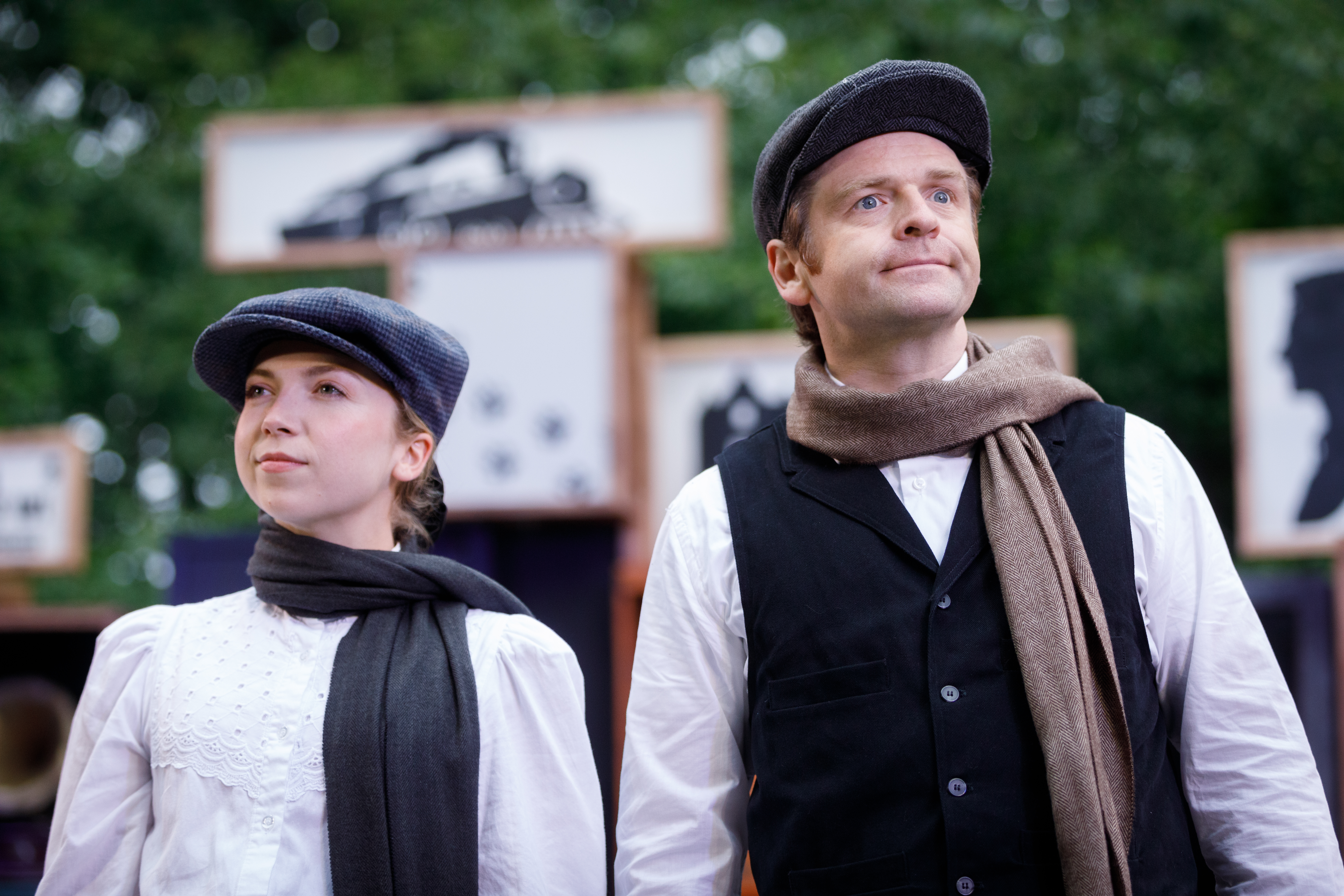
The play opens with Watson (William E. Gardiner) setting the stage by narrating what he and Holmes (Alexander Platt) know and what they need to learn about the mysterious deaths of the Baskerville heirs. Although the actors look and emote like their iconic cinematic predecessors, Basil Rathbone (Holmes) and Nigel Bruce (Watson), they each bring additional layers to the onion, remaking the characters as their own.

Gardiner’s Watson is a blend of subtle contradictions — confident, yet cautious; anxious, yet reckless; compassionate, yet unquestioningly loyal. Platt’s Holmes is delightfully quirky — blind to his worst foibles while perseverating over imagined transgressions; jumping up and down and squealing in delight one minute, while dispassionately describing a victim’s gory fate the next. Platt uses his height and leanness to bring spot on physicality and humor to his character. They are both up to the task of anchoring the play, both as its namesakes and as the two actors who play only one role.

The other three are maestros of quick change: character, costume and accent. Among them they play more than 40 characters with a style that would be at home in a Victorian melodrama. Anna Bortnick is a standout as she glides from character to character, morphing from a Scottish nurse to a severe, humorless Swedish caretaker to an older, maternal housekeeper to a scrappy Dickensian urchin boy (in whose skin Bortnick particularly shines).

Anna Bortnick and Alex Jacobs as messenger boys.

Alex Jacobs is superb as he flows from Stapleton (a seemingly geeky butterfly lover who conceals a psychopath within) to Barrymore (the mournful caretaker of Baskerville Hall) to Milker (the other scrappy Dickensian urchin boy) to Lucy (the loving wife of Wilson) to Dr. Mortimer the elegant, friendly and passionate.

Julian Manjerico rounds out the trio with versatility and verbal and physical nimbleness as he hops from Sir Hugo Baskerville (a brutal, cruel Cavalier) to Wilson (the exuberant, hearty head of a messenger office), to Sir Henry Baskerville (a young Texan relation to Baskervilles, open-hearted, earnest, ready for adventure and to fall in love), to Inspector Lestrade, a cocky police inspector.

They are all aided by Miranda Kau Giurleo’s flawless costume design, Erica Tobolski’s dialect coaching and Robert Walsh’s expert action consultation. Director Jim O’Connor utilizes Janie E. Howland’s efficient, moveable set and Dewey Dellay’s original music and sound design  to maximum advantage in creating a thoroughly satisfying theatrical experience.

Windhover Center for the Performing Arts is a hidden Shangri-la of a venue with a horseshoe shaped seating arrangement encircled by a grove of protective and comforting trees. The effect is intimate, organic and charming. For tickets and info, go to gloucesterstage.com/baskerville/.

‘Baskerville: A Sherlock Holmes Mystery’ – Written by Ken Ludwig. Directed by Jim O’Connor. Set Design by Janie E. Howland; Lighting Design by Marcella Barbeay; Original Music/Sound Design by Dewey Dellay; Costume Design by Miranda Kau Giurleo; Props Design by Emme Shaw; Dialect Coach – Erica Tobolski; Action Consultation by Robert Walsh. Presented by Gloucester Stage Company at the Windhover Center for the Performing Arts in Rockport through July 25.

The 1938 Munich Agreement Is Unmasked in Gloucester Stage Company’s Inventive ‘The Battle Not Begun’

by Shelley A. Sackett

Those of us who eschew the national news in favor of mental equilibrium and spiritual health should be forewarned: it is nearly impossible to watch this historically grounded play and not draw some scary parallels to global current events. The points between 1938 and 2020 beg to be connected.

That said, ‘The Battle Not Begun,’ written by playwright and NPR news analyst Jack Beatty, is as artistically absorbing as it is factually repellant. Under Myriam Cyr’s tight editing and sharp-eyed direction, the audience becomes a fly on the wall at the fateful meeting between Adolph Hitler and British Prime Minister Neville Chamberlain that gave Hitler a green light to launch what became World War II.

A little historical background may be helpful. (I offer this lengthy intro because, as one whose knowledge of WWII is admittedly gauzy, I wish I had this primer before sitting down to watch the play.)

After the First World War ended in 1918, the map of Europe was redrawn and several new countries were formed, including Czechoslovakia. As a result, three million Germans found themselves living under Czech rule in the Sudetenland. In 1938, when Hitler came to power, he vowed to reunite Germans into one nation, starting with the cessation to Germany of the “Sudeten German territory.”

Incited by Hitler’s rhetoric, Sudeten Germans rioted and deliberately provoked violence by the Czech police. Hitler falsely claimed that the police killed 300 Germans during these protests.  With this weaponized “fake news” as justification, Hitler immediately placed German troops along the Czech border and announced his intention to annex it. Chamberlain flew to Hitler’s private mountaintop retreat to try to forge an agreement to bring “peace for our time” and avoid further Nazi aggression. (This meeting is the setting for ‘The Battle Not Begun.’)

Instead, Chamberlain caved to Hitler’s every demand about the Sudetenland in the naïve belief that, in exchange, Hitler would honor his end of the bargain and not seek additional territory in Europe. Hitler lied, astutely outplaying Chamberlain. Chamberlain loudly touted the pact as a personal triumph and Britain’s legacy for peace by negotiation. History has since dubbed the Munich Agreement shorthand for “a failed act of appeasement” and a symbol for the futility of placating expansionist totalitarian states.

An inventive film/theater/re-enactment hybrid, ‘The Battle Not Begun’ sets its period mood from the outset. TV/movie-like credits roll over a 1938 tinted photo, slowly panned in a Ken Burns-esque manner. Adolf Hitler (played with technicolor panache by the  supremely talented Ken Bolden) appears full frame in all his stereotypic glory. He paces, prances, preens and snarls, almost simultaneously. This is not someone who plays hide the ball. As Chamberlain waits offstage, he wastes no time telling the audience exactly what he thinks of this “Calvin Coolidge less the exuberance” who is all “grey competence.”

Enter Chamberlain (Malcolm Ingram, who maintains an implacably stiff upper lip and air of entitled aristocracy throughout the performance), as if on cue. He is as polite, deferential and serious as Hitler is insulting and crass. The worst that can be said of Chamberlain’s behavior is that he is a snob and a stick-in-the-mud.

For the rest of the 97-minute production, we have a ring-side seat as these two slug out a resolution to the situation in Czechoslovakia. Along the way, we learn much about these men and what makes each tick. Chamberlain, the white glove diplomat who grew up with a platinum spoon in his mouth, is dispassionate and clinical. He never had actual boots on any war-torn ground, and, while he is no humanist (he disdains the Czechs-and Slavs in general- as much as Hitler does), he is also no savage. He is petty and obsessed with his public image and avenging the humiliation he suffered at the hands of Prime Minister Lloyd George. But he also believes in the sanctity of human life. “When lives are at stake, every chance of peace must be explored,” he implores. “War is a nightmare.”

Hitler, on the other hand, grew up friendless, homeless and impoverished in Vienna. He found peace, meaning and acceptance as a soldier during WWI.  “War is not a nightmare to me. It is life unmasked,” he explains. “War is the great equalizer of class. All are equal in the trenches.” Avenging Germany’s defeat has been his life’s sole mission since 1918.

By the play’s end, we sense that anything negotiated by these two men is doomed to failure; they are simply too different, unable to speak the same language or play by the same rules. No matter what they draft and sign, it cannot be binding because it cannot be translated.

“I became me in war. You became you in a peace that ground every German face to the ground,” Hitler says, as if providing a proof text.

‘The Battle Not Begun-Munich 1938:The Brink of War’ – Written by Jack Beatty; Directed by Miriam Myriam Cyr; Produced by Gloucester Stage Company at Oneline/Virtual Space in collaboration with Punctuate4, an all-female led production company based on the North Shore, as part of its 2020 Never Dark Series. Streaming online September 3-6 at https://gloucesterstage.com/battle-not-begun/