‘Murder for Two’ Is A Goofy, Musical Valentine to Classic Whodunits.

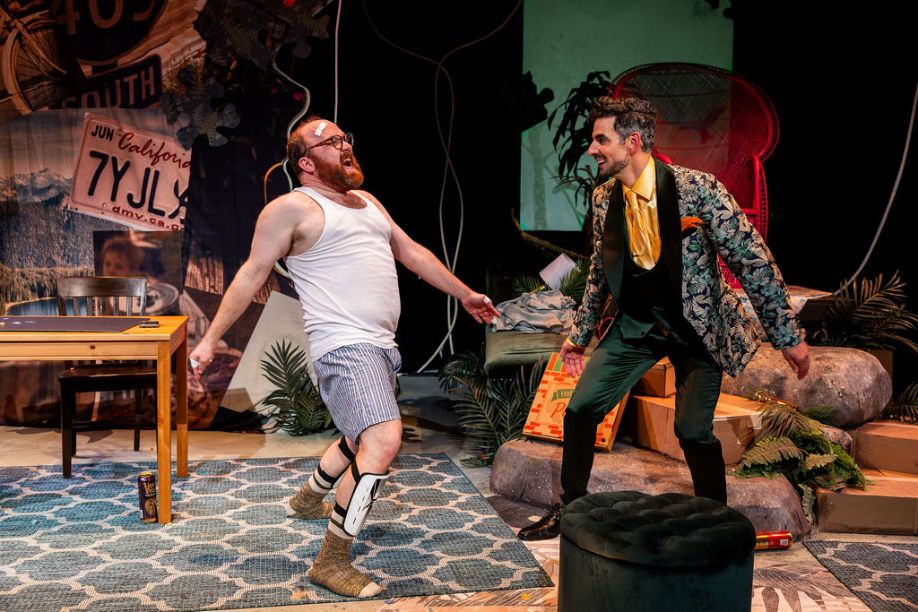
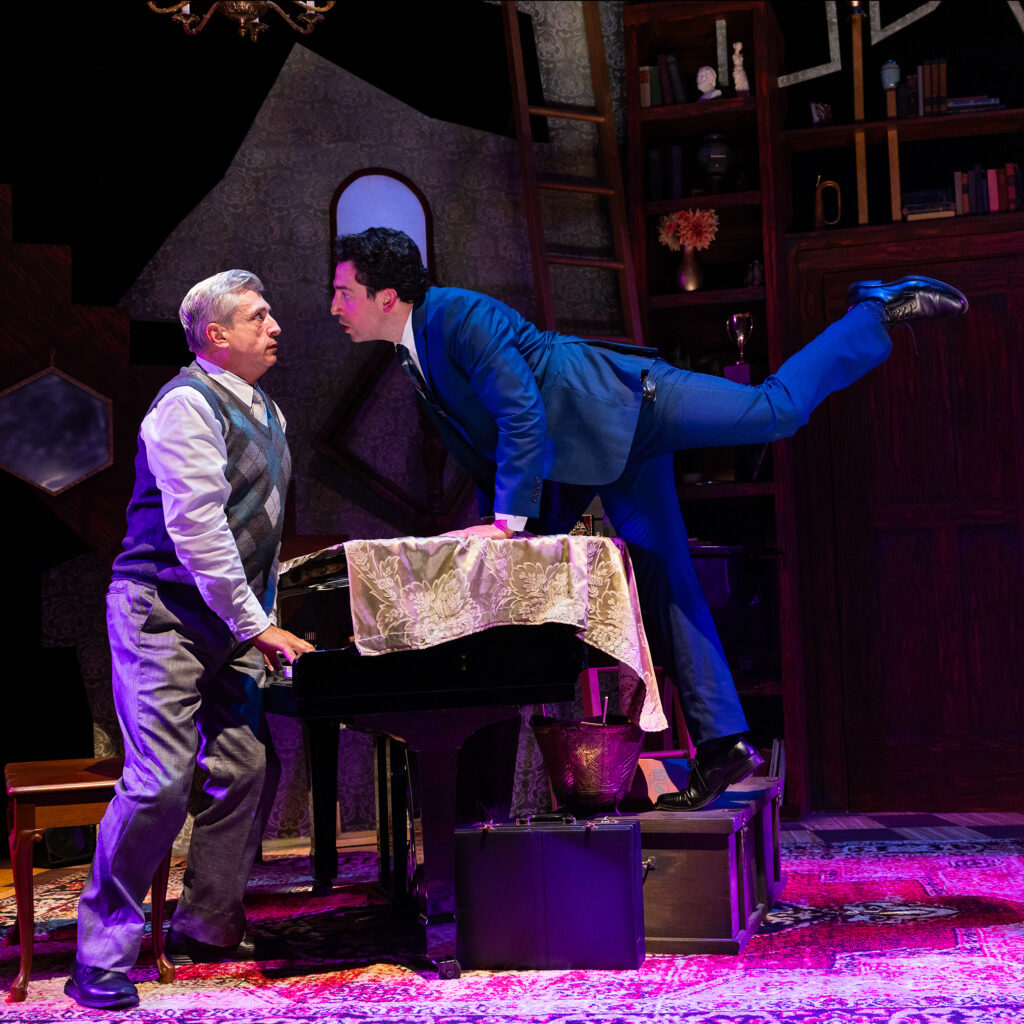
Will McGarrahan and Jared Troilo in “Murder for Two” at Greater Boston Stage
Photos: Niles Scott Studios

‘Murder for Two’ — Book and Music by Joe Kinosian. Book and Lyrics by Kellen Blair. Directed by Tyler Rosati. Music Direction by Bethany Aiken; Scenic Design by Katy Monthei; Lighting Design by Matt Cost; Sound Design by Adam Smith. Presented by Greater Boston Stage Company, 395 Main St., Stoneham, MA through Nov. 9.

By Shelley A. Sackett

Murder for Two is a loving parody of classic murder mysteries. A two-person musical, the 100-minute (no intermission) production is more vaudevillian revue than its genre’s prototypes, relying on gimmicks, songs, and quick changes to tell a familiar story in a new way.

The plot is fairly straightforward and as formulaic as it gets.

In the opening moments, Arthur Whitney, a famous author, is murdered in his mansion on the eve of his own surprise party. It is, of course, a stormy and dark night and the suspects are many — 13, in fact. From the widow, to the niece, psychiatrist, ballerina, town doctor, neighbors and local fireman, each is quirky and none lacks motive.

The only thing that keeps Murder for Two from being a total cliché is that all 13 suspects are played by Will McGarrahan, a virtuoso with a supple face and talent for impersonation. A simple hand gesture, distinctive gait, snooty scowl, tutu or pair of cat’s eyeglasses, and he becomes a different character, capturing their essence in the blink of an eye.

Jared Troilo is the small-town cop named Marcus Moscowicz who jumps at the chance to solve the case (and advance his stagnant career) when the real detective can’t be located. A by-the-books kind of guy, he has his work cut out for him dealing with this motley crew.
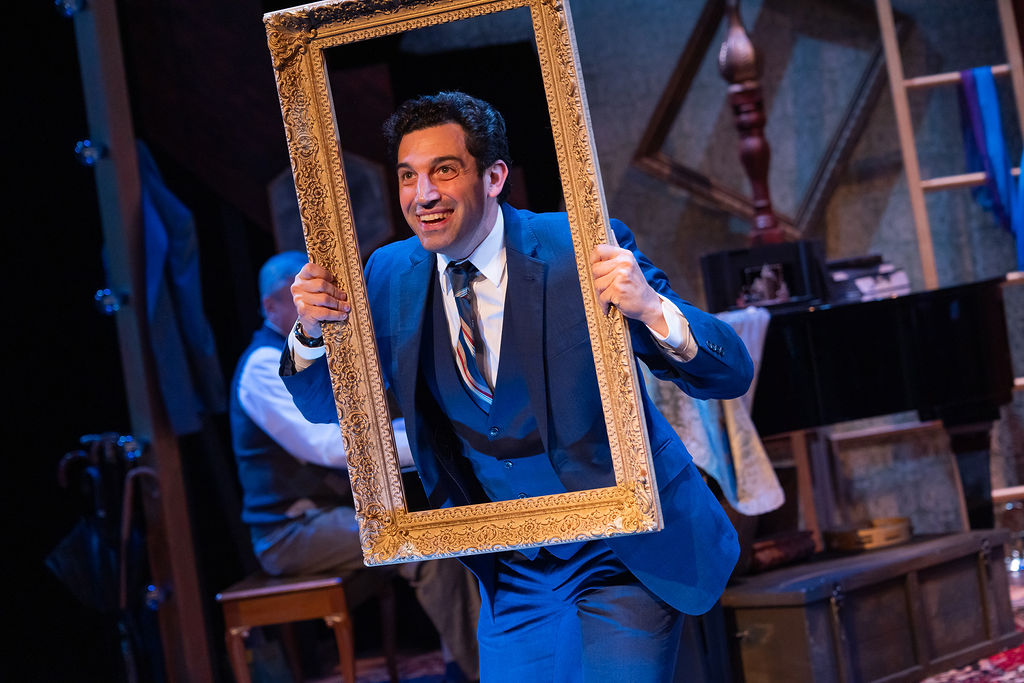
Troilo

The focal point of the small but expertly designed and lighted set is an upright piano, where the two actors show off their piano playing and vocal chops. Their musical rapport and interaction is delightful. They finish each other’s phrases, take turns singing and accompanying, and shine during four-handed duets. Unfortunately, the songs lack lyrics of substance and tunes with catchy melodies, but the actors’ comfort, confidence, and camaraderie (almost) make up for it.

The play also relies heavily on shtick and, like all shtick, some is laugh-out-loud funny, and some is corny and cutesy, landing with a thud.

At the Saturday evening performance on opening weekend, McGarrahan’s microphone malfunctioned and, despite an unscheduled intermission (which provided fertile fodder and opportunity for the actors to break the fourth wall and ad lib to the audience’s delight), still didn’t work properly. Given the show’s fast pace and McGarrahan’s pivotal role, it made the first half of the show even harder to follow.
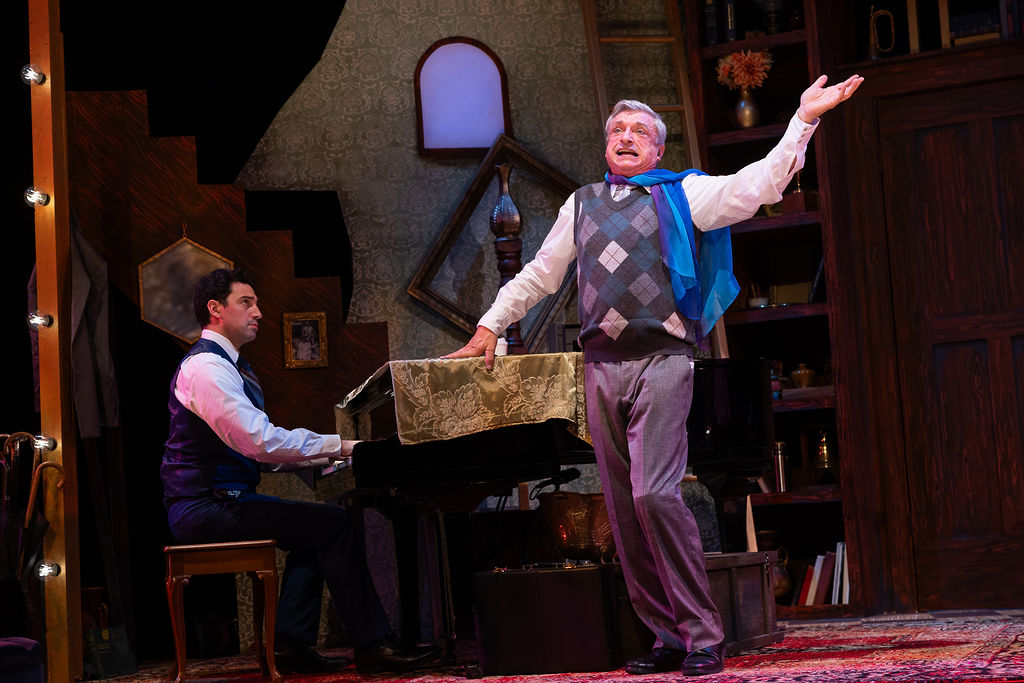
McGarrahan 

Following the plot and figuring out who done it, however, is not the point of attending this production. The real reason is the physical comedy and musical showmanship of two actors who are so comfortable with each other and their performances that, at one point, McGarrahan goes off script and shakes a tambourine in Troilo’s face until he cracks up. After an hour of scripted unevenness, the audience applauded in appreciation and relief.

Despite working with such unexceptional material, McGarrahan and Troilo seem to be having the time of their lives on stage. Would that the audience could have shared in some of that.

For more information, visit https://www.greaterbostonstage.org/
Paul Melendy Soars in GBSC’s Fabulous ‘Featherbaby’

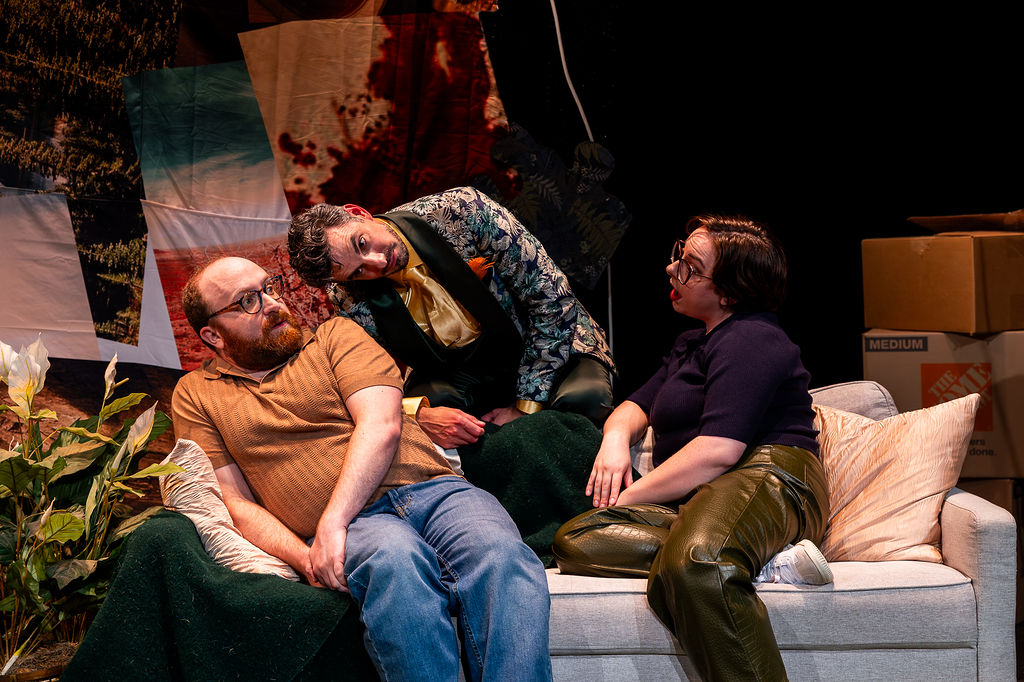
Gabriel Graetz, Paul Melendy and Liv Dumaine in GBSC’s ‘Featherbaby’

By Shelley A. Sackett

There are not enough words of praise to describe Paul Melendy’s sublime performance as the insightful, unfiltered and outrageously funny trash-talking parrot, Featherbaby, in the eponymous play now running in its co-world premiere through September 28 at Greater Boston Stage Company in Stoneham. If you only see one production this entire season, this is the one that should be at the top of your list.

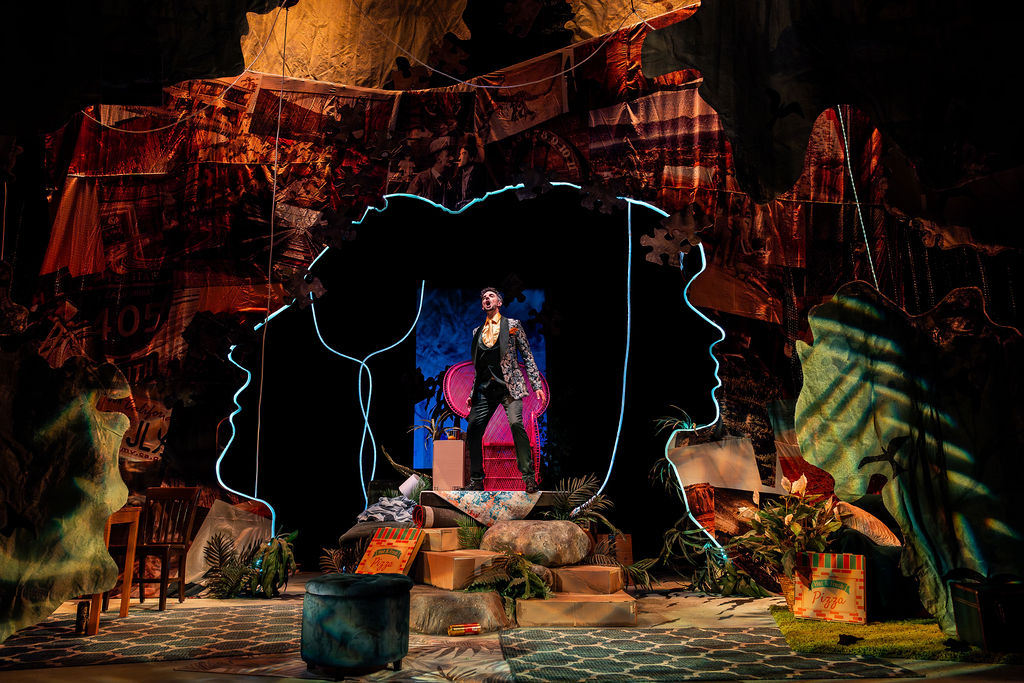
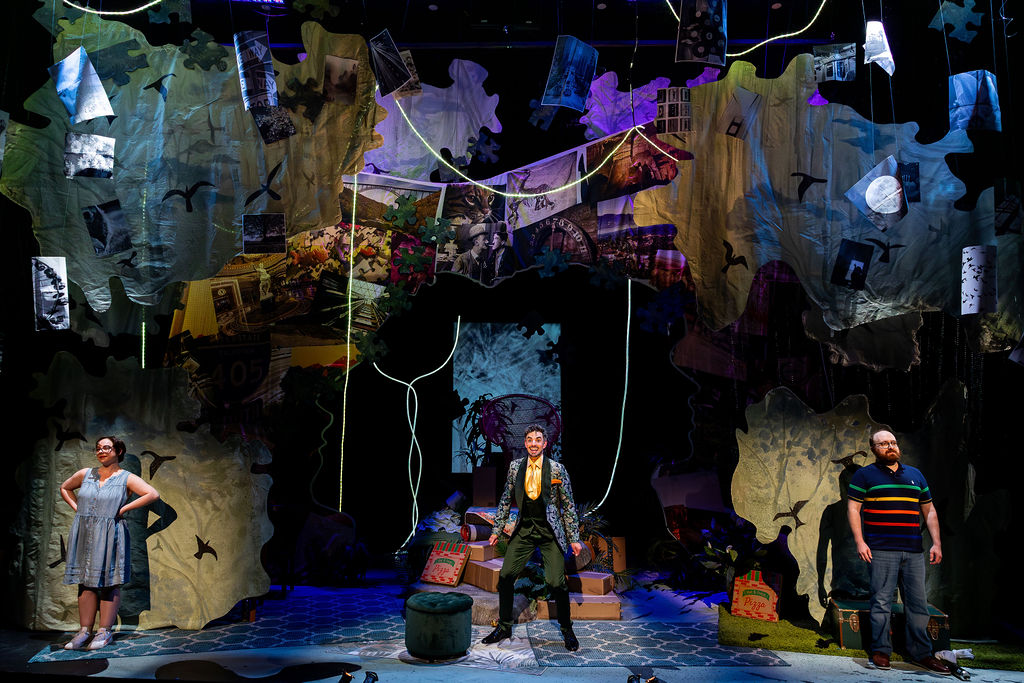
The set (Katy Monthei) alone is worth the price of admission. A pink wicker peacock chair sits high and center stage, an eye-catching focal point that will double as Featherbaby’s cage. Jigsaw pieces, rainforest motifs painted on cloth panels, strings of lights, and photographs of crime scenes foretell later plot elements, but before the curtain even goes up, all are indicative of the uniquely inventive theatrical event soon to begin. A simple desk and chair stage right and small table stage left bridge Featherbaby’s world and the two humans who will later share their stage.

The play opens with Melendy sashaying on the stage in full regalia. Thankfully, that does NOT include a stuffed-animal-like mascot costume of a green parrot. Rather, Deirdre Gerrard has captured the image of an Amazon parrot while allowing Melendy’s plasticene physicality to strut its stuff by creating an outfit of floral, formal dinner jacket, green vest and matching pants, and luminescent yellow satin shirt and tie. Melendy makes expert use of the long, wide double flaps in the jacket’s back as he manipulates his “tail” to great dramatic effect.

Melendy

“I am adorable,” Featherbaby announces. Melendy casts a magical spell as his facial expressions, neck twitching, and bird-like prancing transform him into a believable version of a bird. “I am also,” he says unnecessarily, “intense.”

Maniacally egotistical, Featherbaby also needs constant attention and will go to great lengths to make sure he is at its center. “I AM HERE!!!!!” is his favorite refrain, seconded only by “poop.”

Melendy goes on, with manic and jaw-dropping physicality, to describe the evolutionary history and modern-day life of the parrot. We learn that parrots are descendants of dinosaurs and that their primary purpose in the wild is as simple as it is singular: avoid getting eaten. We also learn a new vocabulary that includes “crunching” (biting) as in, “I feel a crunch coming on.”

He describes being bagged by poachers and transported from his rainforest Amazonian haven to a cage in America. Melendy is an indescribable delight to watch, as he vamps, pantomimes, and literally inhabits Featherbaby. He even ad-libs at one point, when he tosses Mason’s “heavily scented boxer shorts” into the audience, only to have them thrown back in his face.

“There’s only room for one cheeky parrot in this play,” he says with a menacing, eyebrow-raised sneer.

The loose-limbed plot involves Angie (Liv Dumaine), the unpredictable and effervescent human who saved Featherbaby from an unfortunate shelter, and Mason (Gabriel Graetz), a man she brings into her (and Featherbaby’s) life.

Angie is a working gal who has recently broken up with her former roommate and girlfriend. The parrot now provides her only companionship. As Angie, Dumaine is all hope and toothy smiles when she brings Mason, a fellow jigsaw puzzle fanatic, home for the first time. Featherbaby takes an instant dislike to Mason, and the hostility is returned. Parrots are terrifically territorial, and when Mason begins to threaten Featherbaby’s previously exclusive relationship with Angie, Featherbaby’s tail feathers become ruffled. He crunches Mason relentlessly, hoping to nip the connection in the bud. That tactic fails, and when Mason moves into the apartment, it is all-out war to win back Angie’s full attention.

Graetz, Melendy

Angie (not quite the nice girl she pretends to be) leaves Featherbaby with Mason (more of a marshmallow sap than he realizes) to resume a relationship with Catherine, her former girlfriend. The two abandoned and betrayed former Angie beloveds must figure out a way to coexist. Eventually, after months of humorous and poignant hits and misses, they strike a truce and end up the better for it.

Along the way, Featherbaby’s asides and narrations delve into deeper issues of friendship, loyalty, competition, respect, and the multifaceted nature of relationships in general and love in particular. Most important are the lessons he learns (and shares) involving acceptance, love and trust.

“Who ends up in our bones is not always our choice,” Featherbaby notes. “Sometimes the bones choose.”

“What excites me most about Featherbaby is that it manages to be both laugh-out-loud funny and deeply touching,” said Director and Producing Artistic Director Weylin Symes in the program notes. “It is a play that sneaks up on you. One moment you are doubled over with laughter, and the next you find yourself thinking about the ways we connect with each other, even in the most unlikely circumstances.”

That is certainly true, but what is even truer about this production of Featherbaby is that it firmly establishes Paul Melendy as a one-of-a-kind talent. I, for one, can’t wait to see him next in Lyric Stage’s A Sherlock Carol.

‘Featherbaby’ — Written by David Templeton. Directed by Weylin Symes. Scenic Design by Katy Monthei; Lighting Design by Matt Cost; Costume Design by Deirdre Gerrard; Sound Design by Mackenzie Adamick. 1 hour 45 minutes, one intermission. Presented by Greater Boston Stage Company at 395 Main St, Stoneham, MA, through September 28.

For more information, visit www.greaterbostonstage.org

GBSC’s “Guys and Dolls” Is A Cool Glass of Summer Refreshment

Jared Troilo, Lisa Kate Joyce in Greater Boston Stage Company’s ‘Guys and Dolls’
Photos by Gillian Gordon

“Guys and Dolls.” Book by Abe Burrows and Jo Swerling. Music and Lyrics by Frank Loesser. Directed/Choreographed by Ceit Zweil. Musical Direction by Dan Rodriguez. Presented by Greater Boston Stage Company, 395 Main Street, Stoneham, through June 30.

By Shelley A. Sackett

When it comes to bubbly, breezy, musical fare, Greater Boston Stage Company is as reliable as it gets and “Guys and Dolls,” in production through June 30, is further proof.

Even before the show starts, a usually boilerplate announcement is anything but. “Turn off your phone. It’s a small theater. Everyone will know it’s you,” a vintage radio announcer-type warns.

Hailed as the perfect musical romantic comedy, this award-winning classic is set in 1920s “Runyonland,” a mythical New York City. Based on Damon Runyon’s short stories, the two-and-one-half-hour play (one intermission) is a potpourri of slapstick, glamorous cabaret showgirls, gamblers, gangsters, and Salvation Army missionaries.

There’s even a quick trip to pre-revolutionary decadent Havana.

Twenty-four musical numbers, backed by a seven-piece orchestra, are the glue that connects the dots and provides both a vehicle to showcase the cast’s formidable talent and a layer of joyful merriment.

The story is fairly straightforward.

Gambler Nathan Detroit needs to find financing to set up the biggest craps game in town. He faces more than a few obstacles. First of all, the authorities are breathing down his neck, Lt. Brannigan of the local police force watching his every move. Second, the only place he can find to hold the game requires $1,000 security deposit. Third, Nathan is broke. And fourth (but hardly last), Adelaide, a nightclub performer and his fiancée of 14 years, has made him promise to give up running craps games. When she finds out he’s still at it, she kicks him out.

Undaunted, Nathan contrives a way to get the money by making a bet with fellow gambler Sky Masterson, known for deep pockets and an inability to resist any wager that crosses his path.

This one? That Sky can’t get Sarah Brown, one of the straight-laced missionaries, to have lunch with him in Havana.

The rest of the play revolves around con men conning and being conned, unrequited love being requited, and an unlikely group of missionaries who yield more influence than they could have prayed for. The plot twists and turns are cute, light, and hilarious — perfect summer fare.

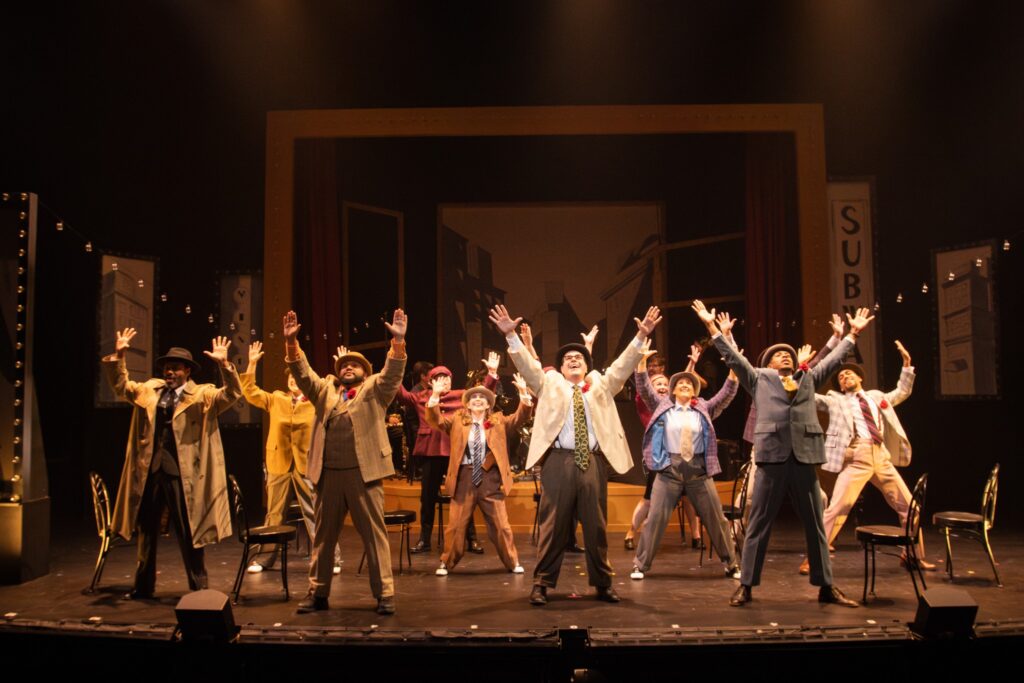
All this is told through top-tapping familiar songs (“Luck Be A Lady,” “A Bushel and a Peck,” and “Guys and Dolls” among them) and exuberant choreography performed with the caliber of singing and acting we have come to expect from GBSC.

Stephen Markarian, Mark Linehan, Christian David

And —best of all!!! — the orchestra complements the actors rather than drowning them out. Kudos to Sound Designer John Stone and his engineers for ensuring that the audience can hear – and understand – the lyrics.

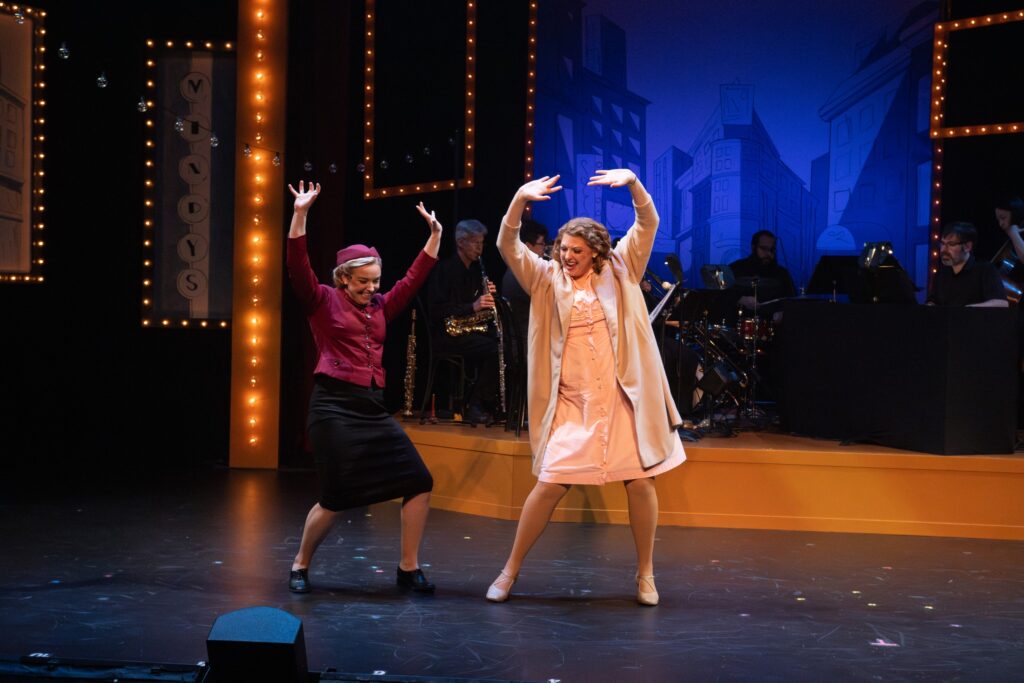
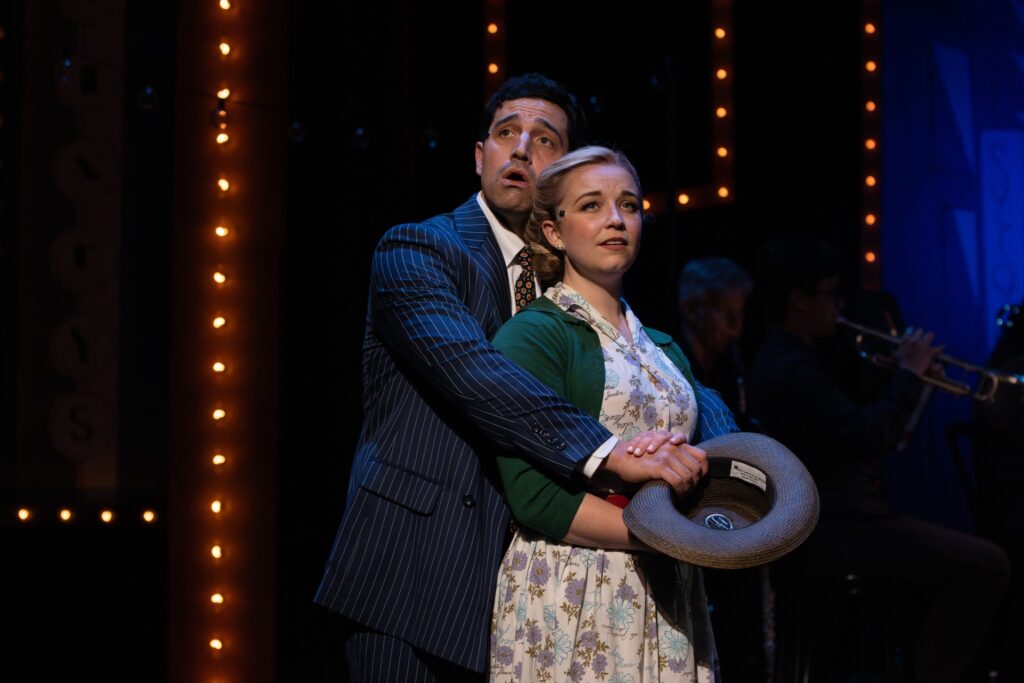
Jon Savage’s set makes efficient use of a compact stage. He has built a neon shadow box to house the orchestra, bringing them into the mix in an organic way. Unobtrusive props change the scene from mission meeting to street corner to cabaret to Havana club. Ceit Zweil’s direction and choreography keep the action flowing and interesting.

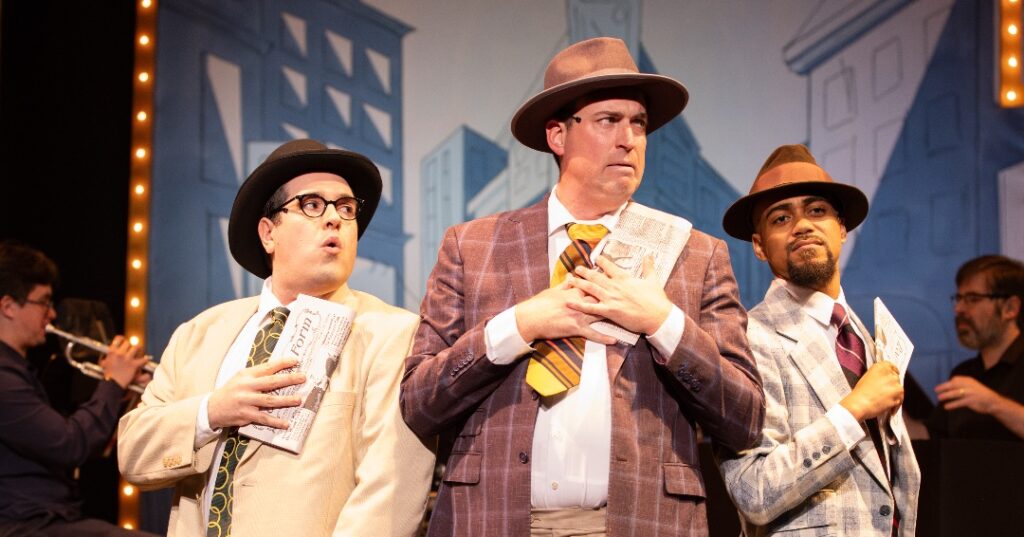
The play’s opening number (“Runyonland”) is upbeat and happy, setting the tone for what is to follow. “Fugue for Tinhorn,” about betting on the races, follows, introducing us to three loveable gamblers: Nicely-Nicely (Stephen Markarian), Benny Southstreet, and Rusty Charlie. Markarian is a standout, bringing warmth, physicality, and self-deprecating humor (and a great voice) to Nicely-Nicely.

Sara Coombs as Adelaide is an adorable knockout. Everything about her performance is impeccable, from her exaggerated facial expressions to her dancing to her fabulous voice. Plus, she has a terrific sense of timing and a comedic flair that is a true pleasure to behold.

Jared Troilo imbues Sky Masterson with sensitivity beneath his worldly criminal carapace. His dancing and singing are superb, and his duets with Sarah are among the show’s highlights.

Of which there are many. There are double entendres and double-crossers.

Joyce, Sarah Coombs

There are the corny, Henny Youngman-esque laugh-out-loud jokes (“I kinda like it when you forget to give me presents. It makes me feel like we’re married,” Adelaide tells Nathan). There are even a barbershop quartet, an a capella number, and an operatic aria (Lisa Kate Joyce has a voice that could shatter glass).

Most of all, there is a light, entertaining story that surprises us with a serious takeaway. As Nicely-Nicely succinctly puts it, “Life is one big crap game, and the Devil is using loaded dice.”

For more information and to buy tickets, visit https://www.greaterbostonstage.org/
‘Boulevard of Bold Dreams’ Shines a Light on Hattie McDaniel and Her 1940 Oscar

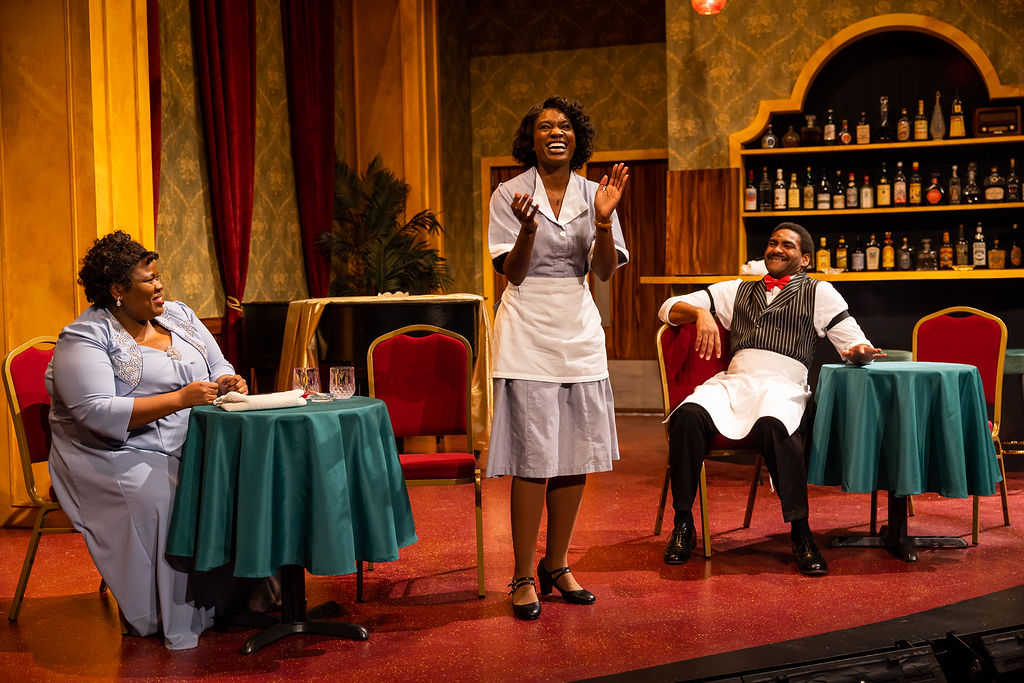
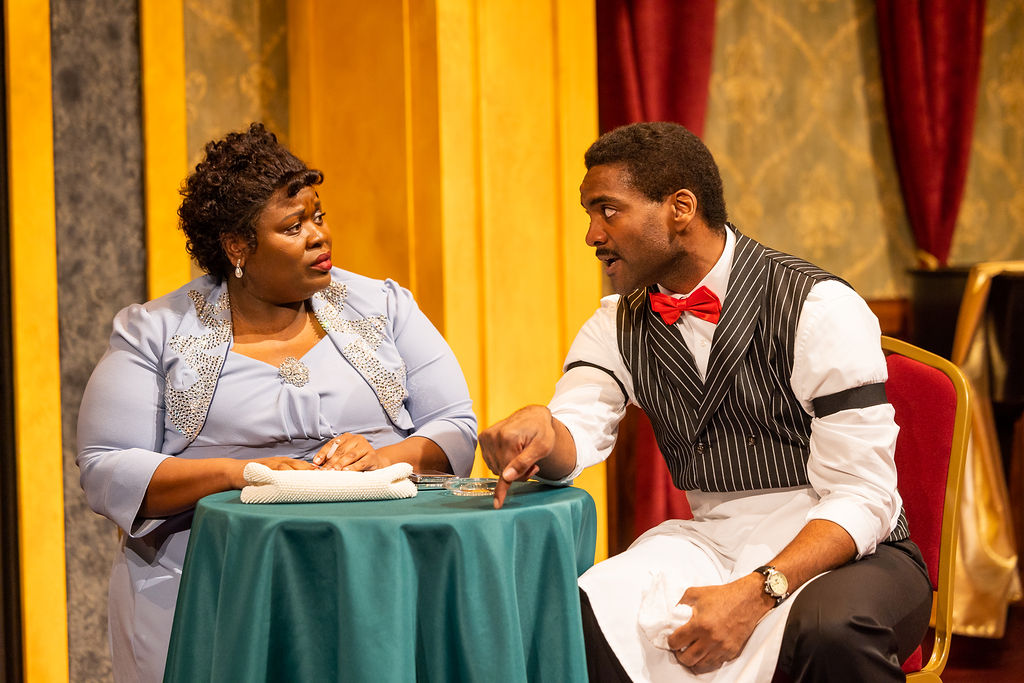
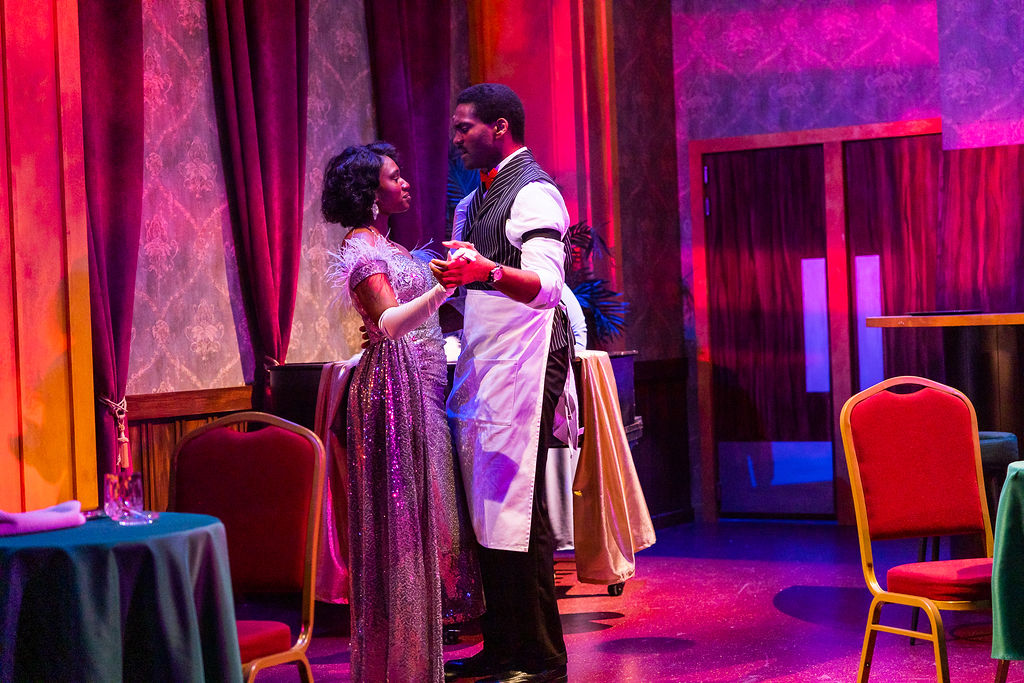
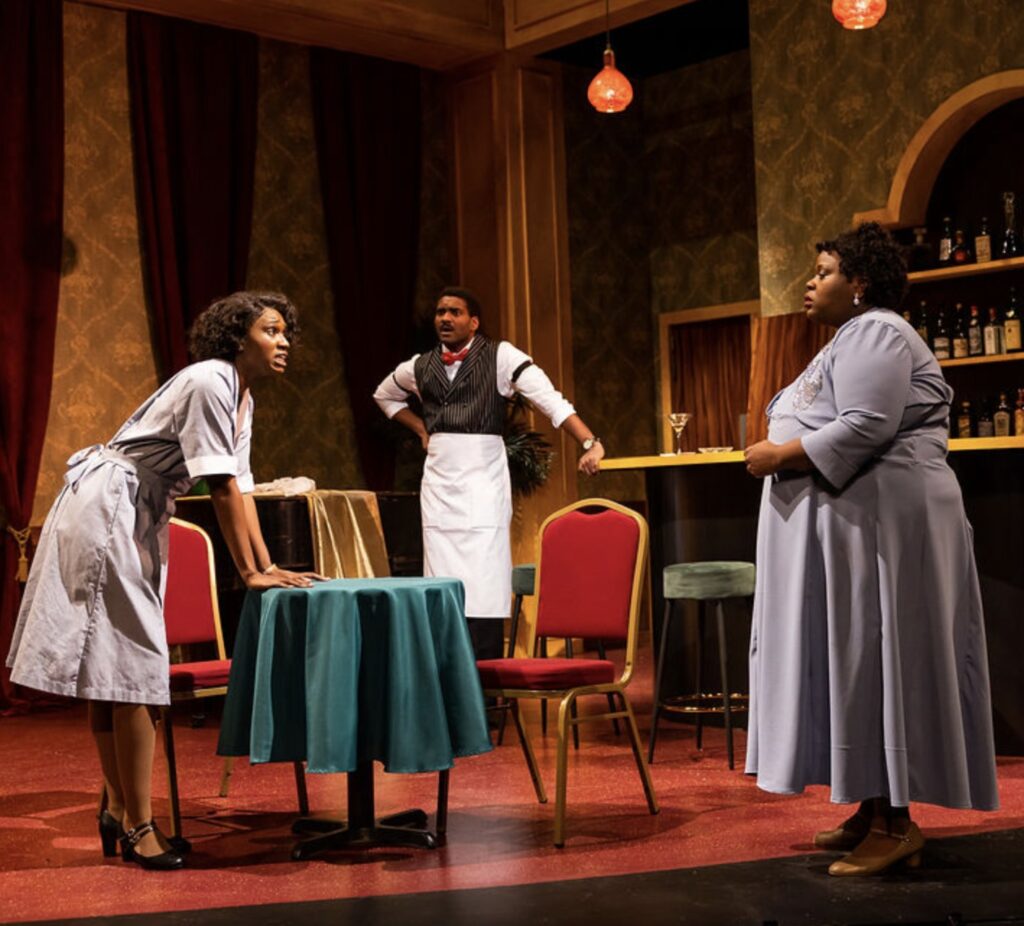
Samantha Jane Williams, Michelle Fenelon, and Stewart Evan Smith in ‘Boulevard of Bold Dreams’ at GBSC. Photos by Nile Scott Studios

By Shelley A. Sackett

Playwright LaDarrion Williams has cherry-picked a dramatic moment in history to explore in his well-crafted ‘Boulevard of Bold Dreams.’ The date is February 29, 1940, the night of the Academy Awards. The setting is Los Angeles’ Ambassador Hotel bar, outside the grand ballroom where the awards will be presented.

Before the ceremony even starts, this year’s Oscars have made history. Hattie McDaniel is the first Black actor to be nominated for an award. She is up for the Best Supporting Actress Oscar for her performance as Scarlett O’Hara’s ‘mammy’ in the Civil War era blockbuster, “Gone With the Wind.”

Working in the sumptuous Art Deco lounge (kudos to set designer Rachel Rose Burke) are Black employees Arthur Brooks (Stewart Evan Smith), a bartender, and Dottie Hudson (Michelle Fenelon), a chambermaid. The two banter as comfortably as rivalrous siblings. In the course of their intimate conversation, the audience picks up that they have been friends since they were two years old. Together, they left rural Alabama for Hollywood to follow their dreams. Dottie, a talented singer, is waiting for her big break. Arthur dreams of becoming a film screenwriter and director. He even has a title for his first project: ‘The Boulevard of Bold Dreams.”

Williams, Smith

Their big dreams, however, run smack into the reality of 1940s California, where most working-class Blacks are relegated to subservient positions and racism is less violent but no less virulent than the version they lived with in Alabama. While waiting for their dreams to come true, they work day jobs they hate.

The silver lining is they work in the same hotel and get to hang out. A lot. They talk about everything under the sun. This evening, Hattie McDaniel is topic number one. The white hotel owner just directed Arthur to set up a table for her in the back corner of the theater, out of sight of the white guests. Allowing her in the hotel at all is a major concession in this whites-only establishment; sitting with her castmates would be out of the question.

The two debate the double-edged sword of the evening and whether McDaniel should attend or not. McDaniel’s nomination for the movie industry’s highest honor is a milestone breakthrough and achievement for Blacks everywhere. “She came out here with nothing but $50 and a dream. She’s a credit to our race,” Arthur says.

Fenelon, Smith

Dotty, on the other hand, thinks McDaniel should strike back at the white establishment that has used and abused her, and refuse to attend. Dotty chafes at the Mammy role that practically venerates slavery and has McDaniel “shucking and jiving for those white folk.” On top of that, and most unforgivable, is the fact that McDaniel was not even allowed to attend the movie’s premiere with her fellow castmates because it debuted at a whites-only theater in Atlanta.

Their hypothetical debate turns real when Hattie McDaniel (Samantha Jane Williams) herself wanders into the bar, seeking a moment alone while she wrestles with the very issue Dotty and Arthur have been discussing. For her, the matter is far more pressing. She has decided she won’t attend the awards ceremony under her agent’s conditions (the studio has even written her acceptance speech, not trusting her to speak on her own ). “What’s the point if I’m not treated like a human being? All I want is to sit with my cast,” she says sadly.

Arthur and Dotty have only minutes if they are to convince her otherwise.

McDaniel describes the negative reaction that has worn her down. Even the NAACP, criticizing the part as “a disgrace to colored folks,” urged her to refuse the role. “My own worst enemy ain’t the white folks. It’s my own people,” she explains.

Over drinks and stories of hardships and dreams, the three reveal their experiences with a racist system designed to keep them down. Arthur tries to convince McDaniel of the importance of the day for Blacks everywhere. Dottie ferociously attacks McDaniel for her part in perpetuating the myth of Blacks with her roles playing happy maids and slaves. She accuses her of being the worst kind of sell-out.

“I’d rather play a maid in the movies than be one in real life,” McDaniel finally fires back. She takes on these maid roles with “pride and responsibility,” she explains, as an homage to Black women and their sacrifices. She wants to show the human value of caregivers like her own mother, a former slave, who made a living mothering the children of a white family who acted like she didn’t exist. “I took those roles for me. I’d play a thousand maids to show people my mother’s worth,” she says. “I made you see them. You know them now.”

Fenelon, Smith, Williams

Eventually, McDaniel’s ambivalence about attending the ceremony wanes. She attends and (no spoilers here) wins, beating out cast mate Olivia de Havilland. The show’s closing scene projects her actual acceptance speech onto a vintage black and white TV along with speeches of ten Black actors who won Oscars since, a clever touch. Especially poignant is hearing Mo’Nique, best-supporting actress winner 70 years later for “Precious,” declare, “I’d like to thank Miss Hattie McDaniel for enduring all that she had to so that I would not have to.”

Williams’ script does an excellent job of bringing us into the hearts and minds of his fictionalized characters while also conjuring up McDaniel’s conflicted viewpoint. At 100 minutes (no intermission), the play both flows and informs. Yet, given the personal pain and humiliation that accompanied her trailblazing triumph, we can’t help wondering how the real Hattie McDaniel, armed with 20-20 hindsight, might truthfully answer Dotty’s question: Was it worth it?

‘Boulevard of Bold Dreams’ — Written by LaDarrion Williams; Directed by Taavon Gamble; Scenic Design by Rachel Rose Burke; Lighting Design by Corey Whittemore; Costume Design by Klara Escalera; Sound Design by James Cannon; Property Design by Emily Allinson. Presented by the Greater Boston Stage Company at 395 Main St., Stoneham, MA through March 19.

For tickets and information, go to https://www.greaterbostonstage.org/
‘Little Women: The Broadway Musical’ Is Another Home Run for Greater Boston Stage

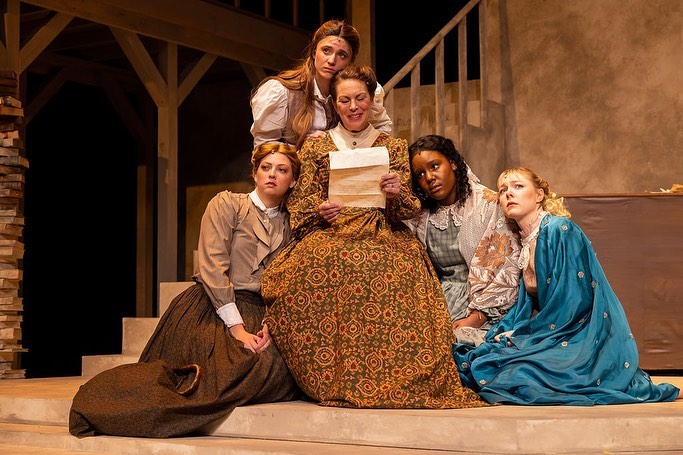
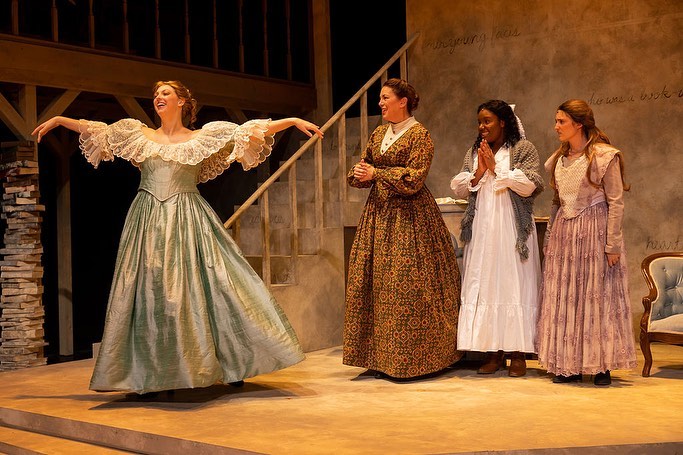
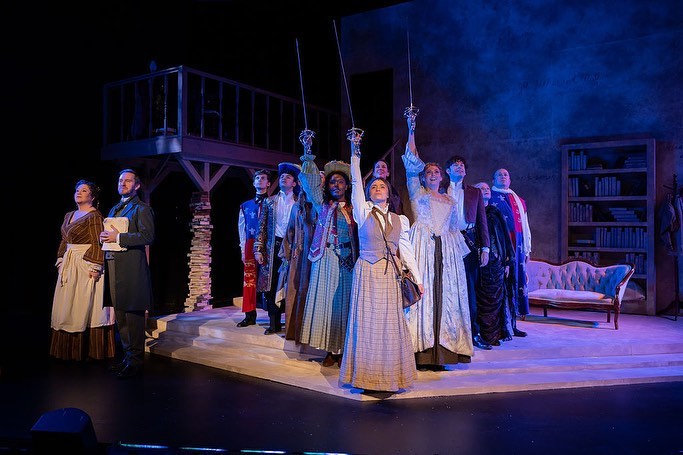
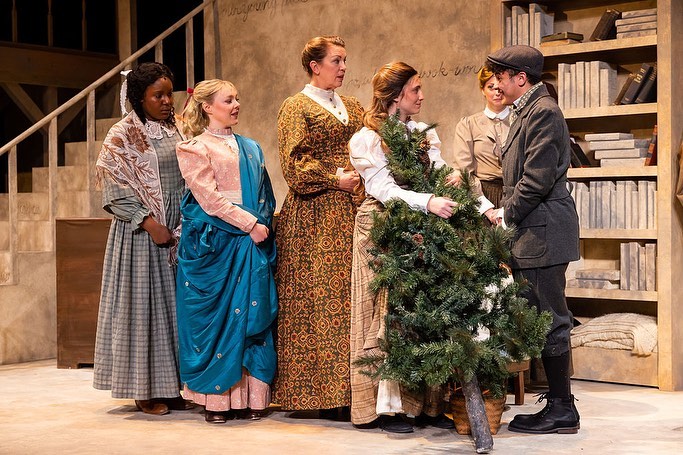
Cast of ‘Little Women’ at Greater Boston Stage Company – L to R Sarah Coombs, Liza Giangrande, Amy Barker, Abriel Coleman, Katie Shults

‘Little Women: The Broadway Musical’ – Book by Allan Knee based on the novel by Louisa May Alcott. Lyrics by Mindi Dickstein and Music by Jason Howland. Directed and Choreographed by Ilyse Robbins. Music Directed by Matthew Stern. Scenic Design by Shelley Barish. Lighting Design by Katie Whittemore. Costume Design by Gail Astrid Buckley. Sound Design by John Stone. Presented by the Greater Boston Stage Company, Stoneham through December 23.

by Shelley A. Sackett

Greater Boston Stage Company has a knack for picking the perfect material and director for its holiday offering. Last year, the musical, ‘All Is Calm,’ also directed and choreographed by the talented Ilyse Robbins, was a crowd pleaser that raised the bar and spoke to audience members of all faiths with a message that transcended the usual Christmas pablum. This year, with its flawless production of Little Women: The Broadway Musical, that bar got even higher. At 150 minutes (including intermission), the play didn’t seem too long, a feat in and of itself.

Based on Louisa May Alcott’s tale of four respectable sisters growing up poor but honest in Civil War-era Concord, MA, the musical follows the adventures of Meg, Jo, Beth and Amy March. Their individual personalities bubble up from the get go. Meg (the riveting Sara Coombs) is the eldest and most traditional of the sisters, prim and proper but romantic and sweet-natured. Jo (Liza Giangrande, giving a grand performance), the willful, spirited center and Alcott proxy in her novel, “Little Women”, is a perfect musical-theater heroine. Equally driven to become a published author and challenge stereotypes about what it means to be a woman, she belongs on the masthead of Ms. Magazine.

Beth (third year Boston Conservatory at Berklee student Abriel Colemanis) is timid, musical, and selflessly encouraging and helpful. By contrast, Amy (Katie Shults) is the spoiled baby of the family, overindulged and used to getting her own way. Shults plays her perfectly, capturing her pouty, tantrum-prone outbursts without erasing her underlying puppy-like irresistibility. At the helm of this brood is Marmee (the rock solid Amy Barker), the backbone of the March family who manages to remain strong in spite of the difficulties she faces.

The play opens in New York, where Jo is living at Mrs. Kirk’s boarding house, trying to peddle her wild, swashbuckling stories to anyone who will listen to her pitch. Fritz Bhaer (subtly and effectively played by Kevin Patrick Martin), the sensible German professor also boarding with Mrs. Kirk, tries to persuades Jo that she is better than the “blood and guts stuff” she has chosen to write. She should try, he urges, to write more from her heart about what she knows.

In a magnificent flashback that establishes the cast’s astonishing vocal and physical abilities, Jo tells him about the “Operatic Tragedy” she wrote and had her family perform on Christmas one year. The actors bring Jo’s story to life in true melodrama form. Coombs, in particular, shines.

Thanks to a well-designed triptych set (Shelley Barish) and spot-on lighting (Katie Whittemore), the audience has no trouble following the action as it moves from the March home to New York to the March attic, which is Jo’s special writing cave.

Along the way, we are introduced to characters who add spice while moving the plot along. Wealthy Aunt March (a terrific Deanna Dunmyer) wants to take Jo under her wing and treat her to a tour of Europe, but only if she agrees to change from a tomboy to a proper society lady. Their duet, “Could You?” is as musically stunning as it is hilarious. Dunmyer steals every scene she is in with her acerbic wit and perfect, sing-song cadence.

When Meg and Jo are invited to a St. Valentine’s Day ball, they meet Theodore “Laurie” Laurence (Kenny Lee, talented and poised beyond his years), the lonely and guileless boy next door who infiltrates the March sisterhood and becomes an honorary brother. He and Jo share an ease and intimacy that, unfortunately for Laurie, doesn’t translate into romance.

While hardly the most sophisticated or musically unforgettable show to hit Broadway (critics gave it a lukewarm reception when it played in 2005), the cast and crew at Greater Boston Stage hone in on its strengths and wring it dry. Robbins’ director and choreographer chops are on full display and Music Director Matthew Stern is worth his weight in gold. Gail Astrid Buckley’s period costumes add just the right touch.

But the real standing ovation goes to the universally airtight performances by an impeccable ensemble cast. What a gift to their audience, especially to this viewer, who has the enviable pleasure of writing an effusive review of a not-to-be-missed show. For tickets and information, go to: https://www.greaterbostonstage.org/
GBSC’s ‘Incident’ Is a Pleasant Trip Down Memory Lane

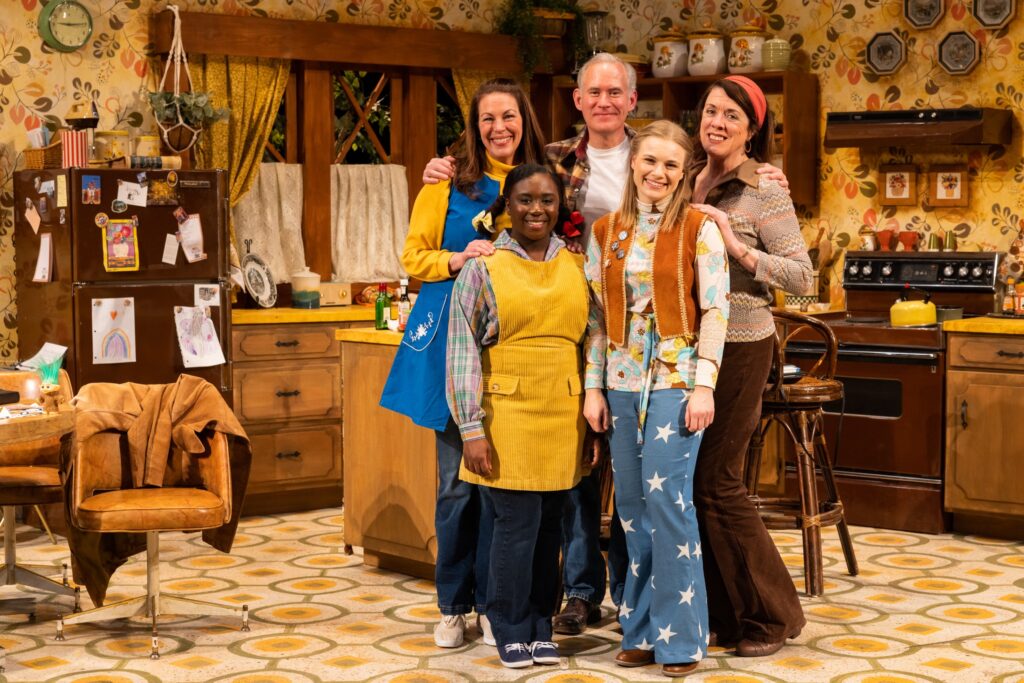
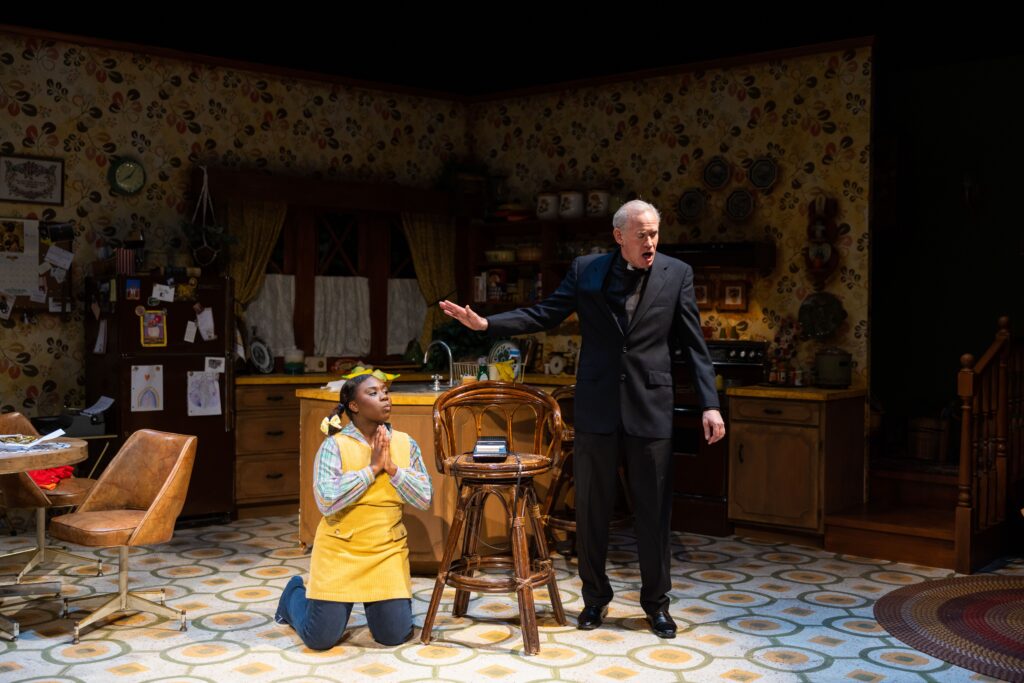
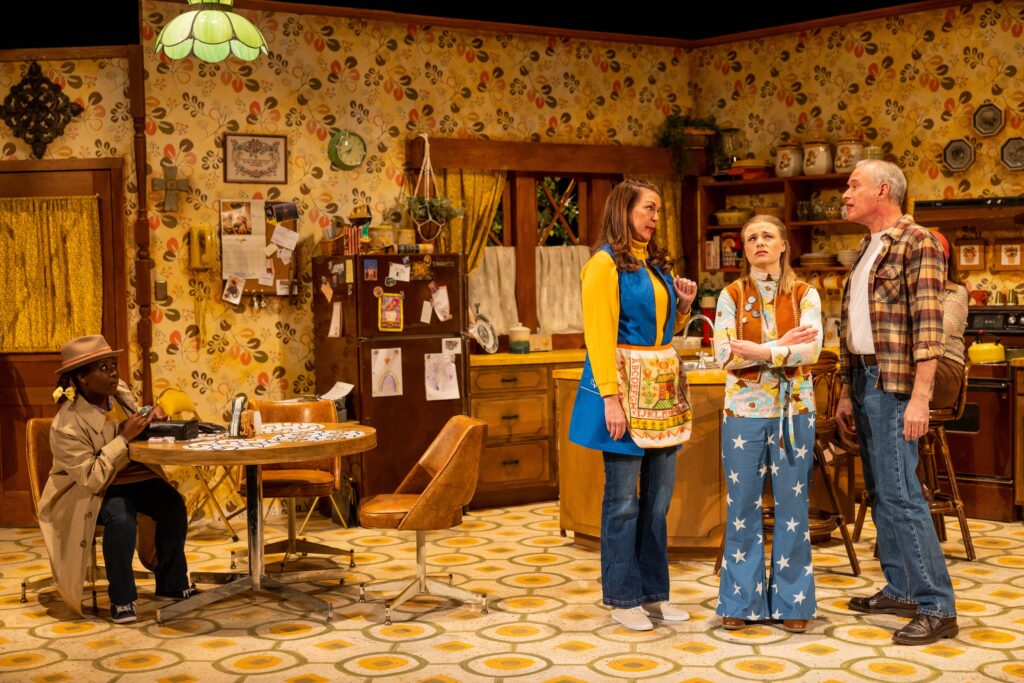
Cast of ‘Incident at Our Lady of Perpetual Help’ at Greater Boston Stage

By Shelley A. Sackett

‘Incident at Our Lady of Perpetual Help’ will strike a particular chord among those of us whose wallets now hold Medicare and AARP cards. Written by Seattle-based playwright, Katie Forgette, it is a loving trip down her personal memory lane. She was raised Catholic and attended parochial school for 12 years. Her father was a hard working cab driver; her mother had many jobs, in addition to birthing ten children and caring for her own disabled mother.

The family wasn’t poor, but only because her parents sacrificed personal goals and worked as hard as they could to be financially comfortable.

Her play is set in the 1970s, and Shelley Barish has created a believable set that focuses on the main gathering place in the house — the kitchen. Homey, shabby and beloved, the room is full of interesting mementos of that era without feeling cluttered. (I was not alone in noticing that the clock on the set wall told the actual time, a nice touch and a visual clue that the connection between past and present is real and fluid).

Linda O’Shea/Forgette, played by Autumn Blazon-Brown, is our 20-something year old protagonist. She makes clear from the get go that, although she is narrator, she may not be a reliable one. “Memory shifts things,” she says. Telling old stories almost always involves the fallibility of memory. Two people, especially family members, remember the same event differently. She talks about the plasticity of memories, how they change over time and with each recollection to the point where, even when it comes to your own life, you may be considered an unreliable narrator.

She also points out the changes since the 1970s in the ways we communicate. “There was no posting; you lived your life in person,” she says wistfully.

Vin Vega, Barlow Adamson

Nonetheless, she is determined to tell the story of her family from her perspective to the best of her recollection.

And so we meet her mother, Jo (Amy Barker), father, Mike (Barlow Adamson), younger sister, Becky (Vin Vega) and Jo’s sister, Aunt Terri (the always fabulous Maureen Keiller). Over the next hour and 45 minutes (including an intermission), this cast of characters (along with a few hysterical cameos by a neighbor and priest) have one job and one job only — to tell the family story the way Linda remembers it.

Some of the characters are not too happy about their supporting roles. They want a monologue of their own, a chance to step up to the mike and explain their version of things. But Linda maintains control, doling out audience access sparingly and under strict time limits.

Although the plots twists and turns and the script’s clever lines draw easy laughs, the real meat and message lie in the family dynamics. They are a tight knit bunch, glued together by bonds of love, loyalty and compassion and — most importantly — humor. They soldier on, often griping and acting out, but they are actors cast in the same play and, at the end of the day, blood is thicker than anything.

Amy Barker, Autumn Blazon-Brown, Barlow Adamson

We are also treated to local parish customs and the hold the Catholic Church had over more than the religious aspects of their lives. Father Lovett and the infuriatingly patronizing church lady, Betty Heckenbach (both played with superb comic timing by Adamson) are examples of the hypocrisies and cruelty the church doled out with its communion wafers.

All the O’Sheas kowtow under the pressure to conform except Terri, who has known the pains of marital separation and barrenness, and isn’t afraid to call a spade a spade.

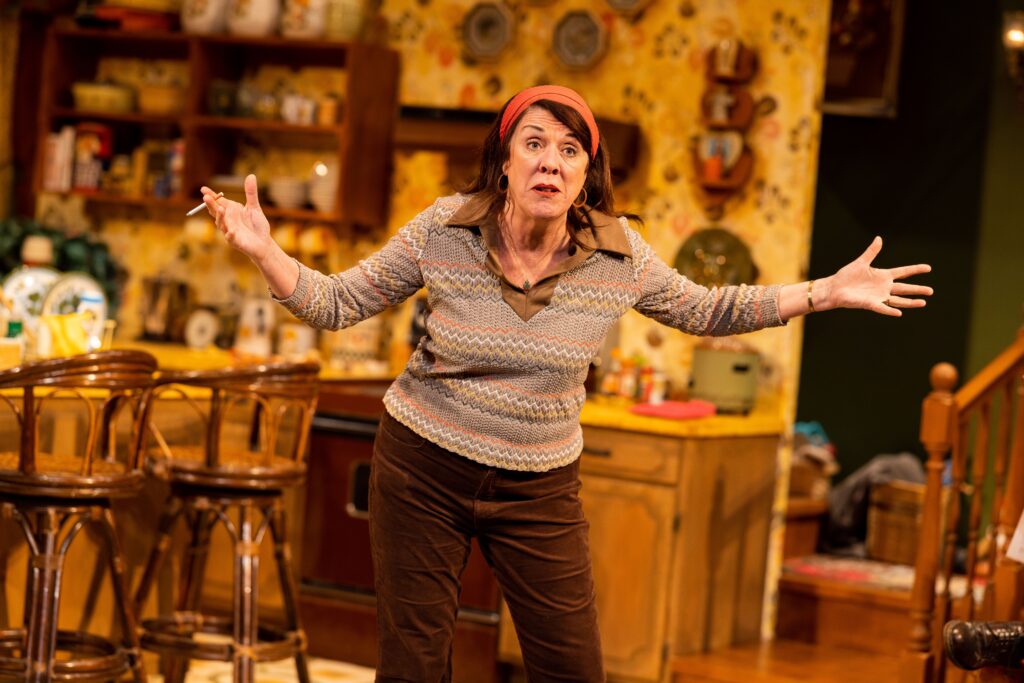
The riveting Keillor is her usual scene stealing self. (She was likewise phenomenal as Sherri Rosen-Mason in the SpeakEasy Stage’s 2019 production of ‘Admissions’). Her performance is calculated, physical and impeccably paced. Yet, it doesn’t have that “staged” feel. Rather, she makes Terri the warmest, realest and most 3-dimensional character on the stage.

Maureen Keillor

While Barker brings a warmth and strength to Jo and Adamson is great in his cameo roles, Vega and Blazon-Brown are weak links, delivering their lines in muffled tones at the speed of light. Too many great jokes are quashed and after a certain time, audience frustration sets in and we stop trying to catch every sentence.

Nonetheless, for Keillor’s performance and a feel-good theatrical experience, ‘Incident’ fits the bill. There are some real belly laughs, thought-provoking messages and zinger one-liners in this production. For tickets and information, go to: https://www.greaterbostonstage.org/
Greater Boston Stage’s ‘All Is Calm’ Strikes the Perfect Chord

by Shelley A. Sackett

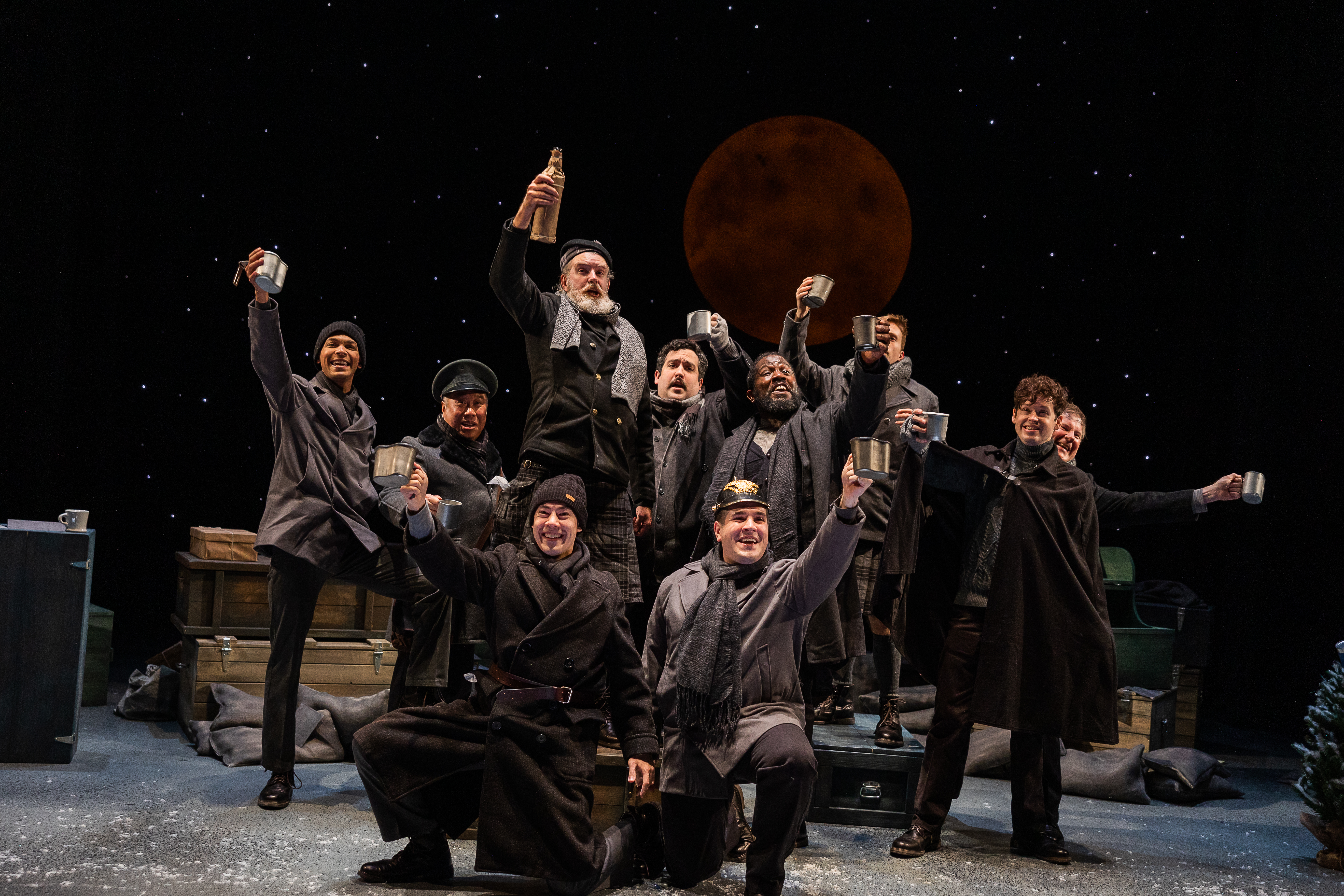
Cast of ‘All is Calm’ at Greater Boston Stage Company. Photo by Nile Scott Studios

From the first note of the first song in the remarkably affecting ‘All Is Calm,’ the choreography chops of its director, Ilyse Robbins, are indisputably evident. Two lines of uniformed men, distinguishable by their country’s military dress, slowly march to the front of the stage as they sing the Scottish folk song, “Will Ye Go to Flanders?” They briefly merge, forming a united single line, before those in the back row return to their original and separate positions. This powerful prologue literally sets the stage and tone for the next intermission-less 70 minutes. We have entered a holy place of unity where a folksong can become a hymnal and where men have the power and ability to come together as one, even if it is merely for a fleeting moment.

This documentary musical tells a well-known true story almost exclusively through a cappella song. On Christmas Day in 1914, with World War I just five months old, enlisted men on both sides of the mucky no-mans-land trenches in Ypres, Belgium emerged to put aside their political differences and celebrate the day and their shared humanity.

Written by Peter Rothstein, the founding director of Theater Latté Da in Minneapolis who also worked at the Minnesota Jewish Theatre Company, the play transcends its Christmas Day message and carols to deliver a powerful and universal message promoting peace, human dignity and reconciliation — a message no less welcomed by those of us lighting Hanukkah candles, spinning dreidels and recalling the battles faced by the Maccabees.

Combining storytelling, historical details, bits of poetry, archival letters and a score of 30 songs, the cast of ten men humanize their journey: from the optimism of their enthusiastic enlistment and deployment to the grim reality of war to the miraculous Christmas respite and momentary truce and back again to battle, they are individuals first, soldiers second. Robbins has gathered a splendid ensemble of complementary singing voices and acting styles, yet masterfully allows space for each performer’s unique qualities to shine as well.

The story itself is predictable. Men susceptible to war fever and the excitement it generated are crestfallen to realize that they might not survive the war they assumed would be over by Christmas. Hope curdles to despair; dreams of adventure morph into nightmares of doom. There is no revisionist history here. Rothstein presents the hardships and suffering of war in full mud-soaked misery.

What is not predictable is the emotional majesty created by Lichte and Takach’s clever interweaving and ordering of songs, particularly those chosen during the truce segment. Amidst the heartache and heartbreak of a Christmas celebrated with death and isolation instead of family and hearth, the Allied troops suddenly make out the familiar melody of “Silent Night” — sung in German. Unarmed, hands lifted and hoisting white handkerchiefs, the Germans emerge one by one. Sworn enemies unexpectedly find themselves face-to-face, one-to-one with the enemy, and “all is calm. All is bright.” Indeed, for those gun-less few moments, all is breathtakingly silent.

The men play football, exchange gifts and even help each other bury those whose deaths they caused. They talk as men, not enemies. “I have now a very different opinion of the Germans,” one soldier wistfully says.

Of course, this bottom-up hiatus can never last. Commanding officers on both sides put an immediate halt to the fraternization, and the soldiers reluctantly return to their trenches, guns obediently re-cocked and aimed. The plaintive “Auld Land Syne,” an ode to kinship remembered, switches almost imperceptibly to “We’re Here Because We’re Here,” sung mournfully as a lamentation to the immovable trap the troops find themselves in.

There are a few tricky moments with the European accents, but the cast is uniformly spot on with the a cappella singing, blending beautifully and consistently. Among the solo standouts are Christopher Chew, Brad Peloquin and David Jiles, Jr. Michael Jennings Mahoney’s haunting tenor beautifully bookended the show from prologue to epilogue.

Erik D. Diaz’s minimalist set design achieves maximum effect. A few packing crates, a starry full mooned backdrop and the constant slow seep of gauzy haze set the proper tone without distraction.

Although there is no ambiguity that ‘All Is Calm’ references Christmas, its universal message of peace transcends specificity of time, place and religion. Particularly during these times of increasing political rancor and division, this meditative production is palpably apolitical, yet makes its point while leaving us to wonder: What if ‘No Man’s Land” were truly ‘Everyman’s Land?” What if those at the top left negotiations to those in trenches? And what if those troops, ordered to go back to war after tasting the fruits of peace, had listened to Winston Churchill and simply gone on strike?

‘All Is Calm: The Christmas Truce of 1914’ – Written by Peter Rothstein; Vocal Arrangements by Erick Lichte and Timothy C. Takach; Directed by Ilyse Robbins; Music Direction by Matthew Stern; Set Design by Erik D. Diaz; Lighting Design by Jeff Adelberg; Sound Design by Dewey Dellay; Costume Design by Bethany Mullins. Presented by Greater Boston Stage Company at 395 Main St., Stoneham through December 23, 2021.For more information or to purchase tickets, call (781) 279-2200 or visit greaterbostonstage.org. Masks are required for all visitors, as well as proof of vaccination or a negative COVID-19 test within 72 hours. For more information about safety, visit geraterbostonstage.org/health-and-safety.html.