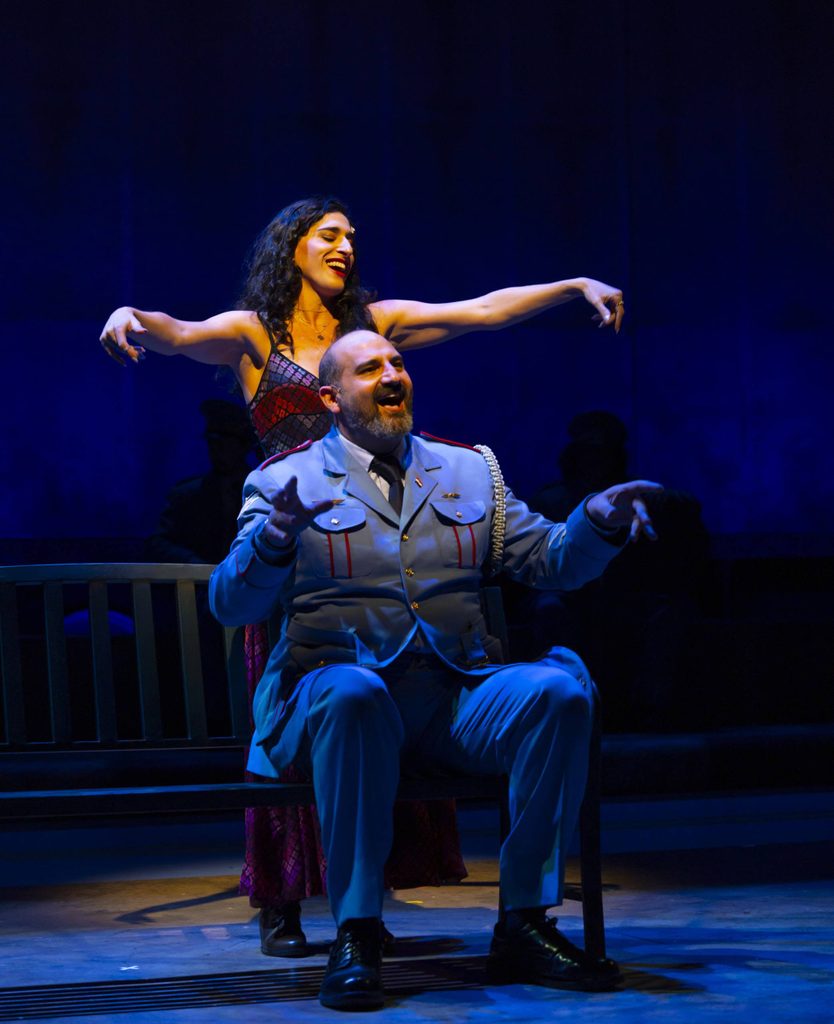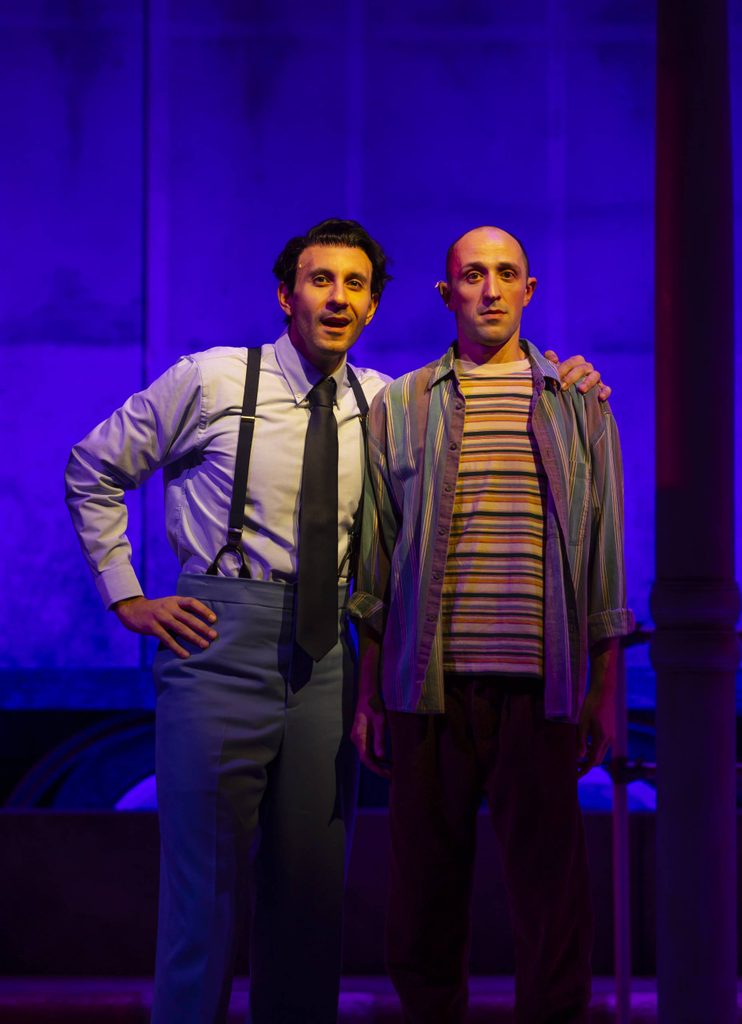
The Huntington’s Superb Musical ‘Fun Home’ Plumbs Memories and Memoirs

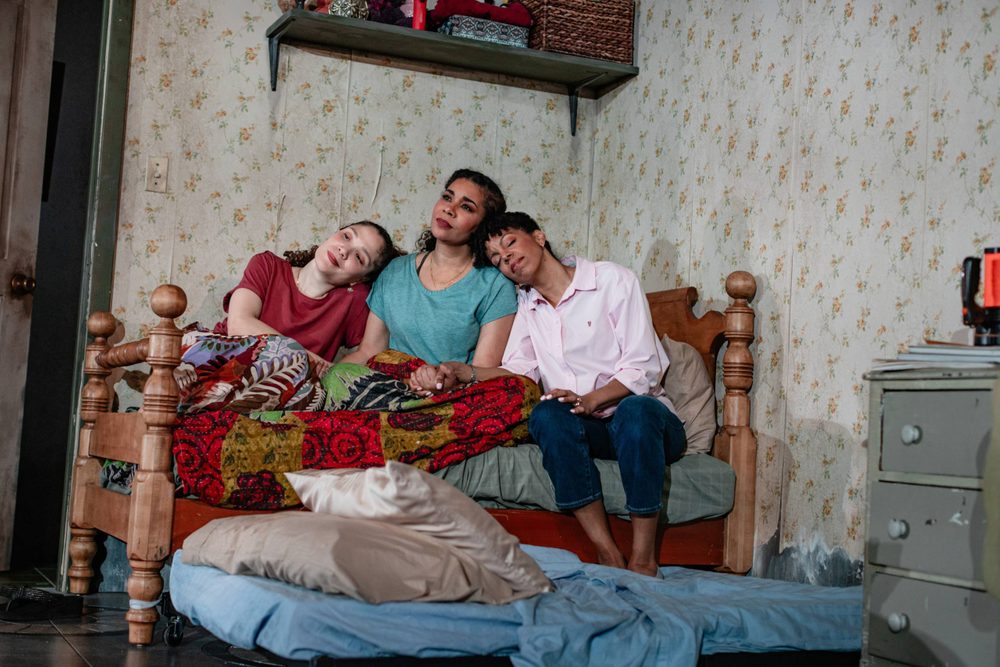
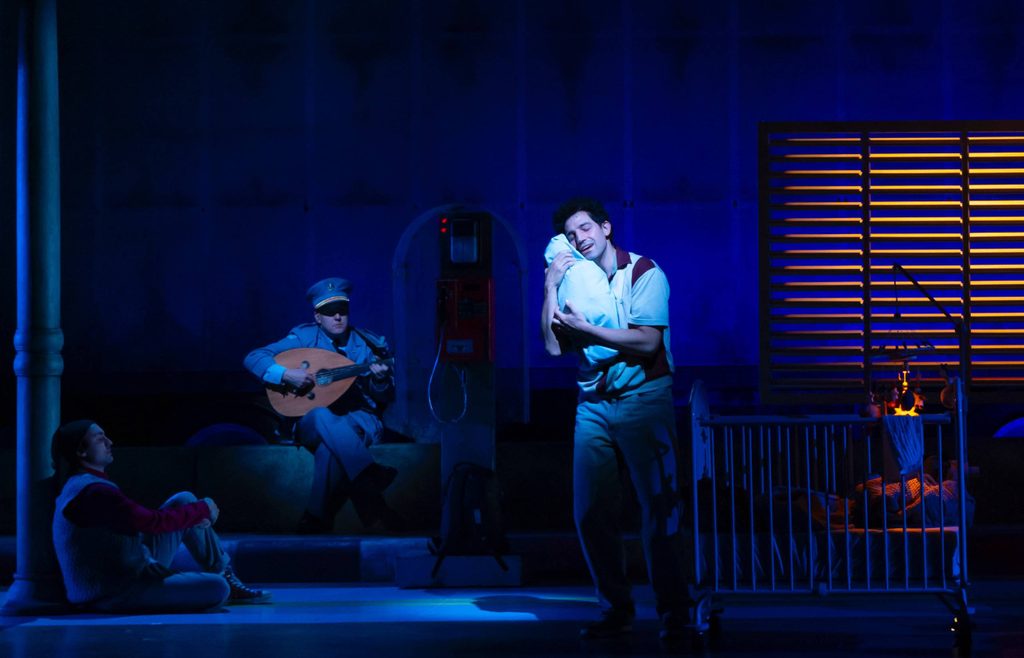
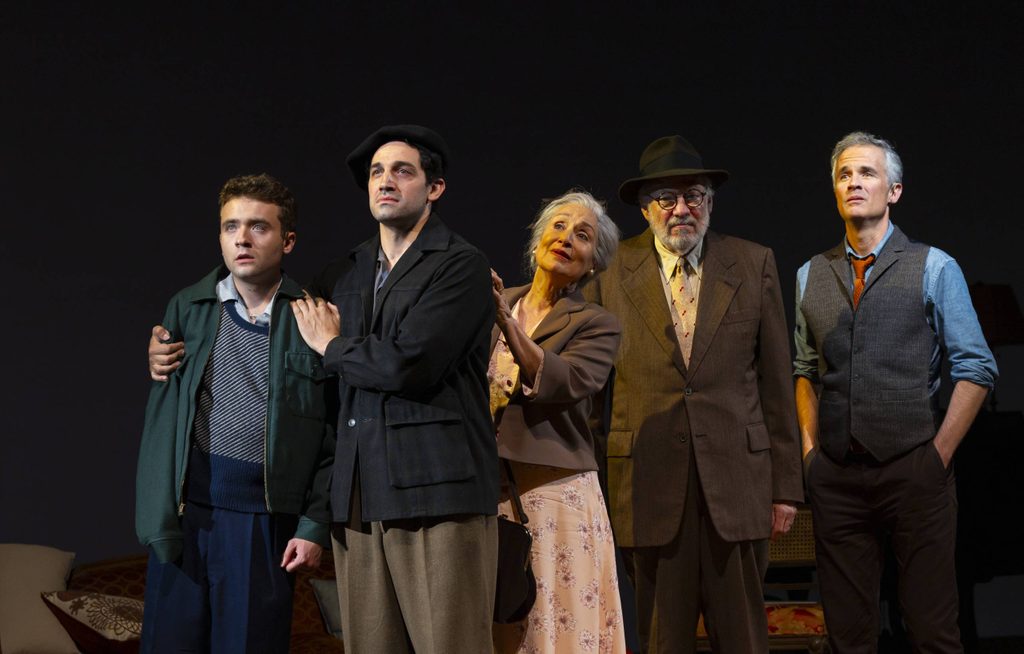
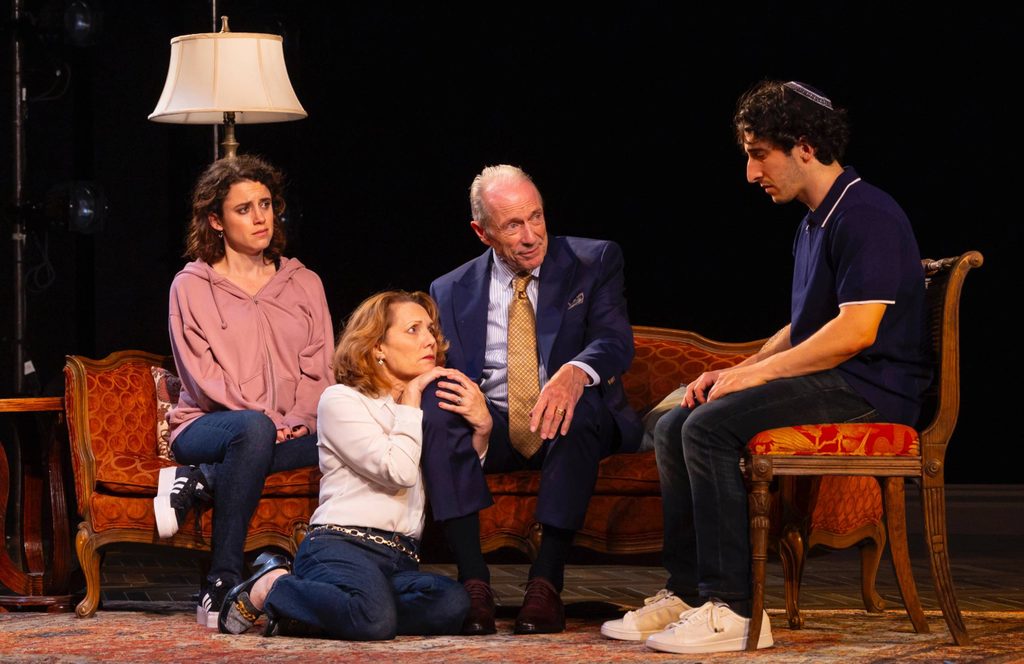
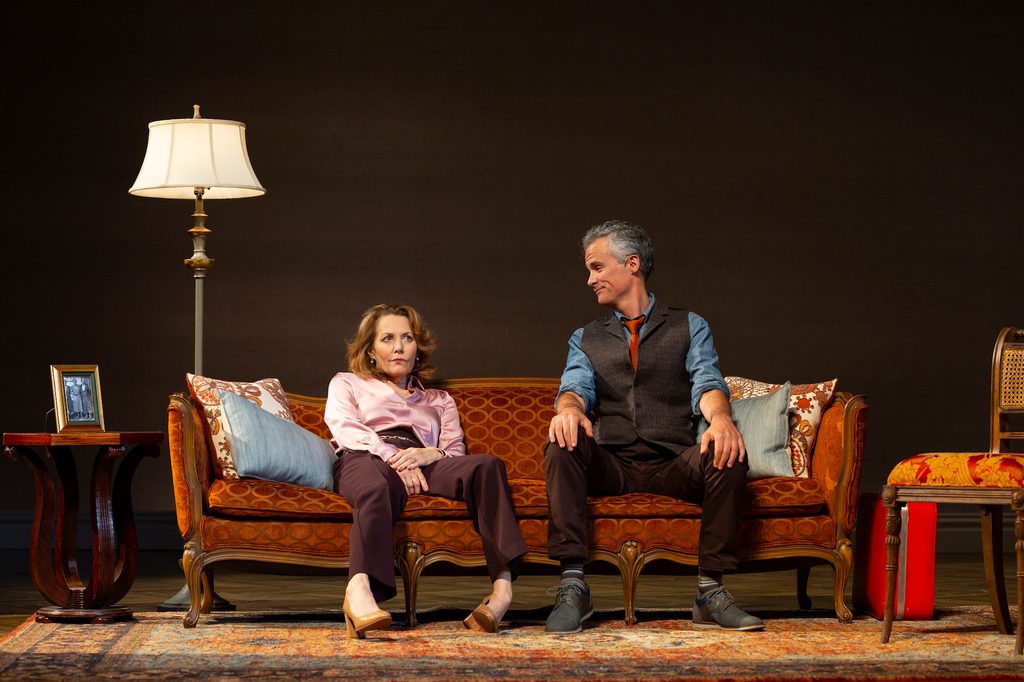
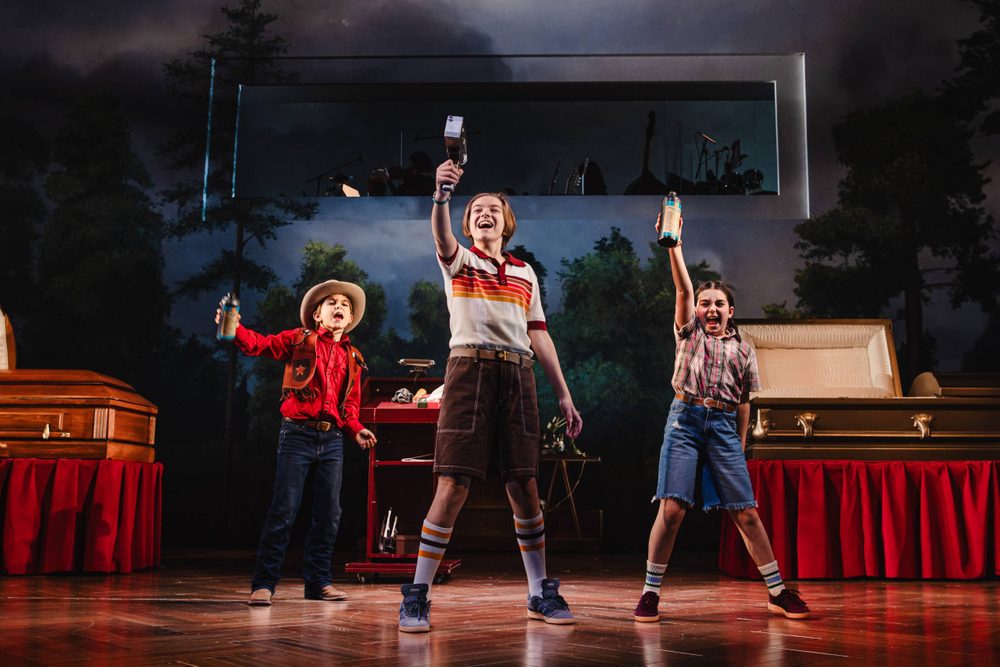
Caleb Levin, Odin Vega, Lyla Randall in ‘Fun Home’ at the Huntington. Photos by Marc J Franklin

‘Fun Home’ — Music by Jeanine Tesori. Book and Lyrics by Lisa Kron. Based on the graphic novel by Alison Bechdel. Directed by Logan Ellis. At the Huntington Theatre, Huntington Ave., Boston through Dec. 14.

By Shelley A. Sackett

In less capable hands, the multiple Tony Award-winning Fun Home, at the Huntington through Dec. 14, could have been a disaster. Adapted from Alison Bechdel’s graphic novel memoir, the storyline follows a family’s journey through sexual orientation, gender roles, suicide, emotional abuse, grief, loss, and lesbian Bechdel’s complicated relationship with her tightly closeted father. To boot, the title refers to the family funeral parlor, where her father worked and she and her siblings played.

Doesn’t sound like the raw material for one of the year’s outstanding Boston area productions? Think again.

Jeanine Tesori, a two-time Tony Award recipient and two-time Pulitzer Prize finalist for drama, has created gorgeous, melodic music for Fun Home. Award-winning playwright and lyricist Lisa Kron hits all the right tones with a masterpiece of storytelling musical numbers overlayed with a balanced, nuanced script that manages to be funny, poignant, clever, wise, and heartbreaking. These two talented women breathe life into Bechdel’s memories, turning what might have been maudlin into a dense and complex story of one family’s journey as narrated by one of its travelers.

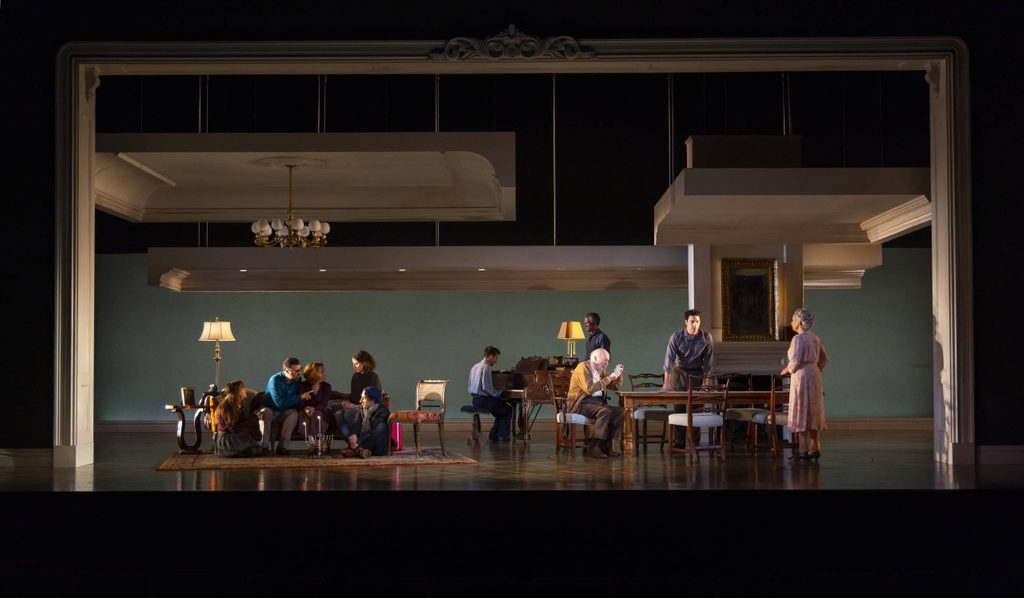
Add to the mix a stellar cast, meticulous direction (Logan Ellis), a sumptuous set (Tanya Orellana), effective lighting (Philip Rosenberg), and a superb orchestra (music direction by Jessie Rosso), and you have all the ingredients for one very special evening of theater.

Bockel, Nick Duckart

The play opens with Alison (Sarah Bockel), a 42-year-old successful cartoonist, center stage, huddled over her drafting table. She crumples one sheet of paper after another, throwing them onto the floor. She recalls two other periods in her life: one when she was 10 (Small Alison, played by the showstopping Lyla Randall) and another when she was a freshman at Oberlin College (Medium Alison, played by Maya Jacobson).

Suddenly, Small Alison’s head pops up out of the drafting table. Kron’s narrative lyrics both highlight Bockel and clue us in about her character. Alison is trying to make sense of her childhood and the larger-than-life role her father, Bruce (a knockout Nick Duckart), played in it. At the center is Alison’s joy at discovering she is a lesbian, her first year in college, and Bruce’s tortured and shamed existence as a closeted gay man living as an outwardly “normal,” heterosexual, family man. His suicide (he stepped in front of a truck) only elevated his importance in Alison’s pursuit of answers to the question, “What happened to us?” If she could only unlock the mysteries surrounding his life, perhaps she could understand those surrounding her own.

The problem is, she doesn’t trust her memory. She needs “real things,” both to draw and to rely on. She needs eyewitnesses. She needs Small and Medium Alisons. Told in a series of nonlinear vignettes connected by narration from the adult Alison character, the Bechdel family saga unfolds.

Her childhood in rural Pennsylvania was anchored by the ornate Victorian house her father obsessively and compulsively restores (two traits he also brings to his homosexuality and cruising). She and her siblings played games, including performing an imaginary advertisement for the family funeral home (Randall, as Small Alison, brings down the house in the hysterical and arresting Jackson Five-style “Come to the Fun Home”). Juxtaposed with Partridge Family scenes are their opposites. Bruce, for example, invites Roy, a young man whom he has hired to do yard work, into the house and begins to seduce him in the library while his wife, Helen (the gifted Jennifer Ellis), plays the piano upstairs, trying her best to ignore it (“Helen’s Etude”).

Sushma Saha, Maya Jacobson

Medium Alison (Jacobson is terrific) enacts Alison’s memories of her first lesbian affair with Joan (Sushma Saha) and gushes with delirious post-sexual froth that she is “changing my major to Joan.” She shares that news with her parents and is forever haunted by suspicions that her coming out led to her father’s death. “I leapt out of the closet — and four months later my father killed himself by stepping in front of a truck,” the overhead caption reads.

Many of the musical numbers are more than plot devices; they are emotional powder kegs and stand-alone gems. “Telephone Wire” documents the moment where Alison and her dad try to get into a gay bar but end up defeated, even when she is carded. The tragedy of the missed opportunity for connection, and of the unspoken yearning and loss both feel but can’t acknowledge, is heartbreaking. In “Ring of Keys,” Small Alison (Randall) again brings down the house as a tiny girl transfixed by a butch delivery woman whose uniform and ring of keys open up doors she didn’t even know were locked.

“Days and Days,” Helen’s cri de Coeur, stands out as a vehicle for Ellis’ prodigious vocal power and a showcase for Kron’s Tony-nominated lyrics. As Bruce’s long-suffering wife, humiliated and abused by the homosexual husband she just as fiercely protects and stands by, Helen admits to Alison that she has sacrificed her life to keep the family together. She wants better for her daughter and warns her not to follow in her mother’s footsteps. “I didn’t raise you to give away your days like me,” she says introspectively.
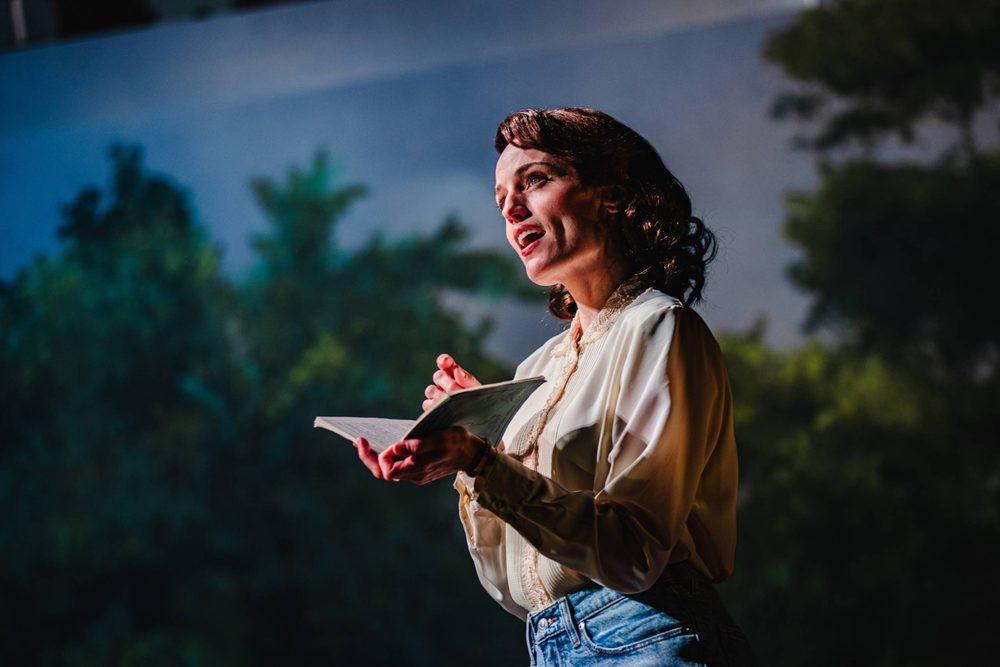
Jennifer Ellis

Fun Home is as complicated as it is simple. It is about a family, its underlying anguish, and the balance between fitting in and being true to oneself. Honest, moving and hilarious, the play never becomes mawkish or angry (though it has every reason to). Each character stands upright, for better and worse, owning their authentic selves.

In the finale, Alison finally realizes the moment when she felt a perfect balance in her life: when her 10-year-old self and her father played “Airplane.” In “Flying Away,” Small Alison duets with her two older selves, a melding at last of past and present that paves a clearer way to the future. The caption above them reads, “Every so often, there was a rare moment of perfect balance when I soared above him.” There wasn’t a dry eye in the house.

Highly recommended.

For more information, visit https://www.huntingtontheatre.org.


In Huntington’s “Don’t Eat the Mangos,” a Matriarchy is Reclaimed When Dark Family Secrets are Revealed

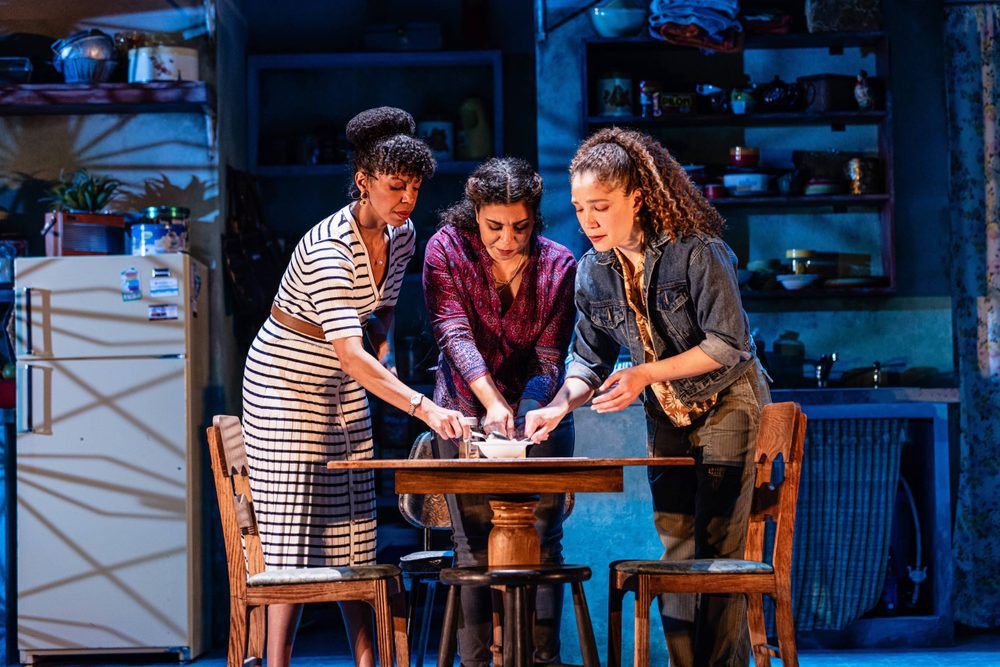
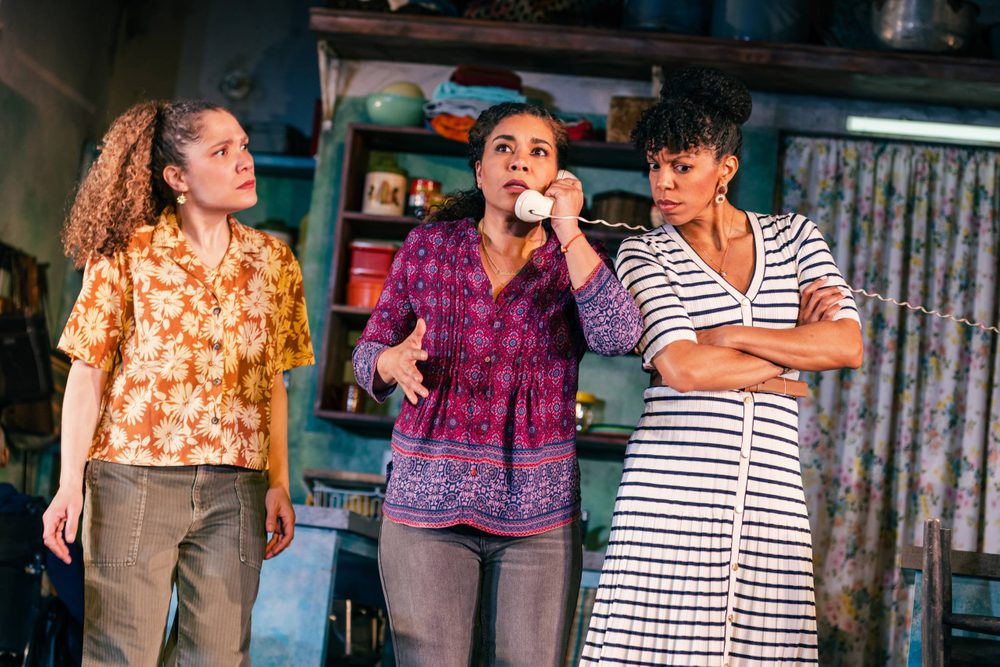
Evelyn Howe, Jessica Pimentel, Yesenia Iglesias in The Huntington’s Don’t Eat the Mangos
Photos by Marc J. Franklin

By Shelley A. Sackett

‘Don’t Eat the Mangos,’ Ricardo Pérez González’s one-act play, has a lot going for it. Set in 2019 in El Comandante, a neighborhood outside San Juan, Puerto Rico, Tanya Orellana’s bright island set plunks the audience smack into a festive, colorful vibe where curtains are doors and a commanding mango tree dominates the yard. We immediately meet three sisters, as different in personality as in looks, yet clearly cut from the same mold.

Of course, they are in the kitchen, where the women curse affectionately, call each other out, and demonstrate the kind of familiarity and genuine love that underlies their shrillest screaming matches.

Ismelda (Jessica Pimentel), the oldest, is all business. The most buttoned-up of the three, she has never married, remaining in the childhood home where she cares for their ailing parents and works as a loan officer. She is stoic and stubborn, bearing her burden but letting her sisters know she could use their help. She takes her role seriously; she actually dusts the plants.

Iglesias, Pimentel, Howe

Yinoelle (Yesenia Iglesias), the middle sister, is the most traditional of the three. Her husband is a successful construction manager who has an opportunity to move to the States. She is stylish, watches her figure and practically vamps with the spoon as she stirs the family dinner.

Wicha (Evelyn Howe) is the youngest, hippest and most passionate. She is a teacher and single mother who embraces causes and barely contains her wild hair. She is clearly comfortable in her own skin and, despite disapproving glares from the other two, plunks herself down at the table and eats cookies straight out of the tin. (That is, until Ismelda replaces the tin with the more proper plate and napkin).

This opening scene is one of the play’s best. González’s script has two goals, and he accomplishes both beautifully — we learn the family’s backstory and witness the sisters’ indelible bonds as they dance their unique sisterly dance.

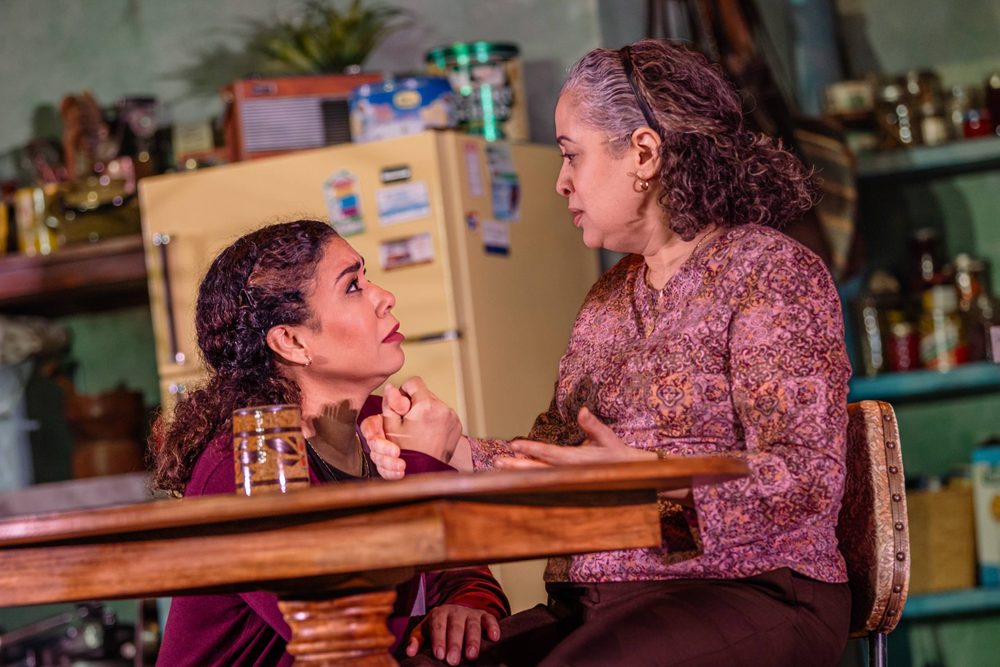
Pimentel, Susanna Guzmán

They speak of Mami (Susanna Guzman), who has suffered a relapse of cancer, and Papi (José Ramón Rosario), who is paralyzed and requires a machine to constantly pump phlegm. The girls take turns dealing with him when a storm causes a power outage and they have to suction him by hand. It is during their discussions of how to settle up with a narcissistic man who neglected and abused his family that the true family dynamics – and secrets – are revealed.

As is often the case, each sister experienced a different version of what growing up in the same household was like and throughout the play, dyads share confidences with the admonition, “Don’t tell the others.” When Ismelda tells the truth about why the mango tree’s fruit lies uneaten and rotten despite the family’s need for food (no spoilers here!), bigger questions surrounding trauma, shame, blame, oppression and duty explode. Throughout the fabric of this micro private story, González masterfully interweaves threads of macro interest, such as the complicated relationship between Puerto Rico and the US, and whether abandoning one’s native island for the mainland is a cop out or no-brainer. “This place is not our future,” Yinoelle warns, to which Ismelda responds, “I stay so you can go.”

Guzman brings an understated grace and gravitas to Mami, the family’s glue and true north. She has parented with healthy doses of superstition, discipline and common sense. She alone holds the keys to both their pasts and futures, and her final gift is to set them all free.

Orellan’s set channels island life, with three rotating sets that feature a cozy but cramped kitchen, bedroom/hospital and backyard, complete with rusty gate and laundry line. Director David Mendizábal effectively and efficiently makes use of every inch, but it is Jake Rodriguez’s sound design, with lightning, insects and salsa, that fine-tunes the tone.

The acting is terrific, especially all three sisters who create a tight ensemble that provides for spotlighted individuality. Howe, as youngest sister Wicha, is a standout, with her malleable features, punchy delivery and irresistible physicality. One potentially macabre but wonderfully hilarious scene turns on the talent of this splendid actress.

Howe, Pimentel, Iglesias

For all its humor, pathos and big ticket, universal questions, however, ‘Don’t Eat the Mangos’ is not unflawed. González’s inclusion of Spanish in the script establishes place and context quickly and seamlessly, but he goes overboard with whole Spanish tracts at the very beginning of the play. Unless  González’s intention is to make non-Spanish speakers feel deliberately excluded, then he needs to either trim the amount of Spanish or provide English Cliff Notes.

Equally confusing is the use of nicknames for characters the playbill lists by full names, particularly in the first few minutes. When they face away from the audience and are not easily understood, the problem is compounded. Finally, the play sometimes seems to be in the throes of an identity crisis, not sure whether to play a scene as straight drama, slapstick comedy, or some hybrid.

Yet, on balance, ‘Don’t Eat the Mangos’ is entertaining, enlightening and thought-provoking, the trifecta gold standard that makes theater such a meaningful part of our lives. 

‘Don’t Eat the Mangos.’ Written by Ricardo Pérez González. Directed by David Mendizábal. Scenic Design by Tanya Orellana; Costume Design by Zoë Sundra; Lighting Design by Cha See; Sound Design by Jake Rodriguez; Original Music by Jake Rodriguez with Alexandra Buschman-Román and Jason Stamberger. Produced by The Huntington Theatre Company, Calderwood Pavilion, Boston Center for the Arts, 527 Tremont St., Boston, through April 27.

For more information, visit: https://www.huntingtontheatre.org/whats-on/dont-eat-the-mangos/

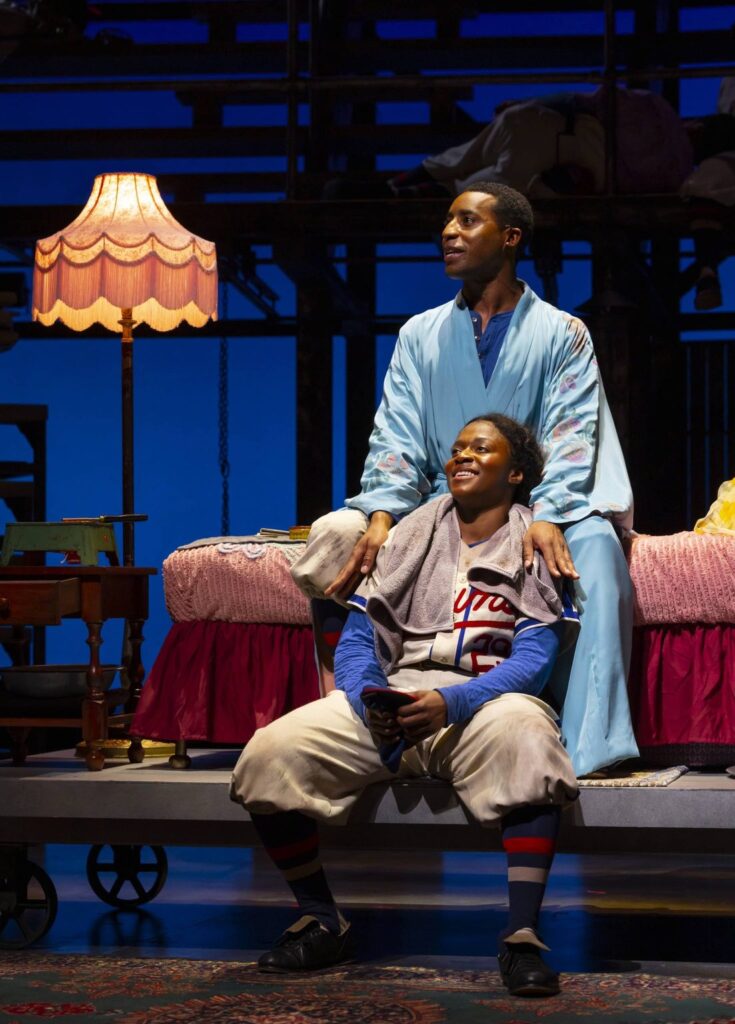
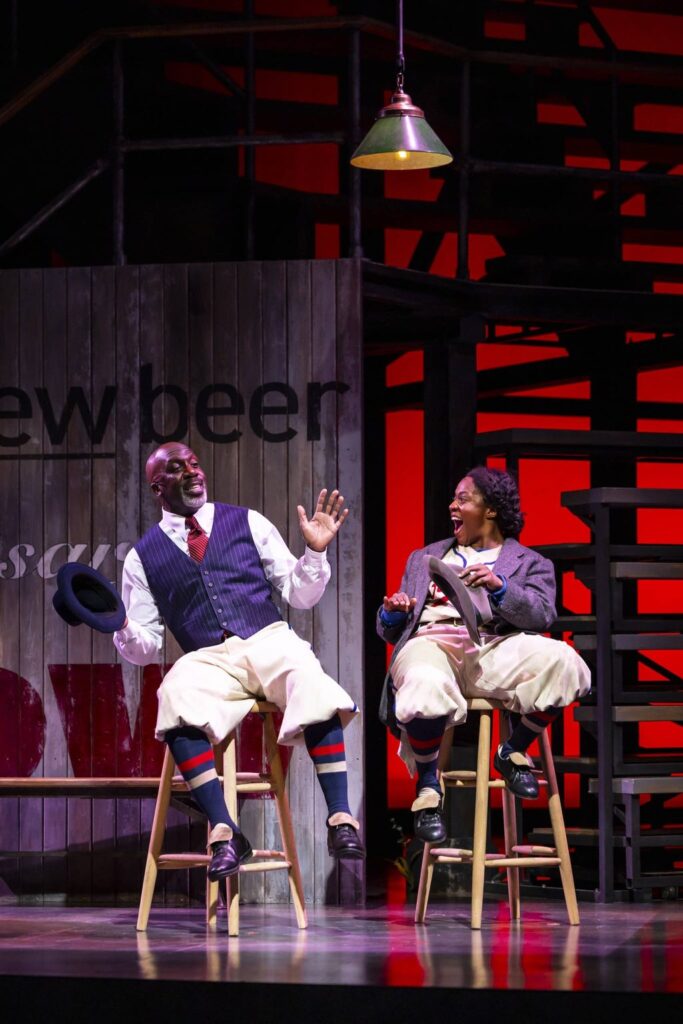
Huntington’s “Toni Stone” Tells the Story of One of the Best Baseball Players You Never Heard of

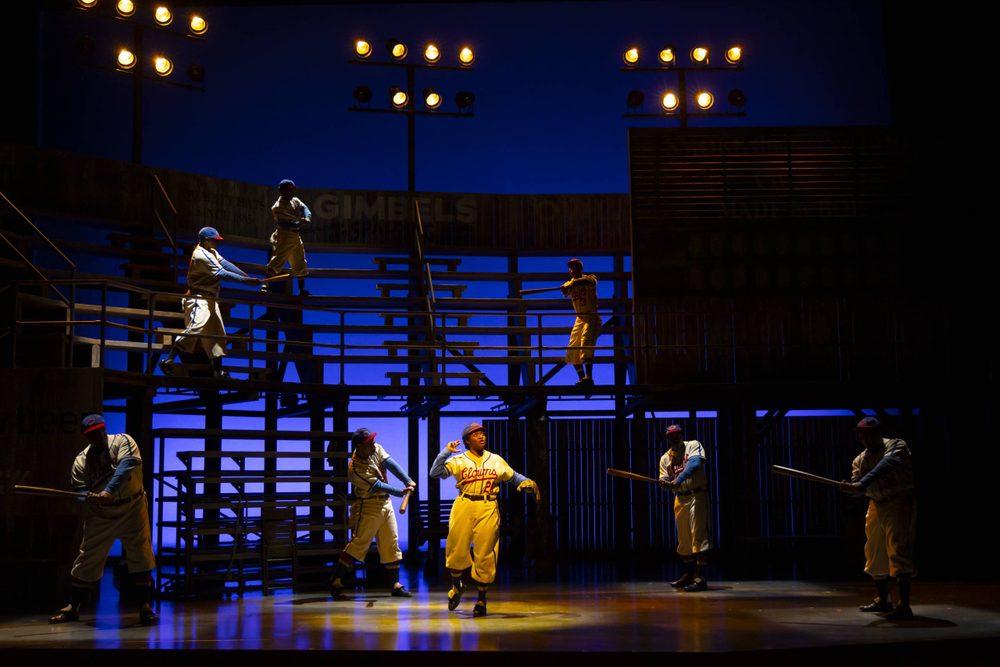
The cast of Toni Stone at The Huntington Theatre. Photos by T. Charles Erickson.

By Shelley A. Sackett

Toni Stone, the subject and title of playwright Lydia R. Diamond’s new drama, has one helluva story to tell. As played by the pitch-perfect Jennifer Mogbock, she is also one helluva terrific storyteller and more than up to the task of narrating the events of her remarkable life.

Which is a good thing, because “Toni Stone,” now at the Huntington, ran almost three hours (with a long intermission and delayed start) on opening night last Wednesday.

Even before the house lights have dimmed, Collette Pollard’s exciting set has placed us smack in the middle of a baseball field, surrounded by bleachers, scoreboards and night lights. Mogbock, a spitfire of energy and physicality, practically leaps onto the stage. A ball rolls slowly on the ground towards her, and she bends down to pick it up.

“The weight of the ball in the hand and the reach,” she announces matter-of-factly as she tosses it in the air. “What this is is what boys are to that girl. This is what I need.”

This — baseball in all its statistical, scientific, and athletic glory — is also what she knows, “maybe better than that girl knows boys.”

Disarming, genuine, and boundlessly enthusiastic, Stone shares her life’s highlights, from her birth in West Virginia to growing up in St. Paul, Minnesota, to becoming the first woman to play baseball in the Negro Leagues. Every step of the way, her single-minded determination to achieve her dream of playing professional baseball lit her path. Overcoming daunting racial and gender barriers, she landed the second base roster spot with the Indianapolis Clowns, taking Hank Aaron’s place when he moved up to the majors in 1953.

Mogbock (front) and team

Stone’s job, she tells the audience, is to tell her story so history doesn’t forget. The audience’s job, she implies, is to remember it. And to pass it on.

With that, the rest of the team bursts onto the stage. Stone introduces them one by one, and then they perform the first of several fabulous dance/acrobatic acts (choreographed by Ebony Williams with original music from Lucas Clopton). These top-notch numbers are a welcome break from the sometimes long stretches of dialogue and give the cast a chance to break loose and shine.

Mogbock is the only woman in the 11-member ensemble, and the ten actors take on individual characters as well as Clown teammates. As Millie, a prostitute who befriends Stone and tries to instill some femininity into the baseball-statistic-obsessed tomboy, Stanley Andrew Jackson is a sublime showstopper. Others play Stone’s parents, manager, coach, and husband. With a simple announcement (“He’s white”) and hand gestures, the all-Black cast also takes on white racist characters in subtle but dramatically powerful ways.

Stanley Andrew Jackson, Mogbock

Through sometimes chronologically disjointed scenes, Stone connects the dots of her personal timeline and, along the way, emotionally connects with the audience. By the end of the play, we don’t just know Stone; we adore her.

She is a complex character, as insecure and flighty socially and intellectually as she is confident and down to earth about her knowledge of and ability to excel at baseball.

As an athletically gifted kid in St. Paul, she excelled at every sport she tried. When her mother steers her towards more “ladylike” sports like figure skating (cute skirts), she easily wins the top city-wide competition and then begs to go back to the sport she really loves. She hated school both because she was bored and because the teachers pigeon-holed her as mentally impaired, misunderstanding her inability to process social cues and making her feel even more isolated and alone. (“When someone tells you there’s something wrong with your mind, you believe them,” she explains).

Yet, there’s nothing wrong with her mind when she’s thinking about a topic that interests her. As she argues with coaches about strategy, spouts baseball card statistics like an AI app, and describes baseball in terms that are poetic and metaphysical, she more than holds her own as confident, shrewd, and articulate.

While Diamond keeps the story light and focused on Stone’s journey, she by no means avoids the harsh realities of racism and misogyny in the 1950s. Stone was shunned and harassed by many of her teammates and was deliberately trampled when defending second base by opposing team members who wanted to “take out that woman.”

At the same time, she and her teammates share more than the same uniform. They are keenly aware that white team owners are using them both to make money and to make the white teams look superior by having them lose in rigged games. After all, and lest they forget their place, the team’s name, “Clowns,” is branded on their uniforms.

Like the Reconstructionist era blackface minstrel “entertainment,” they are supposed to, above all else, entertain. “They know we know what they’re doing to us,” Stone says just as Act I ends. “But we still make them laugh.”

Because that’s the only way a Black person or woman could play baseball in a white male world: by playing “their” game by “their” rules. And at the end of the day, the player’s desire to play ball is greater than their pride.

Jonathan Kitt, Mogbock

The second act (thankfully shorter and tighter) covers a lot of ground. Stone marries and retires from baseball when she ends up spending more time sitting on the bench than playing. She spends a year being a good housewife and then becomes a nurse. Although Diamond drops the ball on dramatic pacing and content at the end, Stone’s words (and Mogbock’s flawless performance) leave the audience with a semblance of closure. 

“There it is,” she says, summing up her life’s story. “I did a thing. Between the weight of a thing and the reach, there is breath. And in that breath is life.” She pauses, looking straight at the audience and melting the proverbial fourth wall. “I reached.”

‘Toni Stone’ — Written and Directed by Lydia R. Diamond. Inspired by “Curveball: The Remarkable True Story of Tony Stone” by Martha Ackmann. Presented by the Huntington, in an arrangement with Concord Theatricals on behalf of Samuel French. At the Huntington Theatre, 264 Huntington Ave., Boston, through June 16.

For more information and to buy tickets, visit https://www.huntingtontheatre.org/

Truth and consequences collide in the Huntington’s bewitching ‘John Proctor is the Villain’

Left to right: Brianna Martinez, Jules Talbot, Victoria Omoregie, Haley Wong in ‘John Proctor is the Villain,’ directed by Margot Bordelon/T. CHARLES ERICKSON

In 1953, the great Jewish American playwright Arthur Miller saw his new play, “The Crucible,” produced on Broadway. Miller wrote it as an allegory for Senator Joseph McCarthy’s anti-Communist and antisemitic fearmongering and the House Un-American Activities Committee, a congressional committee tasked with rooting out dangerous inhabitants.

These so-called communists were no more a threat to America’s political order than those accused of witchcraft posed to Salem’s Puritan community in 1692, when hysteria based on nothing more than innuendo and hearsay led to the conviction and execution of 19 people.

“The Crucible” remains a mainstay of most high school curricula, including in an 11th-grade honors English literature class in 2018 rural Georgia, the time and place of “John Proctor is the Villain.” Kimberly Belflower’s razor-sharp and timely play is now on stage at the Huntington Calderwood Pavilion/Boston Center for the Arts.

The opening scene finds Carter Smith, the laid back I-could-be-your-buddy teacher, standing in front of a group of bored 16-year-olds. “Sex,” he says, to which they respond in robotic call and response, reciting the administration’s sanctioned definition.

All junior English classes are charged with including 10 minutes of sex ed class for six weeks. This community clearly exerts cultural and political power over what the next generation is supposed to think (and when they’re supposed to learn it) about matters that are both personal and societal.

We get glimpses into the seven students’ and their teacher’s personalities and the strictures of their one-stoplight town through the intimate banter that interrupts these sex ed drills.

Beth, eager and smart, complains about squandering academic time. Nell, a new transplant from Atlanta, says she had sex ed in fifth grade. Ivy is all business and practicality (“Doesn’t it make sense for sex ed to actually come like before people know about sex?”). Raelynn is a cheerleader type, scowling one minute and vamping the next. Lee is the quintessential poster boy for teenage testosterone and Mason, the class clown and slacker.

Carter is the teacher we all wanted to have in high school – a little goofy, learned, and universally appealing. He basks in his students’ trust and adoration.

He also has a laundry list of issues, many of which are later aired. Caught in the netherworld between being a teenager himself and entering the adult world of his students’ parents, he evokes both our affection and suspicion.

He is traditional, however, when it comes to teaching “The Crucible,” the basis for their junior lit project and the platform that triggers a collision between age-old Southern cultural tradition and religious values and the #MeToo headlines that highlight a national reckoning with gender, power, and toxic complicity.

John Proctor, he proclaims, is the hero of the play because he speaks the truth.

Proctor, as a reminder, is the 35-year-old married man who seduces Abigail, a teenage girl he employs. Abigail, shamed and disgraced, is thrown out of the house. Proctor lies about the affair right up to the moment he is about to be hanged, confessing only because he hopes his honesty will redeem him and literally save his neck.

To Carter, Abigail is the villainess because she starts the witch rumors that eventually lead to the Salem Witch Trials. His five #MeToo generation female students don’t agree. They maintain Abigail’s “revenge” was the only way for her to achieve power in a society that marginalized and demonized her.

Adding to this caldron of budding feminism, these five are stirring in their desire to start a feminist club to “spread awareness, foster dialogue, and ignite.” When Carter offers to be their faculty adviser, the pieces are all in place for Belflower to conjure her dramaturgical magic.

And make no mistake – Bridging eras over 300 years to create a cogent, insightful, accessible, and – most of all – funny commentary on male power, female vulnerability, and agency is nothing short of miraculous.

To describe the plot further would deprive its audience of the pleasure its surprises, twists, and turns bring. Belflower has an uncanny ear for dialogue and has penned spectacular characters. Director Margot Bordelon squeezes every drop of theatricality out of this fast-paced play, and her cast wear their roles as if they were custom-made.

Although not flawless (the actors’ enunciation, projection, and timing frequently preclude comprehension), “John Proctor is the Villain” is what good theater is all about. Its storyline is a dynamo of pathos and laugh-out-loud humor.  Θ

In production at The Calderwood/BCA, 527 Tremont St., Boston, through March 10. For tickets, visit huntingtontheatre.org.
Huntington, SpeakEasy’s Co-Production “The Band’s Visit” Serves Up A Sublime Slice of Life

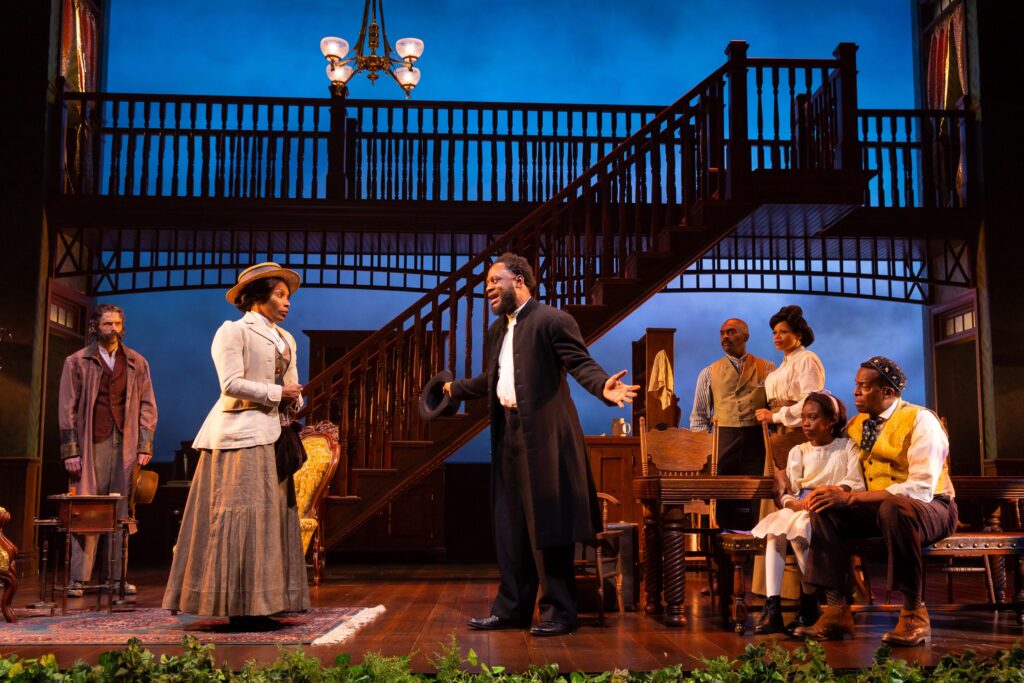
The cast of “The Band’s Visit” at the Huntington. Photo by T Charles Erickson

By Shelley A. Sackett

The delightful musical “The Band’s Visit” is a welcome breath of air in the current asphyxiating climate surrounding the war between Israel and Hamas. Its focus is a single night in Bet Hatikva, a tiny Israeli town that feels more like a pit stop on the way to someplace more important than a destination.

“You probably didn’t hear about it,” says Dina (played by a magnificent Jennifer Apple in a star-making performance), the proprietor of Bet Hatikva’s only café and its resident narrator and cynic. “It wasn’t very important.”

As she goes about her business at the café, lamenting her plight in this Podunk town in the middle of nowhere, her fellow residents, workers and perpetual customers join in witty song to echo her sentiments.

Everyone is waiting for something to happen. Everyone is bored. Everyone is “looking off out into the distance/Even though you know the view is never gonna change.”

And then, suddenly, an entire band of Egyptians clad in gaudy, bright powder-blue uniforms shows up as if beamed down from heaven in answer to their unspoken prayer. It is as disorienting as it is exciting.

Jennifer Apple, Brian Thomas Abraham
 

It’s as if the cast from Wes Andersen’s “Budapest Hotel” showed up en masse dressed as bellhops.

The members of the Alexandria Ceremonial Band, led by its uptight, by-the-book conductor, Tewfiq (played with a hint of vulnerability and compassion by Brian Thomas Abraham), seem to be unwitting victims of confusion and ineptness. They are due at the Arab Cultural Center in the thriving city of Petah Tikva. Instead, they have landed in the motheaten town of Bet Hatikva, where they are truly strangers in a strange land.

Making matters worse, there is no bus until the next morning. There are also no hotels. The Egyptians are as stuck as the residents. Not to worry, Dina says. The locals will be happy to host the Egyptians for the night.

And for the next 90 intermission-less minutes, these two very different groups of individuals who do not share the same language or culture will bond in ways that reveal gossamer layers of tenderness, humanity and hope. The ice breaker, it turns out, is music, the universal language of the soul.

Which is lucky for us. With songs by David Yazbek and a script by Itamar Moses, “The Band’s Visit” is as satisfying a musical as it gets. The ballads and character songs blend wisps of haunting Middle Eastern and klezmer melodies and rhythms with poignant, funny Sondheim-quality lyrics. Icing atop this sumptuous cake is the fact that each syllable is crystal clear thanks to perfect enunciation and expert sound.

The action, as it were, takes place as vignettes of intimate interactions between the Israelis and their guests. In the process, we get to glimpse the similarities of sadness, regret, dashed dreams and promises unfulfilled that they all share. These seemingly disparate people, Egyptians and Israelis, learn there is more that joins than separates them when politics are ignored.

The salve of that message alone is reason enough to see this show. The pitch-perfect production under Paul Daigneault’s direction and stand-out acting and musicianship raise the bar to a sublime level.

Kareem Elsamadicy, Jesse Garlick

As Dina, Apple is riveting. She brings fire (think Selma Hayek), ice and a powerful set of pipes to the complicated woman who rages against life’s disappointments while being unable to let go of her lifeline of hope. Her body language is eloquent and articulate. The scenes between her and Tewfiq, where each reveals their most secret secrets, are heartbreaking. In another life, at a different time, these two could have been a match made in heaven.

Everyone benefits from these chance encounters, learning more about themselves in the course of learning more about the “other.” An Egyptian clarinetist and assistant conductor help Itzhak and Iris, a floundering young couple on the brink of losing the thread of their union. A Don Juan hopeful trumpeter (Kareem Elsamadicy) gives the socially awkward Papi (a scene-stealing Jesse Garlick) a lesson in how to approach girls.

There is also laughter, mirth and the delight of cast members who do double duty as musicians. It is pure magic each time the six members of the band break into song on stage.

By morning, when it’s time for the band to depart, things have shifted. There is a new melancholy in the air, yet it is not borne of despair or sadness. Rather, it stems from the experience of how one single night can change a person — and an entire community — in a profound way that leaves hope in its wake.

Marianna Bassham, Andrew Mayer, Robert Saoud, James Rana, Jared Troilo

Dina and Tewfiq face each other for the last time, sharing both the joy of having discovered that there is a comforting home even for their shattered hearts and the pain of knowing that that bed will never be feathered. When Tewfiq raises a palm to Dina and she raises her back, the emotional gravitas of their goodbye ranks right up there with Rick and Ilsa’s embrace on the tarmac in “Casablanca.”

“Nothing is as beautiful as something you don’t expect” is a common refrain. By the play’s end, every character has been transformed in some indelible way by the band’s unexpected visit. And, after experiencing 90 minutes of a music-filled world devoid of ethnic conflict and invectives, where Arabs and Jews connect and share just as regular folks looking out for each other, so have we.

For information and to buy tickets, go to https://www.huntingtontheatre.org/

“The Band’s Visit” — Music and Lyrics by David Yazbek. Book by Itamar Moses. Based on the Screenplay by Eran Kolirin. Directed by Paul Daigneault; Choreography by Daniel Pelzig. Music Direction by José Delgado. Scenic Design by Wilson Chin and Jimmy Stubbs. Costume Design by Miranda Kau Giurleo. Lighting Design by Aja M. Jackson. Sound Design by Joshua Millican. Produced by Huntington Theatre in collaboration with SpeakEasy Stage at 264 Huntington Ave. Boston through December 17.

“Prayer for the French Republic” Tackles Existential Issues with Humor, Grit and Gravitas

Cast of The Huntington’s ‘Prayer for the French Republic’.  Photo by Nile Hawver.

‘Prayer for the French Republic’ – Written by Joshua Harmon. Directed by Loretta Greco. Scenic Design by Andrew Boyce. Costume Design by Alex Jaeger. Lighting Design by Christopher Akerlind. Sound Design and Composition by Fan Zhang. Presented by Huntington Theatre, 264 Huntington Ave., through October 8.

By Shelley A. Sackett

Playwright Joshua Harmon has a gift for tackling important, profoundly challenging and topical subjects and, through sheer brilliance of characters and dialogue, creating intimate and accessible theater that both rivets his audience and leaves them in a standing ovation of thunderous applause.

He did it with “Bad Jews,” “Admissions,” and “Significant Other,” which Boston theatergoers had the good fortune to see at SpeakEasy Stage Company. Thanks to the Huntington Theatre’s season opener, the 2022 Drama Desk Outstanding Play Award-winning “A Prayer for the French Republic,” they have the opportunity to experience this supremely talented writer’s latest and most ambitious project.

And experience it they should.

Under Loretta Greco’s razor-sharp direction, the 11-member cast masterfully brings Harmon’s themes of antisemitism, assimilation, family, freedom, identity and fear — to name a few — to life. Despite its three-hour running time (one intermission), the fast-paced and sharp-witted dialogue makes the time fly by.

Set in Paris in 2016 and 1945, the play follows five generations of Jewish piano sellers. Marcelle Salomon Benhamou, the current matriarch, her husband Charles and their children, Daniel (26) and Elodie (28), are the contemporary members of the original Salomon family. Hers is a complicated and intricate family tree, full of twists and turns and bent and broken branches.

Jesse Kodama, Jared Troilo, Phyllis Kay, Peter Van Wagner, Tony Estrella

The play opens with house lights up as Patrick (Tony Estrella), the play’s narrator and Marcelle’s brother, addresses the audience. His eye contact and hands-in-trousers-pockets ease establish rapport and immediacy. “What is the beginning of a family?” he asks as he strolls across a set that will represent both 1945 and 2016. “And what,” he doesn’t ask but seems about to, “is its end?”

The calm is broken by a thrust into the Benhamou apartment, where Marcelle (the sublimely talented Amy Resnick) continues Patrick’s train of thought by explaining the family genealogy to a dumbfounded guest, Molly (Talia Sulla), a naïve and distant sort of cousin from America who is spending her junior year abroad in Paris. Molly (like the audience) tries to absorb the details but is thankful when Marcelle repeats the accounting.

Jumping to the present, Marcelle explains that Daniel is their religiously observant son. Daughter Elodie has been struggling with mental health issues and is, well, Elodie. Molly nods in mute agreement.

Just as Molly (and we) sort of get it, Charles (the always amazing Nael Nacer) and Daniel (Joshua Chessin-Yudin) burst through the door. Daniel, who teaches at a Jewish school and wears a kippah (Jewish head covering), has been attacked by a gang of antisemitic thugs. His face is bloody, but he is nonplussed. His parents are apoplectic.

“How many times have I begged you to wear a baseball cap?” Marcelle pleads, comparing his refusal to hide the kippah to painting a target on his back that screams, “Here I Am.” She urges her son to wake up to the danger he invites by advertising his religion in what is France’s current climate, where Holocaust deniers and Nazi sympathizers hold more sway. What she doesn’t do is entertain any thought of fleeing the country where her family of Ashkenazi ancestors has lived for centuries.

Carly Zien, Amy Resnick, Will Lyman, Joshua Chessin-Yudin

Charles’ reaction is different. He has seen this before and knows where it can lead. His North African Sephardic Jewish ancestors have been living in diaspora since they were forced to flee their home in Algeria in the 1960s. 

“It’s the suitcase or the coffin,” he says. He has reached his limit. He wants to go “home.” He wants to move to Israel. It may be unsafe there, too, but at least everyone is unsafe, not just Jews.

The family’s real firebrand and deliverer of Harmon’s celebrated monologues and dialectic analyses is Elodie (an electrifying Carly Zien, who steals every scene she’s in). While she may present as disheveled, her lines of logic and fact-based arguments are sources of encyclopedic knowledge and awe. She is not mentally ill so much as she is reacting in an unhinged way to a world that has come unhinged. (Her interaction with Molly at a bar is worth the price of admission and deserving of a standing ovation).

Harmon then quietly relocates us to 1944 (Andrew Boyce’s set accomplishes this seamlessly and with elegant artistry), where we meet Marcelle and Patrick’s great-grandparents, Irma and Adolphe Salomon (Peter Van Wagner and Phyllis Kay, both charming). They sit in their apartment towards the end of World War II, wondering what has happened to the rest of their family. Miraculously, they were able to remain in Paris during the war after the Nazis sent to deport them took pity on their age and left them alone. They have even managed to hold onto their piano store.

“What do people remember when you’re gone?” narrator Patrick asks the audience, pointing to his forebears. He then tells the story (Estrella really shines here) of how Irma would butter Adolphe’s toast first, and then use what was left to butter her own, in order to make it last longer and hide their dire circumstances from Adolphe. Those tiny, very human details are only one example of Harmon’s many playwriting virtuosities.

Writing cutting, funny, fast-paced and well-researched dialogue is another. The words fly at whiplash speed when the action shifts from 1944 back to 2016, where we pick up where we left off. Daniel and Molly are getting to know each other. (“How did you become religious?” she asks. “I prayed and I liked it, so I kept going,” he replies.)

Amy Resnick, Tony Estrella; photo by T Charles Erickson

Charles makes his case for leaving France before it’s too late (“I’m scared. Something is happening,” he confesses). Marcelle, quintessentially French and clinging to control, argues that Jews are never safe. Anywhere. At any time. Jew hatred, which in 2016, with the 2015 Charlie Hebdo and kosher deli shootings in Paris, the rise of the ultra-right in Europe and the election of Trump in America, has been regaining a foothold globally, is just the way it is.

“What is history but a bunch of stuff other people tell you to get over,” Patrick asks when later, with calm, cynicism and a touch of sadness, he gives a matter-of-fact account of the centuries of persecution suffered by Jews at the hands of the French, starting in 1096 with the Crusades.

And yet, France was the first country in Europe to offer Jews the full rights of citizenship in the hope that they would stop acting like a separate nation and assimilate, identifying more as French than as Jews. Making the case for staying put, he alludes to the fact that even the Holocaust couldn’t uproot the Salomon French family tree. Nor did it force them to convert (although he chose to marry a Catholic). They can withstand this comparative blip.

“Prayer for the French Republic” addresses many deeply troubling topics. Why are people obsessed with Israel? Is it appropriate for Jews to be scared? Is it irresponsible not to be? Now that Israel’s internal politics have so radically shifted, is even Israel still safe? Is it really “home?” Are we at the same tipping point where we were right before the Holocaust? At what point do we acknowledge that our world has hit an iceberg and, like it or not, our choices are to jump overboard or go down with the mother ship?

For this reviewer, the most telling moment was the play’s end. Would Harmon come down on the side of staying put in France or moving to Israel? As the cast belted out the French national anthem, “La Marseillaise” instead of Israel’s “Hatikva,” we had our answer.

For more information and to buy tickets, visit https://www.huntingtontheatre.org/

A Magnificent ‘Joe Turner’s Come and Gone’ Heralds the Huntington’s Jubilant Homecoming 

Patrese D. McClain and James Ricardo Milord (foreground) and cast in ‘Joe Turner’s Come and Gone’ at The Huntington.

‘August Wilson’s Joe Turner’s Come and Gone’ by August Wilson. Directed by Lili-Anne Brown; Arnel Sancianco, Scenic Design; Samantha C. Jones, Costume Design; Jason Lynch, Lighting Design; Aubrey Dube, Sound Design. Presented by The Huntington Theatre through November 13.

by Shelley A. Sackett

What a pleasure it is to have the Huntington Theatre Company back. With its sleek Narragansett Green walls, gold domed ceiling and cherry red extra legroom seats, an always pleasurable theatrical experience is now also one full of creature comforts. Even more stunning, however, is the magnificent production of August Wilson’s Joe Turner’s Come and Gone, with which the Huntington christened its reopening. If Joe Turner’s footprints lingered long after he had gone, it’s because Wilson’s unforgettable presence (and titular title as the Huntington’s creative patron saint) enveloped the stage.

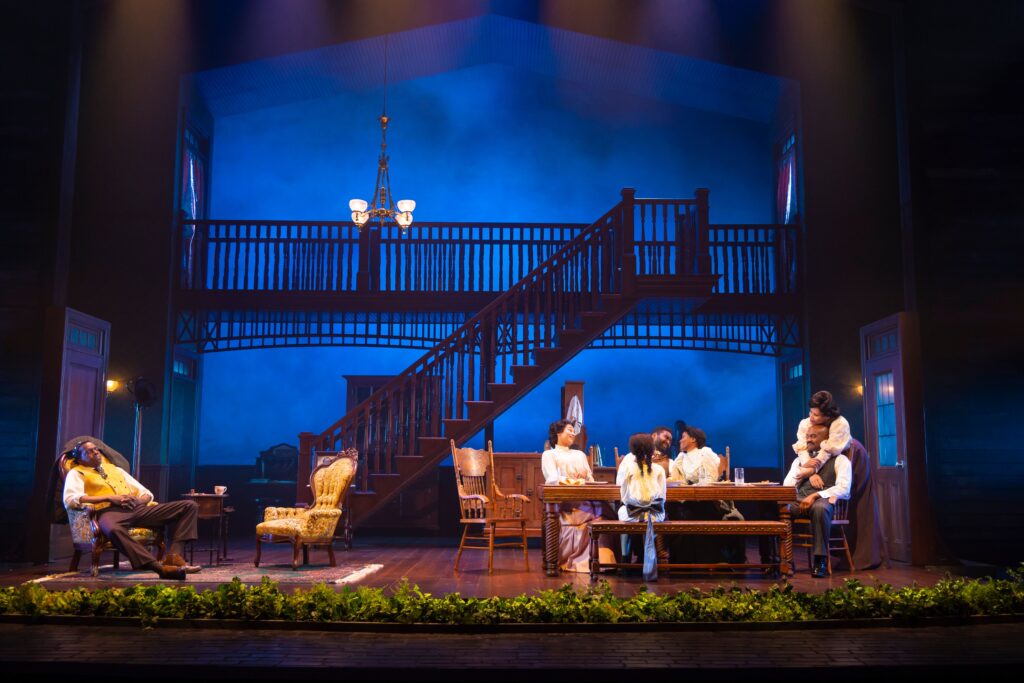
Other than sporadic trouble understanding and hearing some of the actors, the production is flawless. Arnel Sancianco’s set captures the pressed oak Victorian glory of an architectural era resplendent in its attention to eye candy detail, including a grand staircase and welcoming dining room table. A crystal clear sound system does justice to Aubrey Dube’s acoustic period selections (always a pleasure to hear Mississippi John Hurt sounding authentic but not like he’s singing underwater). And Samantha C. Jones’s costumes (especially the women’s hats) and Jason Lynch’s lighting (which manages to track the sun’s movement) are icing on the cake.

And that’s before we get to the cast’s universally brilliant acting and Lili-Anne Brown’s spot-on, outstanding direction.

First, though, a little historical background is in order. The title, Joe Turner’s Come and Gone, refers to Joe Turney, the brother of former Tennessee Governor Peter Turney. In the late 19th Century, Joe Turney was responsible for transporting black prisoners from Memphis to the Tennessee State Penitentiary, located in Nashville. Instead, Turney abused his role by running a network of “convict leasing.” He was also known for swooping down on innocent freed blacks and illegally enslaving them for seven years, often to work on his own farm. When men turned up missing in black communities, word quickly spread that “Joe Turner’s come and gone.”

Against this harsh backdrop of the Jim Crow lawless post-Civil War America, Wilson introduces us to his cast of vivid characters.

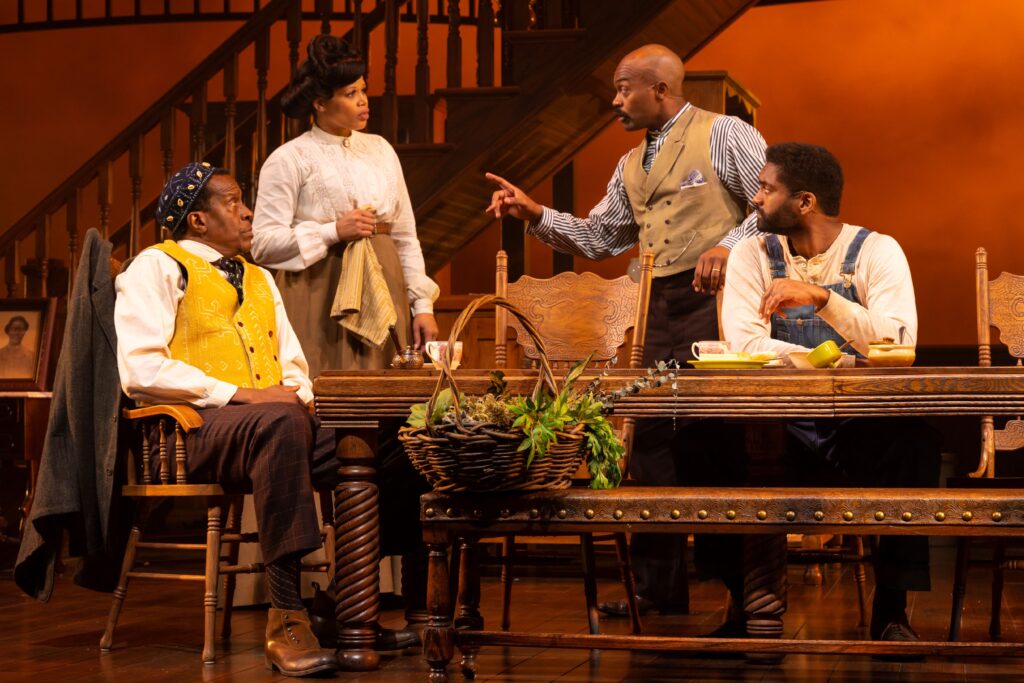
It’s 1911 and Seth and Bertha Holly run a “respectable” boardinghouse in Pittsburgh. Seth (played with pitch perfect comedic timing by Maurice Emmanuel Parent), its owner, inherited the property and business from his parents. He was born to free African-American parents in the North and is a real killjoy. Set in his ways, he is happy to assimilate to the degree he is allowed, and is economically shrewd and heartlessly capitalistic.

Bertha (the sublime Shannon Lamb), his wife of 25 years, is a loving mother to her boardinghouse family. Although she knows her place, she manages to manipulate Seth’s decision-making in subtle yet effective ways. Love and laughter get her by. She embraces Northern ways (including Christianity), but her heart and spirit remain tied to her African ancestors.

Bynum Walker, a 60ish “conjuror” who practices healing arts with herbs, incense and song, is Seth’s foil. As portrayed by Robert Cornelius, Bynum is both as large as a giant and as gentle as a lamb. He is as grounded in his roots and heritage as Seth is in his denial of them. In touch with his inner soul and identity, he offers to help those lost to themselves and others with his powers to “bind.” Bynum is part shaman, philosopher and therapist — and all compassion. He has lived at the Holly’s for a while and moves about as comfortably as if he were a blood relation.  

Jeremy Furlow (an exuberant Stewart Evan Smith), 25, is trying to find his identity as a member of the younger generation of newly liberated slaves. He is footloose and itching to travel the nation with his guitar and fancy green suit. In the meantime, he works anywhere that will hire him building whatever needs building. He naively chafes at the racial injustice he encounters and will accept the company of any woman who accepts his as he tries to find his perfect mate.

Robert Cornelius, Shannon Lamb, Maurice Emmanuel Parent and Stewart Evan Smith

The only white character in the play, Rutherford Selig (a suitably sycophantic and tone deaf Lewis D. Wheeler) is a peddler known as the “people finder.” He was also a fugitive slave finder, like his father (his grandfather ran the first ships, we’re told, that captured Africans and brought them to America to become slaves). He acts as middleman for Seth’s hand-crafted dustpans and keeps a tight record of everyone he meets on his travels.

Mattie Campbell (an earnest Al-nisa Petty), a young woman who finds Seth’s when she seeks Bynum’s help in binding her to her missing boyfriend, is disappointed in the life that has left her a bereaved mother of two dead babies and a jilted girlfriend. By contrast, the last thing Molly Cunningham (the slinky Dela Meskienyar), another tenant in her mid-20s, wants is to be bound to anyone or anything — except maybe her mama. She is independent, spoiled and totally aware of the power her striking looks and wardrobe afford her.

Into this ersatz family wanders Herald Loomis (brilliantly embodied by James Milford), a former deacon and odd man who dons an overcoat in August, and his skinny 11-year-old daughter Zonia (Gray Flaherty at last Sunday’s matinée). He has the skittish mannerisms of one suffering from post-traumatic stress disorder. He has been travelling from town to town, looking for his wife, Martha Loomis. The last time he saw her was 11 years ago, right before Joe Turner captured and enslaved him for seven years. By the time he was freed, Martha had fled. He’s been on the road looking for her for four years, Zonia in tow.

Wilson is a maestro at creating masterpieces that illustrate the Black human condition in America. Armed with this rich palette of characters and his magic wand of a brush, he paints a picture rich in both human emotion and historical context. He doesn’t polemicize, castigate or lecture, yet he makes his points about racial injustice, Black diaspora, migration and the irredeemable evil and gall of kidnapping and slavery. His wholly fleshed out characters let us through the keyholes of their lives and by the end of the play, we have connected the dots.

The specific plot twists and turns are too numerous (and contain too many spoilers) to detail here, and Wilson is more about the journey than the destination anyhow. By the end of the almost three hour (with intermission) play, the audience has experienced the pain and promise of the post-slavery years and the power of community to heal and revive a broken and lost soul.

Everyone at the boardinghouse is searching for their missing piece. Unspeakable horrors and disruptions untethered men like Herald Loomis, who has lost his sense of who he is because he cannot remember who he was before he was enslaved. For men like Seth, who has only known life in the North, slavery and its consequences are more hearsay than heartache. He’s more concerned with keeping what’s his in the face of the increased competition post-emancipation northern migration has wrought. He knows the system is, and always will be, rigged against him. His mission is to squeeze through the loopholes unnoticed and differentiate himself from these newly arrived migrants.

Seth is also a pragmatic man who doesn’t feel the need to seek meaning or purpose by way of spirituality or a return to his African roots. Christianity and churchgoing is as much about fitting in as it is about religion.  Of Bynum’s shaman-like behavior, he says, “All that old mumbo jumbo nonsense. I don’t know why I put up with it.”

Bynum, on the other hand, is at peace with himself and the world as he finds it. He believes himself to be part of a “grand design,” a belief that ultimately allows him to “swallow any adversity.” For Bynum, his spirituality and helping others re-find themselves become a way of making sense and finding his own purpose in an unpredictable world.

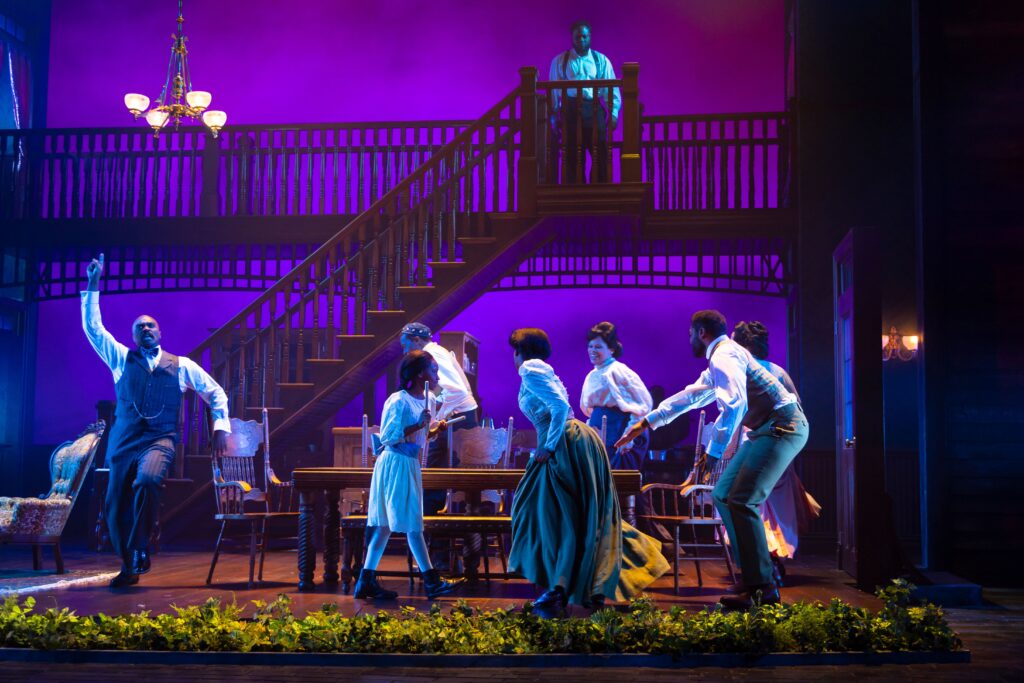
Straddling the two is Bertha, who is as down to earth and practical as Seth but takes comfort in Bynum’s old forms of African healing and mystical practices. One of the highlights of the play is the joyful “Juba” dance around the kitchen table where all but Herald participate and lose themselves in a moment of communal ecstasy. (The Juba dance was originally brought by Kongo slaves to Charleston, S.C.).

By the play’s end, Loomis (and several others) have found their inner song and are on the path to exploring their identity, and the audience standing has found itself in thunderous applause. Wilson’s words and spirit spin a magic that will resonate long after the last cheer has faded. Highly recommended.

For tickets and information, go to: https://www.huntingtontheatre.org/

Huntington Theatre’s ‘The Bluest Eye’ Is A Triumph

Cast of The Huntington Theatre’s production of The Bluest Eye by Lydia R. Diamond

by Shelley A. Sackett

Brimming with sparkling ensemble acting, inspired staging and soulful song and dance, Huntington Theatre’s The Bluest Eye packs a wallop. Thanks to Lydia R. Diamond’s faithful yet nuanced adaptation, Toni Morrison’s groundbreaking début novel about two poor Black families in 1940s Lorain, Ohio is brought to the stage with all its poetry, pathos and humor intact. You can almost feel Morrison’s presence in the audience, beaming pride and approval.

The story is neither easy nor pretty. Nor is it sugar-coated. A harrowing (and timely) tale about the insidious effects of racism, the 80-minute intermission-less play explores what happens to people — especially children — whose identities and self-images become distorted by the relentless oppression and cruelty they suffer.

What happens to that marginalized little Black girl who feels neglected, lonely and ugly? Whose hand local (white) shopkeepers won’t touch? Whose home life is abusive and unsafe? Whose only frame of reference for happiness, friendship and family harmony is the Dick and Jane primer she reads every day in school, the one about white, blue-eyed, blond Jane and her adoring, white parents?

Brittany-Laurelle, Hadar Busia-Singleton, and Alexandria King

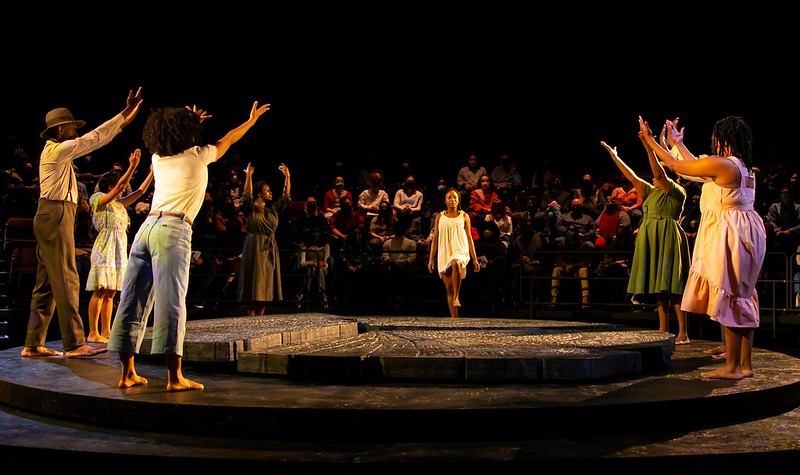
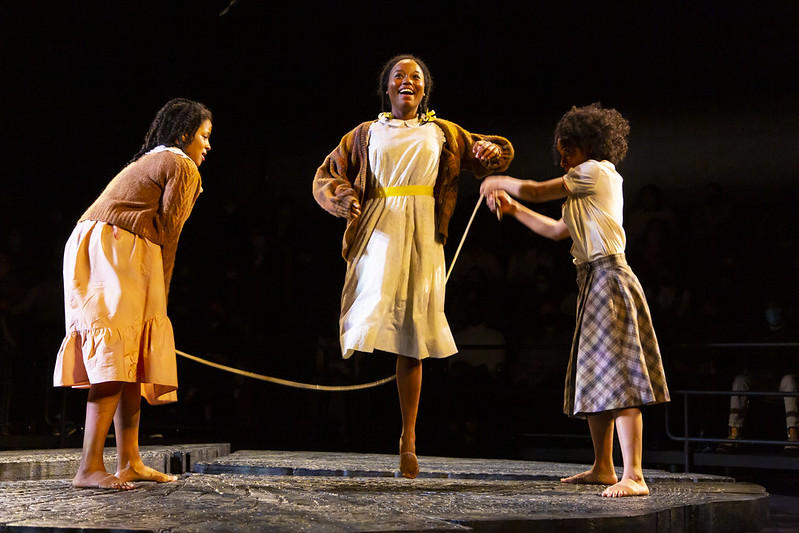
From the get go, there is a feeling of community and engagement among the actors and between actors and audience. Performed on a raised, round stage between two semi-circles of audience members, the (masked) physical immediacy and intimacy heightens the mood. No one is hidden; no one can hide.

The play opens with two feisty preteen sisters discussing local gossip. Claudia (Brittany-Laurelle, who brings a powerful but contained individuality to the role) and Frieda (Alexandria King in a magnificently physical and expressive, punchy performance) will act as narrators and guides, and their sassy, lighthearted banter is the perfect foil to the heaviness of the story that will unfold. Like vocal choreography, their voices dance with and around each other, weaving a single tapestry from many strands.

Their main topic of conversation is the Breedlove family, the ugliest family in Lorain. “Their ugliness came from a conviction that they accepted without question,” Claudia explains. Eleven-year-old Pecola Breedlove (played by the hypnotic Hadar Busia-Singleton, who manages to infuse her unbearably sad character with a whisper of hope) knows the world finds her Blackness ugly. “How do you get somebody to love you?” she asks over and over.

But she has a plan. She has figured out the key to being lovable. All she needs are blue eyes, as blue as Jane’s and Shirley Temple’s. “Then the teachers would see me and people would have to be nice to me,” she explains matter-of-factly.

R foreground: Ramona Lisa Alexander, Lindsley Howard, McKenzie Frye

Claudia and Frieda’s recollections and narrations are the backbone of the play, told with overlying reenactments of the various scenarios that have shaped and marked their and Pecola’s families. Mrs. Breedlove (McKenzie Frye) is a cleaning woman with a bum foot and missing front tooth who would go to the movies and dream of looking like Jean Harlow. Her husband Cholly (Greg Alverez Reid) suffered the kind of loss, humiliation and violence that doesn’t excuse his inexcusable acts, but at least provides context. Beneath their toughened exteriors, each carries the weight of unbearable despair. Together, they are a ticking time bomb, Pecola its collateral damage.

By comparison, Claudia, Frieda and their Mama (played by Ramona Lisa Alexander as unyielding and fussy yet kindhearted) lead a life of relative ease and stability. These three are the source of the play’s lightness and humor. As Claudia, Brittany-Laurelle brings down the house in the reenactment of a scene when she received a blond, white baby doll as a gift. To her mother’s disbelief and horror, rather than covet it, she destroys it, but only after she has humiliated and terrorized it. She hates its so-called beauty. “What was I supposed to do with that?” she asks without irony.

Through a series of events that would include spoilers, Pecola’s prayers for blue eyes and all that means seem to be answered by the magic of Soaphead Church, a charlatan soothsayer, played brilliantly by Brian D. Coats. Yet, it is at such a steep price that we are left grieving for this child whose innocent light has been extinguished.

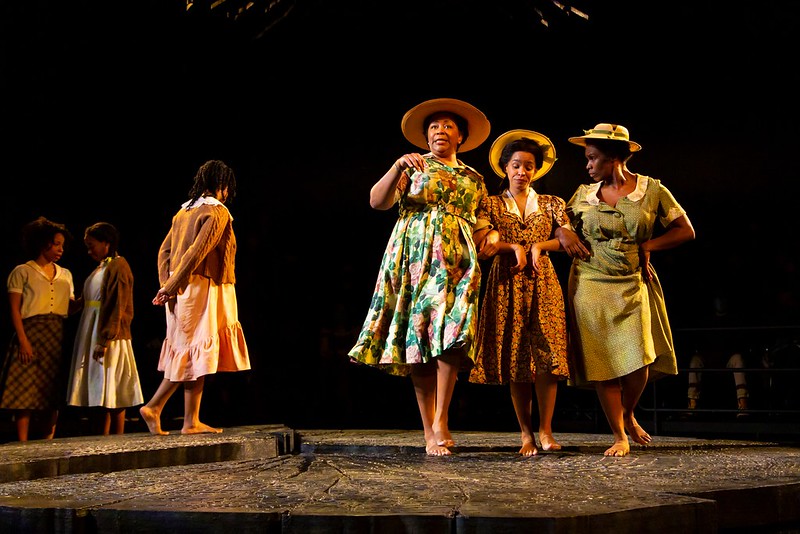
Under Awoye Timpo’s direction, The Bluest Eye brings a lot of extras to the table. She makes wonderful use of a trio of women who appear throughout the production, imbuing them with many of the gestures and props familiar to fans of Alvin Ailey’s “Revelations.” They are welcome palette cleansers, acting as part Greek chorus, part harpies, and part goddesses. The interweaving of a capella spirituals (Frye is a knockout) and choreography (especially the slow-motion battle scene between Cholly and Mrs. Breedlove) is inspired and welcome.

The Boston theater scene is replete with many productions that are well worth seeing. Only a handful rise to the level of “must see.” The Bluest Eye is one of them.

‘The Bluest Eye’ – Based on the book by Toni Morrison, adapted for stage by Lydia R. Diamond, Dramaturgy by Sandy Alexandre. Directed by Awoye Timpo; Set Design by Jason Ardizzone-West; Costume Design by Dede Ayite and Rodrigo Muñoz; Lighting Design by Adam Honoré; Sound Design by Aubrey Dube; Original Music by Justin Ellington; Choreography by Kurt Douglas; Music Direction by David Freeman Coleman. Presented by Huntington Theatre Company at Boston Center for the Arts through March 26. Digital recordings available Feb. 14 through April 9.For tickets and information, go to: https://www.huntingtontheatre.org/