
Walking into a room of Impressionist paintings always feels like coming home; there is a calm to the predictably pleasant. It takes a bold and innovative approach to snap one out of this complacency, and Peabody Essex Museum’s new exhibit, “Impressionists On The Water,” is that and more.
With over 90 paintings, prints, model boats and photographs, the exhibition focuses its lens on the influence waterways had on French Impressionists Monet, Renoir, Matisse, Signac, Pissarro, Caillebotte and Daubigny.
The unconventional staging of the show is masterful. Each display is punctuated with models of the boats illustrated in the nearby paintings. Of the two full-sized boats, the replica of the craft in Caillebotte’s “Boating on the Yerres” is a work of art in its own right. The curators have overlooked no detail: even the gallery walls are treated with sculptural elements that evoke a watercraft.
France’s many rivers and ocean harbors inspired its national pastime of pleasure boating. Among the most passionate sailors and yachtsmen were our beloved painters, and each has a maritime story to share.
 Full-sized model of the boat in Caillebotte’s “Boating on the Yerres.” (Shelley A. Sackett)
Caillebotte designed and created more than 20 boats; a racing rule bears his name. Signac owned 30 boats. Daubigny and his protege, Monet, lived on studio boats so they could be closer to their subject matter.
Throughout the exhibit we sense a celebration of light, water and sky. These painters brought the hallmarks of the Impressionist movement to their water experiences: spontaneity, sunlight, exhilarating color and a devotion to painting outdoors. They painted what they saw and felt; there is passion in their palettes.
Among the harbors, regattas, beaches and waves, one painting really stands out. Eugene Delatre’s “Woman Rowing” is a watercolor of a solitary woman in shadow, rowing towards sunrise. She is the lone female of the show and the lone loner; every other boating painting depicts at least two men.
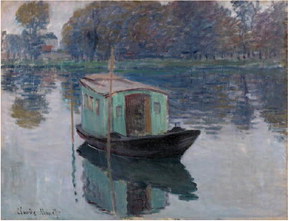
Claude Monet, “Monet’s Studio-boat, (Le bateau-atelier).” Collection Krller-Mller Museum, Otterlo, The Netherlands. (Courtesy of Peabody Essex Museum)
The most unexpected and wonderful surprise of the exhibit, however, is the lifesized reproduction of the floating boat Monet painted in the adjacent “Monet’s Studio-boat.” We are encouraged to enter and take a seat. The boat is outfitted with every appliance and comfort, and video displays mimic a water-line perspective. Like Alice and her rabbit hole, we have stepped into another world.
By the time we reach Monet’s “Waves Breaking,” the last painting in the show, we are looking through eyes that have gained a fundamental understanding of the artistic possibilities inherent in water and boats. We linger a bit before leaving, seeing what Monet saw, breathing the salt air and celebrating a single moment of just standing by the sea.
Pictured at top: Gustave Caillebotte, “Boating on the Yerres (Prissoires sur L’Yerres).” Milwaukee Art Museum, Gift of the Milwaukee Journal Company, in honor of Miss Faye McBeath. Photograph by John R. Glembin. (Courtesy of Peabody Essex Museum)

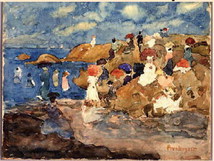 Revere Beach 1896.
 InSights