SpeakEasy’s “Pru Payne” Is A Must See for Fans of Fabulous Theater

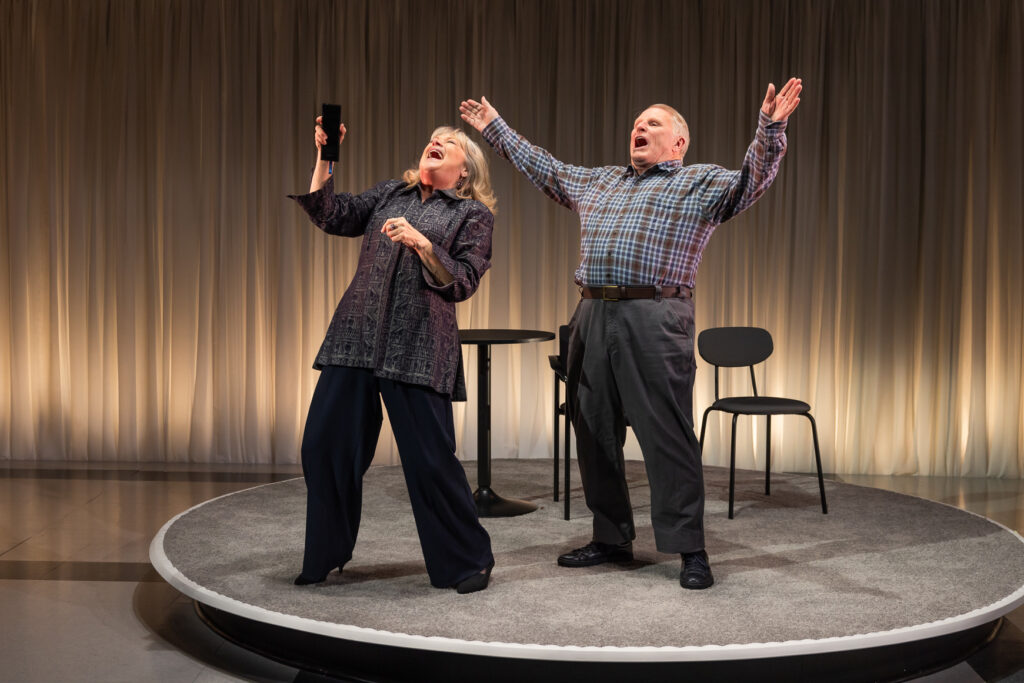
Karen MacDonald and Gordon Clapp in SpeakEasy Stage Company’s production of Pru Payne.
Photo: Nile Scott Studios

By Shelley A. Sackett

Karen MacDonald, recently introduced as “the empress of Boston,” adds another gem to her tiara with her portrayal of Prudence Payne, a Dorothy Parker-esque reviewer whose sharp wit, acid tongue and encyclopedic familiarity with minutiae of all things cultural have earned her many awards. We are introduced to her as she and her son, Thomas (De’Lon Grant) sit in the Brook Hollow clinic anteroom, awaiting a consultation with a doctor. The television is blaring pablum. Pru regally grabs the remote, waves it like a magic wand. She tries to turn the television set off, but can’t. She retakes her seat, slumping in confused defeat. Tommy reminds her that there are other people in the room who may want to continue watching. “Re. Member,” Pru says, enunciating each letter as if it were a syllable unto itself.

In a flash of a flashback, the music cues and we are transported to 1988 (kudos to Set Designers Christopher and Justin Swader, whose elegantly simple set easily morphs in our mind’s eye from medical waiting room to time travel “Beam Me Up Scotty” mode to grand ceremonial dais.) Pru is at the pinnacle of her career, about to become the first woman and first critic to receive the alliteratively laden AAAA’s (American Academy of Arts and Aesthetics) Abernathy Award.

We catch her as she mounts the podium amidst resounding applause. Her acceptance speech is impudent, provocative and riotously funny. She is brilliant and revels in peppering her monologue with fast-paced literary citations that showcase her sophisticated and seasoned palette while challenging her audience to guess their source. If there were a Mensa Jeopardy, Pru would be its host.
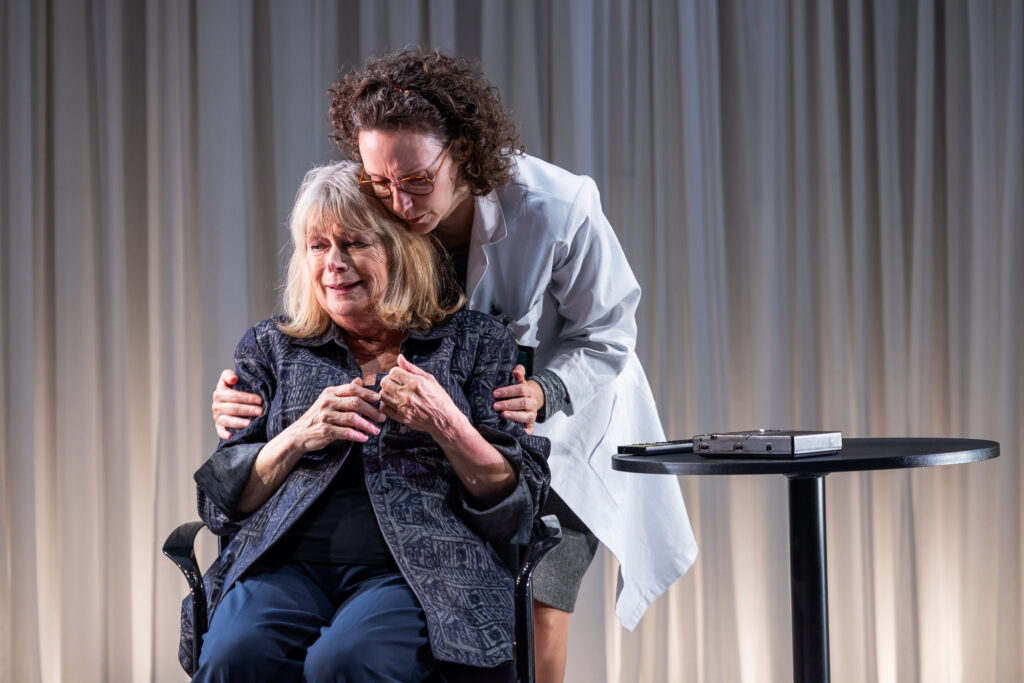
MacDonald, Marianna Bassham

But a sudden shift, almost imperceptible at first, indicates all is not quite right with Pru. She devolves into F-bombs, rectal references and borderline slander. Thomas approaches her, but she waves him away. When she loses her place and starts to panic on stage, MacDonald’s prodigious skills are on full display. In the blink of an eye, her Pru actually pales, her face sags, her shoulders droop and her speech falters. Thomas rescues her and escorts her to her seat. We are back in the waiting room, where the TV continues to blame.

Brook Hollow, it turns out, is a Massachusetts memory clinic where Thomas has brought Pru for evaluation following her speech and the uproar it causes. To smooth the turbulent wake Pru left with the AAAA, he has offered up her memoir as a peace offering, due the following fall. It is only two weeks later, yet we sense that Pru has deteriorated. She is still irreverent and acerbic, yet her confusion and slips are more frequent.

Thomas is desperate to thwart his mother’s memory loss. It is an irony lost to no one that a woman whose memory is galloping away is chasing her past before it is out of reach in order to write her memoir.

For the next 90 intermission-less minutes, we ride shotgun over two decades as Pru travels down the path of full-blown, irreversible dementia. If this sounds gut-wrenching and jarring, it is. Yet, in the skilled hands of master wordsmith and award-winning playwright Steven Drukman (and under Paul Daigneault’s flawless and sensitive direction), it is also rip-roaringly funny and brimming with empathy. The Newton native has married head and heart in a tightly crafted script that abounds in clever one-liners and zinger plays on words. (It also has tons of fun local references). Painful as the topic and Pru’s story are, Drukman’s humor and hopefulness dull the knife’s sharp blade just enough to prevent the play from circling the drain of utter despair.
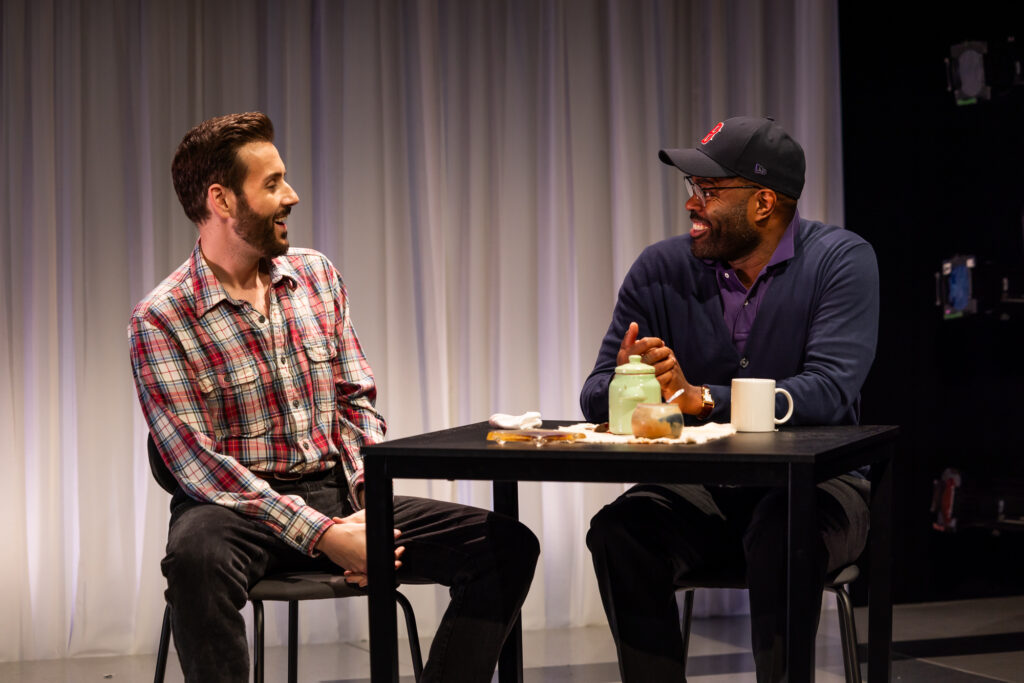
Greg Maraio, De’Lon Grant

He has also penned a group of supporting characters who each have independent agendas and stories, yet who interlace as an ensemble that embraces and supports the play’s eponymous Pru.

Pru and Thomas, an aspiring novelist, meet with Dr. Dolan (the magnificent Marianna Bassham in an unfortunately understated, somewhat unimaginative role), who, unsurprisingly, wants to admit Pru for observation. They start to protest when Pru spots Gus Cadahy (the quietly show-stopping Emmy, SAG and IRNE Awards winner Gordon Clapp), a custodial engineer who is accompanied by his son, Art (Greg Maraio). They, too, are at Brook Hollow so Gus can be evaluated for memory decline and associated behaviors.

Pru and Gus are yin and yang, opposite forces that form a whole in a balance that is always changing. He is lower middle class, uneducated, and speaks with a thick Boston accent. She is stratospherically wealthy, wears her pedigree on her sleeve, and effects a Brahmin patois. He is unapologetic, hilarious and down to earth, determined to squeeze every last drop of fun and pleasure out of life. He makes no excuses and accepts what comes his way.

She is calculated, driven and controlling. “Good enough” are two words meant to be spat, like a curse. Despite her sophistication and breeding, she is far crasser than the social mores minded Gus.

Their love affair at Brook Hollow opens the door to more than a delineation of their differences. Pru is Gus’ missing piece and vice versa. He softens and grounds her, whether playing gin, dancing, making love or reeling her back from memory’s steep precipice. Pru, for the first time in her life, is able to let go, let loose and let herself love and be loved.
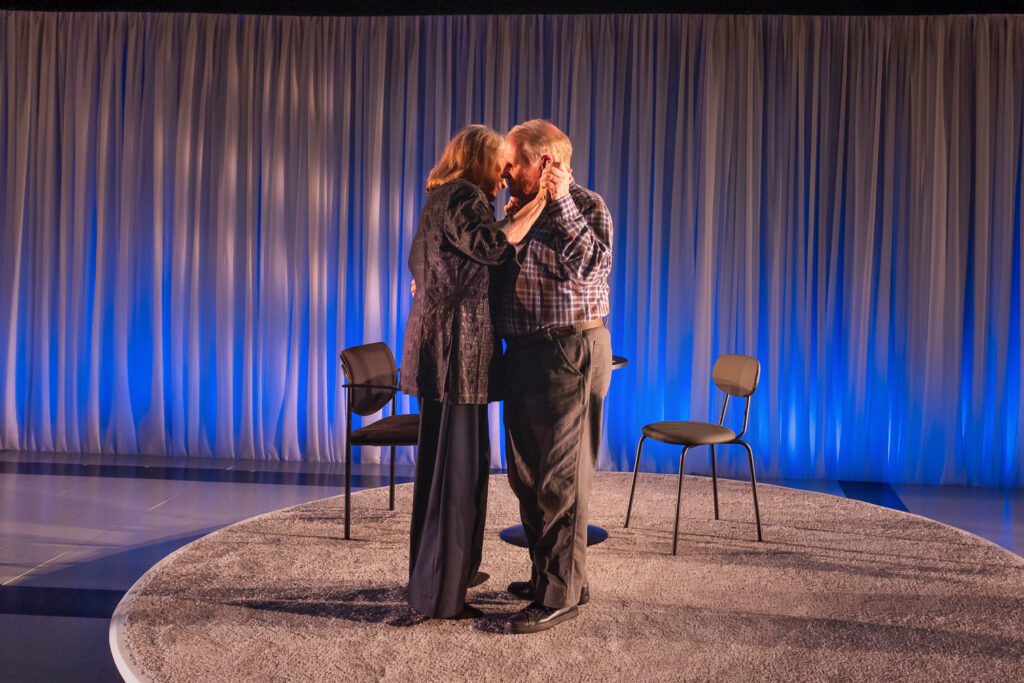
MacDonald, Clapp

Meanwhile, their sons have their own backstory, which would be a spoiler to divulge other than to let slip that, while their parents are creating new memories, their sons are revisiting old ones.

Boston native Maraio is terrific as Art, both in his interactions with his father and with Thomas, especially as concerns their parents’ relationship. He brings a nuanced vulnerability to his external impermeability. Grant, so wonderful as Keith in “A Case for the Existence of God,” brings that same sweet openness to Thomas, a quiet defenselessness and optimism.

Although Drukman meanders peripherally into timely topics of the 1990s and 2000s (AIDS, politics, and the demise of cultural standards, for example), he has the good sense to use this detour for context rather than theme. He has written an important and riveting play about a timely and difficult subject that is, in its own right, much more than just “good enough.”

We ache for Pru and her family, but covet our view through the keyhole at that in-between stage where one starts to become unglued. yet is still together enough to be aware of what is happening (and what is to come). We also come face to face with some heady and introspective queries.
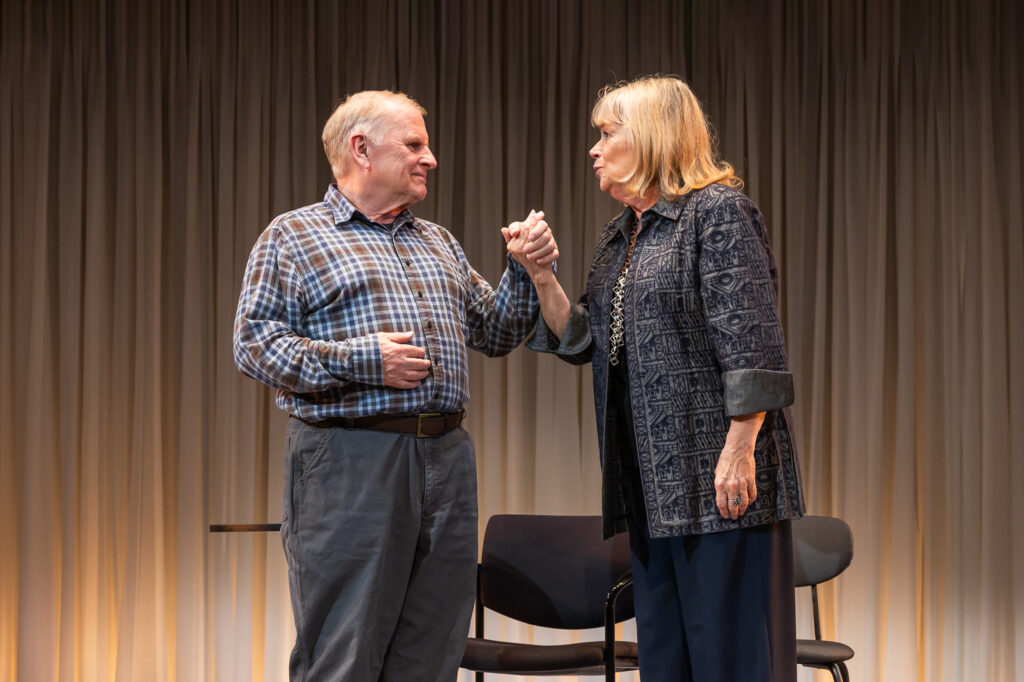
Clapp, MacDonald

How, for example, do you sum up a person, especially one whose life ends in the black hole of dementia and Alzheimer’s Disease? Who is the real Pru? How should she be remembered? Is it fair to her to remember her in her absolute decline or is it dishonest to remember her otherwise? Do we curate our own memories? Do others curate theirs of us? At the end of the day, does it really matter?

As her own memories dissolve and past human connections along with them, Pru has moments lucid enough to still contemplate Pru-worthy big picture questions. What if, she wonders, her entire life was just a memory trick?

What if, indeed.

“Pru Payne”— Written by Steven Drukman. Directed by Paul Daugneault. Presented by SpeakEasy Stage at Boston Center for the Arts, Calderwood Pavillion, 539 Tremont St., Boston, through Nov. 16.For tickets and more information, go to https://speakeasystage.com/
The Huntington’s “Nassim” Bridges Our Differences through Language, Gimmickry and Charm

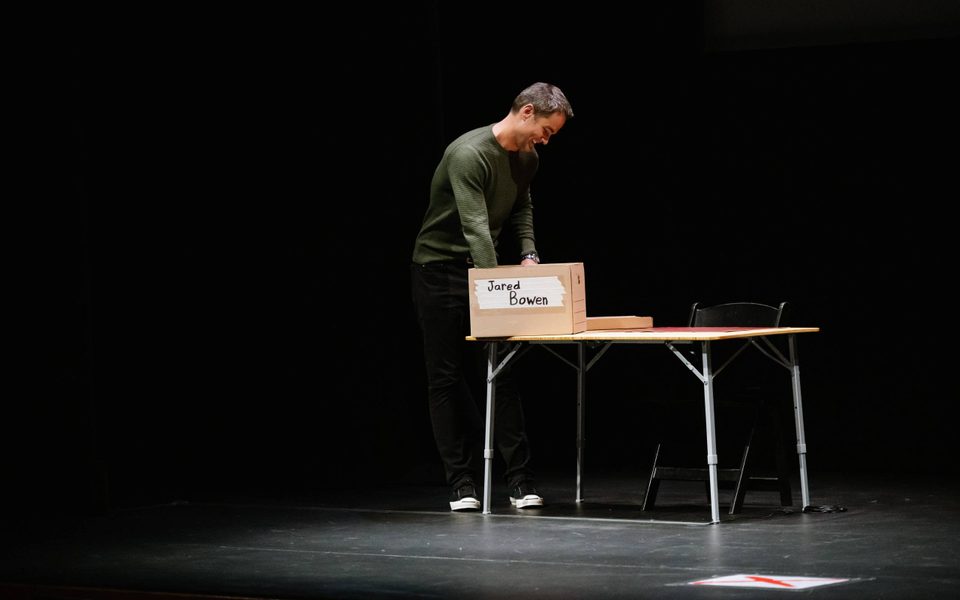
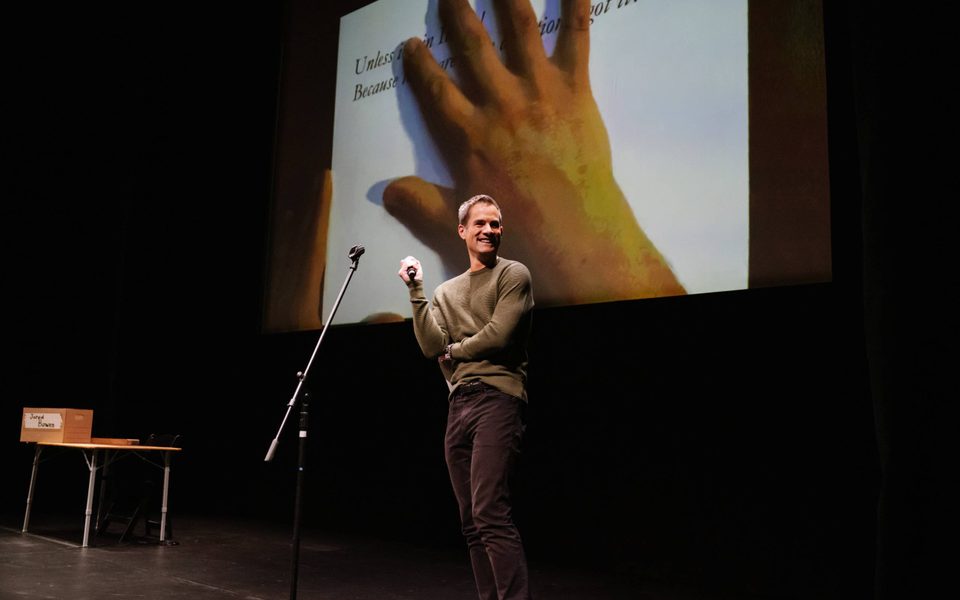
Jared Bowen in Nassim at the Calderwood Pavillion, BCA. Photos by © Mike Ritter

“Nassim” — Written by Nassim Soleimanpour. Directed by Omar Elerian. A new guest performer for every show. Presented by The Huntington through October 27.

By Shelley A. Sackett

“White Rabbit, Red Rabbit,” Iranian Nassim Soleimanpour’s absurdist adventure, which sits on the boundary of comedy and drama and burst into London’s West End in 20212, changed my opinion about audience participation in theater. Not a big fan of the genre, I left the 2016 performance at New York City’s Westside Theatre a convert.

Conceived while 29-year-old Soleimanpour was barred from leaving Iran for refusing military service, the play challenged its audience on issues of trust, obedience and complicity while demolishing the fourth wall and having a different actor read the script for the first time at each performance.

The words were Soleimanpour’s; the implicit messages were the idea of someone trying to speak through someone else and the question of what censorship means.

So when The Huntington announced it was producing the eponymous “Nassim,” I was on board. Originally commissioned and produced by London’s Bush Theatre in 2017, the drama, comedy and social experiment is even more timely today.

Fueled by curiosity, compassion and a longing for global community, Soleimanpour employs his trademark style of having a different actor cold read his script in front of a live audience. Karen MacDonald, the “empress of Boston theater,” had the honors the night I attended, and she rose to the task with her usual humor, flair and skill.

For 75 intermission-less minutes, MacDonald read from a script (minus the italicized stage directions) projected on a jumbo screen, as its pages were moved by disembodied hands. The play’s theme, a meditation on how foreign languages divide us, slowly comes into focus. While Soleimanpour’s plays have been performed in dozens of languages worldwide, they’ve never been performed in Farsi in his native country because of governmental repression. This situation particularly distresses him because his mother, who still lives in Iran, has never heard or seen one of her son’s plays performed in her (and his) mother tongue.

Although “Nassim” at times feels insubstantial and the gimmicky aspect often crosses over into banal cutesiness, its positive message of global community through communication and understanding prevails. Mimicking a language class, Soleimanpour’s script invites the audience (and especially MacDonald) to experience the beauty and magic of his native language, Farsi. We discover through the timeless and borderless device of fairytales.

Naheem Garcia

“Once upon a time” are our first Farsi words, along with “mom.” “You have to learn your mother tongue,” MacDonald reads.

In Act Two, Soleimanpour’s script turns more autobiographical, and we find out that he wrote the play in Farsi with words he wanted to learn in English. The play, which celebrated its 479th performance and has been staged all over the world, was intended as a means for its author to meet new people and be taught new words all over the world.

“A writer’s heart will always beat in his mother’s tongue,” Soleimanpour says through MacDonald. “But isn’t it amazing how languages work? They bring us together; they tear us apart.”

It would be too much of a spoiler to reveal all the surprises in store, but this charming and timely piece of experimental, experiential theater is a must for anyone curious about more than the shiny, big productions that often dominate conversation, reviews, and box office receipts. Take a chance with this little gem; you won’t be disappointed.

For more information, go to https://www.huntingtontheatre.org/

Review: MRT’s ‘Erma Bombeck: At Wit’s End’ a Delightful Breath of Fresh Air

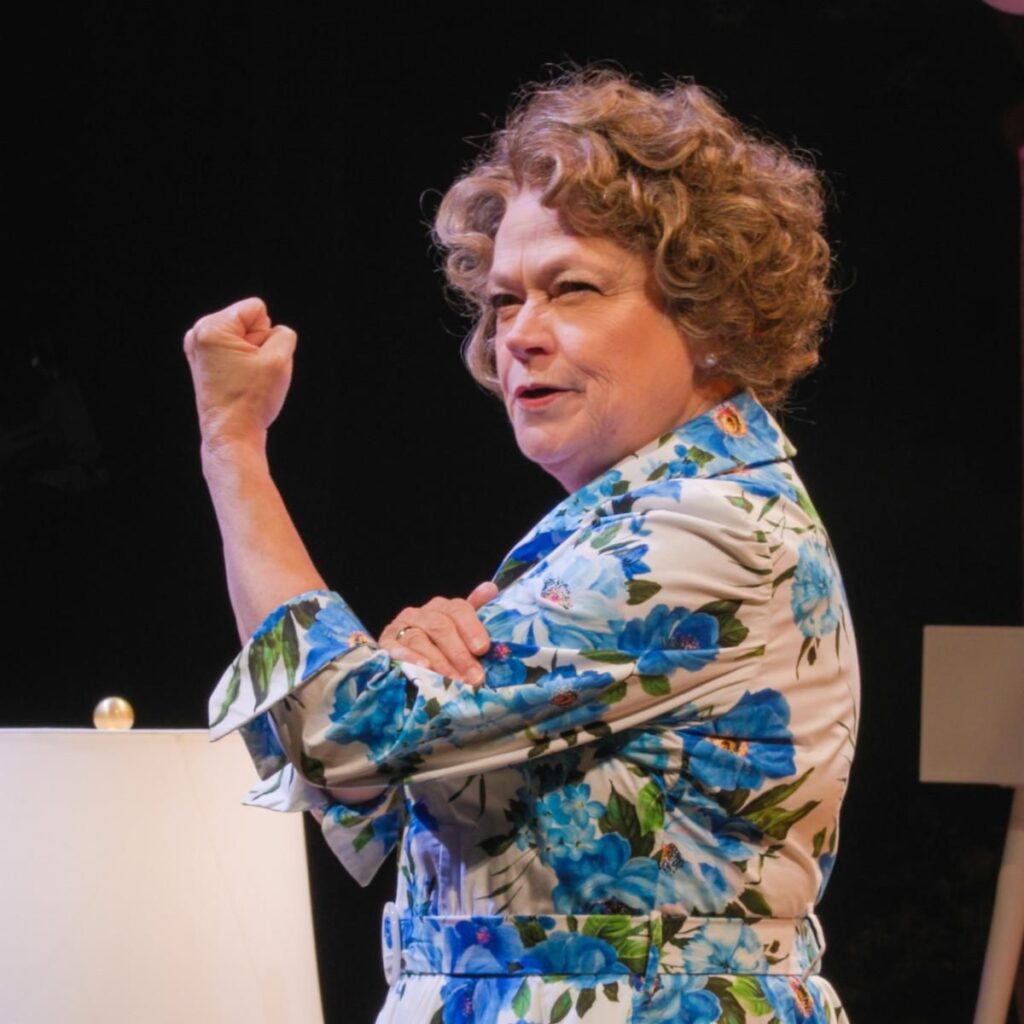
Karen MacDonald as Erma Bombeck in MRT’s ‘Erma Bombeck: At Wit’s End’

by Shelley A. Sackett

Karen MacDonald is nothing short of spectacular in the one-woman show, ‘Erma Bombeck: At Wit’s End,’ now playing at Merrimack Repertory Theatre through March 13. For 80 intermission-less minutes, she doesn’t just play Erma Bombeck; she IS Erma Bombeck, from her impeccable timing to the subtlest gesture and most delicate modulation. Don’t let this one slip away without seeing it. It is a balm of enormous power during these dark tundra days.

That power comes from Bombeck herself, whose simple, perceptive and — most importantly — funny writings are the backbone of the script. It feels so good to just relax, witness a magnificent performance, and laugh.

Daniel Zimmerman’s scenic design sets a perfect table for this theatrical feast. Complete with shag carpet (mustard and chartreuse), mid-century modern furniture and Hoover upright vacuum cleaner, we are instantly transported back to 1960s suburbia. His backdrop creation of a birds eye drone view of a typical neighborhood is as brilliant as it is effective. The effect is like being in a shadow box or viewing a large 3-D cinematic screen turned on its head.

We first meet Erma in her spotless living room, clad in a belted flowered shirtwaist dress, apron, pearls and heels, enjoying a moment’s peace before she starts ironing, vacuuming and folding laundry. MacDonald establishes rapport with the audience before she even utters a word. Yes, she really IS that good an actor.

By the time Erma utters her first line, she has the audience in the palm of her hand. “How,” she asks half in earnest, half rhetorically, “did I end up in suburbia?”

The rest of the monologue traces Erma’s life, from Bellbrook, Ohio to Cherrywood

Orchards community and motherhood to her spectacular career as columnist, book author and nationally sought speaker. Along the way, we are treated to snippets of Erma’s insightful, playful yet always spot-on humor and advice.

A bright woman straddling a line between domestic bliss and oblivion, Erma was a self-described “willing prisoner.” She had her kids early in life and compares the drudgery and workload of stay-at-home motherhood (the second oldest profession) to prostitution (the first), the difference being that mothers don’t get paid.

“I signed up for this life sentence,” she admits (though without, she notes, the usual possibility of parole for good behavior). At the end of the day, however, she offers a one-size-fits-all piece of advice: “If you can laugh at it, you can live with it.”

She escapes her sadness and emptiness by getting back to her writing, which was interrupted by her new role as housewife. She decides to use humor to tell the truth about her life in a column. After her third (and last) child starts kindergarten, she gets started.

Her success is immediate, her popularity taking off like a rocket into space. She goes from one column in a small, local papers to three columns weekly in a syndication of 900 papers nationwide. Yet she never loses sight or grasp of who she is and what her goals are.

“There was love in every line I wrote,” she says. There is also honesty, wit, laughter and pain. Remarkable for their  absence are anger and resentment.

We learn more about how a chance lecture by Betty Friedan launched Erma on her quest to pass the Equal Rights Amendment. She travelled for two years to garner support, writing her columns while on the road. She never missed one deadline during her entire career.

Towards the end of the play, Erma waxes poetic as she wistfully reflects on her career, cancer and waning years. “I was a stay at home mom,” she says. “The key to my writing is I am ordinary. Most of us are unremarkable.”

Although she never won a Pulitzer Prize, she is proud of her columns’ status as “top billing on the refrigerator.” She is such a good sport about everything, rolling with the punches and still harboring no resentment, regrets or complaints. “My plan was to wear out, not rust out,” she admits. “I wrote for me and the other mothers waiting to be recognized. I valued what everyone else took for granted- good old Mom.”

Her final words of advice on staying upbeat through the trials and tribulations of motherhood? “Seize every moment to make a difference,” she urges. “Who wants to live with regrets? Think of all those women on the Titanic who passed up the dessert tray.”

“Erma Bombeck: At Wit’s End.” Written by Allison Engel and Margaret Engel. Directed by Terry Berliner; Scenic Design by Daniel Zimmerman; Costume Design by Teresa Snider; Lighting Design by Joel Shier; Sound Design by Scott Stauffer; Original Music Composed by Brett Marcias. Produced by Merrimack Repertory Theatre, 50 East Merrimack Street, Lowell, MA through March 13.

For tickets and information, go to: https://mrt.org/

An Interview: Meet the Star and Director of MRT’s ‘Erma Bombeck: At Wit’s End’

Karen MacDonald stars as Erma Bombeck in “Erma Bombeck: At Wit’s End. / Photo: Megpix/Meghan Moore

by Shelley A. Sackett

LOWELL — It may surprise many to learn that Erma Bombeck, the celebrated humorist, was not Jewish. With lines like, “If Life Is a Bowl of Cherries, What Am I doing in the Pits?” the big-hearted mother of three had the wit, wisdom, and chutzpah that are hallmarks of a classic Jewish mother. Her nationally syndicated column, “At Wit’s End,” ran in 900 newspapers and championed the undervalued everyday lives of millions of stay-at-home suburban moms, offering them a cathartic lifeline of truth, daring, and laughter. She boosted their spirits by poking fun at herself and her life’s ups and downs in an original, comic voice that was both sassy and satiric.

Born in small-town Bellbrook, Ohio, to a working-class family in 1927, she wrote her first humorous column for her junior high school newspaper and went on to write for the Dayton Herald. She wrote a series of columns while at home with her young children and resumed her writing career in 1965 with biweekly humor columns. Within three weeks of the first articles’ publication, she was picked up for national syndication, appearing three times a week in 36 papers under the title “At Wit’s End.”

By the time of her death in 1969, she had written 15 books and appeared regularly on “Good Morning America.”
As a timely antidote to a bleak January’s cold, snow, and COVID, Merrimack Repertory Theatre in Lowell is serving up a sunny dose of Bombeck’s humor in its one-woman show, “Erma Bombeck: At Wit’s End,” from Feb. 24 through March 13.

Boston based actor, director, and teacher Karen MacDonald will bring Erma’s larger than life personality to the stage. She remembers Bombeck as part of her family’s life from a young age. Her mother, a big fan, would laugh out loud as she read the column every morning, often posting her favorites on the refrigerator.

“You couldn’t bother Mom until she finished ‘reading her Erma,’” MacDonald said by email.

In preparation for the role, MacDonald, who loves doing research, read many of her books, a biography, and revisited “The Feminine Mystique,” a book by Betty Friedan that Bombeck credited as her personal wake-up call.

In the course of her research, MacDonald discovered that Bombeck was complex, funny, and an astute observer of ordinary life. She also discovered much to admire: Bombeck’s diligence in writing three columns a week; her deep respect for the work women do; her devotion to her family; and her commitment to the Equal Rights Amendment.

“There is a rich amount of material for an actor to work with,” said MacDonald.

While pointing out that no one could really “play” Erma but Erma herself, “You want to gather as much as you can to bring to life such a fascinating woman, MacDonald said. “Then, you synthesize all that information and, hopefully, come up with your own Erma, true to her and true to yourself.”

Director Terry Berliner is also no stranger to Bombeck’s writing. “Erma Bombeck has always been part of my life. I do not know a world without her. Her stories showed me the importance of perspective, the power of a good story, and the significance of capturing the truth,” she said by email.

Although Bombeck was the epitome of a woman’s voice being heard across America at her time, she was written off by many for that very reason – because she was a woman in a man’s world. Playwright twin sisters Allison and Margaret Engel, who primarily work as reporters, co-wrote “At Wit’s End” to amplify that voice and garner the acclaim they believe she deserves.

“She was the most widely read columnist in the history of the country, yet she never won the Pulitzer Prize and is rarely mentioned in journalism schools,” the Engels said in an interview. “Most likely, her subject matter – families and children – was not considered as important as the thoughts of political pundits. Yet she chronicled a very important transformation in the lives of ordinary women in this country.”

MacDonald hopes the play will be “just the tip of Iceberg Erma” and that audiences will leave with a curiosity to reread her work, to learn more about her life, and to reconsider her place in American humor.

On a more visceral level, she also hopes “folks will find some relief, in these strange days, with laughter. It feels good to laugh.”

The play will be available virtually throughout its run. For access or in-house tickets, visit mrt.org/ERMA. The Merrimack Repertory Theatre, located at 50 East Merrimack St., Lowell, is requiring all guests to show proof of COVID vaccination or a recent negative test and to wear masks at all times in the building. To learn more about the COVID policy, visit mrt.org/covid.

Child Is Father to Man in SpeakEasy Stage Company’s “The Children.”


CHILD-site

DRINK PARSNIP WINE. Karen MacDonald, Tyrees Allen and Paula Plum in SpeakEasy Stage’s production. All photos by Maggie Hall Photography.

By Shelley A. Sackett

Playwright Lucy Kirkwood had wanted to write about climate change for quite a while when the 2011 Fukushima nuclear disaster in Japan provided the impetus and inspiration. With “The Children,” a must-see production enjoying its Boston premiere at SpeakEasy Stage Company through March 28, she has succeeded in crafting a thoughtful and provocative three-character play that manages to raise profound existential and moral questions while slowing peeling back the layers of this three-some’s long and complicated history.

It is also one heck of a riveting eco-thriller/emotional detective story brilliantly acted by the inimitable stage luminaries Tyrees Allen, Karen MacDonald and Paula Plum.


The_Children_0159


The lights first come up almost mid-sentence on a rustic kitchen where Rose (MacDonald) stands, trying to staunch the flow of blood as it gushes from her nose and stains her shirt. Hazel (Plum) enters with a towel, trying to assist, but Rose waves her away. Rose asks after Hazel’s children. Hazel casually mentions she thought Rose was dead. Their banter is informal and the tone almost familial, but it is clear from the get-go that theirs is a tricky relationship and that there is something uneasy and troubling in this cottage.

As the story unfolds, we learn that Hazel and her husband, Robin (Allen), both retired, have taken refuge in their country cottage because their pastoral English seaside community has been devasted by a nuclear power plant disaster caused by an earthquake and tsunami. Their farm/home now lies in the toxic exclusion zone. All now in their 60s, the three met as 20-something physicists and engineers when they worked together building the power plant that just melted down.


Rose clothes her unannounced arrival—Hazel hasn’t seen her in 38 years—as concern about the disaster and how it has affected Hazel and Robin. But all is not what meets the eye and it soon becomes clear that the three share a complicated entanglement and that Rose’s visit is neither spontaneous nor agenda-less. Yet the question remains: Why is she there?


The_Children_0118


Kirkwood masterfully delineates her characters, revealing their personality infrastructures slowly, deliberately and subtly. Hazel and Robin raised four children and Hazel, even in her new post-apocalyptic existence where the air is radioactive and electricity is rationed, maintains her rigid domestic and yoga regimens. She is dogmatic in her belief that one must adapt to survive. “If you’re not going to grow, don’t live,” she practically spits at Rose. She is determined to live to a ripe od age and to die on her own terms. She is beholden to none; she has paid her dues.

Rose, on the other hand, never married, spent time in America and has been prescribed birth control pills to extinguish her fomenting libido. As it turns out, that treatment has been only minimally effective, as the smoldering embers of an old triangle soon reveal. She is the wild child yin to Hazel’s buttoned-up yang, mischievously clogging Hazel’s toilet by deliberately doing a “number two” after being asked not to and defiantly smoking cigarette after cigarette.

Robin is the fulcrum between the two, the double-dipper who ended up with Hazel but who still ignites in Rose’s proximity. He copes with his new reality by continuing to farm and care for his cows despite the risk posed by prolonged exposure to radiation. He seems rudderless and passive, going with the flow (including marrying Hazel when she became pregnant despite his arguable preference for Rose), creating no wake.

Over an hour into the 100-minute intermission-less show, Rose’s purpose is revealed: she has come to recruit Hazel and Robin to clean up the radioactive mess their shortsighted and negligent engineering knowingly created. “We built it. We’re responsible. I feel the need to clean it up,” she admonishes. Furthermore, she believes it is their duty to trade places (and, by implication, deaths) with the 20-somethings assigned the task of scrubbing away the radioactive debris. “It’s our duty to a child to die at some point,” the childless Rose chides. “I’ll know when I’ve had enough,” Rose yells back, later admitting, “I don’t know how to want less.”

No spoilers here about Robin and Hazel’s choices, but Kirkwood asks some deep and soul-searching questions. If we know the facts about climate change, why are we failing so catastrophically to change our behavior? Is it enough to stop contributing to the damage or is there a duty to fix what we created and are leaving the next generation? And who are the real children referred to in the title: those who are the actual children, powerless victims inheriting a flawed world or their parents, who act like children with their selfish irresponsibility and assumptive impunity?

“The Children”. By Lucy Kirkwood. Directed by Bryn Boice. Presented by SpeakEasy Stage Company, Calderwood Pavilion at the BCA, 537 Tremont Street, Boston through March 28.