Two Unlikely Buddies Talk Trash in Gloucester Stage’s Clever Comedy, ‘The Garbologists’

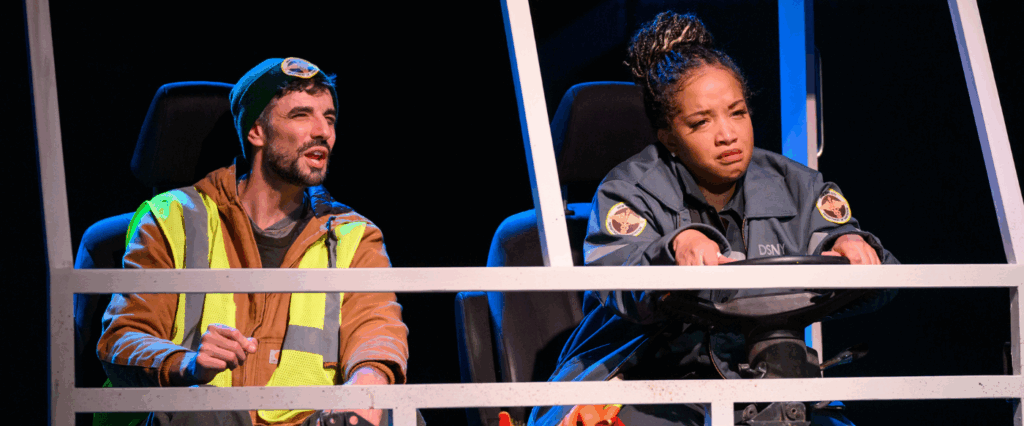
Paul Melendy and Thomika Marie Bridwell in Gloucester Stage Company’s “The Garbologists.”
Photos by Shawn G. Henry

By Shelley A. Sackett

Rebecca Bradshaw, Producing Artistic Director of Gloucester Stage Company and director of its first-rate The Garbologists, couldn’t have timed it better. With Republic Services sanitation workers in the second week of their strike, garbage is on everyone’s mind as bags pile up on the North Shore and throughout Greater Boston.

Playwright Lindsay Joelle’s tight, bright comedy brings its audience behind the windshield of a New York City Sanitation Department truck and into the lives of two people thrown together by circumstance: Danny (an exceptionally talented and engaging Paul Melendy) and Marlowe (Thomika Marie Bridwell). The two-hander (80 minutes with no intermission) is one of the most endearing odd couple buddy comedies since, well, Jack Klugman and Jack Lemmon in the 1970s television series, “The Odd Couple.”

Danny, a 41-year-old white blue-collar regular guy, is bigger than life. A seasoned worker with nine years’ experience, he is a nonstop talker, full of advice and corny jokes. He also has a wealth of institutional knowledge and an intuitive sixth sense about the street as a source of understanding the meaning of life. “There’s a lot you can tell about someone by what they throw away,” he counsels his rookie partner. “Read the bags.”
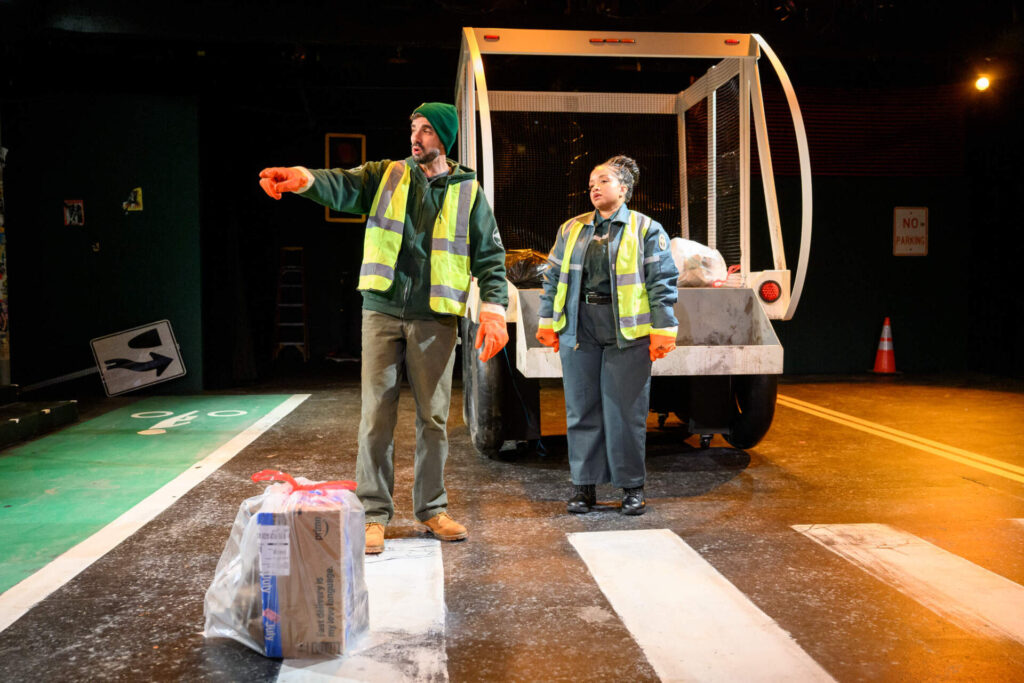
Gloucester Stage Company’s production of The Garbologists by playwright Lindsay Joelle, in Gloucester, MA. The production is directed by Rebecca Bradshaw and stars Tomika Marie Bridwell as Marlowe and Paul Melendy as Danny. © 2025 Shawn G. Henry • 978-590-4869 GSC-250702-Garbologists_017

Marlowe, a mid-30s Black Ivy League-educated (two degrees, no less) woman, is as buttoned up as Danny is unzipped. For the first many minutes, she watches and listens in disinterested silence as Danny continues his comedic monologue. In her pressed and pristine uniform, she looks more ready to walk across a graduation podium than toss overstuffed black bags into the bowels of their truck.

Like an awkward blind date, they eye each other suspiciously, each seeming to wonder what they did to deserve such a match.

But these two have more in common than it first appears, and thanks to a combination of a mostly sharply honed script and spot-on, crisp direction, the layers of what separates them melt away. By the play’s life-affirming end, the two have found more than just friendship; they have found a piece of themselves through each other.

Set in the streets of New York (effective lighting by Anshuman Bhatia, sound by Julian Crocamo and a terrific set by Kristin Loeffler that includes traffic lights, road signs and a functioning trash truck that swivels and rotates), the show slowly builds hope, trust and friendship between these two seemingly mismatched characters as they go about the business of their day. Danny pours on the charm, trying to get Marlowe to loosen up and laugh. Melendy’s performance is worth the price of admission. He is a one-man showstopper, and he is on stage the entire time. As he swerves from serious mentorship to revealing details of his personal life (he is divorced, has a seven-year-old son and is currently under a temporary restraining order), he is a whirling dervish of physicality and nuanced delivery. He is also caring, philosophical and self-aware. “I’m an acquired taste,” he admits. “Like blue cheese.”
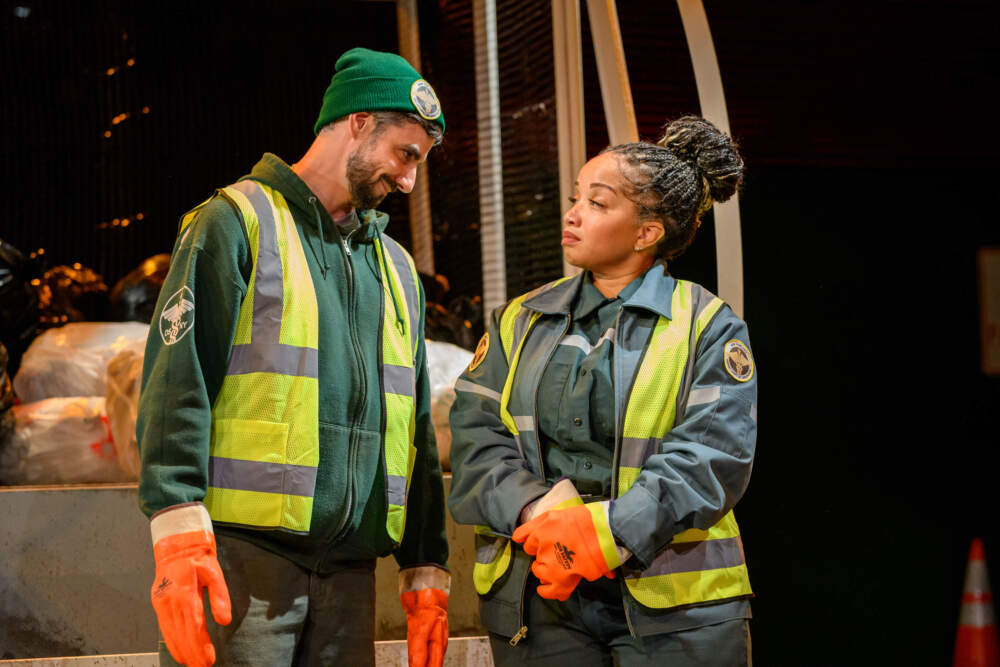
Gloucester Stage Company’s production of The Garbologists by playwright Lindsay Joelle, in Gloucester, MA. The production is directed by Rebecca Bradshaw and stars Tomika Marie Bridwell as Marlowe and Paul Melendy as Danny. © 2025 Shawn G. Henry • 978-590-4869 GSC-250702-Garbologists_053

For her part, Marlowe at first is having none of it. Bridwell alternates between high-decibel anger and sullen silence, limiting the audience’s ability to get to know and relate to her character. Although by the end we understand the trauma that led her to take this job, it is an uphill climb.

Joelle gives these two plenty of meaty dialogue, full of astute observations about the meaning behind what people throw away. The street is a resource as well as a wastebasket; one person’s waste is another’s life source.

There are some belly laugh lines and hysterical scenes, especially one with a box full of dildos that Danny uses for an improvisational monologue that finally gets Marlowe to laugh. Triumphant, Danny basks in his accomplishment. “You look radiant,” he practically gushes.

With the exception of a distractingly contrived and awkward twist at the play’s end, Joelle keeps both storyline and character development moving in dynamic and engaging ways.

When Danny gets a call to pick up his sick son at school, Marlowe helps him navigate the awkwardness of figuring out how to contact his ex-wife without violating the terms of his TRO. When Marlowe rescues a teddy bear and places it reverently on a pole, Danny observes but gives her space and time to disclose her reasons. And when Marlowe endangers herself by cavalierly tossing potentially hazardous substances into the compactor, Danny reacts both as boss and concerned friend.
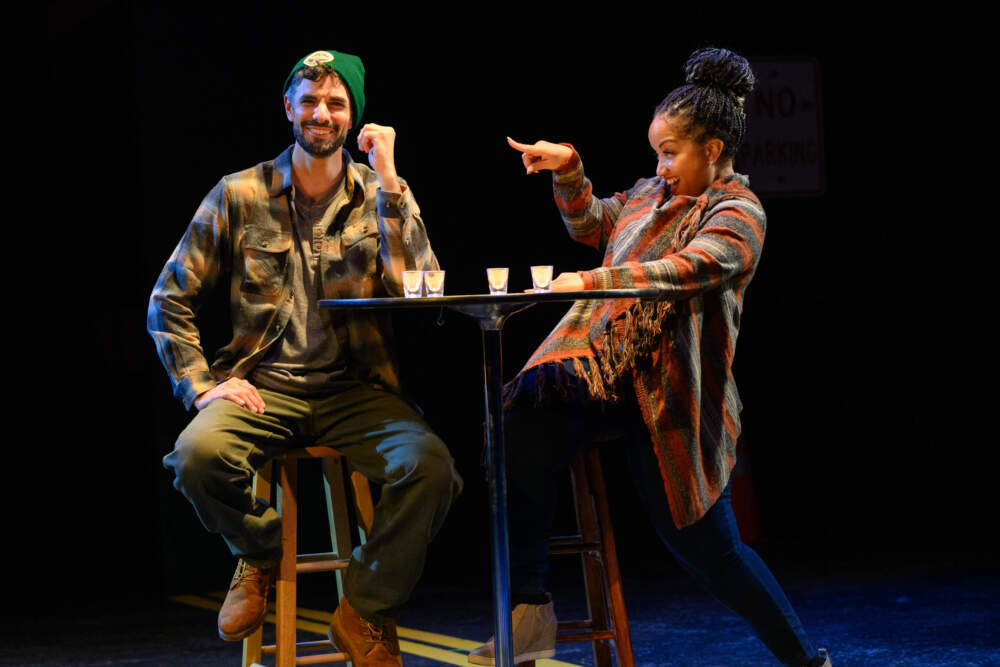
Gloucester Stage Company’s production of The Garbologists by playwright Lindsay Joelle, in Gloucester, MA. The production is directed by Rebecca Bradshaw and stars Tomika Marie Bridwell as Marlowe and Paul Melendy as Danny. © 2025 Shawn G. Henry • 978-590-4869 GSC-250702-Garbologists_274

By the play’s end, we really feel for these two and the cycles of grief, joy, insecurity, loss and random bad luck each has experienced. We also think about garbage (and garbage collectors) in new and shaded ways. Is there a moral obligation, for example, to return something of value that its owner ignorantly tossed, or does the “Finders Keepers” rule apply? When we discard something, do we also discard the right to privacy and anonymity about having owned it?

Most of all, Joelle shines a timely light on our detached perception of those who haul away our debris as faceless and anonymous. These two are full-throated, wonderfully fleshed out, complex and likeable characters, loyal to their families and supportive in their friendships. “Just because we pick up trash doesn’t make us garbage,” Danny says. Amen to that.

Recommended.

‘The Garbologists’ — Written by Lindsay Joelle. Directed by Rebecca Bradshaw. Presented by Gloucester Stage Company at 267 East Main St., Gloucester, through July 26.

For more information, visit: https://gloucesterstage.com/garbologists/

Trayf is in Eye of the Beholder in New Rep’s ‘Trayf’

Jonathan (Nile Scott Hawver), Zalmy (Ben Swimmer) and Shmuel (David Picariello) in New Rep’s ‘Trayf’

By Shelley A. Sackett

Hasidic teenagers Zalmy and Shmuel, the main characters of the New Repertory Theatre’s “Trayf,” are, at face value, typical 1990s adolescents. They love cruising around New York City in their brand-new van, blasting their favorite music and singing along at the top of their lungs. Their good-natured banter, conversational short cuts and puppy-like rapport reveal a chemistry borne of lifelong friendship. They talk about everything, from music to families to the riddle of sex. Any mother would be proud to claim them as her budding mensches.

Yet, on another level, Zalmy and Shmuel are anything but typical teens. They have never left their insular Crown Heights, Brooklyn community and Manhattan’s secular streets, bejeweled and beckoning with the forbidden (trayf), startle them. In their Chabad-Lubavitch (Orthodox Jewish Hasidic movement) uniform of black hats, facial hair and black coats, they hardly blend in. The van they drive is a Mitzvah Tank, a makeshift synagogue-on-wheels with an ice cream truck-like banner that reads, “Mitzvahs on the Spot for People on the Go.” The music they adore is Hasidic pop/rock. These two are not trolling for babes. They have but one mission: to inspire Jews to do mitzvahs. “We’re the Rebbe’s foot soldiers going to battle in the most secular city in the world,” Shmuel solemnly declares.

New York based playwright Lindsay Joelle deftly uses this distinctive community and these two friends as the platform from which she launches her exploration of weighty themes such as commitment, identity, loyalty, tolerance and what being Jewish means (and doesn’t mean) in 21st century America. By nimbly plumbing Zalmy and Shmuel’s rich relationship, she keeps “Trayf” light, comedic and fluid while digging deeply beneath the surface.

During Zalmy’s (Ben Swimmer) and Shmuel’s (David Picariello) chatty drives into the City, their individualiities surface. Shmuel is scandalized by Times Square; Zalmy is intrigued. Shmuel is devoted, resolved and unquestioning. His is a world of bright lines: black and white, kosher and trayf. Zalmy is more open-minded and daring; he can sense the gray of a possible middle ground, and it draws him in.

Swimmer, Picariello

Joelle carefully places this tinderbox of conflict beneath the teens’ friendship. Jonathan (Nile Scott Hawver), who approaches the Mitzvah Tank looking for “spiritual belonging,” is the flint that ignites it.

Jonathan is a young man who was raised Catholic. While cleaning out some of his father’s things after his recent death, he came across his birth certificate, showing his father emigrated from Germany and was, in fact, Jewish. Convinced that exploring these Jewish roots will fill the emptiness inside him, he is drawn to the Mitzvah Tank like a drowning man to a life boat.

Zalmy is happy to take Jonathan on as a student, especially after he learns he is a record producer and might be his conduit to secular musical delights. Shmuel is predictably skeptical. “He doesn’t feel like a Jew,” Shmuel says. “Why would anyone pretend to be Jewish?” Zalmy counters.

For the first time in their decades long friendship, Zalmy and Shmuel follow divergent paths. Zalmy takes Jonathan under his wing, bringing him home every week for Shabbos. “You’re so lucky, Zalmy. With your family I feel connected. I feel God,” Jonathan says. Zalmy is just happy to receive some of Jonathan’s secular trayf tapes.

Well into the intermission-less 80-minute production, Jonathan’s Jewish girlfriend Leah Caplan (Kimberly Gaughan) shows up, angry at her goyishe boyfriend’s makeover into a full-blown Chabadnik, hat, beard and all. The granddaughter of survivors, she “knows what it means to be Jewish” and has chosen a Catholic partner on purpose. She has also just courted him through an intense period of mourning and feels betrayed by his sudden change.

Picariello, Kimberly Gaughan as Leah

Leah seems to want more of a therapy session that an intervention from Shmuel, her need more to vent than to be soothed. Shmuel, however, sees a parallel with his relationship with Zalmy and his tone and body language suddenly shift and soften. He tries to comfort and calm her and to get her to see what he is only beginning to embrace and understand. “There is no love, only acts of love,” he tells her, quoting the Rebbe.

From here, the characters’ paths diverge, merge and change course in ways both predictable and surprising. Picariello and Swimmer bring a chemistry and effortlessness to their roles that is helped by Joelle’s character development and dialogue. She is not as successful with Jonathan and Leah. They are two-dimensional, cardboard props, more symbols than flesh and blood. Their role is one of foil rather than relatable people.

Celine Rosenthal’s direction keeps the play moving and her choice to put Zalmy and Shmuel as front and center as the script allows is a wise one. Grace Laubacher’s set is minimal but effective, the Mitzvah Tank its main focal point. The backdrop of a Manhattan skyline has a Marc Chagall shtetl feel, an acknowledgment to Crown Heights as a bridge between the Chabad’s Eastern European birthplace and its modern digs. Whether intentional or not, it’s a nice touch.

For Joelle, “Trayf” is the culmination of over five years’ research that started with her friendship with a former Chabadnik who shared with her how he had “dipped his toe into the secular world” until he finally broke from his roots and embraced a secular life.

She hopes the audience leaves wondering what each character will do next as they embark on their transformative journeys. “I’m most drawn to Shmuel’s newfound understanding that ‘acts of love’ include giving friends space to change and grow, and that true friendship transcends ideological beliefs,” she said.

A version of this review appeared in the Jewish Journal (jewishjournal.org).

“Trayf”. Written by Lindsay Joelle. Directed by Celine Rosenthal. Scenic Design: Grace Laubacher. Lighting Design: Marcella Barbeau. Costume Design: Becca Jewett. Sound Design: Aubrey Dube. Stage Manager: Jenna Worden. Produced by New Repertory Theatre in partnership with Jewish Arts Collaborative, 321 Arsenal St., Watertown through November 3.