‘Art’ Becomes More Than What Meets The Eye in Lyric Stage’s Splendid Production

Theater Mirror

John Kuntz and Michael Kaye in Lyric Stage’s ‘Art’. Photo Credit: Mark S. Howard

By Shelley A. Sackett

The French playwright, actress, novelist, and screenwriter Yasmina Reza has a special talent for creating dialogue and characters that simultaneously focus inward on the complexities of interpersonal relationships and outward on the demands and mores of contemporary middle-class society. ‘Art,’ now enjoying a magnificent run at Lyric Stage Company, premiered in Paris in 1994 and took both London’s West End and New York’s Broadway by storm. It won Olivier, Tony, Molière, and every other major theatre award and has been packing in audiences worldwide in 30 languages ever since.

The plot is deceptively simple. Serge (Michael Kaye), Marc (John Kuntz) and Yvan (Remo Airaldi) have been friends for 15 years. Serge is a successful dermatologist. Marc is an aeronautical engineer and Yvan has spent his life “in textiles.” Unlike his friends, his professional life has been a failure and he has a new job as a sales agent for a wholesale stationery business. He’s engaged to marry his boss’s daughter in a couple of weeks.
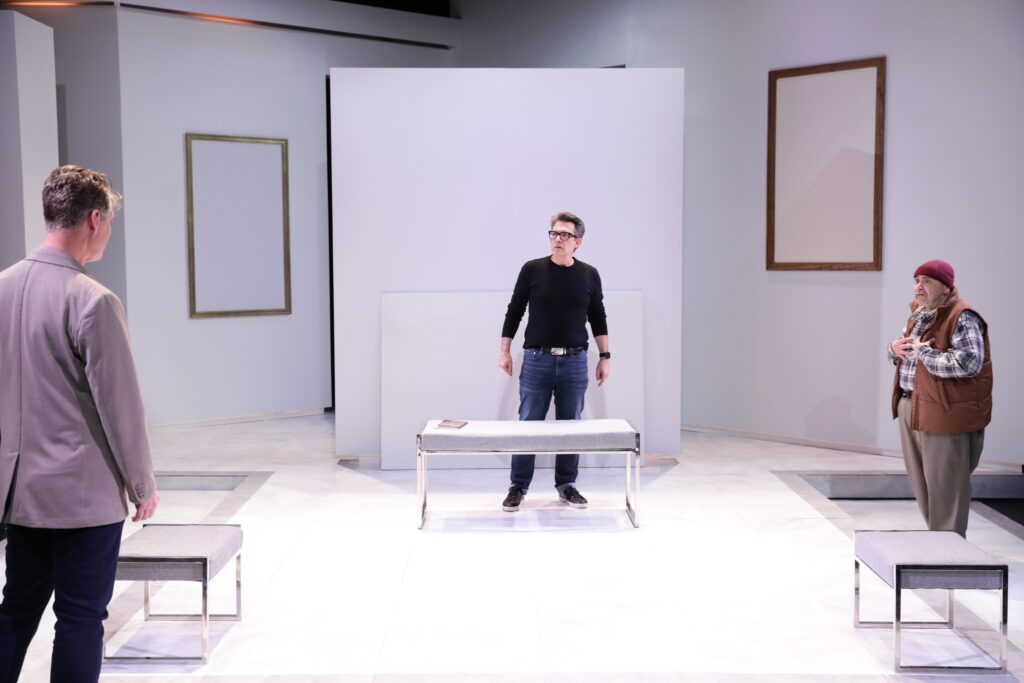
Kaye, Kuntz and Airaldi

When Serge spends an extortionate amount of money on a modernist painting by Atrios that is all white with three white stripes, his close friends are not just baffled but deeply rattled. Like an earthquake, Serge’s purchase shakes the bedrock of their friendship and sends aftershocks and tsunamis in its wake.

Marc is appalled to hear that Serge had paid two hundred thousand francs for “a piece of white shit.” Serge argues that the painting, created by a reputable artist (“he has three paintings in the Pompidou”) is worth its hefty price, but Marc remains unconvinced. The two draw verbal swords, and the temperature in the room rapidly rises as the thrusts and parries turn nasty and personal.

Both break the fourth wall, addressing the audience with what they really think. Serge mocks Marc, one of the “new style of intellectuals” who are enemies of modernism yet know nothing about it. Marc is upset on a deeper, more individual level. His friend has done something he cannot understand or relate to. He is hurt and untethered. “It’s a complete mystery to me, Serge buying this painting. It’s unsettled me, it’s filled me with some indefinable unease,” he admits. Worst of all, Serge seems to have lost his sense of humor. Marc can’t bear the thought of not sharing a laugh with Serge, even though it is over an act Serge himself committed.

Overwhelmed by the perceived seriousness of the situation, both Serge and Marc confide in Yvan about their disagreement. Yvan, who is dealing with his own conflict over his forthcoming wedding, tries to remain a neutral peacemaker, giving each just enough of what they want to hear while avoiding firmly taking sides. To Serge, Yvan is noncommittal, only admitting that he does not grasp the essence of the painting. To Marc, Yvan laughs off the price tag, but suggests that the work is not quite meaningless “if it makes Serge happy.”
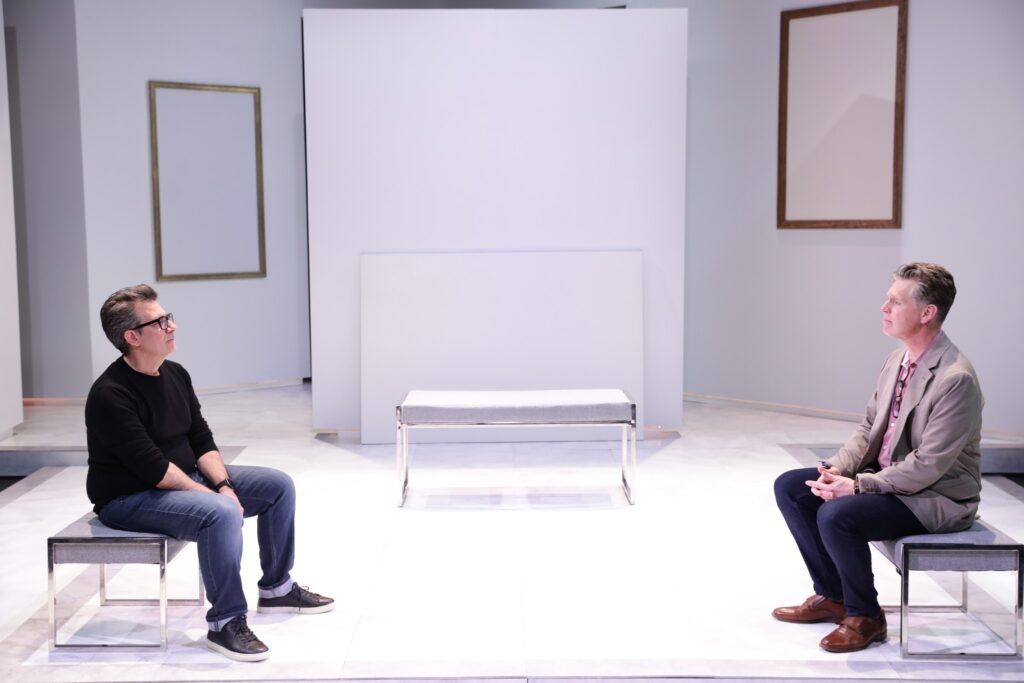
Kuntz and Kaye

Serge’s shuttle diplomacy is a failure. Instead, each digs in his heels deeper, and the clash escalates to all-out war. Objective art appreciation shifts to subjective, petty, tactless attacks. At the heart of the matter is the fact that these two really care about each other and this schism wounds them both. “What I blame him for is his tone of voice, his complacency, his tactlessness. I blame him for his insensitivity. I don’t blame him for not being interested in modern art, I couldn’t give a toss about that…,” Serge says. In an aside to the audience, Marc admits that, bottom line, his feelings are hurt. “What kind of friend are you if you don’t think your friends are special?” he laments.

Yvan’s vacillations are gas on the flames of his friends’ conflict. When neither Serge nor Marc succeeds in their goal of manipulating Yvan to their side, they turn on Yvan after he is late for dinner. Not even a Moth StorySLAM-worthy monologue of an excuse (Airaldi deserved a standing ovation) can dissuade Serge and Marc from attacking Yvan for being, well, Yvan.

That a male friendship could become unglued over a provocative painting rather than a love or property rivalry underscores the way Reza deftly peels this delicate onion to reveal the kind of profoundly felt emotions more usually explored among female relationships. These three ask deep and heady questions, revealing their innermost private selves in their answers. They are brutally honest, especially when they know the truth will sting. Yet, when all has been said and done, the underlying bond they share withstands even this most violent rupture.
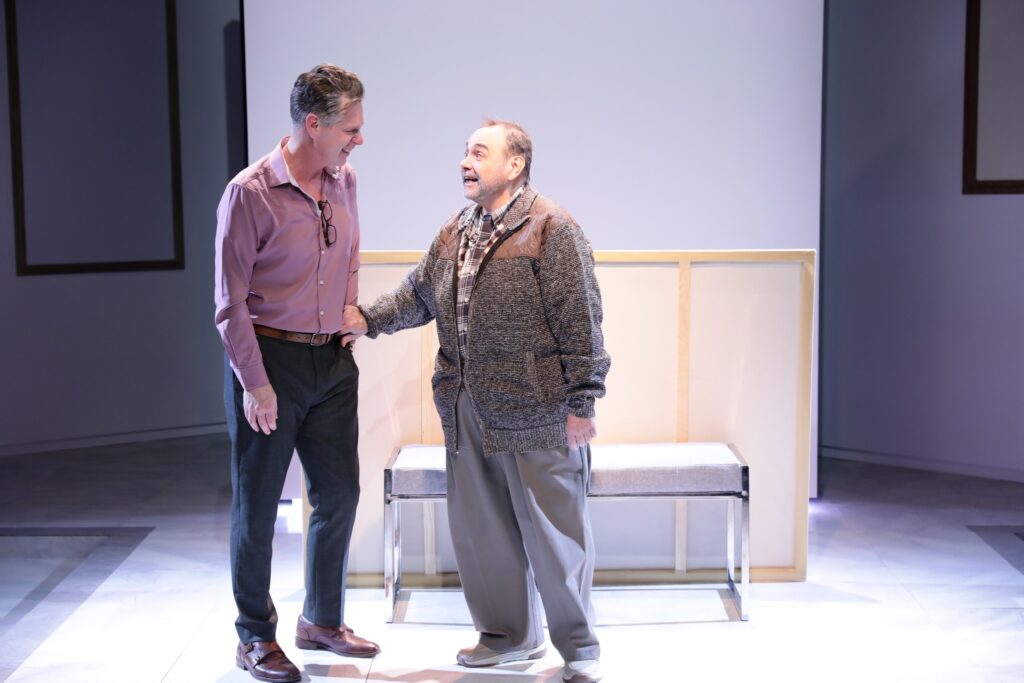
Kaye and Remo Airaldi

Airaldi imbues Yvan with the kind of heart, humor and self-acceptance reminiscent of Jonathan Winters at his best. Kaye’s Serge is nuanced; he’s snooty and disdainful one minute yet insecure and lonely the next. As Marc, Kuntz has the difficult job of hiding his fears and vulnerabilities beneath a frosty veneer of supercilious superiority and furious frankness. All three actors give flawless performances, the kind that make 90 intermission-less minutes fly by.

Shelley Barish’s sleek, contemporary set mirrors the painting’s self-conscious minimalism. Chrome and steel benches adorn a simple platform of white tiles bordered in pale gray. The tone is both monastically sterile and peacefully Zen.

Kudos to Courtney O’Connor for her pitch-perfect direction. Recommended.

‘Art’ by Yasmina Reza. Translated by Christopher Hampton. Directed by Courtney O’Connor. Scenic Design by Shelley Barish. Costume Design by Chelsea Kerl, Lighting Design by Elmer Martinez. Sound Design by Adam Howarth. Presented by The Lyric Stage Company of Boston, 140 Clarendon Street, Boston, through March 16.

For more information or to buy tickets, visit https://www.lyricstage.com/
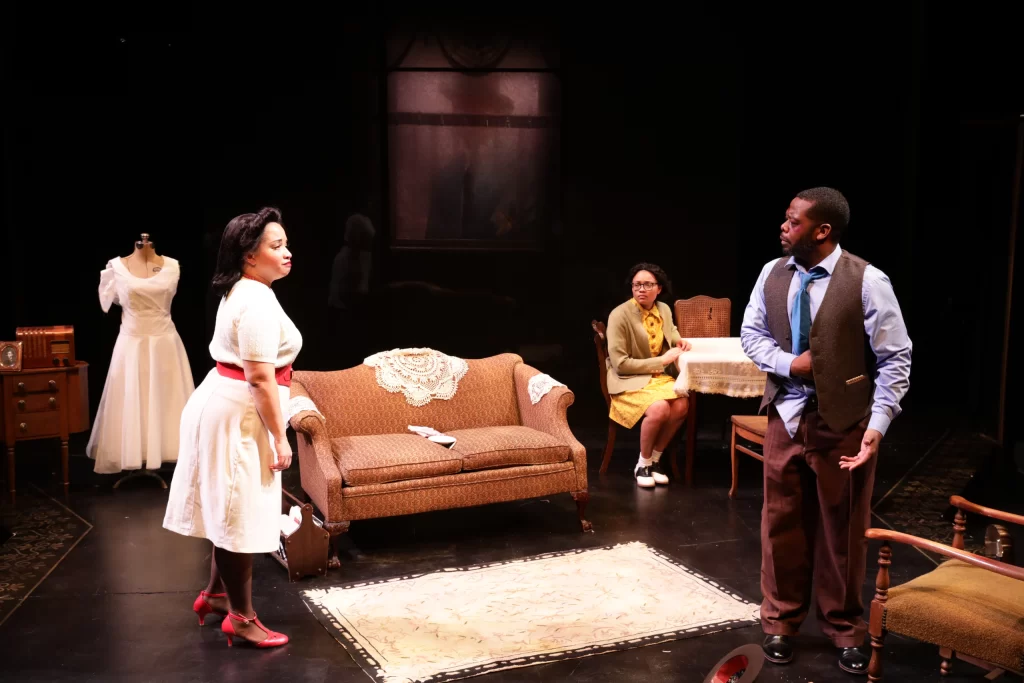
Lyric Stage’s ‘Crumbs from the Table of Joy’ Has A Tale to Tell  


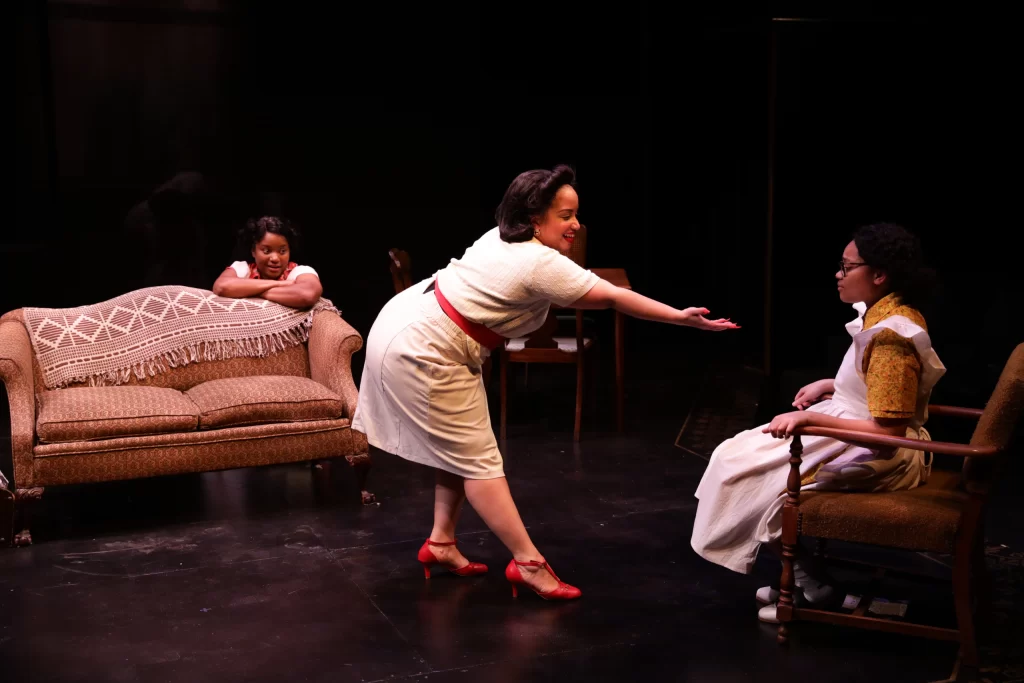
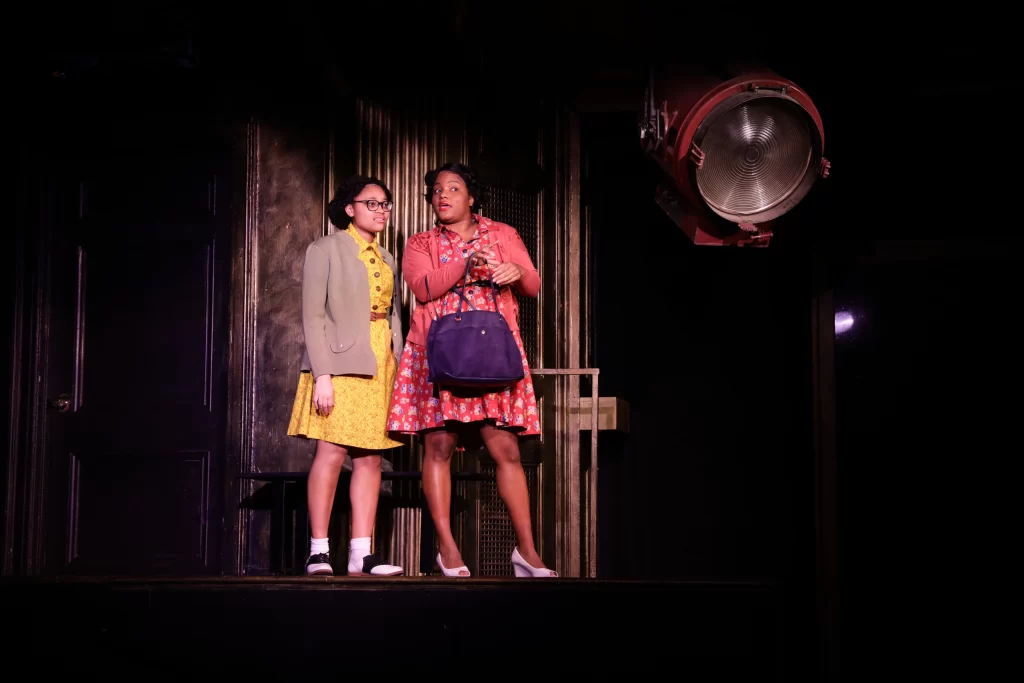
Cast of Lyric Stage’s ‘Crumbs From The Table Of Joy’. Photos: Mark S. Howard 
Thomika Marie Bridwell, Madison Margaret Clark, and Dominic Carter 

By Shelley A. Sackett

Luck

Sometimes a crumb falls
From the tables of joy,
Sometimes a bone
Is flung.

To some people
Love is given,
To others
Only heaven.

— Langston Hughes

James Mercer Langston Hughes, best known for his Harlem Renaissance Jazz Poetry, wrote “Luck” in 1947. The poem can be interpreted as a commentary on unfairness, deprivation, and the pursuit of love. It could also be read as a reminder of the injustices faced by Black Americans and other “have-nots’ who must bear witness to the overflowing bounty of the “haves” and hope they are in the right place at the right time to scoop up the discarded scraps.

Lynn Nottage’s 1995 play, ‘Crumbs from the Table of Joy,’ picks up Hughes’ theme and runs with it in a two-act work now in production at Lyric Stage. Fair warning to fans of Nottage’s later, brilliantly biting “Clyde’s,” and Pulitzer Prize-winning “Ruined” and “Sweat” — ‘Crumbs’ is far less absorbing and captivating. A nostalgic look in the rearview mirror, it is a good story but about as edgy as a Hallmark movie.

Set in 1950, “Crumbs” is a memory play about the Crumps, a “colored” family that migrates from Jim Crow Florida to Brooklyn. Although the country is recovering from World War II and the Civil Rights movement is gaining momentum, the discrimination and lack of opportunity that greets them in New York doesn’t differ significantly from what they left behind.

Ernestine Crump (Madison Margaret Clark), a 17-year-old who wears bobby socks and glasses, is the amiable, if hardly charismatic, narrator. She shows us around the cramped Brooklyn flat she shares with her father, Godfrey (a nuanced Dominic Carter) and her bouncy, lively 15-year-old sister Ermina (an engaging Catia).

Grief-stricken and psychologically undone by his wife Sandra’s death and faced with raising two motherless teenage girls on his own, Godfrey uprooted the family to follow the African American evangelist, Father Divine, his personal guru and religious savior. It turns out Brooklyn is the return address on Father Divine’s mail order catalog; his Peace Mission Movement is actually headquartered in Philadelphia.

Undaunted, Godfrey immerses himself in his faith in the belief that this will provide a fresh start and a better life for him and his daughters. He dons blinders and digs deeper into Father Divine’s strict religious teachings of celibacy, sobriety and solemnity on Sundays. Structure and strictures are his lifeline. Father Divine lets him know all will be O.K.

Catia, Bridwell, and Clark

He writes letter after letter to Father Divine, desperate for his advice and a glimmer of direct connection. Finally, the mission writes back, telling him to keep following the path and donate money. Godfrey bestows a church name on himself and his daughters and keeps a notebook into which he obsessively jots down questions he will ask Divine Father during his anticipated face-to-face.

Ernestine and Ermina don’t share this version of deliverance and choose a different escape route from reality. For them, joy is to be found in dreams and fantasy; in other words, at the movies.

Ernestine is also about to graduate from high school, the first Crump to reach that level of education and achievement. One day, a sewing pattern arrives in the mail for her. It turns out her mother had ordered it before she died. She sets up a sewing form in the living room, sewing the dress throughout the play as a reminder of her mother and a bridge between the world they left behind and the one in which they now live.

Just when it feels like the weight of Nottage’s sluggish, speech-heavy script (not helped by voice projection problems) might sink the ship before it gets out of the harbor, Sandra’s sister, Lily Ann Green (an outstanding Thomika Marie Bridwell), saves the day. She bursts into the apartment, riding a gale wind that fills the play’s sagging sails and keeps it afloat for the remainder of its almost two-and-one-half-hour running time.

Clark, Catia

Vivacious and uninvited, Lily is dressed in sunglasses, a fur coat and a well-tailored white suit. Red shoes and a cigarette are the perfect accessories. Lily is a non-conformist, an educated woman who lives in Harlem and hobnobs with revolutionaries and communists. Although she didn’t make it to her sister’s funeral, she is committed to moving in with Godfrey and helping raise her sister’s two girls.

She is also committed to raising hell, and although she and Godfrey share a past that she tries desperately to reignite, her antics send him scurrying away, leaving her more isolated than ever.

Lily drinks, cavorts, swears and doesn’t work. She is the unrequited yin to Godfrey’s yang of a consuming need for order and answers. Both are chasing salvation as they try to manage their grief and rage. After Lily goes too far one night, giving Godfrey a kiss which he miserably admits does tempt him, Godfrey disappears for three days, leaving Lily and the girls to fend for themselves.

He returns with Gerte (a terrific Bridgette Hayes), a white German refugee whom he met on the subway and introduces as his wife. He believes he is following Father Divine’s advice to move forward with his life. It’s unclear whether the girls are more unhappy that she’s white or that their father married so soon after their mother’s death. Lily sinks deeper into drinking, humiliated and devastated that Godfrey couldn’t/wouldn’t marry her instead.

Clueless about racial tensions in America but delighted to have found an American husband, Gerte’s one saving grace is the love for movies she shares with the girls. In her dreams, she hungers to be Marlene Dietrich, and the scenes that allow Hayes to channel that persona are a welcome respite and among the play’s most engaging.

Nottage plods on, addressing a myriad of social, political and emotional issues while keeping us in the loop as time marches on for the Crumps. Every member of the family eventually runs smack into the reality of how the color of their skin interferes with their pursuit of the American Dream. Change and revolution may be in the wings, but they are not here yet and they will be traveling hand-in-hand with pain and fear. In the meantime, each Crump must cope in their own way, through action, fantasies, faith and anesthetics.

Director Tasia A. Jones gives us a straightforward version of ‘Crumbs’ and, while Cristina Todesco’s set design and Eduardo Ramirez’s lighting design work well as the action hops from living room to subway car to Ernestine’s movie fantasies, the production lacks coherency, urgency, and intimacy. We want to understand Ernestine and what makes her tick, but her monologues, monotone, and static blocking keep us at arm’s length.

‘Crumbs’ is worth seeing for its solid ensemble and stand-out performances, its homage to the 1950s, and, most of all, for providing a reason to appreciate how far Lynn Nottage has traveled in her 30-year career.

Crumbs from The Table Of Joy.’ Written by Lynn Nottage. Directed by Tasia A. Jones. Sound Design by Aubrey Dube. Costume Design by Mikayla Reid. Scenic Design by Cristina Todesco. Lighting Design by Eduardo Ramirez. Produced by Lyric Stage at 140 Clarendon Street, 2nd Floor, Boston, through February 2nd.

For more information and tickets, visit: https://www.lyricstage.com/

‘The Great Leap’ Tackles Bigger Issues Than Basketball 

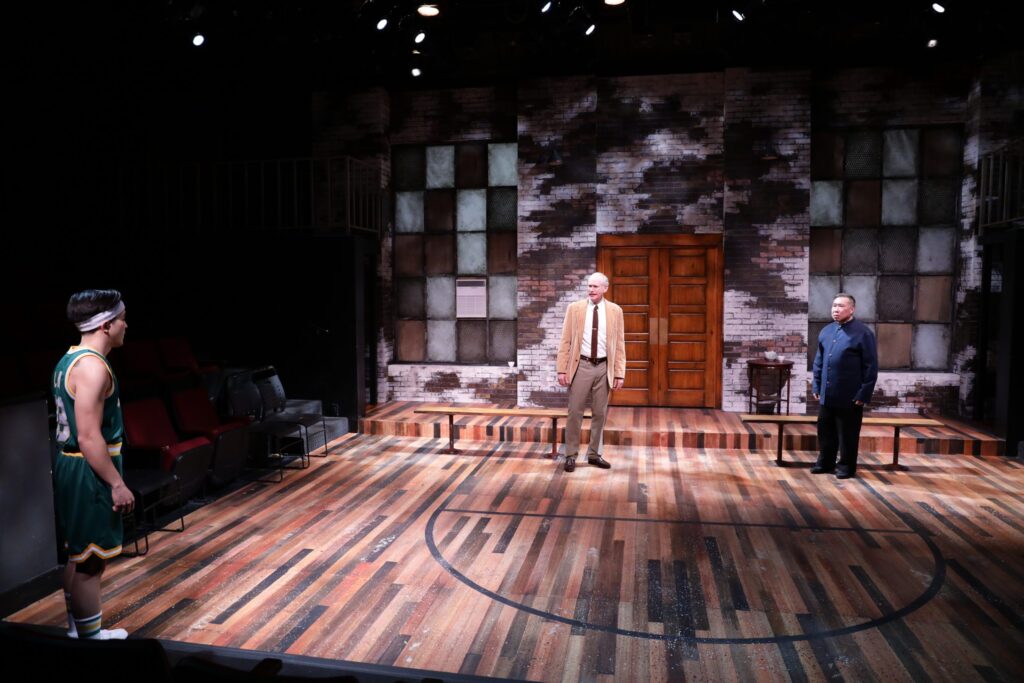
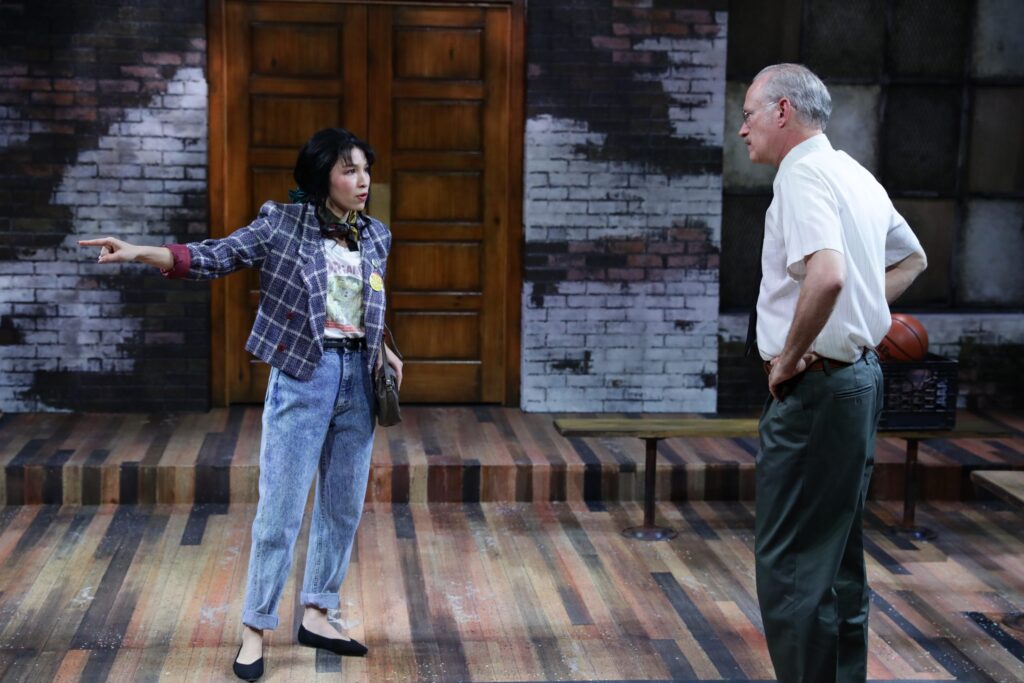
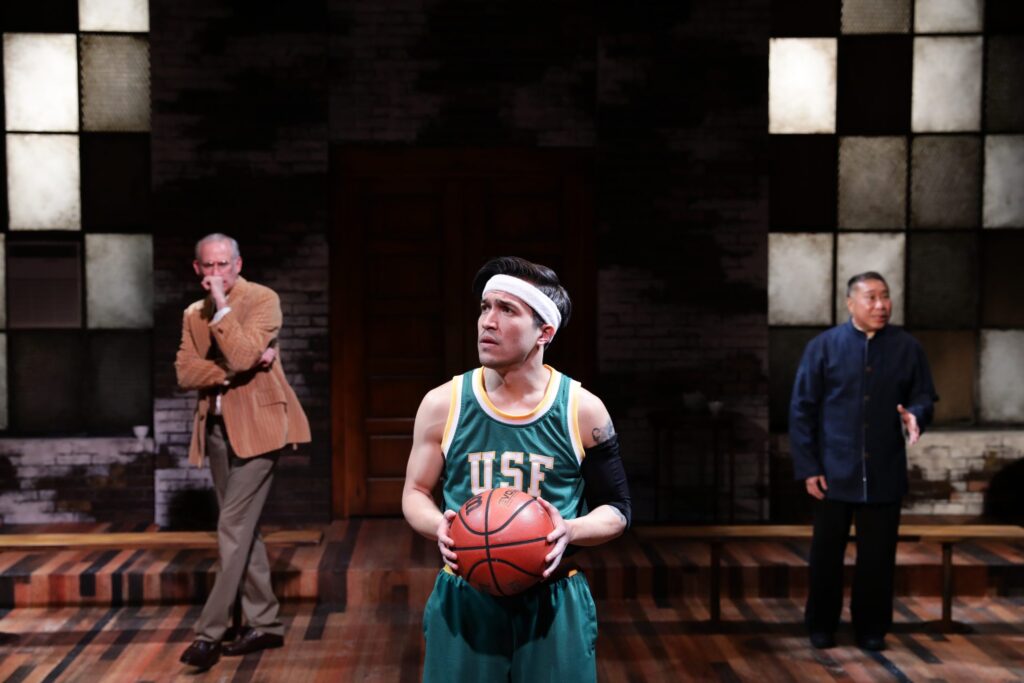
Tyler Simahk, Barlow Adamson, and Gary Thomas Ng in The Great Leap at Lyric Stage

By Shelley A. Sackett

Award-winning playwright Lauren Yee has skin in the game with her play, ‘The Great Leap,’ now making its Boston premiere at Lyric Stage Company. Her father, a rare 6’1” Asian-American basketball player, was part of the 1981 team the US sent to China for a “friendship game” between Beijing University and the University of San Francisco. The Americans were demolished during the exhibition games.

Yee suspects the team, composed of non-NBA, non-college players, was hand-picked by the Chinese so the Americans would lose. Her father, who recounted his experiences to her as she wrote her play, was very helpful. “On stage, you’ll see a version of my father; it’s not pretending to be him,” Yee says in the program notes.

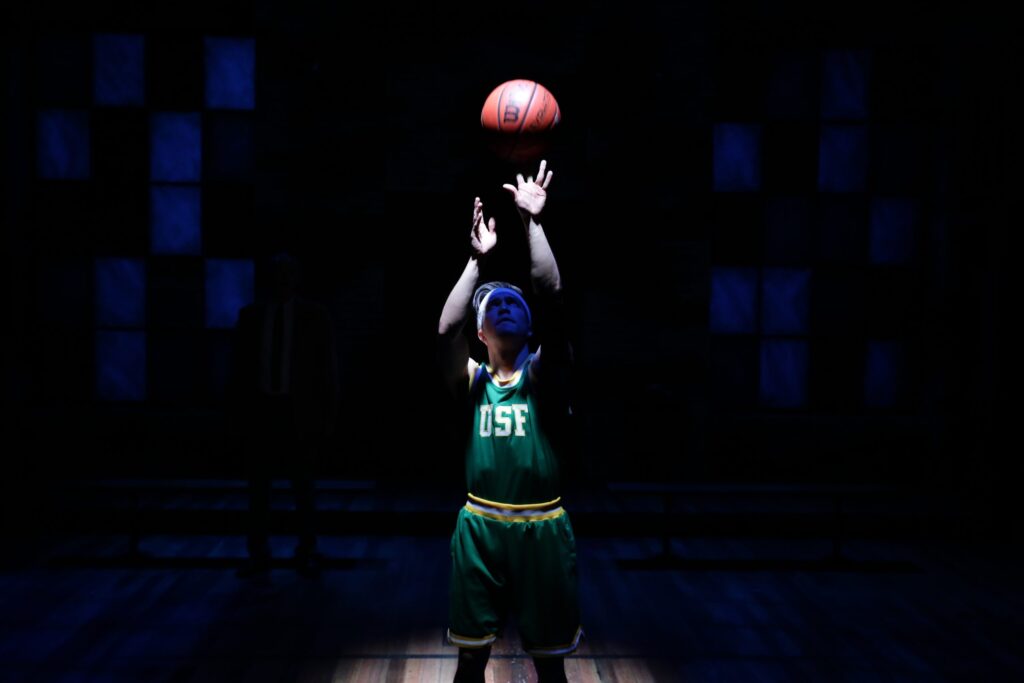
She sets her drama in 1989, a year that saw rising demonstrations for political and economic reform in Tiananmen Square. Using humor, spicy vernacular and some actual on-stage dribbling sequences, she weaves together an absorbing story while making some astute points about the intersection and consequences of politics, cultural identity and human foibles.

The plot is pretty straightforward.

It is 1989. Manford (an outstanding Tyler Simahk), “the most feared basketball player in Chinatown,” is a pushy and single-minded 17-year-old. The play opens with him confronting the San Francisco University basketball coach, Saul (a first-rate Barlow Adamson), demanding that Saul put him on the team he is taking to China to play in an exhibition match against Beijing University on June 3 and 4.

Saul has heard of Manford, ”the only guy who got thrown out of a game for fighting with his own teammate.” Manford knows a thing or two about Saul, too, and wastes no time striking at Saul’s Achilles’ heel. With an 8-20 losing record, his career is circling the drain. A loss to a Chinese team would finish him. Only Manford can rescue him from this fate.

“I am the most relentless person you ever met,” Manford taunts.

Turns out Coach Saul was at the helm of the team that traveled to Beijing in 1971 to advise a politically appointed amateur, Wen Chang (an outwardly cardboard but inwardly emotive Gary Thomas Ng) about the American game of basketball. This was at the height of the ferocious Cultural Revolution. Wen’s assignment was more about his Communist “rehabilitation” than a perfect job match.

Jihan Haddad, Adamson

Eighteen years later, Saul is headed back for a rematch against Wen. Manford’s mission is to convince Saul that the Americans will lose unless Manford is on the team. He’s better than any point guard Saul has on his SFU roster and he knows what Saul will be facing when he returns to Beijing. “Eighteen years ago, you went as their guest. You’re going back as their enemy,” he warns.

Manford has another reason he needs to return, and that hidden secret drives the ending’s delicious plot twist and would be an unconscionable spoiler to reveal. He has just lost his mother, who fled Beijing before he was born and whom he claims he didn’t really know (she spoke only Chinese). His father was never in the picture. He now lives with the family of his “cousin” Connie (a terrific Jihan Haddad), a 25-year-old graduate student and Manford’s cheerleader and True North.

The rest of the almost two-hour (one intermission) production flips back and forth between 1971 and 1989, filling in the gaps in the storyline and fleshing out its four characters. The flashbacks to 1971 (wonderfully costumed by Seth Bodie) contrast the brash, arrogant Saul and Wen, the hollowed-out victim of a regime he hates but resignedly obeys. Eighteen years later, their positions and perspectives have shifted. Wen is on top of his game and is chomping at the bit to give Saul a taste of the medicine he dished out in 1971.

Yee tackles many big-ticket issues in her play (the human cost of the Cultural Revolution, taking a stand vs standing still, living an authentic life, and cultural identity) and by its end, we understand her four characters and what makes them tick. Although overlong and in need of some editing, “The Great Leap” is greatly satisfying and its ending alone is worth the price of admission.

For tickets and information, go to:www.lyricstage.com

The Great Leap – Written by Lauren Yee. Directed by Michael Hisamoto. Scenic Design by Baron E. Pugh. Costume Design by Seth Bodie. Lighting Design by Michael Clark Wonson. Sound Design by Elizabeth Cahill. Presented by Lyric Stage Company of Boston through March 19, 2023.

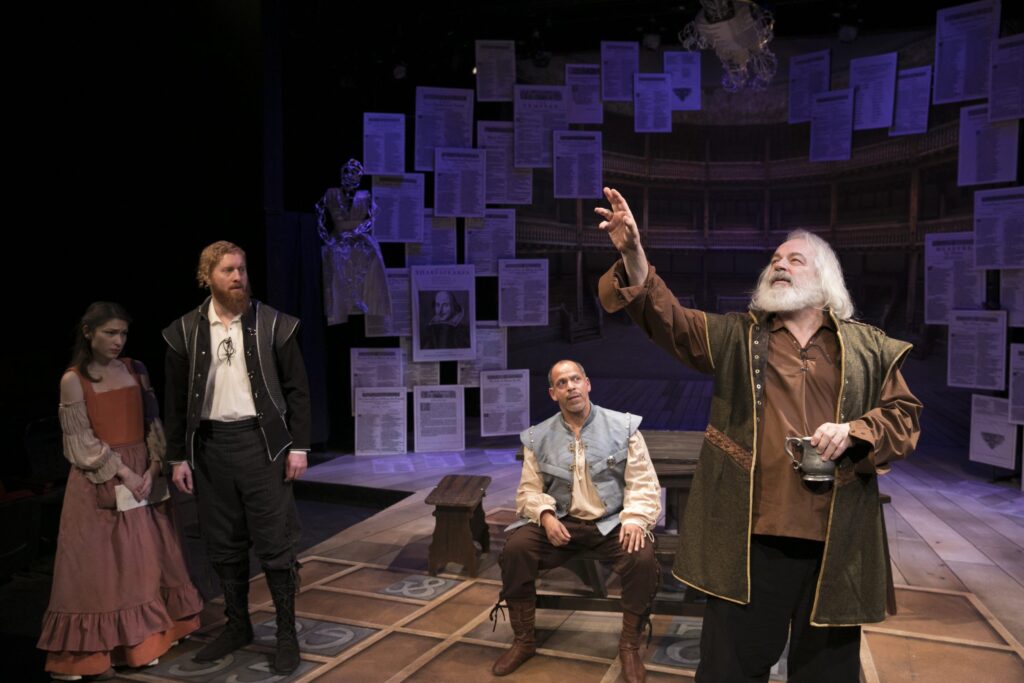
Lyric Stage’s Superb ‘The Book of Will’ Takes Us Back to the Time of the Bard

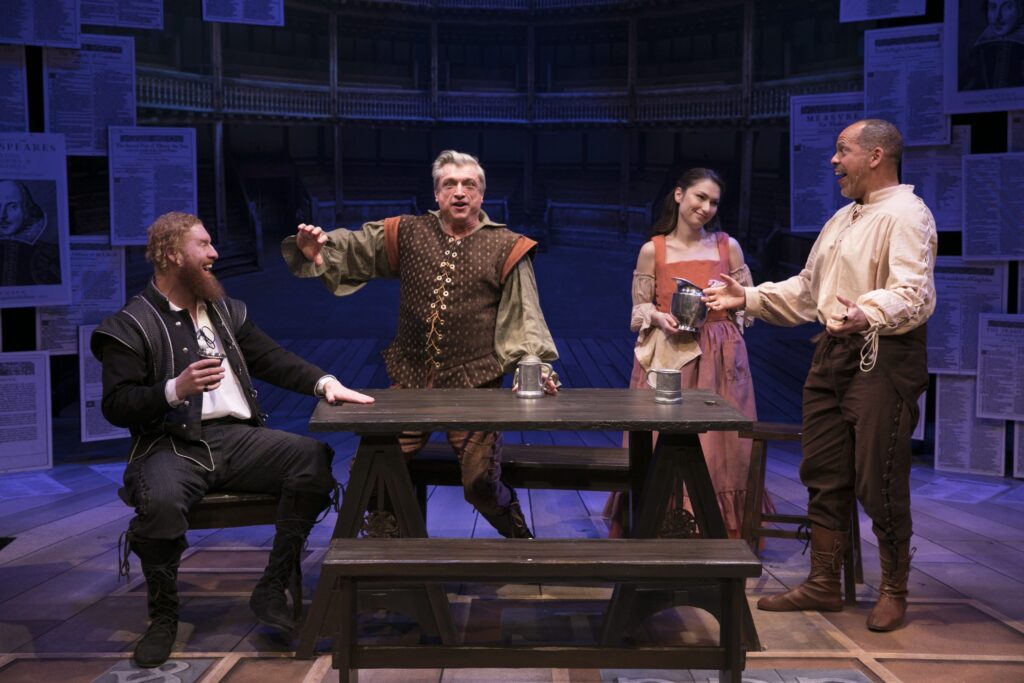
Cast of ‘The Book of Will’ at Lyric Stage

By Shelley A. Sackett

Ever wonder about the immediate aftermath of Shakespeare’s death, how his plays were preserved in an era when plays were not considered to be important works of literature, plots were largely constructed by the actors and written out in a ‘fair copy’ for their records by the company scribes, and new plays were churned out at an incredibly fast rate to provide the companies with enough material to keep performing new shows all the time?

Well, wonder no more.

The Lyric Stage Company of Boston’s must-see production of ‘The Book of Will’ brings the story of Shakespeare’s legacy, and the women and men devoted to creating and preserving it, to life. Director Courtney O’Connor weaves magic from a smart and inspired script by playwright Lauren Gunderson. For two hours and 15 minutes (with intermission), we willingly time travel back to an era of pubs, plays and camaraderie.

Sound Elizabethan and dull? Not a chance! But first, a little more context.

Playwriting then was a little like writing for a sitcom or a soap opera in the modern day, and once a play was performed, the acting companies would only keep the scripts if they felt they might revive them again down the road. If not, they might sell them off to a publishing house, who would try and make a quick profit on them.

Ed Hoopman, Will McGarrahan, Grace Experience, Joshua Wolf Coleman

By Shakespeare’s time, printing was more common, and book publishing was more of a commercial enterprise. Yet, Shakespeare’s plays were not published all together in his own lifetime. John Heminges, Richard Burbage, and Henry Condell, fellow actors in the Kings Men and devoted friends of the Bard, began collecting the various published versions of Shakespeare’s plays, actors’ scripts, and scribal copies, and edited them together into the First Folio, published in 1623.

The whole project was perhaps an attempt to eulogize Shakespeare and make his work last forever. It’s partly these reasons that allowed his writings to become part of the fabric of English culture and language. His works, which most certainly would have been lost, have been read and circulated endlessly and have had a life of their own, though Shakespeare himself is long dead.

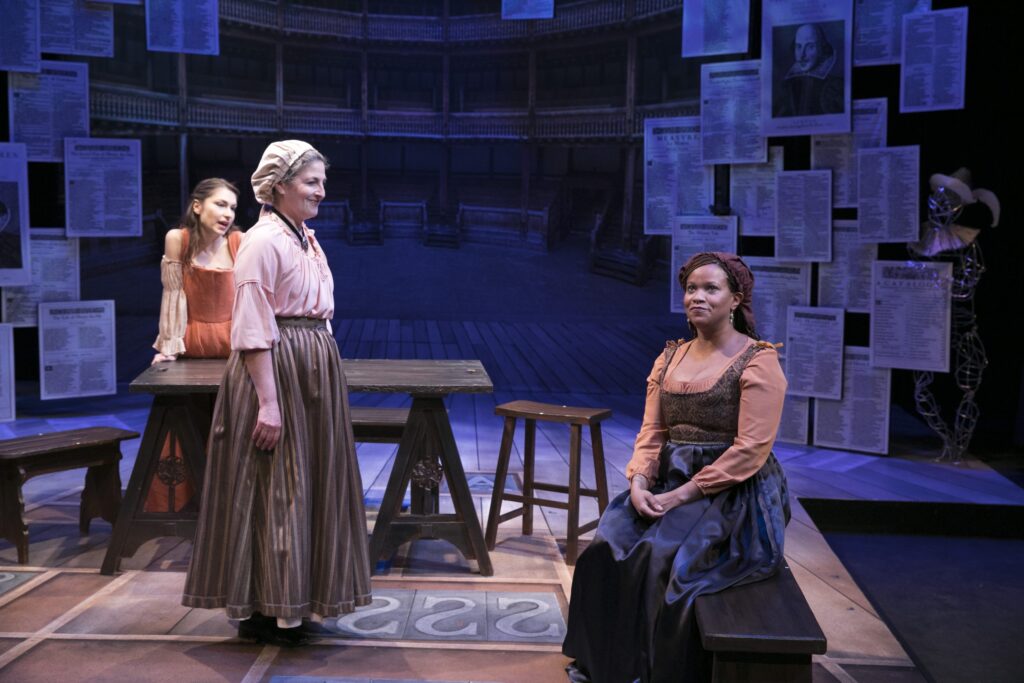
Experience, Sarah Newhouse, Shani Farrell

Janie E. Howland’s set, Elisabetta Polito’s costumes and Elizabeth Cahill’s sound design thrust us immediately into the thick of Stratford-on-Avon between 1619 and 1623. From the get-go, the talent and credibility of the actors is obvious. Particularly noteworthy are Fred Sullivan, Jr. as Ben Jonson and others, Will McGarrahan as Richard Burbage and William Jaggard, and the magnificent Ed Hoopman as Henry Condell. (I could listen to Hoopman recite the phone book.)

If Gunderson has strayed from historical fact, it is in her inclusion of women as prominent players in the project. These women are interesting, compelling, ambitious, funny and, in their own ways, powerful. There is not one weak link among the actors. Grace Experience as Alice Heminges (whom she plays with an Audrey Hepburn elegance), Shani Farrell as Elizabeth Condell, and Sarah Newhouse as Rebecca Heminges each bring their own nuances to their roles.

Lest you think this is a play reserved for Shakespeare nerds, think again. Gunderson has infused the script with humor, poetry, pathos and intrigue — ingredients for entertaining theater — as well as factual history.

Experience, Hoopman, Coleman, Fred Sullivan, Jr.

“Shakespeare doesn’t need much help in being revered. He needs help in being human. That’s the real heart of this story,” Gunderson said in an interview. “It really has to be the emotional reason that these people did this almost impossible thing. It comes down to their loves and friendships that really provide the engine for this effort.”

“The Book of Will.” Written by Lauren Gunderson. Directed by Courtney O’Connor. Scenic Design by Janie E. Howland; Costume Design by Elisabetta Polito; Lighting Design by Christopher Brushberg; Sound Design by Elizabeth Cahill. Produced by The Lyric Stage Company of Boston, 140 140 Clarendon St., Boston through March 27.

For more information and tickets, go to: https://www.lyricstage.com/