A Theatrical Alchemy, A.R.T.’s ‘Diary of a Tap Dancer’ Is More Than the Sum of Its Parts

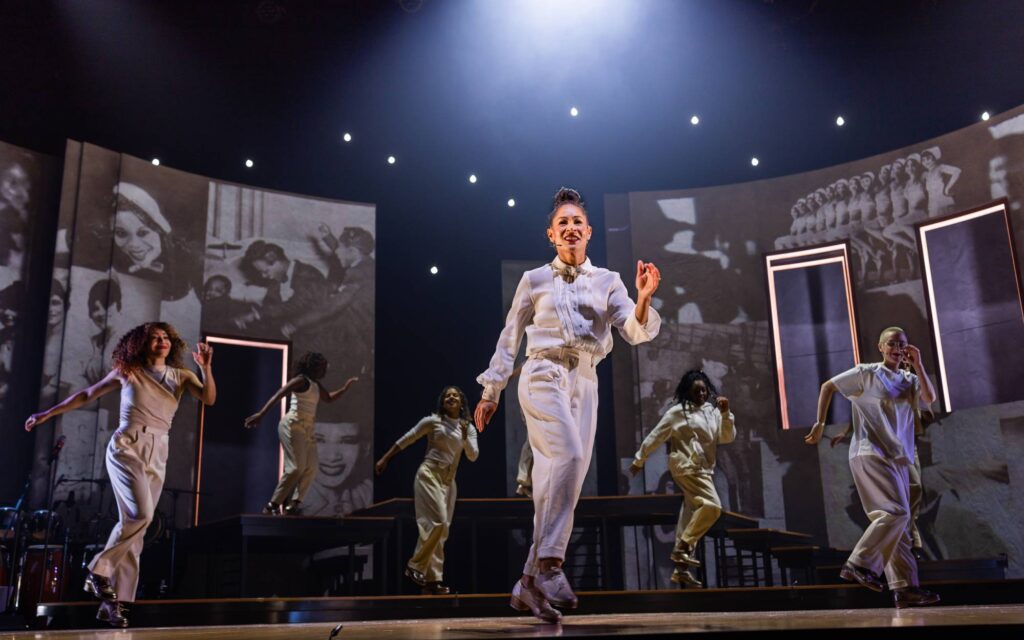
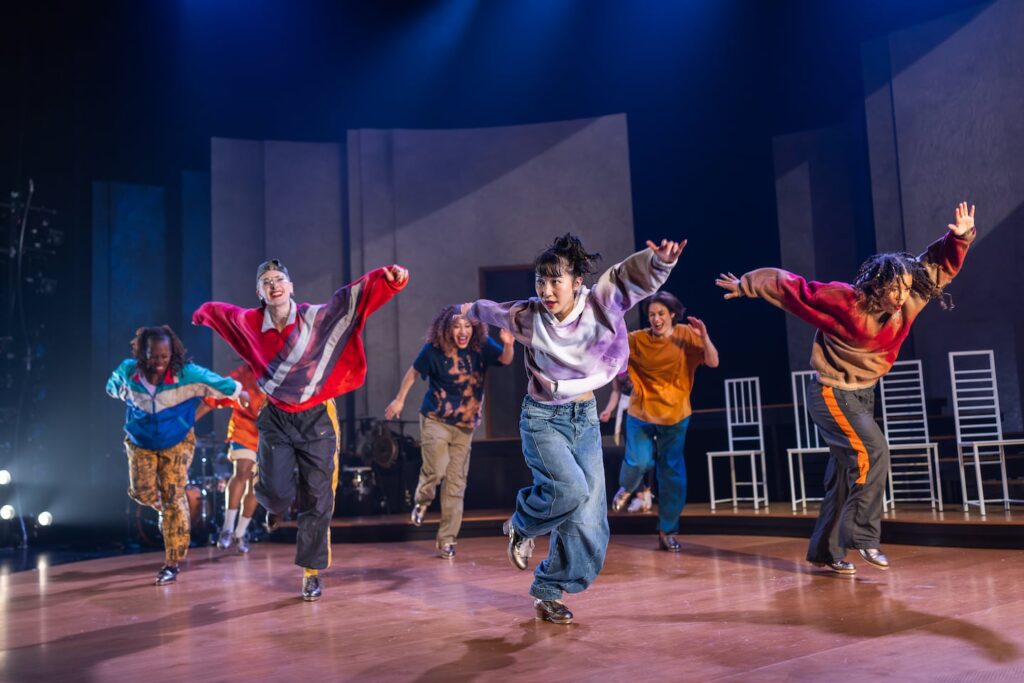
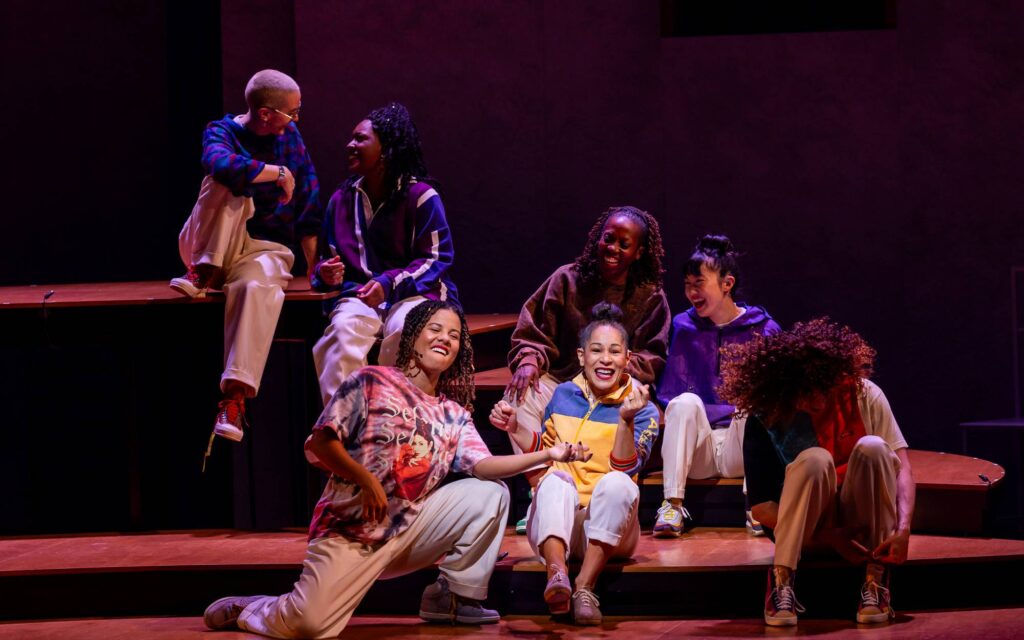
Ayodele Casel (center) and the cast of A.R.T.s ‘Diary of a Tap Dancer.’
Photos: Nile Scott Studios and Maggie Hall
 

By Shelley A. Sackett

Ayodele Casel’s ‘Diary of a Tap Dancer’ defies pigeonholing. First, it is a crackerjack tap dance concert, choreographed and performed by a jubilant devotée of the genre whose sensitivity to its rhythmic musicality keeps the action moving and the audience’s toes tapping along.

Second, it is a narrative documentary that “shines a light on women hoofers,” especially the unknown and forgotten black tap dancers of the 1920s through the ‘50s who blazed a trail for others, like Casel, to follow. Projection Designer Katherine Freer has curated a six-screen still and moving visual accompaniment that introduces us to all the dancers who might have been written out of history — women like Juanita Pitts, Jeni Le Gon, Cora LaRedd, Louise Madison and Marion Coles —  but for her efforts to draw attention to them.

“I have an intense need, desire and responsibility to speak their names,” Casel, the self-proclaimed sepia Cinderella of tap, shares. “They were entrepreneurs, choreographers and dancers. Our time on earth matters. Don’t wait for an invitation to tell your story.”

Additionally, Casel’s ‘Diary of a Tap Dancer’ is just that- an oral diary that tells, in upbeat, humorous and, at times, painfully repetitive detail, the story of her life.

Born in the Bronx to a Puerto Rican mother and African American father (whom she didn’t meet until she was 17 years old), she was sent as a child to live with her Puerto Rican grandparents, where she honed her scrappy spirit by getting into fist fights with boys. When she returned to the Bronx, she and her mother watched old movies and read movie magazines, falling for the glamor and magic of Ginger Rogers and Fred Astaire. She discovered the world of tap during a high school class in movie history. Later, as an NYU theater major, she took her first tap class, showing up with shoes from “Payless” that were as close to Rogers’ as she could find.

“Tap is magic,” Casel says. “It changed my life.”

Her single-minded persistence landed her a spot as the first woman in Savion Glover’s (of mid-90s off-Broadway hit, “Bring in ‘da Noise, Bring in ‘da Funk,” fame) dance company, a real turning point in her career. Tap legend Gregory Hines has referred to her as “one of the top young tap dancers in the world.”

When it comes to paving the way for other marginalized dancers, Casel doesn’t just talk the talk; she also walks the walk (taps the tap?) by sharing the stage and spotlight with seven female and nonbinary young dancers who both complement each other as an ensemble and shine as soloists. But the spritely, charismatic, and extraordinarily talented Casel can’t help but steal every scene with the simplest flap-ball-change. Who knew tap could be so orchestral and communicative?

Under Torya Beard’s (Casel’s longtime collaborator and wife) direction, the atmosphere is set even before the show starts with an almost holy ambient organ major harmonic dyad punctuated by muted city traffic, sirens, and birds. A simple blue set sports what looks like graffiti but is actually a photograph of 18th-century legislation forbidding slaves from owning drums.

A slow spotlight reveals white-clad dancers using every inch of Tatiana Kahvegian’s sparse but effective stage. Dancers are scattered in little solo spaces reminiscent of the staging of “The Lion King.” When the soundtrack kicks in and they all start tapping, it’s like a magical sound bath of rhythm and movement.

Backed by a terrific trio of on-stage musicians (Carlos Cippelletti on piano, Raul Reyes Bueno on bass and Keisel Jiménez Leyva on drums), the musical dance numbers are a pure delight. Casel tells her intimate and powerful story through straight narration, rap, beat and counter-beat. Her acting chops show in the comfort with which she addresses the audience. It’s no surprise to learn that “Ayodele” is Yoruban for “joy.” Casel is not just a top-notch dancer and choreographer; she is genuinely warm, funny, smart, guileless, and humble. She is also an articulate, eloquent, and bold guide who unlocks the enchantment and triumph of the human spirit that is the essence of tap.

The problem (at least at last Sunday’s world premiere production, which ran 30 minutes beyond the show’s already overly generous 2 hours with one intermission) is that Casel has a lot to say about a lot of topics about which she is understandably passionate. “This show is narrative justice,” she explains.

But by trying to tackle such big-ticket items as racism, sexism, African American history, misogyny, and historical exclusion, instead of leaving her audience feeling enlightened and informed, she leaves them wishing for more dance and less talk. A LOT less talk.

While Casel is an excellent and engaging narrator, it is the magic language of her syncopated footwork and vocal scat work that offer a more compelling and emotionally accessible (and less preachy) tribute to the art form of tap and the black foremothers she seeks to honor. A little editing could go a long way.

‘Diary of a Tap Dancer’ – Written and Choreographed by Ayodele Casel. Directed by Torya Beard. Musical Direction by Nick Wilders; Scenic Design by Tatiana Kahvegian; Costume Design by Camilla Dely; Lighting Design by Brandon Stirling Baker; Sound Design by Sharath Patel; Projection Design by Katherine Freer; Compositions, Orchestrations, and Arrangements by Carlos Cippelletti, Ethan D. Packchar. Presented by American Repertory Theater at the Loeb Drama Center, 64 Brattle St., Cambridge, through January 4, 2025.

For tickets and information, go to: https://americanrepertorytheater.org/shows-events/diary-of-a-tap-dancer/

Neshama Carlebach headlines Swampscott inclusion celebration

By Shelley A. Sackett

Neshama1

Neshama Carlebach will headline Swampscott’s Shirat Hayam’s Shir Lanu Inclusion Initiative Celebration on October 27 and 28.


Singer/songwriter Neshama Carlebach, a passionate advocate for inclusion in synagogue, will headline Congregation Shirat Hayam’s Shir Lanu (“One Song-Every Voice”) Inclusion Initiative Celebration October 27 and 28.

“When you’re accepting people who are different than you, it means that you have acceptance and love in your heart. Period. And if you don’t have love and acceptance in your heart, that’s not a place to pray,” the six-time entrant in the 2011 Grammy Awards said by phone last week from her New York City apartment.

One of Shirat Hayam’s stated missions is to support and provide opportunities for families and individuals with special needs as well as the LGBTQ community, interfaith families, elders and everyone who seeks a genuinely respectful, compassionate and responsive synagogue experience.

“I believe that hands down, this is one of the most important missions in the Jewish world right now. Every single synagogue should have this mission attached to their synagogue statement,” Carlebach said.

Last May, the synagogue received a selective Ruderman Synagogue Inclusion Project (RSIP) grant to further its inclusion work. The Ruderman Family Foundation is a Boston-based philanthropic entity that advocates for and advances the inclusion of people with disabilities throughout society.

Michele Tamaren and Amanda Clayman co-chair Shirat Hayam’s Shir Lanu inclusion committee and attended the gathering for the cohort of new 2017 RSIP affiliates. There they met Neshama Carlebach, who performed for the group.

“We were deeply moved by her soulful ability to lift hundreds of us in that room,” Tamaren said. She and Clayman stayed and connected with her after the concert. When the Shir Lanu committee started planning the October inclusion event, Tamaren and Clayman invited Carlebach to be the weekend’s artist-in-residence and to perform a community concert Saturday night with her gospel band, The Glory to God.


Neshama2

Neshama Carlebach has sold more than one million records, and performed and taught in cities worldwide.

Neshama Carlebach is the daughter of renowned Rabbi Shlomo Carlebach, the folksy, guitar-playing Orthodox rabbi who created hundreds of uplifting melodies, including many that are part of Shabbat services in synagogues all over the world. She sang with her father until his death in 1994, when she launched her own professional career.

She has sold more than one million records, performed and taught in cities worldwide, and co-authored the Broadway play, “Soul Doctor,” based on her father’s life. In 2016, she was inducted into the Brooklyn Hall of Fame, where she received a Certificate of Congressional Recognition for her work.


Carlebach credits her father for instilling in her the desire to bring inclusivity, love and wonder to the world. “My father gave that to me in my ear and in my heart from the moment I was born. That’s what he stood for. There’s no way I could have been any different,” she said.

She has done several events with the Ruderman Family Foundation. “I have never cried so much in my life, sitting and hearing these inspirational people talk about how they have struggled in their wheelchairs and how doors have been shut in their faces,” she said.

As the weekend’s artist-in-residence, Carlebach will provide inclusion teachings at the Friday, October 27 evening “Holy, Happy Hour Minyan” and the Saturday, October 28 morning “Nosh and Drash” Shabbat services. “Her teachings will focus on the Jewish imperative of inclusion,” Tamaren said.

Saturday evening, she will perform with her band and members of the spirited New York gospel choir, The Glory to God Gospel Singers, at Congregation Shirat Hayam, 55 Atlantic Ave, in Swampscott.

Reflecting on today’s divisive political climate, Carlebach thinks her father would be broken-hearted about the pain in the world and would have tried to do everything he could to bring healing. “Under his influence and in my own heart, I hope to try to do the same,” she said.

“There’s a song I sing called, ‘Y’hi shalom b’haylech’ – ‘May there be peace in your borders and tranquility in your castles.’ My father spoke about that all the time, that true peace comes from within the castle,” she said.

She paused for a few moments, then added, “I know you can’t heal what’s going on now with a song, but it would be great if all the world was waiting for was that one right niggun (Jewish religious melody).”

For more information or to purchase tickets, visit shirat­hayam.org/Neshama or call 781-599-8005.

Swampscott cantor hits it out of the park with new CD release

Shelley A. Sackett, correspondent


_H2A3577


Cantor Elana Rozenfeld loves her job at Congregation Shirat Hayam (CSH) and last Sunday, her congregation gave her a big “back atcha” with a “Song of the Sea Soirée” that honored her six years as their cantor and celebrated the release of her new CD, “Hallelu!”


The sold-out crowd of over 260 guests was treated to an elegant evening of food, camaraderie and — most importantly — music as Cantor Elana and her six-piece band performed a repertoire that included several songs from the new CD and ranged in genre from Yiddish theater to a popular Israeli radio hit song to liturgical music.


Rabbi Michael Ragozin introduced her as the “biggest engine and vehicle” that has strengthened the temple’s ability to forge life long, meaningful relationships. “Her music brings us together in powerful ways that I haven’t experienced anywhere else,” he said. “This is the space where I want to be and it is all because of our cantor.”


_H2A3561


“I’m an artist. That’s what fills me up, it’s what gives me something to give. If I take away the giving part of what I do, I’m not happy,” she said.


That generosity of spirit and artistry were on full display during the 70-minute concert and fundraiser that brought the audience to their feet for two standing ovations and had many wiping away a tear after her soulful encore rendition of “Somewhere Over the Rainbow.”


Each of the 14 songs took on a special meaning after Cantor Elana’s informative and anecdotal introductions. The musicianship of her band (violin: Yaeko Miranda Elmaleh; guitar: Lautaro Mantilla; percussion: Jeremiah Klarman; bass: Simón Willson; back vocals: Sarah Nissenbaum; piano: David Sparr) added special texture, color and professionalism to the evening.


In the audience, 17-year-old Rachel Nissenbaum and her parents, Lilly and Jerry, were thrilled that Berklee vocal student and Rachel’s sister, Sarah, was sharing the stage with Cantor Elana as back up singer. “It’s so nice to see so many people here supporting the cantor. It’s very beautiful,” Rachel said.


“I’m so excited! I can’t wait!” added Lilly.


“Oy Mame,” a Yiddish love song, had the crowd clapping along to Cantor Elana’s exaggerated theatrical gestures and tapping their toes to Elmaleh’s klezmer-like violin accompaniment.


“Shavim,” a popular Israeli song about equality and inclusion, was dedicated to CSH and its “tireless effort to support all people in our spiritual home.” The cantor underscored her point by signing the words as she sang them.


Other songs urged listeners to look inward during these challenging times. “History Has Its Eye On You/Oseh Shalom,” a “mash up” of a song from the musical “Hamilton” and a Hebrew prayer for peace, is about life, regrets, mistakes and hope for a better future. “It should remind us that it’s up to each of us to make a change and to make peace,” she said.


“Seven Years,” a female rewrite of Lukas Graham’s top 40 hit, considers what kind of legacy we want to leave for our children. “I want to make the world a better place. Isn’t that the point of art? Isn’t that the point of music?” she said earlier in the week during an interview.


Cantor Elana is known as much for her love of teaching children as she is for her exquisite voice. The Chai Notes, CSH’s all-girl teen choir, is her pride and joy.


They performed Fleetwood Mac’s “Landslide” at the soirée fresh on the heels of their June 13 performance of “Star-Spangled Banner” at Fenway for Jewish Heritage Night.


How they got to Fenway is inextricably related to the CD celebrated at the soirée.


The girls recorded the song “Hatikvah,” the Israeli national anthem, for Cantor Elana’s new CD. While working with them on that track, she became aware of Fenway’s upcoming Jewish Heritage Night and a light bulb went off in her head. “I thought, ‘We need to do Fenway’” she said.


Congregant and choir mom Amanda Clayman contacted the Red Sox and found out how they selected singers and what The Chai Notes would need to submit for consideration. Since they already had studio time for the CD, they were able to quickly record the requisite “The Star Spangled Banner” in three-part harmony and then send it in.


“They responded immediately, ‘Yes. We want you.’” Cantor Elana said. “And then we practiced. A LOT.”


Although her impressive resume includes NYU’s Tisch School for the Arts, the Jewish Theological Seminary, and cantorial posts at Temple Beth-El Mekor Chayim in Cranford, N.J. and Park Avenue’s eminent Park Avenue Synagogue, her reasons for wanting to make a CD have nothing to do with personal gain or fame. They are all about promoting the synagogue she calls home.


“People are starting to know me in the Jewish world and to know Shirat Hayam. We’re this hidden gem and I want us to be less hidden,” she said. “No one would know that a shul (synagogue) like this would exist in Swampscott,” Cantor Elana said.


The CD also allows CSH to put their liturgical music on their website. “This is a fraction of the musical legacy of CSH,” she said, adding she hopes people will hear the music and say, “Yeah. I want to go there.”


All the money earned by the CD goes to CSH for music programming. Although she owns the copyright to her own music, Cantor Elana does not reap any personal financial benefit from sales.


She hopes that people will buy CDs for themselves and for “100 of their closest friends” to support the work she is trying to do.


“We say it supports music at Shirat Hayam, but music IS Shirat Hayam. If someone gives money to the Hebrew School or preschool, there’s music programming in both of those. Everything we do is around music,” she said.


Rabbi Michael is especially pleased that the CD contains most of the musical prayers which comprise the Friday evening and Saturday morning Shabbat services, giving CSH the ability to reach beyond the weekly live prayer/performance experience and give others access to these same connections any time they want.


“Many of the things we do are aimed at increasing accessibility and giving someone this CD also gives them tremendous accessibility to what we’re doing here at Shirat Hayam,” he said.


For more information or to buy the CD “Hallelu!”, visit https://store.cdbaby.com/cd/cantorelanarozenfeld.