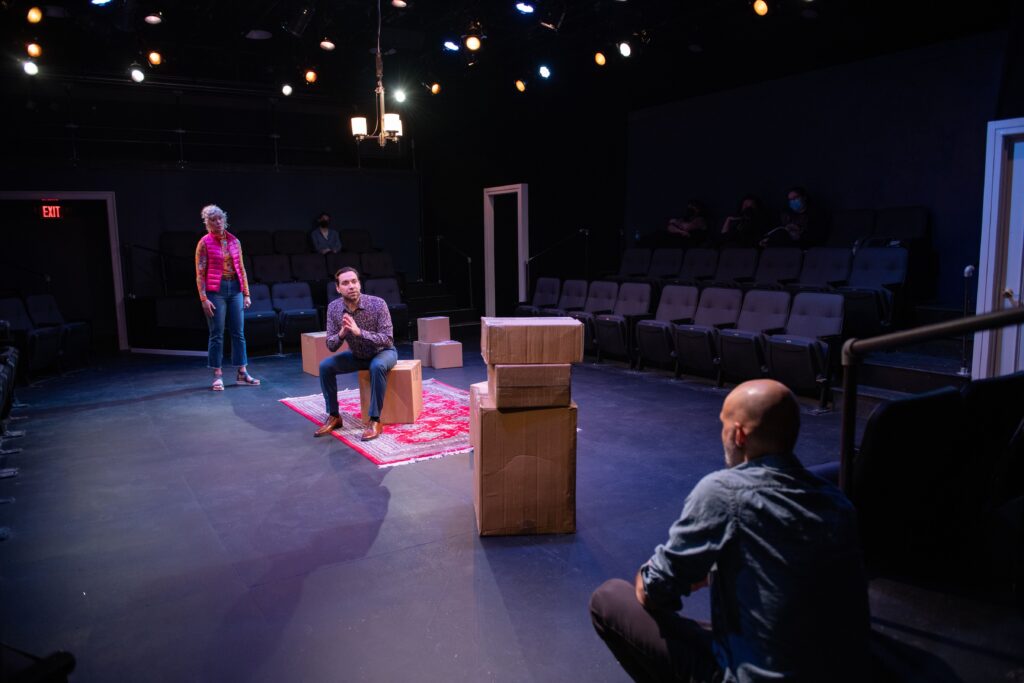
Two Unlikely Buddies Talk Trash in Gloucester Stage’s Clever Comedy, ‘The Garbologists’

Paul Melendy and Thomika Marie Bridwell in Gloucester Stage Company’s “The Garbologists.”
Photos by Shawn G. Henry

By Shelley A. Sackett

Rebecca Bradshaw, Producing Artistic Director of Gloucester Stage Company and director of its first-rate The Garbologists, couldn’t have timed it better. With Republic Services sanitation workers in the second week of their strike, garbage is on everyone’s mind as bags pile up on the North Shore and throughout Greater Boston.

Playwright Lindsay Joelle’s tight, bright comedy brings its audience behind the windshield of a New York City Sanitation Department truck and into the lives of two people thrown together by circumstance: Danny (an exceptionally talented and engaging Paul Melendy) and Marlowe (Thomika Marie Bridwell). The two-hander (80 minutes with no intermission) is one of the most endearing odd couple buddy comedies since, well, Jack Klugman and Jack Lemmon in the 1970s television series, “The Odd Couple.”

Danny, a 41-year-old white blue-collar regular guy, is bigger than life. A seasoned worker with nine years’ experience, he is a nonstop talker, full of advice and corny jokes. He also has a wealth of institutional knowledge and an intuitive sixth sense about the street as a source of understanding the meaning of life. “There’s a lot you can tell about someone by what they throw away,” he counsels his rookie partner. “Read the bags.”
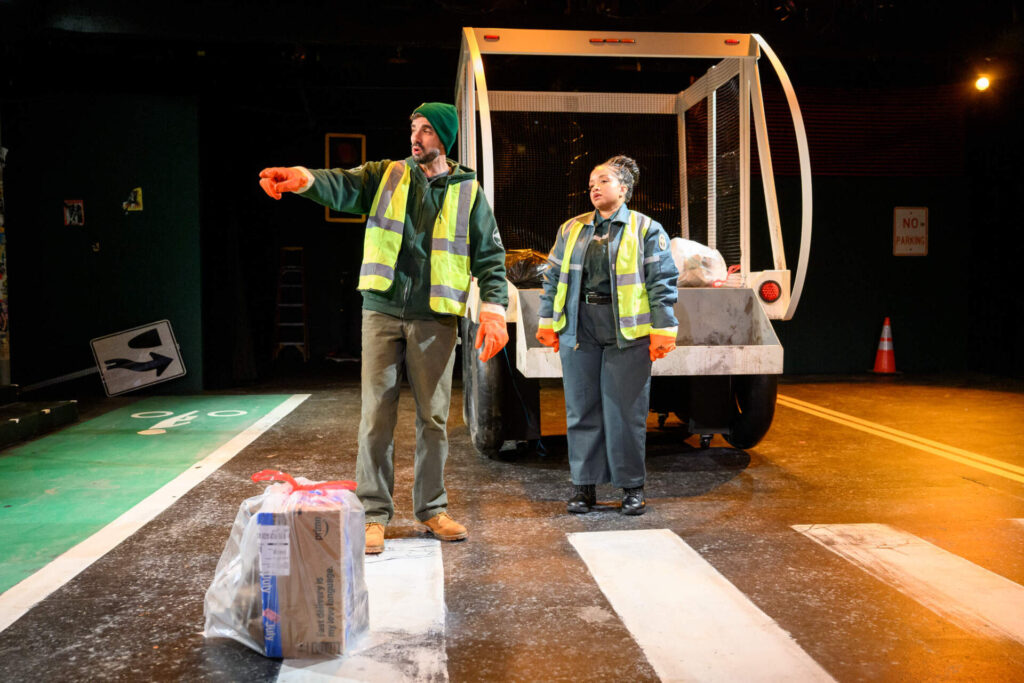
Gloucester Stage Company’s production of The Garbologists by playwright Lindsay Joelle, in Gloucester, MA. The production is directed by Rebecca Bradshaw and stars Tomika Marie Bridwell as Marlowe and Paul Melendy as Danny. © 2025 Shawn G. Henry • 978-590-4869 GSC-250702-Garbologists_017

Marlowe, a mid-30s Black Ivy League-educated (two degrees, no less) woman, is as buttoned up as Danny is unzipped. For the first many minutes, she watches and listens in disinterested silence as Danny continues his comedic monologue. In her pressed and pristine uniform, she looks more ready to walk across a graduation podium than toss overstuffed black bags into the bowels of their truck.

Like an awkward blind date, they eye each other suspiciously, each seeming to wonder what they did to deserve such a match.

But these two have more in common than it first appears, and thanks to a combination of a mostly sharply honed script and spot-on, crisp direction, the layers of what separates them melt away. By the play’s life-affirming end, the two have found more than just friendship; they have found a piece of themselves through each other.

Set in the streets of New York (effective lighting by Anshuman Bhatia, sound by Julian Crocamo and a terrific set by Kristin Loeffler that includes traffic lights, road signs and a functioning trash truck that swivels and rotates), the show slowly builds hope, trust and friendship between these two seemingly mismatched characters as they go about the business of their day. Danny pours on the charm, trying to get Marlowe to loosen up and laugh. Melendy’s performance is worth the price of admission. He is a one-man showstopper, and he is on stage the entire time. As he swerves from serious mentorship to revealing details of his personal life (he is divorced, has a seven-year-old son and is currently under a temporary restraining order), he is a whirling dervish of physicality and nuanced delivery. He is also caring, philosophical and self-aware. “I’m an acquired taste,” he admits. “Like blue cheese.”
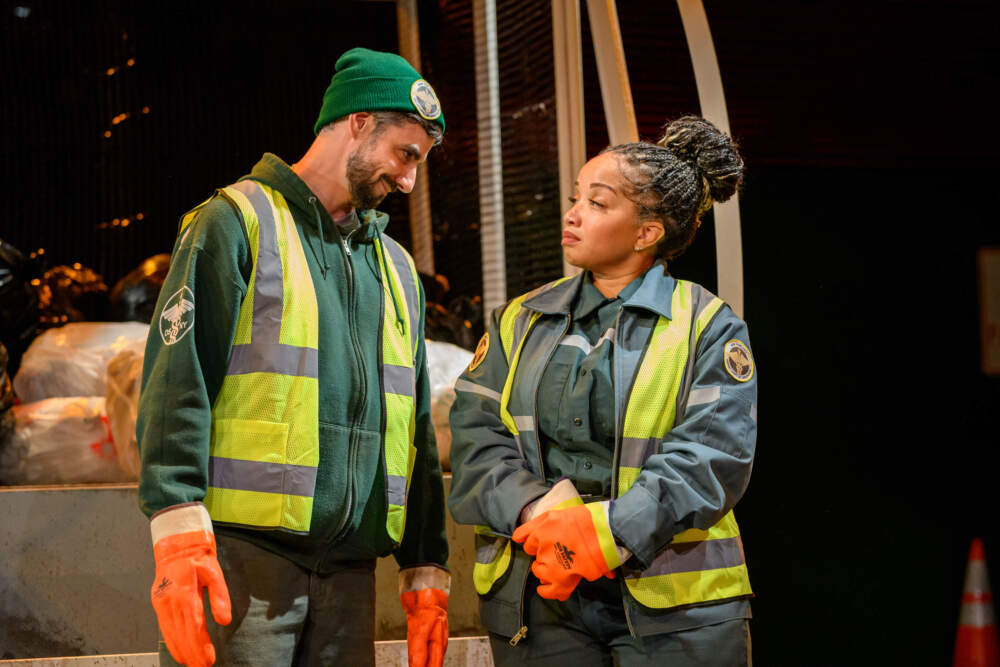
Gloucester Stage Company’s production of The Garbologists by playwright Lindsay Joelle, in Gloucester, MA. The production is directed by Rebecca Bradshaw and stars Tomika Marie Bridwell as Marlowe and Paul Melendy as Danny. © 2025 Shawn G. Henry • 978-590-4869 GSC-250702-Garbologists_053

For her part, Marlowe at first is having none of it. Bridwell alternates between high-decibel anger and sullen silence, limiting the audience’s ability to get to know and relate to her character. Although by the end we understand the trauma that led her to take this job, it is an uphill climb.

Joelle gives these two plenty of meaty dialogue, full of astute observations about the meaning behind what people throw away. The street is a resource as well as a wastebasket; one person’s waste is another’s life source.

There are some belly laugh lines and hysterical scenes, especially one with a box full of dildos that Danny uses for an improvisational monologue that finally gets Marlowe to laugh. Triumphant, Danny basks in his accomplishment. “You look radiant,” he practically gushes.

With the exception of a distractingly contrived and awkward twist at the play’s end, Joelle keeps both storyline and character development moving in dynamic and engaging ways.

When Danny gets a call to pick up his sick son at school, Marlowe helps him navigate the awkwardness of figuring out how to contact his ex-wife without violating the terms of his TRO. When Marlowe rescues a teddy bear and places it reverently on a pole, Danny observes but gives her space and time to disclose her reasons. And when Marlowe endangers herself by cavalierly tossing potentially hazardous substances into the compactor, Danny reacts both as boss and concerned friend.
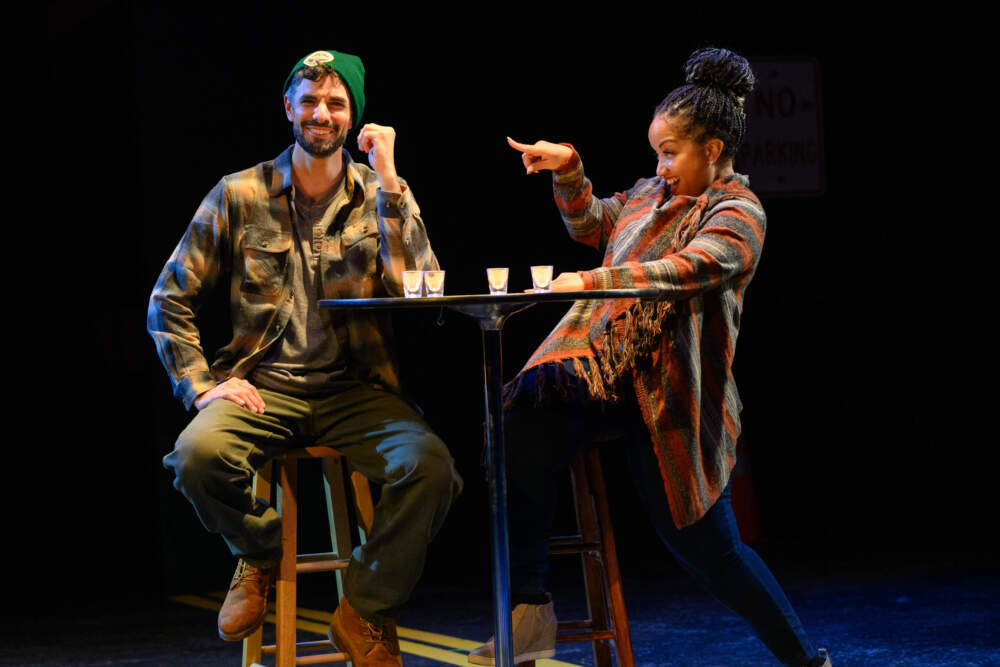
Gloucester Stage Company’s production of The Garbologists by playwright Lindsay Joelle, in Gloucester, MA. The production is directed by Rebecca Bradshaw and stars Tomika Marie Bridwell as Marlowe and Paul Melendy as Danny. © 2025 Shawn G. Henry • 978-590-4869 GSC-250702-Garbologists_274

By the play’s end, we really feel for these two and the cycles of grief, joy, insecurity, loss and random bad luck each has experienced. We also think about garbage (and garbage collectors) in new and shaded ways. Is there a moral obligation, for example, to return something of value that its owner ignorantly tossed, or does the “Finders Keepers” rule apply? When we discard something, do we also discard the right to privacy and anonymity about having owned it?

Most of all, Joelle shines a timely light on our detached perception of those who haul away our debris as faceless and anonymous. These two are full-throated, wonderfully fleshed out, complex and likeable characters, loyal to their families and supportive in their friendships. “Just because we pick up trash doesn’t make us garbage,” Danny says. Amen to that.

Recommended.

‘The Garbologists’ — Written by Lindsay Joelle. Directed by Rebecca Bradshaw. Presented by Gloucester Stage Company at 267 East Main St., Gloucester, through July 26.

For more information, visit: https://gloucesterstage.com/garbologists/
Gloucester Stage ‘s Thought-Provoking ‘The Ding Dongs’ is a Theatrical Tour-de-Force

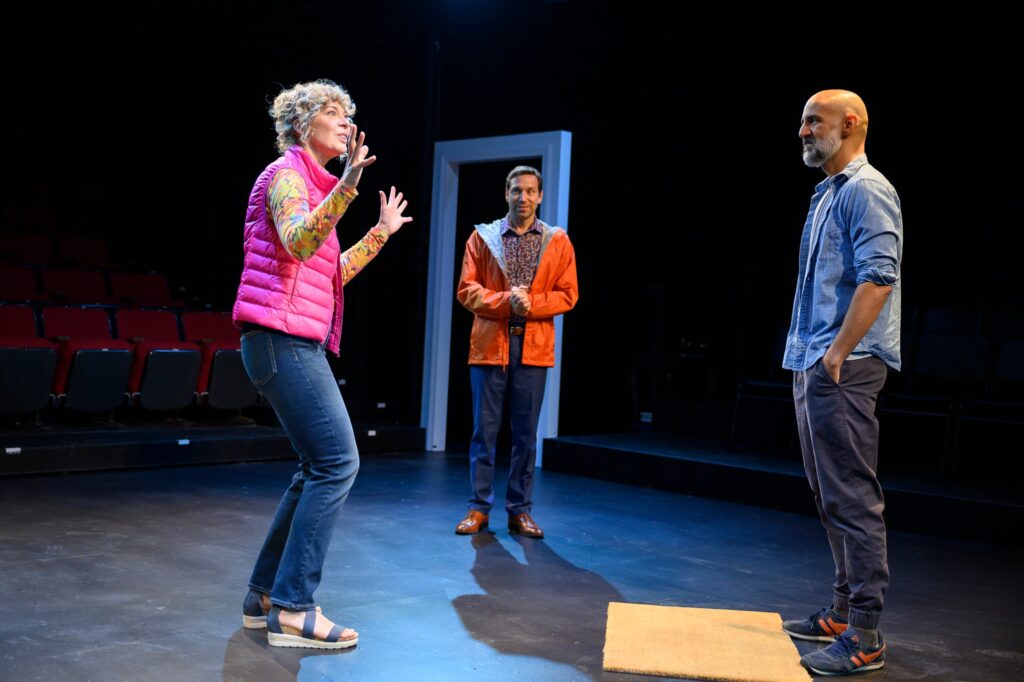
Erica Steinhagen, Karl Gregory, and Nael Nacer in Gloucester Stage Company’s ‘The Ding Dongs’

By Shelley A. Sackett

We’ve all been there. That split second when we realize that all may not be as it seems, that we have misread a vital clue and that all is about to go south. The Ding Dongs, in production at Gloucester Stage through August 27, takes that moment and straps it to a steroid drip.

Don’t be put off by the title, as I almost was. (Is it a tribute to Hostess? To a bebop group? To the comedic wrestling duo?) The Ding Dongs will keep you on the edge of your seat for its entire 75 minutes from lights up to fade out and leave you dying to talk about it to anyone within earshot.

When is the last time theater had that kind of visceral effect?

The action starts with — what else — a couple ringing the doorbell of a suburban single-family home. Inside, the owner Redelmo (the always magnetic Neal Nacer), pauses and runs his hand over his shaved head as if some sixth sense warns him against answering the door.

From the get-go, there is something awry with Natalie (the mesmerizing Erica Steinhagen) and Joe (the superbly flexible Karl Gregory). Natalie is dressed like soccer mom Barbie and her husband Joe looks at home in his orange hooded windbreaker and fitted mod shirt. They present as any ordinary, if unfashionable, couple might, a little ditzy perhaps (another meaning of “ding-dong” is dingbat), but otherwise innocuous.

Natalie is the more forceful, immediately establishing that Joe grew up in Redelmo’s house and that they would love to come inside and take a peek at the old homestead. Joe is the more affable, taking his cues from Natalie and speaking only when she opens that door and invites him into the conversation.

Uncomfortable and increasingly suspicious, Redelmo tries to field their barrage of questions and reveal as little about himself as possible. Yet his politeness and graciousness are no defense to the couple’s verbal bombardment, and they steamroll right over the doomed deed holder’s threshold.

Once inside, all semblance of ordinariness vanishes. The couple launches their assault in earnest, cajoling, beseeching and threatening Redelmo. Natalie is equal parts pit bull prosecutor, evil enchantress and comical talk show host. Joe plays her foil, good cop to her sinister, slightly unhinged one.

The exchanges can be funny, but the overlay of menace and chaos erases any possibility of the audience feeling comic relief. These two are world-class black widow creeps, and Redelmo, with his social graces and timidity, is no match for them.

Soon, their unsettling stories turn more sinister, violent and threatening. Their past is revealed, including a dark chapter involving home invasions, violence, disruption and dislocation. The two are verbal quick-change artists, feigning innocence one minute, wielding machetes the next.

In this boxing match of words and wit, Redelmo is outperformed and outnumbered and no amount of fancy footwork is going to save him from the blows that will eventually corner and pummel him into submission.

Unexpectedly, the doorbell rings again and large boxes addressed to the couple begin arriving. At this point (and not until), Redelmo wakes up to the fact that these two are not visitors who can be reasoned with and will eventually get the message that he wants them to leave. These are ruthless, deranged home invaders who play by alien rules and carry baggage far more unsettling than whatever might be in the avalanche of boxes squatting in his living room.

Abruptly, his house has gone from a calm, suburban home to a cross between Pee Wee’s Playhouse and Regan’s bedroom in “The Exorcist,” and Redelmo reels at the heightened stakes.

Natalie continues, now claiming that the house really belongs to Joe because, after all, he has priority in the chain of deeds, having lived there well before Redelmo “owned” it. In fact, they argue, to an outside observer, it is Redelmo who would be considered the squatter, not them.

“The simplest explanation is always the best, even if it isn’t the truth,” she says. Like wolves closing in on common prey, Natalie and Joe encircle Redelmo, smelling his fear and tightening their grip.

And then, things get even twistier and more disorienting until by the play’s sudden end, neither the actors nor the audience is really sure who’s who and what’s what. Like a huge pot put on a flaming stove, this play simmers for a long time until you wonder if it will ever reach boiling point. When it finally does start to roil, however, there is no lid heavy or strong enough to keep it from boiling over, like poor Mickey’s cauldron in “Fantasia’s” famous “The Sorcerer’s Apprentice.”

Playwright Brenda Withers has written a riveting, thought-provoking, timely play that receives a must-see, first-rate production under Rebecca Bradshaw’s crisp direction. Sound designer Julian Crocamo masterfully reflects the jerkiness of mood by subtly swinging from the sweetness of harmony to the menace of dissonance.

Setting the stage as a theater-in-the-square with four bays of seats gives the illusion of a boxing arena. It also allows Bradshaw and lighting designer M. Berry to take full advantage of a set that affords the audience a different perspective by slight shifts in position and luminosity. A few steps to the left or right and the focus can swing from an actor’s action to their reaction, giving the audience an entirely different perspective on the same situation.

With “The Ding Dongs,” Withers has created a sophisticated, multi-layered, complicated microcosm whose effects linger long after the play’s dramatic end. She subtitled her play, “What Is the Penalty in Portugal? a meditation on homeland security,” and she gives a clue as to her intention in writing it in a recent interview.

She had started thinking about land and property after reading an article about a skirmish in the Middle East. She thought about gentrification, the displacement of humans around the globe, and what makes a home a home.

She also thought about civility and how far we’ll let people get in order to maintain good manners. “What happens when you finally push back on someone and say, ‘These are actually my boundaries’ or ‘This is what’s making me uncomfortable.”’

This is not a “feel good” kind of play. Its laughs are funny but not funny. The manipulation, aggression and sense of helplessness are palpable and contagious. Those of us who think we may be inured and resigned to the realities of living in a macroworld where rules and truth are arbitrary will be further disheartened by this up close and personal micro-encounter with its nefarious day-to-day consequences.

It is, however, an important play with a timely and important message that should be seen and discussed. That Gloucester Stage’s production is an artistic bases loaded home run is icing on the cake.

‘The Ding Dongs’ — Written by Brenda Withers. Directed by Rebecca Bradshaw. Costume Design by Camilla Dely; Lighting Design by M. Berry; Sound Design by Julian Crocamo. Presented by Gloucester Stage, 267 East Main St., Gloucester, through August 27.

For tickets and information, go to: https://gloucesterstage.com/