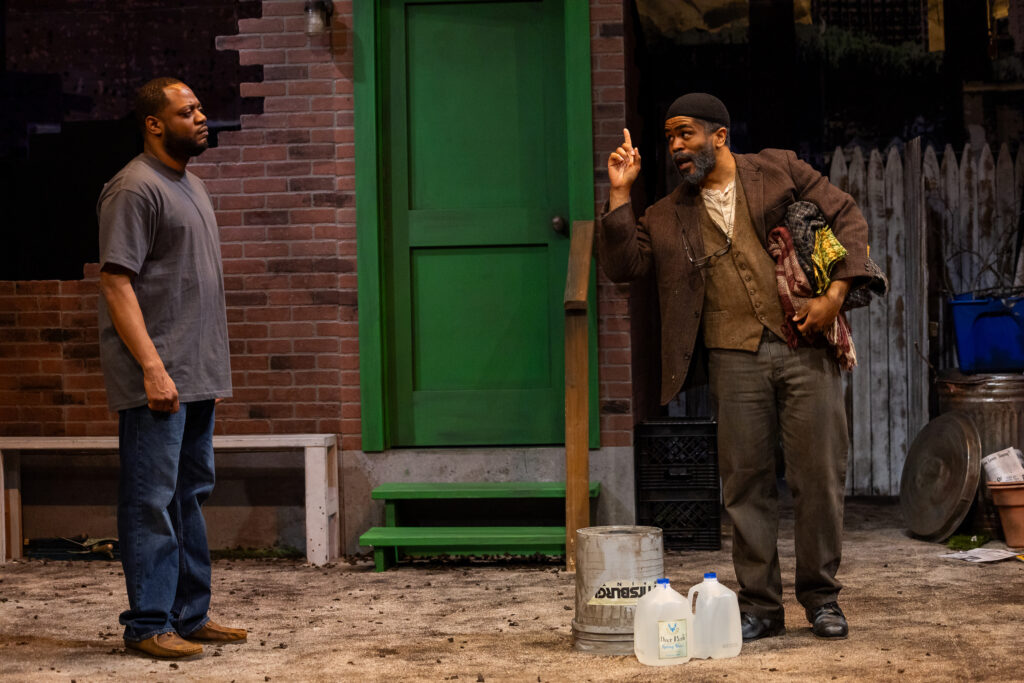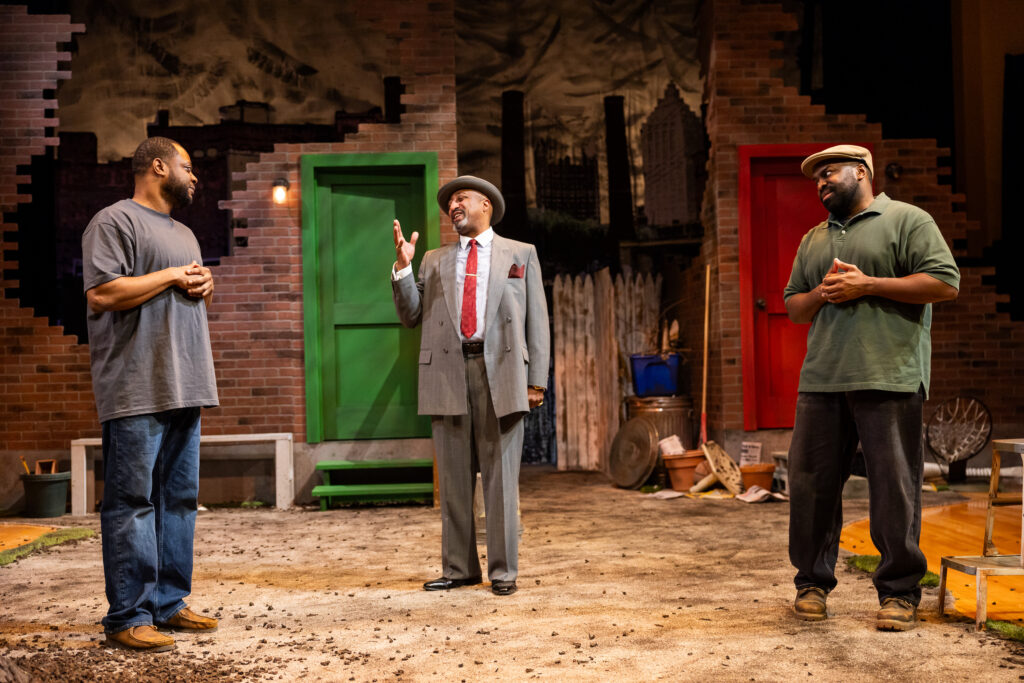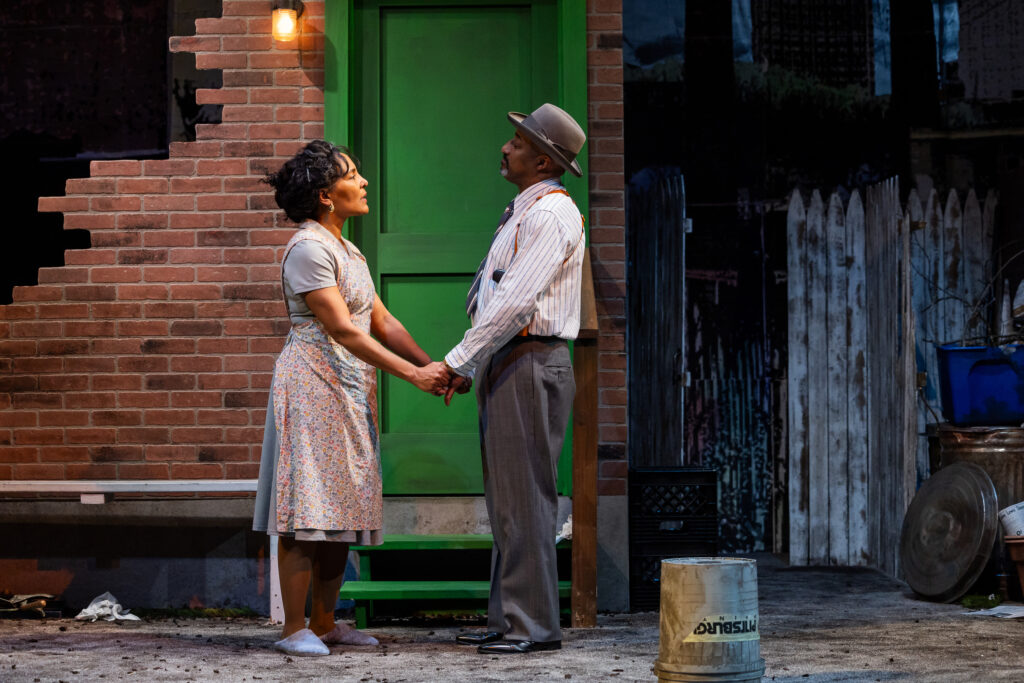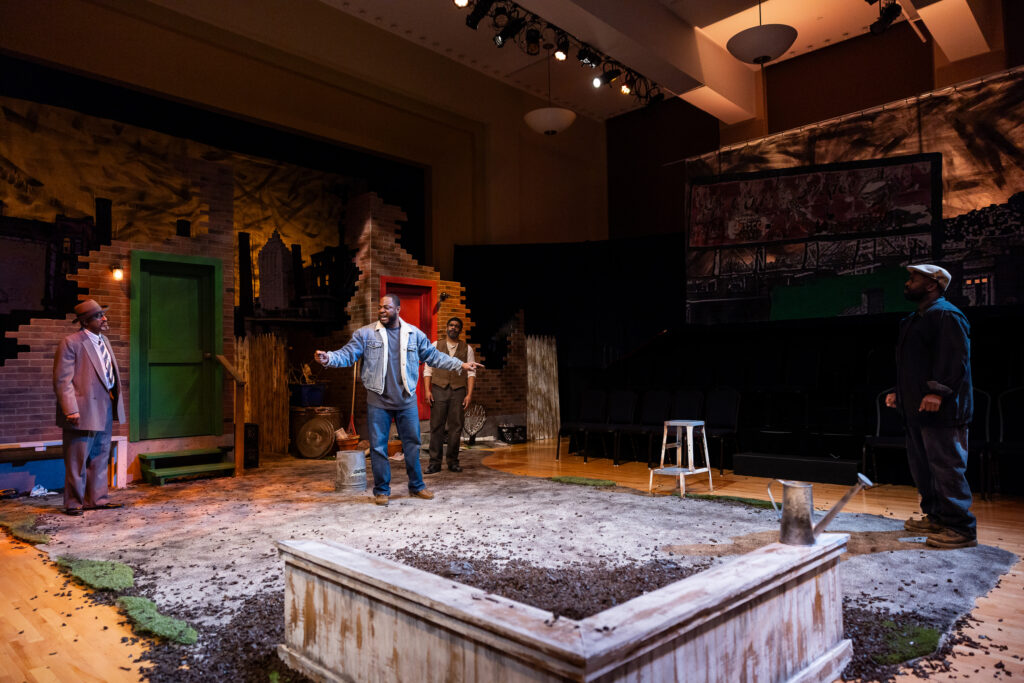
SpeakEasy’s ‘A Man of No Importance’ Is Must-See, Feel-Good Theater at Its Absolute Finest

Theater Mirror

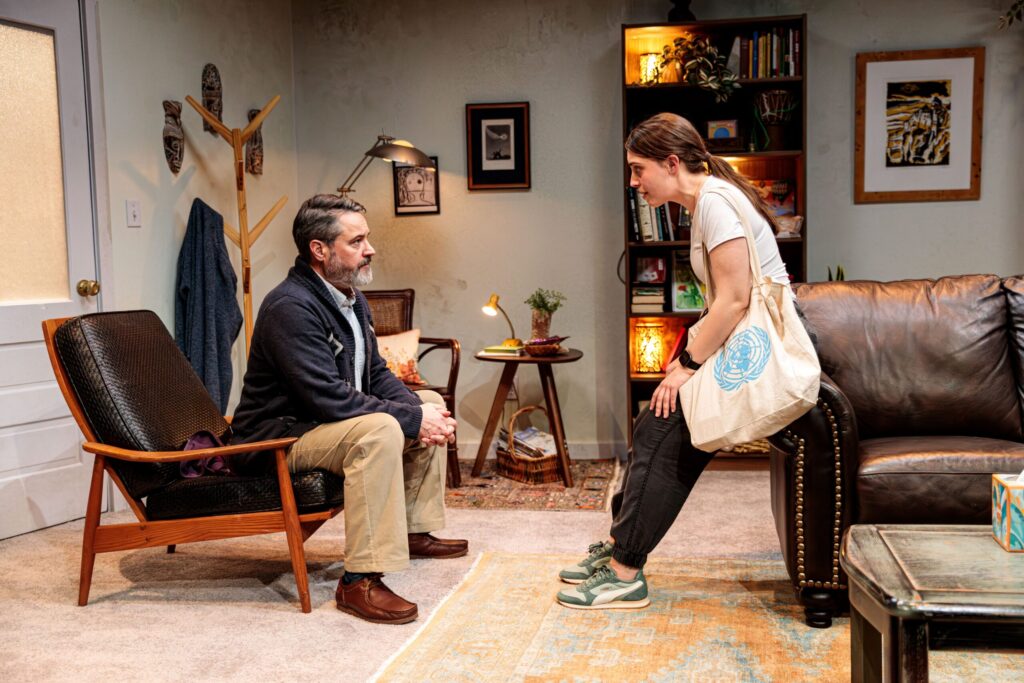
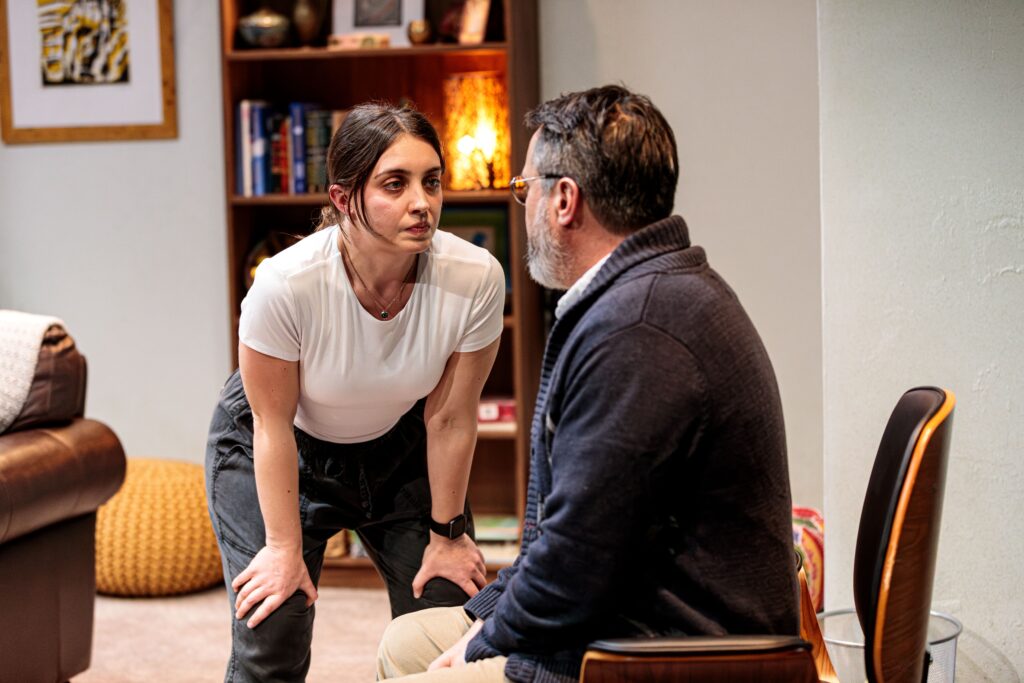
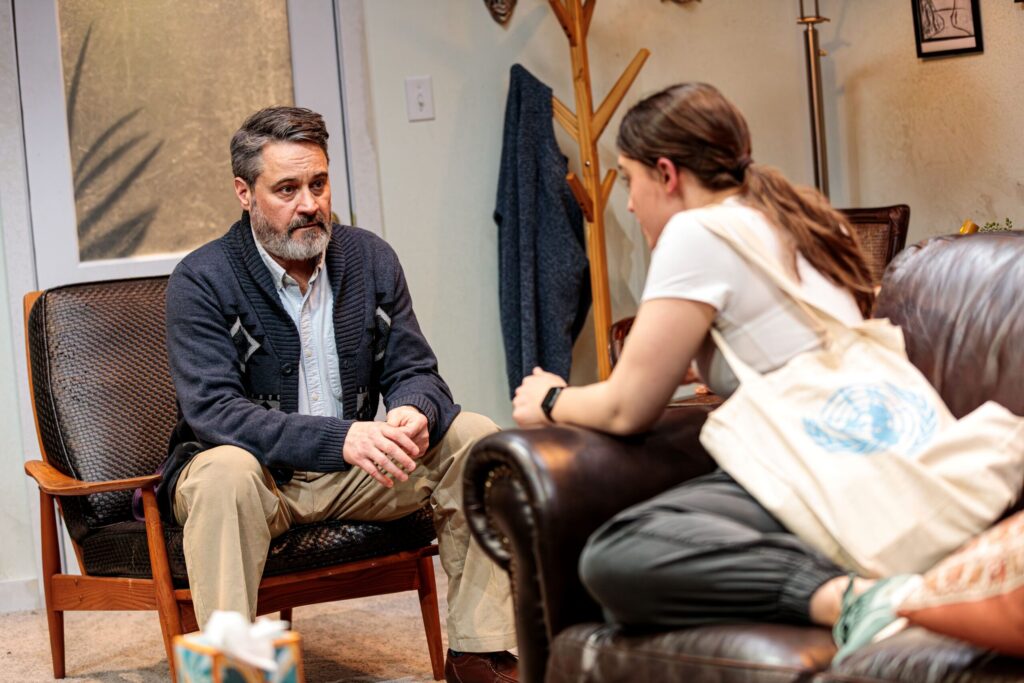
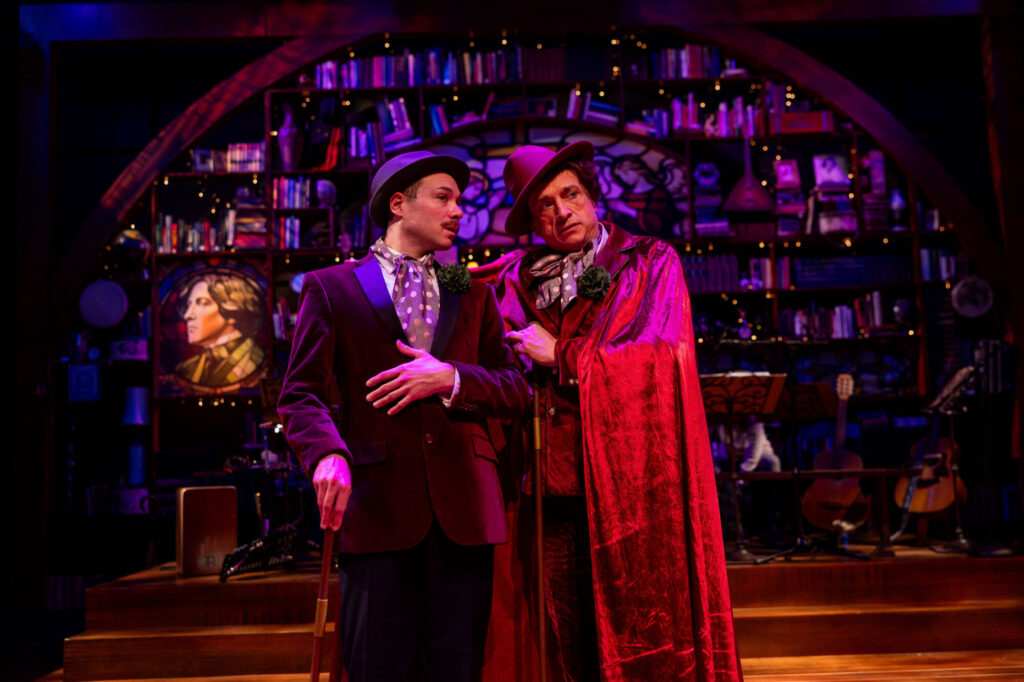
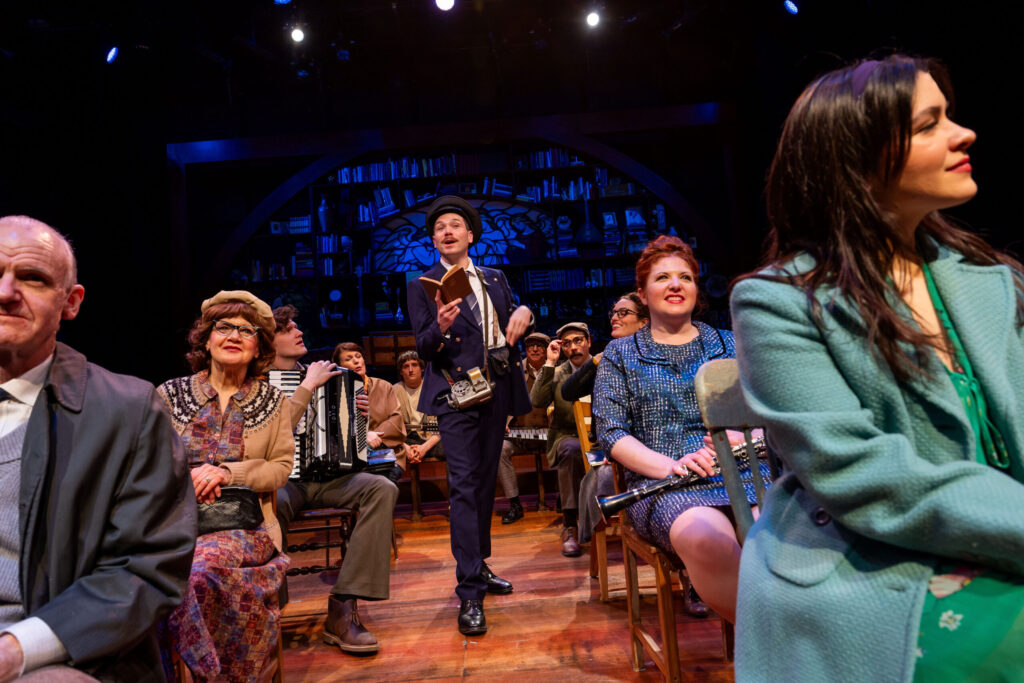
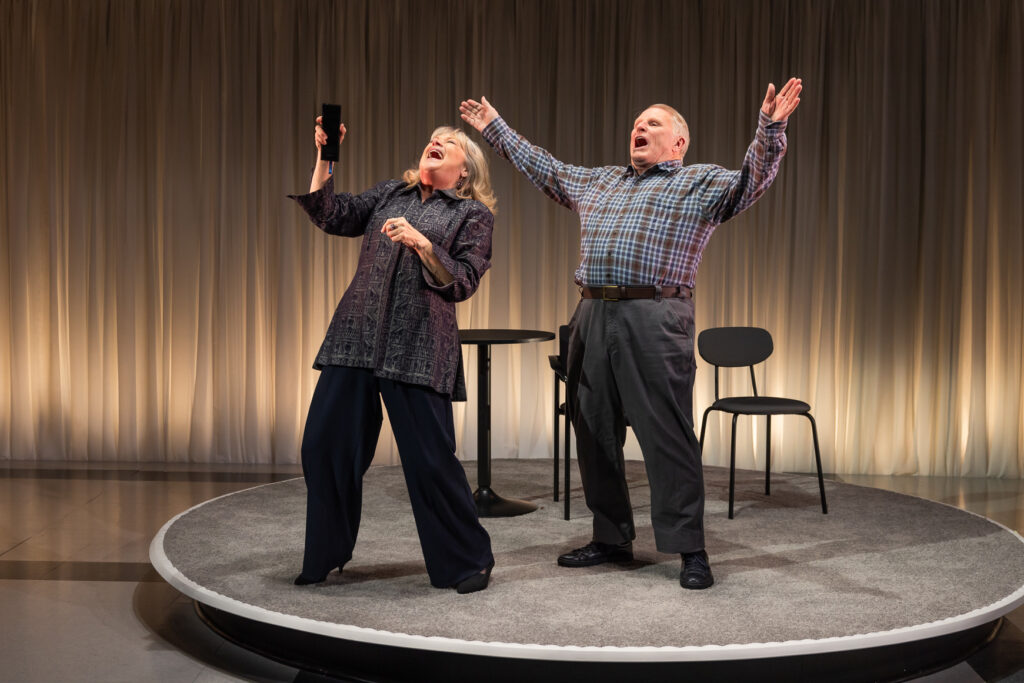
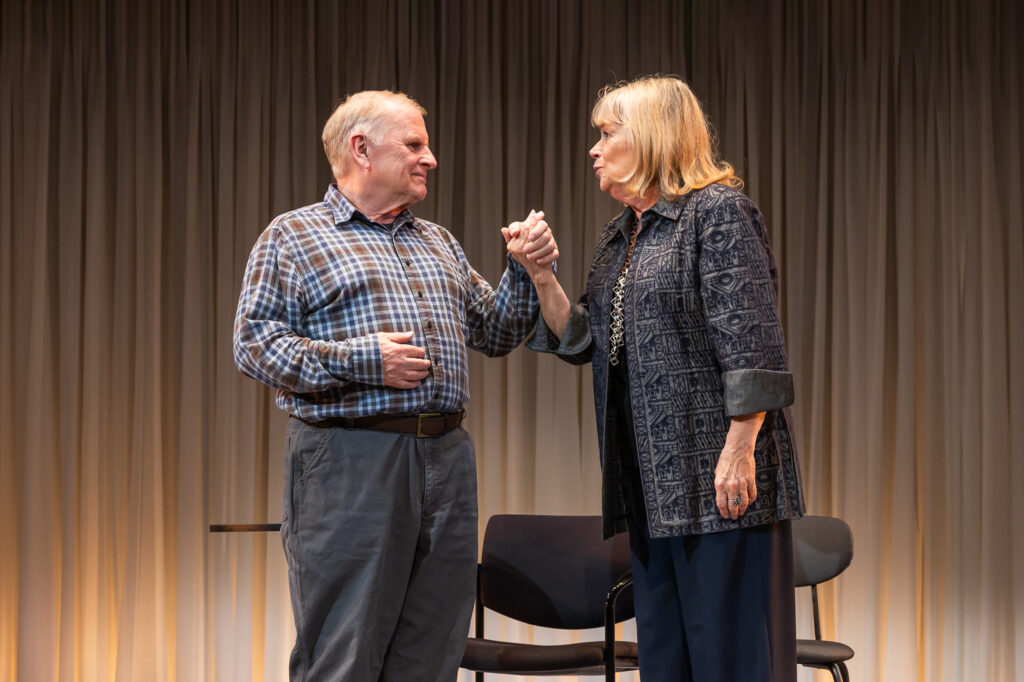
Eddie Shields and Will McGarrahan in Speakeasy’s ‘A Man of No Importance’
Photos by Nile Scott Studios

By Shelley A. Sackett

There is so much to praise about SpeakEasy Stage Company’s ‘A Man of No Importance,’ director Paul Daigneault’s swansong production after leading the company he founded for 33 years, it’s hard to know where to begin.

Terence McNally’s Tony Award-winning play, for starters, is a brilliant choice for any audience at any time, but its message is especially poignant today. A musical based on the 1994 film, it tells the story of an amateur theatre group in 1964 led by their queer, closeted bus driver leader who is determined to stage a version of “Salome” at his church, despite the objections of church authorities.

1960s Ireland had not yet progressed beyond the era of Oscar Wilde, who was jailed from 1895-7 after a criminal conviction for gross indecency for homosexual acts. Decades away from the days when “coming out” became acceptable, being gay was still a crime in Ireland. McNally, an ardent gay rights advocate, infuses his main character, Alfie Byrne, with his passion. Eddie Shields plays the charismatic character with a pitch-perfect blend of pathos, compassion, and zeal.

At the heart of the play is Alfie’s painful struggle to be his authentic self. He finds relief by channeling his energy and angst in the St. Imelda’s players, a group of local amateurs whom Alfie imbues with his own love for the magnetic magic of the theater.

Shields and cast

The rehearsal space and the camaraderie it engenders create a sanctuary where the community can gather and unapologetically be themselves. They are there for each other but most of all, they are there for Alfie and the life of the artistic world he has introduced them to.

The problem is he has audaciously chosen Wilde’s one-act tragedy, “Salome,” to stage in the Catholic church. The play-within-a-play, which depicts the attempted seduction of John the Baptist by Salome, goes too far. The Archbishop ordains the work as obscene and banishes the troupe from St. Imelda’s.

Alfie protests that the play is dramatic art at its finest, but to no avail. St. Imelda’s doors, Alfie’s sole conduit for emotional release from the loneliness and tension of leading a double life, are closed and bolted.

While Alfie is the eponymous man of no importance, it is the ensemble of first-rate supporting actors, musicians, choreography, set design, 20 songs, and brilliant directing that are the shining constellation at the epicenter of this production.

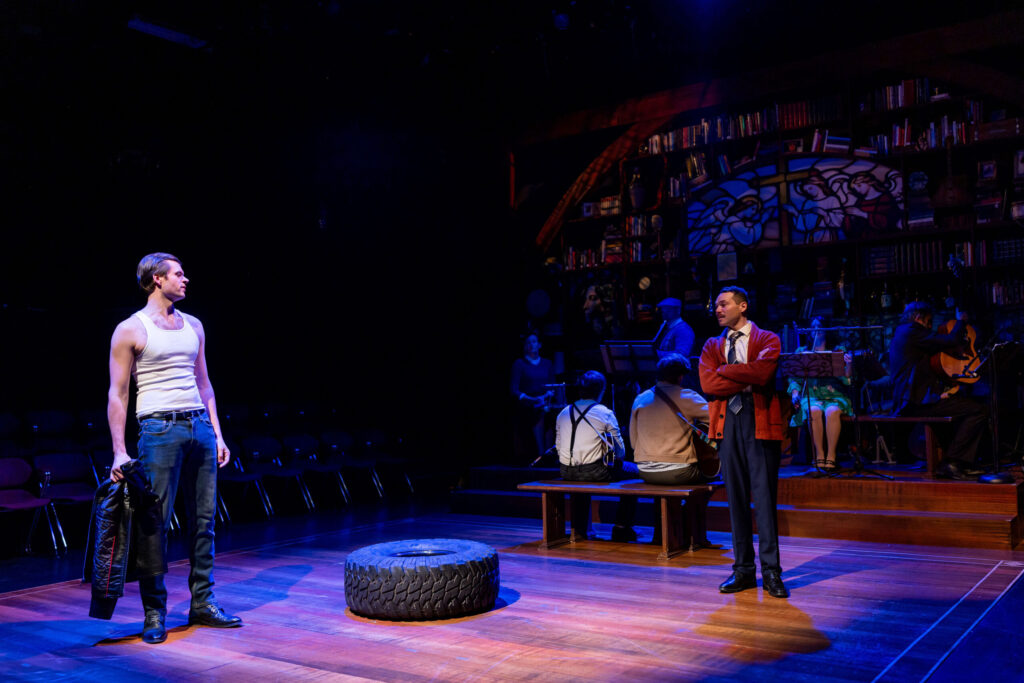
Keith Robinson and Shields

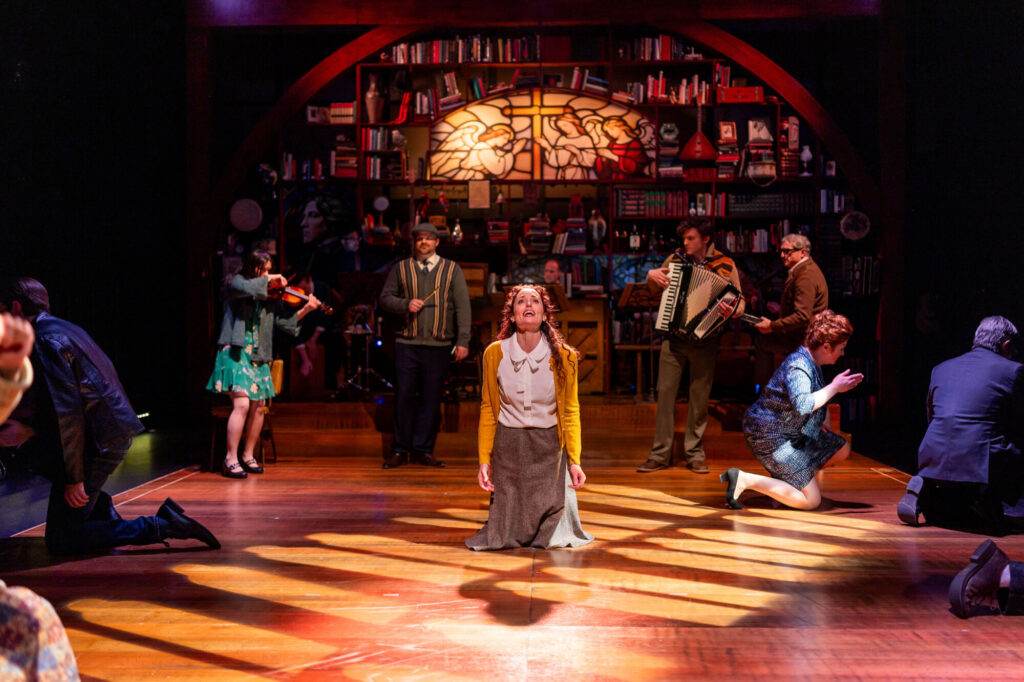
Jenna McFarland Lord’s set literally sets the stage and mood from the get-go. The audience is seated on three sides around a platform in the square. The fourth side holds a small stage with just enough room for musicians. Above them is an amalgam of Alfie’s book-stuffed bedroom, St. Imedlda’s stained glass window, and the rough-hewn wood that hints at a traditional Irish pub.

For 105 minutes (no intermission), live traditional Irish music accompanies the brilliantly poetic and funny songs (Lynn Ahrens’ lyrics and Stephen Flaherty’s music) and acts as a background. Actors double as musicians and enter, exit and linger in the aisles. The effect is live surround sound and the audience can’t stop smiling and tapping their feet in appreciation.

Master choreographer Ilyse Robbins has designed playful, effective moves for the nimble cast that are both functional (moving furniture, for example, to create a bus or pub) and wildly adorable (Kathy St. George’s tap dance is a show-stopping knockout).

Jennifer Ellis (center) and cast

As Lily, Alfie’s devoted sister who has put her life on hold until her brother finds a wife to take care of him, Aimee Doherty brings depth, humor and impeccable timing. Her duet with butcher Carney (a delightfully smarmy Sam Simahk), “Books,” is a storytelling first-rate number and a stand-alone hit.

Another storytelling marvel, “The Streets of Dublin,” takes the audience into the world of the workingman’s pub, capturing the characters’ everyday world of pints, traditional ballads and dancing. In adding the ghost of Oscar Wilde to his adaptation of the film, McNally gives Alfie the opportunity to express his true self to his idol and imaginary mentor. Will McGarrahan brings flourish and panache to red-caped Wilde, and Alfie takes his support and advice to heart. Encouraged by Wilde to “love who you love” and get rid of temptation by yielding to it, he braves the first step down the path of sexual authenticity to predictably disastrous results. Alfie is beaten up, outed, and publicly shamed.

This is, after all, still 1960, and the love that dare not speak its name has no place in a world that desperately clings to what it knows.

Despite setbacks and disappointments, the play ends on an uplifting note, one that is as relevant and helpful today as it might have been in Oscar Wilde’s day. Alfie’s theatrical community and sister don’t abandon him and he basks in a new understanding of what is of most importance in a world that thrives on conflict, humiliation and accusation.

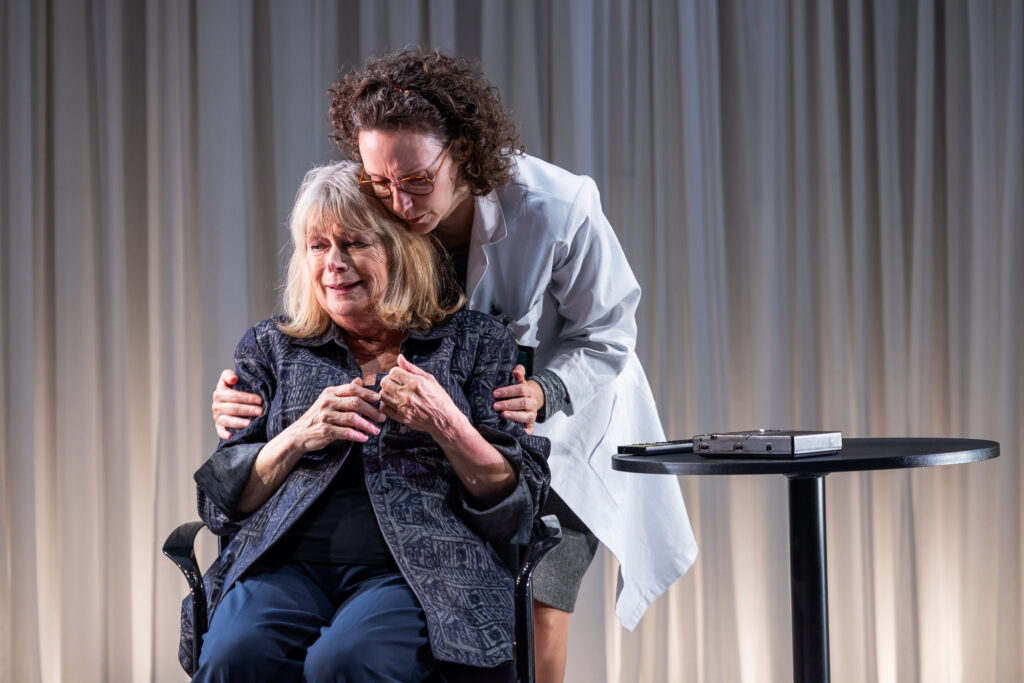
Shields and Aimee Doherty

“I used to think the most thrilling words in the English language were ‘At Rise’ as we began a new project and opened our books to the first page of the playwright’s text,” he says.

After his ordeal and the rallying of his troupes, he has changed his mind. “The most thrilling words in the English language,” he amends, “are these: ‘Good morning, my dear friends.’”

‘A Man of No Importance’ – Based on the film, ‘A Man of No Importance.’ Lyrics by Lynn Ahrens; Music by Stephen Flaherty; Book by Terrence McNally; Directed by Paul Daigneault. Choreographed by Ilyse Robbins. Music Direction by Paul S. Katz. Scenic Design by Jenna McFarland Lord. Presented by SpeakEasy Stage Company. At the Roberts Studio Theatre, Calderwood Pavilion, Boston Center for the Arts, through March 22.

For more information and tickets, go to: https://speakeasystage.com/

Flight 1619 Finally Lifts Off in SpeakEasy/Front Porch’s Ambitious ‘Ain’t No Mo’

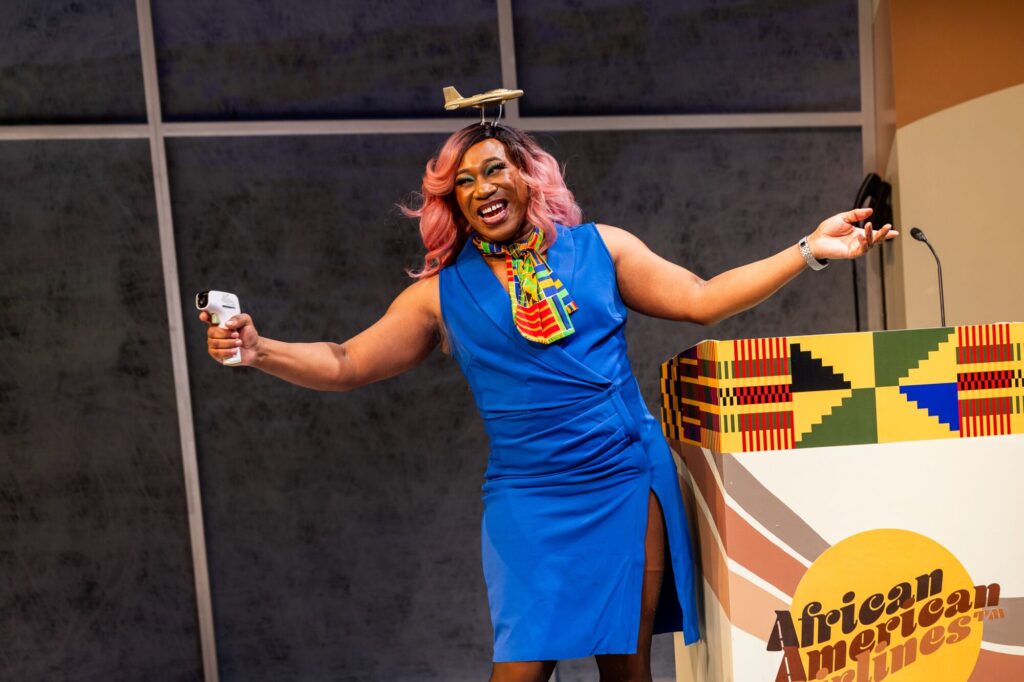
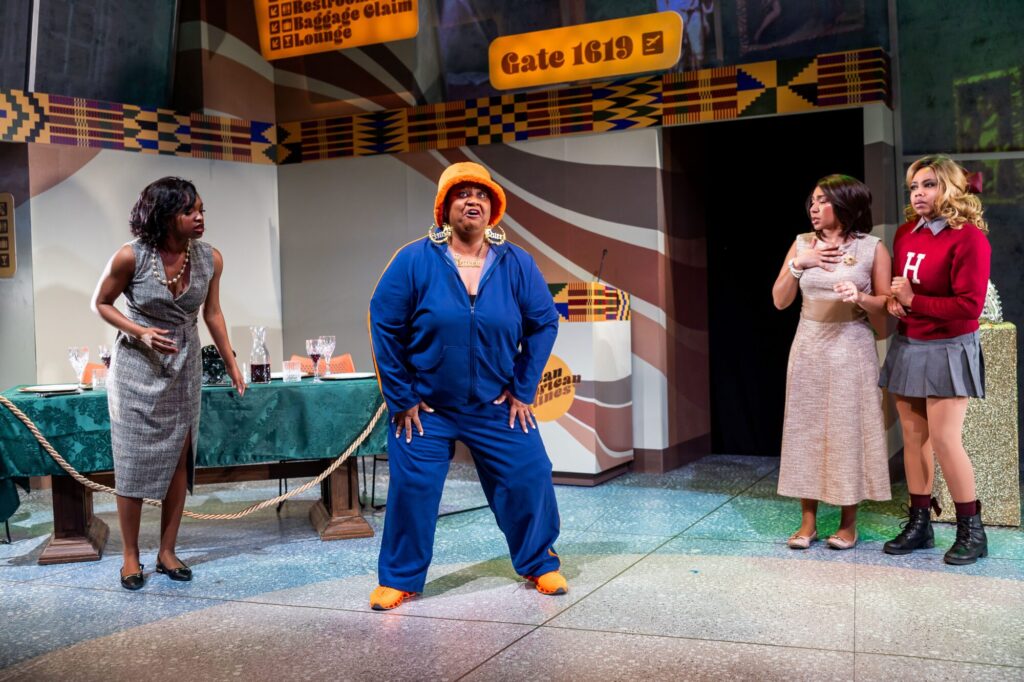
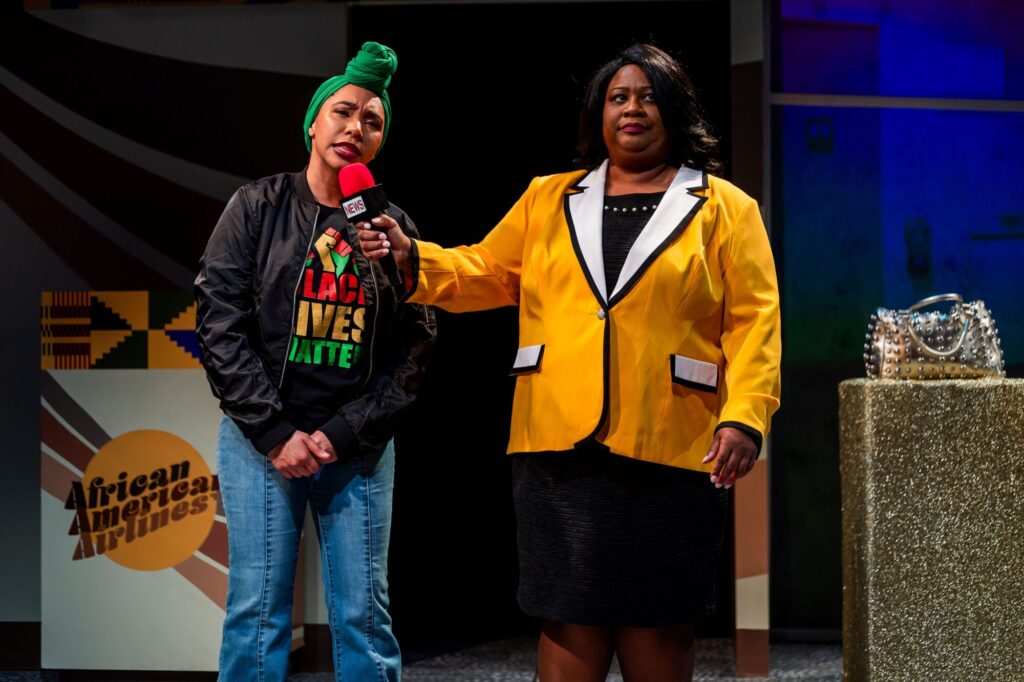
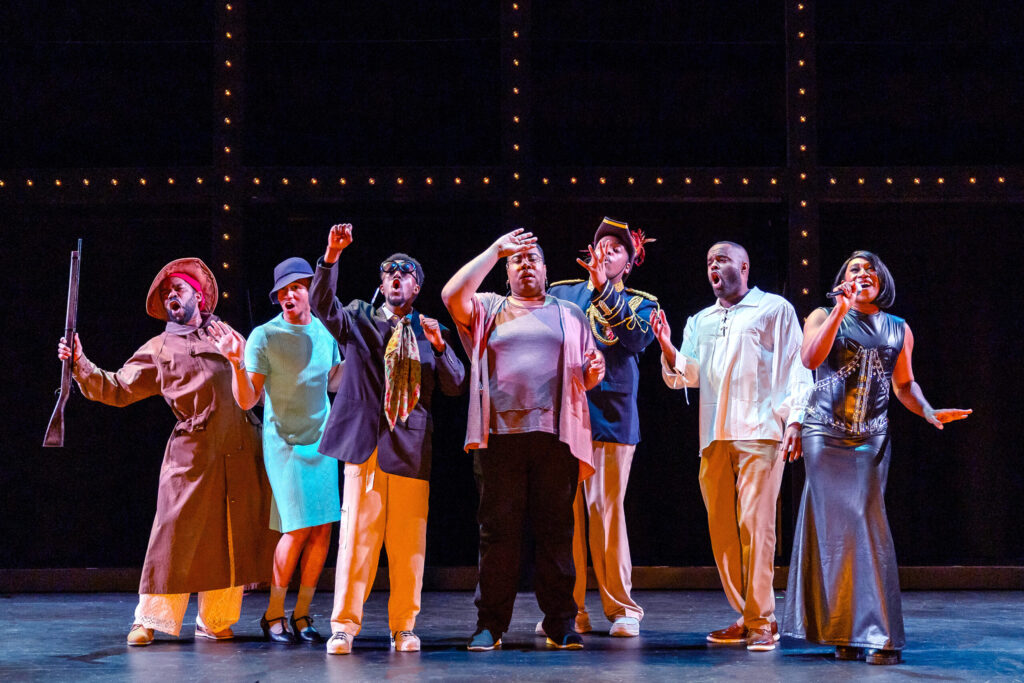
Cast of SpeakEasy/Front Porch’s ‘Ain’t No Mo’ Photos: Nile Scott Studios
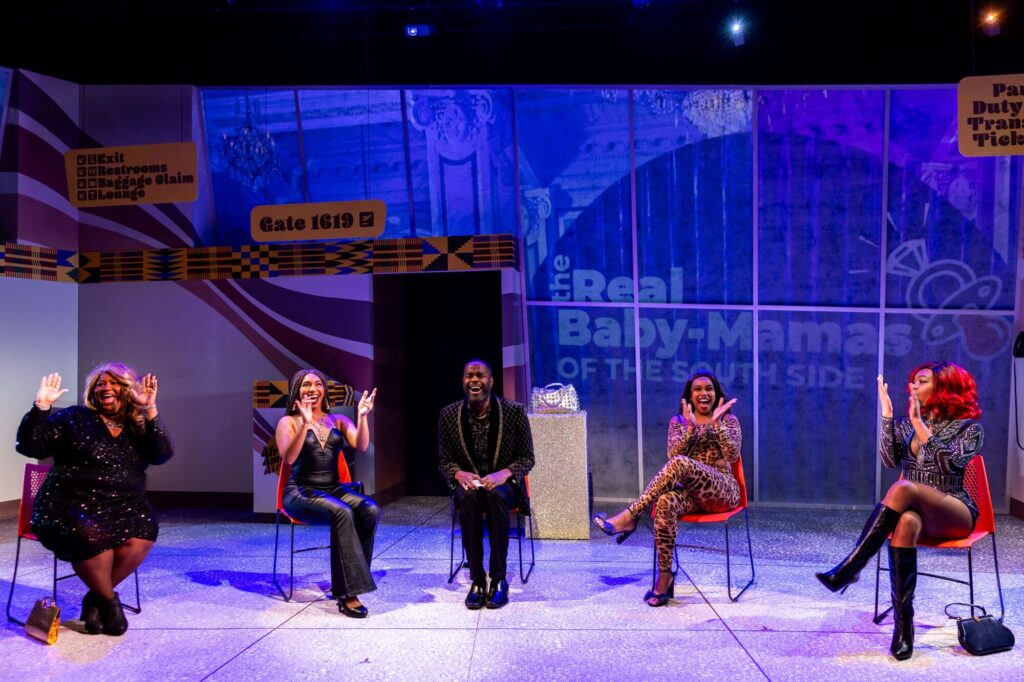
MaConnia Chesser, Kiera Prusmack, De’Lon Grant, Schanaya Barrows, and Dru Sky Berrian.

By Shelley A. Sackett

Jordan E. Cooper’s Ain’t No Mo is a complicated, uneven, scathing, audacious, and hilarious rollercoaster ride of a play. It covers a lot of ground, and Cooper dips his pen into the inkwell of every genre known to playwrights: from satire, allegory, fiction, and parody to tragedy and Shakespeare-worthy soliloquy.

Performed as a series of loosely connected vignettes that sometimes change at whiplash speed during 100 intermission-less minutes, this SpeakEasy Stage Company/Front Porch Arts Collective production is guaranteed to spark lively post-theater discussion.

Here’s the premise.

In 2016, with the election of Donald Trump and the end of Barack Obama’s presidency and its promise of Hope and Equality, African Americans descended from slaves are offered a one-way ticket “home” to Dakar, Senegal. A “dedicated observer of equal oppression,” African American Airlines’ Flight 1619 is in the house, or the White House to be more precise. Whether to stay and live life as it is in this country or leave on the “Reparations Flight” and start anew is each individual’s choice.

The government expects this will solve the problem of racism in America once and for all. Almost all eligible Blacks (millions) register to take advantage of the free flight.

What Cooper does with this simple premise, however, is staggering in terms of its brazenness and sheer creative genius. Director Dawn M. Simmons executes with full-throated flamboyance and exaggeration.

The six-actor ensemble switches into many roles easily, aided by Rachel Padula-Shufelt’s fabulous costume design and wig choices. Mac Young’s set design is both flexible and exacting, flowing smoothly between very different settings. Aja M. Jackson’s lighting design and Aubrey Dube’s sound design help create a unifying aesthetic for the show’s differing segments.

Cooper’s no-holds-barred approach is evidenced full blast even before the house lights are fully dimmed. The mild-mannered recording that announces where exits are and what to do in case of an emergency is suddenly interrupted by Peaches, the Flight 1619 airport gate attendant.

Grant Evan

“Ladies, gentleman, and those who don’t give a damn. Welcome yo ass to The Roberts Theater. Yessss, we in Boston, bitch! It’s ‘bout time to get this thing started, so I hope you had enough sense and shat before you sat,” she shouts into the sound system.

The rest of the play, which starts with the election of President Obama and ends with Flight 1619 taking off, traces the Black American experience with scenes Cooper chooses to exemplify that jumbled, complicated, painful journey. Like a book of loosely connected short stories, each scene functions independently, yet, taken together, they weave a single cloth.

What unites them is their characters’ reactions to news of the subsidized flight to Africa. Will they stay or leave? And, more importantly, why?

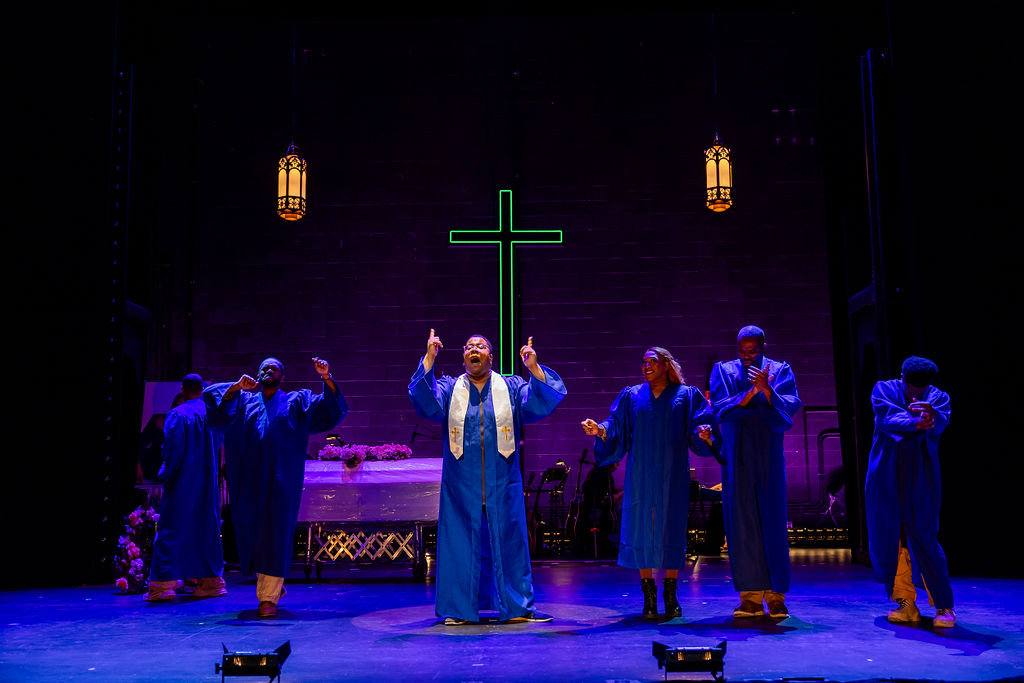
The action opens with “Book of Revelation,” a bang-up of a funeral led by Pastor Freeman (played with over-the-top verve by a terrific De’Lon Grant). It is November 4, 2008, and the Black community has gathered to celebrate Obama’s election and lay Brother Righttocomplain, the embodiment of protest and injustice, to rest.

“Ain’t no mo’ shot down dreams with its blood soaking the concrete,” Freeman bellows. “Ain’t no mo’ riots.”

Now that a Black president has been elected, the unrealistic assumption is that centuries of racism and discrimination will suddenly be reversed and a new era of promise will be escorted in.

The joy and celebration is short-lived. After this gospel-infused scene, the mood and time shifts to 2016 and the election of Trump. White backlash against black Americans and ginned-up fear and resentment will set the next agenda.

Between each plotted scene, we witness morsels of what Peaches (a scene-stealing non-binary Grant Evan) is dealing with as the sole check-in agent for Flight 1619. A larger-than-life drag queen who wears a hot pink wig, Kente scarf, and model airplane-adorned tiara; her role is the play’s only constant through a series of sketches and settings.

She checks in various passengers and offers counsel to those who are hesitant. She also prepares Miss Bag, a suitcase she claims holds “our entire story as a people in this country,” and encourages passengers to drop their stories in the bag so they may bring it to Africa. She warns those who stay behind will be subjected to “extreme racial transmogrification” by “The Powers That Be”: they will be turned into white people.

The audience comes to trust her voice and feel her frustration and angst as she single-handedly supervises boarding millions. She is the reliable narrator, part mother hen and part Greek chorus.

Dru Sky Berrian, MaConnia Chesser, Kiera Prusmack, and Schanaya Barrows

With “Circle of Life,” Cooper tackles the heartbreak of young lives ended by violence and police brutality and the unwillingness of Trisha (Dru Sky Berrian), pregnant by Damien (Grant), to bring a future victim into the world. “A better time is coming. We just have to wait for it,” Damien assures her. Despite his pleas, she is adamant. So are the million other women in line at the Sister Girl We Slay All Day Cause Beyonce Say Community Center, a clinic oasis in a country where abortions are no longer available. Trisha is Number 73,545.

“Real Baby Mamas of the South Side” is a parody of the Real Housewives franchise. This one focused on four black women pretending to have multiple baby daddies and an obsequious host who keeps the provocation flowing. One panelist isn’t even black but is “transracial,’ white Rachel dressed as black Rachonda, “choosing to be herself” and “living her truth” as a black woman.

Tracy, another panelist, breaks character and confronts her. “Race is not a choice. It’s a fact,” she states. Unlike the Rachondas of the world, her skin and the experiences that come with it are NOT optional.

Here, and at many other times, Cooper squanders an opportunity to dig deep into some meaty issues like exploitation, appropriation, stereotyping, ownership, protection of black culture and the tipping point between the humorous and the hateful. Instead, he takes the easy way out, letting the scene devolve into a catfight, leaving the audience unsatisfied and his craftsmanship in question.

In “Green” and “Untitled Prison Play,” Cooper makes his point with more clarity and self-discipline. Each scene features Maconnia Chesser, who anchors and elevates them. In “Green,” Cooper lampoons rich black families who – in this case literally — buried their blackness and partook in the material rewards of assimilation. They have no intention of going anywhere, certainly not to Africa. They have bought into the American Dream, despite its hefty price tag. This is now their America, too.

Chesser plays Black, the human personification of their family’s “blackness,” locked away in the basement by the family’s deceased patriarch for forty years while he became rich. Suddenly, she is set free. She has a lot to say. And she is pissed off.

“Now is the chance to learn who you really are,” she tells them. “I am your family’s black. Come on, we have a plane to catch.” Instead, they plead, threaten and eventually try to shove her back into the basement. No way is this Pandora going back into her box.

Again, the scene devolves into chaos and violence, and again, we are left unsure what point Cooper was trying to make and why.

In “Untitled Prison Play,” the play’s most moving scene, Chesser plays an inmate who can’t leave prison without signing for her possessions and who won’t sign until everything she had when first incarcerated is accounted for and returned. What she’s missing are her joy and a little piece of chaotic peace. Her name. Her place on earth. And, most of all, her smile. Her real smile.

But her choice is stark. Refuse to sign and return to her cell or leave and find herself some new stuff. Like Freedom.

Flight 1619 does finally takes off, but not before Peaches brings down the house with a lightning bolt monologue. There are even last-minute spoilers and pyrotechnics.

When Cooper started Ain’t No Mo, he was just a high school student. Its genesis was in reaction to an incident of police intimidation that rocked and changed him. Its Off-Broadway premiere happened when he was just 24 years old and three years later, Cooper became the youngest Black American to make his Broadway playwriting debut and the youngest Black American playwright ever nominated for a Tony Award. Ain’t No Mo garnered six nominations, including Best Drama, despite its closing after a mere three-week run.

To be sure, Cooper’s play is hardly flawless. It is dated and full of platitudes, pacing issues, and tiresome, gratuitous expletives. It is also in dire need of judicious breadth and length editing.

But Cooper’s pen is a magic wand as well, spinning a smart, confident and grand play out of an undisciplined galaxy of issues and ideas. And when the smoke clears and the stage finally quiets, we’re surprised by the number of important questions left rolling around in our minds, like party favors.

Kiera Prusmack and MaConnia Chesser

If Miss Bag is the “carrier of our entire story as a people in this country” — the music, art, culture, political ideas, and everything else Blacks have contributed to the American landscape — should it travel to a new destination? Will it reassimilate or hold its owners back, married to an old reality while trying to forge a new one?

When émigrés board a plane, for example, perhaps with just one bag, what do they leave behind? What does the country they leave lose? And after they leave, whose story is theirs to tell? What do we do when the story is over? Perhaps, most importantly, where does freedom fit in if its price is a future without a past?

And these questions are just for starters.

‘Ain’t No Mo’.’ Written by Jordan E. Cooper. Directed by Dawn M. Simmons. Co-produced by SpeakEasy Stage and Front Porch Arts Collective at the Calderwood Pavilion, 527 Tremont Street, through February 8.

For more information and to buy tickets, visit https://speakeasystage.com/shows/2025/01/aint-no-mo/

SpeakEasy’s “Pru Payne” Is A Must See for Fans of Fabulous Theater

Karen MacDonald and Gordon Clapp in SpeakEasy Stage Company’s production of Pru Payne.
Photo: Nile Scott Studios

By Shelley A. Sackett

Karen MacDonald, recently introduced as “the empress of Boston,” adds another gem to her tiara with her portrayal of Prudence Payne, a Dorothy Parker-esque reviewer whose sharp wit, acid tongue and encyclopedic familiarity with minutiae of all things cultural have earned her many awards. We are introduced to her as she and her son, Thomas (De’Lon Grant) sit in the Brook Hollow clinic anteroom, awaiting a consultation with a doctor. The television is blaring pablum. Pru regally grabs the remote, waves it like a magic wand. She tries to turn the television set off, but can’t. She retakes her seat, slumping in confused defeat. Tommy reminds her that there are other people in the room who may want to continue watching. “Re. Member,” Pru says, enunciating each letter as if it were a syllable unto itself.

In a flash of a flashback, the music cues and we are transported to 1988 (kudos to Set Designers Christopher and Justin Swader, whose elegantly simple set easily morphs in our mind’s eye from medical waiting room to time travel “Beam Me Up Scotty” mode to grand ceremonial dais.) Pru is at the pinnacle of her career, about to become the first woman and first critic to receive the alliteratively laden AAAA’s (American Academy of Arts and Aesthetics) Abernathy Award.

We catch her as she mounts the podium amidst resounding applause. Her acceptance speech is impudent, provocative and riotously funny. She is brilliant and revels in peppering her monologue with fast-paced literary citations that showcase her sophisticated and seasoned palette while challenging her audience to guess their source. If there were a Mensa Jeopardy, Pru would be its host.

MacDonald, Marianna Bassham

But a sudden shift, almost imperceptible at first, indicates all is not quite right with Pru. She devolves into F-bombs, rectal references and borderline slander. Thomas approaches her, but she waves him away. When she loses her place and starts to panic on stage, MacDonald’s prodigious skills are on full display. In the blink of an eye, her Pru actually pales, her face sags, her shoulders droop and her speech falters. Thomas rescues her and escorts her to her seat. We are back in the waiting room, where the TV continues to blame.

Brook Hollow, it turns out, is a Massachusetts memory clinic where Thomas has brought Pru for evaluation following her speech and the uproar it causes. To smooth the turbulent wake Pru left with the AAAA, he has offered up her memoir as a peace offering, due the following fall. It is only two weeks later, yet we sense that Pru has deteriorated. She is still irreverent and acerbic, yet her confusion and slips are more frequent.

Thomas is desperate to thwart his mother’s memory loss. It is an irony lost to no one that a woman whose memory is galloping away is chasing her past before it is out of reach in order to write her memoir.

For the next 90 intermission-less minutes, we ride shotgun over two decades as Pru travels down the path of full-blown, irreversible dementia. If this sounds gut-wrenching and jarring, it is. Yet, in the skilled hands of master wordsmith and award-winning playwright Steven Drukman (and under Paul Daigneault’s flawless and sensitive direction), it is also rip-roaringly funny and brimming with empathy. The Newton native has married head and heart in a tightly crafted script that abounds in clever one-liners and zinger plays on words. (It also has tons of fun local references). Painful as the topic and Pru’s story are, Drukman’s humor and hopefulness dull the knife’s sharp blade just enough to prevent the play from circling the drain of utter despair.

Greg Maraio, De’Lon Grant

He has also penned a group of supporting characters who each have independent agendas and stories, yet who interlace as an ensemble that embraces and supports the play’s eponymous Pru.

Pru and Thomas, an aspiring novelist, meet with Dr. Dolan (the magnificent Marianna Bassham in an unfortunately understated, somewhat unimaginative role), who, unsurprisingly, wants to admit Pru for observation. They start to protest when Pru spots Gus Cadahy (the quietly show-stopping Emmy, SAG and IRNE Awards winner Gordon Clapp), a custodial engineer who is accompanied by his son, Art (Greg Maraio). They, too, are at Brook Hollow so Gus can be evaluated for memory decline and associated behaviors.

Pru and Gus are yin and yang, opposite forces that form a whole in a balance that is always changing. He is lower middle class, uneducated, and speaks with a thick Boston accent. She is stratospherically wealthy, wears her pedigree on her sleeve, and effects a Brahmin patois. He is unapologetic, hilarious and down to earth, determined to squeeze every last drop of fun and pleasure out of life. He makes no excuses and accepts what comes his way.

She is calculated, driven and controlling. “Good enough” are two words meant to be spat, like a curse. Despite her sophistication and breeding, she is far crasser than the social mores minded Gus.

Their love affair at Brook Hollow opens the door to more than a delineation of their differences. Pru is Gus’ missing piece and vice versa. He softens and grounds her, whether playing gin, dancing, making love or reeling her back from memory’s steep precipice. Pru, for the first time in her life, is able to let go, let loose and let herself love and be loved.

MacDonald, Clapp

Meanwhile, their sons have their own backstory, which would be a spoiler to divulge other than to let slip that, while their parents are creating new memories, their sons are revisiting old ones.

Boston native Maraio is terrific as Art, both in his interactions with his father and with Thomas, especially as concerns their parents’ relationship. He brings a nuanced vulnerability to his external impermeability. Grant, so wonderful as Keith in “A Case for the Existence of God,” brings that same sweet openness to Thomas, a quiet defenselessness and optimism.

Although Drukman meanders peripherally into timely topics of the 1990s and 2000s (AIDS, politics, and the demise of cultural standards, for example), he has the good sense to use this detour for context rather than theme. He has written an important and riveting play about a timely and difficult subject that is, in its own right, much more than just “good enough.”

We ache for Pru and her family, but covet our view through the keyhole at that in-between stage where one starts to become unglued. yet is still together enough to be aware of what is happening (and what is to come). We also come face to face with some heady and introspective queries.

Clapp, MacDonald

How, for example, do you sum up a person, especially one whose life ends in the black hole of dementia and Alzheimer’s Disease? Who is the real Pru? How should she be remembered? Is it fair to her to remember her in her absolute decline or is it dishonest to remember her otherwise? Do we curate our own memories? Do others curate theirs of us? At the end of the day, does it really matter?

As her own memories dissolve and past human connections along with them, Pru has moments lucid enough to still contemplate Pru-worthy big picture questions. What if, she wonders, her entire life was just a memory trick?

What if, indeed.

“Pru Payne”— Written by Steven Drukman. Directed by Paul Daugneault. Presented by SpeakEasy Stage at Boston Center for the Arts, Calderwood Pavillion, 539 Tremont St., Boston, through Nov. 16.For tickets and more information, go to https://speakeasystage.com/

The Wheels Go ‘Round and ‘Round and ‘Round in SpeakEasy Stage/Front Porch’s ‘A Strange Loop.’


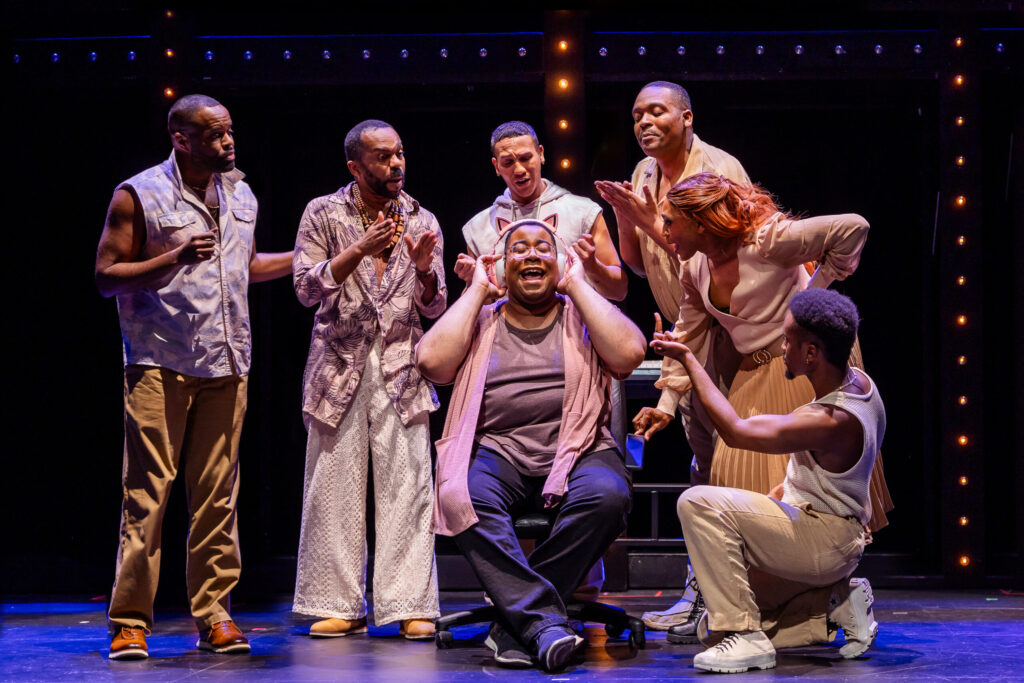
Kai Clifton (center) and the company of A STRANGE LOOP at Speakeasy Stage. From left: De’Lon Grant, Davron S. Monroe, Jonathan Melo, Aaron Michael Ray (background), Grant Evan, and Zion Middleton (kneeling). photos by Maggie Hall Photography.

By Shelley A. Sackett

Playwright Michael R. Jackson, a heavy-set Black queer man, has brought the concept of sharing to a new level in his Pulitzer Prize and Tony Award-winning musical, “A Strange Loop.” The compulsively introspective show, which runs at 100 intermission-less minutes, spelunks into the deepest crevices of the anguished mind of its hero, Usher, a fat, Black, queer man writing a musical called “A Strange Loop” about a fat, Black queer man who’s writing a musical about a fat Black queer man.

It’s a crawl through a wormhole rigged with armed psychological and emotional IEDs, self-loathing, and regrets. It’s also a raucous and playful musical, full of humor, harmony, colorful characters, and even more colorful (potty) language.

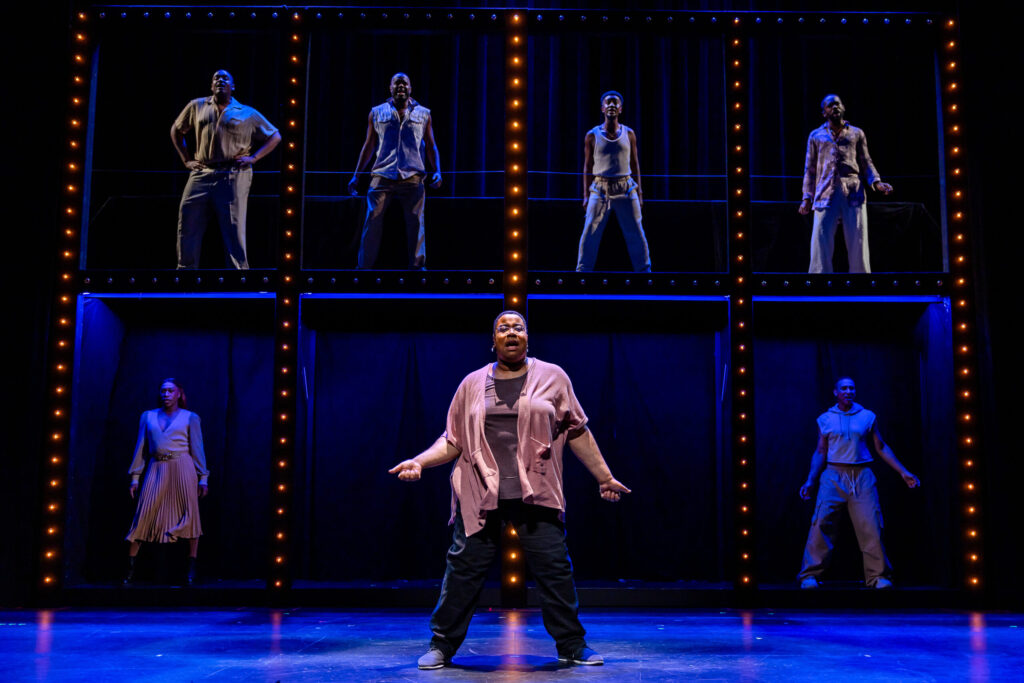
The play opens on Jon Savage’s effective, slick set of eight cubes lit in Broadway blue neon. (The only guidance Jackson’s script offers is to describe the setting as “A loop within a loop within a loop inside a perception of one man’s reality.”) Characters meant to represent Usher’s thoughts stand inside each cube. They dance. They sing. The effect is a cross between “Shindig” and “Hollywood Squares.”

We meet Usher (Kai Clifton) as the Thoughts dress him in his professional usher’s uniform. Usher works to make money in a theater where “The Lion King” reigns while he tries to write his play, a “big, Black, queer-ass, American Broadway show.” As he externally prepares to deal with the patrons who will soon flood the theater’s aisles, his mind is busy writing his play. He eagerly shares this work-in-progress with the audience.

““A Strange Loop” will have black shit! All thoughts. And white shit! It’ll give you uptown and downtown! With truth-telling and butt-fucking! There will be butt-fucking!” he belts out with gleeful forewarning.

It’s as if Jackson and Usher want to tip off their audience, “This ain’t no Disney musical, and make no mistake, we aim to deliver,” which they do, especially on the last item.

Usher leads a complicated inner life. His mind is a six-lane highway where Thoughts criticize, intimidate, denigrate, and insult his every move. Every time he resolves to dig himself out of his miserable routine, his thoughts disrupt and derail his plans.

The supporting cast of Thoughts #1-6, donning eye-catching costumes (Becca Jewett), are a vicious gang representing Usher’s agent (Fairweather), his inner cynic (Your Daily Self Loathing) and a host of other unhelpful characters, most notably Mom and Dad.

Through these inner/outer conversations between Usher and himself, Usher reveals his quest to peel back the layers of labels (Black, queer, etc.) and discover who he really is. We learn about all the issues he struggles with, including family pressures to ditch his sexual and professional preferences and embrace the Lord and style of Tyler Perry’s gospel melodramas; trying to figure out what it means to be a Black playwright writing a Black play; and struggling with what today’s world requires if one is to be “Black enough” and “gay enough.”

He also is coping with the bull’s eye homophobia, fatphobia, racism, and a white theater industry painted on his back.

All this should (and does) sound heartbreaking and overbearing. Yet, Jackson manages to pull off a musical that infuses humor and sincerity into a story replete with sadness, desolation, and rejection.

Through seventeen songs, Jackson’s lyrics tell a multilayered story of Usher’s angst-ridden life.

He longs for the unhampered freedom white girls have, yet also feels obligated to fulfill Black boy stereotypes (“Inner White Girl”). His doctor tells him he’s not gay enough because he’s only having sex once a year, but when Usher starts using dating apps, the result is predictably humiliating. He meets an engaging, flirtatious stranger only to discover he is a figment of his imagination.

The list of disappointments and rejections grows longer. His mother calls him on his birthday to remind him homosexuality is a sin, and his father asks if he’s contracted AIDS yet.

The best scenes, dramatically and musically, are those that have anything to do with Gospel music. When Usher’s agent tells him Tyler Perry is looking for a ghostwriter for his next gospel play, Usher turns up his nose in disgust. His Thoughts accuse him of being a “race traitor,” and in a hilarious scene, historical Black figures persuade him to take the job (“Tyler Perry Writes Real Life”). The full replication of a Tyler Perry set and lyrics that skewer Usher’s parents and parody Tyler (“Precious Little Dream/AIDS Is God’s Punishment”) are a welcome break. The actors’ voices (especially Clifton’s) awaken and strut their range and vibrancy. The lyrics are edgy and funny, the tune snappy and toe-tapping.

With the exception of distracting and annoying technical problems with the sound mixing (the actors’ voices were frequently not mic’d) and muffled lyrics, the production is effective, from Maurice Emmanuel Parent’s thoughtful direction to David Freeman Coleman’s music direction and conducting. The six Thoughts shine individually and blend seamlessly as an ensemble.

But it is Clifton as Usher who literally carries the weight of the show, and he is more than up to the task. Despite the temptation to wash our hands in frustration with this character who can’t seem to get out of his own way, his unfortunate circumstances notwithstanding), Clifton brings an underlying earnestness and likeability that make it impossible to abandon him. Plus, Clifton lets loose a powerful set of pipes during certain numbers (notably the gospel songs).

It’s hard to understand Jackson’s real purpose in writing “A Strange Loop.” It takes its title from a Liz Pfair song and from Douglas Hofstadter’s scientific concept that when a person only moves up or down, they’ll end up where they started. In other words, no matter how far or fast they think they’re going, they are essentially marching in place.

Jackson, now 43, said that although his play is not formally autobiographical, he began writing it as a monologue in his early 20s when he was experiencing himself as “nothing more than a mass of undesirable fat, Black gay molecules floating in space without purpose.”

He wrote Usher as a 26-year-old under unimaginable pressure. He is full of self-doubt and self-loathing, yet compulsively writes about himself in the belief it will magically change him. The more he plumbs his inner self, the more guilt and shame he dredges up. If writing “A Strange Loop” was meant to be Usher’s psychological catharsis, it misses its mark.

After all, Usher’s closing words are:

“Someone whose self-perception is based upon a lie,

Someone whose only problem is with the pronoun “I.”

Maybe I don’t need changing

Maybe I should regroup

’Cause change is just an illusion.

If thoughts are just an illusion, then what a strange, strange loop.”

And maybe that is Jackson’s point, after all. Inside his endless, strange loop of destructive thoughts and desperate hope that he can change who he is, Usher is his own worst enemy. Not only does he see himself as a failure, he assumes that everyone sees him as he sees himself.

His illusions are negative delusions.

It takes someone outside the loop—an impartial audience, for example—to appreciate that underneath this angsty, meek gay Black man beats the heart of a brave, creative person full of caustic wit and laser-sharp insight. We can only hope that Usher and all those suffering as he does can jump off the treadmill of self-doubt and fear, take a deep cleansing breath, and learn to love and accept themselves.

‘A Strange Loop’ — Book, Music and Lyrics by Michael R. Jackson. Directed by Maurice Emmanuel Parent. Music Direction by David Freeman Coleman. Choreographed by Taavon Gamble. Co-produced by SpeakEasy Stage and Front Porch Arts Collective at the Calderwood Pavilion, 527 Tremont Street, through May 25.

For more information and tickets, visit https://speakeasystage.com/
No One Gets a Free Ride in Speakeasy’s Rich ‘Cost of Living’

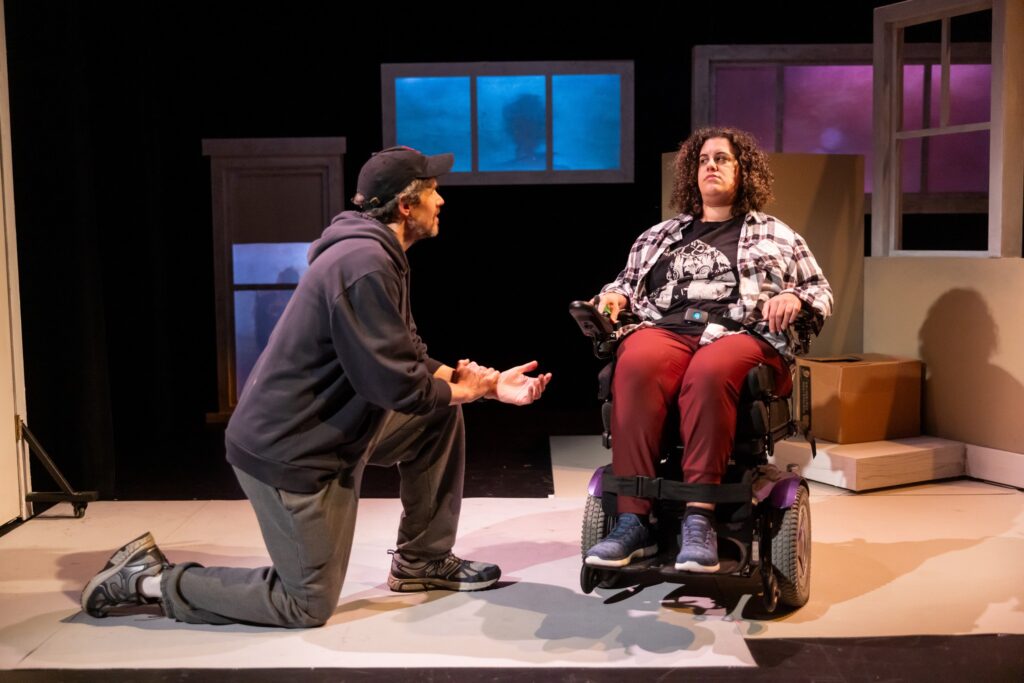
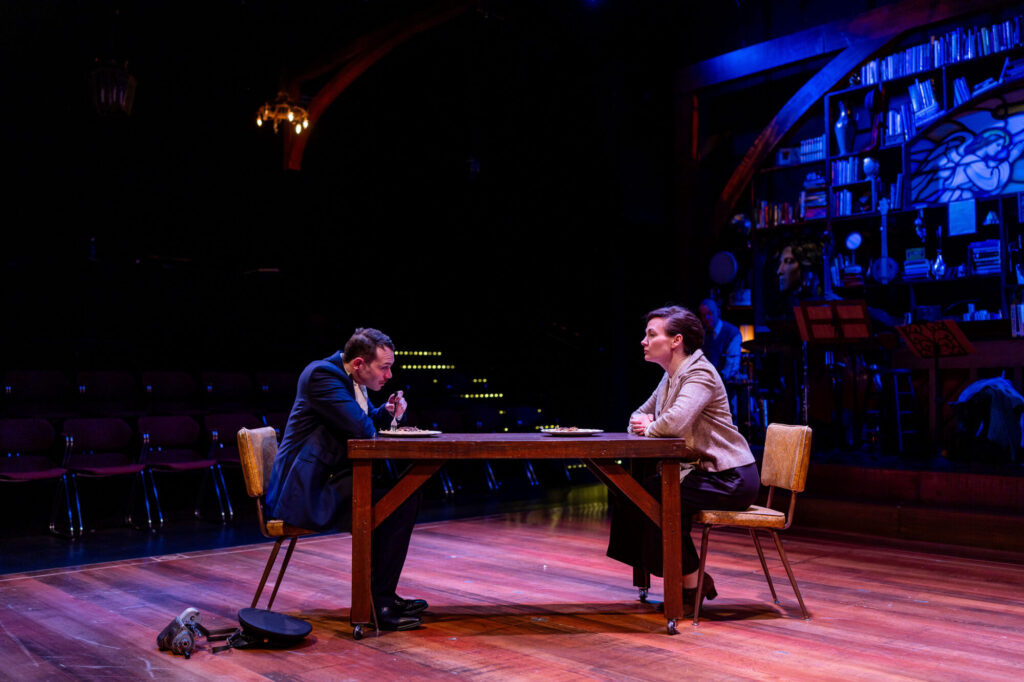
Stephanie Gould and Lewis D. Wheeler in “Cost of Living” at Speakeasy Stage
Photos: Nile Scott Studios

By Shelley A. Sackett

At its heart, ‘Cost of Living,’ is about relationships: how two people meet; how and whether they connect, separate, and reconnect; and how they handle caring and being cared for.

In playwright Martyna Majok’s magic hands, the fact that one person in each relationship has a disability is secondary (though hardly unimportant). Rather, she focuses on the universal vicissitudes of life — emotional, financial, good luck and bad, good health and illness — and how we handle them. The delicacy and craftsmanship of that artistic feat won her the 2018 Pulitzer-Prize award for Drama.

In ‘Cost of Living,’ everyone carries baggage, some external and others internal. The richness of Majok’s script lies in the way she peels back her character’s outer, tougher layers to reveal the softer, vulnerable center within.

Eddie (a magnificent Lewis D. Wheeler) is an unlucky former long-distance trucker. We meet him in a bar in the play’s riveting opening monologue, during which he pours out his grief over the recent loss of his wife, Ani (a top-notch Stephanie Gould). We learn quite a bit about him. He is funny, lonely and somewhat introspective. He is also boyishly guileless in a way that’s hard to resist. He is 12 years sober, struggles to make ends meet, and believes his dead wife can text him from the beyond, where he hopes she is having the time of her afterlife.

Gina Fonseca, Sean Leviashvill

In flashbacks, we meet Ani, Eddie’s estranged wife. Just released from the hospital after a horrific car accident that shattered her spine, she must learn to adjust to life as a paraplegic who needs constant care. She is alone with her wheelchair in an apartment filled with boxes and gloom.

Suddenly, Eddie shows up, unannounced and unexpected. These two are in that marital purgatory of married but separated, separated but not yet divorced, and from the get go, it is easy to see that whatever flame drew them together initially still smolders.

Their easy going banter and underlying affection shines through even Ani’s most withering and acerbic comments. “We have too much dirt on each other,” Ani says, and she doesn’t mean that that’s necessarily a bad thing. Eddie just wants to be near her, needs to be near her, even though he now lives with the woman who was the reason the marriage broke up.

Ani gives him no end of lip, but Eddie, resolute and undaunted, cajoles and pleads and turns on his considerable charm. Eventually she relents, and Eddie becomes her full time caregiver.

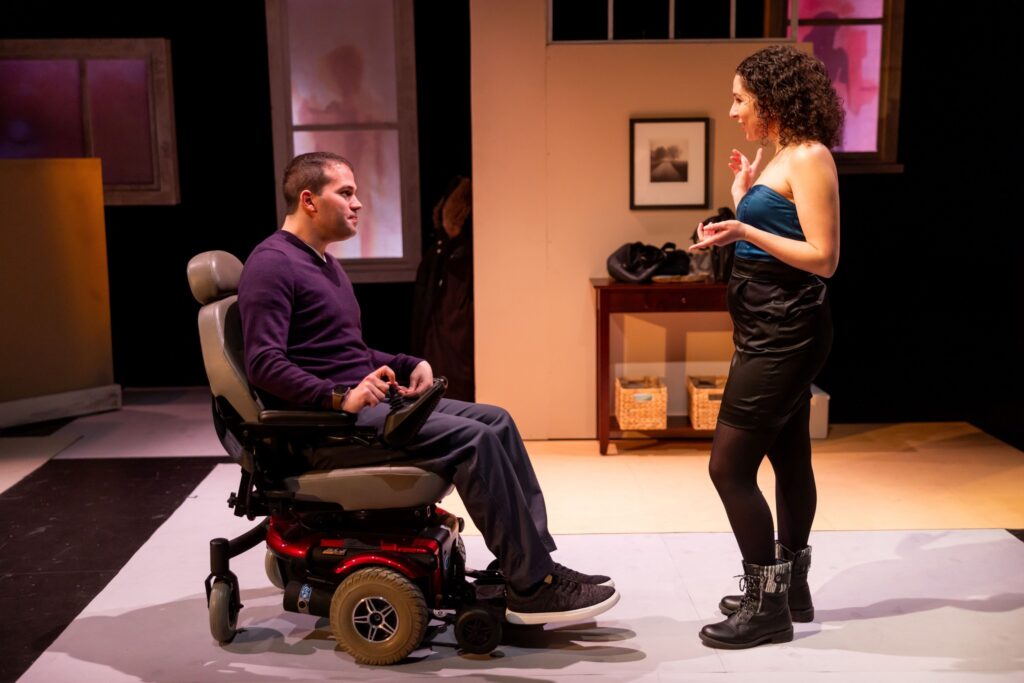
Across town in a tonier part of New Jersey, lives John (an effective Sean Leviashvill), a wealthy and nit-picky (think Niles Crane in “Frasier”) Princeton University doctoral student who happens to have cerebral palsy. We meet him in his wheelchair as he is interviewing — make that grilling — Jess (an outstanding Gina Fonseca) for the job as his early morning caretaker.

“How much life have you lived?” he demands over and over again. Turns out that Jess, a first generation working-class graduate of Princeton, has lived plenty. She works at a bar often until 4 am, but assures John she can handle the hours, physical demands and intellectual sparring that caring for him would involve.

She says she needs the money, but it’s clear she needs more than that. This job provides as much a life line for her as she would for John.

The more John tries to dissuade her, the more Jess digs in her heels, determined to land this job. Even at this meet and greet, it’s evident that these two will be a good match. Despite the gaping disparities in their physical abilities and economic class, they are intellectual equals who enjoy a good academic romp.

Wheeler, Gould

“Working all the time doesn’t seem like a life,” John tells her right before hiring her. Unspoken but communicated telepathically is Jess’s response: Neither does sitting alone in a fancy apartment. These are two kind-hearted, lonely people who need each other’s care in more ways than they realize.

Over the course of 90 minutes (no intermission), these two relationships develop in tandem and, thanks to Janie E. Howland’s clever set, side by side. The action switches seamlessly from Ani’s meager digs to John’s upscale apartment with the rolling in and out of various props and sectioned set pieces.

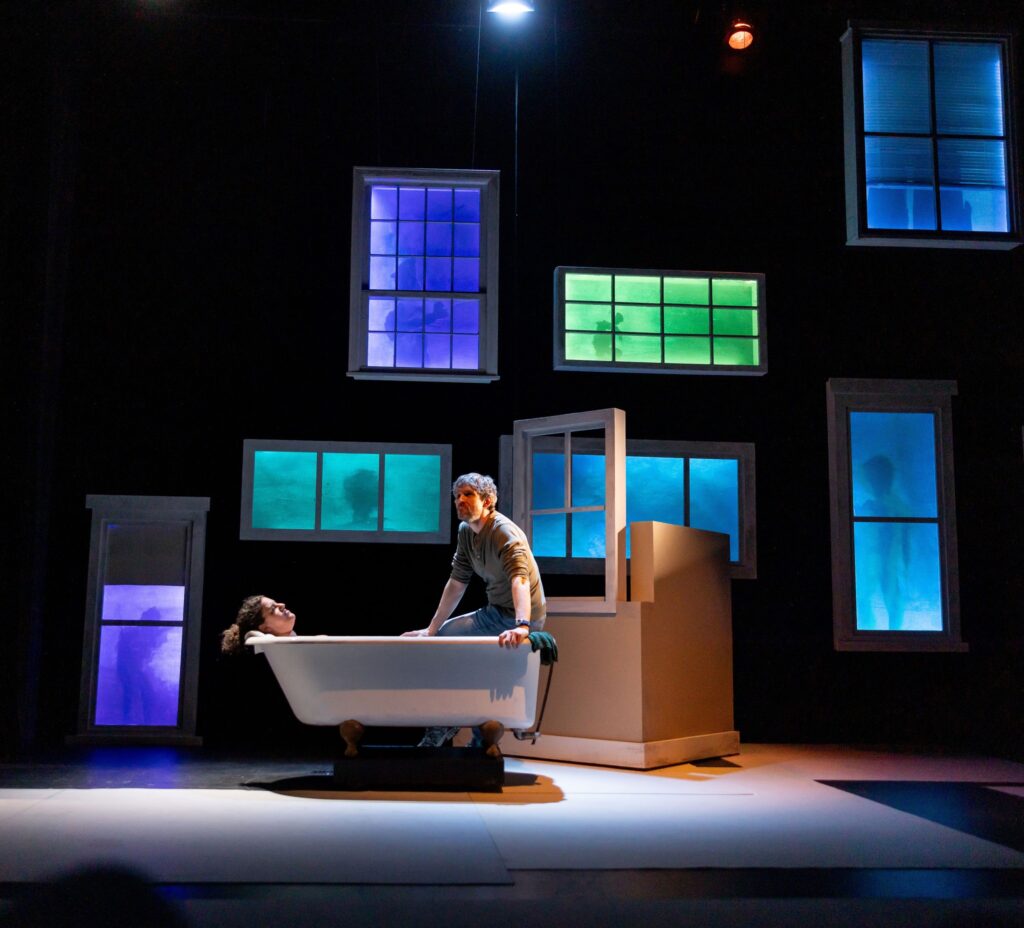
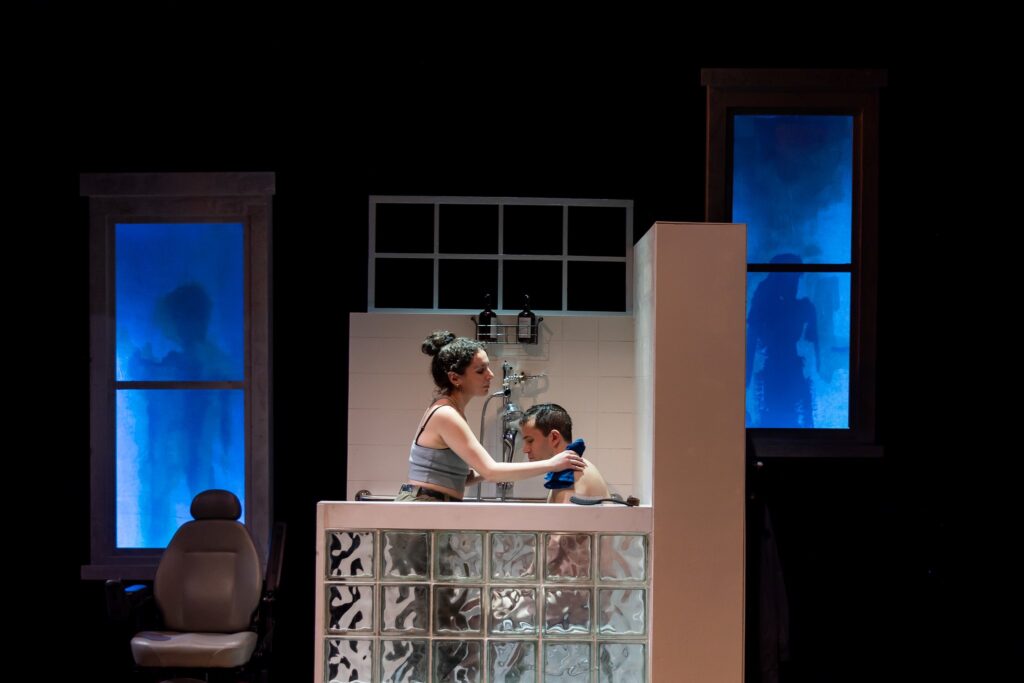
We really feel as if we are there in the room with these couples. Howland built a perimeter of walls and peppered them with large window frames that house backlit silhouettes. The effect creates a space where the audience feels both the discomfort of being watched (and judged?) and the relief of being in a safe and cozy environment, sealed off from the outside world which can look in but not enter.

In the show’s two most affecting scenes, the stage is magically transformed into a bathroom. Eddie pushes Ani onstage in a full length tub of water (Amanda E. Fallon’s lighting design is breathtaking) and tenderly washes her for the first time since the accident. Although Ani loses none of her acerbic edge, there is a playful tenderness that shines through. Eddie wears his heart on his sleeve, caring and solicitous in ways he probably wasn’t during their marriage. Watching these two have a second chance at getting back to the essence of what drew them together in the beginning is as emotionally satisfying as it is structurally effective.

Equally touching is the scene where Jess showers John. His edges soften as he trusts her with his vulnerabilities and fears. She responds with affectionate competence and confidence, allaying his concern while basking in the closeness she yearns for.

In less skillful hands, these scenes could have been sappy, awkward or implausible. Under Alex Lonati’s spot on, sensitive direction, they instead serve as a magic keyhole through which the audience really gets inside these characters’ skins and witnesses their revelations that they are lonely and alone. Each not only discovers they need people; they also discover they need to be needed. These are regular people with imperfections and eccentricities, and the four actors who play them are engaging and believable.

Fonseca, Leviashvill

As Jess, Fonseca struts her tough girl stuff but the challenges and pain that lurk just below the surface are impossible to hide. Wheeler is a stand out as Eddie, so at ease in his role that it’s hard to separate the two. He IS Eddie. Both Leviashvili and Gould were born with cerebral palsy, and they bring a special sensibility to their roles.

Although Gould says she did a lot of hiding when she was growing up because her disability was emotionally and physically painful, she’s more comfortable and confident now. “I want to show people that disabled actors are just as worthy of stage time as ‘normal’ actors,” she told the Boston Globe. After viewing her in ‘Cost of Living,’ it’s clear she has done just that — and more.

Cost of Living – Written by Martyna Majok; Directed By Alex Lonati; Scenic Design by Janie E. Howland; Costume Design by Chelsea Kerl; Lighting Design by Amanda E. Fallon; Sound Design by Anna Drummond. Presented by Speakeasy Stage Company at 527 Tremont St, Boston  through March 30th, 2024.

For tickets and information, click here.

ASP’s Impressive ‘King Hedley II’ Is a Requiem to a Dream

James Ricardo Milord and Omar Robinson in Actors’ Shakespeare Project’s production of August Wilson’s King Hedley II. Photo by Maggie Hall Photography.

By Shelley A. Sackett

August Wilson’s King Hedley II, the Pulitzer Prize nominated play, is set in 1985 in the same Pittsburgh Hill District backyard where Wilson set his previous work, Seven Guitars (which received a knock out production in 2023 by Actor’s Shakespeare Project). Jon Savage’s same terrific set (and Anshuman Bhatia’s spot-on lighting) adds continuity and interest.

It’s now 40 years and several generations later, and the upbeat, soulful guitar blues arias soundtrack of Seven Guitars has been replaced by a thrumming funeral march set in a minor key.

Hill District is a poster child for its era: the promised trickle-down effect of Reaganomics has instead trickled up, and Black communities, always hampered, are now in a keyless lockbox.

Murder and crime are bit players in this tragedy of dreams confused and deferred, lurking behind every door and hiding under every unturned stone. Yet, as always, Wilson manages, through sheer artistic genius, to find a glimmer of light in this dark place. As with all ten of his Century Cycle plays (also called The Pittsburgh Cycle, a collection of ten plays that span across decades to document African American experiences in the 20th century), it is family and community that are Wilson’s main focus.

Milord, Karimah Williams

And it is through their words — brilliantly crafted dialogues, monologues and epistles — that he brings his characters to life and prevents the play from spiraling into a bottomless abyss of sorrow and gloom.

Which is a good thing, because King Hedley II’s backstory has already taken place when it begins. Much of its 90-minute first act is characters talking about what has already happened or what is happening offstage. Telling rather than showing rarely makes for thrilling theater.

Luckily, Wilson can create whole worlds through his dialogue.

King Hedley II fast forwards from where Seven Guitars ended. King (an outstanding James Ricardo Milord), last “seen” in utero, is now in his late thirties. He has just returned from a seven-year stint in prison and has a huge scar on the left side of his face, a reminder that he killed a man and a source of his unease and insecurity.

“Anyone who killed someone has no right to God. Living without God is the ultimate punishment,” a character says.

Milord and Brandon G. Green

He is desperate to restart his life. His to do list includes resuming his relationship with his second wife Tonya (Karimah Williams) and getting $10,000 so he and boyhood best friend Mister (an effectively under-stated Omar Robinson) can open a video store.

King and Mister have amassed a pool of cash by selling refrigerators with suspicious chains of ownership to their Black neighbors and supplementing that with recreational crimes like a midday jewelry heist. Despite pressing immediate needs for the money — Mister’s wife left him and took all the furniture; King wants to move from the Hill District to give him, Tonya and their expected baby a fresh start — they tamp down these immediate gratification urges in favor of the patience needed to achieve their American dream.

Ruby, (Patrice Jean-Baptiste, in a role and under direction that, after the disappointing  Trouble in Mind, thankfully allows her to strut her acting chops) a sixty-something former blues singer who recently moved back to Pittsburgh, is King’s biological mother. When we last saw her, she was a 20-something spitfire visiting her Aunt Louise. Pregnant by one of her two lovers (Leroy Slater or Elmore), she ended up leaving King with Louise and her boyfriend, King Hedley, who assumed the role of the boy’s father. The two raised King, although Hedley I died when he was three.

Milord, Naheem Garcia, and Robinson

Aunt Louise recently died and Ruby is back to claim her rightful property inheritance. She also wants to take a stab at establishing a mother-son relationship with King. Still hot on her trail is Elmore (a best-in-show Naheem Garcia), the unapologetic, charismatic snake-oil salesman who blows with the wind as long as that wind involves a con and carries Ruby’s scent. The two are moths drawn to each other’s flames, and it’s with a comparatively light heart that the audience watches their pas de deux, wondering how close they can dance before singeing their wings and retreating.

Stool Pigeon (Brandon G. Green) rounds out the cast, and as Greek chorus and narrator, his role is crucial. Through him, Wilson permeates his script with Black folklore, scripture, societal observation and bigger picture commentary. He picks up where King’s titular father, Hedley I, left off.

In Seven Guitars, Hedley I is an old man, not altogether right in the head, who has turned his back on the white world he loathes. He’s a Caribbean islander, a believer in saints, spirits, prophets and the ghost of Charles (Buddy) Bolden, the legendary New Orleans trumpeter who died in an insane asylum. More than anything else, Hedley would like to sire a messiah. (Throughout King Hedley II, King asks, “Is there a halo around my head?”)

Stool Pigeon’s opening prologue (the first time Wilson used this device in a Cycle play) gives context and content while firmly establishing his position as Hill elder spokesman, conduit to the outside world, and spiritual and practical truthsayer.

As the play opens, he has just learned Aunt Ester, who lived nearby, has died at age 366. (Interesting sidenote: that would mean she was born in 1619, the first year a documented African arrived in the continental US and a year before the Puritans landed. Throughout the Cycle plays, she has been the embodiment of African wisdom and tradition.)

Patrice Jean-Baptiste, Garcia

Her death devastates the Hill District community. Stool Pigeon warns, “Lock your doors! Close your windows! Turn your lamp down! We in trouble now.”

He worries that without Aunt Esther to guide them, they will be lost and future generations of the Black community are at risk of never knowing where they came from.

“The people need to know the story. See what part they play,” he says. “God has already written the script, and man’s role is to play his part as written. Period.”

Their fates may be in God’s hands, but as for the ability to understand the meaning of it all and make the lack of free will bearable, well that’s another story altogether. “(God) said, ‘Let he who has wisdom understand.’ Aunt Esther got the wisdom. All that’s left now is the playing out,” Stool Pigeon says.

And for over three hours (plus one 20-minute intermission), the outstanding cast of King Hedley II does just that. Under Summer L. Williams’s crisp-paced and compassionate direction, the ensemble plays it out as both a single collective and a collection of individuals.

Notwithstanding their flaws, violent streaks and knuckleheaded moves, the men are at heart decent, caring and wanting to do the right thing. They can be whimsical and curious, undaunted by repeated set-backs. “Life is funny,” one says. “I keep trying to figure it out.”

Tonya and Ruby are voices of logic and healing, reality checks in a world where murder is a male rite of passage and a single slight can rip a dream to shreds.

King Hedley II tackles some meaty issues, both concrete and existential. Guns are everywhere, as are the consequences of their use and misuse. Poverty and conflict go hand in hand, as do death and deceit. Life is a gritty game where the white man makes the rules and those rules are in constant flux.

Yet the overarching question — how can a Black person survive, let alone thrive, in racist country? — is treated with thoughtfulness and introspection. King embodies and epitomizes the agony of trying to raise a family when all the odds are stacked against his success. “How do you build a better future when everything around you is going to shit?” he asks.

Nonetheless, his destiny is to try. When Tonya advocates for abortion over bringing a child into a world where motherhood is reduced to trying to keep that child alive, King chides her for having the baby buried before he’s born. He needs this baby both as a legacy (he already refers to him as King Hedley III) to redeem himself and as a way to prove that he has the ability to do something right.

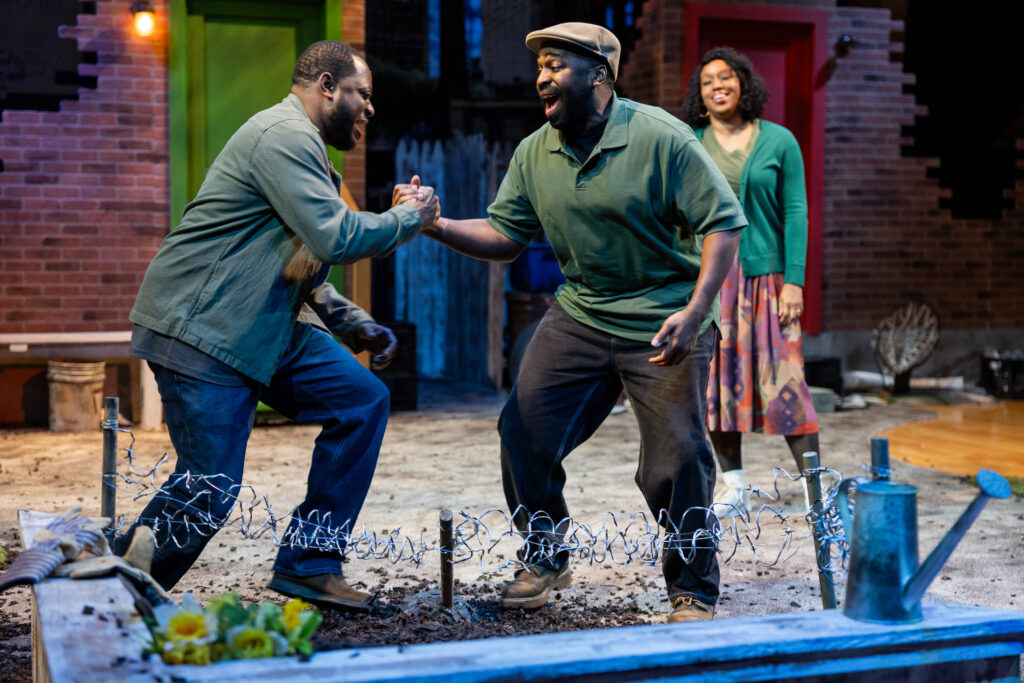
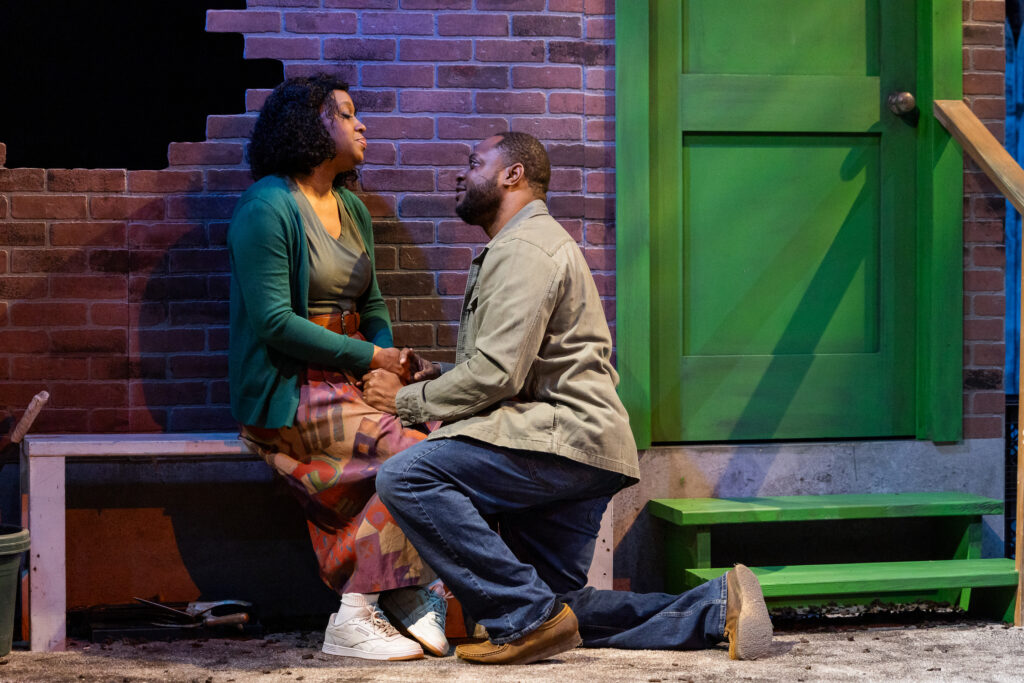
This blind optimism is epitomized by King’s determination to force seeds to grow in a dried up patch of ground in the backyard in the middle of a slum. The image of him on his knees, tenderly tilling the dirt and rejoicing at the first signs of life, are heartbreaking and exhilarating. While the play ends on a disturbing note, this is the image remains: the extraordinariness that this ordinary man can do an ordinary thing on an ordinary day.

‘King Hedley II’ – Written by August Wilson; Directed by Summer L. Williams; Scenic Designer: Jon SavageCostume Designer: Becca JewettLighting Designer: Anshuman BhatiaSound Designer: Caroline Eng. Presented by Actors’ Shakespeare Project at Hibernian Hall, 184 Dudley St, Roxbury, through April 7, 2024

For tickets and information, go to: https://www.actorsshakespeareproject.org/

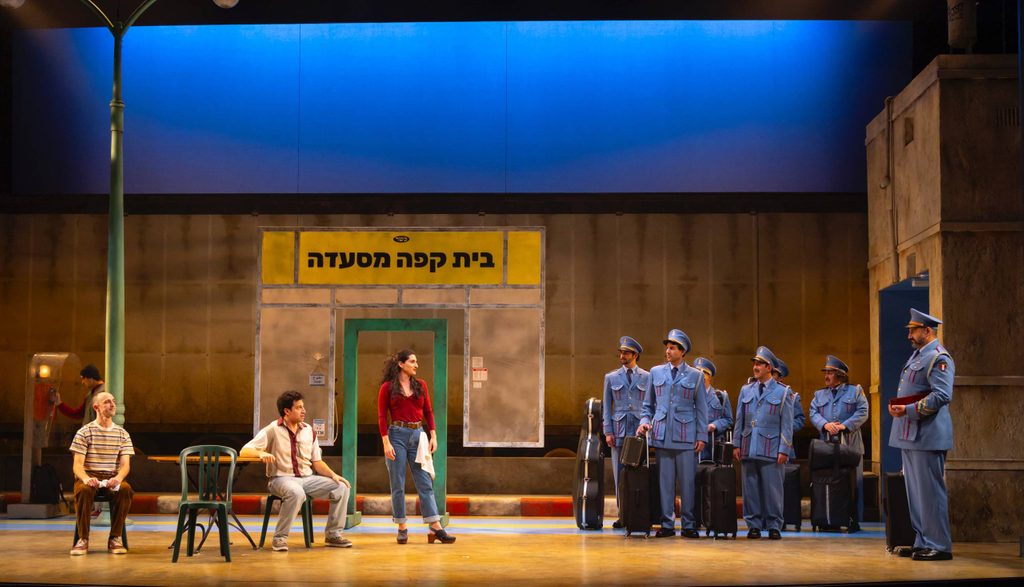
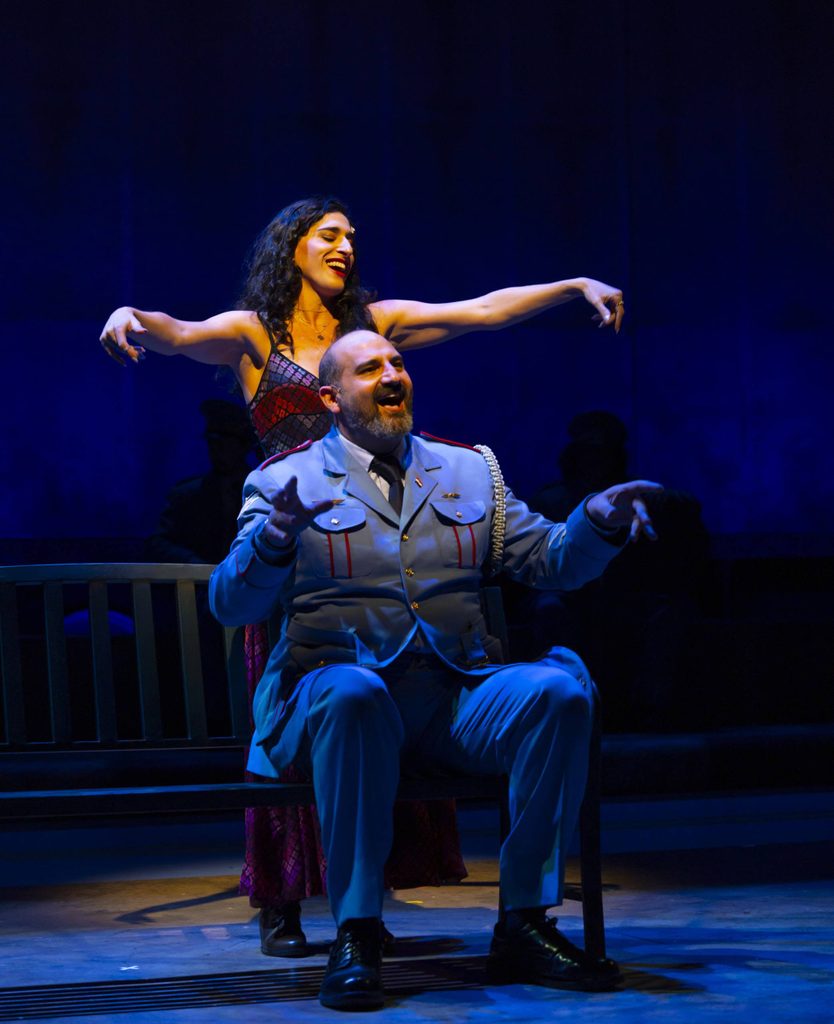
Huntington, SpeakEasy’s Co-Production “The Band’s Visit” Serves Up A Sublime Slice of Life

The cast of “The Band’s Visit” at the Huntington. Photo by T Charles Erickson

By Shelley A. Sackett

The delightful musical “The Band’s Visit” is a welcome breath of air in the current asphyxiating climate surrounding the war between Israel and Hamas. Its focus is a single night in Bet Hatikva, a tiny Israeli town that feels more like a pit stop on the way to someplace more important than a destination.

“You probably didn’t hear about it,” says Dina (played by a magnificent Jennifer Apple in a star-making performance), the proprietor of Bet Hatikva’s only café and its resident narrator and cynic. “It wasn’t very important.”

As she goes about her business at the café, lamenting her plight in this Podunk town in the middle of nowhere, her fellow residents, workers and perpetual customers join in witty song to echo her sentiments.

Everyone is waiting for something to happen. Everyone is bored. Everyone is “looking off out into the distance/Even though you know the view is never gonna change.”

And then, suddenly, an entire band of Egyptians clad in gaudy, bright powder-blue uniforms shows up as if beamed down from heaven in answer to their unspoken prayer. It is as disorienting as it is exciting.

Jennifer Apple, Brian Thomas Abraham
 

It’s as if the cast from Wes Andersen’s “Budapest Hotel” showed up en masse dressed as bellhops.

The members of the Alexandria Ceremonial Band, led by its uptight, by-the-book conductor, Tewfiq (played with a hint of vulnerability and compassion by Brian Thomas Abraham), seem to be unwitting victims of confusion and ineptness. They are due at the Arab Cultural Center in the thriving city of Petah Tikva. Instead, they have landed in the motheaten town of Bet Hatikva, where they are truly strangers in a strange land.

Making matters worse, there is no bus until the next morning. There are also no hotels. The Egyptians are as stuck as the residents. Not to worry, Dina says. The locals will be happy to host the Egyptians for the night.

And for the next 90 intermission-less minutes, these two very different groups of individuals who do not share the same language or culture will bond in ways that reveal gossamer layers of tenderness, humanity and hope. The ice breaker, it turns out, is music, the universal language of the soul.

Which is lucky for us. With songs by David Yazbek and a script by Itamar Moses, “The Band’s Visit” is as satisfying a musical as it gets. The ballads and character songs blend wisps of haunting Middle Eastern and klezmer melodies and rhythms with poignant, funny Sondheim-quality lyrics. Icing atop this sumptuous cake is the fact that each syllable is crystal clear thanks to perfect enunciation and expert sound.

The action, as it were, takes place as vignettes of intimate interactions between the Israelis and their guests. In the process, we get to glimpse the similarities of sadness, regret, dashed dreams and promises unfulfilled that they all share. These seemingly disparate people, Egyptians and Israelis, learn there is more that joins than separates them when politics are ignored.

The salve of that message alone is reason enough to see this show. The pitch-perfect production under Paul Daigneault’s direction and stand-out acting and musicianship raise the bar to a sublime level.

Kareem Elsamadicy, Jesse Garlick

As Dina, Apple is riveting. She brings fire (think Selma Hayek), ice and a powerful set of pipes to the complicated woman who rages against life’s disappointments while being unable to let go of her lifeline of hope. Her body language is eloquent and articulate. The scenes between her and Tewfiq, where each reveals their most secret secrets, are heartbreaking. In another life, at a different time, these two could have been a match made in heaven.

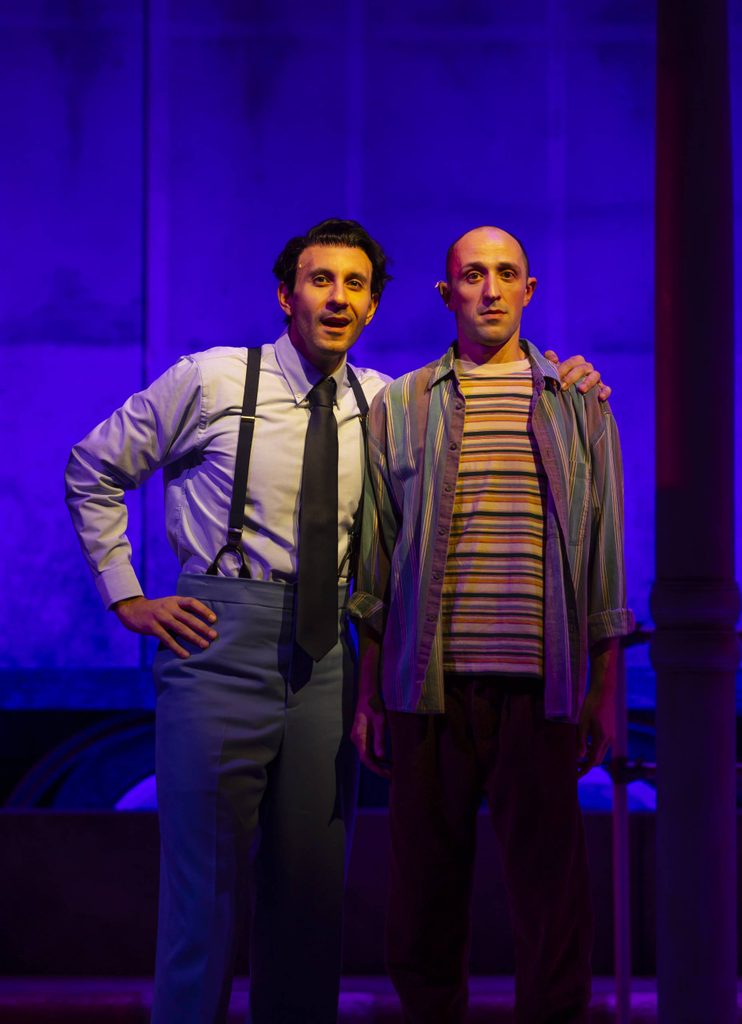
Everyone benefits from these chance encounters, learning more about themselves in the course of learning more about the “other.” An Egyptian clarinetist and assistant conductor help Itzhak and Iris, a floundering young couple on the brink of losing the thread of their union. A Don Juan hopeful trumpeter (Kareem Elsamadicy) gives the socially awkward Papi (a scene-stealing Jesse Garlick) a lesson in how to approach girls.

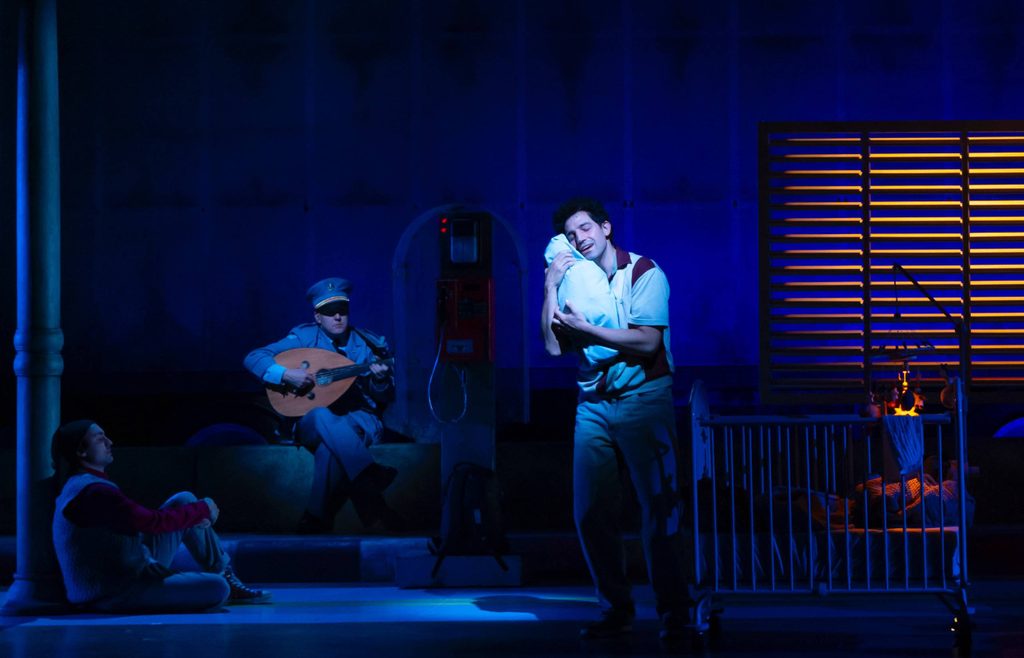
There is also laughter, mirth and the delight of cast members who do double duty as musicians. It is pure magic each time the six members of the band break into song on stage.

By morning, when it’s time for the band to depart, things have shifted. There is a new melancholy in the air, yet it is not borne of despair or sadness. Rather, it stems from the experience of how one single night can change a person — and an entire community — in a profound way that leaves hope in its wake.

Marianna Bassham, Andrew Mayer, Robert Saoud, James Rana, Jared Troilo

Dina and Tewfiq face each other for the last time, sharing both the joy of having discovered that there is a comforting home even for their shattered hearts and the pain of knowing that that bed will never be feathered. When Tewfiq raises a palm to Dina and she raises her back, the emotional gravitas of their goodbye ranks right up there with Rick and Ilsa’s embrace on the tarmac in “Casablanca.”

“Nothing is as beautiful as something you don’t expect” is a common refrain. By the play’s end, every character has been transformed in some indelible way by the band’s unexpected visit. And, after experiencing 90 minutes of a music-filled world devoid of ethnic conflict and invectives, where Arabs and Jews connect and share just as regular folks looking out for each other, so have we.

For information and to buy tickets, go to https://www.huntingtontheatre.org/

“The Band’s Visit” — Music and Lyrics by David Yazbek. Book by Itamar Moses. Based on the Screenplay by Eran Kolirin. Directed by Paul Daigneault; Choreography by Daniel Pelzig. Music Direction by José Delgado. Scenic Design by Wilson Chin and Jimmy Stubbs. Costume Design by Miranda Kau Giurleo. Lighting Design by Aja M. Jackson. Sound Design by Joshua Millican. Produced by Huntington Theatre in collaboration with SpeakEasy Stage at 264 Huntington Ave. Boston through December 17.

SpeakEasy’s “POTUS” Soothes Our Distressed Political Souls With the Balm of Humor

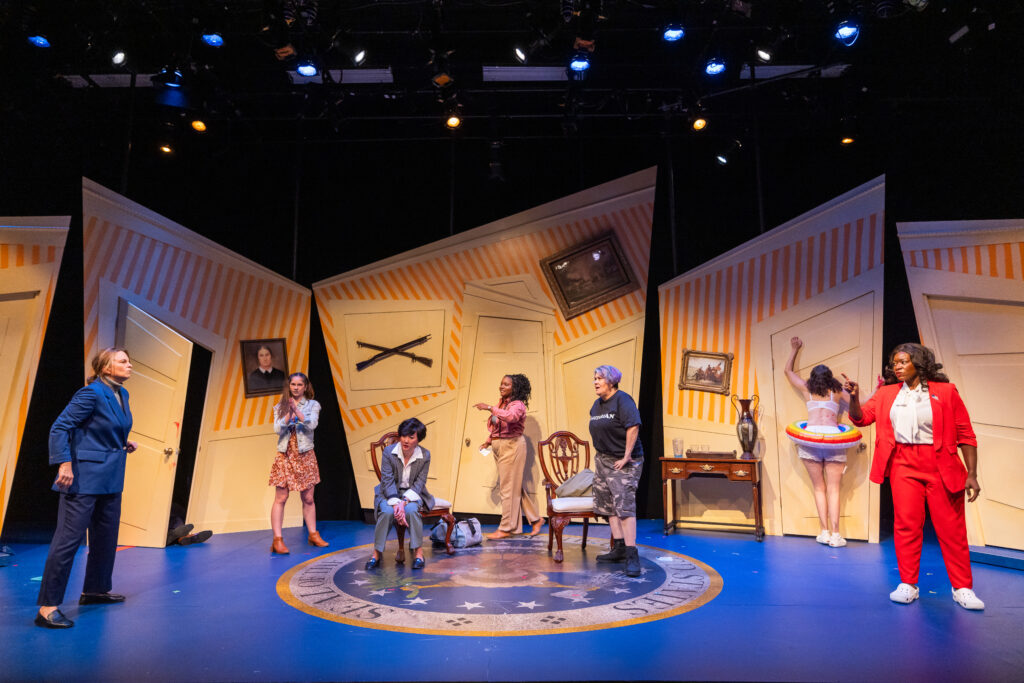
Cast of SpeakEasy Stage’s production of “POTUS” (Courtesy Nile Scott Studios)

“POTUS: Or, Behind Every Great Dumbass are Seven Women Trying to Keep Him Alive” by Selina Fillinger. Directed by Paula Plum. Scenic Design by Jenna McFarland Lord. Sound Design by Aubrey Dube. Lighting Design by Karen Perlow. Costume Design by Rebecca Glick. Fight Choreography by Angie Jepson. Presented by Speakeasy Stage at the Calderwood Pavilion, Boston, through October 15.

By Shelley A. Sackett

Hands down, “POTUS” takes the prize for the most winning opening scene currently on stage in Boston. It is shriek-out-loud funny, clever, pithy, lightning-paced, and uncompromisingly no-nonsense.

The setting is The White House, not exactly the Trump administration, but also not exactly not the Trump administration. Two pantsuit-clad women are in mid-conversation when the audience joins them.

Chief of Staff Harriet (Lisa Yuen) is filling in Press Secretary Jean (Laura Latreille) on the morning’s diplomatic meeting and on what POTUS did that she, as press liaison, will have to spin at the press briefing that is about to start.

The play’s first line sets the tone for the rest of the evening. “Cunt,” says Harriet, lassoing Jean’s and the audience’s attention. Apparently, POTUS excused his wife Margaret’s absence by saying she was having a “cunty” day. Beyond the use of the “C” word, the even bigger trouble is that Margaret was in the room. The whole time. Sitting (obscured) right in front of POTUS.

Not to worry. Jean’s job, after all, is to support and protect POTUS and, despite his worst instincts and basest actions, keep him (and herself) in power. She is used to donning rubber gloves and cleaning up the mess. “That’s not so bad. We can contain that,” she says, brightening. “We all have cunty mornings sometimes. My son has them every week.”

Playwright Selina Fillinger’s “POTUS” is aptly subtitled, “Or, Behind Every Great Dumbass Are Seven Women Trying to Keep Him Alive.” She has populated her farce/satire with seven strong behind-the-scenes women whose sole purpose is to keep a dangerous and inept man in office, not because they believe in him, but because the only way they are allowed near the epicenter of power is by clinging to his coattails.

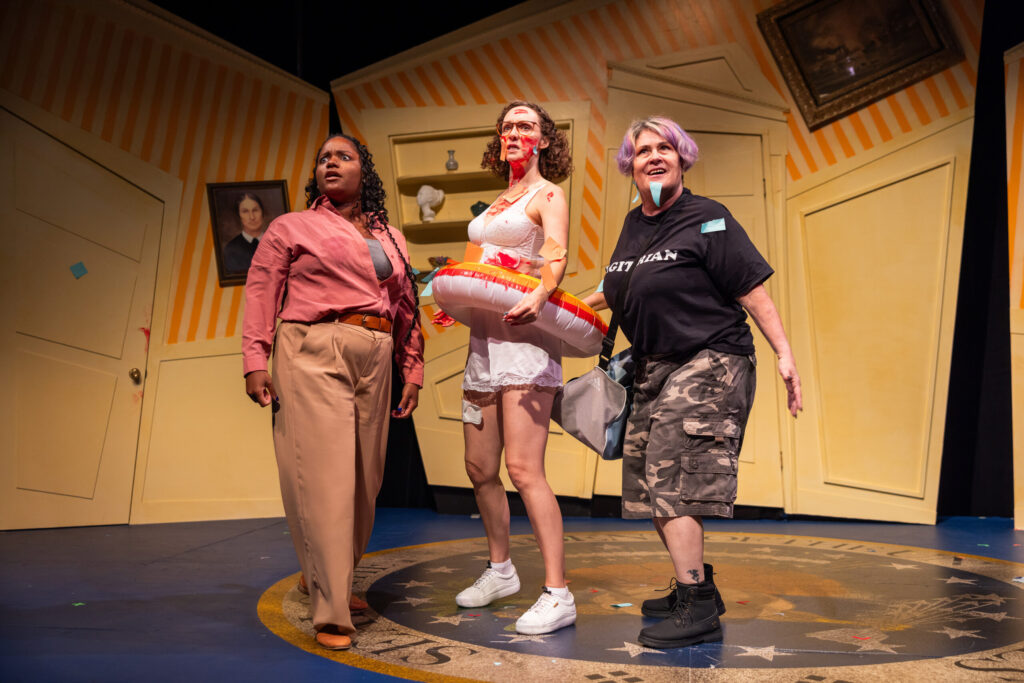
Catia, Marianna Bassham, and Johanna Carlisle-Zepeda

In addition to Harriet and Jean, the other women in the president’s inner circle are his savvy, earthy, and jaded wife Margaret (Crystin Gilmore) and his neurotic, perfectionist personal secretary Stephanie (Marianna Bassham). Clearly, these women are the only reason he has a job. They are brilliant, dedicated, and gifted at damage control. What they aren’t is respected, acknowledged, or valued by anyone except each other.

“Why isn’t SHE president?” is the common refrain as each rises to the next challenge and douses the next blaze. The answer boils down to one word — patriarchy. “People don’t love him,” one character explains. They’re just afraid of the alternative — US!”

Add to the mix his cocky, queer, convicted-felon sister Bernadette (Johanna Carlisle-Zepeda), Chris, the recently post-partum reporter whose attire includes breast pump attachments (Catia), and the president’s pregnant girlfriend Dusty (the impossibly flexible Monique Ward Lonergan), and you have all the ingredients for a no-holds-barred satirical farce. There is a little of everything, from door slamming, slapstick, sight gags to dramatic anarchy, comic invective, and mistaken identity.

There’s even a bottle of psychedelic tabs masquerading as Tums.

Yet beneath all this droll merriment are serious messages for these serious times. According to Fillinger, those messages may be political, but they are hardly partisan. The pain and rage that underpin the biting humor in her words are aimed squarely at the White Patriarchy that keeps women in their places and men like POTUS in his.

Director Paula Plum has plumbed the sizeable talents of her extraordinary cast to create an ensemble where each individual performer shines, and the whole is even greater than the sum of its parts, no small feat with these remarkably gifted women.

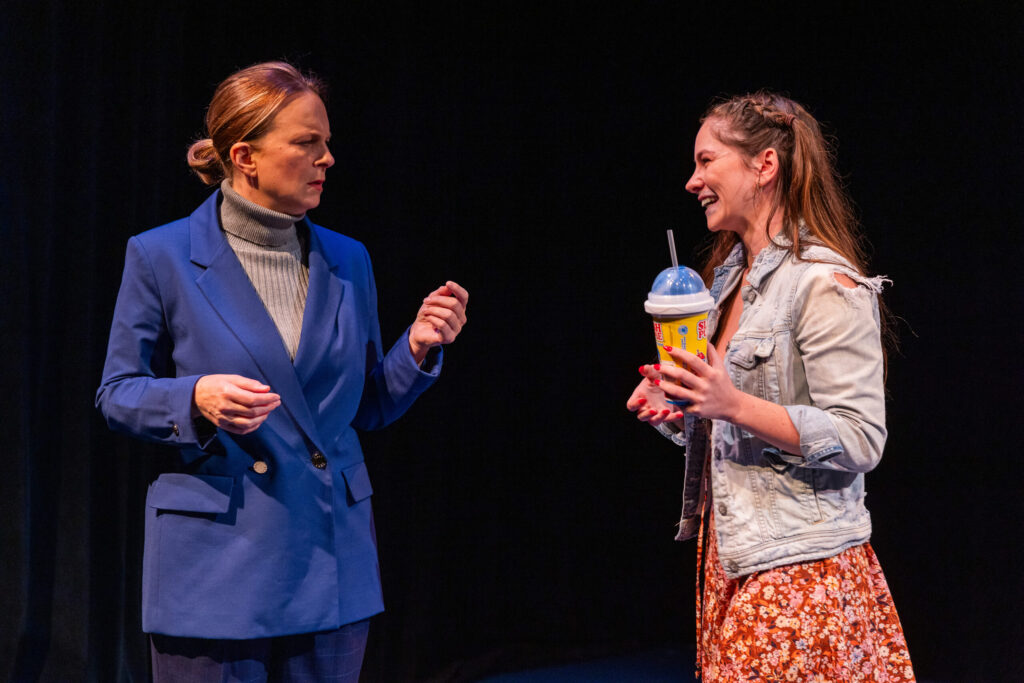
Laura Latreille, Monique Ward Lonergan

Jenna McFarland Lord has created the perfect set, part “Laugh-In,” with lots of doors to open and slam, and part Pee Wee’s Playhouse, where even the pictures are askew. The result is a dizzying, unhinged quasi-reality, mirroring the conditions our heroines face daily.

Despite her use of potty language, piercing wit, and crude jokes (most of which hit their mark), Fillinger has a serious point to make. What would it be like if these skillful, thoughtful women were able to spend their time actually running the world instead of covering and cleaning up after the inept dumbass who was elected to perform that duty but can’t? Is that idea really that scary?

Asked what she hopes audiences take away from seeing “POTUS,” Fillinger said, “I hope they wake up the next day and put their money, time and votes towards equity and freedom for all,” to which we add, “Amen.” For tix and information, go to: https://speakeasystage.com/
A love story in the age of (anti)social media

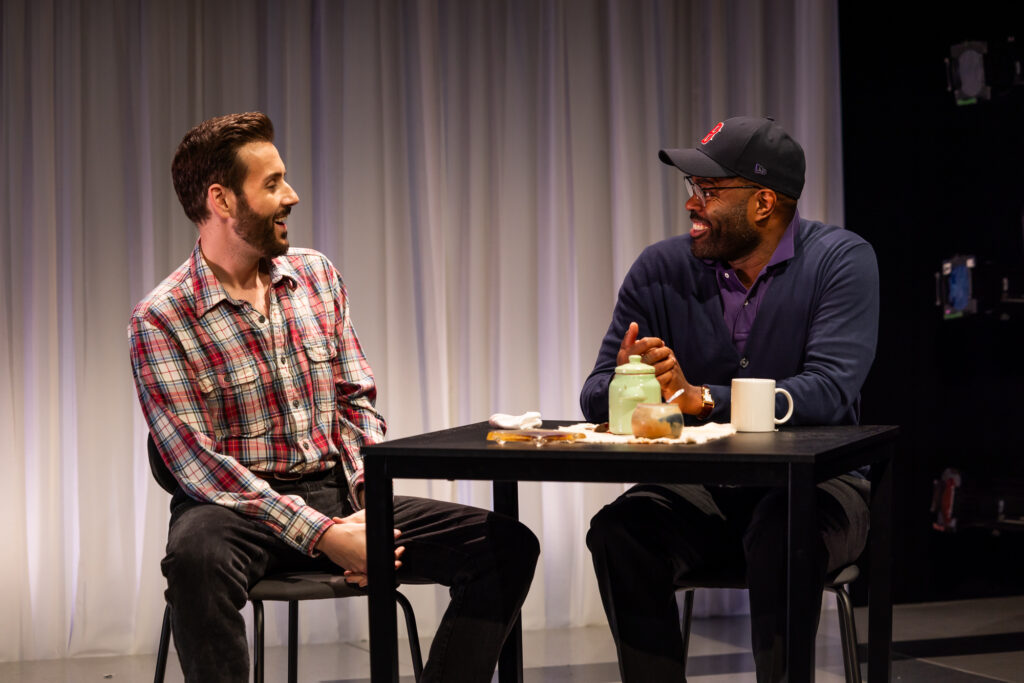
Jeffrey Song and Eunji Lim in SpeakEasy’s ‘Wild Goose Dreams.” / Photo Credit: NILE SCOTT STUDIOS

By Shelley A. Sackett

According to Genesis, the Babylonians wanted to make a name for themselves by building a mighty city and a tower with its top in the heavens. God disrupted the work by so confusing the workers’ language that they could no longer understand one another. The city was never completed, and the people were dispersed over the face of the earth.

Playwright and native South Korean Hansol Jung’s impressive play “Wild Goose Dreams” examines the modern-day Tower of Babel known as the internet, a global nation where algorithms create a universal language that renders its human users more disconnected than connected.

Presented by SpeakEasy Stage Company, it runs through April 8 at Calderwood Pavillion in Boston.

Set in contemporary Seoul, the plot follows the romance between a married South Korean man, Guk Minsung (Jeffrey Song), and Yoo Nanhee (a terrific Eunji Lim), a North Korean defector. They both travel with more than carry-on baggage.

Minsung is a “goose father,” the label given to a man who stays and works in South Korea while his family lives in an English-speaking country. Because South Korea values fluency in English (and because its education system is fiercely competitive), they are assured a better life when they return. Like their migrating namesakes, these fathers sacrifice for the sake of their offspring, sending money but rarely getting to see them. Minsung’s only means of contact with his wife and daughter are his cellphone and Facebook, and he longs for an-person visit.

Like Minsung, Nanhee is lonely, disoriented and (literally) haunted by the family she lives without. Four years ago, she suddenly and without notice left North Korea and her father (an amusing John D. Haggerty). She too was in search of a better life than she could ever have in that impoverished, repressive place. Her flight was full of peril and trauma; guilt and fear still preoccupy her thoughts and dreams. She sends her father money that she doesn’t know if he receives. He appears to her daily, a ghost-like companion invisible to anyone else.

Paralyzed by second-guessing the choices they made, they are isolated and numb. Theirs will be a textbook love story for the modern, dysfunctional age.

Both turn to the internet and online dating for comfort and connection, and depicting that world is where “Wild Goose Dreams” breaks bold new theatrical ground.

Jung’s intrusive and omnipresent cyberspace is portrayed by director Seonjae Kim as a lively, noisy Greek chorus of wild characters who chant and mime the equivalents of cellphone ringing, emojis and various internet functions (reboot is a stitch!). The costumes, sound effects and choreography are dizzying.

On its surface, this parallel universe is eye candy, entertaining and fun. Yet, just like the “real” internet, it smothers and disrupts, ultimately blurring the thinning line between virtual and actual realms, between fantasy and reality.

Amidst this relentless and chaotic cacophony of popups, “what’s on your mind?” and other distractions, Nanhee (screen name Miner’s Daughter) and Minsung (Gooseman) meet. Though they technically speak the same language, they bring different cultural contexts which Jung uses for both empathic and comic purpose. “Is that a joke?” each asks frequently, followed by “Is it a North/South Korean joke?”

Like post-Tower of Babel Babylonians, these two live in a diaspora where babble is the mother tongue.
While staggering in its imagination, creativity and craftsmanship, Jung’s play is not just humor, gimmickry and ingenuity. Below the surface, the gifted playwright skillfully tackles the broader issues of the genuine and overwhelming challenges we face living in a world of generational, cultural and technological disconnects.

Jung cleverly uses a fairy tale to link the various themes and plotlines. The play opens on a simple set with a storyteller (Nanhee’s father) telling his daughter a bedtime tale about an angel who loses the ability to fly and falls in love with a human. Later, the angel must choose between staying on earth with her lover or regaining her power of flight. These forked paths of freedom or family, taking flight or remaining grounded, will show up for the rest of the play. The personal toll they exact from Nanhee and Minsung shape their relationship and its unforeseen conclusion.

Although the play briefly stalls at an hour (at one hour and forty minutes, it could benefit from an intermission or shortening or both), “Wild Goose Dreams” is nonetheless one of the most exciting, out-of-the-box, charming and well-produced pieces of theater to hit Boston this season. Check it out and enjoy the guaranteed post-theater conversation.

For tickets and information, go to https://speakeasystage.com/.

Speakeasy’s ‘Wild Goose Dreams’ Is A Surreal Romp Between Two Realities

Ciaran D’Hondt, Fady Demian, Elaine Hom, Ryan Mardesich, Amanda Centeno, and John D. Haggerty in Speakeasy’s ‘Wild Goose Dreams’ Photos by Nile Scott Studios

‘Wild Goose Dreams’ – Written by Hansol Jung. Directed by Seonjae Kim; Scenic Design by Crystal Tiala; Costume Design by Machel Ross; Lighting Design by Kathleen Zhou; Sound Design by George Cooke. Presented by SpeakEasy Stage at The Calderwood Pavillion, Boston through April 8.

By Shelley A. Sackett

On its surface, ‘Wild Goose Dreams,’ lays out parallel tales of migration, sacrifice, and dreams. To fully appreciate Hansol Jung’s brilliant script and Seonjae Kim’s spot-on direction, a little background is helpful. Geese migrate with the seasons, traveling great distances and enduring physical hardships to secure food and shelter for their families. Their survival hinges on uprooting themselves and flying to an unknown place that they hope will provide what they need.

Starting in the 1990s, Korean culture mirrored this concept of sacrifice and travel when fathers who could afford to began sending their families to English-speaking countries so their children could achieve their dreams of a better life when they returned to Korea. Known as “Wild Goose Fathers,” they stayed in Korea to earn money. They, like migrating geese, would see their families only seasonally. “Penguin Fathers,” like those flightless birds, were the Wild Goose Fathers who weren’t sure if or when they would ever see their families due to the exorbitant expense of travel. During this same time period, another kind of migration was taking place in Korea. Many people in North Korea began defecting to the South in search of better lives. These flights were full of peril and trauma.

Lim, Song

‘Wild Goose Dreams’ opens on a simple set with a storyteller (a splendid John D. Hoggerty) setting the play’s overarching narrative through a tale replete with metaphor and symbolism (although the audience won’t realize that until the play progresses). His bedtime tale is about an angel who loses the ability to fly and falls in love with a human. Later, the angel must choose between staying on earth with her lover or regaining her power of flight. These contradictory options of freedom and family, and the personal toll they exact, will overshadow the rest of the show.

Jung’s two main characters are the storyteller’s daughter, Yoo Nanhee (a perfectly cast Eunji Lim), and Guk Minsung (the equally terrific Jeffrey Song). Nanhee is a North Korean defector; Minsung is a Goose Father. Both are lonely, disoriented, and haunted by the family they live without. Nanhee’s father makes daily ghost-like appearances; Minsung’s wife and daughter show up sporadically via cellphone and Facebook.

Ciaran D’Hondt, Jeffrey Song, Ryan Mardesich, and Amanda Centeno

Both turn to the internet and online dating for comfort and contact, and depicting that world is where ‘Wild Goose Dreams’ breaks through a theatrical glass ceiling.

Jung’s cyberspace is interpreted by Kim as a lively, noisy Greek Chorus of wild characters that chant and mime the equivalents of cellphone ringing, emojis and various internet functions (reboot is a stitch!). The costumes (Machel Ross), sound effects (George Cooke), and choreography are dazzling.

Amidst this chaotic cacophony of popups, “what’s on your minds” and other distractions, Nanhee (screen name ‘Miner’s Daughter’) and Minsung (‘Gooseman’) meet. Though they technically speak the same language, they bring different cultural contexts which Jung uses for both empathic and comic purpose. “Is that a joke?” each asks frequently, followed by “Is it a North/South Korean joke?”

Despite these communication disconnects, the two share an innocence and ease brought to life by Lim and Song’s effortless portrayals. They are both “lonely and paralyzed,” both preoccupied with those far away and bewildered by the terrain they now inhabit. Yet, both are open to redefining their lives to reflect their growing live (vs virtual) intimacy.

Song, Lim

“Do we have impact on each other?” Minsung asks. “Couldn’t we call that love? Couldn’t that be enough for now?”

Jung’s play is not just humor, gimmickry, and imagination. Below the surface, the gifted playwright skillfully tackles the broader issue of the real and overwhelming challenges we face living in a world of generational, cultural, and technological disconnects. Her ‘Wild Goose Dreams’ is an entertaining, fun, well-produced piece of theater that is guaranteed to spark post-performance conversation.

For information and tickets, go to https://speakeasystage.com/
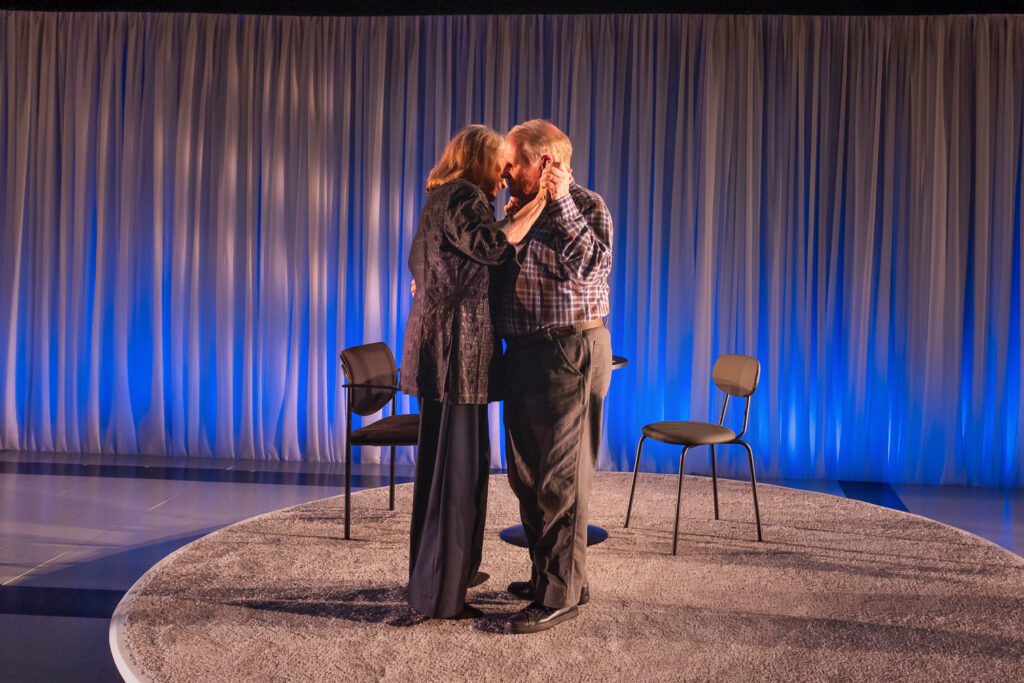
Wild Goose Dreams’ – Written by Hansol Jung. Directed by Seonjae Kim; Scenic Design by Crystal Tiala; Costume Design by Machel Ross; Lighting Design by Kathleen Zhou; Sound Design by George Cooke. Presented by SpeakEasy Stage at The Calderwood Pavillion, Boston through April 8.