‘Bad Shabbos’ director dishes about filmmaking and his love of being Jewish

The cast of “Bad Shabbos”/MENEMSHA FILMS

BY SHELLEY A. SACKETT

Daniel Robbins, the director and co-writer of the award-winning film “Bad Shabbos,” discovered two things about himself at a very early age – he loved Judaism and he loved making films.

Raised in a Modern Orthodox Jewish family, he attended Westchester Day School up to 8th grade and then Ramaz, the yeshiva in New York’s Upper East Side, for grades 9-12. Every year, the “funny kids” in the upper grades were tasked with making a short video. As “funny kids,” Robbins and his friends were drafted in high school. “I felt the spark,” Robbins told the Journal by phone. “From my junior year in high school, I wanted to go to film school.”

He also loved growing up in a family that gathered for Shabbos dinner every Friday night. “Even on the most chaotic nights, there was a warmth,” Robbins says. He still observes this tradition with family and close friends. “It’s not about your week or how your work is going, but rather about your dignity as a person and connecting with the people around you.”

What he most appreciates about Judaism (and especially Modern Orthodox Judaism) is that it takes universal values (family, community, loving other people, for example) and builds habits around them. “It’s one thing to cherish those values, but Judaism also gives us an actual framework that pushes us to practice them,” he says.

I think Shabbos dinner is probably the main way we can improve our lives. Which is why we made a movie about it.”

“Bad Shabbos,” released in 2024 and co-written and produced by fellow Ramaz alumni Zack Weiner and Adam Mitchell, has taken the festival circuit by storm. This film is not, however, about your bubbe’s Shabbos dinner. Unless, of course, your regular family Friday night gatherings included a prank gone awry, a death (an accident, or possibly a murder) and Cliff “Method Man” Smith masquerading as an observant Jew. Throw in the first meeting between parents of engaged children (a visiting Catholic couple from the Midwest and their hosts, observant, wealthy New York Modern Orthodox Jews), and you’re getting close to the tenor of what becomes a very bad, very funny, and ultimately very poignant Shabbos dinner.

The film stars Kyra Sedgwick as the matriarch, David Paymer as patriarch, and Jon Bass, Milana Vayntrub, Meghan Leathers, Theo Taplitz and Ashley Zukerman, Catherine Curtin and John Bedford Lloyd.

Robbins and his team’s primary goal was to make a film that authentically portrayed their subculture as New York Modern Orthodox Jews in a loving light. His second goal was to take everything he loves about the fast-paced comedies he grew up with (anything Mel Brooks, “Meet The Parents,” “My Big Fat Greek Wedding,” “The Birdcage,” and “Death At A Funeral,” among others) and adapt it to modern times. Coming from a horror film background (his first film, “Pledge,” debuted at the 2018 Screamfest where it won Robbins an award for Best Directing), the film also had to have a dead body. “I love horror and the dead body trope,” Robbins says. “With horror, the realer it is, the scarier it is. It’s the same with comedy – the realer it is, the funnier it is.”

Waxing more serious, he shares how he sees Modern Orthodox Judaism as a metaphor for the film’s family. The family members in “Bad Shabbos” must manage their individual polarities, between personal freedoms and familial expectations and between unconditional love and constructive criticism, all while trying to get along with each other. Similarly, Modern Orthodox Jews must manage the polarities between the secular and the religious, balancing the sometimes-conflicting agenda of the traditional and contemporary.

“I feel like Jewish content hasn’t shown this section of Judaism, the kind that interacts with the secular world while also keeping their traditions very seriously. I thought if we could show the energy of one of those households honestly and with a break-neck plot, this could be a movie people would love,” Robbins says.

The film has resonated with Jewish and non-Jewish audiences from Berlin to Seattle to a packed Coolidge Theater earlier this month (“I think Boston might be our best audience,” says Robbins. “They got every joke in the movie”). It won the Audience Award for Best Narrative Feature at the prestigious Tribeca Film Festival and audience awards at many others, including Boston Jewish Festival.

Robbins explains that “Bad Shabbos” neither mocks religion nor lampoons Judaism. It is a loving portrayal of characters trying to find equilibrium by incorporating religion into their lives. Their goal is to deepen their connection to religion and find a way to make it work for them. In that way, it stands apart from the many films that parody religion and depict people trying to self-actualize by ignoring, rejecting or escaping religion. “It’s a faith-based movie,” Robbins says.

It’s also a funny movie that celebrates Jewish humor and Jewishness at a time fraught with antisemitic, anti-Israel and anti-Zionist sentiments. Robbins says that finding laughter in the dark spots is part of what defines Jewish humor. “People forget that there’s a Jewish responsibility to also rejoice, to remember how beautiful life can be, that it’s not just about suffering and complaining about how bad things are,” he says.

Robbins remembers the film’s premiere at the Berlin Jewish Film Festival. There was a huge crowd and someone asked him how he could make a comedy during these difficult times. His response was that if Jewish artists waited for good times to make comedies, there wouldn’t be any Jewish comedies. Says Robbins, “We still have to persevere and do what we can, even when times aren’t great.” Θ

Marblehead’s Edna and Don Kaplan volunteer in Israel to provide “hands on” help

Edna Kaplan in the Israeli army uniform she “proudly wore.”

BY SHELLEY A. SACKETT

MARBLEHEAD — After Oct. 7, 2023, Edna and Dr. Don Kaplan wanted to do something hands-on to help Israel. Edna, who was born in Israel and lived there until her family relocated to New York City when she was eight years old, had dreamed of returning to her native land to do her army service for over 30 years, but had no idea how. After the Hamas attack, she was motivated to make that dream come true and started researching in earnest.

She discovered Sar-El, a non-political volunteer organization founded in 1983 and dedicated to supporting Israel by assisting the Israel Defense Forces and learned that volunteers had been manning bases in Israel for decades.

For two weeks in May, she and Don volunteered (Don lovingly says that Edna volunteered; he was conscripted) at Tel Hashomer, where a major IDF base and the Sheba Medical Center are located. A mission-critical logistics base, Tel Hashomer prepares medical kits of all types requested by military bases.

On Sundays, the Kaplans’ team was met at the Tel Aviv airport for transport to the Dori base near Ramat Gan. They returned to Tel Aviv on Thursday mid-afternoon for Shabbat.

During the first week, their team opened up kits that had been returned by army bases and sorted them for repackaging. Another team checked for expired dates.

The second week they packed several different medical kits requested by various IDF bases. Don, a retired critical care and pulmonary specialist, was tapped to pack operating room kits.

The volunteers were paired with a roommate to share air-conditioned barracks. Every evening the organization arranged programs in the activity center for after-dinner gatherings.

“I still communicate with my roommate, Hadar, at least weekly,” Edna said. She and Don look forward to seeing other Sar-El friends when they travel to Australia this fall.

Dr. Don Kaplan (right) stands with Amnon, manager of the surgical kits warehouse.

Edna’s Israeli roots extend deeper than her birth certificate. In 1947, her Polish parents set out for Israel on the Exodus, a ship carrying Jewish refugees – primarily Holocaust survivors – from Europe to Palestine during the British Mandate era. Refused entry in Palestine, they were returned to Germany. They found another ship in 1948. “When my father got off the boat in Israel, he immediately enlisted. He fought in the 1948 and 1956 wars,” she said.

The family moved to New York City in 1956. Each parent had one sister there, the only remains of very large families. Her father was one of nine children, her mother one of seven.

When she was a 21-year-old doctoral candidate at Ohio State University, Edna decided to take a quarter off and go to Israel. She and her cousin volunteered at Kibbutz Degania Bet as cooks, preparing meals for 600 people. “The day we were supposed to fly home, we looked at each other, shrugged and went back to work. I gave up a fully paid Ph.D. program, and never regretted staying in Israel. I only left because I was about to be drafted. That, I do regret.

“I have wanted to do my army service a couple of weeks at a time until I put in my full two years,” Edna said. “Well, two weeks down, 102 weeks to go! If I had only known about Sar-El earlier, I would have started a lot sooner.”

Newton native Don attended Hebrew school and had his bar mitzvah at Temple Emeth in South Brookline, where his father served on the board and his mother was an active member of Hadassah. He and Edna started dating when he moved to New York City for his internship and residency in internal medicine. The two married in 1976 and eventually settled in Marblehead, joining Temple Israel and raising two sons, both Y2I alumni.

Don worked as medical director of the Whidden Memorial Hospital and was instrumental in its merger with Cambridge Health Alliance. An avid sailor since childhood, he was president of Community Boating on the Charles River and trustee of Boston’s Museum of Science.

Edna, “mostly retired” from KOGS Communication, the PR agency she founded in 1990, was a JCCNS board member for 23 years, serving on and chairing numerous committees. She was also a longtime National Tay-Sachs and Allied Diseases (NTSAD) board member.

Other than one local friend who was born in Israel and Edna’s Israeli family, the Kaplans haven’t found a specifically Israel-focused community like what they experienced through Sar-El.

“There’s good reason Sar-El volunteers from all over the world return year after year, some multiple times in a single year. It’s a soul-satisfying experience like no other. You are with a group of like-minded, pro-Israel volunteers, Jews and non-Jews, secular and religious, doing productive, meaningful work together,” Edna said.

She and Don stay in touch with the people they’ve met from all over the world through WhatsApp. “I think I’ll find my pro-Israel family through Sar-El,” Edna said. Θ

A Peek Behind The Backstage Curtain in Hub Theatre Co.’s Funny, Poignant ‘The Understudy’

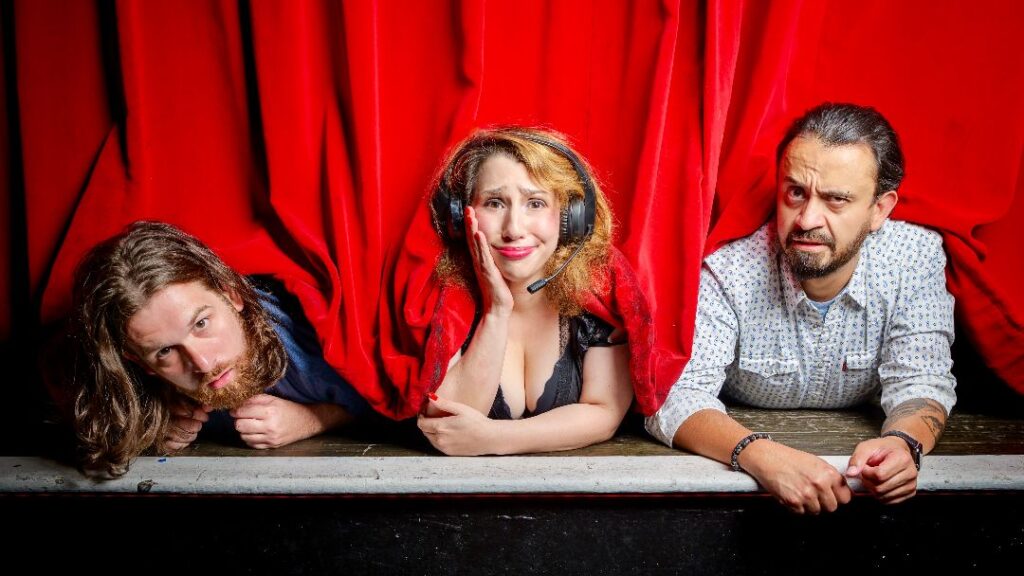
Kevin Paquette, Lauren Elias, and Cristhian Mancias-Garcia in Hub Theatre’s ‘The Understudy’

By Shelley A. Sackett

Playwright Theresa Rebeck’s smart, funny, snarky The Understudy takes us straight into the belly of the beast known as “Broadway Theater.” (Rebeck also penned the smash TV series, “Smash.”) Set backstage during an understudy rehearsal for The Castle, a fictitious long-lost play by Franz Kafka, the three-hander starts with a five-screen surround projection of close-ups of a Clint Eastwood-esque guy’s stubbled face. He mugs and does a macho muscled vamp, screaming “Get in the truck!” menacingly. Eventually, the film’s title (“Trucknado”) blazes across the screen as a booming voice warns, “Stay low or drive high.”

A gunshot is next. Harry (Kevin Paquette) runs onto the stage, waving a gun around, looking over his shoulder, and wildly pointing it haphazardly at members of the audience. “Oh, it’s not real. For heaven’s sake,” he says, setting the tone for the next 100 minutes as the actors (and audience) straddle lines between the ridiculous and the believable, nonsense and common sense, the real and the surreal.

As it happens, Harry (plump in an adorable way, unkempt and shaggy-haired) had auditioned for that movie role and lost out to Jake (Cristhian Mancias-Garcia), now famous as an action hero owing to the film’s box office success ($90 million the first weekend). Although he claims he’s not bitter, Harry is as acidic as it gets. “He’s talent-free,” he snarls, pointing at Jake’s frozen screen image. Yet, he explains, Jake’s lack of acting ability is exactly what the part (and financial backers) demanded.

“What is reality? You have to ask yourself. I ask myself that all the time. I mean, when HE gets to be the REAL ONE, I think we’re all allowed a little moment of private rage or …the occasional fantasy with a gun,” he adds ruefully.

To rub cosmic salt in Harry’s wound, he has been cast, of course, as Jake’s understudy in The Castle, a role for which Harry had also auditioned. Jake, second fiddle to Bruce (the bankable lead star), is also an understudy — for Bruce. Stage manager Roxanne (Lauren Elias) will run this rehearsal because, with the show up and running, the director has moved on. This is, after all, merely a rehearsal for two understudies, mandated by insurance and not worth the time of anyone of real value.

Oh, and by the way, Harry left Roxanne at the altar six years ago, and the two have not seen each other until this moment. Thinking no one wanted to hire him because his name was Harry, Harry had changed his name to Robert Merrill.

Blindsided, Roxanne wails, “What can the universe be trying to teach me by having you show up?”

An unseen but ever-present fourth character, Laura, mans the lights and sounds from a pot-infused booth, her stoned antics providing initial laughs but ultimately wearing thin.

The rest of the play (under veteran Boston icon Paula Plum’s crisp, expert direction), however, flows beautifully, the three actors a perfectly cast ensemble and individually spot on in timing and nuance.

Rebeck’s conceit — that an existentially traumatizing, two-handed, three-hour Kafka play could be a hit on Broadway if it starred two movie box office draws — is the perfect platform from which she launches comedy and drama. There are hysterically satirical scenes counterbalanced with meaty discussions about Kafka, the brutality of a theatrical system that prizes looks and money over talent and integrity, and the uphill battle women must wage to keep a toe in the door. Snippets of the imaginary The Castle that Rebeck has penned showcase her dazzling insight and dramaturgical chops.

The three characters reveal a lot as they slog their way through a rehearsal for something that will never happen (Kafka-esque enough?). Roxanne, it turns out, is quite a good actor (as is Harry), but has had to transition to non-acting jobs (as has Harry) to stay in the theatrical arena that she won’t live without. She is tightly strung but very good at what she does, namely, shouldering all the responsibility to keep things moving while sacrificing the recognition reserved for actors and directors.

Jake, too, has a few surprises up his sleeve. He actually is a skilled actor, his talent untapped (and undisplayed) in his film. He is smart and articulate, and has done a deep dive into all things Kafka. He genuinely longs to prove his acting worth and is convinced that mouthing his ersatz idol’s words on stage will do just that.

Harry, a victim of a system that prizes assets he lacks, is a multi-faceted mash-up of hope, anger, bewilderment, tenderness, and talent. He is also hopelessly inept romantically. Yet, he manages to tug at our heartstrings (and Roxanne’s), emerging as endearingly (though exasperatingly) huggable as a teddy bear.

Peyton Tavares’ simple but effective design (three-wheeled screens mounted with sconces, a few chairs, a table) is enough to set the stage, especially when coupled with Justin Lahue’s projections. There are some nice, more serious moments, as the bromance between Jake and Harry blossoms and they sit and talk about their craft. There are also some lighthearted, behind-the-scenes scenes, such as the one where Harry and Jake turn their flashlights into light sabers, becoming two kids playing “Star Wars.”

We learn by the end of The Understudy that these three really are cut from the same cloth and that fate has dealt them the same hand. Despite its brutality, theater is the only flame that will ever draw them in, even at the risk of getting their wings a little singed.

‘The Understudy’ — written by Theresa Rebeck. Directed by Paula Plum. Scenic Design by Peyton Tavares; Projections Design by Justin Lahue; Sound Design by Gage Baker; Lighting Design by Emily Bearce. Presented by Hub Theatre Company of Boston at Club Café, 209 Columbus Ave., Boston, through August 2.

For more information, go to http://www.hubtheatreboston.org/

NSMT’s ‘The Wizard of Oz’ Couldn’t Be More Enjoyable

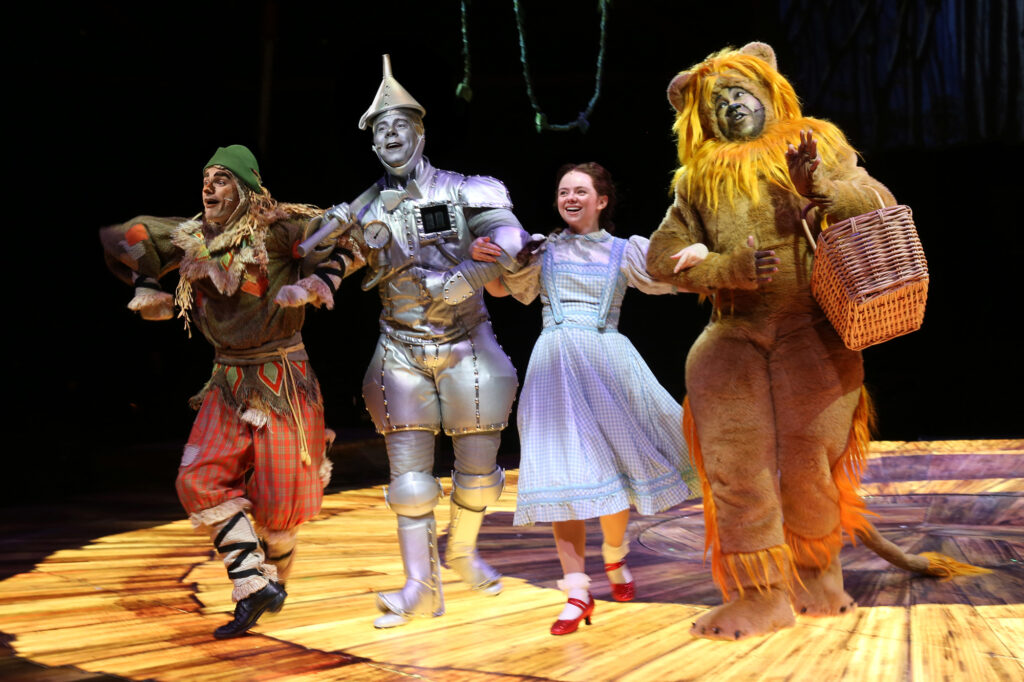
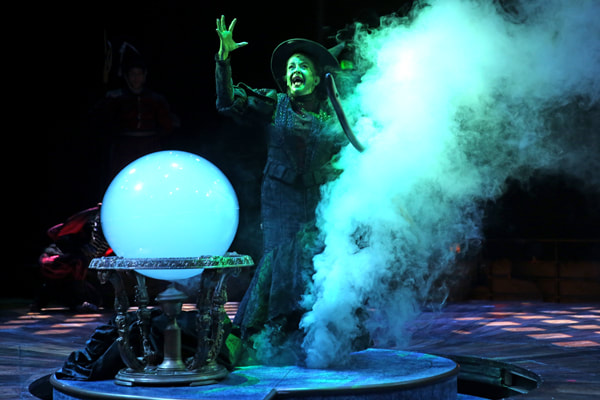
Ethan Carlson, Sean Bell, Bridget Delaney, and E. Mani Cadet in “The Wizard of Oz” at North Shore Music Theatre thru July 20, 2025. Photos by Paul Lyden

By Shelley A. Sackett

North Shore Music Theatre continues its streak of winners with The Wizard of Oz, a spectacular extravaganza of a show that has everything going for it — top-notch talent, a stunning set, spot-on direction, clear and understandable sound, clever costumes and lighting, marvelous choreography, and a bang-up live orchestra.

Oh, and did I neglect to mention its iconic theater-in-the-round stage, which is used to maximum effect throughout the nearly three-hour (one intermission) show?

Even those who think they are too jaded to enjoy yet another go round of the same story should hightail it to Beverly and catch this version, which is infinitely more enjoyable than the recent film and Broadway versions combined.

Delaney

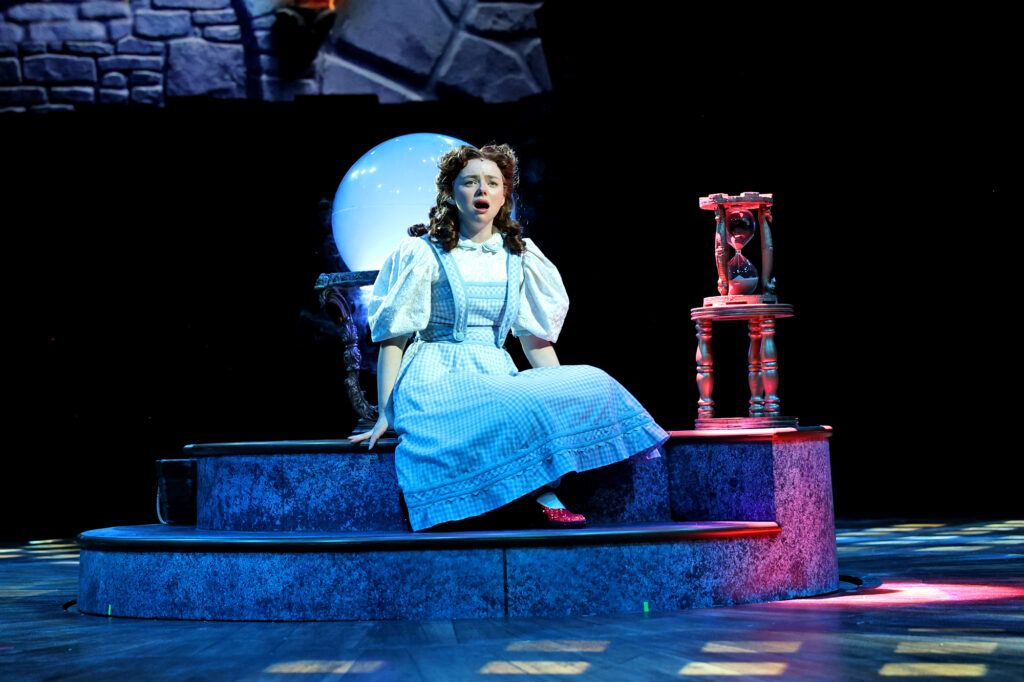
As the lights dim, five overhead surround theater screens counsel that this production is dedicated to the young at heart. As they fade to Kansas fields of grain, Dorothy (a fabulous Bridget Delaney) comes skipping down the aisle, followed by Toto (the equally fabulous Bug Minnie). Eye-winking foreshadowing is a nice addition to the familiar story about Dorothy’s conk on the head during a tornado, her journey to Oz while out cold, and her return to Kansas with renewed appreciation that there is “no place like home.”

Farmhand Zeke/Cowardly Lion (E. Mani Cadet) plays with the rope in his hand the same way he will later swish his lion’s tail. Hickory/Tin Man (Sean Bell) plays with a tin funnel on his head and Hunk/Scarecrow (Ethan Carlson) walks across the stage carrying a scarecrow. Setting the stage for who the characters will become in Dorothy’s dream, these little touches lend a nuanced humanity to their fictional avatars.

Choreographer Briana Fallon, costume coordinator Rebecca Glick and wig and hair designer Rachel Padula-Shuflet deserve huge shout outs for the way they interpreted many of the static events of the story, starting with the staging of the tornado. As the overhead screens project twisters, dancers clad in shades of gray skin tight leotards swirl and twirl across the stage carrying pieces of debris. The concept is brilliant, its execution breathtaking. This team will later gift the audience with orange spat footed crows, a sassy showgirl trio of talking apple trees, a scarlet field of dancing poppies, bejeweled snowflakes and, of course, flying monkeys.

While the second act predictably drags a bit (what second act doesn’t?), the familiar songs (“Ding Dong! The Witch Is Dead,” “Over The Rainbow,” “Follow The Yellow Brick Road,” among them) and the fabulous talent temper any lull with freshness and upbeat excitement. As Almira Gulch/Wicked Witch of the West, Michele Ragusa is spellbinding. Her vocal chops and comic timing are impeccable (plus she really knows her way around a theater-in-the-round such that her time with her back to any section is unnoticeable). Kerry Conte (Aunt Em/Glinda) shines as Glinda, her voice like a wave of a pink crystalline wand.

And then there is elder statesman David Coffee (Professor Marvel/The Wizard), beloved Scrooge in NSMT’s A Christmas Carol. There is even an inside joke (“You’re a humbug,” one character chides him) which the adoring crowd ate up in spades.

Michele Ragusa

Perhaps the true unsung heroes of the evening is the ensemble of munchkins, a corps of the most adorable and proficient youngsters (a standout is Ashley Fox, a rising 8th grader worth following). Kudos to the team that prepared them.

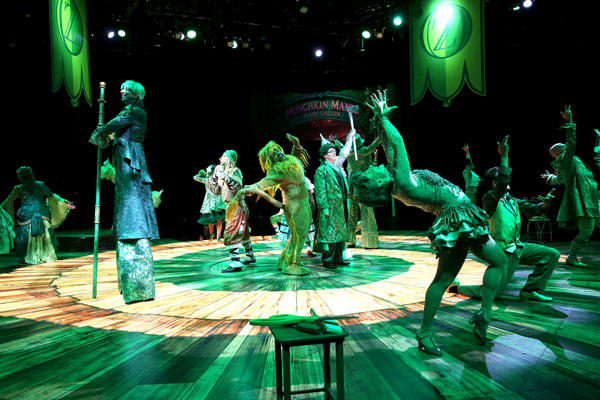
Finally, no musical theater review would be complete without a tip of the hat to its music director (Matthew Stern). The jazzy number that opens Act II outside the Emerald City, complete with green costumes, tap dancing and a clarinet solo, is a particular knockout.

By the time Dorothy mouths those famous words, “There’s no place like home,” the audience is ready to agree — especially if that home is North Shore Music Theatre.

‘The Wizard of Oz’ — Written by L. Frank Baum. Directed by Robert W. Schneider. Music and Lyrics by Harold Arlen and E.Y. Harburg; Background Music by Herbert Stothart. Presented by North Shore Music Theatre, 54 Dunham Road, Beverly through July 20.

For more information, visit: https://www.nsmt.org/oz.html

Two Unlikely Buddies Talk Trash in Gloucester Stage’s Clever Comedy, ‘The Garbologists’

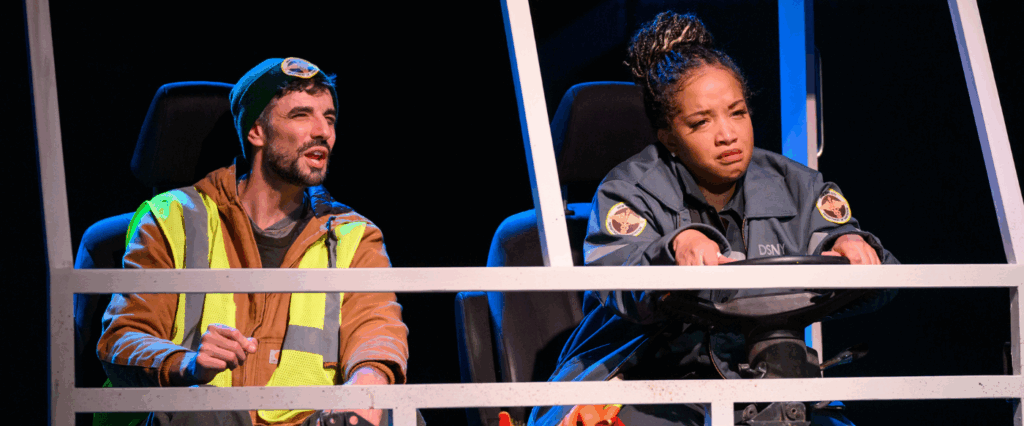
Paul Melendy and Thomika Marie Bridwell in Gloucester Stage Company’s “The Garbologists.”
Photos by Shawn G. Henry

By Shelley A. Sackett

Rebecca Bradshaw, Producing Artistic Director of Gloucester Stage Company and director of its first-rate The Garbologists, couldn’t have timed it better. With Republic Services sanitation workers in the second week of their strike, garbage is on everyone’s mind as bags pile up on the North Shore and throughout Greater Boston.

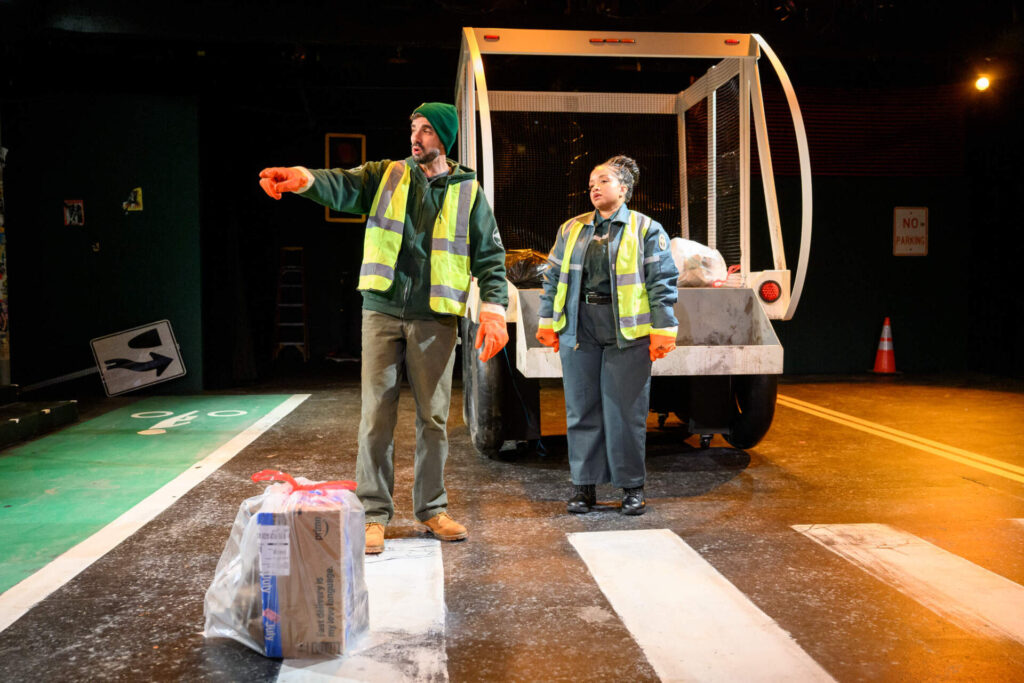
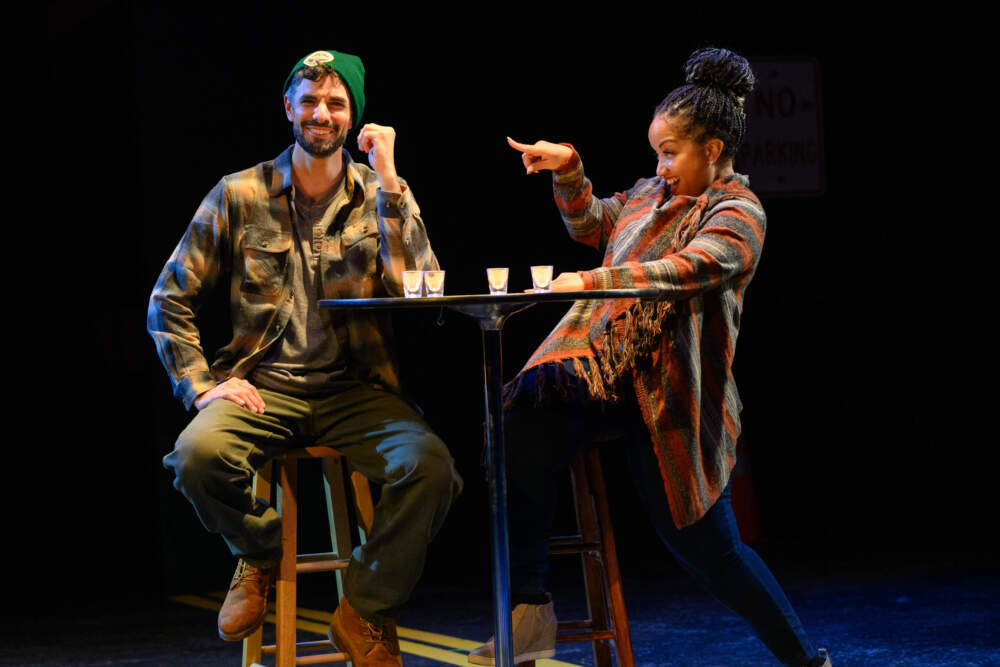
Playwright Lindsay Joelle’s tight, bright comedy brings its audience behind the windshield of a New York City Sanitation Department truck and into the lives of two people thrown together by circumstance: Danny (an exceptionally talented and engaging Paul Melendy) and Marlowe (Thomika Marie Bridwell). The two-hander (80 minutes with no intermission) is one of the most endearing odd couple buddy comedies since, well, Jack Klugman and Jack Lemmon in the 1970s television series, “The Odd Couple.”

Danny, a 41-year-old white blue-collar regular guy, is bigger than life. A seasoned worker with nine years’ experience, he is a nonstop talker, full of advice and corny jokes. He also has a wealth of institutional knowledge and an intuitive sixth sense about the street as a source of understanding the meaning of life. “There’s a lot you can tell about someone by what they throw away,” he counsels his rookie partner. “Read the bags.”

Gloucester Stage Company’s production of The Garbologists by playwright Lindsay Joelle, in Gloucester, MA. The production is directed by Rebecca Bradshaw and stars Tomika Marie Bridwell as Marlowe and Paul Melendy as Danny. © 2025 Shawn G. Henry • 978-590-4869 GSC-250702-Garbologists_017

Marlowe, a mid-30s Black Ivy League-educated (two degrees, no less) woman, is as buttoned up as Danny is unzipped. For the first many minutes, she watches and listens in disinterested silence as Danny continues his comedic monologue. In her pressed and pristine uniform, she looks more ready to walk across a graduation podium than toss overstuffed black bags into the bowels of their truck.

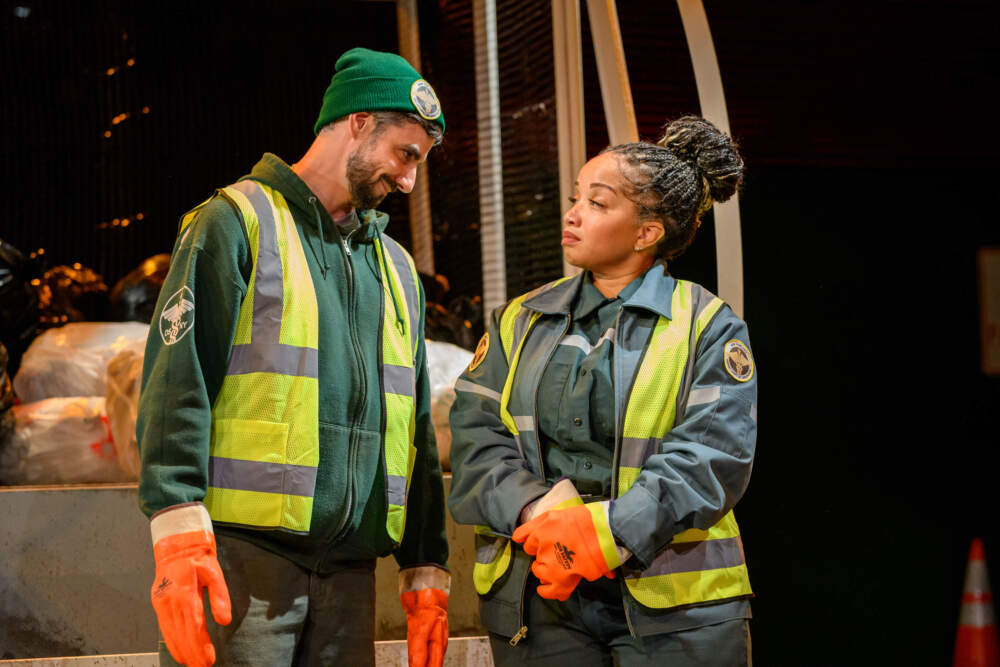
Like an awkward blind date, they eye each other suspiciously, each seeming to wonder what they did to deserve such a match.

But these two have more in common than it first appears, and thanks to a combination of a mostly sharply honed script and spot-on, crisp direction, the layers of what separates them melt away. By the play’s life-affirming end, the two have found more than just friendship; they have found a piece of themselves through each other.

Set in the streets of New York (effective lighting by Anshuman Bhatia, sound by Julian Crocamo and a terrific set by Kristin Loeffler that includes traffic lights, road signs and a functioning trash truck that swivels and rotates), the show slowly builds hope, trust and friendship between these two seemingly mismatched characters as they go about the business of their day. Danny pours on the charm, trying to get Marlowe to loosen up and laugh. Melendy’s performance is worth the price of admission. He is a one-man showstopper, and he is on stage the entire time. As he swerves from serious mentorship to revealing details of his personal life (he is divorced, has a seven-year-old son and is currently under a temporary restraining order), he is a whirling dervish of physicality and nuanced delivery. He is also caring, philosophical and self-aware. “I’m an acquired taste,” he admits. “Like blue cheese.”

Gloucester Stage Company’s production of The Garbologists by playwright Lindsay Joelle, in Gloucester, MA. The production is directed by Rebecca Bradshaw and stars Tomika Marie Bridwell as Marlowe and Paul Melendy as Danny. © 2025 Shawn G. Henry • 978-590-4869 GSC-250702-Garbologists_053

For her part, Marlowe at first is having none of it. Bridwell alternates between high-decibel anger and sullen silence, limiting the audience’s ability to get to know and relate to her character. Although by the end we understand the trauma that led her to take this job, it is an uphill climb.

Joelle gives these two plenty of meaty dialogue, full of astute observations about the meaning behind what people throw away. The street is a resource as well as a wastebasket; one person’s waste is another’s life source.

There are some belly laugh lines and hysterical scenes, especially one with a box full of dildos that Danny uses for an improvisational monologue that finally gets Marlowe to laugh. Triumphant, Danny basks in his accomplishment. “You look radiant,” he practically gushes.

With the exception of a distractingly contrived and awkward twist at the play’s end, Joelle keeps both storyline and character development moving in dynamic and engaging ways.

When Danny gets a call to pick up his sick son at school, Marlowe helps him navigate the awkwardness of figuring out how to contact his ex-wife without violating the terms of his TRO. When Marlowe rescues a teddy bear and places it reverently on a pole, Danny observes but gives her space and time to disclose her reasons. And when Marlowe endangers herself by cavalierly tossing potentially hazardous substances into the compactor, Danny reacts both as boss and concerned friend.

Gloucester Stage Company’s production of The Garbologists by playwright Lindsay Joelle, in Gloucester, MA. The production is directed by Rebecca Bradshaw and stars Tomika Marie Bridwell as Marlowe and Paul Melendy as Danny. © 2025 Shawn G. Henry • 978-590-4869 GSC-250702-Garbologists_274

By the play’s end, we really feel for these two and the cycles of grief, joy, insecurity, loss and random bad luck each has experienced. We also think about garbage (and garbage collectors) in new and shaded ways. Is there a moral obligation, for example, to return something of value that its owner ignorantly tossed, or does the “Finders Keepers” rule apply? When we discard something, do we also discard the right to privacy and anonymity about having owned it?

Most of all, Joelle shines a timely light on our detached perception of those who haul away our debris as faceless and anonymous. These two are full-throated, wonderfully fleshed out, complex and likeable characters, loyal to their families and supportive in their friendships. “Just because we pick up trash doesn’t make us garbage,” Danny says. Amen to that.

Recommended.

‘The Garbologists’ — Written by Lindsay Joelle. Directed by Rebecca Bradshaw. Presented by Gloucester Stage Company at 267 East Main St., Gloucester, through July 26.

For more information, visit: https://gloucesterstage.com/garbologists/