Two-day SSU symposium trains clinicians in addiction diagnosis and treatment


David Selden, a clinical social worker and therapist, has been involved with the management and provision of behavioral health services for over 35 years as a clinician, administrator, executive level manager and consultant.


He is the Director of Leahy Health System’s Cape Ann Adult Behavioral Learning Center in Salem and teaches part-time at Salem State University in the Psychology Department.


He also has a private practice with a specialty in working with teens, adults and their families who are experiencing difficulties from substance use and related mood disorders. He holds both ACSW and LICSW degrees and has lived on the North Shore for over 30 years.


In other words, he is no stranger to mental health and addiction issues on the North Shore. And Selden is worried.


“50-60% of our clients have substance use and addictive issues. We are primarily a mental health and not a specialty substance use treatment facility. This is typical for most mental health facilities, and why it is so important the staff are cross-trained in both the mental health and addiction treatments,” he said.


Although more and more clients with substance abuse and addiction disorders seek help initially from psychotherapists, local graduate schools do not include this topic in their curricula, he explained.


“Local programs are graduating new clinicians who become therapists, case managers, program directors and supervisors with no education or experience in this specialty. This is resulting in misdiagnoses, inadequate treatment and programs unprepared to provide necessary services,” the Marblehead resident said.


To rectify this deficiency, he has been working with administrators at Salem State University to develop training programs and curricula that may lead toward a specialty graduate program in the area of substance abuse and addiction. That long-range project has the support of local agency executives, who see a major need for this type of workforce training.


In the meantime, however, he is focused on the more immediate need to fill the gaping hole in practicing clinicians’ and graduate students’ training. To that end, he has spearheaded and organized a two-day symposium titled, “Substance Use and Addictive Disorders: Energizing the Community to Fight Back.”


The intensive and highly interactive conference will integrate elements of best practice treatment models, case studies and virtual team practice sessions. The two-day workshop runs Friday, June 16 and Saturday, June 17 from 8:30 am – 4:30 pm with 12 CEUs available for professionals who attend both days.


Selden worked with Dr. Carol Bonner, Associate Dean of SSU School of Social Work and Dr. Jeanne Corcoran, Interim Dean of the College and Health and Human Services. The symposium is supported by the School of Social Work and will take place at SSU’s Ellison Campus Center.


Between 2000 and 2016, opioid-related deaths have dramatically increased in Massachusetts, according to The Official Website of the Executive Office of Health and Human Services. For example, total statewide deaths increased by more than five-fold, from 379 to 2,069.


Essex county increased from 51 to 281 deaths; Salem from 5 to 19 deaths; Gloucester from 2 to 9 deaths; Swampscott from 0 to 4 deaths; and Marblehead from 3 to 4 deaths. (For more information, visit

mass.gov/eohhs/gov/departments/dph/stop-addiction/current-statistics.html.)


Selden thinks the symposium is both well timed and relevant.


Allison Bauer, who holds degrees in law and social work and is the Director of the Massachusetts Department of Public Health’s Bureau of Substance Abuse Services, will open the Friday, June 16 with a keynote address.


The rest of the day is devoted to topics in two areas: basic clinical (“What is Addiction?”; “Assessment and Diagnosis”; “Stages of Change/Motivational Enhancement Therapy”) and supervision/management (“State of the Treatment System”; “Self-Help 101”; “Alternative Programming”).


Day Two deals with treatment, post-recovery and relapse issues. Participants will spend the afternoon in virtual treatment teams that will be assigned case studies for practice in assessment and treatment planning.


Selden has assembled a stellar panel with a variety of degrees and professions, from business executives to educators to nurses and treatment program specialists. He has promoted the symposium through e-mail, social media and word of mouth via various professional networks.


Colleague feedback has been “overwhelmingly positive. Everyone I speak to agrees this is a much-needed program. The faculty all readily stepped up to volunteer their time for the symposium,” he said.


With the opioid addiction crisis and its human toll frequently at the forefront of local, state and national news, Selden stresses that the symposium is neither limited to nor geared exclusively for professionals in addiction treatment or related fields.


“The audience is anyone interested in working with people with substance use and addictive disorders,” he said, including those whose friends or loved ones may be so afflicted.


To register, go to substanceabuse17.eventbrite.com.

Rosenberg Takes the Jewish Journal Helm


When Steve Rosenberg was seven years old, he had a friend who delivered newspapers for The Boston Globe. He tagged along, reading the paper before throwing it on the front doorstep. That early experience opened his eyes to the fact that there was a “whole, big world outside of my neighborhood that came in a newspaper every day,” Rosenberg said.


His fascination with journalism grew, reaching a peak during his teenage years with the Watergate political scandal and the crucial roles played by Carl Bernstein and Bob Woodward, two young Washington Post reporters whose determination and relentless hard work broke the story that toppled Nixon’s presidency.


“Watergate showed just how important the free press was to our country, and that with a little digging, a young reporter could help protect our democracy. I knew then that I wanted to be a journalist,” he said.


Rosenberg made that dream a reality, graduating from University of Massachusetts Amherst with a major in journalism in 1981. Thirty years later, after returning to school, he earned an MFA in writing and literature from Bennington College.


And as of its May 4, 2017 issue, he is the new publisher and editor of the Jewish Journal. “I’m excited. This is a dynamic and thoughtful community. And, in this time and age, committed journalism is needed more than ever,” Rosenberg said. “We give voice to a population and a demographic that otherwise might be ignored, and also serve as a watchdog of the government.”


Rosenberg will bring decades of experience to his role, including 15 years as a staff writer and columnist for The Boston Globe and three years as editor of The Jewish Advocate. His articles and columns have been broadly published in the US, and abroad in The International Herald Tribune, Ha’aretz Newspaper and The Jerusalem Post.


The Jewish Journal is a 40-year-old nonprofit based in Salem that reaches 17,000 homes semimonthly. Rosenberg is its fifth editor since 2014, and Bob Rose, president of the Journal Board of Overseers, thinks he is an excellent match. “Steve has a long and distinguished career as a journalist, has very deep personal roots in the North Shore and is intensely committed to Judaism,” he said.


Rosenberg intends to bring strong, quality journalism that reflects the greater Jewish community of the North Shore to the Jewish Journal. He plans to make the paper “newsier” with opinion and editorial pages “filled with experts who base their pieces entirely on facts.”


Lynn Nadeau, of Marblehead, has been a Jewish Journal board member for 12 years and is delighted with Rosenberg’s hire. “He is a real journalist, not an advocate. He chooses his words carefully, with nuance and thought. He will uphold the values we hold: accuracy, fairness, balance, inclusiveness, civility, transparency and integrity,” she said.


According to Rose, Rosenberg’s duties as publisher/editor include producing print and web versions of the Jewish Journal; supervising and leading the staff; interfacing with the Board; engaging with the Jewish community in the broadest sense; and inspiring philanthropy and development.


“Rosenberg is a good fit because he understands that the Jewish Journal serves a niche. Hopefully, he will fill the paper with local stories that were always the meat of the paper,” said Barbara Schneider, who was the Jewish Journal’s publisher from 2004 — 2015.


“As publisher/editor, he has a particularly challenging role,” she continued. “The publisher’s duty is to keep a nonprofit paper on a solid financial footing while being an outreach ambassador to the community. His role as editor is to fill the paper with interesting and frequently controversial stories. Sometimes these roles conflict.”


Rosenberg thinks of himself as a writer and storyteller above all, and he enjoys the interview process, especially its qualities of intimacy and inherent trust. He is continuously captivated by what he learns when he spends an hour sitting and listening to someone tell their story, and by the similarities he sometimes finds with his own life. “It’s rewarding to publish these pieces because they help serve as common threads, and remind us that we have much more in common with our neighbors than we thought,” he said.


Many of Rosenberg’s articles for the Boston Globe chronicled life in the Greater Boston suburbs, giving voice to commonplace people. Fishermen, gang members, suburban moms, rabbis and veterans are among the hundreds his columns brought to life. His most recent book, “Middle Class Heroes: Voices from the Boston Suburbs” is an anthology of almost 90 of these columns.


In his new role as publisher/editor, he intends to bring similar personal stories to the Journal, focusing on people who work tirelessly in the Jewish community, and on everyday relatives who help sustain their familes and Judaism. “These pieces provide a glimpse of our shared values and priorities,” he said. “We are documenting a time and place in American history.”


Mark Arnold, Journal publisher/editor from 3003-2006 and a longtime journalist, applauds Rosenberg’s commitment to reflect the diversity of the local Jewish community and to write about “real people doing real things.” “Steve will be honest about the challenges our institutions face and show where we are and aren’t making progress,” he said.


He added that Rosenberg has the qualities needed for the position: a clear vision of the role the Jewish Journal should play in the community; a set of values and goals to steer by; patience, diplomacy, creativity, and open mind, and — thick skin. “I think Steve has been waiting his whole life for a challenge like this,” Arnold said.


Rosenberg and his wife, Dr. Devorah Feinbloom, a chiropractor and director of Marblehead Natural Healing, have one son Aaron, currently enrolled in Clark University’s Masters in Business Administration program.


Rosenberg is passionate about Israel and Judaism, and he travels to Israel a couple of times a year, where he especially loves spending time in the desert. Closer to home, he also enjoys walking and relaxing in the woods and on the beaches near his home. He has played guitar since childhood and recently bought an electric drum set. He also studies the Torah and finds Rashi’s commentaries particularly intriguing.


Asked which of his many accomplishments — journalist, photographer, documentary filmmaker, author, editor, TV station manager, producer — he is proudest of, Rosenberg doesn’t hesitate. “My family is the most meaningful and really, the only lasting accomplishment in my life,” he said. He also mentioned a strong group of friends from kindergarten he is in regular contact with, and whom he loves.


“Relationships keep me going; all else is temporary,” he said.

Reality Fair Provides Reality Check

Wulf,Gj,Boppart,Ac

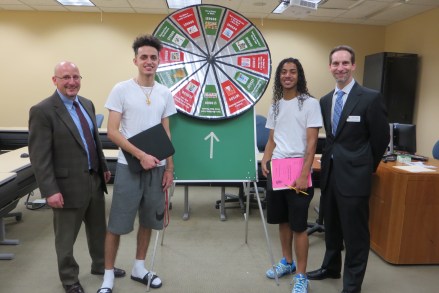
Andrew Wulf, SHS Assistant Principal for Teaching and Learning, SHS seniors Xhoralgo Gjinaj and Vistor Acosta, and Bryan Boppert, SSU AssociateDirector of the Student Navigation Center, pose with the Reality Check wheel of fortune. PHOTO: Shelley A. Sackett


Salem High School senior Daniele Alejandro hoped the financial Salem High School Reality Fair, a simulation of the financial challenges adults face, would show him how to be financially stable. After attending last Wednesday’s event, he came away with a better idea of how many obstacles he will face to achieve that goal.


“I was surprised at the cost of housing and how expensive it was. We had three people sharing an apartment and it was still difficult to pay for utilities,” he said.


Jaileny Pimentel, whose favorite subjects are calculus and statistics and who is interested in a career in business, looked forward to learning “tricks on how to save money.” Some students, like Victor Acosta, already pay all their personal bills, such as food and cell phone. Acosta recognizes he needs to learn to save on a regular basis and hoped the fair would teach him how to better manage money so he could afford to own a car.

Alej,Pimen

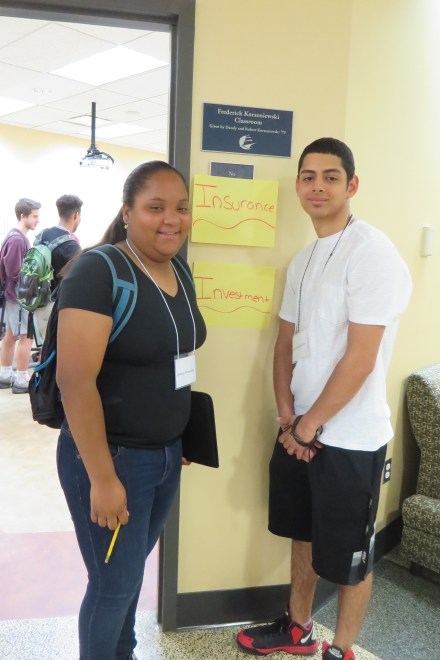
SHS seniors Jaileny Pimental (left) and Daniele Alejandro about to enter the Insurance and Investments booth.


Other students, like Xhoralgo Gjinaj, simply welcomed the opportunity to be out of the classroom on a beautiful May day. He anticipated the fair being “fun, interesting and something new.”


Since 2015, Salem Public Schools has run the SHS Reality Fair, providing graduating seniors with the opportunity to experience an up close and personal snapshot of what lies ahead of them as financially independent adults. The fair also supplies them with some of the tools they will need to tackle the many obstacles they will encounter along the way.


“We are very excited to be partnering with Salem State University (SSU), Salem Five Bank and Cabot Wealth Management. Everyone is committed to making sure our seniors leave high school understanding how to manage money,” said Andrew Wulf, Assistant Principal for Teaching and Learning at Salem High School.


The Reality Fair planning team included Mikki Willson from Cabot Wealth Management; Ginny Leblanc, who teaches at Salem High School and handled most of the event coordination; and Adria Leach and Bryan Boppert from SSU. Bertolon School of Business at Salem State University hosted the event.


Each student received an individualized packet upon arrival with their name, occupation, and a summary of their hypothetical financial life at age 25, including net income after all taxes are deducted from their salary. Armed with that figure, they visited 16 booths to fill in the blanks on how to survive on that amount of money while also managing student loan debt and saving some money every month. Adult volunteers from the business, non-profit and public sectors staffed the booths, located in classrooms throughout the building.


At the end of the three-and-one-half hour fair, each student came away with a realistic monthly budget and the skills necessary to build one for themselves in the future.


Among the booths were: Career Counseling, Charity, Clothing, Credit/Lending, Credit Counseling, Education, Food, Luxury, Furniture, Housing, Insurance, Investment, Retirement, Savings and Transportation. In the Reality Check booth, a giant wheel similar to the “Wheel of Fortune” greeted visitors. Instead of winning vowels, however, a spin of this wheel yielded those little twists and turns life can unpredictably throw at you. Landing on green meant unexpected gains; red signified a loss.


For example, the green slots included a $100 birthday present from your parents or a part time job that yielded $250 a month. Red could mean an $875 expense to attend a wedding or $500 to replace a broken smartphone.


“It was really eye opening to see how the real world works,” said Alejandro, who hopes to earn an R.N. degree after graduation.


Bryan Boppert, Associate Director of the Student Navigation Center at SSU, greeted each student when they entered the lobby with a handshake and a smile. This was his first year of official involvement in the Reality Fair, but he was aware of it last year.


“Students took away the real world benefit of learning that budgeting is a skill learned through practice that requires discipline to maintain. Some students wanted fancy cars and vacations, but in the end they wound up broke,” he said, adding that the real benefit of the Reality Fair is that students can fail in a simulated way instead of trying it in the real world where they could lose their car or hurt their credit score.


His office, which counsels SSU students on borrowing responsibly, paying bills on time and managing the complex world of college, would love to replicate the Salem High School Reality Fair for their own students. “I would go so far as to say that the state should mandate financial literacy for all students because it has such a positive effect,” Boppert said.


Wulf has received positive feedback from the volunteers and students, who mentioned that the fair gave them a nice dose of reality regarding the complexities of managing their money. He believes that having volunteers from different companies and organizations was key to making the experience more authentic for the students.


“We have yet to hear from a student that the fair was not worthwhile,” he said with pride.

Salem Artist Tapped as New ArcWorks Director


AW10 (1)


Lifelong artist Susan Dodge loves her new position as Director of ArcWorks Community Center in Peabody. “The job I am doing now is just such a reward. I smile everyday. I’m happy to go to work. And I get to do so many things I really love, like curating shows, working with artists and envisioning what the next project will be,” the Salem resident said during an interview at The Bridge at 211 in Salem, where she currently has a piece on exhibit.


The Northeast Arc (NeArc) is a not-for-profit organization that helps children and adults with disabilities become full participants in the community. ArcWorks is its inclusive art center, which serves artists and viewers of all talents, skills, interests and backgrounds and provides artistic opportunity for people with and without disabilities.


In her role as its director, Dodge is responsible for scheduling gallery shows at both the art center and Breaking Grounds, the coffee shop in Peabody that NeArc runs. She also creates curriculum and teaches various art classes during the day to NeArc clients and in the evening to community members.


“I am happily tired at the end of the day,” Dodge said with a smile.


Tim Brown, Dodge’s supervisor and NeArc’s Director of Innovation and Strategy, couldn’t be more pleased to have Dodge on board.


“I have been a personal fan of Susan’s art for many years,” he said. “What I did not know was how each step in her personal journey fit so nicely into the model we wanted to develop.”


Dodge’s impressive resumé includes teaching art; a commission for 48 paintings at the famed Palm Beach, Florida property, The Breakers; a seven-year stint as Project Manager at a web design firm; a business career in sales and marketing at The Hawthorne Hotel; curating many art shows, and owning her own pottery studio, The Artful Dodger, through which she sold murals, tiles and signature pottery throughout the U.S. and the Virgin Islands.


She earned a B.F.A from Massachusetts College of Art and returned to school at age 48 for a certificate in digital graphic design.


According to Brown, the diversity of Dodge’s experience was exactly what NeArc hoped a new director bring to the position — the abilities both to develop an engaging class structure using a variety of mediums, and to manage the Gallery Shows and Shop within the ArcWorks program.


“Within her first four months at NeArc, she has curated five different gallery shows. Each show brought new artists and viewers, expanding our reach and recognition within the art community,” he said.

Prior to her current position, Dodge has always taught private art classes to children. This is her first time working with students with disabilities, but she sees more similarities than differences.


“I look at people with disabilities as just people. Creating art in so many ways is about honing a technique and seeing things. Everyone has their own vision of how they see things. Basically, making art is just translating that vision into an object or putting it on a canvas or a paper,” she said.


AW8 (1)

Susan Dodge is working with Polyvios Christoforos on a painting that was ultimately featured in a collection of greeting cards handed out at the Ne-Arc “An Evening of Changing Lives Dinner and Fashion Show” on April 29


She works with 25-year-old Polyvios Christoforos twice a week. “He is a prolific painter. We work together really well,” she said. Christoforos’ work was featured in a collection of greeting cards handed out at NeArc’s “An Evening of Changing Lives Dinner and Fashion Show” on April 29.


“When you teach people with disabilities, you have to be really present, and compassionate and listen really well,” Dodge said, noting that many of her clients have speech-related issues. “I have developed different ways I work with people” depending on their needs.


Over the years and from her teaching experiences in the U.S. and abroad, Dodge has noticed a consistent and common thread among all her students: they share an eagerness to create something they can be proud of.


“In my core, I believe that everyone is an artist. It’s just a matter of letting yourself do it without judging what you’re doing,” she said.


For more information, visit ne-arc.org.


Rescuing Cats Is a Family Affair

Dedicated PALS volunteer marks fifteen years of service


The first thing Maryann Tapparro did when she left her childhood home in Rochester, New York was to get a pet. “My parents didn’t like pets; they weren’t animal people,” the Danvers resident said during a phone interview. “We were living in an apartment and so my first pet happened to be a cat.”


That was 54 years ago, and Tapparro has had cats ever since. “I don’t know why, but I’m just passionate about cats. They’re wonderful, intriguing animals,” she said, over the background mewling of a litter of recently born kittens.


Fifteen years ago, she found out about Pals Animal Lifesaver (known as “PALS”), a local all-volunteer no-kill cat shelter in Salem. The non-profit organization, founded in 1995, is dedicated to helping homeless cats and kittens find suitable, loving homes, and is funded fully by donations, adoption fees, and organized fundraisers.


Maryann and Cat

Maryann Tapparro with one of her many cats.


Since then, Tapparro has done every job there is at PALS and currently serves on its Board of Directors as Feline Coordinator. PALS has a team of rescuers on call 24-hours-a-day that responds to reports of a cat in the local area in need of rescue. As Feline Coordinator, Tapparro’s basic task is finding foster care for these rescue cats until they can be vetted and placed for adoption.


She has five cats of her own and has fostered hundreds over the years. “It’s very hard because we become attached to these cats, but then we are really happy that they do get adopted,” she said.


Some cats are sick or injured, so they may need medication or surgery. Some have chronic diseases, such as leukemia or thyroid issues, and need lifetime care. “We have some wonderful people out there who do adopt these animals and continue the medications for them,” Tapparro said.


She mentions educating the public as the biggest challenge PALS faces. First is teaching people to have their cats spayed or neutered. “Then there wouldn’t be so many strays,” she said.


Second is to educate cat owners about the importance of keeping their cats indoors because of the obvious safety hazards and because cats are not geared outdoor survival.


“If people move, they sometimes leave their cats thinking they can fend for themselves, but cats really are not used to eating birds and mice. It’s just a form of play for them,” she said. “That’s why we find a lot of cats in dumpsters trying to find food.”


They also need water, which is sometimes hard for an animal to find outdoors.


While fostering cats on her own, Tapparro also manages the database for all the other cats in other foster homes and initiates check-ups. All cats are followed up with and watched throughout all stages of rescue. Once well enough to enter the adoption center, a PALS Adoption Coordinator matches cats with the most suitable adopter for their needs.


Since 2003, PALS has been an adoption partner at PetSmart’s store at 10 Traders Ways in Salem. Hours for adoption are Saturday and Sunday from 11 a.m. until 4 p.m. and Fridays by appointment. The cats can be viewed in their cages during regular store hours.


According to PALS Volunteer Coordinator, Sandy Perry, the rewards of volunteering show no bounds. “Between the friendships made, helping adopters both past and present, and sharing the joys of their new family member and the wonderful felines we encounter every day, this is a wonderful, rewarding endeavor,” she said.


Maryann and Amanda

Maryannn Tapparro and her granddaughter and fellow PALS volunteer, Amanda Tapparro.

For Tapparro, it is also a family affair. Three of her granddaughters have followed in her footsteps and volunteer at PALS. Amanda Tapparro is the official PALS photographer.


Her three children have also inherited her love of animals, one going one step further. “They all have cats. One even has dogs too,” she said with a laugh.


For more information, visit palscats.org/ or call 978-531-7478.


Salem Film Fest Turns Ten!

The “little festival that could” celebrates with a Gala

When local filmmaker Joe Cultrera, businessman Paul Van Ness and Salem Chamber of Commerce Executive Director Rinus Oosthoek gathered at the fledgling CinemaSalem’s café in 2007, they all shared a common goal: to create an event that would be fair to documentary filmmakers and attractive to audiences. They presented a week of special film programming and live events in the middle of that same winter. “That’s about as fast as a festival can be put together once you have a venue,” said Van Ness who owns CinemaSalem. “I suppose you could call it a spring training for the big league festival that would inaugurate the next year.”

The 2008 Salem Film Fest drew 1,743 filmgoers; last year, more than 6,000 attended what has grown to be both one New England’s largest and among the nation’s most respected all-documentary film festivals. Each March, the festival presents a rich and diverse collection of the year’s best work from all over the world that helps sustain cinephiles through the long, bleak slog of New England winter.

This year the festival runs from March 2-9 and will kick off its tenth anniversary with a Gala on Thursday, March 2 at the Hawthorne Hotel that will combine presentation of the 2017 SFF Storyteller Award to Frontline founder David Fanning with a live music dance party. (Visit salemfilmfest.com/2017/gala-tickets for more information).

“Come to Salem, see the world” has been the Salem Film Fest catch phrase since its inception, both as an homage to old Salem merchant ships that established trade with the rest of the world and in tribute to the dozens of countries represented by the films the festival has screened over its ten years.

With a line-up of 35 feature and 13 short documentaries from more than 25 countries, SFF 2017 covers a lot of the globe: from the largest Syrian refugee camp in Jordan (“After Spring”) to Finland’s worst cheerleading team (“Cheer Up”); from the Mississippi Delta blues (“I Am the Blues”) to Mexico’s most famous tabloid photographer (“The Man who Saw Too Much”); from Jalalabad’s child street gangs (“Snow Monkey”) to a New York City’s West Village artist community (“Winter at Westbeth”). And everyplace in between.

Besides CinemaSalem, SFF partners with Peabody Essex Museum’s Morse Auditorium (PEM) and the National Park Service Visitor Center (NPS) as additional venues. With simultaneous screenings at all three sites, the streets of Salem feel like a mini Sundance as filmgoers greet each other on the street, making their way from one film to the next.

As in past years, SFF 2017 focuses on filmmakers as much as their films, and 19 filmmakers and/or their subjects will attend this year’s post-screening Q&A sessions, which promise to be as exciting and informative as festivalgoers have come to expect. “It’s great to see the growth of the festival while we also stay true to our roots. More and more filmmakers have found the festival to be a haven of sorts for their films, and they enjoy spending time in Salem,” said Jeff Schmidt, who has been SFF program director since 2014.

Cultrera, who handed the programming to Schmidt in 2013, agrees. “The thing I look forward to every year is getting a new crew of filmmakers to the festival: spending time interacting with them; introducing them to Salem; watching friendships build between them and some of our audience, and talking shop at after-hours gatherings,” he said.

Among this year’s line-up are three U.S. premieres: “The Day the Sun Fell” (surviving Red Cross doctors and nurses remember the day Hiroshima was bombed as nuclear disaster strikes Japan again); “Mattress Man” (an Irish 60-something-year-old creates a tacky YouTube persona to boost his failing business) and “Zimbelism” (one of the last working street photographers shares stories from his dark room). Both filmmaker Matt Zimbel and his subject and father, George S. Zimbel, will be present at the “Zimbelism” screening at PEM on Sunday, March 5 at 10:50 a.m.

The programming committee started looking for SFF 2017 films last June, and the richly varied menu of films has something to please every palette. To make planning easier, SFF offers a helpful guide that organizes the films into a number of “curated itineraries” to allow the audience to review films through specific lenses.

Three films that address complex socio-political issues through one person’s story are “Almost Sunrise”, Tickling Giants” and “Death by One Thousand Cuts”.

Filmmaker Michael Collins’ “Almost Sunrise” addresses “moral injury” by following two Iraq War veterans suffering from PTSD as they trek 2,700 miles in a last ditch effort to find the healing they both seek. Collins will attend the Q&A after the screening at PEM on Saturday, March 4 at 8:35 p.m.

“Tickling Giants” examines the aftermath of the Egyptian Arab Spring by showcasing Bassem Youssef, the “Egyptian Jon Stewart” who endangers his life and livelihood when the Morsi regime doesn’t appreciate his jokes. Filmmaker Sara Taksler will be available for a post-screening Q&A. The film is at PEM on Friday, March 3 at 8:10 p.m.

In “Death by a Thousand Cuts”, a brutal murder on the Haiti-Dominican border exposes the complex consequences of killing the Dominican forests, one cut at a time. The filmmaker will attend the Q&A after the screening at CinemaSalem on Sunday, March 5 at 5:10 p.m.

On the more whimsical side, “The League of Exotique Dancers” introduces eight unforgettable Burlesque Hall of Fame inductees who share the good, the bad and the ugly about the golden age of stripping with bawdy good humor and moving insight in a film that is a guaranteed crowd-pleaser. It screens at CinemaSalem on Saturday, March 4 at 9:40 p.m.

Those most interested in the arts have plenty to choose from this year. “The Ballad of Fred Hersch” traces the foremost jazz pianist and composer’s journey from AIDS coma survivor to musical triumph (Friday, March 3 at CinemaSalem at 5:10 p.m.). “Yarn” introduces edgy, contemporary women who are revolutionizing the art of knitting and crocheting. (Saturday, March 4 at PEM at 11:50 a.m.). “I Am the Blues” gives an up-close-and-personal tour of the original southern juke joints with the aging blues musicians who still play its “Chitlin’ Circuit”. (Closing night feature on Thursday, March 9 at CinemaSalem at 7:00 p.m.).

Every year, regular attendees look forward to the premiere of “Salem Sketches”, a series of two-minute documentaries based in Salem and created exclusively for SFF by local filmmakers and SFF Planning Committee members Cultrera and Perry Hallinan. “We’re one of the few festivals that can claim to have our own original programing,” Cultrera said with pride.

SFF 2017 is also jam-packed with events, parties and the live music performances before many of the screenings at CinemaSalem by local musicians whose contributions add to the festival’s literal good vibrations.

While the community-driven, all-volunteer festival steadfastly remains true to its ideals of high-level programming and treating filmmakers like the stars they are, the “little festival that could” seems poised for even wider appeal and reach in its second decade. All agree that fundraising and broadening the volunteer base are two critical ingredients for generating this growth.

“The festival is special, but it could be on another level entirely if we had the resources and if there was a mechanism in place in Salem that better synchronized public, private and non-profit energies,” said Cultrera.

Nonetheless, the wildly popular and highly anticipated festival draws sell-out crowds to one of the liveliest and friendliest of Salem’s many festivities. Patrons return year after year and hugging reunions in the CinemaSalem lobby are commonplace. Clearly, the Salem Film Festival is about more than films. It’s also about community.

“Come to Salem, see the world. Come to Salem, meet the world,” Oosthoek said with a smile.

Salem Film Fest runs March 2-9 with screenings at CinemaSalem, Peabody Essex Museum and National Park Service Visitors Center. For more information or to purchase tickets or passes, go to the CinemaSalem box office or visit salemfilmfest.com/2017/.

Israeli Innovations Energize Mayor Driscoll


Israel had long been on Mayor Kim Driscoll’s bucket list. So when she was invited to participate in the American Israel Education Foundation’s (AIEF) educational seminar to Israel for members of Congress and other politically influential people last February, she jumped at the chance.


“We think Salem, which is almost 400 years old, has an embarrassment of riches, from the birthplace of the National Guard to the Witch Trials to the great age of sail. We’re a babe in the woods compared to what’s over there,” she said.


Although she is a practicing Catholic, she was more drawn into the history of the sites she visited than the bible stories. “I really value the role history plays in the character of a place. The commitment to never lose sight of that, whether it’s good history or history that’s more tragic, like the Witch Trials — that’s definitely moving,” she said.

Western Wall

At the Kotel (Western Wall)

At the Kotel, or The Western Wall (an ancient limestone wall in the Old City of Jerusalem), she also felt the weight of the region’s history and the thousands of years during which there have been sometimes violent disagreements. She came away with an even stronger commitment towards peace. “It is so complicated and so hard to achieve, yet so necessary,” she said.


She was also on the look out for Israeli ideas she could bring back to Salem, and she found more than she expected. “I was struck by the drive for ingenuity and innovation in Israel,” she said more than once during the hour-long conversation.


In particular, she marveled at Israel’s ability to recycle 80 percent of its water in a sustainable, thoughtful way. “It’s amazing what you can do when you have to. Water scarcity is a big issue in the Middle East. They don’t have a choice,” she said.


Israeli engineering firms that have developed ways of monitoring water leaks to help with water loss also caught her attention. “When you think about a water system as old as ours, well theirs is a thousand times older. I think there could be some shared alignment,” she said.

Granot Desalination Plant visit

At the Granot Desalination Plant


Urban agriculture, also tied to water, is another area of potential transferability. “I think we’re all going to need to think about that as more folks move into cities. There’s already a farm-to-table sustainability food industry here. I think there’s a lot we could learn,” she said.


She also sees potential applicability for Salem to adapt the way Israeli law enforcement communicates with residents. In Jerusalem, for example, a system of colored lights signal the current level of concern about potential attacks from Israel’s enemies. Although Salem doesn’t fear that kind of attack, Mayor Driscoll came away with ideas about how to expand the system already in place that flashes a blue light when there is a snow-parking ban.


“I’m talking more about if trash is delayed a day, or if there is other information we want to get out,” she said. “Right now we rely on phone calls or web sites. Their simple lighting system communicated a universal message to a city where people were from many different backgrounds and spoke many different languages. It was very clear to everyone what was going on.”


According to 2015 Census Bureau information, 23.3 percent of Salem citizens speak a language other than English. That is higher than the national average of 21%.


The February itinerary included briefings at the Gaza Strip and Lebanese and Syrian borders, and visits to the Granot desalination plant and the Knesset as well as to top tourist sites in Jerusalem, Tel Aviv and Capernaum.


Group photo at Visit to Sea of Galilee- Mt. of Beatitudes

Group photo at Mt. of Beatitudes- Sea of Gallilee


“I really felt like I was on a journey to better understand history and also how people interact in a time when there is trauma, stress and threats all around them. There is a real perseverance in Israel that you can see everyday,” she said in an interview soon after her return.


“We had immense opportunities to speak with everyone we met. We were told, ‘There is nothing you can’t ask. There is nothing out of bounds.’ That was very worthwhile,” she said.


The group was diverse, with members of state government, many of whom had been active in political campaigns and within different policymaking levels of government. “The discussions were really hearty. I appreciated being in a discussion with folks who had different lenses. I brought a lot of the local flavor, I would say,” she said.


What most impressed her, however, were two qualities she circled back to again and again: political consensus building and the perseverance of a people at perpetual risk.


“Israel has 26 different parties. It is very much a parliamentary form of government with lots of coalition building. Yet they can adopt a uniform policy that covers the whole country and it can have meaningful impact,” she said.


Although consensus building is harder in Israel than in the U.S., its power and effectiveness is greater. At the Knesset (Israel’s legislative body), she witnessed lots of party members expressing lots of opinions. “Yet I was struck by their ability to move something forward,” she said in reference to Israel’s policies of universal health insurance and national water conservation policy.


She contrasted that to the situation in the U.S. with our city, county, state and federal levels of government. “We get almost nothing done with two parties, yet with six parties influencing policies and legislation, they manage to get consensus,” she said, shaking her head.


On a more personal note, Mayor Driscoll described her visit to a kibbutz near the Gaza Strip where she met families who live under the constant threat of rocket attacks, yet would never consider living anywhere else.


“Seeing the bomb shelters, seeing the Egyptian border, and hearing first hand from individuals who lived there was very moving for me. The situation was normalized for them. It was normalized for their kids. If you heard the alarm, you had 19 seconds to get into a bomb shelter,” she said.


The impact that governmental actions can have on families’ everyday lives “hit me in the face. A peace process can be mind-boggling, trying to figure out who’s responsible for what and the role we Americans play in it. But the difficulties and complexities involved in that discussion didn’t matter to the kids sitting at the bus stop next to the bomb shelter,” she said.


The geography and diversity of the Israeli landscape, “mountains to coastline and everything in between” surprised Mayor Driscoll. So did the fact that she never felt unsafe for one minute. “I would encourage anyone who is remotely worried about safety to just go,” she said, pointing out that many Israelis she spoke to said they wouldn’t feel safe traveling to the U.S. with news reports of gun violence and school shootings. “We put into perspective the awful things that have happened here, normalizing them. We still haven’t passed gun control,” she added.


The AIEF trip was not all work and no play, and Mayor Driscoll thoroughly enjoyed getting better acquainted with Israel’s “awesome” food. “Shakshouka!” she exclaimed with a broad smile. “My new favorite, and they have it at Adea’s on Sunday right here in Salem!”


“I guess I had never thought of Middle Eastern food as the culmination of different places. It’s a little Syrian, a little Israeli, a little of everything. We were served small plates…but they just kept on coming,” she said with a laugh, adding, “we tried to walk as much as we ate.”


She was also surprised by the visit to a winery in the Golan Heights. “Who thought I’d be in a terrific winery in the Golan Heights? When I think Golan Heights, I think of ‘Duck for cover!’’ she said.


If invited back to Israel for a follow up trip, Mayor Driscoll would suggest the itinerary include digging deeper into Israel’s schooling and education. The February tour incorporated brief visits to schools that are trying to bridge Muslim and Arab and Jewish differences by bringing students and their families together in ways she found “smart and thoughtful”.


“We saw kids from different backgrounds being educated together and celebrating all holidays. This is sometimes under really difficult circumstances in neighborhoods where there may be a history of trauma or tragedy that exists between those with long-held beliefs or differences of opinion.


If they can figure that out, that younger generation might be the real key to achieving peace in the Middle East,” she said.


AIEF is the charitable organization affiliated with AIPAC, America’s pro-Israel lobby, and was created in 1990. For more information visit aiefdn.org.


Former Czech Spy Tells It Like It Was

SSU panelists warn about dangers of “fake news”

Shelley A. Sackett

Dillon and M-B

Peggy Dillon, SSU Associate Professor and panel moderator, listens as Dr. Martin-Bittman talks about his years as a Czech spy.


What do a former Czech spy who served as a post-war intelligence officer specializing in disinformation for the Czech Intelligence Service and Earth Day have in common? According to Peggy Dillon, Associate Professor of Communications at Salem State University and member of the SSU Earth Day Committee, everything.


“This year’s Earth Day theme on campus is ‘It’s Your World, It’s Your Future: Get Involved,’” she said. “I thought a panel about media literacy — and fake news and disinformation in particular — would be a timely topic for media consumers in general, as well as for environmentalists.”


Dillon had agreed to create and moderate a panel about media literacy as part of SSU’s 2017 Earth Days events. The panelists would examine how disinformation and fake news have permeated the media landscape and discuss media-literacy strategies for telling the difference between truth and fiction in the news.


She titled the panel, “How to Recognize Disinformation and Fake News: Be a Media-Literate Advocate for your Cause” and invited SSU Communications professors Jane Regan and Cindy Vincent to participate. Regan, a lecturer in Multimedia Journalism who is also an investigative journalist, would address “both-siderism” and mainstream vs. “alternative” media coverage, particularly of environmental topics. Assistant professor Vincent would discuss filter bubbles, media distractions and the ability to discern credible sources.


But she still wanted a third panelist to round out the discussion.


As part of her “newly ramped-up political activism” following the 2016 elections, Dillon started attending meetings at the Rockport Unitarian Universalist Church of like-minded concerned citizens. There she heard about Lawrence Martin-Bittman, a Rockport resident whom a member knew from church.


Né Ladislav Bittman in 1931 in Prague, Martin-Bittman defected to the United States in 1968 after the Soviet invasion of Czechoslovakia. Prior to that, he was an expert in creating and disseminating Soviet propagandistic disinformation, spreading anonymously and deliberately distorted information to deceive and manipulate public opinion.


“I met Dr. Martin-Bittman for lunch and heard his life story, and immediately invited him to join the panel. He agreed,” Dillon said. After all, who better to address the topic of fake news and disinformation than one who not only could talk the talk, but had also — literally — walked the walk?


And for nearly thirty minutes on Tuesday, over 30 students, faculty members and visitors were captivated by the 86-year-old ex-spy’s stories about how he came to be recruited by the Czech Secret Service and the kinds of disinformation campaigns he engaged in.


“It’s nice to be back again on academic soil,” the former Boston University professor and author said.


As a teenaged student of international law at Charles University in Prague, Martin-Bittman anticipated a career as a diplomat. Instead, upon graduation, he and 37 of his 42 fellow classmates were “invited” to the Central Committee of the Communist Party headquarters where they were told they would work in the Czech Intelligence Service. “I didn’t even know Czechoslovakia had an intelligence service,” he said.


Overnight, he became a spy.


Over the course of 14 years as an operative, he had 30 names and supervised hundreds of other agents, eventually becoming deputy commander of the disinformation department, leaking carefully constructed false messages to reporters in order to influence people and politicians.


In 1968, when the Soviet invasion Czechoslovakia effectively ended the Prague Spring and his country’s brief attempt to enact democratic reforms, Martin-Bittman realized he had spent the last14 years of his life “basically working for the Russians.” He decided to quit and defected to the United States later that year.


He was tried in absentia in a military court in Czechoslovakia, which convicted him of treason. “I was treated as a defector and hunted for decades,” he said. One of his students at Boston University was even recruited to spy on him, he discovered later to his dismay. His death sentence was recently revoked. “I never thought the Communist regime would collapse in my lifetime,” he said.


No stranger to the concept of “fake news”, Martin-Bittman is alarmed by the current state of global media with reports of cyber warfare, information weaponization and information wars. “We live in a world of deception and manipulation,” he warned.


“For the United States or any other democratic country with a free press, spreading propagandistic information might be a dangerous, self-destructive weapon, a ticking time bomb that can explode in the perpetrator’s backyard,” he continued.


He is quite concerned about the Russian doctrine of information warfare and its implications in the U.S. presidential election campaign of 2016, which he feels demonstrated the importance of developing new defenses in protecting the American democratic system. “Misinformation is information that is bad, wrong or mistaken. Disinformation is deliberate and malicious,” he said.


Dillon believes journalists and media educators have an important role to play right now in helping the public understand the difference between fact and fiction in their media diet, and she hopes people came away from the panel discussion with a heightened awareness about the prevalence of false or distorted information in our media diet. Martin-Bittman goes one step further.


“People must realize that there is an urgent need to educate the new generation of journalists about the new information environment and the dangers of disinformation,” he said. “The best protection against any kind of propaganda is strong analytical press capable of professional analysis of all suspicious information, wherever it comes from.”

Chef Joe Raises the Bar at Village Tavern; New Menu Offers More than Just Bar Food

Ingemi and Peterson

“Chef Joe” displays his technique while preparing one of his signature dishes, Beef Strogonoff. PHOTO CREDIT: Shelley A. Sackett

Joseph Peterson — “Chef Joe” — can pinpoint the exact moment he knew he wanted to be a chef. He was a 12-year-old boy living in Dryden, New York, about an hour south of Syracuse. It was 10 o’clock at night, his mother was at work, and he was hungry. “I made stir fry beef with noodles and it tasted so good,” he said with a broad smile. “I had so much fun making it that the next day I thought, ‘this is what I want to do.’”

Right around that time, Dryden got its first cable service. Peterson wasted no time discovering cooking shows and famed chef Ming Tsai’s “East Meets West” program particularly captivated the tween. “He showed people how he cooked inside his restaurant, which was French-American-Asian. As a kid, I watched that show every Saturday and wanted to grow up to be just like him,” Peterson said.

Fast forward to 2009 when Peterson, fresh out of Boston’s Cordon Bleu cooking school, went to work for his idol at Tsai’s acclaimed Wellesley restaurant, Blue Ginger. After training under the celebrity chef, he went on to become executive chef at Jerry Remy’s, the downtown Boston restaurant near Fenway Park.

That’s where “Chef Joe” was working when Andrew Ingemi, who co-owns Village Tavern with his father, Arthur, realized that he would be a perfect fit for their Salem restaurant. “Jerry Remy’s gave him experience with volume,” Ingemi said. “I needed someone who would have no trouble with an October crowd. With Joe’s experience of a busy restaurant with Red Sox games multiple times a week, it was an easy choice.”

Ingemi hired Peterson last fall and the two unveiled an overhauled menu last month.

Peterson in the kitchen

Village Tavern co-owner Andrew Ingemi and Chef Joseph Peterson at a quiet moment in the bar.    PHOTO CREDIT: Shelley A. Sackett

Part of Ingemi’s dream was to make Village Tavern known for higher end tavern fare rather than just bar food. The new menu features such dishes as Sweet and Sour Duck and 28-day dry-aged grass fed sirloin, which “may be the very best steak you’ll ever have, other than at a fancy steakhouse in Boston,” he said.

Peterson is equally excited about the fusion side of the menu, which mixes traditional appetizers and Asian touches in such inventions as Philly Steak Egg Roll and Buffalo Chicken Ragoon.

Dear to Peterson’s heart is his Beef Strogonoff, which is a hearty and tasty dish his mother used to make once a week. His special secret? He adds sour cream at the end to give it a “zing” (his mom used heavy cream).

“A lot of cooking is about technique,” Peterson said as he prepared this dish for the Salem Gazette. “Stroganoff is simple, but hard to make it taste well.”

Ingemi’s family has been in the restaurant business in Salem since the 1970’s. His great-grandfather is the Steve of Steve’s Market and his father and grandfather have owned many eateries over the years. Ingemi didn’t join them until 2012, when his father and brother were opening the Village Tavern and asked him to help out. At the time, he was working in Boston at State Street Bank. He thought he would stay a year. Five years later, he’s still there.

“I fell in love with working with my family and making the restaurant better. It’s so rewarding,” he said. “It’s kind of fun — we have a big history in Salem.”

He’s also proud of “Chef Joe” and all the staff for “kicking it up a notch” to be up to Joe’s standards in the kitchen. “We’re able to give guests the overall experience we’ve been wanting to give them for the last couple of year,” Ingemi said.

Peterson is delighted to be in Salem after many years in Boston. While he’s looking forward to making an impact with his food, he is just as eager to take a leadership role among his employees in his kitchen. In the six months he has been at Village Tavern, he has already promoted many from within and has built a team spirit and loyalty among his staff.

“Taking a cook and making him sous-chef or taking a peeler and making him a prep chef, that the kind of stuff that excites me. I like growing people. I could do everything myself back there, but that’s not the idea,” he said.

Salem First Muster Soldiers on Despite April Fool’s Day Storm

IMG_4731

More than 100 uniformed National Guardsmen and women, members of Veteran’s organizations and civilian onlookers braved the heavy snow and fierce winds Saturday morning to mark the 380th Anniversary of the first military muster in the United States in the very birthplace of the National Guard — Salem.

Soldiers and senior leaders of the Massachusetts National Guard, Veteran’s organizations, military re-enactors and living history groups were on hand to lend an authentic and solemn air to the event.

The first muster —or military drill — took place in Salem Common in 1637, the year after the National Guard was formed. Saturday’s event was a yearly celebration commemorating significant moments in the history of the Massachusetts National Guard as well as the origin of the Army National Guard.

In January 2013, President Barak Obama signed legislation initiated by Massachusetts Congressman John Tierney designating Salem as the birthplace of the National Guard.

Sponsored by the Second Corps Cadets Veterans Association, this 380th milestone anniversary kicked off at 9:30 a.m. with a wreath-laying ceremony at St. Peter’s Episcopal Church and at the nearby gravesite of Captain Stephen Abbott, founder and first commander of the Second Corps. All stood as a single trumpet played a plaintive “Taps” in the acoustically splendid church. Each note seemed to hover weightless above the pews.

Chief of the Guard Bureau, 4-star General Joseph Lengyel, was this year’s guest of honor. He addressed the crowd at St. Peter’s Church before venturing outside to lay the wreath and lead the procession. “It’s good to be home,” the Peabody native declared. “I am proud of who we are and what we mean to this country. I am proud of all these people — doctors, lawyers, store owners, teachers, policemen and women — who have committed to keeping our country safe abroad and at home.”

Lengyel serves as the 28th chief of the National Guard Bureau and as a member of the Joint Chiefs of Staff. He is a military adviser to the President, Secretary of Defense, and National Security Council.

Captain Phillip Jenkins, Battery Commander C Battery 1/101 Field Artillery, followed, raising a chuckle when he said, “This is the first time you’ll see a Captain following a 4-star General.” He gave a brief but informative history of the National Guard and what the term “citizen soldier” means, also praising the Second Corps Cadet Veterans Association for “maintaining camaraderie and service to fellow soldiers.”

Colonel Cheryl Poppe, a Salem resident, looks forward to Salem First Muster every year. She retired from the Massachusetts National Guard in 2008 and is now Superintendent of Chelsea Soldiers’ Home, where she oversees 136 long-term care and 194 dormitory residents. “I am delighted to see the press here and to see how many intrepid residents and members of the Second Corps ventured out on this snowy day,” she said, adding, “I am very proud to have been part of this. There is a lot of benevolent work here.”

Captain Jim Sweet, who joined the National Guard in 1977 and was battery commander of the 102nd battalion, rang the St. Peter’s Church bell, the same one that has rung after the death of every United States President since George Washington. A gift from King George to the Massachusetts Bay Colony, the original bell arrived in Salem in1733 and was replaced in 1740. “Salem was at the seat of government during the Revolutionary War,” he reminded the crowd.

After a ceremony at Armory Park on Essex Street, participants marched to the Salem Common, where troops on horse back, some wearing vintage uniforms, re-enacted the first muster with: formations of troops, presentation of honors, inspection of troops, honors to the nation and remarks from Governor Charlie Baker, General Joseph L. Lengyel and Major General Gary W. Keefe. Tents billowed in the gusts that sent wind chill factors below freezing and caused a smaller turnout than in 2016. For those who stuck it out, there was the promise of a late-morning cannon salute.

One such resolute fan was Jerry Schmitt of Salem, who looked at his heavy coat, boots and gloves and laughed remembering last year’s commemoration in almost 70-degree weather. Although he never served in the National Guard, he tries to attend the Salem First Muster every year. “I’m just here to support the troops,” he said.