Gloucester Stage Company Hits It Out of the Park with “Out of Sterno”

Gloucester Stage Company is on a roll this summer. On the heels of its stunning “Sweet and Sad,” the North Shore venue offers up “Out of Sterno,” a dazzling production about female empowerment that is impossible not to like. This is one you will not want to miss.

Deborah Zoe Laufer’s play features Dotty, a 23-year-old who has spent the last seven years of marriage sequestered in her apartment, occupying her days in ways that would make Pee Wee Herman feel right at home. Dotty’s “playhouse” includes toys, gadgets and puppet characters (although her appliances and furniture don’t talk, which is too bad since Dotty believes everything she is told, and even a chair would have better advice to offer than her mother’s).

Photo_2_8437

Amanda Collins as Dotty replays the first time she met her husband.

She has a crafts table where she constructs kindergarten art projects based on domesticity and a VCR where she watches re-enactments of her first meeting with Hamel, her perfect husband who has forbidden her to leave the apartment or answer the phone. The rest of her day is spent doing laundry and preparing the same dinner for Hamel — a smiley-faced hamburger. Although this is Sterno, not Puppetland, Dotty and Pee Wee are two peas in an infantile pod, their exaggerated cheer at times bordering on hysteria.

Dotty’s hermetic world is unsealed the day she receives a mysterious phone call and finds a nude girlie picture in Hamel’s grease monkey overalls. Her ordered world is suddenly topsy-turvey. She decides to disobey Hamel and track down the truth.

Once she leaves her apartment, our modern-day Dorothy discovers she is not in Kansas anymore. “Life was so much simpler when I never left the apartment,” she rues.

Her yellow brick road leads her first to Zena (a force to be reckoned with as played by Jennifer Ellis), the she-devil beautician who gives Dotty a primer in what womanhood can look like. The textbook is “Beautiful or Bust” magazine and the uniform includes false boobs, a wig and stilettos guaranteed to lead to debilitating foot problems. It also includes tutelage in Zena’s tried-and-true method to make it as a woman in a man’s world: steal another woman’s husband.
By way of illustration, Zena tells Dotty she has sunk her razor-sharp claws into potential husband number six. Before Dotty realizes that it is her own Hamel whom Zena is prattling on and on about snatching, she too falls under Zena’s foul-mouthed spell, finding womanly self-worth and identity by wearing Zena’s animal print jumpsuits and scrubbing her salon’s toilets with a toothbrush.

Photo_7_8571

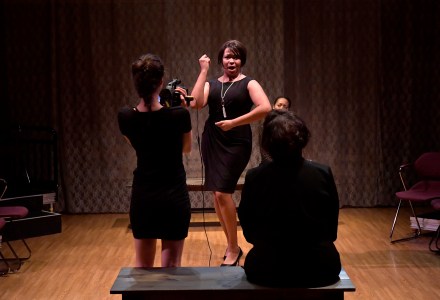
Amanda Collins (Dotty) finds female fulfillment scrubbing Zena’s toilets with a toothbrush.

Dotty meets many characters no less colorful than Conky, Cowboy Curtis and Miss Yvonne while on her quest for the meaning of womanhood. Richard Snee plays each of these cameo roles with relish and panache. These include a cabbie, a professor, other beauty shop clients, and Dotty’s new “bus buddies” — a militant feminist, a pregnant Southern lady and a geeky salesman.

Each offers her a manifesto, a code of ethics and a dress code. Like the blind men feeling the elephant in the Indian parable, each has his or her narrow, subjective perspective based on a single experience that fails to account for other possible truths or for a totality of truth.

Photo_16_8754Little by little, Dotty starts to realize that, while each of these guides can help her learn something about herself, only she holds the key that can unlock the mystery of her authentic self.

The extraordinary Amanda Collins as Dotty is reason enough to see the show. She effortlessly brings to the role an openness of curiosity and naïvité (think the un-raunchy elements of Lena Dunham); a slapstick wacky physicality (think Lucille Ball) and an exceptionally expressive face (think pre-plastic surgery Meg Ryan). Her delivery is flawless and she radiates an inner light that draws the audience’s attention like a moth to a flame.

Paula Plum’s direction is full of surprises, such as props falling from the ceiling, and jaw-dropping brilliance, such as the staging of the final scene. The music has the breeziness of “The Pink Panther” and “Mad Men” and the set designs make creative use of overhead projectors, billowing curtains and backlit shadows.

“Out of Sterno” is particularly relevant in the wake of such “news” as Caitlyn Jenner’s Vanity Fair cover that shows her authentic female self. As Plum notes in the playbill, “I found it intriguing that Jenner displayed herself through the lens of Beauty Culture: corseted, provocative and heavily made-up. The transformation of this former Olympic athlete to femme fatale poses the question: what makes a ‘real woman’? Is it the sum of our exterior parts?”

Sounds like Jenner should make a trip to Gloucester; Dotty could teach her a thing or two.

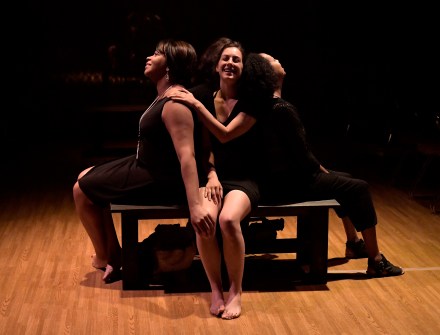
Pictured at top: Jennifer Ellis (as Zena), Richard Snee (as beauty shop patron) and Amanda Collins (as Dotty)

“Out of Sterno” runs through July 18 at Gloucester Stage Company, 267 E. Main St., Gloucester. For tickets go to gloucesterstage.com or call 978-281-4433.

The Girls Are Dreamin’ in Beverly

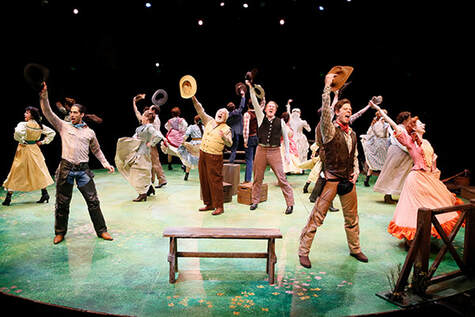
Eric LaJuan Summers steals the show as James “Thunder” Early in NSMT’s production of “Dreamgirls.”
PhotoPaul
Lyden

Attending the season opener at the North Shore Music Theatre brings back memories of stepping off the bus on the first day of summer camp. Like the joy of reconnecting with old friends and places, the NSMT’s round stage with its magic trapdoor center pit, its live orchestra and its signature disco-esque spinning light signal that, finally, summer is here.

And with its exuberant production of “Dreamgirls”,the winner of six Tony and two Grammy Awards, NSMT throws quite the summer party. There’s even dancin’ in the streets.

Inspired by the career of Diana Ross and The Supremes, the musical follows the onstage and backstage drama of the 1960s up-and-coming female trio, “The Dreams.” From their career-launching talent contest at New York City’s famed Apollo Theatre to their farewell concert over a decade later, there are the usual love triangles, artistic squabbles and managerial double-crossings.

There are also a soulful score, slick choreography and the performances of Bryonha Marie Parham as Effie and Eric LaJuan Summers as James “Thunder” Early that make “Dreamgirls” anything but the usual summer musical fare.

Parham and Summers are hands down the standouts in the strong 22-member cast. In Effie, Parham has a vehicle to unleash her powerful voice, and what a set of pipes she has. Her “And I’m Telling You I’m Not Going” deservedly brought down the house. Summers likewise packs a wallop as the showboat Early, playing him with a blend of James Brown athleticism, Stevie Wonder crooning and Little Richard flamboyance. Not since J. Cameron Barnett tore up the stage last summer as Sebastian the crab in “The Little Mermaid” has the NSMT hosted such an electrifying performer.

Like most NSMT productions, “Dreamgirls” is a little long at two-and-a-half hours (which includes a 20-minute intermission), but in this age of shrinking values and increasing costs, that seems a pretty silly thing to complain about.

“Dreamgirls” plays through June 14. For tickets and more information, visit nsmt.org or call 978-232-7200.

Summer Stages Beckon

 Even on a cold and rainy Sunday afternoon, there is something summery about the opening day of the summer theater season. The North Shore is blessed with two stellar companies, Gloucester Stage and Beverly’s North Shore Music Theatre, that have offered theatergoers the chance to see professional productions without having to traipse into Boston for a combined 97 years.

Under the skillful direction of Weylin Symes, Gloucester Stage, in collaboration with Stoneham Theatre, opens its season with “Sweet and Sad”. The production introduces us to the five members of the fictional Apple family, who are at the center of four plays by American playwright Richard Nelson. “Sweet and Sad” is the second in the chronological series. All are set in Rhinebeck, N.Y., and all focus on either an election or a significant historical anniversary.

In “Sweet and Sad”, the Apple family assembles uncomfortably on the tenth anniversary of 9/11 (the New York Public Theater opening night was actually September 11, 2011). Although the family members — siblings Marian, Barbara, Jane and Richard, and their Uncle Benjamin — spend less time talking about the events of 9/11 than their own personal histories, the significance of the day officially devoted to loss and remembrance casts an indelible shadow.

Even though Barbara (Karen MacDonald whose nuanced performance brings to mind Diane Wiest at her finest), a schoolteacher whose Rhinebeck home hosts the family brunch, early on states that the day is not one to talk politics, the reason for the gathering is to attend a commemoration her students will perform that evening. Uncle Benjamin, who moved in with caretaker Barbara after his brilliant acting career was cut short by a heart attack that left him amnesiac, will read Walt Whitman’s “The Wound Dresser”.

Marian, also a teacher, has just moved in with Barbara, seeking refuge from a recent separation from her husband. Manhattanites Richard, a Wall Street lawyer, and Jane, a writer, round out the family. Tim, Jane’s sometimes boyfriend and an actor currently relegated to waiting tables, walks the fine line between blending in and being unobtrusive.

It’s hard to know where to start praising this production.

The lights rise on a large set that makes good use of the entire stage and yet also creates an intimate dining room setting for the family to share a late lunch and squabble. Each actor embodies his role with a stunning naturalism, breathing life and depth into his role. The same cast staged the first of the four-part Apple family plays, “Hopey Changey,” earlier at Stoneham Theater, and their obvious comfort with each other is the stuff stellar ensemble acting is all about. They are so physically at ease that the audience really does feel like it’s eavesdropping on a family reunion.

Symes, producing director at Stoneham, brings a light but quirky touch to the show, allowing the characters to explore their characters’ eccentricities and individuality without jeopardizing the cohesive fabric of their shared histories. Watching the siblings interact as adults, you can imagine what they must have been like as kids. And having the actors really eat real food (in some cases going back for seconds) is nothing short of brilliant.

Which brings us last, but hardly least, to Nelson’s script. In fewer than two intermission-less hours, he lets us through the keyhole to glimpse a family’s most perilous secrets while making us think about such broad and weighty topics as: the roles of memory and memorials; what drives young people to suicide; and the state of the nation. The characters overlap and interrupt and answer for each other with the familiarity of broken thoughts and familial patterns. We witness the passive-aggressive, judgmental and ultimately supportive Apple family dance. His dialogue (and its flawless delivery) points to as much what is not said as to what is.

The only time all the Apples manage to sit still and listen quietly is when Uncle Benjamin practices reading “The Wound-Dresser”. Whitman’s poem is a tribute to the memory of the Civil War soldiers he tended during his time as a nurse, but when we hear, “I sit by the restless all the dark night; some are so young, some suffer so much, I recall the experience sweet and sad,” he could be talking about the Apple family today.

Pictured at top: Karen MacDonald (Barbara Apple) makes her sisterly point with Laura Latreille (Jane Apple Halls).

(Photo by GARY NG)

“Sweet and Sad” is at Gloucester Stage, 267 East Main St. through June 20. For tickets, go to gloucesterstage.com or call 978-281-4433.

Between Avraham and Ibrahim: Interview with “In Between” author Ibrahim Miari

Ibrahim Miari

Ibrahim Miari’s one-man show, “In Between” is a 5-course dramatic feast. It starts with the hypnotic pageantry of Miari’s Sufi dervish dancing and ends with his intercultural marriage to Sarah Goldberg, a Jewish Buddhist. In between, there is a larger-than-life puppet, hypnotic dumbek drumming, and lightening speed changes of character, place, time and emotion.

The play is also a petri dish for every conceivable political, religious and intercultural discussion on the subject of Israel and the Middle East. Miari grew up in Acco, Israel, the son of an Israeli Jewish mother and Palestinian Muslim father. His spellbinding autobiographical story, told with piercing insight and candor, repeatedly raises our awareness by putting us in the unfamiliar shoes of an Israeli who carries a passport stamped “Arab.”

As an Arab Israeli, Miari explains to his audience, he’s not Israeli enough because he’s a Muslim through his father (Islam is patrilineal); he’s not Arab enough because he’s a Jew through his mother; and he’s not Palestinian enough because he doesn’t live on the West Bank.

“I am a 1948 Arab,” his character declares, referring to Arabs who settled in Israel after the War of Independence. “I’m a demographic problem. I’m an inside Arab- an Israeli citizen. I am a ticking bomb-the ultimate security risk.”

Miari is also Ishmael grafted onto Isaac. Born Avraham, at 7 he attended a Jewish school and won the costume contest for Purim, his (and his mother’s) favorite Jewish holiday. By age 8, he was Ibrahim, enrolled at an Arabic school where Israeli Independence Day was celebrated as Nakba Day, the “Day of the Catastrophe”. He identified with everyone and with no one; he was a community of one.

Before moving to the United States in 2005, Miari was a member of the Acco Theatre Center Ensemble for nearly 12 years, acting and dancing in ensemble based projects for both young and adult audiences throughout Israel, Europe and the United States. He also performed solo shows in Hebrew, Arabic and English. An accomplished Sufi dancer and sacred dances instructor, he has directed the drama program at several peace camps in Canada and US with high school age Israeli and Palestinian youth.

In fact, it was while running such a program at a Canadian peace camp for young Israelis and Palestinians that he met his wife Sarah. Their subsequent search for a clergy to marry them gave Miari terrific material. He mesmerizes the audience with skill and satire as his Bread-and-Puppet sized silk cloud of a puppet transforms from imam to rabbi to Buddhist priest, each declining the young couple’s request to officiate their ceremony for ironically similar reasons.

Shelley A. Sackett with Ibrahim Miari at Arsenal Center for the Art’s NewRep Black Box Theater.

Reached at home by phone, Miari articulated why he has not published his play. “It is still a work in progress,” he said of the work that began as his MFA thesis project while attending Boston University’s Theater Education program. “(Not publishing) it allows me to change it as I grow as an artist and a performer. I improvise as I see fit in the moment, according to the energy in the room and current events.” By example, he recalled performing at MIT shortly after the Boston Marathon bombing last year. When his character likened being an “inside Arab” in today’s world to a “ticking bomb”, Miari sensed how the weight and immediacy of that line moved the audience. He paused along with them, incorporating that instant into that performance.

“All of a sudden, I took them to my story and I brought them back to reality. I am in the show and I am in the moment. This play is so personal to me and to my experience that no one else but me could perform it.”

Although his play is autobiographical, he had to invent the way his parents met because his mother wouldn’t tell him the true story. “After watching the DVD (“In Between” has yet to be staged in Israel), my mother said ‘You see? That’s why I didn’t tell you!’” Miari laughed. She remains silent on the subject to this day, although she is as supportive and understanding of her son in real life as she is portrayed in the play.

Miari prefers not to talk about politics (“My opinion about what is happening in Palestine is expressed in my work”), but he offers that the road to a peaceful resolution in Israel is as complicated as it is simple. “It is simple because people need to acknowledge that the violence, occupation and suffering needs to stop, and then they need to have the intention to go towards a solution. It is complicated because most people are unwilling to talk and because there is a lot of ignorance on both sides.”

On a happier note, he pondered what his daughter might take away from “In Between.” “I hope she would see that we’re all one, that this world is so much more than religion and politics. That you should live your life the way it suits you and not try to accommodate anyone.”

While Ibrahim Miari’s story and background may be unique, he echoes what every parent of every nationality and every religion says about every one of his children. “I just want her to be happy.”

Read more: http://blogs.boston.forward.com/insights/183518/between-avraham-and-ibrahim-interview-with-in-be/?#ixzz3dT0uEz5w

Don’t Pass Over‘The Whipping Man’

The finest theater experience makes us think, feel and debate. We gain some new insights into ourselves and others, and maybe learn a new fact or two. Such a trifecta is rarely attained, and when it is, we should notice with our feet. Matthew Lopez’s “The Whipping Man,” currently in its Boston premiere run at the New Rep Theatre in Watertown, is just such a play. In a nutshell, the 2006 Obie Award-winning period drama is set in Richmond, Virginia during the crucial month of April 1865, as three historical events intersected: the end of the Civil War and American institutionalized slavery; the assassination of Abraham Lincoln; and Passover, which began the day after Robert E. Lee’s surrender.

The setting is the half destroyed mansion of the Jewish DeLeon family. The characters include Caleb DeLeon, the injured Confederate soldier who has returned to the family home, and Simon and John, two newly freed DeLeon slaves, who had been converted to Judaism and raised as Jews by Caleb’s father.

Over the course of two days, the three address and try to make sense of their pasts as they reconstruct their futures against the backdrop of a suddenly reordered world. They revisit bitter traumas, reveal devastating secrets and warily navigate the waters of “freedom.” The play closes as the three conduct a makeshift seder, insisted upon and led by Simon.

“This year we are slaves, next year we may be free,” Simon recites before singing a few verses of “Go Down, Moses.” The stirring weight of the African American spiritual that celebrates the same hopes and dreams shared by the Israelites as they commemorate deliverance from Egyptian bondage is otherworldly in its force, emotion and layers of meaning.

As Simon, Johnny Lee Davenport brings a decency, self-confidence and self-knowledge to the play’s pivotal character. He embodies the shuffling, obedient slave of just yesterday, while evidencing the emerging freeman, at the helm of his future. Keith Mascoll’s John is spry and cocky, with impeccable timing and delivery. His is Simon’s perfect foil.

For a Jew, the complex messages of “The Whipping Man” are sobering. How do we face our collective hypocrisy that, after suffering the evils of slavery, we became slave owners? How do we bear our collective shame and guilt that we converted slaves to Judaism, but did not treat them as fellow human beings? What are the roles and responsibilities of legacy, trust, family and faith? We can almost channel the discomfort of many southern Jewish families as they sat down to the seder meal in 1865, a dank cloud of irony hovering unwelcome over the table.

To its great credit, the New Rep recognized the challenge posed by this complicated play, and invited the public to a free symposium of Jewish and African American scholars who discussed its meanings prior to the opening of the show. Perhaps the most insightful comment was by Professor Hillel Levine, an expert in historical conciliation, who interpreted “The Whipping Man” as a commentary on lost opportunities during Reconstruction.

“Maybe if Abraham Lincoln had had seders all over the country, things would have been different. Maybe it’s not too late,” Levine pondered.

“The Whipping Man” is the perfect antidote to this winter’s arctic freeze. Go with friends, maybe even read the play, and then settle in for scintillating discussion. The hot topics are sure to warm heart, mind and soul.

Pictured above from left: Jesse Hinson (Caleb), Johnny Lee Davenport (Simon) and Keith Mascoll (John) participate in a Passover seder in “The Whipping Man.”
Andrew Brilliant / Brilliant Pictures

Bernie Madoff: Jewish Rogue or Rogue Jew?

We humans pay a price for our free will, and that price is accountability for our actions. According to Jewish thought, we are born with two opposing inclinations, one good (“yetzer ha-tov”) and one evil (“yetzer ha-ra”). Yetzer ha-tov gives us the opportunity to become closer to God. Yetzer ha-ra is not a demonic external force, but rather an undisciplined abuse of natural appetites and passions. These God-given instincts are not intrinsically evil, but harm ensues when we cede them control.

It is through our knowing and willing acts that we indulge our evil or good impulses. Our bible is full of characters who exemplify this dualism. Cain and Esau are no less human than Abel and Jacob; they simply have made different choices. The underlying issue becomes not judging one good and the other evil, but rather understanding what motivated them to act as they did.

In “Imagining Madoff,” Deborah Margolin’s 2010 provocative and compelling play, we meet two such men. Both are Jewish. Both weave biblical parables, Talmudic quotes and Jewish jokes into their conversation. One is Bernie Madoff; the other is Solomon Galkin, a synagogue treasurer, former concentration camp inmate, and poet/Talmudic philosopher. Galkin is based not so loosely on Elie Wiesel. Madoff is unabashedly based on the Ponzi maestro. The play’s spotlight mostly alternates between Madoff’s maximum-security cell, where his consciousness streams aloud to an invisible biographer, and Gaulkin’s plush study, where he and Madoff bond during an all-nighter fueled by scotch. They yak like boyhood chums, alighting on such topics as baseball, sex, lust, humor, friendship, money, God, guilt, Judaism and the Holocaust.

“We acted like old friends,” Madoff tells his biographer. “But that was just us being Jews. We didn’t really know each other.”

Through her insightful and skillfully crafted monologues and dialogues, however, Margolin lets her audiences get to know these two men and discover what makes them tick. Margolin resists prototyping Madoff as an inhuman monster, or Galkin as a paragon of moral authority. She assumes we all know the who, what, when, where and how of each man’s story. Instead, she presents them as multi-dimensional human beings, and trusts her audience to draw their own conclusions about the “why.”

Jeremiah Kissel possesses the role of Madoff with a brilliant sense of electric urgency. His Madoff is complicated and contradictory. One minute he is charming, handsome and smart; the next, he is sleazy, foulmouthed and foul-tempered. He relives crying after he told his first lie as a child, sensing, like a crackhead after his first hit, that he would forever be powerless and addicted to duplicity.

“It was so easy it was painful,” he recounts. “I just told the truth in a completely false way.”

As Galkin, Joel Colodner brings a quiet, weighted, calm confidence to the role. Here is a man who survived evil and doesn’t blame the God who created the men who committed it. If anyone could justify a free pass on amorality, it is Galkin. Instead, he takes solace and refuge in his religion, embracing Torah, ethics, ritual and the goodness of the Jewish people. He, too, is complicated and contradictory.

Ultimately, we see that Madoff and Galkin are two sides of the same Jewish coin. One talks the talk; the other walks the walk. Both have made choices in their lives, but those choices do not alter the fact that they are both Jews. The audience’s job is to notice, not to judge.

When asked why she wrote this play, Margolin answered by email, “The theater is the place where writers and actors ask: Who is this person? Why does he behave as he does?”

“When all is said and done,” she continued, “both Madoff and Galkin are just men. I wanted to ask a dramatic question that explores the seductive beauty and the real and present dangers of absolute faith, either in God, or in men.”

“Recommend” is too tame a word to use in reference to “Imagining Madoff.” I extol it as a sublime work of art, from its brilliant set to its inspired acting to its gifted writing. If you miss its run, you will be sorry.

Pictured above: Joel Colodner (left) starred as Solomon Galkin and Jeremiah Kissel as Bernard Madoff in “Imagining Madoff.”


‘The Soul Doctor’ is In

“Soul Doctor” is a Broadway musical based on the life of Rabbi Shlomo Carlebach. The Rebbe, who died in 1994, was known as the “rock-star rabbi.” A colorful character, Carlebach transformed liturgical music during the 1960’s, recording over 25 albums and performing with such luminaries as Bob Dylan, Joni Mitchell and the Grateful Dead.


A brilliant Torah scholar, his progressive and unique views on everything from prayer to women inspired a generation to seek connection to God and to each other through his songs.

The play starts with a flash-forward to its last scene: a 1972 concert in Vienna, at the height of Reb Shlomo’s Haight-Ashbury “House of Love and Prayer” commune phase. The actors enter from four aisles, singing and dancing, sporting vibrant hippie-era clothing and hairdos. I felt like I was seeing “Hair” again. The Jewish version.

This playfulness is unfortunately short-lived, as we begin our plodding, chronological journey through the life of Shlomo, played with subtlety, warmth and charm by the stellar Eric Anderson.

We start in 1938 Vienna, where we meet 13-year-old Shlomo and his middle class family. The heir to a dynasty of Orthodox rabbis, young Shlomo exhibits his rebellious, passionate and determined nature. His Rebbe father moves the family to Brooklyn, one step ahead of the Nazis. He starts a strictly Orthodox yeshiva in his strictly Orthodox shul. Both, Shlomo tells his father, “are bankrupt. The bank accounts are fine, but the seats are empty.”

Shlomo sets off to find a different way to rekindle their passion of head and heart. He doesn’t have to go far. The Chabad-Lubavitch movement has set up shop nearby, and Shlomo, as his father fears he will, “goes to the Hassidim as a tourist, and comes back as a tour guide.”

Carlebach

The late Rabbi Shlomo Carlebach

Wandering New York’s streets late one night in 1963, Shlomo drifts into a lounge where the classically-trained Nina Simone is singing sultry, smoky blues and jazz. With Nina’s appearance (played by the polished and riveting Amber Iman, in her Broadway debut), the show wakes up and turns an important corner. She’s not exaggerating when she sings, “I Put a Spell On You.”

Meeting Nina is the watershed event of Shlomo’s life. They are kindred souls, both unconventional children of clergy (a Baptist minister in Nina’s case). She plugs him in to his inner neshama (soul/spirit), giving him the tools to express his heart through his music. She is his muse; he is her cheerleader. Their 25-year friendship is a celebration of the secular and the sacred, of mutual respect and support, and of the limitless possibilities available to those of open hearts and minds. Their parallel rises to fame and popularity are as spiritual and uplifting as the songs each sings.

Yet not all the songs are hits. Of the 35 musical numbers in the show, those saddled with new English lyrics feel long and monotonous. The jazz, gospel and Hebrew songs (especially “Ki Va Moed” and “Sim Shalom”) are infectious and stirring.

“Soul Doctor” is not just a valentine to Shlomo Carlebad (although it is definitely that). It raises important questions such as: What are the roles of tradition and revision in modern American Judaism? How do we connect with one another and with God? When have we strayed too far from our roots, for the sake of filling the empty shul?

The play doesn’t offer any easy answers. But it does, per Jewish custom, offer a question. As Shlomo said to his father, “You brought us to America. What did you expect?”