Photos by Joan Marcus
“The Receptionist” – Written by Adam Bock; Directed by Sarah Benson; Scenic Design by dots; Costume Design by Enver Chakartash; Co-Lighting Design by Stacey Derosier and Bailey Costa; Sound Design by Bray Poor. Presented by Second Stage at the Pershing Square Signature Center, 480 W. 42nd St., New York, through May 24.
By Shelley A. Sackett
A frumpy, somewhat dazed man stands in a cardboard booth lined with some sort of metallic padding. It looks like a cross between a confessional, a detention unit, and a fourth grader’s science fair version of a spaceship.
The man’s name is Mr. Raymond (Nael Nacer, sadly underused). He is fidgety and nervous as he addresses the audience.
“I like fly fishing. There’s nothing like it. I love everything about it. I love catching fish. I love letting them go, too. I have a philosophy when it comes to a caught fish. If you catch a fish and it’s ok, you let it go. But if it’s snagged or it’s got a hook in its gills, you can’t put it back in the stream because it’ll die. So if that happens, I think you should prepare the fish to be killed,” he says matter-of-factly.

As if momentarily distracted by an almost PTSD type of unwanted, interfering thought, he pauses and then describes his wife’s reactions to pictures of people “over there” and what “we” are doing to them. He can’t finish his sentences.
“When things are hard,” he continues, after regaining his composure, “I think about fly fishing.”
Nacer brings a nuance to Mr. Raymond that is heartbreaking and intriguing. Unlike his colleagues, he lives in the gray – half in the dark and half in the light.
He is also a mystery. Why is he agitated, losing his train of thought mid-sentence? Why does he conclude with an explanation about how he kills the fish “humanely” and then eats it? “And that’s okay,” he explains. “Because everything out there is eating something.”
His monologue, part confession, part plea for help, ends, and Mr. Raymond ambles off stage, leaving us to wonder how and when his message will make sense (and bringing to mind Mark Rylance in the existentialist “Nice Fish”).
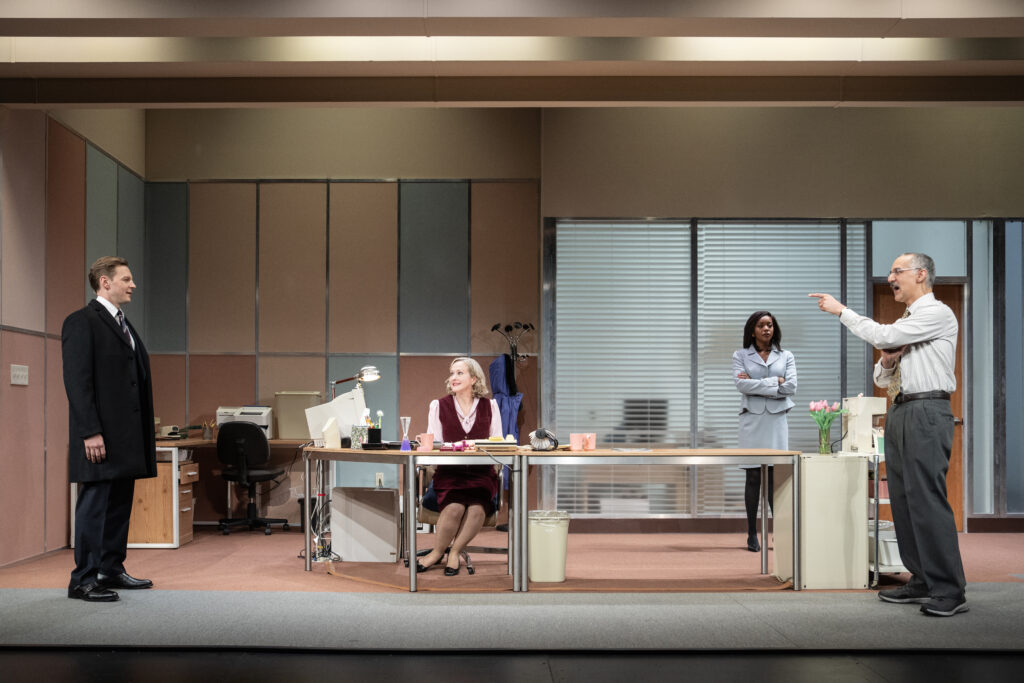
The scene abruptly shifts gears to the mundane here and now — the reception area of a shabby, mind-numbingly drab office reception area (with an elevator door that actually works, the only visual excitement on the set). Beverly Wilkins (Kate Finneran in a role she was born to play), the titular receptionist, handles her desk as if captain of a fleet. Brisk, efficient and in command of her domain, she interrupts her gossipy calls to friends and family only when forced to.
“Northeast Office, please hold,” she repeats – and repeats – as she rolls her eyes in irritation and puts callers through to the voice mail of her two higher-ups, head honcho Mr. Raymond and second-in-command, Lorraine Taylor, both missing in action.
She’s used to Lorraine being late; Mr. Raymond’s absence alarms her. A client contact apparently did not go well for him. Something is amiss. Something enigmatic, significant and menacing.
She distracts herself by playing “Dear Abby” to friends and family, making coffee, straightening the blinds and shredding some documents. She even orders a birthday cake. She is a whirling dervish of meaningless activity and bossy, judgmental, boundary-less encounters.
Owing to Finneran’s physical comedic flair and timing and director Sarah Benson’s crisp pacing, Beverly is engaging, endearing and more multi-layered than she at first presents.
She is also a riot. Playwright Adam Bock has given her most of the funniest lines, and she knows just how to milk their delivery for all they’re worth.
By the time Lorraine (Mallori Johnson) shows up, however, even Finneran can’t keep Bock’s stand-up comic/sitcom patois from becoming monotonous, and we crave anything and anyone more than just Beverly.
Lorraine and Beverly engage in small talk about personal crises. Although Lorraine is clearly Beverly’s superior professionally, she seeks Beverly’s stern counsel on everything from romance to attire. (Beverly looks like she shops in the Target clearance department; Lorraine is sleek, chic, and skin-tight.)
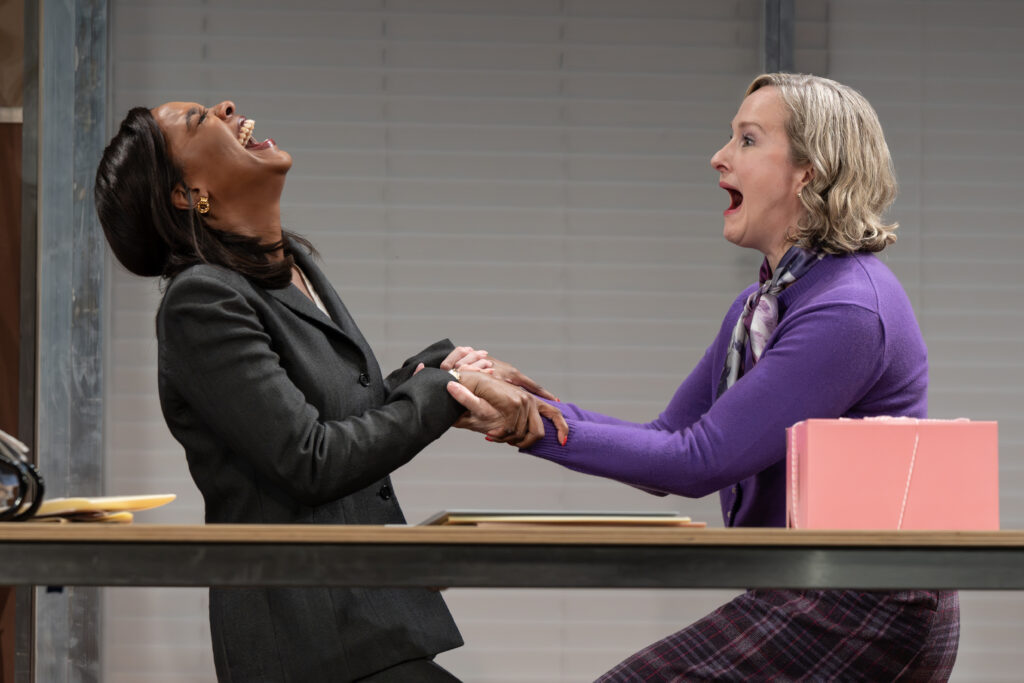
Just when it seems Bock will never get to the point of all this banter (the play, after all, is only 75 minutes and we’re almost at the half-hour point), Beverly lets slip that Mr. Raymond was summoned to the Central Office yesterday and never returned to the office.
Almost on cue, Martin Dart (Will Pullen) arrives, without an appointment, from that same Central Office.
He is looking for Mr. Raymond and will wait until he returns. He is married with a four-year-old who eats paste. He jokes with Beverly and flirts in a creepy, cringe-worthy way with the willing and desperate Lorraine. He even wears blood red socks.
He steps out to pick up pastries and a paper and so is gone when Mr. Raymond finally arrives and exposes what really goes on at this seemingly unremarkable office. His great reveal and his tenuous circumstance change everything.
Again, Nacer brings a sensitivity to a character who is blessed with three, rather than two, dimensions. Mr. Raymond is the meatiest (and smallest) role, and one can’t help wishing Bock had pared the other three and padded this one.
With Mr. Raymond’s acknowledgment of events, all that was light and comfortable suddenly is not. Loyalties, responsibilities and the banality of evil take center stage. Mr. Dart shape shifts into a Stasi-like commandant, official, brutal and terrifying. Everyone is ambiguous. No one can be trusted. Everyone is a potential liar. No one is above suspicion. No one is safe.
Like zombies in a “Twilight Zone” episode, our office mates wander in a world that not only no longer welcomes them, but actually may persecute and prosecute them.

It is impossible to detail any more of the plot without becoming a spoiler, but Bock’s outrage over issues he found compelling and relevant in 2004 (he started writing in response to the Iraq war “Torture Memos”) now leaves us nostalgic for those “good old days” when complicity, compliance and corruption were still alarming and shocking.
But for the outstanding cast (especially Finneran and Nacer) and elevated production, The Receptionist would leave us feeling like its revival was merely an opportunity to rub salt into an open, unhealed wound, still festering after more than two decades.
And if we want that feeling, all we have to do is read the front page of the newspaper.
For more information, go to https://2st.com/shows/the-receptionist

