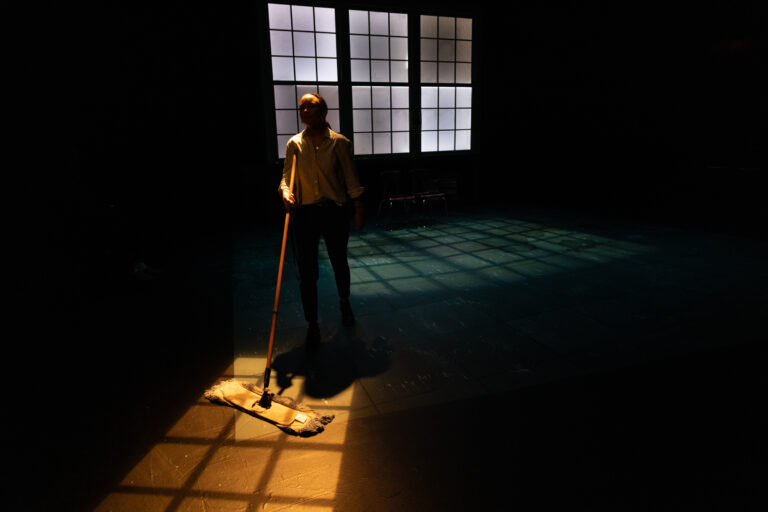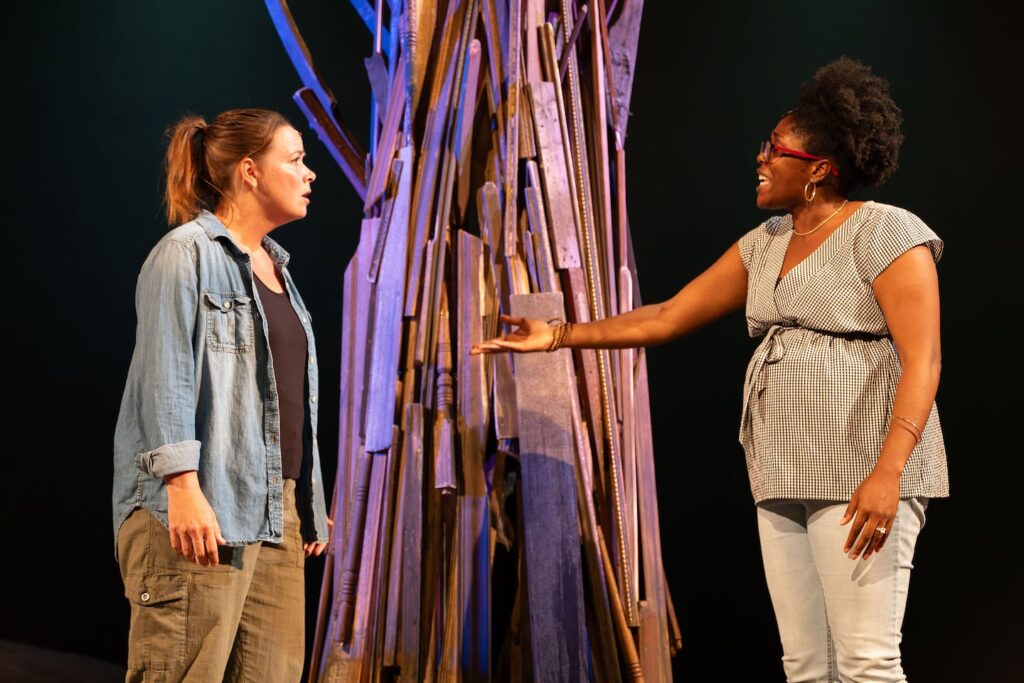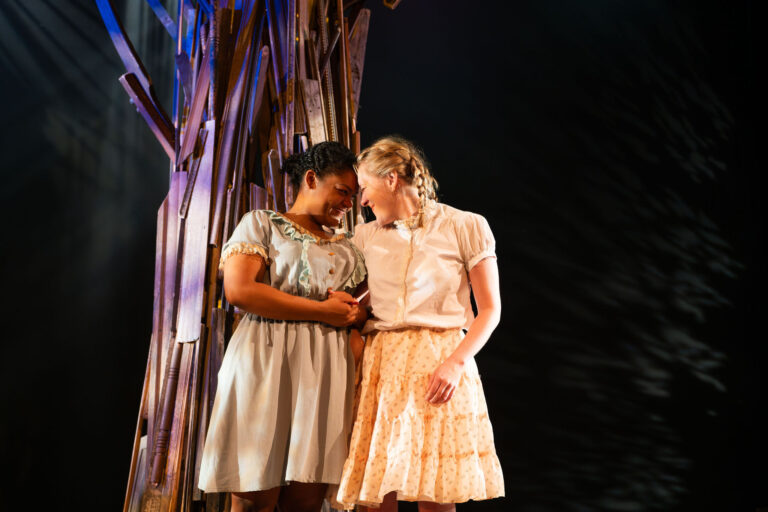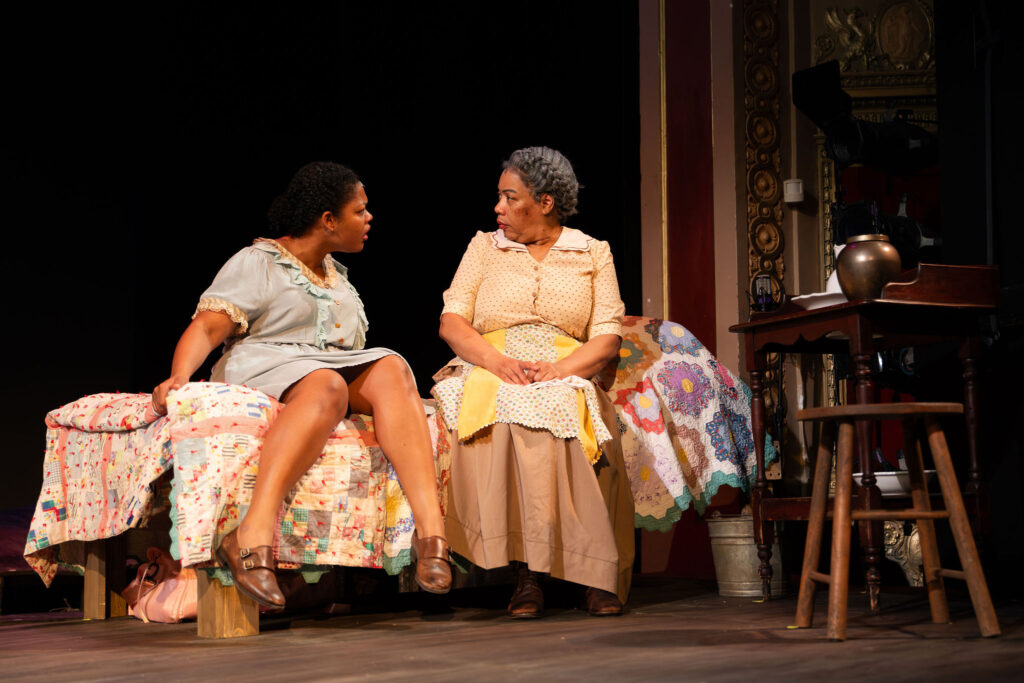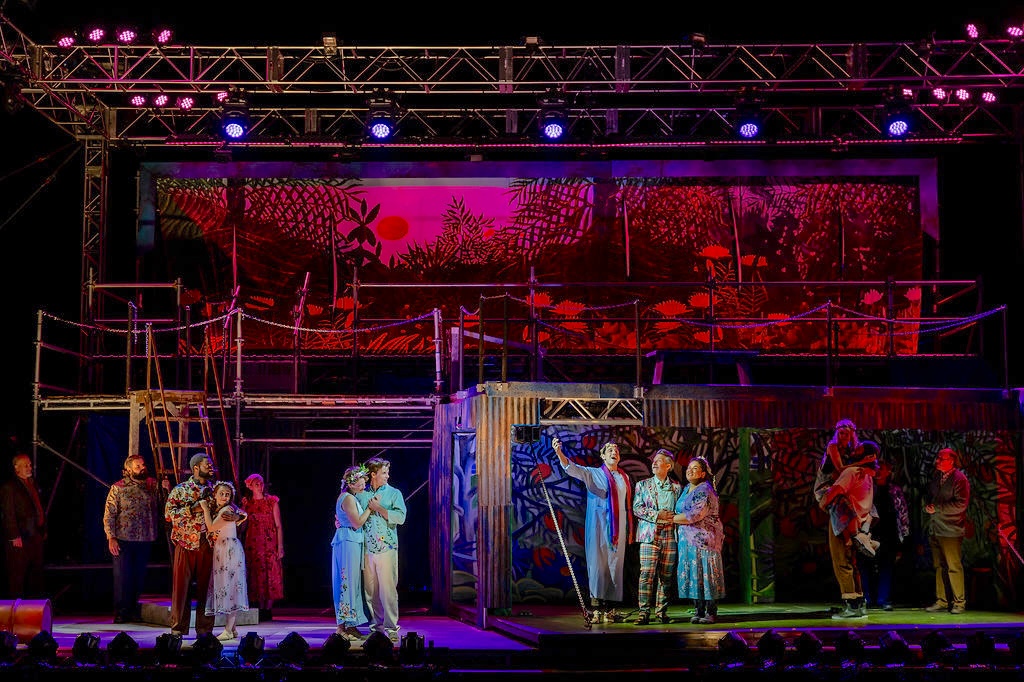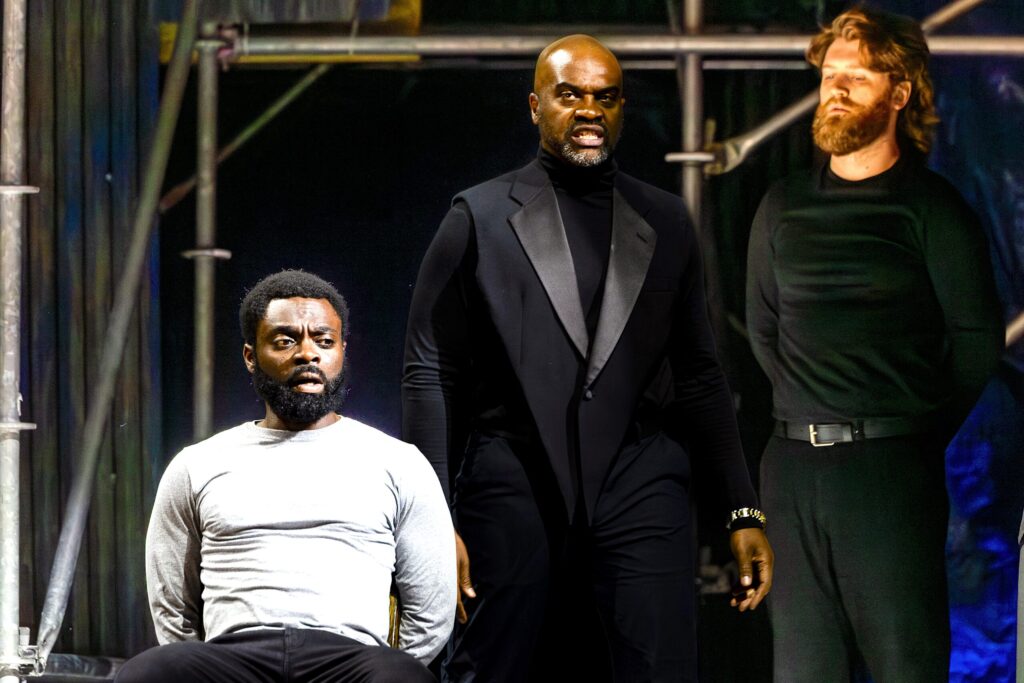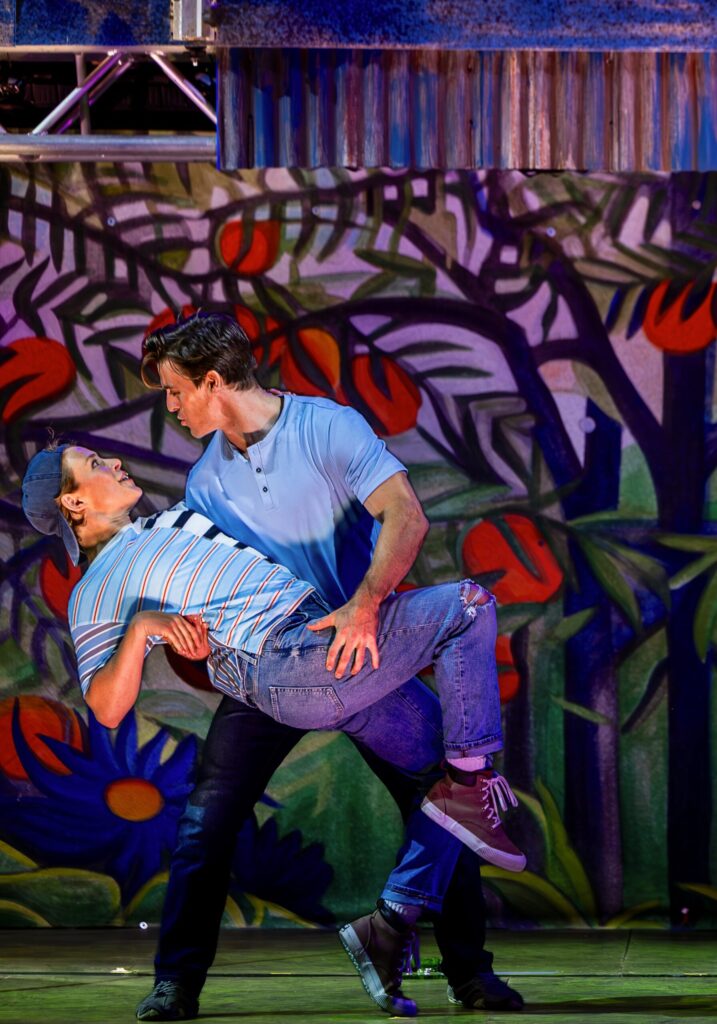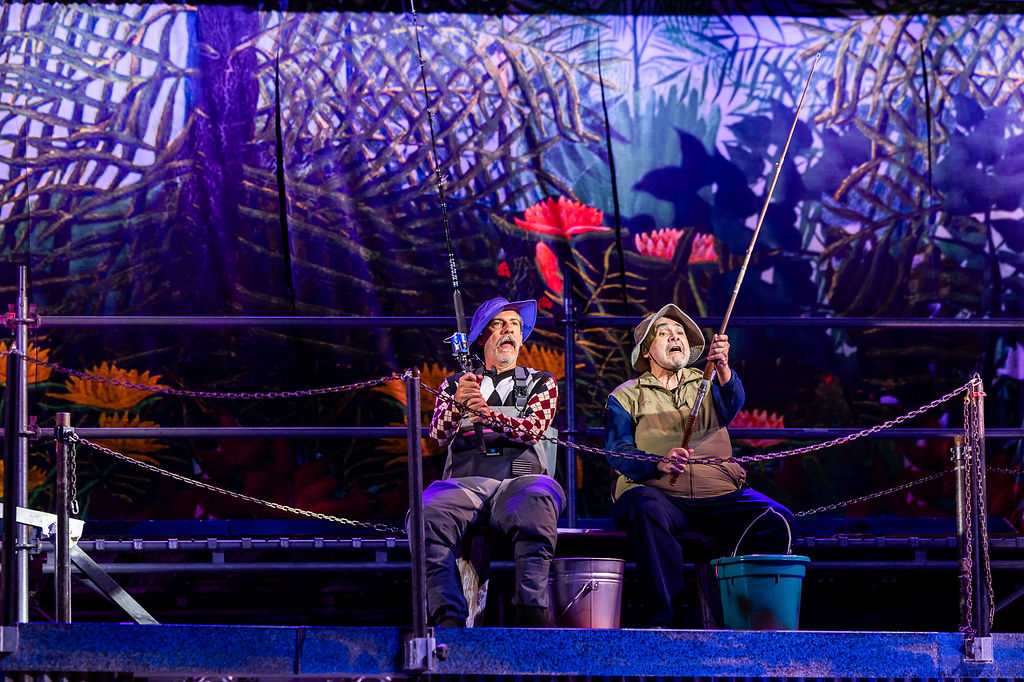
A Peek Behind The Backstage Curtain in Hub Theatre Co.’s Funny, Poignant ‘The Understudy’

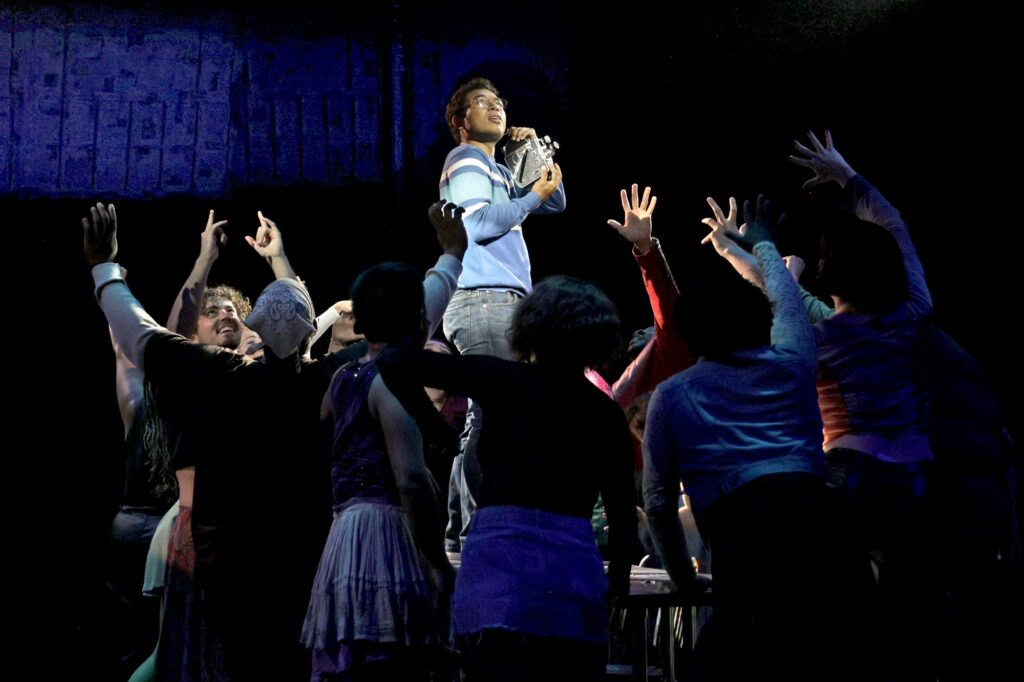
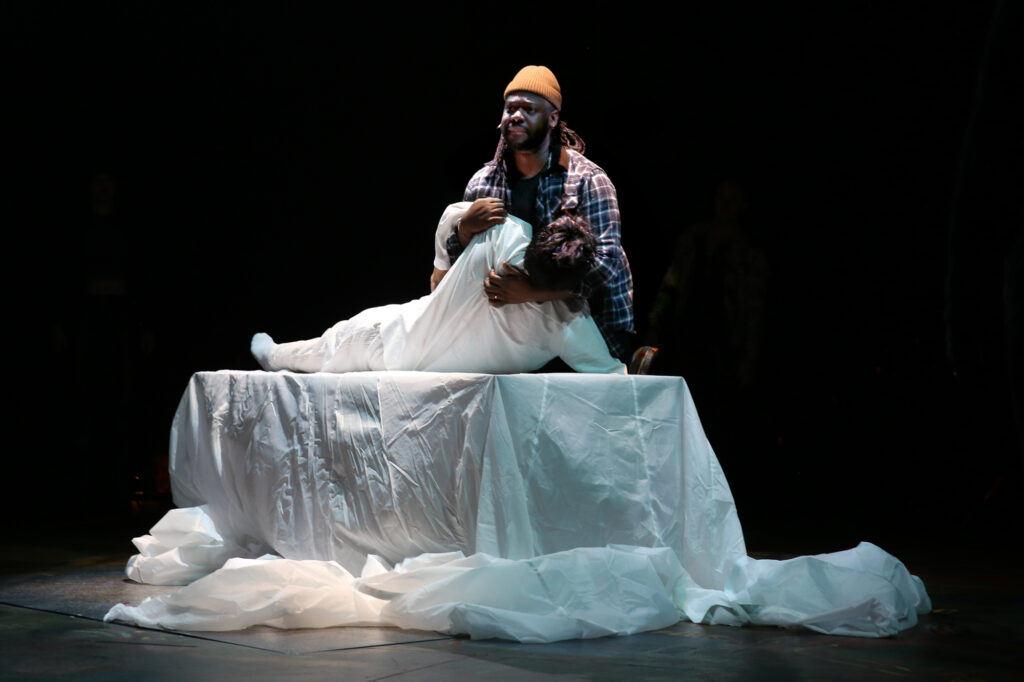
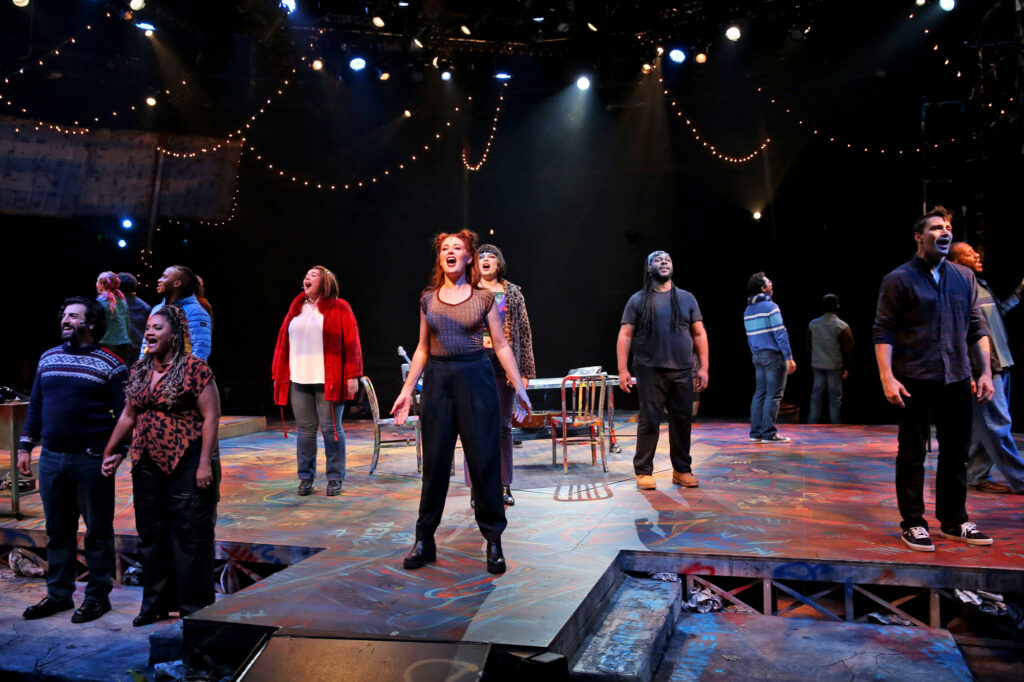
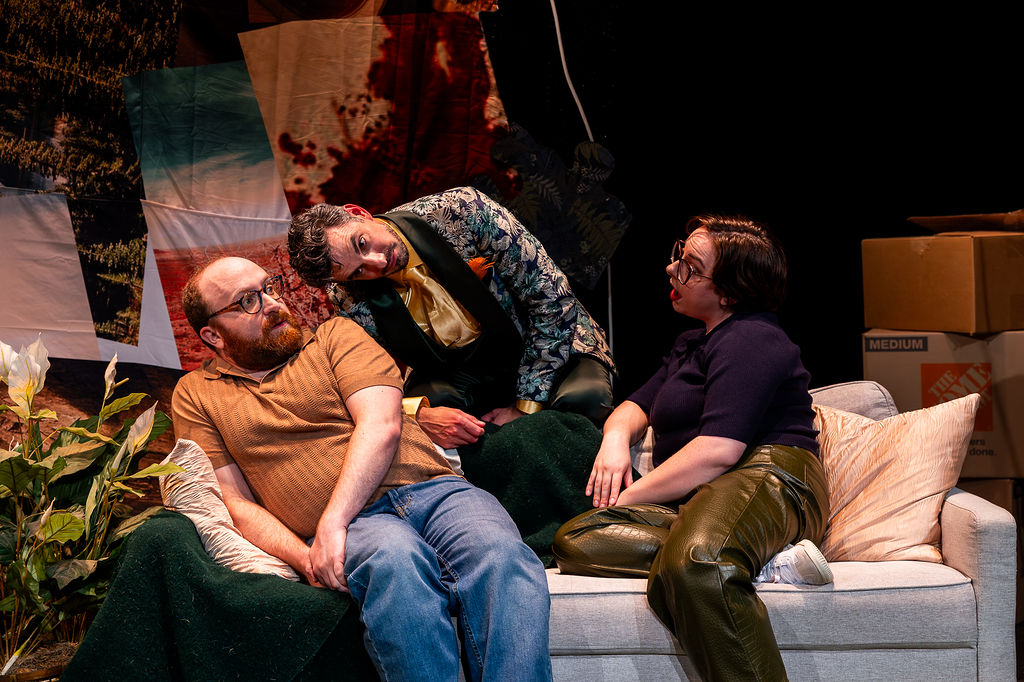
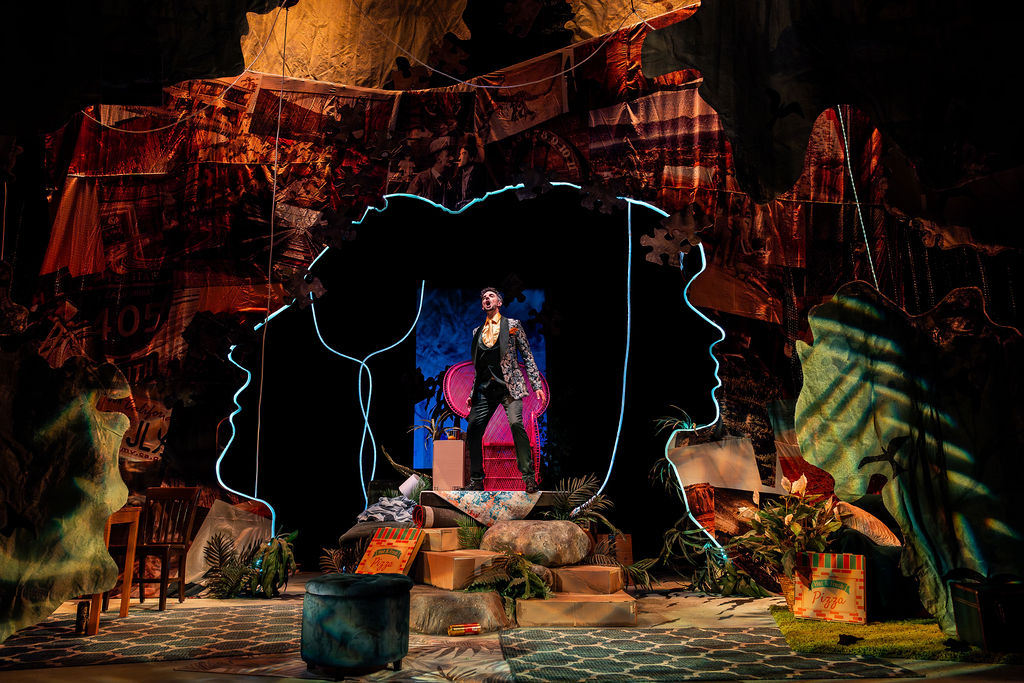
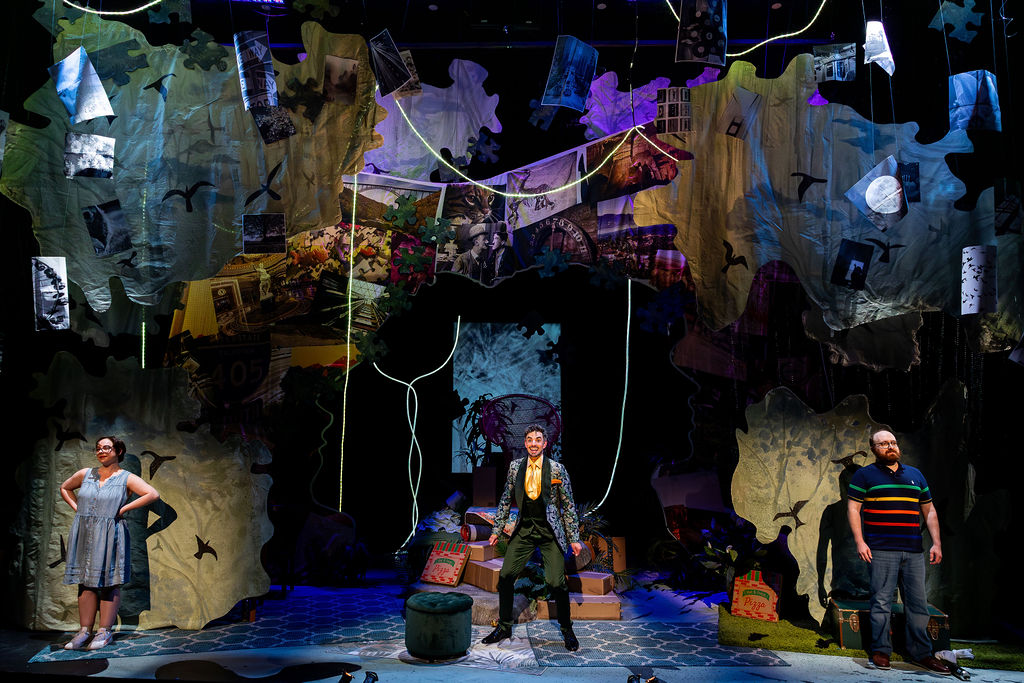
Kevin Paquette, Lauren Elias, and Cristhian Mancias-Garcia in Hub Theatre’s ‘The Understudy’

By Shelley A. Sackett

Playwright Theresa Rebeck’s smart, funny, snarky The Understudy takes us straight into the belly of the beast known as “Broadway Theater.” (Rebeck also penned the smash TV series, “Smash.”) Set backstage during an understudy rehearsal for The Castle, a fictitious long-lost play by Franz Kafka, the three-hander starts with a five-screen surround projection of close-ups of a Clint Eastwood-esque guy’s stubbled face. He mugs and does a macho muscled vamp, screaming “Get in the truck!” menacingly. Eventually, the film’s title (“Trucknado”) blazes across the screen as a booming voice warns, “Stay low or drive high.”

A gunshot is next. Harry (Kevin Paquette) runs onto the stage, waving a gun around, looking over his shoulder, and wildly pointing it haphazardly at members of the audience. “Oh, it’s not real. For heaven’s sake,” he says, setting the tone for the next 100 minutes as the actors (and audience) straddle lines between the ridiculous and the believable, nonsense and common sense, the real and the surreal.

As it happens, Harry (plump in an adorable way, unkempt and shaggy-haired) had auditioned for that movie role and lost out to Jake (Cristhian Mancias-Garcia), now famous as an action hero owing to the film’s box office success ($90 million the first weekend). Although he claims he’s not bitter, Harry is as acidic as it gets. “He’s talent-free,” he snarls, pointing at Jake’s frozen screen image. Yet, he explains, Jake’s lack of acting ability is exactly what the part (and financial backers) demanded.

“What is reality? You have to ask yourself. I ask myself that all the time. I mean, when HE gets to be the REAL ONE, I think we’re all allowed a little moment of private rage or …the occasional fantasy with a gun,” he adds ruefully.

To rub cosmic salt in Harry’s wound, he has been cast, of course, as Jake’s understudy in The Castle, a role for which Harry had also auditioned. Jake, second fiddle to Bruce (the bankable lead star), is also an understudy — for Bruce. Stage manager Roxanne (Lauren Elias) will run this rehearsal because, with the show up and running, the director has moved on. This is, after all, merely a rehearsal for two understudies, mandated by insurance and not worth the time of anyone of real value.

Oh, and by the way, Harry left Roxanne at the altar six years ago, and the two have not seen each other until this moment. Thinking no one wanted to hire him because his name was Harry, Harry had changed his name to Robert Merrill.

Blindsided, Roxanne wails, “What can the universe be trying to teach me by having you show up?”

An unseen but ever-present fourth character, Laura, mans the lights and sounds from a pot-infused booth, her stoned antics providing initial laughs but ultimately wearing thin.

The rest of the play (under veteran Boston icon Paula Plum’s crisp, expert direction), however, flows beautifully, the three actors a perfectly cast ensemble and individually spot on in timing and nuance.

Rebeck’s conceit — that an existentially traumatizing, two-handed, three-hour Kafka play could be a hit on Broadway if it starred two movie box office draws — is the perfect platform from which she launches comedy and drama. There are hysterically satirical scenes counterbalanced with meaty discussions about Kafka, the brutality of a theatrical system that prizes looks and money over talent and integrity, and the uphill battle women must wage to keep a toe in the door. Snippets of the imaginary The Castle that Rebeck has penned showcase her dazzling insight and dramaturgical chops.

The three characters reveal a lot as they slog their way through a rehearsal for something that will never happen (Kafka-esque enough?). Roxanne, it turns out, is quite a good actor (as is Harry), but has had to transition to non-acting jobs (as has Harry) to stay in the theatrical arena that she won’t live without. She is tightly strung but very good at what she does, namely, shouldering all the responsibility to keep things moving while sacrificing the recognition reserved for actors and directors.

Jake, too, has a few surprises up his sleeve. He actually is a skilled actor, his talent untapped (and undisplayed) in his film. He is smart and articulate, and has done a deep dive into all things Kafka. He genuinely longs to prove his acting worth and is convinced that mouthing his ersatz idol’s words on stage will do just that.

Harry, a victim of a system that prizes assets he lacks, is a multi-faceted mash-up of hope, anger, bewilderment, tenderness, and talent. He is also hopelessly inept romantically. Yet, he manages to tug at our heartstrings (and Roxanne’s), emerging as endearingly (though exasperatingly) huggable as a teddy bear.

Peyton Tavares’ simple but effective design (three-wheeled screens mounted with sconces, a few chairs, a table) is enough to set the stage, especially when coupled with Justin Lahue’s projections. There are some nice, more serious moments, as the bromance between Jake and Harry blossoms and they sit and talk about their craft. There are also some lighthearted, behind-the-scenes scenes, such as the one where Harry and Jake turn their flashlights into light sabers, becoming two kids playing “Star Wars.”

We learn by the end of The Understudy that these three really are cut from the same cloth and that fate has dealt them the same hand. Despite its brutality, theater is the only flame that will ever draw them in, even at the risk of getting their wings a little singed.

‘The Understudy’ — written by Theresa Rebeck. Directed by Paula Plum. Scenic Design by Peyton Tavares; Projections Design by Justin Lahue; Sound Design by Gage Baker; Lighting Design by Emily Bearce. Presented by Hub Theatre Company of Boston at Club Café, 209 Columbus Ave., Boston, through August 2.

For more information, go to http://www.hubtheatreboston.org/

NSMT’s ‘The Wizard of Oz’ Couldn’t Be More Enjoyable

Ethan Carlson, Sean Bell, Bridget Delaney, and E. Mani Cadet in “The Wizard of Oz” at North Shore Music Theatre thru July 20, 2025. Photos by Paul Lyden

By Shelley A. Sackett

North Shore Music Theatre continues its streak of winners with The Wizard of Oz, a spectacular extravaganza of a show that has everything going for it — top-notch talent, a stunning set, spot-on direction, clear and understandable sound, clever costumes and lighting, marvelous choreography, and a bang-up live orchestra.

Oh, and did I neglect to mention its iconic theater-in-the-round stage, which is used to maximum effect throughout the nearly three-hour (one intermission) show?

Even those who think they are too jaded to enjoy yet another go round of the same story should hightail it to Beverly and catch this version, which is infinitely more enjoyable than the recent film and Broadway versions combined.

Delaney

As the lights dim, five overhead surround theater screens counsel that this production is dedicated to the young at heart. As they fade to Kansas fields of grain, Dorothy (a fabulous Bridget Delaney) comes skipping down the aisle, followed by Toto (the equally fabulous Bug Minnie). Eye-winking foreshadowing is a nice addition to the familiar story about Dorothy’s conk on the head during a tornado, her journey to Oz while out cold, and her return to Kansas with renewed appreciation that there is “no place like home.”

Farmhand Zeke/Cowardly Lion (E. Mani Cadet) plays with the rope in his hand the same way he will later swish his lion’s tail. Hickory/Tin Man (Sean Bell) plays with a tin funnel on his head and Hunk/Scarecrow (Ethan Carlson) walks across the stage carrying a scarecrow. Setting the stage for who the characters will become in Dorothy’s dream, these little touches lend a nuanced humanity to their fictional avatars.

Choreographer Briana Fallon, costume coordinator Rebecca Glick and wig and hair designer Rachel Padula-Shuflet deserve huge shout outs for the way they interpreted many of the static events of the story, starting with the staging of the tornado. As the overhead screens project twisters, dancers clad in shades of gray skin tight leotards swirl and twirl across the stage carrying pieces of debris. The concept is brilliant, its execution breathtaking. This team will later gift the audience with orange spat footed crows, a sassy showgirl trio of talking apple trees, a scarlet field of dancing poppies, bejeweled snowflakes and, of course, flying monkeys.

While the second act predictably drags a bit (what second act doesn’t?), the familiar songs (“Ding Dong! The Witch Is Dead,” “Over The Rainbow,” “Follow The Yellow Brick Road,” among them) and the fabulous talent temper any lull with freshness and upbeat excitement. As Almira Gulch/Wicked Witch of the West, Michele Ragusa is spellbinding. Her vocal chops and comic timing are impeccable (plus she really knows her way around a theater-in-the-round such that her time with her back to any section is unnoticeable). Kerry Conte (Aunt Em/Glinda) shines as Glinda, her voice like a wave of a pink crystalline wand.

And then there is elder statesman David Coffee (Professor Marvel/The Wizard), beloved Scrooge in NSMT’s A Christmas Carol. There is even an inside joke (“You’re a humbug,” one character chides him) which the adoring crowd ate up in spades.

Michele Ragusa

Perhaps the true unsung heroes of the evening is the ensemble of munchkins, a corps of the most adorable and proficient youngsters (a standout is Ashley Fox, a rising 8th grader worth following). Kudos to the team that prepared them.

Finally, no musical theater review would be complete without a tip of the hat to its music director (Matthew Stern). The jazzy number that opens Act II outside the Emerald City, complete with green costumes, tap dancing and a clarinet solo, is a particular knockout.

By the time Dorothy mouths those famous words, “There’s no place like home,” the audience is ready to agree — especially if that home is North Shore Music Theatre.

‘The Wizard of Oz’ — Written by L. Frank Baum. Directed by Robert W. Schneider. Music and Lyrics by Harold Arlen and E.Y. Harburg; Background Music by Herbert Stothart. Presented by North Shore Music Theatre, 54 Dunham Road, Beverly through July 20.

For more information, visit: https://www.nsmt.org/oz.html

Two Unlikely Buddies Talk Trash in Gloucester Stage’s Clever Comedy, ‘The Garbologists’

Paul Melendy and Thomika Marie Bridwell in Gloucester Stage Company’s “The Garbologists.”
Photos by Shawn G. Henry

By Shelley A. Sackett

Rebecca Bradshaw, Producing Artistic Director of Gloucester Stage Company and director of its first-rate The Garbologists, couldn’t have timed it better. With Republic Services sanitation workers in the second week of their strike, garbage is on everyone’s mind as bags pile up on the North Shore and throughout Greater Boston.

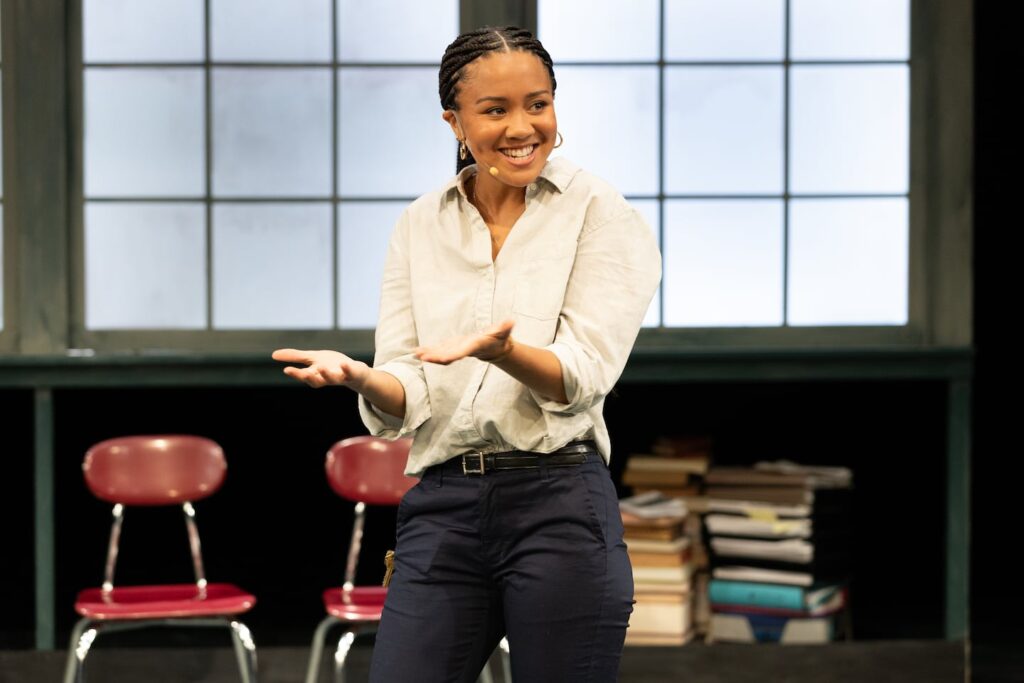
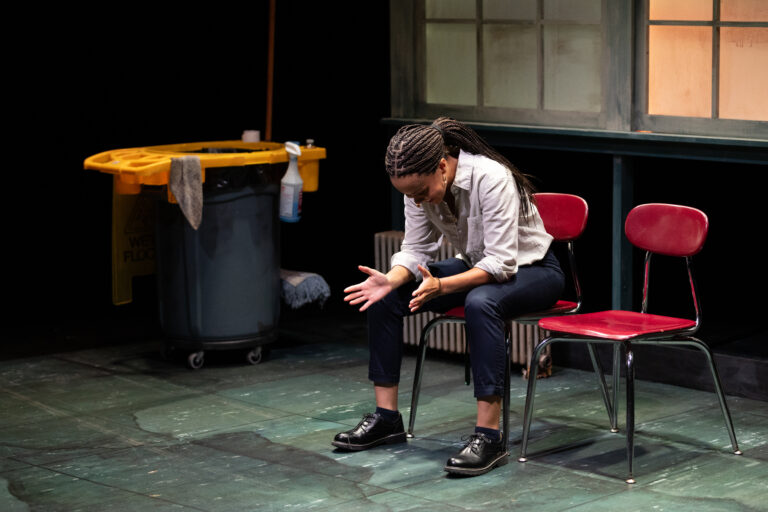
Playwright Lindsay Joelle’s tight, bright comedy brings its audience behind the windshield of a New York City Sanitation Department truck and into the lives of two people thrown together by circumstance: Danny (an exceptionally talented and engaging Paul Melendy) and Marlowe (Thomika Marie Bridwell). The two-hander (80 minutes with no intermission) is one of the most endearing odd couple buddy comedies since, well, Jack Klugman and Jack Lemmon in the 1970s television series, “The Odd Couple.”

Danny, a 41-year-old white blue-collar regular guy, is bigger than life. A seasoned worker with nine years’ experience, he is a nonstop talker, full of advice and corny jokes. He also has a wealth of institutional knowledge and an intuitive sixth sense about the street as a source of understanding the meaning of life. “There’s a lot you can tell about someone by what they throw away,” he counsels his rookie partner. “Read the bags.”

Gloucester Stage Company’s production of The Garbologists by playwright Lindsay Joelle, in Gloucester, MA. The production is directed by Rebecca Bradshaw and stars Tomika Marie Bridwell as Marlowe and Paul Melendy as Danny. © 2025 Shawn G. Henry • 978-590-4869 GSC-250702-Garbologists_017

Marlowe, a mid-30s Black Ivy League-educated (two degrees, no less) woman, is as buttoned up as Danny is unzipped. For the first many minutes, she watches and listens in disinterested silence as Danny continues his comedic monologue. In her pressed and pristine uniform, she looks more ready to walk across a graduation podium than toss overstuffed black bags into the bowels of their truck.

Like an awkward blind date, they eye each other suspiciously, each seeming to wonder what they did to deserve such a match.

But these two have more in common than it first appears, and thanks to a combination of a mostly sharply honed script and spot-on, crisp direction, the layers of what separates them melt away. By the play’s life-affirming end, the two have found more than just friendship; they have found a piece of themselves through each other.

Set in the streets of New York (effective lighting by Anshuman Bhatia, sound by Julian Crocamo and a terrific set by Kristin Loeffler that includes traffic lights, road signs and a functioning trash truck that swivels and rotates), the show slowly builds hope, trust and friendship between these two seemingly mismatched characters as they go about the business of their day. Danny pours on the charm, trying to get Marlowe to loosen up and laugh. Melendy’s performance is worth the price of admission. He is a one-man showstopper, and he is on stage the entire time. As he swerves from serious mentorship to revealing details of his personal life (he is divorced, has a seven-year-old son and is currently under a temporary restraining order), he is a whirling dervish of physicality and nuanced delivery. He is also caring, philosophical and self-aware. “I’m an acquired taste,” he admits. “Like blue cheese.”

Gloucester Stage Company’s production of The Garbologists by playwright Lindsay Joelle, in Gloucester, MA. The production is directed by Rebecca Bradshaw and stars Tomika Marie Bridwell as Marlowe and Paul Melendy as Danny. © 2025 Shawn G. Henry • 978-590-4869 GSC-250702-Garbologists_053

For her part, Marlowe at first is having none of it. Bridwell alternates between high-decibel anger and sullen silence, limiting the audience’s ability to get to know and relate to her character. Although by the end we understand the trauma that led her to take this job, it is an uphill climb.

Joelle gives these two plenty of meaty dialogue, full of astute observations about the meaning behind what people throw away. The street is a resource as well as a wastebasket; one person’s waste is another’s life source.

There are some belly laugh lines and hysterical scenes, especially one with a box full of dildos that Danny uses for an improvisational monologue that finally gets Marlowe to laugh. Triumphant, Danny basks in his accomplishment. “You look radiant,” he practically gushes.

With the exception of a distractingly contrived and awkward twist at the play’s end, Joelle keeps both storyline and character development moving in dynamic and engaging ways.

When Danny gets a call to pick up his sick son at school, Marlowe helps him navigate the awkwardness of figuring out how to contact his ex-wife without violating the terms of his TRO. When Marlowe rescues a teddy bear and places it reverently on a pole, Danny observes but gives her space and time to disclose her reasons. And when Marlowe endangers herself by cavalierly tossing potentially hazardous substances into the compactor, Danny reacts both as boss and concerned friend.

Gloucester Stage Company’s production of The Garbologists by playwright Lindsay Joelle, in Gloucester, MA. The production is directed by Rebecca Bradshaw and stars Tomika Marie Bridwell as Marlowe and Paul Melendy as Danny. © 2025 Shawn G. Henry • 978-590-4869 GSC-250702-Garbologists_274

By the play’s end, we really feel for these two and the cycles of grief, joy, insecurity, loss and random bad luck each has experienced. We also think about garbage (and garbage collectors) in new and shaded ways. Is there a moral obligation, for example, to return something of value that its owner ignorantly tossed, or does the “Finders Keepers” rule apply? When we discard something, do we also discard the right to privacy and anonymity about having owned it?

Most of all, Joelle shines a timely light on our detached perception of those who haul away our debris as faceless and anonymous. These two are full-throated, wonderfully fleshed out, complex and likeable characters, loyal to their families and supportive in their friendships. “Just because we pick up trash doesn’t make us garbage,” Danny says. Amen to that.

Recommended.

‘The Garbologists’ — Written by Lindsay Joelle. Directed by Rebecca Bradshaw. Presented by Gloucester Stage Company at 267 East Main St., Gloucester, through July 26.

For more information, visit: https://gloucesterstage.com/garbologists/

‘Our Class’ Confronts And Challenges Revisionist History

Cast of Arlekin Players’ ‘Our Class’. Photos by Irina Danilova

By Shelley A. Sackett

No one can take his audience on an emotional and artistic roller coaster like Igor Golyak, founder and artistic director of Arlekin Players Theatre & Zero Gravity (Zero-G) Theater Lab. With “Our Class,” in production through June 22 at the Calderwood Pavilion, he introduces us to characters we initially relate to and bond with, spins an artistically ingenious cocoon, and then tells a tale that rips our heart to shreds and leaves us too overwhelmed to even speak.

Written by Catholic Polish playwright Tadeusz Slobodzianek in 2010 and inspired by the true story of the 1941 Jedwabne pogrom, “Our Class” introduces a group of 10 young adults – five Catholic Poles (Zocha, and the “Four Musketeers” Rysiek, Zygmunt, Heniek, Wladek) and five Jewish Poles (Dora, Rachelka, Jakub, Menachem, Abram) – who have grown up in the small town of Jedwabne and have known each other since 1925, when they were all five years old.

Subtitled “A History in Fourteen Lessons,” the multiple Lortel Award-winning play follows these 10 from 1925 to 2003, through the upheavals of 80 years of history marked by rotating vicious regimes (Stalin’s Red Army, Hitler’s Nazi Germany, post-WWII USSR), increased brutality and genocidal antisemitism. Some will become victims, while others will become perpetrators. None will remain unscathed.

We meet these classmates in Lesson 1 as grade schoolers, singing songs and introducing themselves. The mood is light and welcoming. They tell what their father does and what they want to do when they grow up. As they speak, each character’s name, date of birth and date of death are written on the enormous blackboard that is the scenic centerpiece. Some will die in 1941; others as late as 2002. Before even hearing their stories, we already know who shall live (mostly Catholics) and who shall die (mostly Jews) and when.

Although Polish-Jewish relations were politically complicated then, these youngsters are merely curious about their differences.

All of that will change soon enough. The choices each character makes in response to these historical events determine the courses of their lives and the demons they will later battle.

In 1937 (Lesson 4), the four Catholic boys band together, turning as brutish and menacing as their government. They reject and betray their Jewish classmates. Catholicism is the “one true faith” and one brings a large cross to class for prayer sessions, “which means it’s time for our Jewish friends to remove themselves to the back of the classroom.” When the Soviets invade, the “Four Musketeers” commit atrocities that they blame on the Communists. When the Nazis arrive, they switch sides and continue preying on the Jews, including their classmates. Zygmunt (a terrifying Ryan Czerwonko) beats up Menachem for his new bicycle while Zocha (the always magnificent Deborah Martin), his Catholic sweetheart, watches helplessly. The four thugs laugh and then defiantly pray to Jesus.

Kirill Rubtsov, Ilia Volok, Jeremy Beazlie, Ryan Czerwonko

That same year, Abram (the charismatic Richard Topol) leaves for New York, the only classmate who escapes the horrors about to unfold. He becomes a rabbi and sends letters home. As the unofficial narrator, announcing each lesson, his happy, settled life in America contrasts starkly with the chaotic ruthlessness of Poland, where friendships and loyalty devolve into violence, prejudice and even murder. When Jakub is suspected of being an informant, three musketeers beat Jakub to death and slit his throat in a gut-wrenching scene staged on a ladder. “They were my neighbors,” Dora flatly recalls. “I knew them. Just laughing. Making jokes.”

Deb Martin, Gigi Watson

The Jedwabne pogrom took place in 1941 (Lesson 10), and 1941 is the play’s pivotal turning point. The town’s Polish citizens killed its 1,600 Jewish residents in one night by locking them in a barn and burning the barn down. These were ordinary people, including our musketeers, doing and covering up unspeakable things. Afterward, the perpetrators maintained that the Nazis were responsible for the massacre, a travesty that continued until a 2008 investigation revealed the truth.

Act I ends with the wedding between Wladek (the musketeer who watched, but did not participate in Jakub’s murder) and Rachelka (the renowned Chulpan Khamatova), the only Jew left in Jedwabne, in one of the play’s most gut-wrenching scenes. Wladek (wonderful Ilia Volok) has vowed to save her with one caveat – she must convert to Catholicism and change her name to Marianna. Shrouded in a white sheet with lipstick smeared across her face, she is a shell-shocked hostage, a dybbuk trapped in an earth-bound body. The three murderous musketeers shower her with wedding gifts of booty stolen from now-dead Jews. The despair in her eyes is shattering.

The play is full of such difficult moments, yet Golyak manages to blunt them with aesthetic elements that help the audience achieve some breathing space from the sheer horror. The opening scene, for example, is staged as a reading. Scripts in hand, the actors are in contemporary garb, evoking the timelessness and timeliness of the play’s issues. Characters draw faces on ghost-white balloons and set them free to float upward, a metaphorical gesture that lessens the impact of watching the inhumanness that might otherwise catapult us over the edge. Folding ladders, a bedsheet, original music and stunning lighting and projections all add to the production’s power and mystical aura.

The acting is indescribably sublime, each actor both a searing individual and a perfect ensemble member.

Chupan Khamatova (center)
 

That the play is rooted in a true story makes “Our Class” feel like an important history lesson, especially in these times of revisionist history, mob mentality, “othering” and seemingly insurmountable global antisemitism, violence, and raw hatred. The questions Slobodzianek poses are no less pertinent today than they were 80 years ago: Who is more to blame, those who incite, those who bear silent witness or those who act? Does it even matter? How do boys become murderers and friends betray friends? How do you know and tell the truth when there are so many to choose from? And most of all, how do you go on as a survivor of such trauma?

Marianna and Wladek stay married until the play’s end. Marianna reflects on her life with ambivalence and resolve, summing it up in seven little words that have become our mantra: “We Jews. We’ve survived such things before.”

‘Our Class’ – Written by Tadeusz Słobodzianek. Adapted by Norman Allen. Directed by Igor Golyak. Staged by Arlekin at the Calderwood Pavilion at Boston Center for the Arts, Boston, through June 22.

For tickets and additional information, go to:  arlekinplayers.com.

(Editor’s Note: This review previously appeared in The Jewish Journal)

‘Bull in a China Shop’ Brings A Powerhouse Feminist to Life

Cast of Treehouse Collective’s ‘Bull in a China Shop’. Photos: Brian Higgins

‘Bull in a China Shop.’ Written by Bryna Turner. Directed by Lisa Tierney. Stage Manager – Nicole O’Keefe; Lighting Designer – Dan Clawson; Set Designer – Britt Ambruson; Sound Designer/Sound and Light Op – Dannie Smith. Presented by The Tree House Collective at Abbott Memorial Theatre at Hovey Players, 9 Spring St., Waltham through June 29.

By Shelley A. Sackett

Mary Emma Woolley may be the least-known important historical figure you’ve never heard of. A radical feminist, education reformer and suffragette, she served as president of Mount Holyoke College from 1900 to 1937. She also lived a fairly openly lesbian life and shared a life-long partnership with Jeannette Marks, her former student and a firebrand academic revolutionary and writer.

Thanks to Bull in a China Shop, Mount Holyoke 2012 alumna Bryna Turner’s smart, ensemble-based one-act play, and The Tree House Collective’s skillful production, the story of Woolley’s fascinating life and important legacy are a little less unfamiliar.

Turner has a lot of material to work with and she covers a lot of ground in a mere 80 minutes, offering glimpses of American women’s history from 1900 to 1930s against the intimate details of Woolley and Marks’ 55-year-long relationship. Inspired by letters the two women wrote during absences from each other, her funny and tender script is also feisty and pedagogic. Her characters liberally sprinkle their conversations with spicy F-bombs one minute and rhapsodize about Virginia Woolf’s “Orlando” the next.

Karen Dervin as Dean Welsh and Linnea Lyerly as Woolley

The play begins as Woolley (Linnea Lyerly) considers leaving her professorial position at Wellesley College for the presidency at Mount Holyoke. She and Marks (Heidi White) discuss the move while embracing on a tiny bed (Britt Ambruson’s minimalist set design is maximally effective). Like any couple, the two struggle with the adjustment Woolley’s position of power and her career ambitions would have on their relationship. With a light yet insightful pen, Turner makes clear that this lesbian couple is no more immune to the stress of these challenges than any heterosexual married couple might be. In both, it is assumed that the non-breadwinning wife would play a secondary, supportive role.

Although Marks is anxious and reticent, they do, of course, move to Mount Holyoke, where Woolley exercises prodigious power and Marks is an English professor, living in a faculty dorm. “I never wanted to be a wife,” Marks complains. Intoxicated by the heady opportunity to smash every social, political, cultural, and academic norm that constricts women, Wooley snaps back, “I want a partner, not a child. Grow up.”

Turner weaves a lot of facts into her play. We learn, by way of pithy, clever dialogue, that in the past, the college had placed an emphasis on women’s education in service to society (all students were required to learn laundry skills, for example, and attend daily chapel). Woolley, by contrast, laid the foundation for a women’s education to be valued for its intellectual merit. Period. On her watch, education for education’s sake would no longer be a brass ring reserved for men.

Ever the proverbial bull in a China shop, Woolley minces no words. “You want a training ground for good pious wives?” she asks during a practice interview with the Mount Holyoke hiring committee. “I’ll give you fully evolved human beings. Are you afraid they won’t find husbands? So what. If a man is interested in headless women, send him to France.”

Alas, while Woolley’s moves to upend the concept of womanhood are met with applause and adulation from the student body, the stuffier, straighter board of trustees and heavy-hitter donors prove a tougher sell.

Hannah Young as Felicity, Lyerly and White

Dean Welch (Karen Dervin) tries to rein Wooley in when she treads too close to the board’s lines in the sand, but Woolley pays no heed until, at last, it’s too late. Before that eventuality, however, there are many delicious subplots to unfold.

There is, for example, the secret fan club that springs up on campus, dedicated to worshipping the romance between Woolley and Marks. Fan club president Pearl (Anneke Salvadori), a student of Marks’ who is so besotted with her teacher that she stalks her like a lovesick puppy, actually pens sonnets about her eyes in the student evaluation forms.

There is a suffrage protest that lands Marks and Woolley on opposite sides of the college administration’s official stand. There is Woolley’s three-month trip to China, which ignites Marks’ predictable affair with Pearl. Felicity (Hannah Young), Marks’ protective and invaluable roommate, is a grounding voice of reason amidst the ensuing domestic chaos.

Turner also raises plenty of philosophical questions clothed in adroitly crafted, though at times dense, conversation. Is Woolley a realist, opportunist or idealist when she doesn’t risk taking a public stand on women’s suffrage until after receiving the board’s approval? Is she sincere or a manipulator, and, at the end of the day, do her motives matter as much as her actions?

The Tree House Collection has mounted a production that feels greater than the sum of its parts. Director Lisa Tierney makes admirable use of the simplest of sets to evoke a bedroom, office, classroom, rooming house, train, and jail. The pacing is brisk, with pleasing, period musical interludes (Dannie Smith) that accompany quick set changes between scenes.

And then there is the crackerjack acting. As Woolley, Lyerly is a complicated, powerful presence, as beguiling and charming as she is frustrating and infuriating. White plays Marks as an intense, humorless professor who seems to be in need of either a chill pill or a new lover. (Young, as roommate Felicity, tries her best to steady Marks’ listing boat).

Heidi White as Marks

But the real surprises and pleasures are Dervin, as Dean Welsh, and Salvadori, as Pearl. Dean Welsh presents as all business and conformity on the outside, but Dervin’s nuanced performance imbues her with a hint of rebellion and a wink of humor. Salvadori simply steals every scene she is in. Her Pearl is dry-witted, wry and droll, and Salvadori deadpans even her most outrageous lines to great effect. Although the scene where Pearl fantasizes about wreaking havoc on Marks after being dumped by her for the returning Woolley could use some editorial tweaking, Salvadori’s delivery could not be more spot on.

Bull in a China Shop debuted off-Broadway in 2017 at Lincoln Center’s Claire Tow Theater, where it earned glowing reviews and played to sold-out audiences. Lincoln Center has offered Turner a commission for her next play. I, for one, can’t wait to see what bauble catches her eye.

For more information, visit https://www.treehousecollective.us/home

Gloucester Stage Breathes Fresh Life into A Beloved Classic, ‘The Glass Menagerie’

Liza Giangrande, Patrick O’Konis in Gloucester Stage company’s The Glass Menagerie’
Photos by: Shawn Henry

‘The Glass Menagerie.’ Written by Tennessee Williams. Directed by Doug Lockwood. Scenic Design by Jenna McFarland Lord; Costume Design by Nia Safarr Banks; Lighting Design by Amanda Fallon; Sound Design by Aubrey Dube. Presented by Gloucester Stage at 267 East Main Street, Gloucester, through June 28.

By Shelley A. Sackett

Tennessee Williams’ classic autobiographical story of a struggling family, The Glass Menagerie, is no stranger to Broadway and community theater stages. It premiered in Chicago in 1944, where it was championed by several Midwest critics, and moved to Broadway in 1945. Subsequent Broadway productions were mounted in 1965, 1975, 1983, 1994, and 2005, with the likes of Jessica Tandy, Julie Harris, and Jessica Lange playing matriarch Amanda Wingfield. The 2013 revival transferred to Broadway from the American Repertory Theatre in Cambridge, MA. Known as a staple in college and community theaters’ repertoire since its 1944 début, the play and its straightforward staging is a reliable crowd pleaser and audience draw.

It’s hard to imagine any theater company could add anything new. Yet, Gloucester Stage (2025 Elliot Norton Award Winner for Outstanding Play, Midsize for its production of Hombres) has effectively (and thankfully) taken the road less traveled in its presentation of the 80-year-old classic with an interesting and thought-provoking production that allows the audience to experience Williams’ script anew through an exciting, hyper-focused and refractive lens.

Williams advises in his preface, Author’s Production Notes, “Expressionism and all other unconventional techniques in drama have only one valid aim, and that is a closer approach to truth. When a play employs unconventional techniques, it is not, or certainly shouldn’t be, trying to escape its responsibility of dealing with reality, or interpreting experience, but is actually or should be attempting to find a closer approach, a more penetrating and vivid expression of things as they are.”

Kudos to Director Doug Lockwood and Scenic Designer Jenna McFarland Lord for taking those words to heart.

De’Lon Grant

The Glass Menagerie is a seven-scene memory play with a storyline that follows Tom Wingfield (De’Lon Grant) as he looks back on his family life in St. Louis during the 1930s. In the opening scene, Tom appears slightly offstage to deliver his soliloquy. “The play is memory. Being a memory play, it is dimly lighted, it is sentimental, it is not realistic,” he says, warning that what he is about to share may not be THE truth, but it is certainly what he remembers (or thinks he does). “Yes, I have tricks in my pocket, I have things up my sleeve. But I am the opposite of a stage magician. He gives you an illusion that has the appearance of truth. I give you truth in the pleasant disguise of illusion.”

He describes exactly who we will see — his mother, Amanda, his sister, Laura, himself, a mystery man — and who we will NOT see: his father, who was a telephone man who “fell in love with long distances.”

The set reflects the otherworldly dreaminess Tom describes. Gauzy, torn gold floor-length drapes enclose the stage like curtains around a freestanding shower/tub. As Amanda’s voice becomes audible, Tom pulls back the curtains and enters the Wingfield residence.

On stage are Amanda (Adrianne Krstansky), Laura (Liza Giangrande) and four chairs. Amanda and Laura sit at an imaginary table, pantomiming eating. Their gestures are in perfect spatial sync, creating the impression that they (and, therefore, we) are suspended in this dreamlike world of memory and mirage, where props are invisible and reality is a hermetically sealed snow globe. Even the only wall art, a baroque gold frame that is supposed to hold a portrait of Tom’s father, is empty.

Grant, Giangrande, and Adrianne Krstansky

This minimalistic approach allows the audience to focus on Williams’ words and the true genius of the script. Without the distraction of glimmering glass animals and ornate period furniture, we too become submerged in Tom’s recollections, a key element of The Glass Menagerie’s success as a “memory play.”

A faded Southern belle of middle age, Amanda deals with her present by hanging onto her past. Abandoned by her husband, she lives with her children. Laura, in her 20s and afflicted with a limp, perhaps caused by polio, is debilitatingly shy. Tom, her younger brother, secretly writes poetry and supports the family by working a warehouse job that he hates. A fêted debutante in her Southern youth, Amanda longs for the creature comforts and male attention she enjoyed and spends most of her time reliving and recounting those happier times.

Amanda is also obsessed with finding a “gentleman caller” for Laura, whose crippling anxiety and introversion have sabotaged her every move, with the result of dropping out of high school and a secretarial course. Laura spends her days in her own homespun world, playing records on the Victrola and polishing and communing with her “glass menagerie,” a collection of tiny animals she engages with as a toddler would in fantasy play. Like Amanda, she treads the path of escapism.

The first five scenes of the play (“Preparation for a Gentleman Caller”) draw to an end as Amanda bribes Tom to bring home some nice young man from the warehouse by promising that, once Laura is married off, Tom is free to follow in his father’s footsteps. He tells her that Jim, a work acquaintance, will join them for dinner the next night. Amanda sets to work, reimagining the apartment, Laura, and the future.

After intermission, when the curtains are again drawn aside, the set revealed is firmly grounded in the “real” world of tangible accoutrements. After all, the very first outsider ever to enter the Wingfield inner sanctum might be scared away by anything short of at least the pretense of “normalcy.” Even Tom’s father is restored to his throne, majestically peering down at the chaos his legacy has sown.

O’Konis and Grant

Subtitled “The Gentleman Calls,” these last two scenes are Williams at his heartbreaking best. Jim O’Connor (Patrick O’Konis, 2025 Elliot Norton Award Winner for Outstanding Lead Performance in a Play, Small), the man Tom has brought home, turns out to have gone to high school with the Wingfield siblings. Tom was “the” big man on campus, starring in the school play and excelling at any sport thrown his way. Like Tom, he is disappointed at his current lot in life and his hope to shine again is conveyed by his study of public speaking, radio engineering, and ideas of self-improvement.

The ending is predictably dark (this is Williams, after all), although there are bursts of cheer and light as Jim and Laura reminisce over their very different high school experiences. The real tragedy is that these two do connect in an authentic way, only possible in the living room of a home where its residents live in a dream world.

The acting in this four-hander is uniformly stellar, the direction more than spot on, and the script a critic’s delight. Even if you think you’ve seen The Glass Menagerie enough times for one lifetime, be sure to catch this version at Gloucester Stage through June 28. You’ll be sorry if you don’t.For more information, visit: https://gloucesterstage.com/glassmenagerie/

Quirky, Funny and Flaky — NSMT’s ‘Waitress’ Is Feel-Good Summer Fare

Christine Dwyer (Jenna) and Brandi Chavonne Massey (Becky) in WAITRESS at North Shore Music Photo©Paul Lyden

‘Waitress.’ Written by Jessie Nelson. Music and Lyrics by Sara Bareilles. Based on the motion picture written by Adrienne Shelly. Directed by Kevin P. Hill. Music Direction by Milton Granger; Choreography by Ashley Chasteen; Scenic and Lighting Design by Jack Mehler; Costume Design by Rebecca Glick; Sound Design by Alex Berg. Presented by North Shore Music Theatre, 54 Dunham Rd, Beverly, MA through June 15.

By Shelley A. Sackett

Who doesn’t love a thick slice of pie, especially in the summer when fresh fillings are ripe and especially sweet? “Sugar, butter, flour” is the mantra chanted like a lullaby throughout Waitress, the wonderfully staged musical now playing at North Shore Music Theatre. Although pie takes center stage throughout the almost two-and-a-half-hour performance (with one intermission), Waitress is no simple, indulgent, or sentimental high. Meaty themes like domestic abuse, infidelity, empowerment, motherhood, and self-fulfillment are the secret ingredients that keep the show rolling and the audience from lapsing into a sugar coma.

Sara Bareilles’ witty, pop-ish lyrics and score marry the narrative requirements of musical theater with a variety of styles ranging from ballads and a country hootenanny to stunning duets and wacky, hysterical solos. The actors are uniformly well cast, from their vocal talents to their abilities to both shine as individuals and meld as an ensemble. Jack Mehler’s scenic and lighting designs are well thought out and effective. Director Kevin P. Hill makes good use of NSMT’s signature theatre-in-the-round stage and center trap door lift and sets a spot-on pacing. Add a live band (Music Director Milton Granger) and excellent sound (Alex Berg), and, production-wise, Waitress is as enjoyable as any production I’ve seen at NSMT.

The plot, which some have described as “half-baked,” is nonetheless a fine table on which to set this entertaining musical.

Christine Dwyer

Jenna (a fabulous Christine Dwyer) is both an expert pie baker and waitress at Joe’s Pie Diner, somewhere in the American South. Baking is her way of continuing her mother’s legacy and flexing her own creative muscle. Stuck in a stereotypical abusive relationship with her high school beau, Earl (Matt DeAngelis, who does the best he can with his cardboard character), she works long hours and considers her co-workers to be her real family.

Jenna is also afraid she might be pregnant (no spoiler; she is) and it is only the coaxing of her fellow waitresses, sassy, brazen Becky (Brandi Chavonne Massey, terrific) and gangly, nerdy Dawn (Maggie Elizabeth May, ditto) that gets her to pee on that proverbial stick.

An unplanned and unwanted pregnancy by a man she doesn’t love only adds to her load. (That she remains with Earl, a one-note bully and narcissist who demands her tip money the second she gets home, is tough to accept plot-wise.) She hides the pregnancy from Earl while she tries to come up with a plan to escape his clutches and start a new life for her and her baby.

Dwyer (Jenna) and Brandon Kalm (Dr. Pomatter)

For the time being, though, what is poor Jenna to do? Why, have an affair with her charismatic (and very married) obstetrician, Dr. Pomatter (a charming Brandon Kalm), of course! (Another plot head-scratcher some might find unrelatable and off-putting).

Meanwhile, back at the diner, Becky and Jenna help Dawn overcome her inertia and self-doubt and create an online dating profile. Almost as quickly as Jenna’s pregnancy test registers positive, Dawn gets a bite from the irrepressible, equally geeky Ogie (played with verve and vivacity by Courter Simmons). Their scenes together are among the most hilarious and weirdly adorable.

Jenna discovers the possibility of a way out of her abysmal home life when Joe (Keith Lee Grant, in a role tailor-made for him), the elderly owner of the eponymous diner, suggests she enter a pie baking contest. The prize is $20,000, her pies are definitely good enough, and she has nothing to lose. After much cajoling, she’s in.

]

Eventually, all ends well (enough) for all the characters and Jenna embraces motherhood with a single-mindedness previously reserved for baking and inventing pies. If this were a dramatic play, no amount of clever dialogue could overcome the light-weight plot line, unnuanced character development and too pat ending. Luckily, Waitress is a musical and the talented Bareilles has crafted a funny, heartfelt and musically exciting score of 19 numbers that keep the action moving, the audience laughing, and the NSMT tent rocking.

For it is through the songs that the subplots and characters unfold.

In “The Negative,” for example, the three waitresses focus on the negative as they pray for Jenna’s pregnancy stick to stop at one line. “Club Knocked Up” is the obstetrician’s waiting room where the very pregnant patients pay homage to the era of the Andrews and Lennon sisters. Simmons, as Ogie, brings down the house with his Pee Wee Herman antics in the belly-laughers, “Never Getting Rid of Me,” and “I Love You Like A Table.” Massey, as Becky, then sets that house on fire in “I Didn’t Plan It.”

Bareilles really lets loose in Jenna and Dr. Pomatter’s duets, both musically and lyrically. “Bad Idea,” on which act one ends, is a slinky, sexy, tribute to the power of attraction. “It’s a bad idea, me and you; Let’s just keep kissing ‘til we come to…” Dwyer and Kalm croon as they throw themselves at each other and onto the gynecology examination table, limbs and voices silkily entwined. The ballad, “You Matter to Me,” gives the audience another opportunity to savor their harmonization.

At the end of the day, though, it is Jenna’s story, and it’s only fitting that she has the show’s two most introspective numbers. In the climactic “She Used to Be Mine,” Jenna unflinchingly assesses who she has become and who she wants to be in a song that is a rollercoaster of emotion and range, giving Dwyer the chance to really strut her vocal stuff. “Everything Changes” is her tribute to the power of motherhood.

The show’s finale, “Opening Up,” circles back to the moral of Waitress — it really does take a village for an individual to survive and thrive. The diner community is that village, holding them up and helping them keep it together. “Take a breath when you need to be reminded that with days like these, we can only do the best we can,” the company sings. Amen to that.

For more information, go to nsmt.org

Charming, Engaging, and Clever — A.R.T.’s Musical ‘Two Strangers’ Has It All!

Sam Tutty and Christiani Pitts in A.R.T.’s ‘Two Strangers (Carry a Cake Across New York)’.
Photos: Joel Zayac

Two Strangers (Carry a Cake Across New York).’ Written by Jim Barne and Kit Buchan. Directed and Choreographed by Tim Jackson. Scenic and Costume Design by Soutra Gilmour; Lighting Design by Jack Knowles; Sound Design by Tony Gayle and Cody Spencer; Orchestrations by Lux Pyramid; Music Direction by Jeffrey Campos. Presented by A.R.T.’s Loeb Drama Center, 64 Brattle St., Cambridge through June 29.

By Shelley A. Sackett

Two Strangers (Carry a Cake Across New York), in its American debut at the American Repertory Theatre,is the perfect antidote to our bleak, cold spring. This sunny, upbeat two-hander musical romantic comedy is as beguiling as it is impeccably acted, directed and produced. In short, it is a full-blown fabulous evening of musical theater at its finest.

Unlike too many musicals these days, Two Strangers has a complicated plot and fetching music with lyrics that are Sondheim-esque in their conversational fluency and relevance. Add to that a smart, slick set (Soutra Gilmour), superb band (Music Direction by Jeffrey Campos), impeccable direction (Tim Jackson) and perfectly matched and equally talented leads (Christiani Pitts and Sam Tutty), and…well…you get the picture.

The premise is worthy of a Meg Ryan-Billy Crystal/Meg Ryan-Tom Hanks blockbuster “meet cute” film. Dougal, an excited and excitable 30-something-year-old Brit, has arrived in New York to attend the Christmastime wedding of the father he has never met. Robin, the 30-something-year-old older sister of the bride, is charged with picking him up at the airport. The two couldn’t possibly be more different.

Dougal (a bouncy, adorable and charismatic Tutty) is a bundle of enthusiastic energy. He’s pumped up to be in New York for the first time (“Are They Ready for Me in New York?” he sings in the opening number, “New York”) and marvels, wide-eyed and bushy tailed, at his first subway ride.

Robin is the jaded and pessimistic foil to Dougal’s blind optimism. A disillusioned New Yorker, working as a barista in a coffee shop and barely making ends meet, she is waiting for something to jump-start her “real” life. Her opening number, “What’ll It Be?” (“Is there something ’round the corner in the distancе? If you’re changing, what’ll it be that makes thе difference? Will you notice, will you feel it? What’ll it be?”) is a lamentation to dreams deferred. 

Dougal is in the same boat over the pond (he lives in his mother’s basement and works as an usher at a cinema), but he has the confidence and faith that fate and time are on his side. Robin’s glass is more than half empty; Dougal toasts hers with one that’s more than half full.

Jim Barne and Kit Buchan have crafted lyrics and music that are varied and reflective of both the two characters and the various situations they encounter. Tutty and Pitts have sparkling chemistry, and they are both engagingly agile actors with spot-on timing, inflection, physicality, and dancing and singing gifts. In the magical first act closing number, “American Express,” with its tip of the hat to Ginger Rogers and Fred Astaire, the two actors really get to strut their stuff. (Kudos to Pitts and Tutty for sharp enunciation and to Tony Gayle and Cody Spencer’s crystal clear sound.)

Gilmour’s set design of stacks of suitcases etched with neon is simple and elegant. It spins throughout the show, underscoring how Robin and Dougal seem to be walking in place while circling each other. Magically, the wardrobes and large suitcases open to a coffee shop, a fleabag hotel, a Chinese restaurant and more. Jack Knowles’ dreamy lighting creates starry skies, dance floors and even a Plaza Hotel suite out of thin air.

The second act is more serious and meatier, as Dougal and Robin begin to open up to each other and provide compassionate reality checks. Robin gets Dougal to acknowledge his daddy fantasies and Dougal eventually succeeds in gaining Robin’s trust. And yes, the two do actually carry a wedding cake across New York.

By the play’s end, it is clear they have had a profound and indelible effect on each other, and that their connection has morphed into more than friendship. To their credit, Barne and Buchan resist the temptation to wrap it all up in a neat, happy rom-com bow, leaving the audience heartful, hopeful and thoroughly charmed.

Highly recommended.

For more information, visit americanrepertorytheater.org

‘Kimberly Akimbo’ Is Musical Theater at Its Absolute Best!

Cast of ‘Kimberly Akimbo’ at the Emerson Colonial Theatre. Photos by Joan Marcus

By Shelley A. Sackett

Kimberly Akimbo should not be as enjoyable as it is. The show tells the tragic story of a lonely teenage girl, Kimberly Levaco (Carolee Carmello), who suffers from a condition similar to progeria that causes her to age at a rate that is four and a half times as fast as normal. Only one in 50 million people is so afflicted, and Kimberly has the appearance and bodily breakdown of an elderly woman with a lifespan that rarely exceeds 16 years.

We meet her shortly after she moves with her family to a new town in suburban New Jersey, after they left their previous home under shady circumstances. She encounters the usual adolescent “new kid” syndrome on steroids. Her narcissistic mother, Pattie (Laura Woyasz), is pregnant with a baby she hopes won’t be like Kimberly. Her father, Buddy (Jim Hogan), is a drunk and an insensitive and negligent father. Kimberly is burdened by both her genetic disease and being a caretaker for her immature, dysfunctional and self-absorbed parents. She also has a crude and zealous aunt Debra (a showstopping Emily Koch), who shows up like a bad penny, ready to engage Kimberly and her teenage posse in her latest felonious scheme.

On top of this, Kimberly is about to turn 16. For her, the bell is truly tolling.

Carolee Carmello and Miguel Gil

Yet, despite these odds, the team of South Boston native David Lindsay-Abaire (book and lyrics) and Jeanine Tesori (music) has made lemonade out of lemons, creating a poignant, funny, upbeat, and clever musical that also packs a wallop of insightful and optimistic messages on the way you can — and should —live your life, no matter how much of it remains to live.

With an unobtrusive yet stunning set design by David Zinn, terrific choreography (Danny Mefford) and orchestrations (John Clancy), and a stellar cast of Tony nominees and experienced Broadway actors (most of whom were in the play’s Broadway run), Kimberly Akimbo is an impressive show that leaves a significant impact and a smile on its audience’s face.

The storyline is anything but straightforward. The plays opens in 1999 at Skater Planet, an ice skating rink in Bergen County, New Jersey, where six teenagers — Kimberly, Seth (Miguel Gil), Martin (Darron Hayes), Aaron (Pierce Wheeler), Teresa (Skye Alyssa Friedman), and Delia (Grace Capeless) — express their misgivings, hopes and frustrations. Each is weird and awkward in their own way. What they all have in common is a feeling that they are not “seen” and a desire to fit in.

There are also teen hormones galore. Seth and Kimberly flirt and decide to partner for their biology project about diseases. Among the other four, unrequited crushes rule. They make plans to mount a Dreamgirls medley for the school choir show, and their practice sessions are a delight.

Kimberly’s home life is a mix of the absurd, the pathetic and the (almost) endearing. When Buddy is three hours late picking her up at the skating rink and arrives drunk, he persuades her to lie for him to her mother. Pattie has casts on both her arms after undergoing double carpal tunnel surgery and spends her time lying on the couch and making a clandestine video for the baby-to-be. Aunt Debra ambushes Kim in the school library, where she has been squatting. She tells Kim that her parents fled Lido, the last town where they all lived together, to deliberately dodge her, and convinces her to open the window at home to sneak her in.

Although the plot is full of capers, slapstick and great reveals (such as the reason the family had to bolt from Lido), the real pathos and meat of the production is exposed through its dazzling musical numbers.

In “Make A Wish,” Kimberly writes a letter to the foundation listing the three things she hopes she has time to do before her time runs out (be a model, take a cruise and build a treehouse) before realizing the only thing she could possibly wish for is to live like normal people live — “however normal people live” — for just one day.

Carolee Carmello and Jim Hogan

In “This Time,” the entire company expresses their hopes for the future, while “Good Kid” offers the audience a glimpse into Seth’s heartbreaking backstory. Even more tragic, however, is “Our Disease,” which puts each student’s presentation on specific diseases (scurvy, fasciolosis and Kim’s disease, progeria) to music. Afterwards, as the students debrief and talk about their dreams for the future, they complain about high school as being “just the crap we have to get through before we get to the real stuff, the good stuff,” ignoring the fact that for Kim, high school is the only stuff.

Finally, fed up with their insensitivity and whining, she explodes. “Your disease is a bad case of adolescence,” she screams. “Getting older is my affliction; getting older is your cure.”

The cast is a theater goer’s dream. They are individually and collectively pitch-perfect, enunciating clearly and spot on in pacing and gestures. (Kudos to director Jessica Stone). As Kimberly, Carmello wears a sad, serious face that is believable and touching. As Seth, her eventual boyfriend, the talented Gil is her perfect partner. The four teens are a seamless ensemble and Koch, as the irrepressible Debra, brings down the house with her earthiness and fabulous vocals. Hogan has a Richard Dreyfus naturalness as Buddy and Woyasz is equal parts adorable and abominable as Kim’s mother, Pattie.

Lindsay-Abaire’s other plays include Fuddy Meers (1999), Good People (2011), and Rabbit Hole (2006), for which he won the 2007 Pulitzer Prize for Drama. Tesori has written the music for stage musicals such as Thoroughly Modern Millie (2000), Caroline or Change (2003), Shrek the Musical (2008), and Fun Home (2013); she has also been twice nominated for the Pulitzer Prize for Drama. She and Lindsay-Abaire had previously worked together on Shrek the Musical.

Emily Koch (center) and company

Kimberly Akimbo won five Tony Awards in 2023, including best musical. Unsurprisingly, Lindsay-Abaire and Tesori manage to pull a rabbit out of their prodigiously talented hat to end this potentially gloomy play on a hopeful, upbeat note where everyone — especially Kim — lives their life to the fullest. As my social worker friend and fellow audience member observed, sometimes people who know their days are numbered have a heightened awareness and appreciation for figuring out what really matters and going for it. What a gift and legacy that Kimberly not only walked that walk before she died, but also talked the talk. After all, as she proves, no matter what shape it takes, life is just one big adventure.

Highly recommended.

‘Kimberly Akimbo.’ Book and Lyrics by David Lindsay-Abaire. Music by Jeanine Tesori. Based on the play by David Lindsay-Abaire. Directed by Jessica Stone. Music Supervision by Chris Fenwick. Choreographed by Danny Mefford. Presented by Broadway in Boston at the Emerson Colonial Theatre, 106 Boylston St., Boston, through May 18.

For theater information and tickets, go to: https://www.emersoncolonialtheatre.com/

Emerson Colonial’s ‘Mean Girls’ Is More Meh Than Mean

Cast of ‘Mean Girls’ at Emerson Colonial Theatre

By Shelley A. Sackett

Tina Fey’s Mean Girls has certainly milked its appeal. When it first appeared in 2004 as a film starring Lindsay Lohan, Rachel McAdams and Amanda Seyfried, it was a runaway hit. Its 2018 transformation into a Broadway musical fared less well and the 2024 remake of the film fared even worse.

Which brings us to the 2025 theatrical musical version that played at Emerson Colonial Theatre recently. Suffice it say, the newest iteration did nothing to reverse Mean Girls’ downward trajectory. Unless, that is, you happen not to have been born in 2004. In that case, (as was evidenced by the hordes of pink-clad teens and twenty-somethings at a Wednesday evening performance), the latest musical version was just what the Minister of Culture ordered.

Plot-wise, not much has changed. Teenage Cady Heron (a tentative Katie Yeomans) was home-schooled in Africa by her scientist parents. When her family moves to the suburbs of Illinois, Cady is jettisoned into the public school jungle, where she gets a quick primer on the cruel, tacit laws of popularity that divide her fellow students into tightly knit cliques from Damian (a terrific Joshua Morrisey) and Janis (Alexys Morera, also very good). But when she unwittingly finds herself in the good graces of an elite group of cool students run by the Queen Mean Girl, Regina (Maya Petropoulos), and dubbed “the Plastics,” Cady is initially seduced by the allure of being a member of the “in” crowd.” Once she realizes how shallow, and, well, mean, this new group of “friends” is, she rebefriends Janis and Damien and exposes Regina and her acolytes for who and what they really are.

José Raúl, Katie Yeomans 

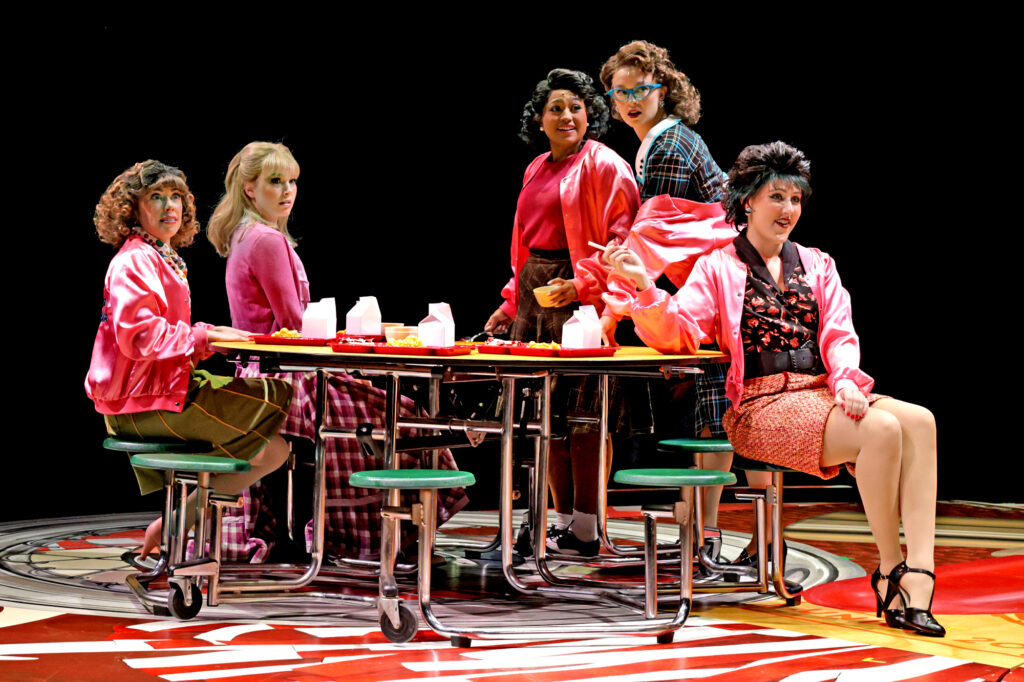
Between opening and closing curtains are 20 musical numbers that take us on a trip through the trials and tribulations of high school with all its unspoken rules and regs, hierarchies, and, of course, sex, drugs, and rock ’n’ roll. Playing multiple roles, Kristen Seggio is a standout as teacher Ms. Norbury, bringing welcome talent and presence to the stage. Scott Pask’s set design is clever and engaging (especially the use of desks on rollers), and John MacInnis’ choreography occasionally shines, especially in the tap number and the use of trays for the lunch scene. But unfortunately, for the most part, the young actors (almost all are debuting in their first national tour) swallow a large percentage of their lines and lyrics, making an at times tedious production all the more so.

There are, to be fair, some high moments, especially during any musical numbers with harmonies. The show opens strongly, with scene-stealer Morrisey and Morera in fine voice and form. Kristen Amanda Smith is effective and (almost) endearing as an on-again, off-again member of Regina’s posse (plus she has a wonderful voice with which she projects and enunciates). As Karen, the airhead blond Regina worshipper, Maryrose Brendel brings a surprising freshness and nuance to a character who is plastic in more than group membership.

Maryrose Brendel, Maya Petropoulosas,  Kristen Amanda Smith

At the end of the day, perhaps Al Franken, Fey’s fellow Saturday Night Live member, summed up Mean Girls’ message to teenagers struggling with the pain of social cliques best. As his beloved character Stuart Smiley would say, “I’m good enough. I’m smart enough. And, doggone it, people like me.”

‘Mean Girls.’ Book by Tina Fey.  Music by Jeff Richmond. Lyrics by Nell Benjamin. Based on the Paramount Pictures film “Mean Girls.” Directed by Casey Cushion. Choreography by John MacInnis; Scenic Design by Scott Pask; Costume Design by Gregg Barnes; Lighting Design by Kenneth Posner; Sound Design by Brian Ronan; Music Direction by Julius LaFlamme; Orchestrations by John Clancy; Music Coordination by John Mezzio; Hair Design by Josh Marquette. Presented by Emerson Colonial Theatre, Bolyston St., Boston. Run has ended.