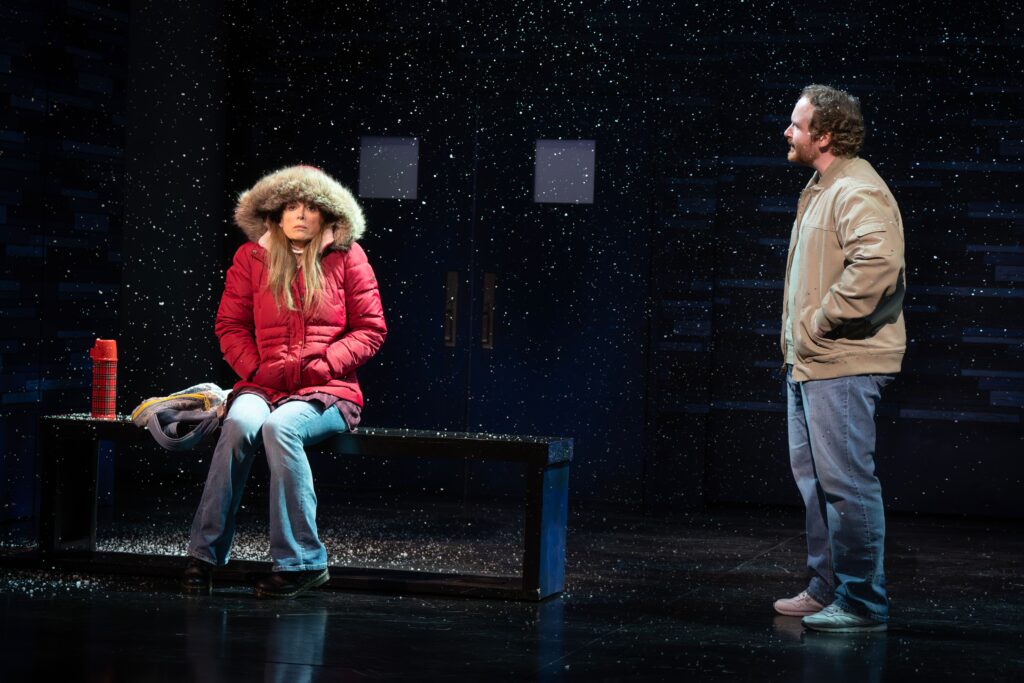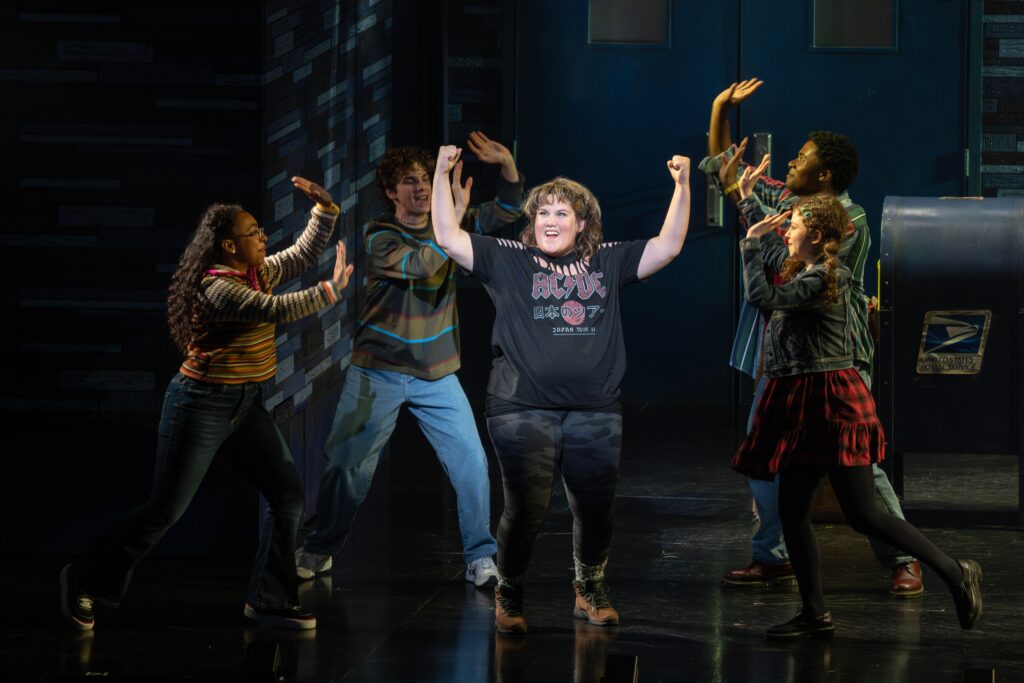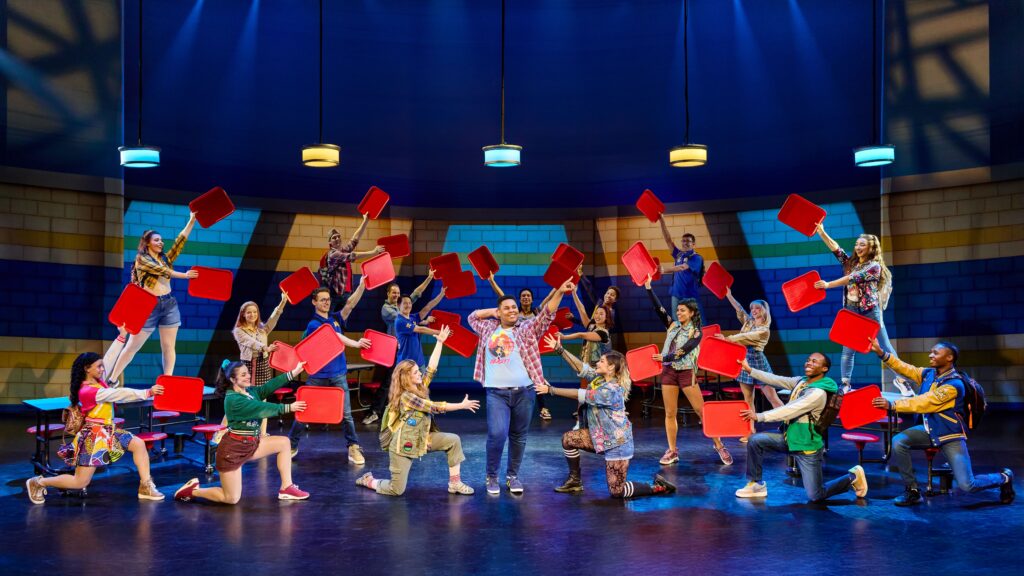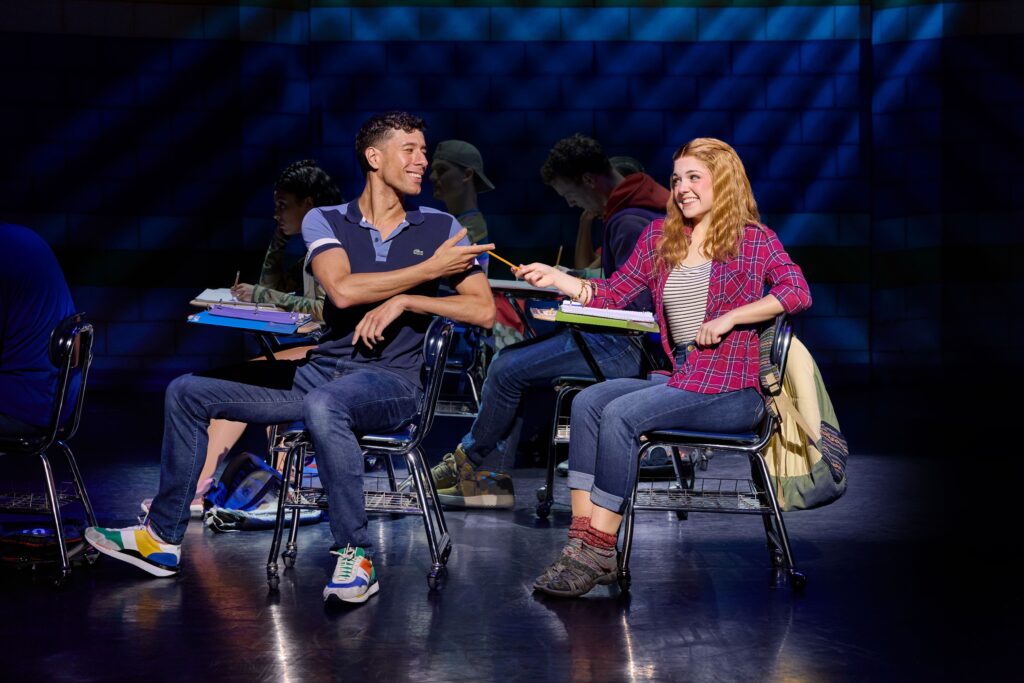
Moonbox’s ‘Crowns’ Raises the Roof

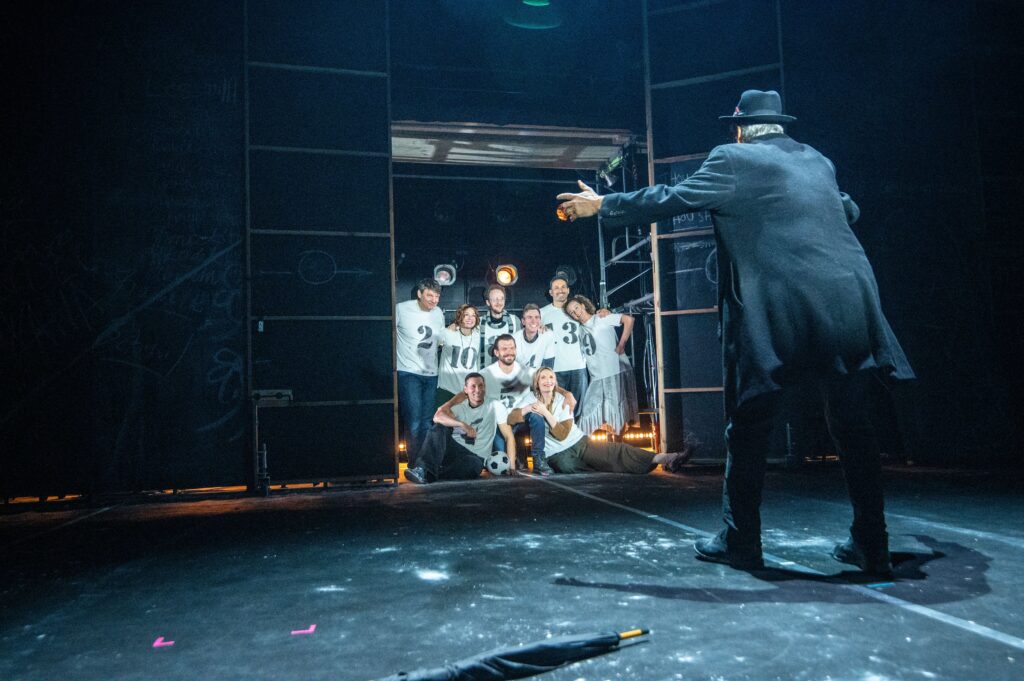
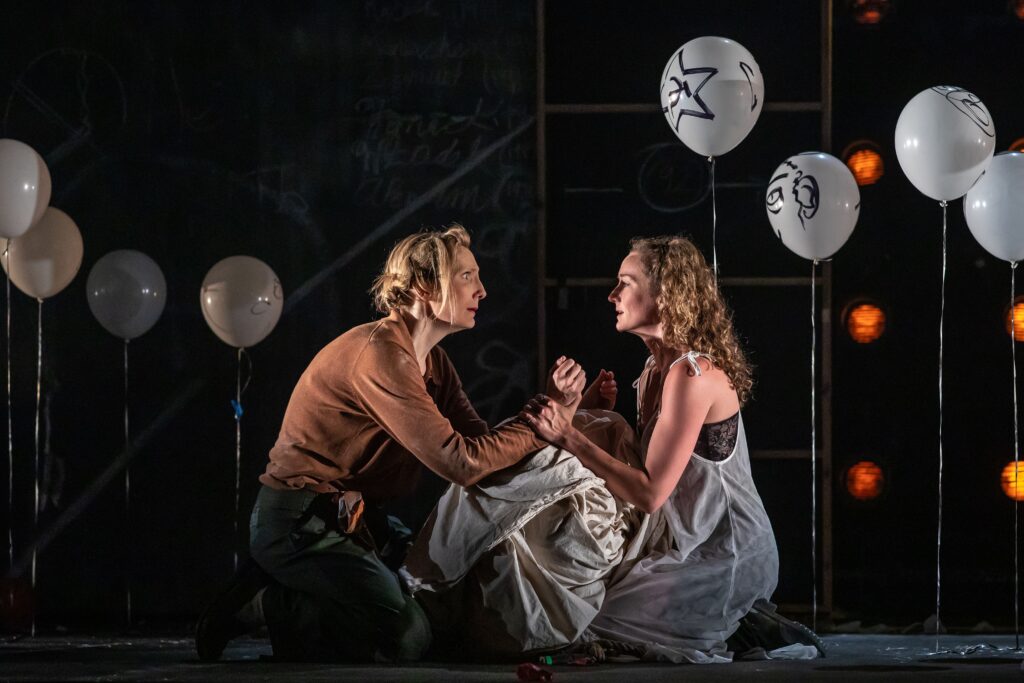
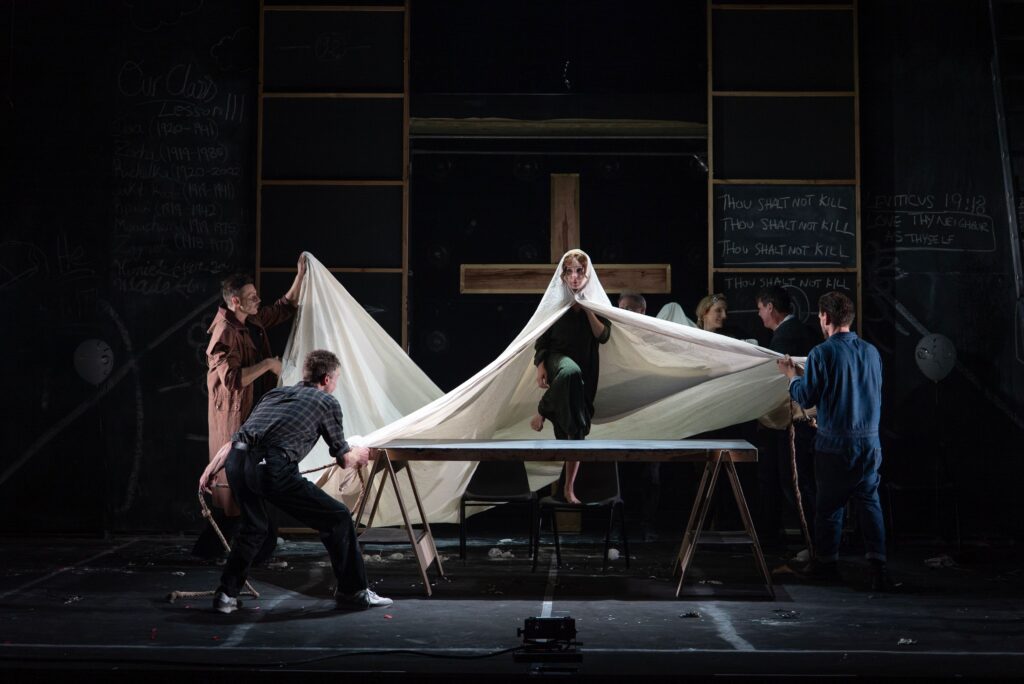
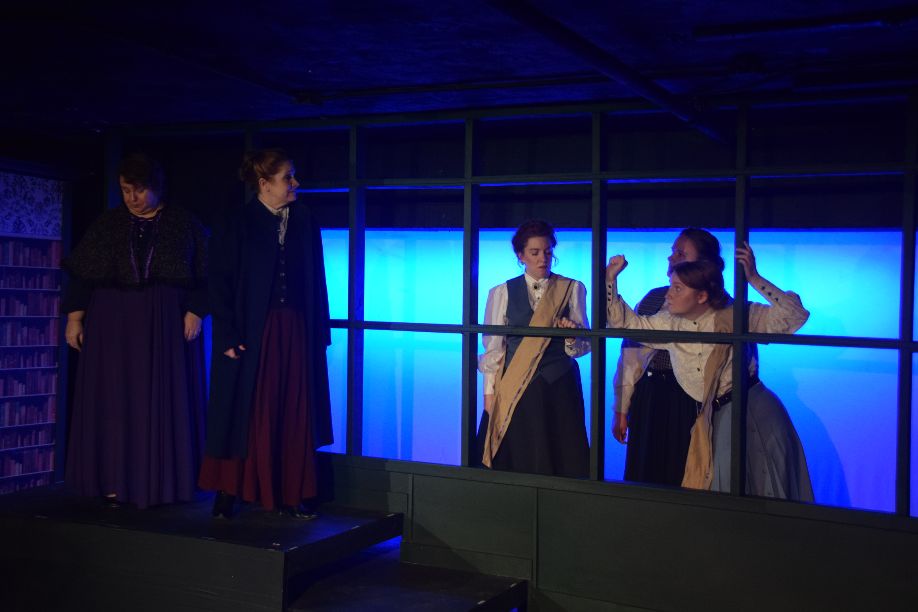
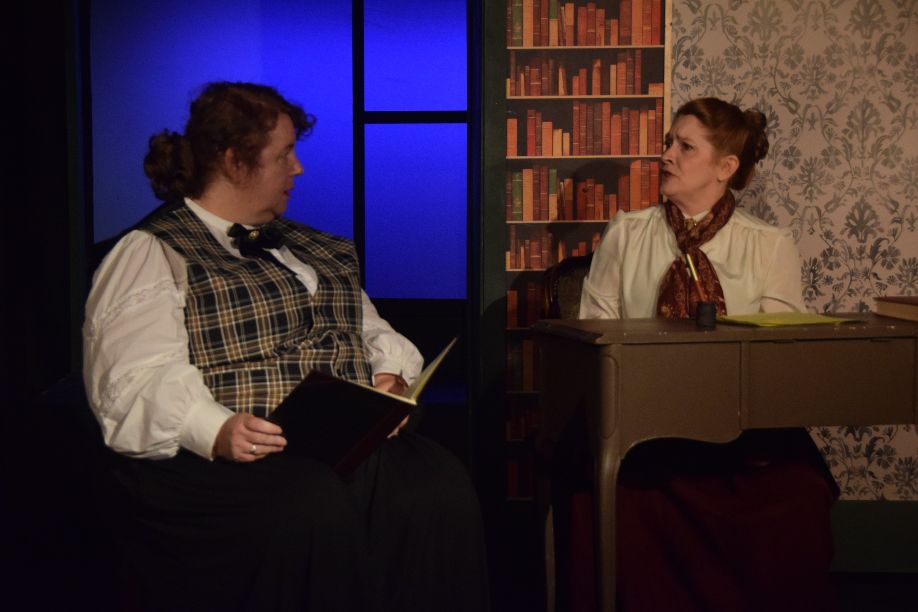
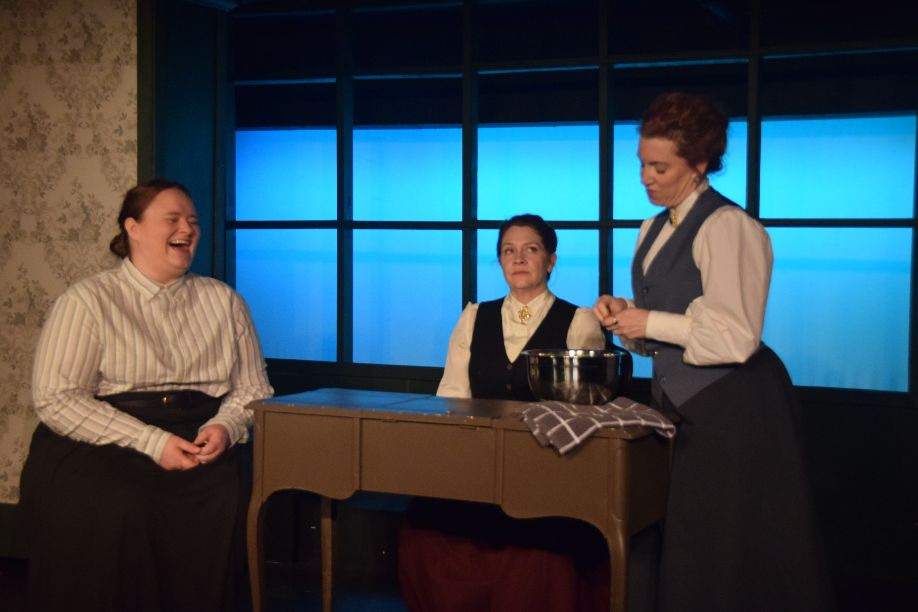
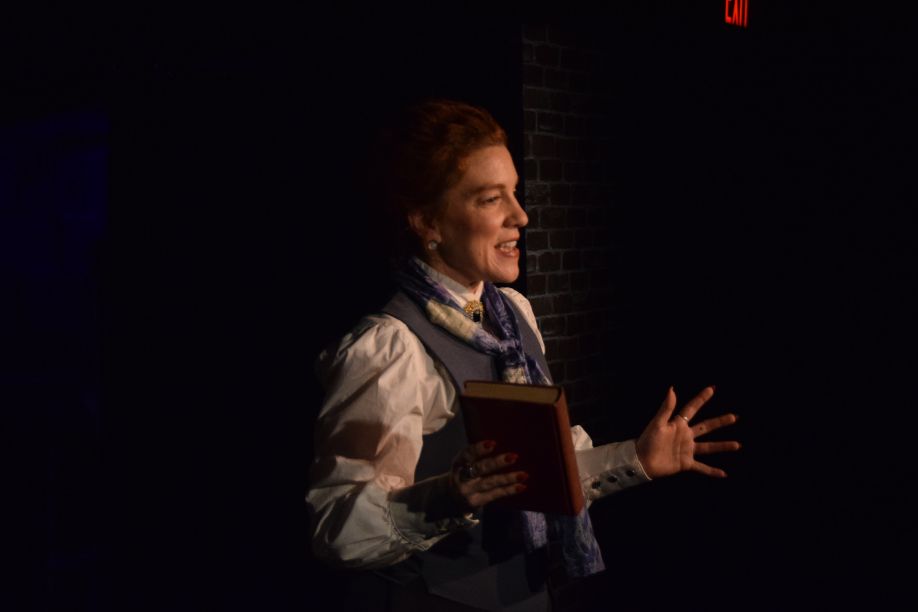
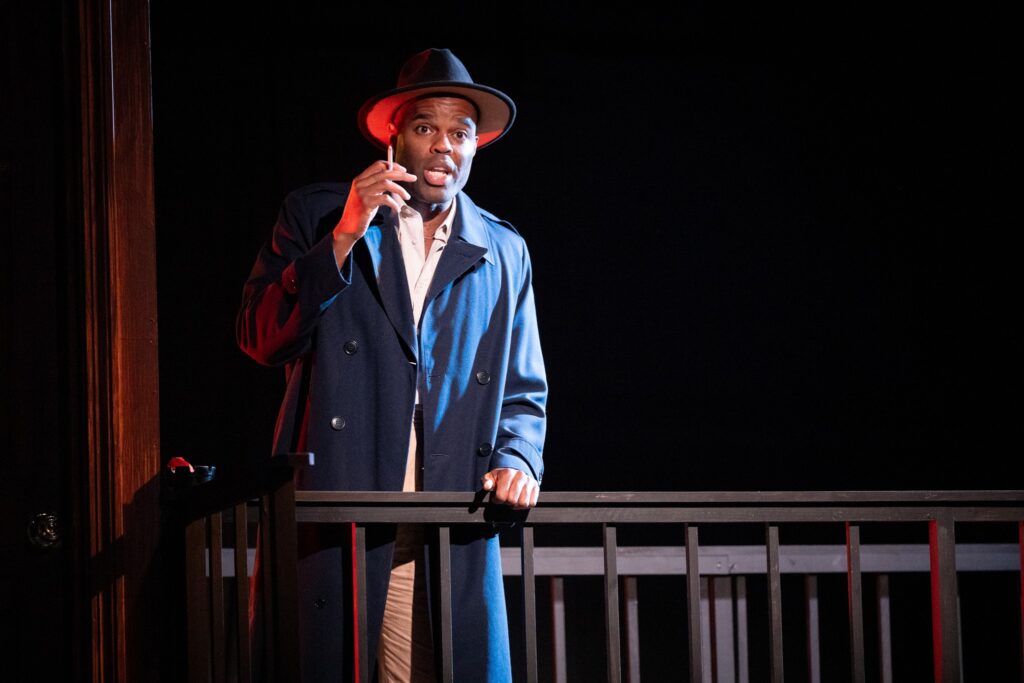
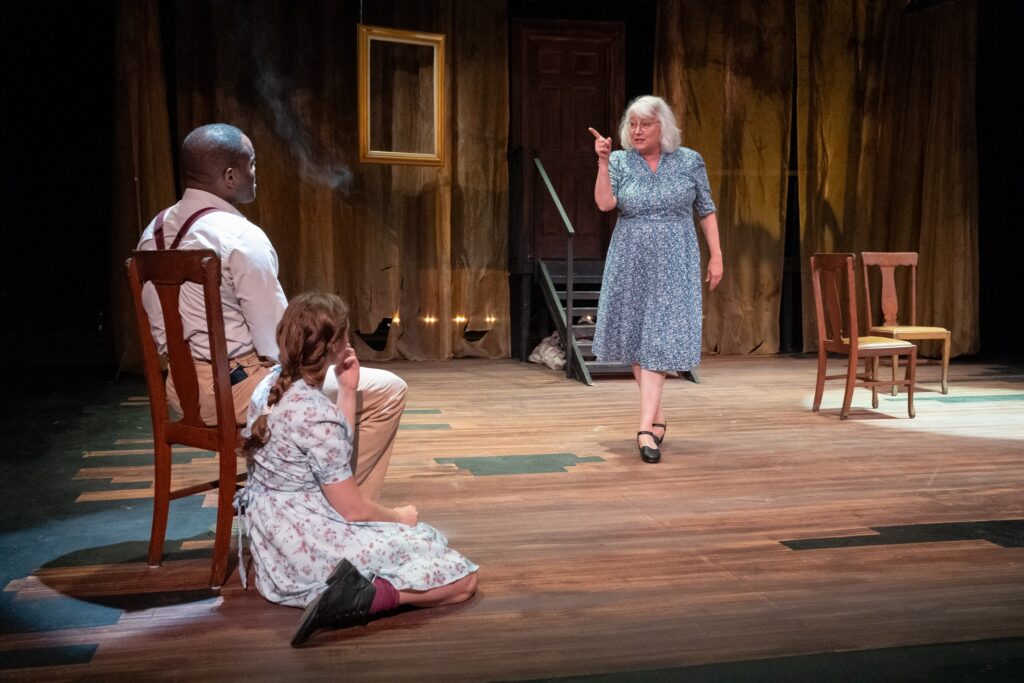
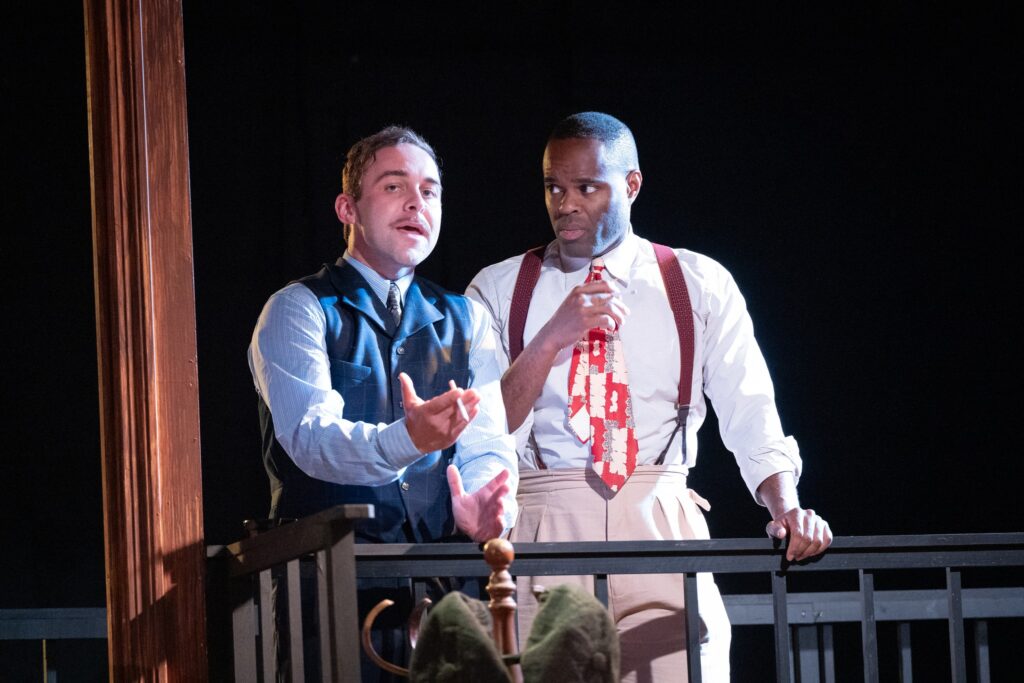
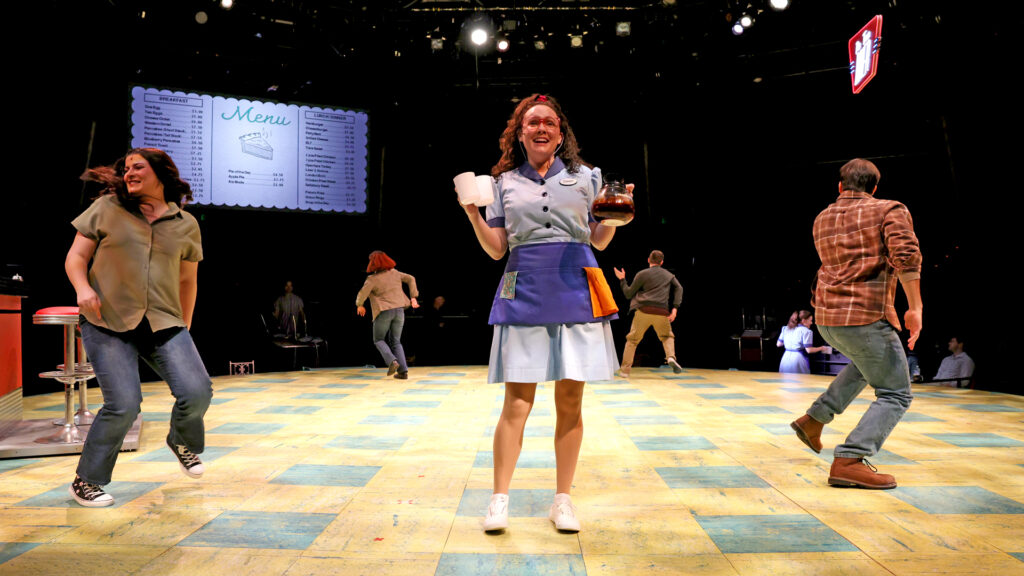
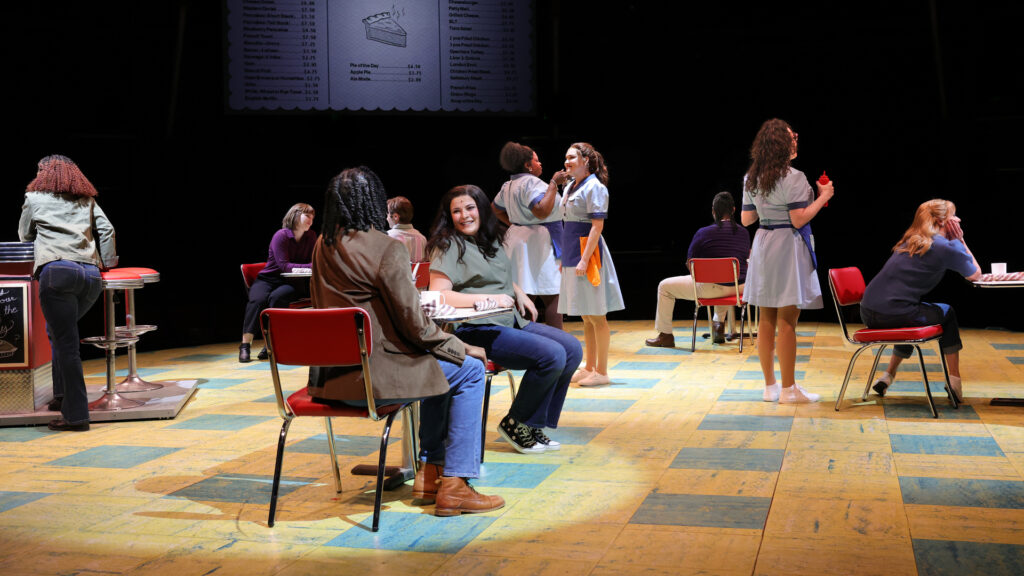
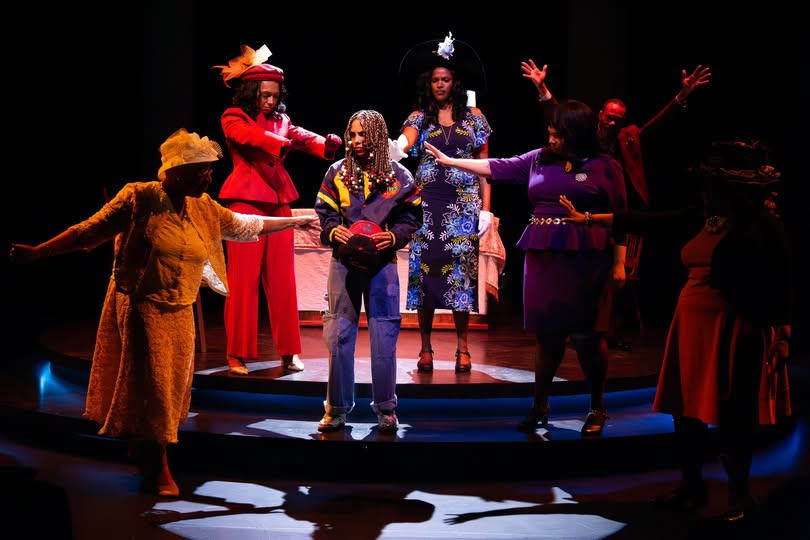
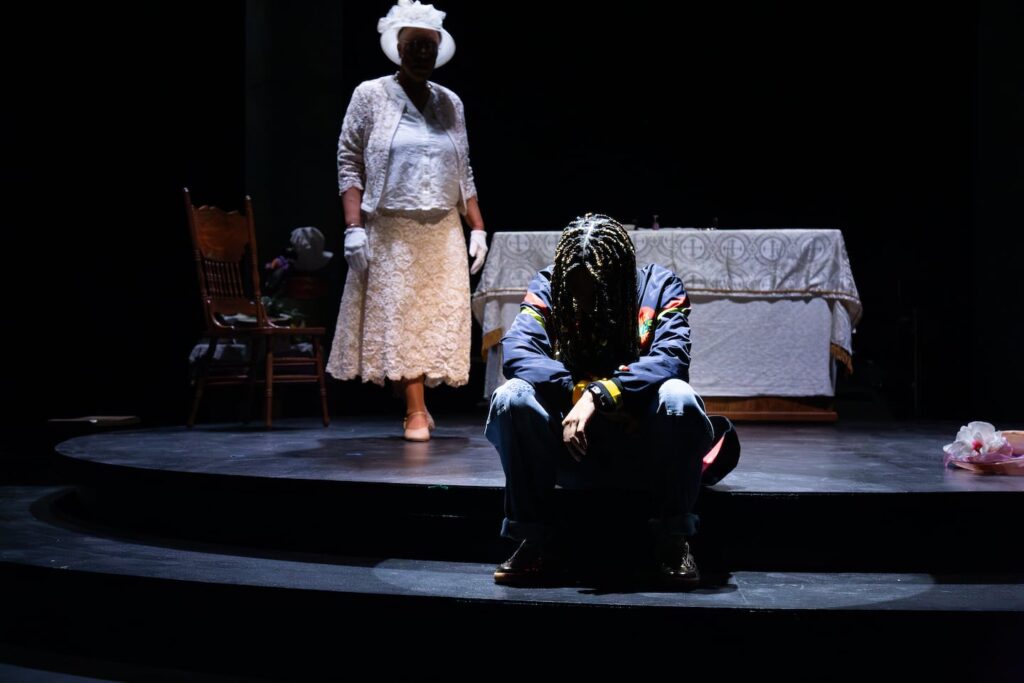
Cast of Moonbox Productions’ “Crowns” at Arrow Street Arts. Photos: Chelcy Garrett

By Shelley A. Sackett

In Crowns, playwright Regina Taylor’s paean to the Black women who held their families, churches and communities together, gospel music, fanciful hats and swanky dresses take center stage. For 90 intermission-less minutes, this jukebox musical rocks the intimate Arrow St. Arts with two dozen songs and a narrative that traces the history of Blacks in America, from slavery to the Jim Crow south to the Civil Rights movement to present-day Black-on-Black violence in Brooklyn’s tougher neighborhoods.

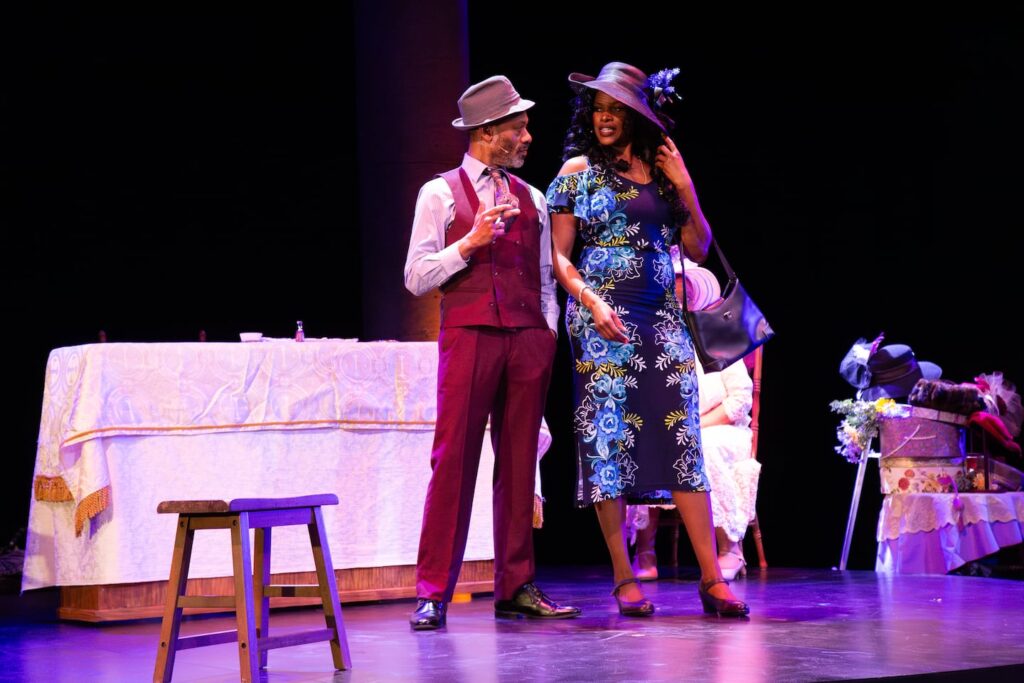
These eras of Black history are not strung together by the play’s thin plot, but rather by the hats that Blacks have consistently worn, from African traditional headdresses to the most elaborate Church Lady hats to spangled, messaged baseball caps. Hats are connective tissue, and the collective spirit of the women who wear them has kept them all afloat. “Hats are a very African thing to do,” Mother Shaw (Mildred E. Walker), a congregant and our titular guide, announces. “All God’s children got a crown.”

They all also gotta have music, and the members of the cast (with keyboards by David Freeman Coleman and drums by Brandon Mayes) belt out song after song with such power and flair that it feels more like the gospel tent at New Orleans Jazz Fest than a midsize theater in Cambridge.

The performance begins with drumbeats and an African chant, “Eshe O Baba,” a Yoruba praise song that is considered worshipful. (Surtitles are helpful for identifying the speaker and providing a transcription of the lyrics, especially where so much of the dialogue occurs in song.) The cast sashays down the aisles as if they are models on a runway, dressed to kill in sequins, stiletto heels and, of course, hats. They pause and pose, reveling in the oohs and aahs. All the while, they sing a gospel song that has the audience smiling, clapping and dancing in their seats.

Cortlandt Barrett

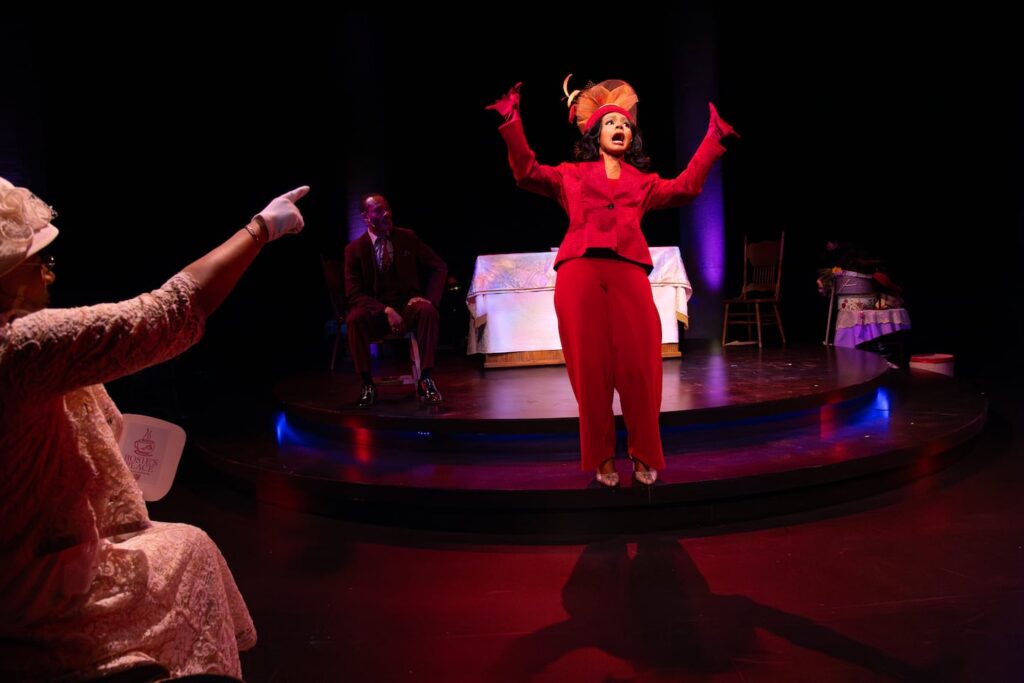
Baron E. Pugh’s simple set literally sets the stage as a church pulpit. Four pillars and two spot-lighted sculptural stands of hats flank a draped pulpit. The audience sits in a semicircle, invoking pews. There is even a Hymnal on the audience seats, with the words to many of the songs.

The storyline’s focus is on Yolanda (Mirrorajah, sadly miscast), Mother Shaw’s granddaughter, who was sent by her mother from Brooklyn to the south to live with her after her brother was shot to death. She is a complete stranger in a strange land, her hat of choice a baseball cap, her braided hair studded with bright beads. She hardly presents as potential “church lady” material.

Mother Shaw brings Yolanda up to speed as the cast sits as if in church, with their backs to us. She explains that during slavery, laws prohibited slaves from gathering except to attend church. After slavery ended, church was still THE place where Blacks could see and be seen. If you owned anything you wanted to be noticed — especially ladies’ hats — church was where you wore it. Gospel music and hats both have special powers, but hats also come with a list of do’s and don’ts.

As the houselights rise and lower, each woman comes forward to tell her story. Mother Shaw describes how her hat collection was the catalyst that empowered her to confront her husband when he tried to prevent her from buying more. She informed him that not only were her hats her property, but so was the money she earned and half the house. Mabel (Cortlandt Barrett) explains that there is a certain way to hug a woman in a hat. There are also “Hat Queen Rules” which must never be broken. Hats are passed on as family heirlooms and legacies, and a daughter has her mother buried in her favorite hat (“Lord, when I’ve done the best I can, I want my crown,” sings Velma (Lovely Hoffman)). Jeanette (Janelle Grace) and Wanda (Cheryl D. Singleton) round out the women; the character named Man (Kaedon Gray) plays all the male parts, minor supporting foils to the women.

Kaedon Gray and Janelle Grace

The only time the women ever removed their hats, we learn, was during a protest march, but they were firmly reaffixed by that Sunday.

Eventually, Yolanda “gets” what the women are trying to teach her, and she embraces them and the church, but the snippets of her journey are really just a means to transition from song to song. In “That’s All Right,” the full ensemble raises the roof, dancing in a circle on the stage. The mixture of gospel, jazz, blues and traditional songs is a fabulous, curated playlist.

Barrett, as Velma, is a real knockout, and not just because of her flaming red dress and matching hat. She has a prodigious set of pipes and both poise and attitude. It’s hard to believe that she is only a sophomore at the Boston Conservatory. Hoffman, as Velma, soars in “His Eye Is On the Sparrow” and Walker, as Mother Shaw, is terrific, her strong voice both grounding and uplifting.

Although each actor has a chance to solo, the strength of the production is as an ensemble piece. Director Regine Vital has managed to delineate distinct individuals (E Rosser’s magnificent costumes help) while also creating a blended cast that seamlessly supports and complements each other.

Mildred E. Walker and Mirrorajah

Clearly, you don’t attend Crowns for its narrative arc. But if you enjoy extraordinary inspirational music, snapshots of everyday lives lived by everyday people and, of course amazing hats, then Crowns is right up your alley. It is also one helluva raucous good time!

Moonbox Productions presents ‘Crowns’ by Regina Taylor, adapted from the book by Michael Cunningham and Craig Mayberry. Regine Vital, Director. David Coleman, Musical Director. Davron Monroe, Associate Director. Kurt Douglas, Choreographer. Isaak Olson, Lighting Designer. Baron E. Pugh, Scenic Designer. James Cannon, Sound Designer. Danielle Ibrahim, Props Designer. E Rosser, Costume Designer. Schanaya Barrows, Wig Designer. At Arrow Street Arts, 2 Arrow Street, Cambridge, through May 4, 2025.

For more information, visit https://www.arrowstarts.org/

A.R.T.’s ‘Night Side Songs’ Is Magical, Boundary-Breaking Theater

Jonathan Raviv and Brooke Ishibashi in A.R.T.’s ‘Night Side Songs’. Photo: Nile Scott Studios

By Shelley A. Sackett

Night Side Songs, the remarkable production by A.R.T. now at Hibernian Hall, bills itself as “communal music-theater experience performed for—and with—an intimate audience that gives voice to doctors, patients, researchers, and caregivers to celebrate the resilience of the human spirit.” This description barely scratches the surface of the uncharted grounds this play explores, and the transfixing heights it reaches.

A musical that explores the intimacy of illness and death through the universal power of song sounds neither uplifting nor entertaining, yet owing to the Lazours’ insightful script and the ensemble of five outstanding talents, that is exactly what Night Side Songs’ 100 minutes is. Knitting a cozy throw from the experiences and voices of doctors, patients and caregivers, the Lazours have somehow managed to address the awfulness of cancer through the kaleidoscope of a dramatic immersion.

Jordan Dobson

The show opens with the charismatic and talented Mary Testa quoting Susan Sontag, who died of complications of acute myelogenous leukemia at 71. “Illness is the night side of life, a more onerous citizenship. Everyone who is born holds dual citizenship, in the kingdom of the well and in the kingdom of the sick. Although we all prefer to use the good passport, sooner or later each of us is obliged, at least for a spell, to identify ourselves as citizens of that other place.”

She and the rest of the ensemble proceed to escort us on several such journeys by means of 21 songs and the 11-part story of Yasmine’s (a sensitive yet sturdy Brooke Ishibashi) confrontation with breast cancer. With unflinching clarity, the Lazours spare no detail as Yasmine finds a lump, receives her diagnosis, goes through treatment, remission, relapse, and chemotherapy with lethal side effects while dealing with bills and her high-maintenance mother, Desiree (Testa). We are strapped in beside her on the roller coaster ride of good and bad days and share in her joy at reconnecting with, and marrying, Frank (Jonathan Raviv) and the eight years of remission they enjoy before the other shoe drops.

If this sounds heavy, that’s because it is. If it sounds depressing, it is not because the Lazour brothers have spun a story of compassion, caring and intimacy out of shards of misery, pain and grief. Their insightful lyrics, the first-rate cast and the warmth of Hibernian Hall’s small performance space create a powerful sense of community and healing.

The audience is invited to sing along at designated spots (lyrics provided), and the repeated lines are particularly poignant and resonant. “Sometimes you don’t know; sometimes you just know. Either way, you gotta keep it together,” Yasmine sings after discovering a lump but before receiving a diagnosis from her doctor (a superb Robi Hager), with whom she coincidentally shared an 8th-grade clandestine kiss.

Mary Testa

Despite her illness, Yasmine soldiers on through the dysfunctional relationship between Frank and her mother and her mother’s quick, surprising death. By the time her end is inevitable, we too are ready to let go. This transition, while sad, is a loving and very natural segue, the beginning of an uncharted crossing away from dark and into light. While the play has focused on the journey, it is the destination that now commands center stage.

Along the way, the Lazours tackle other meaty issues that accompany illness, caregiving and the often callous state of healthcare in the US. In a segment that takes place in a medieval pub, its feisty owner (Testa) deals with a tumor that is treated with leeches, excision and derision. She searches for an underlying cause and remedy, alternately looking for a miracle from God and a reason that justifies her illness. In her search, she encounters guilt-tripping clergy and a vacuum where compassion and pity should dwell. She also discovers the power of song, showcased in “The Reason,” an upbeat, funny number with fabulous harmonies and a show-stealing vamping by Hager.

Ishibashi

The brothers also shine a light on the caregiver and their pain and need for treatment, albeit of a nonmedical nature. When the side effects from Yasmine’s chemo treatment reverse her remission, catapulting her into a terminal relapse, Frank travels almost daily from Maine to Mass General to be by her side. “I won’t know what to say, but I will check in on you every day,” he sings to her. Yasmine, too, needs reassurance that Frank can handle the relief she comes to crave. ”Will you let me know I can let you go? Can you softly say you will be ok?” she asks.

The cast, rounded out by Jordan Dobson and his calm presence and musical chops, is uniformly terrific. If you get a chance to catch the last performances of this transfixing show, take it!

‘Night Side Songs.’ Words and Music by the Daniel and Patrick Lazour. Directed by Taibi Magar. Scenic Design by Matt Saunders; Costume Design by Jason A. Goodwin; Lighting Design by Amith Chandrashaker; Sound Design by Justin Stasiw. Music Direction and Piano Arrangements by Alex Bechtel. Presented by American Repertory Theater in association with Philadelphia Theatre Company at Hibernian Hall, 184 Dudley St., Boston through April 20.
For more information, visit https://americanrepertorytheater.org/shows-events/

ASP’s Rowdy ‘A Midsummer Night’s Dream’ Flips the Bard’s Gem on its Breakdancing Head

Cast of Actors’ Shakespeare Project’s “A Midsummer Night’s Dream.”Photos: Nile Scott Studios

By Shelley A. Sackett

A Midsummer Night’s Dream is one of those plays that is firmly etched in most people’s long-term memory banks, whether as a first introduction to Shakespeare in high school or as one of scores of film and theatrical productions. There are countless riffs on the play, from the sci-fi A Midsummer Night’s Gene to recently produced The Donkey Dream. Even The Beatles got in on the act in their 1964 TV special, “Around the Beatles,” when they played the “Pyramus and Thisbe” section of the play to an audience of hecklers and moonstruck fans, especially appropriate for this comedy play within a play. (https://www.youtube.com/watch?v=SvREt_w_KOE )

So, director Maurice Emmanuel Parent set a lofty goal for himself when he decided to create a version that could stand out as uniquely his. Happily, he not only succeeds but raises the bar for the next director that proposes to make their mark on this well-represented classic. He brilliantly manages to leave his 21st-century fingerprints on an age-old classic while allowing room for the beauty of the original late 16th-century language to radiate.

Parent creates a mash-up universe where fairies inhabit “a space of freedom, fun, sex, danger, mystery, and transformation,” as he describes in his director’s notes. He envisions theirs as a world of clubs like the ones he frequented in New York in his late teens and early 20s. Think The Roxy, Palladium, and Tunnel, he suggests. “These were joyful, queer-positive spaces that offered refuge for many of us. But they were also dangerous.”

His fairy world is not full of sugar plums and pixie dust; it is a disco inferno on steroids, where glitter, leather, gyrating hips and lascivious tongues rule.

Humans inhabit a more “normal” place, but the simplest set and props (scenic design by Ben Lieberson, props by Christina Ostner), creative lighting (Brian Lilienthal), and 21st-century costumes (Seth Bodie) ensure it is not mundane. Kudos, too, to sound designer Mackenzie Adamick for crisp clarity and the actors for their enunciation; it’s always a pleasure not to have to strain to hear and/or understand what’s being said.

The beloved main plot revolves around three subplots: the romantic entanglement of four Athenian lovers, the conflict between the fairy king and queen, and a group of amateur actors preparing a play. These storylines intertwine, leading to humorous misunderstandings and ultimately a happy resolution of reconciliation and, for the humans, marriage.

The lovers’ romances are complicated but amusing. Hermia (the lively Thomika Marie Bridwell), in love with Lysander (Michael Broadhurst), is forced by her father, Egeus (the standout Bobbie Steinbach), to marry Demetrius (De’lon Grant, always a pleasure to watch). Helena (a show-stealing Deb Martin) is in love with Demetrius, who is in love with Hermia.

Hermia and Lysander decide to run away to the woods to elope, but are followed by Demetrius and Helena.

Meanwhile, all is not well in the parallel but very different world of the fairies. King Oberon (Dan Garcia, channeling Rocky Horror Picture Show’s Frank-N-Furter) and Titania (an elegantly lithe Eliza Fichter), his queen, are at odds over the fate of a changeling boy. Oberon, seeking a tit-for-tat revenge on Titania, gets the tricksy sprite, Puck (Alan Kuang, both carnal and ethereal), to use a love potion to make her fall in love with the first living thing she sees after waking. For sport, he also instructs Puck to use the same potion on the humans to manipulate their affections.

Adding spice to the mix is a group of Athenian artisans, or “mechanicals,” who are rehearsing the play “Pyramus and Thisbe,” which they hope will be picked as the entertainment for Duke Theseus (Kody Grasset) and Hippolyta’s (Fichter) wedding. Under the direction of Quince (Steinbach), the carpenter, the members of the troupe are: Snug, the joiner (Rémani Lizana); Bottom, the weaver (a superb Doug Lockwood); Flute, the bellows-mender (Evan Taylor); and Starveling, the tailor (Grassett). Their rehearsals and attempts to perform the play are filled with comical mishaps and confusion.

The three plot vectors collide when Puck disrupts them all with his peevish mischief. He transforms Bottom’s head to that of a donkey and makes sure he is the first thing Titania sees upon awakening. He finds the four lovers asleep in the woods and applies the potion to Lysander and Demetrius, who both fall madly in love with Hermia.

Eventually, the potion is undone, and the lovers, with the help of Oberon, realize their true affections, and he and Titania are reconciled. “Pyramus and Thisbe,” to the audience’s delight, wins the contest to be the entertainment at the Duke and Hippolyta’s wedding, and all ends in merriment and mirth, both in the human and fairy worlds.

De’Lon Grant and Deb Martin

While the production is a hands-down blast full of singular moments and overall skillful acting, there are some outstanding performances that have to be spotlighted and applauded. As Helena, Martin brings the force of a hurricane and the delicacy of a ballerina. Her hand gestures alone are worth the price of admission. As Bottom, the conceited and clownish actor who milks every second of Titania’s infatuation, Lockwood mugs without exaggerating and commands the stage without seeming to. Steinbach is always a treat and this show is no exception. Last, but hardly least, is Kuang, who doesn’t just play Puck, but is Puck, albeit as a reimagined break-dancer, all wisecracks and tattoos. His spirit — and energy! — are palpable.

Parent sprinkles in a bunch of fleeting backhanded references (The Lion King, the Beatles’ “Blackbird,” and Lynda Carter’s Wonder Woman outfit) that are a hoot. His pacing, not rushing the Bard’s words, allows ample time for their meaning to percolate. This is, after all, one of Shakespeare’s funniest and cleverest plays, and even if you’ve seen it multiple times already — especially if you’ve seen it multiple times already — be sure not to miss this crackerjack version.

A Midsummer Night’s Dream.’ Written by William Shakespeare. Directed by Maurice Emmanuel Parent. Presented by Actors’ Shakespeare Project at Mosesian Center for the Arts, 321 Arsenal St., Watertown through May 4.

For more information, visit https://www.actorsshakespeareproject.org/plays-events/midsummer-2025/

BLO’s ‘Carousel’ Is More Miss Than Hit

Cast of Boston Lyric Opera’s ‘Carousel’. Photo by Nile Scott Studios.

By Shelley A. Sackett

Boston Lyric Opera’s production of Carousel is being touted on many levels. It is a return of Rogers and Hammerstein’s second musical (written just two years after the smash hit Oklahoma) on the same stage where it débuted in 1945 with John Raitt (Bonnie Raitt’s late father) as the lead, Billy Bigelow. Director Anne Bogart’s program notes stress the tension inherent in staging a show with such strong nostalgic ties to tradition for a contemporary audience. She checks the reverence box by not changing a syllable of the original script or lyrics. The notes refer to checking the innovation box by envisioning the players-within-the-play as “a group of refugees who arrive from a great distance to perform the play, seeking to gain access and acceptance,” but, at least for this viewer, that intention yielded only confusion.

The play tackles a lot of heady, heavy issues, many still timely enough to have relevance without the staging gimmickry of neon wigs, tattoos and clownish costumes. Domestic abuse, violence, darkness, shame —these are unfortunately as germane today as they were 80 years ago.

The production opens with house lights up on Sara Brown’s spare, almost sinister stage as the full orchestra (under Conductor David Angus) plays the songless “Prologue (The Carousel Waltz”). An enormous cast files across the winding bridge of an abandoned roller coaster, like animals descending off Noah’s ark. They traverse the stage, gathering in front of prison-like gates and stare up at the audience.

Edward Nelson as Billy and Brandie Sutton as Julie

As the gates open and the house lights dim, a circus act takes center stage with actors holding poles meant to represent the poles of a carousel. Costume designer Haydee Zelideth’s whimsical outfits of feather-head-dressed pink ponies and even a tiger hold promise of a transporting theatrical event. It is 1873, we learn, and the bustling carnival has arrived at a staid village on the New England coast.

Billy Bigelow (Edward Nelson), the barker, bursts onto the stage clad in leather vest and huge white cowboy hat. All muscle with an animal charisma, he is the ultimate bad boy babe magnet. He meets — and flirts with — Julie Jordan (Brandie Sutton) and her friend, Carrie Pipperidge (Anya Matanovič). Mrs. Mullin (Sarah Meltzel), the carnival’s widowed owner, shows up and witnesses Billy and Julie. She clearly loves Billy, and when he refuses to throw Julie and Carrie off the grounds, she fires him.

Billy, now unemployed and distraught, needs a beer. He also needs a woman’s attention, and Julie is game, even though staying out past curfew will result in her getting fired, too. Their snake-bit romance leads to marriage, a daughter and a tragic end. It also yields some of the show’s best-known songs (“If I Loved You” and “You’ll Never Walk Alone”).

Nelson as Billy (center)

Meanwhile, Carrie confides to Julie that she too has a beau, Enoch Snow (Omar Nahun), a straight-as-an-arrow fisherman.

Billy, increasingly frustrated by not being able to find work, resorts to his ways of carousing all night with his criminal buddy, Jigger. He even hits Julie, earning him the reputation as a wife beater. When Julie announces she’s pregnant, Billy becomes relatively introspective (for him), looking at fatherhood as a chance to wipe the slate clean and focus on the future and his legacy. He vows to take care of his child and provide everything he lacked, especially money. He falls prey to abetting Jigger’s sly plan that, of course, fails. It’s no spoiler to divulge that Billy dies, and a good deal of Act II is spent with Billy in the afterlife, struggling to make sense of, and amends for, his life on Earth.

There are many bright spots in the production, especially Matanovič, whose gorgeous soprano singing and sparkling performance imbue Carrie with light and life. As Enoch Snow, her betrothed, Nahun brings similar energy and the two are a delight to watch. The vocals of most of the actors are sublimely operatic, befitting Carousel’s presentation as “opera theater” (vs traditional musical theater). Finally, Abigail Marie Curran as Louise, Julie and Billy’s daughter, is a whirlwind of fresh air. Her dreamy dance in Act II and pitch perfect combination of innocence and insolence bring the character to life and make one wish she had had more time on stage.

While there is a lot of visual flash and flourish in the production (and the orchestra does a great job), for those without a nostalgic hook to the show (and maybe even for those who grew up singing the songs around the family table), this production misses the mark on many levels. First is the lack of chemistry between Billy and Julie, despite the actors’ vocal ranges and skills. Sutton brings a softness and accessibility to Julie, but Nelson’s Billy is remote and static. It’s hard to believe in their romance, making it even harder to care when things go awry. Then, there are distracting missed lines and glaring miscasting of Theophile Victoria as mill owner and uptight Victorian prig, David Bascombe, and Lee Pelton as Starkeeper. Finally, the pacing elongates several scenes which could be glossed over and glosses over others that shouldn’t.

Anya Matanovič and Sutton

Whether you enjoy Bogart’s Carousel may depend heavily on the connection you already have with the show. By the end, my companion, who grew up listening to the LP, was teary, verklempt with emotion and nostalgia. After three hours (one intermission), I was just relieved it was over. Equity, Diversity & Inclusion Consultant, Kira Troilo, sums it up best in her program notes. “Can Carousel work now? The answer won’t be the same for everyone, and that’s exactly the point,” she writes.

Rodgers and Hammerstein’s ‘Carousel,’ 80th Anniversary Production. Music by Richard Rodgers. Book and Lyrics by Oscar Hammerstein II. Conducted by David Angus. Directed by Anne Bogart. Presented by Boston Lyric Opera, Emerson Colonial Theatre, 106 Boylston Street, Boston. Run has ended

Broadway in Boston’s ‘Shucked’ Is Just What the Doctor Ordered – A Funny, Punny and Talent-Packed Musical

Cast of Broadway in Boston’s ‘Shucked’ at Citizens Opera House
Photos by Matthew Murphy and Evan Zimmerman

By Shelley A. Sackett

If ever we were collectively in need of some levity, it’s now. Between the political roller coaster, serious Boston theater topics and frigid spring temperatures, we could all use a light, fun break. As if reading the tea leaves, Broadway in Boston has come to our rescue with its lighthearted, raucous production, Shucked.

A Tony Award-winning musical comedy, the play is based on a book by Tony Award winner Robert Horn (“Tootsie”), with a score by the Grammy Award-winning Nashville songwriting team of Brandy Clark and Shane McAnally (Kacey Musgraves’ “Follow Your Arrow”), and direction by Tony Award winner Jack O’Brien (“Hairspray”). A talent-packed cast (including two original Broadway members) is icing on the cake.

Mention must be made about the clear-as-a-bell sound system and actors’ enunciation. I cannot remember the last time I wasn’t straining to hear and/or understand what was being said on stage, and attending ‘Shucked’ reminded me of what is possible and what I’ve been missing.

The plot is simple and functions primarily as a vehicle for the creative team to flex their considerable muscle and concoct two and a half hours (one intermission) of lowbrow entertainment consisting of nonstop corny but hilarious one-liners and playlist-worthy songs.

The setting is fictional Cob County, a southern enclave isolated from the outside world and inhabited by cheerful inbred families who have been each other’s best friends and drinking buddies for generations. The town is cut off from the rest of the world by rows of corn stalks, which provide identity, livelihood, and moonshine. One day, the corn goes flaccid, and the town melts down along with it.

Jake Odmark and Danielle Wade

The crisis hits the central romantic couple, Beau (Jake Odmark) and Maizy (Danielle Wade), hardest. Their wedding is postponed, and Maizy, braver than Beau, ventures to the megapolis of Tampa to seek help.

There, she meets Gordy (Quinn VanAntwep), a podiatrist who advertises as a “corn doctor.” Gordy is a handsome grifter who is in hock up to his eyeballs with the mob. He smells a sucker ripe for the picking when Maizy shows him a bracelet her grandfather made from rocks beneath her house that resemble precious gems. Gordy has them assessed, determines they are his key to freedom, and follows Maizy home.

He convinces all the locals he is the answer to their troubles; all, that is, except Beau, whose lifelong romance with Maizy is interrupted by Gordy’s hold over her, and Lulu (the amazing Miki Abraham), Maizy’s cousin and local booze distiller, who smells a rat. Nonetheless, Lulu ends up falling for Gordy, Maizy re-falls for Beau, and still the corn stalks droop.

Eventually, romantic snags untangle, the corn is saved, and all’s well in Cob County once again. As I said, you don’t go to ‘Shucked’ for the storyline.

Quinn VanAntwerp and Miki Abraham

What you DO go for, however, are outstanding performances, quirky secondary characters, and an uninterrupted barrage of the corniest, belly-laugh-out-loud one-liners and terrific song and dance numbers. Remember the guiltless pleasures of “Laugh In,” “Hee Haw,” “Green Acres,” “Gomer Pyle” and “The Andy Griffith Show,” and you get the picture.

Horn does come up with some clever dramatic maneuvers, and his most effective is the use of narrators, Storyteller #1 (Maya Lagerstam) and Storyteller #2 (Tyler Joseph Ellis), who guide us through the “farm to fable” tale. They provide the play’s only surprise in a sweet and unexpected twist at the very end.

The real stars of the show, however, (across the board magnificent performances notwithstanding) are the groan-worthy but ingeniously smart jokes. Horn’s puns are raunchy, dopey, and Borsht-belt worthy. The opening number, “Corn,” praises its subject with the description, “It’s the same going in as coming out.” Peanut (Mike Nappi), Beau’s half-wit brother who compulsively fires off random one-liners, channels a dumbed-down stand-up comedian.

Examples of the rapid fire barrage are: “Remember when we used to make sandcastles with Grandma until Dad took the urn away?” “Politicians and diapers should be changed regularly for the same reason.” “If life were fair, mosquitos would suck fat instead of blood.” And, “It’s like not realizing how many people you hate until you try to name a baby.” Hackneyed? Maybe. Funny? Definitely.

In addition to the uplifting script are the fabulous song and dance numbers. Abraham (Lulu), Wade (Maizy), Lagerstam (Storyteller #1), Odmark (Beau), and VanAntwerp (Gordy) have amazing sets of pipes, and the harmonies (especially in the duets) are swoon-worthy. Abraham’s “Independently Owned” brought down the house while “I Do” is worthy of release as a single.

At this time of heavy headlines and trauma-laden theater, it’s a treat and welcome reset to indulge in an angst-free Vaudevillian spoof. We all deserve a night of tasty, tantalizing empty calories.

‘Shucked.’ Book by Robert Horn. Music and Lyrics by Brandy Clark and Shane McAnally. Directed by Jack O’Brien; Choreographed by Sarah O’Gleby; Music Supervision by Jason Howland. Presented by Broadway in Boston at  Citizens Opera House, 539 Washington St., Boston through April 20.
For more information, go to https://www.citizensoperahouse.com/

In Huntington’s “Don’t Eat the Mangos,” a Matriarchy is Reclaimed When Dark Family Secrets are Revealed

Evelyn Howe, Jessica Pimentel, Yesenia Iglesias in The Huntington’s Don’t Eat the Mangos
Photos by Marc J. Franklin

By Shelley A. Sackett

‘Don’t Eat the Mangos,’ Ricardo Pérez González’s one-act play, has a lot going for it. Set in 2019 in El Comandante, a neighborhood outside San Juan, Puerto Rico, Tanya Orellana’s bright island set plunks the audience smack into a festive, colorful vibe where curtains are doors and a commanding mango tree dominates the yard. We immediately meet three sisters, as different in personality as in looks, yet clearly cut from the same mold.

Of course, they are in the kitchen, where the women curse affectionately, call each other out, and demonstrate the kind of familiarity and genuine love that underlies their shrillest screaming matches.

Ismelda (Jessica Pimentel), the oldest, is all business. The most buttoned-up of the three, she has never married, remaining in the childhood home where she cares for their ailing parents and works as a loan officer. She is stoic and stubborn, bearing her burden but letting her sisters know she could use their help. She takes her role seriously; she actually dusts the plants.

Iglesias, Pimentel, Howe

Yinoelle (Yesenia Iglesias), the middle sister, is the most traditional of the three. Her husband is a successful construction manager who has an opportunity to move to the States. She is stylish, watches her figure and practically vamps with the spoon as she stirs the family dinner.

Wicha (Evelyn Howe) is the youngest, hippest and most passionate. She is a teacher and single mother who embraces causes and barely contains her wild hair. She is clearly comfortable in her own skin and, despite disapproving glares from the other two, plunks herself down at the table and eats cookies straight out of the tin. (That is, until Ismelda replaces the tin with the more proper plate and napkin).

This opening scene is one of the play’s best. González’s script has two goals, and he accomplishes both beautifully — we learn the family’s backstory and witness the sisters’ indelible bonds as they dance their unique sisterly dance.

Pimentel, Susanna Guzmán

They speak of Mami (Susanna Guzman), who has suffered a relapse of cancer, and Papi (José Ramón Rosario), who is paralyzed and requires a machine to constantly pump phlegm. The girls take turns dealing with him when a storm causes a power outage and they have to suction him by hand. It is during their discussions of how to settle up with a narcissistic man who neglected and abused his family that the true family dynamics – and secrets – are revealed.

As is often the case, each sister experienced a different version of what growing up in the same household was like and throughout the play, dyads share confidences with the admonition, “Don’t tell the others.” When Ismelda tells the truth about why the mango tree’s fruit lies uneaten and rotten despite the family’s need for food (no spoilers here!), bigger questions surrounding trauma, shame, blame, oppression and duty explode. Throughout the fabric of this micro private story, González masterfully interweaves threads of macro interest, such as the complicated relationship between Puerto Rico and the US, and whether abandoning one’s native island for the mainland is a cop out or no-brainer. “This place is not our future,” Yinoelle warns, to which Ismelda responds, “I stay so you can go.”

Guzman brings an understated grace and gravitas to Mami, the family’s glue and true north. She has parented with healthy doses of superstition, discipline and common sense. She alone holds the keys to both their pasts and futures, and her final gift is to set them all free.

Orellan’s set channels island life, with three rotating sets that feature a cozy but cramped kitchen, bedroom/hospital and backyard, complete with rusty gate and laundry line. Director David Mendizábal effectively and efficiently makes use of every inch, but it is Jake Rodriguez’s sound design, with lightning, insects and salsa, that fine-tunes the tone.

The acting is terrific, especially all three sisters who create a tight ensemble that provides for spotlighted individuality. Howe, as youngest sister Wicha, is a standout, with her malleable features, punchy delivery and irresistible physicality. One potentially macabre but wonderfully hilarious scene turns on the talent of this splendid actress.

Howe, Pimentel, Iglesias

For all its humor, pathos and big ticket, universal questions, however, ‘Don’t Eat the Mangos’ is not unflawed. González’s inclusion of Spanish in the script establishes place and context quickly and seamlessly, but he goes overboard with whole Spanish tracts at the very beginning of the play. Unless  González’s intention is to make non-Spanish speakers feel deliberately excluded, then he needs to either trim the amount of Spanish or provide English Cliff Notes.

Equally confusing is the use of nicknames for characters the playbill lists by full names, particularly in the first few minutes. When they face away from the audience and are not easily understood, the problem is compounded. Finally, the play sometimes seems to be in the throes of an identity crisis, not sure whether to play a scene as straight drama, slapstick comedy, or some hybrid.

Yet, on balance, ‘Don’t Eat the Mangos’ is entertaining, enlightening and thought-provoking, the trifecta gold standard that makes theater such a meaningful part of our lives. 

‘Don’t Eat the Mangos.’ Written by Ricardo Pérez González. Directed by David Mendizábal. Scenic Design by Tanya Orellana; Costume Design by Zoë Sundra; Lighting Design by Cha See; Sound Design by Jake Rodriguez; Original Music by Jake Rodriguez with Alexandra Buschman-Román and Jason Stamberger. Produced by The Huntington Theatre Company, Calderwood Pavilion, Boston Center for the Arts, 527 Tremont St., Boston, through April 27.

For more information, visit: https://www.huntingtontheatre.org/whats-on/dont-eat-the-mangos/

Harbor Stage Brings the Cult Film ‘My Dinner with André’ to Life

Robin Bloodworth, Jonathan Fielding, and Robert Kropf in Harbor Stage Company’s “My Dinner with Andre.” Photo: Joe Kenehan

By Shelley A. Sackett

A corner booth, fancy fare and tasty conversation — who doesn’t remember the cult frenzy caused by Louis Malle’s 1981 110-minute film that enchanted audiences, defied pigeon-holing and raised the bar on the “art” referred to as conversation?

This unconventional film should have been all but unwatchable. After all, it is simply a cinema verité version of a conversation between playwright Wallace Shawn and André Gregory, a well-known experimental theater director who seems to have dropped off the edge of the planet and whom Shawn has been trying to avoid for years.

For some, the film actually was unwatchable, and it is not to that audience that Harbor Stage’s theatrical version is geared. For those, however, who found the film charmingly quirky, the production at BCA Plaza Black Box Theatre is right up your alley.

Adapted by Jonathan Fielding (who plays – and looks like – Wally Shawn) and Robert Kropf (ditto for André Gregory), the play brings its audience through the celluloid keyhole right into the cozy, ritzy Manhattan restaurant. Evan Farley’s terrific scenic design channels the film’s setting with chandeliers, chic sconces and rich red leather upholstery. Four gilt-framed mirrors line the walls above the booth, a stroke of brilliance that allows the audience to witness the characters’ actions and reactions from multiple angles and perspectives.

Breaking the fourth wall from the get-go as narrator and soul bearer, Wally lets the audience eavesdrop on his internal monologue Woody Allen-style. “Asking questions always relaxes me,” he confides, setting the tone for the questions about life, death and everything in between that will occupy the next 90 intermission-less minutes.

The two meet at the restaurant and it is immediately clear that Wally is a fish out of water with the swanky menu (which, in an aside, he confesses he can’t translate) and even swankier server (a Lurch-like Robin Bloodworth). André is comfortably in his element and, with infinitesimal prodding, launches into an epic monologue that is as shocking in its length as in the fact that it is neither boring nor obnoxious, despite André’s obsessive fascination with all things André.

He tells Wally that he strives to lead his life as improvisational theater, and his journeys through the Sahara desert to Tibet to the forests of Poland are surreal and capture Wally’s attention. (In truth, Wally may be less captivated than relieved to be cast as the silent listener). Nonetheless, André’s insistence on waking himself to the true meaning of life and hurtling through the emotional cosmos contrasts perfectly with Wally’s grounded, simpler take on what it means to be a human being.

For André, a complacent life is a squandered life. Wally, on the other hand, not only sees nothing wrong with comfort but actively seeks it out. He’s just trying to survive, he admits, and unapologetically takes pleasure in such simple matters as errands, responsibilities, and Charlton Heston’s autobiography. He can’t understand why André is so wrapped up in figuring out what makes a hypothetical life worth living that he is unable to enjoy the details of his own life. Exasperated, Wally blurts out, “I don’t know what you’re talking about,” the truest words he’s uttered all evening.

When the two discuss theater and the responsibility of its creator to its consumer, things get more interesting and realer because Wally (finally) speaks up and disagrees with André. André insists that theater needs to show the audience a version of the world that is different from their reality, to take them to an extreme place that will shake and shock them into consciousness.

Wally believes that theater should connect people with reality and be enjoyable. People go to theater to be entertained and to relax, not to be confronted by existential crises. He is more perplexed by the challenge of eating quail (“God, I didn’t know they were so small”) than the quest for the answer to the meaning of life.

Even if all this verbosity, pompousness and navel-gazing turns you off, you might still consider seeing ‘My Dinner with André’ just to bask in the performances. Kropf is phenomenal as André, his cadence and gestures imbuing pages of monologue with simplicity and purposefulness. The tiniest flicker of an eye or tonal shift softens his character and exposes an interiority that prevents André from devolving into a shallow, two-dimensional showoff.

Fielding is the perfect foil. His Wally is a little nervous, a little frumpy and satisfied enough – for now. His facial reactions to André’s stories say more than pages of dialogue might; his slight self-conscious discomfort renders him all the more endearing. If the ordinary rules of life don’t seem to apply to André, Wally is only too happy to take up the slack, following the path of least resistance and most relief.

‘My Dinner With André’ – Based on the film by Wallace Shawn and André Gregory. Developed by Johnathan Fielding and Robert Kropf. Production Stage Management by D’Arcy Dersham. Scenic Design by Evan Farley. Lighting Design by John Malinowski. Produced by Harbor Stage Company, ‘My Dinner With André’ runs at BCA Plaza Black Box Theatre at 539 Tremont Street, Boston. Run has ended

For more information visit: https://www.harborstage.org/

In The Huntington’s ‘The Triumph of Love,’ All’s Fair in the War Between Reason and Romance

Marianna Bassham, Nael Nacer in Huntington’s ‘The Triumph of Love’. Photos by Liza Voll

By Shelley A. Sackett

Pierre Carlet de Marivaux’s “The Triumph of Love,” which premiered in 1732 and is at The Huntington through April 6, is like a trifle dessert, with light spongey layers of raucously funny deceptions, disguises and mistaken identities soaked in a sherry-spiked pastoral period set design. Instead of the traditional alternating tiers of sweet jams and custard, however, Marivaux has substituted a bitter concoction of calculated cruelty and manipulation. The end result is a sugar-coated confection that leaves a very bitter taste in the mouth.

Stephen Wadsworth’s definitive and sparkling translation is chock-full of clever double entendres and contemporary plays on words that prevent Marivaux’s commedia dell’arte from getting stuck in 18th-century French linguistic mud.

A hectic first scene gives the lay of the land. We meet two women, loosely disguised as men, in the country retreat setting of a manicured garden. Princess Léonide (an excellent Allison Altman) and her maid, Corine (Avanthika Srinivassan), quickly bring the audience up to speed on who they are, why they are there, and what they plan to accomplish.

Vincent Randazzo, Avanthika Srinivasan

Léonide (incognito as the man Phocion) is the princess of Sparta, but only because her uncle stole the throne from the rightful king (who, to make matters more complicated, had kidnapped the rightful king’s mistress). While on a walk in the woods, Léonide spotted the young man Agis (Rob Kellogg), who lives in the household of the old philosopher Hermocrates (a terrific Nael Nacer) and his spinster sister, Léontine (Marianna Bassham, perfectly cast). It turns out that Agis is the true prince and rightful heir to the Spartan throne. Hermocrates, a strict follower of Enlightenment tenets, rescued him and raised him in seclusion to embrace the safety of rational reason and spurn the dangers of the kind of romantic love that destroyed his parents.

Undaunted, Léonide vows to win Agis’ heart and restore him to power. First, though, she has to get past the brother and sister team of Hermocrates and Léontine. No problem for our wily and ingenious princess; she will simply get them both to fall in love with her so she can then use them in her pursuit of her true love.

All of which, through a series of tricks, treacheries and outright cons, she accomplishes. Employing a variety of alter egos and all her charm and quick-tongued-ness, she turns the heads of the stuffy Hermocrates, his desiccated old maid sister, and his virginal charge.

Allison Altman, Rob B. Kellogg

On its surface, ‘A Triumph of Love’ explores and ridicules the sharp lines drawn between the Enlightenment’s Age of Reason and the subsequent Romanticism movement, which focused instead on emotion, individualism, and the sublime. There are some great supporting characters, including Hermocrates’ servant, Harlequin (a delightfully spry Vincent Randazzo), and gardener, Dimas (Patrick Kerr), and some corny, rim-shot humorous one-liners. (“They are dresspassers,” Harlequin says of Léonide and Corine, and “Digression is the better part of a valet.”) Harlequin and Dimas are breaths of fresh air, and Randazzo’s entr’acte solos are wonderful diversions.

There is also a lot of meaty, thought-provoking dialogue about the meaning of life, liberty and the pursuit of happiness, especially when it comes to love. Marivaux isn’t afraid of exposing his characters’ seamier sides, and he asks some tough, smart questions about complicated philosophical issues.

Bassham, Altman, Randazzo

Junghyun Georgia Lee’s classically elegant set and costume designs are spot on, as is Tom Watson’s hair, wig, and makeup design (special kudos for Nacer’s transformed pate!). Although the first act drags a bit, director Loretta Greco (and, therefore, her cast) find their footing in the second act, which flows more easily and naturally. As Léonide, Altman is a triumph, which is fortunate since she dominates nearly every scene during the production’s 135 minutes (one intermission). She never ceases to surprise and engage, no matter how contrived and repetitive the ruse, a masterly feat to be sure.

Yet, for all the romping and spoofing, there is an undeniable nastiness reminiscent of “Les Liaisons Dangereuses.” To try to change the minds of those stuck in the rigid rules of reason and logic, and advocating for a life of feeling and love by engaging in honest debate, is one thing. But proving your point that a life of passion is not only possible but preferable by tricking people to fall in love with you and then discarding them is just plain mean. Awakening a frozen heart to feeling and then condemning it to a life of philosophy without love not only proves the point that love is self-serving, hazardous and risky; it also raises an even bigger and more timely issue: can nefarious means ever justify the ends?

‘The Triumph of Love.’ Written by Pierre Carlet de Marivaux. Adapted by Stephen Wadsworth. Directed by Loretta Greco. Scenic and Costume Design by Junghyun Georgia Lee. Hair, Wig, and Makeup Design by Tom Watson. Lighting Design by Christopher Akerlind. Composer and Sound Design by Fan Zhang. Presented by The Huntington Theatre, 264 Huntington Ave., Boston through April 6, 2025.

For more information, visit https://www.huntingtontheatre.org/whats-on/the-triumph-of-love/

Don’t Let The Bleak Premise Of The First Rate Musical “Parade” Scare You Away

Cast of the National Tour of ‘Parade’ at the Emerson Colonial Theatre.
Photos by Joan Marcus

By Shelley A. Sackett

It was with trepidation that I attended opening night of “Parade,” now at the Emerson Colonial Theatre through March 23. After all, the premise of the 2023 multiple Tony Award-winning musical revival is hardly uplifting. The book by Alfred Uhry (author of “Driving Miss Daisy”) is set in 1913 Atlanta and tells the true story of Leo Frank, a transplanted Brooklyn Jew and pencil factory supervisor who is married to his Jewish boss’s daughter, Lucille. As the newlyweds struggle to carve out their lives in the red hills of Georgia, Leo is falsely scapegoated for the murder of a 13-year-old white girl in his employ. The rest of the play dramatizes his trial, imprisonment, and 1915 mob lynching.

In the current climate of rampant disinformation and antisemitism, it’s easy to understand why some might eschew entertainment that is grounded in both.

At no point does the 180-minute show (one intermission) shroud the wretched facts of the case and the ginned up hate, prejudice and calculated lies that fueled Atlanta’s judicial, political and journalistic engines. Yet, like alchemy, first-rate staging, talent and especially Jason Robert Brown’s rapturous Tony Award-winning score of 29 songs transform this cheerless tale into a riveting musical production that scratches well below the surface to examine just what made the Jim Crow South tick.

Max Chernin, Talia Suskauer

The stage is minimally set (design by Dane Laffrey) with a high and low platform that will magically evoke the Franks’ home, a witness box, a factory, a soapbox, a cell and a governor’s mansion. Throughout the show, background projections display real photographs, names and dates of the play’s characters as well as archival photos of 1910s Atlanta, newspaper stories and the “Leo Frank Lynching” memorial plaque in Marietta, Georgia. These both make the action easier to follow and remind us that “Parade” is based on truth.

The play opens in 1863 Marietta (“The Old Red Hills of Home”) as a young soldier leaves his lover for battle. Fifty years later, Atlantans still romanticize and mythologize the glories of the Civil War’s “Lost Cause” with Confederacy Day, which is when we first meet Leo and Lucille Frank.

“Why would anyone want to celebrate losing a war?” Leo (a pitch perfect, exceptional Max Chernin) asks his wife. Wiry, prickly and bespeckled, he struggles to fathom the mores of Atlantans. “For the life of me, I can’t understand how God could create people who are Jewish and Southern at the same time,” he bemoans.

Lucille (Talia Suskauer, whose voice seems directly wired to her emotions) doesn’t understand Leo’s Yankee manners any better than he grasps the ways of a Jewish southern belle. We are left wondering what drew these two to each other in the first place. Their singing selves couple in a soaring intimacy that their characters just can’t mirror.

Olivia Goosman, Jack Roden

Their marital conflict pales compared to the troubles that unfold when the body of Mary Phagan is discovered  in the factory. Two suspects are ripe for the picking: Newt Lee, the Black night watchman, and Leo Frank. That Leo is a self-absorbed workaholic who carries himself with a supercilious self-importance may make him hard to like, but his downfall is no less tragic.

District Attorney Hugh Dorsey (a believably slimy Andrew Samonsky) needs a conviction, and hanging another Black “ain’t enough.” The professional boost he seeks requires something more. This time, he’ll need to hang “the Jew.” He suborns testimony from many sources, threatening and cajoling even the Frank’s loyal maid, Minnie. Ex-con Jim Conley (Ramone Nelson in a barnstorming, show-stopper of a performance) fabricates eye witness evidence to save his own skin, yet ends up back on the chain gang when Donley double crosses him. Newspaperman Britt Craig (Michael Tacconi) hails the resurrection of his career as he stokes antisemitic hysteria and catches the eye of his editor.

Atlantans are only too happy to take the bait and, as Act I ends, Leo is swiftly convicted, sentenced to death and jailed.

Director Michael Arden’s staging at several critical moments expands “Parade’s” theatricality and our access to Leo’s opaque interiority. Now imprisoned, Leo spends the entire intermission sitting onstage with his head in his hands. Shed of his cocky, brittle skin, he presents as more grounded and relatable. Although jarring, having Leo mime the false testimony of others during his trial is another stroke of dramatic brilliance.

Act II shifts to Leo and Lucille’s marriage, which is strengthened by his imprisonment and their joint efforts to prove his innocence. Eventually, Governor Slaton (a solid Chris Shyer) heeds Lucille’s pleas and, after investigating, commutes Leo’s sentence to life. His fate has already been sealed in the book of public opinion, however, and he is kidnapped and hanged.

With this storyline fully established from the prologue, it is indeed a wonder that “Parade” feels as dynamic, affective and —yes — entertaining as it does. Make no mistake; this is a first rate Broadway production with a lot going for it.

The cast of vocal performers (particularly the leads and Nelson) is, with few exceptions, extraordinary, and they have a lot to work with in Brown’s marvelous score. Backed by a terrific orchestra, Brown’s Sousa-style marches, work songs, haunting duets and raw blues and efficient, targeted lyrics achieve more than a page of dialogue might. While injustice and inhumanity are ever present, they simmer and percolate rather than boil over. Granted, some of the actors’ accents need polishing and the characters’ unambiguous goodness/evil renders them somewhat two-dimensional, but the timeliness and relevance of this ongoing story is almost reason enough to see it.

(Foreground) Andrew Samonsky, Robert Knight

The wave of antisemitism that results in Leo’s conviction and lynching led to both the formation of the Anti-Defamation League and the resurgence of the Ku Klux Klan, both still significant forces. When the chorus of white Georgians chants, “hang ‘im, hang ‘im, make him pay,” it’s impossible not to hear the January 6 refrain and feel its aftershocks. As “Parade” points out, although Leo Frank’s death sentence was commuted, the case, reopened in 2019, is ongoing. Mary’s killer was never found. Unlike the more than 300 cases overturned thanks to the Innocence Project, he has never been exonerated.

As Leo is about to be hanged, right before chanting his final “Shema,” he states, “God chose me for a plan. I don’t know what it is.” Perhaps, at this time of thinking about who gets to write history’s story, one thread of that unknown plan is to broaden the inquiry and ask ourselves who had to pay for those stories we get to tell, and at what price? 

Parade – Book by Alfred Uhry; Music and lyrics by Jason Robert Brown; Co-conceived by Harold Prince; Directed by Michael Arden; Choreography by Lauren Yalango-Grant & Christopher Cree Grant; Music direction by Charlie Alterman. At the Emerson Colonial Theatre, Boston, through March 23rd.  

For tickets and more information, visit emersoncolonialtheatre.com/

SpeakEasy’s ‘A Man of No Importance’ Is Must-See, Feel-Good Theater at Its Absolute Finest

Theater Mirror

Eddie Shields and Will McGarrahan in Speakeasy’s ‘A Man of No Importance’
Photos by Nile Scott Studios

By Shelley A. Sackett

There is so much to praise about SpeakEasy Stage Company’s ‘A Man of No Importance,’ director Paul Daigneault’s swansong production after leading the company he founded for 33 years, it’s hard to know where to begin.

Terence McNally’s Tony Award-winning play, for starters, is a brilliant choice for any audience at any time, but its message is especially poignant today. A musical based on the 1994 film, it tells the story of an amateur theatre group in 1964 led by their queer, closeted bus driver leader who is determined to stage a version of “Salome” at his church, despite the objections of church authorities.

1960s Ireland had not yet progressed beyond the era of Oscar Wilde, who was jailed from 1895-7 after a criminal conviction for gross indecency for homosexual acts. Decades away from the days when “coming out” became acceptable, being gay was still a crime in Ireland. McNally, an ardent gay rights advocate, infuses his main character, Alfie Byrne, with his passion. Eddie Shields plays the charismatic character with a pitch-perfect blend of pathos, compassion, and zeal.

At the heart of the play is Alfie’s painful struggle to be his authentic self. He finds relief by channeling his energy and angst in the St. Imelda’s players, a group of local amateurs whom Alfie imbues with his own love for the magnetic magic of the theater.

Shields and cast

The rehearsal space and the camaraderie it engenders create a sanctuary where the community can gather and unapologetically be themselves. They are there for each other but most of all, they are there for Alfie and the life of the artistic world he has introduced them to.

The problem is he has audaciously chosen Wilde’s one-act tragedy, “Salome,” to stage in the Catholic church. The play-within-a-play, which depicts the attempted seduction of John the Baptist by Salome, goes too far. The Archbishop ordains the work as obscene and banishes the troupe from St. Imelda’s.

Alfie protests that the play is dramatic art at its finest, but to no avail. St. Imelda’s doors, Alfie’s sole conduit for emotional release from the loneliness and tension of leading a double life, are closed and bolted.

While Alfie is the eponymous man of no importance, it is the ensemble of first-rate supporting actors, musicians, choreography, set design, 20 songs, and brilliant directing that are the shining constellation at the epicenter of this production.

Keith Robinson and Shields

Jenna McFarland Lord’s set literally sets the stage and mood from the get-go. The audience is seated on three sides around a platform in the square. The fourth side holds a small stage with just enough room for musicians. Above them is an amalgam of Alfie’s book-stuffed bedroom, St. Imedlda’s stained glass window, and the rough-hewn wood that hints at a traditional Irish pub.

For 105 minutes (no intermission), live traditional Irish music accompanies the brilliantly poetic and funny songs (Lynn Ahrens’ lyrics and Stephen Flaherty’s music) and acts as a background. Actors double as musicians and enter, exit and linger in the aisles. The effect is live surround sound and the audience can’t stop smiling and tapping their feet in appreciation.

Master choreographer Ilyse Robbins has designed playful, effective moves for the nimble cast that are both functional (moving furniture, for example, to create a bus or pub) and wildly adorable (Kathy St. George’s tap dance is a show-stopping knockout).

Jennifer Ellis (center) and cast

As Lily, Alfie’s devoted sister who has put her life on hold until her brother finds a wife to take care of him, Aimee Doherty brings depth, humor and impeccable timing. Her duet with butcher Carney (a delightfully smarmy Sam Simahk), “Books,” is a storytelling first-rate number and a stand-alone hit.

Another storytelling marvel, “The Streets of Dublin,” takes the audience into the world of the workingman’s pub, capturing the characters’ everyday world of pints, traditional ballads and dancing. In adding the ghost of Oscar Wilde to his adaptation of the film, McNally gives Alfie the opportunity to express his true self to his idol and imaginary mentor. Will McGarrahan brings flourish and panache to red-caped Wilde, and Alfie takes his support and advice to heart. Encouraged by Wilde to “love who you love” and get rid of temptation by yielding to it, he braves the first step down the path of sexual authenticity to predictably disastrous results. Alfie is beaten up, outed, and publicly shamed.

This is, after all, still 1960, and the love that dare not speak its name has no place in a world that desperately clings to what it knows.

Despite setbacks and disappointments, the play ends on an uplifting note, one that is as relevant and helpful today as it might have been in Oscar Wilde’s day. Alfie’s theatrical community and sister don’t abandon him and he basks in a new understanding of what is of most importance in a world that thrives on conflict, humiliation and accusation.

Shields and Aimee Doherty

“I used to think the most thrilling words in the English language were ‘At Rise’ as we began a new project and opened our books to the first page of the playwright’s text,” he says.

After his ordeal and the rallying of his troupes, he has changed his mind. “The most thrilling words in the English language,” he amends, “are these: ‘Good morning, my dear friends.’”

‘A Man of No Importance’ – Based on the film, ‘A Man of No Importance.’ Lyrics by Lynn Ahrens; Music by Stephen Flaherty; Book by Terrence McNally; Directed by Paul Daigneault. Choreographed by Ilyse Robbins. Music Direction by Paul S. Katz. Scenic Design by Jenna McFarland Lord. Presented by SpeakEasy Stage Company. At the Roberts Studio Theatre, Calderwood Pavilion, Boston Center for the Arts, through March 22.

For more information and tickets, go to: https://speakeasystage.com/