Reviewed by Shelley A. Sackett
On the surface, two plays, both two-handers running through June 28, have much in common. They both center on men and women seeking second chances at connection after suffering through previous unhealthy relationships. Both feature intensely persistent men who face uphill battles convincing the women to see them as life rafts rather than (another) albatross necklace.
Both women resist, terrifying ghosts of their pasts still fresh and evidenced in the emotional and physical scars they bear. They have convinced themselves that they are happy (enough), settled in their aloneness. Fear of repeating past miseries outweighs any desire to explore alternatives; as far as they’re concerned, the possibility of finding real love is a ship that sailed long ago.
Yet, for all their similarities, In Old Age (Front Porch Arts Collective) and Frankie & Johnny in the Clair de Lune (Psych Drama Company) couldn’t be more different.
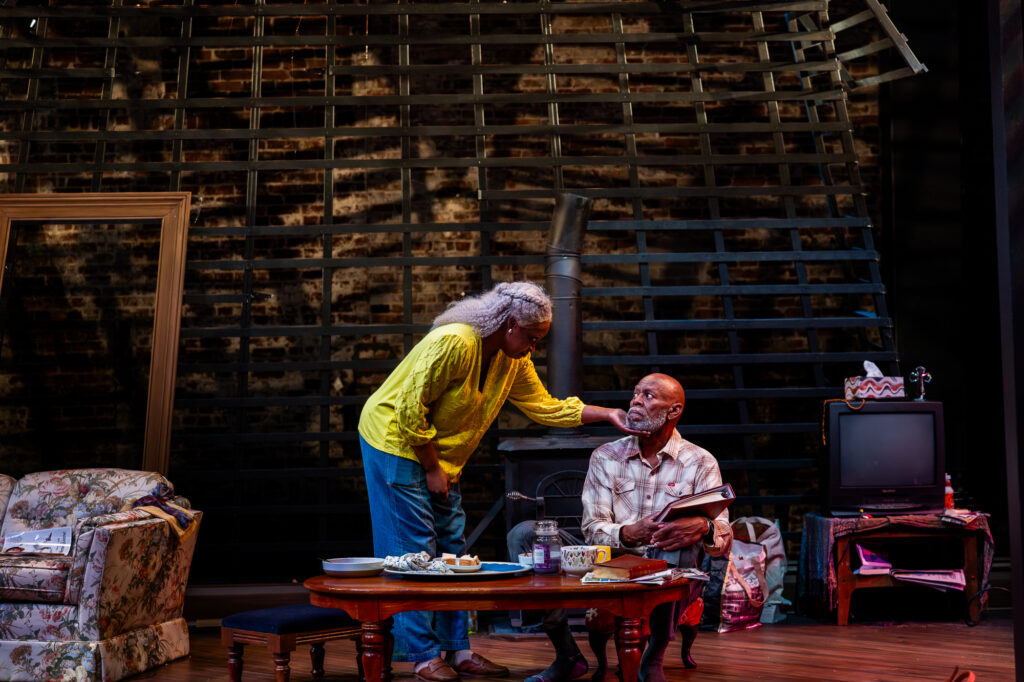
The eighth and penultimate installment of playwright Mfoniso Udofia’s nine-part Ufot Family Cycle, In Old Age (105 min., no intermission) centers on Abasiama (an expressive, nuanced and captivating Ebony Marshall-Oliver), the 80-year-old Nigerian-American matriarch who lives in the house she shared with her deceased husband in Worcester. The house hasn’t been updated since 2001; there is a rusty coal stove in the living room, the floors creak, the windows are sieves and whatever repairs need to be done, well, Abasiama handles them herself.
She knows the house is falling apart (the play opens with a piece of molding falling off the wall and her trying in vain to stick it back on), but she is content in her cocoon where she no longer has to do anything she doesn’t want to do and where what she has and what she has been is fine with her. At her age, she has no interest in picturing what something could become or in imagining what might come next.
Her daughter, Toyoima, has other ideas. As a surprise gift, she has hired a carpenter to renovate her mother’s home. Abasiama learns all this when Azell Abernathy (a convincingly winsome and equally captivating Marvin Bell) shows up one early morning, banging on her door.
He explains that his church keeps a list of workers whom they send out on jobs. Toyoima contacted his pastor to hire someone to build her mother the house of her dreams. “I’m your man — workman,” he explains to the thunderstruck Abasiama. “It’s been a long time since I met someone with the ability to piss me right off,” she replies.
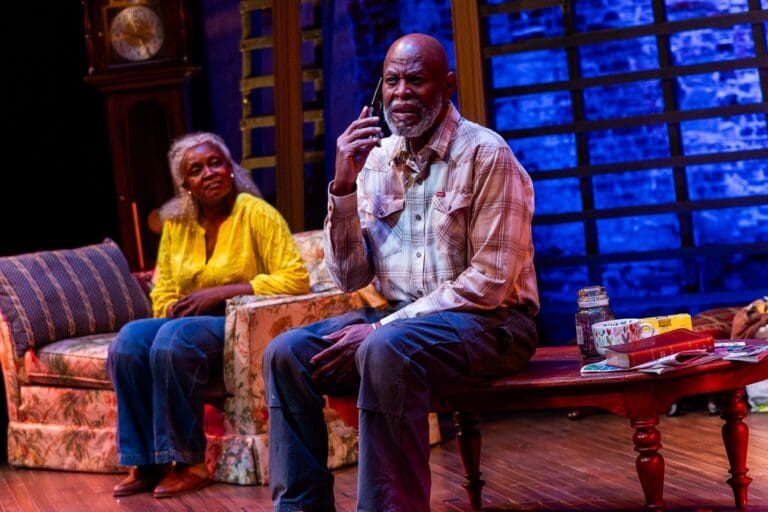
Their rocky start goes from pebbles to boulders. Azell hasn’t worked in a while and this project will be his last job. “It’s got angel dust on it,” he says prophetically. He is no-nonsense and gung-ho, demanding that she pick out new flooring and wall colors. He is smooth-talking and doggedly enthusiastic, confident that if Abasiama follows his rules, everything will run smoothly.
He never anticipated his client would thwart his every move, battling him tooth and nail with rules and demands of her own. Abasiama may be the feistiest, stubbornest, most independent woman he has ever met. She calls him a “charming bulldozer.”
If he’s going to force her to let him guide and witness as she opens up and embraces change, she wants a quid pro quo from him. Azell has to make himself vulnerable to her too and reveal intimate details about himself. “What kind of man are you?” she asks by way of introducing this idea. “Tell me something about your women.”
As they work through the renovation project, it takes on the tenor of a spiritual renewal for these two. Their ease with each other increases as their relationship unfolds organically. They talk about and own their mistakes. They exhaust each other, exasperate each other, and ultimately trust each other and themselves. They approach the idea of friendship as steady, capable adults, with openness, tenderness and honesty.
Udofia’s script is funny, moving, romantic, emotional and more intimate than a 10-alarm lovemaking scene. She weaves in the ancestral spirits and ghosts that have been integral to every Ufot play. Director Dawn M. Simmons has done a marvelous job, as have Eduardo Ramirez (lighting), Arshan Gailus (lighting), and Jeffrey Peterson (set). Most of all, Marshall-Oliver and Bell are pitch perfect as Abasiama and Azell; they bring an authenticity that hooks us emotionally and artistically.
Frankie & Johnny in the Clair de Lune tackles the same subject of the possibility of second-chance connections to wildly different effect. Frankie, a cagey, hardened waitress, and Johnny, a short-order cook who spouts Shakespeare and declarations of love, work in the same diner. The set (Allie Glavey ) is Frankie’s apartment; its main focus is the bed, where most of the play’s action takes place, including the opening scene of acrobatic sex accompanied by moans and groans of operatic volume and duration.
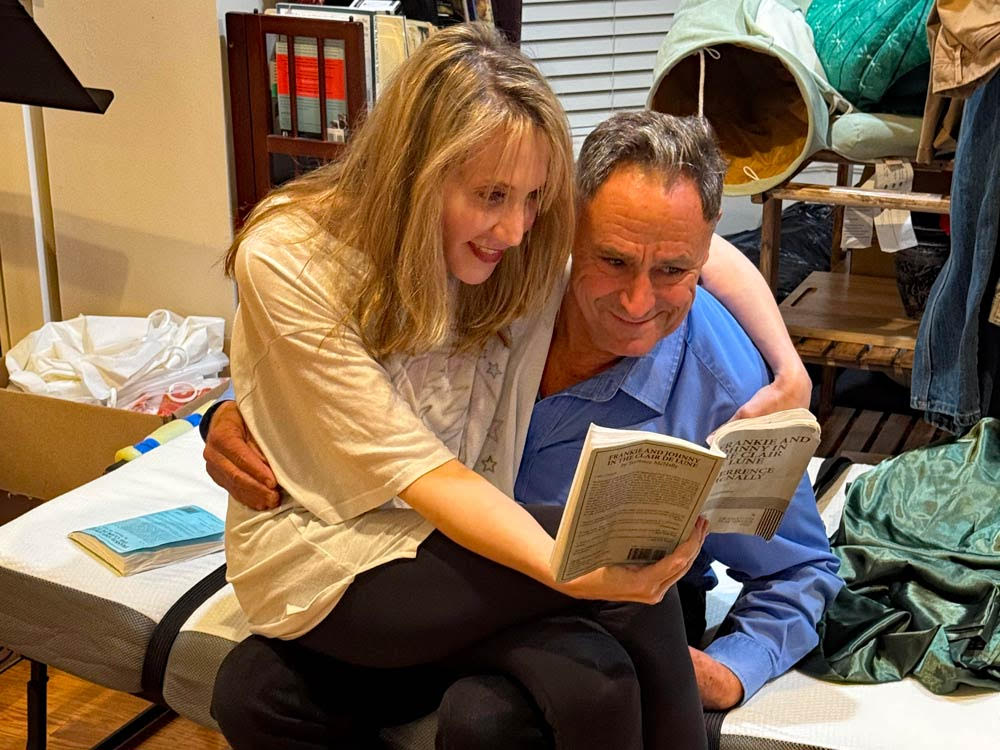
Frankie and Johnny are on their first date after eyeing each other for a while. Initially lurid, amusing, then (after overstaying its welcome by too many beats— the case in most of the play) boring, this sexual romp sets the tone for the next 150 minutes (one intermission).
The rest of the play takes place over the course of this single evening. Although meant to reveal these two to each other and to the audience, playwright Terrence McNally has given them little to work with. Johnny’s “I love you” and Frankie’s “You really don’t know me” mantras elicit eye rolls and watch checking after the first half dozen declarations. They are both relentless, repetitive, and cardboard, more caricatures than fleshed-out people. They are vulnerable and pitiable, but we don’t care and so we really don’t care if they come together or not.
McNally pays lip service to character development, but never really scratches below the surface. Where Azell is a charming bulldozer, Johnny is more tedious, a demolition derby. He talks over Frankie, dismisses her and starts to creep her (and us) out when he refuses to leave despite her repeated requests for him to do so.
Frankie’s character fares a little better, and Wendy Lippe gives it her all, but there’s little for her to hook onto, and she and Cliff Blake (Johnny) have little chemistry. By the time dawn breaks on our immature pair, we want to congratulate them for making it through the night and ourselves for lasting through the second act.
Before June 28, maybe someone should buy Frankie and Johnny tickets to see In Old Age — they might learn a thing or two about grown-up relationships.
‘In Old Age’ — Written by Mfoniso Udofia. Directed by Dawn M. Simmons. Scenic Design by Jeffrey Peterson; Lighting Design by Eduardo Ramirez; Sound Design by Arshan Gailus; Costume Design by Chloe Moore. A Front Porch Arts Collective production presented by Arts Emerson at Emerson Paramount Center, 559 Washington St., Boston through June 28.
‘Frankie & Johnny in the Clair de Lune’ — Written by Terrence McNally. Directed by Julia Murney. Technical and Set Design by Allie Glavey; Lighting Design by Matthew Breton; Sound Design by Olivia Comolli; Intimacy Coordination by Katie Thorn. Presented by The Psych Drama Company, Inc. & Luckiest Films, LLC at Plaza Black Box Theatre, 539 Tremont St., Boston through June 28.
For more information, visit https://artsemerson.org/events/in-old-age/ and https://www.bostontheatrescene.com/shows-and-events/frankie-johnny-in-the-clair-de-lune/

