Two Couples, Each On the Verge of Connection, Take Different Paths in ‘In Old Age’ and ‘Frankie & Johnny in the Clair de Lune’


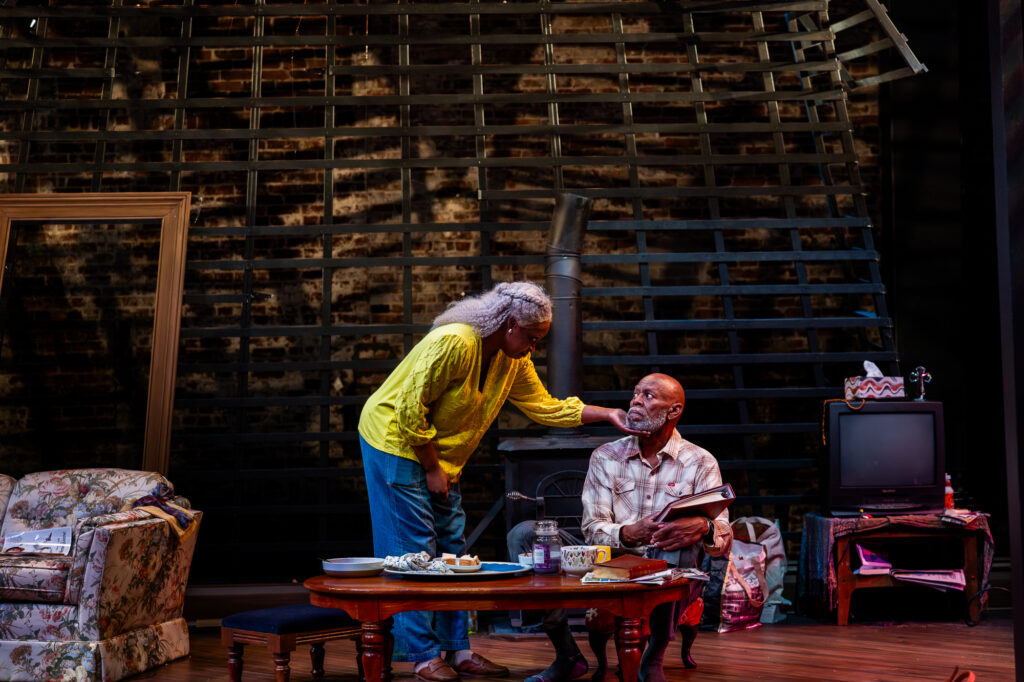
Ebony Marshall-Oliver and Marvin Bell in Front Porch Arts Collective’s ‘In Old Age’

Reviewed by Shelley A. Sackett

On the surface, two plays, both two-handers running through June 28, have much in common. They both center on men and women seeking second chances at connection after suffering through previous unhealthy relationships. Both feature intensely persistent men who face uphill battles convincing the women to see them as life rafts rather than (another) albatross necklace.

Both women resist, terrifying ghosts of their pasts still fresh and evidenced in the emotional and physical scars they bear. They have convinced themselves that they are happy (enough), settled in their aloneness. Fear of repeating past miseries outweighs any desire to explore alternatives; as far as they’re concerned, the possibility of finding real love is a ship that sailed long ago.

Yet, for all their similarities, In Old Age (Front Porch Arts Collective) and Frankie & Johnny in the Clair de Lune (Psych Drama Company) couldn’t be more different.

The eighth and penultimate installment of playwright Mfoniso Udofia’s nine-part Ufot Family Cycle, In Old Age (105 min., no intermission) centers on Abasiama (an expressive, nuanced and captivating Ebony Marshall-Oliver), the 80-year-old Nigerian-American matriarch who lives in the house she shared with her deceased husband in Worcester. The house hasn’t been updated since 2001; there is a rusty coal stove in the living room, the floors creak, the windows are sieves and whatever repairs need to be done, well, Abasiama handles them herself.

She knows the house is falling apart (the play opens with a piece of molding falling off the wall and her trying in vain to stick it back on), but she is content in her cocoon where she no longer has to do anything she doesn’t want to do and where what she has and what she has been is fine with her. At her age, she has no interest in picturing what something could become or in imagining what might come next.

Her daughter, Toyoima, has other ideas. As a surprise gift, she has hired a carpenter to renovate her mother’s home. Abasiama learns all this when Azell Abernathy (a convincingly winsome and equally captivating Marvin Bell) shows up one early morning, banging on her door.

He explains that his church keeps a list of workers whom they send out on jobs. Toyoima contacted his pastor to hire someone to build her mother the house of her dreams. “I’m your man — workman,” he explains to the thunderstruck Abasiama. “It’s been a long time since I met someone with the ability to piss me right off,” she replies.
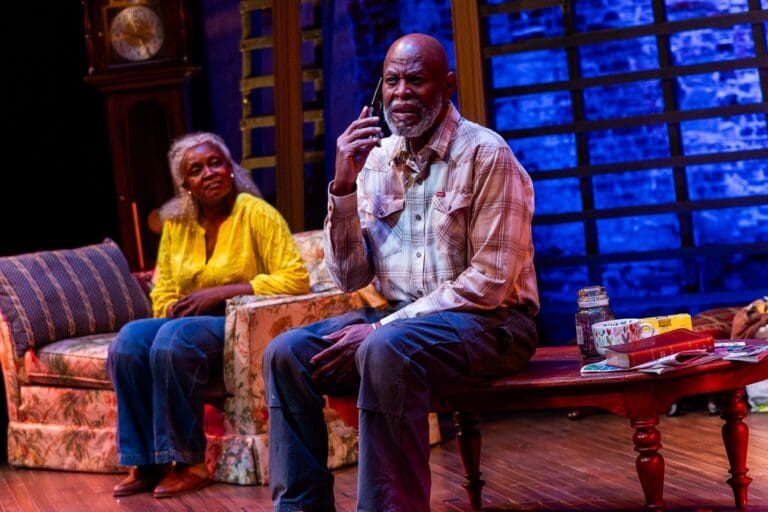
Their rocky start goes from pebbles to boulders. Azell hasn’t worked in a while and this project will be his last job. “It’s got angel dust on it,” he says prophetically. He is no-nonsense and gung-ho, demanding that she pick out new flooring and wall colors. He is smooth-talking and doggedly enthusiastic, confident that if Abasiama follows his rules, everything will run smoothly.

He never anticipated his client would thwart his every move, battling him tooth and nail with rules and demands of her own. Abasiama may be the feistiest, stubbornest, most independent woman he has ever met. She calls him a “charming bulldozer.”

If he’s going to force her to let him guide and witness as she opens up and embraces change, she wants a quid pro quo from him. Azell has to make himself vulnerable to her too and reveal intimate details about himself. “What kind of man are you?” she asks by way of introducing this idea. “Tell me something about your women.”

As they work through the renovation project, it takes on the tenor of a spiritual renewal for these two. Their ease with each other increases as their relationship unfolds organically. They talk about and own their mistakes. They exhaust each other, exasperate each other, and ultimately trust each other and themselves. They approach the idea of friendship as steady, capable adults, with openness, tenderness and honesty.

Udofia’s script is funny, moving, romantic, emotional and more intimate than a 10-alarm lovemaking scene. She weaves in the ancestral spirits and ghosts that have been integral to every Ufot play. Director Dawn M. Simmons has done a marvelous job, as have Eduardo Ramirez (lighting), Arshan Gailus (lighting), and Jeffrey Peterson (set). Most of all, Marshall-Oliver and Bell are pitch perfect as Abasiama and Azell; they bring an authenticity that hooks us emotionally and artistically.

Frankie & Johnny in the Clair de Lune tackles the same subject of the possibility of second-chance connections to wildly different effect. Frankie, a cagey, hardened waitress, and Johnny, a short-order cook who spouts Shakespeare and declarations of love, work in the same diner. The set (Allie Glavey ) is Frankie’s apartment; its main focus is the bed, where most of the play’s action takes place, including the opening scene of acrobatic sex accompanied by moans and groans of operatic volume and duration.
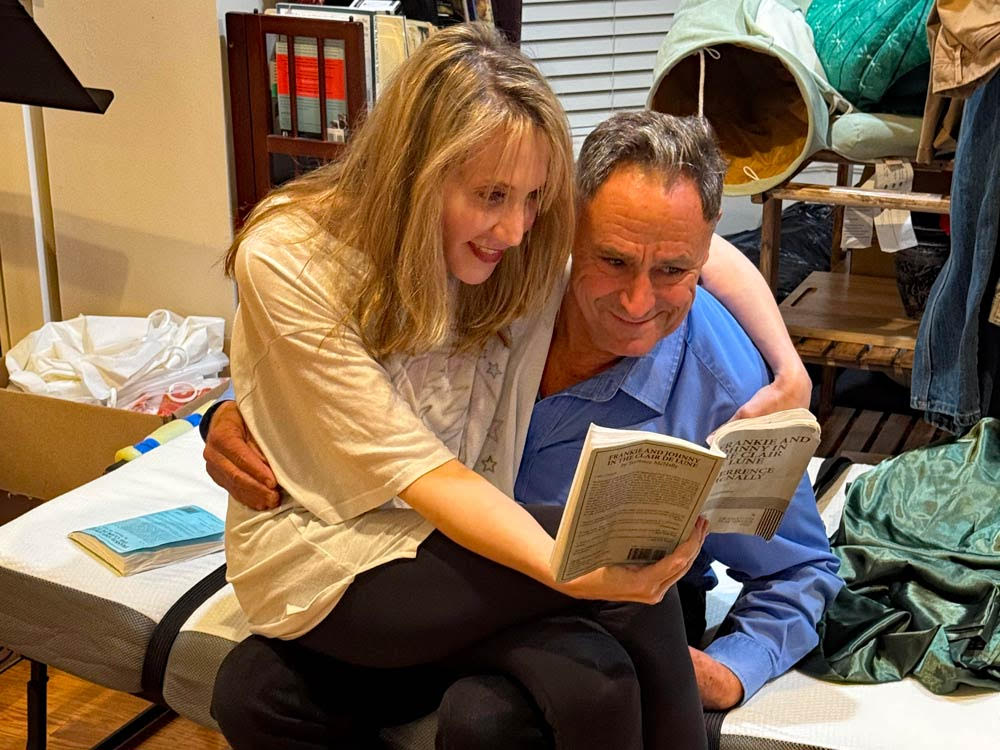
Wndy Lippe and Cliff Blake in The Psych Drama Company’s ‘Frankie & Johnny in the Clair de Lune’

Frankie and Johnny are on their first date after eyeing each other for a while. Initially lurid, amusing, then (after overstaying its welcome by too many beats— the case in most of the play) boring, this sexual romp sets the tone for the next 150 minutes (one intermission).

The rest of the play takes place over the course of this single evening. Although meant to reveal these two to each other and to the audience, playwright Terrence McNally has given them little to work with. Johnny’s “I love you” and Frankie’s “You really don’t know me” mantras elicit eye rolls and watch checking after the first half dozen declarations. They are both relentless, repetitive, and cardboard, more caricatures than fleshed-out people. They are vulnerable and pitiable, but we don’t care and so we really don’t care if they come together or not.

McNally pays lip service to character development, but never really scratches below the surface. Where Azell is a charming bulldozer, Johnny is more tedious, a demolition derby. He talks over Frankie, dismisses her and starts to creep her (and us) out when he refuses to leave despite her repeated requests for him to do so.

Frankie’s character fares a little better, and Wendy Lippe gives it her all, but there’s little for her to hook onto, and she and Cliff Blake (Johnny) have little chemistry. By the time dawn breaks on our immature pair, we want to congratulate them for making it through the night and ourselves for lasting through the second act.

Before June 28, maybe someone should buy Frankie and Johnny tickets to see In Old Age — they might learn a thing or two about grown-up relationships.

‘In Old Age’ — Written by Mfoniso Udofia. Directed by Dawn M. Simmons. Scenic Design by Jeffrey Peterson; Lighting Design by Eduardo Ramirez; Sound Design by Arshan Gailus; Costume Design by Chloe Moore. A Front Porch Arts Collective production presented by Arts Emerson at Emerson Paramount Center, 559 Washington St., Boston through June 28.

‘Frankie & Johnny in the Clair de Lune’ — Written by Terrence McNally. Directed by Julia Murney. Technical and Set Design by Allie Glavey; Lighting Design by Matthew Breton; Sound Design by Olivia Comolli; Intimacy Coordination by Katie Thorn. Presented by The Psych Drama Company, Inc. & Luckiest Films, LLC at Plaza Black Box Theatre, 539 Tremont St., Boston through June 28.

For more information, visit https://artsemerson.org/events/in-old-age/ and https://www.bostontheatrescene.com/shows-and-events/frankie-johnny-in-the-clair-de-lune/
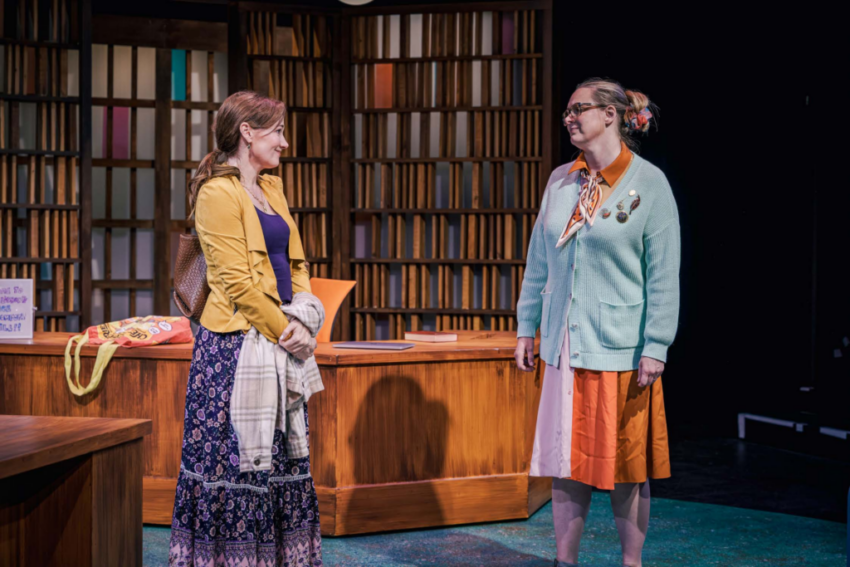
‘Bad Books’ Dives Way Below A Book’s Cover to Explore Meaty Topics in GSC’s Riotous New Play

Reviewed by Shelley A. Sackett

On its surface, Bad Books looks much like many recent productions that touch on the book bannings that are sweeping our nation faster than the wildfires in our beloved West. (See, for example, Shelf Help: Tales of the Unbound by Patricia Morgan and Jena Enfinger; Dirty Books by Max Lieberman, and Alabama Story by Kenneth Jones).

What separates Gloucester Stage Company’s cracker-jack production of playwright Sharyn Rothstein’s two-hander goes deeper than its crackling dialogue, crisp acting, and direction. Rothstein hulls this symbol of repression and fear to ask deeper and more universal questions: What is our role as parents? Do we ever really know our kids the way we think we do? Is that even possible? When they seek unbiased help elsewhere, how do we, as parents, deal with that? What drives our prejudices, our belief systems, our secret night terrors? When is it ok for us to agree to disagree and when must we dig in our heels, stand our ground and take to the Internet to recruit support and attention? What about the collateral damage we cause, intentionally and unintentionally, when fighting this “good fight?”

And these only scratch the surface of a play that, though not flawless, should be seen and discussed by theatergoers who enjoy after-theater dishing as much as watching the live performance.

Plus, it is REALLY funny, and who among us couldn’t use a belly laugh these days?

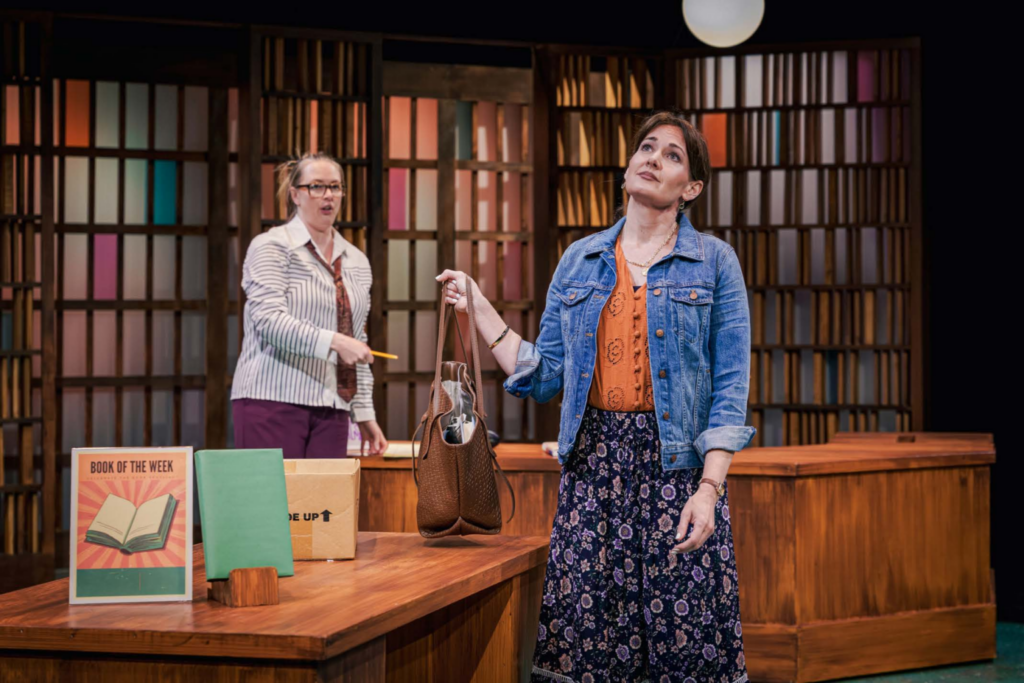
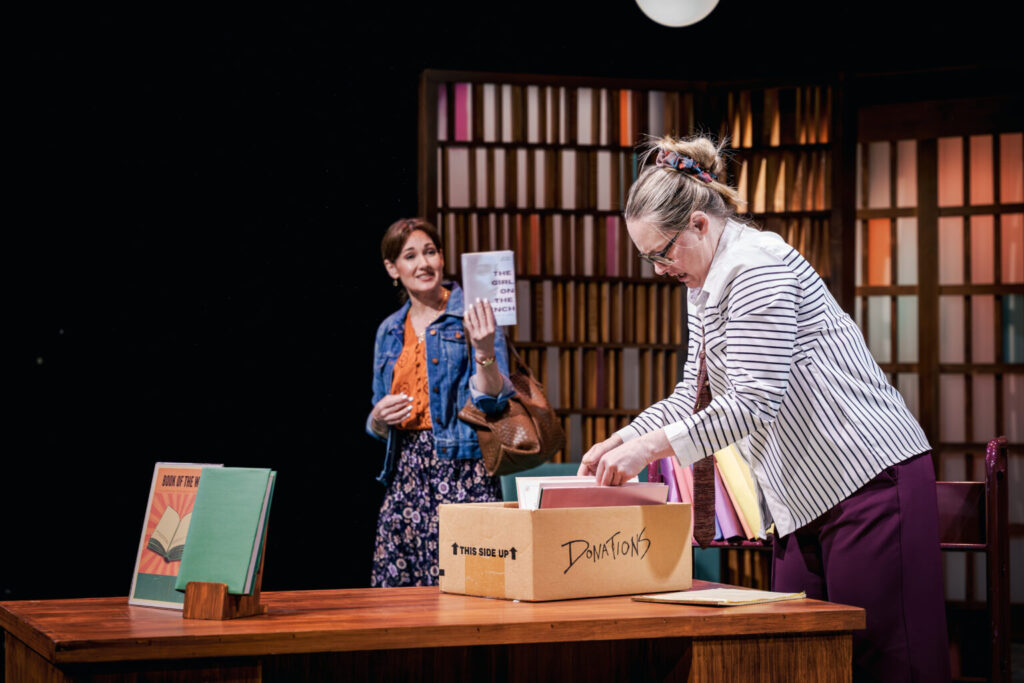
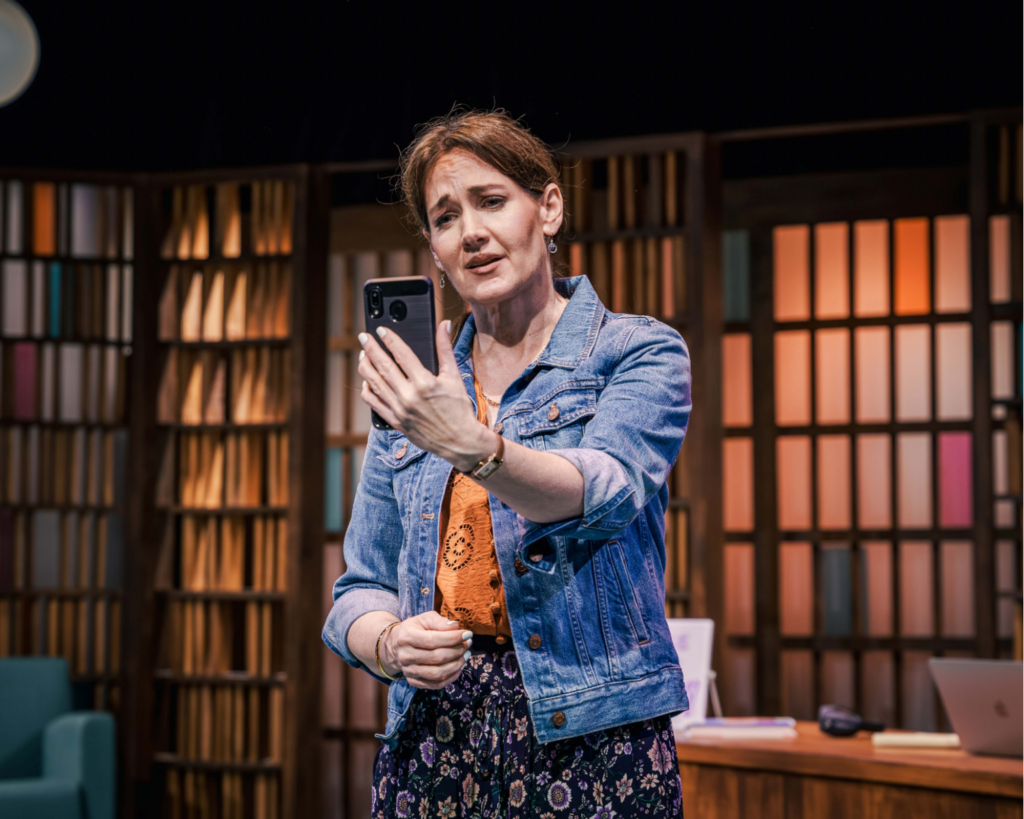
Therese Plaehnand Aimee Doherty in Gloucester Stage’s ‘Bad Books’. Jeff Bousquet Photography.

Dahlia Al-Habieli’s set is simple yet contemporary, with stained-glass panels and movable furniture that easily changes from library to office to church assembly room and back again. The action begins in media res, with two women grunting and circling each other mid-jab. They sway; they parry, they lunge. The music is sporting-event hysteria, the action slo-mo.

Just as suddenly, we are in the empty library. The Librarian (the enormously talented and perfectly cast Therese Plaehn) is alone, removing books from a box marked “donations.” Suddenly, she slams the book shut. “Ow! Motherf—!” she shouts, swallowing the last syllables when she hears a woman clearing her throat. The Mother (Aimee Doherty, whose chameleon face can change from warrior to piteous in a flash) stands there, armed with a large purse and a book.

“Welcome to the library!” the Librarian (Rothstein identifies her characters by title rather than name) cheerfully regales.

From the get-go, these two reveal as hot-headed, articulate, and determined. The book the Mother is holding is titled “Boob Juice,” and she found it in her son Jeremy’s room, recommended by none other than the Librarian. After light-hearted, snarky banter that establishes each as smart and no-nonsense (and, in the case of the Librarian, very funny), the Mother’s mission becomes clear. She has come to challenge the Librarian for recommending this book without first receiving parental (i.e., her) express permission.

The Librarian tries her best to explain the context of the situation. Jeremy confided in her that he was confronting challenges he couldn’t talk to his mother about. Jeremy loves books and spends quite a bit of time in the library (defying his mother’s wish for him to take more interest in sports and social activities). He trusts the Librarian; she, in turn, only has his best interests at heart.

The Mother (who has only read its jacket) knows that this book is inappropriate for her son and that it is even more inappropriate for the Librarian to have given it to him. The book, after all, deals with abortion. She refers to 15-year-old Jeremy as “a child.” She presents as a struggling, high-strung, single mother whose identity is unhealthily welded to controlling her son under the guise of protecting him. She is mother and father to Jeremy, and that is all her son needs.

Doherty and Plaehn

She also harbors a deep, dark secret which the Librarian not only knows, but, armed with which she tries, in vain, to reason with the Mother. The Mother is having none of it, and the two take off their kid gloves, lacing up their inner weapons of mass verbal destruction.

Undaunted, the Librarian goes toe to toe and snark for snark with the Mother. She may not have children of her own, but she recognizes and champions “thoughtful young people who love books” — like Jeremy. She goes so far as to suggest it takes a village to raise a child, hinting that the Mother might try something other than terror and domination with her son. Something, maybe, like trust.

At which point, the Mother’s cup of rage boileth over.

She convenes her minions with an internet I.E.D. that paints a crosshair on the Librarian’s back. “I am a member of a lot of groups,” she snarls. Soon, there are hordes gathered outside the library armed with more than just snacks. The situation devolves into mayhem, a Pandora’s box of gremlins released. Scene I ends with what sounds as much like sandbox taunts as cris de coeurs. “Because am the Mother,” one shouts in desperation.

“And I,” the other responds with a symbolic gesture that leaves the audience roaring, “am the Librarian.”

The other three scenes follow the Mother’s travails as she meets with her boss and the mother of one of Jeremy’s friends before we end up where we began, at the library. (Plaehn plays the boss, other mother and herself while Doherty never changes character). We may have come full circle set-wise, but much has changed for our antagonists, both internally and externally. (Revealing any more about Rothstein’s intricate plot twists would both label me a spoiler and result in editorial reprimands).

Thankfully, discussing the big-ticket issues that Bad Books raises (beyond censorship, of course, and the right to read and write whatever you want) is sanctioned.

Doherty

There are many and they are timely. In this messy world of differing opinions, for example, how obligated is anyone (including a playwright) to present all sides? Does one have the right to ban one’s own book? How do we deal with the virulent spread of public shaming when we are victims (Revenge? Defense? Depression?), and is there ever enough contrition to absolve the perpetrators? And, perhaps most importantly of all, in a world increasingly polemical and divided, is there any realistic hope for mediation and compromise, or have we entered a no man’s land of survival of the fittest?

Rothstein’s play may not be perfect (oversimplified characters, a somewhat contrived plot and a squishy ending), but her dialogue and the actors’ performances (especially Plaehn, who commands every scene she’s in) more than overcome those craftsmanship bugs. And at 90 minutes (no intermission), Bad Books hits that sweet spot of sating without saturation.

Bad Books (Regional Premiere) by Sharyn Rothstein. Directed by M. Bevin O’Gara, Scenic Design by Dahlia Al-Habieli, Costume Design by Chelsea Kerl, Lighting Design by Karen Perlow, Sound Design by Zoe Stanton-Savitz, Props Design by Emme Shaw, Fight Consulting by Omar Robinson, Movement Consulting by Sophia Shaw, Stage Managed by Chris Daly. Produced by the Gloucester Stage Company, 267 East Main St., Gloucester, through June 27, 2026.

For more information, visit https://gloucesterstage.com/badbooks/

NSMT’s ‘On Your Feet!’ Is A Nostalgic, if Clichéd, Look Back at Gloria and Emilio Estefan’s Remarkable Marriage and Career

By Shelley A. Sackett

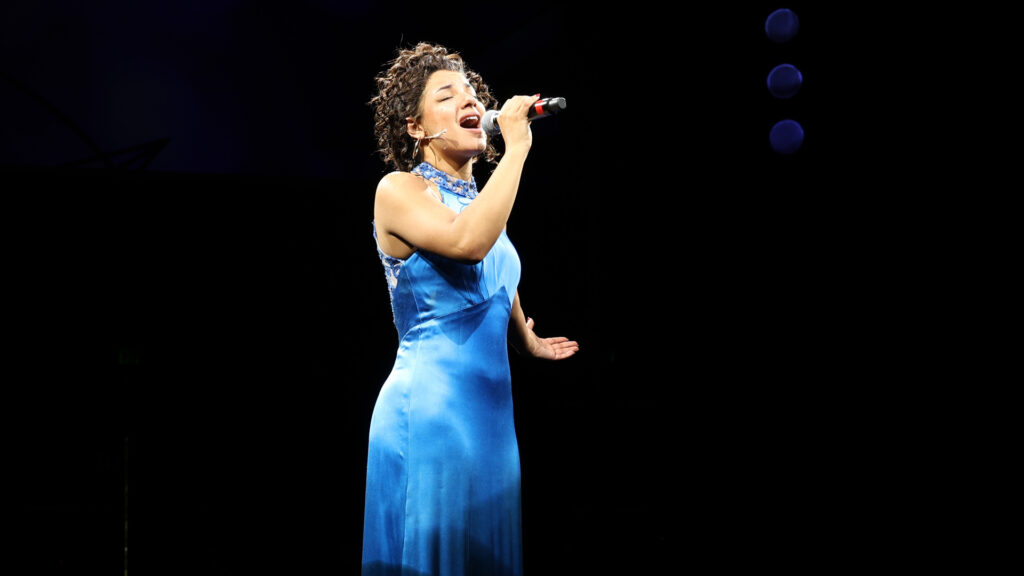
On Your Feet!, in production at North Shore Music Theater through June 14, is a feel-good jukebox musical that played on Broadway for two years before hitting the road for an international tour that continues some nine years later. Based on the lives and musical careers of the 26-time Grammy Award-winning team, Gloria and Emilio Estefan, the musical features a score built around the Cuban-fusion pop music that brought the couple fame, fortune, and a life together, noteworthy for its lack of rancor as much as for its longevity.

It also features choreography by the talented Marcos Santana, music direction by award-winning Jose Delgado, and an engaging set by Jack Mehler.

Like most jukebox musicals, On Your Feet! uses pre-existing, well-known popular songs (26 to be precise) for its score, rather than original music composed for the show. These tunes are woven together to create a brand-new narrative.

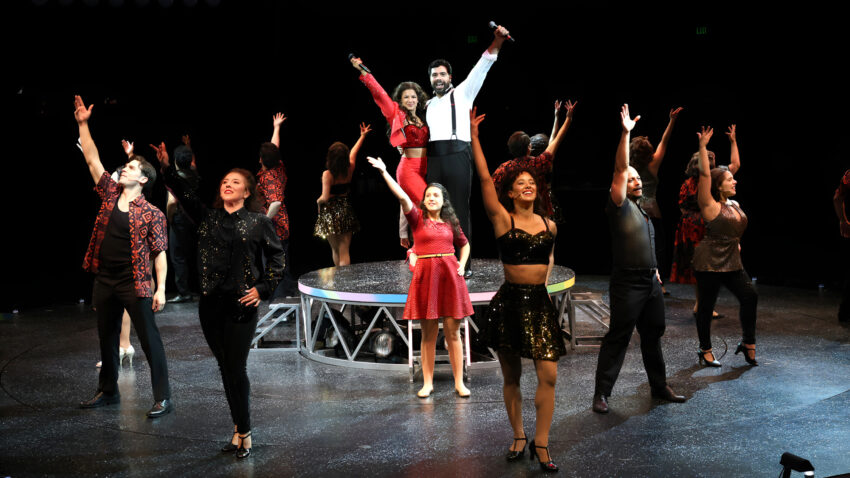
Isabel Leoni as Gloria Estefan in “On Your Feet! The Story of Emilio & Gloria Estefan” at North Shore Music Theatre thru June 14, 2026. Photos © Paul Lyden

Those familiar with the group’s repertoire will delight in this menu of hits; to the unfamiliar, they start to blend into a single high-energy song, repetitive but nonetheless enjoyable.

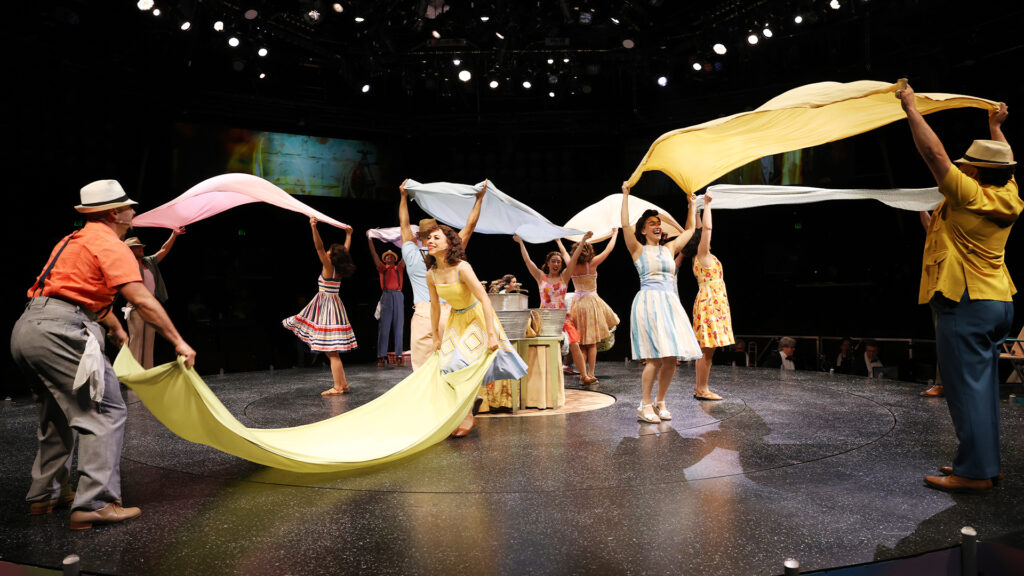
As is the case in every NSMT performance, the theater-in-the-round’s production values are high and among the show’s highlights. The many screens above the stage flash snapshots of the Estefans and their families. Director Santana starts off with a bang as the taut, terrific nine-piece band rises from center stage to the beat and blaring horns of the duo’s signature, “Rhythm Is Gonna Get You,” a promise the show keeps throughout its entire 2-plus hours (one intermission). The entire audience chair-danced right along with the excellent dancers.

Would, however, that the script (and, for the most part, acting) were as engaging and peppy as the score. Although there are some good points made about immigrants and the uphill battle of breaking into the mainstream American music scene, character and plot development take a back seat to the fast-paced and complex salsa, cumbia, bachata and other Cuban-based dance numbers. It starts to feel like we’re on a fabulous island vacation, which is one of the musical’s strengths.

The other is the vocal prowess of many of the actors, especially Karmine Alers as Gloria’s mother, Isabel Leoni as the adult Gloria, and Kendall Rivera as Young Gloria. Henry Gainza, as Gloria’s father, has his moment in the spotlight with a magnificent solo. The ensemble dances and sings their hearts out and, clad in Emilio Sosa’s sassy, sequined costumes, is worth the price of admission.

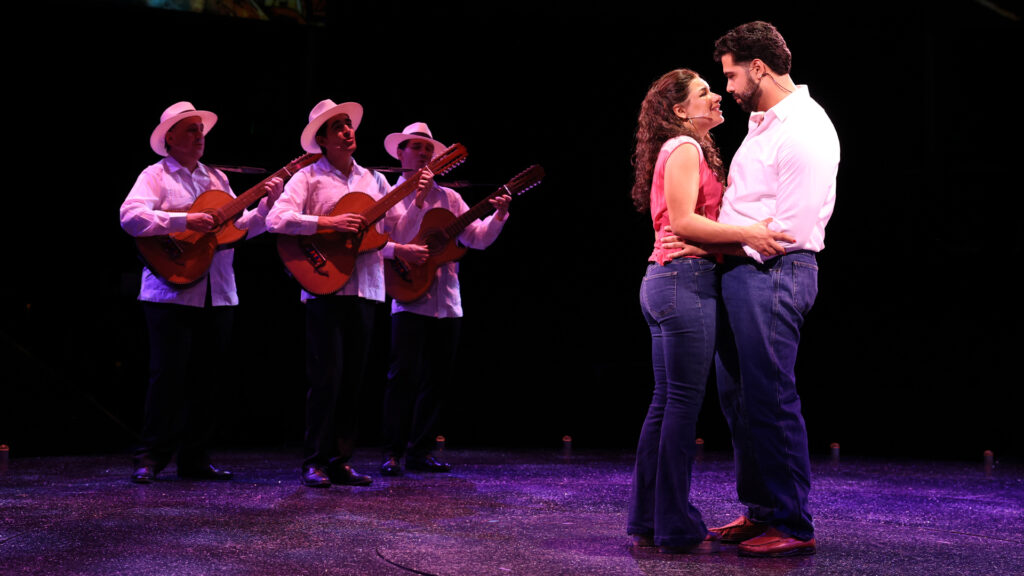
The storyline follows the couple’s journey: Cuban boy meets Cuban girl, boy woos girl, boy gets girl, boy and girl marry and make their way to America, where the couple takes the world by storm with their blend of music and chemistry. In this case, Emilio and Gloria’s path has a few detours that provide context, pathos and joy. Gloria’s overbearing mother (Alers is very good) resents that Gloria is getting to live the dream she had to give up when she became pregnant with Gloria. Her abuela (grandmother), a showstopping Sydia Cedeño-Genat, keeps the peace between the two while encouraging Gloria to go for it when Emilio notices her and asks her to sing with his previously all-male band.

Isabel Leoni (Gloria Estefan), Marcello Audino (Emilio Estefan), cast

Other touching, more emotive scenes are when Gloria sings to her father, bedridden with MS, and when she and her mother reconcile after two years of no communication. In both scenes, tender ballads set the tone and add variety to the otherwise dance-driven soundtrack.

The 1990 bus accident that left Gloria with two fractured vertebrae is meant to be an important turning point, but misdirection and unnuanced acting strip it of poignancy and impact. Gloria goes from a wheelchair to the stage for the American Music Awards with hardly a beat skipped.

Nonetheless, for all its shortcomings, there is no denying the raw energy, beautiful music (especially the harmonies) and lively dancing that are On Your Feet!’s strengths. For some, that alone can be enough.

NSMT’s ‘On Your Feet!’ Is A Nostalgic, if Clichéd, Look Back at Gloria and Emilio Estefan’s Remarkable Marriage and Career‘On Your Feet!’. Book by Alexander Dinelaris. Featuring Music Produced and Recorded by Emilio & Gloria Estefan & Miami Sound Machine. Directed and Choreographed by Marcos Santana. Set and Lighting Design by Jack Mehler; Costume Design by Emilio Sosa; Sound Design by Alex Berg; Wig and Hair Design by Charles G. LaPointe; Projection Design by Pamela Hersch. Presented by North Shore Music Theatre, 54 Dunham Rd., Beverly, through June 14.

For more information, visit http://nsmt.org/

‘Eureka Day’ Tackles Serious Topics with Biting Insight and Riotous Wit

By Shelley A. Sackett

It’s not every playwright who could find gut-splitting humor in the raw topic of divergent views about vaccinations and their collateral damage of incivility, intolerance and epistemic crisis (a situation where society loses its shared consensus on fundamental facts that results in the mechanisms used to determine what is a true breakdown).

Not to mention preventable life-threatening illness.

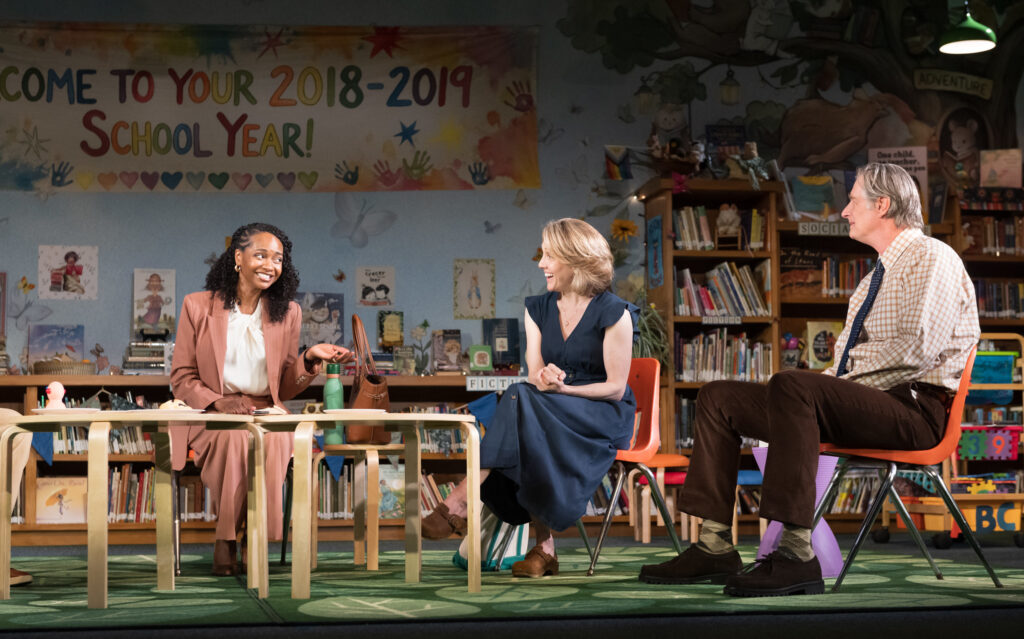
Yet, Jonathan Spector has done just that and more with Eureka Day, his 100-minute play in production at The Huntington through June 28. Timely, razor-sharp and depressingly pertinent, the play takes place during the 2018/2019 school year, penned right before COVID (during Trump I) unleashed a Pandora’s Box that makes us long for the innocence and sanity of Eureka Day. (It won the 2025 Tony Award for Best Revival of a Play.)

The plot revolves around a five-member school committee at a private fictional elementary school in Berkeley, California, that prides itself on diversity, equity, inclusion and political correctness. The members smugly delight in congratulating themselves about how diverse, equal and inclusive they are. Every community member is listened to and accepted. They “hold space for” all opinions and decisions are reached by consensus.

If there were a school chant, it would be “Om shanti.” If there were a school song, it would be “Kumbaya.”

Eunice Woods, Nancy Lemenager, and Ken Cheeseman in Huntington’s ‘Eureka Day’. Photos by Liza Voll

All this has worked perfectly enough until the rubber hits the road when the committee’s well-meant liberalism has to confront a real issue where unanimity may be a pipe dream.

The play opens with the members called for an unprecedented emergency meeting. Spector methodically establishes each character’s persona as they act (and react) in response to Head of School Don’s (a splendid Ken Cheeseman) presentation of the issue at hand.

First, he opens the meeting with quotes from Rumi, the Sufi mystic, poet, and founder of the Islamic brotherhood known as the Mevlevi Order. He dons an almost creepy smile, swooning as he reads.

An anonymous parent has submitted a request to amend the school’s admission form in response to an outbreak of mumps. There are currently no vaccination requirements. The proposal is to alter that policy, requiring a number of vaccinations, including — and especially — mumps.

Suzanne (an equally splendid Nancy Lemenager) quickly emerges as the committee’s (and perhaps the entire town’s) self-appointed doyenne. Well-off, well-coiffed, and well-outfitted, she interrupts, mind-reads, Suzanne-splains, and all but demands fealty. She reminds everyone that she has served on this board for 30 years, joking that she had her last child so she could keep serving.

Nancy Lemenager

It turns out that Suzanne is also a rabid anti-vaxxer who would die on her sword before vaccinating her own children, let alone demanding that others vaccinate theirs.

Suddenly, it also turns out that her championing “holding space for others’ points of view” is mere lip service unless those views mirror hers.

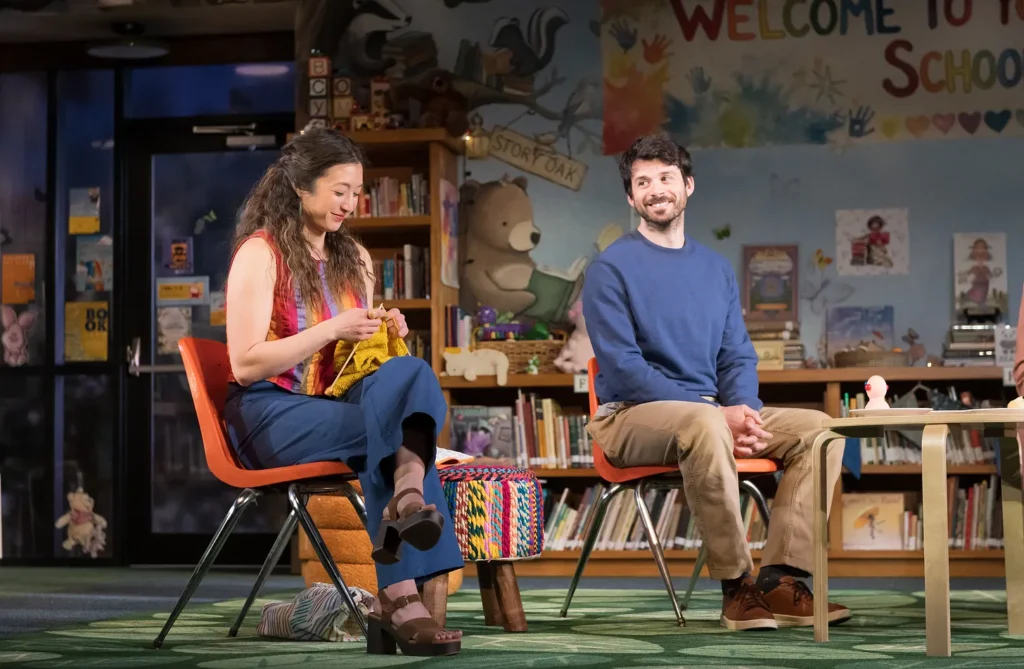
Sasha Diamond, Japhet Balaban

Single mom Meiko (Sasha Diamond) spends the meeting with eyes glued to her knitting, but doesn’t miss a beat. Eli (Japhet Balaban) is swimming in tech nouveau riches and prides himself on the open marriage he and his wife enjoy. He is only slightly less disruptive than Suzanne, derailing conversations mid-syllable.

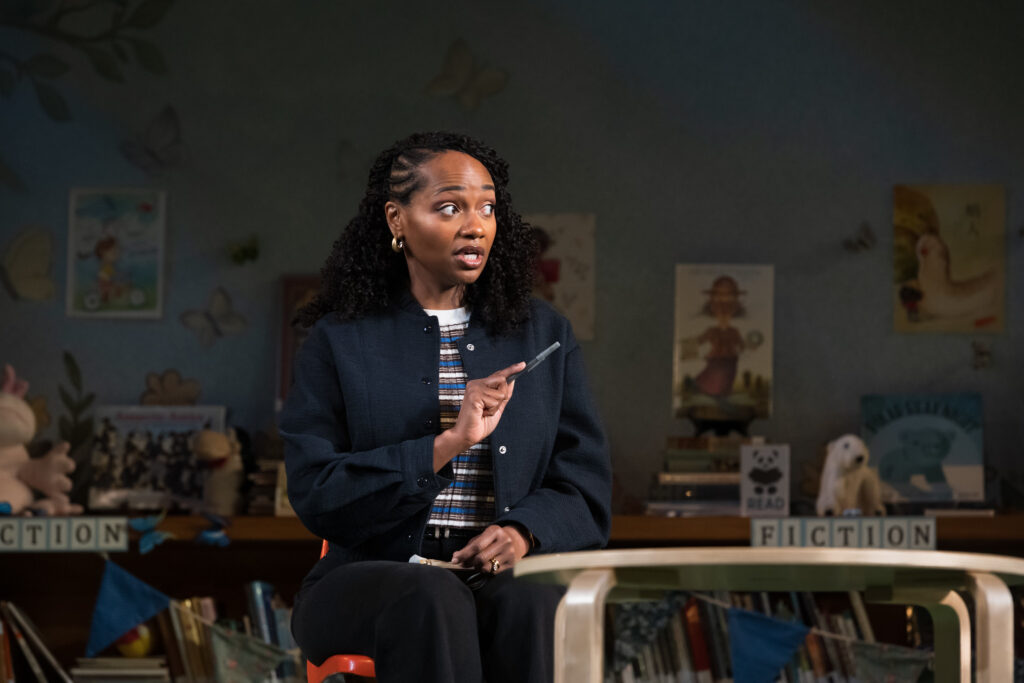
Last is Carina (a smooth Eunice Woods), a recent transplant to the Eureka community. She is this year’s committee’s at-large “new parent” representative. She is also its only Black member.

Eunice Woods

The plot thickens as it is revealed that Meiko’s child has mumps, that she and Eli are having an affair, that Eli’s son contracted mumps with dire consequences after playing with Meiko’s daughter, and that Carina is the anonymous parent requesting a change in admission policy.

Further complicating matters is the fact that the city’s health division was alerted to the outbreak and has written a letter that states unequivocally that no student is to be allowed back into the school without documentation of vaccination until there is “no risk of exposure.”

Don, the wannabe peacemaker, is about to have a night he won’t soon forget. You can almost hear Bette Davis crooning, “Fasten your seat belts. It’s about to be a bumpy ride.”

Illusions of harmony and consensus quickly melt as the members approach the issue with the tact and finesse of bulls in a china closet. Hoping to garner support, Suzanne suggests a “Community-activated conversation” on Zoom. Don opens the meeting and encourages participants to use the chat tab (which is projected above the committee members in a font large enough to actually read).

Sasha Diamond, Nancy Lemenager, Ken Cheeseman, Eunice Woods, and Japhet Balaban

These comments quickly devolve from private, individual conversations to the kind of tasteless, offensive attacks that have come to define disagreements in this age of anything goes.

They are also belly-laugh hilarious, and it’s an interesting sensation to cringe and laugh for such a prolonged (perhaps too prolonged?) period of time.

The rest of the play may feel a bit dated, circular, and unnuanced at times, but there is no denying that Spector has written a play that both plumbs the limits of honest, benevolent, open-mindedness and allows us to recognize and poke fun at ourselves. He also poses some serious questions whose answers come with serious consequences.

What exactly is acceptable “collateral damage” to achieve a policy goal? At what point must “majority rule?” And who gets to decide how that majority is determined?

Written and first performed in pre-COVID times, the failure of a utopia played to a different crowd when it premiered. In 2025, as we grapple with the changes seven years have wrought, Spector brilliantly adds a single line to the play’s end that endears its squabbling characters for their naïveté at what’s in store in this tragicomical new world.

“Work hard,” Don announces in his farewell and final all-school address. “It’s going to be clear skies and smooth sailing as we launch together into the 2019-2020 school year.”

The audience erupted in raucous laughter, applause, and deep cathartic exhalations on opening night.

Recommended.

‘Eureka Day’ – Written by Jonathan Spector. Directed by Margot Bordelon. Scenic Design by Luciana Stecconi. Costume Design by Zoe Sundra. Lighting Design by Cha See. Sound Design by Daniela Hart, Noel Nichols, Bailey Trierweiler & UptownWorks. Presented by The Huntington, 264 Huntington Ave., Boston through June 28.

For more information, visit huntingtontheatre.org

Category: Theater Reviews