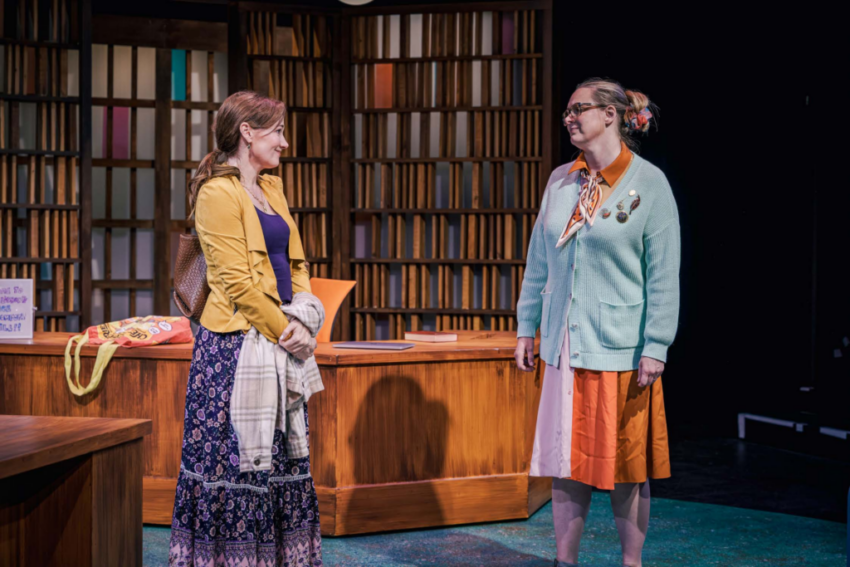
Reviewed by Shelley A. Sackett
On its surface, Bad Books looks much like many recent productions that touch on the book bannings that are sweeping our nation faster than the wildfires in our beloved West. (See, for example, Shelf Help: Tales of the Unbound by Patricia Morgan and Jena Enfinger; Dirty Books by Max Lieberman, and Alabama Story by Kenneth Jones).
What separates Gloucester Stage Company’s cracker-jack production of playwright Sharyn Rothstein’s two-hander goes deeper than its crackling dialogue, crisp acting, and direction. Rothstein hulls this symbol of repression and fear to ask deeper and more universal questions: What is our role as parents? Do we ever really know our kids the way we think we do? Is that even possible? When they seek unbiased help elsewhere, how do we, as parents, deal with that? What drives our prejudices, our belief systems, our secret night terrors? When is it ok for us to agree to disagree and when must we dig in our heels, stand our ground and take to the Internet to recruit support and attention? What about the collateral damage we cause, intentionally and unintentionally, when fighting this “good fight?”
And these only scratch the surface of a play that, though not flawless, should be seen and discussed by theatergoers who enjoy after-theater dishing as much as watching the live performance.
Plus, it is REALLY funny, and who among us couldn’t use a belly laugh these days?
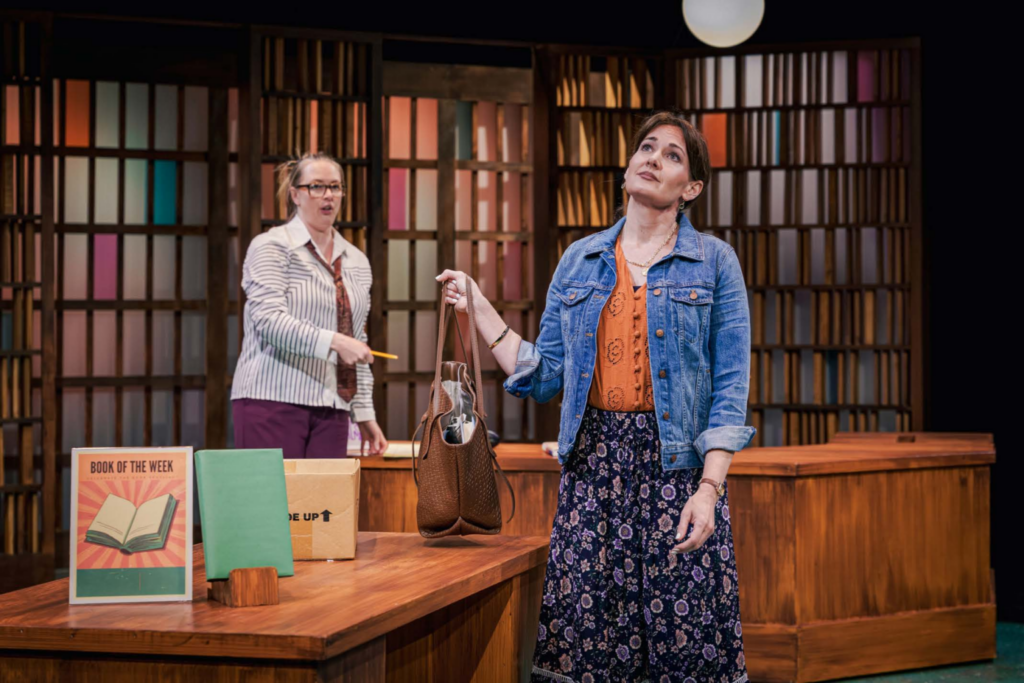
Dahlia Al-Habieli’s set is simple yet contemporary, with stained-glass panels and movable furniture that easily changes from library to office to church assembly room and back again. The action begins in media res, with two women grunting and circling each other mid-jab. They sway; they parry, they lunge. The music is sporting-event hysteria, the action slo-mo.
Just as suddenly, we are in the empty library. The Librarian (the enormously talented and perfectly cast Therese Plaehn) is alone, removing books from a box marked “donations.” Suddenly, she slams the book shut. “Ow! Motherf—!” she shouts, swallowing the last syllables when she hears a woman clearing her throat. The Mother (Aimee Doherty, whose chameleon face can change from warrior to piteous in a flash) stands there, armed with a large purse and a book.
“Welcome to the library!” the Librarian (Rothstein identifies her characters by title rather than name) cheerfully regales.
From the get-go, these two reveal as hot-headed, articulate, and determined. The book the Mother is holding is titled “Boob Juice,” and she found it in her son Jeremy’s room, recommended by none other than the Librarian. After light-hearted, snarky banter that establishes each as smart and no-nonsense (and, in the case of the Librarian, very funny), the Mother’s mission becomes clear. She has come to challenge the Librarian for recommending this book without first receiving parental (i.e., her) express permission.
The Librarian tries her best to explain the context of the situation. Jeremy confided in her that he was confronting challenges he couldn’t talk to his mother about. Jeremy loves books and spends quite a bit of time in the library (defying his mother’s wish for him to take more interest in sports and social activities). He trusts the Librarian; she, in turn, only has his best interests at heart.
The Mother (who has only read its jacket) knows that this book is inappropriate for her son and that it is even more inappropriate for the Librarian to have given it to him. The book, after all, deals with abortion. She refers to 15-year-old Jeremy as “a child.” She presents as a struggling, high-strung, single mother whose identity is unhealthily welded to controlling her son under the guise of protecting him. She is mother and father to Jeremy, and that is all her son needs.
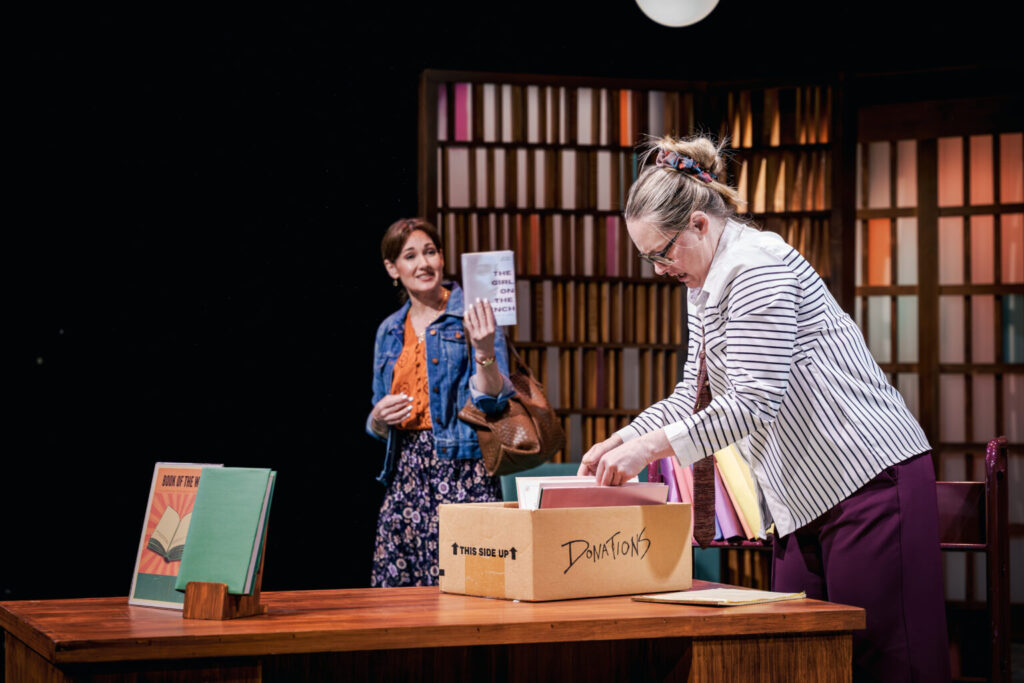
She also harbors a deep, dark secret which the Librarian not only knows, but, armed with which she tries, in vain, to reason with the Mother. The Mother is having none of it, and the two take off their kid gloves, lacing up their inner weapons of mass verbal destruction.
Undaunted, the Librarian goes toe to toe and snark for snark with the Mother. She may not have children of her own, but she recognizes and champions “thoughtful young people who love books” — like Jeremy. She goes so far as to suggest it takes a village to raise a child, hinting that the Mother might try something other than terror and domination with her son. Something, maybe, like trust.
At which point, the Mother’s cup of rage boileth over.
She convenes her minions with an internet I.E.D. that paints a crosshair on the Librarian’s back. “I am a member of a lot of groups,” she snarls. Soon, there are hordes gathered outside the library armed with more than just snacks. The situation devolves into mayhem, a Pandora’s box of gremlins released. Scene I ends with what sounds as much like sandbox taunts as cris de coeurs. “Because I am the Mother,” one shouts in desperation.
“And I,” the other responds with a symbolic gesture that leaves the audience roaring, “am the Librarian.”
The other three scenes follow the Mother’s travails as she meets with her boss and the mother of one of Jeremy’s friends before we end up where we began, at the library. (Plaehn plays the boss, other mother and herself while Doherty never changes character). We may have come full circle set-wise, but much has changed for our antagonists, both internally and externally. (Revealing any more about Rothstein’s intricate plot twists would both label me a spoiler and result in editorial reprimands).
Thankfully, discussing the big-ticket issues that Bad Books raises (beyond censorship, of course, and the right to read and write whatever you want) is sanctioned.
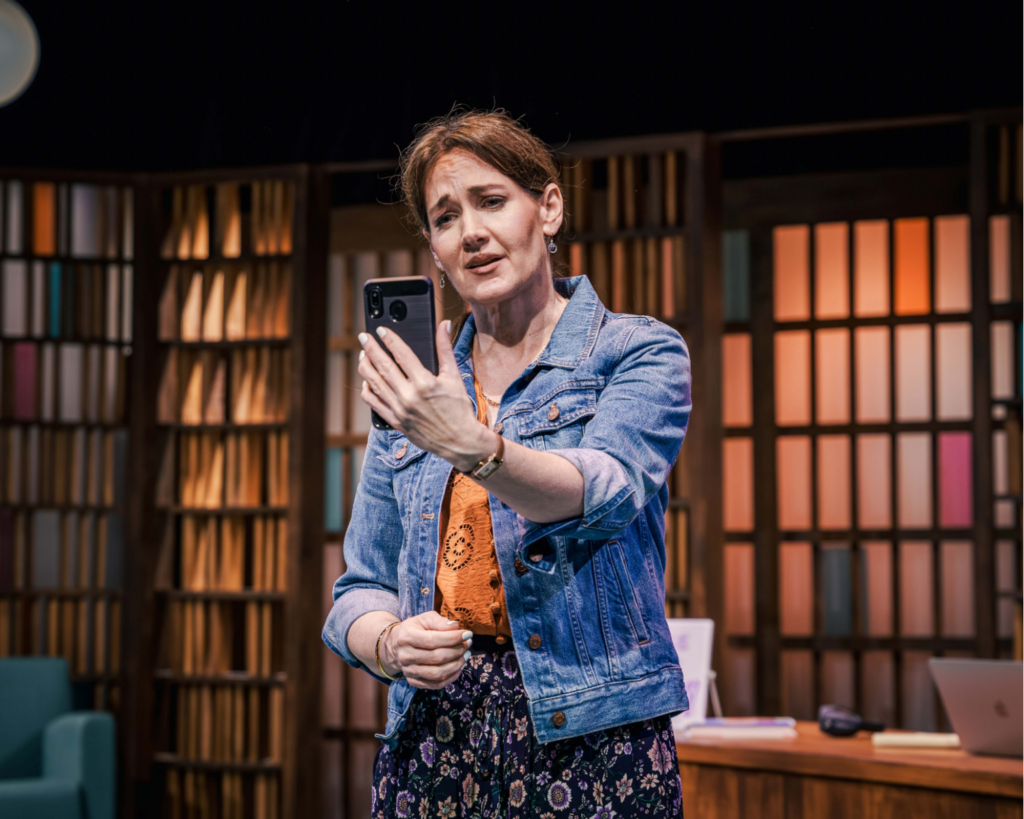
There are many and they are timely. In this messy world of differing opinions, for example, how obligated is anyone (including a playwright) to present all sides? Does one have the right to ban one’s own book? How do we deal with the virulent spread of public shaming when we are victims (Revenge? Defense? Depression?), and is there ever enough contrition to absolve the perpetrators? And, perhaps most importantly of all, in a world increasingly polemical and divided, is there any realistic hope for mediation and compromise, or have we entered a no man’s land of survival of the fittest?
Rothstein’s play may not be perfect (oversimplified characters, a somewhat contrived plot and a squishy ending), but her dialogue and the actors’ performances (especially Plaehn, who commands every scene she’s in) more than overcome those craftsmanship bugs. And at 90 minutes (no intermission), Bad Books hits that sweet spot of sating without saturation.
Bad Books (Regional Premiere) by Sharyn Rothstein. Directed by M. Bevin O’Gara, Scenic Design by Dahlia Al-Habieli, Costume Design by Chelsea Kerl, Lighting Design by Karen Perlow, Sound Design by Zoe Stanton-Savitz, Props Design by Emme Shaw, Fight Consulting by Omar Robinson, Movement Consulting by Sophia Shaw, Stage Managed by Chris Daly. Produced by the Gloucester Stage Company, 267 East Main St., Gloucester, through June 27, 2026.
For more information, visit https://gloucesterstage.com/badbooks/
 InSights