Gloucester Stage ‘s Thought-Provoking ‘The Ding Dongs’ is a Theatrical Tour-de-Force

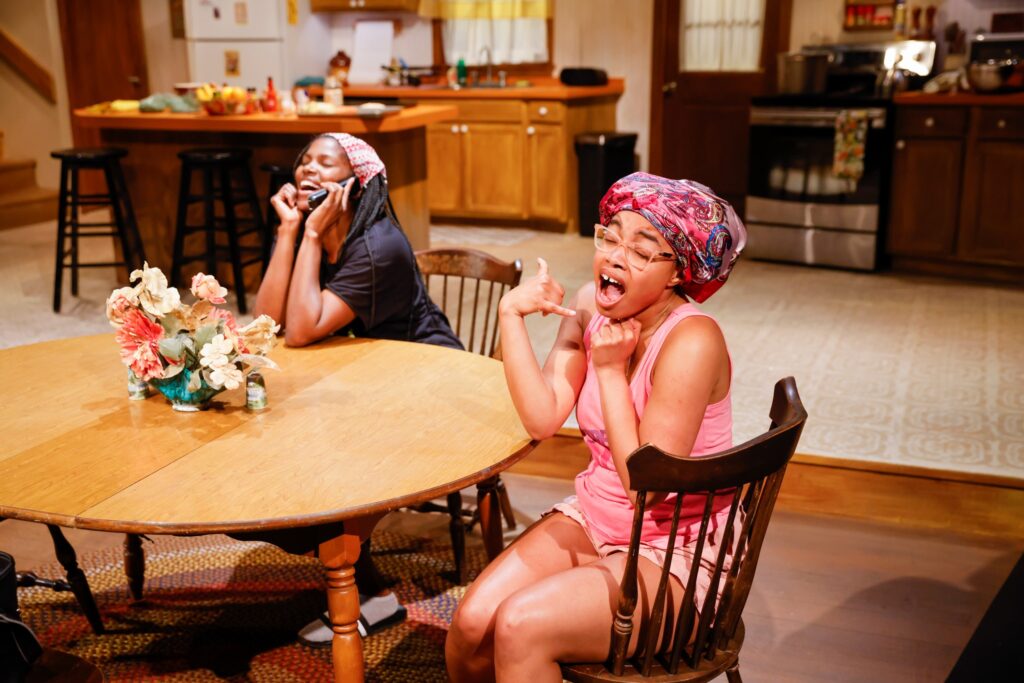
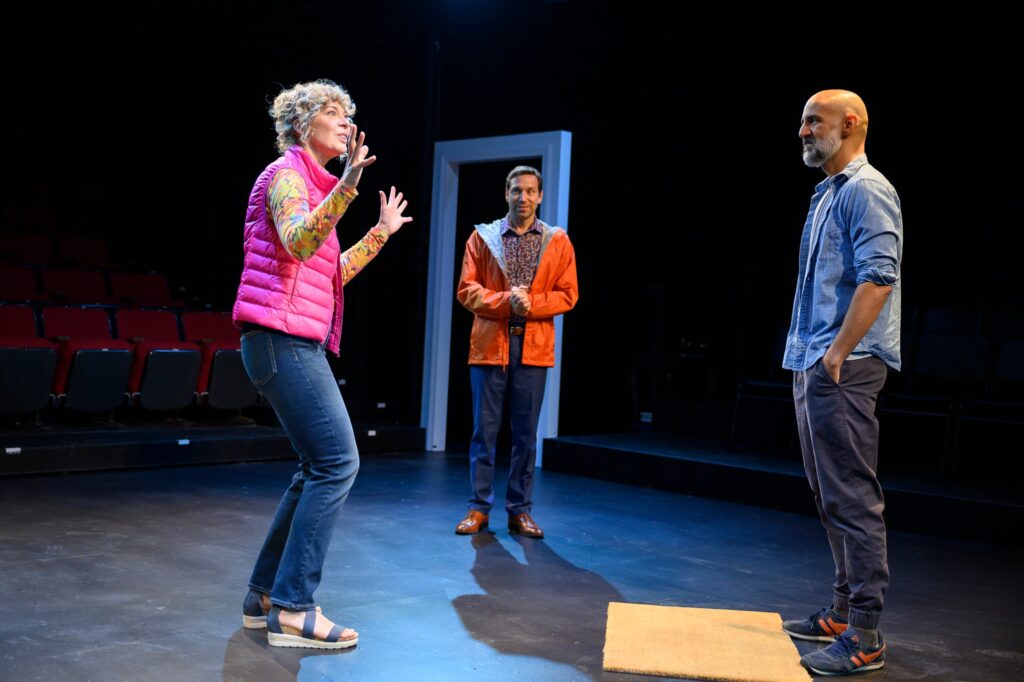
Erica Steinhagen, Karl Gregory, and Nael Nacer in Gloucester Stage Company’s ‘The Ding Dongs’

By Shelley A. Sackett

We’ve all been there. That split second when we realize that all may not be as it seems, that we have misread a vital clue and that all is about to go south. The Ding Dongs, in production at Gloucester Stage through August 27, takes that moment and straps it to a steroid drip.

Don’t be put off by the title, as I almost was. (Is it a tribute to Hostess? To a bebop group? To the comedic wrestling duo?) The Ding Dongs will keep you on the edge of your seat for its entire 75 minutes from lights up to fade out and leave you dying to talk about it to anyone within earshot.

When is the last time theater had that kind of visceral effect?

The action starts with — what else — a couple ringing the doorbell of a suburban single-family home. Inside, the owner Redelmo (the always magnetic Neal Nacer), pauses and runs his hand over his shaved head as if some sixth sense warns him against answering the door.

From the get-go, there is something awry with Natalie (the mesmerizing Erica Steinhagen) and Joe (the superbly flexible Karl Gregory). Natalie is dressed like soccer mom Barbie and her husband Joe looks at home in his orange hooded windbreaker and fitted mod shirt. They present as any ordinary, if unfashionable, couple might, a little ditzy perhaps (another meaning of “ding-dong” is dingbat), but otherwise innocuous.

Natalie is the more forceful, immediately establishing that Joe grew up in Redelmo’s house and that they would love to come inside and take a peek at the old homestead. Joe is the more affable, taking his cues from Natalie and speaking only when she opens that door and invites him into the conversation.

Uncomfortable and increasingly suspicious, Redelmo tries to field their barrage of questions and reveal as little about himself as possible. Yet his politeness and graciousness are no defense to the couple’s verbal bombardment, and they steamroll right over the doomed deed holder’s threshold.

Once inside, all semblance of ordinariness vanishes. The couple launches their assault in earnest, cajoling, beseeching and threatening Redelmo. Natalie is equal parts pit bull prosecutor, evil enchantress and comical talk show host. Joe plays her foil, good cop to her sinister, slightly unhinged one.

The exchanges can be funny, but the overlay of menace and chaos erases any possibility of the audience feeling comic relief. These two are world-class black widow creeps, and Redelmo, with his social graces and timidity, is no match for them.

Soon, their unsettling stories turn more sinister, violent and threatening. Their past is revealed, including a dark chapter involving home invasions, violence, disruption and dislocation. The two are verbal quick-change artists, feigning innocence one minute, wielding machetes the next.

In this boxing match of words and wit, Redelmo is outperformed and outnumbered and no amount of fancy footwork is going to save him from the blows that will eventually corner and pummel him into submission.

Unexpectedly, the doorbell rings again and large boxes addressed to the couple begin arriving. At this point (and not until), Redelmo wakes up to the fact that these two are not visitors who can be reasoned with and will eventually get the message that he wants them to leave. These are ruthless, deranged home invaders who play by alien rules and carry baggage far more unsettling than whatever might be in the avalanche of boxes squatting in his living room.

Abruptly, his house has gone from a calm, suburban home to a cross between Pee Wee’s Playhouse and Regan’s bedroom in “The Exorcist,” and Redelmo reels at the heightened stakes.

Natalie continues, now claiming that the house really belongs to Joe because, after all, he has priority in the chain of deeds, having lived there well before Redelmo “owned” it. In fact, they argue, to an outside observer, it is Redelmo who would be considered the squatter, not them.

“The simplest explanation is always the best, even if it isn’t the truth,” she says. Like wolves closing in on common prey, Natalie and Joe encircle Redelmo, smelling his fear and tightening their grip.

And then, things get even twistier and more disorienting until by the play’s sudden end, neither the actors nor the audience is really sure who’s who and what’s what. Like a huge pot put on a flaming stove, this play simmers for a long time until you wonder if it will ever reach boiling point. When it finally does start to roil, however, there is no lid heavy or strong enough to keep it from boiling over, like poor Mickey’s cauldron in “Fantasia’s” famous “The Sorcerer’s Apprentice.”

Playwright Brenda Withers has written a riveting, thought-provoking, timely play that receives a must-see, first-rate production under Rebecca Bradshaw’s crisp direction. Sound designer Julian Crocamo masterfully reflects the jerkiness of mood by subtly swinging from the sweetness of harmony to the menace of dissonance.

Setting the stage as a theater-in-the-square with four bays of seats gives the illusion of a boxing arena. It also allows Bradshaw and lighting designer M. Berry to take full advantage of a set that affords the audience a different perspective by slight shifts in position and luminosity. A few steps to the left or right and the focus can swing from an actor’s action to their reaction, giving the audience an entirely different perspective on the same situation.

With “The Ding Dongs,” Withers has created a sophisticated, multi-layered, complicated microcosm whose effects linger long after the play’s dramatic end. She subtitled her play, “What Is the Penalty in Portugal? a meditation on homeland security,” and she gives a clue as to her intention in writing it in a recent interview.

She had started thinking about land and property after reading an article about a skirmish in the Middle East. She thought about gentrification, the displacement of humans around the globe, and what makes a home a home.

She also thought about civility and how far we’ll let people get in order to maintain good manners. “What happens when you finally push back on someone and say, ‘These are actually my boundaries’ or ‘This is what’s making me uncomfortable.”’

This is not a “feel good” kind of play. Its laughs are funny but not funny. The manipulation, aggression and sense of helplessness are palpable and contagious. Those of us who think we may be inured and resigned to the realities of living in a macroworld where rules and truth are arbitrary will be further disheartened by this up close and personal micro-encounter with its nefarious day-to-day consequences.

It is, however, an important play with a timely and important message that should be seen and discussed. That Gloucester Stage’s production is an artistic bases loaded home run is icing on the cake.

‘The Ding Dongs’ — Written by Brenda Withers. Directed by Rebecca Bradshaw. Costume Design by Camilla Dely; Lighting Design by M. Berry; Sound Design by Julian Crocamo. Presented by Gloucester Stage, 267 East Main St., Gloucester, through August 27.

For tickets and information, go to: https://gloucesterstage.com/
Gloucester Stage Serves Up More Than Good Food in ‘Stew’

By Shelley A. Sackett 

Stew is any dish that is prepared by “stewing” — that is, submerging the ingredients with just enough liquid to cook them through on a low flame in a covered pot for a longtime. It is also a synonym for brooding. One who is in an extreme state of worry and agitation is said to be “stewing.” 

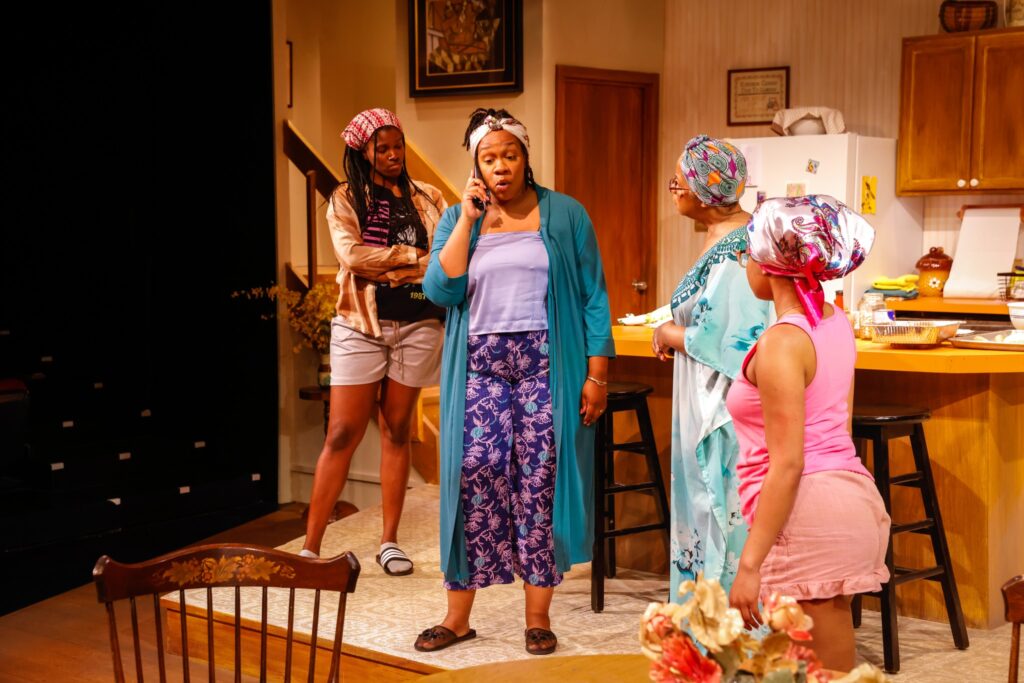
Playwright Zora Howard has captured the richness of the dish and the simmering state of its emotional namesake in her 90-minute intermission-less play, “Stew,” now in production at Gloucester Stage. A 2021 Pulitzer Prize in Drama finalist, it is the story of three generations of Black women who gather at the family home in Mount Vernon, N.Y. 

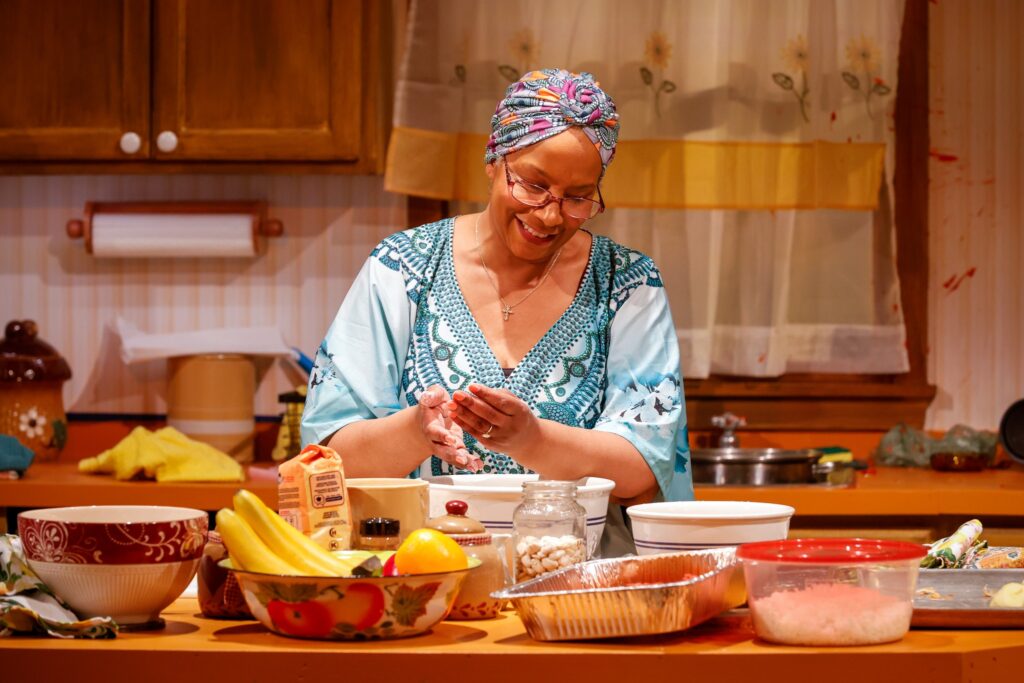
The show opens in the Turner’s comfortable kitchen with Mama (the magnificent Cheryl D. Singleton in a role that fits her like a glove) alone in her slippers and robe, singing, dancing, and grooving to the gospel song,”“Rejoice.” She sashays over to the pot bubbling on the stove, stirring it with the finesse and timing of a backup singer. This is a woman in her element. Unobserved, undisturbed, she is in her happy place. 

That spell is quickly shattered by a dog barking and the boisterous arrival of the rest of theclan. Mama’s two daughters, Lillian (Breezy Leigh) and Nelly (Janelle Grace), burst into the room, and the atmosphere shifts from private sanctuary to multi-generational chaos. Lillian, in her 30s, is visiting with her 12-year-old daughter, Lil Mama (Sadiyah Dyce Janai Stephens), and younger son Junior, who is already up and outside playing. Lillian’s sister, 17-year-old high schooler Nelly, lives with Mama, although not for long if she has her way and her temporary boyfriend turns out to be her forever man. 

The titular plot revolves around Mama cooking for 50 for an event after church. The stew that has been brewing on the stove has burned, and Mama dumps it into the trash. Similarly, the relationships among these four Turner women get an overhaul during the course of the day as their banter and bickering reveal their secrets, fears, resentments, and hopes, the ingredients they bring to the familial stew that has been quietly simmering on the Turner family back burner for many years. 

Mama has just been to the doctor, and although she won’t admit it, is starting to slow down. “Are you dyin’?” Lillian asks with both accusation and terror in her voice. “It’s certainly the direction I’m heading,” Mama quips. For her part, Lillian has returned home to do more than just check in on Mama’s well-being. Her marriage is stuck in an awkward gear, and, although it will take her another hour to voice it, she is home because she needs her mother’s support and advice. 

Nelly has her first real boyfriend and confides to Lil Mama that she’s sure she has found the real thing. She can’t wait to get on with her life with him. Lil Mama is a free-spirited pre-teen, equal parts silly and earnest, anxious to be taken seriously but still needing to be coddled. She is preparing to audition for the role of Queen Elizabeth in Shakespeare’s Richard III.  

Just as Mama takes charge of her brood in directing them to create her stew, so she commands the troops in helping Lil Mama practice her lines. Mama was, after all, the founder and director emeritus of the Mt. Vernon High Dramatic League as well as the first soloist at the Greater Centennial A.M.E. Zion Church, a fact her children know so well they lip sync the oft-repeated line. 

Howard has a keen ear for writing compelling and laugh-out-loud dialogue that blends the authentic, intimate, and emotional. She manages to keep the rapid-fire pace of the women’s feisty verbal thrusts and parries while subtly defining each character’s individual traits and issues. More than once, she injects thought-provoking subtext into a moment that was teetering dangerously close to TV sit-com banality. 

In her Director’s Notes, Rosalind Bevan hits the nail on the head in describing “Stew’s” message. “All families are woven from a multi-generational fabric spun with joy, pain, celebration, misunderstanding, regrets, and triumphs. If we’re lucky, we can feel and see that the thread holding all of these things together is love. If we’re honest with ourselves, in those moments when that love is less felt or harder to see, we know it’s still there.” 

Bevan’s direction shines a spotlight on the splendid set (Jenna McFarland Lord) while allowing her ensemble cast enough breathing room to create strong individual presences. Leigh’s Lillian is believable and complicated, her pain and uncertainty barely perceptible beneath her bubbly veneer. As the teenage rebel looking for a cause, Grace manages to bring a childish innocence to Nelly’s most churlish tantrum. And who could resist Stephens’s gap-toothed Lil Mama, even when she is screeching at the top of her lungs? 

But it is Singleton as Mama who grounds the show and the family, seasoning her loved ones with the same care and compassion she brings to her cooking. “You’ve got to season your food, talk to your food. Keep it going. You gotta laugh and eat together. It’s the nourishment of life,” she tells her daughters and granddaughter.  

Although uneven and sporting a questionable ending, “Stew” paints a timeless and universal picture of family life, with all its messiness and serendipity. Like the flavors of the secret ingredients in Mama’s special stew, Howard has written a play that will continue to roll around in your thoughts long after the curtain has fallen.

‘STEW’ – Written by Zora Howard. Directed by Rosalind Bevan. Scenic Design by JennaMcFarland Lord. Costume Design by KJ Gilmer. Lighting Design by Kat C. Zhou. SoundDesign by Aubrey Dube. Presented by Gloucester Stage, 267 E Main St, Gloucester, MAthrough July 23. 

For tickets and information, go to: https://gloucesterstage.com/
It’s All in the Family in Huntington’s Spectacular ‘The Lehman Trilogy’

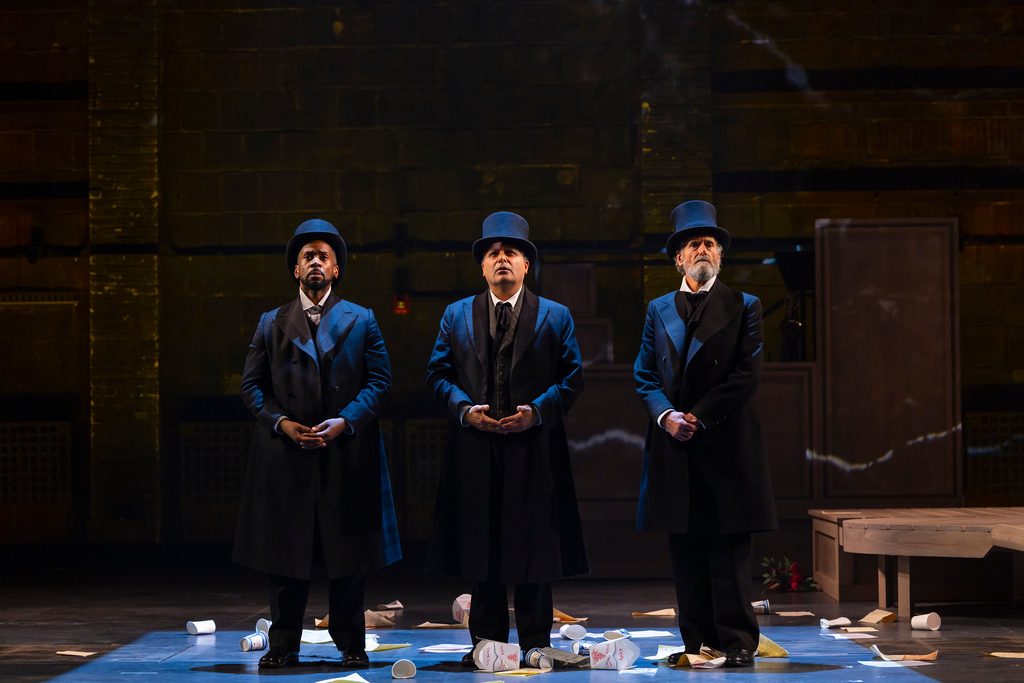
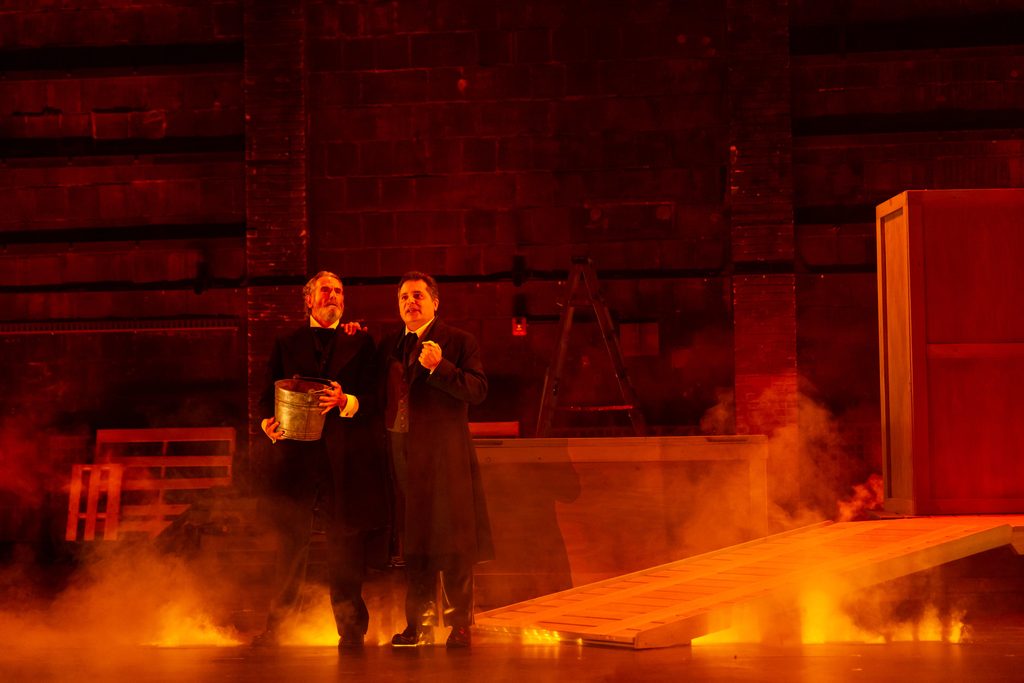
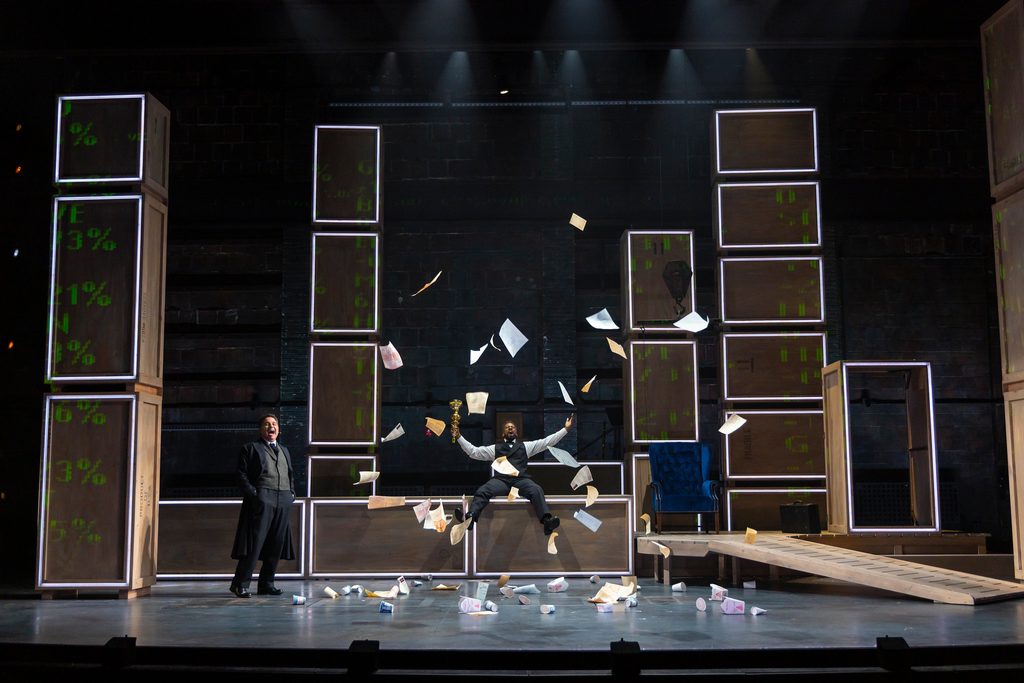
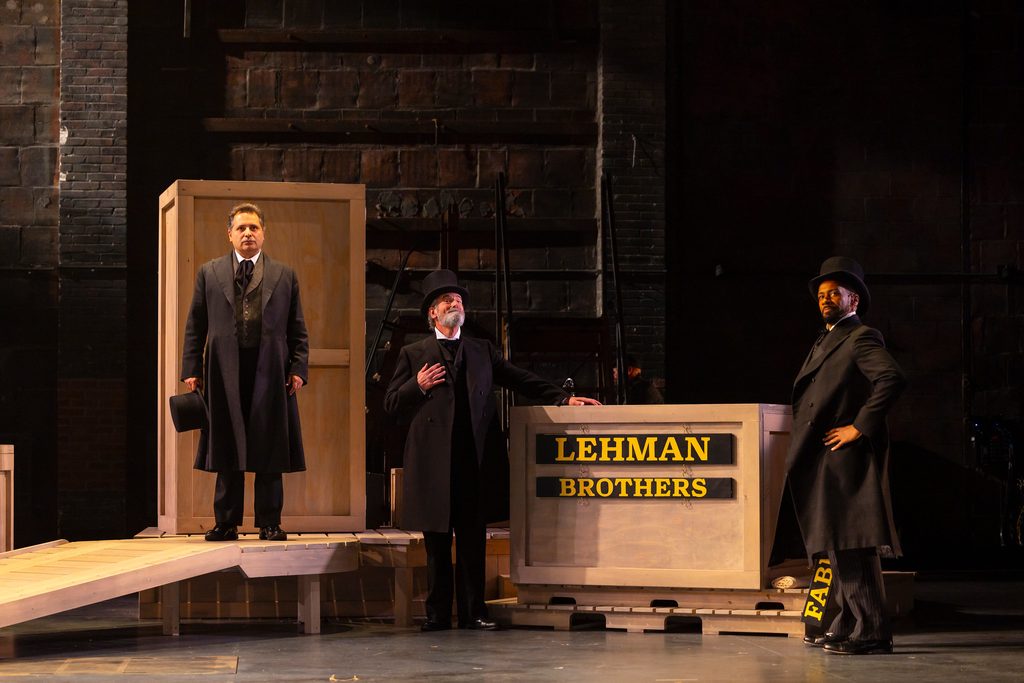
Joshua David Robinson, Firdous Bamji, and Steven Skybell in ‘The Lehman Trilogy’ at the Huntington. Photos by T. Charles Erickson

By Shelley A. Sackett

A lone and mournful clarinetist (Joe LaRocca) wanders across the stage of the Huntington’s theatrically astonishing “The Lehman Trilogy,” inviting comparisons in tone and content to the spirited drama “Fiddler on the Roof.” Steeped in ritual and Judaism, both stories trace what happens to a family when political oppression forces it to leave home, leading most of its members to emigrate to America.

For the dairyman Tevye ben Shneur Zalman, tradition and God are immutable and one; he will walk the straight and narrow walk wherever he wanders. For the Lehman brothers — and especially for their American progeny — tradition and God are moving targets, luxuries that morph with the exigencies of assimilation.

Yet the unobtrusive but ever-present LaRocca and his plaintive clarinet, saxophone, and flute melodies (original music by Mark Bennett) are constant reminders of the Lehmans’ past and the threads that, though frayed and denied, they share with Tevye and his ancestors.

“The Lehman Trilogy,” winner of the 2022 Tony Award for Best Play, assumes the 2008 demise of Lehman Brothers, the colossal bank whose collapse helped trigger the global Great Recession, is well known. Instead of rehashing that final piece of the story in detail, it wisely spends the bulk of its three and a half hours (two intermissions) chronicling the lesser-known details of the enterprise’s birth and extraordinary upward trajectory. 

The action opens on 9/11/1844 with the New York arrival of 21-year-old Henry (Steven Skybell, the standout in a cast of standouts) from Rimpar, Bavaria. He immediately sets sail for Mobile, Alabama, with little but his experience in trade and finance and his skill with cloth. Buoyed to be in the American South, where Jews are allowed to own land and where the caste system is built on race rather than religion, Henry quickly makes enough money as a peddler to fund his move inland to Montgomery, where he settles down and opens a dry goods store. Younger brothers Emanuel (Joshua David Robinson) and Mayer (Firdous Bamji) soon follow to this promised land of milk and honey and cotton where “a man can live to work, not work to live.”

Absent the violence, restrictions, and family restraints of Rimpar, the brothers create their own American version of the Lehman myth, tradition, and legacy. Their unbridled ambition, ingenuity, and taste for fortune lead them to adapt to the times and fill any gap they spot. 

The first Lehman Brothers sign is hung on a dry goods storefront that starts out selling fabrics and cotton and ends up as a powerful monopoly that buys raw cotton from antebellum plantations and resells it to factories in the North. The brothers ingeniously invent the profession of being a middleman, making their first fortune off the back of an economy dependent on slavery.

They also dip their toes into the business that will fuel their rise and fall. By offering credit to planters short of funds, they become cotton brokers, the first stage in their eventually becoming an investment bank.

Only after the cotton economy’s collapse in the wake of the Civil War do we hear a word of admonition or conscience about their connection to slavery (word is the lines were only added in response to criticism), and those are spoken by only one character, a local doctor.

“Everything that was built here was built on a crime,” he tells the brooding Mayer. “The roots run so deep you cannot see them, but the ground beneath our feet is poisoned. It had to end this way.”

Like a phoenix rising from the ashes, Lehman Brothers transforms and reinvents itself, helping the South as it reconstructs. Over the decades, it will survive two world wars, the 1929 stock market crash and the Great Depression, mutating from a brokerage house to an investment bank and finally to architects of subprime mortgages. The brothers relocate to New York and create the Cotton Exchange, Coffee Exchange, and Stock Exchange, all admirable strokes of business genius which pad their own pockets handsomely.

Structured in three parts, the play follows the Lehman family through 164 years of successive generations. We ride shotgun on the journey that proves even more tragic for the fabric and integrity of the heritage the three brothers so revered. Along the way, ethics, decency, and loyalty are qualities that vanish from the Lehman family tree, especially in the wake of the 1960s creation of a trading division run by non-family members. From boardroom savagery to talk of how to get people to buy things they don’t want with money they don’t have, the apples fall far, far from the ancestral tree.

And therein lie the bones of the play and the attraction of its world. At heart, this is a very human story about real, complicated people living real, messy lives. The story’s true tragedy and greater lesson is to be found in the degradation and demise of their familial — rather than financial — legacy.

When we first meet Henry, Emanuel, and Mayer in the 1840s, they are untarnished, wide-eyed boychiks, still tethered to their religious and family values. We bond with them. We root for them. Most all of, we care about them.

Henry is funny and sympathetic, his guilelessness rendering him accessible and charming. Mayer and Emanuel elicit similar reactions. When their children and grandchildren become characters from “Succession,” we cut them a little slack because we knew their parents and grandparents. Although we’re glad they’re not around to witness the havoc they wrought, we miss them.

Fleshing out this compelling story is the real reason “The Lehman Trilogy” is in that rare not-to-be-missed category: the breathtaking three actors (the entire cast!) who switch genders and ages to portray a score of characters. Starting out as the engaging Henry, Skybell is a delight as a tightrope walker, a crusty, old rabbi, a flirty divorcée, and others. Bamji is no less extraordinary as the youngest (and patronized) brother Mayer. His acting chops are on full display as the ruthless Bobbie, a blushing bride, a pouty toddler, and more. As the steady, stalwart middle brother Emanuel, Robinson clearly enjoys the looser reins when playing the later Lehman clan members and their gang of motley plunderers.

Equally praiseworthy are Perloff’s razor-sharp direction (the wrecking ball pendulum as 2008 draws nigh is brilliant), Brown’s efficient yet thrilling set, and Oi-Suk Yew’s use of projected images.

Much has been penned complaining about the play’s underemphasis on the role slavery played in the Lehmans’ initial success and the short shrift given to the firm’s 2008 nosedive crash and burn finale. My take is that these were not intended as deliberate snubs. Rather, they were omitted because they were peripheral to playwright Massini’s core purpose: to allow us a peek through the keyhole at the tale of three German Jewish brothers from Bavaria and the way they took America by storm.

The resulting epic — intimate and engaging — is a nonjudgmental study of the personalities, relationships, and events that shaped this one family’s shifting definition of the American dream.

Don’t be put off by the play’s length. The story is so engrossing, the production (and acting!) so remarkable that more than one patron was overheard commenting that they wished it had been even longer!

‘The Lehman Trilogy’ – Written by Stephano Massini and Adapted by Ben Power. Directed by Carey Perloff. Scenic Design by Sara Brown; Projection Design by Jeanette Oi Suk-Yew; Costume Design by Dede Ayite; Lighting Design by Robert Wierzel; Original Music by Mark Bennett; Co-Sound Design by Mark Bennett and Charles Does. Presented by the Huntington Theatre, 264 Huntington Ave., through July 23.

For tickets and information, go to: https://www.huntingtontheatre.org/whats-on/lehman-trilogy/

Ruth Rooks loves to share her passion for art

Ruth Rooks in her painting studio./SHELLEY A. SACKETT

By Shelley A. Sackett

Artist and art teacher Ruth Rooks has always portrayed whatever caught her interest at that moment. In the first grade, it was beets. In 1996, it was the external pageantry of the Big Dig and the internal world of hospitals. Lately, she has been experimenting with two totally different subjects: the view from her studio window and faces.

Along the way, the Swampscott resident and president of the Swampscott Arts Association has garnered a “drawer full” of prizes, including two from the Copley Society of Boston and many from the Marblehead Festival of the Arts and SAA.

“Every time I submit a piece of my work, I hope it will be well-received and am thrilled when it is publicly recognized,” she said.

Rooks grew up in Brighton in a three-story apartment complex, attended Sunday school in a one-room schoolhouse and played with her neighborhood friends on the wide sidewalk in front of the building and in the large backyard behind it. Although she had few toys as a child, she always had a box of crayons.

Her first encouragement came from her father, Harry Kemelman (author of the Rabbi Small detective series) and his writer friend, who conspired to send her three-year-old drawings to Life magazine after it published an article on modern art. Art in the Brighton public schools was uninspiring, limited in medium to crayons and in subject to classroom holiday decorations.

Moving to Marblehead in the seventh grade was a double-edged sword. On the one hand, Rooks was thrust into a small-town environment where most of the other kids knew each other since kindergarten. On top of that, her father drove her to school and she was late “EVERY. SINGLE. DAY!”

On the other hand, Marblehead schools championed the arts, and Rooks encountered media other than crayons along with encouraging teachers. In high school, Marion Brown, “famous as an artist and by ancestry,” introduced Rooks to watercolors, a medium (along with oil paints and gouache) she favors to this day.

At 15, she “stretched the truth” and applied as a 16-year-old to be arts and crafts director at Camp Columbia day camp. She got the job and stayed for eight years, loving every minute, even the rainy days when she had an hour to dream up a project for the more than 50 campers who would show up in her shop.

It was then she knew she wanted to teach art. “I always liked to make things,” she explained. “If I saw something in a store, I would try to make it with whatever was in the house. I don’t throw away anything that sparkles and seizes my attention.”

Ruth Rooks with one of her “Big Dig” paintings./SHELLEY A. SACKETT

Years later, while her husband, George, attended Columbia University Graduate School of Business, Rooks attended the university’s Teachers College to complete the coursework needed for Massachusetts certification. Her first job was at Revere Junior High School and she never stopped teaching art, from a juvenile court-ordered program in Boston, to the Jewish Community Center of the North Shore, the Marblehead Arts Association, and private classes in her home. Under the direction of Bennett Solomon, she started the art program at (now) Epstein Hillel School.

These part-time jobs afforded her flexibility to mother three children – Nina, Jennifer, and Jared – and to take classes with a variety of artists. Then, in 1993, she was diagnosed with lung cancer and her teaching career ground to a halt.

She recovered after two surgeries, but was “antsy. I needed a schedule,” she said, so she enrolled in three classes at DeCordova Sculpture Park and Museum in Lincoln: silversmithing, silver jewelry, and painting critique. Silversmithing hurt her wrist and she had more jewelry than she would ever wear. The painting class, taught by Tim Harvey (“one of the best painters I know and one of the harshest critics”), resonated in a way that would set her life’s creative agenda.

When her family moved to Swampscott in 1996, Rooks had room to set up a dedicated studio. Her first inspiration came from Boston’s Big Dig, the largest public works project in the country. “I loved everything about it – the cranes, the sand barrels, the colors of the equipment, the huge building structures. So I painted them!” she exclaimed.

Her paintings were included in many shows and won many prizes. “It was heady stuff,” she admitted.

But the restless Rooks soon tired of construction scenes and moved on to whimsical but undeniably hospital scenes based on another medical stay (“I can’t think of anyone who would buy one!”) and her current interests in landscapes and faces.

Although her father – whose “Friday the Rabbi Slept Late” won the Edgar Award for Best First Novel in 1964 and starred Art Carney in a made-for-TV adaptation – always wrote, Rooks was unaware of it as a child. What she does remember is his lecturing to her and her siblings. “We were his audience and he liked to expound. All that you read and learn in the Rabbi Small books, we heard one way or another,” she said. A creative writing teacher, he brought his work home and encouraged his children to “write a million words,” a lesson Rooks took seriously and enjoyed as a nightly exercise.

Rooks also takes the Swampscott Arts Association (swampscottarts.org) and her role as president seriously. To add some challenge for the more experienced artist, SAA holds one or two juried shows per year. It also sponsors two social events: an annual meeting/picnic at Rooks’ home, and a December holiday party.

The most special aspect for Rooks? “This is an organization where everyone seems to like each other!” she said with a smile. 

In DTF’s ‘Misery,’ Writing Like Your Life Depends on It Takes On New Meaning

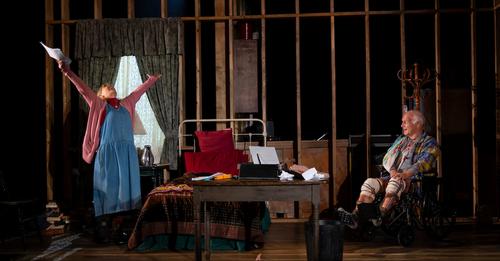
Kelly McAndrew and Dan Butler in ‘Misery’ at Dorset Theatre

By Shelley A. Sackett

Fans of Stephen King’s 1987 novel or Rob Reiner’s 1990 award-winning film, Misery, should not expect more of the same from Dorset Theatre Festival’s season opener, Misery. Playwright William Goldman has transformed the nail-biter of a scary suspense thriller into a lukewarm reminder of its prodigal self.

The excellent cast, director, and production team make the most of the script and gift the audience with an enjoyable evening of theater, but it was hard not to wonder what the same team might have cooked up had they had better-quality raw ingredients.

The plot remains pretty much the same. Annie Wilkes (a convincing and scene-chewing Kelly McAndrew) lives alone in her gothic family home in the remote backcountry of Silver Creek, Colorado. In one of her guest bedrooms lies the shattered body of best-selling romance novelist Paul Sheldon (Dan Butler), whose car went off the road in a snowstorm a few days ago. It seems Annie, his “number one fan,” just happened to be driving behind him when his car plunged into a ravine. Somehow, she managed to wrest his mangled body from the wreckage and bring it home to convalesce.

Paul awakens from the crash to Annie’s chirping chatter as she fills him in on the last few days. His two legs are badly fractured. She has set them to the best of her ability (Isn’t he lucky she’s a nurse!) and plied him with just enough drugs to ebb his pain while increasing his dependence on her.

Annie is more than an obsessed fan of Paul’s Misery series, about an orphaned 19th-century waif named Misery. She is also a lonely, middle-aged homicidal psychopath who talks to God, is divorced, wanders through her house surrounded by photos of dead relatives, and is an expert at lying and stalking.

As she slowly exposes the levels of her derangement and fixation on the Misery character, it becomes clear she intends to do more than just heal Paul. She intends to imprison him. Until death do them part.

Or at least until he writes another novel, which may just spare his life. Or, toys with Annie in this cat-and-mouse game in which she is recast as a lioness and he as a crippled cricket; then again, it may not.

In any case, write he must, as Paul’s life indeed does depend on it. Unbeknownst to Annie, his most recent installment in the Misery series kills off her beloved heroine. Coincidentally, the book’s release overlapped with Paul’s stay at Annie’s.

As his Number One Fan, Annie, of course, has her local bookstore save her all the new Paul Sheldon books. One day, she bursts into his room, triumphantly brandishing her copy.

Annie is excited beyond her wildest dreams. To be reading her idol’s latest Misery book while he is living in her house brings a creepy Little Bo Peep lilt to her gait. Paul knows (as do we) that Little Miss Sunshine will morph into Chucky the moment she reaches the end of the book. Exactly when that will happen is uncertain, but when it does, Annie’s rage will be of force majeure quality.

For his part, Paul is at first grateful, then wary, and finally determined to escape this real-life misery. His pithy, New York sophisticated banter turns less glib as he realizes the peril he is in and plots his escape, no easy feat for a man with two broken legs and an antique wheelchair for a getaway vehicle.

Goldman has provided Annie’s character with the best lines and the grisliest of backstories, and McAndrew milks it for all it’s worth. When Paul pretends to court her, luring her to a romantic dinner as part of his escape plan, Annie sheds her overalls and boots and shows up in a dress befitting Laura Ingalls from “Little House on the Prairie.”. It would be a touching scene if it weren’t for the sheen of Bette Davis’s Baby Jane character with which Annie powdered her nose.

Butler, a talented actor with star-studded credits, does the best he can with the cardboard Paul. Riw Rakkulchon’s revolving set creates a folksy, cozy country home that would be at the top of anyone’s Airbnb list. Thanks to dramatic lighting and sound design, the scenes come to creepy life. Kudos, too, for a system that allows the actors’ words to be easily heard and, more importantly, understood, something increasingly and annoyingly rare in too many Boston theaters.

It’s hard not to miss the intensity and tension generated by the Misery novel and film, but for those in the mood for a Misery-lite summer version that recasts the horror tale as a more whimsical melodrama, Dorset Theatre Festival has just the ticket.

‘Misery’ –Written by William Goldman based on the novel by Stephen King. Directed by Jason Gay. Scenic Design by Riw Rakkulchon; Costume Design by Fabian Fidel Aguilar; Lighting Design by Joey Moro; Sound Design by Daniel Baker/Broken Chord. Presented by Dorset Theatre Festival, Dorset, Vermont, through July 8.

For more information and to buy tickets, visit https://dorsettheatrefestival.org

A.R.T.’s Spectacular ‘Evita’ Raises the Bar on the Term, “Production Values”

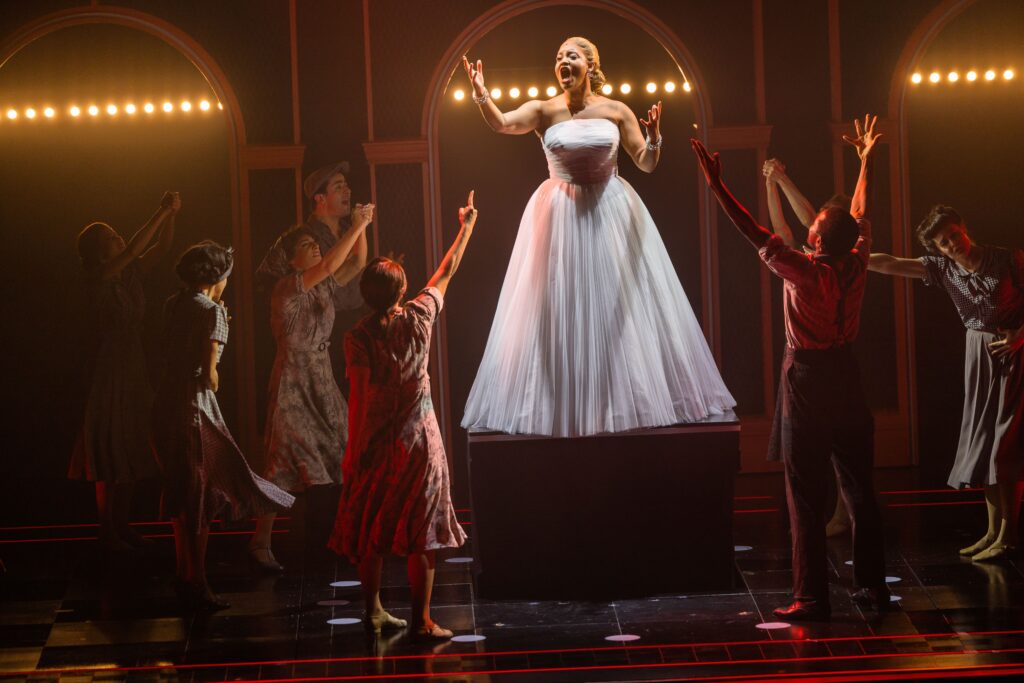
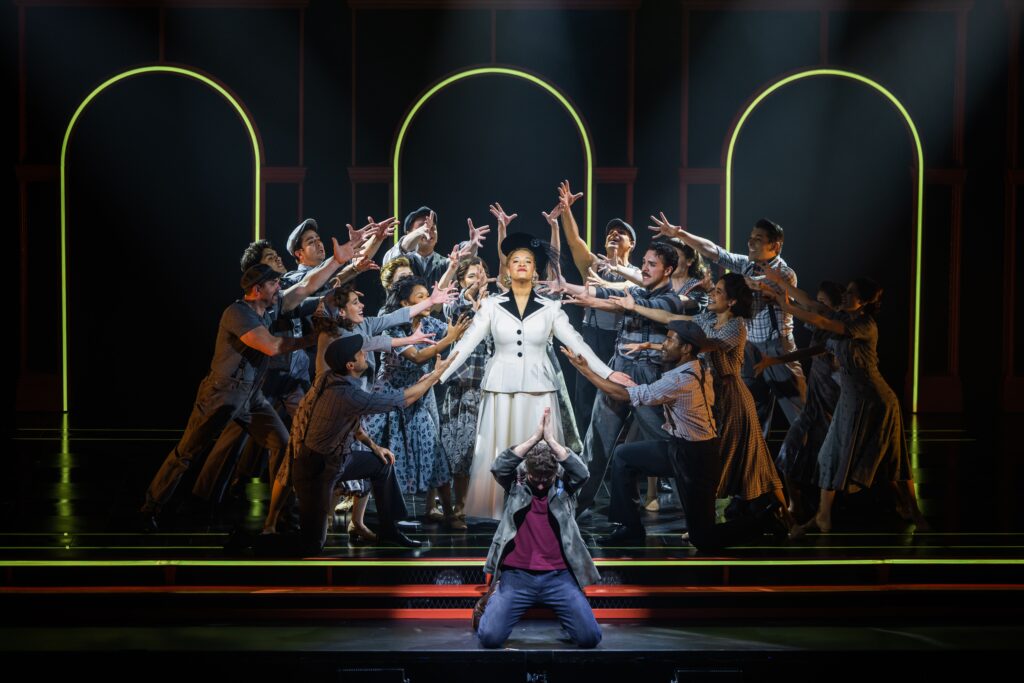
Shereen Pimentel (Eva) in Evita at American Repertory Theater. Photo Credits: Emilio Madrid.

by Shelley A. Sackett

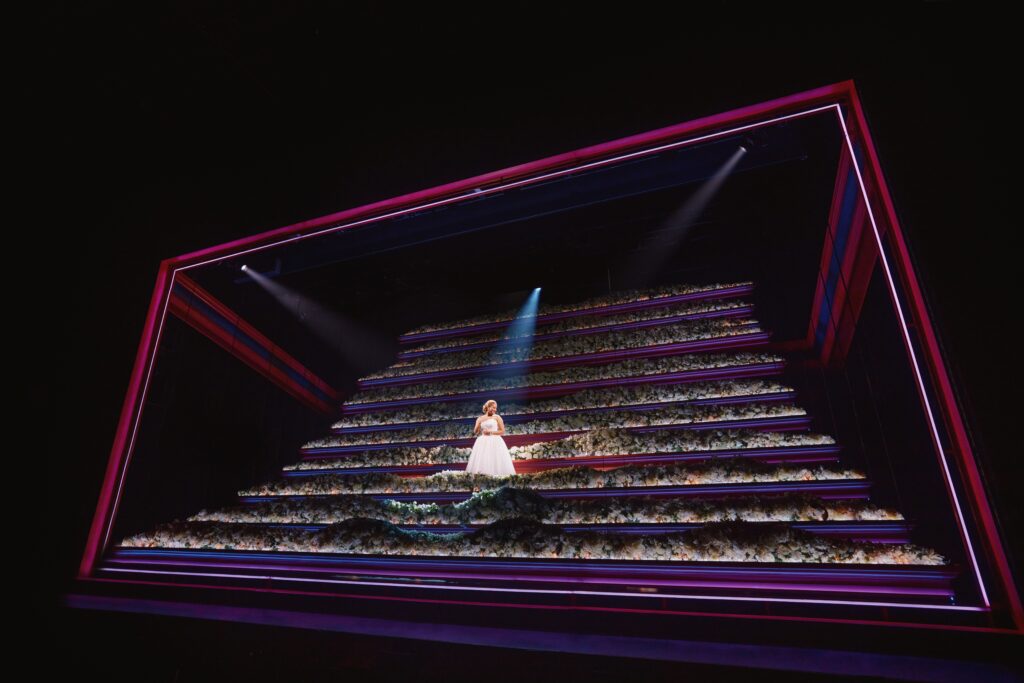
A cross between an iron maiden and a fairy princess gown, the replica of Eva Peron’s famous Dior strapless gown hangs suspended over a neon-framed stage. Like a mummified 3-dimensional diorama, the white bejeweled dress takes on a life of its own, its bodice both unsettling and beckoning, warning the audience: look but do not touch.

This riveting image, with its promise of an evening of highly stylized art and mixed messages, is the perfect introduction to the spectacularly staged ‘Evita’ now at the A.R.T.’s Loeb theater. Its production values — from exquisite costumes, choreography, scenic design, and lighting to orchestration and cast talent — can’t be overpraised. The most striking evening of theater to hit Boston stages in a while is, luckily and uncharacteristically, in town for a good, long run (through July 30), so there is plenty of time to snag a ticket and enjoy.

When the scrim lifts and the real show begins, the visuals only get better. A backdrop of silhouetted men and women in gorgeous haute couture hats and heels suddenly breaks into song and dance, like a painting come to life. Cinematic and magical, the effect is thrilling.

Told in vignettes, the storyline is anchored by Eva Duarte Perón and her rise from poverty in rural Argentina to reigning first lady and beloved titular patron saint. Eva’s journey is complicated and full of contradictions. While shamelessly sleeping her way to the top and ruthlessly trampling anyone who gets in her way, she also champions the poor, the disenfranchised, and the everyday working class. Voracious in her personal ambition and an original “mean girl,” she also cares deeply for her beloved country and its people.

Critical observer and cynic Che (the standout Omar Lopez-Cepero) narrates this legend, filling in the fairytale with unflattering morsels of on-the-ground reporting. In his opposing version, Eva’s deceitfulness and egomaniacal greed overshadow her legacy of charisma and beneficence.

Shereen Pimental soars as the larger-than-life Eva, transfixing the audience with her vocal range and regal presence. She commands attention every moment she is on stage, whether as a naïve 15-year-old in search of an acting breakthrough or the haughty, bejeweled dictator of fashion bullying all who don’t kowtow to her. We may feel ambivalent about her, but we can’t take our eyes off her either.

Under Sammi Cannold’s savvy direction, Emily Maltby and Valeria Solomonoff’s sassy, authentic tango choreography, and the exceptional performances by Pimentel and Lopez-Cepero, it’s almost possible to overlook the major drawback of the evening — namely, the play itself, which is more disjointed abstraction than linear storytelling. Spawned from a 1976 concept album by composer Andrew Lloyd Webber and lyricist Time Rice, the musical is short on character development and plot and long on untuneful, long-winded operatic numbers (many overamplified and difficult to decipher). Other than “Don’t Cry for Me, Argentina,” the songs blend, leaving behind no choral snippets that loop in one’s memory banks after the show’s end. Yet “Evita” is not meant to be about traditional dramaturgy. Like its namesake, it is about splash and sparkle and smoke and mirrors, and from the moment the audience lays eyes on the suspended disembodied gown until the orchestra sounds its final note, A.R.T.’s production is an unapologetic feast for all the senses. Highly recommended for anyone looking for an evening of pure epic entertainment.

Lyrics by Tim Rice. Music by Andrew Lloyd Webber. Directed by Sammi Cannold. Choreography by Emily Maltby, Valeria Solomonoff; Music Direction by Mona Seyed-Bolorforosh; Scenic Design by Jason Sherwood; Costume Design by Bradley King; Lighting Design by Bradley King. Presented by the American Repertory Theater in Association with Shakespeare Theatre Company at the Loeb Drama Center, 64 Brattle St., Cambridge through July 30.

For information and tickets, go to: https://americanrepertorytheater.org/

We All Walk The Trail of Tears in ‘And So We Walked’

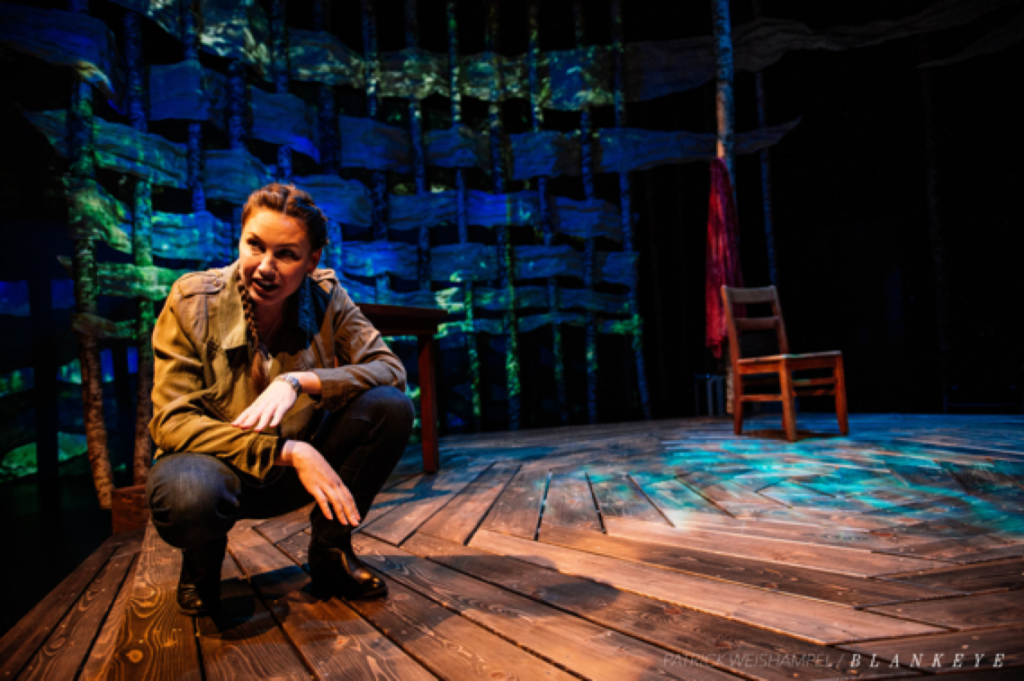
DeLanna Studi in “And So We Walked.” Photos by Patrick Weishampel/Blankeye

By Shelley A. Sackett

When the pre-written announcement acknowledging Indigenous and Enslaved Peoples is read prior to every local theatrical production, it often feels disconnected from the show that follows. Not so with Cherokee actress, artist, and activist DeLanna Studi’s stunning one-woman autobiographical presentation, ‘And So We Walked.”

For 150-minutes (one intermission), we shadow Studi’s and her ancestors’ lives as members of the Cherokee nation. She and her full-blooded 70-year-old Cherokee father (her mother is white) spend six weeks retracing the Trail of Tears, that noxious route trudged by over 100,000 Native Americans in the 1800s after they had been forcibly removed from their homes by the U.S. government. It is the same path her great-great grandparents took during the relocation of 17,000 Cherokee people.

The audience learns how tens of thousands of Native Americans died in retention centers, and many more by way of the trail. The survivors never received the $5 million sale price of their land, nor promised reparations.

“Every great story has truth in it and that truth is dangerous,” Studi explains. “The Cherokee story is written in blood.”

She peppers the evening with anecdotes, history and geography lessons, and terrific metamorphoses into a dozen characters, embodying their subtle physical and dialectic idiosyncrasies. She is a riveting presence on stage; maintaining audience interest for over two hours is no small feat, one the opening night audience acknowledged with its standing ovation.

The simple, elegant set and judicious choice and use of props captures the trail’s atmosphere, straddling between contemporary and pre-removal Cherokee life. Large pieces of white horizontal fabric reflect a variety of projected images, conjuring interior and exterior spaces. Studi is a magician at using the set to invoke a school house, Cherokee Council House, SUV and campfire gathering.

She covers a lot of ground, delving into factual topics such as the forced “reeducation” of Native children in white boarding schools from the 1860s until the 1980s. She also tackles the personal, emotional and cultural issues surrounding what it means to be a Native American in contemporary America. She feels isolated and tribeless, a bridge between two worlds, neither of which she can ever fully claim as home.

Studi replays the scene when, as a young school girl, her teacher announced that “Indians are extinct.” Because she was only half Cherokee, the elders made her sit alone at tribal ceremonies. Later in life, when auditioning for acting roles, she was told she was too white for Native parts and too Native for white roles.

Her father tries to reassure her that blood quantity is irrelevant; she should be proud of her heritage, standing tall and strong as a Cherokee woman.

“Being Cherokee isn’t about blood,” he tells her. “It’s knowing who you are. And keeping it alive.”

On her own, personal trail of tears, Studi discovers who she really is and what her rights and responsibilities are as one of the very few whose ancestors survived the Trail of Tears. Searching for her place and identity, she uncovers her essence and where she fits in.

Studi is especially effective when she addresses the audience directly, letting them in on a joke or expressing a particular emotion on her manipulable face. Although her story is replete with loss, victimization and trauma, she has seasoned it generously with humor and wit.

After their journey, her father asks, “Didja get what you came for?” If ‘And So We Walked’ is representative of what Studi gained, I’d say we all came out winners.

For tickets and information, go to: https://artsemerson.org/

‘And So We Walked’ — Created and Performed by DeLanna Studi. Directed by Corey Madden; Scenic Design by John Coyne; Costume Design by Andja Budincich; Lighting and Projection Design by Norman Coates; Sound Design and Original Music by Bruno Louchouarn. Co-represented by Octopus Theatricals and Indigenous Performance Productions. Presented by Arts Emerson at the Emerson Paramount Center, 559 Washington St., Boston through April 30, 2023.

Deb Schutzman to become executive director at Swampscott’s Congregation Shirat Hayam

Deb Schutzman / STEVEN A. ROSENBERG/JOURNAL STAFF

By Shelley A. Sackett

SWAMPSCOTT — About a year ago, Congregation Shirat Hayam President Ruth Estrich knew the synagogue would be hiring an executive director. The board of directors had included the salary in their budget and generated the revenue to fund it.

The Swampscott synagogue didn’t have to travel far to find the perfect fit: Deb Schutzman has worked at Temple B’nai Abraham in Beverly for 18 years, the last 15 as its executive and education directors. B’nai Abraham is just over 7 miles from Shirat Hayam.

It has been a while since Shirat Hayam had an executive director, and Estrich, a retired corporate executive, knew what the synagogue needed.

“We were looking for a seasoned professional, someone who would be capable of leading our employees, working collaboratively with our clergy, being the face of our congregation with our congregants, and supporting our board and our volunteers,” Estrich said.

In addition, the synagogue wanted someone who would honor Shirat Hayam’s history; create unprecedented growth for the future and attract new members; increase revenue; and provide all segments of the community with a place to call home.

“A piece of cake!” Estrich said with a laugh.

The next step was to craft a contemporary and comprehensive job description. The Shirat Hayam human resource committee – after gathering information from congregational stakeholders – created a draft. They vetted it with two national organizations: the United Synagogue of Conservative Judaism – the major congregational organization of Conservative Judaism in North America – and the North American Association of Synagogue Executives.

Estrich heard about Schutzman through “good old-fashioned networking.” They connected online and set up an in-person meeting.

“I knew immediately and absolutely our search was over. It felt bashert [Yiddish for “meant to be”], like the missing piece of our puzzle was in place,” she said.
Schutzman, who was born in Lowell and lives in Gloucester, brings expertise in community building, facility management, and strategic planning. She also has a deep love for the Jewish community of the North Shore. During her years as executive director at B’nai Abraham, she participated in hiring a new rabbi, a successful merger, increasing adult education programming, adding music to services, and launching a capital campaign.

While Schutzman loved her tenure at B’nai Abraham, she was ready for a change. “Shirat Hayam faces the same challenges as other synagogues. We all need to get people back into the building,” she said.

Although she acknowledged that the pandemic made attending services virtually both easier and more acceptable, “Nothing compares to being physically together. Shabbat is just not an ordinary experience at Shirat Hayam. There is an energy when we are physically together that makes it very special.”

One of her greatest joys at B’nai Abraham was her involvement with the religious school, and she especially loves watching kids come into the sanctuary at the end of Shabbat services and high-five Rabbi Michael Ragozin before chanting the blessings over wine and challah.

“Children are our greatest gifts. While teaching them, we are reminded about what is truly important and meaningful in life. The value of that teaching experience for me was priceless,” she said.

As executive director, Schutzman’s first focus at Shirat Hayam will be assessing its staffing needs. “Shirat Hayam has an incredible staff who have worked tirelessly over the past few years to hold things together during very unusual circumstances,” she said. As the congregation turns the corner on the pandemic and its ramifications, the needs of the community require reevaluation.

“Synagogue life has changed. How we communicate and interact is different now, and we need to ensure that we have the people in place with the skills to meet those needs,” she said.

Schutzman’s longer-range goals are to stabilize the operations side of the synagogue; improve communication; training and support for staff; address deferred facility maintenance; and plan for the future.

“I want to help fill the building not just for services, but for educational and social programming, life cycle events, and celebrations,” she said.

Schutzman attended Hebrew day schools from kindergarten through ninth grade. She lived in Israel for two years during high school and graduated from the New England Academy of Torah in Providence. She studied business administration at Stern College of Yeshiva University in Manhattan and UMass Lowell, after which she spent 12 years in retail store management for Macy’s and Filene’s Basement before joining B’nai Abraham.

She is the proud mother of Benjamin and Andrew and loves kayaking on the Annisquam River from May though November, “especially at sunset.”

With her term as president nearing its end, Estrich will be leaving on a personal high note with Schutzman at the organizational helm. “I’d say that with Rabbi Michael, Cantor Sarah and Deb, we’ve got the dream team and the sky’s the limit. I can’t wait to see where they take us,” she said.

Sassy, Somber and Sensual — Paul Taylor Dance Company Covers All the Bases

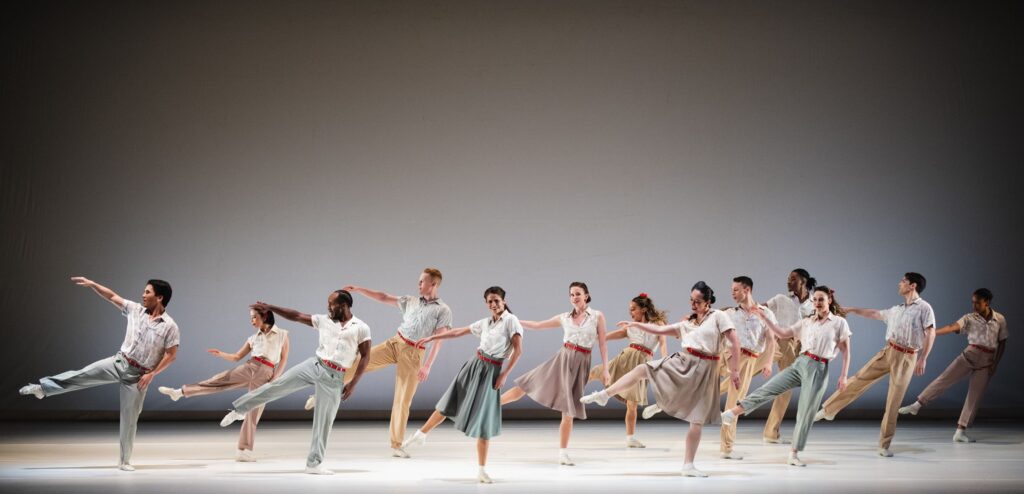
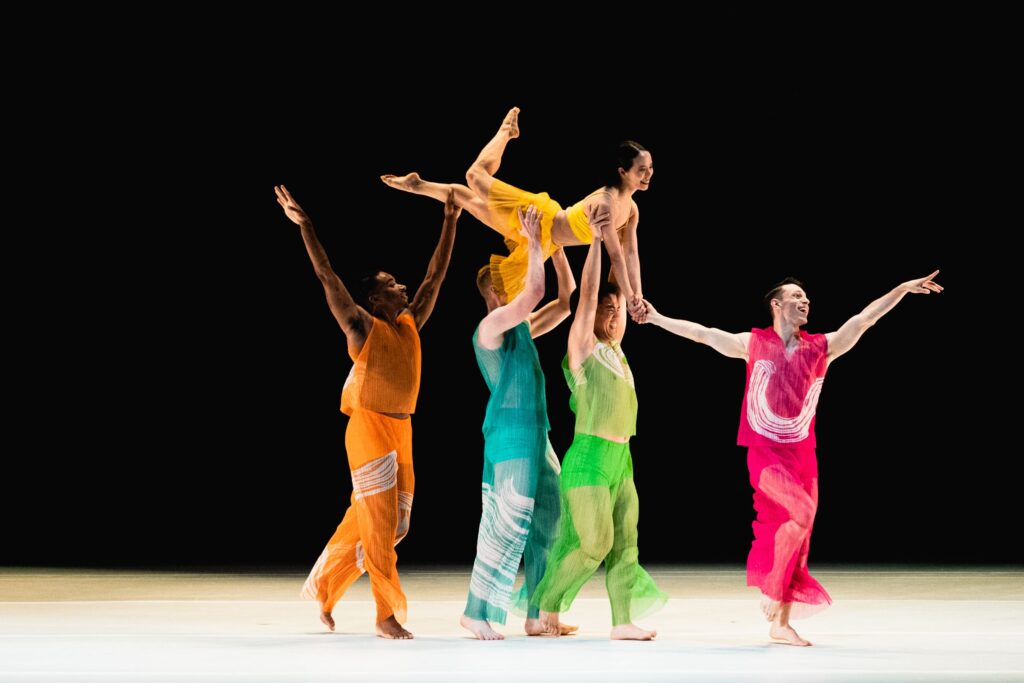
Full cast of Paul Taylor Dance Company at Boch Center — Shubert Theatre. Photos by Ron Thiele

By Shelley A. Sackett

Paul Taylor, whose imagination, emotional breadth and sheer physical ability helped shape and define the purely American art form known as modern dance, never fails to amaze and enchant. The thunderous opening night applause from the standing audience shows that, if anything, the company has only increased its seductive power over its Boston fans.

The three pieces (two by founding Artistic Director Paul Taylor), separated by intermissions, provided an evening of athletic exuberance and emotional depth, choreographer Taylor’s trademark, as well as the unabashed joy of the opening number, Amy Hall Gardner’s “Somewhere in the Middle,” a fun and sassy piece set to a selection of classical jazz music.

The evening opens on Donald Martiny’s jazzy set of textured paint squiggles hanging against a black backdrop. Count Basie’s toe-tapping music sets the mood for the ensemble to burst onto the stage, clad in Mark Eric’s yummy pastel costumes (briefs and bras overlaid with sheer, shimmering fabric). They tumble, leap, roll on the floor with nymph-like speed and charm, matching Ella Fitzgerald’s famous scats and bends with fancy foot and arm work.

Gardner’s piece makes excellent use of the ensemble while also allowing for individual dancers to grab the spotlight. A pas de deux slows things down, the romantic couple engaging in what my companion referred to as the “hunt” of search, attract, repel and retreat. Softer lighting (by the talented Jennifer Tipton) and sexier movements complement the darker, more fitted costumes.

Nonetheless, the overwhelming effect of this selection was of sweet, campy, happy couples who danced their way through dream-like vignettes.

Taylor’s “Brandenburgs” sets an entirely different tone. Johann Sebastian Bach’s Brandenburg Concertos nos. 6 and 3 are from the Baroque era, that period that bridged the Renaissance, with its emotional reawakening, and the Classical era with its return to the staid and formal values of antiquity.

Taylor and costume designer Santo Loquasto reflect the formality and romanticism of this refined early eighteenth century time.

The curtain lifts to a sculptural tableau reminiscent of the figures atop the piece’s namesake gate in Berlin. Slowly, subtle lighting shifts to reveal three women (muses?) and a man (Apollo?) standing in a circle of five male dancers.

The costumes are bejeweled and traditional, regal and lovely but, compared to the other two pieces, uptight and unexciting. The choreography is likewise dignified and constrained. Under Tipton’s thoughtful lighting, the dancers’ skin is luminescent, glowing in silhouette against a matte black backdrop. They shimmer in what feels like slow motion, capturing the sheer genius of Taylor’s talent at spinning breathtaking magic from simple hand gestures.

With the final piece, Taylor’s “Company B,” the evening is back to its opening cheeriness, albeit with a layer of complexity and subtlety not present in Garner’s work. Set during Second World War time, the mood is established by a soundtrack of songs sung by the Andrews Sisters meant “to express typical sentiments of Americans during WWII.” Crafted as a series of interconnected sketches, the dancers shine both collectively and individually.

Loquasto’s costumes are nothing short of adorable. White anklets and sneakers, red belts (for men and women), rolled up button down shirts, wide khakis and twirling skirts feel sock hop cute. The youngsters flirt, smooch and jitterbug, ponytails and skirls flying.

Taylor also conjures up a sense of the darkness of the times. There are silhouettes of men marching to war, couples uncoupling and lovers abandoned. This is a gorgeous, multifaceted and complicated piece, rendered sublime by the gifted cast of dancers.

The highlights are the eight solo numbers, which finally give the audience a chance to appreciate the individual personalities of some of the dancers. All shine, but there are three true stand outs. Alex Clayton is the mannerly guy next door in “Tico, Tico” until he is not. John Harnage, in Boogie Woogie Bugle Boy (of Company B), lights up the stage.

But the real show stopper (who pops in every piece, even when she is one of many in the chorus) is Madelyn Ho in “Rum and Coca-Cola.” Spritely, impossibly lissome and exquisitely cute, it is difficult to look away from this beguiling dancer.

Even if modern dance isn’t your “thing,” don’t miss the magic of this high caliber, delightful and uplifting performance. There’s still time!

For tickets and information go to: https://www.celebrityseries.org/productions/paul-taylor-dance-company/

Paul Taylor Dance Company – Artistic Director Michael Novak; Founding Artistic Director – Paul Taylor; Resident Choreography – Lauren Lovette; Lighting Designer – Jennifer Tipton; Costume Design – Donald Martiny; Costume Design – Mark Eric and Santo Loquasto. Presented by Celebrity Series of Boston at Boch Center — Shubert Theatre, 265 Tremont St., Boston, through April 16.

‘Clyde’s’ serves up redemption, one sandwich at a time

Harold Surratt and April Nixon in the Tony Award nominated “Clyde’s.” / KEVIN BERNE

By Shelley A. Sackett/JEWISH JOURNAL

Tikkun Olam, as explained in the Mishnah, is a Jewish concept defined by acts of kindness performed to perfect or repair the world. There are innumerable ways for us to do tikkun olam in our daily lives, each one with the potential to change everything for everyone.

Although it’s unlikely playwright Lynn Nottage had this concept in mind as she wrote the Tony Award-nominated comedy “Clyde’s,” now in production at the Huntington through April 23, its message runs throughout her play.

The setting (and what a set it is!) is Clyde’s, a truck stop café near Reading, PA. More than a way station for the road-weary, it is also a shelter for its four employees, all felons. For the three recent arrivals who need to show a weekly paycheck to maintain parole, it is also their only shot at getting back on track after derailment. Montrellos (Monty), Clyde’s elder statesman, role model and Zen master, supervises this crew.

Under the annihilative command of Clyde, the owner, achieving that goal is an uphill battle.

The play opens with Clyde and Monty (dressed in bright dashiki and kufi) in mid-conversation. He begs her to taste his latest creation, a sublime twist on the grilled cheese sandwich. She blows cigarette smoke in response. Wearing a glow-in-the-dark orange waist-length wig and exterior black corset, she looks like a cross between a deranged Tina Turner imposter and an S&M dominatrix. The effect is terrifying.

Instead of tasting the sandwich, she uses it to crush out her cigarette, just as she relentlessly snuffs out any hint of hope or happiness she senses smoldering.

The staff live in fear of her temper and she taunts them sadistically with threats to make up a parole violation and report them to the police. Behind the kitchen’s swinging door, without her lurking, they are free to connect and actually enjoy their work. Cautiously, they relearn how to trust, revealing what landed them in the slammer. Letitia, a quick-witted, sassy single mom, broke into a pharmacy to steal unaffordable seizure medicine for her daughter. Rafael, a playful recovering addict, tried to rob a bank with a BB gun while high. Jason, Clyde’s only white employee, is covered in white supremacy tattoos and fresh out of prison for assault.

In his role as mentor, Monty is kind, sage and committed to helping his charges survive their difficult transition. Although he doesn’t reveal why he served time until the play’s end, he has clearly walked the same walk.

His trick is the quest to create the perfect sandwich, that “most democratic of all foods.” Sandwiches can be more than the quotidian ingredients they slap between two pieces of bread for the café’s clientele, Monty counsels. They can reflect their creators’ dreams and truths. They even have the magic power to unlock the gate to their salvation. He is living proof.
The others bite, joining him on his pilgrimage. They bond over shared imaginary recipes, light-heartedly chanting ingredients like tantric mantras. After hours, each secretly works out combos that might earn Monty’s approval and, by extension, launch them toward a sense of self-worth.

Clyde doesn’t see sandwiches (or anything else) through the same rose-tinted lenses as Monty. Although she, too, was imprisoned, empathy and tikkun olam hardly drive her to hire only ex-cons. Rather, she uses them as cheap labor to populate her own sort of jail where she reigns as warden to these “loser” ex-prisoners who float in painful limbo between “real” prison and the ersatz one she has created.

Against great odds, and with Monty’s critical help, her employees ultimately free themselves from her grip by banding together and refusing to follow an order they just cannot abide. Although what triggers their rebellion is on its surface comedic, Nottage deftly handles this turning point moment, plumbing it for deeper beauty, poignancy and strength.

Nottage also has a gift for comedy, and under Taylor Reynold’s tight direction, her zingers are laugh-out-loud funny. The terrific actors playing the kitchen crew are an airtight ensemble that breathe life into their parts.

Unfortunately, the same is not true of the unnuanced Clyde. To be fair, Nottage has created a cardboard caricature, giving the actress little to work with. The distraction of her dozen or so wig and outfit changes only emphasizes the playwright’s missed opportunity in not fully fleshing her out.

Which is too bad, because Clyde exemplifies what can happen when, in pursuit of financial gain and raw power, we lose sight of what really feeds and sustains us. Luckily, her crew has Monty, with his belief in the restorative power of the sandwich, to lead by example and show them a better way.

For more information and to buy tickets, visit www.huntingtontheatre.org.