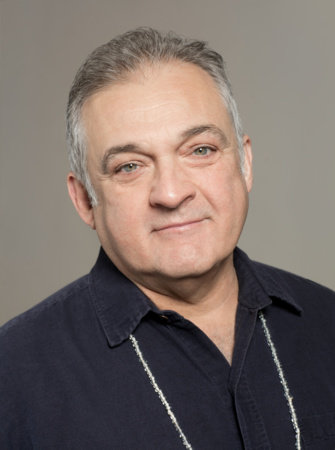
Saul Rubinek recasts Shakespeare in the provocative ‘Playing Shylock’

Saul Rubinek in “Playing Shylock.” | DAHLIA KATZ

By Shelley A. Sackett

Ask a Jewish audience what their first reaction is when they think about Shakespeare’s “The Merchant of Venice,” and chances are they will mention the negative portrayal of Jews by the Venetian moneylender and play’s principal villain, Shylock. Long considered a slur against Jews, the very term was condemned by the Anti-Defamation League as antisemitic as recently as last July, when Trump described bankers as “shylocks and bad people” during a rally in Iowa.

Saul Rubinek flips that ingrained stereotype on its head in “Playing Shylock,” the provocative and powerful solo play he stars in and helped develop with playwright Mark Leiren-Young and director Martin Kinch. The play premieres in New York at Polonsky Shakespeare Center and runs through Dec. 7.

Rubinek plays a fictionalized version of himself. The actor is forced to stop “The Merchant of Venice” because his portrayal of Shylock – as Rubinek, a Jewish man – has angered members of the Jewish community, who have successfully petitioned for the production to be shuttered because it “endangers the well-being of some in our community.”

During the play, Rubinek uses the show’s cancellation as a launching pad from which to engage the audience on thorny issues like antisemitism, institutional self-censorship and cultural appropriation, and stereotyping. He challenges the audience to wrestle with whether the theater might be right to consider the current climate of antisemitism or whether it’s more dangerous to censor a play than to stage it.

“Isn’t Shylock part of the history of antisemitism? The most famous Jewish character in theater? And isn’t it important to own it, talk about it and show it?” Rubinek rhetorically asked the Journal over Zoom from his California home. Contrary to popular perception, he posits that “Shylock is not a caricature. He is the first three-dimensional Jew in the history of English literature.”

He details how in 1595, when Shakespeare’s play was first produced, there had been no Jews in England in the 300 years since King Edward I issued the Edict of Expulsion in 1290 (ironically on Tisha B’Av). Jews were portrayed as clowns, puppets with horns, or a devil in religious pageants. Audiences threw figs and oyster shells at them. “They were used to thinking of Jews as not being people because they had never actually met one,” Rubinek said.

Christopher Marlowe’s “The Jew of Malta,” first produced in 1592 (three years before Shakespeare), “sold tickets like Taylor Swift” and was the first antisemitic play where a Jew was played by a living actor. Its Jewish character was a one-dimensional Machiavellian villain. Shakespeare, on the other hand, was the first playwright to humanize his Jewish character.

Although Shylock only appears in five scenes, the character and his lines are synonymous with the play, even though he is not the star (the Italian Antonio is the eponymous merchant) and is deemed vile for demanding the pound of flesh he is owed on a defaulted loan.

Rubinek points to Shylock’s most famous speech: “Hath not a Jew eyes? Hath not a Jew hands, organs, dimensions, senses, affections, passions? Fed with the same food, hurt with the same weapons, subject to the same diseases, healed by the same means, warmed and cooled by the same winter and summer, as a Christian is? … And if you wrong us, shall we not revenge? If we are like you in the rest, we will resemble you in that … The villainy you teach me, I will execute, … but I will better the instruction.”

“The point of that speech,” he said, “is not a plea for humanity;” rather, it is a declaration of a right. “We are human, just like a Christian. And if we are like you in other ways, are we not like you in villainy? Whatever you do to me, I will do back to you tenfold. That is what the character is about. That is what the speech is about. And that is why it’s ageless and relevant.”

In other words, according to Rubinek, Shylock is telling his Christian audience, “If you don’t like what you see in me, look in the mirror to see where it comes from.”

The 77-year old actor, best known for television (“Frasier,” “Billions,” “Mrs. Maisel,” “Schitt’s Creek,” “Hunters”) and films (“Unforgiven,” “True Romance,” “The Battle of Buster Scruggs” and over 60 other features), co-founded and was actor/writer/director at the Toronto Free Theatre (now Canadian Stage). He has continued his work in theater in Canada, the U.S. and Europe.

Rubinek’s love for the theater and storytelling is deeply rooted in his heritage. His parents survived the Holocaust by hiding in a Polish farmhouse for 2 1/2 years. (In 1986, he took his parents back to Poland for a reunion with these farmers and created a book, play and documentary film about the experience). He was born in a refugee camp in Germany after World War II. His father, who was a Yiddish theater actor before the war in Lodz, ran a Yiddish repertory company in Germany before the family immigrated to Canada when Rubinek was 9 months old. He spoke Yiddish and French before learning English, and at age 8 started acting in English on the stage.

Though he attended Talmud Torah and Jewish summer camp and grew up in a world of Talmudic discussion, his Jewish upbringing was secular. “I have never been fond of any organized religion, but I love the Jewish traditions. They matter to me on a deep level even though I don’t go to synagogue,” he shared. He, his wife and his children, who are half Scottish/English, celebrate the Jewish holidays and participate in, for example, tashlich. “I grew up without any grandparents, but with these rituals. They are very meaningful to me,” he added.

Rubinek recalled that his father always wanted to portray Shylock on the stage, but “Hitler stopped him. I always wanted to play my father playing Shylock in his heavy Jewish accent,” he said. One of the play’s most moving scenes is when the Rubinek character, clad in traditional Hassidic garb and channeling his father, recites Shylock’s famous “Does a Jew not bleed?” speech in Yiddish.

In the play (and during this interview), Rubinek tells the story of his 16-year-old father confronted by his father (Rubinek’s Zayde) after he had cut off his payos (sidelocks) so he could continue in the Lodz Yiddish theater he so loved. “My Zayde asked, ‘How could you go so far away from God? How can you betray your family, your people, like this?”’ Rubinek said.

His father explained that he was doing a Yiddish play by a great writer about a Jewish family and their hopes for their children. Rubinek continued, “My father said to his father, ‘Theater – if it’s good – the audience sees themselves on the stage. They laugh. They cry. And for a few minutes each night, they don’t feel so alone.’ And my Zayde said, ‘Maybe it’s not so far from God after all.’

“That’s why I wrote the play,” Rubinek said, with an emotional catch in his voice and the glimmer of a tear in his eye.

For more information, visit https://tfana.org/about/polonsky-shakespeare-center

Bearing witness: 85-year-old Holocaust survivor relives her childhood in the docudrama, ‘Hidden: The Kati Preston Story’

By Shelley A. Sackett

Kati Preston being interviewed for the film. | KELLY FAN

On Sept. 20, the 41st Boston Film Festival will host the world premiere of “Hidden: The Kati Preston Story.” The 75-minute film is a powerful docudrama that follows the extraordinary journey of 85-year-old Holocaust survivor Kati Preston. Exceptionally well-edited, directed and produced, it retells the story of one person’s resilience and survival in the face of a society descending into antisemitism, authoritarianism, dictatorship and tyranny.

The film opens on a bucolic country scene with a horse peacefully grazing near a white clapboard house. Smoke spirals invitingly from its chimney. Inside, a woman sits at her desk, turning the pages of a scrapbook of sepia-toned family photos. “Everybody here is dead. I’m the only one left,” says Kati Preston. “It feels so strange because I feel like I’m in exile. The world I come from is gone. When I die, nobody will remember these people because I’m the last person who bears witness.”

Seamlessly, the screen melts into 43 seconds of black-and-white archival footage that shows Jews living openly Jewish lives followed quickly by scenes of them being rounded up, transported, beaten and murdered. The last shot is of crematoria ovens, doors wide open, displaying their interiors of ashen, bony remains. Mercifully short, these devastating images are a reminder of the lightning speed and crusading evil that are the backdrops to Kati’s story.

Based on Kati’s award-winning graphic novel, “HIDDEN: The True Story of the Holocaust,” the film is narrated by Kati and features reenactments of her story. In 1943, her hometown of Nagyárad, Hungary (now Oradea, Romania) boasted a thriving Jewish community with synagogues, a Jewish hospital, Jewish schools and Jewish coffee houses. Despite a diverse society that welcomed religious Jews, Roma and Muslims, Jews remained insulated, not wanting to assimilate.

Kati’s childhood was one of luxury. Her mother ran a dressmaking business with 40 employees and her father was a carp wholesaler. At 5 years old, she was beautifully dressed, wore curlers to bed every night and enjoyed the comforts of maid and governess. Her father was Jewish, her mother a Catholic who converted. Although they were secular Jews, Kati remembers her mother lighting Shabbat candles every Friday night.

She also remembers going to the opera on Sundays with her Catholic grandmother. Those outings routinely ended with the two of them sitting at a bar and her grandmother slugging down shot after shot until she was drunk.

Kati’s father was playful and happy-go-lucky. Her mother, whom Kati feared and loved but “did not like,” was more in control and controlling. To make sure Kati was trained to be a proper young lady, she hired Fraulein, who “terrified children into behaving instead of educating them.” One tool in Fraulein’s toolbox was her book of Grimm’s Fairy Tales, which was used to teach German children the dangers of misbehavior through traumatic stories. These included a child having his thumbs cut off for thumb-sucking and a girl who burns to death for playing with matches.

Interspersed among the narrative reenactments are interviews with Tom White (Holocaust and genocide educator), Dr. Martin Rumscheidt (Christian minister, educator, author and theologian), Annette Tilleman Lantos (Holocaust survivor from Budapest), Rabbi Oberlander Baruch (Chief of the Budapest Orthodox Rabbinate) and Kati’s son Daniel Mator, who directed “Hidden.” His six-year collaboration with filmmaker Jody Glover and determination to trace his family roots are responsible for Kati’s story being brought to life.

Inserting talking heads into a docudrama can be risky. If clumsily done, these can interrupt rather than augment, breaking the mood and boring the audience. Director Mator and his team avoid this common pitfall, masterfully using these commentators to supplement the interviews with eye witness accounts and historical context. In particular, Mator’s on-the-ground guided narration of life and lives in the Jewish ghetto in the 1940s feels more like an immersion experience than a lecture, thanks to his use of animated maps and archives.

Things go from bad to worse for Kati and her mother after Hitler invades Hungary. Her mother sews the mandatory yellow star onto Kati’s coat, which she proudly wears until a man sees it and spits on her. “I couldn’t understand why I had to wear a star that would make someone spit on me,” Kati says of her first encounter with antisemitism.

A Hungarian farmer woman who feels beholden to Kati’s mother agrees to hide Kati in her barn. Miraculously, she avoids detection until she can be reunited with her mother. The defeat of the Nazis brings Russian occupation and a different set of perils, as those soldiers rape, pillage and murder with impunity. Again, Kati’s mother displays fearless ingenuity and chutzpah when she curries favor by offering to make a dress for one of the female Russians. Soon, she is outfitting the entire women’s corps. In exchange, mother and daughter are protected and amply fed.
Their lives under Stalin’s communist regime take an even darker turn, as Kati, “brainwashed,” actually reports her own mother to the police. Mator eventually brings us into the 21st century, focusing on generational trauma and the troubling narrative of Hungary’s revisionist history.

Kati is one of the two (out of 52) kindergarteners in her class who survived the Holocaust. She lost all 28 members of her extended family to Nazi genocide. Believing that her survival has given her “the energy to make my life count,” she pursued careers in journalism, fashion, theater and education before dedicating her life to sharing her story. She speaks in schools, libraries and public institutions, emphasizing survival over victimhood and the urgency of combatting prejudice.

Along with former New Hampshire Gov. Chris Sununu, she succeeded in getting Bill HB115 passed to make Holocaust education compulsory in New Hampshire schools. Her remarkable connection with youth has inspired her graphic novel, and now this film. These are being combined with classroom lesson plans for a worldwide distribution to schools as an initiative towards Holocaust education.

“I loved my childhood,” Kati reminds her audience. “Then things shifted. These things can happen here.”

‘Bad Shabbos’ director dishes about filmmaking and his love of being Jewish

The cast of “Bad Shabbos”/MENEMSHA FILMS

BY SHELLEY A. SACKETT

Daniel Robbins, the director and co-writer of the award-winning film “Bad Shabbos,” discovered two things about himself at a very early age – he loved Judaism and he loved making films.

Raised in a Modern Orthodox Jewish family, he attended Westchester Day School up to 8th grade and then Ramaz, the yeshiva in New York’s Upper East Side, for grades 9-12. Every year, the “funny kids” in the upper grades were tasked with making a short video. As “funny kids,” Robbins and his friends were drafted in high school. “I felt the spark,” Robbins told the Journal by phone. “From my junior year in high school, I wanted to go to film school.”

He also loved growing up in a family that gathered for Shabbos dinner every Friday night. “Even on the most chaotic nights, there was a warmth,” Robbins says. He still observes this tradition with family and close friends. “It’s not about your week or how your work is going, but rather about your dignity as a person and connecting with the people around you.”

What he most appreciates about Judaism (and especially Modern Orthodox Judaism) is that it takes universal values (family, community, loving other people, for example) and builds habits around them. “It’s one thing to cherish those values, but Judaism also gives us an actual framework that pushes us to practice them,” he says.

I think Shabbos dinner is probably the main way we can improve our lives. Which is why we made a movie about it.”

“Bad Shabbos,” released in 2024 and co-written and produced by fellow Ramaz alumni Zack Weiner and Adam Mitchell, has taken the festival circuit by storm. This film is not, however, about your bubbe’s Shabbos dinner. Unless, of course, your regular family Friday night gatherings included a prank gone awry, a death (an accident, or possibly a murder) and Cliff “Method Man” Smith masquerading as an observant Jew. Throw in the first meeting between parents of engaged children (a visiting Catholic couple from the Midwest and their hosts, observant, wealthy New York Modern Orthodox Jews), and you’re getting close to the tenor of what becomes a very bad, very funny, and ultimately very poignant Shabbos dinner.

The film stars Kyra Sedgwick as the matriarch, David Paymer as patriarch, and Jon Bass, Milana Vayntrub, Meghan Leathers, Theo Taplitz and Ashley Zukerman, Catherine Curtin and John Bedford Lloyd.

Robbins and his team’s primary goal was to make a film that authentically portrayed their subculture as New York Modern Orthodox Jews in a loving light. His second goal was to take everything he loves about the fast-paced comedies he grew up with (anything Mel Brooks, “Meet The Parents,” “My Big Fat Greek Wedding,” “The Birdcage,” and “Death At A Funeral,” among others) and adapt it to modern times. Coming from a horror film background (his first film, “Pledge,” debuted at the 2018 Screamfest where it won Robbins an award for Best Directing), the film also had to have a dead body. “I love horror and the dead body trope,” Robbins says. “With horror, the realer it is, the scarier it is. It’s the same with comedy – the realer it is, the funnier it is.”

Waxing more serious, he shares how he sees Modern Orthodox Judaism as a metaphor for the film’s family. The family members in “Bad Shabbos” must manage their individual polarities, between personal freedoms and familial expectations and between unconditional love and constructive criticism, all while trying to get along with each other. Similarly, Modern Orthodox Jews must manage the polarities between the secular and the religious, balancing the sometimes-conflicting agenda of the traditional and contemporary.

“I feel like Jewish content hasn’t shown this section of Judaism, the kind that interacts with the secular world while also keeping their traditions very seriously. I thought if we could show the energy of one of those households honestly and with a break-neck plot, this could be a movie people would love,” Robbins says.

The film has resonated with Jewish and non-Jewish audiences from Berlin to Seattle to a packed Coolidge Theater earlier this month (“I think Boston might be our best audience,” says Robbins. “They got every joke in the movie”). It won the Audience Award for Best Narrative Feature at the prestigious Tribeca Film Festival and audience awards at many others, including Boston Jewish Festival.

Robbins explains that “Bad Shabbos” neither mocks religion nor lampoons Judaism. It is a loving portrayal of characters trying to find equilibrium by incorporating religion into their lives. Their goal is to deepen their connection to religion and find a way to make it work for them. In that way, it stands apart from the many films that parody religion and depict people trying to self-actualize by ignoring, rejecting or escaping religion. “It’s a faith-based movie,” Robbins says.

It’s also a funny movie that celebrates Jewish humor and Jewishness at a time fraught with antisemitic, anti-Israel and anti-Zionist sentiments. Robbins says that finding laughter in the dark spots is part of what defines Jewish humor. “People forget that there’s a Jewish responsibility to also rejoice, to remember how beautiful life can be, that it’s not just about suffering and complaining about how bad things are,” he says.

Robbins remembers the film’s premiere at the Berlin Jewish Film Festival. There was a huge crowd and someone asked him how he could make a comedy during these difficult times. His response was that if Jewish artists waited for good times to make comedies, there wouldn’t be any Jewish comedies. Says Robbins, “We still have to persevere and do what we can, even when times aren’t great.” Θ

Theater Mirror’s Shelley Sackett Interviews Modern Dance Visionary Mark Morris

The Mark Morris Dance Company in The Look of Love. Photo: Julieta Cervantes

The Mark Morris Dance Group returns to Boston with Morris’ evening-length work, The Look of Love at Emerson Cutler Majestic Theatre from January 23 through January 26. The piece is a wistful and heartfelt homage to the chart-topping hits of Burt Bacharach, a towering figure of popular music, newly arranged by jazz pianist, composer, and MMDG musical collaborator Ethan Iverson. Bacharach’s melodies and unique orchestrations soar with influences from jazz, rock, and Brazilian music. The stage comes alive in a powerful fusion of dance and music with an exceptional ensemble of vocals, piano, trumpet, bass, and drums, led by singer, actress, and Broadway star Marcy Harriell.

SAS: Is there an overarching philosophy or spirit that you bring to your choreography?

MM: I wouldn’t know. I’m the wrong person to ask. I have no philosophy. I mean I famously answered that in Brussels. ‘I make it up. You watch it. End of Philosophy.’

I meant it. It’s not a word thing. It’s a choreo-musical thing. It’s not a philosophy. It’s been my only job, and I‘ve been doing it for nearly 50 years. So, I’m not waiting to figure out what it is. It’s music and dance; that’s what I’m about. It’s vocal music a lot, and vocal music has lyrics. Whether it’s an opera or popular songs or whatever language, the music exists because of the text.

So in the case of Hal David and Burt Bacharach meets Dionne Warwick, that’s a fabulous, brilliant combination of those things, and then I do like I would with Schumann or Handel or anything, I work with the music on its own terms. It’s always the same, in that I’m always working from music.

SAS: So what was it about the Burt Bacharach music and oeuvre that appealed to you?

MM: What happens is that good music lasts, and all good art is relevant to the people who find it appealing. The idea that it’s popular music and, therefore, not valuable is just utter nonsense. All good art is relevant to the people who find it appealing. It isn’t just written for just one person, it’s written for everybody, and it’s written from a particular point of view.

A lot of popular music fades away. So whether you know who wrote it or not, whether you know the words or not, whether you like it or not, you recognize certain bits of Burt Bacharach when you hear it. His music has endured.

He wrote from a huge range of points of view and it was all amazing music. Why Burt Bacharach? Why anybody’s music? Why would I choreograph it? I like it. I can’t work with shitty music, and I only work with live music.

In talking with Ethan Iverson about 15 years ago about music we’d been familiar with our whole lives, actively or not, music that was ‘in the air,’ Burt Bacharach’s name came up, and we thought, ‘Well, sure. Let’s do this.’

Mark Morris

SAS: He wrote so many songs, how did you decide on the ones you chose and how did you decide on the order in which they appear?

MM: First of all, Ethan Iverson (who was my music director for a number of years long ago and whom I’d worked with before on “Pepperland,” the evening-length choreography and arrangement of Beatles music to celebrate the 50th anniversary of the release of Sgt. Pepper’s Lonely Heart’s Club Band album) and I listened to Burt’s music. We each picked our favorite songs. We also knew we didn’t want a whole bunch that were similar in style, tempo, or key.

In meeting with Burt, he gave us full approval and loose reins for the arrangements. When we got the rights, Ethan started arranging and I started choreographing. The very last thing was what order they would be in, and it went almost right up to opening night before we had the exact order because of the way I choreographed and the way they fit together according to key signature or rhythm or familiarity. I didn’t want it to be just a jukebox.

That’s the fun part, but it was a lot of hard work and we have now been performing it for a few years. It lives on and it’s really great.

SAS: What is The Look of Love about?

MM: The songs are all about love. Some are terribly sad, but many are upbeat. There’s optimism, but there’s also realism. They’re very profound songs. We don’t change the show performance to performance, but there are pockets of improvisation like there is in anything live, but it’s the same text and the same piece every night.

That’s why, if you go early (in the run), you can go back and see it again. That’s the live aspect of it, and there’s nothing better than that.

We haven’t been to Boston for six years! Covid was four and a half of them, but it’s been a while and we have an audience in Boston, we just haven’t been able to go for a long time, so we’re really happy to be back.

SAS: Your designer is the great fashion guru Isaac Mizrahi. How did that work?

MM: Isaac and I work together a lot. We’re very close friends. We’re both busy and we don’t work together that often. I knew that he was the right person for this, and so did he. We start with the music, which is how I start with everyone (lighting, design, costumes and music). I send Isaac the playlist of what I think is going to be the music long before we even start. He gives me some designs, and we talk about them and change them or not. It doesn’t start with a finished dance and then we add on to it. It’s pretty organic right from the starting gate.

That’s the way I like to work. It’s more thorough and it’s a collaboration. I’m in charge ultimately, but I listen and we participate or fight and it’s good. I don’t work with a lot of different people. I have a small roster of collaborators and it’s familiar in the sense that we don’t have to lie. We might say, ‘That’s the ugliest I’ve ever seen,’ or ‘That’s boring,’ or even, ‘That’s the greatest thing I’ve ever seen.’ That happens too sometimes, and it’s nice.

It’s friendly, but we’re pretty honest.

SAS: A lot of these songs are hits from long ago that younger audience members might be totally unfamiliar with them. Any thoughts about that?

MM: If you go see the show because you’re curious, and you can afford a ticket, that’s great. There’s no lesson to be learned from the show. It’s been very successful, and not just with seniors who, unfortunately, start singing along. The musicians start to play “Alfie,” and everyone goes, ‘Ohhh….’

This music is part of American folk ways now. Bacharach is part of the American Songbook.

SAS: Do you plan to keep doing what you’re doing? What next creative itch are you looking to scratch?

MM: I’m working on several things already. It’s been a very difficult period for everybody. I have a piece that will be premiering in early April, so I’ve been working on that all the time we’re not on the road.

This is my only skill. I’m going to do it til I can’t. One thing, I’m making up dances for after I don’t choreograph, after I’m dead or incapacitated. It’s a project called “Dances for the Future.” I have several pieces that are in the can, as they say, they’ve been choreographed, there are designs and notations and we’re going to keep them until I can’t make up dances anymore and then we’ll release them one a year for as long as we can do that. It’ll be a world premiere out of boredom, which I think is a fabulous, morbid idea.

I’m also working on a piece called “Moon” for a small festival in April commissioned by the Kennedy Center and inspired by the Golden Record on the 1977 Voyager.

SAS: Anything else you want to riff on?

MM: The Look of Love is not performed all that frequently. We don’t tour it for six weeks to five cities, it’s 3-5 shows and then it might weeks or months before we do it again. We re-rehearse it and buff it up and it’s a bit different and more confident and swings better every time we bring it back. It doesn’t change, but the tone and the ease with which we can present it is reassuring; it means we are performing it more, and we’re getting back in the hang of it.

For a YouTube preview of The Look of Love, click here. For tickets and information, go to: https://www.globalartslive.org/events/list-events

‘The Dybbuk’ showcases how throughout history, Jews have lived ‘Between Two Worlds’


By Shelley A. Sackett

‘The Dybbuk’ has been adapted from a 1914 play by Igor Golyak, founder and artistic director of Arlekin Players Theatre.

Igor Golyak, founder and artistic director of Arlekin Players Theatre, was an 8-year-old growing up in Kyiv – then part of the Soviet Union – when his family gave him news that would change the trajectory of his life.

They told him that he was Jewish.

Because the practice of Judaism was suppressed by the state, Golyak had never even heard of Jews. His family moved to Boston in 1990 when he was 11 and – other than returning to Moscow to study theater after graduating from high school – he has called the area home since.

In 2009, he founded Arlekin Players, a Needham-based company of mostly Jewish immigrants from the former USSR. It has risen to national and international acclaim, especially since the pandemic and the launch of its ground-breaking Virtual Theater Lab in 2020. The New York Times recently cited Golyak as “among the most inventive directors working in the United States.”

Although Golyak has said he never thought he would be a “Jewish theater director,” the company has increasingly presented works that underscore themes of immigration, antisemitism, displacement, and Jewish cultural and religious identity.

“It’s what’s happening in our world and in my community. I’m Jewish. These are things that I’m trying to understand. These ideas and questions have captured my attention, my imagination and, at least right now, is what’s compelling to me,” he told the Journal by email.

Right after the Oct. 7 Hamas attack, Arlekin Players launched its Jewish Plays Initiative with the goal of shedding light on voices and stories that aren’t being heard; on pain points that are misunderstood; on ideas that are silenced; and on the “beautiful culture of a people that needs to be shared and celebrated.”

“The Dybbuk,” its latest project, was adapted by Golyak and Rachel Merrill Moss and will celebrate its U.S. premiere in partnership with the Vilna Shul, Boston’s Center for Jewish Culture, from May 30 through June 23.

Steeped in Jewish tradition, folklore, and mysticism, “The Dybbuk” – also known as “Between Two Worlds” – is one of the most widely produced plays in the history of Jewish theater. It was written in 1914 by the Russian S. Ansky and is based on the mystical concept from Hassidic Jewish folklore of the dybbuk, a disembodied human spirit that wanders restlessly until it finds a haven in the body of a living person.

In Ansky’s work, a young girl’s father refuses to let her marry her lover, betrothing her to another more worthy suitor. The rejected suitor dies of heartbreak, and his spirit enters the body of his beloved. The two eventually reunite supernaturally.

It is the account of two suspended souls trapped between two worlds, tethered to each other yet also displaced. To Golyak, the tale of these disoriented young people is particularly pertinent.

“Isn’t this where we live? As Jews, as immigrants? It’s where we so often have lived as Jewish people for centuries: between worlds. It’s our story – ancient and mystical, the story of our ancestors, but also our story of living in America today,” he said.

While researching “The Dybbuk,” Golyak learned that its original production in Poland was performed by the Vilna Troupe. When he visited the Vilna Shul in Boston for the first time last fall, he was struck by its history, architectural details, and layers of paint, murals, and Judaica. He could feel the company of several generations, from those Eastern European immigrants who built the shul at the turn of the last century to those who use the space today.

As the only surviving landmark of Boston’s immigrant Jewish past, he knew it would be the perfect space to share “The Dybbuk.”

Elyse Winick, director of arts and culture at the Vilna, hopes the audience will gain a deeper sense of the 1919 shul that is both a performance venue and a living museum. “This is a rare opportunity to synthesize those two aspects of our identity, deepening both the power of seeing the play and the significance of this extraordinary piece of Boston’s Jewish history,” she said by email.

“For us, it is as if the souls of the Polish Vilna Troupe have taken refuge in the Vilna Shul and then come forward to share this tale,” Golyak added.

Golyak’s professional and personal lives overlap, his Jewish identity informing both. In an October 2023 article for WBUR, he wrote in support of Israel and expressed shock at the silence from others in the theater world. “I don’t know if I am an American, or a Ukrainian, or if I am somehow an Israeli, but I know that I am a Jew,” he wrote. “The more we are hated, the more I feel I am a Jew.”

He believes the theater is important as a place where people can experience others’ truths and wrestle with that exposure. “With war, brokenness, displacement, and a rise in antisemitism happening around us, I want to do plays that help us see each other and untangle how we do what we do as human beings,” he said.

In a world where unexplainable hatred exists, he is concerned about his children and the future they may face. “They should be proud of their identity. They are part of a people who feel deeply, think wisely, laugh abundantly, innovate and invent, and will always gather and share food, music and stories,” he said. “They belong wherever they are. And no matter what, they can survive and thrive.” Θ

For more information and to purchase tickets, visit arlekinplayers.com.

Read all about it: Salem Literary Festival coming September 5-10

Jenna Blum/JANNA GIACOPPO and Hank Phillippi Ryan/IDEN FORD

By Shelley A. Sackett

SALEM – Fans of the Jewish Community Center of the North Shore’s Jewish Book Month speaker series will be thrilled to learn that two favorite authors, Jenna Blum and Hank Phillippi Ryan, will appear at the upcoming Salem Literary Festival.

Presented by The Salem Athenaeum, the Salem Lit Fest will run in virtual and in-person format from Sept. 5 through Sept. 10 with a host of events that range from writing workshops and moderated author panels to a puppet show and a Spanish/English bilingual community read.

On Friday, Sept. 8, Blum will share the stage with Laurie Lico Albanese to speak about, “A Telling Story: Familiar Tales Retold” at Salem Academy Charter School. The free, in-person event will start at 7 p.m. (registration required).

GennaRose Nethercott will bring added value (and her handheld and shadow puppets) to the evening with a presentation of her novel, “Thistlefoot,” a reimagination of the centuries-old character Baba Yaga as a Jewish woman living in a shtetl in 1919 Russia, a time of civil war and pogroms. This charmed exploration of Jewish myth and lyrical prose is a sweeping epic rich in Eastern European folklore, sibling rivalry, and Kyiv magic.

Keynote speaker Blum is the author of three novels: “Those Who Save Us,’’ which won the Ribalow Prize awarded by Hadassah magazine and adjudged by Elie Wiesel; “The Lost Family,” and “The Stormchasers,” and a memoir about her dog, “Woodrow on the Bench.” She is cofounder/CEO of the online author platform A Mighty Blaze. She has taught writing workshops at Grub Street Writers in Boston for over 20 years.

Blum grew up in Montclair, N.J., a town with a robust Jewish population. Her dad was “Jewish in culture – a self-described bagel Jew,’” and her mom, a “recovering Lutheran.”

Her Westchester paternal grandparents introduced her to lox and schmear, kugel, kasha, and Yiddish terms with which she still peppers certain conversations. She always had Jewish friends and identified strongly as a “half-Jewish girl.” Reading “The Diary of Anne Frank” affected her so deeply that she prepared for the Nazis’ inevitable arrival in Montclair by outfitting an attic hiding place with her favorite stuffed animals, books, and Lorna Doones.

In the mid-1990s, after a life-changing post-college trip to Germany with her mother, Blum immersed herself in research about the Third Reich, its causes, victims, and citizens. Of most importance to her were the four years she spent interviewing Jewish survivors in the Minneapolis-Saint Paul area for Steven Spielberg’s Survivors of the Shoah Visual History Foundation (now the USC Shoah Foundation). “It was, and is, the greatest honor of my life,” she said by email.

Almost every survivor told her, “The world should know what we went through so it will never happen again.” As a writer and an activist, she takes the moral responsibility of transmitting the stories of those who no longer can speak for themselves.
“If I spent the rest of my life communicating what they went through, it would never be enough,” Blum said.

The main characters Anna (“Those Who Save Us”) and Peter Rashkin (“The Lost Family”) owe much of their full-fleshed emotional spectrum to Blum’s careful listening and deep-dive exploration. Although she used no actual survivor testimony in writing “Those Who Save Us,” out of respect for the “hallowed ground” those memories occupy, she refracted their anguish and horror through a fictional lens.

“That is another reason I wrote the novel: to pay survivors homage,” she said.

On Saturday, Sept. 9, Hank Phillippi Ryan fans will have the opportunity to hear her moderate an author discussion titled, “Crime Time: Secrets of Suspense.” The in-person event starts at 4 p.m. at the Community Life Center.

An on-air investigative reporter for Boston’s WHDH-TV who has won 37 Emmy Awards, Ryan is also the USA Today bestselling author of 15 psychological thrillers, winning the most prestigious awards in the genre: five Agathas, five Anthonys, and the coveted Mary Clark Higgins Award.

Of growing up as one of the only Jewish kids in rural Indiana more than 55 years ago, Ryan said, “I didn’t know it was strange until it was strange.” At that time, she ascribed her lack of friends, dates, and invitations to garden variety unpopularity. She remembers wondering what she had done wrong until her mother explained that behaviors she took for granted – celebrating Jewish holidays, attending temple, observing Passover – marked her as “different.” Her high school class voted her “Most Individual.”

Ryan always loved reading, and was especially drawn to Nancy Drew books, Sherlock Holmes short stories, Dorothy Sayers, and Agatha Christie. “I fell in love with storytelling, and the architecture of a mystery,” she said. That love blossomed into her first mystery novel, the Agatha Award-winning “Prime Time,” which she wrote in 2007 after she “simply had a good idea” while working at Channel 7 on what was otherwise an ordinary day. Finishing writing that book was encouraging evidence she could succeed as a writer.

Ryan crafts her books with her readers in mind, wanting them to be unable to resist finding out what happens next. She creates compelling characters, an important problem that needs to be solved, life-changing secrets and stakes, and an ending that gets justice and changes the world a little.

“The big key of suspense is to have readers care about what happens,” she said. Her fast-paced thrillers weave intricate plots, but also tackle thought-provoking themes like female empowerment and the power that persuasive words in the wrong hands can have to devastatingly change a person’s life.

Ryan, 72, considers herself the poster child for undertaking new pursuits at midlife and urges others to consider following suit. “I’m proof, as I sit here writing my 16th book, that it’s never too late to follow your dreams,” she said. Θ

For more information and to register for the Salem Literary Festival, visit salemlitfest.org.

Ruth Rooks loves to share her passion for art

Ruth Rooks in her painting studio./SHELLEY A. SACKETT

By Shelley A. Sackett

Artist and art teacher Ruth Rooks has always portrayed whatever caught her interest at that moment. In the first grade, it was beets. In 1996, it was the external pageantry of the Big Dig and the internal world of hospitals. Lately, she has been experimenting with two totally different subjects: the view from her studio window and faces.

Along the way, the Swampscott resident and president of the Swampscott Arts Association has garnered a “drawer full” of prizes, including two from the Copley Society of Boston and many from the Marblehead Festival of the Arts and SAA.

“Every time I submit a piece of my work, I hope it will be well-received and am thrilled when it is publicly recognized,” she said.

Rooks grew up in Brighton in a three-story apartment complex, attended Sunday school in a one-room schoolhouse and played with her neighborhood friends on the wide sidewalk in front of the building and in the large backyard behind it. Although she had few toys as a child, she always had a box of crayons.

Her first encouragement came from her father, Harry Kemelman (author of the Rabbi Small detective series) and his writer friend, who conspired to send her three-year-old drawings to Life magazine after it published an article on modern art. Art in the Brighton public schools was uninspiring, limited in medium to crayons and in subject to classroom holiday decorations.

Moving to Marblehead in the seventh grade was a double-edged sword. On the one hand, Rooks was thrust into a small-town environment where most of the other kids knew each other since kindergarten. On top of that, her father drove her to school and she was late “EVERY. SINGLE. DAY!”

On the other hand, Marblehead schools championed the arts, and Rooks encountered media other than crayons along with encouraging teachers. In high school, Marion Brown, “famous as an artist and by ancestry,” introduced Rooks to watercolors, a medium (along with oil paints and gouache) she favors to this day.

At 15, she “stretched the truth” and applied as a 16-year-old to be arts and crafts director at Camp Columbia day camp. She got the job and stayed for eight years, loving every minute, even the rainy days when she had an hour to dream up a project for the more than 50 campers who would show up in her shop.

It was then she knew she wanted to teach art. “I always liked to make things,” she explained. “If I saw something in a store, I would try to make it with whatever was in the house. I don’t throw away anything that sparkles and seizes my attention.”

Ruth Rooks with one of her “Big Dig” paintings./SHELLEY A. SACKETT

Years later, while her husband, George, attended Columbia University Graduate School of Business, Rooks attended the university’s Teachers College to complete the coursework needed for Massachusetts certification. Her first job was at Revere Junior High School and she never stopped teaching art, from a juvenile court-ordered program in Boston, to the Jewish Community Center of the North Shore, the Marblehead Arts Association, and private classes in her home. Under the direction of Bennett Solomon, she started the art program at (now) Epstein Hillel School.

These part-time jobs afforded her flexibility to mother three children – Nina, Jennifer, and Jared – and to take classes with a variety of artists. Then, in 1993, she was diagnosed with lung cancer and her teaching career ground to a halt.

She recovered after two surgeries, but was “antsy. I needed a schedule,” she said, so she enrolled in three classes at DeCordova Sculpture Park and Museum in Lincoln: silversmithing, silver jewelry, and painting critique. Silversmithing hurt her wrist and she had more jewelry than she would ever wear. The painting class, taught by Tim Harvey (“one of the best painters I know and one of the harshest critics”), resonated in a way that would set her life’s creative agenda.

When her family moved to Swampscott in 1996, Rooks had room to set up a dedicated studio. Her first inspiration came from Boston’s Big Dig, the largest public works project in the country. “I loved everything about it – the cranes, the sand barrels, the colors of the equipment, the huge building structures. So I painted them!” she exclaimed.

Her paintings were included in many shows and won many prizes. “It was heady stuff,” she admitted.

But the restless Rooks soon tired of construction scenes and moved on to whimsical but undeniably hospital scenes based on another medical stay (“I can’t think of anyone who would buy one!”) and her current interests in landscapes and faces.

Although her father – whose “Friday the Rabbi Slept Late” won the Edgar Award for Best First Novel in 1964 and starred Art Carney in a made-for-TV adaptation – always wrote, Rooks was unaware of it as a child. What she does remember is his lecturing to her and her siblings. “We were his audience and he liked to expound. All that you read and learn in the Rabbi Small books, we heard one way or another,” she said. A creative writing teacher, he brought his work home and encouraged his children to “write a million words,” a lesson Rooks took seriously and enjoyed as a nightly exercise.

Rooks also takes the Swampscott Arts Association (swampscottarts.org) and her role as president seriously. To add some challenge for the more experienced artist, SAA holds one or two juried shows per year. It also sponsors two social events: an annual meeting/picnic at Rooks’ home, and a December holiday party.

The most special aspect for Rooks? “This is an organization where everyone seems to like each other!” she said with a smile. 

Deb Schutzman to become executive director at Swampscott’s Congregation Shirat Hayam

Deb Schutzman / STEVEN A. ROSENBERG/JOURNAL STAFF

By Shelley A. Sackett

SWAMPSCOTT — About a year ago, Congregation Shirat Hayam President Ruth Estrich knew the synagogue would be hiring an executive director. The board of directors had included the salary in their budget and generated the revenue to fund it.

The Swampscott synagogue didn’t have to travel far to find the perfect fit: Deb Schutzman has worked at Temple B’nai Abraham in Beverly for 18 years, the last 15 as its executive and education directors. B’nai Abraham is just over 7 miles from Shirat Hayam.

It has been a while since Shirat Hayam had an executive director, and Estrich, a retired corporate executive, knew what the synagogue needed.

“We were looking for a seasoned professional, someone who would be capable of leading our employees, working collaboratively with our clergy, being the face of our congregation with our congregants, and supporting our board and our volunteers,” Estrich said.

In addition, the synagogue wanted someone who would honor Shirat Hayam’s history; create unprecedented growth for the future and attract new members; increase revenue; and provide all segments of the community with a place to call home.

“A piece of cake!” Estrich said with a laugh.

The next step was to craft a contemporary and comprehensive job description. The Shirat Hayam human resource committee – after gathering information from congregational stakeholders – created a draft. They vetted it with two national organizations: the United Synagogue of Conservative Judaism – the major congregational organization of Conservative Judaism in North America – and the North American Association of Synagogue Executives.

Estrich heard about Schutzman through “good old-fashioned networking.” They connected online and set up an in-person meeting.

“I knew immediately and absolutely our search was over. It felt bashert [Yiddish for “meant to be”], like the missing piece of our puzzle was in place,” she said.
Schutzman, who was born in Lowell and lives in Gloucester, brings expertise in community building, facility management, and strategic planning. She also has a deep love for the Jewish community of the North Shore. During her years as executive director at B’nai Abraham, she participated in hiring a new rabbi, a successful merger, increasing adult education programming, adding music to services, and launching a capital campaign.

While Schutzman loved her tenure at B’nai Abraham, she was ready for a change. “Shirat Hayam faces the same challenges as other synagogues. We all need to get people back into the building,” she said.

Although she acknowledged that the pandemic made attending services virtually both easier and more acceptable, “Nothing compares to being physically together. Shabbat is just not an ordinary experience at Shirat Hayam. There is an energy when we are physically together that makes it very special.”

One of her greatest joys at B’nai Abraham was her involvement with the religious school, and she especially loves watching kids come into the sanctuary at the end of Shabbat services and high-five Rabbi Michael Ragozin before chanting the blessings over wine and challah.

“Children are our greatest gifts. While teaching them, we are reminded about what is truly important and meaningful in life. The value of that teaching experience for me was priceless,” she said.

As executive director, Schutzman’s first focus at Shirat Hayam will be assessing its staffing needs. “Shirat Hayam has an incredible staff who have worked tirelessly over the past few years to hold things together during very unusual circumstances,” she said. As the congregation turns the corner on the pandemic and its ramifications, the needs of the community require reevaluation.

“Synagogue life has changed. How we communicate and interact is different now, and we need to ensure that we have the people in place with the skills to meet those needs,” she said.

Schutzman’s longer-range goals are to stabilize the operations side of the synagogue; improve communication; training and support for staff; address deferred facility maintenance; and plan for the future.

“I want to help fill the building not just for services, but for educational and social programming, life cycle events, and celebrations,” she said.

Schutzman attended Hebrew day schools from kindergarten through ninth grade. She lived in Israel for two years during high school and graduated from the New England Academy of Torah in Providence. She studied business administration at Stern College of Yeshiva University in Manhattan and UMass Lowell, after which she spent 12 years in retail store management for Macy’s and Filene’s Basement before joining B’nai Abraham.

She is the proud mother of Benjamin and Andrew and loves kayaking on the Annisquam River from May though November, “especially at sunset.”

With her term as president nearing its end, Estrich will be leaving on a personal high note with Schutzman at the organizational helm. “I’d say that with Rabbi Michael, Cantor Sarah and Deb, we’ve got the dream team and the sky’s the limit. I can’t wait to see where they take us,” she said.

A film about an opera written at a Nazi concentration camp on screen in Beverly

“The Kaiser of Atlantis” director Sebastián Alfie adapted charcoal sketches made by Terezín prisoners for the film’s animated sequences./COURTESY PHOTO

By Shelley A. Sackett

Argentine filmmaker Sebastián Alfie saw the opera, “The Kaiser of Atlantis,” by chance. He was visiting his hometown Buenos Aires in 2006, and happened to get tickets to the Teatro Colón, where it was playing. He was amazed by the music and the story surrounding it.

Composer Viktor Ullmann’s chamber opera, with a libretto by Peter Kien, was written in 1943 while they were imprisoned in the Nazi concentration camp Theresienstadt (Terezín). It tells the story of the Emperor of Atlantis, a tyrant bent on waging endless war. It was rehearsed in 1944, but never performed at Terezín because that October, most of the musicians were deported to Auschwitz, where Ullmann and Kien were killed.

The manuscript, however, survived, and through a series of lucky coincidences, ended up in the hands of London-based musician and arranger Kerry Woodward, who conducted the world première of the piece in Amsterdam in 1975.

Alfie researched the opera and its history, and discovered no one had told its remarkable story, but at that time he lacked the resources to film it. Seven years in the making, his documentary, “The Kaiser of Atlantis,” tells the remarkable journey of the opera from its creation in 1943 to its large-scale staging at Madrid’s Teatro Real nearly 80 years later.

The film will have its U.S. première as part of Salem Film Fest on Sunday, March 26, at 2:30 p.m. at The Cabot in Beverly. Alfie will join viewers for a live, post-screen Q&A. The film has been selected by festivals in over 20 countries and has so far won nine awards.

“Kaiser” intertwines several narrative threads, from the opera’s collaborative origin to Woodward’s own deep connection to its composer and his work to the newest production in Madrid by the late stage director Gustavo Tambascio and conductor Pedro Halffter. It took Alfie two years to edit his film, “cleaning” what wasn’t moving the story forward.

There is even a mystical strand, involving Woodward’s connection to Rosemary Brown, the late English spiritualist, composer, and pianist who claimed that dead composers dictated new works to her. Respected in her time, even Leonard Bernstein sought Brown’s counsel.

“I think this is the first time that a medium takes part in a Holocaust documentary … as far as I know,” Alfie said by email from Spain, where he is now based. Woodward maintained that he was able to connect with Ullmann through Brown to address questions regarding the original score.

Alfie included music and animation to great artistic effect. He found inspiration for the animated sequences in actual drawings made by prisoners who used pieces of charcoal to sketch on the back of Nazi registration forms. These were adapted by the film’s animators.

“I needed to explain the plot of the opera, and animation was the perfect tool to do it,” Alfie said. He also needed to fill in the gaps about parts of the story that had been lost forever. There is almost no photographic record of Viktor Ullmann, for example, and animation was a good way of representing his biography.

When Alfie interviewed Dagmar Lieblova, a Czech Terezín survivor who appears in the film, he was deeply affected. Until her death in 2018, and well into her 80s, she was a tireless lecturer at Terezin, conducting classes with students of all nationalities. “Meeting her was the most emotional part of the entire filmmaking process for me,” he said.

Alfie hopes audiences will leave the film with greater understanding of the sacrifices Ullmann, Kien, and their friends made and the role art can play when fighting for what we think is just. The film’s dire warning about tyrants is as relevant today as it was in 1943.

“If we don’t learn from the mistakes of the past, we are condemned to repeat them. When rulers play with war in order to gain popular support, they are playing with fire and putting us all at risk,” he said. Θ

The Salem Film Fest runs from March 23 to April 2. For information and tickets, visit salemfilmfest.com.

Author to tell Golda Meir’s story through a feminist lens at JCCNS

Pnina Lahav, author of “The Only Woman in the Room”

By Shelley A. Sackett

MARBLEHEAD — There is no dearth of books about and by Golda Meir, the Israeli politician, teacher, and kibbutznik who served as the fourth prime minister from 1969 to 1974. Yet, as far as Pnina Lahav was concerned, Meir’s real story was still untold.

The former law professor and member of the Elie Wiesel Center for Judaic Studies at Boston University last September published, “The Only Woman in the Room: Golda Meir and Her Path to Power,” which looks at Meir through a feminist lens, focusing on her recurring role as a woman standing alone among men. The meticulously researched book is chockful of anecdotes that flesh out Meir’s full identity as a woman, Jew, wife, mother, and Zionist leader who was one of the founders of Israel.

On Tuesday, March 21 at 7 p.m., the Jewish Community Center of the North Shore in Marblehead will sponsor “An Evening with Pnina Lahav,” where the Israel-born scholar will talk about her new book with this Journal correspondent and answer questions from the audience. The event is part of the Israel at 75 series and will be followed by a dessert reception.

The idea for the book emerged as Lahav approached retirement and found herself reflecting on her career and what had most resonated with her over the decades. In 1998, she wrote her first biography, an award-winning book about Shimon Agranat, the third president of the Supreme Court of Israel. She had enjoyed both the process and the positive reviews and prizes it earned.

While searching for a special retirement gift to herself, she came up with the perfect idea: She would write another biography and return to the topic that had held her interest for half a century, since she published her first article in 1974 titled, “The Status of Women In Israel: Myth and Reality.”

“I decided to explore how Golda, the most successful Israeli politician of the 20th century and the fourth and only woman prime minister, functioned between the myth of equality and the reality of misogyny,” Lahav told the Journal. The title is both a play on the famous statement, attributed to David BenGurion, that Golda was ‘the only man in the room,’ and a tip of the hat to the fact that Golda surrounded herself with men. She made sure she was indeed the only woman in her political room.

Lahav’s biggest challenge was covering the entire history of Israel through a gender-oriented lens, from the Second Aliyah (1904-1914) to the Yom Kippur War (1973). She hopes today’s Jewish woman learns a lesson of perseverance from reading about Golda’s life story.

“If you want something with all your heart, try to get it, try to do it all, and do not fear criticism. At the end, you will be a happier person.” Lahav said. Θ

The event is free to JCCNS members, $10 for the community. To register, visit jccns.org.