Ruth Wisse will discuss her new memoir, “Free As A Jew,” in person at JCCNS Jewish Book Month Speaker Series on November 7

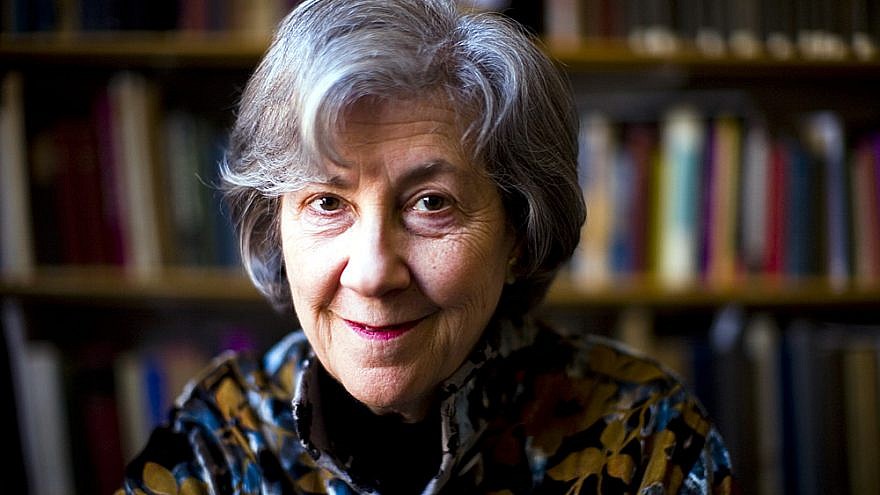
Ruth Wisse

By Shelley A. Sackett

Ruth Roskies Wisse is no shrinking violet. Born in Czernowitz, Romania, in 1936, she and her family escaped to Montreal in 1940, where her parents’ home became a salon and safe haven for Jewish writers, actors and artists who had also fled the Nazis. After graduating with a BA from McGill University in 1957 (where she befriended Leonard Cohen), she earned a MA in Yiddish studies at Columbia University, the only place in North America that offered such a program at that time. She returned to Montreal to raise her family and finish her Ph.D.. In 1968, she began teaching Yiddish literature and helped found a program that would become the Department of Jewish Studies at McGill.

No less a trailblazer academically, Wisse became a joint professor in the Departments of Yiddish and Comparative Literature at Harvard University in 1993, where she taught until she retired in 2014. Her gender, religion, subject matter (Yiddish) and conservative political and social views set her apart from the get go. Her razor-sharp intellect and prolific authorship made her views impossible to ignore.

In 2000:, she received the National Jewish Book Award in Scholarship for “The Modern Jewish Canon: A Journey through Language and Culture” and in 2007, she received the National Humanities Medal, which cited her for “scholarship and teaching that have illuminated Jewish literary traditions. Her insightful writings have enriched our understanding of Yiddish literature and Jewish culture in the modern world.”

Along the way, she developed relationships with Nobel Prize winning authors, Saul Bellow and Isaac Bashevis Singer, and a bevy of Harvard University students, faculty and administrators.

A staunch neoconservative and supporter of Israel, Wisse is a prolific author. She has collaborated on Yiddish collections, penned numerous political essays (many of which appear regularly in Commentary, The New Republic and The Jerusalem Report), and authored several books, including the controversial “If I Am Not for Myself…The Liberal Betrayal of the Jews,” a Zionist critique of the American Jewish climate.

No less controversial is her new book, “Free as a Jew: A Personal Memoir of National Self-Liberation,” a no-holds-barred memoir. Wisse will discuss her book with Andrea Levin, Executive Director and President of the Committee for Accuracy in Middle East Reporting and Analysis (CAMERA), as part of the JCCNS Jewish Book Month Speaker Series on Sunday, November 7 at 3 pm at Temple Emanu-El, Marblehead. The in person event includes a reception and book signing.

According to Wisse , she began writing about parts of her life as a way of understanding the world around her. “Free As A Jew” takes her to the point of her retirement from Harvard in 2014. “One of the ways in which I’ve been fortunate is in the interesting people I’ve come to know. I’ve tried to write this as cultural history, and about myself as a minor participant in that history,” she said by email.
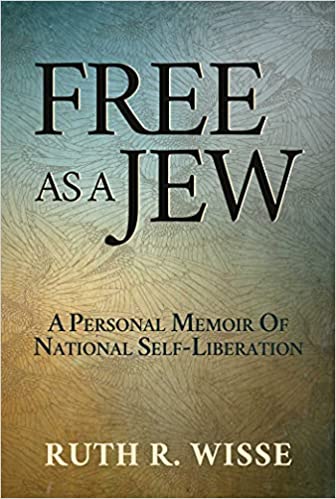
She chose the title carefully and deliberately. “I call it a personal memoir of national self-liberation because I concentrate on the public, intellectual, cultural, and political events I witnessed: most extraordinarily, the reestablishment of a sovereign Jewish country. The defeat—at least formally—of German Fascism and Soviet Communism were great victories. Not for a moment can we afford to take those civilizational achievements for granted,” Wisse said. “But they are being taken for granted.”

The direction of current political and cultural life concerns her, particularly the uptick in anti-Semitism and anti-Israel rhetoric and what she calls “contemporary loss of confidence.”

“It is no secret that the ideological and military war against the Jewish people has in many ways revved up rather than quieted down in recent decades. When people are under assault, many grow frightened, or apologetic, wanting to stay out of trouble. Some respond by trying to appease their attackers, or by becoming more like them. Jews have many things in common with other minorities, but no other minority is under the same sustained attack. This is confusing. Many lose confidence in their Judaism and blame their fellow Jews for the attacks against them,” she said.

Wisse stresses that her memoir is intended as neither homily nor “how to” book, but rather as another tool in one’s toolbox. “In explaining how I came to think about certain things, like the modern challenges to women, the nature of community, liberalism and conservatism, how literature works and why it matters, education and Jewish education, and so on, my story may be useful to others. No two lives are alike, but we all tend to have certain problems and opportunities in common,” she said.

The Exodus story of the Jews leaving slavery Egypt for freedom in Canaan particularly resonates with Wisse and also influenced her book’s title. “Jews learn that escape from bondage is only the first step of the process. We are a rabble — miserable, needy, and anxious — until we accept our pretty stringent set of laws. To be free as a Jew means to assume the responsibilities of freedom and to realize how liberating that really is,” she said.

For more information and to buy tickets, visit jccns.org.
College students immerse themselves in Israeli culture

By Shelley A. Sackett

Despite anxiety over civil and political unrest – and the ever-present threat of COVID-19 – three college students from Swampscott’s Congregation Shirat Hayam headed to Israel for summer internships.

They returned in agreement on three important points: Israel is a spectacular tourist destination; the country feels like one big family; and any young adult offered the opportunity to participate in a residential program in Israel should grab it.

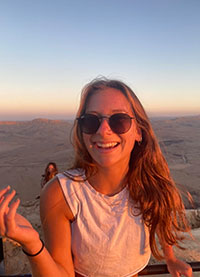
As part of a gap year before heading to Stanford University this fall, 19-year-old Swampscott resident Anna Levenberg spent four months living in Israel through Aardvark Israel, an international program that provides internships and volunteer opportunities. She interned at Keren Or, the Jerusalem center for children with visual impairments and multiple disabilities. She also lived on an army base for a week, volunteering with Sar-El, an organization that partners with the Israel Defense Forces.

Anna Levenberg at Mitzpe Ramon

In between, she found time to explore new places: rafting in the Golan Heights, swimming in the Dead Sea, and skydiving in Haifa. Although this was not her first trip in Israel, it was her favorite.
“Being able to live in Israel for so long allowed me to get to know the country and the culture in a way that would be impossible if I were there only for a few weeks,” Levenberg said. “The communal values in this country are so strong, and people have such a willingness to help one another. From countless Shabbat dinners at my neighbors’ homes to being begged in the Shuk to make Aliyah, I know my presence is valued in Israel.”

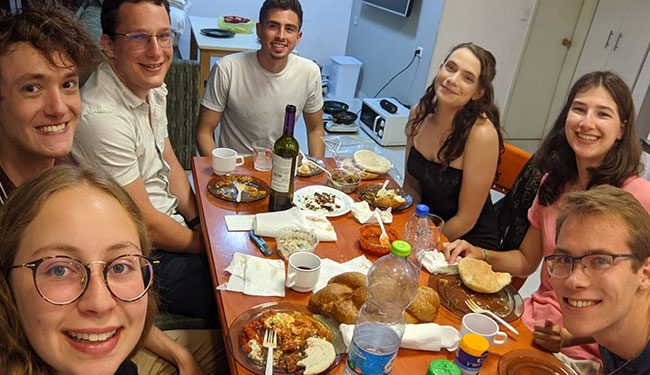
Ethan Keller (second from left) at a Shabbat potluck dinner with trip participants in Israel.

Jerusalem was also home base for Ethan Keller of Whitinsville, whose six-week Boston Onward Israel internship residency gave him the opportunity to get to know Israel – and Israelis – in a deeper way than his three previous shorter and more structured trips.

Although his first couple of weeks were challenging, the 22-year-old Clark University student quickly adapted and focused on the summer’s rewards, including touring the country, making new friends, and taking advantage of the chance to dig beneath the superficial.

“This trip has been life-changing,” Keller said. “Israel is a complicated place with complicated people. I’ve had some really good conversations with Israelis, and I’ve had some less pleasant ones. There are people who don’t care about or want peace, and there are those working hard for it.”

He made a Palestinian friend who, along with having a startup in Tel Aviv, is working in his community in East Jerusalem to build trust between Israelis and Palestinians. “There is a lot of hate and misunderstanding in this country and the Palestinian territories, which makes it all the more important to fight against it,” he added.

Cole Cassidy atop a camel.

University of New Hampshire junior Cole Cassidy lived in Tel Aviv and worked as an Onward Boston intern for NOX Group in its marketing department, promoting the top clubs and bars in Tel Aviv. “With a city that doesn’t sleep at night and the endless beach days with sand that makes you feel like you’re on the moon, Tel Aviv felt like utopia,” the 20-year-old Swampscott resident said.

His first trip to Israel was four years ago with the two-week Youth to Israel program sponsored by the Lappin Foundation. He appreciated the freedom of living on his own with two months to discover the country in his own fashion, all while getting an internship under his belt and exploring his Jewish roots.

At first, he was surprised that all stores are closed on Shabbat. “It was definitely an odd adjustment to remember to get groceries or anything I needed Friday before sunset. I was also surprised that the culture is so friendly and outgoing. It felt like one big family here in Israel and within the community,” Cassidy said.

He was struck by the many occasions when being a Jew in a Jewish country collided in powerful ways, for example during a trip to Mitzpe Ramon in the Negev for a Shabbaton. “Celebrating Shabbat in the desert under the most thrilling night sky where you are able to see every star was incredible,” he said.

Without hesitation, all three would offer the same advice to young adults considering an internship in Israel: Do it!

“Israel is unlike anything you will ever experience,” Cassidy said. “You can come here and feel like family instantly, not just like a tourist. This is the home of our people and the connection you will feel to our homeland is unbelievable.”

Levenberg recommends going out of your way to meet new people. “Talk to Israelis in the street; ask English speakers where they are from, and chat with your waitresses. My time in Israel has shown me the true power of Judaism. I love living in a place surrounded by Jews who are so proud to be Jews, who influence you to learn more about your religion and culture. It has been such a moving experience being able to connect with my religion alongside my peers from all around the world.”

Local author unpacks a pivotal court case, an obscure doctrine and an ugly legacy

Jack Beermann

By Shelley A. Sackett

The Dormant Commerce Clause doctrine is aptly named. Known to induce temporary dormancy among even the most avid first year law students, its post-bar review practical value outside academia is, essentially, nil.

And yet, Jack Beermann, a Boston University School of Law professor of Constitutional Law, Civil Rights and Administrative Law, has just published a book, “The Journey to Separate But Equal,” based on a little-known but pivotal Supreme Court case that hung its hat on this arcane and crucial constitutional construct that prevents both discrimination against, and excessive burdens on, interstate commerce

Moreover, he turned out a narrative that is as accessible to lay readers as to legal scholars.

It all started when Beermann, who grew up in Skokie, Illinois and lives in Swampscott with his wife, Debbie Korman, read a law review article that cited Hall v. Decuir, an 1877 Supreme Court decision that struck down a Louisiana state antidiscrimination statute and, for the first time after the Civil War, actually approved race-based segregation.

He had never heard of the case.

His curiosity piqued, he began a ten-year journey of trips to Louisiana, research, writing and re-writing, fueled by a drive to document the Court’s first step towards validating segregation in US society. The end result, “The Journey to Separate But Equal,” while exhaustively researched and painstakingly scholarly, is also immensely readable, owing to the compelling human story at its center.

Josephine Decuir, a mixed-race, privileged and wealthy woman whose free family owned slaves that worked their Louisiana plantations, had, as was her custom, booked a first-class ticket in the ladies’ cabin aboard the interstate riverboat, The Governor Allen. Instead of honoring her prepaid ticket, the boat’s stringent segregation policy relegated her to the “colored-only” section of the riverboat, where all non-White passengers, regardless of sex or social status, slept in common areas.

Madame Decuir sued the riverboat owner, citing Louisiana’s nondiscrimination statute, a state law passed during Reconstruction. State courts ruled in her favor, and the owner appealed. The case wound its way to the Supreme Court as Hall v. Decuir. That court ruled against Madame Decuir, citing the US Constitution’s Dormant Commerce Clause doctrine, which is used to prohibit state legislation that discriminates against interstate or international commerce.

Essentially, the Court accepted the owner’s argument that, despite violating state law, segregation was both customary on riverboats and necessary to keep Whites as customers; i.e., integration had the potential to negatively impact his business.

Beermann, who already knew the Supreme Court had prevented the federal government from enforcing Congress’s civil rights program for Reconstruction, wasn’t aware it had also prevented states from enforcing liberal civil rights laws. “I would have written the book regardless of what was happening in the world, but it feels like this subject gets more timely every day,” he said by email.

There are many parallels between the Courts of 1877 and today, Beermann said. “One thing courts are very good at is justifying terrible decisions with bland, benign language. The Justices in 1877 were good people, well-trained in the law; and yet, without flinching, they doomed millions of their fellow citizens to terrible lives of oppression and injustice.”

During his research, Beermann experienced two “aha” moments. One was when he realized the scope and implications of the story he had uncovered. Decuir, as a “person of color”, was used to the treatment and privilege her wealth, status and lighter skin afforded her. Suddenly, she felt the sting of prejudice and exclusion almost as strongly as the darker-skinned people at the bottom of the social ladder.

The other was when he recognized, after repeated attempts, that he couldn’t address the complicated issue that Madame Decuir and her family were themselves slaveowners before the Civil War. “I decided to focus on her dignity harms and leave that issue to the reader, or perhaps to another project,” he said.

As a teenager, the protests against the Vietnam War and Martin Luther King’s activism awakened Beermann’s interest in civil rights. He remembers his father as “a bit involved in politics. I knew we were a very liberally oriented family, even when I was a small child.” He has taught in Israel numerous times and, “although I don’t agree with all of its policies,” he is a strong supporter. His family (including three sons and a daughter, when they are home) attends Chabad House and Temple Sinai in Marblehead. “Our Jewish identity is very important to us,” he said.

Beermann hopes his readers will gain a better sense of the racial politics of the Reconstruction era, opening their eyes to how laws and courts contributed — and continue to contribute — to racial segregation. In the end, though, he admits he doesn’t know the moral of the Decuir legacy.

“It’s too simplistic to say that race discrimination is wrong; my sense, maybe what I was trying to communicate, is that race discrimination, and white supremacy in particular, are woven into the fabric of our country and have resisted unraveling at every turn,” he said.

Join Beermann at a free Zoom author event on May 27 from 7-8 pm. To register, visit jccns.org.

Shirat Hayam families adjust b’nai mitzvah plans in the time of COVID

by Shelley A. Sackett

Despite Covid-19 and the unpredictability of surges, declines and shifting Massachusetts social gathering rules, eight Shirat families celebrated Bnei Mitzvah over the course of this past year. Five held services at CSH with fewer than 25 guests; two held services in their homes with clergy support online, and one family held the service in their home with Rabbi Michael present.

(L-R)  Kay (age 11), Sara (Ewing), Nat and Jay Mahler

Nat Mahler had the distinction of being CSH’s first Covid-19 Bar Mitzvah. Scheduled for March 21, 2020, it was exactly eight days after everything in the state shut down, including CSH. The Mahler family decided to have the service in their living room. They borrowed a Torah and siddurim from CSH and Rabbi Michael officiated. Nat’s paternal grandparents, aunt, uncle and cousins attended and everyone else connected via Zoom, “which was a novelty back in the day!” Sara joked. For Kiddush, Jay’s parents brought bagels.

They were saddened that Sara’s family couldn’t travel from out of state, that the service could not be in the synagogue and that the evening celebration had to be cancelled. “At first I felt disappointed, but I soon realized that I had to rise to the occasion and do my best,” Nat said. Fortunately, he was able to have all his Bar Mitzvah lessons in person. “Studying for my big event went well and I was more than prepared thanks to my awesome tutor, Jan Brodie.”

For Sara and Jay, having an actual Torah in their house was very special, a flip side of Covid-19 restrictions. “Also, the service was very intimate, special and a unique experience that will stand out in everyone’s memory,” Sara said. “And, our cat Pepper was able to attend!”

At first, Jeremy Sorkin, whose spring Bar Mitzvah was postponed until October 11, 2020  was worried that he might have to learn a new parsha when his original date was moved. But when Rabbi Michael suggested he keep the original parsha as an importance part of maintaining the significance of his Bar Mitzvah, he was greatly relieved. Although it was difficult to continue his lessons virtually, his tutor Jan Brodie and Aunt Nancy Sorkin spent countless hours preparing him during the fall. “This gave me so much confidence for performing the service on my big day,” Jeremy said.


(L-R): Jeffrey, Amanda, Jeremy, and Amy Sorkin

When Jeremy’s parents, Amy and Jeffrey Sorkin, moved the original May 23, 2020 date to Columbus Day weekend, they never imagined they would be having a virtual Bar Mitzvah, but as the date approached, it became evident they would. In October, there was a 25-person limit on indoor gatherings, and their immediate family could be accommodated with friends and family watching from afar. Even with the technical challenges of shulcasting, Amy and Jeffrey were able to find a silver lining. “Our family was able to focus on what the true essence of a Bar Mitzvah celebration is- a very meaningful service conducted by Cantor Alty (Rabbi Michael was sick), a thought-provoking Dvar Torah by Jeremy and dancing the hora with our close family. It was truly a memorable experience for our family,” they said.


Hannah and Vivian (age 10) Schwartz

Two weeks later, on October 24,2020  Hannah Schwartz also celebrated her Bat Mitzvah at CSH with a small family group and more than 100 others watching on Zoom. The weekend included a Shabbat dinner in an indoor/outdoor setting, a hybrid service Saturday morning, a drive-by parade after the service for local friends, a boxed Kiddush lunch outside, a Saturday night festive dinner and Sunday brunch- and lots of careful quarantining, testing and masking for those participating in person.

For Hannah’s parents, Janna and George Schwartz, the biggest challenges were the unknowns every step of the way, and they are grateful to everyone at CSH who helped them navigate the unchartered waters. While they missed many people, they felt blessed to have been able to integrate many personal elements into the ceremony, from Hannah’s sister Vivian playing Siman Tov on the piano to her cousin’s receiving an in-person Aliyah to her grandparents presenting her with her tallis. “Jews have endured carrying on our traditions despite difficult circumstances throughout history. This was ours- and one to be cherished,” Janna said.

For Hannah, though, the virtual experience was disappointing. “Not everyone was there. It didn’t feel like a ‘normal’ Bat Mitzvah, but it was a special family gathering and we made the most of it,” she said.

Liora Ragozin, whose September 25, 2020 Bat Mitzvah also took place in the CSH sanctuary with many others watching and participating virtually, missed having her cousins with her, but said that because her family (including her parents, Rabbi Michael and Sarah Ragozin and siblings Noam and Aliza) and friendship circle are small, “it felt good to celebrate the way we did. My favorite part was giving my Dvar Torah. I enjoy public speaking – when it’s in English!” she added.

Jake Dubow initially felt let down that his December 12, 2020 Bar Mitzvah didn’t turn out as planned. “For my whole life, I had been talking with my family about a big Bar Mitzvah and party,” he said. Instead of the 400-guest in-person ceremony in the sanctuary, sleepover with all his camp friends and a celebration at Boston’s Hard Rock Café, he had a small service with 17 guests in an open-sided tent in his Swampscott yard without his paternal grandparents, who couldn’t make it from Canada and Florida. Even the clergy were zoomed in.


(L-R): Jonathan, Jake, Rachelle and Charlie Dubow

Jake had started studying with Jan Brodie before the pandemic and felt grateful for the in-person lessons prior to having to shift to virtual tutoring. “Studying was hard work, but I was very diligent. Although I was nervous, I was also excited to show off my hard work on my Bar Mitzvah day,” he said.

For his parents, Rachelle and Jonathan, the vagaries of Covid-19 were even more daunting. Rachelle grew up with a mother who was (and still is) a professional event planner and a grandfather who was a kosher caterer, so celebrating simchas in a “big” way has always been in her blood. They had already shifted  gears, with plans to still celebrate on Jake’s actual Bar Mitzvah date (also Shabbat of Hannukah) at CSH with Rabbi Michael and Cantor Alty, but with only 17 live guests and the rest of their friends and family virtually. Then, on December 8, CSH indoor rules changed, prohibiting any gatherings in the building. The Dubows pivoted to the tent, hardly missing a beat.

The family Kiddush was shared on Zoom, with Jake and his younger brother, Charlie, leading the prayers, followed by an outdoor pop-up and drive-by for well-wishers. “We had music playing and an amazing vibe going, so despite being outside and masked, it felt like a slice of normal,” Rachelle said.

Her biggest challenge was missing her in-laws and sister and her family, but the many rewards softened that blow. Because of Zoom, many friends and relatives were able to join from Israel, France, Canada and the US. The Wednesday before the Bar Mitzvah, two Torahs arrived at their home. “Just having those scrolls in my home elevated us spiritually in a way that is hard to describe. But most of all, it was the pride, the immeasurable, indescribable pride we had in our son who had worked so hard and handled all the pivots and little disappointments with such grace,” she said.

Like his fellow Covid-19 Bnei Mitzvah celebrants, Ned Jefferies was at first disappointed that his January 9, 2021 would be on Zoom instead of in the sanctuary, and then he was doubly disappointed that instead of Zoom (where he could have seen those watching), there were so many guests that they had to use Zoom Webinar. “It was cool seeing everyone’s messages in chat, though,” he said.


(L-R): Jennifer Mazur (Cat’s mother), Cat, Tom, Sophie, Ned, Yelena Jefferies and Joe Mazur (Cat’s father)

For his parents, Cat and Tom Jefferies, the event was actually wonderful, with Tom’s family in England and their friends all over the world able to join them. “For many, this was the first Bar Mitzvah they had ever been to. We were really touched by how meaningful they found it and it felt wonderful to be able to share it with them,” Cat said.

Although Cat admits they were nervous about the technology, J.R. Young, Rabbi Michael, Cantor Alty and Barri Stein all advised them. Family members were able to Zoom in and read Torah, take Aliyahs and read prayers “from California to Canada to England – and it all went smoothly!” Cat said.

Kiddush was Ned’s favorite dish, pesto pasta cooked by his grandmother, Jennifer Mazur. The eight family members sat around the kitchen table and then ran out to do a Mitzvah drive-by at CSH.

Having the Torah in their home was very special and a highlight of the weekend and a true family event. They set it on a 19th century tablecloth that had travelled to the US with Cat’s grandmother, and placed one of Tom’s paintings behind it. “We could really feel the love of our family, friends and the congregation during this momentous occasion,” Cat said.

Gloucester violinist helps keep the sound of Yiddish music alive

Klezmer violinist Abigale Reisman recently received a grant from Club Passim’s music fund. Photo: Bryce Vickmark

by Shelley A. Sackett

Abigale Reisman was a 19-year-old undergraduate at The Manhattan School of Music when she fell in love. The classical violin performance major was listening to a lot of Russian composers such as Tchaikovsky, Prokofiev, and Stravinsky, but something was missing. She yearned for the Jewish music she grew up with in synagogue and Jewish day school, and the special place it had in her heart.

A friend suggested she check out a genre of music she had never heard of – klezmer – and for Reisman, it was obsession at first listen. Luckily, she lived in New York City, home to some of the leading klezmorim. She booked a private lesson with violinist Alicia Svigals (co-founder of the Grammy-winning band The Klezmatics), and attended KlezKamp – a yearly Klezmer music and Yiddish culture festival – in the Catskills.

“It was a beautiful introduction to the klezmer world and I never left,” Reisman said from her Gloucester home.

Almost 15 years later, the Atlanta native is a violinist, composer, and educator. She wears many musical hats, from klezmer and classical to experimental and pop. She is a cofounder of Thread Ensemble, an experimental trio that creates music out of interactions with their audiences; a member of Tredici Bacci, which was featured in Rolling Stone’s “10 Artists You Need to Know: November 2016;” and a composer, arranger, and performer in the International Jewish Music Festival award-winning band, Ezekiel’s Wheels Klezmer Band.

Although Reisman doesn’t have a favorite musical genre (“I love it all in different ways”), she plans to focus her energy on recording a series of videos that explore the treasures of the Jewish violin, thanks to a grant from Club Passim’s Iguana Music Fund.

Her purpose is two-fold: To create and release her own interpretation of the music she loves so dearly, and to reveal to the average Jewish music listener the complex history of the violin in East European Jewish music.

“The fidl [Yiddish for violin] truly mimics the human voice, especially the cantorial sound,” Reisman said. “It speaks in Yiddish sentences and gestures. It plays pieces full of bubbling trills, moans, slides, and specifically Jewish phrasing.”

The grant money will ensure the sound and video qualities of her recordings will capture these subtleties.

Since 2008, the Iguana Music Fund has awarded gifts annually to musicians for career building projects and for those that provide community service through music. Abby Altman, Club Passim manager, said Reisman is known for being part of great ensembles. Her application stood out because it focused on her as a solo artist working in a genre she is passionate about.

“We’re excited to see what she creates when she is in complete control of the material,” Altman said.

Reisman’s target audience for her videos is both the casual Jewish music listener and the next generation of serious klezmer violinists. Although most contemporary audiences think of the clarinet as klezmer’s dominant melodic instrument, for hundreds of years the violin was the epicenter of Eastern European shtetl music. Reisman wants to introduce this fidl-centric music to those whose only exposure has been to the 20th century jazz-influenced clarinet-centric version of klezmer.

She also wants to provide serious klezmer violinists with 21st century videos that contain both archival repertoires and clear views of the technical aspects of playing klezmer. Reisman recalled she didn’t know where to turn to when she started to play klezmer fidl. The only archival recordings she found were scratchy and difficult to decipher. She wants her videos to make it easier for violinists to get an immediate sense of the music they could play. “I also want to lure them into listening to the archival recordings,” she said.

Ashkenazi Jewish culture has played a large part in Reisman’s life since she was a child. “It creates a beautiful community and gives me a familiar access point to spirituality, morality, and kindness,” she said. She remembers feeling especially connected to Judaism as a young Jewish day school student. “I liked following rules and they had a lot of rules,” she said with a chuckle.

COVID-19 has been hard for her and her musician husband, Charles Clements. Although Reisman lost a lot of summer gigs (weddings, outdoor festivals, etc.), she has been able to teach and perform virtually and has helped create an online global klezmer community.

She’s also been able to slow down and think about the future of her career and the important, constructive role artists play in safeguarding our humanity. “This is why I’ve finally been able to conceive of the start of this project that has been in the back of my mind for so many years,” she said.

To learn more and listen to Abigale Reisman’s music, visit abigalereisman.com.

‘Never Again!’ Teen Holocaust Legacy Fellows return from Poland and Berlin empowered and committed

Aus-Bir tracks

HLF teens walk the tracks to Auschwitz-Birkenau where the ashes of 1.2 million human beings lie.


Shelley A. Sackett

On August 12, Marblehead High School incoming senior Jillian Lederman was not at the beach, enjoying the North Shore summer with her friends. Instead, she stood on the grounds of Majdanek concentration camp in Poland. She saw the dusty shoes piled to the ceiling and a massive mountain of human ash. Majdanek made the stories of abuse, anti-Semitism and genocide suddenly real.


“It didn’t seem that any human could commit such atrocities, that the rest of the world could just sit by and let it happen,” she said. “I saw all that remained of thousands of Jews who were brutally and mercilessly murdered and it clicked. The Holocaust happened. It was real and it was terrible.”


Majdanek-Schwartz

“I believe that this trip is to open our eyes and see first-hand what deep rooted hatred in people can do. This is to teach us to be compassionate and sensitive in order to counteract and spread the antithesis of spreading hatred.” -Jonah Schwartz, Framingham, Gann Academy


For Lederman and her 15 fellow teen travelers, their journey began in April 2018, when Jody Kipnis and Todd Ruderman stood in the Auschwitz concentration camp in Poland on Yom HaShoah and promised each other that the words ‘never again’ would no longer be a call to prayer, but a call to action. The key to fulfilling their commitment, they decided, lay in creating future Jewish leaders in the community who would learn about and fully understand the Holocaust.


A mere 16 months later, they took a group of teens to Poland and Berlin on the first fully subsidized trip of Holocaust Legacy Fellows (a non-profit they created, funded and co-direct). The 16 HLF teens came from 10 Greater Boston cities and towns. None had previously participated in an organized Holocaust educational trip to Poland.


“Our biggest challenge was knowing that nothing, and I mean nothing, will prepare you for a visit to Treblinka, Auschwitz and Majdanek, or to stand in Buczyna forest where 800 Jewish children were murdered in one mass grave,” Kipnis said.


Veksler and Richmond

Victoria Veksler, Marblehead High School, and Danny Richmond, Needham High School, at the Wannsee Conference Center reading the Final Solution where, in just 83 minutes, the extermination of the Jews was drafted.


Participants were required to keep a journal during the trip as a means of coping with their mix of emotions and to record what they saw and heard from their tour guide, a second-generation Holocaust survivor. “Keeping the journal was extremely helpful. It served as my personal therapist during the trip,” Victoria Veksler of Marblehead said.


The itinerary started in Berlin, Germany, where the teen fellows toured Wannsee, the site where high-ranking Nazi Party and German government officials discussed and coordinated implementation of the Final Solution of the Jewish Question. “One of the teens said to me, “I can’t understand how this could happen here. This place feels so normal,” Ruderman said.

Chak

Alan Chak, Middleton, Masconomet Regional High School, outside the crematorium in Majdanek wondering why the world stood by while 6 million Jews were brutally murdered.


From Berlin, the group travelled to Warsaw, Poland where they visited the Jewish cemetery on Okopowa Street, the Warsaw Ghetto and the Treblinka death camp. For most, it was their first visit to the site of a concentration camp. “I visited Treblinka and I felt a strong sense of purpose. I understand why we are here. We need to teach the Holocaust so it won’t be forgotten,” Alan Chak, of Middleton, wrote in his journal.


On their way to Kraków, the group toured Auschwitz-Birkenau concentration camp, where the ashes of 1.2 million human beings lie. “The things I saw there will never escape my memory. This is where I realized the true inhumanity of the Nazi officers. Even more impactful, though, was hearing the testimony of the survivors. Listening to stories of children sacrificing the little food they had so they could keep their parents alive another day broke me,” Adam Zamansky, of Marblehead, said.


Nonetheless, their tour guide, Sara Pellach, the daughter of two Holocaust survivors, filled the teens with hope that Jewish life can be re-built. She described her family for them: four children, 18 grandchildren, eight great grandchildren and another on the way.


All was not doom and gloom. While in Kraków, the teens visited Oskar Schindler’s factory, where they learned about his saving the lives of 1,100 Jews despite being a Nazi himself. They also experienced Kraków Old Town, the biggest market square in Europe, and visited the JCC, which coordinates programming open to the entire community and meant to foster Polish-Jewish relations.


And everyone looked forward to the daily respite of creamy, delicious Polish ice cream.


It was Majdanek death camp, however, that most horrified the teens, according to Kipnis. Unlike Treblinka and Auschwitz-Birkenau, Majdanek is completely intact, from barbed wire to barracks, from gas chambers to crematoria.


Majdanek-2019HLF

2019 Holocaust Legacy Fellows outside Majdanek


“There were countless people who could see the smoke from the crematorium, and others who saw Jews walking the 4km from the train station to the camp. They said nothing about it, pretending as if nothing were wrong at all. I thought a lot about all those bystanders,” Danny Richmond, of Needham, said.


Every night of the 10-day trip, group dialogue and role playing helped the teens transition back to everyday life. “The biggest reward for the teens in our opinion were the engagement and interpersonal relationships that formed. Their nightly discussions could have gone on for hours had we let them,” Kipnis added.


The HLF program did not begin or end in Germany and Poland. In preparation, teens attended mandatory educational meetings and met and heard from Holocaust survivors firsthand. Now that they have returned, they have to: write a post-trip reflection of their experience; prepare and deliver a presentation on the memory and lessons of the Holocaust; participate in the Holocaust Remembrance Service; pledge to transmit the lessons and memories of the Holocaust to future generations, and serve on the Holocaust Speakers Bureau.


“Holocaust Legacy Fellows was designed to create an empowered community of critical thinkers who will illuminate the world with hope, respect and responsibility. This alone sets our Holocaust education program apart from any other,” Kipnis said.


The HLF capstone is a graduation ceremony on September 8th at 4pm at Temple Ner Tamid in Peabody. Jeff Jacoby, Boston Globe columnist, will be the keynote speaker and the teens will read their reflection essays.


Kipnis and Ruderman’s goal of inspiring the 16 HLF graduates to take on the mantle of leadership and inform their communities about the Holocaust seems to have hit its mark.


“This trip changed my life in so many ways and has given me an important purpose in life. The post trip assignments do not feel like a burden. They are an opportunity for me to fulfill a deep desire to educate others and advocate on behalf of myself, HLF and the Jewish people,” Max Foltz, of Newburyport, said.


The trip was also transformative in intangible but indelible ways. “We saw first-hand what deep rooted hatred in people can do. This is to teach us to be compassionate and sensitive and to counteract and spread the antithesis of hatred,” Jonah Schwartz, of Framingham, said.


“For the first time, I truly thought of the Jewish people as my people,” Katie Hubbard, of Arlington, added.


North Shore Music Theatre’s ‘Oklahoma’ Is A Rollicking Kick Off to its 64th Season


thumb-nsmt-oklahoma-ensemble-1_2

The cast of Rodgers and Hammerstein’s OKLAHOMA! at North Shore Music Theatre thru June 16, 2019. Photos © Paul Lyden

By Shelley A. Sackett

Just when the cold, wet slog of spring 2019 was about to wear down all hope that summer would ever arrive, NSMT comes to the rescue with a first-rate production of the 1943 classic, Richard Rodgers and Oscar Hammerstein II’s ‘Oklahoma!’ Perfect for theatre-in-the-round staging, this Broadway masterpiece has everything: a snappy, foot-stomping score, impressive choreography and a captivating story that is more complex and bleak than many may remember.

Under the direction of Mark Hartman, the orchestra is spot on. The opening overture is an immediate reminder of all the hits that came out of this show (‘Oh, What a Beautiful Mornin,” ‘The Surrey with the Fringe on Top,’ ‘I Cain’t Say No,’ ‘People Will Say We’re in Love,’ and, of course,‘Oklahoma!’) and last Wednesday night, the near capacity audience lip synched to almost every song. But when cowboy Curly McLaine (played with a perfect mixture of cockiness and aw-shucks-ma’am by the talented Blake Price) entered the stage astride an actual horse, the crowd predictably went wild with appreciation.

Born into a prosperous German Jewish family in Queens, New York City, composer Rodgers was the son of Mamie and Dr. William Rodgers, a prominent physician who had changed the family name from Rogazinsky. Librettist/lyricist Hammerstein II was also born in New York City.  His father was from a Jewish family, and his mother was the daughter of Scottish and English parents.

“Oklahoma” was their first collaboration and the first of a new genre, the musical play, which they created by melding Rodgers’ sophisticated style of musical comedy with Hammerstein’s innovations in operetta.

The narrative is simple on its face. Set in the Oklahoma territory in the 1900s, the musical lays out the story of two sets of lovers. Curley and the feisty, independent farmer Laurey Williams (played by the gifted Madison Claire Parks, whose dazzling singing is a delicious treat) are as in love as they are stubborn about not admitting their feelings to each other. They are early settlers building new lives on the wild frontier, and their pioneering spirits unsurprisingly clash.

Laurey’s Aunt Eller (played with zest by the buoyant Susan Cella) has some of the script’s best lines as she tries to knock some sense into Laurey and Curley, using every trick she knows short of actually knocking their heads together. The chemistry between the actors feels real, and their voices blend beautifully during their one duet, “People Will Say We’re in Love.”

thumb-nsmt-oklahoma-laurie-curley-1_orig

Madison Claire Parks (Laurey) and Blake Price (Curly).


Ado Annie Carnes (the Olive Oyl-like and spectacularly hilarious Melissa Carlile-Price), one of Laurey’s friends, and her boyfriend, cowboy Will Parker (Sean Bell, a terrific tap dancer) are the other couple. Or, at least they were. While Will was away on a trip to Kansas City, Ado Annie has fallen for the peddler Ali Hakim (the fine Cooper Grodin), who is a ladies’ man with zero intention of marrying her. Carlile-Price is a side-splitting enchantress, stealing every scene she is in.

But all is not innocence and trivial entertainment. Meatier topics like patriotism, impending statehood, and a spirited rivalry between the local farmers and cowboys provide a backdrop of danger and excitement. Add to the mix Jud Fry, the creepy farm hand that harbors nefarious designs on Laurey (darkly played by Alex Levin, whose baritone is operatic), and the plot truly thickens.

Mara Newbery Greer’s choreography elevates the show to greater artistic heights. In particular, the tap dancing in “Kansas City” and the dream sequence, “Ballet” (Bella Calafiura is a standout as Dream Laurey), are superb.

If there is any criticism of the production, it is that there is too much of it. At 3 hours, it is uncomfortably long, especially Act I (105 minutes).

Nonetheless, if you’re looking for an evening of thoroughly entertaining, (mostly) light summer fare, “Oklahoma!” fits the bill.


‘Oklahoma!’ is presented by North Shore Music Theatre, 62 Dunham Rd., Beverly, through June 16. Visit nsmt.org/ or call 978-232-7200.


Teen Legacy Fellows preserve and perpetuate the memory of the Holocaust 

by Shelley A. Sackett

In April 2018, Jody Kipnis and Todd Ruderman visited Auschwitz with their dear friend David Schaecter, a 90-year-old survivor who spent over two years of his youth in this indescribable death camp. “While standing in front of David’s bunker, he turned to us and said, ‘Hear me, understand me, and let me tell my story,’” Kipnis said. By the end of their trip, she and Ruderman began to understand what their friend was asking.

“The imminent passing of survivors will occur during your and our children’s lifetimes,” Ruderman explained, noting the alarming results of a survey conducted by The Conference on Jewish Material Claims Against Germany that showed the Holocaust is fading from global memory. “While no one alone can change this disturbing trend, by the conclusion of our visit, Jody and I committed ourselves to do what we could to assure this does not happen.”

The two made a pledge while standing in the Auschwitz concentration and extermination camp in Poland on Yom HaShoah in April 2018. “We promised each other that the words ‘never again’ would no longer be a call to prayer, but a call to action,” Kipnis said.

When they returned home, they conceived of Holocaust Legacy Fellows (HLF), whose mission is preserving and perpetuating the memory and lessons of the Holocaust for future generations by inviting teens throughout Greater Boston to meet survivors, learn about the Holocaust and make the trip to the places that forever changed Kipnis and Ruderman’s lives. Kipnis and Ruderman are its co-directors and funders.

By coincidence, Kipnis’s daughter, Gann Academy student Gillian Pergament, was on the 2018 Y2I trip and told Lappin Foundation Executive Director Deborah Coltin about the Holocaust travel program her mom and Ruderman were interested in starting. “I said I would love to know more and asked her to tell her mom,” Coltin said. She and Kipnis connected within days of her returning from the Y2I trip and, together with Ruderman, their ideas came to fruition.

“Debbie is an expert on teen travel and engagement. With her help, we pulled this together in just three months,” Kipnis said. She and Ruderman also enlisted the assistance of the Lappin Foundation (which has run the Youth to Israel program since 1971) to administer and implement HLF, and hired Coltin as education and program development consultant.

David Schaecter shows his tattooed number from Auschwitz.

Kipnis said HLF is in the process of becoming its own stand-alone non-profit organization.

Eligible teens for the 2018-2019 HLF pilot year needed to be juniors in high school; have participated in an organized Israel experience; be able to attend all pre- and post-trip meetings; agree to complete all homework assignments; and not have previously participated in an organized Holocaust educational trip to Poland.

As HLF Educator, Coltin, who has three decades experience teaching the Holocaust, created the curriculum, and will be one of the staff on the fully subsidized August 4-13, 2019 Poland and Berlin trip. She plans all meeting lessons, teaches the classes, and schedules survivors to speak to the teen Fellows.

“The curriculum reflects the human face of the Holocaust. The Fellows meet survivors in person, the last generation to do so. They bear witness to the Holocaust by hearing the survivors’ testimonies about their lives before, during and after the Holocaust, and what the enormous price in particular Jewish people paid for such hatred that went unchecked,” said Coltin.

The 16 inaugural Fellows represent Lynnfield, Middleton, Newburyport, Beverly, Arling­ton, Marblehead, Newton, Needham, Framingham and Swampscott. “I wanted the participants to be from ‘Greater Boston,’ not just one area. These kids have a responsibility to preserve and perpetuate the lessons of the Holocaust for future generations. How else will we get the word out?” Kipnis said.

After attending an orientation and hearing survivor Schaecter speak last October, nominated teens wrote a paragraph describing why they wanted to be a Fellow. “In the aftermath of the Pittsburgh shooting, it is more important than ever that we continue discussing the Holocaust. I want to be part of the movement that ensures that nothing even close to it ever happens again,” wrote Dina Zeldin, a junior at Newton South High School.

“I hope to gain a new level of knowledge about the Holocaust and use that in my community, my country and someday even the world. I want to bring a sense of hope in such a dark trip,” Max Foltz, a junior at Newburyport High School, wrote.

For Coltin, the HLF trip will be her first time traveling to Poland and Berlin. While she admits that going to these sites so deeply connected to the Final Solution is “way out of my comfort zone,” she is thankful for the opportunity to open up and learn more.

“The Holocaust journey should be personal. We will be learning our history, our story. Knowing who we are as Jews puts us in the best possible position to support and promote the mission of Holocaust Legacy Fellows,” she said.

“Jody and Todd had a phenomenal idea and they followed through. Our community is truly blessed,” she added.

For more information, visit https://holocaustlegacyfellows.org/.

Temple Emanu-El unveils stunning stained glass ark at rededication

by Shelley A. Sackett

MARBLEHEAD – When Rabbi David J. Meyer stood on the bimah facing a packed congregation at the Temple Emanu-El rededication ceremony on March 8, he felt like a moment of fulfillment was being shared with the entire North Shore Jewish community.

The lights came up in the newly renovated sanctuary, with its magnificent stained glass ark, and he could hear gasps of amazement. “I felt enormous gratitude for the blessings filling the moment,” he said.

Ingrid Pichler, the Swamp­scott artist who created the ark, was among the attendees at the Shabbat service who witnessed the Torahs being placed in their new illuminated home.

“It’s a very different feeling when the work is installed as it takes on its own identity, the one it was created for, in the place it was always meant to be,” said Pichler. “After months in my studio, the work has now gone home.”

Ingrid Pichler, the Swampscott artist who created the ark, working with stained glass in her studio. Photo courtesy of Ingrid Pichler

The renovation was a long road that started with discussions five years ago, as both the need and desire to update the sanctuary, social spaces, offices, and learning spaces became ever more compelling. The $1.8 million project, which addressed accessibility and inclusion, functionality, security, and the environment, also stressed artistic considerations, which is immediately evident upon entering the remodeled sanctuary.

During discussions of how to best capture the essence of their community, Temple Emanu-El members kept coming back to the idea of water. “It is fitting, especially for our synagogue which stands only steps from the Atlantic Ocean, that water is used as a visual theme for our sanctuary of worship,” Rabbi Meyer said in a statement last year.

Pichler was first contacted by Francine Goldstein, Renovation Committee chairwoman, who asked if she would be interested in submitting a proposal for the ark as part of a national search for artists. The only direction she received was that the theme was water and she had one week to come up with something.

There were no initial guidelines regarding color, shape, or content, which left it up to the artists to find their own interpretations and relationships with the theme of water and the architectural space. The committee also considered using mosaic, metal, and wood.

Pichler presented her preliminary designs, and Goldstein recalled overwhelming committee support for using glass as the medium to express the theme. “The flowiness of the glass really speaks to the whole idea of water without being too blatant,” she said.

Pichler received the green light to meet with the design team and submitted her first designs in February 2018. After a lengthy period of discussion and tweaking, the final design was approved last May.

A view of the ark from the aisle. Photo by Stuart Garfield

“Any site-specific installation has to successfully integrate the architectural space; honor the location, purpose, and light of that space and, in this case, be the focal point,” Pichler said.

Pichler admitted she was a bit apprehensive at first, since this was her first Jewish house of worship (she has created work for churches in the United Kingdom and Marblehead). However, as a visual artist working in glass, she reminded herself that she communicates through more than just words.

“The language of color, shape, texture, line, and light is universal,” she said.

Originally from northern Italy, Pichler has been working in architectural glass for almost 30 years. She cut, shaped, assembled, and fired each one of the several thousand pieces of glass for the ark.

“I consider each piece of glass as a brush stroke that makes up the final painting, and therefore I work solo,” she said. “Water for a sacred space demands a very different interpretation than water for a luxury spa or swimming pool, and my thoughts when designing and fabricating are matched accordingly.”

The stunning result evokes the ocean, waves, and flow of the tides with its hues of blues and refraction of light, accomplishing much more than just its functional goal.

“In the Torah, water is the primordial substance from which life emerged at the will of God,” said Rabbi Meyer.

Salem Film Fest screens ‘The Accountant of Auschwitz’

by Shelley A. Sackett

In 2015, a frail 93-year-old former Nazi officer made international headlines when he went on trial in Germany, charged with complicity in the murder of 300,000 Jews at Auschwitz.

Nicknamed “The Accountant of Auschwitz,” Oskar Gröning was hardly the architect of the Holocaust. He was a 21-year-old soldier, following orders to collect and account for the items taken from Jewish prisoners as they were herded off trains and ultimately sent to their deaths.

Nonetheless, he was there, witnessing and abetting a system where 1.1 million people died at the notorious Nazi camp.

On the stand over 70 years later, with some who had survived Auschwitz in the courtroom as witnesses and testifiers, Gröning unemotionally described what he saw and what he did. He wanted to speak out as a witness because more than anything, he said, he wanted to debunk Holocaust deniers. On the other hand, as a participant, his hands were hardly clean. The issues raised were murky ethically and morally, asking questions with no clear answers.

Gröning was found guilty but died in March 2018, before he could begin the four-year prison sentence he was given.

If this sounds like it would make a great documentary film, director Matthew Shoychet and producer Ricki Gurwitz agreed. They teamed up to make the award-winning “The Accountant of Auschwitz,” which will screen at Peabody’s Black Box Theater (located inside the ArcWorks Community Art Center, 22 Foster St., Peabody) on Saturday, March 30, as part of the Salem Film Fest.

Shoychet, who grew up in a “pretty secular household” in Toronto, always was interested in Jewish subjects, but felt a special link through film. His grandfather showed him the 1959 film, “The Diary of Anne Frank,” which opened his 7-year-old eyes to the Holocaust.

Years later, “Schindler’s List” had a strong effect on him, Shoychet said. Although he is not a grandchild of survivors, many of his cousins and relatives were murdered. “I knew, as a Jew, I was connected,” he said.

Gurwitz attended Jewish day school in Toronto in a family she describes as a mix of conservative and reform. A “history nerd,” she was always interested in how her Jewish community has persevered through the centuries in the face of constant persecution.

Their paths crossed and they became friends in 2013 during an International March of the Living, the annual educational program that brings individuals from around the world to Poland and Israel to study the history of the Holocaust and to examine the roots of prejudice, intolerance, and hatred.

Shoychet took the trip again in 2015, where he met and befriended Holocaust survivor Bill Glied, who had to leave early to testify at the trial of another former Nazi in Germany.

“I didn’t know Nazi trials were even possible anymore,” Shoychet said.

By coincidence, Gurwitz, who was working as a TV producer, called Shoychet two months later to tell him about a story she just covered: the German trial of the former “Accountant of Auschwitz.” The two combined forces, created a pitch, and started filming as soon as they could.

They faced many challenges. German law does not allow filming inside courtrooms, so animations and graphics fill in the blanks. But the biggest challenge to Shoychet was for people not to dismiss the film as “just another Holocaust film.” His unique storytelling resists a chronological approach, instead interweaving side stories that take history and relate it to Gröning’s trial.

“There is a feeling of a race against time. Soon, Nazi perpetrators and Holocaust survivors will be gone,” Shoychet said.

For Gurwitz, making the film was a “life-altering experience. Witnessing a former SS officer testify in court is something I will never forget,” she said. “I want to challenge preconceived beliefs about justice, punishment, and culpability. There are two sides here, and I could argue both of them. I want audiences to explore the complexities surrounding this trial and ask questions about how we punish war crimes, who is responsible, and what is the statute of limitations.”

Salem Film Fest 2019 runs from Friday, March 29 to April 4. For more information or to buy tickets, visit salemfilmfest.com.