Lyric Stage’s ‘Be Here Now’ Asks: “At What Price Happiness?”

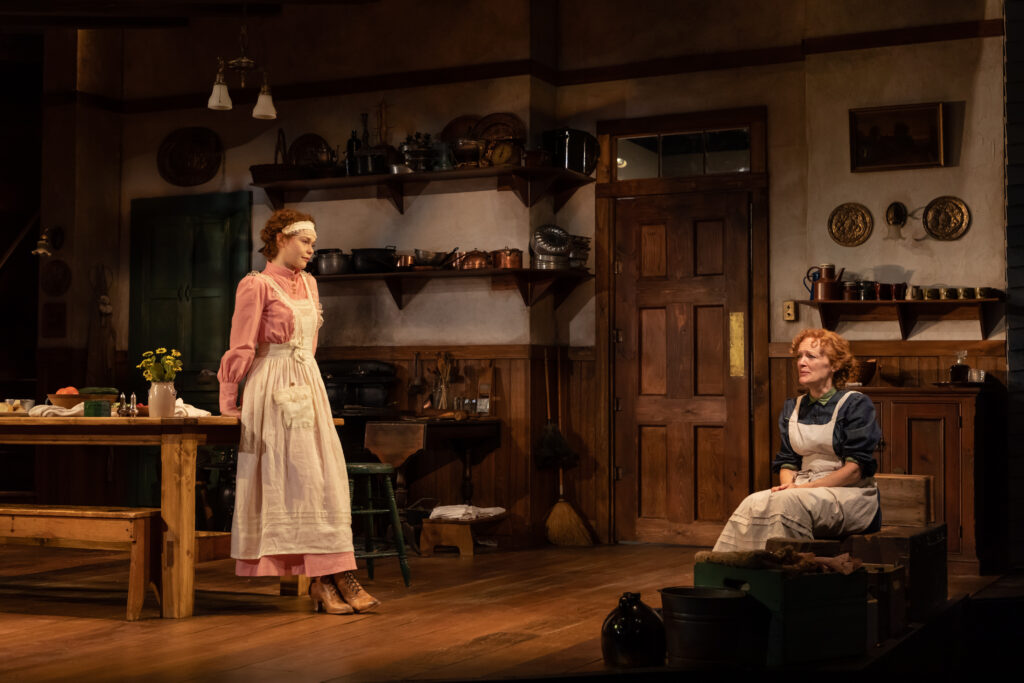
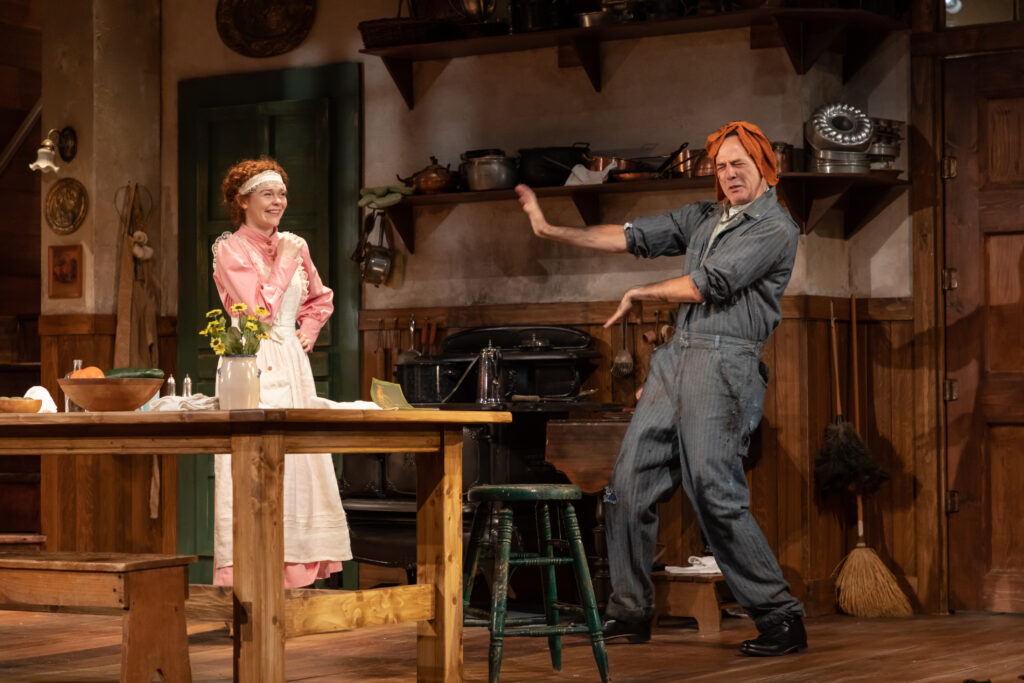
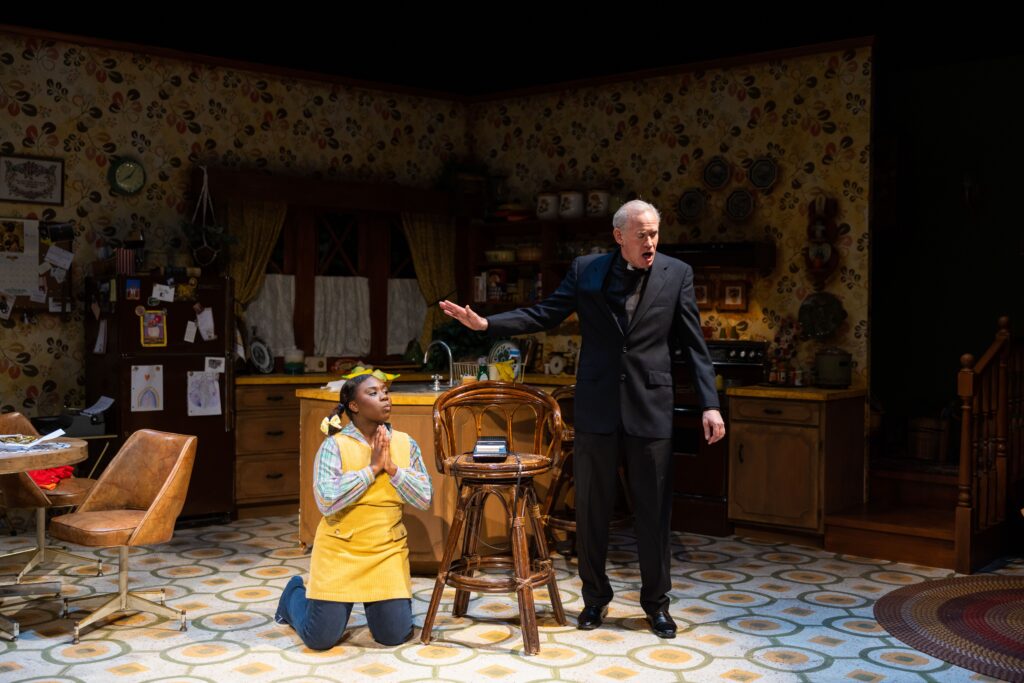
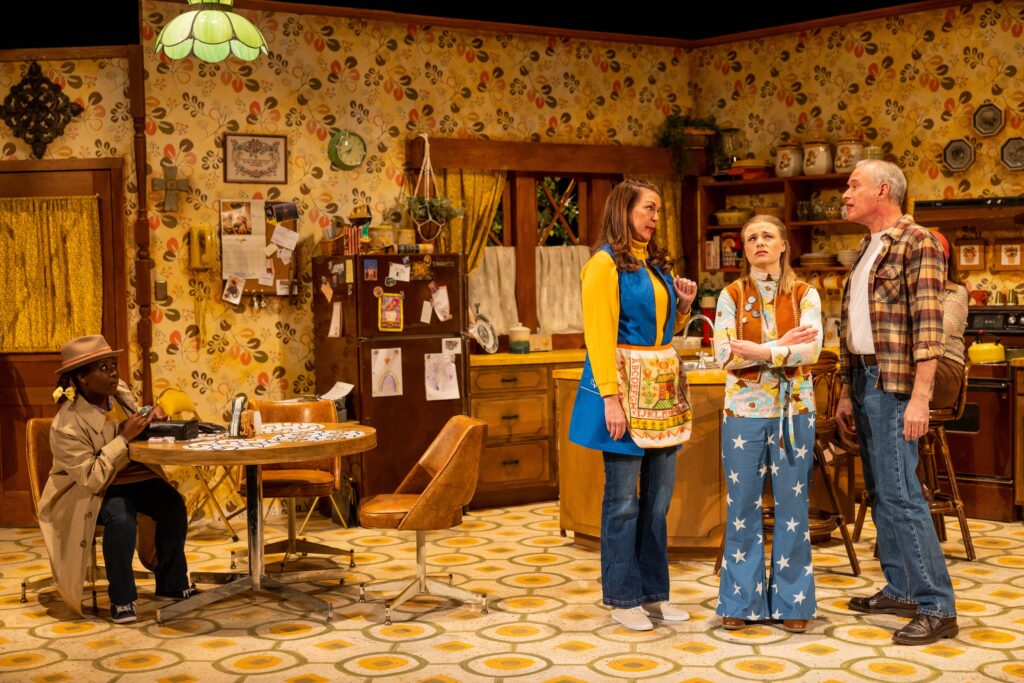
Patty, Bari and Luann at work at the fulfillment center
(Photos by Mark S. Howard)

By Shelley A. Sackett

Deborah Zoe Laufer’s deceptively profound Be Here Now opens with an almost slapstick scene. Three women (Patty and Luanne Cooper and Bari) sit on yoga mats as the blissed-out disembodied voice coaches them to look inside themselves and “let go.” Patty (Shani Farrell) and Luanne (Katherine C. Shaver), dressed appropriately in latex, comply, closing their eyes and sinking into their mats. Bari (Samantha Richert) clearly marches to a different drummer. She is fully dressed (as in a midi dress and huge coat-sweater) and keeps her eyes defiantly open, widening them at each suggestion she close them. Her face portrays the furthest state from bliss possible. This woman is irredeemably and unapologetically miserable.

Turns out she has every reason to be.

She has lost her job at a university in New York City teaching — drum roll — nihilism because she is ABD (all but dissertation). She is 17 days away from her ultimate deadline; she has been working on it eight years. And she has been having bone-crunching headaches.

Exiled to her economically depressed small hometown its small-town people, she works at a fulfillment center (which is anything but) with Luann and her Aunt Patty Cooper, both Christian “believers.” Thirtyish Luann believes her choice to have faith and BE-LIEVE is behind her happiness (the anti-depressants don’t hurt either). “You can choose to be happy. Or you can choose to be sad. I prefer to be happy,” she explains to Bari.

“Whatever you choose, sooner or later it will end in grief,” Bari glumly replies. The spunky, honest, funny and compassionate camaraderie among these three provides both comic relief and fodder for deeper consideration — Does it really matter how one finds happiness? Is it really anybody’s business but your own?

Patty (also no stranger to mood enhancing drugs) decides to set Bari up with her cousin Mike (everyone in Coopersville has the surname Cooper except Bari), who has his own baggage and, literally, garbage. Bari outright refuses, immediately experiences the first of many forthcoming seizures, and ,with this seizure and its repercussions, playwright Laufer has penned the lynchpin on which the rest of the play’s message depends.

As Bari comes to, the sound shifts to the Zen meditation we heard at the beginning. For the first time in her life, Bari feels happy. She suddenly feels like everything matters, especially meeting Mike for a blind date. Suddenly she has “urges” that she must immediately satisfy. She loves this new euphoric Bari and will fight tooth and nail to hang onto it, whatever the price.

Turns out that price may be her life, but we don’t want to get ahead of ourselves.

Under the spell of post-seizure after glow, she meets Mike (Barlow Adamson) and promptly has another seizure, this one more of a doozy. When revives, she hears yoga music and a sea of Oms. The sees auras. She is a poster child for ecstasy. She is terrified the feeling won’t last and goads him into coming home with her and having sex.

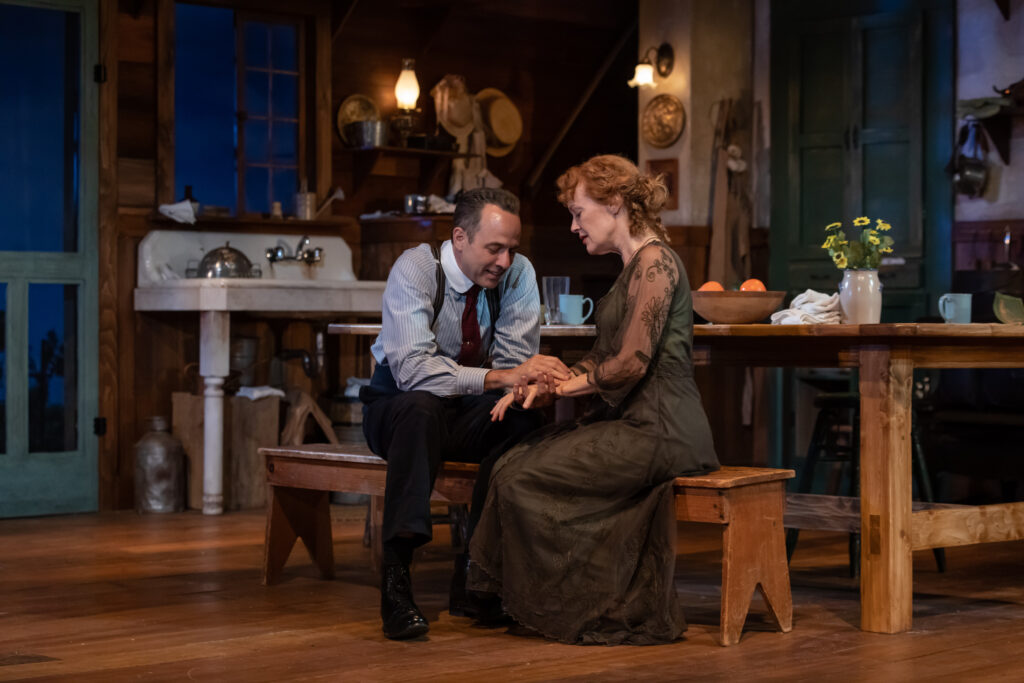
Girl gets boy that night, girl loses boy next day when she kicks him out so she can write, girl begs forgiveness from boy by presumptuously showing up at his sparse cabin unannounced.

There is a lot more to Mike than his eccentricities of collecting garbage (“found objects”), living without cell phone or a car, and cohabitating with a crow might indicate. His tragic backstory carries a motherlode of pain, guilt and despair. Yet, he is determined to rebuild his life (literally) by creating MacArthur Fellowship Genius Grant-worthy shelters from these found objects.

He is trying to keep his life small. No one has ever been to his cabin until her. “I can’t take on anything more,” he says as Bari relentlessly presses him for more.

He is convinced Bari’s headaches are caused by a brain tumor, her post-seizure euphoria a medically common side effect. He agrees to let her stay as long as she forks over her cell phone and understands he will dial 911 if she has another seizure.

Bari rhapsodizes about how she feels with her “new brain.” She doesn’t want to give it up and doesn’t want to know if it is a tumor that will kill her. She knows now that happiness exists; does it matter if its source is religion, Zoloft, meditation, sheer will of choice or a deadly tumor? For the first time, she feels alive. And she loves it.

Of course, she has another seizure. Of course, Mike calls 911 and accompanies her to the hospital. She has a kiwi-sized tumor and will indeed die — and soon — unless it is removed. Yet she is afraid she won’t like Mike, that he won’t like her, that she will become anhedonic without it. Does it really matter how we achieve happiness, even if it kills us?

What comes next would be a spoiler to reveal and this is a play that really should be seen, so I’ll stop here.

The actors give uniformly beautiful performances. Barlow Adamson stands out, bringing both gravitas and grace to the smart, wounded, quirky visionary Mike. Adamson is a big guy, yet manages to  transform himself into a fragile bird with a broken wing.

Samantha Richert takes Bari though her highs and lows at breakneck speed. But is the interplay between Shani Farrel (Patty) and Katherine C. Shaver (Luanne) that are a delightful reprieve from the sometimes relentless Sturm und Drang. Farrel is as practical as Shaver is mercurial and the way they play off each other is a pleasure to behold. Think the cast of “Steel Magnolias” or “9 to 5” and you get the idea.

Finally, Courtney O’Connor’s directing, Janie E. Howland’s clever set, Karen Perlow’s subtle lighting and especially Dewey Dellay’s composition and sound design elevate the production in notable yet nonintrusive ways.

For tickets or more information, go to lyricstage.com/

Lyric Stage’s ‘Be Here Now’ Asks: “At What Price Happiness?”

‘Be Here Now — Written by Deborah Zoe Laufer. Directed by Courtney O’Connor. Scenic Design by Janie E. Howland. Costume Design by Rachel Padula Shufelt. Lighting by Karen Perlow. Composition and Sound by Dewey Dellay. Starring Barlow Adamson, Shani Farrell, Samantha Richert and Katherine C. Shaver. Presented by The Lyric Stage Company of Boston at 140 Clarendon St. through October 17.

Make SpeakEasy Stage’s Impeccable ‘The Sound Inside’ Your First Stop for In-Person Theater

Jennifer Rohn and Nathan Malin in ‘The Sound Inside’ All photos by Nile Scott Studios

By Shelley A. Sackett

If your Covid Comfort Zone now includes attending indoor events, gallop on over to SpeakEasy Stage’s production of Adam Rapp’s The Sound Inside, a trifecta of what makes for exalted theater: flawless script, acting and directing. This two-hander doesn’t just hit a home run over the green wall; it launches it into outer space.

That said, it still takes a leap of faith to believe that it is safe to be packed together as tightly as a fully booked economy cabin as long as everyone is fully vaccinated and masked. It took me several minutes before my anxiety leveled off and I could be entirely present for the play.

And what an extraordinary play it is.

In a nutshell, Rapp has written a 90-minute intermission-less drama about two writers: Bella Baird (Jennifer Rohn), a 53-year-old Yale professor of creative writing who has just been diagnosed with stage 2 cancer, and Christopher Dunn (Nathan Mailin), her student who marches to a different drummer than his peers.

Through their intellectually intimate and intricate conversations, we glimpse the moving targets of their lives’ stories and the fictional lives each has woven as cover and cover up. We also glimpse their pain, isolation, loneliness and pessimism. They are as different as night and day, as similar as two peas in a pod.

There emerges an undercurrent of dormant dread and tension underlying their relationship., but also the hint of potential relief and comfort. Their hyper-articulate, erudite dialogue takes them on a roller coaster ride, sometimes igniting storage bins of disillusion and defeat. Other times, their conversations are the magical balm that soothes their aching souls. Rapp keeps us guessing whether grief or solace lurks around every encounter, as thoroughly engaging and enjoyable as good page turner.

Jennifer Rohan in ‘The Sound Inside’

Under Devorah Kengmana’s brilliant lighting design, the play opens in darkness. A spotlighted Bella emerges and begins to address the audience. As if workshopping a novel, she describes her experiences, thoughts, and disappointments. She is scathing and dispassionate, especially when critiquing herself, the author of two novellas and “an under-appreciated novel written in my late thirties that, despite some flattering reviews and a mention or two on a handful of year-end lists, is struggling to stay alive.” She is also not above petty jealousy. Although she adores James Salter’s “Light Years,” rereading it every year, she refuses to teach it because “it is a rare work of fiction that continues to reveal new things with each reading…It’s so good it enrages me.”

The set (by Cristina Todesco) is sparse, dark and efficient, a single table and two chairs. When Bella addresses the audience from the table and the lighting shifts, we are transported to her office. Christopher arrives without an appointment (for which she admonishes him, but doesn’t send him away). He speaks to Bella and she speaks both directly to him and to the audience in frequent pithy asides. Alternating who gets to play narrator is a device Rapp employs to great effect throughout the play.

Christopher is a Yale misfit, surly, full of contradictions, with a chip on his shoulder and a mind as focused on and in love with writing as is Bella’s. He is obsessed with Dostoyevsky’s “Crime and Punishment.” He is out of step with his generation (“Twitter is for people who are terrified of solitude”) and at heart an old-fashioned romanticist (“Email’s not my style. I prefer penmanship. Getting ink on your fingers. The human effort”).

In some ways, they are yin and yang; she’s all about following rules and protocol, while he simply follows his own instincts. Yet something sparks when they are together. They admire — and, surprisingly, seem to trust — each other. He loved her published works and cites long passages as he paces her office, praising her novel (after which she seems to melt, and tells him to call her Bella instead of Professor Baird). She is impressed by his ambition (he is writing a novella with himself as the protagonist) and prodigious intellect.

Under Bryn Boice’s spot on direction, the rest of the play (no spoilers here!) weaves a tapestry borne of their conversations. They become more honest and unguarded with each other, exposing an almost erotic, yet chaste, intimacy that lifts each out of his fundamental sadness. It is no surprise that Christopher’s novella bears a quote from “Crime and Punishment: “We sometimes encounter people, even perfect strangers, who begin to interest us at first sight, somehow suddenly, all at once, before a word is spoken.”

Jennifer Rohn brings a gorgeous nuance to Bella, imbuing her (many, many) lines with pathos, compassion and, when called for, playfulness. Her body language shifts on a dime; her vocal pacing and tone are subtle and effective.

As Christopher, Nathan Mailin brings the same qualities he did as a runaway star in ‘Admissions,’ the 2019 SpeakEasy Stage production where he debuted as a 20-year-old BU student. He has tempered and honed his style (which still has enormous range and presence) and brings depth, vulnerability and physicality to a character that could have easily become a caricature in less capable hands. Individually, each is superb; together, they are simply sublime.

Cannot be recommended highly enough.

Presented by Speakeasy Stage in the Calderwood Pavilion at the Boston Center for the Arts through Oct 16, 2021.

For COVID protocol, go to https://www.speakeasystage.com/visit/covid-masks-vax/

For tickets and more info, go to https://www.speakeasystage.com/shows/2021/09/the-sound-inside/

Nathan Malin and Jennifer Rohn in ‘The Sound Inside’

Dorset Theatre Festival’s ‘Queen of the Night’ Spins Evening Magic

Leland Fowler (at left) and Danny Johnson in ‘Queen of the Night.’

By Shelley A. Sackett

Finding one’s seat (a folding beach chair) for  Dorset Theatre Festival’s world première of “Queen of the Night” at Southern Vermont Art Center’s rustic plein-air stage is like entering a fairy forest world where reality and theater blend. Night creatures are everywhere — by design piped in over the sound system, and by Mother Nature in the woods, open field and air that are the outdoor playhouse. As dusk fades to night, the stars complement the strung overhead lights to create a magical haven far removed from the day’s blaring headlines and latest COVID statistics.

The efficient and effective campsite set, designed by landscape gardeners Justin and Christopher Swader, blends into its organic setting. All the natural world is indeed this play’s intimate stage, and the audience is palpably grateful to be part of it. What could possibly go wrong on a night like this? By the time Tyler (Leland Fowler) and his father Stephen (Danny Johnson) amble onto the “stage” and begin to pitch their tents, it feels like we should jump up, welcome them to the neighborhood and offer to help them set up.

This father and son, however, are not simply taking a break from their Houston lives to spend three peaceful nights camping in a nearby state park. They have brought more baggage than their camping gear and a mile-long laundry list of issues that both unite and divide them. “Ty” is young, black, semi-employed and flamboyantly gay. For his first night in the woods, he shows up in orange short shorts and a black floral, lacy top. L.L. Bean he is not (thanks to Fabian Fidel Aguilar’s bold and fun costumes). He loves city life, gay bars, vamping, prancing and channeling Celine Dion at the top of his talented lungs. He worries about bad cell service and being eaten by bears. He is in constant motion and we are drawn to his physicality like a moth to a flame.

Stephen, on the other hand, is steady and solid, a reliable and dependable employee and family man. Think of a 63-year-old man with James Earl Jones’ octogenarian gravitas. He inhales the campsite with reverence and relief. He pays attention to nature with serious religiosity. He is the obvious yin to his son’s yang; and yet, as the play unfolds, we will see how these opposite and contrary forces may actually be complementary, interconnected, and interdependent. By the end, they actually give rise to and liberate each other as they interrelate.

The presenting reason for this father-son camping trip to their longtime stomping grounds is the impending remarriage of Ty’s mother, which both will attend. They are navigating difficult waters — Ty and his more successful corporate lawyer brother Marshall are trying to be there for both parents without making hurting either; Stephen admits he still loves his (ex-) wife. The weekend is meant to clear the air and reset their clock, to help them reconnect in the way they did when Ty was a young Boy Scout and he and his father would go camping, in this very spot, just the two of them.

The trouble is that they each have very different memories of those trips, and of just about everything else during Ty’s childhood. Stephen wanted to make Ty tough, independent and resourceful. All Ty wanted was to feel his father’s love and acceptance of him, just the way he was.

Over the course of the 90-minute intermission-less production, we witness the erosion of years of hurt, disappointments and missed opportunities as the two let down their guard and act more like buddies than adversaries. Stephen confesses that he has been laid off from his job and that he has been seeing a therapist. He’s changed. He’s sorry. He wants to be close to his son, to undo the damage he had no idea he caused. “You’re my missing piece,” he tells Ty. “I need you.”

Ty acknowledges his frailty and insecurity, his sadness and longing for paternal praise and love. His veneer of gaiety barely camouflages a melancholy so deep that he reflects on his desire to die alone in the woods at night.

tate uses this broken relationship as a platform from which to tackle a bunch of big-ticket themes: being Black; being gay; being a man; being a Black gay man; being accepted; being accepting; unconditional love; self-love, self-hatred, family dynamics, to name just a few. While his dialogue has moments of sharp insight and laugh-out-loud humor, it often feels preachy and spread too thin over too many issues. Some lines feel injected out of nowhere just to make a point, never a help to a two-handed play.

To the script’s rescue, however, is the spectacular acting of the two leads, reason enough to see the production (and anything else these two may appear in).

Danny Johnson brings an elegant sobriety to the father, Stephen. His raspy melodious voice, cadence and spot-on phrasing imbue his character with humility, decency and authenticity, bring true life to a role that could have been easily become two-dimensional. Leland Fowler brings equal parts joie de vivre and soul-crushing heartache to Ty, miraculously keeping the character light and accessible.

A cursory search reveals that Queen of the Night has many meanings, including the villain in “The Magic Flute,” a white night-blooming cactus flower and, slangily, a flamboyant and promiscuous gay man. It’s the operatic aria reference that resonates most with me, with its message that only those who embrace love and forgiveness are worthy to be considered human. These two are indeed all too human beings, dealing with their perceptions of who they are and who they want to be, starting with their roles as father and son.

Queen of the Night’ – Written by travis tate. Directed by Raz Golden. Scenic Design by Christopher and Justin Swader; Lighting Design by Yuki Nakase Link; Sound Design by Megumi Katayama; Costume Design by Fabian Fidel Aguilar. Presented by Dorset Theatre Festival at the Southern Vermont Arts Center in Manchester, Vermont through September 4.

For tickets and information, call 802-867-2223, ext. 101 or visit dorsettheatrefestival.org

Gloucester Stage’s ‘Baskerville” Is A Literal Breath of Fresh Air

By Shelley A. Sackett

Texan Sir Hugo Baskerville (Julian Manjerico) consults with Sherlock Holmes (Alexander Platt) and John Watson (William E. Gardin). All photos by Jason Grow

Nothing could be finer than to be at theater-en-plein-air in Rockport on a clear and balmy summer evening carousing with the brilliant cast of the spectacularly entertaining Baskerville: A Sherlock Holmes Mystery. Penned by Ken Ludwig, the Tony-award winning playwright of Lend Me A Tenor, this fast-paced comedic melodrama is a riff on the quintessential detective, Sherlock Holmes, and his faithful sidekick, Dr. John Watson.

This time, the dynamic duo is called upon to crack the case of “The Hound of the Baskervilles” before a family curse dooms its newest heir. Along the way, they encounter a motley crew of eccentric characters, hair pin plot twists and turns and red herrings galore. The 2-hour-15-minute (including one intermission) production flies by as five spectacularly talented actors play more than forty characters whose slapstick gestures and hyperbolic speeches they perform with impeccable pacing and precision. Couple this with stellar set, lighting, sound and prop designs, and theatergoers are in for a rollicking evening of good old-fashioned fun.

The play opens with Watson (William E. Gardiner) setting the stage by narrating what he and Holmes (Alexander Platt) know and what they need to learn about the mysterious deaths of the Baskerville heirs. Although the actors look and emote like their iconic cinematic predecessors, Basil Rathbone (Holmes) and Nigel Bruce (Watson), they each bring additional layers to the onion, remaking the characters as their own.

Gardiner’s Watson is a blend of subtle contradictions — confident, yet cautious; anxious, yet reckless; compassionate, yet unquestioningly loyal. Platt’s Holmes is delightfully quirky — blind to his worst foibles while perseverating over imagined transgressions; jumping up and down and squealing in delight one minute, while dispassionately describing a victim’s gory fate the next. Platt uses his height and leanness to bring spot on physicality and humor to his character. They are both up to the task of anchoring the play, both as its namesakes and as the two actors who play only one role.

The other three are maestros of quick change: character, costume and accent. Among them they play more than 40 characters with a style that would be at home in a Victorian melodrama. Anna Bortnick is a standout as she glides from character to character, morphing from a Scottish nurse to a severe, humorless Swedish caretaker to an older, maternal housekeeper to a scrappy Dickensian urchin boy (in whose skin Bortnick particularly shines).

Anna Bortnick and Alex Jacobs as messenger boys.

Alex Jacobs is superb as he flows from Stapleton (a seemingly geeky butterfly lover who conceals a psychopath within) to Barrymore (the mournful caretaker of Baskerville Hall) to Milker (the other scrappy Dickensian urchin boy) to Lucy (the loving wife of Wilson) to Dr. Mortimer the elegant, friendly and passionate.

Julian Manjerico rounds out the trio with versatility and verbal and physical nimbleness as he hops from Sir Hugo Baskerville (a brutal, cruel Cavalier) to Wilson (the exuberant, hearty head of a messenger office), to Sir Henry Baskerville (a young Texan relation to Baskervilles, open-hearted, earnest, ready for adventure and to fall in love), to Inspector Lestrade, a cocky police inspector.

They are all aided by Miranda Kau Giurleo’s flawless costume design, Erica Tobolski’s dialect coaching and Robert Walsh’s expert action consultation. Director Jim O’Connor utilizes Janie E. Howland’s efficient, moveable set and Dewey Dellay’s original music and sound design  to maximum advantage in creating a thoroughly satisfying theatrical experience.

Windhover Center for the Performing Arts is a hidden Shangri-la of a venue with a horseshoe shaped seating arrangement encircled by a grove of protective and comforting trees. The effect is intimate, organic and charming. For tickets and info, go to gloucesterstage.com/baskerville/.

‘Baskerville: A Sherlock Holmes Mystery’ – Written by Ken Ludwig. Directed by Jim O’Connor. Set Design by Janie E. Howland; Lighting Design by Marcella Barbeay; Original Music/Sound Design by Dewey Dellay; Costume Design by Miranda Kau Giurleo; Props Design by Emme Shaw; Dialect Coach – Erica Tobolski; Action Consultation by Robert Walsh. Presented by Gloucester Stage Company at the Windhover Center for the Performing Arts in Rockport through July 25.

‘Bar Mitzvah Boy’ wrestles with keeping the (Jewish) faith when bad things happen to good people

Rabbi Michael (Diane Di Bernardo) and Joey Brant (Peter Palmisano) prepare for Joey’s upcoming adult Bar Mitzvah in ‘Bar Mitzvah Boy.’

By Shelley A. Sackett

Right out of the gate, playwright Mark Leiren-Young challenges his audience to leave their assumptions in the (virtual) lobby. ‘Bar Mitzvah Boy,’ his prize-winning 90-minute two-hander, opens as a young woman wearing jogging gear, baseball cap and rock-blasting ear buds pauses by a bench, then continues on the wooded trail, straight up the front steps of a stately mid-20th century synagogue.

Inside the rabbi’s office, a 60ish man, dressed in full rabbinic regalia —  gray suit, tallis (prayer shawl), kippah and tefilln (phylacteries) — pulls a book from the book shelf. He sits at his desk, poring over it somberly, as a woman’s nasal voice bleats over a tinny loudspeaker, “Rabbi. You’ve got a visitor.”

The jogger enters and freezes. “Excuse me?” she says with ambiguous inflection. “I don’t mean to be rude, but I’m waiting for someone,” the man replies. In the first of many twists meant to keep us untethered, it turns out the woman is Rabbi Michael Levitz-Sharon (Diane Di Bernardo) and the man, a prosperous divorce attorney, is Joey Brant (Peter Palmisano).

Joey has a mission; he begs her to prepare him for a traditional Bar Mitzvah. He is desperate to carry on this family practice before his grandson, Ben, celebrates his own Bar Mitzvah the following week in the same synagogue, but “no one can know.” Rabbi Michael objects, complaining only a magician could pull off such a feat, but when Joey deploys his talent for persuasion, she reluctantly agrees to take him on as a student.

These opening scenes lay the groundwork for this thinly-plotted, character-driven play, and establish Leiren-Young as a gifted craftsman. The dialogue is witty, smart and fast, full of one-liners and prickly punch lines delivered by two talented actors. Although Joey and Rabbi Michael initially seem poles apart, the more they talk, the more their chemistry grows. They riff off each other. Both make their livings through words, and they delight in the gamesmanship of debate. They are skilled active listeners and articulate, honest responders. They share a sense of humor which has helped each navigate life’s hardships and disappointments. And they both wear their hearts — and their pain — on their sleeves.

Yet, on other levels, the two couldn’t be more different. Joey is impatient, pushy and demanding, a man who knows what he wants and is used to getting it. He abandoned Judaism 52 years ago and hasn’t  been in a synagogue since.

Rabbi Michael, on the other hand, is a third-generation rabbi who entered the “family business” because she wanted to help people. She is in love with the sense of home she gets every time she enters any synagogue, anyplace in the world. Her faith is her bedrock;  her community, her lifeline.

As the play evolves, the tenor of their conversation deepens and Leiren-Young lets his characters ask the question the audience has been pining to have answered. “Why are you here?” Rabbi Michael finally asks. Joey replies, “I want to believe in God,” but admits he has trouble when he sees “stuff like this,” referring to Rachel, the 11-year-old terminal cancer victim he saw at services the previous Saturday. “She’s my daughter,” Rabbi Michael (whose name, ironically, means “beloved of God) answers, and with that, ‘Bar Mitzvah Boy’ shifts gears as the two join forces in their quest to make sense of Judaism in the light of unspeakable tragedies.

The pitch of their conversations deepens in intellectual, spiritual and emotional tone as their relationship morphs from teacher/student to trusting friends. The rabbi shepherds Joey on his journey of Jewish rediscovery despite her breaking heart, putting on a “good face” for her congregation and supporting her daughter’s desire is to be called to the Torah as a Bat Mitzvah before she dies. She candidly admits that Rachel’s imminent passing and the marital separation it caused has stressed her faith to the breaking point. Whether it will survive her death is anyone’s guess.

Joey, too, lets down his guard and reveals the real reason he never had a Bar Mitzvah. For him, a Bar Mitzvah doesn’t represent a coming-of-age rite; it is a coming-back-to-faith turning point.

Joey and Rabbi Michael’s meaty discussions about the Bible as metaphor, miracles, forgiveness, tragedies, and what it means to “feel” Jewish are certainly heady and thought provoking. ‘Bar Mitzvah Boy’ is, after all, a Jewish play with a universal story about keeping faith when bad things happen to good people.

But at the end of the day, these scholarly concepts alone can’t save them. Rather, it is their personal connection as caring friends that helps them build a bridge over the rough waters of their doubts, and their shared faith in the power of community that might just carry them across.

‘Bar Mitzvah Boy’ — Written by Mark Leiren-Young; Directed by Saul Elkin; Produced by David Bunis; Managing Director- Jordana Halpern; Stage Manager- Keelin Higgins; Set Design by David Dwyer; Costume Design by Ann Emo; Sound Design by Nicholas Quin. Presented by Jewish Repertory Theatre. ‘Bar Mitzvah Boy’ is available for digital download from November 5-25. For more information or to purchase tickets, visit jccns.org/event/bar-mitzvah-boy/

‘Manifest Destiny’s Child’ or True Confessions of a Regretful 2016 Jill Stein Supporter

Dennis Trainor Jr in “Manifest Destiny’s Child

by Shelley A. Sackett

‘Manifest Destiny’s Child’ is a dramatization of Dennis Trainor, Jr.’s true story about his personal involvement in all things social justice, from protesting at Standing Rock and Occupy Wall Street to his hosting and writing the nationally syndicated news and politics show Acronym TV to, ultimately, becoming Communications Director of Dr. Jill Stein’s ill-fated third party run for President in 2016.

Created as a memoir at Boston’s creative writing space, Grub Street, Trainor decided to morph the piece into a one-man show. While he and director Jeff Wise wisely interspliced actual footage from the protests and Stein’s campaigns, that footage spotlights Trainor, either as participant or interviewer. Coupled with the remainder of the 63-minutes that focuses on Trainor as a talking head either in emotive full face  or — annoyingly — in static profile, that’s a LOT of on-screen Trainor, his Robert Downey, Jr./Matthew Perry appeal  notwithstanding.

Dennis Trainor Jr arrested in the Hart Senate Office Building during the Occupy Wall Street movement, October 2011. Image: Screenshot/ Manifest Destiny’s Child / AcronymTV.org

It’s hard to get a handle on Trainor’s point at first. We are introduced to his comfortable, well-appointed bourgeois lifestyle (love the art work!), his mid-life professional crisis and his inviolable weekly date nights with his wife. We also glimpse his rage and disappointment at “Trumplandia” and receive a history lesson on “Manifest Destiny,” the widely held 19th century American imperialist belief that American expansion throughout the continent was both justifiable and inevitable.

“How did we get into this Trump mess?” Trainor bemoans. “Inequality and poverty are not an accident. They are human made.”

Finally, some 20 minutes in, Trainor throws us a contextual lifeline. It is 2015 and, seemingly out of the blue, Dr. Jill Stein asks him to be her Communications Director for her presidential campaign. Trainor, flattered and relieved to have something meaningful to do with his life, accepts her offer. Nine months later, he quit but not before amassing a trove of frustrations and disappointments that he can’t wait to share.

The show sometimes feels like a TED talk, and perhaps that’s a venue Trainor should explore, since those parts of the piece feel most authentic and are most engaging. He holds forth on the history of third parties in American politics and the narrow but important victories they won, such as the end of slavery by the then third-party Republican party and women’s right to vote by the Woman Suffrage Party.

Yet, through the whining and misgivings, one can’t help wondering: Why did he work for Stein if he knew she would never be president? Why did she run if not to win?

Trainor’s point (and it is an excellent one) is that Stein should have set her sights on getting the Green New Deal passed rather than securing the presidency, which was completely beyond her grasp. However, she stubbornly stayed in the fray, eventually (in Trainor’s tortured mind) drawing enough votes away from Clinton to result in Trump’s victory. And he was her willing accomplice.

Although he quit Stein’s campaign after nine months, he returned a year later as an independent contractor handling her media (or “sales,” as he aptly puts it). Trainor feels residual existential guilt over his part in her toxic and unproductive run, and this is where the show changes tenor from memoir to chest-beating therapy, which is too bad.

Turns out, however, Trainor and Stein had more in common than not: they share an almost masochistic compulsion to make arguments and fight battles they are certain to lose. “Throwing sand at tsunamis,” he names it.

The piece does end on an upbeat note, heralding  revolutionary struggles that can actually be won, like Occupy Wall Street and Standing Rock. Still, it’s hard not to worry about Trainor personally. If the 2016 election threw him into a tailspin of depressing hours spent on Facebook, Twitter and list making, how must he be coping with that scenario redux and COVID?

‘Manifest Destiny’s Child’ — Written and performed by Dennis Trainor, Jr.; Directed by Jeff Wise and Dennis Trainor; Presented by Acronym TV. 

Manifest Destiny’s Child will stream on-demand October 24st — November 8th, 2020 here: https://acronymtv.org/mdc

Gloucester Stage Company Serves Up Full-Bodied Blues in ‘Paradise Blue’

by Shelley A. Sackett

There’s a raw poetic cadence to the dazzling dialogue of playwright Dominique Morisseau’s final play in her trilogy set in different decades in Detroit. It’s 1949, and the downtown Blackbottom entertainment district is home to many black-owned jazz clubs, including the Paradise Club. Director Jackie Davis sets the tone immediately. Against an opening montage of black and white period photos and a pained, bone-melting trumpet solo,  we hear a single gunshot. This film noir trope is a perfect entrance into ‘Paradise Blue’ and an introduction to the complicated passions that drive its five characters.

Although a structurally imperfect play, Morisseau has served up a piece of theatrical pie rich in language, character development and emotional impact. Despite the virtual production (done zoom-like with seated actors who address the camera full on), the superb cast delivers the caliber of performances that suck the audience right in, dissolving the cyber barrier.  Davis uses a stage direction reader (Aimee Hamrick) to keep the production moving. Hamrick’s “just the facts-ma’am” efficient and unobtrusive narration adds another layer of Sam Spade noir. Once again, Gloucester Stage Company has gifted its theater-hunger fans with a satisfying and innovative armchair experience.

All the action takes place in the Paradise Club, a jazz and drinks joint that both exalts and entombs Blue (Ricardo Engermann), its owner, bandleader and tortured trumpeter. Although lean and small boned, Blue casts a long shadow and his moodiness hangs like an ominous dark cloud over his head. His club is staffed by his affable and hardworking girlfriend-cook-housekeeper Pumpkin (played with confidence and self-effacement by Meagan Dilworth) and his bandmates, piano man Cornelius (Cliff Odle) and drummer P-Sam (Omar Robinson). The topic at hand is how to keep the music going in the absence of the group’s bassist, whom Blue fired after getting into a row with him.

To make ends meet, Blue decides to advertise a room for rent. When the sultry, sexy Silver (Ramona-Lisa Alexander) shows up to answer the ad wearing a red hat and carrying a wad of cash, a loaded pistol and a steamy look that could liquefy lacquer, the play’s pulse quickens. Although Alexander is seated throughout the reading, her voice and gestures spellbind the audience with their overwhelming sensuality and physicality. She is unmistakably a woman used to using her charisma and beauty to charm men into doing what she wants them to do. In Alexander’s exceptional hands, she is indeed a black widow, drawing us into her web every time she looks our way.

Although the 2hour24 minute production gets off to a slow and stilted start, once Silver shows up, there’s an uptick that is sustained until the end. This play is not plot driven; rather it is a snapshot glimpse through the keyhole of five multi-dimensional lives in Black Detroit in 1949. Morisseau’s gifted dialogue lets her characters’ layered stories slowly unfold through their rich and intimate conversations and confrontations with each other. It’s a treat to be a fly on these walls.

Pumpkin, the literal heart of the play and its moral compass, is sensitive and caring. She even carries a book of poetry which she is intent on memorizing just because of its beauty. Despite Blue’s depression and habit of manhandling her, Pumpkin only sees the goodness in him. “A woman’s job is to ease a man’s troubles. This man has a gift. Makes me feel like somebody just to be close to it,” she tells Silver.

Silver couldn’t be a starker contrast. She is aggressive, suspicious and competitive. She is also heartbreakingly sensitive, seeing demons everywhere, from the white world in which a Black man struggles to exist to her own barren womb. “I’m cursed. What’s a woman if she ain’t bearing fruit?” she confides to the sympathetic, compassionate Cornelius (whom she takes as her lover).

Although the three males are less clearly delineated, their portrayers do a splendid job of bringing them to life. Engermann plays Blue with a Denzel Washington fluid and easy delivery, his voice like caramel with a dusting of sandpaper. His and Alexander’s (Silver) phrasings, cadences and pauses are breathtakingly spot on. Odle as Corn is accessible and gentle, a wise and wizened elder statesman. Robinson does the best he can with the thinly drawn P-Sam.

While Morisseau excels at teasing out the nuances of personal relationships, her structural shortcomings in three important areas diminish her audience’s ability to appreciate her artistic intent: (1) Detroit Mayor Albert Cobo’s platform promoting urban gentrification and the buying of black businesses to cure “urban/black blight” is essential background information only obliquely referenced; (2) as the play’s principal character, Blue is underdeveloped; we need more of his backstory told by- not about- him, and (3) the ending feels out of step, strained and jarring.

Notwithstanding, ‘Paradise Blue’ is well worth the stamina required to watch and highly recommended for its superb acting, fabulous soundtrack and inspired production. Once again, Kudos to Gloucester Stage Company for raising the virtual bar yet again.

‘Paradise Blue’ — Written by Dominique Morisseau; Directed by Jackie Davis; Produced by Gloucester Stage Company at Oneline/Virtual Space, as part of its 2020 Never Dark Series. Streaming online October 1-4 at https://gloucesterstage.com/battle-not-begun/

The 1938 Munich Agreement Is Unmasked in Gloucester Stage Company’s Inventive ‘The Battle Not Begun’

by Shelley A. Sackett

Those of us who eschew the national news in favor of mental equilibrium and spiritual health should be forewarned: it is nearly impossible to watch this historically grounded play and not draw some scary parallels to global current events. The points between 1938 and 2020 beg to be connected.

That said, ‘The Battle Not Begun,’ written by playwright and NPR news analyst Jack Beatty, is as artistically absorbing as it is factually repellant. Under Myriam Cyr’s tight editing and sharp-eyed direction, the audience becomes a fly on the wall at the fateful meeting between Adolph Hitler and British Prime Minister Neville Chamberlain that gave Hitler a green light to launch what became World War II.

A little historical background may be helpful. (I offer this lengthy intro because, as one whose knowledge of WWII is admittedly gauzy, I wish I had this primer before sitting down to watch the play.)

After the First World War ended in 1918, the map of Europe was redrawn and several new countries were formed, including Czechoslovakia. As a result, three million Germans found themselves living under Czech rule in the Sudetenland. In 1938, when Hitler came to power, he vowed to reunite Germans into one nation, starting with the cessation to Germany of the “Sudeten German territory.”

Incited by Hitler’s rhetoric, Sudeten Germans rioted and deliberately provoked violence by the Czech police. Hitler falsely claimed that the police killed 300 Germans during these protests.  With this weaponized “fake news” as justification, Hitler immediately placed German troops along the Czech border and announced his intention to annex it. Chamberlain flew to Hitler’s private mountaintop retreat to try to forge an agreement to bring “peace for our time” and avoid further Nazi aggression. (This meeting is the setting for ‘The Battle Not Begun.’)

Instead, Chamberlain caved to Hitler’s every demand about the Sudetenland in the naïve belief that, in exchange, Hitler would honor his end of the bargain and not seek additional territory in Europe. Hitler lied, astutely outplaying Chamberlain. Chamberlain loudly touted the pact as a personal triumph and Britain’s legacy for peace by negotiation. History has since dubbed the Munich Agreement shorthand for “a failed act of appeasement” and a symbol for the futility of placating expansionist totalitarian states.

An inventive film/theater/re-enactment hybrid, ‘The Battle Not Begun’ sets its period mood from the outset. TV/movie-like credits roll over a 1938 tinted photo, slowly panned in a Ken Burns-esque manner. Adolf Hitler (played with technicolor panache by the  supremely talented Ken Bolden) appears full frame in all his stereotypic glory. He paces, prances, preens and snarls, almost simultaneously. This is not someone who plays hide the ball. As Chamberlain waits offstage, he wastes no time telling the audience exactly what he thinks of this “Calvin Coolidge less the exuberance” who is all “grey competence.”

Enter Chamberlain (Malcolm Ingram, who maintains an implacably stiff upper lip and air of entitled aristocracy throughout the performance), as if on cue. He is as polite, deferential and serious as Hitler is insulting and crass. The worst that can be said of Chamberlain’s behavior is that he is a snob and a stick-in-the-mud.

For the rest of the 97-minute production, we have a ring-side seat as these two slug out a resolution to the situation in Czechoslovakia. Along the way, we learn much about these men and what makes each tick. Chamberlain, the white glove diplomat who grew up with a platinum spoon in his mouth, is dispassionate and clinical. He never had actual boots on any war-torn ground, and, while he is no humanist (he disdains the Czechs-and Slavs in general- as much as Hitler does), he is also no savage. He is petty and obsessed with his public image and avenging the humiliation he suffered at the hands of Prime Minister Lloyd George. But he also believes in the sanctity of human life. “When lives are at stake, every chance of peace must be explored,” he implores. “War is a nightmare.”

Hitler, on the other hand, grew up friendless, homeless and impoverished in Vienna. He found peace, meaning and acceptance as a soldier during WWI.  “War is not a nightmare to me. It is life unmasked,” he explains. “War is the great equalizer of class. All are equal in the trenches.” Avenging Germany’s defeat has been his life’s sole mission since 1918.

By the play’s end, we sense that anything negotiated by these two men is doomed to failure; they are simply too different, unable to speak the same language or play by the same rules. No matter what they draft and sign, it cannot be binding because it cannot be translated.

“I became me in war. You became you in a peace that ground every German face to the ground,” Hitler says, as if providing a proof text.

‘The Battle Not Begun-Munich 1938:The Brink of War’ – Written by Jack Beatty; Directed by Miriam Myriam Cyr; Produced by Gloucester Stage Company at Oneline/Virtual Space in collaboration with Punctuate4, an all-female led production company based on the North Shore, as part of its 2020 Never Dark Series. Streaming online September 3-6 at https://gloucesterstage.com/battle-not-begun/

Arlekin Players Theater’s ‘State vs. Natasha Banina’ Turns Virtual Theatre on Its Head in a Groundbreaking Production


nd-29-1024x576

Darya Denisova as Natasha in ‘State vs. Natasha Banina.’


By Shelley A. Sackett


If there are silver linings to the COVID-19 pandemic (and I firmly believe there are many), the robust and varied ways in which live theatre has adapted itself to the digital Zoom era ranks at the top of the list. Some have opted to create a virtual replica of the silent, passive invisible spectator model, maintaining a masked cyber wall between actor and audience, with mixed and inconsistent success.


Not so Arlekin Players Theater’s production of ‘State vs. Natasha Banina.’ Under Igor Golyak’s ground-breaking direction, his “live theater and experiment” audience is far from detached and anonymous. Digging deep into his interactive theatrical bag of tricks, Golyak uses graphics, animation and live viewer participation to erase the glass barrier between observed and observer and create a unique film/theater hybrid. The result is one thrilling corona coaster ride.


The 55-minute live production centers on the fate of Natasha Banina (brilliantly played by the 2020 Elliot Norton Award-winner for Outstanding Actress, Darya Denisova), a Russian 16-year-old incarcerated as she awaits trial for manslaughter in a crime of passion. During pre-show remarks, a masked Golyak addresses the spectators with the words, “Welcome to our virtual courtroom.”


The audience/participants (which last Sunday numbered close to 100) are members of the Zoom jury, Golyak says. We are encouraged to introduce ourselves in a pre-show chat room and take an interactive on-line poll to determine our eligibility to serve. The camera remains 2-way throughout the performance, with Natasha periodically addressing the “jurors” by name. The effect is electrifying.


We then enter Natasha’s cell, where we remain with her for the rest of the piece as she takes the virtual stand and testifies on her own behalf. She slowly unfolds her story, peeling back the layers of an onion that brings predictable tears to the eye. Raised in a small-town orphanage by abusive and hard-hearted “caregivers”, she describes a childhood laced with pain, populated by girls who bully each other and a mother who refers to her as “my abortion.” Unflappable, Natasha nonetheless remains optimistic. She has hope for a different future. She has faith in an imaginary pipedream. “Natasha, what is your dream?” she repeatedly asks herself, with increasing desperation and animalistic passion.


Her life went bad, she confides, when a journalist came to the orphanage and, in the course of his research, took a personal interest in her inhumane conditions. He asked her a question no one had ever asked: “What’s your dream, Natasha?”


nd-24-1-1024x576


Natasha misinterprets this single moment of kindness (“It is the first time someone has been horrified for my life,” she says with puppy dog exuberance). She overreacts, and in her delusional and desperate infatuation, imagines him as her knight in shining armor who will marry her and lead her into a fairytale land of forever after. (Under animator Anton Iakhontov’s inspired genius, the knight is replaced by an astronaut who literally leads Natasha to another world amid cartoon hearts and clouds).


As the lines between inside and outside the stark white cell become blurred for the audience, so does Natasha’s grip on reality as she tells us what came next. She paces around the confined space, grinning all the time with a Cheshire cat grin that alternates among bestial, alluring, menacing and achingly vulnerable. Running black eye makeup and a half- blackened tooth amplify the effect.


Trapped by her fantasies, Natasha continues her self-defense. When she spies her imaginary lover with another woman, she becomes unhinged, encouraging her posse to savagely beat her as revenge. The woman remains hospitalized in a coma and for that act, Natasha faces trial.


And we, the Zoom jury, are to decide her fate.


Natasha takes it to an even more personal level as she addresses audience members by name and pleads with them to see her side of the story. “It’s just a dream I had,” she confesses. And with that, an interactive poll appears on the screen and we are asked to vote: guilty or not guilty?


Within seconds, the verdict appears. Last Sunday, Natasha was found guilty. Other nights, she has had more luck.


Denisova’s performance cannot be praised enough. Although she is alone throughout the entire performance, the audience is left wanting more, no small or standard feat. Her physicality is riveting: she prowls, growls, purrs and eventually claws her way into our hearts. Her jagged smile and trapped, beseeching eyes make us want to hug her and tame her, not necessarily in that order.


As engaging as the play was, the almost as long Emerson-facilitated talk-back was equally absorbing, as Golyak and Denisova fielded questions and took us on a tour of the apartment where the performance was filmed. The audience/jury participation in the live chat was rich with insight and nuance as the discussion veered to questions of morality, insanity defense, human pain and suffering, and judgment.


“The virtual medium is just another space where theater takes place and where audiences can share experiences,” Golyak explained. “Theater is one of those art forms that can be represented in many different environments.”


‘State vs Natasha’ has just started its global virtual tour. For more information, go to www.arlekinplayers.com.

‘State vs. Natasha Banina’ Directed by Igor Golyak, based on Yaroslava Pulinovich’s ‘Natasha’s Dream;’ Performed by Darya Denisova; Translated by John Freedman; Animation by Anton Iakhontov; Video by Igor Golyak; Music composed by Vadim Khrapatchev. Produced by Arlekin Players Theater in partnership with ArtsEmerson and the Cherry Orchard Festival. For upcoming performances, visit arlekinplayers.com/state-vs-natasha-banina-online-interactive-live-performance-2/


Living Out Loud: Gloucester Stage Unmasks Isabella Stewart Gardner in a Tour-de-Force Production

Isabella

by Shelley A. Sackett

Isabella Stewart Gardner’s legacy is synonymous with that of her namesake museum, Fenway Court. Part arboretum, part concert hall, and part cultural repository, the building houses the eccentric millionaires’ collection of art, sculpture, tapestries and more in a gilded Italian confection that reflects its creator’s love affair with the Italian Renaissance.


Just as a visit to the museum titillates and seduces the visitor with romantic corridors and hidden treasures, so does Leigh Strimbeck’s spectacular performance as the spirited and indomitable Mrs. Gardner lead us down a magical path that unveils this complex firecracker of a Bostonian Brahmin’s wife. For just under an hour, Strimbeck (who wrote the one-woman script) is Isabella Stewart Gardner and we are her confidantes as she tells the story of her life from a 20-year-old newlywed in 1860’s Boston to the widowed hostess at the opening of her beloved museum in 1903.


What a story it is and was a terrific storyteller to boot!


Strimbeck is on camera in this “Theatre on Film” production during the entire 56 minutes, and  neither the camera nor the audience can get enough of her. By the end of the monologue, we feel like we’ve barely scratched beneath the surface of this enigmatic powerhouse.


As instructive as it is entertaining, ‘‘The Queen of Fenway Court: Isabella Stewart Gardner’’ introduces Isabella as she struggles with her life as an ebullient, headstrong and feisty young wife stuck in uptight, staid class-obsessed Boston. She quickly abandons any thought of reining in her temperament to “blend in,” and soon she is the belle of the ball and talk of the town- not all of it flattering.


To the woman bragging about her ancestors being among the first to arrive in Boston, Isabella cracks, “Yes. They were much less careful about immigration in those days.” She takes a lion on a walk on a dare and attends dances alone while her equally independent and modern husband Jack (a monied Peabody by birth, a banker by trade) takes refuge in his club. “I obey the rules when they suit me,” she dead pans, her playful eyes dancing roguishly.


Her life takes a U-turn with the birth and death at age 2 of her only child, a son. “My heart sweated,” she says. “Where is God in all of this?” When she suffers a miscarriage and subsequent hysterectomy, her husband whisks her off to Europe and Egypt to recover, planting the seed of the second great romance that will dominate her life: a love for travel. “Travel is the way out and the way back,” she says.


She returns to Italy with a companion (she has many, mostly male and all allegedly platonic) and finds both her true passion and her voice in sensational Venice, the antidote to functional and stoic Boston with its 50 gloomy shades of wintry gray. When she answers the “call to the hunt” and purchases her first painting, Titian’s “The Rape of Europa,” (which she hopes is “enough to turn any Puritan to a Bacchante”), she discovers her true calling: to collect art for art’s sake. Eyes ablaze, she triumphantly crows after bagging the prized Titian at her first auction, “I vow to live out loud.”


When she returns to Boston, her goals are straightforward: to bring the visual feast of Italy to Boston while, whenever possible, scandalizing its uptight Victorian inhabitants. She and her beloved Jack will build a palazzo to house her carefully curated collection. When he dies midway through the project, however, she decides to live there alone and  builds her cozy fourth-floor apartment.


Full-bodied and clad in the black velvet dress and ruby necklace made famous in John Singer Sargent’s portrait, Strimbeck channels Isabella and all her inconsistencies, quirkiness and charm. She wears both halo and crown and, in the blink of an eye, shifts from steely and unwavering to coquettish and fun-loving and back again to shrewd and fearless. Her voice is nuanced, the pacing interesting and intimate. All this makes for great storytelling and enchanting theater.


Isabella Stewart Gardner’s art and her museum are her last dance and her last love. Above the entrance is the motto, “C’est mon Plaisir.” (this is my delight). After spending an hour getting to know and understand Isabella/Strimbeck, revisiting this literal palace in the hopefully not too distant future will also be nos plaisirs. Merci, Isabella.


‘The Queen of Fenway Court: Isabella Stewart Gardner’ – Written and Performed by Leigh Strimbeck; Directed by Joshua Briggs; Original Music by Jan Jurchak. Produced by Gloucester Stage Company at Oneline/Virtual Space as part of its 2020 Never Dark Series. Streaming online August 6-9.For tickets and information, go to: gloucesterstage.com.