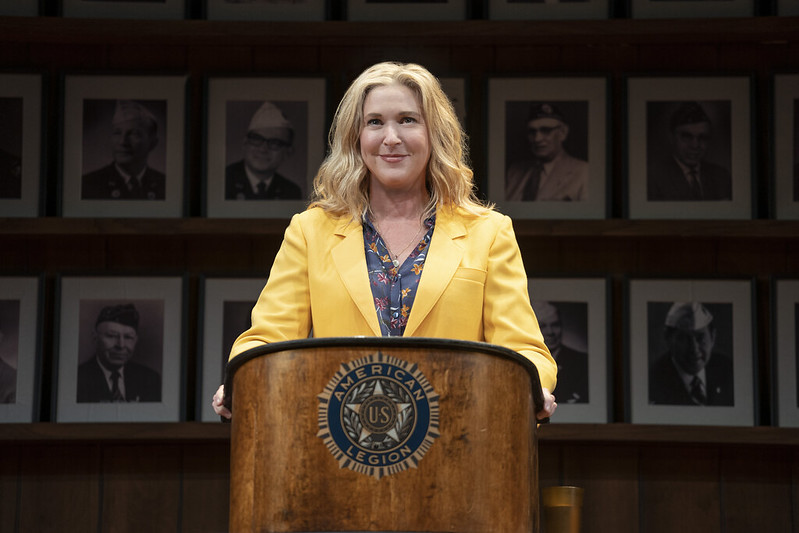
Huntington Theatre’s ‘The Bluest Eye’ Is A Triumph

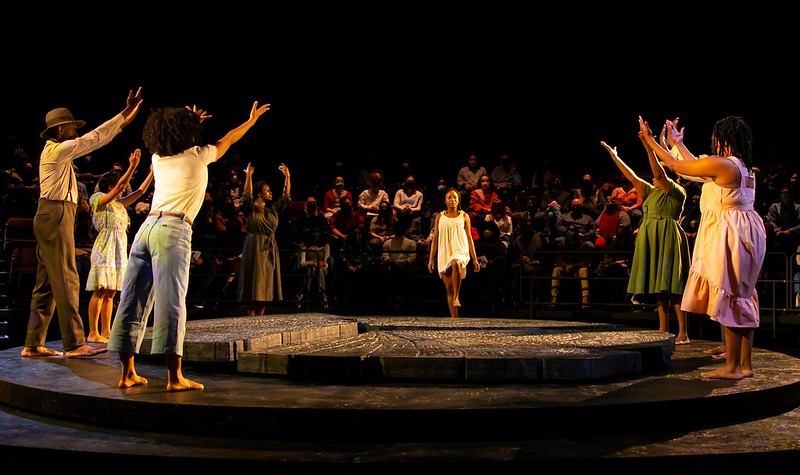
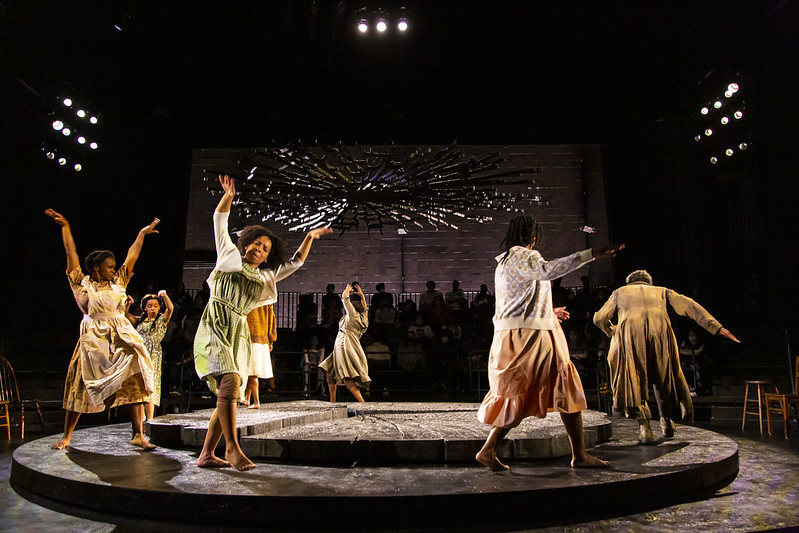
Cast of The Huntington Theatre’s production of The Bluest Eye by Lydia R. Diamond

by Shelley A. Sackett

Brimming with sparkling ensemble acting, inspired staging and soulful song and dance, Huntington Theatre’s The Bluest Eye packs a wallop. Thanks to Lydia R. Diamond’s faithful yet nuanced adaptation, Toni Morrison’s groundbreaking début novel about two poor Black families in 1940s Lorain, Ohio is brought to the stage with all its poetry, pathos and humor intact. You can almost feel Morrison’s presence in the audience, beaming pride and approval.

The story is neither easy nor pretty. Nor is it sugar-coated. A harrowing (and timely) tale about the insidious effects of racism, the 80-minute intermission-less play explores what happens to people — especially children — whose identities and self-images become distorted by the relentless oppression and cruelty they suffer.

What happens to that marginalized little Black girl who feels neglected, lonely and ugly? Whose hand local (white) shopkeepers won’t touch? Whose home life is abusive and unsafe? Whose only frame of reference for happiness, friendship and family harmony is the Dick and Jane primer she reads every day in school, the one about white, blue-eyed, blond Jane and her adoring, white parents?

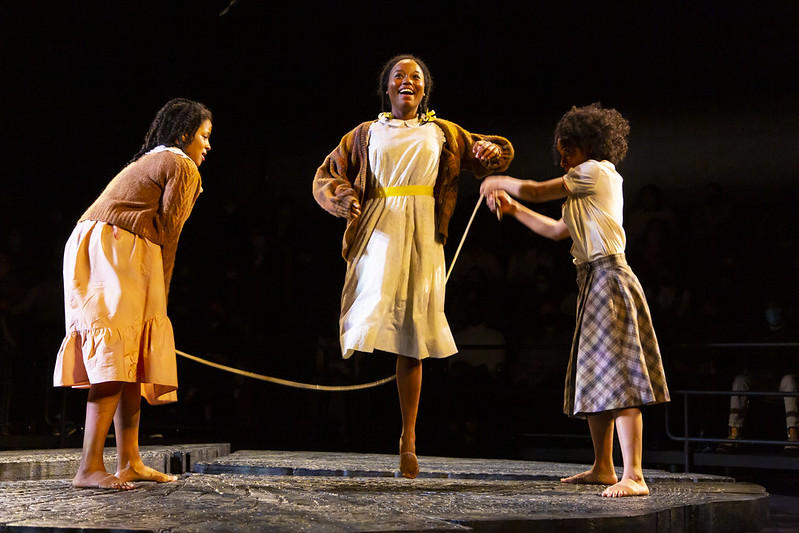
Brittany-Laurelle, Hadar Busia-Singleton, and Alexandria King

From the get go, there is a feeling of community and engagement among the actors and between actors and audience. Performed on a raised, round stage between two semi-circles of audience members, the (masked) physical immediacy and intimacy heightens the mood. No one is hidden; no one can hide.

The play opens with two feisty preteen sisters discussing local gossip. Claudia (Brittany-Laurelle, who brings a powerful but contained individuality to the role) and Frieda (Alexandria King in a magnificently physical and expressive, punchy performance) will act as narrators and guides, and their sassy, lighthearted banter is the perfect foil to the heaviness of the story that will unfold. Like vocal choreography, their voices dance with and around each other, weaving a single tapestry from many strands.

Their main topic of conversation is the Breedlove family, the ugliest family in Lorain. “Their ugliness came from a conviction that they accepted without question,” Claudia explains. Eleven-year-old Pecola Breedlove (played by the hypnotic Hadar Busia-Singleton, who manages to infuse her unbearably sad character with a whisper of hope) knows the world finds her Blackness ugly. “How do you get somebody to love you?” she asks over and over.

But she has a plan. She has figured out the key to being lovable. All she needs are blue eyes, as blue as Jane’s and Shirley Temple’s. “Then the teachers would see me and people would have to be nice to me,” she explains matter-of-factly.

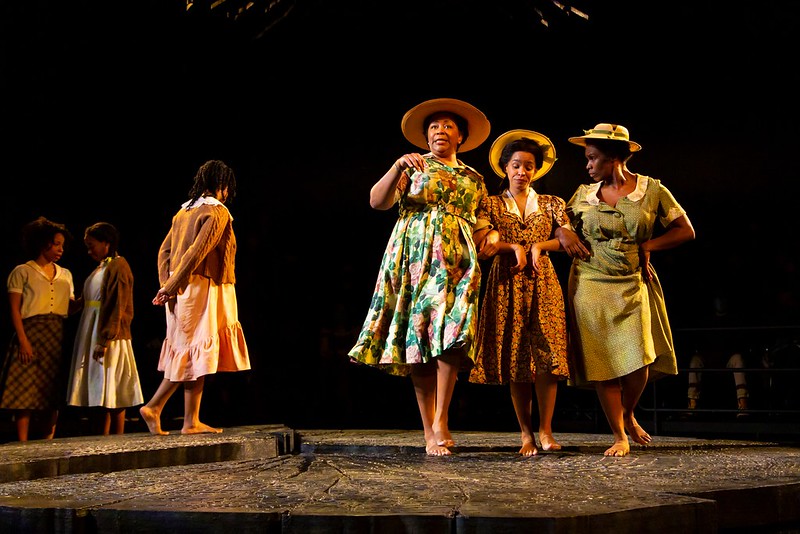
R foreground: Ramona Lisa Alexander, Lindsley Howard, McKenzie Frye

Claudia and Frieda’s recollections and narrations are the backbone of the play, told with overlying reenactments of the various scenarios that have shaped and marked their and Pecola’s families. Mrs. Breedlove (McKenzie Frye) is a cleaning woman with a bum foot and missing front tooth who would go to the movies and dream of looking like Jean Harlow. Her husband Cholly (Greg Alverez Reid) suffered the kind of loss, humiliation and violence that doesn’t excuse his inexcusable acts, but at least provides context. Beneath their toughened exteriors, each carries the weight of unbearable despair. Together, they are a ticking time bomb, Pecola its collateral damage.

By comparison, Claudia, Frieda and their Mama (played by Ramona Lisa Alexander as unyielding and fussy yet kindhearted) lead a life of relative ease and stability. These three are the source of the play’s lightness and humor. As Claudia, Brittany-Laurelle brings down the house in the reenactment of a scene when she received a blond, white baby doll as a gift. To her mother’s disbelief and horror, rather than covet it, she destroys it, but only after she has humiliated and terrorized it. She hates its so-called beauty. “What was I supposed to do with that?” she asks without irony.

Through a series of events that would include spoilers, Pecola’s prayers for blue eyes and all that means seem to be answered by the magic of Soaphead Church, a charlatan soothsayer, played brilliantly by Brian D. Coats. Yet, it is at such a steep price that we are left grieving for this child whose innocent light has been extinguished.

Under Awoye Timpo’s direction, The Bluest Eye brings a lot of extras to the table. She makes wonderful use of a trio of women who appear throughout the production, imbuing them with many of the gestures and props familiar to fans of Alvin Ailey’s “Revelations.” They are welcome palette cleansers, acting as part Greek chorus, part harpies, and part goddesses. The interweaving of a capella spirituals (Frye is a knockout) and choreography (especially the slow-motion battle scene between Cholly and Mrs. Breedlove) is inspired and welcome.

The Boston theater scene is replete with many productions that are well worth seeing. Only a handful rise to the level of “must see.” The Bluest Eye is one of them.

‘The Bluest Eye’ – Based on the book by Toni Morrison, adapted for stage by Lydia R. Diamond, Dramaturgy by Sandy Alexandre. Directed by Awoye Timpo; Set Design by Jason Ardizzone-West; Costume Design by Dede Ayite and Rodrigo Muñoz; Lighting Design by Adam Honoré; Sound Design by Aubrey Dube; Original Music by Justin Ellington; Choreography by Kurt Douglas; Music Direction by David Freeman Coleman. Presented by Huntington Theatre Company at Boston Center for the Arts through March 26. Digital recordings available Feb. 14 through April 9.For tickets and information, go to: https://www.huntingtontheatre.org/

Beverly filmmakers document Alabama vaccination campaign; will screen at Sundance festival

Rachael DeCruz and Jeremy S. Levine

By Shelley A. Sackett

It was spring 2021, the second year of the pandemic, and filmmakers Rachael DeCruz and Jeremy S. Levine were depressed. They were living in Alabama, a state with one of the lowest vaccination rates in the country.

“We had nearly forgotten what it was like to make eye contact with other humans. We finally had a vaccine, but people weren’t getting the shot – at least not in Alabama,” Levine said by email.

The Massachusetts natives’ dour moods lifted, however, when they heard about Dorothy Oliver, a woman who was running a vaccination drive out of her mobile home convenience store in Panola, a rural Black town of almost 400 near the Mississippi border. Panola was too small for its own COVID vaccine center and the closest hospital is almost 40 miles away. Many residents don’t have cars; some still rely on horses for transportation.

Oliver and County Commis­sioner Drucilla Russ-Jackson hatched a plan to keep their town safe. Rather than try to bring Panola’s unvaccinated to the hospital, they would bring the hospital to Panola. They persuaded a local clinic to bring a pop-up site to the town under one challenging condition: They had to convince 40 residents to sign up for the vaccine.

Although Panola had its share of skeptics, a lot of residents wanted the shot. It was logistics – not anti-vax ideology – that kept them from getting it. As social justice advocates and activists, Levine and DeCruz were troubled by the underlying unfairness behind the public health reality of this poor, Black rural community.

They jumped into their car and drove out – unannounced – to meet Oliver at her store. “Instead of sitting on our couch in a state of existential dread, we set out to seek solutions – and frankly, some hope,” said Levine.

Oliver welcomed them like family from the beginning. “She showed us that even in trying times, even when discussing a politically fraught issue, the only way forward is with hope, warmth, and a sense of humor,” DeCruz said.

Levine and DeCruz were so struck by Oliver’s tenacity and the injustice of Panola’s situation that they decided to bring the story to a larger audience. “The Panola Project,” a 16-minute documentary they coproduced and codirected, chronicles Oliver’s campaign as she goes door to door, talking people into signing up and lightly chiding them about their fears and concerns. The film was recently named an official selection of the 2022 Sundance Film Festival.

DeCruz and Levine, who grew up in Beverly but met as adults in New York City, share a deep commitment to social justice issues. They were both raised in families grounded by Jewish values, culture and traditions. They moved to Tuscaloosa when Levine was hired as an assistant professor of media production at the University of Alabama.

Levine remembers learning about the Jews’ difficult history as a kid, when he attended Hebrew school at Temple B’nai Abraham in Beverly. “This created a deep-rooted desire to fight for justice for all. The idea of ‘tikkun olam’ was important to my worldview from early on,” he said.

DeCruz’s life and identity were shaped by both race and religion. Her mother is white and Jewish and her father is Black. Growing up, she didn’t know many mixed-race families and at home, “We never talked about race, despite the fact that it was impacting each of our lives every day in numerous ways. I spent a lot of my childhood trying to figure out my place and understand the many layers of my identity. These factors were a large part of what drove me to do racial justice work,” said DeCruz, the associate director of advocacy at Boston University’s Center for Antiracist Research.

“The Panola Project,” which spotlights the racial and social inequities behind public health policy, was a perfect fit for these two filmmakers professionally and personally, with Oliver as its perfect spokesperson. “I just felt like I had to do it because the government, nobody does enough in this area,” Oliver explains on camera. “This area here is majority Black. Kind of puts you on the back burner.”

Oliver received USA Today’s Best of Humankind/Best of Womankind Award, which recognizes and celebrates an everyday person who is making a difference in their community. Dr. Anthony Fauci thanked her, saying her work can serve as a model for the country.

DeCruz points out that, despite Alabama having one of the lowest vaccination rates in the country, 99 percent of adults in Panola have now received their shots, thanks to Oliver and Russ-Jackson’s relentless campaign. “The film showcases the incredible strength of Black women who frequently serve as the backbone holding their communities together,” she said.

For Levine, who recently began as a communication, journalism, and media professor at Suffolk University, the power of storytelling became obvious at an early age. He clearly remembers the pivotal moment that set him on his journey as a filmmaker, or “visual storyteller” as he calls it.

He was a 7-year-old, fulfilling his Hebrew school assignment to record a relative’s story. Armed with a plastic Playskool cassette tape recorder, he interviewed his great-grandmother about her journey to the United States. She told the boy how – when she was just a child – her parents hired a smuggler to sneak her out of Russia under the cover of night to escape antisemitism.

“Had I not gone that day with a tape recorder, her story would have been lost. The connections to our contemporary stories of migration would have been lost with it. This showed me, at a young age, the power of stories,” he said.

To view “The Panola Project,” go to youtube.com/watch?v=j1wI4T9SKGA.

Danvers Holocaust Symposium asks ‘What does the Holocaust have to do with me?’

50th anniversary revival of ‘Jesus Christ Superstar’ storms the stage
Three swastikas have been found at Danvers public schools since the fall.

by Shelley A. Sackett

DANVERS — Last year, Danvers was in the news, but not for reasons that made its leaders and community members proud. Amid allegations of antisemitism, racism and homophobia in the Danvers High School hockey team, there were complaints about lack of transparency and accountability in the school and police departments. Then, in November, swastikas were discovered at the Holten Richmond Middle School and in December, a swastika was found at Danvers High School.

In response, about 200 people gathered for a “vigil of inclusion” organized by the Danvers Human Rights and Inclusion Committee and the Danvers Interfaith Partnership. But Danvers officials, especially the School Committee and administration, wanted to go further.

To that end, Danvers Public Schools partnered with Lappin Foundation to host a six-week Intergenerational Holocaust Symposium on Zoom. The free program began Jan. 6 and includes 39 students and 34 adults.

“We need to continue to work on ensuring our school has a safe and respectful climate and empower all our community members to call out and fight against biased and hateful language and actions,” Danvers High School Principal Adam Federico said in an email. “This work needs to be done by students, faculty and families.”

Consisting of curated materials, primary sources, films, survivor testimony, a book read and discussions, the symposium was created in response to antisemitism, swastikas and racist graffiti showing up more frequently in schools and in community settings. Danvers is the fourth symposium (the others were at New England Academy and Duxbury and Newton North High Schools) and the first to be open to the entire community.

“I believe education is our best hope. Opening the symposium to students and adults in Danvers to learn together has been especially powerful,” said Deborah Coltin, who is Lappin Foundation’s executive director and also runs the symposium.

So far, participants couldn’t agree more.

At the beginning of the first session, Coltin posed the open-ended question, “Why are you here?” Many answered that they wanted to make a difference in Danvers and to be on the side of not making light of recent events. “I want to be rebooted in my attitudes,” a student said.

Tess Wallerstein, an 11th grade Jewish student, took comfort in knowing there are “actually people in Danvers who genuinely care about this topic.” She believes a large percentage of people spreading antisemitism either have an incorrect understanding of the Holocaust or are rooted in ignorance. “Symposiums like this could help lots of people gain a better understanding of major issues and could bring community members together in open discussions by connecting young and old,” she said.

Parent Mike Hass wants to help raise the bar on what is acceptable behavior. He also wants his daughter to learn more about the deeper societal issues that led to the Holocaust. “I want her to see and experience that speaking up and taking an active role in society is critical to shaping the world around her,” he said in an email.

Danvers Chief of Police James Lovell believes the program can serve as a framework for additional, admittedly difficult conversations that will help Danvers grow as a community. “More importantly, I hope to learn things I can do in my role as a public official and leader to ensure we properly investigate incidents of antisemitism and help create a culture where hate is not acceptable or tolerated,” he said in an email.

The program included the movie, “The Path to Nazi Genocide,” that uses rare footage to examine the Nazis’ rise and consolidation of power in Germany. Intended to provoke reflection and discussion about the role of ordinary people, institutions, and nations between 1918 and 1945, the film did just that.

Students and adults agreed that seeing video recordings from that era was much more impactful than reading about it in books. “Nothing is left to the imagination. This is a wake-up call,” said a student. “Seeing the sophistication of the Nazis’ approach, the normalization of ‘us’ and ‘them’ and the hijacking of tradition – that really scared me,” added an adult.

For Selectman David Mills, Human Rights and Inclusion Committee co-founder, seeing the ease with which ordinary people were drawn into something so horrible disturbed him. “Do we all have that monster lurking just below the surface?” he asked.

Community member Carla King, who learned about the symposium through DanversCARES, has visited the United States Holocaust Memorial Museum and attended lectures on the topic. She thought she knew more than many about the Holocaust. After the first session, she realized and appreciated there was much more for her to learn.

She was unnerved to watch the events that led to Hitler’s rise to power. “It was very powerful for me thinking of the current climate in the U.S. and that some of what we see is how it all started,” she said in an email. “Our children need to be educated about what the swastika means. I don’t believe they really understand, and if they did, I don’t think they would be doing what they are doing.”

Mary Wermers, assistant superintendent of Teaching and Learning at Danvers Public Schools, thinks outreach like this symposium can help Danvers. “We need passive bystanders to become upstanders in the community. It is time that we call out biased remarks and/or actions, try to explain why it is hurtful and not stand by and let it happen,” she said in an email.

Dave McKenna, who co-founded the Human Rights and Inclusion Committee in 1993 and is superintendent of Jewish Cemeteries of the North Shore, would go one step further. “We need to find a way to reach those who have no interest in learning about these issues and enlighten them as to the cause and effect of divisiveness and how it leads to hatred,” he said in an email. “We still have a long way to go.”

Shirat Hayam intern investigates where spiritual practice and mindfulness converge

Benjamin “Beni” Summers

By Shelley A. Sackett

SWAMPSCOTT – Rabbi Michael Ragozin was thrilled when Benjamin “Beni” Summers indicated an interest in joining Congregation Shirat Hayam as its rabbinic intern from October 2021 until June 2022.

“This is an opportunity for CSH to be inspired by a rabbinical student, while providing greater service to our traditional minyan,” said Rabbi Ragozin.

Currently a Shanah Bet Rabbinical student at Hebrew College, Beni worked for the last eight years in the Jewish professional space. He is also about to begin an internship with SHEFA: Jewish Psychedelic Support. “My dream is to become a thought leader in the field of spiritual care for the emerging Jewish psychedelic movement,” he said.

Beni will lead the traditional Shabbat minyan (9 a.m.) and Nosh & Drash (10 a.m.) on Jan. 8, Feb. 12, March 12, April 7, and May 7.

Beni answered some questions to help introduce himself to the North Shore community.

What was your childhood like? What part did Judaism play in your family?

I was born in Salem and started my school journey at the JCCNS preschool. My mother, Leah Summers, worked at Cohen Hillel Academy for decades and we were deeply connected to the Jewish community of the area. We attended Temple Sinai when I was young. Some of my beloved ancestors were devout Chassids and members of the Yiddish intelligentsia of early 20th century Poland, and I grew up on stories of their wisdom, intellect and devotion to the Jewish people.

Can you tell us about your mindfulness training and how that fits into your life and your decision to become a rabbi?

The seeds of my relationship to the theory and practice of Jewish Mindfulness were first planted in 2015, when I was working at Temple Emunah in Lexington. Our rabbi mentioned at a staff meeting that he was working with a few congregants to start a new initiative within the community that would focus on offering contemplative experiences and programs centered around Torah and tefillah (prayer). Something deep within me welled up with intense excitement at the thought of investigating what Jewish spiritual practice and mindfulness might offer one another.

Turns out, it’s quite a lot! I spent the next several years building a routine meditation practice into my daily life, which eventually led me to attend several multi-day silent meditation retreats and to take advanced courses at Lesley University in their Mindfulness Studies master’s program to familiarize myself with the intricacies of neuroscience and predominant theories of Western mindfulness as sourced from Therevaden Buddhist roots. In 2018, I began hosting weekly meditation gatherings in my home in Somerville called “Sit & Sing,” where folks would gather together to sit in silence for 30 minutes followed by 30 minutes of singing niggunim, zemirot and other forms of devotional tunes.

In terms of how my practice interacted with my path to the rabbinate, I can say that the deliberation process was significantly aided by the spaciousness and quietude of the retreat setting. I also believe that as a society we would benefit from installing more methods for slowing down and practicing “radical amazement,” as Rabbi Abraham Joshua Heschel coined it, into our daily lives. My hope is that as a spiritual leader, I can guide others in discovering how practices like mindfulness can be both personally healing and Jewishly enriching.

What do you plan to talk about in your monthly drashes (Torah discussions)?

I am thrilled to share my practice of contemplative and embodied Torah study with the community. Learning Torah is more than just an intellectual exercise. It can be a laboratory for spiritual experience and personal meaning-making that taps into realms of mind and heart beneath surface level. There is a teaching in the Talmud which beautifully refers to Torah learning for its own sake (Torah Li’shma) as a Sam Chayyim (A Drug Of Life), which can be likened to the other kinds of drugs out in the world which are sourced from nature, are medicinal, and help us to locate the Divine in our lives for the betterment of all.

This is just one of a growing number of ideas that I have been collecting from our tradition that will hopefully aid psychedelic journeyers, grousnding their experiences of expanded awareness back into the roots of their Jewish journey, which for me is crucial as we move into a new age of legal and regulated psychedelics being utilized for healing and for spiritual transformation in society at large.

Shabbat services at Congregation Shirat Hayam are both online and live. Visit shirathayam.org/spiritual/ for more information.

Samuel Bak, who paints the past so we will never forget it, to be on display in Beverly

Samuel Bak in his Weston studio. Photo: Pucker Gallery, Boston

by Shelley A. Sackett

BEVERLY – Samuel Bak, the renowned international artist, speaks in a language of images, dreamscapes, and colors. A child prodigy and Holocaust survivor, Bak tells his life’s stories through canvases rich in symbol, metaphor and reorientation. Recognizable objects and figures appear shattered and reglued; a pear sports a smoke stack, broken teacups become surrealist landscapes, and a ruined house sits atop a mound of books.

Bak’s rich, thought-provoking works will soon be on view in Beverly. “Samuel Bak and the Art of Remembrance,“ an exhibition at Montserrat College of Art Gallery presented in cooperation with Pucker Gallery of Boston, brings together 37 paintings and works on paper created between the 1990s and today. The show runs Jan. 18 to March 4, with an opening reception to commemorate International Holocaust Remembrance Day on Jan. 27.

Persistence of Memory by Samuel Bak

His canvases tell the story of a world destroyed, a destruction he witnessed and survived. His work references Jewish and Holocaust history, challenging historical amnesia with difficult images of those times.

Yet, he does not consider himself a “Holocaust painter,” as he is often described, and despite the fact that what he witnessed during those times is the subject of many of his paintings. “I felt I have a story to tell and I wanted to touch other people. I refer to the Holocaust because it is something I know, but it goes beyond that,” he said over Zoom from his Weston home.

His paintings are meant to make the viewer wonder what happens when the world rejects equality and focuses on dehumanizing “the Other.” “My paintings ask questions. They don’t necessarily give answers because I personally don’t have any,” he said.

Despite scenes of anguish and despair, Bak also paints survivors, imbuing them with glimmers of muted hope and resilience. Rivers still run; painters still paint. The teddy bears and tea cups and humans are put back together again, but they can never be the same as our first memories of them.

Under the trees of Ponari by Samuel Bak

“I wanted to speak about the survivors, who are people who try to rebuild something that is similar to the reality that existed once, but cannot be totally reconstructed,” he said. “Somehow it is out of the bits and pieces of the horrors of the past that we can construct the sense of our being here and learn to prevent such horrors from happening again as much as it is possible.”

An only child, Bak was born in 1933 to an educated, middle-class family in Wilno, Poland. At age 3, he was a recognized child prodigy painter. At age 7, on the day after his first day of school, he and his family were deported to the old Jewish quarter of the city now called Vilna. At 9, he had his first exhibition, inside the Vilna ghetto. When the Russians liberated Vilna, he and his mother were among its 200 survivors from a pre-war community of between 70,000 and 80,000 Jews.

“The major subject of my paintings is: How was it possible such events happened? How is it I am still alive?” he said.

He and his mother spent from 1945 until 1948 in German displaced person camps, immigrating to Israel in 1948 when Bak was 15. After working and living in Tel Aviv, Paris, Rome and Lausanne, he came to America and settled in Weston in 1993.

During his 85-year career, Bak has produced over 9,000 items. Since the 1960s, remembrance and its nuances has been a major theme.

“Memory is not a folder that is downloaded onto your computer and when you want to look at it, you give a click and the folder reopens exactly as it was before,” the 88-year-old said.

Persistence by Samuel Bak

Unlike a computer folder, Bak sees the human memory as unique and individual because it also contends with our failure to remember. “We are blessed that we have the possibility to forget. This is what keeps us alive,” Bak said. It is also why, when we want to remember, we must recreate that memory.

In his paintings, Bak is “recreating the image that I have of the world in which people live today. Images that somehow seem to belong to another world attract viewers and enable me or others who speak about my work to speak of the times they represent,” he said.

His paintings have been used to educate thousands of teachers and students about the Holocaust since 1978. That year, he exhibited in a national museum in Germany that drew large groups of teachers and young students. “It suddenly opened my eyes. I thought, ‘My goodness. My paintings can do that. That’s absolutely wonderful,’” he said.

Since then, the PBS show “Facing History” has used his art for over 40 years to teach about the Holocaust, reaching millions of students in thousands of classrooms. In 2022, the Florida Holocaust Museum in St. Petersburg will mount a yearlong exhibit of his paintings to commemorate its 30th anniversary.

Montserrat will sponsor a virtual artist talk with Bak and – COVID permitting – other school groups plan to visit the exhibit. “What is happening with this exhibition at Montserrat College is not something new, but it is something I know works,” Bak said.

Believe the Hype- ‘Imagine Van Gogh’ at SoWa Power Station Is A Knockout

Photo by Laurence Labat

by Shelley A. Sackett

“Imagine Van Gogh the Original Immersive Exhibition in Image Totale©” has  been advertising its arrival in Boston since last March. At last, the wait is over and, in a nutshell, it was well worth it.

It is hard to overstate the impact of walking into a 24,000 square foot architectural wonder that has been transformed into a blank canvas for multi-projections of 200 of the Dutch artist’s most vibrant and famous paintings. Viewers don’t just enter a gallery; they enter a world, miraculously passing through a magical keyhole that allows us to become part of these masterpieces.

There is no center or periphery. Visitors are indeed, as promised by the introductory panel, “guided by their emotional intelligence, allowing them to imagine their own Vincent Van Gogh.”

The floor is part of the canvas and it pans in and out to coordinate with the images cast above, which also move. The effect is both thrilling and dizzying. We literally enter the artist’s world of dreams (and nightmares), transported on a journey to the heart of his work. Brushstrokes are blown up to the size of unfurled flags, projected in indescribably fine detail that invite us to dive in.

A timed musical loop completes this multisensorial magical mystery tour. Prokofiev, Saint-Saëns, Mozart and especially Délibes’ delicious “Flower Duet” encourage us to move about the room in concert with the tactile brushstrokes that dance around us.

Photo by Laurence Labat

This is not passive viewing; each one of us is free to wander around, exploring and experiencing in their own way and, most importantly, at their own pace. The educational panels that efficiently introduce us to the nuts and bolts behind the technology as well as details of Van Gogh’s life provide both content and effect. Easy-to-read panels hang suspended in a welcoming anteroom, inviting yet not overwhelming.

Van Gogh was born in 1853, in the Netherlands, home to bleak dark winters. From early childhood, he showed signs of a moody and agitated temperament that would torment him throughout his life. His father was a Protestant preacher, and he first chose to follow in his footsteps. He became a preacher in London and returned to the mining town of Boringe to try his hand at evangelizing.

Instead — and lucky for the art world — he turned to painting as a way to express sympathy for the miners’ plight in dark tones and somber moods. By 1886, he was living in Paris with his art dealer brother Theo, hobnobbing with the impressionists and developing his own style of bright colors and bold brushstrokes.

The even brighter sun of the south of France — his “Arles Period” — magnified Van Gogh’s use of primary colors and  brash, swirling  brushstrokes. “Van Gogh’s Greatest Hits” are all here, from Starry Nights to Sunflowers, Irises, Self-Portraits, Portrait of the Postman, Church at Auvers  and more.

The Introductory panel to this astonishing accomplishment is worth taking a moment to digest, no matter how strong the magnetic pull to dive into the exhibit, for it sets the stage and pays homage to its creator, Total Image©. The Boston exhibit is the US Premiere of the first immersive exhibition, presented in 2008 in France and created by Annabelle Mauger. Since then, there have been numerous smaller versions inspired by the original, but make no mistake — this one  is the real deal.

‘Imagine Van Gogh the Original Immersive Exhibition in Image Totale©” is at the SoWa Power Station, Boston, through March 19, 2022. To buy tickets or for more information, go to http://www.imagine-vangogh.com.

Huntington Theatre’s Ambitious ‘Teenage Dick’ Challenges Our Assumptions

Louis Reyes McWilliams, Shannon DeVido, Emily Townley, Portland Thomas, Gregg Mozgala in ‘Teenage Dick’, at The Huntington Calderwood/BCA. Photos: Teresa Castracane

by Shelley A. Sackett

From the moment he walks onto the bare stage and addresses the audience in the first of many private monologues, it’s clear 17-year-old Roseland High School junior Richard Gloucester (Gregg Mozgala) has an angle beyond just establishing a connection with the audience. What that angle is is less clear, and will shape-shift with dizzying speed during the next 70 minutes until the audience is left in a delicious murky space of questioning almost everything they thought they knew about both Richard and themselves.

That Richard (and, as it turns out, Mozgala) has cerebral palsy, however, is indisputable. He wears two leg braces and walks with a spastic gait. It galls him that the junior class president is Eddie, the lunkhead quarterback and the vice president is Clarissa, a pandering religious toady, while he, imminently more qualified, languishes in his role as secretary.

But languish he will no more. Whatever it takes, this Richard is determined to rise to the top.

Mike Lew’s ambitious ‘Teenage Dick,’ a thinly disguised riff on Shakespeare’s “King Richard III,” appropriates the Elizabethan amoral, villainous scoliotic protagonist bent on murdering his way to the throne and recasts him as an impishly fiendish disabled high school senior, hell-bent on not just winning the election, but humiliating and grinding his opponents into dust.

Commissioned by Apothetae theater company, which is dedicated to productions that “explore and illuminate the ‘disabled experience,’” and where Mozgala is artistic director, ‘Teenage Dick’ deliberately features disabled actors on stage. The result lends a riveting authenticity. These actors aren’t just playing a part; they reveal what disability really feels like from the inside.

Back to teenage Richard who, still in his introductory aside, informs us matter-of-factly that he will “vault past my inglorious station” and become class president by systematically destroying the competition and holding dominion over the entire school. “I come to bury Eddie, not to praise him. Is this a ballot I see before me?” he asks in a mashup of well-known Shakespearean lines.

But why would he do something so mean? “Because they all hate me, that’s why! I was stamped for their hatred from birth. They see my unpleasant shape and like a magnet I must repulse,” he tells us. Yet, from the play’s prologue to its epilogue, we are left wondering: Is Richard’s self-hatred the result of his classmates’ rebuff or its cause? And, more critically, is disability something you learn to accept and adjust to or is it just one of life’s hurdles you strive to rise above?

Before those enquiries have time to sink in, poof! We are transported to Elizabeth York’s (Emily Townley) English class, where Richard’s classmates are none other than Eddie (Louis Reyes McWilliams), Clarissa (Portland Thomas) and “Buck,” (the show stopping, scene -stealing Shannon DeVido), Richard’s wheelchair-bound best friend.

Aptly, the class is studying Machiavelli’s The Prince, the original handbook for unscrupulous politicians. Unsurprisingly, Richard has devoured every word. He is armed and ready for election battle. He even has a plan: he will run a covert campaign.

He also has an accomplice. Or two. He has imperiously assumed Buck would be on board. He also manipulates the support of Ms. York —who is advisor to the drama club — by promising he will make sure the school’s discretionary funds don’t all go football. “I know someone like you understands the importance — the all-consuming social importance — of live theater!” she croons. When Richard responds by mugging to the audience, the masked crowd went wild.

Just as Shakespeare’s King Richard III seduces Lady Anne in his scrabble to the throne, Richard decides he needs to add Eddie’s cool ex-girlfriend, dancer Anne Margaret (the impossibly lithe and lovely Zurin Villanueva) to his arsenal. He turns his Machiavellian charm her way, conning her into asking him to the Sadie Hawkins dance and giving him dance lessons.

With his unbalanced and unpredictable shuffle, Richard is a challenge, but one Anne is up for. The scenes between these two are among the play’s most critical. They address disability head on and from the heart. Anne, intimately connected with the joy her body affords her, teaches Richard to acknowledge and accept his own limitations rather than fight against it. Their interactions are tender, intimate and beautifully staged.

“Richard, can I ask? What’s it like? Like the way that you move, what does it feel like to you?” Anne asks sincerely.

When Mozgala/Richard answers, the authenticity is palpable. “I’ve never been asked… You know how sometimes in winter when you hit an ice patch you didn’t know was there, how you brace yourself before you’re about to slip on the ice?… That’s what it’s like for me all the time,” he answers.

The interactions between the sardonic hilarious Buck and Richard are similarly loaded. These two travel the same path and when they talk about it, it is from a place of shared legitimacy. Yet, their approaches couldn’t be more different.

“Do you believe our social station is circummountable, or is it immutable? Don’t you believe we can rise past our station, given sufficient cunning and skill?” Richard asks. “Nope, I don’t. I’m not like you, yearning to fly beyond nature’s boundaries like some kind of disabled nerd Icarus,” Buck replies.

But then she asks him the bigger question, the one at the heart of his personal psychological limitation. “Richard. Why can’t you be happy just being yourself?” Richard responds: “This [high school] is as good as it gets for us. This isn’t our awkward phase, it’s the rest of our lives.”

Although the writing and acting is uneven, this production is worth seeing for DeVido’s performance as Buck alone. Her delivery, gesticulations and wheelchair maneuvering are spellbinding and side-splittingly hysterical. Lew has given her the play’s best lines and she chews them up, spitting them out with relish.

Kudos also to Mozgala and his nuanced performance, Villanueva for her dancing and  Palmer Hefferan for her punchy sound design.

Alas, Lew’s shifts from satire to TV sitcom to high drama, melodrama and horror give the audience a mild case of the bends, and by the time Richard reveals his true self in his epilogue monologue, emotional fatigue has set in. Yet these words arouse us from our sensory overload:

“You already decided who I was before it was mine to choose it, so what else could I do but act out the role that’s been writ? If that makes me the villain, welllll… You already knew I wasn’t the hero from the moment I came limping your way. So close your eyes and forget about me. You always do anyhow,” Richard says.

Lew’s zinger closing line goes to the heart of the biggest issues ‘Teenage Dick’ addresses, that is: Did Richard choose to be a villain or was he forced into that role? Is he undone by his own psychological defects or by outside forces that have marginalized and bullied him? And, ultimately and most importantly, how much of the responsibility do we in the able-bodied world bear based on how we might have perceived and treated the disabled?

For more information and to buy tickets, go to https://www.huntingtontheatre.org/season/2021-2022/teenage-dick/.

‘Teenage Dick’ – Written by Mike Lew; Directed by Moritz von Stuelpnagel; Scenic Design by Wilson Chin; Sound Design by Palmer Hefferan; Lighting Design by Amith Chandrashaker; Choreography by Jennifer Weber; Fight Choreography by Robb Hunter. Presented by The Huntington Theatre Company at The Calderwood Pavillion, 527 Tremont St., Boston through January 2, 2022.‘Teenage Dick’ – Written by Mike Lew; Directed by Moritz von Stuelpnagel; Scenic Design by Wilson Chin; Sound Design by Palmer Hefferan; Lighting Design by Amith Chandrashaker; Choreography by Jennifer Weber; Fight Choreography by Robb Hunter. Presented by The Huntington Theatre Company at The Calderwood Pavillion, 527 Tremont St., Boston through January 2, 2022.

Greater Boston Stage’s ‘All Is Calm’ Strikes the Perfect Chord

by Shelley A. Sackett

Cast of ‘All is Calm’ at Greater Boston Stage Company. Photo by Nile Scott Studios

From the first note of the first song in the remarkably affecting ‘All Is Calm,’ the choreography chops of its director, Ilyse Robbins, are indisputably evident. Two lines of uniformed men, distinguishable by their country’s military dress, slowly march to the front of the stage as they sing the Scottish folk song, “Will Ye Go to Flanders?” They briefly merge, forming a united single line, before those in the back row return to their original and separate positions. This powerful prologue literally sets the stage and tone for the next intermission-less 70 minutes. We have entered a holy place of unity where a folksong can become a hymnal and where men have the power and ability to come together as one, even if it is merely for a fleeting moment.

This documentary musical tells a well-known true story almost exclusively through a cappella song. On Christmas Day in 1914, with World War I just five months old, enlisted men on both sides of the mucky no-mans-land trenches in Ypres, Belgium emerged to put aside their political differences and celebrate the day and their shared humanity.

Written by Peter Rothstein, the founding director of Theater Latté Da in Minneapolis who also worked at the Minnesota Jewish Theatre Company, the play transcends its Christmas Day message and carols to deliver a powerful and universal message promoting peace, human dignity and reconciliation — a message no less welcomed by those of us lighting Hanukkah candles, spinning dreidels and recalling the battles faced by the Maccabees.

Combining storytelling, historical details, bits of poetry, archival letters and a score of 30 songs, the cast of ten men humanize their journey: from the optimism of their enthusiastic enlistment and deployment to the grim reality of war to the miraculous Christmas respite and momentary truce and back again to battle, they are individuals first, soldiers second. Robbins has gathered a splendid ensemble of complementary singing voices and acting styles, yet masterfully allows space for each performer’s unique qualities to shine as well.

The story itself is predictable. Men susceptible to war fever and the excitement it generated are crestfallen to realize that they might not survive the war they assumed would be over by Christmas. Hope curdles to despair; dreams of adventure morph into nightmares of doom. There is no revisionist history here. Rothstein presents the hardships and suffering of war in full mud-soaked misery.

What is not predictable is the emotional majesty created by Lichte and Takach’s clever interweaving and ordering of songs, particularly those chosen during the truce segment. Amidst the heartache and heartbreak of a Christmas celebrated with death and isolation instead of family and hearth, the Allied troops suddenly make out the familiar melody of “Silent Night” — sung in German. Unarmed, hands lifted and hoisting white handkerchiefs, the Germans emerge one by one. Sworn enemies unexpectedly find themselves face-to-face, one-to-one with the enemy, and “all is calm. All is bright.” Indeed, for those gun-less few moments, all is breathtakingly silent.

The men play football, exchange gifts and even help each other bury those whose deaths they caused. They talk as men, not enemies. “I have now a very different opinion of the Germans,” one soldier wistfully says.

Of course, this bottom-up hiatus can never last. Commanding officers on both sides put an immediate halt to the fraternization, and the soldiers reluctantly return to their trenches, guns obediently re-cocked and aimed. The plaintive “Auld Land Syne,” an ode to kinship remembered, switches almost imperceptibly to “We’re Here Because We’re Here,” sung mournfully as a lamentation to the immovable trap the troops find themselves in.

There are a few tricky moments with the European accents, but the cast is uniformly spot on with the a cappella singing, blending beautifully and consistently. Among the solo standouts are Christopher Chew, Brad Peloquin and David Jiles, Jr. Michael Jennings Mahoney’s haunting tenor beautifully bookended the show from prologue to epilogue.

Erik D. Diaz’s minimalist set design achieves maximum effect. A few packing crates, a starry full mooned backdrop and the constant slow seep of gauzy haze set the proper tone without distraction.

Although there is no ambiguity that ‘All Is Calm’ references Christmas, its universal message of peace transcends specificity of time, place and religion. Particularly during these times of increasing political rancor and division, this meditative production is palpably apolitical, yet makes its point while leaving us to wonder: What if ‘No Man’s Land” were truly ‘Everyman’s Land?” What if those at the top left negotiations to those in trenches? And what if those troops, ordered to go back to war after tasting the fruits of peace, had listened to Winston Churchill and simply gone on strike?

‘All Is Calm: The Christmas Truce of 1914’ – Written by Peter Rothstein; Vocal Arrangements by Erick Lichte and Timothy C. Takach; Directed by Ilyse Robbins; Music Direction by Matthew Stern; Set Design by Erik D. Diaz; Lighting Design by Jeff Adelberg; Sound Design by Dewey Dellay; Costume Design by Bethany Mullins. Presented by Greater Boston Stage Company at 395 Main St., Stoneham through December 23, 2021.For more information or to purchase tickets, call (781) 279-2200 or visit greaterbostonstage.org. Masks are required for all visitors, as well as proof of vaccination or a negative COVID-19 test within 72 hours. For more information about safety, visit geraterbostonstage.org/health-and-safety.html.

Arlekin Players Theatre’s documentary theater piece “Witness” asks “Where do unwanted people go?”

Igor Golyak

By Shelley A. Sackett

When Igor Golyak, founder and artistic director of Arlekin Players Theatre, was doing research for “The Merchant of Venice,” he was smacked in the face by the discovery that the Jews have been on the move throughout the span of their existence as a people. Their constant migration reminded him of his own family, which emigrated in 2004 from the Ukraine .

Then, on July 1, Brighton Rabbi Shlomo Noginski was stabbed. Golyak attended a meeting with other Jewish refugees and he remembers someone asking, “Where do we go now?”

“My family came here to escape anti-Semitism. What I suddenly understood is that there is no escaping anti-Semitism,” Golyak said by phone. That realization was the germ of the bold and complex new virtual documentary theater piece, “Witness,” which bears witness to the migratory experience of Jews throughout history. Based on interviews of Jewish people around the world by the Arlekin company members, along with historical records and documents, this timely piece will tell a multiplicity of stories of migration, displacement, home and identity.

“I want to make anti-Semitism and hate visible to people so they see that it doesn’t live only with Nazis and in history, but is here today. That’s the first step to trying to identify the problem,” he said.

Golyak enlisted the help of Moscow-based playwright Nana Grinstein to translate his idea into a script. He explained he wanted the play to be “documentary theater” — built out of historical primary sources (letters, journals, telegrams, newspapers, etc.) and interviews describing first-hand experiences— about what makes Jews move around the world.

Grinstein often works on this type of project and did a deep dive into what historical options existed that could be an accurate metaphor for this idea.

She proposed the history of the liner St. Louis, which sailed from Nazi Germany in 1939 shortly after Kristallnacht, but was not accepted by Cuba, the United States or Canada. The 900 Jews on board, who understood that their return to Germany meant certain death, spent several weeks on the ocean.

“The Holocaust is impossible to understand to this day. As one of the St. Louis passengers said, ‘I don’t understand how the world could watch this and nobody did anything about it.’ I hope the audience will find themselves in the shoes of the Jews, who have been, and still are, under the pressure of anti-Semitism, which has many forms — from everyday xenophobia to terror and massacres,” Grinstein said by email.

Golyak loved the St. Louis metaphor for the concept: Where Do People Go? He next contacted dramaturg Blair Cadden, whose job would be to help bring “Witness” to life by learning as much as possible about the play, the medium (virtual, immersive and interactive) and the context of its creation.

The end result will be a blend of pre-recorded and live performances that includes elements of interactivity with the audience. Set on a boat in digital space, actors and audience members will share a live interactive experience as they move together between countries and time periods in a game of life and death set in a virtual world. Previews begin December 10 with the World Premiere scheduled December 13.

“Witness“ brings a lot of theatricality and inventiveness to the way these true stories are presented. “The St. Louis is a vivid microcosm of the larger experience that is shared by so many Jews across the world,” Cadden explained by email. “Documentary theater is an exciting genre because it invites the audience to form a different connection with that history. Things that might feel very distant when we encounter them in the pages of a history book take a new immediacy in live theater.”

The performance, accessible on Zoom to an international audience through Arlekin’s Zero Gravity (zero-G) Virtual Theater Lab, allows the audience to gather from across geographical locations and time zones. The Arlekin team hopes people will share their own emigration stories for inclusion in the production (to share your or your family’s story, contact story@arlekinplayers.com or visit arlekinplayers.com/witness/)

Golyak hasn’t decided yet if parts of his own story will be included. He was brought up in the Soviet Union, where being Jewish was difficult. He was eight-years-old when his father, one morning while shaving, paused, faced his son, and told him matter-of-factly and out of the blue, “Oh, by the way, you’re Jewish.”

He then turned back to the mirror and continued shaving.

“It was like finding out you are from Mars,” Golyak said without a laugh. There was no context in Russia for what being Jewish entailed. “How does that affect who I am? There’s no language, there’s no land. I’m told I am a Jew, but what does that actually mean?” It is a question he is still trying to answer.

Cadden, who is not Jewish and whose ancestors came to the United States so long ago that no one in family remembers exactly when, hopes the common threads between the experience of the St. Louis passengers and the experiences of more recent Jewish immigrants and refugees will affect Jews and non-Jews alike. For those who share the Jewish heritage and/or immigrant experience, she hopes it will be a moment to feel seen and connected.

For everyone, it should be “an eye-opener to the continued prevalence of anti-Semitism and anti-Semitism in our own society and an invitation to empathize with the experiences of immigration and this search for Jewish identity and a sense of belonging,” she said.

Golyak hopes his “Witness” makes the audience aware of the prevalence of anti-Semitism today. “That’s the first step: to identify the problem. And then, hopefully, this will inspire people to think about and acknowledge the fact that this problem exists, so we can somehow try to solve it,” he said.

For more information or to buy tickets, visit arlekinplayers.com/2021-22-season/

Annual JArts Hanukkah celebration at the MFA has a new feminine twist

Yemenite singer and songwriter Tair Haim

By Shelley A. Sackett

BOSTON – Since 2015, Jewish Arts Collaborative has brought the Greater Boston community together to celebrate Hanukkah at the Museum of Fine Arts, Boston. Despite Covid constraints, JArts, the MFA and JCC Association of North America and their JFest program have collaborated to bring an innovative and uplifting Hanukkah program into the homes of celebrants across the country with their virtual event on Wednesday, December 1, “Hanukkah: The Festival of Lights.”

This year, the tradition of partnering with local artists and communities to create an exceptional evening for all ages has a special feminine twist.

The free program will feature eight Hanukkah lamps, including six from the MFA’s Charles and Lynn Schusterman Collection, and eight international women artists for an evening of performance, education, global diversity and artistic engagement. Like an elegant wine pairing where patrons enjoy wine at its fullest potential by pairing it with the perfect food, these performances and lamps elevate and balance each other, bringing out the best in both.

German Rococo Hanukkah Lamp, about 1750 Photograph © Museum of Fine Arts, Boston

Each piece will last approximately five minutes. Slides of the corresponding lamp will appear during the presentations.

The idea behind this year’s theme germinated from brainstorming sessions between Laura Conrad Mandel, JArts Executive Director, and the MFA’s Charles and Lynn Schusterman Curator of Judaica, Simona Di Nepi.

Originally from Rome, Di Nepi studied and worked in London and Tel Aviv for 25 years before coming to the US. She became the first full-time Judaica curator at the MFA (as well as at any other encyclopedic museum in the US) in 2017. Her appointment followed the gift in 2013 of 120 decorative and ritual objects from the Charles and Lynn Shusterman Collection.

Although “Judaica” typically describes ritual objects used in the home or in the synagogue across history, geography and media, Di Nepi stresses that she takes a broader view. “Any kind of MFA material or object that is related to Jewish life, art and history can be considered as Judaica,” she said, adding that as curator, it is also her job to decide what “Judaica” means at the MFA.

Mandel asked Di Nepi to choose an array of Hanukkah lamps. “Some of the lamps are on display, but others are in storage, so this a unique opportunity to hear about them. Each of the lamps represents a different aspect of global Jewry in an effort to spotlight the diversity of Jewish culture,” Mandel said.

Italian cook Silvia Nacamulli will offer a cooking demo

After they picked the lamps, the team curated artists with connections to the stories behind the Hanukkah lamps. Their hope is that by pairing a lamp with a particular artist, attendees will be inspired to reimagine these beautiful objects of Judaica in ways that capture their imaginations and bring to life each lamp’s contemporary culture.

During the selection process, and purely by coincidence, they realized how many women’s voices they were drawn to. “We suddenly realized we had all women. There’s a theme there as well that adds special value to the evening,” Di Nepi said. “Eight nights of Hanukkah, eight lamps and eight women guests.”

Contemporary dancer Rachel Linsky was inspired by Linda Threadgill’s “Garden of Light Hanukkah lamp.

The full program includes an exciting mix of artforms, including dance, singing and, for the first time, a culinary event. Italian cook Silvia Nacamulli will do a cooking demo. Her presentation is paired with a 16th century Italian bronze lamp.

Tair Haim is a powerhouse Yemenite Israeli singer, songwriter and founder of the internationally acclaimed group A-WA who took the music world by storm with the mega hit ‘Habib Galbi’. Her performance is paired with a 1920s silver Yemeni lamp which features figures of the Maccabees and is one of Di Nepi’s favorites. “I have a weakness for the Yemenite one,” she said with a laugh when pressed to choose.

Hanukkah lamp Yehia Yemini (born In Yemen (Sana), active in Israel, 1897–1983) 1920s Yemenite Hanukkah lamp, 1920s * Photograph © Museum of Fine Arts, Boston

Boston-based contemporary dancer, choreographer and educator Rachel Linsky filmed her original piece at the Gardens at Elm Bank in Dover. It was inspired by American Linda Threadgill’s lithe and charming 1999 silver, bronze and walnut lamp, “Garden of Lights,”.

Indian Israeli singer Liora Isaac has an ardent following in Israel, where she highlights a unique look at Indian-Israeli culture. Her performance will be paired with a 20th century brass lamp from India.

Hanukkah lamp Linda Threadgill (American, born in 1947) 1999 Silver, bronze, walnut * Photograph © Museum of Fine Arts, Boston

Neta Elkayam, another wildly popular Israeli visual artist and singer of North African music, brings a Moroccan flavor to her work, complementing a silver early 20th century Moroccan lamp. The striking American Ladino singer and composer, Sarah Aroeste, will add to  the evening with her feminist Ladino rock. An elegant 17th century bronze lamp joins hr.

Israeli visual artist and singer of North African music Neta Elkayam

Rounding out the Hanukkah lamp selections are a charming 1960 silver American piece (Di Nepi will interview Massachusetts-based jeweler and metalsmith Cynthia Eid) and an ornate 1750 silver German lamp that is embellished with elaborate Rococo ornaments that support figures of Judith and David, two ancient Jewish heroes. American Mizrachi belly dancer Jackie Barzvi’s performance accompanies the lamp. “This lamp reflects the [artistic] language of the time,” Di Nepi explained. “In Germany, that language was Rococo, with its distinctive and precise motifs. Jewish materials spoke that local artistic language too.”

For more information and to register, visit jartsboston.org/event/hanukkah-the-festival-of-lights-2/