Over 160 state municipal leaders join fight against antisemitism at Lappin forum

“This is not just a Jewish problem,” Deborah Coltin said at the March 28 forum.

By Shelley A. Sackett

SALEM — The Lappin Foundation on March 28 sponsored “Two Steps Forward Against Antisemitism,” a virtual event aimed to educate Massachusetts city and town officials on two important steps they can take to help their communities stand up to and combat the growing threat of antisemitism. The event drew 168 municipal leaders representing more than 100 localities.

Deborah Coltin, Lappin Foundation executive director, explained the summit’s goal was to educate attendees about two tools available to fight antisemitism: adoption of the International Holocaust Remembrance Alliance’s non-legally binding, working definition of antisemitism, and local enactment of a proclamation to annually commemorate International Holocaust Remembrance Day on Jan. 27.

“This is not just a Jewish problem. Where there is antisemitism, there are also other kinds of hate,” Coltin said.

The IHRA, which has promoted Holocaust education, research, and remembrance since 1998, is the only intergovernmental organization mandated to focus solely on Holocaust-related issues. With strong evidence of a recent rise in antisemitism, its experts determined that in order to begin to address the problem, there must be clarity about what antisemitism is, according to its website, http://www.holocaust­remembrance.com.

The IHRA defines antisemitism as “a certain perception of Jews, which may be expressed as hatred towards Jews. Rhetorical and physical manifestations of antisemitism are directed toward Jewish or non-Jewish individuals and/or their property, toward Jewish community institutions and religious facilities.”

Over a dozen scenarios apply the definition in the contexts of criticism against Israel and contemporary examples in public life, the media, schools, the workplace, and the religious sphere.

Robert Leikind, regional director of the American Jewish Committee of New England, stressed the importance of a common framework to help governmental officials and others understand what is meant by antisemitism. “In the absence of a clear understanding of the definition, you can’t create policies to deal with it,” he said. “You can’t fight what you don’t recognize.”

So far, 35 countries have endorsed the IHRA, including the United States. Twenty states and five governors have adopted its definitions of antisemitism, including Massachusetts, when Governor Charlie Baker signed a proclamation on Feb. 18.

Peabody Mayor Ted Betten­court, honorary chair at the Lappin event, announced that the Peabody City Council unanimously voted to adopt the IHRA’s antisemitism guidelines at its March 24 meeting, making Peabody one of the state’s first to do so (Newton, New Bedford and Lynn have already adopted the IHRA definition). Mayor Bettencout also issued a proclamation on Jan. 27 recognizing it as International Holocaust Remembrance Day and January as Holocaust Education Month.

The Peabody City Council is considering adding Holocaust education to its middle and high school curriculum, Bettencourt said.

Referencing the verbal attack on Chabad Rabbis Nechemia Schusterman and Sruli Baron on Lowell Street in 2019, Bettencourt stressed that acts of hate will not be tolerated in Peabody. “Love and acceptance can triumph over hatred, intolerance, and exclusion,” he declared.

Underscoring the importance of adopting the IHRA guidelines, Robert Trestan, Anti-Defamation League New England regional director, cited a recent poll that indicated almost all American Jews say antisemitism is a problem. Furthermore, 2021 FBI statistics indicate that 60 percent of all hate crimes are against Jews.

“This is not just anecdotal. The increase in violence and antisemitic incidents is real,” Trestan said.

Sharon was the first town to adopt the IHRA definition in March 2021. Sharon community activist Robert Soffer, who was instrumental in this process, emphasized that antisemitism is as grave a danger for non-Jews as for Jews. “It is the ‘canary in the coal mine’ and indicative of all forms of hate,” he said. “If the municipal managers attending this summit truly embrace this fact, then something very important will have been achieved.”

Rounding out the list of speakers were Josh Kraft, president of Kraft Philanthropies and the Foundation to Combat Anti-Semitism; Jody Kipnis, co-founder of Holocaust Legacy Foundation; Lucy New and Sofia Vatnik, cochairs of the Teen Antisemitism Task Force; and Dr. Hans Fisher, a frequent speaker and Holocaust survivor who was aboard the M.S. St. Louis in 1939. The ship carried more than 900 Jews who had fled Germany and hoped to reach Cuba and then migrate to the US, but passengers were not allowed to get off the ship in Havana, and then shut off from docking in Florida. The St. Louis was forced to return to Europe, where more than 250 of the Jewish passengers were killed by the Nazis.

“Antisemitism is alive and well in the US,” Dr. Fisher told the Journal after the summit. “Police protection, unfortunately, is often necessary right now, but strong school education programs can be very effective in ameliorating this scourge.”

In her remarks, Kipnis urged attendees to work to get their communities to adopt the IHRA definition and proclaim January 27 as International Holocaust Remembrance Day. “Ask yourselves two questions: What have I learned? And, how can I make a difference in community,” she said.

For more information about adopting the working definition of antisemitism as an educational tool to identify and combat hate, email Robert Leikind, Director of American Jewish Committee New England, at leikindr@ajc.org. For information about the process Sharon went through to adopt the definition, email Robert Soffer at sofferrobert@gmail.com.

Live screenings return for JCC’s annual film festival in Marblehead

Movies also are available to watch online

Jérémie Renier and François Cluzet in a tense moment in the French thriller, “The Man in the Basement.”

By Shelley A. Sackett

MARBLEHEAD — The Jewish Com­munity Center of the North Shore International Jewish Film Festival is celebrating both its ninth year and its return to in-person screenings with a diverse menu of 12 films inspired by Jewish history, culture, and humor.

All in-person screenings will be shown at the Warwick Cinema in Marblehead. Films also are available to view virtually for those who choose to watch at home.

The festival runs from April 24 through May 5 and includes prerecorded and live Zoom conversations with filmmakers. Fran Levy-Freiman and Izzi Abrams are cochairs. The festival is sponsored by Sharon and Howard Rich and Leslie and Bob Ogan and is partnering with the Central Mass International Jewish Film Festival at the Worcester JCC.

Opening night presents the tense, psychological thriller, “The Man in the Basement,” a French film about a Parisian couple who sells their basement apartment to a seemingly well-mannered former teacher. Their world is turned upside down when they discover he has hidden his secret life as an antisemitic conspiracy theorist, leading to a sinister standoff.

Two historical dramas set in 1942 recount the plight of Jews living in France during the Nazi occupation.

Rebecca Marder and Cyril Metzer star in the French historical drama, “A Radiant Girl.” Photo Credit: Jérôme Prébois

Set in Paris, “A Radiant Girl” is the charming story of a 19-year-old aspiring actress whose carefree life and indomitable spirit are put to the test by the growing Nazi threat to her entire world, especially her close-knit family.

“Valiant Hearts,” starring Camille Cottin, tells the true story of six Jewish children forced to take refuge among the Louvre Museum artworks hidden in the Chateâu de Chambord. This story of exceptional bravery is suitable for the whole family.

Another family choice is “Alegria,” a dramady centered around a matriarch who returns to her native Melilla in Spain for the Sephardic wedding of her niece. Along the way, she reunites with her estranged daughter and reconnects to her roots, illuminating Melilla’s multiculturalism and the richness of her relationships with the women in her circle.

In “Plan A,” a newly released mystery/drama, a Jewish Holocaust survivor meets a radical group of Jewish resistance fighters in 1945. They, like him, have lost hope for their futures after their families were killed by the Nazis. They hatch a revenge operation that takes the concept of “an eye for an eye” to a new level. They will kill six million Germans – one for every Jew slaughtered.

On a lighter note, “The Specials” is an uplifting story about two friends – one an ultra-Orthodox Jew, the other a Muslim – who join forces to advocate for autistic teens that have been rejected by state-run hospitals.

Menachem Begin addresses a crowd in the documentary, “Upheaval: The Journey of Menachem Begin.”

Rounding out the dramatic offerings is the Israeli film, “Greener Pastures,” a comedy about a widowed man obsessed with escaping the nursing home his family has placed him in against his will – until he discovers potentials provided by legal medical cannabis the residents all enjoy and rely on.

Five documentaries complete the lineup. “The United States of Elie Tahari” chronicles the life of fashion designer and mogul Elie Tahari, from his childhood in Israel to his arrival in New York City in 1971 with $100 in his pocket to his fashion empire, worth over a $1 billion today.

Israeli-born filmmaker Becky Tahel grapples with her understanding of religion, love, and identity after her younger sister marries a non-Jew in her introspective film, “American Birthright.” Her quest leads her on an extraordinary journey of self-discovery.

The Israeli film, “Yerusalem: The Incredible Story of Ethiopian Jewry,” describes the brave Ethiopian Beta-Israel immigrants and the people who risked their lives to help them make Aliyah between 1977 and 1985. Despite their long history of observing Jewish traditions and the trauma of a tumultuous exodus, the Beta-Israelis can’t shake their outsider status in Israel, where they still struggle to prove their Jewishness and earn a legitimate place in Israeli society.

“Upheaval: The Journey of Men­achem Begin” portrays the life and essence of the brilliant and proud man who never compromised when the survival of Israel and the Jewish people were at stake.

Finally, closing night (May 5) showcases the film “The Automat,” a valentine to the iconic 100-year food chain, Horn & Hardart. Featuring an original song written and performed by Mel Brooks, the movie includes interviews and reminisces of such notable former customers as Ruth Bader Ginsburg, Howard Schultz, Colin Powell, and others. The in-person screening will be introduced live by Richard J.S. Gutman, America’s leading diner expert.

For more information and to buy tickets, visit jccns.org/film-festival-2022.

Salem Film Fest celebrates ‘Fiddler’s’ 50th anniversary

Chaim Topol and Norman Jewison on the set of “Fiddler.” Photo: Zeitgeist Films

By Shelley A. Sackett

SALEM — Two Jewish films that run the gamut from life to death – “Fiddler’s Journey to The Big Screen” and “On This Happy Note” – make their way to the Salem Film Fest March 24-April 3. These enjoyable, feel-good movies are the perfect respite from this endless winter.

Salem Film Fest, the all-documentary film festival now in its 15th year, will screen 47 features and shorts during its hybrid 2022 season. From March 24-27, all screenings will be in person only at Cinema Salem, Peabody Essex Museum and The Cabot in Beverly. From March 28-April 3, the fest will be exclusively virtual.

2021 marked the 50th anniversary of the beloved “Fiddler on the Roof,” the film The New Yorker’s Pauline Kael called “the most powerful movie musical ever made.” Narrated by Jeff Goldblum, “Fiddler’s Journey” captures the humor and drama of director Norman Jewison’s quest to re-create the lost world of Jewish life in Tsarist Russia and re-envision the stage hit as a wide-screen epic.

Filmmaker Daniel Raim was most interested in the inner lives of the cinema artists making the film. “Ironically, most of the cinema artists making ‘Fiddler on the Roof’ were not Jewish. And that’s what makes this film that much more interesting – because it explores their approach to authentically re-creating Jewish life in Tzarist Russia in 1905,” Raim said in an email.

“I wanted to learn about their exploration of Jewish identity both in front of and behind the camera,” the native Israeli said. Developing these themes into a concise narrative structure was “probably one of the more challenging and rewarding aspects of making this film.”

He remembers his grandparents, who survived the Holocaust, introducing him to “Fiddler” when he was 13 years old. “It was a window into the world my grandparents came from, which no longer exists,” he said.

“On This Happy Note”

Tamar Tal Anati’s remarkable film, “On This Happy Note,” heralds and honors death by documenting the deliberate and thoughtful way one woman chose to live her last days.

We first meet Anat Gov, one of the most influential playwrights in Israeli theater, as she prepares for her death from cancer just a couple of months away. A chain smoker, she is unafraid of her fate. But when she asks her longtime literary agent, Arik Kneller, to be the executor of her will, he struggles to accept the humor, serenity and grace with which she faces her upcoming end.

Gov believes there is such a thing as a happy ending and that it is possible to die in peace. She wants her death to open doors for others by leaving footprints for them to follow. Gov wishes to leave a spiritual legacy.

As it turned out, she also leaves a cinematic legacy.

“On This Happy Note” was launched when Kneller decided to film his final meeting with Gov. She agreed, and the two longtime colleagues and friends recorded as they talked about her work and hopes for how she will be remembered.

Kneller showed the footage to Israeli-born director Anati, who would work with it to create a film. Two weeks later, Gov died and the project temporarily froze.

In the meantime, Anati dove into Gov’s writings, learning about her creative process. She read Gov’s plays and television scripts and, in the course of doing this research, wrote a new script from the scenes and writings Gov left. The film weaves performances from her plays and footage of her family and political world to create a tapestry that highlights the very thin line between documentary and real life and the stories that connect the two.

For Anati, Gov’s way of thinking and dealing with death was not shocking. “In a way, she gave clear and very accurate words to what I felt. The most important thing to her is that fewer people fear death. She thought that if we talked about death and accepted it as part of life, we would live better,” she said from Florence, Italy, via email.

Like Gov and her writings, the film spotlights black humor to address challenging matters and difficult themes. At the film’s premiere, she was shocked by the number of places where people roared with laughter. “It’s kind of a nice release,” she said.

Gov’s family saw the film, and shared their strong, positive reaction to it. “They said they felt like she had returned to life for an hour,” Anati said.

“Fiddler’s Journey to The Big Screen” will screen in person only at Cinema Salem on March 25, 2:45 p.m. “On This Happy Note” will screen virtually from March 28-April 3. For more information go to salemfilmfest.com

Event planner reflects on 40 years of catering the banquets of life

Bruce Silverlieb, The Party Specialist

By Shelley A. Sackett

LYNN — When Bruce Silverlieb, 61, was a 15-year-old growing up in Swampscott, he took a babysitting job to make extra spending money. That job set the trajectory of the rest of his life.

He started making dinner as part of his babysitting duties. Parents hired him whenever they entertained, and word spread. At 16, he printed his first business cards. The Party Specialist was born.

In April 1982, Silverlieb rented the space at 530 Chestnut St. in Lynn and The Party Specialist has called it home ever since.

A lot has changed in the event planning industry over 40 years, Silverlieb said. Small plates and passed hors d’oeuvres have replaced formal sit-down dinners. Production Manager Tammy Choquette of Lynn, Head Chef Richard “Richie” Mintzer of Swampscott, and Silverlieb are all certified in Food Allergy Awareness to accommodate a dramatic increase in special diet requests. Choquette joined the business in 1983 and Mintzer one year later.

Although The Party Specialist is primarily a catering service, clients sometimes request that the team organize the entire event. They have handled events for 3,000 people and tented affairs with a field kitchen lacking access to water or electricity. “Our adaptability allows us to create very special parties even in the most difficult situations,” Silverlieb said.

Silverlieb also works with clients to accommodate unusual requests, such as orchestrating a performance by silk trapeze artists over the guest table in a Boston castle or arranging fireworks displays as a bride and groom depart in a helicopter. “I like being the guy who says ‘yes,’” Silverlieb said with a smile.

He attributes his four decades’ longevity to three things: this “say yes” philosophy, his insistence on quality, and the loyalty and experience of his staff.

“In an industry known for high turnover, we boast an amazing team,” Silverlieb said with pride about the people who feel like family as much as employees. “It’s not unusual to have three generations of staff at a party,” he added.

SIlverlieb, who lives in Marblehead with his husband Dr. Mark Korson, admits that surviving COVID as a small business was the hardest challenge of his career, but is optimistic. “I just want to keep doing exactly what I am doing now,” he said.

CSH, JCCNS partner with theater company to present unique Women’s Seder

CSH, JCCNS partner with theater company to present unique Women’s Seder

Tiffany Moalem (l) and Kimberly Green (r) will perform stories at the Women’s Seder.

By Shelley A. Sackett

Why is this year’s Passover different from other years?

Because this year, the Jewish Community Center of the North Shore and Congregation Shirat Hayam have teamed up to partner with The Braid (formerly the Jewish Women’s Theatre) to put on a hybrid Women’s Seder that will interweave Zoomed professional story performances with the text of the women’s Haggadah the team has created.

“The broad themes of encouraging each of us to free ourselves to be ourselves might seem only individual. But when we see a group of women around us wrestling with the same issues — trying to uncover and accept who each of us is beneath all of our expectations, responsibilities and self-denials — we realize we are more similar than different,” said Janis Knight, Director, Center for Jewish Education at CSH.

It all started when Sara Ewing, JCCNS Director of Adult Programs, reached out to Knight, who has run a CSH Women’s Seder for years, asking if she wanted to partner with the JCCNS. Ewing had received a grant from the Jewish Women’s Endowment Fund. Knight was immediately on board.
“Collaborations are key in getting the word out, sharing resources, and building a sense of community,” Ewing said.

Ewing was introduced to The Braid at a national JCC conference. She liked the company’s creative approach and she and Knight reached out to the California-based group to work together and bring something innovative and different to the North Shore community.

Jodi Marcus, Community Partnership Lead at The Braid, explained how their unique process works. First, she asks if there is a particular theme the organization wants to explore and the number of stories they want presented. To create a unique Haggadah, as they are doing in this case, Ronda Spinak, The Braid Founder and Artistic Director, suggests specific stories that illuminate the theme — some funny, some thought-provoking and some that might elicit a tear.

“We are thought partners,” Marcus explained.
The team selects stories to highlight JCCNS/CSH’s theme of “Journeys to Liberation – Transcendence, Acceptance, and Freedom to Reveal Our True Identities.” They then forward those stories to the JCCNS/CSH team for approval, and determine how they’d like to integrate the stories into the Haggadah, including room for writings, prayers or songs that are meaningful to the community.

The Braid’s virtual partnership will bring a creative and modern twist to an ancient tradition. Their stories, performed live for an online audience, are guaranteed to punctuate and enrich the seder experience.

Cantor Sarah Freudenberger, who is excited to help create and participate in the event, will enhance the morning with her musical talents. “I am excited to see what Passover is like at Shirat Hayam, and to add my own music to the story,” she said.

Before the seder, The Braid and local team will have a technical rehearsal to ensure the event will flow smoothly. Knight, in particular, is thrilled (and relieved) to have been able to hire someone to focus on the timing and production of the Zoom event.

Since 2008, The Braid has pioneered a new theatrical art form called Salon Theatre, a compilation of true stories curated around a theme meant to illuminate the human condition. This unique art form sits at the intersection of theater and storytelling, giving voice to diverse contemporary stories grounded in Jewish culture and experience that can be performed anywhere.

The Braid doesn’t use sets, props or costumes. Rather, the experience is meant to be intimate and engaging, whether on Zoom or in person. “Touching hearts and leaving no Jewish story untold is at the core of what we do,” Marcus said.

The Braid will perform many stories, including: the retooling of Dayeinu (“It would have been enough”) into a rap song; a mother’s trauma when she discovers her son has head lice (one of the 10 plagues), and the true story of Rabbi Angela Buchdahl, senior rabbi of New York’s Central Synagogue, the daughter of a Korean Buddhist mother and a Jewish father.

These stories will be Zoomed in at specific times during the seder, which will be inperson only on Sunday, April 3, at 11 a.m. at Congregation Shirat Hayam. A $5 fee includes a kosher boxed lunch.

Stressing inclusivity, particularly for Jews of Color, LGBTQ+ Jews, Jews of choice and others, Knight is especially hopeful the seder will draw teenage girls and their mothers, in order to expand their awareness of what being a Jewish woman is and can be in this community. “I hope to hear singing, laughter, conversation, and that indefinable humming noise you get when someone hears a story that has touched them,” Knight said.

For more information or to register, go to bit.ly/WomensSederNorthShore

Salem Film Fest celebrates ‘Fiddler’s’ 50th anniversary

Chaim Topol and Norman Jewison on the set of “Fiddler.” Photo: Zeitgeist Films

By Shelley A. Sackett

SALEM — Two Jewish films that run the gamut from life to death – “Fiddler’s Journey to The Big Screen” and “On This Happy Note” – make their way to the Salem Film Fest March 24-April 3. These enjoyable, feel-good movies are the perfect respite from this endless winter.

Salem Film Fest, the all-documentary film festival now in its 15th year, will screen 47 features and shorts during its hybrid 2022 season. From March 24-27, all screenings will be in person only at Cinema Salem, Peabody Essex Museum and The Cabot in Beverly. From March 28-April 3, the fest will be exclusively virtual.

2021 marked the 50th anniversary of the beloved “Fiddler on the Roof,” the film The New Yorker’s Pauline Kael called “the most powerful movie musical ever made.” Narrated by Jeff Goldblum, “Fiddler’s Journey” captures the humor and drama of director Norman Jewison’s quest to re-create the lost world of Jewish life in Tsarist Russia and re-envision the stage hit as a wide-screen epic.

Filmmaker Daniel Raim was most interested in the inner lives of the cinema artists making the film. “Ironically, most of the cinema artists making ‘Fiddler on the Roof’ were not Jewish. And that’s what makes this film that much more interesting – because it explores their approach to authentically re-creating Jewish life in Tzarist Russia in 1905,” Raim said in an email.

“I wanted to learn about their exploration of Jewish identity both in front of and behind the camera,” the native Israeli said. Developing these themes into a concise narrative structure was “probably one of the more challenging and rewarding aspects of making this film.”

He remembers his grandparents, who survived the Holocaust, introducing him to “Fiddler” when he was 13 years old. “It was a window into the world my grandparents came from, which no longer exists,” he said.

Anat Gov

“On This Happy Note”

Tamar Tal Anati’s remarkable film, “On This Happy Note,” heralds and honors death by documenting the deliberate and thoughtful way one woman chose to live her last days.

We first meet Anat Gov, one of the most influential playwrights in Israeli theater, as she prepares for her death from cancer just a couple of months away. A chain smoker, she is unafraid of her fate. But when she asks her longtime literary agent, Arik Kneller, to be the executor of her will, he struggles to accept the humor, serenity and grace with which she faces her upcoming end.

Gov believes there is such a thing as a happy ending and that it is possible to die in peace. She wants her death to open doors for others by leaving footprints for them to follow. Gov wishes to leave a spiritual legacy.

As it turned out, she also leaves a cinematic legacy.

“On This Happy Note” was launched when Kneller decided to film his final meeting with Gov. She agreed, and the two longtime colleagues and friends recorded as they talked about her work and hopes for how she will be remembered.

Kneller showed the footage to Israeli-born director Anati, who would work with it to create a film. Two weeks later, Gov died and the project temporarily froze.

In the meantime, Anati dove into Gov’s writings, learning about her creative process. She read Gov’s plays and television scripts and, in the course of doing this research, wrote a new script from the scenes and writings Gov left. The film weaves performances from her plays and footage of her family and political world to create a tapestry that highlights the very thin line between documentary and real life and the stories that connect the two.

For Anati, Gov’s way of thinking and dealing with death was not shocking. “In a way, she gave clear and very accurate words to what I felt. The most important thing to her is that fewer people fear death. She thought that if we talked about death and accepted it as part of life, we would live better,” she said from Florence, Italy, via email.

Like Gov and her writings, the film spotlights black humor to address challenging matters and difficult themes. At the film’s premiere, she was shocked by the number of places where people roared with laughter. “It’s kind of a nice release,” she said.

Gov’s family saw the film, and shared their strong, positive reaction to it. “They said they felt like she had returned to life for an hour,” Anati said.

“Fiddler’s Journey to The Big Screen” will screen in person only at Cinema Salem on March 25, 2:45 p.m. “On This Happy Note” will screen virtually from March 28-April 3. For more information go to salemfilmfest.com

SpeakEasy’s ‘Once on This Island’ Is A Magical Tour of A Mystical Place

Peli Naomi Woods, Kenny Lee, and the cast of SpeakEasy Stage’s Once on This Island (2022). Photos by Nile Scott Studios.

by Shelley A. Sackett

‘Once On This Island’ is such a happy, toe-tapping, brightly colored musical, it’s easy to forget that its overarching tragic themes are Caribbean colonialism, racism, and slavery. Part ‘Romeo and Juliet’ (which didn’t end well for those star-crossed lovers, either), part Little Mermaid and part multi-cultural folk fable, the show explains the history of the Island Hispaniola and its eventual split into Haiti and the Dominican Republic.

Yet, the show is not heavy. There is also a contagious high-spirited cheerfulness that amounts to one of the most enjoyable theatrical experiences of 2022 (and there has been some stiff competition). Erik D. Diaz’s set is eye candy. Pink tiles, a shimmering crescent moon, lush vegetation and outdoor patio dining evoke the laid back magical vibe of island living.

Malik Mitchell, Peli Naomi Woods, Davron S. Monroe, Christina Jones, and Yewande Odetoyinbo

Under the direction of the talented David Freeman Coleman, live calypso music has the audience smiling and seat dancing before the play begins. The cast slowly moseys onto the stage, dressed in bright island finery. They engage and joke with audience members and each other, bantering in clear, easy to eavesdrop patois. The scene is set and the audience is primed.

Then suddenly, the horseshoe shaped stage is on fire, a burst of simultaneous music, song and dance. While there are a dozen individuals who are a “who’s who” of Boston’s finest actors/singers/dancers, in the prologue number, “We Dance,” they are a single, well-oiled ensemble. Voices blend seamlessly in strong, crisp and tuneful harmony. Jazelynn Goudy’s choreography is exciting and even more eye candy. There is so much to absorb sensorially, it’s hard to take it all in.

And that’s before the outstanding Peli Naomi Woods (Ti Moune) explodes onto the stage, commanding its center with confidence and grace while demonstrating her formidable vocal and dancing prowess.

Davron S. Monroe

The overlapping stories of Ti Moun and Haiti (referred to as “the jewel of the Antilles”) unfolds for the next 90 intermission-less minutes as an operetta, (a form of theatrical light opera) that includes spoken dialogue, songs, and dances. Told as a Hans Christian Anderson type of fairy tale fable, we learn about the history of the island and the caste system that divides people according to skin color, origin and wealth. The Beauxhommes, descendants of European colonialists, have the money, the power and the land. The native islanders are poor and stuck in their station. There is no possibility of fraternization, let alone marriage, between the two. Their futures are indelibly tracked.

Still, they all serve the caprices of the local gods, praying to them, fearing them and dancing to their music.

Through Lynn Ahrens (book and lyrics) and Stephen Flaherty’s (music) magnificent libretto, we learn Ti Moun’s story. It all starts with a big storm that left her an orphan. The gods spared her life for a purpose; they chose her for a magical adventure.

She is cared for by Ton-Ton Julian and Mama Euralie and grows up into the magnificent Woods. All is fine until Daniel, son of a wealthy Beauxhomme landowner, catches her eye as he races through her village in a splashy sports car. She becomes convinced they are each other’s destiny. She is determined to find a way for them to be together.

Peli Naomi Woods, Reagan Massó

One day, Daniel crashes his car and Ti Moun finds him. She decides the gods orchestrated this, revealing their plan for her and the reason she survived the storm. She goes into hiding with him, resolved to nurse him back to health. Papa Ge, the Demon of Death, comes to claim him, and Ti Mouns makes a bargain: her life for Daniel’s, payable at Papa Ge’s whim.

Ti Moun believes that love’s force can overcome all, even a bargain with the death god. Like Romeo and Juliet, these two really do love each other but, notwithstanding Ti Moun’s faith, no love is strong enough to overpower social and political mores.

To call “Once on This Island” enjoyable is like saying the Taj Mahal is a nice space. This production sparkles on every level. The musicians are first class. The choreography is inventive and inspired. In one knock-out number, Goudy arms the dancers with silver, shimmering umbrellas. The effect is otherworldly — are they jellyfish? Protective kites? Homage to Alvin Ailey’s “Revelations?” Or are they just there because it’s raining?

It’s hard to know where to begin to give shout outs among the cast. Woods (Ti Moun) is an undergraduate senior at Boston Conservatory at Berklee with a bright future that we hope will remain in Boston — at least for a little while. Anthony Pires, Jr. (Ton-Ton Julian) brings a lithe physicality, knock ‘em dead pipes and an irresistible twinkle in his eye to his role. Christina Jones (Erzulie) possesses a quiet substance and the voice of angel. And Becky Bass  (Steel Pannist and narrator/storyteller) is fresh, nuanced and natural. Her facial expressions and body language are magnetic. Kenny Lee, who plays the pivotal role of Daniel, could use a little more seasoning, but that’s something that additional stage time should cure.

Don’t miss this balm of a show. It is a four course, five star theatrical feast.

“Once On This Island.” Book and Lyrics by Lynn Ahrens. Music by Stephen Flaherty. Directed by Pascale Forestal. Music Direction by David Freeman Coleman; Choreography by Jazelynn Goudy; Scenic Design by Erik D. Diaz; Costume Design by Chelsea Kerl; Lighting Design by Aja M. Jackson; Sound Design by Andrew Duncan Will. Presented by Speakeasy Stage, Boston Center for the Arts, 527 Tremont Street, Boston, MA through April 16.

For more information and tickets, go to: https://www.speakeasystage.com/

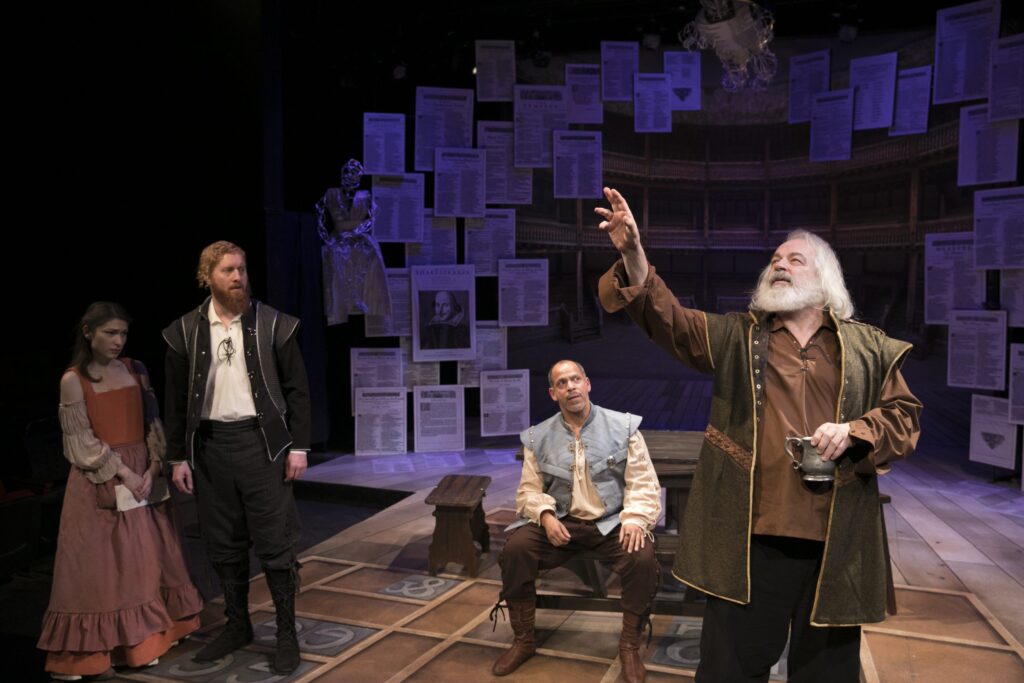
Lyric Stage’s Superb ‘The Book of Will’ Takes Us Back to the Time of the Bard

Cast of ‘The Book of Will’ at Lyric Stage

By Shelley A. Sackett

Ever wonder about the immediate aftermath of Shakespeare’s death, how his plays were preserved in an era when plays were not considered to be important works of literature, plots were largely constructed by the actors and written out in a ‘fair copy’ for their records by the company scribes, and new plays were churned out at an incredibly fast rate to provide the companies with enough material to keep performing new shows all the time?

Well, wonder no more.

The Lyric Stage Company of Boston’s must-see production of ‘The Book of Will’ brings the story of Shakespeare’s legacy, and the women and men devoted to creating and preserving it, to life. Director Courtney O’Connor weaves magic from a smart and inspired script by playwright Lauren Gunderson. For two hours and 15 minutes (with intermission), we willingly time travel back to an era of pubs, plays and camaraderie.

Sound Elizabethan and dull? Not a chance! But first, a little more context.

Playwriting then was a little like writing for a sitcom or a soap opera in the modern day, and once a play was performed, the acting companies would only keep the scripts if they felt they might revive them again down the road. If not, they might sell them off to a publishing house, who would try and make a quick profit on them.

Ed Hoopman, Will McGarrahan, Grace Experience, Joshua Wolf Coleman

By Shakespeare’s time, printing was more common, and book publishing was more of a commercial enterprise. Yet, Shakespeare’s plays were not published all together in his own lifetime. John Heminges, Richard Burbage, and Henry Condell, fellow actors in the Kings Men and devoted friends of the Bard, began collecting the various published versions of Shakespeare’s plays, actors’ scripts, and scribal copies, and edited them together into the First Folio, published in 1623.

The whole project was perhaps an attempt to eulogize Shakespeare and make his work last forever. It’s partly these reasons that allowed his writings to become part of the fabric of English culture and language. His works, which most certainly would have been lost, have been read and circulated endlessly and have had a life of their own, though Shakespeare himself is long dead.

Experience, Sarah Newhouse, Shani Farrell

Janie E. Howland’s set, Elisabetta Polito’s costumes and Elizabeth Cahill’s sound design thrust us immediately into the thick of Stratford-on-Avon between 1619 and 1623. From the get-go, the talent and credibility of the actors is obvious. Particularly noteworthy are Fred Sullivan, Jr. as Ben Jonson and others, Will McGarrahan as Richard Burbage and William Jaggard, and the magnificent Ed Hoopman as Henry Condell. (I could listen to Hoopman recite the phone book.)

If Gunderson has strayed from historical fact, it is in her inclusion of women as prominent players in the project. These women are interesting, compelling, ambitious, funny and, in their own ways, powerful. There is not one weak link among the actors. Grace Experience as Alice Heminges (whom she plays with an Audrey Hepburn elegance), Shani Farrell as Elizabeth Condell, and Sarah Newhouse as Rebecca Heminges each bring their own nuances to their roles.

Lest you think this is a play reserved for Shakespeare nerds, think again. Gunderson has infused the script with humor, poetry, pathos and intrigue — ingredients for entertaining theater — as well as factual history.

Experience, Hoopman, Coleman, Fred Sullivan, Jr.

“Shakespeare doesn’t need much help in being revered. He needs help in being human. That’s the real heart of this story,” Gunderson said in an interview. “It really has to be the emotional reason that these people did this almost impossible thing. It comes down to their loves and friendships that really provide the engine for this effort.”

“The Book of Will.” Written by Lauren Gunderson. Directed by Courtney O’Connor. Scenic Design by Janie E. Howland; Costume Design by Elisabetta Polito; Lighting Design by Christopher Brushberg; Sound Design by Elizabeth Cahill. Produced by The Lyric Stage Company of Boston, 140 140 Clarendon St., Boston through March 27.

For more information and tickets, go to: https://www.lyricstage.com/

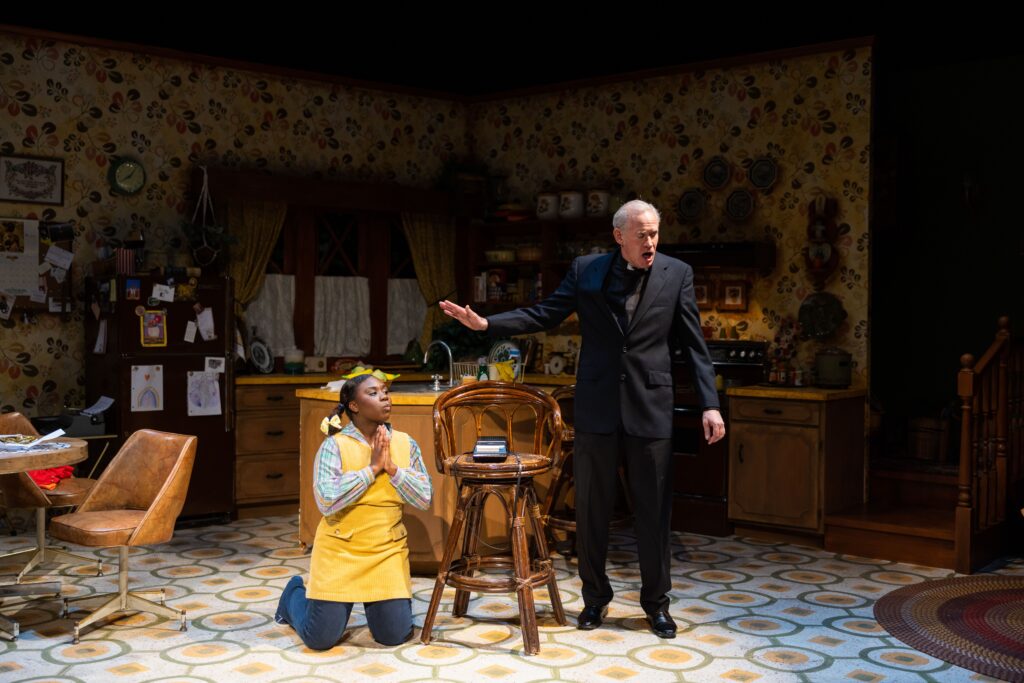
GBSC’s ‘Incident’ Is a Pleasant Trip Down Memory Lane

Cast of ‘Incident at Our Lady of Perpetual Help’ at Greater Boston Stage

By Shelley A. Sackett

‘Incident at Our Lady of Perpetual Help’ will strike a particular chord among those of us whose wallets now hold Medicare and AARP cards. Written by Seattle-based playwright, Katie Forgette, it is a loving trip down her personal memory lane. She was raised Catholic and attended parochial school for 12 years. Her father was a hard working cab driver; her mother had many jobs, in addition to birthing ten children and caring for her own disabled mother.

The family wasn’t poor, but only because her parents sacrificed personal goals and worked as hard as they could to be financially comfortable.

Her play is set in the 1970s, and Shelley Barish has created a believable set that focuses on the main gathering place in the house — the kitchen. Homey, shabby and beloved, the room is full of interesting mementos of that era without feeling cluttered. (I was not alone in noticing that the clock on the set wall told the actual time, a nice touch and a visual clue that the connection between past and present is real and fluid).

Linda O’Shea/Forgette, played by Autumn Blazon-Brown, is our 20-something year old protagonist. She makes clear from the get go that, although she is narrator, she may not be a reliable one. “Memory shifts things,” she says. Telling old stories almost always involves the fallibility of memory. Two people, especially family members, remember the same event differently. She talks about the plasticity of memories, how they change over time and with each recollection to the point where, even when it comes to your own life, you may be considered an unreliable narrator.

She also points out the changes since the 1970s in the ways we communicate. “There was no posting; you lived your life in person,” she says wistfully.

Vin Vega, Barlow Adamson

Nonetheless, she is determined to tell the story of her family from her perspective to the best of her recollection.

And so we meet her mother, Jo (Amy Barker), father, Mike (Barlow Adamson), younger sister, Becky (Vin Vega) and Jo’s sister, Aunt Terri (the always fabulous Maureen Keiller). Over the next hour and 45 minutes (including an intermission), this cast of characters (along with a few hysterical cameos by a neighbor and priest) have one job and one job only — to tell the family story the way Linda remembers it.

Some of the characters are not too happy about their supporting roles. They want a monologue of their own, a chance to step up to the mike and explain their version of things. But Linda maintains control, doling out audience access sparingly and under strict time limits.

Although the plots twists and turns and the script’s clever lines draw easy laughs, the real meat and message lie in the family dynamics. They are a tight knit bunch, glued together by bonds of love, loyalty and compassion and — most importantly — humor. They soldier on, often griping and acting out, but they are actors cast in the same play and, at the end of the day, blood is thicker than anything.

Amy Barker, Autumn Blazon-Brown, Barlow Adamson

We are also treated to local parish customs and the hold the Catholic Church had over more than the religious aspects of their lives. Father Lovett and the infuriatingly patronizing church lady, Betty Heckenbach (both played with superb comic timing by Adamson) are examples of the hypocrisies and cruelty the church doled out with its communion wafers.

All the O’Sheas kowtow under the pressure to conform except Terri, who has known the pains of marital separation and barrenness, and isn’t afraid to call a spade a spade.

The riveting Keillor is her usual scene stealing self. (She was likewise phenomenal as Sherri Rosen-Mason in the SpeakEasy Stage’s 2019 production of ‘Admissions’). Her performance is calculated, physical and impeccably paced. Yet, it doesn’t have that “staged” feel. Rather, she makes Terri the warmest, realest and most 3-dimensional character on the stage.

Maureen Keillor

While Barker brings a warmth and strength to Jo and Adamson is great in his cameo roles, Vega and Blazon-Brown are weak links, delivering their lines in muffled tones at the speed of light. Too many great jokes are quashed and after a certain time, audience frustration sets in and we stop trying to catch every sentence.

Nonetheless, for Keillor’s performance and a feel-good theatrical experience, ‘Incident’ fits the bill. There are some real belly laughs, thought-provoking messages and zinger one-liners in this production. For tickets and information, go to: https://www.greaterbostonstage.org/

As Shirat Hayam’s cantor is ordained, some wonder, ‘What exactly is ‘Renewal’?

ALEPH Dean of Students Hazzan Diana Brewer participates in the ordination of Cantor Sarah Freudenberger.

by Shelley A. Sackett

Cantor Sarah Freudenberger of Congregation Shirat Hayam in Swampscott was ordained in January, culminating more than five years’ training at the ALEPH Ordination Program, a Renewal-style program that promotes global Jewish music.

Candidates study classical Ashkenazi musical motifs as well as other genres, such as Sephardic. Graduates are able to navigate and lead in a wide variety of contexts, blending both traditional and contemporary styles.

Although she worked as a full-time cantor since her college graduation, Cantor Sarah ran into barriers when she discovered that mainstream seminaries didn’t accept students with non-Jewish partners.

“Even though I wanted to learn, I couldn’t,” she said.

Finally, she discovered ALEPH, a program founded by Reb Zalman, who believed that music is the carrier of the Jewish message. She chose ALEPH both because it was welcoming and, more importantly, because of its robust and comprehensive curriculum and respected reputation.

AOP dates its origins back to the mid-1970s, and progressively evolved over the course of four decades to where it is today.

It all started in Somerville in 1968. Rabbi Zalman Schachter-Shalomi – “Reb Zalman” – was instrumental in the founding of Havurat Shalom, a collective egalitarian spiritual community. He was a visionary pioneer in contemporary Jewish life. His ideas and work influenced the birth of the Havurah movement and the international Jewish Renewal movement.

In 2000, he engaged Hazzan Jack Kessler to develop a new kind of program that would train cantors who are grounded in tradition, but who could also keep Jewish music alive, relevant, and growing into the future. The two agreed this training would encompass additional skills that go beyond vocal performance and the knowledge that was once sufficient for someone to be called a cantor.

By 2001, Reb Zalman had ordained three hazzanim. He then turned over the effort to Hazzan Jack, who created a comprehensive program that embraces traditional and contemporary Jewish musical and liturgical creativity.
As of 2022, ALEPH has ordained 30 cantors. Cantor Sarah is the only cantor ordained in the 2022/5782 class.

Cantor Sarah Freudenberger

Conservative synagogues like Shirat Hayam are bringing in Renewal melodies, percussion, meditative prayer experiences, healing prayers, and an array of Renewal-style approaches to making communal prayer dynamic and participatory, Hazzan Jack explained.

“We believe that synagogues can once again become magnets for Jewish spiritual seekers, Jewish families, and anyone who cares about the continuity of Jewish life, where we can find prayer experiences that elevate our souls and activate our best selves. This is our commitment,” he said.

Cantor Sarah and Hazzan Jack at her ALEPH ordination

ALEPH Executive Director SooJi Min-Maranda reported an uptick in younger applicants who transfer from a more traditional seminary where they didn’t feel their approach to spirituality quite fit. “Most say they are excited about the way ALEPH brings emotional relevance to Jewish life,” she said.

Yet, for many lay people, two huge questions still remain unanswered: What exactly is meant by “Renewal?” And how can a synagogue be both Reform/Conservative/Orthodox and part of the Renewal movement?

Shaul Magid, the Distinguished Fellow in Jewish Studies at Dartmouth College and author of the seminal book, “American Post-Judaism: Identity and Renewal in a Postethnic Society,” spoke with the Journal.

From the beginning, according to Magid, Reb Zalman did not envision Renewal as a new Jewish denomination, but rather as a new vision that could revive late 20th-century Judaism. “He wanted different communities to adopt pieces of that vision as it suited its own inclinations,” he said. “Renewal offers a different template and assumes we are living in a new global [and not only Jewish] era that demands a more radical reevaluation of how we engage and encounter Jewish life.”

At Shirat Hayam, the Renewal approach informs services and life-cycle rituals. “The synagogue experience, particularly prayer, must be accessible, meaningful, and leave people feeling transformed,” said Rabbi Michael Ragozin.

“Perfunctory ritual has failed to maintain the vibrancy of Jewish life. Renewal Judaism offers an approach to revitalizing Jewish practice.”