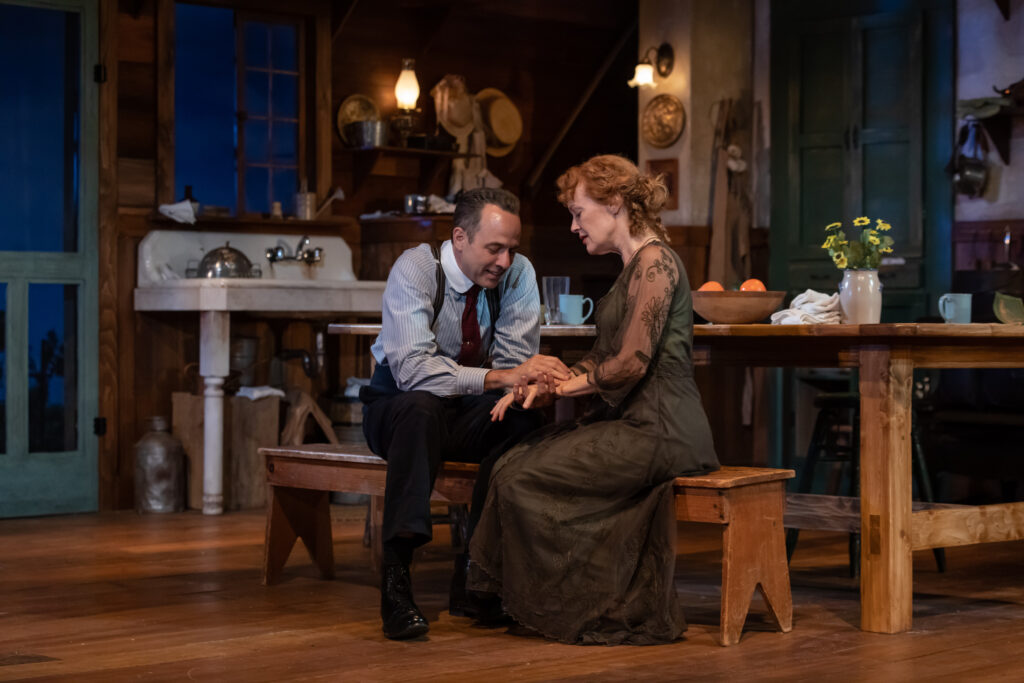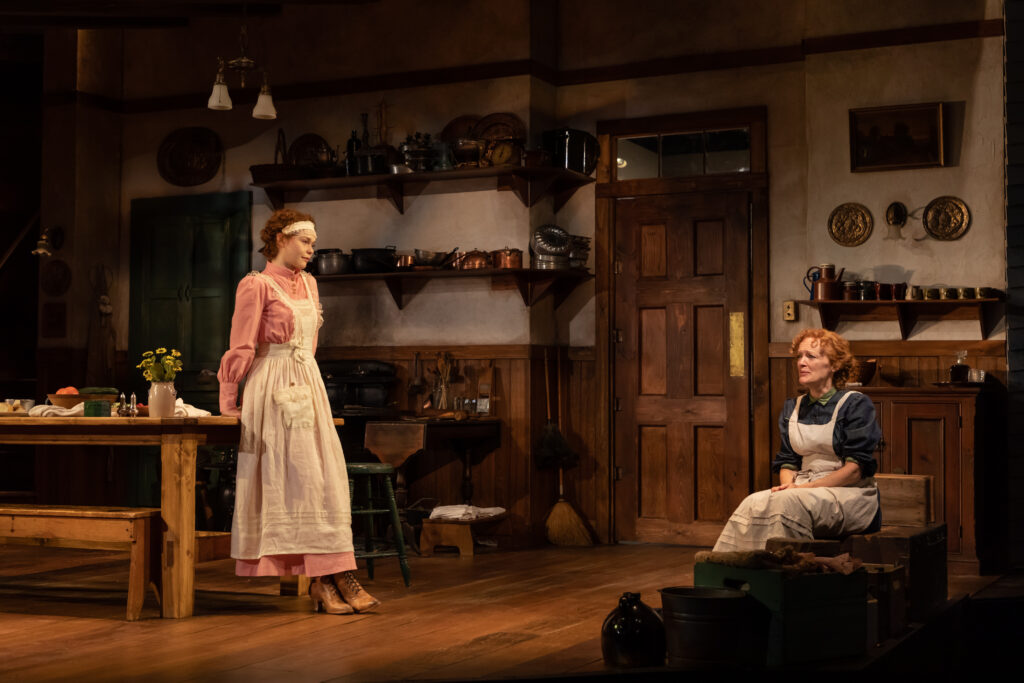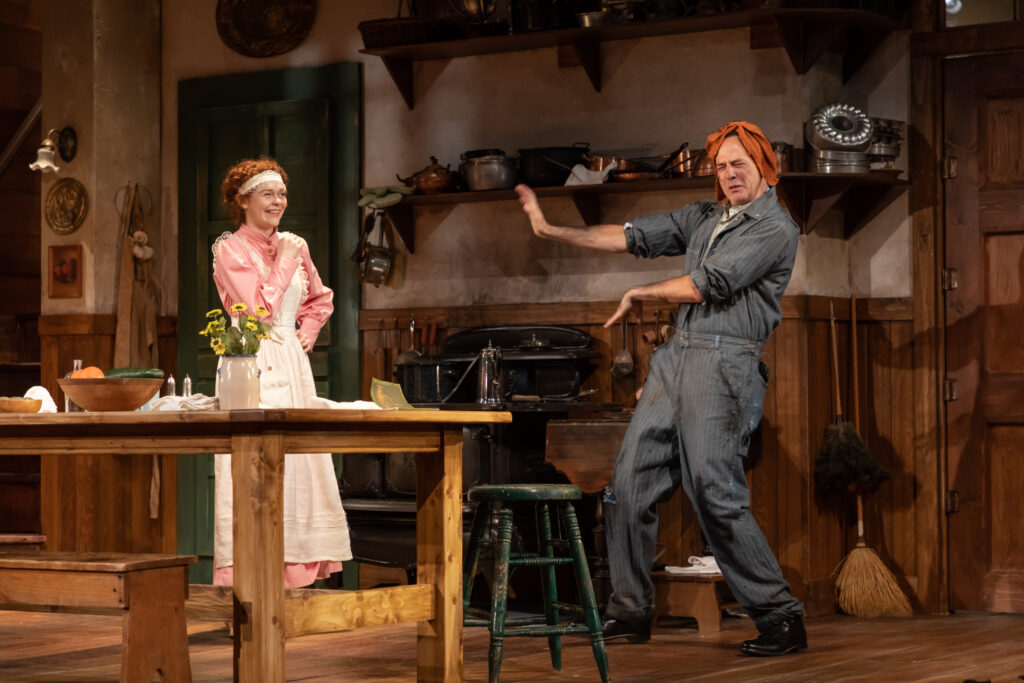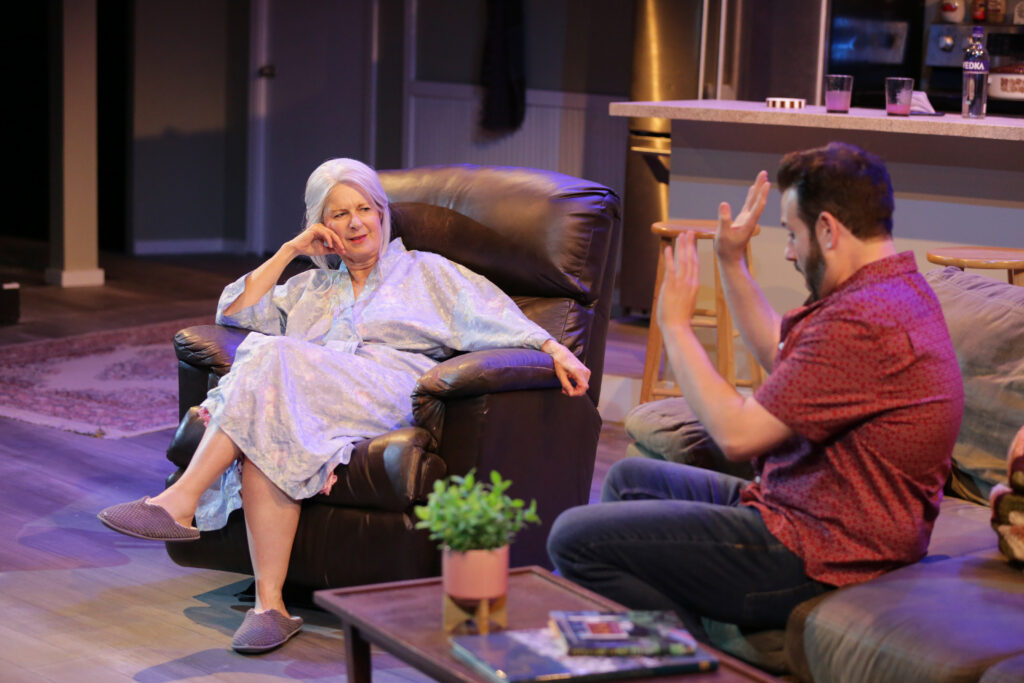
SpeakEasy’s ‘English’ Explores The Tipping Point Between Identity and Heritage

Cast of ‘English’ at Speakeasy Stage. Photos by Nile Scott Studios

by Shelley A. Sackett

SpeakEasy Stage’s production of Sanaz Toossi’s ‘English’ starts out simply enough. Four Iranian students are studying in Karaj for the Test of English as a Foreign Language Exam (TOEFL) , an English proficiency exam they must pass if they hope to pursue university study abroad, immigration and more. Their teacher, Marjan (a first-rate Deniz Khateri), rules her classroom with an iron fist. They will speak only English during class, and when anyone slips into Farsi, she posts a strike against them on her giant blackboard, practically snarling with scorn.

This is language immersion that is the equivalent of throwing a baby into the deep end to teach them to swim. Yet, her motive, at least in the beginning, seems pure and altruistic. She studied in Manchester, England, an experience that changed her life for the better and one she speaks of with near religious veneration. She believes that she and she alone can help her flock find this same path that opened her world, and she takes her role as their shepherd with the seriousness and zeal of a missionary.

[An effective and engaging scripted touch is that when the actors speak their native Farsi, they do so in fluent conversational English. When they practice English, their speech is more staccato, with a heavily accented cadence of a beginning foreign language student.]

Marjan insists her students leave their Iranian identities outside her classroom door. “English Only!” is underlined twice on the blackboard. The implication is clear — Farsi and all things Iranian are baggage that need to be shed if one is to “make it” in the global arena. “Speaking English is one of the greatest things two people can do together,” she coos, and she means it with all her being.

Her students don’t always agree. Roya (the splendid Layla Modirzadeh) needs to learn English so she can join her son and his family (including a granddaughter whose English name Roya can’t pronounce) in Canada, where they have emigrated and assimilated. She is the oldest of the students and the one with the longest and deepest roots in Iran.

When she learns that Marjan happily gave up her identity in England, letting others call her “Mary” for their convenience and ease, she chafes. People should not have to give up their names to learn a language, she says. “Our mothers get to name us. Not foreigners.”

Zaven Ovian, Deniz Khateri, Josephine Moshiri Elwood

Elham (compellingly played by the feisty Josephine Moshiri Elwood) has taken the TOEFL before and failed. More than the others, she needs to pass this test to pursue her goal of studying gastroenterology in Australia. In addition to her thick Farsi accent and lack of facility with languages,  she faces two other barriers: she despises English and how her voice sounds when she speaks it, and she can’t stand Marjan and her autocratic ways. That Marjan deliberately humiliates and picks on her adds fuel to her hot-blooded flame.

Goli (Lily Gilan James, a senior at Boston Conservatory at Berklee) is a compliant and reticent 18-year-old who happily does as she is told. She is the least interesting, with no axe to grind and nothing to prove. She just wants to pass the exam so she can go to a university outside Iran.

On the other hand, 29-year-old Omid (Zaven Ovian) is an enigma. His English is better than the teacher’s, and he comes up with complex and specific vocabulary, like “windbreaker” during a word game. He and Marjan bond inside and outside class over their seeming shared love of all things foreign, but Omid has a secret he keeps tight to his vest until the play’s end. Ovian splendidly plays out the mystery.

Director Melory Mirashrafi, a first generation Iranian-American, makes the most of Janie E. Howland’s well-designed set and a script that at times moves slowly.

Playwright Sanaz Toossi (who won this year’s Lucille Lortel Award for “English”) takes her petri dish of varied and complex characters and, over 100 intermissionless minutes, seamlessly interweaves engaging theater with an existential examination of identity, heritage, assimilation and alienation.

She poses many important and timely questions. Is there is a tipping point at which the loss of cultural identity outweighs the materials of life in one’s non-native land? Is voluntary immigration something to be encouraged or grieved? What about the generations, like Roya’s granddaughter, who will grow up without hearing Farsi or understanding her cultural heritage?

Is it worth leaving your homeland voluntarily, Toossi questions, to forever be branded a foreigner with an accent, the “other” who will always be asked, “where are you from?” [Toossi’s mother immigrated to the U.S. from Iran in the mid-1980’s following the Iranian Revolution].

When Elham returns to the classroom after taking (and passing with 99%) the TOEFL, it is not to gloat or thank Marjan, but to offer by example a lesson of how you can gain English language proficiency without losing your Iranian soul.

“You are Iranian but your English is a lot of things. It wants to be American and some of the time British and now it does not know what it is. When I speak English, I know I will always be a stranger,” Elham tells Marjan. “I hear my home. What do you hear?”

English’ –Sanaz Toossi, Playwright. Melory Mirashrafi, Director. Janie E. Howland, Scenic Designer. Nina Vartanian, Costume Designer. Amanda E. Fallon, Lighting Designer. Ash, Sound Designer. Emme Shaw, Props Designer. Presented by SpeakEasy Stage at the Roberts Studio Theatre, Calderwood Pavilion, Boston Center for the Arts, 527 Tremont St. Boston, through November 19, 2022.

For tickets and information, go to: https://www.speakeasystage.com/

Bill Irwin Is Brilliant in ArtsEmerson’s Not-to-Be-Missed “On Beckett.”

Bill Irwin in “On Beckett” at ArtsEmerson

‘On Beckett’ — Conceived and Performed by Bill Irwin. Produced by Octopus Theatricals; Scenic Design by Charles Corcoran; Costume Consultation by Martha Hally; Lighting Design by Michael Gottlieb; Sound Design by M. Florian Staab. Presented by Arts Emerson at the Emerson Paramount Center, 559 Washington St., Boston, MA through October 30.

by Shelley A. Sackett

Bill Irwin is a legendary actor, writer, director and clown artist. The Tony award-winner is as known for serious theatrical roles on Broadway as he is for his beloved Mr. Noodle on television’s “Elmo’s World.”

With “On Beckett,” his solo exploration of his decades long relationship with the Irish playwright, Samuel Beckett, Irwin takes on yet another role — that of compassionate guide through the sticky wickets of Beckett’s intimidating and often baffling prose and plays.“Here is what I am proposing to you this evening,” he tells the audience with an intimacy and earnestness that has them in the palm of his hand from the get-go. “I’m not a scholar or a biographer,” he says almost apologetically, implying that those who expect a pedantic lecture from the head will be disappointed. “I am an actor and a clown and what I have is an actor’s knowledge” of Beckett, he says. And what a trove of treasures that is.

What Irwin brings to the table and generously shares is of far greater value and infinitely more enjoyable than a straight out lecture. He discloses what it has been like for him to experience Beckett’s language from the inside out, as one who has been entrusted with the sacred task of memorizing the writer’s words, processing them through his Bill Irwin persona, and then speaking them to a contemporary audience as he imagines Beckett himself intended.

For an absorbing, enlightening and entertaining 90 minutes, Irwin shines his inner light on four works by Beckett: Texts for Nothing, Watt, The Unnamable and Waiting for Godot. He peppers his readings/performances with anecdotes and observations, revealing what it feels like as an actor and as a human being to mouth the words of the great existentialist and arguably the greatest playwright who ever penned a line of dialogue.

His approach blends the physical (often hilarious) and emotional as he digs deep into Beckett’s “character energy,” managing to keep the evening challenging enough for aficionados of the work and light enough for novices. “These are like people I’ve known. Like my own mind — me, myself and I in conversation,” he says, bringing Beckett’s often lofty language down to earth.

Which is not to say he doesn’t pose heady questions meant to expand our thinking about Beckett, ourselves and the world we live in. “Was Beckett a writer of the body or mind?” he asks. Midway through the enjoyable and impactful evening, Irwin addresses the elephant in the room. “Is this a portrait of existence?” he asks of a passage in The Unnameable. “What is it?”

eckett

He then gives an easy-to-digest short treatise on existentialism, pithy and humorous, yet also the product of a deep thinker who has spent years pondering these questions both on and off stage. It is no surprise to learn he has won Fulbright, Guggenheim, National Endowment for the Arts and MacArthur Fellowships. His explanations and analyses are brilliant. “These are the precise but undefinable questions that keep us awake,” he says before adding,” and put us to sleep.”

As expected of a lauded actor and director, his timing and punctuation is perfect. But Irwin is also a clown, and when he grabs his bowler and baggy pants, the evening shifts gears. Although Beckett’s words carry no less weight and Irwin’s performance embodies that gravitas, it is now clothed in the shimmering gossamer of physical comedy, taking the sting out of some of the words by allowing us to laugh at them and, by extension, at ourselves. Sure, existence is tough and death is even tougher, but let’s not forget that we were also created to laugh, Irwin reminds us.

Irwin appeared with Steve Martin and Robin Williams in the Lincoln Center Off-Broadway production of Waiting for Godot in 1988, in the role of Lucky. Lucky’s only lines consist of a famous 500-word-long monologue, an ironic element for Irwin, since much of his clown-based stage work was silent.

He treats us to a remarkable rendition and, at the end of the show, frankly admits that even after all these years, some of Beckett’s language remains beyond his grasp. “I keep discovering new things in the words,” he says. “I don’t know why. I don’t know how an airplane stays up in the air either, but I still want to climb onboard.”

Act NOW and you might just be lucky enough to catch one of the last Boston performances. Whether you’re encountering the Nobel Prize winner’s writing for the first time, or building on a body of Beckett knowledge, this dynamic showcase is not to be missed.

A Magnificent ‘Joe Turner’s Come and Gone’ Heralds the Huntington’s Jubilant Homecoming 

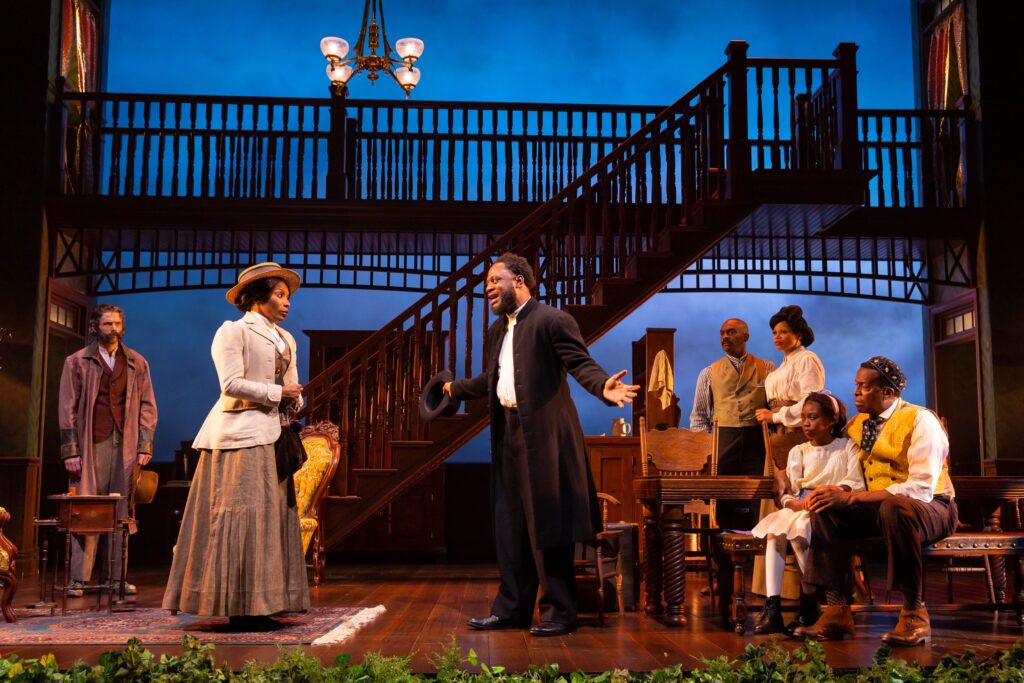
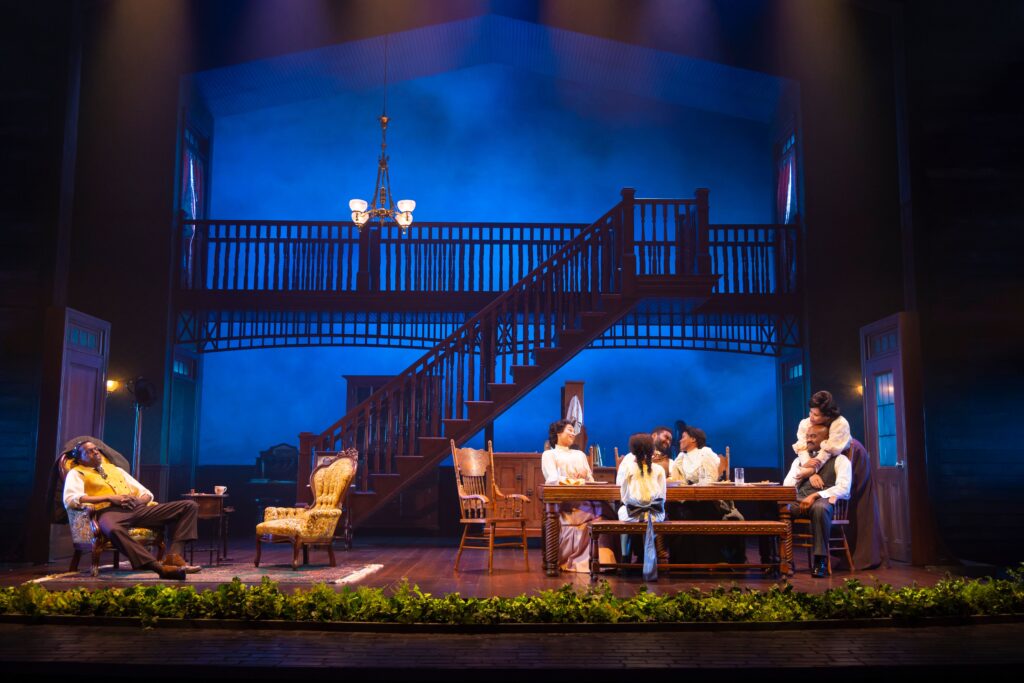
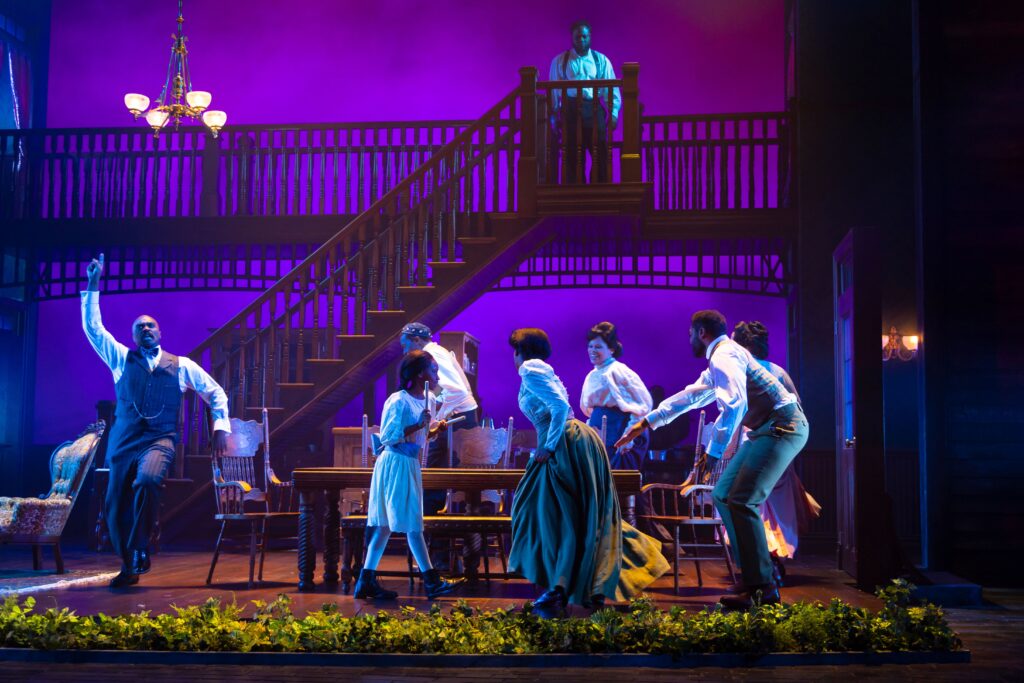
Patrese D. McClain and James Ricardo Milord (foreground) and cast in ‘Joe Turner’s Come and Gone’ at The Huntington.

‘August Wilson’s Joe Turner’s Come and Gone’ by August Wilson. Directed by Lili-Anne Brown; Arnel Sancianco, Scenic Design; Samantha C. Jones, Costume Design; Jason Lynch, Lighting Design; Aubrey Dube, Sound Design. Presented by The Huntington Theatre through November 13.

by Shelley A. Sackett

What a pleasure it is to have the Huntington Theatre Company back. With its sleek Narragansett Green walls, gold domed ceiling and cherry red extra legroom seats, an always pleasurable theatrical experience is now also one full of creature comforts. Even more stunning, however, is the magnificent production of August Wilson’s Joe Turner’s Come and Gone, with which the Huntington christened its reopening. If Joe Turner’s footprints lingered long after he had gone, it’s because Wilson’s unforgettable presence (and titular title as the Huntington’s creative patron saint) enveloped the stage.

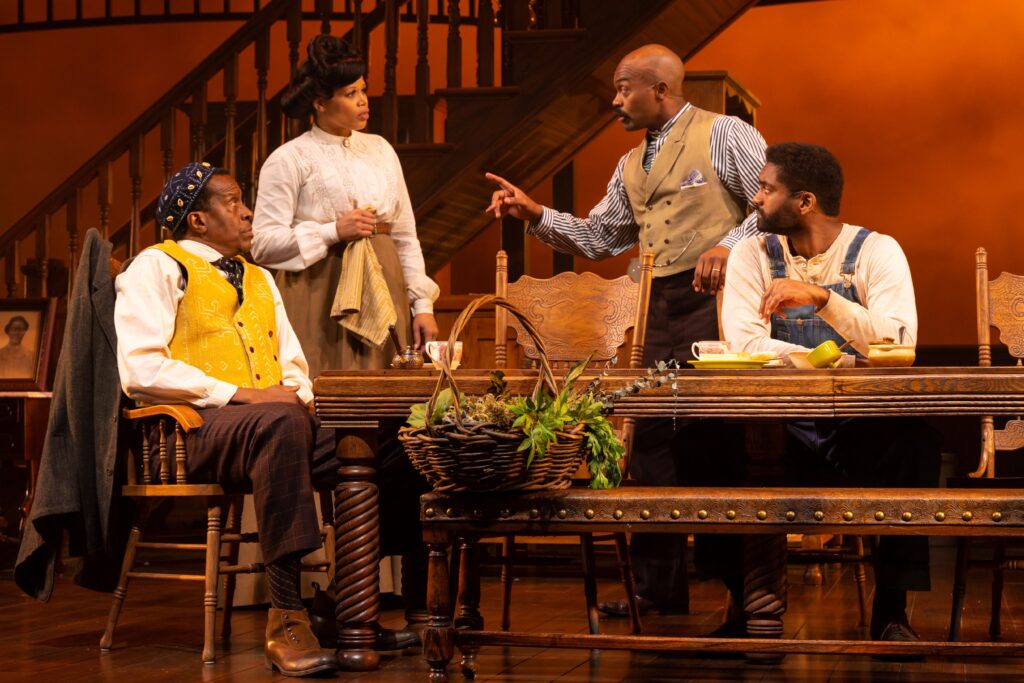
Other than sporadic trouble understanding and hearing some of the actors, the production is flawless. Arnel Sancianco’s set captures the pressed oak Victorian glory of an architectural era resplendent in its attention to eye candy detail, including a grand staircase and welcoming dining room table. A crystal clear sound system does justice to Aubrey Dube’s acoustic period selections (always a pleasure to hear Mississippi John Hurt sounding authentic but not like he’s singing underwater). And Samantha C. Jones’s costumes (especially the women’s hats) and Jason Lynch’s lighting (which manages to track the sun’s movement) are icing on the cake.

And that’s before we get to the cast’s universally brilliant acting and Lili-Anne Brown’s spot-on, outstanding direction.

First, though, a little historical background is in order. The title, Joe Turner’s Come and Gone, refers to Joe Turney, the brother of former Tennessee Governor Peter Turney. In the late 19th Century, Joe Turney was responsible for transporting black prisoners from Memphis to the Tennessee State Penitentiary, located in Nashville. Instead, Turney abused his role by running a network of “convict leasing.” He was also known for swooping down on innocent freed blacks and illegally enslaving them for seven years, often to work on his own farm. When men turned up missing in black communities, word quickly spread that “Joe Turner’s come and gone.”

Against this harsh backdrop of the Jim Crow lawless post-Civil War America, Wilson introduces us to his cast of vivid characters.

It’s 1911 and Seth and Bertha Holly run a “respectable” boardinghouse in Pittsburgh. Seth (played with pitch perfect comedic timing by Maurice Emmanuel Parent), its owner, inherited the property and business from his parents. He was born to free African-American parents in the North and is a real killjoy. Set in his ways, he is happy to assimilate to the degree he is allowed, and is economically shrewd and heartlessly capitalistic.

Bertha (the sublime Shannon Lamb), his wife of 25 years, is a loving mother to her boardinghouse family. Although she knows her place, she manages to manipulate Seth’s decision-making in subtle yet effective ways. Love and laughter get her by. She embraces Northern ways (including Christianity), but her heart and spirit remain tied to her African ancestors.

Bynum Walker, a 60ish “conjuror” who practices healing arts with herbs, incense and song, is Seth’s foil. As portrayed by Robert Cornelius, Bynum is both as large as a giant and as gentle as a lamb. He is as grounded in his roots and heritage as Seth is in his denial of them. In touch with his inner soul and identity, he offers to help those lost to themselves and others with his powers to “bind.” Bynum is part shaman, philosopher and therapist — and all compassion. He has lived at the Holly’s for a while and moves about as comfortably as if he were a blood relation.  

Jeremy Furlow (an exuberant Stewart Evan Smith), 25, is trying to find his identity as a member of the younger generation of newly liberated slaves. He is footloose and itching to travel the nation with his guitar and fancy green suit. In the meantime, he works anywhere that will hire him building whatever needs building. He naively chafes at the racial injustice he encounters and will accept the company of any woman who accepts his as he tries to find his perfect mate.

Robert Cornelius, Shannon Lamb, Maurice Emmanuel Parent and Stewart Evan Smith

The only white character in the play, Rutherford Selig (a suitably sycophantic and tone deaf Lewis D. Wheeler) is a peddler known as the “people finder.” He was also a fugitive slave finder, like his father (his grandfather ran the first ships, we’re told, that captured Africans and brought them to America to become slaves). He acts as middleman for Seth’s hand-crafted dustpans and keeps a tight record of everyone he meets on his travels.

Mattie Campbell (an earnest Al-nisa Petty), a young woman who finds Seth’s when she seeks Bynum’s help in binding her to her missing boyfriend, is disappointed in the life that has left her a bereaved mother of two dead babies and a jilted girlfriend. By contrast, the last thing Molly Cunningham (the slinky Dela Meskienyar), another tenant in her mid-20s, wants is to be bound to anyone or anything — except maybe her mama. She is independent, spoiled and totally aware of the power her striking looks and wardrobe afford her.

Into this ersatz family wanders Herald Loomis (brilliantly embodied by James Milford), a former deacon and odd man who dons an overcoat in August, and his skinny 11-year-old daughter Zonia (Gray Flaherty at last Sunday’s matinée). He has the skittish mannerisms of one suffering from post-traumatic stress disorder. He has been travelling from town to town, looking for his wife, Martha Loomis. The last time he saw her was 11 years ago, right before Joe Turner captured and enslaved him for seven years. By the time he was freed, Martha had fled. He’s been on the road looking for her for four years, Zonia in tow.

Wilson is a maestro at creating masterpieces that illustrate the Black human condition in America. Armed with this rich palette of characters and his magic wand of a brush, he paints a picture rich in both human emotion and historical context. He doesn’t polemicize, castigate or lecture, yet he makes his points about racial injustice, Black diaspora, migration and the irredeemable evil and gall of kidnapping and slavery. His wholly fleshed out characters let us through the keyholes of their lives and by the end of the play, we have connected the dots.

The specific plot twists and turns are too numerous (and contain too many spoilers) to detail here, and Wilson is more about the journey than the destination anyhow. By the end of the almost three hour (with intermission) play, the audience has experienced the pain and promise of the post-slavery years and the power of community to heal and revive a broken and lost soul.

Everyone at the boardinghouse is searching for their missing piece. Unspeakable horrors and disruptions untethered men like Herald Loomis, who has lost his sense of who he is because he cannot remember who he was before he was enslaved. For men like Seth, who has only known life in the North, slavery and its consequences are more hearsay than heartache. He’s more concerned with keeping what’s his in the face of the increased competition post-emancipation northern migration has wrought. He knows the system is, and always will be, rigged against him. His mission is to squeeze through the loopholes unnoticed and differentiate himself from these newly arrived migrants.

Seth is also a pragmatic man who doesn’t feel the need to seek meaning or purpose by way of spirituality or a return to his African roots. Christianity and churchgoing is as much about fitting in as it is about religion.  Of Bynum’s shaman-like behavior, he says, “All that old mumbo jumbo nonsense. I don’t know why I put up with it.”

Bynum, on the other hand, is at peace with himself and the world as he finds it. He believes himself to be part of a “grand design,” a belief that ultimately allows him to “swallow any adversity.” For Bynum, his spirituality and helping others re-find themselves become a way of making sense and finding his own purpose in an unpredictable world.

Straddling the two is Bertha, who is as down to earth and practical as Seth but takes comfort in Bynum’s old forms of African healing and mystical practices. One of the highlights of the play is the joyful “Juba” dance around the kitchen table where all but Herald participate and lose themselves in a moment of communal ecstasy. (The Juba dance was originally brought by Kongo slaves to Charleston, S.C.).

By the play’s end, Loomis (and several others) have found their inner song and are on the path to exploring their identity, and the audience standing has found itself in thunderous applause. Wilson’s words and spirit spin a magic that will resonate long after the last cheer has faded. Highly recommended.

For tickets and information, go to: https://www.huntingtontheatre.org/

North Shore travelers embark on a mission to discover Spain and Portugal’s Jewish past

JCC travelers at the Lisbon memorial to the Jewish massacre of 1506.

by Shelley A. Sackett

MARBLEHEAD – On Sept. 7, most of the 32 North Shore residents leaving on a 13-day trip to Spain and Portugal the next day were doing a last-minute check on their weather apps and adjusting their suitcases accordingly.

Billy Flaxer had other priorities. He had only one item on his “must pack” list – the velvet bag containing his tallis, tefillin, and kippah, items worn by Jews during weekday prayers. The retired pharmacist from Peabody, for whom davening is a daily ritual, decided he would put on his tallis and tefillin and recite the Shema in public locations where practicing Jews had historically prayed.

On this trip organized by the Jewish Community Center of the North Shore in Marblehead, those opportunities would be rare in the countries where the Spanish (1492) and Portuguese (1536) Inquisitions resulted in the expulsion, forced conversion, and death of hundreds of thousands of Iberian Jews. Today, Jewish Heritage Sites in these countries more often refer to places marked by plaques indicating where prosperous Jewish communities used to exist.

Yet Flaxer was able to fulfill his promise two times in Spain. The first was in Girona at the Jewish Museum located in the former Jewish quarter on the site of one of the town’s three synagogues, where he prayed “in remembrance of our fellow Jews who once lived and thrived in this town.” The other was in Toledo at the Sinagoga de Santa Maria La Blanca, an 1190 Moorish synagogue that was converted to a Catholic church in the early 15th century.

“It was important to me that I pay tribute to the thousands of Spanish Jews who flourished in Spain until 1492,” Flaxer said.

The ambitious trip itinerary, which covered over 1,100 miles by bus and – in addition to Girona and Toledo – included stops in Barcelona, Zaragoza, Madrid, Granada, Seville, Evora, Lisbon, and Sintra, was part of the JCCNS’s travel program.

Diane Knopf, group travel leader, helped recruit and organize the trip and planned the three orientation sessions during which travelers had the chance to meet each other and ask questions about the trip. Originally scheduled for September 2020. the trip had been postponed twice due to the pandemic.

“I was awestruck by how quickly people who didn’t know each other before the trip formed a familial bond,” she said, a sentiment confirmed by fellow travelers as one of the highlights of their trip.

For Wendy Zimmer of Marblehead, waking up each day was “like getting a new surprise to open. What would our next hotel look like? What medieval town would we be walking through that day?”

Billy Flaxer prayed at the Toledo Sinagoga de Santa Maria La Blanca.

In Barcelona, the La Sagrada Família Basilica, the largest unfinished Catholic church in the world and a UNESCO World Heritage site, was a trip favorite of both Alan and Donna Pierce from Beverly. “When I entered, my breath was taken away. I felt as if I had walked into a magical forest with the nature-themed columns that were so tall and bright and unlike other dark, Gothic cathedrals I’ve seen,” said Donna, a retired insurance claims manager.

A more whimsical stop was at the “Windmills of Don Quixote” on the road between Madrid and Granada. Twelve white tower windmills crown Cerro Calderico Mountain, surrounded by the sprawling plains of Castilla-La Mancha and backdropped by a striking medieval castle. These iconic towers are believed to be the windmills described by Miguel de Cervantes in his famous novel, “Don Quixote” (part 1, 1605, and part 2, 1615).

The group toured the historic Lisbon synagogue on the final day of the trip. Called Shaaré Tikvah (Gates of Hope), it was inaugurated in 1904 as the first synagogue built in Portugal since the late 15th century. The historic and functioning house of worship hosts Friday night, Shabbat and holiday services, and follows Sephardic customs. With 900 member families, its 450 seats cannot accommodate all who want to attend High Holiday services.

Sandra Montez, a Lisbon native and local guide, was a wealth of information about the Portuguese city’s past and present. She chronicled the history of the synagogue and described the current social and religious climate in Lisbon.

The Lisbon Synagogue especially moved Jean Guastaferri, who lives in Marblehead and is retired from the Massachusetts Council Against Discrimination. “As a non-Jew, I enjoyed learning more about the deep roots of Jews and Jewish history in Iberia and how the Jews and Moors lived peacefully together for so many centuries,” she said.

“Simply walking through where ‘the Jews used to be’ strained our collective imaginations,” said Salem attorney and historian Alan Pierce. The utter lack of official, public acknowledgment of the contribution that Jews made to Spain and Portugal before the Inquisitions troubled Judy Mishkin of Salem. “We saw a few symbols of where the Jews lived, but I believe there should have been much more recognition,” the senior caregiver consultant said.

Nonetheless, the overwhelming majority of reactions were positive. Everyone experienced that special bolt of wonder travelers crave. For one, it was shock at the heavy traffic in and out of Barcelona and Madrid. Another interacted with locals and improved her Spanish skills. And it was impossible not to marvel at the breathtaking scenery of the Spanish and Portuguese countryside.

Mishkin echoed her fellow travelers when asked about her biggest takeaway: “The absolutely tremendous amount of planning that goes into a trip of this magnitude,” she answered without a moment’s hesitation.

For additional information about the JCCNS’ travel program, contact Adult Program Director Sara Ewing at sewing@jccns.com

Book your ticket to hear eight top authors at the Marblehead JCC’s speaker series

The 28th Annual Jewish Book Month Speaker Series will be held at the Jewish Community Center of the North Shore.

by Shelley A. Sackett

MARBLEHEAD – Once again, culture vultures on the North Shore are in luck. From Oct. 12 until Nov. 29, the 28th Annual Jewish Community Center of the North Shore Jewish Book Month Speaker Series in Marblehead will treat locals to in-person conversations with seven authors and a virtual interview with another, and a catered lunch in memory of Susan Steigman, a former JCCNS staff member, longtime JBM committee member, and dedicated JCCNS volunteer.

JBM cochairs Sylvia Belkin and Patti McWeeney and their committee have selected a bang-up roster of eight non-fiction, mystery, memoir, historical fiction, and cookbook authors. Sharon and Howard Rich continue as longstanding cultural benefactors. Discounted ticket packages to all events are available at $165 for members and $180 for non-members.

Opening night features two-time Peabody Award-winning writer and CBS News “60 Minutes” producer Ira Rosen, who will talk about his revealing tell-tale memoir, “Ticking Clock: Behind the Scenes at 60 Minutes.” The book – dubbed “a 60 Minutes story on 60 Minutes itself” – details the intimate and untold stories of Rosen’s decades at America’s most iconic news show, including war room scenes of clashing producers, anchors, and correspondents like the legendary Mike Wallace. The Oct. 12 event at 7 p.m. at the JCCNS is $30 and includes a reception.

Letty Cottin Pogrebin, journalist, lecturer, social activist, a founding editor of Ms. magazine, and the author of 12 books, will speak about her latest, “Shanda: A Memoir of Shame and Secrecy.” Fears of shanda (shame or disgrace in Yiddish) and public humiliation and an overarching desire to fit in drove three generations of her immigrant family to lie and cover up long suppressed secrets. Pogrebin unmasks their hidden lives – including her own long suppressed secret – and showcases her family’s talent for reinvention in an engrossing and illuminating narrative. This writer will interview her on Zoom on Oct. 19, which can be seen by a live audience and also at home – both for $20.

Marblehead resident and best-selling author Eric Jay Dolin will speak about his latest book, “Rebels at Sea: Privateering in the American Revolution” on Oct. 27 at 7 p.m. at the JCCNS ($20 includes a reception). Dolin contends that privateers (aka pirates), thousands of whom tormented British ships, were critical to the war’s outcome. Abounding with tales of daring maneuvers and deadly encounters, Dolin’s book reveals the history of this critical period in the nation’s founding in a way rarely documented.

Two historical novels, set against the backdrop of World War II, bring life and romance to very different stories. Based on the true account of Coco Chanel’s war-time romance with a German spy and how that affair led to her arrest for treason following the liberation of Paris, author Gioia Diliberto, who will be interviewed by JCCNS past president Izzi Abrams, takes a closer look at Chanel, her powerful personality, and her activities during the occupation of France in “Coco at the Ritz.” (Nov. 2 at 7 p.m. at the Boston Yacht Club for $30.

Weina Randel’s “The Last Rose of Shanghai,” set in 1940 when the city was occupied by Japan, brings to life Shanghai’s history as a haven for Jewish refugees as well as its dynamic jazz scene, all through a heart-rending and timeless love story. (Nov. 10 at 7 p.m. at the JCCNS. $20 includes reception)

In partnership with the Consulate General of Israel to New England, chef and restaurateur Avi Shemtov will talk about “The Simcha Cookbook,” which celebrates the traditions of Shemtov’s Turkish-Israeli heritage and recreates the delectable dishes those familiar with his Sharon restaurant have come to cherish. The event, in memory of Susan Steigman, is on Nov. 13 at 11 a.m. at the JCCNS. $30 includes lunch.

Beloved bestselling writer B.A. Shapiro will speak about her masterful novel of psychological suspense, “Metropolis,” on Nov. 16 at 7 p.m. at the JCCNS ($20 includes a reception). In her latest, Shapiro follows a cast of six intriguing characters with no obvious ties to each other except they all store goods at the same warehouse in Cambridge. After a fatal accident, their precariously balanced lives are torn apart in this page-turning mystery.

Closing the series is “The Imposter’s War,” a riveting narrative about intrigue and espionage by Mark Arsenault. Arsenault has covered national politics, gambling, and worked on Spotlight Team investigations as a staff reporter for the Boston Globe, which won a Pulitzer Prize for its coverage of the Boston Marathon bombing. In his first nonfiction book, he tells the stranger-than-fiction story of the efforts of John Rathom, the Australian-born editor of the scrappy Providence Journal, to shift American attitudes toward involvement in World War I after Germany spent the modern equivalent of $1 billion to infiltrate American media, industry, and government in the hopes of undermining the supply chain of Allied forces. Without the ceaseless activity of this editor, America may have remained committed to its position of neutrality. Yet, Rathom was not even his real name! Arsenault asks and answers the question: who was this great, beloved, and ultimately tragic imposter? (Nov. 29 at 7 p.m. at the JCCNS. $20 includes a reception.)

The Jewish Community Center of the North Shore is located at 4 Community Road, Marblehead. For more information and to buy tickets, go to
jccns.org/jewish-book-month

All books can be purchased through Copperdog Books in Beverly at copperdogbooks.com/jewish-book-month

Dorset Theatre Festival Closes The 2022 Season in Triumph with Its Remarkable World Première of “Thirst”

 David Mason and Kathy McCafferty in THIRST at the Dorset Theatre Festival. Photos by Joey Moro

by Shelley A. Sackett

Arriving early for “Thirst,” playwright Ronán Noone’s dazzling new play, is a stroke of good ole Irish luck. A crisp sound system pumps toe-tapping traditional pub music, setting a jig-worthy mood. Functional period lamps bathe the livable kitchen set in warmth, creating a cozy tone for arguably the best theatrical experience of the 2022 summer season.

By the time the Irish lilted announcements herald the play’s start, the audience has been transported to another time and another place.

And what a time and place it is.

Noone sets “Thirst” in the kitchen of the Tyrone family’s seaside Connecticut home on the August day in 1912 when Eugene O’Neill’s classic tragedy, “A Long Day’s Journey Into Night” takes place. [Although familiarity with that play is not a prerequisite to “getting” ‘Thirst,’ Noone sprinkles his script with delicious breadcrumbs for those who have tasted the original to follow.]

While the Tyrones spend the day destroying themselves and each other offstage in their toile-wallpapered dining room, their cook, kitchen maid and chauffer spend theirs in the kitchen, sitting around the table together, enjoying their privacy and relative freedom while performing their demeaning menial duties. Their individual posts may have led them to this quasi-family-by-default situation, but they are genuine in their interactions. They bicker, they laugh, they tease and they worry. But they do it together, and it comes from their hearts. They genuinely need and enjoy each other’s company.

Each brings a different, but similar, back story to the mix.

Bridget Conroy emigrated from Ireland 16 years ago to become the Tyrone’s cook. Her outer shell is brittle and cynical, but she saves her harshest criticism and reproach for herself, especially for her closeted alcoholism. Yet, the only time she emerges from her carapace is when she’s juiced enough to black out the shame and regrets that poison her every sober breath and thought. Only then can she express — and admit to — the love and need she has for Jack.

Meg Hennessy, McCafferty

For his part, Jack Smythe, a local native and the Tyrone’s chauffeur, grew up poor in this place that is playground to the spoiled rich. He yearns to leave his hometown with its paper trail witnessing his past transgressions and finally, as he approaches middle age, set out to secure his independence and happiness.

Last, but hardly least, is the winsome new arrival, Cathleen Mullen, Bridget’s 18-year-old niece who miraculously survived her trip over on the ill-fated Titanic. She is feisty and blindly optimistic, determined to climb the golden ladder of American success.

These three flawed characters bring real troubles and equally real compassion to their shared  table. Bridget was banished from her home after giving birth at age 16; that birth is only thing she has done in her life that she’s proud of, in spite of its personal cost. Like the penitent sinner she believes herself to be, she dutifully sends money and a letter to her family every week. In 16 years, she has received not even a postcard in return. Although she loved the beach in Ireland, she won’t go to the sea just down the street, either because it makes her too homesick or because she must deny herself all pleasure as penance for her sin, or — most likely — both.

Jack was a drunk, so far gone he couldn’t face his wife’s illness and death and even missed her funeral, when Bridget found him in the street and, like a sick stray, took him home and nursed him back to physical and spiritual health. In return, Jack is determined to offer her the same life raft and save her from a life of self-pity and recrimination — a life he knows too well — not because he owes her, but because he loves her.

Cathleen’s bubble is burst when, shortly after arriving in America, she receives a letter from her fiancé announcing he is ditching her for a woman with property. She’s more annoyed and humiliated than heartbroken. Young, ambitious and resilient, she naively throws herself behind a ditzy plan to become the next “it” girl on Broadway.

These three have more in common than their woes, regrets and heartbreaks. They are survivors and they share a determination to live, no matter the consequences. They also really care about each other. Noone, with his well-tuned ear and light touch, pens robust yet sleek dialogue that tackles a lot of big ticket topics (shame, redemption, assimilation, discrimination to name a few) while staying grounded in the here and now of these three individuals and their intertwined daily lives.

By Ronán Noone Directed by Theresa Rebeck, Scenic Design: CHRISTOPHER & JUSTIN SWADER, Costume Design: FABIAN FIDEL AGUILAR, Lighting Design: MARY ELLEN STEBBINS, Sound Design: FITZ PATTON, Stage Manager: AVERY TRUNKO

Rebeck’s direction is economical, efficient and effective, and she lets each actor spread their wings and breathe life and individuality into their characters. They inhale, they exhale, they react, interact and bring each other lightness and laughter. Kathy McCafferty, as Bridget, is a whirling dervish of anger and productivity, and the kitchen is her made-to-order stage. She cooks (making real scrambled eggs over a real range), scrubs, arranges, rearranges and throws pots and pans, all while letting fly mouthfuls of rapid-fire heavily accented lines.

David Mason brings a lanky self confidence and Kevin Costner-esque genuineness to his Jack. He is a regular, decent guy who made a mistake, acknowledges it and just wants a shot at the brass ring with the girl of his dreams — nothing more, but nothing less.

Rounding out the trio is the lithesome and impossibly creamy-skinned (think yogurt, not heavy cream) Meg Hennessy as the vivacious Cathleen. She brings comic timing, physicality and a gift for facial mood changes that are as talented as they are entertaining.

If there is a flaw, it is that the women’s accented rapid-fire delivery is often muffled or lost, a shame (and annoyance) considering the richness of Noone’s craftmanship. A little microphone could go a long way.

That aside, there are too many positives to give them all justice. Mary Ellen Stebbins’ lighting paints the day’s passing with a sun shape shifting across the kitchen walls. Fitz Patton makes optimum use of a terrific sound system. And Christopher and Justin Swader’s set design, with its punctuating swinging back door, adds more than a mere scenic element — it is an escape route from all the Tyrone kitchen represents to a world of fresh air and fresh starts.

That door swings both ways. Jack and Bridget, after two plus hours, finally manage to cross over the threshold to the land of hope and promise. And Cathleen? Only time — and perhaps a sequel — will tell.

‘Thirst’ — Written by Ronán Noone. Directed by Theresa Rebeck; Scenic Design by Christopher and Justin Swader; Sound Design by Fitz Patton; Lighting Design by Mary Ellen Stebbins, Costume Design by Fabian Fidel Aguilar. Presented by Dorset Theatre Festival, Dorset, Vermont. The run has ended.

Was the Gangster Meyer Lansky a Mensch?

Meyer Lansky

Lansky as pictured in Lang’s graphic novel.

Photo Credit: Illustration by Andrea Mutti and Shawn Martinbrough/Courtesy Jonathan Lang

By Shelley A. Sackett

When Jonathan Lang ’98 set out to write a graphic novel about the notorious Jewish gangster Meyer Lansky, he was determined to capture the mobster’s life in all its moral complexity.

The result is 2019’s “Meyer,” for which Lang wrote the story and text (illustrations by Andrea Mutti and Shawn Martinbrough), a fictionalized account of Lansky’s last days hiding out in a Miami nursing home in the 1980s.

In the book, Lansky has one last caper to commit, and while it leads to plenty of murder and mayhem, it also exposes his menschy side – his connection to his Judaism, devotion to his grandfather and support of Israel.

“In my version, Meyer was a businessman and proud Jew,” Lang said. “My Meyer is kind of a Jewish geriatric hero.”

Lansky’s Life

Born Maier Suchowljansky in 1902 in what is now Belarus, Lansky and his family fled antisemitism in 1911, landing on the Lower East Side of Manhattan. He got involved initially with bootlegging and small-time gambling, but then rose through the ranks to become known as “Mob’s Accountant,” running casinos and nightclubs for organized crime in Las Vegas, Cuba and Florida.

Lang sees Lansky’s career choice as very much the result of antisemitism in America at the time. Lang himself had relatives in Brooklyn in the 1940s who worked as numbers runners.

“Lansky didn’t accept the terms life offered him. He took what he wanted,” Lang said. “It wasn’t a matter of morality. It was a matter of survival.”

Lang said it remains unknown to what extent Lansky participated in the violence committed by some of his best-known associates such as “Bugsy” Siegel and “Lucky” Luciano.

The FBI portrayed him as the financial brains behind the mob’s operations — “he would have been chairman of the board of General Motors if he’d gone into legitimate business,” an agent once said — but even that is uncertain. A 1991 biography portrayed him as a failed businessman who bungled the mob’s casino operations in Cuba.

In 1970, Lansky was indicted for tax evasion. He fled to Israel but was refused the right to settle there. It was a devastating blow to the mobster, who had always hoped to be buried beside his beloved grandfather on the Mount of Olives in Jerusalem.

Lansky was eventually acquitted of some of the charges against him while others were dropped, partly because he was in ill health. He lived quietly in Miami until his death in 1983.

Lang Learns About Lansky

Lang’s fascination with Lansky goes back to his childhood, when his father, a neurosurgeon, saw the gangster in the hallway of a Florida hospital.

Lang’s father described Lansky, who was 5-feet 4-inches tall, as “this well-dressed little pisher” [Yiddish for a presumptuous person]. Lansky had the whole hospital hustling around to help him, radiating a presence that commanded respect. “My father said he never saw anything like it,” Lang said.

Lang said he had his own rebellious streak while growing up. He hung out with troublemakers and nearly got kicked out of Alexander Muss High School in Tel Aviv, which offers American students a year abroad in Israel.

“Kindness toward my bubbie [Yiddish for grandmother], performing tikkun olam [repairing the world] and still cutting class were exactly who I was,” he said. “I straddled the line, at times.”

After getting his master’s in film at the University of Amsterdam in 2000, Lang moved back to Florida, living in his childhood bedroom, surrounded by his baby pictures and bar mitzvah mementos.

Depressed, he sought comfort and refuge at the local library.

It was kismet that he picked up “Bloodletters and Badmen: A Narrative Encyclopedia of American Criminals from the Pilgrims to the Present,” a book he remembered using to write a report about Al Capone in the sixth grade. Thumbing through the book, he found the picture that would launch his novel.

A dapper Meyer, wearing sunglasses, was walking his little dog Bruiser in Miami Beach, looking over his shoulder. The FBI had taken the picture. “When was Lansky in Miami? Who was he watching out for?” Lang wondered.

Lang also thought back to his time at Brandeis when he volunteered as a companion to the elderly at a local retirement home. There, he met Fred Flagg, an amazing 103-year-old member of the first graduating class at Tufts Medical School.

They got together once a week, and Lang would sit and soak up his beguiling stories. “What if my community service was with a gangster?” Lang thought to himself, and that gave him the idea of setting his book in a nursing home.

Lang also read about how Lansky secretly worked with the U.S. Navy during World War II to spot German U-boats along the New York City docks he controlled. “This is a man who was both needed and prosecuted by the same government. How do you reconcile that?” Lang asked.

Lang Meets Lansky II

In another instance of kismet, Lang was busy promoting his book on Instagram last fall. While checking his direct messages, he saw one that stopped him cold. “This is Meyer Lansky. I need to talk to you about your book,” it read.

Terrified, Lang says his first thought was, “Is this his ghost?” After a quick search, he realized it was his grandson, Meyer Lansky II.

Lang called Lansky II, and the two hit it off. Lansky II liked the book so much that he offered to write a blurb endorsing it.

Lang and Lansky II are now discussing a synagogue tour and other appearances.

“What a bizarre turn,” Lang said. “An imaginary biography led to a relationship with walking history.”

This article was published in The Jewish Experience https://www.brandeis.edu/jewish-experience/

Teens return from Y2I trip with fierce allegiance to Israel

Y2I teens at the Western Wall in Jerusalem. Photos courtesy of Lappin Foundation

by Shelley A. Sackett

After a two-year pandemic hiatus, the Lappin Foundation’s 12-day, fully subsidized Youth to Israel Adventure resumed this summer, and the 83 teens from 31 local communities and 41 high schools returned on July 8 with reactions that reflected a somber reality.

Against the current backdrop of rising global antisemitism and increased incidents of anti-Israel sentiments and activities on college campuses, the 2022 Y2I cohort was especially receptive to learning ways to help them face the challenges they may soon confront as college students.

Although the teens still kvelled over praying at the Kotel (Western Wall) on Shabbat, viewing sunrise from Masada and swimming in the Dead Sea, their post-trip reflections also reveal more sobering concerns about coping with the world in which they live.

By far the experience most mentioned as having had a significant impact were two presentations by StandWithUs director of international student programs Charlotte Korchak. Speaking passionately and from personal experience, she explained the history of the Israeli-Palestinian conflict and counseled how to best respond when encountering anti-Israel propaganda and misinformation.

The presentations are a regular part of the Y2I experience, but resonated particularly with this group. StandWithUs is an international Israel education organization that inspires and educates people of all ages and backgrounds, challenges misinformation, and fights antisemitism.

“Building on Y2I’s positive impact of enhancing Jewish identity, building community, and connecting teens to Israel, the teen Israel experience also takes on added importance of educating teens on how to identify and respond to antisemitism in its many forms,” said Lappin Foundation Executive Director Deborah L. Coltin, who has supervised Y2I since 2006. “The Jewish community has an obligation to do this. If we don’t do this, who will?”

At the Cardo in Jerusalem’s Old City.

Ephram Adler, of Wenham, wondered whether Israel might really be the aggressive apartheid regime he read about before the trip during a perusal of online posts and comments about Israel, Gaza, and the West. Now, armed with facts, he better understands how misinformation thrives on such sites and “feeds monsters.”

Several teens were surprised to discover how little they knew about the conflict and how complicated it is. “I learned neither side is completely innocent, and it is important that I stay involved and informed as a non-Israeli Jew,” said Sarah Diamond of Malden.

With antisemitic incidents becoming more commonplace in their own schools and community settings, the teens luxuriated in the freedom and empowerment they felt being in a land where they were not a minority and where expressing Jewish pride did not pose a risk to their safety.

“Israel is a place where I do not have to explain myself to anyone. It is such a beautiful thing to see Jewish people walking around, going about their day as a Jew, and wearing their religious attire without fear,” said Naomi Smith of Amesbury.

Y2I teens in Jaffa.

For many teens, especially those who lack a local Jewish community, the Y2I trip provided an important connection between their homeland and their homes. “Before this trip, I knew very few Jewish people in my town [Newbury] or at my school, but now I feel a have a community of Jewish friends I can always turn to if I ever need to talk about antisemitism in my town or stuff related to being Jewish,” said Sofia Colden.

Some, like Rachel Freedman of Peabody, said the sense of belonging she felt in Israel helped her see a whole new side of Judaism. “Israel felt like home. Now I have a voice and I’m not scared to use it. I’m not afraid anymore. Yes, I’m Jewish and there’s nothing wrong with that. I’m proud to be who I am. Y2I helped me find that,” she said.

For five teens, the opportunity to enhance their Jewish identity occurred during the trip when they decided to have an informal Bar/Bat Mitzvah. Emma Mair, one of the counselors and a college student at Mount Holyoke and rabbinic intern at Temple Tiferet Shalom in Peabody, led the (re)commitment to Judaism ceremony.

“This moment gave me the opportunity before I returned home to further connect myself to my Judaism with those I grew so close to over the course of this journey,” said Drew McStay of Danvers, one of the five.

For many, the biggest takeaways from the trip were the surprising nuances of Israeli culture and customs, which opened their eyes to a new way of contemporary life. Diamond found it interesting and “honestly, a relief” to see so many reform teens who supported issues like feminism and gay marriage. “I felt like I could really relate to these modern-day residents of the Holy Land,” she said.

For Chase Goldberg of Lynnfield, a chance encounter revealed the heart of the homeland. In Tel Aviv, he was looking for a missing scavenger hunt item he had no idea where to find. A man sitting nearby witnessed his struggle and offered to help, giving him a detailed explanation of where it was.

“I learned later that random acts of kindness like this are not random in Israel; it is just their way of life,” Goldberg said.

Virtual Services connect and expand the Shirat Hayam community

‘A Beautiful Noise’ comes to Emerson Colonial Theatre

Shirat Hayam’s Zoom services.

by Shelley A. Sackett

SWAMPSCOTT — Since 2020, Covid has significantly affected Jewish religious practice nationwide, and Shirat Hayam is no exception. Almost overnight, services — especially minyanim — went virtual by necessity. For many, the inability to gather in person — the very essence and meaning of “congregation” — is a hardship for which no amount of technology can compensate.

Nonetheless, this sudden shift has not been without its silver linings. According to tabletmag.com, an extraordinary number of people have engaged in Jewish experiences online owing to two important factors: the efforts by synagogues to put their programming and worship online immediately following the March 2020 moratorium on in-person gatherings, and the global accessibility of content.

For some locals, the convenience of attending services, study sessions and programming from their cozy homes has been a plus, especially during the cold, dark and snowy months. For others who live far beyond Shirat Hayam’s Swampscott location, virtual programming has made it possible for them to participate in services and feel part of the community.

“Shirat Hayam has been a leader in accessibility,” said Rabbi Michael Ragozin, noting that the temple removed stairs from its bima, revamped Shabbat services, and began Shulcasting almost two decades ago. “Investing in new technologies like Zoom, microphones, and webcams is a natural expression of our commitment to making a dynamic Judaism and Jewish community available to all.”

Arinne Braverman of Natick regularly attends Friday night and Saturday morning Shabbat services, usually via Facebook Live. Despite not having set foot in the physical building since becoming a member, she still feels connected.

She attends services online with her mother, Diana Edelman, also a CSH member, who lives fulltime in California. Although she misses the one-on-one informal and impromptu conversations with congregants, “I love not having to commute to and from shul,” Arinne said.

She believes strongly that people looking to join a synagogue should consider more than just its geographical convenience. Her own search took her quite a while. With the pandemic and the sudden possibility of remote attendance, she expanded her search from local to nationwide.

She ultimately chose CSH specifically because of its clergy. She first met Rabbi Ragozin when she was Executive Director of Northeastern University Hillel and he contacted her to offer his support after reading an article about Hillel’s fight against BDS and the surge in campus antisemitism. Later, he invited her to partner on CSH’s Campus Antisemitism Task Force training.

Although her mother, Diana, belonged to a local, in-person Reform synagogue, it wasn’t the right fit for her. At Arinne’s suggestion, she checked out a Shirat Hayam Shabbat service on Zoom and found what she was looking for. After confirming that remote access was not just a temporary response to Covid and would continue even when worship returned to in-person services, she joined.

She would like to attend in person, but recognizes that is not a viable option. “I would prefer to interact with other members so I would have a sense of belonging to a community or extended family,” she said.

Despite some annoyances (remote participants singing out of sync or not muting themselves while carrying on personal conversations during services), she likes the convenience and flexibility of remote attendance, especially the ability to mute her own microphone and video camera.

“Remote attendance provides me with the chance to participate in a service and enjoy the music, singing, spirituality and d’var Torah,” Diana said.

Donna Revman also enjoys remote Zoom services. She lives in Charlotte, North Carolina but grew up in Marblehead, where she and her family attended Temple Israel. Even after she left the area, she always returned to Temple Israel and, after the merger with Temple Beth El in 2005, Shirat Hayam for the High Holy Days. When she couldn’t attend in person, she would watch the services on Shulcast.

She started attending minyan after her mother, Sylvia Revman z”l, passed away. “It was a way my sister in Massachusetts, my brother in New York, and I in North Carolina could honor my mother together during shloshim,” she said.

She prefers the more interactive Zoom services to Shulcast. “It gives me the opportunity to see the people attending, with a chance to say hello before and after the service, and even the ability to participate sometimes by leading one of the responsive reading sections,” she said.

Holly Strogoff, who lives in Florida, began attending the evening minyan services weekly after her father passed away. “I knew I wanted to honor him by saying Kaddish, but I wasn’t sure how this would work,” she said.

Rabbi Michael suggested she check out Zoom services. “I am grateful to participate in services in the community where I was raised,” she said.

When she signed on to attend her first service, she was immediately welcomed into the group. “Although sometimes Zoom can seem impersonal, I found the services to be warm and welcoming. Since I started attending these minyan services, I have found comfort in the connection and plan to continue to attending,” Holly added.

A version of this article first appeared in the ‘New Wave’, the Congregation Shirat Hayam newsletter.

Gloucester Stage’s ‘Grand Horizons’ Asks, “After 50 Years of Marriage, What’s Love Got to Do with It?

Cast of Gloucester Stage’s ‘Grand Horizons’

by Shelley A. Sackett

Nancy and Bill (played by real life spouses and stellar actors Paula Plum and Richard Snee) are introduced in their cookie cutter split level house as they go about their chores preparing for dinner. Silently and robotically, they perform their choreographed rituals. Bill sets the table; Nancy dishes out the food. Is this a couple so in sync after so many years that they don’t need to talk or is each seething with rancor just below their calm demeanor?

Finally, Nancy speaks. “I think I would like a divorce,” she says matter-of-factly. “All right,” Bill responds.

With all the subtlety of a network TV sitcom, their thirty-something sons, Ben (Jeremy Belize) and Brian (Greg Maraio) burst through the front door of their Grand Horizons independent-living home, outraged and sputtering about their parents’ obligation to stay together for the sake of the kids, especially since they’re almost dead anyway. “You’re almost 80. How much else even is there?” asks the stereotypical and bossy first-born Ben. Brian, the self-absorbed, whiny, indulged “baby,” just wants the nest he grew up in and never really left to remain intact.

Paula Plum, Greg Maraio, Richard Snee

Nancy, a retired librarian, has other ideas. After a loveless marriage, she feels like time is running out. “I want to be seen, praised and appreciated,” she says. She also wants to change the role she plays with her sons from their caregiver to adult peer. “You have to hear this,” she tells a resistant Brian as she reveals details of her intimate life he would rather not hear. “I will be a full person to you.”

For his part, Bill just wants to tell a decent joke and to that end has enrolled in a comedy class at the recreation center. A grump with questionable timing, his future as a stand up comic is less than assured.

Paula Plum, Greg Maraio

The remainder of the two hour (including intermission) production examines what happens to this family when its foundation cracks. The sons rant, rave and pout in a cardboard two-dimensional orbit. Ben’s wife, Jess (Marissa Stewart), a caricature of a touchy-feely therapist, urges her in-laws, who were never physically close, to begin the healing by holding hands. The “kids” prefer their la-la land of denial to facing the mature realities and responsibilities of adulthood. Their parents’ actions are a shot across the bow of their own lives they are unable to appreciate.

Nancy and Bill are written with more complexity and their calm acceptance and assessment of life’s vicissitudes is a welcome respite from the slapstick, hit-or-miss dirty jokes and gratuitous gay romp scene. Plum’s comedic physicality is understated (the sandwich scene is a knockout) and her verbal timing and intonation are, as always, impeccable. Snee brings a relaxed and easy calm to Richard, letting his softer and more vulnerable side quietly seep through his hardened, gruff exterior.

Snee, Plum

It is through them that Wohl asks the big ticket questions she wants us to consider: What is a “great” marriage? When (if ever) does a couple’s duty to sacrifice their own happiness and stay together for the sake of their kids shift? At what point do parents have a responsibility to treat their children like the adults they are and force them to grow up and stand on their own two feet? Is it ever too late to shift gears and change the course of a life-long marriage?

And, perhaps most important, what exactly is love?

Although the play at times seems to wander in search of its genre, Wohl’s underlying messages, the terrific Plum and Snee and a killer ending to Act I save the day.  For tickets and information, go to: https://gloucesterstage.com/

Written by Bess Wohl; Directed by Robert Walsh; Scenic Design by Jenna McFarland Lord; Costume Design by Chelsea Kerl; Lighting Design by Anshuman Bhatia; Sound Design by Dewey Dellay. Presented by Gloucester Stage through August 21.