Exotic “Grupo Corpo” Troupe Combines Exceptional Dancing with Brazilian and African Rhythm for a Spectacular Evening of Excitement and Adventure

“Grupo Corpo” Artistic Director – Paulo Pederneiras; Choreographer – Rodrigo Pederneiras; Presented by Celebrity Series at Boch Center Shubert Theatre. Run has ended.

By Shelley A. Sackett

Founded in 1975 by Paulo and Rodrigo Pederneiras, the Brazilian dance company Grupo Corpo (meaning “Body Group” in Portuguese) is renowned for its unparalleled blend of popular Brazilian culture, African rhythms, and classical technique.

At last Saturday night’s performance, the troupe treated its audience to a mesmerizing evening of ingenious choreography, tireless, virtuoso dancers, inventive lighting and stage design, and pulsating, tribal-tinged music by Bahian songwriter Gilberto Gil and the Brazilian jazz band, Metà Metà.

The concert was as thrilling, riveting and entertaining as it gets.

In the first piece, “Gil Refazendi (Gil Remaking),” a subtly shifting abstract image of unfolding sunflowers is background to a stage lit by simple, single white light spots. (Scenography and lighting by the talented Paulo Pederneiras). The jazzy, infectious beat of ancestral drums, electronic distortions, African percussion gourds, and woodwinds sets the mood.

Known as the godfather of Brazilian music, Gilberto Gil’s compositions are high energy and uplifting, impossible not to sway and toe tap to. Conceived and then, post-pandemic, fully reconceived by choreographer Rodrigo Pederneiras, “Gil Refazendi” contains themes of renewal, rebuilding, and revitalization.

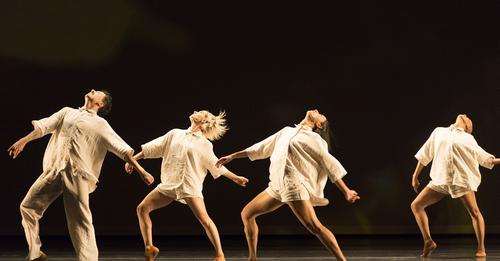
Female dancers explode onto the stage, alighting like beams of Tinkerbell magic clad in oversized white raw linen shirts and scanty shorts. The male dancers follow, dressed in the same breezy material cast as casual shirts over billowing pants (Costumes by Freusa Zechmeister). The effect is smooth, graceful, and playfully sexy.

Under Pederneiras’s mind-boggling choreography, the dancers stretch, pirouette, leap and undulate to the varying strains of samba, bossa nova and rock. They dance solo, as couples and in various groupings.

Although each dancer has their moment in the spotlight, what resonates most is the awe-inspiring synchronicity of the twenty-member troupe. When on stage as an ensemble, they move as a single organic whole. Not one wrist flicks out of tempo; not one back arches higher than another. That degree of skill and discipline is nothing short of astonishing and a rare pleasure to behold.

The second piece, “Gira,” is less abstract and more somber in tone. It is based on the rites of “Umbanda,” one of the most widely practiced Brazil-born religions that pulls on traditions from West African practices, Candomblé, Catholicism and others. In some Umbanda rituals, participants release control of their bodies to the spirits of ancestors or deities in what’s described as an altered state of consciousness.

Pederneiras’s choreography reflects gestures and movements he witnessed during actual ceremonies. There is a hint of menace in the air, particularly during the male/female couplings, which frequently teeter on the edge of violence before withdrawing back to more tender territory.

Male and female dancers are dressed identically, with naked torsos and white skirts of raw linen. Red paint on their necks adds a formal, sacramental touch. Again, the dancers are impossibly lithesome, transitioning from jolts of electric voltage to supple melting seamlessly. That they are dressed identically further blurs the edges between solo and troupe, between the individual and the collective.

Pederneiras started to choreograph in 1978 and has become known for the way in which he constructs sophisticated dialogues between music and dance using the bodies of his dancers as his interpreters. His work is a thrill to behold and one-of-a kind, a genuine reimagining of the ways in which humans can harness, express and appreciate the magic of creative energy.
Sassy, Somber and Sensual — Paul Taylor Dance Company Covers All the Bases

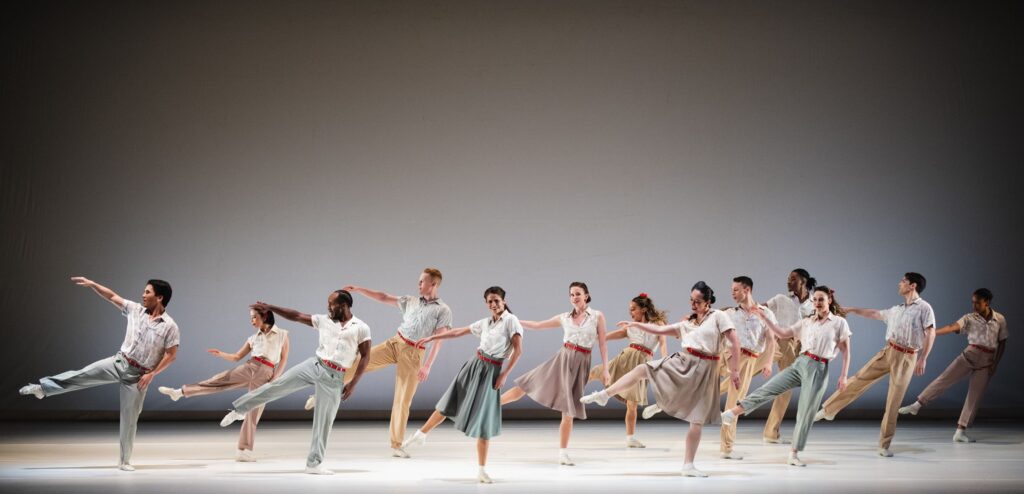
Full cast of Paul Taylor Dance Company at Boch Center — Shubert Theatre. Photos by Ron Thiele

By Shelley A. Sackett

Paul Taylor, whose imagination, emotional breadth and sheer physical ability helped shape and define the purely American art form known as modern dance, never fails to amaze and enchant. The thunderous opening night applause from the standing audience shows that, if anything, the company has only increased its seductive power over its Boston fans.

The three pieces (two by founding Artistic Director Paul Taylor), separated by intermissions, provided an evening of athletic exuberance and emotional depth, choreographer Taylor’s trademark, as well as the unabashed joy of the opening number, Amy Hall Gardner’s “Somewhere in the Middle,” a fun and sassy piece set to a selection of classical jazz music.

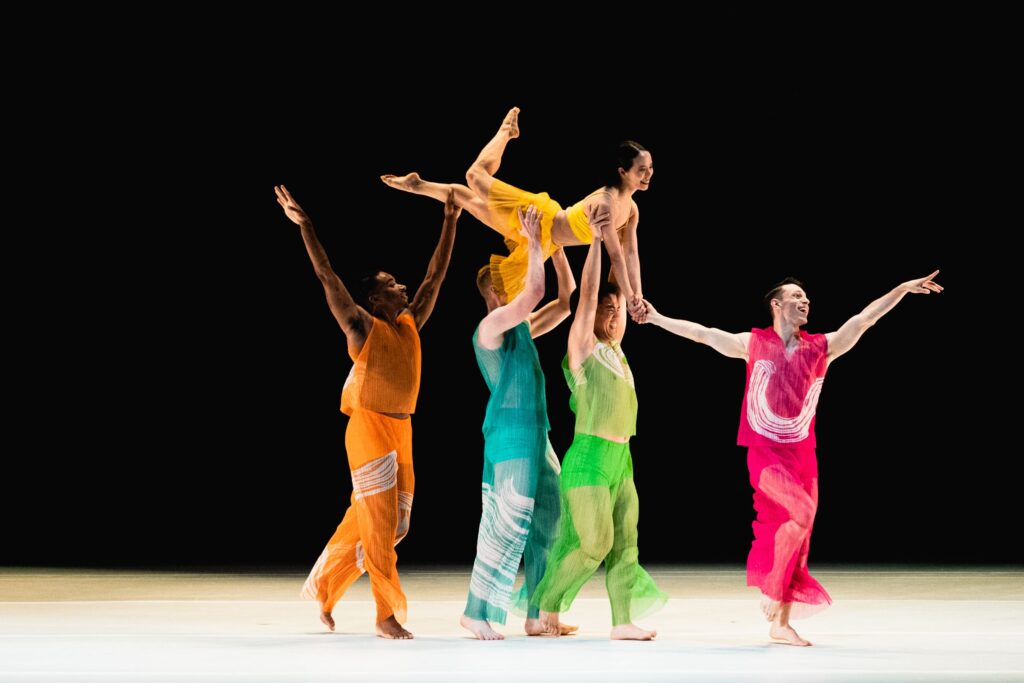
The evening opens on Donald Martiny’s jazzy set of textured paint squiggles hanging against a black backdrop. Count Basie’s toe-tapping music sets the mood for the ensemble to burst onto the stage, clad in Mark Eric’s yummy pastel costumes (briefs and bras overlaid with sheer, shimmering fabric). They tumble, leap, roll on the floor with nymph-like speed and charm, matching Ella Fitzgerald’s famous scats and bends with fancy foot and arm work.

Gardner’s piece makes excellent use of the ensemble while also allowing for individual dancers to grab the spotlight. A pas de deux slows things down, the romantic couple engaging in what my companion referred to as the “hunt” of search, attract, repel and retreat. Softer lighting (by the talented Jennifer Tipton) and sexier movements complement the darker, more fitted costumes.

Nonetheless, the overwhelming effect of this selection was of sweet, campy, happy couples who danced their way through dream-like vignettes.

Taylor’s “Brandenburgs” sets an entirely different tone. Johann Sebastian Bach’s Brandenburg Concertos nos. 6 and 3 are from the Baroque era, that period that bridged the Renaissance, with its emotional reawakening, and the Classical era with its return to the staid and formal values of antiquity.

Taylor and costume designer Santo Loquasto reflect the formality and romanticism of this refined early eighteenth century time.

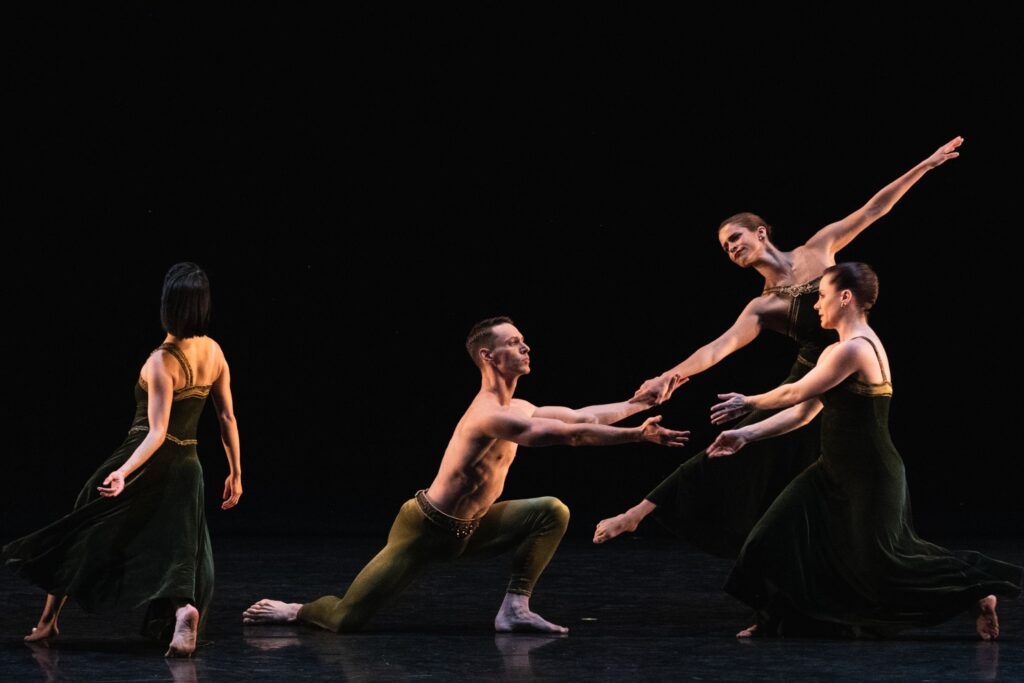
The curtain lifts to a sculptural tableau reminiscent of the figures atop the piece’s namesake gate in Berlin. Slowly, subtle lighting shifts to reveal three women (muses?) and a man (Apollo?) standing in a circle of five male dancers.

The costumes are bejeweled and traditional, regal and lovely but, compared to the other two pieces, uptight and unexciting. The choreography is likewise dignified and constrained. Under Tipton’s thoughtful lighting, the dancers’ skin is luminescent, glowing in silhouette against a matte black backdrop. They shimmer in what feels like slow motion, capturing the sheer genius of Taylor’s talent at spinning breathtaking magic from simple hand gestures.

With the final piece, Taylor’s “Company B,” the evening is back to its opening cheeriness, albeit with a layer of complexity and subtlety not present in Garner’s work. Set during Second World War time, the mood is established by a soundtrack of songs sung by the Andrews Sisters meant “to express typical sentiments of Americans during WWII.” Crafted as a series of interconnected sketches, the dancers shine both collectively and individually.

Loquasto’s costumes are nothing short of adorable. White anklets and sneakers, red belts (for men and women), rolled up button down shirts, wide khakis and twirling skirts feel sock hop cute. The youngsters flirt, smooch and jitterbug, ponytails and skirls flying.

Taylor also conjures up a sense of the darkness of the times. There are silhouettes of men marching to war, couples uncoupling and lovers abandoned. This is a gorgeous, multifaceted and complicated piece, rendered sublime by the gifted cast of dancers.

The highlights are the eight solo numbers, which finally give the audience a chance to appreciate the individual personalities of some of the dancers. All shine, but there are three true stand outs. Alex Clayton is the mannerly guy next door in “Tico, Tico” until he is not. John Harnage, in Boogie Woogie Bugle Boy (of Company B), lights up the stage.

But the real show stopper (who pops in every piece, even when she is one of many in the chorus) is Madelyn Ho in “Rum and Coca-Cola.” Spritely, impossibly lissome and exquisitely cute, it is difficult to look away from this beguiling dancer.

Even if modern dance isn’t your “thing,” don’t miss the magic of this high caliber, delightful and uplifting performance. There’s still time!

For tickets and information go to: https://www.celebrityseries.org/productions/paul-taylor-dance-company/

Paul Taylor Dance Company – Artistic Director Michael Novak; Founding Artistic Director – Paul Taylor; Resident Choreography – Lauren Lovette; Lighting Designer – Jennifer Tipton; Costume Design – Donald Martiny; Costume Design – Mark Eric and Santo Loquasto. Presented by Celebrity Series of Boston at Boch Center — Shubert Theatre, 265 Tremont St., Boston, through April 16.