A.R.T.’s ’Rhinoceros’ is A Must-See Knockout

By Shelley A. Sackett

Eugène Ionesco (né Ionescu) was born in Romania in 1909. He spent most of his childhood in France, returning to Romania with his father in 1925. As a young man in Bucharest, he witnessed the rise of the Iron Guard, a violent and prominent fascist movement, and watched in horror and despair as many of his friends, mentors, and intellectuals embraced its Nazi ideology. When his father, a magistrate, opportunistically shifted toward antisemitism and totalitarian politics in 1936, Ionesco broke off relations with him. The two never reconciled.

Years later, while living in France, he remained deeply scarred by World War II and the way ordinary people had accepted the extraordinary. In 1959, he wrote Rhinoceros, his “Absurdist” play that illustrates how society and herd mentality normalizes extremism. Now in production at American Repertory Theater’s Loeb Drama Center through September 27, this 2-ish hour (one intermission) is a response to and condemnation of the seduction of the surging rise of Fascism and Nazism during the years preceding World War II.
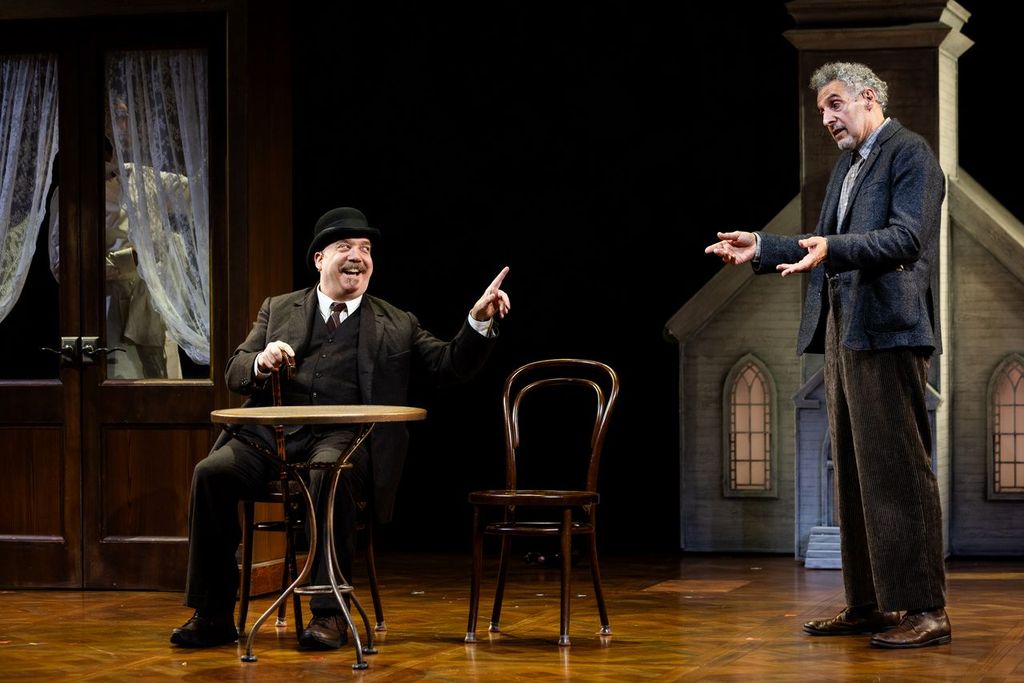
Paul Giamatti and John Turturro in A.R.T.’s ‘Rhinoceros’ Photos by Hawver and Hall

Rhinoceros starts out as an alarming, grotesque anomaly. Quickly, that anomaly is rationalized, debated into legitimacy, and eventually adopted by civic institutions as the new norm, leaving dissenters feeling like they are the ones losing their minds.

If this sounds like 2026 as much as 1936, well it should. The play’s themes of mob mentality, philosophy and (im)morality couldn’t be more timely.

If it sounds dark and depressing, it is that too, but rest assured that Tony Award-winning director Diane Paulus and her star-studded cast (led by John Turturro, Paul Giamatti and Tatiana Maslany) and creative team will mesmerize you with the most energetic, innovative, talented and — yes — hilarious evening of theater this side of Broadway. (Who would have guessed Ionesco could be quite THAT funny about a topic that painful?)

The play opens on a small, provincial French town square. The tidy, attractive café, church and grocery store (set by Riccardo Hernández) are the centers of activity. Bérenger (Turturro) is a low-level clerk who is too apathetic even to hate his job. He nurses a hangover and thirsts for his first drink of the day while awaiting his best friend, Jean, a man as buttoned-up and practical as Bérenger is disheveled and detached. Jean is a man of purpose with nary a moment to waste, except when it comes to criticizing his friend.
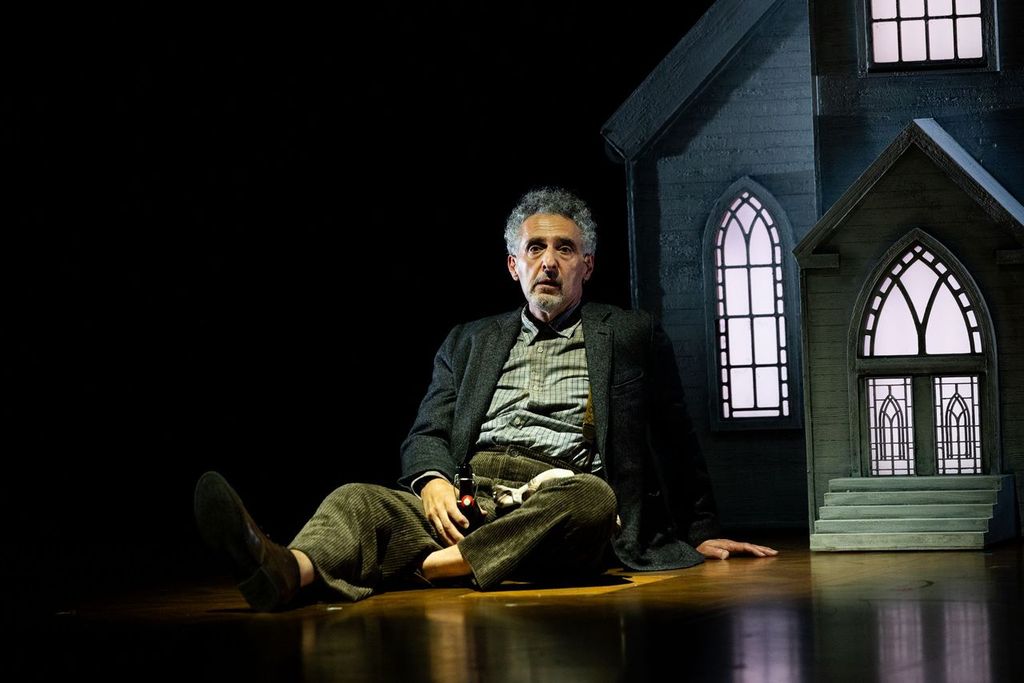
Turturro

Ionesco pens his most clever lines for these two, and Obie and Emmy Award-winning Turturro and three-time Golden Globe awardee Giamatti couldn’t be better matched, each electrifying in his own way. Part Vladimir and Estragon, part Laurel and Hardy, they are a winsome duo.

Turturro brings humor and heartache to Bérenger, withstanding Jean’s barbs one minute, regretting his life the next. (“I’ve always tried to live, but I’ve passed life by,” he laments.) His cadence is impeccable, his flourishing gestures and facial expressions works of art.

It is Giamatti, however, who will steal the first two acts (he doesn’t appear in Act III) with his staccato sarcasm and self-serving puffery. He uses his whole body to summon comedic punctuation, shape-shifting (literally) before our eyes.

All is not well in our bucolic town, however. A rhinoceros has been spotted, raging through the streets. Suddenly, one stampedes through town. A second tramples a cat.

The sound (Fitz Patton), special effects (Markus Maurette) and lighting (Jen Schriever) are dark and menacing. We feel the presence of these enormous animals as they blast past. Kudos to these three, who bring the stampede to life without overplaying their hand and turning the sublime into the mundane.

Jean is beside himself, asking everyone what they thought of what happened. “I can’t get over that!” he exclaims over and over. “It shouldn’t be allowed.” Nonplussed, Bérenger tries to rationalize the rhinoceroses’ appearance. Perhaps they escaped from a zoo, he suggests. In any case, it doesn’t matter, because it’s over.

Except it isn’t over and it does matter. Some don’t believe the news reports. (“I never believe journalists. I don’t need them to tell me what to think,” one of Bérenger’s co-workers says). Some think they should be left alone (“Are they harming you?”) Some question the morality of deciding whether to become a rhinoceros or not; others reframe good and evil, wondering whether they are merely “personal preferences.”

Suddenly, townspeople are changing into rhinoceroses. At first, it seems to be against their will. It just happens. There are debates about whether the metamorphosis is caused by a disease, why it is happening, whether it isn’t a good thing after all, and, finally, whether there is any reason NOT to join the crusade.

Even Jean embraces becoming one of the herd. Giacometti’s transformation is such a tour de force of frenzied snorting, frothing and rutting we almost expect him to return for the curtain as a fully shapeshifted rhinoceros.

Act III continues the downward spiral, but without the warmth and humor. A placid co-worker sheds his white button-down oxford for a horn and thick skin. One by one, the entire town “gets used to it.” Bérenger and his girlfriend, Daisy (Tatiana Maslany, the Emmy winner of TV’s “Orphan Black”), are the last holdouts until she too falls under the spell of mass conformity.
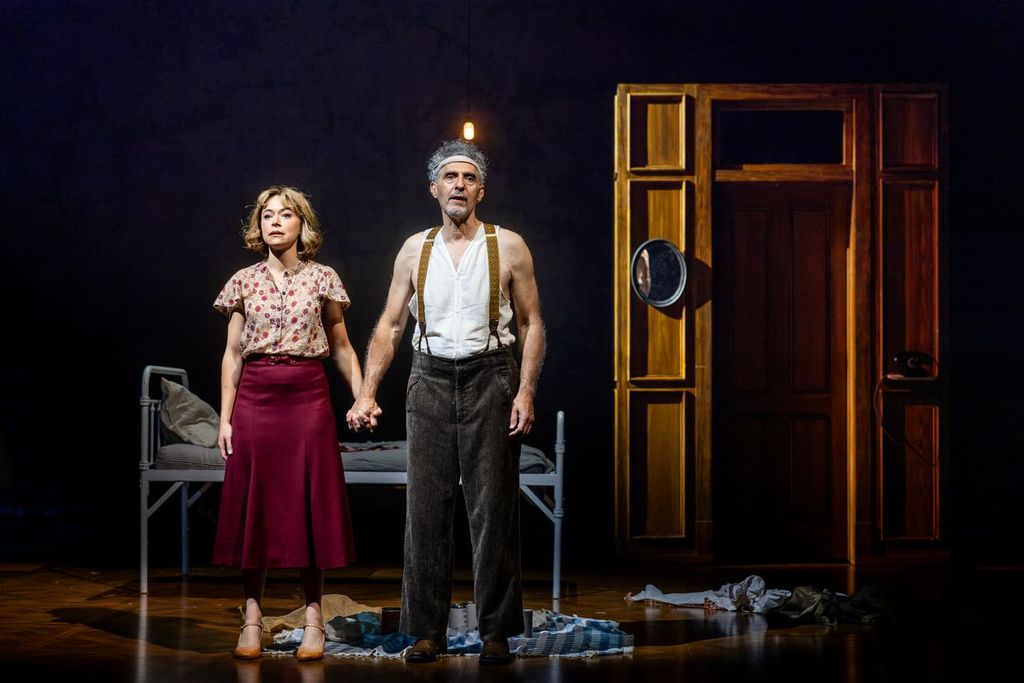
Tatiana Maslany and John Turturro

Alone, the last human left standing, Bérenger wonders if he’s made the right choice, then turns on himself. He is ugly. They are beautiful. He is miserable. They are happy. He will come to a bad end. They will triumph.

But be that as it may, he’s not giving up. He may be the last man standing, but he’s not capitulating. Long live Bérenger; long live Ionesco; and long live Diane Paulus and her reign at A.R.T.!

Highly recommended!

Rhinoceros‘ by Eugène Ionesco, translated by Derek Prouse, adapted by American Repertory Theater. Directed by Diane Paulus. Scenic Design by Riccardo Hernández; Costume Design by Anita Yavich; Lighting Design by Jen Schriever; Sound Design by Fitz Patton; Special Effects Design by Markus Maurette; Fight Direction by Thomas Schall; Movement Advisor Jill Johnson; Dramaturgy by Ryan McKittrick; Production Stage Manager Ryan Gohsman. Produced by American Repertory Theater in Cambridge, MA through September 27, 2026.

For more information, visit https://americanrepertorytheater.org/shows-events/rhinoceros/
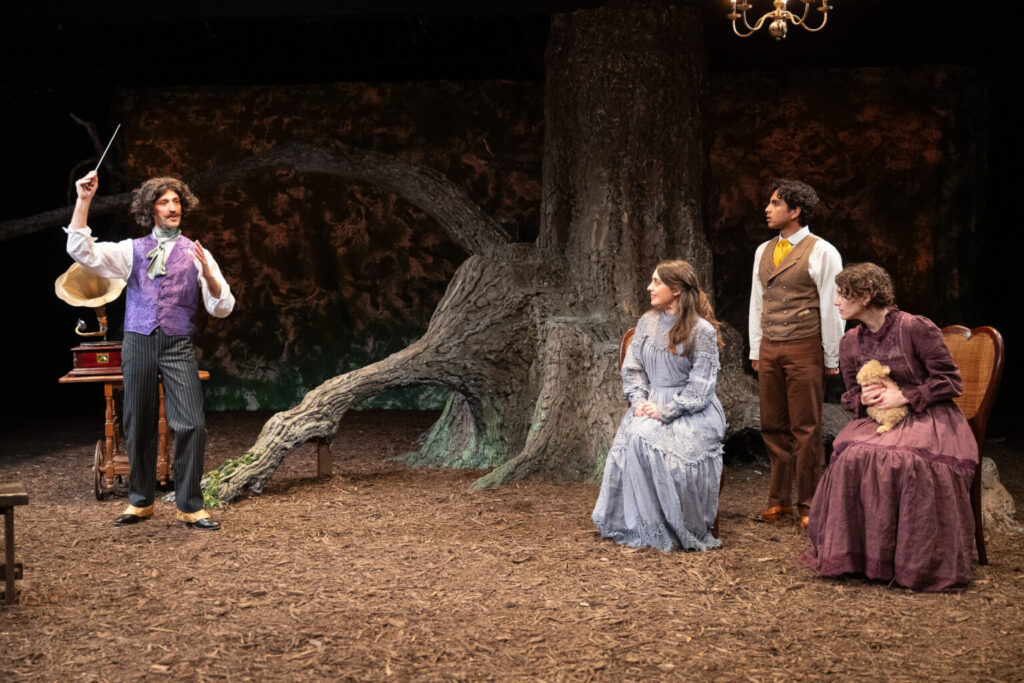
‘Dalloway: First Love’ Is A Romp Through the Beloved Novel’s Genesis

Cast of Gloucester Stage Company’s “Dalloway: First Love”. Photos by Shawn G. Henry

By Shelley A. Sackett

Ever since high school English classes, where most of us first encountered (and many fell head-over-heels in love with) Virginia Woolf and her seminal novel, Mrs. Dalloway, any speculation about the characters that populate the book has been largely prospective rather than retrospective. What might have happened to these people, so intertwined, next, we wondered. Few, if any, even thought about what Clarissa Dalloway might have been like as a teenager, or the origins of the relationships woven into the tapestry of her life.

Luckily, playwright Lindsay Joelle (TRAYF, The Garbologists) not only pondered, but dug in and applied her creative juices to pen Dalloway: First Love, a creditable version of 18-year-old Clarissa and her cohorts during one indelible summer. Her play is the perfect backstory —  it enriches Woolf’s novel for those familiar with its characters without alienating or abandoning those who have never read it.

It also makes for an enjoyable theatrical experience, especially when paired with a (mostly) exceptional cast, outstanding direction, and stunning set. Gloucester Stage Company presents this world premiere through August 29, and it is well worth the trip up the coast to see it.

A nutshell version of the novel is helpful to appreciate the play. Mrs. Dalloway covers one day in the life of Clarissa Dalloway, a 51-year-old upper-class housewife, as she walks through her London neighborhood to prepare for the party she will host that evening. She thinks about many people from her past, reliving interactions and replaying conversations. All will be at her party, including a former suitor, Peter Walsh, her husband, Richard Dalloway, and Sally Seton, a firebrand in her youth who shared an incendiary and life-altering kiss with Clarissa and who now has five sons and a husband.

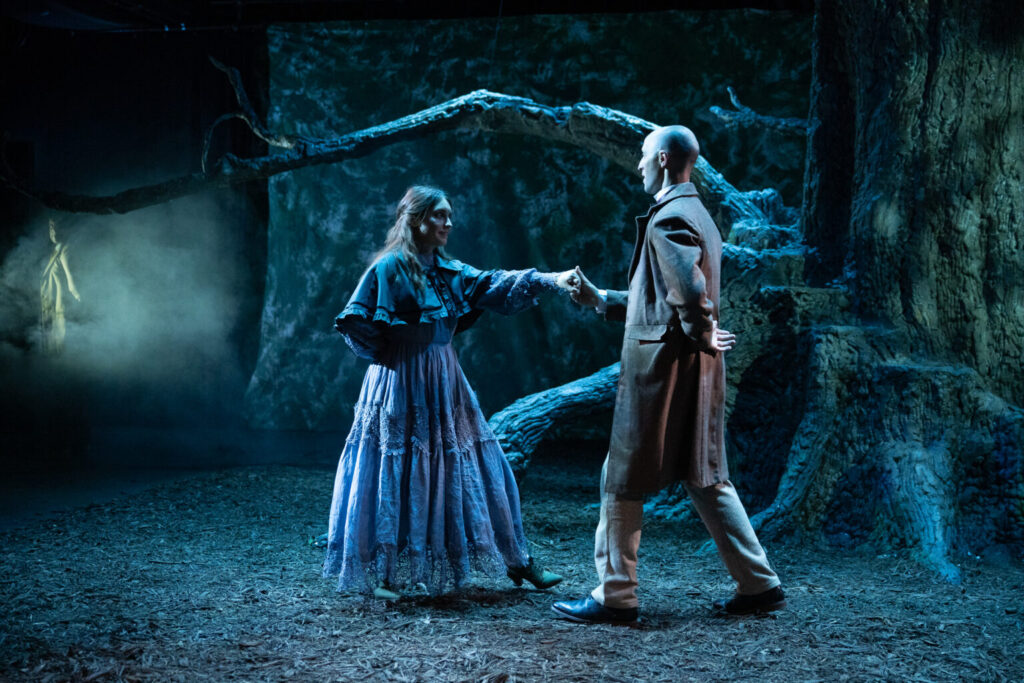
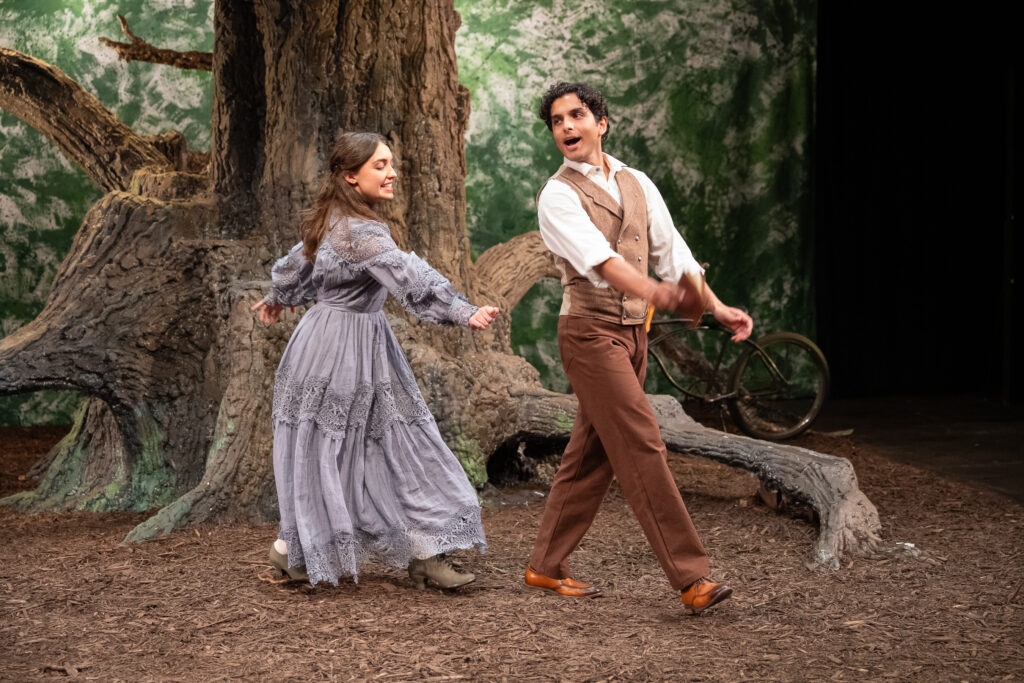
Josephine Moshiri Elwood and Shobhit Piasa

The play opens as a tomboy-clad young woman lolls, book in hand, under a massive tree that is the stage’s centerpiece and around which all the action will take place (set design by Kristin Loeffler). Engrossed, she recites aloud, “Mrs. Dalloway said she would buy the flowers herself,” the first line from the 1925 novel. With that simple reference, Joelle acknowledges that, while her work is of her own invention, she is aware of and pays homage to its underlying source.

In a flash, we are in 1890, 35 years earlier, at the Bourton family estate. Clarissa Parry (a luminous Josephine Moshiri Elwood) is about to turn 18. Motherless since childhood (Woolf’s mother died when she was 13-years-old), she lives with her stern, no-nonsense father (Jesse Garlick, who plays several roles) and desperately misses her sister, whose fatal fall from the set’s massive tree she still grieves (with the help of the opioid, laudanum).

This is the summer she will pursue and be pursued by a number of suitors. They will fall into three categories: those her father prefers, those she prefers, and one lifelong friend who longs to elevate his status from friend to husband. The problem is that Bourton is facing financial ruin (a fact for which her father takes no responsibility) and he has laid a guilt trip on Clarissa that it is her duty to “marry up” and save them both from ruination.

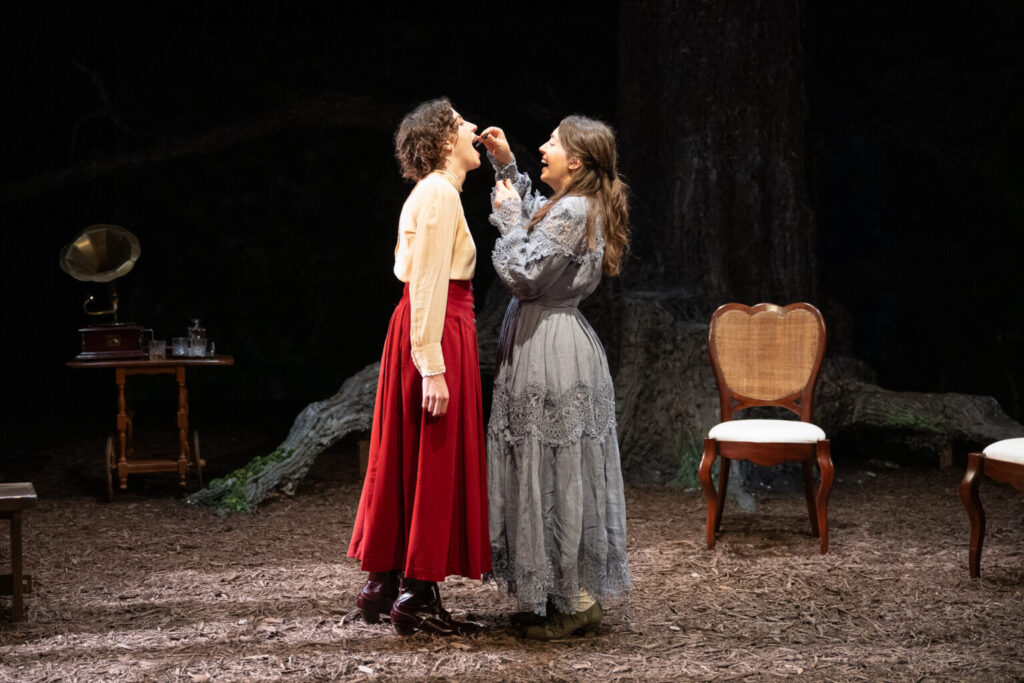
Haley Dyana Schwartz nd Josephine Moshiri Elwood

Peter Walsh (Shobhit Pisa) is the life-long friend. Penniless and of Indian descent (his parents still live in India), he left Oxford under cloudy circumstances and has returned to Bourton to propose marriage to the love of his life. Clarissa is caught off guard, wanting to keep her best friend’s companionship, but unwilling to sacrifice romance to do so. Enter Sally Seton (a deliciously salacious and scene-stealing Haley Dyana Schwartz) and her bag of magic tricks.

At Bourton under dubious pretenses, Sally captures Clarissa’s attention, captivating her with tales of wanton, Je m’en fou behavior and arousing a heretofore unknown passion. When the two share a delicate kiss (at Clarissa’s instigation), Clarissa is left shell-shocked and head-over-heels in lust.

This simmering pot boils over with the arrival of Hugh, a smarmy, wealthy suitor summoned by Clarissa’s father to woo her and save the family homestead. Turns out he and Sally have a backstory. The two squabble like schoolyard rivals, revealing how cunning and duplicitous they both are at heart.

Josephine Moshiri Elwood and Shobhit Piasa

Clarissa, however, has been awakened by Sally to her own homo/bi-sexuality (Woolf herself and Vita Sackville-West shared one of the most famous literary relationships of the 20th century, beginning as an intense romantic affair in the mid-1920s and evolving into a lifelong friendship that lasted until Woolf’s death in 1941). She falls hook, line and sinker for Sally’s picture of a Utopian world where women are free to live without men, on their own terms and in charge of their own bodies and destinies. “There is no need to be anyone but ourselves,” Sally says. She talks of a “Women’s Collective,” and Clarissa is ready to pack her suitcase and abandon stuffy, patriarchal England.

More down to Earth, Peter counsels her that “the privilege to be whoever you are is reserved for the wealthy” which, at least for the moment, includes neither of them. Snotty, snide Hugh (Garlick shines in this role), for his part, maintains the party line of his class and sex — marriage is a business arrangement best left to men to arrange.

There are a slew of other suitors, Clarissa’s sister’s music teacher and even a séance, all of which feel like they serve Joelle’s inexplicable need to run out the clock and pad the character list.

With the arrival of Richard Dalloway (Garlick, perhaps at his most comfortable), the tone shifts from semi-frenzied to semi-gentrified. Richard is Peter’s foil, as cerebral and self-contained as Peter is emotional and impulsive. Yet, he instinctively knows what Clarissa wants and, more importantly, what she needs. Unlike Peter, he doesn’t require a roadmap; he just does it. He may be dispassionate and aloof, but he pushes the right buttons and she is finally able to relax.

While Act II starts out with a bang (the séance), it quickly bogs down as Joelle shifts gears and (again, inexplicably) has her characters catapult into 20th century speculation about women’s rights, racism, and the challenges facing those fighting the good fight. (“See you in 1990,” one character actually says). Fortunately, Joelle rights the ship before capsizing, and we are again in the midst of the summer of first loves, first unrequited loves, and first steps towards lifelong relationships.

Woolf champions those connections forged in 1890 in her novel, where Clarissa relives many events of that summer, including the life-altering kiss with Sally. “She and Sally fell a little behind. Then came the most exquisite moment of her whole life passing a stone urn with flowers in it. Sally stopped; picked a flower; kissed her on the lips. The whole world might have turned upside down! The others disappeared; there she was alone with Sally,” she wrote.

Joelle closes by beautifully bridging the 35-year gap between her play and the novel with a single line. Spoken by Clarissa to Richard Dalloway, it is both indicative of the reins she will hold during their marriage and a direct link between Clarissa’s character at 18 and 51. “I shall always buy the flowers myself,” she informs him, and that, dear audience, is that.

Dalloway: First Love’ by Lindsay Joelle. A world premiere production directed by Rebecca Bradshaw; scenic design by Kristin Loeffler; costume design by Chelsea Kerl; lighting design by M Berry; sound design by Aubrey Dube; intimacy direction by Cassie Chapados; stage managed by Carolyn Ferris. Presented by Gloucester Stage Company in Gloucester, MA through August 29, 2026.For more information, visit https://gloucesterstage.com/dalloway/

‘Starf*ckers’ Showcases Writer/Actor John Kuntz in A Tailor-Made Solo Performance


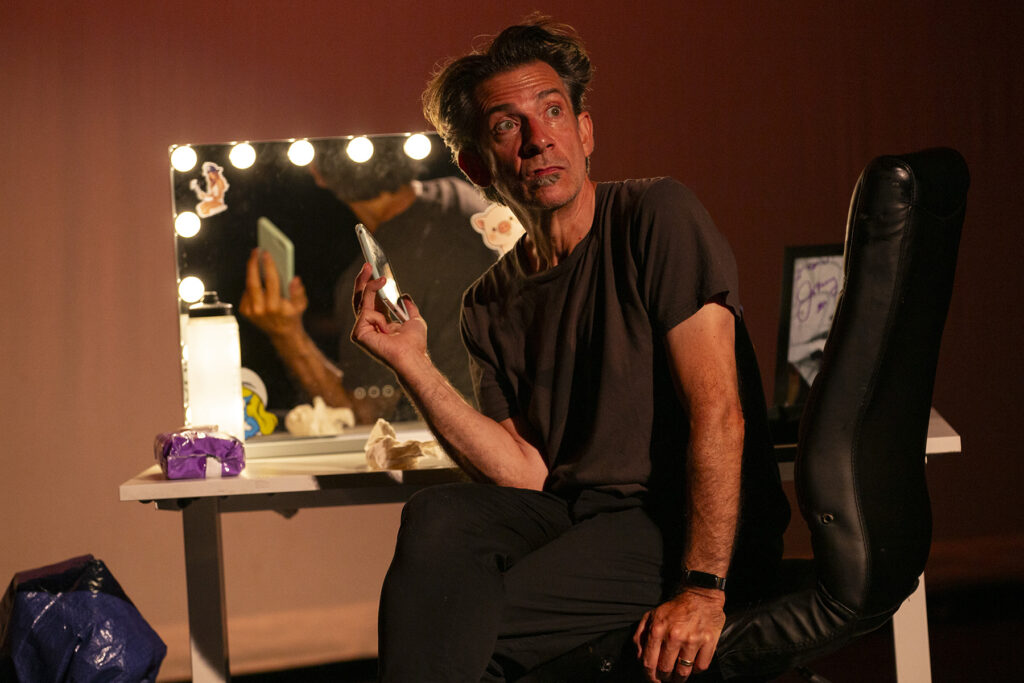
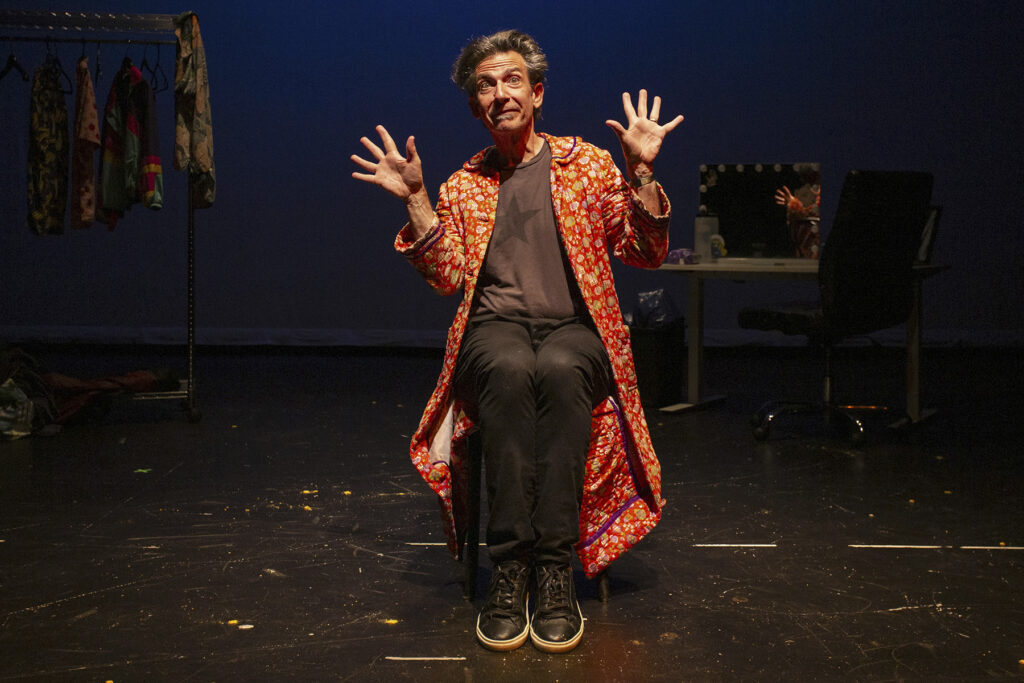
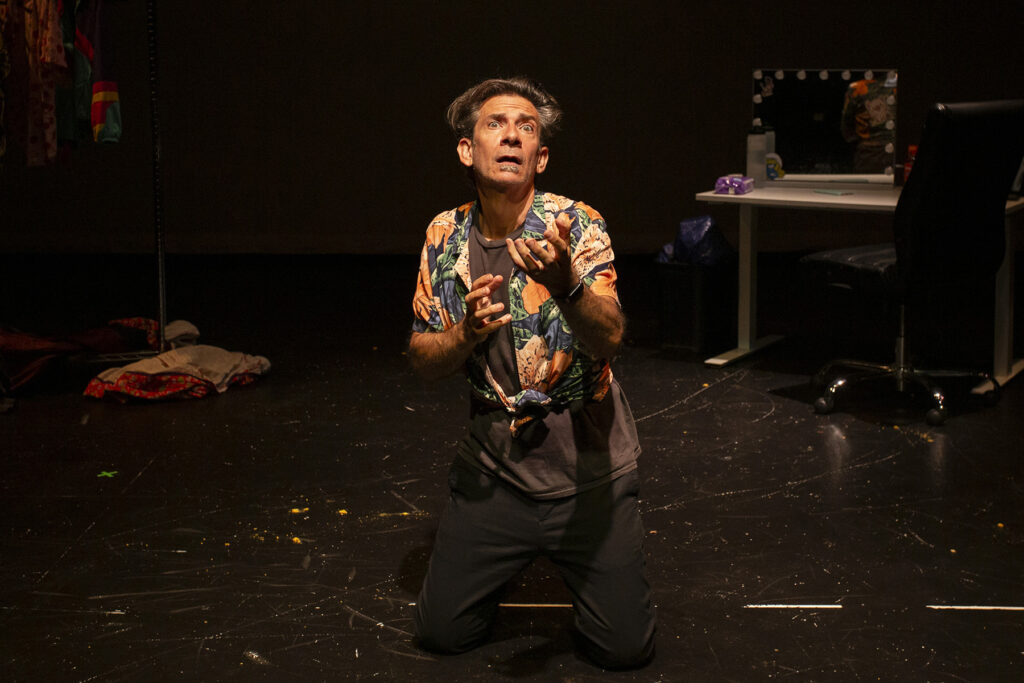
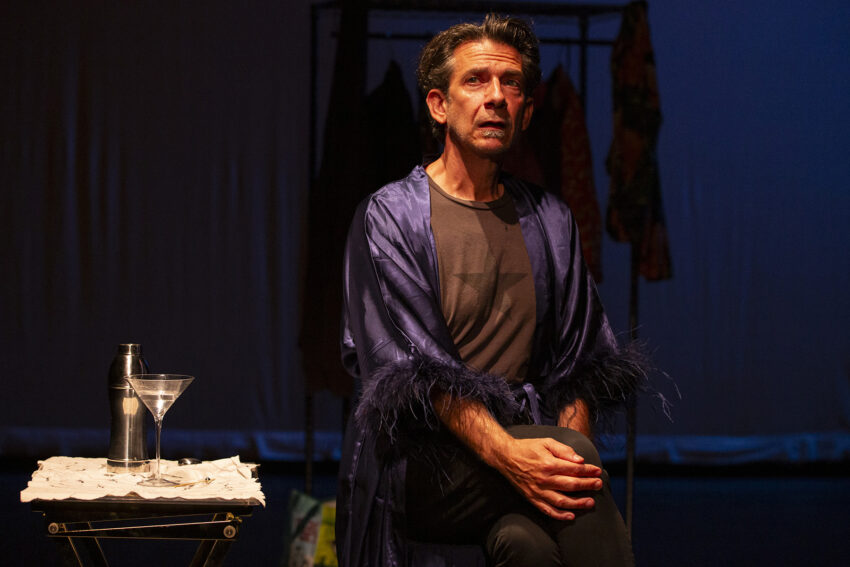
John Kuntz in Starf*ckers. Photo: Gillian Gordon Photography.

‘Starf*ckers’ — Written and performed by John Kuntz. Directed by Alex Lonati. Lighting Design by Sawyer Grabow; Sound Design by Alex Lonati and Anna Drummond. The run has ended.

By Shelley A. Sackett

When local playwright, actor, director and solo performer John Kuntz débuted Starf*ckers in 2000 at Speakeasy Stage Company, it garnered the Norton Award for Outstanding Solo Performance. Over a quarter of a century later, the 90-minute piece about a handful of characters’ obsession with celebrity and fame has, if anything, mushroomed in relevance, affecting all of us, from adults to young children. With the invention and accessibility of “new and improved” technology and social media platforms, today’s fixation on likes, follows and filters has created its own menu of psychosocial disorders and challenges, including but not limited to anxiety, depression, cyberbullying, and the exaggeration of unrealistic beauty standards.

All of which is not meant to plunge us into despair, but rather to point out how timely and indeed prescient Kuntz’s piece remains.

The intermission-less evening begins with Kuntz chatting with the audience in real, 2026 time. He references reviews when the play first opened (“Joyce’s Choices” raved; The Evening Transcript “not so much”) and contemporary examples of what the show we’re about to see is about (“Sydney Sweeney — look her up”).

Then the lights dim (Lighting Design by Sawyer Grabow) and Kuntz scampers over to a clothing rack which contains all he will need to transform into six characters who have one thing in common: they would all sell their soul (and probably their mother’s and children’s) for fame of the David Bowie variety.

The first character (who bookends the play’s seven vignettes) is a no-talent actress auditioning for a part in Xanadu: The Musical that she will never get. She is presumptive, rude, crude and clueless. She offers to sleep with anyone and everyone before going postal at a “No, thank you” response. Kuntz couldn’t be more convincing as this excruciatingly awful leech.

Sprite-like, Kuntz dashes to the clothing rack, changing from one character to the next with the simplest costume adjustment, his chameleon features fully exploited to theatrical advantage by Grabow’s literally spot-on lighting. He introduces us in turn to five others who were bitten hard by the showbiz bug.

There is a man who spent a brief time as Julia Roberts’ best friend, to a disastrous end. There is Ginger Grant, a Nora Desmond-esque fading actress who recounts her life’s story to a man she is on a first date with. Turns out “Gilligan’s Island” was not as much fiction as fact, and the Professor and Mary Ann were sources of a secret sauce. Kuntz shines in this role, both as performer and storyteller, though the story could be edited a tad to excise repetition and retain audience interest.

In “Pig-man,” the man whose advertising career and life go south after he invests in irreversible self-mutilating surgery, Kuntz is unable to rein in his sheer joy at playing such a revolting, pig-hearted, and scandalously funny clout chaser.

A creepy “Adonis” who looks and sounds AI-created and advertises useless products while repeating, “I say what you want to hear” is next. This one, with its bloodless monologue about conquering and consuming the world and Brown Shirt aura, is a little too close for contemporary comfort.

The evening’s most (and, perhaps, only) endearing character is a retired “Smurfs on Ice” road manager and cat collector being interviewed by Cat Fancy Magazine. Channeling Robin Williams as Mrs. Doubtfire, Kuntz creates a full-fleshed, appealing grandmother type whose backstory reveals humility, compassion and integrity. Fame was never her holy grail, and what she’s doing hanging out with the rest of this motley crew only Kuntz knows, but she is a welcome palate cleanser.

Finally, we are full circle back to that Sydney Sweeney wannabe. While some sketches are more silly than funny and the script could use paring down in spots, Kuntz brings a vibrancy of spirit and talent that is refreshing and unique, and an evening spent with him and his posse of Starf*ckers is an evening well spent indeed.

BTG’s Pitch Perfect ‘Lovesong’ Traces the Evolution of a Marriage

By Shelley A. Sackett

We have all handled times when, faced with a fork in life’s path, we have had to decide which one to take. Moments, years or decades later, it’s hard to resist wondering how our lives might have turned out had we chosen differently, whether we should regret or rejoice in the one we selected.

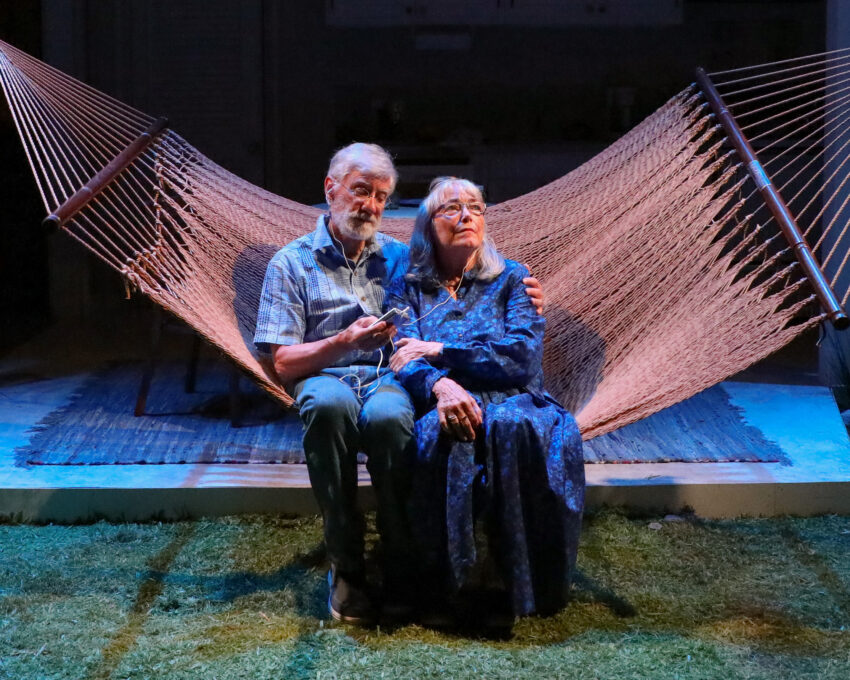
In playwright Abi Morgan’s ‘Lovesong,’ in production through August 29 at Unicorn Theatre in Stockbridge, she gifts her audience with a glimpse at a couple at the end of a long and complicated marriage. Over 90 intermission-less minutes, we ride shotgun as Maggie (Karen Allen, resplendent) and Billy (a winsome David Garrison) remember themselves as newlyweds Margaret (Rebecca Brooksher) and William (Shawn Fagan) and, together, trace episodes in their four decades of marriage.

Along the way, there are shared moments of joy, silliness, heartbreak and passion. There are also moments of betrayal, boredom, isolation and retreat, any one of which might have sent any one of us on a path straight to a divorce lawyer. Yet, through it all, Maggie/Margaret and Billy/William stay the course, navigating the choppiest waters until, at last, they reach the safe harbor of old age.

Shawn Fagan and Rebecca Brooksher

The trigger for this trip down memory lane is Maggie and Billy’s need to clean out the 40 years of stuff they’ve collected during their marriage as they downsize and move on (any more hints would be a spoiler). Each item they unearth sparks memories and instant time travel back to the moment when they first acquired it. Suddenly, their 30-something selves (Margaret and William) appear, reliving that moment as their 70+ selves watch their relationship slowly replay.

And here lies the intersecting brilliance of Morgan’s script, Pulitzer Prize-winning playwright David Auburn’s direction, and Isadora Wolfe’s movement direction. Like the lithest and most appealing dancers, the two couples are on stage together, gliding past each other, seemingly within millimeters, on Alexander Woodward’s stunning two-story set. Complete with kitchen, bathroom, bedroom, staircase and yard, this home is the perfect hearth for a blending of past and present in this sensitive portrayal of aging, memory and indelible connection.

As the play begins, a Medicare-plus-aged Billy stands on the porch, looking over a slightly overgrown lawn and smoking a cigarette. “When I clean my teeth, I always clean them twice… Because our teeth are our legacy, after bones and muscles have dissolved into dust and the earth, our teeth remain. Their value to archaeologists and paleontologists is infinite and undeniable. They reveal what we eat and how we live. I see it as my duty to preserve them,” he informs the audience.

Preserving legacy even seeps into his dreams, he explains. “In my sleep, I am younger.”

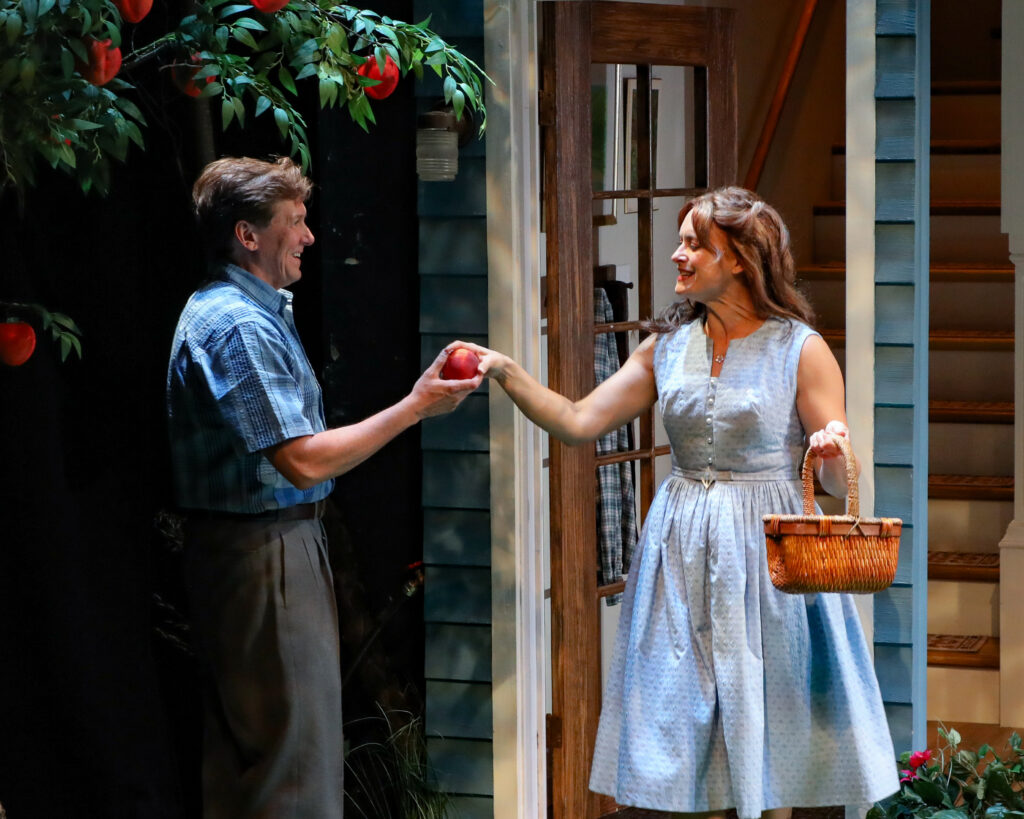
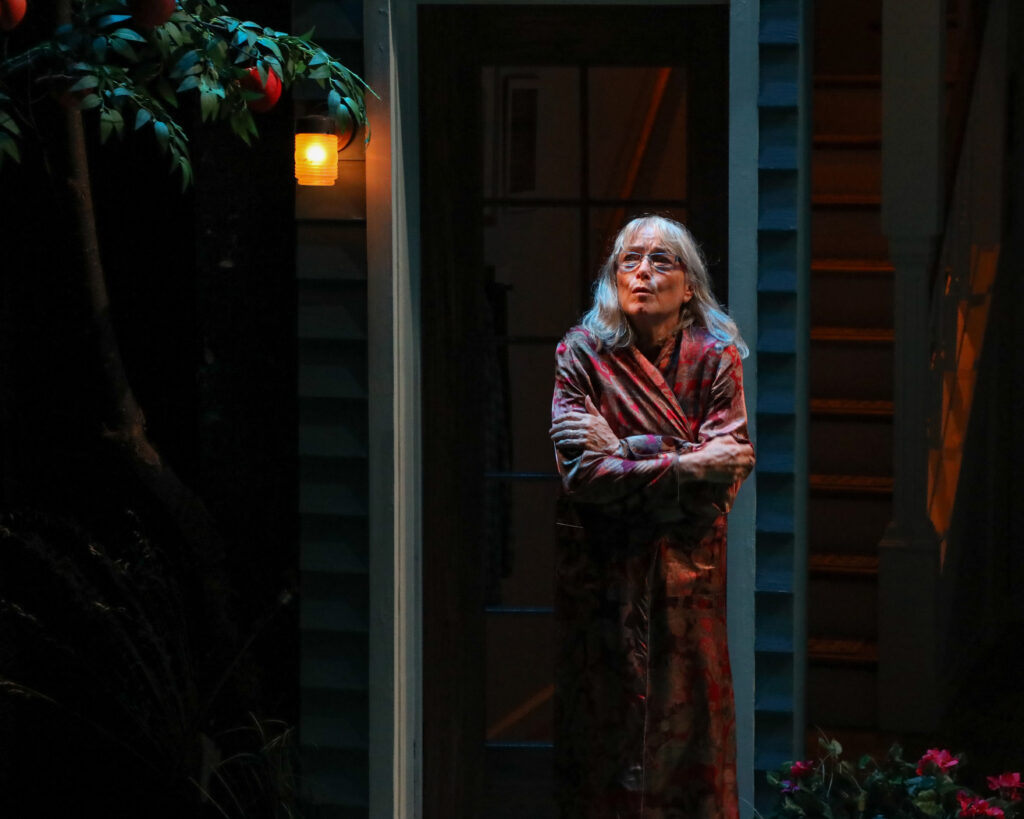
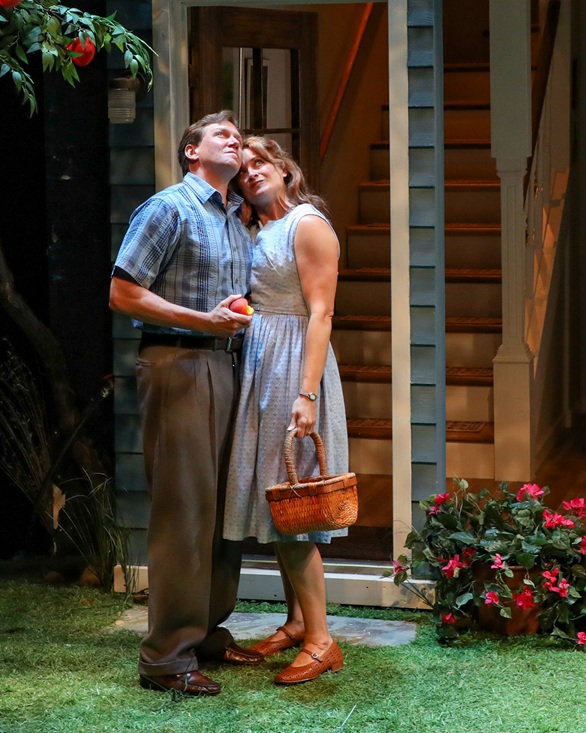
He and Maggie (a role that Allen effortlessly owns) talk about the size of the lawn, whether it has shrunk and whether the peaches are ripe enough to eat. Against the backdrop of drumbeat thrum and swelling music (composition and sound design by Scott Killian), they slowly climb the stairs to get ready for bed. Maggie opens the closet door, and Margaret steps out.

Allen

We first meet William and Margaret as newlyweds. Margaret is thrilled by their house, by the prospect of a future full of the patter of little feet. William is a freshly minted dentist who is chafing under the thumb of his boss. Even though the mortgage is stretching their budget to the breaking point, William wants to take out a loan to open his own practice.

He sits alone at the kitchen table, drink in hand. He downs it, goes to the freezer, removes the bottle of vodka, and refills his glass. Twice. When he tells Margaret his plan, she objects. When he tells her he already secured the location and loan, she hits the roof.

For the first time in this newborn marriage, disagreement has arisen. William sees taking a risk as a crucial element of the success of their future together. “There are going to be moments when you have to leap with me,” he says. “Do you trust me?”

The focus shifts back to the present as Billy and Maggie finish preparing for bed. “We can’t stave off the inevitable,” Maggie (Allen) tells Billy (Garrison), continuing the same conversation some 40 years later.

And, just like that, ‘Lovesong’ casts its magic spell. For the rest of the show, we will travel back to those moments that, for specific reasons private to their shared lives, are the bedrock of this couple’s marital narrative.

We witness the good, the bad, the sacred and the profane that take place over the lifetime of this union. They face many bumps in the road — from infidelity and boredom to learning to balance the need to be alone with the realities of marriage. They are loving and they are mean. They cope with childlessness and illness. They rejoice in eating the peach from the tree they plant.

Morgan has a featherlight touch as she hints at the future without tipping her hand. Auburn’s direction is equally understated, and Daniel J. Kotlowitz’s lighting renders the chronological shape-shifting both artful and credible.

It is the cast, however, who really make the conceit work. Allen doesn’t play Maggie; she is Maggie, from her first moment on stage to her last. As Billy, Garrison brings both a boyish charm and sage resignation. The two share palpable chemistry and artistic sympatico.

Fagan’s William wears his heart on his sleeve, moving from arrogant to insecure to sentimental. Brooksher imbues Margaret with a level-headed maturity and candor that meshes, clashes, and blends with her partner.

Shawn Fagan and Rebecca Brooksher

‘Lovesong’ offers its viewers a glimpse through the keyhole at a couple whose marriage survives those crises that present moments of soul-searching questioning: Can I stay in this marriage? Do I want to stay in this marriage? How many have been at that very fork in the road and wondered, decades later, how their lives might have turned out differently if they had chosen differently?

Maggie/Margaret and Billy/William are one of those couples that chose to struggle through together, to sacrifice the small things for the sake of the bigger picture. As the breathtakingly affecting ending illuminates, such a lifetime lived together is a reflection of life’s most resilient, fragile and intimate offerings. Or at least, it can be.

Highly recommended.

‘Lovesong’ — Written by Abi Morgan. Directed by David Auburn. Scenic Design by Alexander Woodward; Movement Direction by Isadora Wolfe; Costume Design by Amanda Roberge; Lighting Design by Daniel J. Kotlowitz; Composition and Sound Design by Scott Killian. Presented by Berkshire Theatre Group at the Unicorn Theatre, Stockbridge, MA through August 29.

For more information, visit BerkshireTheatreGroup.org