In GSC’s Excellent ‘Betrayal,’ Pinter Creates An Endless Loop of Deception

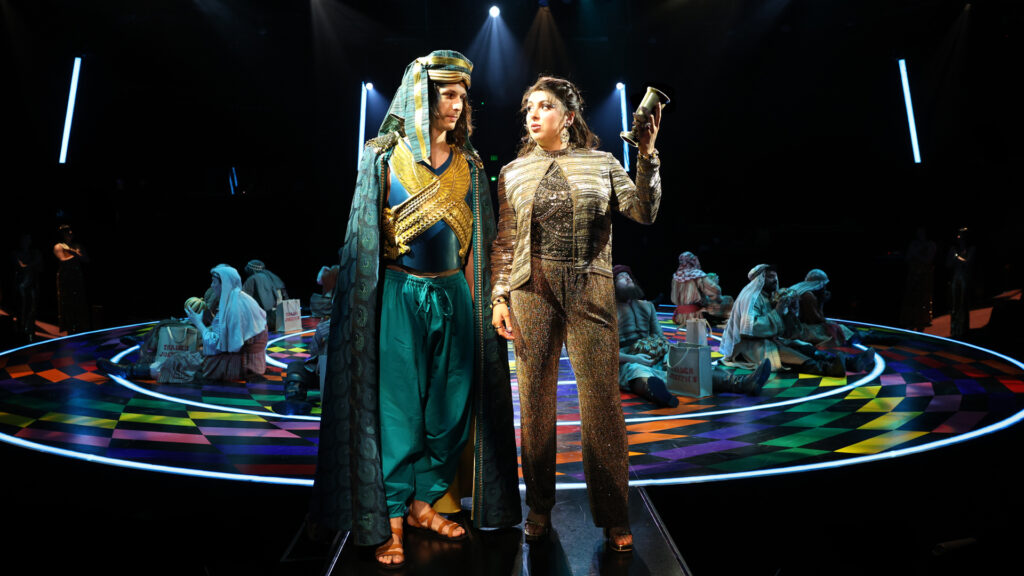
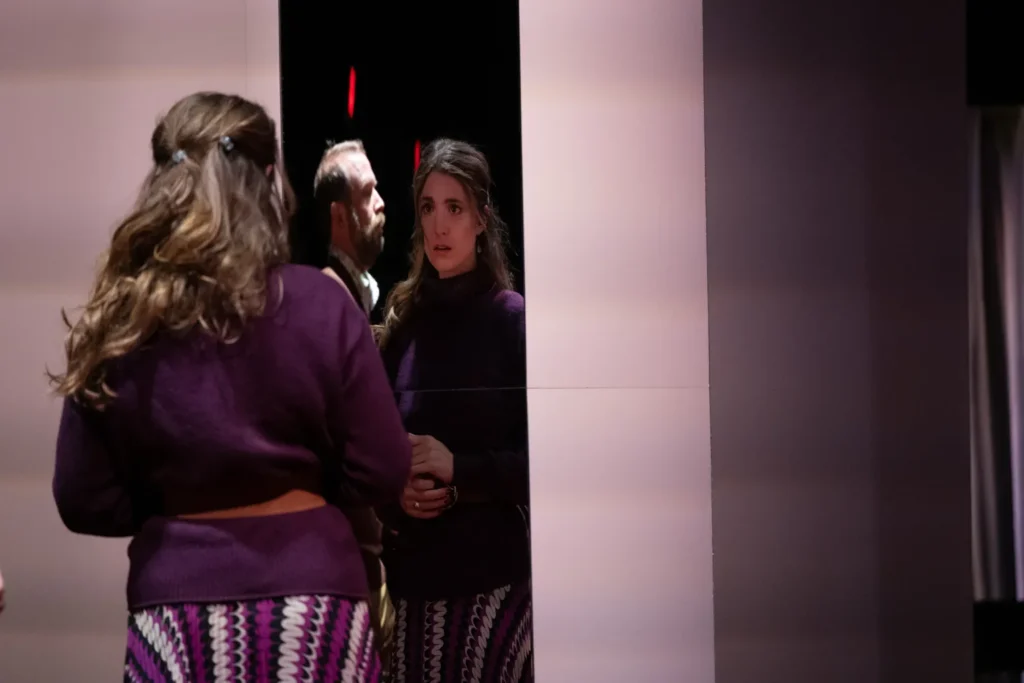
Liza Giangrande and Tanner Efinger in Gloucester Stage Company’s production of “Betrayal”. Photos by Shawn G Henry

‘Betrayal’ — Written by Harold Pinter. Directed by Shana Gozansky. Scenic Design by Jeffrey Petersen; Costume Design by Nia Safarr Banks; Lighting Design by Amanda E. Fallon; Sound Design and Composition by Julian Crocamo. Presented by Gloucester Stage Company, 267 East Main Street, Gloucester through August 1

By Shelley A. Sackett

The “Droste effect” is a unique visual experience created by the seemingly infinite repetition of a picture within itself, creating a captivating, recursive image that draws the viewer in and leaves them pondering the limits of reality. Like a telescoped hall of mirrors, the effect is of a picture appearing within itself, in a place where a similar picture would realistically be expected to appear, creating a loop that could theoretically go on forever. Named after a Dutch cocoa company whose packaging featured the effect, the “Droste effect” has captured the imagination of artists, photographers, and design enthusiasts alike.

In 1978, it also captured the imagination of playwright Harold Pinter, whose drama, ‘Betrayal,’ is in production through August 1 at Gloucester Stage Company.

Presented in reverse chronological order, the play traces the nine-year cycle of birth, life and death of an affair between Emma (a glorious Liza Giangrande) and Jerry (Michael Underhill), Emma’s husband Robert’s (Tanner Efinger) best friend. We meet our former lovers as they face the fact that their fiery affair is, alas, smoke and ashes. They have not used the clandestine flat they rented in two years. It’s time to face the fact that their love nest is empty and to move on.

We learn that Emma is a gallerist and Jerry and Robert have a personal (going back to college days) and professional (Jerry is a literary agent, Robert a publisher) relationship. Interestingly, all three have one thing (other than Emma and Jerry’s affair) in common — they all make their living as middle (wo)men, peddling and profiting from the creativity of others.
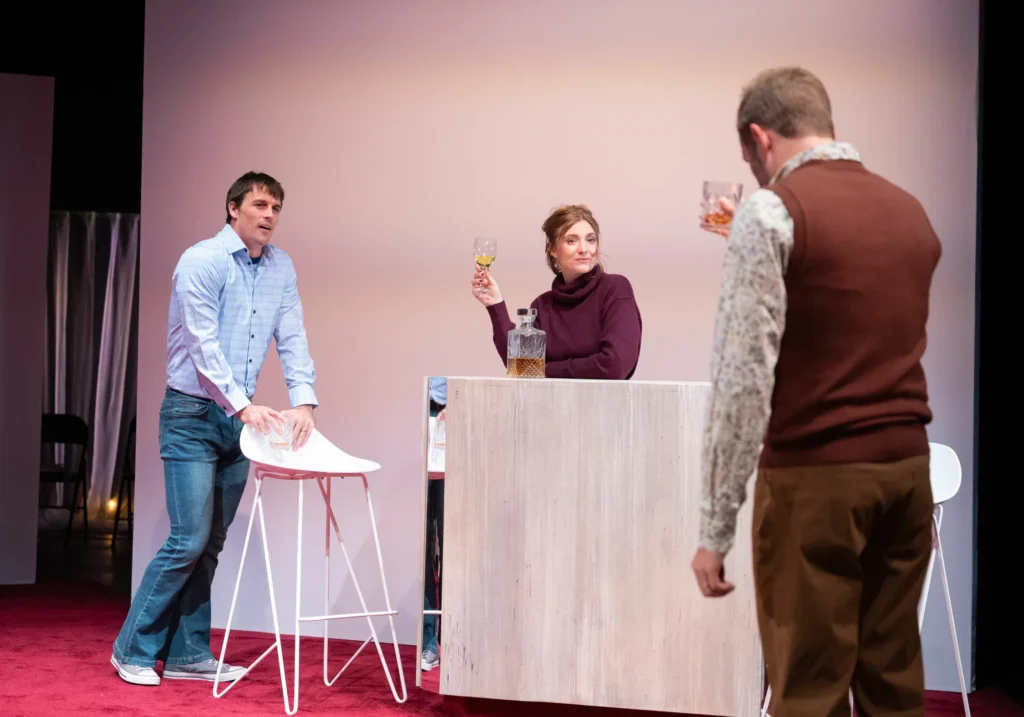
Underhill and Giangrande

Over 85 intermission-less minutes, these three will take a trip down a Droste tunnel where it becomes impossible to untangle the betrayed from the betrayer. Truth, lies and everything in between lurk more in the interstitial pauses than actual conversation, a signature talent of Pinter’s which he hones to a lethally sharp point in this sparse, nine-scene classic.

Because we know how, why and when the affair ends, our attention can focus on unraveling what makes the characters tick rather than figuring out the plot. Pinter dangles clues and then hides them behind a cloud of scant dialogue and nine-month pregnant pauses. More emotion is revealed by the stellar ensemble (especially Giangrande) and their silent but dramatic reactions than by the words they actually say aloud to each other. These are people who live in the shadows, whose dishonesty with each other is only surpassed by their disingenuousness with themselves.

About the only consistent link among them seems to be the belief that monogamy breeds monotony. That and a penchant for conversation that is cerebral, pithy and devoid of passion.
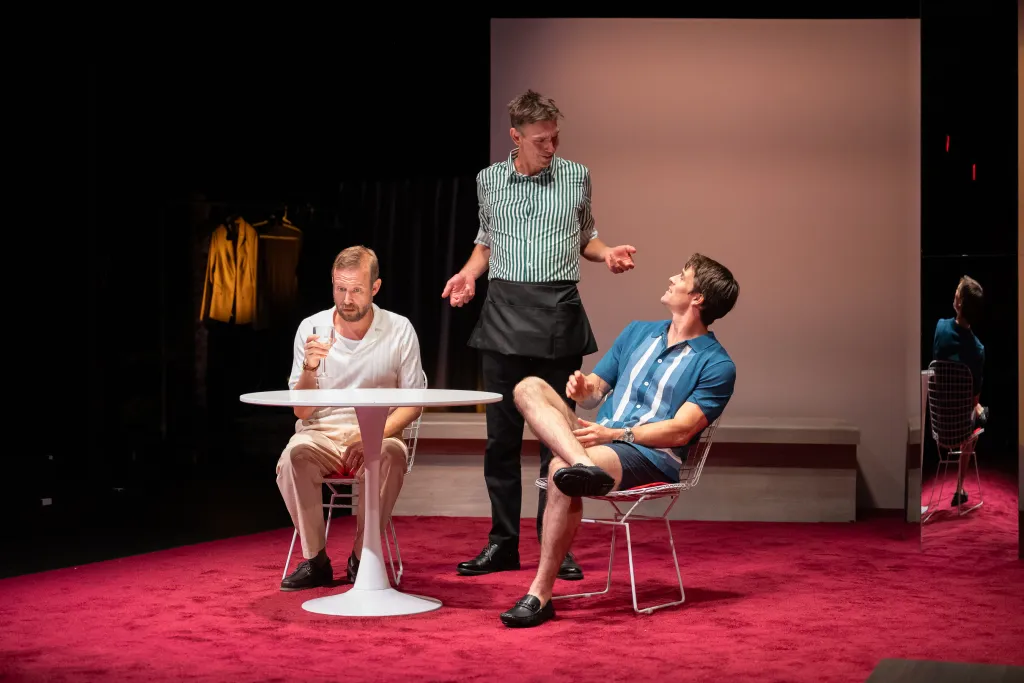
Efinger, Jeremy Beazlie, Underhill

Yet, thanks to Shana Gozansky’s focused, expert direction (she hits that elusive dramatic sweet spot of milking each pause without ever overdoing it) and a top-notch production team and cast, the play rarely lags.

The “Memento” (Christopher Nolan’s cinematic masterpiece) experience begins subtly with a seductive jazz soundtrack (Sound and Composition design by Julian Crocamobefore the play starts, setting a relaxed but sexy tone. As the timeline runs in reverse from 1977 to 1968, so does the soundtrack, sounding more like the Beatles’ “Revolution No. 9” by the end. Jeffrey Petersen’s slick, impersonal set morphs easily from pub to house to apartment to hotel and restaurant. Back-lit walls that silhouette the characters as they change costumes (Lighting Design by Amanda E. Fallon, Costume Design by Nia Safarr Banks) bring reminders of the late 1960s-70s mod, go-go style that featured sharp tailoring, bold colors, and geometric shapes.

All four cast members are superb. Jeremy Beazlie is a tension-breaking relief and delight in his comic waiter cameos. As Jerry, Underhill embodies his narcissistic immaturity and boyish shallowness. Efinger brings an undertone of dissatisfaction and sadness to a character whose anhedonia knows no relief except when he is playing squash.

But it is Giangrande as Emma who anchors the production both plot-wise and by her nuanced portrayal of a complex, perplexed and enigmatic woman whose identity seems dependent on mistreatment by and of men. Beyond all the duplicity, deception, infidelity, competition and power tripping exhibited by our damaged trio, the most chilling moment is Robert’s confession that he hit Emma. “I wasn’t inspired to do it from any kind of moral standpoint. I just felt like giving her a good bashing. The old itch…you understand,” he confides to Jerry.
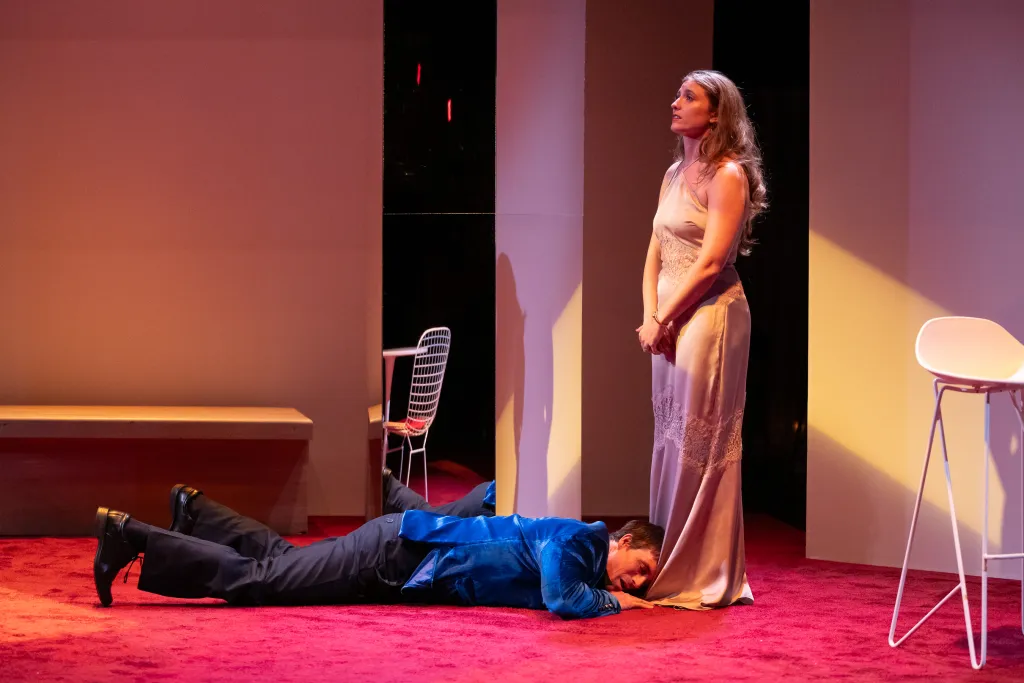
Like all satisfying theater, ‘Betrayal’ leaves us pondering big-ticket questions. What exactly constitutes “betrayal?” Is it an action? An omission? Is it knowing about the act and saying nothing? Does a betrayer owe loyalty to their co-conspirator or to their partner or to neither? Can only lovers suffer and commit betrayal, or does it extend to strangers?

But, most difficult to understand of all, is why our ill-fated lovebirds thought that renting a flat together would cure their malaise. A placeholder that is neither home not hotel, they set up house, replicating that which is obviously not working in their “real” lives. If it were, they wouldn’t be having an affair, or, now knowing these two as best as is possible, would they?

For more information, visit: https://gloucesterstage.com/
Fast-paced, Colorful, and Highly Entertaining NSMT’s ‘Joseph and the Amazing Technicolor Dreamcoat’ Is A Crowd Pleaser

By Shelley A. Sackett

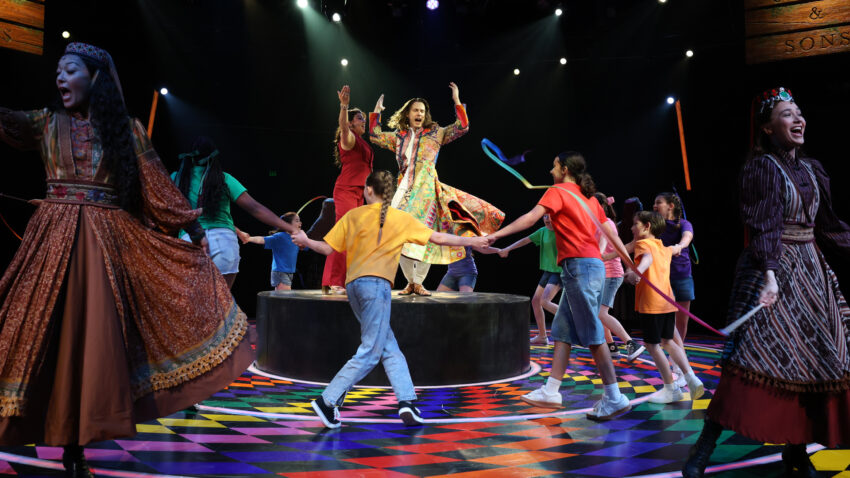
What a set of pipes Olivia Valli has! The granddaughter of iconic singer and actor Frankie Valli (known as the lead singer of Frankie Valli & The Four Seasons), Olivia has also played her own grandmother, Mary Delgado, in ‘Jersey Boys’ Off-Broadway. As the omnipresent Narrator in North Shore Music Theatre’s excellent ‘Joseph and the Amazing Technicolor Dreamcoat,’ she brings an excitement and hip, young vibe to one of the oldest and best-known stories ever told.

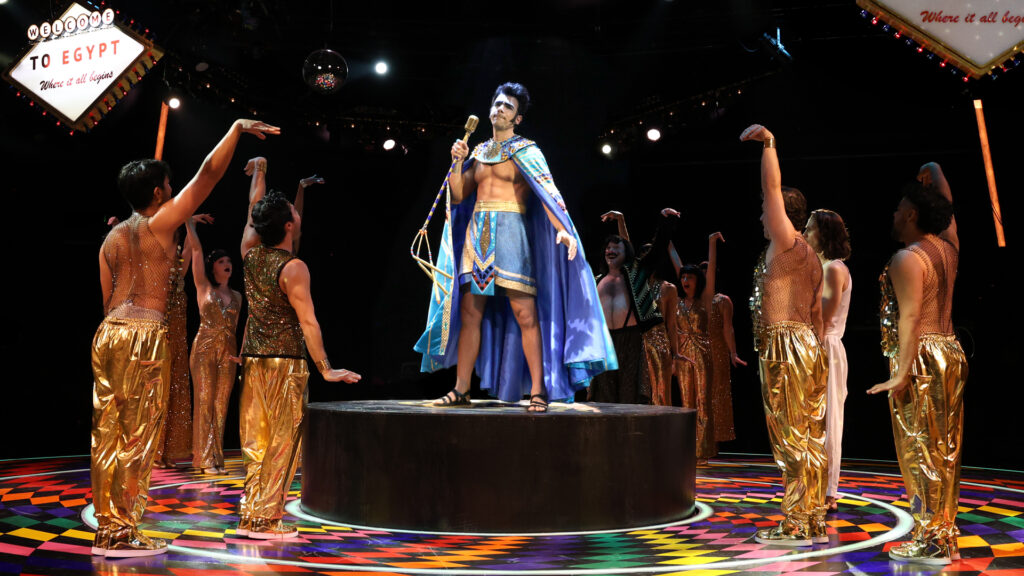
Nikita Burshteyn (Joseph) and Olivia Valli (Narrator) and the cast of “Joseph and the Amazing Technicolor Dreamcoat” at North Shore Music Theatre

It’s a pretty safe bet, however, that this dazzling, high-energy and delightfully entertaining version of the Genesis tale is a far cry from the one you grew up with.

First, a nutshell primer. Joseph’s father, Jacob, had 12 sons, but favored Joseph and gave him the famous multi-colored coat as a gift. This sends his brothers, already jealous of Jacob’s favoritism, nearly over the edge. When Joseph tells them of his two dreams in which all the brothers bowed down to him, they decide to get rid of him. They throw him into a pit and then sell him into slavery. The brothers then dip Joseph’s coat in goat blood and show it to their father, saying that a lion tore Joseph apart.

Joseph ends up in Pharaoh’s court as his favored vizier after he correctly interprets Pharaoh’s dreams, ensuring Egypt’s survival and prosperity during a predicted famine. Joseph’s brothers, suffering in Canaan, travel to Egypt, where they bow before a Joseph they do not recognize (thus fulfilling his prophetic dream) and beg him to sell them food.

Joseph eventually reveals himself, the brothers retrieve their father, and they all live happily ever after, a family reunited and absolved.

How lyricist Tim Rice and composer Andrew Lloyd Webber managed to come up with their inventively fresh spin on this old tale is one of the unheralded wonders of the world.

Precision-perfect direction and choreography by Gerry McIntyre match Robert L. Rucinski’s always luminous musical direction as the cast and children’s chorus sing and dance their way through numbers that range from a country-and-western hoedown and calypso to 1970s disco and 1920s Charleston. There’s even a 1960s hip-shaking Pharaoh as Elvis and a 1970s go-go number. Somehow, it works; Rice and Weber successfully infuse this well-known tale with a mish-mash of styles without sacrificing narrative cohesion or artistic integrity.

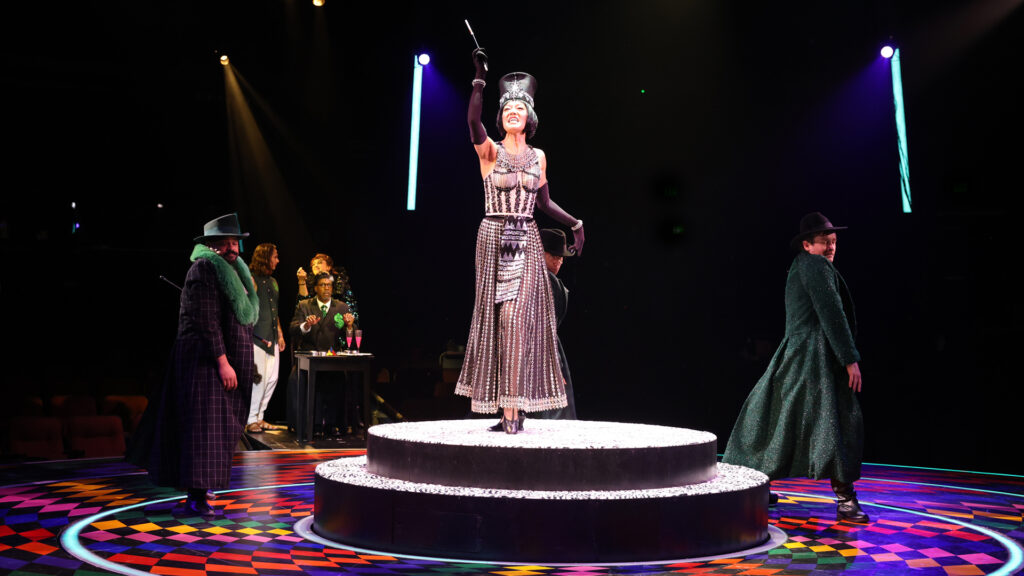
To boot, the quality of talent, from dancing to soaring harmonies and swoon-worthy solos (Valli brings down the house several times with her powerhouse voice and comedic timing), is icing on this already delectable cake. The ensemble meshes beautifully, yet supports individual spotlights, such as Brent Thiessen as Pharoah/Elvis, Nikita Burshteyn as Joseph, Eric Jordan Young as Jacob/Potiphar, and Naomi Kakuk’s dance solo as the slinkiest Mrs. Potiphar this side of Michelle Pfeiffer’s Catwoman.

Although ‘Joseph’ is over 130 minutes long (one intermission), unlike other recent NSMT productions, the show feels well-paced, exciting, and interesting, from start to finish. Even if you’ve seen ‘Joseph’ before, seeing it in the round lends a new twist. And if you’re seeing it for the first time, you’re in for a treat — NSMT’s production was worth the wait!

Recommended.

‘Joseph and the Amazing Technicolor Dreamcoat’ — Lyrics by Tim Rice. Music by Andrew Lloyd Webber. Music Direction by Robert L. Rucinski. Direction and Choreography by Gerry McIntyre. Scenic Design by Baron E. Pugh; Costume Coordination by Rebecca Glick; Lighting Design by Jose Santiago; Sound Design by Alex Berg; Wig and Hair Design by Rachel Padula-Shufelt. Produced by North Shore Music Theatre, 54 Dunham Road, Beverly through July 19.

For more information, visit https://www.nsmt.org/

Even BinB’s Glitzy Production Pizazz Can’t Hide the Underlying Tragedy of ‘The Great Gatsby’

By Shelley A. Sackett

It’s not surprising that the current climate of skyrocketing economic disparity and criminal impunity has spawned renewed interest in The Great Gatsby, the story of Jay Gatsby, F. Scott Fitzgerald’s fictional mega-nouveau-riche man with a mysterious back story and lavish lifestyle. Set in the post-WWI, giddy, glitzy Jazz Age, the 1925 novel depicts first-person narrator Nick Carraway’s interactions with Gatsby, a man haunted by his past and obsessed with reuniting with his former lover, Carraway’s cousin, Daisy Buchanan.

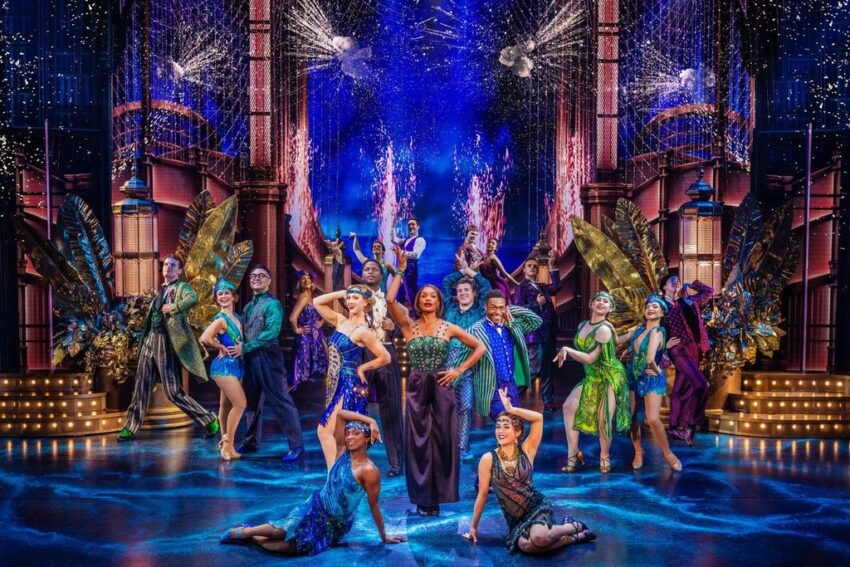
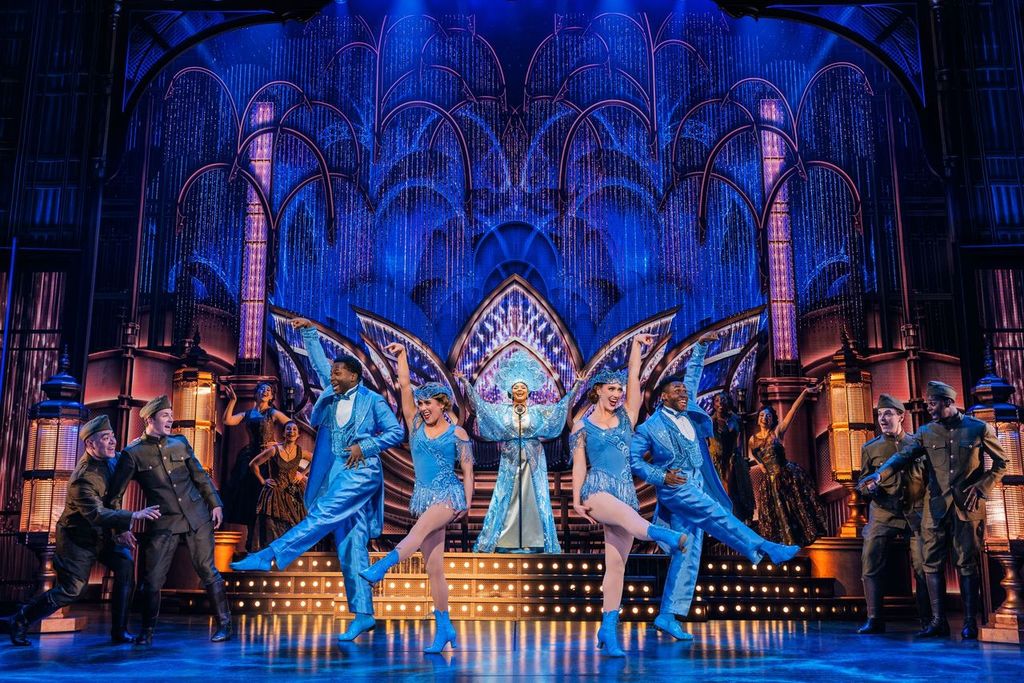
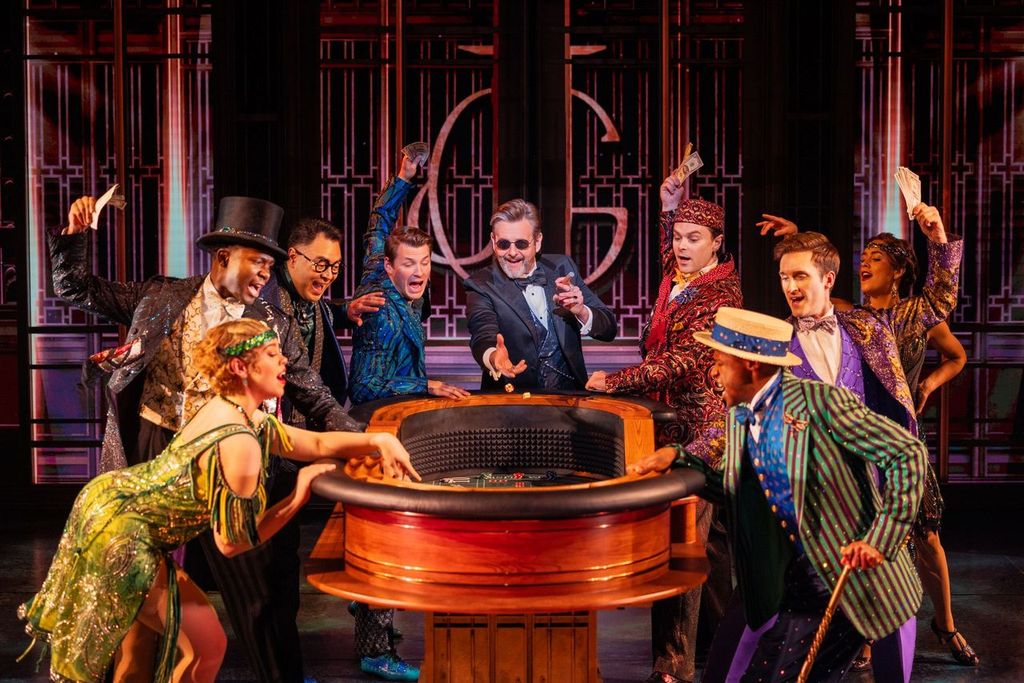
As has been the case with many Broadway in Boston productions, the best quality of ‘The Great Gatsby’ lies in its production value. The giant period musical spares no expense when it comes to extravagant sets (Paul Tate dePoo III), costumes (Linda Cho) and orchestration (Jason Howland). Alas, no amount of moving screens, fancy projections and on-stage gimmickry (including several vintage cars) can mask the fact that beneath the eye and ear candy, this emperor of a production wears no clothes.

Cast of Broadway in Boston’s ‘The Great Gatsby’

There is quite a bit of meat on the bones of Fitzgerald’s tragic tale. It’s spring 1922, and Yale alumnus and World War I veteran Carraway (an appealing Joshua Grosso) has moved from the Midwest to New York City, where he hopes to get a job selling bonds. He rents a cottage on Long Island in East Egg, next to Gatsby (Jake David Smith) and across the sound from his cousin Daisy (a sadly miscast Senzel Ahmady), who lives in the “old money” town of West Egg with her husband, Tom Buchanan (Will Branner).

Glimpses of a plot emerge. Daisy and Gatsby became sweethearts when he was stationed near her before overseas deployment. He was unable to reconnect; she thought he was dead. She reluctantly married the wealthy, brutish and philandering Buchanan because, well, what else was a young single socialite to do?

Now she has a baby, money and a ball and chain named Tom Buchanan.

Staying with the Buchanans is Jordan Baker (Leanne Robinson, a welcome relief), an outspoken flapper, golf champion and childhood friend of Daisy’s. She fills Carraway in on the unspoken details of the goings on in this sad, unhumble abode.

Buchanan (a fellow Yalie who remembers Carraway), for his part, is carrying on an affair with Myrtle (Lila Coogan), who lives in semi-squalor with her clueless, sad-sack mechanic husband, George (Justin Scott Brown). Buchanan pampers her with gifts, a suite at the Plaza, and the occasional broken nose. She all but rubs it in George’s impossibly naive face.

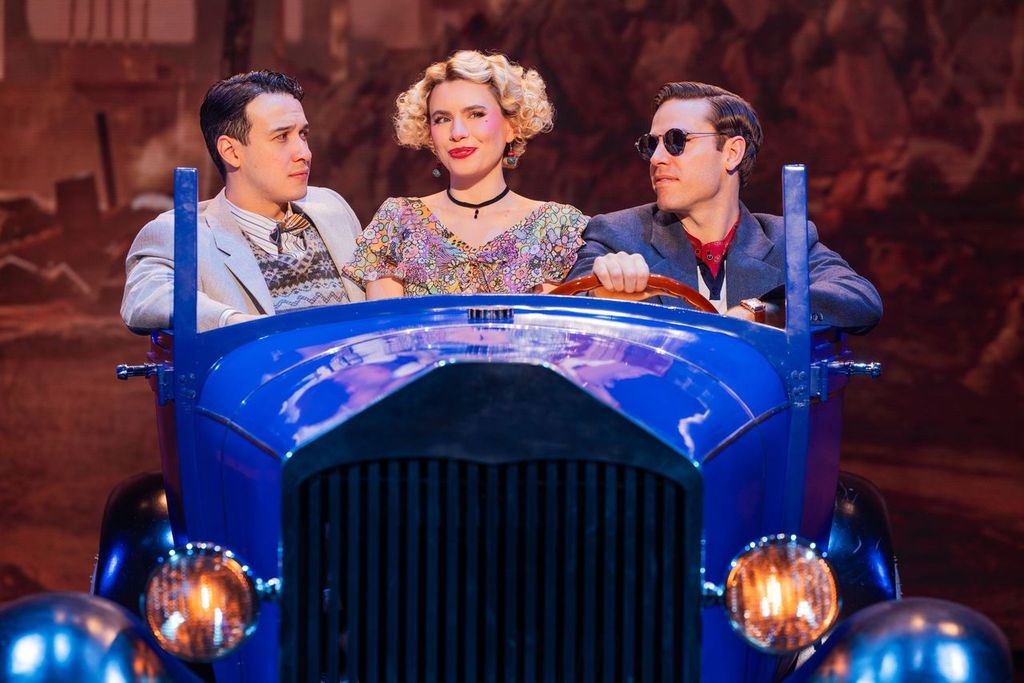
Joshua Grosso, Lila Coogan. Will Branner

Meanwhile, Gatsby explains to Carraway that he built the mansion directly across from Daisy’s house so he could see her. His only mission in life is to win her back. He enlists Carraway’s help in setting up a meeting, which eventually leads to a rekindled affair.

Along the way to its grim and fateful conclusion, ‘Gatsby’ picks up steam with bootleggers, mistaken identities, trysts, deaths and the reveal that the main difference between the rich and the unrich is the latter’s ability to shield themselves from the consequences of their reckless, selfish acts and the former’s fate to clean up the mess and try to keep on keeping on.

If all this sounds like juicy fodder for a gritty drama, it is. What it is not is grist for the kind of run-of-the-mill musical currently in Boston.

In fairness, ’The Great Gatsby’ does a good job of exposing the dark, violent underbelly of the glittering 1920s. But its misguided (though entertaining) insistence on peppering the production with goofy, comic musical numbers feels like a red herring intended to distract the audience from the fact that this is a gossamer version of Fitzgerald’s classic tale.

While most of the cast is in fine vocal form (especially Smith as Gatsby and Robinson as Baker), they are hamstrung by a script that provides little emotional exploration and connection. Branner does what he can with two-dimensional Buchanan and Grosso tries to elevate Carraway above his role as flaky narrator and moralist, but, in Ahmady’s hands, the central role of Daisy is unfortunately (and distractingly) demoted to the trivial.

Nonetheless, if a summer night of razzle-dazzle is what you’re in the mood for, by all means attend (and revel in) this musical version of ‘The Great Gatsby.’ Just don’t expect F. Scott’s ghost to be lurking in the wings, nodding in approval.

‘The Great Gatsby’ — Book by Kait Kerrigan. Based on the novel by F. Scott Fitzgerald. Lyrics by Nathan Tysen. Music by Jason Howland. Directed by Marc Bruni. Music Supervision and Arrangements by Jason Howland; Choreography by Dominique Kelley; Scenic and Projection Design by Paul Tate dePoo III; Costume Design by Linda Cho; Lighting Design by Cory Pattak; Sound Design by Brian Ronan. Presented by Broadway in Boston at Citizens Opera House, Boston through July 19.

For more information, visit https://www.boston-theater.com/shows/citizens-bank-opera-house/the-great-gatsby