‘Wicked’ Is As Wickedly Entertaining As It Is Timely

By Shelley A. Sackett

It’s nearly impossible not to think of the current state of our political situation while watching Broadway in Boston’s excellent production of ‘Wicked,’ at the Citizens Opera House through November 15. Although its thinly veiled political, ethical and social commentary on the nature of good and evil takes place in the Emerald City of Oz, its lyrics might have been torn from the latest Op-Ed pieces of our national newspapers.

Loosely based on Gregory Maguire’s 1995 novel, “Wicked: The Untold Story of the Witches of Oz” (which, in turn, is loosely based on L. Frank Baum’s 1900 novel, “The Wonderful Wizard of Oz”), “Wicked” delves into the backstories of Glinda, the Good Witch of the North, and the Wicked Witch of the West. In this theatrical version, librettist Winnie Holzman and songwriter Stephen Schwartz have given their Wicked Witch a name (Elphaba), a sorrowful backstory, and a moral compass loaded with heart.
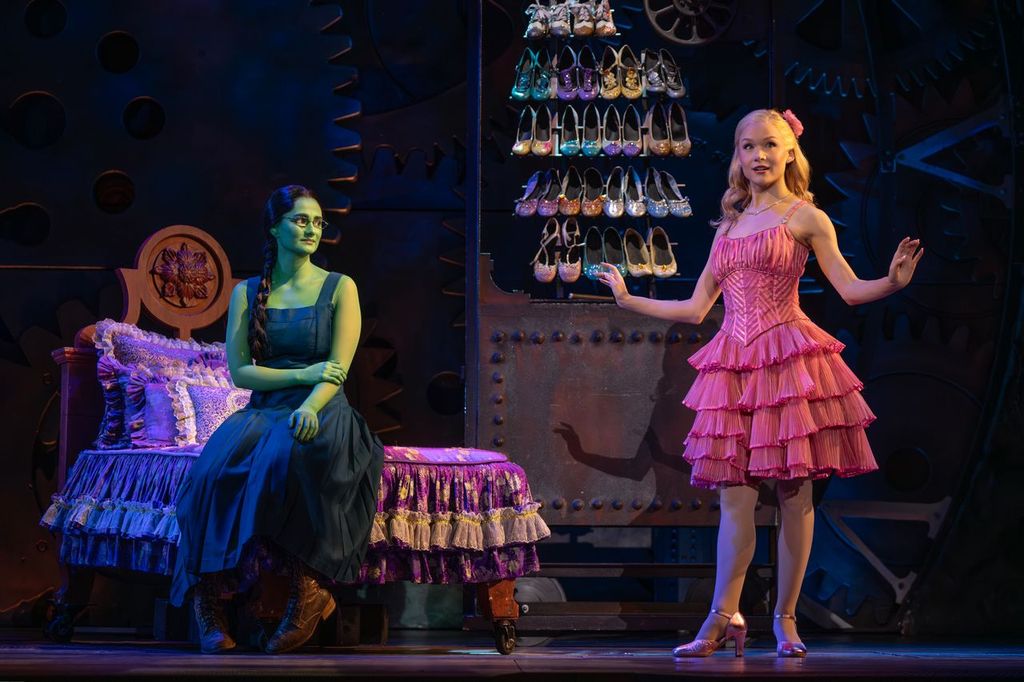
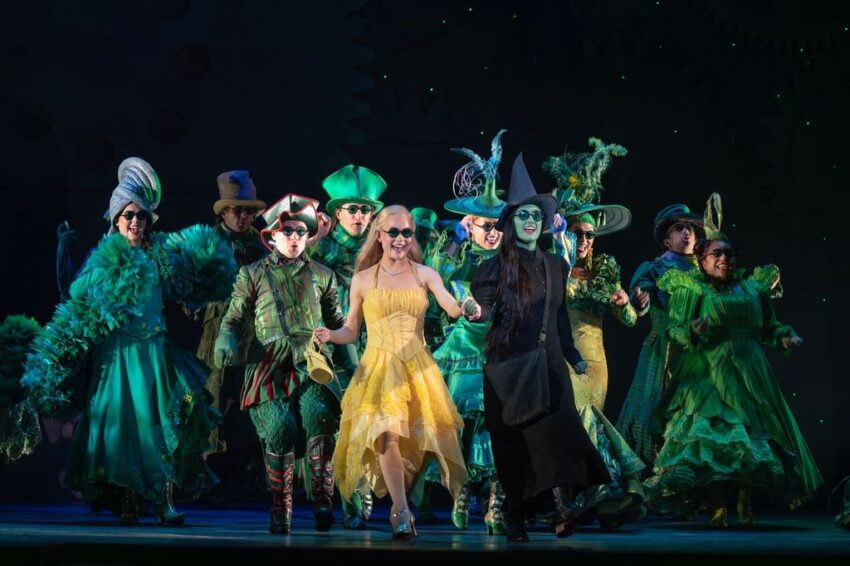
Aline Mayagoitia as Elphaba and Claudia Bennett as Glinda in ‘WICKED’ at the Citizens Bank Opera House. Photos by Joan Marcus

They are less kind to Glinda, whom they paint as a narcissistic opportunist whose true North points to one thing — popularity.

The musical assumes its audience is familiar with the original Oz story and proceeds to turn that story on its head. Set in Oz before and after Dorothy’s arrival from Kansas (she never appears on stage), “Wicked” focuses on the complex relationship between Glinda Upland and Elphaba Thropp, the future Good and Wicked witches.

The show opens with a number that pulls out all the big production stoppers and has the audience cheering by its end. Eugene Lee’s magnificent Tony Award-winning set of metal sculptures and clock towers is imposing and sturdy enough to climb on, which the flying monkeys (still crowd pleasers from the original “The Wizard of Oz”) are happy to do. The orchestra is pitch-perfect, Munchkins cavort, and the cast belts out the first musical number (“No One Mourns the Wicked”).

The cause for all this celebration is the death of the Wicked Witch of the West. Glinda (née Galinda), played by Claudia Bennett, the allegedly good witch, floats down out of the sky, protected from the masses she lords over by her pink bubble shield. “Are people born Wicked?” she muses, “or do they have Wickedness thrust upon them?”

The rest of the plot centers on reminiscences about their shared past. Elphaba (“beautifully tragic”), played by Aline Mayagoitia, was born with green skin and promptly disowned by her father, the Governor of Munchkinland. Her younger paraplegic sister Nessarose (“tragically beautiful”), played by Cristina Sastre, is the light of her father’s eye. When Nessarose is sent to the posh Shiz University, Elphaba is allowed to go too, but only because she is to care for her sister. Although Elphaba’s native tongue is sarcasm and she shows disdain for study and fellow students, she is actually a very bright, funny and caring soul.
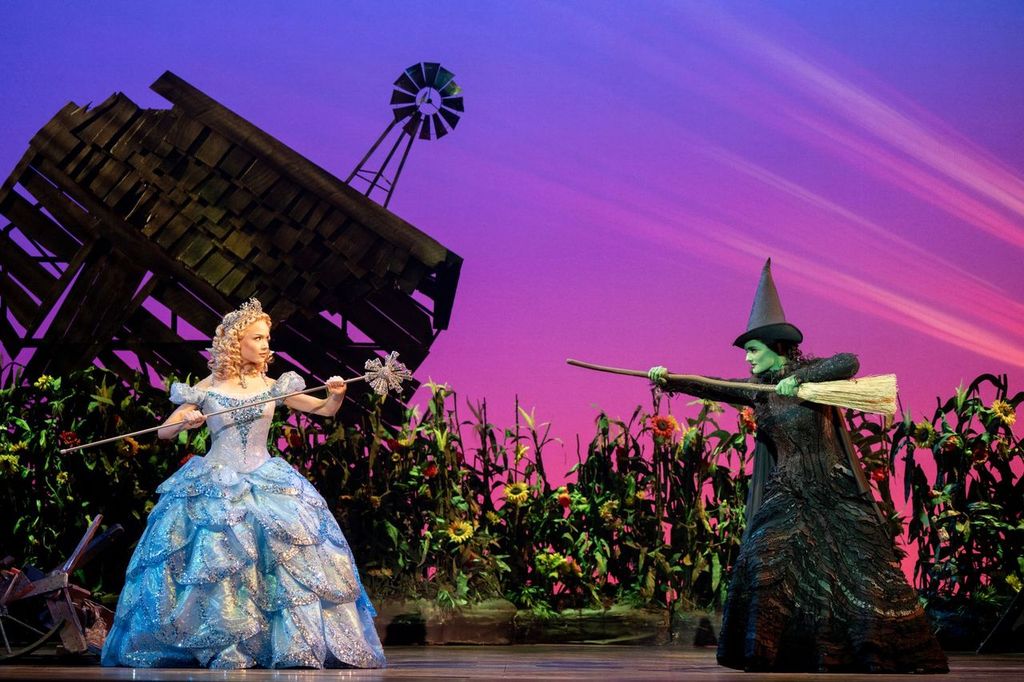
Aline Mayagoitia as Elphaba and Claudia Bennett as Glinda

Enter Galinda, her perfect foil. A stuck-up, shallow blonde bombshell with a one-track mind and a warehouse full of clothes, she is all about — and only about — Galinda.

The school’s headmistress, Madame Morrible Susan Cella), decides to care for Nessarose herself and assign Elphaba to room with — no surprises here — Galinda. The two eventually become friends and, though their characters lead them to completely different destinies, their relationship is the driving and unifying energy behind the plot.

So is sorcery, and it is Elphaba’s innate abilities (and Galinda’s lack thereof) that both separate and draw the two girls together. The plot thickens when a rakish young prince, Fiyero (Ethan Kirschbaum), arrives at Shiz. He presents himself as shallow and vain (which attracts Galinda like a moth to a flame), but he is actually as compassionate and thoughtful as Elphaba.

All three are enrolled in a class taught by Dr. Dillamond (Drew McVety as a comely goat), the only animal teacher left at Shiz. He and Elphaba share a sandwich (she eats the sandwich; he eats the wax paper wrapping) and recognize each other as kindred souls — both discriminated against, ostracized and lonely. When he warns Elphaba of a conspiracy afoot to stop animals from speaking, she is as alarmed as he is.
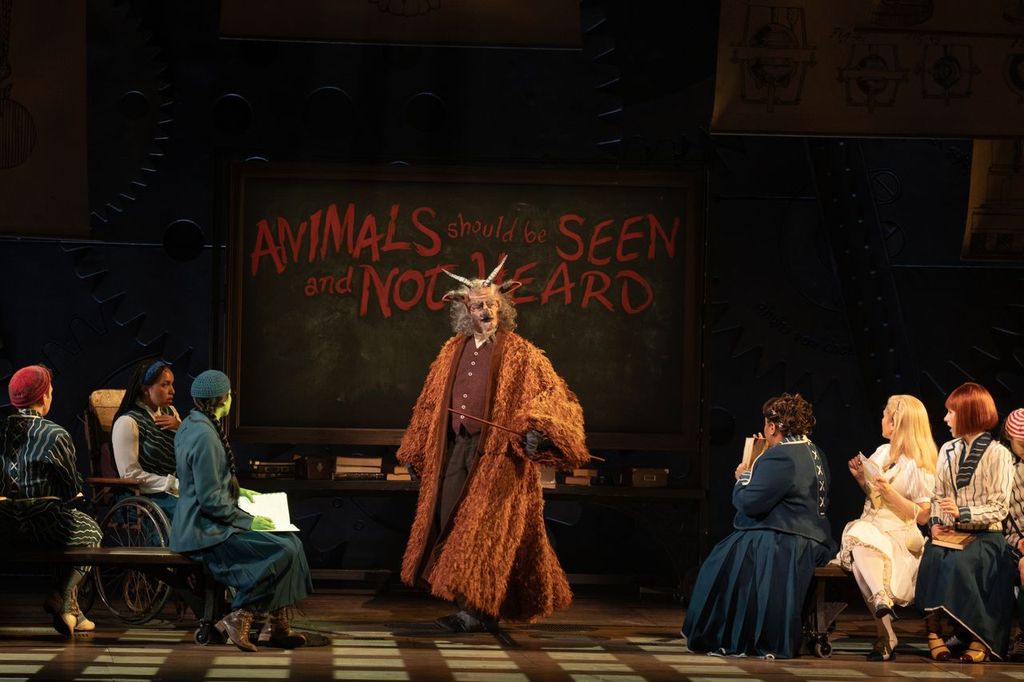
Drew McVety as Doctor Dillamond

Eventually, Elphaba is invited to meet the Wizard of Oz. She, in turn, invites a pouting Galinda to come with her. Together, they encounter a Wizard (Tom McGowan) more corrupt and ruthless than the rheumy-eyed Frank Morgan in the 1939 film. He has ordered that animals be stripped of their ability to speak and caged after decades of rising to professorship positions. He urges citizens to spy on each other. Speech is monitored and controlled and propaganda abounds. “The truth,” after all, “is what everyone agrees it is,” the Wizard explains.

Glinda (she has changed her name by then) drinks the power Kool-Aid and joins the Wizard’s gang of merry pranksters. Elphaba, horrified, goes Rambolina.

There are lots of plot twists and nods to the original L. Frank Baum story. We see where the Tin Man, Scarecrow and Cowardly Lion came from. We put two and two together about which witch was under the house that Dorothy and Toto flew in on. We learn how Elphaba got her green skin and why her mother left her a bottle of green elixir. The musical numbers are well executed, and the cast is solid. (Pablo David Laucerica is a standout as Boq, the Munchkin besotted with Galinda).

Overall, “Wicked” is a glitzy show with enough humor, razzle dazzle, music and dance to please pretty much everyone. Broadway in Boston has done another very good job.

Yet, the show is more than theatrical eye candy, with thought-provoking, serious points too. We have seen “Good” Glinda and “Wicked” Elphaba through clear lenses, and neither is as advertised. Glinda is more wicked than good; Elphaba is more “good” than Glinda could ever be. And so we wonder: what does it really mean to be deemed “good” or “wicked” in a world where those words are defined by whatever suits those in power? Can good intentions ever absolve bad results? And will we ever see a turnaround from our current political, moral and humanistic entropy?

If it can happen in Oz, well, maybe it can happen here too.

‘Wicked’ — Music and Lyrics by Stephen Schwartz. Book by Winnie Holzman. Based on the novel by Gregory Maguire. Directed by Joe Mantello. Set by Eugene Lee; Costumes by Susan Hilferty; Lighting by Kenneth Posner; Sound by Tony Meola; Music Arrangements by Alex Lacamoire and Stephen Oremus; Music Direction by Faith Seetoo; Dance Arrangements by James Lynn Abbott. Presented by Broadway in Boston at The Citizens Opera House through November 15.

For more information, visit: https://boston.broadway.com/shows/wicked-2/
NSMT’s ‘Come from Away’ Is A Reminder That Inherent Kindness Does Still Exist

By Shelley A. Sackett

President Obama recently addressed a packed house of over 4,000 adoring fans at Salem State University’s athletic complex. While acknowledging that the current state of politics is “mean-spirited” and “dangerous,” he ended on an uplifting note.

“What people are starved for at the moment is the ability to tell a moral and compelling story about how we live together. … There is an underlying moral fabric to how we see each other and treat each other,” the Salem Patch reported.

He might as well have put in a plug for one of the most uplifting and entertaining musicals that not only fits the bill, but just happens to be playing up the road a piece at North Shore Music Theatre through next weekend.

As timely as it is timeless, ‘Come from Away’ is based on true events in the Newfoundland town of Gander during the week following the September 11, 2001 attacks, almost exactly 25 years ago. The musical follows the intersection of 7,000 passengers stranded in Gander (population 9,000) for five days in the aftermath of the closing of US airspace when all US-bound flights were diverted across Canada, including 38 that landed at Gander International Airport.

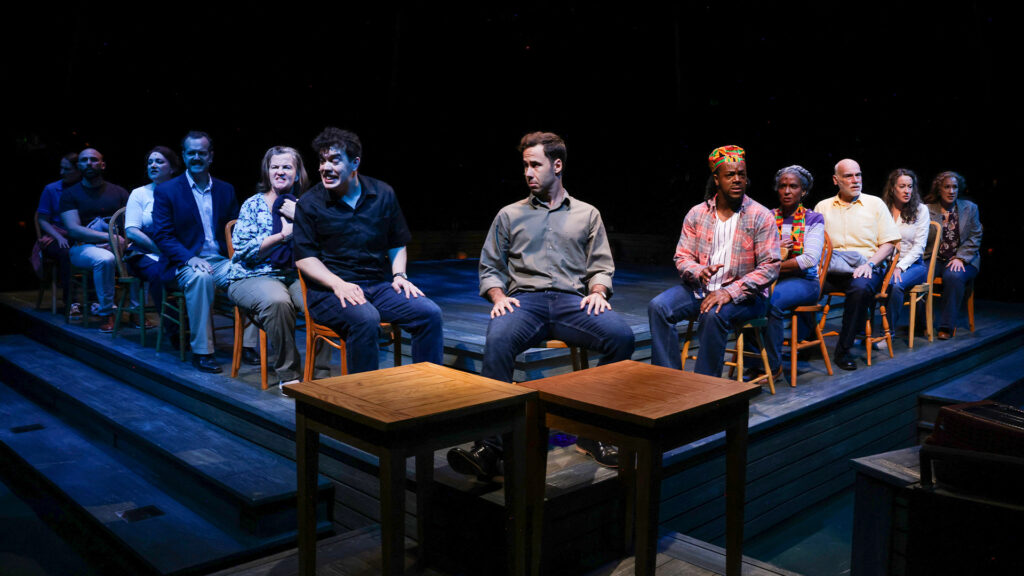
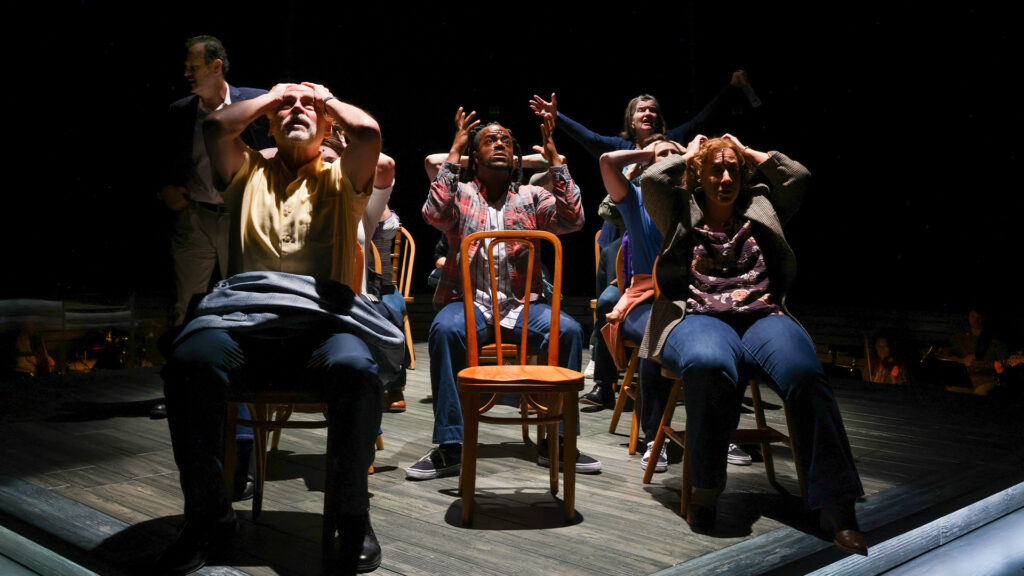
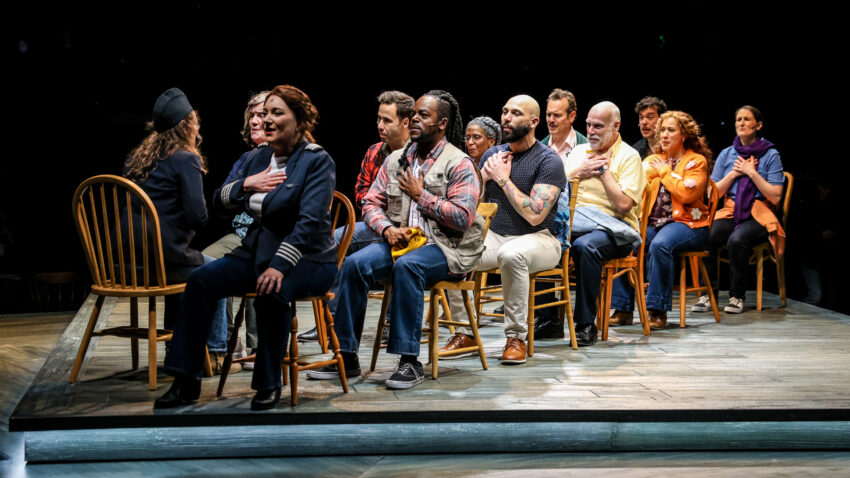
The cast of “Come From Away” at North Shore Music Theatre. Photos by Paul Lyden

The 100-minute one-act show does a marvelous job of bringing the audience into the small worlds of the passengers and town folk, each coping with stresses, challenges and unforeseen circumstances. The “plane people” are forbidden to leave their planes for over 28 hours. They have no idea why they have been grounded. They are without supplies, cell service or information about the attacks.

Meanwhile, the town tries to cope with the near doubling of their population amidst a bus driver strike, and the logistics of how to house, feed and care for an onslaught of international frightened and disoriented strangers. Stores donate whatever is needed, mess halls are set up, cots procured and clothes donated. Anyone with a spare bedroom happily offers it to strangers.

Eventually, the passengers are released from their planes, and the town rises to the occasion, not only providing food, sanitation, diversions, but also offering friendship, compassion and just plain old-fashioned kindness.

Conceived by Michael Rubinoff, a Toronto lawyer, theater producer and professor, he hired the husband-and-wife team Irene Sankoff and David Hein to write the show. They traveled to Gander on the 10th anniversary of 9/11 and spent almost a month interviewing its residents. Every character in the play is based on a real person; every event is a retelling of what actually happened.

The result is a show brimming with heart, humor and catchy roots, folk and Celtic-informed music.

Although NSMT seats 1,500, Jack Mehler’s sparse set of a few tables and mismatched chairs and a cast of only 12 who rapidly switch accents, costumes and carriage lend an uncommon intimacy and immediacy to the theater. Lively choreography and crisp direction (both by Kevin P. Hill) and snappy lyrics and dialogue combine to create a show well worth traveling to the North Shore to see. (Note: the stage in this theater-in-the-round is actually square for this production).

The plot unfolds seamlessly through the show’s musical numbers that are chock-full of narrative content. The opening number (“Welcome to the Rock”) gives the audience a through-the-keyhole look at the makeup of the town and its characters, including its mayor, Claude, a news reporter who just happens to be in Gander (Janice), Beulah and Annette (two teachers), and a host of other colorful characters. The ensemble of actors is well-oiled, conveying an atmosphere of ease, contentment, and familiarity.

Just as seamlessly, they move the chairs into two rows of closely packed seats and suddenly we are in the claustrophobic belly of a grounded plane (“28 Hours/Wherever We Are”) seated alongside passengers who are literally in the dark about why they are there. When they are finally allowed to disembark, they are greeted by Army tanks, buses and a landscape that resembles the moon.

Each passenger gets a moment in the spotlight to clue the audience in on their perspective. Bob, a black New Yorker, is wary of the natives’ friendliness and trust. When he is asked to gather all the grills he finds in people’s backyards, he is worried he will be shot for stealing — until he isn’t. A gay couple from L.A. who are both named Kevin have different reactions to Gander’s open arms. Diane, a Texan, and Nick, a Brit, strike up a romance while Hannah, the mother of a New York firefighter, bonds with Beulah as she tries to reach her son. Beverley, an American Airlines pilot, describes what it took to become the first AA female pilot (“Me and the Sky).

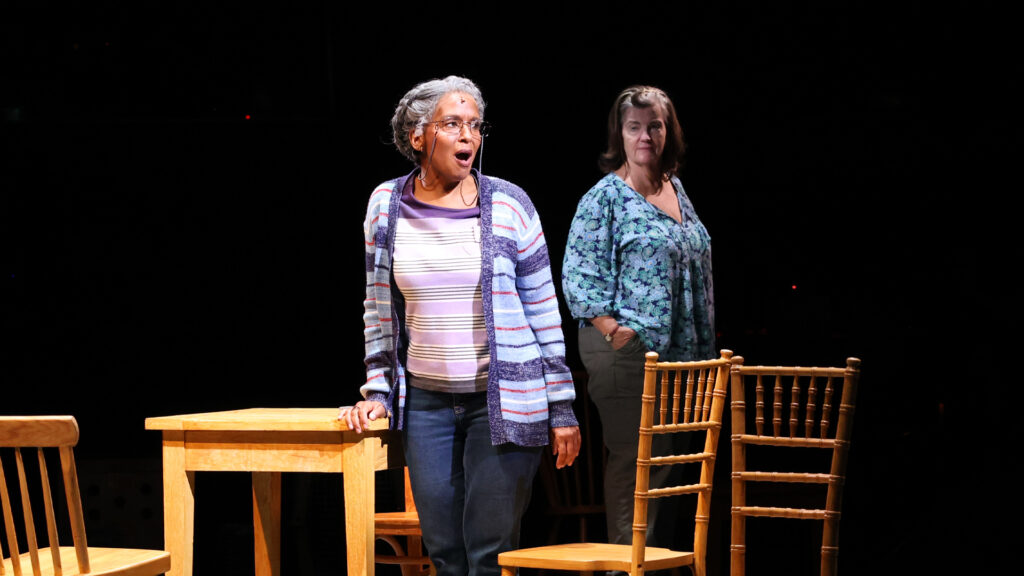
Carla Woods (Hannah) and Mary Callanan (Beulah)

There are poignant moments of connection and interaction. The 7,000 plane people have been diverted from all over the world, creating a communication challenge on par with the Tower of Babel. There are ethnic and religious diversities that don’t exist in Gander, yet its citizens welcome and make accommodations for all. Even when tensions rise, tempers flare and prejudices surface (one passenger, Ali, is an American Muslim), the town pulls together and plans a diversion in a local bar.

Lest this starts to feel like a Hallmark fairytale, it bears remembering that the play is based on true events, real people and eyewitness interviews. By the time the plane people are cleared for takeoff, lives have been changed by more than the devastation of the terrorist attacks. Marveling at the hospitality and kindness shown to them by the townsfolk of this isolated outpost in the middle of nowhere, the only reaction they get is grounded in the hope and faith that continues to drive President Obama. “You would’ve done the same,” they are told.

Recommended!

‘Come from Away’ — Book, Music and Lyrics by Irene Sankoff and David Hein. Direction and Choreography by Kevin P. Hill. Music Direction by Dr. Michael McBride; Scenic and Lighting Design by Jack Mehler; Sound Design by Ryan Marsh; Costume Design by Rebecca Glick. Presented by North Shore Music Theatre, 54 Dunham Rd., Beverly through September 27.

For more information, visit nsmt.org/comefromaway

Israeli ballet wunderkind makes his Boston Ballet debut

Israeli dancer Yuval Cohen is a native of Jerusalem./OFER MOLDOVAN

By Shelley A. Sackett

Growing up in Jerusalem, Yuval Cohen always loved to dance. He started at age six with the Mehola Dance Company, focusing on folk and modern dance, and then joined the Jerusalem Ballet School in 2017, after receiving an excellence scholarship from the American-Israel Cultural Foundation.

But it was not until 2018, at age 15, when he won the gold medal at Russia’s Nutcracker International Ballet Competition and received an invitation to the Vaganova Academy in St. Petersburg, that he realized dancing was more than his passion; it was his destiny.

“It felt so natural to be in a huge theater, performing with an orchestra, even though I’d never seen these kinds of opera houses or even listened to a live orchestra,” Cohen recalled.

After graduation, he continued his meteoric path, first with the Bolshoi Theatre and then with the Philadelphia Ballet, where he was promoted quickly from apprentice to company and soloist. He made history in 2023 when he won the bronze medal at the Jackson International Ballet Competition, the first Israeli dancer to both reach the final round and receive a medal.

Cohen joined the Boston Ballet as an artist of the company in 2026, and the 23-year-old couldn’t be more excited about his move, both professionally and personally. “I love that Boston is super clean, with historic buildings alongside gorgeous skyscrapers, parks and greenery. It’s so relaxing and peaceful,” he said, noting that, when he misses home, he goes to one of the many Israeli/Jewish-owned restaurants.

He will dance in the season opener, “Fall Experiences” in the second piece, “Vertical Road [Reimagined],” a ballet set to an evocative score and driven by rhythmic, elemental movement that explores humanity’s search for meaning. “It’s so intense and so hard on the body, but has such a powerful energy and connection to God and humans collectively,” Cohen explained.

Although he has lived far from Israel for most of his career, Cohen retains deep connections to both his homeland and his Jewish heritage no matter where he resides. Surprisingly, his years in Russia were no exception.

Russia and Israel had better relations from 2018-2021, the years Cohen was there, than they do today. He spent a lot of time at the Chabad synagogue in Saint Petersburg. “It made me feel very close to home and kept me connected to the traditions that I grew up with in Israel,” he said.

The Russian appreciation for the art of ballet was equally surprising, unlike anything he had experienced anywhere else. “Being an artist in Russia is like being a Hollywood star in America,” he said, recounting the time a taxi driver asked him for his autograph when he heard he was a ballet dancer.

After the Hamas attack on Oct. 7, 2023, Cohen became very active and vocal in his support of Israel. By coincidence, he was scheduled to perform his first featured role with the Philadelphia Ballet – Escamillo in “Carmen” – that very night. He dedicated his performance to Israel and the hostages. “It was my way of serving Israel, like my brothers and our soldiers, but in my field,” he said.

With the hostages back, he is happier and relieved, but is still scared to look at what news he has awakened to. He is aware of the international damage the war has caused, and he remains committed to continuing to help however he can, whether by performing at fundraisers or by showing up at simple talks and gatherings. “The Jewish and Israeli communities have to keep supporting each other and Israel,” he said.

He was raised in Israel during times of war and uncertainty in a family that included Holocaust survivors. “This makes you see life differently,” Cohen said. “Jews and the Israelis are, in general, optimistic.” He credits this optimism with keeping him focused and able to push his body and mind forward to continue to break new ceilings in his career.

“I believe everything is a journey. No matter how hard and difficult life is, you must still work and grow. You might not see the light at the end of a dark path today, but it will happen,” he said.

In July 2024, Cohen was selected by Dance Magazine for their “25 to Watch” list of up-and-coming dancers. He performed an excerpt from William Forsythe’s “In the Middle, Somewhat Elevated” for the magazine’s “25 to Watch Live Event.” (Forsythe is an American choreographer who transformed classical ballet into a dynamic 21st-century art form by pushing classical technique to extreme physical and conceptual limits).

Cohen has been fortunate to work with different choreographers and stagers across many repertoire genres, from classical and traditional to modern and contemporary. The Forsythe work is one of his favorites to perform because it “shapes your body and mind in a most interesting way,” he said. Nonetheless, he is always ready to prepare for a classical, full-length ballet because he thinks “it’s most satisfying for the dancers and audience to follow a story and characters on stage in a ballet journey.”

To prepare for his roles, he works with his trusted teacher, Nadya Timofeyeva, the artistic director of the Jerusalem Ballet). First, they read about the character he will perform, looking at paintings, for example, to see their style and how they carry themselves. After gathering this information, the two begin investigating the choreography and what Cohen can do to make himself more in character. “I will be forever grateful that I have her help and guidance with every production,” he said.

Cohen is excited to join the Boston Ballet and the Boston community. “I hope I can bring over beautiful traditions, culture and Jewish Israeli spice to any stage and platform. Being together gives us strength to spread love and happiness to the world,” he declared. Θ