SWAMPSCOTT – Rabbi Michael Ragozin was thrilled when Benjamin “Beni” Summers indicated an interest in joining Congregation Shirat Hayam as its rabbinic intern from October 2021 until June 2022.
“This is an opportunity for CSH to be inspired by a rabbinical student, while providing greater service to our traditional minyan,” said Rabbi Ragozin.
Currently a Shanah Bet Rabbinical student at Hebrew College, Beni worked for the last eight years in the Jewish professional space. He is also about to begin an internship with SHEFA: Jewish Psychedelic Support. “My dream is to become a thought leader in the field of spiritual care for the emerging Jewish psychedelic movement,” he said.
Beni will lead the traditional Shabbat minyan (9 a.m.) and Nosh & Drash (10 a.m.) on Jan. 8, Feb. 12, March 12, April 7, and May 7.
Beni answered some questions to help introduce himself to the North Shore community.
What was your childhood like? What part did Judaism play in your family?
I was born in Salem and started my school journey at the JCCNS preschool. My mother, Leah Summers, worked at Cohen Hillel Academy for decades and we were deeply connected to the Jewish community of the area. We attended Temple Sinai when I was young. Some of my beloved ancestors were devout Chassids and members of the Yiddish intelligentsia of early 20th century Poland, and I grew up on stories of their wisdom, intellect and devotion to the Jewish people.
Can you tell us about your mindfulness training and how that fits into your life and your decision to become a rabbi?
The seeds of my relationship to the theory and practice of Jewish Mindfulness were first planted in 2015, when I was working at Temple Emunah in Lexington. Our rabbi mentioned at a staff meeting that he was working with a few congregants to start a new initiative within the community that would focus on offering contemplative experiences and programs centered around Torah and tefillah (prayer). Something deep within me welled up with intense excitement at the thought of investigating what Jewish spiritual practice and mindfulness might offer one another.
Turns out, it’s quite a lot! I spent the next several years building a routine meditation practice into my daily life, which eventually led me to attend several multi-day silent meditation retreats and to take advanced courses at Lesley University in their Mindfulness Studies master’s program to familiarize myself with the intricacies of neuroscience and predominant theories of Western mindfulness as sourced from Therevaden Buddhist roots. In 2018, I began hosting weekly meditation gatherings in my home in Somerville called “Sit & Sing,” where folks would gather together to sit in silence for 30 minutes followed by 30 minutes of singing niggunim, zemirot and other forms of devotional tunes.
In terms of how my practice interacted with my path to the rabbinate, I can say that the deliberation process was significantly aided by the spaciousness and quietude of the retreat setting. I also believe that as a society we would benefit from installing more methods for slowing down and practicing “radical amazement,” as Rabbi Abraham Joshua Heschel coined it, into our daily lives. My hope is that as a spiritual leader, I can guide others in discovering how practices like mindfulness can be both personally healing and Jewishly enriching.
What do you plan to talk about in your monthly drashes (Torah discussions)?
I am thrilled to share my practice of contemplative and embodied Torah study with the community. Learning Torah is more than just an intellectual exercise. It can be a laboratory for spiritual experience and personal meaning-making that taps into realms of mind and heart beneath surface level. There is a teaching in the Talmud which beautifully refers to Torah learning for its own sake (Torah Li’shma) as a Sam Chayyim (A Drug Of Life), which can be likened to the other kinds of drugs out in the world which are sourced from nature, are medicinal, and help us to locate the Divine in our lives for the betterment of all.
This is just one of a growing number of ideas that I have been collecting from our tradition that will hopefully aid psychedelic journeyers, grousnding their experiences of expanded awareness back into the roots of their Jewish journey, which for me is crucial as we move into a new age of legal and regulated psychedelics being utilized for healing and for spiritual transformation in society at large.
Shabbat services at Congregation Shirat Hayam are both online and live. Visit shirathayam.org/spiritual/ for more information.
Samuel Bak in his Weston studio. Photo: Pucker Gallery, Boston
by Shelley A. Sackett
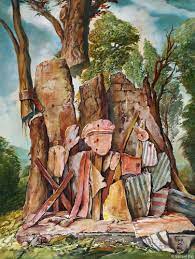
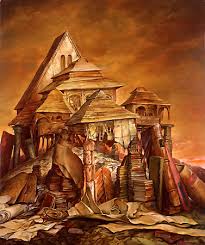
BEVERLY – Samuel Bak, the renowned international artist, speaks in a language of images, dreamscapes, and colors. A child prodigy and Holocaust survivor, Bak tells his life’s stories through canvases rich in symbol, metaphor and reorientation. Recognizable objects and figures appear shattered and reglued; a pear sports a smoke stack, broken teacups become surrealist landscapes, and a ruined house sits atop a mound of books.
Bak’s rich, thought-provoking works will soon be on view in Beverly. “Samuel Bak and the Art of Remembrance,“ an exhibition at Montserrat College of Art Gallery presented in cooperation with Pucker Gallery of Boston, brings together 37 paintings and works on paper created between the 1990s and today. The show runs Jan. 18 to March 4, with an opening reception to commemorate International Holocaust Remembrance Day on Jan. 27.
Persistence of Memory by Samuel Bak
His canvases tell the story of a world destroyed, a destruction he witnessed and survived. His work references Jewish and Holocaust history, challenging historical amnesia with difficult images of those times.
Yet, he does not consider himself a “Holocaust painter,” as he is often described, and despite the fact that what he witnessed during those times is the subject of many of his paintings. “I felt I have a story to tell and I wanted to touch other people. I refer to the Holocaust because it is something I know, but it goes beyond that,” he said over Zoom from his Weston home.
His paintings are meant to make the viewer wonder what happens when the world rejects equality and focuses on dehumanizing “the Other.” “My paintings ask questions. They don’t necessarily give answers because I personally don’t have any,” he said.
Despite scenes of anguish and despair, Bak also paints survivors, imbuing them with glimmers of muted hope and resilience. Rivers still run; painters still paint. The teddy bears and tea cups and humans are put back together again, but they can never be the same as our first memories of them.
Under the trees of Ponari by Samuel Bak
“I wanted to speak about the survivors, who are people who try to rebuild something that is similar to the reality that existed once, but cannot be totally reconstructed,” he said. “Somehow it is out of the bits and pieces of the horrors of the past that we can construct the sense of our being here and learn to prevent such horrors from happening again as much as it is possible.”
An only child, Bak was born in 1933 to an educated, middle-class family in Wilno, Poland. At age 3, he was a recognized child prodigy painter. At age 7, on the day after his first day of school, he and his family were deported to the old Jewish quarter of the city now called Vilna. At 9, he had his first exhibition, inside the Vilna ghetto. When the Russians liberated Vilna, he and his mother were among its 200 survivors from a pre-war community of between 70,000 and 80,000 Jews.
“The major subject of my paintings is: How was it possible such events happened? How is it I am still alive?” he said.
He and his mother spent from 1945 until 1948 in German displaced person camps, immigrating to Israel in 1948 when Bak was 15. After working and living in Tel Aviv, Paris, Rome and Lausanne, he came to America and settled in Weston in 1993.
During his 85-year career, Bak has produced over 9,000 items. Since the 1960s, remembrance and its nuances has been a major theme.
“Memory is not a folder that is downloaded onto your computer and when you want to look at it, you give a click and the folder reopens exactly as it was before,” the 88-year-old said.
Persistence by Samuel Bak
Unlike a computer folder, Bak sees the human memory as unique and individual because it also contends with our failure to remember. “We are blessed that we have the possibility to forget. This is what keeps us alive,” Bak said. It is also why, when we want to remember, we must recreate that memory.
In his paintings, Bak is “recreating the image that I have of the world in which people live today. Images that somehow seem to belong to another world attract viewers and enable me or others who speak about my work to speak of the times they represent,” he said.
His paintings have been used to educate thousands of teachers and students about the Holocaust since 1978. That year, he exhibited in a national museum in Germany that drew large groups of teachers and young students. “It suddenly opened my eyes. I thought, ‘My goodness. My paintings can do that. That’s absolutely wonderful,’” he said.
Since then, the PBS show “Facing History” has used his art for over 40 years to teach about the Holocaust, reaching millions of students in thousands of classrooms. In 2022, the Florida Holocaust Museum in St. Petersburg will mount a yearlong exhibit of his paintings to commemorate its 30th anniversary.
Montserrat will sponsor a virtual artist talk with Bak and – COVID permitting – other school groups plan to visit the exhibit. “What is happening with this exhibition at Montserrat College is not something new, but it is something I know works,” Bak said.
When Igor Golyak, founder and artistic director of Arlekin Players Theatre, was doing research for “The Merchant of Venice,” he was smacked in the face by the discovery that the Jews have been on the move throughout the span of their existence as a people. Their constant migration reminded him of his own family, which emigrated in 2004 from the Ukraine .
Then, on July 1, Brighton Rabbi Shlomo Noginski was stabbed. Golyak attended a meeting with other Jewish refugees and he remembers someone asking, “Where do we go now?”
“My family came here to escape anti-Semitism. What I suddenly understood is that there is no escaping anti-Semitism,” Golyak said by phone. That realization was the germ of the bold and complex new virtual documentary theater piece, “Witness,” which bears witness to the migratory experience of Jews throughout history. Based on interviews of Jewish people around the world by the Arlekin company members, along with historical records and documents, this timely piece will tell a multiplicity of stories of migration, displacement, home and identity.
“I want to make anti-Semitism and hate visible to people so they see that it doesn’t live only with Nazis and in history, but is here today. That’s the first step to trying to identify the problem,” he said.
Golyak enlisted the help of Moscow-based playwright Nana Grinstein to translate his idea into a script. He explained he wanted the play to be “documentary theater” — built out of historical primary sources (letters, journals, telegrams, newspapers, etc.) and interviews describing first-hand experiences— about what makes Jews move around the world.
Grinstein often works on this type of project and did a deep dive into what historical options existed that could be an accurate metaphor for this idea.
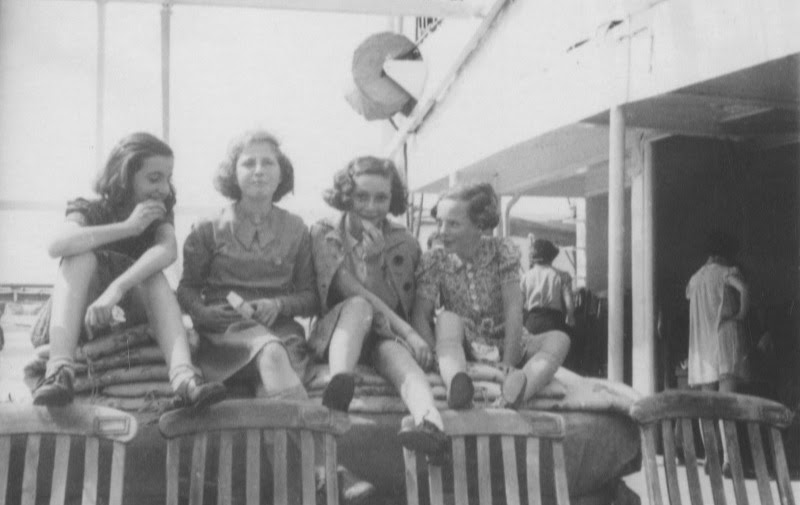
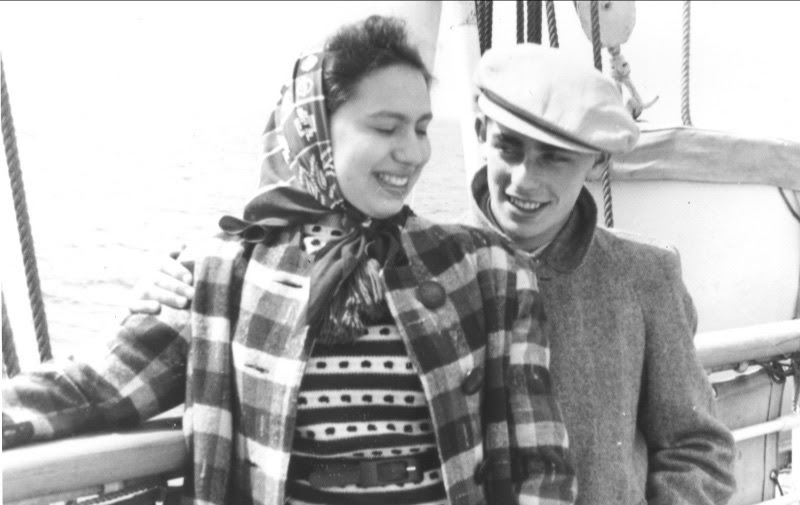
She proposed the history of the liner St. Louis, which sailed from Nazi Germany in 1939 shortly after Kristallnacht, but was not accepted by Cuba, the United States or Canada. The 900 Jews on board, who understood that their return to Germany meant certain death, spent several weeks on the ocean.
“The Holocaust is impossible to understand to this day. As one of the St. Louis passengers said, ‘I don’t understand how the world could watch this and nobody did anything about it.’ I hope the audience will find themselves in the shoes of the Jews, who have been, and still are, under the pressure of anti-Semitism, which has many forms — from everyday xenophobia to terror and massacres,” Grinstein said by email.
Golyak loved the St. Louis metaphor for the concept: Where Do People Go? He next contacted dramaturg Blair Cadden, whose job would be to help bring “Witness” to life by learning as much as possible about the play, the medium (virtual, immersive and interactive) and the context of its creation.
The end result will be a blend of pre-recorded and live performances that includes elements of interactivity with the audience. Set on a boat in digital space, actors and audience members will share a live interactive experience as they move together between countries and time periods in a game of life and death set in a virtual world. Previews begin December 10 with the World Premiere scheduled December 13.
“Witness“ brings a lot of theatricality and inventiveness to the way these true stories are presented. “The St. Louis is a vivid microcosm of the larger experience that is shared by so many Jews across the world,” Cadden explained by email. “Documentary theater is an exciting genre because it invites the audience to form a different connection with that history. Things that might feel very distant when we encounter them in the pages of a history book take a new immediacy in live theater.”
The performance, accessible on Zoom to an international audience through Arlekin’s Zero Gravity (zero-G) Virtual Theater Lab, allows the audience to gather from across geographical locations and time zones. The Arlekin team hopes people will share their own emigration stories for inclusion in the production (to share your or your family’s story, contact story@arlekinplayers.com or visit arlekinplayers.com/witness/)
Golyak hasn’t decided yet if parts of his own story will be included. He was brought up in the Soviet Union, where being Jewish was difficult. He was eight-years-old when his father, one morning while shaving, paused, faced his son, and told him matter-of-factly and out of the blue, “Oh, by the way, you’re Jewish.”
He then turned back to the mirror and continued shaving.
“It was like finding out you are from Mars,” Golyak said without a laugh. There was no context in Russia for what being Jewish entailed. “How does that affect who I am? There’s no language, there’s no land. I’m told I am a Jew, but what does that actually mean?” It is a question he is still trying to answer.
Cadden, who is not Jewish and whose ancestors came to the United States so long ago that no one in family remembers exactly when, hopes the common threads between the experience of the St. Louis passengers and the experiences of more recent Jewish immigrants and refugees will affect Jews and non-Jews alike. For those who share the Jewish heritage and/or immigrant experience, she hopes it will be a moment to feel seen and connected.
For everyone, it should be “an eye-opener to the continued prevalence of anti-Semitism and anti-Semitism in our own society and an invitation to empathize with the experiences of immigration and this search for Jewish identity and a sense of belonging,” she said.
Golyak hopes his “Witness” makes the audience aware of the prevalence of anti-Semitism today. “That’s the first step: to identify the problem. And then, hopefully, this will inspire people to think about and acknowledge the fact that this problem exists, so we can somehow try to solve it,” he said.
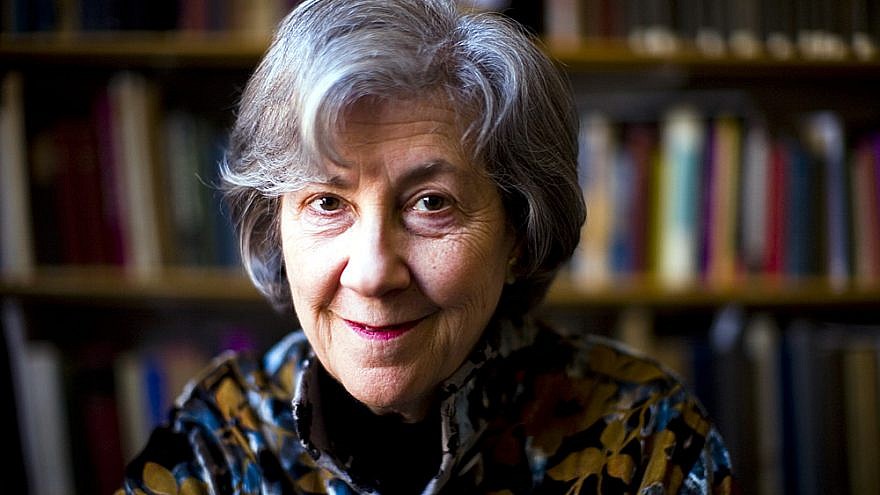
Ruth Roskies Wisse is no shrinking violet. Born in Czernowitz, Romania, in 1936, she and her family escaped to Montreal in 1940, where her parents’ home became a salon and safe haven for Jewish writers, actors and artists who had also fled the Nazis. After graduating with a BA from McGill University in 1957 (where she befriended Leonard Cohen), she earned a MA in Yiddish studies at Columbia University, the only place in North America that offered such a program at that time. She returned to Montreal to raise her family and finish her Ph.D.. In 1968, she began teaching Yiddish literature and helped found a program that would become the Department of Jewish Studies at McGill.
No less a trailblazer academically, Wisse became a joint professor in the Departments of Yiddish and Comparative Literature at Harvard University in 1993, where she taught until she retired in 2014. Her gender, religion, subject matter (Yiddish) and conservative political and social views set her apart from the get go. Her razor-sharp intellect and prolific authorship made her views impossible to ignore.
In 2000:, she received the National Jewish Book Award in Scholarship for “The Modern Jewish Canon: A Journey through Language and Culture” and in 2007, she received the National Humanities Medal, which cited her for “scholarship and teaching that have illuminated Jewish literary traditions. Her insightful writings have enriched our understanding of Yiddish literature and Jewish culture in the modern world.”
Along the way, she developed relationships with Nobel Prize winning authors, Saul Bellow and Isaac Bashevis Singer, and a bevy of Harvard University students, faculty and administrators.
A staunch neoconservative and supporter of Israel, Wisse is a prolific author. She has collaborated on Yiddish collections, penned numerous political essays (many of which appear regularly in Commentary, The New Republic and The Jerusalem Report), and authored several books, including the controversial “If I Am Not for Myself…The Liberal Betrayal of the Jews,” a Zionist critique of the American Jewish climate.
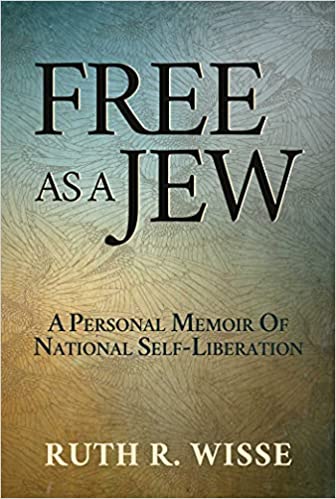
No less controversial is her new book, “Free as a Jew: A Personal Memoir of National Self-Liberation,” a no-holds-barred memoir. Wisse will discuss her book with Andrea Levin, Executive Director and President of the Committee for Accuracy in Middle East Reporting and Analysis (CAMERA), as part of the JCCNS Jewish Book Month Speaker Series on Sunday, November 7 at 3 pm at Temple Emanu-El, Marblehead. The in person event includes a reception and book signing.
According to Wisse , she began writing about parts of her life as a way of understanding the world around her. “Free As A Jew” takes her to the point of her retirement from Harvard in 2014. “One of the ways in which I’ve been fortunate is in the interesting people I’ve come to know. I’ve tried to write this as cultural history, and about myself as a minor participant in that history,” she said by email.
She chose the title carefully and deliberately. “I call it a personal memoir of national self-liberation because I concentrate on the public, intellectual, cultural, and political events I witnessed: most extraordinarily, the reestablishment of a sovereign Jewish country. The defeat—at least formally—of German Fascism and Soviet Communism were great victories. Not for a moment can we afford to take those civilizational achievements for granted,” Wisse said. “But they are being taken for granted.”
The direction of current political and cultural life concerns her, particularly the uptick in anti-Semitism and anti-Israel rhetoric and what she calls “contemporary loss of confidence.”
“It is no secret that the ideological and military war against the Jewish people has in many ways revved up rather than quieted down in recent decades. When people are under assault, many grow frightened, or apologetic, wanting to stay out of trouble. Some respond by trying to appease their attackers, or by becoming more like them. Jews have many things in common with other minorities, but no other minority is under the same sustained attack. This is confusing. Many lose confidence in their Judaism and blame their fellow Jews for the attacks against them,” she said.
Wisse stresses that her memoir is intended as neither homily nor “how to” book, but rather as another tool in one’s toolbox. “In explaining how I came to think about certain things, like the modern challenges to women, the nature of community, liberalism and conservatism, how literature works and why it matters, education and Jewish education, and so on, my story may be useful to others. No two lives are alike, but we all tend to have certain problems and opportunities in common,” she said.
The Exodus story of the Jews leaving slavery Egypt for freedom in Canaan particularly resonates with Wisse and also influenced her book’s title. “Jews learn that escape from bondage is only the first step of the process. We are a rabble — miserable, needy, and anxious — until we accept our pretty stringent set of laws. To be free as a Jew means to assume the responsibilities of freedom and to realize how liberating that really is,” she said.
For more information and to buy tickets, visit jccns.org.
2021 Obermayer Award winner Dr. Marion Lilienthal seeks to tell the real story, through extensive research and a hands-on approach to teaching history.
by Shelley A. Sackett
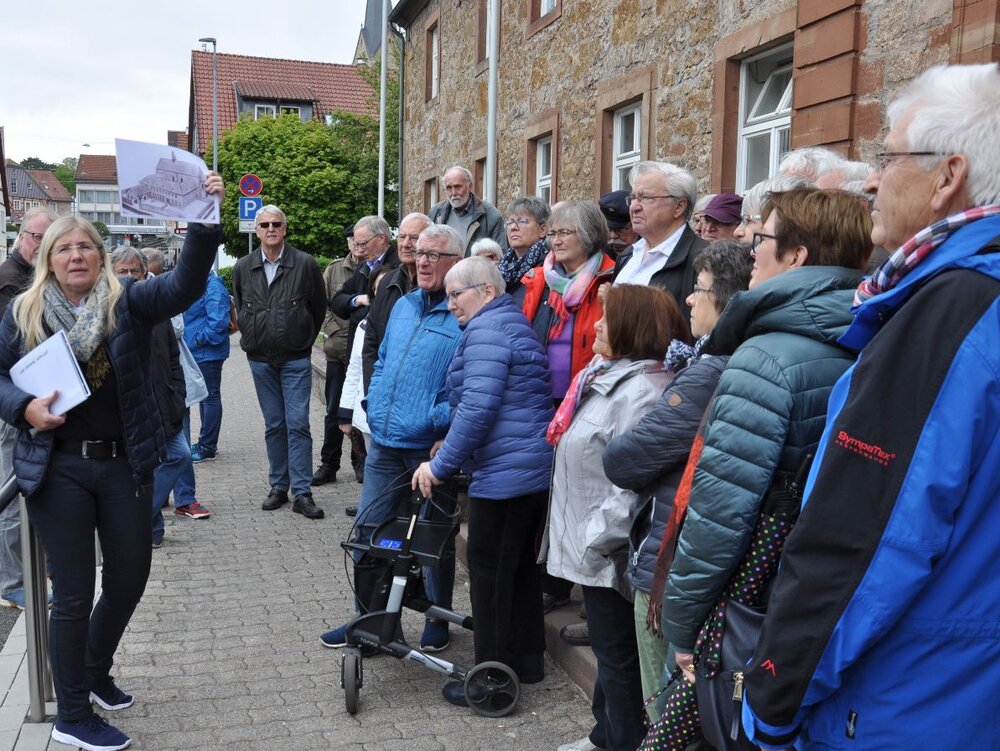
Dr. Marion Lilienthal leads a local tour in Korbach, Germany.
Dr. Marion Lilienthal has always taken the road less traveled. As a young schoolgirl in Kassel, at an age when most of her classmates were content to play with dolls, she became interested in the National Socialist period. Her grandparents, who opposed the Nazi Party and suffered disadvantages as a result, raised her father to be politically active and to speak up against injustice and he, in turn, raised his daughter to embrace the same values.
Although her father was a child during the war, he remembered seeing Jews led through Kassel, probably to the train for deportation. He also spoke warmly of a Jewish family he had known, always with enormous respect but also sadness about their suspected fate, leaving his young daughter with a positive image of Jews and a desire to find out what might have happened to them. It made the fate of Jews personal for her, giving a name and a life story to each.
The Holocaust was an important theme at her school and a real turning point for Dr. Lilienthal occurred in 1979 when, as a 13-year-old, she watched the Holocaust mini-series with her classmates. “It shocked me to see what people are capable of and strengthened my conviction to fight against injustice,” she says. Later, through an exhibit she created about Jews in Kassel, she became acquainted with Esther Hass, a teacher who was then head of the Jewish community in Kassel. Haas took the teenager under her wing, and the two worked on many projects together, including one at the local Jewish cemetery.
Dr. Lilienthal tried to learn as much as she could about the history of Nazi Germany, but repeatedly ran into roadblocks. “As a young person, it was very difficult to get information. There was public opposition. The archives did not answer all my questions, and people looked at you strangely when you researched there,” she recalls.
Twenty years later, in 1999, she arrived in Korbach as a high school history and computer science teacher with a specialization in the German-Jewish history of her home region, North Hesse. Since then, not only has Dr. Lilienthal distinguished herself among colleagues and students by her commitment to teaching; she has also engaged in exceptional socio-political activities with her students, young adults and community members to bring the centuries-old history of the Jews in the region back into the collective consciousness so that people can learn from mistakes of the past as they confront prejudice and anti-Semitism today.
Her impact, however, extends beyond teaching and spearheading group activities. Her work one-on-one reconnecting former Korbach residents and their descendants with the region has profoundly changed individual hearts and minds in a way that brings peace and closure. “I was able to learn about my grandparents and great-grandparents, who I could never meet, and the events that led up to my mom coming to America. The love shown to my daughter when she was invited to Korbach by Dr. Lilienthal to experience the places where my mom must have spent time is priceless,” says Renee Schindelheim. “While I have never met Dr. Lilienthal personally, she has impacted my life greatly.”
Part of Dr. Lilienthal’s motivation was a mission to correct inaccuracies she found in history books. “The Nazis wanted to destroy all Jewish life. I try to research these individual Jewish life stories to keep their memory alive,” she says. It has not always been easy.
She depends on post-war period files and interviews with local people. “I have looked for photos, gone from house to house knocking,” she says. Recently, a woman contacted her with eyewitness testimony about the fate of two Korbach brothers her father saw in Treblinkla. “She is so emotionally burdened. She wants to help,” she adds.
Today, she leads guided tours of Korbach that focus on the pre-WWII Jewish community. She invites people to walk in the footsteps of Jewish inhabitants, standing in front of a house and showing them an archival photo. She tells them what she knows about the family that used to live there and its fate. “The next time they pass this house, they have an idea of what happened there,” she says.
She first began her research 20 years ago as a newcomer in Korbach. “If people don’t know you, they don’t necessarily want to speak to you,” she says. Also, there was no interest at that time in revisiting the National Socialist period. “You had to be tough, be determined and be strong. I have received not only praise, but also hostility.”
When she mounted an exhibit about the looting of the Jews in Korbach, the mayor and city council supported her, but many Korbach residents did not. “The population is always afraid that a shadow could come over the family. Even today, there are letters and threats,” she says.
A few years ago, Dr. Lilienthal received her doctorate in “Euthanasia” under Prof. Krause-Vilmar. Her dissertation focused on Nazi era persecution of sick, disabled and “socially unadjusted” people from Korbach.
Her activities – nearly all of which have been outside her regular paid work – include: remembrance projects and publications to raise awareness of Jewish history in the region; connections to Jewish descendants from the region; a range of activities and workshops with her students and youth groups that have had a significant impact on how they see local history and the world; network building locally with like-minded people; and work with anti-racism, democracy and tolerance groups and initiatives.
She and many colleagues, including many former Obermayer Awardees, have formed a network of people and associations (such as the Arolsen Archives) from communities in the district where there used to be vibrant Jewish communities. The network sponsors events and publications that spotlight persecution and murder of the Jews while promoting coexistence of Jews and Christians in the region.
Her books and articles, which are used by libraries, history associations and other institutions, have achieved extraordinary results in combatting prejudice, as have her special public exhibitions. “Over the years, her many publications have helped people of all ages to overcome the period of forgetting, repressing and denying essential parts of our regional history. She has made a great contribution to bringing the centuries-old history of the Jews in our region back into consciousness so that people can learn for the future from the mistakes of the past,” reads a statement of support signed by Ernst u. Brigitte Klein, Karl-Heinz Stadltler, Hans-Peter Klein and Johannes Gröecke, all Obermayer awardees.
But, perhaps her most impactful work has been as a teacher, where she carries out projects with her colleagues and students that focus on Jewish life in the region.
Many former students credit Dr. Lilienthal’s hands-on approach to teaching the history of the Holocaust with sensitizing them to fight anti-democratic tendencies. “The work with Dr. Lilienthal left a lasting impact on me,” says former student Dominic Antony, who oversees the technical implementation of her projects. “Many years after my schooling, I am still involved in the fight against anti-Semitism and racism.”
Over the years, her research and documentation of the history of German-Jewish families led her to record, process and publish the life memories of contemporary witnesses. She established and maintains contact with families who have emigrated to the USA, Israel and Australia.
Ten years ago, with the help of her students, Dr. Lilienthal created an online portal so this work is accessible worldwide. “I am fearful about the future with no witnesses. I try to work as fast as possible to contact as many witnesses as possible and document what they experienced. I know it is a race against time,” she says.
The website, “Gedenkportal Korbach”, provides extensive information about Korbach and its Jewish community, Jewish families, perpetrators and victims. (gedenkportal-korbach.de). Family members who don’t know who to ask about their family history can see her genealogical work in photos and documents, enabling them to reconstruct their own family tree and learn about deportations. The site preserves the history and memory of the Jewish community that lived in Korbach for hundreds of years until the Holocaust.
She was one of the first in the region to recognize the importance of online publications, particularly for the young generation today. Her computer expertise and electronic publications have extended the reach and influence of her work far beyond the region, and made them accessible teaching materials for schools worldwide.
For Michael Dimor, of Tel Aviv, Gedenkportal Korbach was the gateway to both learning about his mother’s family roots in Korbach and also developing a deep, strong relationship with Dr. Lilienthal and her husband. He contacted her in 2011, seeking information about his family. She forwarded photos and documents and arranged a visit for Dimor and his family during the 80th memorial of Kristallnacht. They participated in several ceremonies, prayed in the old Jewish cemetery, and met with Dr. Lilienthal’s students, including Marie Fischer. “For our generation, who never saw that part of history, it is hard to imagine what terrible things happened back then,” Fischer says.
For the granddaughter (Renee Giordano) and great-granddaughter (Dr. Sara Giordano) of pre-WWII Korbach residents Toni and Siegmund Weitzenkorn, Dr. Lilienthal provided a priceless link to their family’s past and a new lens to view Germany today. Sara met her in Korbach and received information and photos of her family that would have been otherwise inaccessible, buried among troves of town documents. She brought them home to her mother, Renee, who was deeply impacted. “Because of the trauma of the war, my mother never told me much about the history of her family in Korbach. I never had a desire to ever step foot in Germany, but because of this work, I now hope to visit the place of my mom’s childhood and to meet Dr. Lilienthal,” Renee says.
Dr. Lilienthal believes her remembrance work is even more important today. “Truth makes you strong. It is much easier to deal with the truth than with an unspoken supposition. With my pupils, I talk about the structure, the motivations, why people did some things. It takes a lot of energy, but it can only strengthen them,” she says. “With all the tragedy or difficulty you encounter, you will come out stronger.”
2021 Obermayer Award winner Volker Keller with Holocaust survivor Daniel Barnea, during Mr. Barnea’s return to Mannheim in 2014.
Volker Keller grew up in a postwar Mannheim marked by a culture of forgetting. On October 22, 1940, over 2,000 Jewish residents of Mannheim were deported from the city to concentration camps in France. Only a few survived Auschwitz and other extermination camps, their next and final stop.
Yet, he was born in 1954 into a household that never discussed “wartime.” When others brought up the topic, he saw how his parents seemed to change somehow, as if they were uncomfortable. Jews were an unusual theme at this time, and whenever documentaries about the war aired on television, his parents sent him out of the room.
Although he was only a little boy, Keller knew he didn’t share his parents’ feelings of discomfort around this topic. On the contrary, he felt a spark of curiosity. The flames from that spark would ignite Keller’s passion and shape his calling for the rest of his life.
Throughout his school years, Keller paid careful attention on the rare occasions when people voiced opinions about the Nazi era. “Some said what happened was terrible, while others spoke almost lovingly about Hitler,” he says. “My interest in history came from wondering how such an injustice could have happened. But when I asked about the “Shoah”, I received evasive answers.”
He started college with a determination to learn about the Nazi era on his own. He concentrated in German studies and took courses in Yiddish language and culture and the history of Mannheim. When he began working as a journalist, he covered local historical themes. That was when he realized there was very little to read about Mannheim’s synagogues. “There were two buildings, but no one knew anything about them,” Keller says.
He decided to fill that void himself. He researched the topic and published the first of many articles in 1982, paving the road of what would become his mission and legacy — volunteering his time to single handedly create a Jewish remembrance culture in Mannheim.
From his college days to his recent retirement from his jobs as teacher and school principal (rector) , Keller has been documenting the life, rich culture and history of Mannheim Jews from its early days to its brutal end. Throughout these many decades of research and commemoration, he placed special emphasis on the relationships he developed with “Shoah” survivors and the families of the victims.
In 1986, when Mannheim first extended an invitation to native Jewish families to visit the city, Keller made sure he was able to meet them. Among the visitors were Asher and Ester Goldman Ariav, who travelled from Israel. Later, they helped him in his research for his first books, sharing photos, memories and insights. “My late parents were extremely impressed by Volker’s deep commitment and extensive efforts to commemorate the former Jewish community in Mannheim,” says their daughter, Edith Ariav-Chazan. After her parents’ deaths, she kept in touch with Keller. “I am similarly impressed by his important commemorative work, all in addition to his busy schedule as a teacher and later principal of an elementary school,” she says. The two families remain close; Keller has visited Ariav in Israel and he arranged a tour of Mannheim for her and her family in 2014.
Over more than 40 years, Keller personally met with scores of survivors and families to learn firsthand of their experience and preserve their testimony. He published five books and countless articles with the goal of documenting the Jewish community’s rich history and significant contribution. “I don’t want Judaism to be associated with the “Shoah” alone. It is a fascinating religion and culture. The general history of Mannheim cannot be separated from the history of its Jewish community,” Keller explains.
One of Keller’s first projects was to create a comprehensive record of the Jewish victims of the “Shoah” and their fate. He organized and led a youth group in the 1990s called “Searching for Traces” that scoured archives and documents for clues on Mannheim’s deportees. They painstakingly contacted survivors and family members. In 1995, the group’s findings were published in a document titled, “Suddenly They Were Gone,” and shared with the city, survivors and families of the victims.
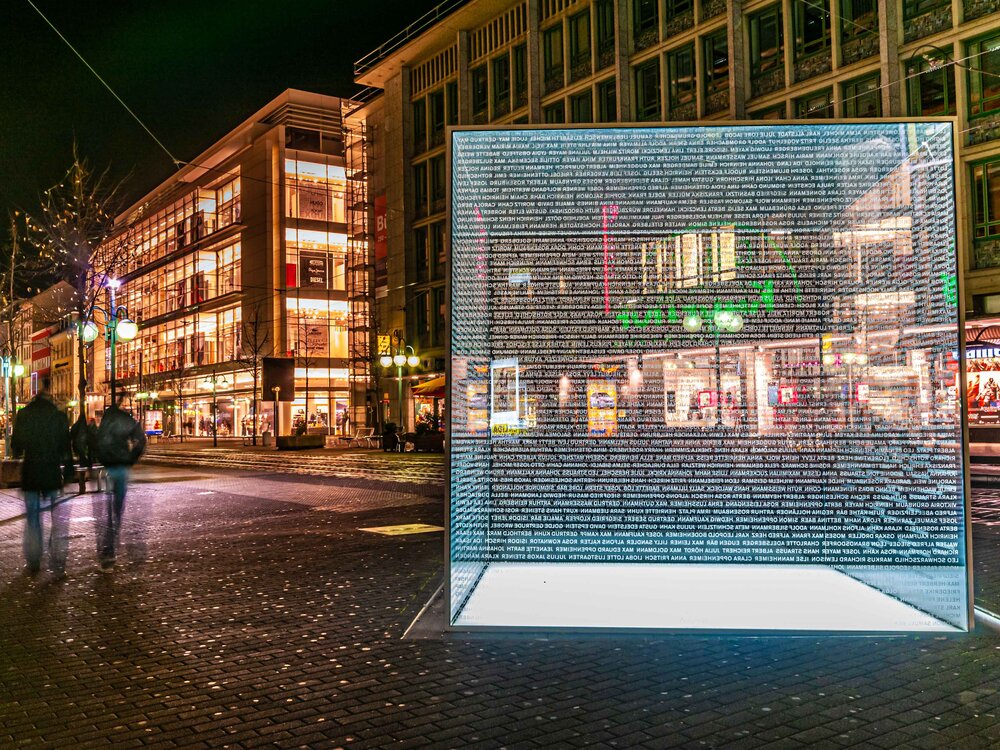
Mannheim, Germany. November 14th, 2009. Two people walking at night by the Mahnmal Memorial. Commemorative sculpture for the Jewish victims of the Nazi Holocaust in Mannheim “Planken” shopping street.
The document had a powerful and far-reaching effect. Not only did the list permanently commemorate the victims in Mannheim by name, it also inspired and triggered the creation of the Memorial to the Jewish Victims of National Socialism in Mannheim, a stunning memorial built by the city and unveiled in 2003. Designed as a glass cube, it has over 2,000 names the Searching for Traces team discovered eternally etched in its walls.
“The Talmud says, ‘A person is only forgotten when his name is forgotten,’” Keller says. “I believe that commemoration work is extremely important. The awareness of historical and cultural issues is what makes us human. Preserving the memory of the victims of the Nazi era is critical to prevent history from being repeated.”
In the course of his extensive research, Keller came across documents that confirmed the existence of several “Jewish Houses” in Mannheim where Jews were forced to relocate in the 1930s. Essentially mini ghettos, the largest, on Grosse Merzelstrausse 7, had housed 76 residents until their deportation in 1940. Keller contacted survivors who were former residents for details and testimony and in 2003, he published an article that described the history of the house and included personal testimony by several surviving residents.
Among those Keller contacted was the Barnea (ne¢ Heilbronner) family from Israel. Uri Barnea and his late brother Daniel were born and raised in the house, and in 2012, when Keller suggested they help construct a memorial for its Jewish residents, the brothers embraced the idea. Keller led and managed the effort; he drafted the text for the memorial, negotiated with the city, and oversaw the design and construction of the memorial stele. It stands at BismarkPlatz in Mannheim, some 50 meters from where the Jewish House once stood. The stele has two glass panels, one telling the story of the house and its tenants, the other listing its 76 residents.
The inauguration ceremony in March 2014 was attended by over 100 community members and 30 members of the Barnea family, including then 85-year-old Daniel. His son, Nir Barnea, credits Keller’s efforts with helping the family transition away from avoidance of painful memories. For years, his father did not want to talk about the “Shoah” and refused to visit Mannheim. The pain was too great. “I internalized his pain and also shunned Germany. It was Keller’s compassionate approach and genuine interest in my father and uncle Uri’s experience that helped my father change his mind,” he says. Nir, too, changed his mind, and he joined the other family members who travelled to Mannheim.
In a message shared at the unveiling, he said, “The best answer we can give to the terrible years of the Nazi regime and the “Shoah” is to stand together with members of the community, in front of this memorial with a message of tolerance, peace and compassion.”
After the unveiling ceremony, Keller coordinated with the Karl Friedrich Gymnasium in Mannheim and he and Daniel Barnea gave a presentation about Daniel and Uri’s life during the Nazi era. For almost all of the teachers and students who participated, it was the first time they had met a Holocaust survivor from Mannheim.
Keller’s insatiable appetite for research next led him to another Jewish house which served as a Jewish senior home. Furnished with a Mikveh (Jewish ritual bath) and a synagogue, the house at B 7,3 boarded its elderly residents from 1939 until 1942, when they were deported to death in Auschwitz. Keller described the house, still standing and in use today, in an article, and spearheaded forming a team to devise a memorial plaque best suited to the building. He authored emotionally moving text for the plaque that included testimony of one of the residents, who took her own life rather than face deportation.
In November, 2015, Keller and Deacon Manfred Froese, a tireless advocate for tolerance and human rights who has collaborated with Keller for over two decades, unveiled the memorial in a ceremony attended by 70 people. “Volker Keller is one of the most profound experts in the field of research into the history of the Jewish community in this area. What distinguishes him is that in addition to his careful historical work, he places a clear emphasis on maintaining contact with people of the Jewish faith,” Froese says.
Schoschnana Maitek-Drzevitzky, Chairperson of the Jewish Community of Mannheim from 2011 to 2016, couldn’t agree more. “Volker Keller has become a friend to the Mannheim Jewish Community, and is close to our heart. He touches on topics few dare to deal with. His work has put the former Jewish history back into the middle of everyday life in the city,” she says.
His books, articles, tours and workshops have also left indispensable trails for future generations to follow, particularly his publications on the three hundredth anniversary of the Mannheim Klaus Synagogue (The World of Mannheim Klaus) and the Jewish Cemetery (Bet Olam- The Jewish Cemetery in Mannheim). Keller’s “Pictures of Jewish Life” and “Jewish Life in Mannheim” caught the eye of Dr. Norbert Giovannini, author and 2020 Obermayer awardee, as he started his work on Heidlelberg’s Jewish history. “The visual material that Keller has collected and saved is extraordinary. I know that such treasures can only be attained if there is a deep relationship of trust between the researchers and the people they come into contact with,” he says.
Keller’s extensive work to research and commemorate the Jewish community in Mannheim was strictly voluntary. He regularly integrated students from his elementary school (Grundschule) into his history work and involved interested community members in his remembrance projects.
“I hope my students, readers, and community learn how fragile our democratic gains are. Everything we take for granted today, human rights, freedom, protection of minorities, tolerance of others, and taking dissenters seriously, must be fought for every day,” he says.
Keller is cautiously optimistic that his work to uncover and preserve Jewish history, culture and contributions in Mannheim has affected the city’s residents. “I don’t want to get my hopes up. But I think even small contributions can have an impact on people, even if it takes a lot of time. The interest of many people is there, but you have to awaken and motivate it. Especially young people are very responsive to topics that concern the past, but also explain their situation today,” he says.
Keller offers this advice to young people today asking themselves how to best make a difference and help end prejudice and intolerance. “ I would first ask, prejudice and intolerance toward whom? Tolerance of enemies of democracy is problematic. But any racist, ideological, sexist or religious intolerance must be fought. There are so many examples of functioning plurality in past and present times. Emphasizing and reminding people of these positive role models is the task of democratic education.”
The Dormant Commerce Clause doctrine is aptly named. Known to induce temporary dormancy among even the most avid first year law students, its post-bar review practical value outside academia is, essentially, nil.
And yet, Jack Beermann, a Boston University School of Law professor of Constitutional Law, Civil Rights and Administrative Law, has just published a book, “The Journey to Separate But Equal,” based on a little-known but pivotal Supreme Court case that hung its hat on this arcane and crucial constitutional construct that prevents both discrimination against, and excessive burdens on, interstate commerce
Moreover, he turned out a narrative that is as accessible to lay readers as to legal scholars.
It all started when Beermann, who grew up in Skokie, Illinois and lives in Swampscott with his wife, Debbie Korman, read a law review article that cited Hall v. Decuir, an 1877 Supreme Court decision that struck down a Louisiana state antidiscrimination statute and, for the first time after the Civil War, actually approved race-based segregation.
He had never heard of the case.
His curiosity piqued, he began a ten-year journey of trips to Louisiana, research, writing and re-writing, fueled by a drive to document the Court’s first step towards validating segregation in US society. The end result, “The Journey to Separate But Equal,” while exhaustively researched and painstakingly scholarly, is also immensely readable, owing to the compelling human story at its center.
Josephine Decuir, a mixed-race, privileged and wealthy woman whose free family owned slaves that worked their Louisiana plantations, had, as was her custom, booked a first-class ticket in the ladies’ cabin aboard the interstate riverboat, The Governor Allen. Instead of honoring her prepaid ticket, the boat’s stringent segregation policy relegated her to the “colored-only” section of the riverboat, where all non-White passengers, regardless of sex or social status, slept in common areas.
Madame Decuir sued the riverboat owner, citing Louisiana’s nondiscrimination statute, a state law passed during Reconstruction. State courts ruled in her favor, and the owner appealed. The case wound its way to the Supreme Court as Hall v. Decuir. That court ruled against Madame Decuir, citing the US Constitution’s Dormant Commerce Clause doctrine, which is used to prohibit state legislation that discriminates against interstate or international commerce.
Essentially, the Court accepted the owner’s argument that, despite violating state law, segregation was both customary on riverboats and necessary to keep Whites as customers; i.e., integration had the potential to negatively impact his business.
Beermann, who already knew the Supreme Court had prevented the federal government from enforcing Congress’s civil rights program for Reconstruction, wasn’t aware it had also prevented states from enforcing liberal civil rights laws. “I would have written the book regardless of what was happening in the world, but it feels like this subject gets more timely every day,” he said by email.
There are many parallels between the Courts of 1877 and today, Beermann said. “One thing courts are very good at is justifying terrible decisions with bland, benign language. The Justices in 1877 were good people, well-trained in the law; and yet, without flinching, they doomed millions of their fellow citizens to terrible lives of oppression and injustice.”
During his research, Beermann experienced two “aha” moments. One was when he realized the scope and implications of the story he had uncovered. Decuir, as a “person of color”, was used to the treatment and privilege her wealth, status and lighter skin afforded her. Suddenly, she felt the sting of prejudice and exclusion almost as strongly as the darker-skinned people at the bottom of the social ladder.
The other was when he recognized, after repeated attempts, that he couldn’t address the complicated issue that Madame Decuir and her family were themselves slaveowners before the Civil War. “I decided to focus on her dignity harms and leave that issue to the reader, or perhaps to another project,” he said.
As a teenager, the protests against the Vietnam War and Martin Luther King’s activism awakened Beermann’s interest in civil rights. He remembers his father as “a bit involved in politics. I knew we were a very liberally oriented family, even when I was a small child.” He has taught in Israel numerous times and, “although I don’t agree with all of its policies,” he is a strong supporter. His family (including three sons and a daughter, when they are home) attends Chabad House and Temple Sinai in Marblehead. “Our Jewish identity is very important to us,” he said.
Beermann hopes his readers will gain a better sense of the racial politics of the Reconstruction era, opening their eyes to how laws and courts contributed — and continue to contribute — to racial segregation. In the end, though, he admits he doesn’t know the moral of the Decuir legacy.
“It’s too simplistic to say that race discrimination is wrong; my sense, maybe what I was trying to communicate, is that race discrimination, and white supremacy in particular, are woven into the fabric of our country and have resisted unraveling at every turn,” he said.
Join Beermann at a free Zoom author event on May 27 from 7-8 pm. To register, visit jccns.org.
Emil and and the author, Shelley A. Sackett, shortly before Emil’s death in 2019 at the age of 82.
By Shelley A. Sackett
When Emil and Lili Berkovits moved to Boynton Beach, Florida, from Salem, Massachusetts, in 2014, they were excited to start their retirement after Emil’s long career as a cantor.
A fifth-generation hazzan who had emigrated from Czechoslovakia as a young child following World War II and grown up in Montreal, Berkovits spent most of his professional career in the United States.
He was a well-built, physically active man who played baseball professionally, but after an injury he gave it up for a career in musical and communal leadership. Berkovits helped bring generations of boys and girls to their bar and bat mitzvahs and made music that stirred the souls of many a congregant.
Decades later, after retiring to Florida, Berkovits, then 78, developed a persistent sore throat and noticed a lump on his neck. He soon was diagnosed with cancer of the oropharynx, near the back of his throat. Oropharyngeal cancer can be slow growing and, like many cancers, often spreads before any symptoms appear. By the time the cancer is detected it can be quite advanced.
The treatment was grueling. Over seven weeks, Berkovits received 35 radiation and seven chemotherapy treatments. He developed a heart infection and his throat became so inflamed that he couldn’t eat — both results of the radiation, doctors told him.
But the treatment was effective: For five years, well into his 80s, Berkovits lived cancer-free.
Yet he suffered dearly from the consequences of the treatment. He no longer could produce saliva, leaving his mouth permanently dry. He lost most of his ability to taste. He went on an exclusively liquid diet because regular food could cause him to choke. He lost 25 pounds, leaving him physically weak.
“Because he can’t eat normal food, he has no energy,” his wife, Lili, said earlier this year, shortly before Berkovits’ death over the summer. “Nothing can help these eating and swallowing issues.”
Berkovits’ experience was not unusual. Many cancer survivors find themselves struggling with health issues related to their treatment for years after they are declared cancer-free. Problems may include pain, fertility issues, infections, memory problems, sexual health issues, cognitive impairments and more, including increased risk of secondary cancers. For many, the health problems last a lifetime.
In Israel, a growing cadre of cancer researchers is focusing not just on cancer treatments but on improving life for cancer survivors by trying to mitigate treatment side effects.
“Quality of life is a subject of utmost importance as cancer patients go through therapy, and even once they complete their treatment,” said Dr. Mark Israel, national executive director of the Israel Cancer Research Fund, or ICRF. “It is not enough to cure cancer. We must also address the patients themselves and their experience.”
ICRF is now investing in research that aims to offset the debilitating side effects of cancer treatments that linger even after the disease is eradicated.
At the Rambam Health Care Campus in Haifa, its director of oncology, Dr. Irit Ben-Aharon, is studying how chemotherapy damages blood vessels, which can lead to vascular disease and fertility problems. By helping cancer patients avoid these toxic effects of their treatment, doctors can reduce their risk of developing cardiovascular disease or infertility in the future.
Ben-Aharon is hopeful her work will be of special benefit to younger cancer survivors.
“As the incidence of cancer in younger individuals is increasing, survivors with very long life expectancy are emerging as a group with significant challenges related to treatment,” she said.
Ben-Aharon’s work is one of four research projects currently funded by ICRF focused on improving the lives of cancer survivors. Two of the projects are being supported by grants provided through the Brause Family Initiative for Quality of Life at ICRF.
Since its founding in 1975, ICRF has raised more than $72 million for Israeli cancer research, including groundbreaking work that has led to both treatment breakthroughs and improved treatment outcomes.
While cancer treatments such as chemotherapy, radiation therapy to the brain and immunotherapy are crucial for curing cancer, they may leave the patient with cognitive deficits. Up to 75 percent of cancer survivors suffer cognitive impairments, including problems with attention, memory and learning.
Dr. Yafit Gilboa, an occupational therapist at The Hebrew University of Jerusalem’s Department of Medicine, is using her ICRF grant funded by the Brause Family Initiative to explore a novel approach to ameliorating that cognitive decline. This new approach, tele-rehabilitation, provides for the remote delivery of courses designed to diminish the cognitive effects of cancer therapy.
Gilboa’s strategy for treating patients with cancer-related cognitive impairment is comprised of 30-minute cognitive trainings several times a week using their home computer, supplemented by a weekly videoconference session with an occupational therapist.
Gilboa credits the Israel Cancer Research Fund for supporting not just research for cancer treatments, but also for treatment of side effects.
“This research makes a valuable difference in the quality of life for cancer survivors,” Gilboa said.
She and her team at The Hebrew University already have recruited patients from Hadassah Medical Center and completed a pilot study that showed encouraging results in cognitive and occupational performance. Patients also reported decreased depression and anxiety and an increased sense of well-being.
“One patient reported that since starting this therapy, he was striving to live the way he did before he got sick. Another said she felt more self-confident,” Gilboa reported.
Dr. Jacob Hanna of the Department of Molecular Genetics at the Weizmann Institute of Science in Rehovot is focused on pluripotent stem cells, which are like the cells from which babies are formed in that they have the ability to become any type of organ or tissue. Hanna and his team are studying how cells with the properties of embryonic stem cells can be generated from a patient’s skin or hair follicles and then used to create an array of cell types for transplantation into cancer patients. This could be instrumental in helping cancer survivors whose treatment regimen destroyed tissue or damaged organs.
Dr. Avi Priel of The Hebrew University’s School of Pharmacy is working on the problem of chronic pain among cancer survivors. While opioids are the most powerful tools for managing pain, they can have debilitating side effects and may be addictive for those requiring chronic relief.
“In the last two decades, the misuse of opioids — powerful but problematic drugs — has shed light on the need for new, less addictive painkillers with fewer side effects,” Priel said. “This is precisely my lab’s research goal.”
Priel’s research team, another recipient of a grant provided through the Brause Family Initiative, is working to develop novel analgesics — painkillers — that will have a potency similar to opioids but with minimal side effects. The team is also investigating drugs that can be combined with opioids to reduce the frequency and amount of opioid required to achieve good pain control.
“We believe these will enable patients who suffer from cancer pain to enjoy a better quality of life,” Priel said.
This article was sponsored by and produced in partnership with the Israel Cancer Research Fund, whose ongoing support of these and other Israeli scientists’ work goes a long way toward ensuring that their efforts will have important and lasting impact in the global fight against cancer. This article was produced by JTA’s native content team.
HLF teens walk the tracks to Auschwitz-Birkenau where the ashes of 1.2 million human beings lie.
Shelley A. Sackett
On August 12, Marblehead High School incoming senior Jillian Lederman was not at the beach, enjoying the North Shore summer with her friends. Instead, she stood on the grounds of Majdanek concentration camp in Poland. She saw the dusty shoes piled to the ceiling and a massive mountain of human ash. Majdanek made the stories of abuse, anti-Semitism and genocide suddenly real.
“It didn’t seem that any human could commit such atrocities, that the rest of the world could just sit by and let it happen,” she said. “I saw all that remained of thousands of Jews who were brutally and mercilessly murdered and it clicked. The Holocaust happened. It was real and it was terrible.”
“I believe that this trip is to open our eyes and see first-hand what deep rooted hatred in people can do. This is to teach us to be compassionate and sensitive in order to counteract and spread the antithesis of spreading hatred.” -Jonah Schwartz, Framingham, Gann Academy
For Lederman and her 15 fellow teen travelers, their journey began in April 2018, when Jody Kipnis and Todd Ruderman stood in the Auschwitz concentration camp in Poland on Yom HaShoah and promised each other that the words ‘never again’ would no longer be a call to prayer, but a call to action. The key to fulfilling their commitment, they decided, lay in creating future Jewish leaders in the community who would learn about and fully understand the Holocaust.
A mere 16 months later, they took a group of teens to Poland and Berlin on the first fully subsidized trip of Holocaust Legacy Fellows (a non-profit they created, funded and co-direct). The 16 HLF teens came from 10 Greater Boston cities and towns. None had previously participated in an organized Holocaust educational trip to Poland.
“Our biggest challenge was knowing that nothing, and I mean nothing, will prepare you for a visit to Treblinka, Auschwitz and Majdanek, or to stand in Buczyna forest where 800 Jewish children were murdered in one mass grave,” Kipnis said.
Victoria Veksler, Marblehead High School, and Danny Richmond, Needham High School, at the Wannsee Conference Center reading the Final Solution where, in just 83 minutes, the extermination of the Jews was drafted.
Participants were required to keep a journal during the trip as a means of coping with their mix of emotions and to record what they saw and heard from their tour guide, a second-generation Holocaust survivor. “Keeping the journal was extremely helpful. It served as my personal therapist during the trip,” Victoria Veksler of Marblehead said.
The itinerary started in Berlin, Germany, where the teen fellows toured Wannsee, the site where high-ranking Nazi Party and German government officials discussed and coordinated implementation of the Final Solution of the Jewish Question. “One of the teens said to me, “I can’t understand how this could happen here. This place feels so normal,” Ruderman said.
Alan Chak, Middleton, Masconomet Regional High School, outside the crematorium in Majdanek wondering why the world stood by while 6 million Jews were brutally murdered.
From Berlin, the group travelled to Warsaw, Poland where they visited the Jewish cemetery on Okopowa Street, the Warsaw Ghetto and the Treblinka death camp. For most, it was their first visit to the site of a concentration camp. “I visited Treblinka and I felt a strong sense of purpose. I understand why we are here. We need to teach the Holocaust so it won’t be forgotten,” Alan Chak, of Middleton, wrote in his journal.
On their way to Kraków, the group toured Auschwitz-Birkenau concentration camp, where the ashes of 1.2 million human beings lie. “The things I saw there will never escape my memory. This is where I realized the true inhumanity of the Nazi officers. Even more impactful, though, was hearing the testimony of the survivors. Listening to stories of children sacrificing the little food they had so they could keep their parents alive another day broke me,” Adam Zamansky, of Marblehead, said.
Nonetheless, their tour guide, Sara Pellach, the daughter of two Holocaust survivors, filled the teens with hope that Jewish life can be re-built. She described her family for them: four children, 18 grandchildren, eight great grandchildren and another on the way.
All was not doom and gloom. While in Kraków, the teens visited Oskar Schindler’s factory, where they learned about his saving the lives of 1,100 Jews despite being a Nazi himself. They also experienced Kraków Old Town, the biggest market square in Europe, and visited the JCC, which coordinates programming open to the entire community and meant to foster Polish-Jewish relations.
And everyone looked forward to the daily respite of creamy, delicious Polish ice cream.
It was Majdanek death camp, however, that most horrified the teens, according to Kipnis. Unlike Treblinka and Auschwitz-Birkenau, Majdanek is completely intact, from barbed wire to barracks, from gas chambers to crematoria.
2019 Holocaust Legacy Fellows outside Majdanek
“There were countless people who could see the smoke from the crematorium, and others who saw Jews walking the 4km from the train station to the camp. They said nothing about it, pretending as if nothing were wrong at all. I thought a lot about all those bystanders,” Danny Richmond, of Needham, said.
Every night of the 10-day trip, group dialogue and role playing helped the teens transition back to everyday life. “The biggest reward for the teens in our opinion were the engagement and interpersonal relationships that formed. Their nightly discussions could have gone on for hours had we let them,” Kipnis added.
The HLF program did not begin or end in Germany and Poland. In preparation, teens attended mandatory educational meetings and met and heard from Holocaust survivors firsthand. Now that they have returned, they have to: write a post-trip reflection of their experience; prepare and deliver a presentation on the memory and lessons of the Holocaust; participate in the Holocaust Remembrance Service; pledge to transmit the lessons and memories of the Holocaust to future generations, and serve on the Holocaust Speakers Bureau.
“Holocaust Legacy Fellows was designed to create an empowered community of critical thinkers who will illuminate the world with hope, respect and responsibility. This alone sets our Holocaust education program apart from any other,” Kipnis said.
The HLF capstone is a graduation ceremony on September 8th at 4pm at Temple Ner Tamid in Peabody. Jeff Jacoby, Boston Globe columnist, will be the keynote speaker and the teens will read their reflection essays.
Kipnis and Ruderman’s goal of inspiring the 16 HLF graduates to take on the mantle of leadership and inform their communities about the Holocaust seems to have hit its mark.
“This trip changed my life in so many ways and has given me an important purpose in life. The post trip assignments do not feel like a burden. They are an opportunity for me to fulfill a deep desire to educate others and advocate on behalf of myself, HLF and the Jewish people,” Max Foltz, of Newburyport, said.
The trip was also transformative in intangible but indelible ways. “We saw first-hand what deep rooted hatred in people can do. This is to teach us to be compassionate and sensitive and to counteract and spread the antithesis of hatred,” Jonah Schwartz, of Framingham, said.
“For the first time, I truly thought of the Jewish people as my people,” Katie Hubbard, of Arlington, added.
Ed Hooperman (as Louis Agassiz), Jacob Oommen Athyal (as Elizabeth Agassiz) and Theresa Hoa Nguyen (as Jane Gray) debate their legacies in “Namesakes.”
Reviewed by Shelley A. Sackett
This review first appeared in The Theater Mirror. theatermirror.net/ All photos by Corinne Elicone.
Mt. Auburn Cemetery and its rich, natural environment is a heaven-made set for Playwright Patrick Gabridge’s spectacular first set of five site-specific one-act plays, collectively titled, “The Nature Plays.” Each ten-minute play touches on a topic germane to its particular setting in the 174-acre cemetery, which is also an arboretum and National Historic Landmark District.
The plays run through June 9 with another series of five short plays, “The American Plays,” scheduled to run September 14-22.
Gabridge, who is also Mt. Auburn Cemetery’s Artist-in-Residence, chose the topics based on “whatever interested him.” The result is five works, each stunning in its whimsicality, creativity, craftsmanship and depth. They seamlessly blend big-picture topics like global warming and the role the present plays in shaping history and legacy with slapstick and zingy one-liners.
Courtney O’Connor directs and cast members, all members of Actors Equity Association, include: Lisa Tucker, Jacob Athyal, Ed Hoopman, and Theresa Nguyen.
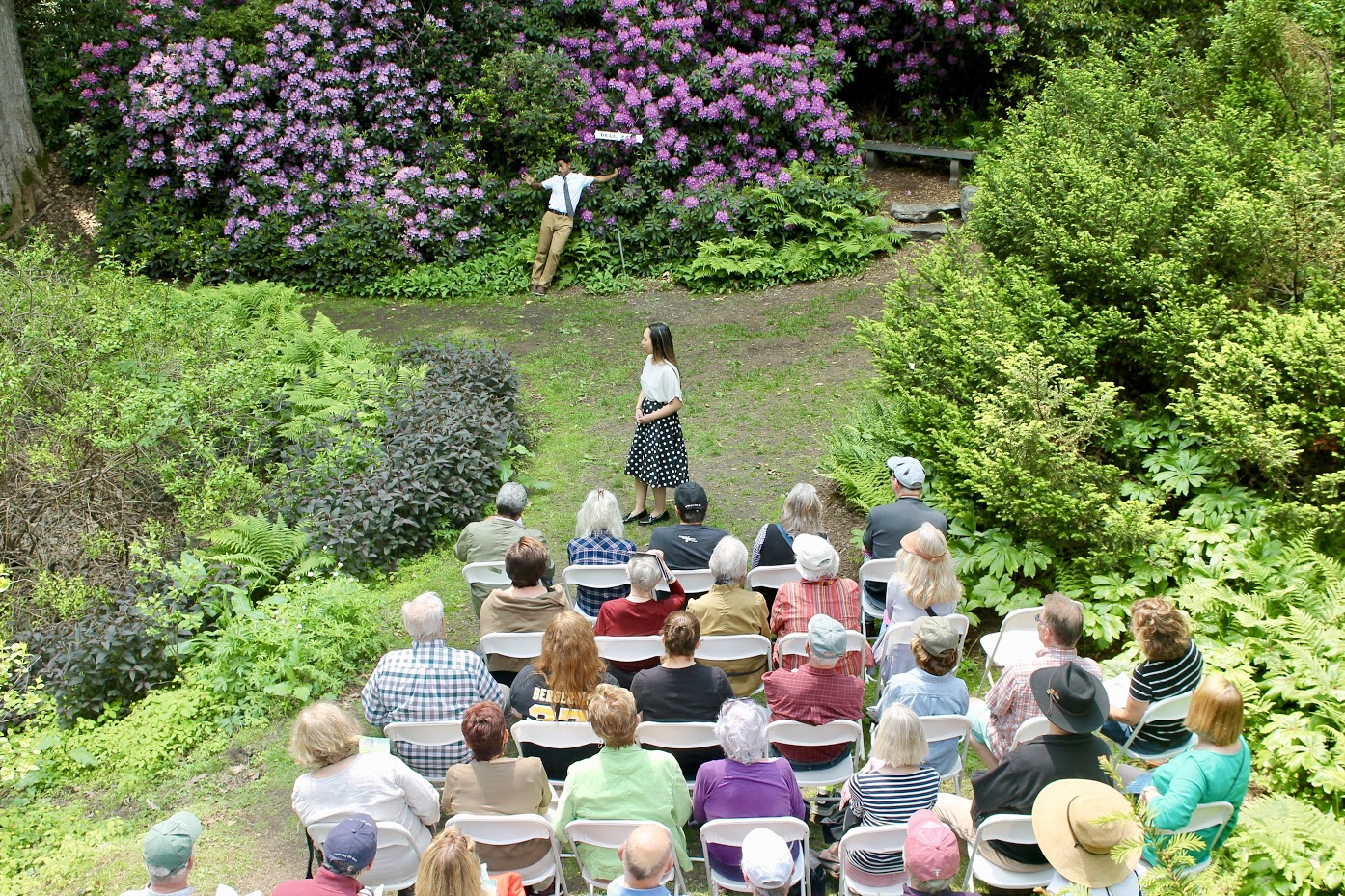
Over the course of the 75-minute production, the audience travels about a mile from site to site with the actors, wandering from pond to gravesite to secret mushroom trove to birding hot spot to sheltered glen. Chairs are set up at each site and there is not a bad seat in the house.
Patrick Gabridge, Playwright and Mt. Auburn Artist-in-Residence
Last Saturday at 5 pm, the stroll through the park-like setting was as magical as the plays themselves. Gabridge was on hand to offer bug spray and a brief introduction to the 35 people lucky enough to have scored a ticket to the sold out show.
The five plays are: “Hot Love in the Moonlight,” about the strange mating habits of spotted salamanders (“but it’s also a play about choosing to have children in a dangerous world,” Gabridge told Theater Mirror); “Namesakes,” which shows the 19th century naturalists Asa Gray and Louis Agassiz confronting the impermanence of their legacies; “Sworn to Secrecy,” a peek at the hidden world of mushroom hunters; “Cerulean Blue,” about the inner lives of bird watchers; and “Love and Loss in the Glade,” a play about healing and loss told through the words of three trees.
Jacob Oommen Athyal (as spotted salamander Jeremy) courts Theresa Hoa Nguyen (as spotted salamander Samantha) in “Hot Love in the Moonlight.”
Along with a natural soundtrack of chirps and tweets, bird recordings of warblers, orioles and warbling vireos chime in during the bird-watching play.
Ed Hooperman (as deaf birdwatcher Dan) and Lisa Tucker (as blind birdwatcher Leanna) share their observations in “Cerulean Blue.”
Each play provides both charm and a deeper message, and the actors clearly revel in delivering their clever lines. “So much life in a place dedicated to the dead….I never expected to feel so much less lonely here,” one bird watcher tells another.
Playwright Patrick Gabridge is an award-winning writer of historical and contemporary stage plays, novels, audio plays, and screenplays. His short plays have been produced more 1,000 times in theaters and schools in 14 different countries around the world and appear in various anthologies. His recent site-specific works include “Blood on the Snow” and “Cato & Dolly” for The Bostonian Society/Old State House, and “Both/And: A Quantum Physics Play” for the MIT Museum.
In 2018, Gabridge launched Plays In Place, a new company that works in partnership with museums, historic sites, and other cultural institutions to develop and produce site-specific theatrical plays and presentations to help engage, entertain, and enlighten visitors in new and vibrant ways. Gabridge’s Mount Auburn plays are presented in partnership with Plays in Place as one of the company’s inaugural projects.
The Theater Mirror caught up with Gabridge, who answered these questions.
TM: How did you decide on the topics for “The Nature Plays?”
G: One of the cool things about being artist-in-residence at Mount Auburn Cemetery is the freedom we get to choose what to create, and also the richness of the history and environment of the place. There are 100,000 people buried there, but it’s also a world-class arboretum, an important stop on the migratory bird pathway. It has lots of interesting wildlife and some very smart programs to get people involved with science and nature.
As I got to know the Cemetery, it quickly became apparent to me that I’d have to write about BOTH history and nature. There was just so much to write about, so many different elements, that I decided to write two series of plays. And even then, The Nature Plays cover quite a bit of ground. The plays themselves also have different styles and takes on their subjects. I love the ability to experiment and play, and I think the audience is going to have a good time, too.
TM: What are the challenges of working/performing in an outdoor environment? What are some of the rewards?
G: The hardest thing about outdoor work is unpredictability, especially around weather. We’re fortunate at Mount Auburn in that we have an indoor rain backup space, at Story Chapel. You also have a lot less control over passersby, random environmental noise, etc., that you don’t have to worry about in the controlled space of an indoor theatre.
However, the rewards are great. We get a vividly real, three-dimensional environment, better than any set we could ever create. In Mount Auburn, we get an incredibly beautiful venue in which to perform and it comes with great spatial depth that we can use.
One thing I love about site-specific work like this is that it’s super intimate—often the audiences and performers are quite close. The formal barrier that exists between actors and audience in a traditional space is much more permeable, much less rigid. This enables more engagement, and I don’t necessarily mean the actors are talking to the audience, but there’s a sense of connection that’s deeper. This kind of experience often has great appeal for people who are less comfortable in a formal theatre environment. There’s a sense of shared experience, even among the audience themselves, that creates a memorable and engaging event.
TM: What do you hope audiences will take away from the experience?
G: I hope they’ll see Mount Auburn a little differently than they did before. That the specific spots where we perform will have a new resonance for them. I hope that they’ll be drawn to visit again, and when they do, they’ll look at the birds and trees and the place with a new curiosity, and also with a sense of belonging. They’ll know something about this place, and I hope they’ll feel like they’re a part of it, and it’s a part of them, in some small way.
TM: What initially inspired you to develop site-specific works?
G: I started creating site-specific plays in Colorado, in 1993. I had co-founded Chameleon Stage, with a bunch of other writers and a director friend, and we had no money, but wanted to experiment with creating new short plays. So we made plays for wild spaces in the mountains of Colorado, just west of Denver. It was called ‘Theatre in the Wild.’ It was so much fun we did more of them, toured a tiny bit (to Aspen and Golden), and then did Asphalt Adventures, a set of parking lot plays. I learned a lot about creating and producing site-specific plays.
TM: Anything you want to add?
G: I hope people will also keep an eye out for the second set of Mount Auburn plays, which will be in September.
THE NATURE PLAYS (30 May to 9 June)Mount Auburn Cemetery, 580 Mount Auburn Street, Cambridge, MA617-607-1980 or mountauburn.org








 InSights